Tag Archives: Compliance

United Arab Emirates IAR compliance assessment report is now available with 58 services in scope

Post Syndicated from Ioana Mecu original https://aws.amazon.com/blogs/security/united-arab-emirates-iar-compliance-assessment-report-is-now-available-with-58-services-in-scope/

Amazon Web Services (AWS) is pleased to announce the publication of our compliance assessment report on the Information Assurance Regulation (IAR) established by the Telecommunications and Digital Government Regulatory Authority (TDRA) of the United Arab Emirates. The report covers the AWS Middle East (UAE) Region, with 58 services in scope of the assessment.

The IAR provides management and technical information security controls to establish, implement, maintain, and continuously improve information assurance. AWS alignment with IAR requirements demonstrates our ongoing commitment to adhere to the heightened expectations for cloud service providers. As such, IAR-regulated customers can use AWS services with confidence.

Independent third-party auditors from BDO evaluated AWS for the period of November 1, 2021, to October 31, 2022. The assessment report illustrating the status of AWS compliance is available through AWS Artifact. AWS Artifact is a self-service portal for on-demand access to AWS compliance reports. Sign in to AWS Artifact in the AWS Management Console, or learn more at Getting Started with AWS Artifact.

For up-to-date information, including when additional services are added, see AWS Services in Scope by Compliance Program and choose IAR.

AWS strives to continuously bring services into the scope of its compliance programs to help you meet your architectural and regulatory needs. If you have questions or feedback about IAR compliance, reach out to your AWS account team.

To learn more about our compliance and security programs, see AWS Compliance Programs. As always, we value your feedback and questions; reach out to the AWS Compliance team through the Contact Us page.

 
If you have feedback about this post, submit comments in the Comments section below.

Want more AWS Security how-to content, news, and feature announcements? Follow us on Twitter.

Ioana Mecu

Ioana Mecu

Ioana is a Security Audit Program Manager at AWS based in Madrid, Spain. She leads security audits, attestations, and certification programs across Europe and the Middle East. Ioana has previously worked in risk management, security assurance, and technology audits in the financial sector industry for the past 15 years.

Gokhan Akyuz

Gokhan Akyuz

Gokhan is a Security Audit Program Manager at AWS based in Amsterdam, Netherlands. He leads security audits, attestations, and certification programs across Europe and the Middle East. Gokhan has more than 15 years of experience in IT and cybersecurity audits and controls implementation in a wide range of industries.

AWS CloudHSM is now PCI PIN certified

Post Syndicated from Nivetha Chandran original https://aws.amazon.com/blogs/security/aws-cloudhsm-is-now-pci-pin-certified/

Amazon Web Services (AWS) is pleased to announce that AWS CloudHSM is certified for Payment Card Industry Personal Identification Number (PCI PIN) version 3.1.

With CloudHSM, you can manage and access your keys on FIPS 140-2 Level 3 certified hardware, protected with customer-owned, single-tenant hardware security module (HSM) instances that run in your own virtual private cloud (VPC). This PCI PIN attestation gives you the flexibility to deploy your regulated workloads with reduced compliance overhead.

Coalfire, a third-party Qualified Security Assessor (QSA), evaluated CloudHSM. Customers can access the PCI PIN Attestation of Compliance (AOC) report through AWS Artifact.

To learn more about our PCI program and other compliance and security programs, see the AWS Compliance Programs page. As always, we value your feedback and questions; reach out to the AWS Compliance team through the Contact Us page.

 
If you have feedback about this post, submit comments in the Comments section below. If you have questions about this post, contact AWS Support.

Want more AWS Security news? Follow us on Twitter.

Author

Nivetha Chandran

Nivetha is a Security Assurance Manager at Amazon Web Services on the Global Audits team, managing the PCI compliance program. Nivetha holds a Master’s degree in Information Management from the University of Washington.

C5 Type 2 attestation report now available with 156 services in scope

Post Syndicated from Julian Herlinghaus original https://aws.amazon.com/blogs/security/c5-type-2-attestation-report-now-available-with-156-services-in-scope/

We continue to expand the scope of our assurance programs at Amazon Web Services (AWS), and we are pleased to announce that AWS has successfully completed the 2022 Cloud Computing Compliance Controls Catalogue (C5) attestation cycle with 156 services in scope. This alignment with C5 requirements demonstrates our ongoing commitment to adhere to the heightened expectations for cloud service providers. AWS customers in Germany and across Europe can run their applications on AWS Regions in scope of the C5 report with the assurance that AWS aligns with C5 requirements.

The C5 attestation scheme is backed by the German government and was introduced by the Federal Office for Information Security (BSI) in 2016. AWS has adhered to the C5 requirements since their inception. C5 helps organizations demonstrate operational security against common cyberattacks when using cloud services within the context of the German Government’s Security Recommendations for Cloud Computing Providers.

Independent third-party auditors evaluated AWS for the period October 1, 2021, through September 30, 2022. The C5 report illustrates AWS’ compliance status for both the basic and additional criteria of C5. Customers can download the C5 report through AWS Artifact. AWS Artifact is a self-service portal for on-demand access to AWS compliance reports. Sign in to AWS Artifact in the AWS Management Console, or learn more at Getting Started with AWS Artifact.

AWS has added the following 16 services to the current C5 scope:

At present, the services offered in the Frankfurt, Dublin, London, Paris, Milan, Stockholm and Singapore Regions are in scope of this certification. For up-to-date information, see the AWS Services in Scope by Compliance Program page and choose C5.

AWS strives to continuously bring services into the scope of its compliance programs to help you meet your architectural and regulatory needs. If you have questions or feedback about C5 compliance, reach out to your AWS account team.

To learn more about our compliance and security programs, see AWS Compliance Programs. As always, we value your feedback and questions; reach out to the AWS Compliance team through the Contact Us page.

If you have feedback about this post, submit comments in the Comments section below.

Want more AWS Security how-to content, news, and feature announcements? Follow us on Twitter.

Julian Herlinghaus

Julian Herlinghaus

Julian is a Manager in AWS Security Assurance based in Berlin, Germany. He leads third-party and customer security audits across Europe and specifically the DACH region. He has previously worked as Information Security department lead of an accredited certification body and has multiple years of experience in information security and security assurance & compliance.

Andreas Terwellen

Andreas Terwellen

Andreas is a senior manager in security audit assurance at AWS, based in Frankfurt, Germany. His team is responsible for third-party and customer audits, attestations, certifications, and assessments across Europe. Previously, he was a CISO in a DAX-listed telecommunications company in Germany. He also worked for different consulting companies managing large teams and programs across multiple industries and sectors.

Fall 2022 PCI DSS report available with six services added to compliance scope

Post Syndicated from Michael Oyeniya original https://aws.amazon.com/blogs/security/fall-2022-pci-dss-report-available-with-six-services-added-to-compliance-scope/

We’re continuing to expand the scope of our assurance programs at Amazon Web Services (AWS) and are pleased to announce that six additional services have been added to the scope of our Payment Card Industry Data Security Standard (PCI DSS) certification. This provides our customers with more options to process and store their payment card data and architect their cardholder data environment (CDE) securely on AWS.

You can see the full list of services on our Services in Scope by Compliance program page. The six additional services are:

AWS was evaluated by Coalfire, a third-party Qualified Security Assessor (QSA). Customers can access the Attestation of Compliance (AOC) report demonstrating our PCI compliance status through AWS Artifact.

To learn more about our PCI program and other compliance and security programs, see the AWS Compliance Programs page. As always, we value your feedback and questions; reach out to the AWS Compliance team through the Contact Us page.

Want more AWS Security news? Follow us on Twitter.

Author

Michael Oyeniya

Michael is a Compliance Program Manager at AWS on the Global Audits team, managing the PCI compliance program. He holds a Master’s degree in management and has over 18 years of experience in information technology security risk and control.

Cloud Security and Compliance Best Practices: Highlights From The CSA Cloud Controls Matrix

Post Syndicated from Rapid7 original https://blog.rapid7.com/2022/12/22/cloud-security-and-compliance-best-practices-highlights-from-the-csa-cloud-controls-matrix/

Cloud Security and Compliance Best Practices: Highlights From The CSA Cloud Controls Matrix

In a recent blog post, we highlighted the release of an InsightCloudSec compliance pack, that helps organizations establish and adhere to AWS Foundational Security Best Practices. While that’s a great pack for those who have standardized on AWS and are looking for a trusted set of controls to harden their environment, we know that’s not always the case.

In fact, depending on what report you read, the percentage of organizations that have adopted multiple cloud platforms has soared and continues to rise exponentially. According to Gartner, by 2026 more than 90% of enterprises will extend their capabilities to multi-cloud environments, up from 76% in 2020.

It can be a time- and labor-intensive process to establish and enforce compliance standards across single cloud environments, but this becomes especially challenging in multi-cloud environments. First, the number of required checks and guardrails are multiplied, and second, because each platform is unique,  proper hygiene and security measures aren’t consistent across the various clouds. The general approaches and philosophies are fairly similar, but the way controls are implemented and the way policies are written can be significantly different.

For this post, we’ll dive into one of the most commonly-used cloud security standards for large, multi-cloud environments: the CSA Cloud Controls Matrix (CCM).

What is the CSA Cloud Controls Matrix?

In the unlikely event you’re unfamiliar, Cloud Security Alliance (CSA) is a non-profit organization dedicated to defining and raising awareness of best practices to help ensure a secure cloud computing environment. CSA brings together a community of cloud security experts, industry practitioners, associations, governments, and its corporate and individual members to offer cloud security-specific research, education, certification, events and products.

The Cloud Controls Matrix is a comprehensive cybersecurity control framework for cloud computing developed and maintained by CSA. It is widely-used as a systematic assessment of a cloud implementation and provides guidance on which security controls should be implemented within the cloud supply chain. The controls framework is aligned to the CSA Security Guidance for Cloud Computing and is considered a de-facto standard for cloud security assurance and compliance.

Five CSA CCM Principles and Why They’re Important

The CCM consists of many controls and best practices, which means we can’t cover them all in a single blog post. That said, we’ve outlined 5 major principles that logically group the various controls and why they’re important to implement in your cloud environment. Of course, the CCM provides a comprehensive set of specific and actionable directions that, when adopted, simplify the process of adhering to these principles—and many others.

Ensure consistent and proper management of audit logs
Audit logs record the occurrence of an event along with supporting metadata about the event, including the time at which it occurred, the responsible user or service, and the impacted entity or entities. By reviewing audit logs, security teams can investigate breaches and ensure compliance with regulatory requirements. Within CCM, there are a variety of controls focused on ensuring that you’ve got a process in place to collect, retain and analyze logs as well as limiting access and the ability to edit or delete such logs to only those who need it.

Ensure consistent data encryption and proper key management
Ensuring that data is properly encrypted, both at rest and in transit, is a critical step to protect your organization and customer data from unauthorized access. There are a variety of controls within the CCM that are centered around ensuring that data encryption is used consistently and that encryption keys are maintained properly—including regular rotation of keys as applicable.

Effectively manage IAM permissions and abide by Least Privilege Access (LPA)
In modern cloud environments, every user and resource is assigned a unique identity and a set of access permissions and privileges. This can be a challenge to keep track of, especially at scale, which can result in improper access, either from internal users or external malicious actors. To combat this, the CCM provides guidance around establishing processes and mechanisms to manage, track and enforce permissions across the organization. Further, the framework suggests employing the Least Privilege Access (LPA) principle to ensure users only have access to the systems and data that they absolutely need.

Establish and follow a process for managing vulnerabilities
There are a number of controls focused on establishing, implementing and evaluating processes, procedures and technical measures for detecting and remediating vulnerabilities. The CCM has dedicated controls for application vulnerabilities, external library vulnerabilities and host-level vulnerabilities. It is important to regularly scan your cloud environments for known vulnerabilities, and evaluate the processes and methodologies you use to do so, as well.

Define a process to proactively roll back changes to a previous state of good
In traditional, on-premises environments, patching and fixing existing resources is the proper course of action when an error or security concern is discovered. Conversely, when things go awry in cloud environments, remediation steps typically involve reverting back to a previous state of good. To this end, the CCM guides organizations to proactively establish and implement a process  that allows them to easily roll back changes to a previously known good state—whether manually or via automation.

How InsightCloudSec Helps Implement and Enforce CCM

InsightCloudSec allows security teams to establish and continuously measure compliance against organizational policies, whether they’re based on common industry frameworks or customized to specific business needs. This is accomplished through the use of compliance packs.

A compliance pack within InsightCloudSec is a set of checks that can be used to continuously assess your cloud environments for compliance with a given regulatory framework or industry best practices. The platform comes out-of-the-box with 30+ compliance packs, and also offers the ability to build custom compliance packs that are completely tailored to your business’ specific needs.

Whenever a non-compliant resource is created, or when a change is made to an existing resource’s configuration or permissions, InsightCloudSec will detect it within minutes. If you so choose, you can make use of the platform’s native, no-code automation to remediate the issue—either via deletion or by adjusting the configuration and/or permissions—without any human intervention.

If you’re interested in learning more about how InsightCloudSec can help implement and enforce security and compliance standards across your organization, be sure to check out a free demo!

James Alaniz and Ryan Blanchard contributed to this article.

Cloud Audit: Compliance + Automation

Post Syndicated from Aaron Wells original https://blog.rapid7.com/2022/12/14/cloud-audit-compliance-automation/

Setting your own standard

Cloud Audit: Compliance + Automation

Today’s regulatory environment is incredibly fractured and extensive. Depending on the industry—and the part of the world your business and/or security organization resides in—you may be subject to several regulatory compliance standards. Adding to the complexity, there is overlap among many of the standards, and they all require considerable resources to implement properly.

This can be a difficult endeavor, to say the least. That’s why many companies have dedicated compliance personnel to (as much as possible) push workloads and resources to adherence to cloud security standards. It’s important to build a plan to keep up with changing regulations and determine what exactly they mean for your environment.

From there, you can specify how to incorporate those changes and automate cloud posture management processes so you can act fast in the wake of an incident or breach. Deploying a cloud security posture management (CSPM) can ease the administrative burden associated with staying in compliance.

Complex compliance frameworks

There’s no reason to think your organization needs to go about all this compliance confusion on its own, even with skilled in-house personnel. There are regulations you’ll need to adhere to explicitly, but oftentimes regulatory bodies don’t offer a solution to track and enforce adherence to standards. It can be difficult to build that compliance framework from scratch.

That’s why it’s important to engage a CSPM tool that can be used to build in checks/compliance standards that align to one or more regulations—as noted above, it’s often a combination of many. It’s also likely you’ll want to supplement with additional checks not covered in the regulatory frameworks. A capable solution like InsightCloudSec can help you accomplish that.

For example, The European Union’s General Data Protection Regulation (GDPR) requires organizations to incorporate data protection by design, including default security features. To this point, InsightCloudSec can help to enforce security rules throughout the CI/CD build process to prevent misconfigurations from ever happening and govern IaC security.

A pre-configured solution can erase the complexity of setting up your own compliance framework and alert system, and help you keep up with the speed of this type of regulatory pace. The key is knowing if the solution you’re getting is up to date with the current standard in the location in which it’s required.

When choosing a solution, look for one that delivers out-of-the-box policies that hold cloud security to high standards, so your controls are tight and contain failsafes. For example, a standard like the Cloud Security Alliance Cloud Controls Matrix (CSA CCM) helps you create and fortify those checks so that your customers or users have confidence that you’re putting cloud security at the forefront. The InsightCloudSec CSA CCM compliance pack provides:  

  • Detailed guidance of security concepts across 13 domains—all of which follow Cloud Security Alliance best practices.
  • Alignment with many other security standards like PCI DSS, NIST, and NERC CIP.
  • Dozens of out-of-the-box policies that map back to specific directives within CSA CCM, all of which are available to use right away so you can remediate violations in real time.

A few questions to keep in mind when considering a solution that aligns to the above criteria:

  • Does the solution allow you to export and/or easily report on compliance data?
  • Does the solution offer the ability to customize frameworks or build custom policies?
  • Does the solution allow you to exempt certain resources from compliance requirements to minimize false positives?

Automating enforcement

Real-time visibility is the key to automating with confidence, which is a critical factor in staying compliant. Given the complexity of today’s hybrid and multi-cloud environments, keeping up with the sheer number of risk signals is nearly impossible without automation. Automation can help you safeguard customer data and avoid risk by catching misconfigurations before they go live and continuously auditing your environment.

As aptly noted in Rapid7’s Trust in the Cloud report, automation must be tuned to internal risk factors like trustworthiness of developers and engineers in day-to-day maintenance, trust in automation to set guardrails in your environments, and your organization’s ability to consistently and securely configure cloud environments. Continuous monitoring, enforcement, reporting—and, oh yeah, flexibility—are keys to success in  the automated-compliance game.

Automated cloud compliance with InsightCloudSec

It can be very easy for things to fall between the cracks when your team is attempting to both innovate and manually catch and investigate each alert. Implementing automation with a solution like InsightCloudSec, which offers more than 30 pre-built compliance packs available out-of-the-box, allows your teams to establish standards and policies around cloud access and resource configuration. By establishing a common definition of “good” and automating enforcement with your organizational standards, InsightCloudSec frees your teams to focus on eliminating risk in your cloud environments.

Get started now with the 2022 edition of The Complete Cloud Security Buyer’s Guide from Rapid7. In this guide, you’ll learn more about tactics to help you make your case for more cloud security at your company. Plus, you’ll get a handy checklist to use when looking into a potential solution.

You can also read the previous entry in this blog series here.

Authority to operate (ATO) on AWS Program now available for customers in Spain

Post Syndicated from Greg Herrmann original https://aws.amazon.com/blogs/security/authority-to-operate-on-aws-program-now-available-for-customers-in-spain/

Meeting stringent security and compliance requirements in regulated or public sector environments can be challenging and time consuming, even for organizations with strong technical competencies. To help customers navigate the different requirements and processes, we launched the ATO on AWS Program in June 2019 for US customers. The program involves a community of expert AWS partners to help support and accelerate customers’ ability to meet their security and compliance obligations.

We’re excited to announce that we have now expanded the ATO on AWS Program to Spain. As part of the launch in Spain, we recruited and vetted five partners with a demonstrated competency in helping customers meet Spanish and European Union (EU) regulatory compliance and security requirements, such as the General Data Protection Regulation (GDPR), Esquema Nacional de Seguridad (ENS), and European Banking Authority guidelines.

How Does the ATO on AWS Program support customers?

The primary offering of the ATO on AWS Program is access to a community of vetted, expert partners that specialize in customers’ authorization needs, whether it be architecting, configuring, deploying, or integrating tools and controls. The team also provides direct engagement activities to introduce you to publicly available and no-cost resources, tools, and offerings so you can work to meet your security obligations on AWS. These activities include one-on-one meetings, answering questions, technical workshops (in specific cases), and more.

Who are the partners?

Partners in the ATO on AWS Program go through a rigorous evaluation conducted by a team of AWS Security and Compliance experts. Before acceptance into the program, the partners complete a checklist of criteria and provide detailed evidence that they meet those criteria.

Our initial launch in Spain includes the following five partners that have successfully met the criteria to join the program. Each partner has also achieved the Esquema Nacional de Seguridad certification.

  • ATOS – a global leader in digital transformation, cybersecurity, and cloud and high performance computing. ATOS was ranked #1 in Managed Security Services (MSS) revenue by Gartner in 2021.
  • Indra Sistemas – a global technology and consulting company that provides proprietary solutions for the transport and defense markets. It also offers digital transformation consultancy and information technologies in Spain and Latin America through its affiliate Minsait.
  • NTT Data EMEAL ­– an operational company created from an alliance between everis and NTT DATA EMEAL to support clients in Europe and Latin America. NTT Data EMEAL supports customers through strategic consulting and advisory services, new technologies, applications, infrastructure, IT modernization, and business process outsourcing (BPO).
  • Telefónica Tech – a leading company in digital transformation. Telefónica Tech combines cybersecurity and cloud technologies to help simplify technological environments and build appropriate solutions for customers.
  • T-Systems – a leading service provider for the public sector in Spain. As an AWS Premier Tier Services Partner and Managed Service Provider, T-Systems maintains the Security and Migration Competencies, supporting customers with migration and secure operation of applications.

For a complete list of ATO on AWS Program partners, see the ATO on AWS Partners page.

Engage the ATO on AWS Program

Customers seeking support can engage the ATO on AWS Program and our partners in multiple ways. The best way to reach us is to complete a short, online ATO on AWS Questionnaire so we can learn more about your timeline and goals. If you prefer to engage AWS partners directly, see the complete list of our partners and their contact information at ATO on AWS Partners.

 
If you have feedback about this post, submit comments in the Comments section below. If you have questions about this post, contact AWS Support.

Want more AWS Security news? Follow us on Twitter.

Greg Herrmann

Greg Herrmann

Greg has worked in the security and compliance field for over 18 years, supporting both classified and unclassified workloads for U.S. federal and DoD customers. He has been with AWS for more than 6 years as a Senior Security Partner Strategist for the Security and Compliance Partner Team, working with AWS partners and customers to accelerate security and compliance processes.

Borja Larrumbide

Borja Larrumbide

Borja is a Security Assurance Manager for AWS in Spain and Portugal. Previously, he worked at companies such as Microsoft and BBVA in different roles and sectors. Borja is a seasoned security assurance practitioner with years of experience engaging key stakeholders at national and international levels. His areas of interest include security, privacy, risk management, and compliance.

AWS achieves GNS Portugal certification for classified information

Post Syndicated from Rodrigo Fiuza original https://aws.amazon.com/blogs/security/aws-achieves-gns-portugal-certification-for-classified-information/

GNS Logo

We continue to expand the scope of our assurance programs at Amazon Web Services (AWS), and we are pleased to announce that our Regions and AWS Edge locations in Europe are now certified by the Portuguese GNS/NSO (National Security Office) at the National Restricted level. This certification demonstrates our ongoing commitment to adhere to the heightened expectations for cloud service providers to process, transmit, and store classified data.

The GNS certification is based on NIST SP800-53 R4 and CSA CCM v4 frameworks, with the goal of protecting the processing and transmission of classified information.

AWS was evaluated by Adyta Lda, an independent third-party auditor, and by GNS Portugal. The Certificate of Compliance illustrating the compliance status of AWS is available on the GNS Certifications page and through AWS Artifact. AWS Artifact is a self-service portal for on-demand access to AWS compliance reports. Sign in to AWS Artifact in the AWS Management Console, or learn more at Getting Started with AWS Artifact.

As of this writing, 26 services offered in Europe are in scope of this certification. For up-to-date information, including when additional services are added, see the AWS Services in Scope by Compliance Program and select GNS.

AWS strives to continuously bring services into the scope of its compliance programs to help you meet your architectural and regulatory needs. If you have questions or feedback about GNS Portugal compliance, reach out to your AWS account team.

To learn more about our compliance and security programs, see AWS Compliance Programs. As always, we value your feedback and questions; reach out to the AWS Compliance team through the Contact Us page.

If you have feedback about this post, submit comments in the Comments section below.

Want more AWS Security how-to content, news, and feature announcements? Follow us on Twitter.

Author

Rodrigo Fiuza

Rodrigo is a Security Audit Manager at AWS, based in São Paulo. He leads audits, attestations, certifications, and assessments across Latin America, Caribbean and Europe. Rodrigo has previously worked in risk management, security assurance, and technology audits for the past 12 years.

Renewal of AWS CyberGRX assessment to enhance customers’ third-party due diligence process

Post Syndicated from Naranjan Goklani original https://aws.amazon.com/blogs/security/renewal-of-aws-cybergrx-assessment-to-enhance-customers-third-party-due-diligence-process/

CyberGRX

Amazon Web Services (AWS) is pleased to announce renewal of the AWS CyberGRX cyber risk assessment report. This third-party validated report helps customers perform effective cloud supplier due diligence on AWS and enhances their third-party risk management process.

With the increase in adoption of cloud products and services across multiple sectors and industries, AWS has become a critical component of customers’ third-party environments. Regulated customers are held to high standards by regulators and auditors when it comes to exercising effective due diligence on third parties.

Many customers use third-party cyber risk management (TPCRM) services such as CyberGRX to better manage risks from their evolving third-party environments and to drive operational efficiencies. To help with such efforts, AWS has completed the CyberGRX assessment of its security posture. CyberGRX security analysts perform the assessment and validate the results annually.

The CyberGRX assessment applies a dynamic approach to third-party risk assessment. This approach integrates advanced analytics, threat intelligence, and sophisticated risk models with vendors’ responses to provide an in-depth view of how a vendor’s security controls help protect against potential threats.

Vendor profiles are continuously updated as the risk level of cloud service providers changes, or as AWS updates its security posture and controls. This approach eliminates outdated static spreadsheets for third-party risk assessments, in which the risk matrices are not updated in near real time.

In addition, AWS customers can use the CyberGRX Framework Mapper to map AWS assessment controls and responses to well-known industry standards and frameworks, such as National Institute of Standards and Technology (NIST) 800-53, NIST Cybersecurity Framework, International Organization for Standardization (ISO) 27001, Payment Card Industry Data Security Standard (PCI DSS), and U.S. Health Insurance Portability and Assessment Act (HIPAA). This mapping can reduce customers’ third-party supplier due-diligence burden.

Customers can access the AWS CyberGRX report at no additional cost. Customers can request access to the report by completing an access request form, available on the AWS CyberGRX page.

As always, we value your feedback and questions. Reach out to the AWS Compliance team through the Contact Us page. If you have feedback about this post, submit comments in the Comments section below. To learn more about our other compliance and security programs, see AWS Compliance Programs.

Want more AWS Security news? Follow us on Twitter.

Naranjan Goklani

Naranjan Goklani

Naranjan is a Security Audit Manager at AWS, based in Toronto (Canada). He leads audits, attestations, certifications, and assessments across North America and Europe. Naranjan has more than 13 years of experience in risk management, security assurance, and performing technology audits. Naranjan previously worked in one of the Big 4 accounting firms and supported clients from the financial services, technology, retail, ecommerce, and utilities industries.

New – AWS Config Rules Now Support Proactive Compliance

Post Syndicated from Danilo Poccia original https://aws.amazon.com/blogs/aws/new-aws-config-rules-now-support-proactive-compliance/

When operating a business, you have to find the right balance between speed and control for your cloud operations. On one side, you want to have the ability to quickly provision the cloud resources you need for your applications. At the same time, depending on your industry, you need to maintain compliance with regulatory, security, and operational best practices.

AWS Config provides rules, which you can run in detective mode to evaluate if the configuration settings of your AWS resources are compliant with your desired configuration settings. Today, we are extending AWS Config rules to support proactive mode so that they can be run at any time before provisioning and save time spent to implement custom pre-deployment validations.

When creating standard resource templates, platform teams can run AWS Config rules in proactive mode so that they can be tested to be compliant before being shared across your organization. When implementing a new service or a new functionality, development teams can run rules in proactive mode as part of their continuous integration and continuous delivery (CI/CD) pipeline to identify noncompliant resources.

You can also use AWS CloudFormation Guard in your deployment pipelines to check for compliance proactively and ensure that a consistent set of policies are applied both before and after resources are provisioned.

Let’s see how this works in practice.

Using Proactive Compliance with AWS Config
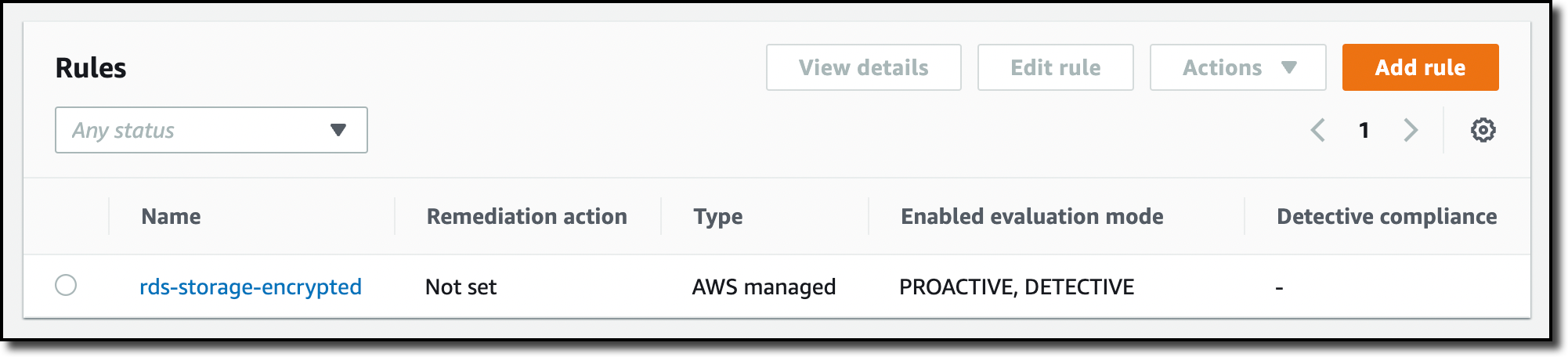
In the AWS Config console, I choose Rules in the navigation pane. In the rules table, I see the new Enabled evaluation mode column that specifies whether the rule is proactive or detective. Let’s set up my first rule.

Console screenshot.

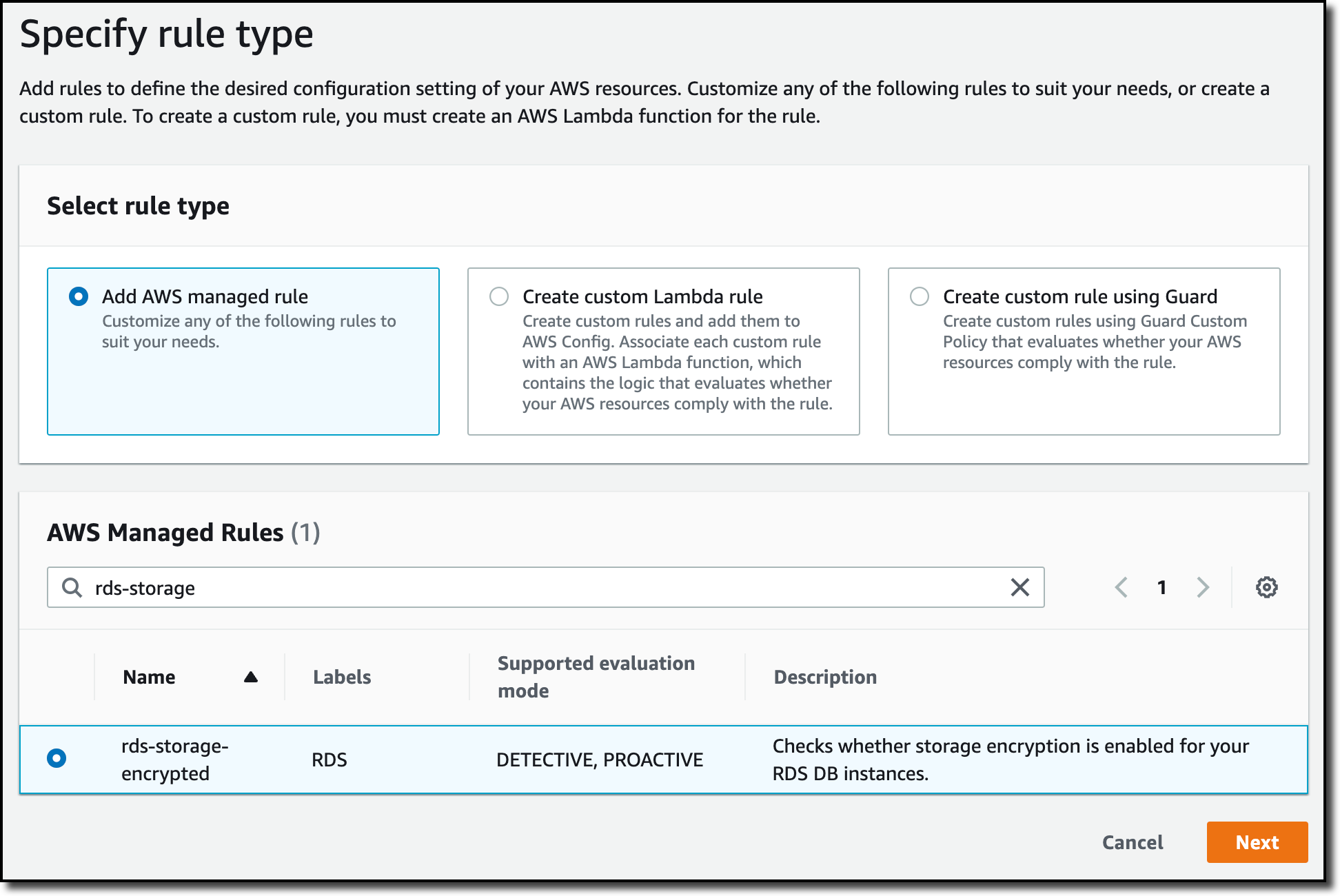
I choose Add rule, and then I enter rds-storage in the AWS Managed Rules search box to find the rds-storage-encrypted rule. This rule checks whether storage encryption is enabled for your Amazon Relational Database Service (RDS) DB instances and can be added in proactive or detective evaluation mode. I choose Next.

Console screenshot.

In the Evaluation mode section, I turn on proactive evaluation. Now both the proactive and detective evaluation switches are enabled.

Console screenshot.

I leave all the other settings to their default values and choose Next. In the next step, I review the configuration and add the rule.

Console screenshot.

Now, I can use proactive compliance via the AWS Config API (including the AWS Command Line Interface (CLI) and AWS SDKs) or with CloudFormation Guard. In my CI/CD pipeline, I can use the AWS Config API to check the compliance of a resource before creating it. When deploying using AWS CloudFormation, I can set up a CloudFormation hook to proactively check my configuration before the actual deployment happens.

Let’s do an example using the AWS CLI. First, I call the StartProactiveEvaluationResponse API with in input the resource ID (for reference only), the resource type, and its configuration using the CloudFormation schema. For simplicity, in the database configuration, I only use the StorageEncrypted option and set it to true to pass the evaluation. I use an evaluation timeout of 60 seconds, which is more than enough for this rule.

aws configservice start-resource-evaluation --evaluation-mode PROACTIVE \
    --resource-details '{"ResourceId":"myDB",
                         "ResourceType":"AWS::RDS::DBInstance",
                         "ResourceConfiguration":"{\"StorageEncrypted\":true}",
                         "ResourceConfigurationSchemaType":"CFN_RESOURCE_SCHEMA"}' \
    --evaluation-timeout 60
{
    "ResourceEvaluationId": "be2a915a-540d-4595-ac7b-e105e39b7980-1847cb6320d"
}

I get back in output the ResourceEvaluationId that I use to check the evaluation status using the GetResourceEvaluationSummary API. In the beginning, the evaluation is IN_PROGRESS. It usually takes a few seconds to get a COMPLIANT or NON_COMPLIANT result.

aws configservice get-resource-evaluation-summary \
    --resource-evaluation-id be2a915a-540d-4595-ac7b-e105e39b7980-1847cb6320d
{
    "ResourceEvaluationId": "be2a915a-540d-4595-ac7b-e105e39b7980-1847cb6320d",
    "EvaluationMode": "PROACTIVE",
    "EvaluationStatus": {
        "Status": "SUCCEEDED"
    },
    "EvaluationStartTimestamp": "2022-11-15T19:13:46.029000+00:00",
    "Compliance": "COMPLIANT",
    "ResourceDetails": {
        "ResourceId": "myDB",
        "ResourceType": "AWS::RDS::DBInstance",
        "ResourceConfiguration": "{\"StorageEncrypted\":true}"
    }
}

As expected, the Amazon RDS configuration is compliant to the rds-storage-encrypted rule. If I repeat the previous steps with StorageEncrypted set to false, I get a noncompliant result.

If more than one rule is enabled for a resource type, all applicable rules are run in proactive mode for the resource evaluation. To find out individual rule-level compliance for the resource, I can call the GetComplianceDetailsByResource API:

aws configservice get-compliance-details-by-resource \
    --resource-evaluation-id be2a915a-540d-4595-ac7b-e105e39b7980-1847cb6320d
{
    "EvaluationResults": [
        {
            "EvaluationResultIdentifier": {
                "EvaluationResultQualifier": {
                    "ConfigRuleName": "rds-storage-encrypted",
                    "ResourceType": "AWS::RDS::DBInstance",
                    "ResourceId": "myDB",
                    "EvaluationMode": "PROACTIVE"
                },
                "OrderingTimestamp": "2022-11-15T19:14:42.588000+00:00",
                "ResourceEvaluationId": "be2a915a-540d-4595-ac7b-e105e39b7980-1847cb6320d"
            },
            "ComplianceType": "COMPLIANT",
            "ResultRecordedTime": "2022-11-15T19:14:55.588000+00:00",
            "ConfigRuleInvokedTime": "2022-11-15T19:14:42.588000+00:00"
        }
    ]
}

If, when looking at these details, your desired rule is not invoked, be sure to check that proactive mode is turned on.

Availability and Pricing
Proactive compliance will be available in all commercial AWS Regions where AWS Config is offered but it might take a few days to deploy this new capability across all these Regions. I’ll update this post when this deployment is complete. To see which AWS Config rules can be turned into proactive mode, see the Developer Guide.

You are charged based on the number of AWS Config rule evaluations recorded. A rule evaluation is recorded every time a resource is evaluated for compliance against an AWS Config rule. Rule evaluations can be run in detective mode and/or in proactive mode, if available. If you are running a rule in both detective mode and proactive mode, you will be charged for only the evaluations in detective mode. For more information, see AWS Config pricing.

With this new feature, you can use AWS Config to check your rules before provisioning and avoid implementing your own custom validations.

Danilo

New for AWS Control Tower – Comprehensive Controls Management (Preview)

Post Syndicated from Danilo Poccia original https://aws.amazon.com/blogs/aws/new-for-aws-control-tower-comprehensive-controls-management-preview/

Today, customers in regulated industries face the challenge of defining and enforcing controls needed to meet compliance and security requirements while empowering engineers to make their design choices. In addition to addressing risk, reliability, performance, and resiliency requirements, organizations may also need to comply with frameworks and standards such as PCI DSS and NIST 800-53.

Building controls that account for service relationships and their dependencies is time-consuming and expensive. Sometimes customers restrict engineering access to AWS services and features until their cloud architects identify risks and implement their own controls.

To make that easier, today we are launching comprehensive controls management in AWS Control Tower. You can use it to apply managed preventative, detective, and proactive controls to accounts and organizational units (OUs) by service, control objective, or compliance framework. AWS Control Tower does the mapping between them on your behalf, saving time and effort.

With this new capability, you can now also use AWS Control Tower to turn on AWS Security Hub detective controls across all accounts in an OU. In this way, Security Hub controls are enabled in every AWS Region that AWS Control Tower governs.

Let’s see how this works in practice.

Using AWS Control Tower Comprehensive Controls Management
In the AWS Control Tower console, there is a new Controls library section. There, I choose All controls. There are now more than three hundred controls available. For each control, I see which AWS service it is related to, the control objective this control is part of, the implementation (such as AWS Config rule or AWS CloudFormation Guard rule), the behavior (preventive, detective, or proactive), and the frameworks it maps to (such as NIST 800-53 or PCI DSS).

Console screenshot.

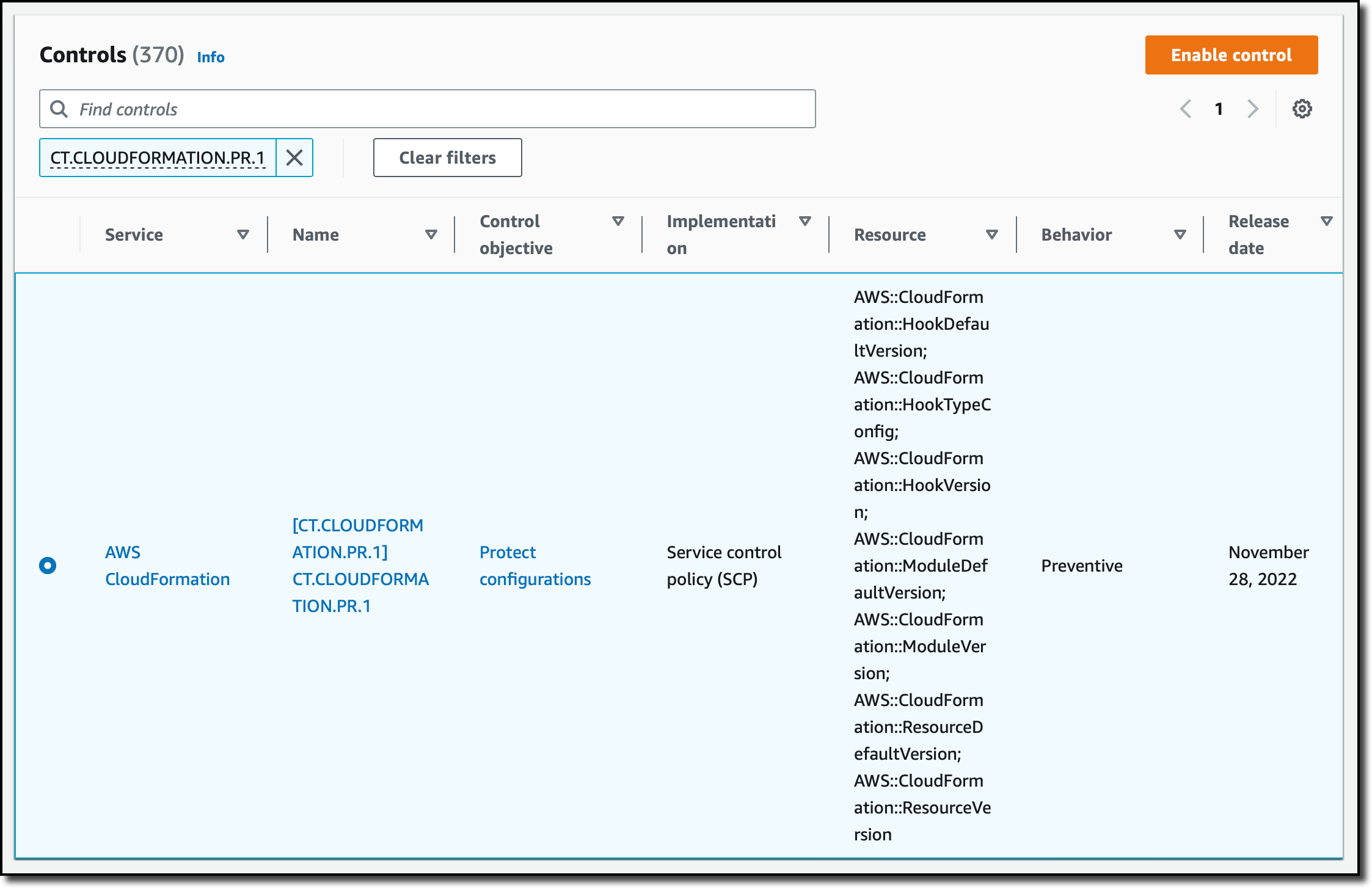
In the Find controls search box, I look for a preventive control called CT.CLOUDFORMATION.PR.1. This control uses a service control policy (SCP) to protect controls that use CloudFormation hooks and is required by the control that I want to turn on next. Then, I choose Enable control.

Console screenshot.

Then, I select the OU for which I want to enable this control.

Console screenshot.

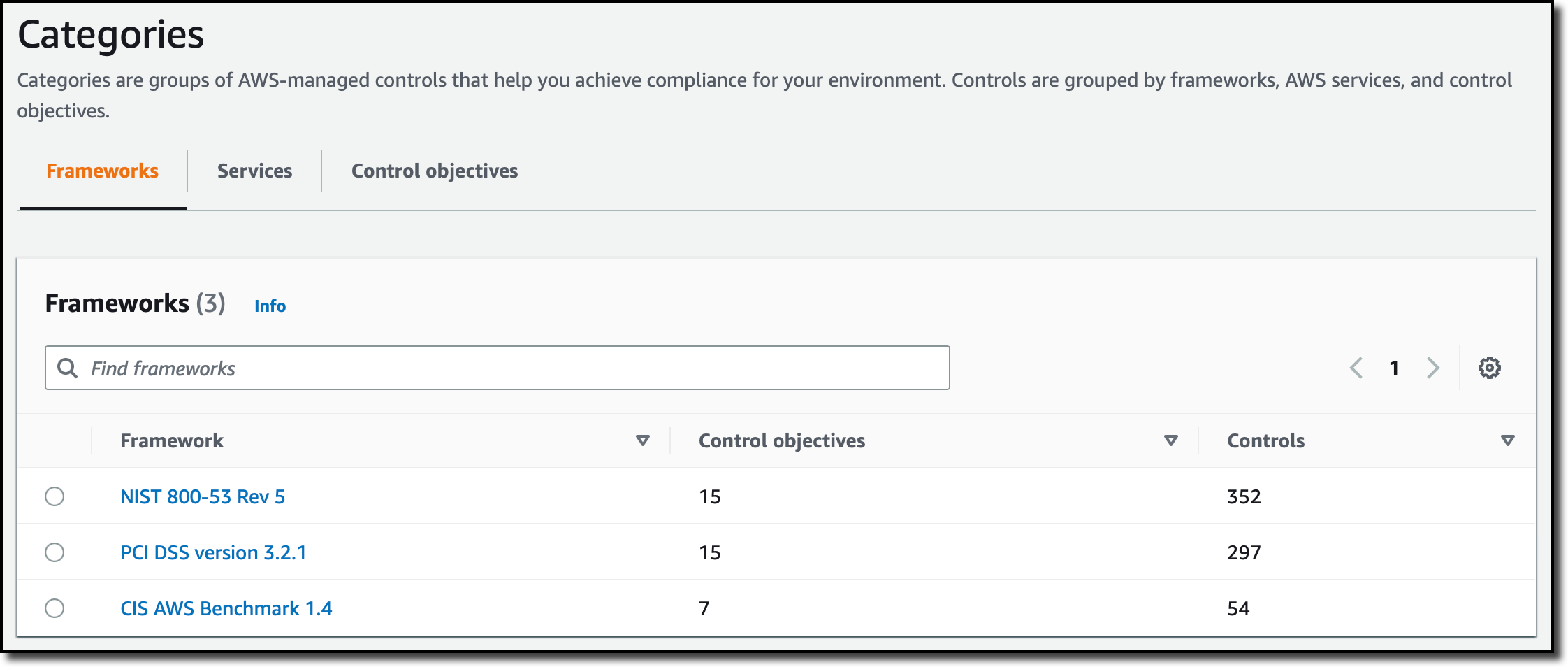
Now that I have set up this control, let’s see how controls are presented in the console in categories. I choose Categories in the navigation pane. There, I can browse controls grouped as Frameworks, Services, and Control objectives. By default, the Frameworks tab is selected.

Console screenshot.

I select a framework (for example, PCI DSS version 3.2.1) to see all the related controls and control objectives. To implement a control, I can select the control from the list and choose Enable control.

Console screenshot.

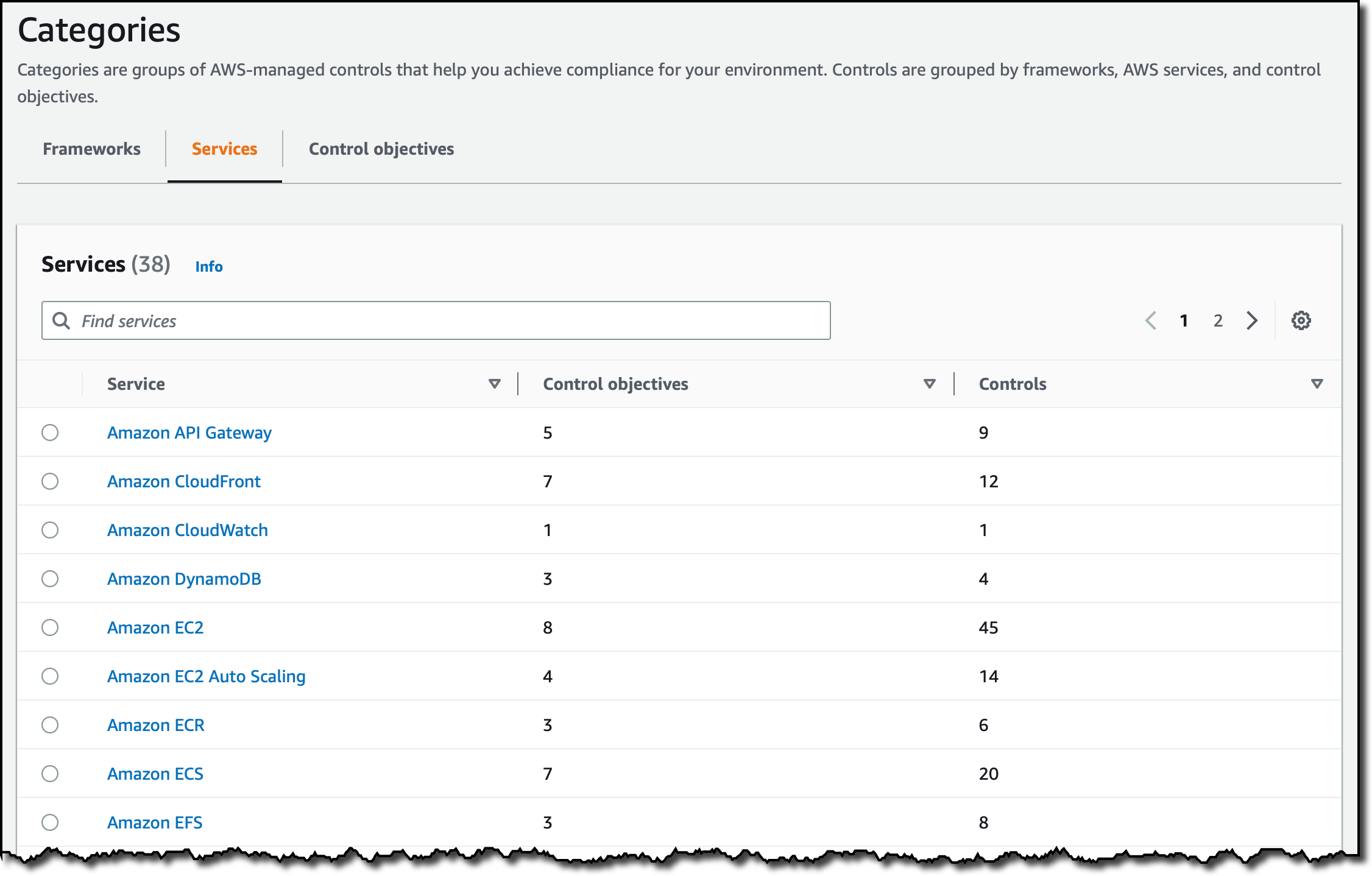
I can also manage controls by AWS service. When I select the Services tab, I see a list of AWS services and the related control objectives and controls.

Console screenshot.

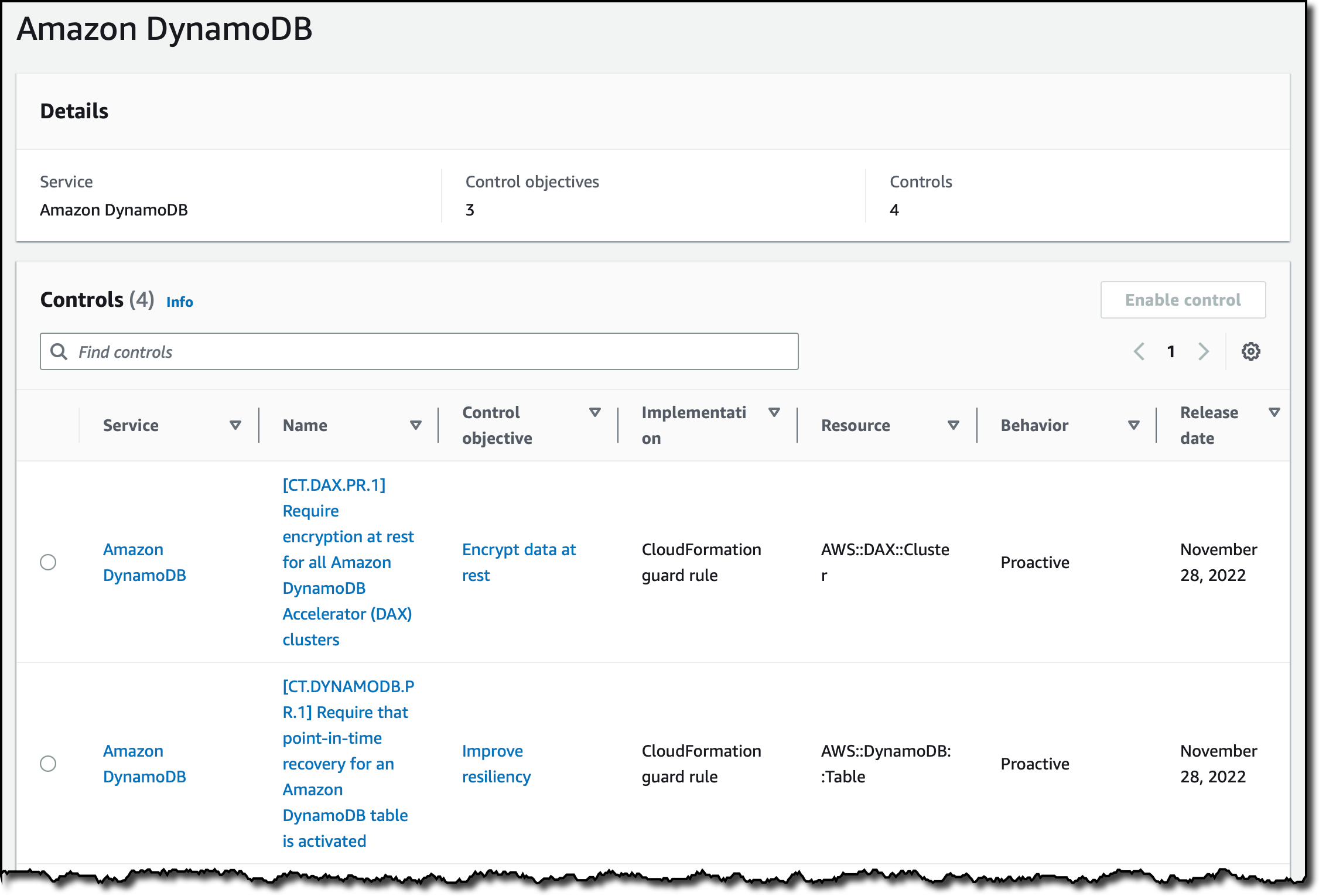
I choose Amazon DynamoDB to see the controls that I can turn on for this service.

Console screenshot.

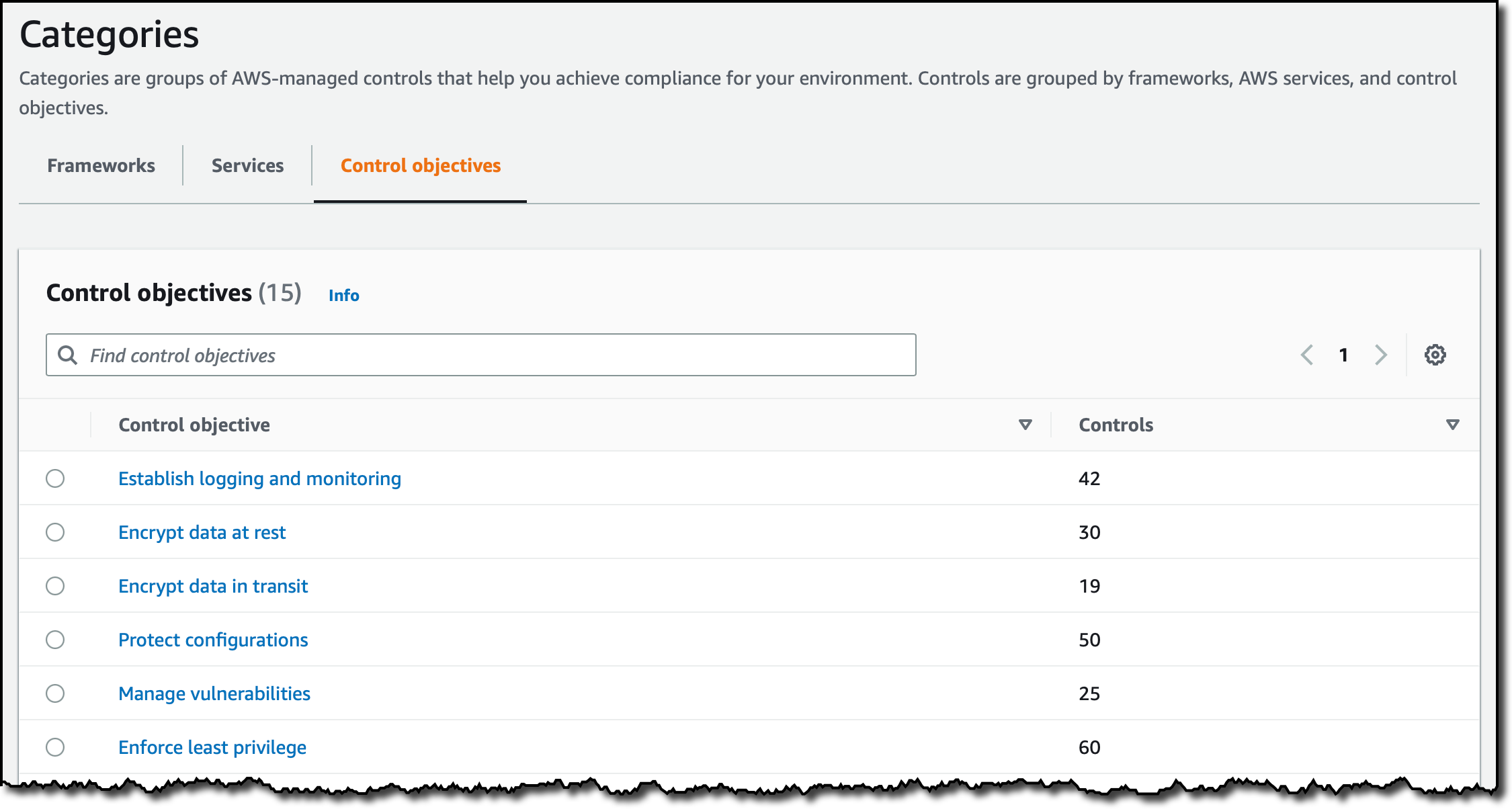
I select the Control objectives tab. When I need to assess a control objective, this is where I have access to the list of related controls to turn on.

Console screenshot.

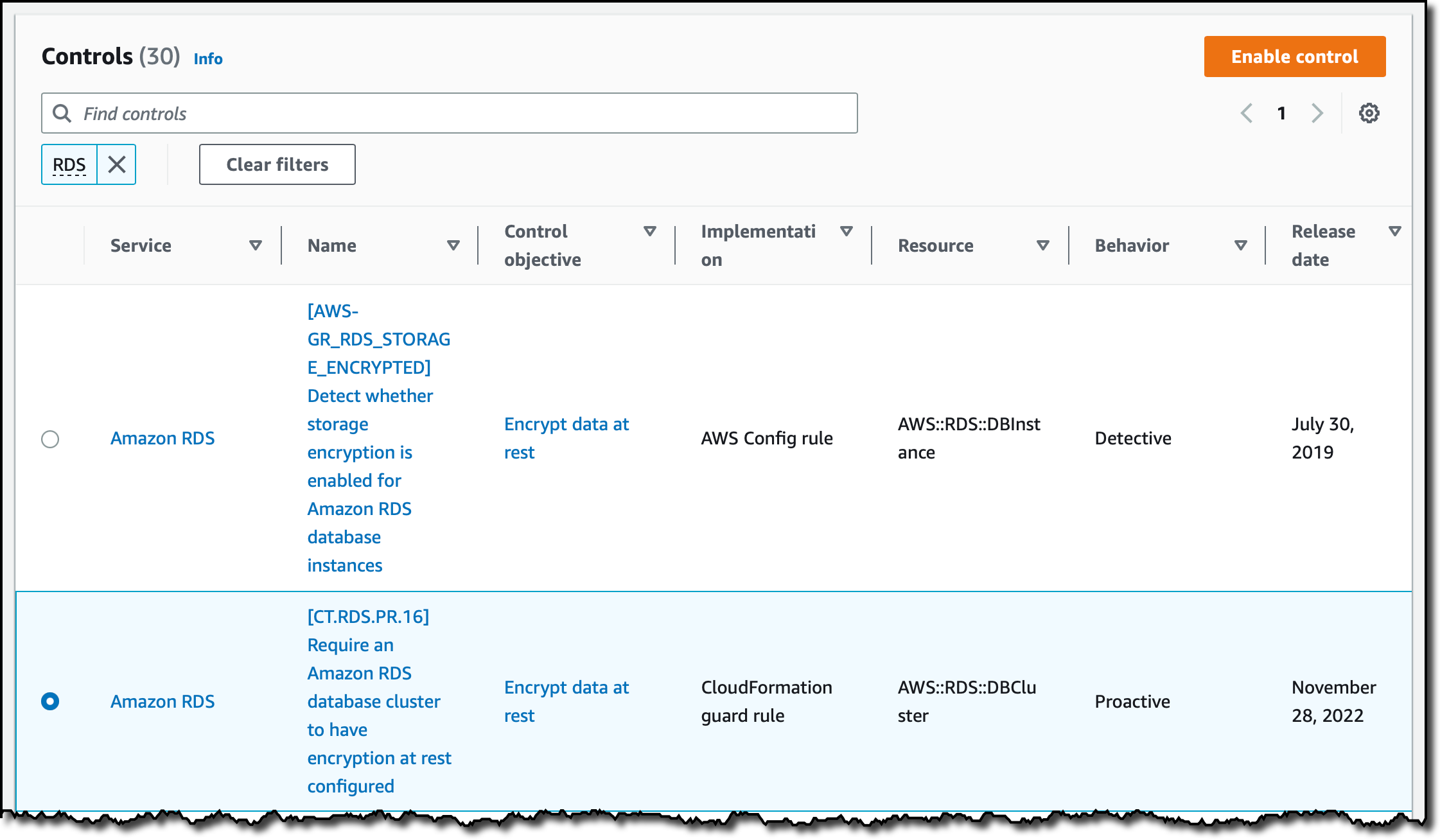
I choose Encrypt data at rest to see and search through the available controls for that control objective. I can also check which services are covered in this specific case. I type RDS in the search bar to find the controls related to Amazon Relational Database Service (RDS) for this control objective.

I choose CT.RDS.PR.16 – Require an Amazon RDS database cluster to have encryption at rest configured and then Enable control.

Console screenshot.

I select the OU for which I want to enable the control for, and I proceed. All the AWS accounts in this organization’s OU will have this control enabled in all the Regions that AWS Control Tower governs.

Console screenshot.

After a few minutes, the AWS Control Tower setup is updated. Now, the accounts in this OU have proactive control CT.RDS.PR.16 turned on. When an account in this OU deploys a CloudFormation stack, any Amazon RDS database cluster has to have encryption at rest configured. Because this control is proactive, it’ll be checked by a CloudFormation hook before the deployment starts. This saves a lot of time compared to a detective control that would find the issue only when the CloudFormation deployment is in progress or has terminated. This also improves my security posture by preventing something that’s not allowed as opposed to reacting to it after the fact.

Availability and Pricing
Comprehensive controls management is available in preview today in all AWS Regions where AWS Control Tower is offered. These enhanced control capabilities reduce the time it takes you to vet AWS services from months or weeks to minutes. They help you use AWS by undertaking the heavy burden of defining, mapping, and managing the controls required to meet the most common control objectives and regulations.

There is no additional charge to use these new capabilities during the preview. However, when you set up AWS Control Tower, you will begin to incur costs for AWS services configured to set up your landing zone and mandatory controls. For more information, see AWS Control Tower pricing.

Simplify how you implement compliance and security requirements with AWS Control Tower.

Danilo

New – Amazon Redshift Support in AWS Backup

Post Syndicated from Danilo Poccia original https://aws.amazon.com/blogs/aws/new-amazon-redshift-support-in-aws-backup/

With Amazon Redshift, you can analyze data in the cloud at any scale. Amazon Redshift offers native data protection capabilities to protect your data using automatic and manual snapshots. This works great by itself, but when you’re using other AWS services, you have to configure more than one tool to manage your data protection policies.

To make this easier, I am happy to share that we added support for Amazon Redshift in AWS Backup. AWS Backup allows you to define a central backup policy to manage data protection of your applications and can now also protect your Amazon Redshift clusters. In this way, you have a consistent experience when managing data protection across all supported services. If you have a multi-account setup, the centralized policies in AWS Backup let you define your data protection policies across all your accounts within your AWS Organizations. To help you meet your regulatory compliance needs, AWS Backup now includes Amazon Redshift in its auditor-ready reports. You also have the option to use AWS Backup Vault Lock to have immutable backups and prevent malicious or inadvertent changes.

Let’s see how this works in practice.

Using AWS Backup with Amazon Redshift
The first step is to turn on the Redshift resource type for AWS Backup. In the AWS Backup console, I choose Settings in the navigation pane and then, in the Service opt-in section, Configure resources. There, I toggle the Redshift resource type on and choose Confirm.

Console screenshot.

Now, I can create or update a backup plan to include the backup of all, or some, of my Redshift clusters. In the backup plan, I can define how often these backups should be taken and for how long they should be kept. For example, I can have daily backups with one week of retention, weekly backups with one month of retention, and monthly backups with one year of retention.

I can also create on-demand backups. Let’s see this with more details. I choose Protected resources in the navigation pane and then Create on-demand backup.

I select Redshift in the Resource type dropdown. In the Cluster identifier, I select one of my clusters. For this workload, I need two weeks of retention. Then, I choose Create on-demand backup.

Console screenshot.

My data warehouse is not huge, so after a few minutes, the backup job has completed.

Console screenshot.

I now see my Redshift cluster in the list of the resources protected by AWS Backup.

Console screenshot.

In the Protected resources list, I choose the Redshift cluster to see the list of the available recovery points.

Console screenshot.

When I choose one of the recovery points, I have the option to restore the full data warehouse or just a table into a new Redshift cluster.

Console screenshot.

I now have the possibility to edit the cluster and database configuration, including security and networking settings. I just update the cluster identifier, otherwise the restore would fail because it must be unique. Then, I choose Restore backup to start the restore job.

After some time, the restore job has completed, and I see the old and the new clusters in the Amazon Redshift console. Using AWS Backup gives me a simple centralized way to manage data protection for Redshift clusters as well as many other resources in my AWS accounts.

Console screenshot.

Availability and Pricing
Amazon Redshift support in AWS Backup is available today in the AWS Regions where both AWS Backup and Amazon Redshift are offered, with the exception of the Regions based in China. You can use this capability via the AWS Management Console, AWS Command Line Interface (CLI), and AWS SDKs.

There is no additional cost for using AWS Backup compared to the native snapshot capability of Amazon Redshift. Your overall costs depend on the amount of storage and retention you need. For more information, see AWS Backup pricing.

Danilo

2022 Canadian Centre for Cyber Security Assessment Summary report available with 12 additional services

Post Syndicated from Naranjan Goklani original https://aws.amazon.com/blogs/security/2022-canadian-centre-for-cyber-security-assessment-summary-report-available-with-12-additional-services/

We are pleased to announce the availability of the 2022 Canadian Centre for Cyber Security (CCCS) assessment summary report for Amazon Web Services (AWS). This assessment will bring the total to 132 AWS services and features assessed in the Canada (Central) AWS Region, including 12 additional AWS services. A copy of the summary assessment report is available for review and download on demand through AWS Artifact.

The full list of services in scope for the CCCS assessment is available on the AWS Services in Scope page. The 12 new services are:

The CCCS is Canada’s authoritative source of cyber security expert guidance for the Canadian government, industry, and the general public. Public and commercial sector organizations across Canada rely on CCCS’s rigorous Cloud Service Provider (CSP) IT Security (ITS) assessment in their decisions to use cloud services. In addition, CCCS’s ITS assessment process is a mandatory requirement for AWS to provide cloud services to Canadian federal government departments and agencies.

The CCCS Cloud Service Provider Information Technology Security Assessment Process determines if the Government of Canada (GC) ITS requirements for the CCCS Medium cloud security profile (previously referred to as GC’s Protected B/Medium Integrity/Medium Availability [PBMM] profile) are met as described in ITSG-33 (IT security risk management: A lifecycle approach). As of November 2022, 132 AWS services in the Canada (Central) Region have been assessed by the CCCS and meet the requirements for the CCCS Medium cloud security profile. Meeting the CCCS Medium cloud security profile is required to host workloads that are classified up to and including the medium categorization. On a periodic basis, CCCS assesses new or previously unassessed services and reassesses the AWS services that were previously assessed to verify that they continue to meet the GC’s requirements. CCCS prioritizes the assessment of new AWS services based on their availability in Canada, and on customer demand for the AWS services. The full list of AWS services that have been assessed by CCCS is available on our Services in Scope for CCCS Assessment page.

To learn more about the CCCS assessment or our other compliance and security programs, visit AWS Compliance Programs. As always, we value your feedback and questions; you can reach out to the AWS Compliance team through the Contact Us page.

If you have feedback about this post, submit comments in the Comments section below. Want more AWS Security news? Follow us on Twitter.

Naranjan Goklani

Naranjan Goklani

Naranjan is a Security Audit Manager at AWS, based in Toronto (Canada). He leads audits, attestations, certifications, and assessments across North America and Europe. Naranjan has more than 13 years of experience in risk management, security assurance, and performing technology audits. Naranjan previously worked in one of the Big 4 accounting firms and supported clients from the financial services, technology, retail, ecommerce, and utilities industries.

AWS achieves Spain’s ENS High certification across 166 services

Post Syndicated from Daniel Fuertes original https://aws.amazon.com/blogs/security/aws-achieves-spains-ens-high-certification-across-166-services/

Amazon Web Services (AWS) is committed to bringing additional services and AWS Regions into the scope of our Esquema Nacional de Seguridad (ENS) High certification to help customers meet their regulatory needs.

ENS is Spain’s National Security Framework. The ENS certification is regulated under the Spanish Royal Decree 3/2010 and is a compulsory requirement for central government customers in Spain. ENS establishes security standards that apply to government agencies and public organizations in Spain, and service providers on which Spanish public services depend. Updating and achieving this certification every year demonstrates our ongoing commitment to meeting the heightened expectations for cloud service providers set forth by the Spanish government.

We are happy to announce the addition of 17 services to the scope of our ENS High certification, for a new total of 166 services in scope. The certification now covers 25 Regions. Some of the additional security services in scope for ENS High include the following:

  • AWS CloudShell – a browser-based shell that makes it simpler to securely manage, explore, and interact with your AWS resources. With CloudShell, you can quickly run scripts with the AWS Command Line Interface (AWS CLI), experiment with AWS service APIs by using the AWS SDKs, or use a range of other tools for productivity.
  • AWS Cloud9 – a cloud-based integrated development environment (IDE) that you can use to write, run, and debug your code with just a browser. It includes a code editor, debugger, and terminal.
  • Amazon DevOps Guru – a service that uses machine learning to detect abnormal operating patterns so that you can identify operational issues before they impact your customers.
  • Amazon HealthLake – a HIPAA-eligible service that offers healthcare and life sciences companies a complete view of individual or patient population health data for query and analytics at scale.
  • AWS IoT SiteWise – a managed service that simplifies collecting, organizing, and analyzing industrial equipment data.

AWS achievement of the ENS High certification is verified by BDO Auditores S.L.P., which conducted an independent audit and confirmed that AWS continues to adhere to the confidentiality, integrity, and availability standards at its highest level.

For more information about ENS High, see the AWS Compliance page Esquema Nacional de Seguridad High. To view the complete list of services included in the scope, see the AWS Services in Scope by Compliance Program – Esquema Nacional de Seguridad (ENS) page. You can download the ENS High Certificate from AWS Artifact in the AWS Management Console or from the Compliance page Esquema Nacional de Seguridad High.

As always, we are committed to bringing new services into the scope of our ENS High program based on your architectural and regulatory needs. If you have questions about the ENS program, reach out to your AWS account team or contact AWS Compliance.

If you have feedback about this post, submit comments in the Comments section below.

Want more AWS Security how-to content, news, and feature announcements? Follow us on Twitter.

Daniel Fuertes

Daniel Fuertes

Daniel is a Security Audit Program Manager at AWS based in Madrid, Spain. Daniel leads multiple security audits, attestations and certification programs in Spain and other EMEA countries. Daniel has 8 years of experience in security assurance and previously worked as an auditor for PCI DSS security framework.

AWS successfully renews GSMA security certification for US East (Ohio) and Europe (Paris) Regions

Post Syndicated from Janice Leung original https://aws.amazon.com/blogs/security/aws-successfully-renews-gsma-security-certification-for-us-east-ohio-and-europe-paris-regions/

Amazon Web Services is pleased to announce that our US East (Ohio) and Europe (Paris) Regions have been re-certified through October 2023 by the GSM Association (GSMA) under its Security Accreditation Scheme Subscription Management (SAS-SM) with scope Data Centre Operations and Management (DCOM).

The US East (Ohio) and Europe (Paris) Regions first obtained GSMA certification in September and October 2021, respectively. This renewal demonstrates our continuous commitment to adhere to the heightened expectations for cloud service providers. AWS customers who provide an embedded Universal Integrated Circuit Card (eUICC) for mobile devices can run their remote provisioning applications with confidence in the AWS Cloud in the GSMA-certified Regions.

For up-to-date information related to the certification, visit the AWS Compliance Program page and choose GSMA under Europe, Middle East & Africa.

AWS was evaluated by independent third-party auditors selected by GSMA. The Certificate of Compliance that shows that AWS achieved GSMA compliance status is available on the GSMA website and through AWS Artifact. AWS Artifact is a self-service portal for on-demand access to AWS compliance reports. Sign in to AWS Artifact in the AWS Management Console, or learn more at Getting Started with AWS Artifact.

To learn more about our compliance and security programs, see AWS Compliance Programs. As always, we value your feedback and questions; reach out to the AWS Compliance team through the Contact Us page. If you have feedback about this post, you can submit comments in the Comments section below.

Want more AWS Security news? Follow us on Twitter.

Author

Janice Leung

Janice is a security audit program manager at AWS, based in New York. She leads security audits across Europe and has previously worked in security assurance and technology risk management in the financial industry for 10 years.

New AWS whitepaper: Using AWS in the Context of Canada’s Controlled Goods Program (CGP)

Post Syndicated from Michael Davie original https://aws.amazon.com/blogs/security/new-aws-whitepaper-using-aws-in-the-context-of-canadas-controlled-goods-program-cgp/

Amazon Web Services (AWS) has released a new whitepaper to help Canadian defense and security customers accelerate their use of the AWS Cloud.

The new guide, Using AWS in the Context of Canada’s Controlled Goods Program (CGP), continues our efforts to help AWS customers navigate the regulatory expectations of the Government of Canada’s Controlled Goods Program in a shared responsibility environment.

This whitepaper is intended for customers that are looking to store and process controlled goods information in the AWS Cloud, and is particularly useful for leadership, security, risk, and compliance teams that need to understand CGP requirements and guidance.

The whitepaper summarizes CGP requirements and guidance related to the protection of controlled goods information, and gives CGP-regulated customers information they can use to commence their due diligence and assess how to implement the appropriate programs for their use of AWS Cloud services.

This document is our first that is specific to Canadian regulatory requirements and joins other guides related to specific regulatory regimes around the world. As the regulatory environment continues to evolve, we’ll provide further updates on the AWS Security Blog and the AWS Compliance page. You can find more information on cloud-related regulatory compliance at the AWS Compliance Center. You can also reach out to your AWS account manager for help finding the resources you need.

 
If you have feedback about this blog post, submit comments in the Comments section below. You can also start a new thread on re:Post to get answers from the community.

Want more AWS Security news? Follow us on Twitter.

Michael Davie

Michael Davie

Michael is a Senior Industry Specialist with AWS Security Assurance. He works with our customers, their regulators, and AWS teams to help raise the bar on secure cloud adoption and usage. Michael has over 20 years of experience working in the defence, intelligence, and technology sectors in Canada and is a licensed professional engineer.

AWS achieves its second ISMAP authorization in Japan

Post Syndicated from Hidetoshi Takeuchi original https://aws.amazon.com/blogs/security/aws-achieves-its-second-ismap-authorization-in-japan/

Earning and maintaining customer trust is an ongoing commitment at Amazon Web Services (AWS). Our customers’ security requirements drive the scope and portfolio of the compliance reports, attestations, and certifications we pursue. We’re excited to announce that AWS has achieved authorization under the Information System Security Management and Assessment Program (ISMAP) program, effective from April 1, 2022 to March 31, 2023. The authorization scope covers a total of 145 AWS services (an increase of 22 services over the previous authorization) across 22 AWS Regions, including the Asia Pacific (Tokyo) Region and the Asia Pacific (Osaka) Region. This is the second time AWS has undergone an assessment since ISMAP was first published by the ISMAP steering committee in March 2020.

ISMAP is a Japanese government program for assessing the security of public cloud services. The purpose of ISMAP is to provide a common set of security standards for cloud service providers (CSPs) to comply with as a baseline requirement for government procurement. ISMAP introduces security requirements for cloud domains, practices, and procedures that CSPs must implement. CSPs must engage with an ISMAP-approved third-party assessor to assess compliance with the ISMAP security requirements in order to apply as an ISMAP-registered CSP. The ISMAP program will evaluate the security of each CSP and register those that satisfy the Japanese government’s security requirements. Upon successful ISMAP registration of CSPs, government procurement departments and agencies can accelerate their engagement with the registered CSPs and contribute to the smooth introduction of cloud services in government information systems.

The achievement of this authorization demonstrates the proactive approach AWS has taken to help customers meet compliance requirements set by the Japanese government and to deliver secure AWS services to our customers. Service providers and customers of AWS can use the ISMAP authorization of AWS services to support their own ISMAP authorization programs. The full list of 145 ISMAP-authorized AWS services is available on the AWS Services in Scope by Compliance Program webpage, and you can also use the ISMAP Customer Package on AWS Artifact. You can confirm the AWS ISMAP authorization status and find detailed scope information on the ISMAP Portal.

As always, we are committed to bringing new services and Regions into the scope of our ISMAP program, based on your business needs. If you have any questions, don’t hesitate to contact your AWS Account Manager.

If you have feedback about this post, submit comments in the Comments section below.
Want more AWS Security how-to content, news, and feature announcements? Follow us on Twitter.

Hidetoshi Takeuchi

Hidetoshi Takeuchi

Hidetoshi is the Audit Program Manager for the Asia Pacific Region, leading Japan security certification and authorization programs. Hidetoshi has worked in information technology security, risk management, security assurance, and technology audits for the past 25 years. He is passionate about delivering programs that build customers’ trust and provide them with assurance on cloud security.

Rapid7 Makes Security Compliance Complexity a Thing of the Past With InsightIDR

Post Syndicated from KJ McCann original https://blog.rapid7.com/2022/08/30/rapid7-makes-security-compliance-complexity-a-thing-of-the-past-with-insightidr/

Rapid7 Makes Security Compliance Complexity a Thing of the Past With InsightIDR

As a unified SIEM and XDR solution, InsightIDR gives organizations the tools they need to drive an elevated and efficient compliance program.

Cybersecurity standards and compliance are mission-critical for every organization, regardless of size. Apart from the direct losses resulting from a data breach, non-compliant companies could face hefty fees, loss of business, and even jail time under growing regulations. However, managing and maintaining compliance, preparing for audits, and building necessary reports can be a full-time job, which might not be in the budget. For already-lean teams, compliance can also distract from more critical security priorities like monitoring threats, early threat detection, and accelerated response – exposing organizations to greater risk.

An efficient compliance strategy reduces risk, ensures that your team is always audit-ready, and – most importantly – drives focus on more critical security work. With InsightIDR, security practitioners can quickly meet their compliance and regulatory requirements while accelerating their overall detection and response program.

Here are three ways InsightIDR has been built to elevate and simplify your compliance processes.

1. Powerful log management capabilities for full environment visibility and compliance readiness

Complete environment visibility and security log collection are critical for compliance purposes, as well as for providing a foundation of effective monitoring and threat detection. Enterprises need to monitor user activity, behavior, and application access across their entire environment — from the cloud to on-premises services. The adoption of cloud services continues to increase, creating even more potential access points for teams to keep up with.

InsightIDR’s strong log management capabilities provide full visibility into these potential threats, as well as enable robust compliance reporting by:

  • Centralizing and aggregating all security-relevant events, making them available for use in monitoring, alerting, investigation, ad hoc searching
  • Providing the ability to search for data quickly, create data models and pivots, save searches and pivots as reports, configure alerts, and create dashboards
  • Retaining all log data for 13 months for all InsightIDR customers, enabling the correlation of data over time and meeting compliance mandates.
  • Automatically mapping data to compliance controls, allowing analysts to create comprehensive dashboards and reports with just a few clicks

To take it a step further, InsightIDR’s intuitive user interface streamlines searches while eliminating the need for IT administrators to master a search language. The out-of-the-box correlation searches can be invoked in real time or scheduled to run regularly at a specific time should the need arise for compliance audits and reporting, updated dashboards, and more.

2. Predefined compliance reports and dashboards to keep you organized and consistent

Pre-built compliance content in InsightIDR enables teams to create robust reports without investing countless hours manually building and correlating data to provide information on the organization’s compliance posture. With the pre-built reports and dashboards, you can:

  • Automatically map data to compliance controls
  • Save filters and searches, then duplicate them across dashboards
  • Create, share, and customize reports right from the dashboard
  • Make reports available in multiple formats like PDF or interactive HTML files

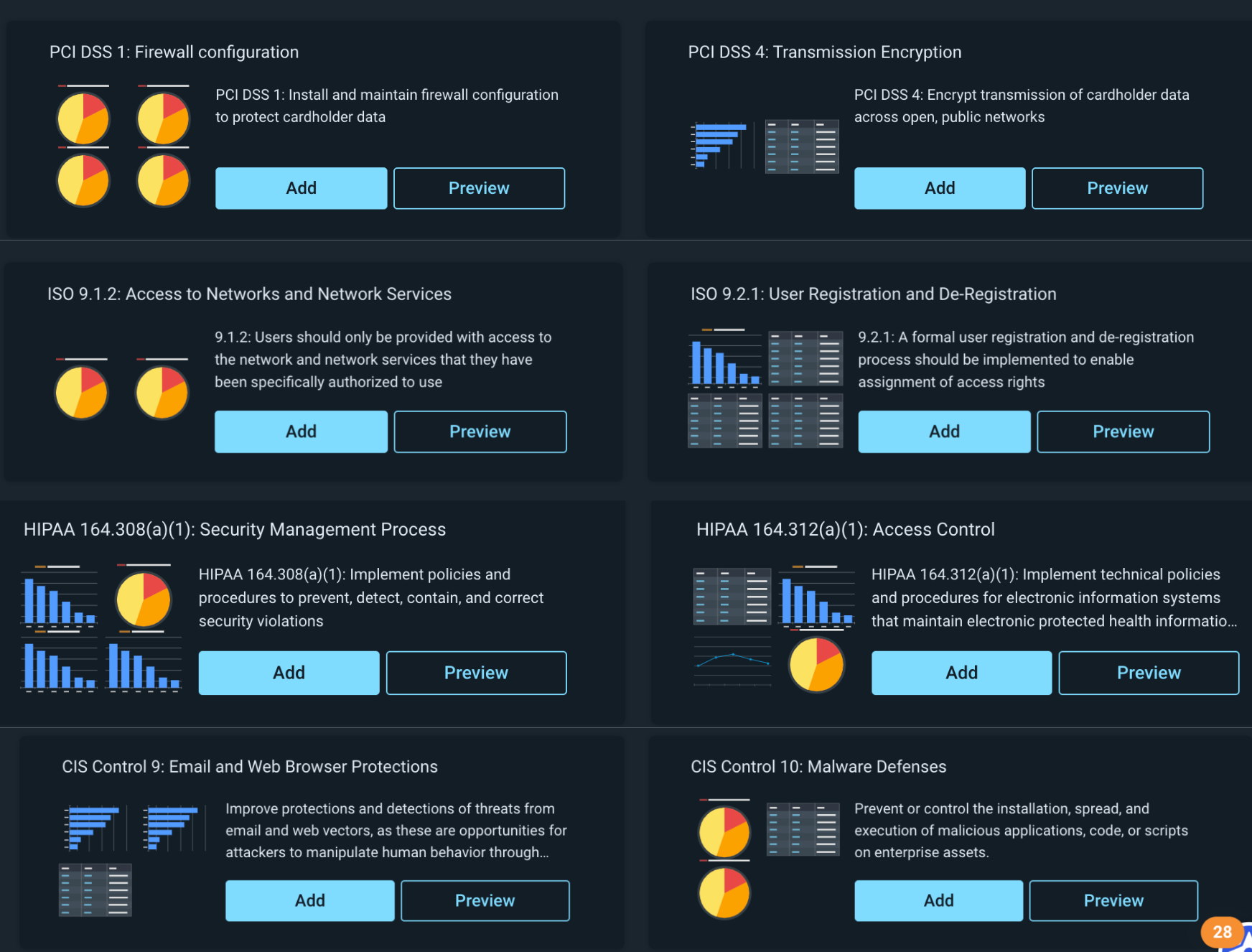
InsightIDR’s library of pre-built dashboards makes it easier than ever to visualize your data within the context of common frameworks. Entire dashboards created by our Rapid7 experts can be set up in just a few clicks. Our dashboards cover a variety of key compliance frameworks like PCI, ISO 27001, HIPAA, and more.

Rapid7 Makes Security Compliance Complexity a Thing of the Past With InsightIDR

3. Unified and correlated data points to provide meaningful insights

With strong log management capabilities providing a foundation for your security posture, the ability to correlate the resulting data and look for unusual behavior, system anomalies, and other indicators of a security incident is key. This information is used not only for real-time event notification but also for compliance audits and reporting, performance dashboards, historical trend analysis, and post-hoc incident forensics.

Privileged users are often the targets of attacks, and when compromised, they typically do the most damage. That’s why it’s critical to extend monitoring to these users. In fact, because of the risk involved, privileged user monitoring is a common requirement for compliance reporting in many regulated industries.

InsightIDR provides a constantly curated library of detections that span user behavior analytics, endpoints, file integrity monitoring, network traffic analysis, and cloud threat detection and response – supported by our own native endpoint agent, network sensor, and collection software. User authentications, locational data, and asset activity are baselined to identify anomalous privilege escalations, lateral movement, and compromised credentials. Customers can also connect their existing Privileged Access Management tools (like CyberArk Vault or Varonis DatAdvantage) to get a more unified view of privileged user monitoring with a single interface.

Meet compliance standards while accelerating your detection and response

We know compliance is not the only thing a security operations center (SOC) has to worry about. InsightIDR can ensure that your most critical compliance requirements are met quickly and confidently. Once you have an efficient compliance process, the team will be able to focus their time and effort on staying ahead of emergent threats and remediating attacks quickly, reducing risk to the business.

What could you do with the time back?

Additional reading:

NEVER MISS A BLOG

Get the latest stories, expertise, and news about security today.

Incident Reporting Regulations Summary and Chart

Post Syndicated from Harley Geiger original https://blog.rapid7.com/2022/08/26/incident-reporting-regulations-summary-and-chart/

Incident Reporting Regulations Summary and Chart

A growing number of regulations require organizations to report significant cybersecurity incidents. We’ve created a chart that summarizes 11 proposed and current cyber incident reporting regulations and breaks down their common elements, such as who must report, what cyber incidents must be reported, the deadline for reporting, and more.

Incident Reporting Regulations Summary and Chart
Download the chart now

This chart is intended as an educational tool to enhance the security community’s awareness of upcoming public policy actions, and provide a big picture look at how the incident reporting regulatory environment is unfolding. Please note, this chart is not comprehensive (there are even more incident reporting regulations out there!) and is only current as of August 8, 2022. Many of the regulations are subject to change.

This summary is for educational purposes only and nothing in this summary is intended as, or constitutes, legal advice.

Peter Woolverton led the research and initial drafting of this chart.

NEVER MISS A BLOG

Get the latest stories, expertise, and news about security today.

Additional reading:

Avoiding Smash and Grab Under the SEC’s Proposed Cyber Rule

Post Syndicated from Harley Geiger original https://blog.rapid7.com/2022/08/23/avoiding-smash-and-grab-under-the-secs-proposed-cyber-rule/

Avoiding Smash and Grab Under the SEC’s Proposed Cyber Rule

The SEC recently proposed a regulation to require all public companies to report cybersecurity incidents within four days of determining that the incident is material. While Rapid7 generally supports the proposed rule, we are concerned that the rule requires companies to publicly disclose a cyber incident before the incident has been contained or mitigated. This post explains why this is a problem and suggests a solution that still enables the SEC to drive companies toward disclosure.

(Terminology note: “Public companies” refers to companies that have stock traded on public US exchanges, and “material” means information that “there is a substantial likelihood that a reasonable shareholder would consider it important.” “Containment” aims to prevent a cyber incident from spreading. Containment is part of “mitigation,” which includes actions to reduce the severity of an event or the likelihood of a vulnerability being exploited, though may fall short of full remediation.)

In sum: The public disclosure of material cybersecurity incidents prior to containment or mitigation may cause greater harm to investors than a delay in public disclosure. We propose that the SEC provide an exemption to the proposed reporting requirements, enabling a company to delay public disclosure of an uncontained or unmitigated incident if certain conditions are met. Additionally, we explain why we believe other proposed solutions may not meet the SEC’s goals of transparency and avoidance of harm to investors.

Distinguished by default public disclosure

The purpose of the SEC’s proposed rule is to help enable investors to make informed investment decisions. This is a reflection of the growing importance of cybersecurity to corporate governance, risk assessment, and other key factors that stockholders weigh when investing. With the exception of reporting unmitigated incidents, Rapid7 largely supports this perspective.

The SEC’s proposed rule would (among other things) require companies to disclose material cyber incidents on Form 8-K, which are publicly available via the EDGAR system. Crucially, the SEC’s proposed rule makes no distinction between public disclosure of incidents that are contained or mitigated and incidents that are not yet contained or mitigated. While the public-by-default nature of the disclosure creates new problems, it also aligns with the SEC’s purpose in proposing the rule.

In contrast to the SEC’s proposed rule, the purpose of most other incident reporting regulations is to strengthen cybersecurity – a top global policy priority. As such, most other cyber incident reporting regulators (such as CISA, NERC, FDIC, Fed. Reserve, OCC, NYDFS, etc.) do not typically make incident reports public in a way that identifies the affected organization. In fact, some regulations (such as CIRCIA and the 2021 TSA pipeline security directive) classify company incident reports as sensitive information exempt from FOIA.

Beyond regulations, established cyber incident response protocol is to avoid tipping off an attacker until the incident is contained and the risk of further damage has been mitigated. See, for example, CISA’s Incident Response Playbook (especially sections on opsec) and NIST’s Computer Security Incident Handling Guide (especially Section 2.3.4). For similar reasons, it is commonly the goal of coordinated vulnerability disclosure practices to avoid, when possible, public disclosure of a vulnerability until the vulnerability has been mitigated. See, for example, the CERT Guide to Coordinated Disclosure.

While it may be reasonable to require disclosure of a contained or mitigated incident within four days of determining its materiality, a strict requirement for public disclosure of an unmitigated or ongoing incident is likely to expose companies and investors to additional danger. Investors are not the only group that may act on a cyber incident report, and such information may be misused.

Smash and grab harms investors and misprices securities

Cybercriminals often aim to embed themselves in corporate networks without the company knowing. Maintaining a low profile lets attackers steal data over time, quietly moving laterally across networks, steadily gaining greater access – sometimes over a period of years. But when the cover is blown and the company knows about its attacker? Forget secrecy, it’s smash and grab time.

Public disclosure of an unmitigated or uncontained cyber incident will likely lead to attacker behaviors that cause additional harm to investors. Note that such acts would be in reaction to the public disclosure of an unmitigated incident, and not a natural result of the original attack. For example:

  • Smash and grab: A discovered attacker may forgo stealth and accelerate data theft or extortion activities, causing more harm to the company (and therefore its investors). Consider this passage from the MS-ISAC’s 2020 Ransomware Guide: “Be sure [to] avoid tipping off actors that they have been discovered and that mitigation actions are being undertaken. Not doing so could cause actors to move laterally to preserve their access [or] deploy ransomware widely prior to networks being taken offline.”
  • Scorched earth: A discovered attacker may engage in anti-forensic activity (such as deleting logs), hindering post-incident investigations and intelligence sharing that could prevent future attacks that harm investors. From CISA’s Playbook: “Some adversaries may actively monitor defensive response measures and shift their methods to evade detection and containment.”
  • Pile-on: Announcing that a company has an incident may cause other attackers to probe the company and discover the vulnerability or attack vector from the original incident. If the incident is not yet mitigated, the copycat attackers can cause further harm to the company (and therefore its investors). From the CERT Guide to CVD: “​​Mere knowledge of a vulnerability’s existence in a feature of some product is sufficient for a skillful person to discover it for themselves. Rumor of a vulnerability draws attention from knowledgeable people with vulnerability finding skills — and there’s no guarantee that all those people will have users’ best interests in mind.”
  • Supply chain: Public disclosure of an unmitigated cybersecurity incident may alert attackers to a vulnerability that is present in other companies, the exploitation of which can harm investors in those other companies. Publicly disclosing “the nature and scope” of material incidents within four business days risks exposing enough detail of an otherwise unique zero-day to encourage rediscovery and reimplementation by other criminal and espionage groups against other organizations. For example, fewer than 100 organizations were actually exploited through the Solarwinds supply chain attack, but up to 18,000 organizations were at risk.

In addition, requiring public disclosure of uncontained or unmitigated cyber incidents may result in mispricing the stock of the affected company. By contradicting best practices for cyber incident response and inviting new attacks, the premature public disclosure of an uncontained or unmitigated incident may provide investors with an inaccurate measure of the company’s true ability to respond to cybersecurity incidents. Moreover, a premature disclosure during the incident response process may result in investors receiving inaccurate information about the scope or impact of the incident.

Rapid7 is not opposed to public disclosure of unmitigated vulnerabilities or incidents in all circumstances, and our security researchers publicly disclose vulnerabilities when necessary. However, public disclosure of unmitigated vulnerabilities typically occurs after failure to mitigate (such as due to inability to engage the affected organization), or when users should take defensive measures before mitigation because ongoing exploitation of the vulnerability “in the wild” is actively harming users. By contrast, the SEC’s proposed rule would rely on a public disclosure requirement on a restrictive timeline in nearly all cases, creating the risk of additional harm to investors that can outweigh the benefits of public disclosure.

Proposed solution

Below, we suggest a solution that we believe achieves the SEC’s ultimate goal of investor protection by requiring timely disclosure of cyber incidents and simultaneously avoiding the unnecessary additional harm to investors that may result with premature public disclosure.

Specifically, we suggest that the proposed rule remains largely the same — i.e., the SEC continues to require that companies determine whether the incident is material as soon as practicable after discovery of the cyber incident, and file a report on Form 8-K four days after the materiality determination under normal circumstances. However, we propose that the rule be revised to also provide companies with a temporary exemption from public disclosure if each of the below conditions are met:

  • The incident is not yet contained or otherwise mitigated to prevent additional harm to the company and its investors;
  • The company reasonably believes that public disclosure of the uncontained or unmitigated incident may cause substantial additional harm to the company, its investors, or other public companies or their investors;
  • The company reasonably believes the incident can be contained or mitigated in a timely manner; and
  • The company is actively engaged in containing or mitigating the incident in a timely manner.

The determination of the applicability of the aforementioned exception may be made simultaneously to the determination of materiality. If the exception applies, the company may delay public disclosure until such time that any of the conditions are no longer occurring, at which point, they must publicly disclose the cyber incident via Form 8-K, no later than four days after the date on which the exemption is no longer applicable. The 8-K disclosure could note that, prior to filing the 8-K, the company relied on the exemption from disclosure. Existing insider trading restrictions would, of course, continue to apply during the public disclosure delay.

If an open-ended delay in public disclosure for containment or mitigation is unacceptable to the SEC, then we suggest that the exemption only be available for 30 days after the determination of materiality. In our experience, the vast majority of incidents can be contained and mitigated within that time frame. However, cybersecurity incidents can vary greatly, and there may nonetheless be rare outliers where the mitigation process exceeds 30 days.

Drawbacks of other solutions

Rapid7 is aware of other solutions being floated to address the problem of public disclosure of unmitigated cyber incidents. However, these carry drawbacks that do not align with the purpose of the SEC rule or potentially don’t make sense for cybersecurity. For example:

  • AG delay: The SEC’s proposed rule considers allowing a delay in reporting the incident when the Attorney General (AG) determines the delay is in the interest of national security. This is an appropriate delay, but insufficient on its own. This AG delay would apply to a very small fraction of major cyber incidents and not prevent the potential harms described above in the vast majority of cases.
  • Law enforcement delay: The SEC’s proposed rule considers, and then rejects, a delay when incident reporting would hinder a law enforcement investigation. We believe this too would be an appropriate delay, to ensure law enforcement can help prevent future cyber incidents that would harm investors. However, it is unclear if this delay would be triggered in many cases. First, the SEC’s proposed timeframe (four days after concluding the incident is material) poses a tight turnaround for law enforcement to start a new investigation or add to an existing investigation, determine how disclosure might impact the investigation, and then request delay from the SEC. Second, law enforcement agencies already have investigations opened against many cybercriminal groups, so public disclosure of another incident may not make a significant difference in the investigation, even if public disclosure of the incident would cause harm. Although a law enforcement delay would be used more than the AG delay, we still anticipate it would apply to only a fraction of incidents.
  • Vague disclosures: Another potential solution is to continue to require public companies to disclose unmitigated cyber incidents on the proposed timeline, but to allow the disclosures to be so vague that it is unclear whether the incident has been mitigated. Yet an attacker embedded in a company network is unlikely to be fooled by a vague incident report from the same company, and even a vague report could encourage new attackers to try to get a foothold in. In addition, very vague disclosures are unlikely to be useful for investor decision-making.
  • Materiality after mitigation: Another potential solution is to require a materiality determination only after the incident has been mitigated. However, this risks unnecessary delays in mitigation to avoid triggering the deadline for disclosure, even for incidents that could be mitigated within the SEC’s proposed timeline. Although containment or mitigation of an incident is important prior to public disclosure of the incident, completion of mitigation is not necessarily a prerequisite to determining the seriousness (i.e., materiality) of an incident.

Balancing risks and benefits of transparency

The SEC has an extensive list of material information that it requires companies to disclose publicly on 8-Ks – everything from bankruptcies to mine safety. However, public disclosure of any of these other items is not likely to prompt new criminal actions that bring additional harm to investors. Public disclosure of unmitigated cyber incidents poses unique risks compared with other disclosures and should be considered in that light.

The SEC has long been among the most forward-looking regulators on cybersecurity issues. We thank them for the acknowledgement of the significance of cybersecurity to corporate management, and for taking the time to listen to feedback from the community. Rapid7’s feedback is that we agree on the usefulness of disclosure of material cybersecurity incidents, but we encourage SEC to ensure its public reporting requirement avoids undermining its own goals and providing more opportunities for attackers.

NEVER MISS A BLOG

Get the latest stories, expertise, and news about security today.

Additional reading: