Today, we announced our new Powered by Backblaze program to give platform providers the ability to offer cloud storage without the burden of building scalable storage infrastructure (something we know a little bit about).
If you’re an independent software vendor (ISV), technology partner, or any company that wants to incorporate easy, affordable data storage within your branded user experience, Powered by Backblaze will give you the tools to do so without complex code, capital outlay, or massive expense.
Read on to learn more about Powered by Backblaze and how it can help you enhance your platforms and services. Or, if you’d like to get started asap, contact our Sales Team for access.
Benefits of Powered by Backblaze
Business Growth: Adding cloud services to your product portfolios can generate new revenue streams and/or grow your existing margin.
Improved Customer Experience: Take the complexity out of object storage and deliver the best solutions by incorporating a proven object cloud storage solution.
Simplified Billing: Reduce complex billing by providing customers with a single bill from a single provider.
Build Your Brand: Improve customer expectations by providing cloud storage with your company name for consistency and brand identity.
What Is Powered by Backblaze?
Powered by Backblaze offers companies the ability to incorporate B2 Cloud Storage into their products so they can sell more services or enhance their user experience with no capital investment. Today, this program offers two solutions that support the provisioning of B2 Cloud Storage: Custom Domains and the Backblaze Partner API.
How Can I Leverage Custom Domains?
Custom Domains, launched today, lets you serve content to your end users from the web domain or URL of your choosing, with no need for complex code or proxy servers. Backblaze manages the heavy lifting of cloud storage on the back end.
Custom Domains functionality combines CNAME and Backblaze B2 Object Storage, enabling the use of your preferred domain name in your files’ web domain or URLs instead of using the domain name that Backblaze automatically assigns.
We’ve chosen Backblaze so we can have a reliable partner behind our new Edge Storage solution. With their Custom Domain feature, we can implement the security needed to serve data from Backblaze to end users from Azion’s Edge Platform, improving user experience.
—Rafael Umann, CEO, Azion, a full stack platform for developers
How Can I Leverage the Backblaze Partner API?
The Backblaze Partner API automates the provisioning and management of Backblaze B2 Cloud Storage storage accounts within a platform. It allows for managing accounts, running reports, and creating a bundled solution or managed service for a unified user experience.
We wrote more about the Backblaze Partner API here, but briefly: We created this solution by exposing existing API functionality in a manner that allows partners to automate tasks essential to provisioning users with seamless access to storage.
Our customers produce thousands of hours of content daily and, with the shift to leveraging cloud services like ours, they need a place to store both their original and transcoded files. The Backblaze Partner API allows us to expand our cloud services and eliminate complexity for our customers—giving them time to focus on their business needs, while we focus on innovations that drive more value.
—Murad Mordukhay, CEO, Qencode
How to Get Started With Powered by Backblaze
To get started with Powered by Backblaze, contact our Sales Team. They will work with you to understand your use case and how you can best utilize Powered by Backblaze.
What’s Next?
We’re looking forward to adding more to the Powered by Backblaze program as we continue investing in the tools you need to bring performant cloud storage to your users in an easy, seamless fashion.
Cybercrime has boomed to the third largest economy in the world behind the US and China (Cybernews), with much of the most nefarious behavior on the dark web. Monitoring it effectively can be the key to identifying the earliest signals of an attack – and the difference between a minor event and a major breach. But monitoring your dark web exposure and wider external attack surface can add complexity and noise to already stretched security teams.
With this in mind, Rapid7 is excited to announce our new Managed Digital Risk Protection (DRP) service, delivering expert monitoring, detection, and threat response across your external attack surface. With Managed DRP as an extension of Managed Threat Complete MDR services, customers have expert threat coverage across their macro attack surface – internal and external – to pinpoint threats, wherever they start. Here are the four key customer benefits and outcomes you can expect from this new service.
1. Identify the earliest signs of a cyber threat to prevent an attack
The external attack surface is often where the very initial phases of a targeted cyber attack begin. From fraud attempts to disrupt your operations, to leaked PII that exposes your organization, or good old phishing campaigns trying to get a gateway into business or customers – many attackers tried and true attack vectors begin outside your perimeter. And while cutting off these attacks as early as possible may seem intuitive, the specialized skill sets required to effectively navigate the complexities of the open, deep, and dark web are out of reach for even many well resourced security teams.
With Managed DRP, customers gain broad and deep external attack surface monitoring with our experts who know how to navigate restricted channels and exclusive dark web forums. With our experienced analysts operating as an extension of your team, we are able to reliably identify real threat signals to enable your team to anticipate and cut off these attacks before they can progress into broader impact for your organization.
2. Visibility and certainty around ransomware leakage
Nefarious ransomware groups are constantly exfiltrating, sharing, and selling organizations’ and individuals’ proprietary information and digital property on the dark web. Even if your organization was not directly a victim of ransomware, you unfortunately could be exposed through an attack on a partner or a supply chain. However, this information moves around the deep and dark web quickly – making it challenging to know if, where, and when you are exposed.
With ransomware leakage visibility in Managed DRP, customers have continuous monitoring of attack groups and their boards to look for customers’ exposed information. Once identified, our experts help analyze this information and ensure the customer has visibility into exactly what has been leaked. With this information, customers can know for certain what exposures exist and take appropriate action to address any compromise.
3. Rapidly remediate and takedown threats to minimize exposure
When – if ever – does it make sense to buy something off of the dark web? Will my organization allow me to make such a purchase? How does one approach removing a spoofed domain or phishing site off the web? While time to respond is critical in effectively extinguishing a threat outside your perimeter, this is new territory for many teams, and there can be uncertainty and complexity that delays taking down external threats before they can cause damage.
With expert guidance and execution, we are able to mitigate the risk posed by external threats and keep your organization safer. Our experts are experienced in navigating the dark web and have relationships with an ecosystem of domain registrars, web hosting providers, and more to accelerate takedown and remediations on your behalf. We streamline these workflows to eliminate targeted, malicious campaigns and minimize potential exposure to your business.
4. Leverage experts to eliminate noise and accelerate results
As our industry skills gap continues to widen, many organizations are turning toward consolidation and service augmentation to bridge this divide and unlock greater efficiency, productivity, and efficacy across their teams. In fact, 97% of organizations have an active consolidation strategy they are pursuing today (Gartner).
With Managed DRP complimenting and extending our leading MDR services, customers are able to quickly unlock an actionable, 360° view to pinpoint threats across their attack surface. Our DRP and MDR experts work side-by-side, to share knowledge of your macro environment and hunt down active threats wherever they may be. When we do identify an event – whether it be attack signals outside your perimeter or within your operating environment – our team is by your side to eliminate that threat from end-to-end.
Command your attack surface with Rapid7
Out of sight out of mind doesn’t work when it comes to cyber attacks. Don’t let your external attack surface be a mystery. Let our experts help you get control of your total attack surface and anticipate threats to prevent breaches earlier with Managed DRP.
Everyone who has taught children before will know the excited gleam in their eyes when the lessons include something to interact with physically. Whether it’s printed and painstakingly laminated flashcards, laser-cut models, or robots, learners’ motivation to engage with the topic will increase along with the noise levels in the classroom.
However, these hands-on activities are often seen as merely a technique to raise interest, or a nice extra project for children to do before the ‘actual learning’ can begin. But what if this is the wrong way to think about this type of activity?
How do children learn?
In our 2023 online research seminar series, focused on computing education for primary-aged (K–5) learners, we delved into the most recent research aimed at enhancing learning experiences for students in the earliest stages of education. From a deep dive into teaching variables to exploring the integration of computational thinking, our series has looked at the most effective ways to engage young minds in the subject of computing.
It’s only fitting that in our final seminar in the series, Anaclara Gerosa from the University of Glasgow tackled one of the most fundamental questions in education: how do children actually learn? Beyond the conventional methods, emerging research has been shedding light on a fascinating approach — the concept of grounded cognition. This theory suggests that children don’t merely passively absorb knowledge; they physically interact with it, quite literally ‘grasping’ concepts in the process.
Grounded cognition, also known in variations as embodied and situated cognition, offers a new perspective on how we absorb and process information. At its core, this theory suggests that all cognitive processes, including language and thought, are rooted in the body’s dynamic interactions with the environment. This notion challenges the conventional view of learning as a purely cognitive activity and highlights the impact of action and simulation.
There is evidence from many studies in psychology and pedagogy that using hands-on activities can enhance comprehension and abstraction. For instance, finger counting has been found to be essential in understanding numerical systems and mathematical concepts. A recent study in this field has shown that children who are taught basic computing concepts with unplugged methods can grasp abstract ideas from as young as 3. There is therefore an urgent need to understand exactly how we could use grounded cognition methods to teach children computing — which is arguably one of the most abstract subjects in formal education.
A recent study in this field has shown that children who are taught basic computing concepts with unplugged methods can grasp abstract ideas from as young as 3.
A new framework for teaching computing
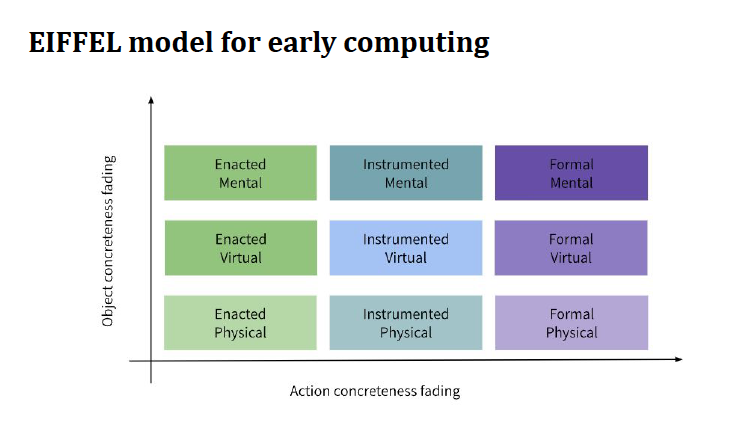
Anaclara is part of a group of researchers at the University of Glasgow who are currently developing a new approach to structuring computing education. Their EIFFEL (Enacted Instrumented Formal Framework for Early Learning in Computing) model suggests a progression from enacted to formal activities.
Following this model, in the early years of computing education, learners would primarily engage with activities that allow them to work with tangible 3D objects or manipulate intangible objects, for instance in Scratch. Increasingly, students will be able to perform actions in an instrumented or virtual environment which will require the knowledge of abstract symbols but will not yet require the knowledge of programming languages. Eventually, students will have developed the knowledge and skills to engage in fully formal environments, such as writing advanced code.
In a recent literature review, Anaclara and her colleagues looked at existing research into using grounded cognition theory in computing education. Although several studies report the use of grounded approaches, for instance by using block-based programming, robots, toys, or construction kits, the focus is generally on looking at how concrete objects can be used in unplugged activities due to specific contexts, such as a limited availability of computing devices.
The next steps in this area are looking at how activities that specifically follow the EIFFEL framework can enhance children’s learning.
Research into grounded cognition activities in computer science is ongoing, but we encourage you to try incorporating more hands-on activities when teaching younger learners and observing the effects yourself. Here are a few ideas on how to get started:
Explore the ‘Teach Data Literacy’ guide, developed by the Data Education in Schools team, which offers some practical activities to support young learners to develop their data literacy skills. You can find out more about the Data Education in Schools initiative in Kate Farrell and Judy Robertson’s seminar on teaching primary learners how to be data citizens from May 2023.
Check out Barefoot Computing, which offers a range of resources for early years education that involve physical manipulation and simulation.
Join us at our next seminar
In 2024, we are exploring different ways to teach and learn programming, with and without AI tools. In our next seminar, on 13 February at 17:00 GMT, Majeed Kazemi from the University of Toronto will be joining us to discuss whether AI-powered code generators can help K–12 students learn to program in Python. All of our online seminars are free and open to everyone. Sign up and we’ll send you the link to join on the day.
This post is written by Dennis Kieselhorst, Principal Solutions Architect.
The combination of portability, efficiency, community, and breadth of features has made Java a popular choice for businesses to build their applications for over 25 years. The introduction of serverless functions, pioneered by AWS Lambda, changed what you need in a programming language and runtime environment. Functions are often short-lived, single-purpose, and do not require extensive infrastructure configuration.
This blog post shows how you can modernize a legacy Java application to run on Lambda with minimal code changes using the updated AWS Serverless Java Container.
Deployment model comparison
Classic Java enterprise applications often run on application servers such as JBoss/ WildFly, Oracle WebLogic and IBM WebSphere, or servlet containers like Apache Tomcat. The underlying Java virtual machine typically runs 24/7 and serves multiple requests using its multithreading capabilities.
Typical long running Java application server
When building Lambda functions with Java, an HTTP server is no longer required and there are other considerations for running code in a Lambda environment. Code runs in an execution environment, which processes a single invocation at a time. Functions can run for up to 15 minutes with a maximum of 10 Gb allocated memory.
Functions are triggered by events such as an HTTP request with a corresponding payload. An Amazon API Gateway HTTP request invokes the function with the following JSON payload:
Amazon API Gateway HTTP request payload
The code to process these events is different from how you implement it in a traditional application.
AWS Serverless Java Container
The AWS Serverless Java Container makes it easier to run Java applications written with frameworks such as Spring, Spring Boot, or JAX-RS/Jersey in Lambda.
The container provides adapter logic to minimize code changes. Incoming events are translated to the Servlet specification so that frameworks work as before.
AWS Serverless Java Container adapter
Version 1 of this library was released in 2018. Today, AWS is announcing the release of version 2, which supports the latest Jakarta EE specification, along with Spring Framework 6.x, Spring Boot 3.x and Jersey 3.x.
Example: Modifying a Spring Boot application
This following example illustrates how to migrate a Spring Boot 3 application. You can find the full example for Spring and other frameworks in the GitHub repository.
Add the AWS Serverless Java dependency to your Maven POM build file (or Gradle accordingly):
Spring Boot, by default, embeds Apache Tomcat to deal with HTTP requests. The examples use Amazon API Gateway to handle inbound HTTP requests so you can exclude the dependency.
The AWS Serverless Java Container accepts API Gateway proxy requests and transforms them into a plain Java object. The library also transforms outputs into a suitable API Gateway response object.
Once you run your build process, Maven’s Shade-plugin now produces an Uber-JAR that bundles all dependencies, which you can upload to Lambda.
The Lambda runtime must know which handler method to invoke. You can configure and use the SpringDelegatingLambdaContainerHandler implementation or implement your own handler Java class that delegates to AWS Serverless Java Container. This is useful if you want to add additional functionality.
Configure the handler name in the runtime settings of your function.
Configure the handler name
Configure an environment variable named MAIN_CLASS to let the generic handler know where to find your original application main class, which is usually annotated with @SpringBootApplication.
When running Lambda functions, start-up time and memory footprint are important considerations. The amount of memory you configure for your Lambda function also determines the amount of virtual CPU available. Adding more memory proportionally increases the amount of CPU, and therefore increases the overall computational power available. If a function is CPU-, network- or memory-bound, adding more memory can improve performance.
Lambda charges for the total amount of gigabyte-seconds consumed by a function. Gigabyte-seconds are a combination of total memory (in gigabytes) and duration (in seconds). Increasing memory incurs additional cost. However, in many cases, increasing the memory available causes a decrease in the function duration due to the additional CPU available. As a result, the overall cost increase may be negligible for additional performance, or may even decrease.
Choosing the memory allocated to your Lambda functions is an optimization process that balances speed (duration) and cost. You can manually test functions by selecting different memory allocations and measuring the completion time. AWS Lambda Power Tuning is a tool to simplify and automate the process, which you can use to optimize your configuration.
Power Tuning uses AWS Step Functions to run multiple concurrent versions of a Lambda function at different memory allocations and measures the performance. The function runs in your AWS account, performing live HTTP calls and SDK interactions, to measure performance in a production scenario.
Improving cold-start time with AWS Lambda SnapStart
Traditional applications often have a large tree of dependencies. Lambda loads the function code and initializes dependencies during Lambda lifecycle initialization phase. With many dependencies, this initialization time may be too long for your requirements. AWS Lambda SnapStart for Java based functions can deliver up to 10 times faster startup performance.
Instead of running the function initialization phase on every cold-start, Lambda SnapStart runs the function initialization process at deployment time. Lambda takes a snapshot of the initialized execution environment. This snapshot is encrypted and persisted in a tiered cache for low latency access. When the function is invoked and scales, Lambda resumes the execution environment from the persisted snapshot instead of running the full initialization process. This results in lower startup latency.
When building serverless applications with Lambda, you can deliver features faster, but your language and runtime must work within the serverless architectural model. AWS Serverless Java Container helps to bridge between traditional Java Enterprise applications and modern cloud-native serverless functions.
You can optimize the memory configuration of your Java Lambda function using AWS Lambda Power Tuning tool and enable SnapStart to optimize the initial cold-start time.
The self-paced Java on AWS Lambda workshop shows how to build cloud-native Java applications and migrate existing Java application to Lambda.
Last week’s launches Here are some launches that got my attention during the previous week.
Amazon Q data integration in AWS Glue (Preview) – Now you can use natural language to ask Amazon Q to author jobs, troubleshoot issues, and answer questions about AWS Glue and data integration. Amazon Q was launched in preview at AWS re:invent 2023, and is a generative AI–powered assistant to help you solve problems, generate content, and take action.
General availability of CDK Migrate – CDK Migrate is a component of the AWS Cloud Development Kit (CDK) that enables you to migrate AWS CloudFormation templates, previously deployed CloudFormation stacks, or resources created outside of Infrastructure as Code (IaC) into a CDK application. This feature was launched alongside the CloudFormation IaC Generator to give you an end-to-end experience that enables you to create an IaC configuration based off a resource, as well as its relationships. You can expect the IaC generator to have a huge impact for a common use case we’ve seen.
Other AWS news Here are some additional projects, programs, and news items that you might find interesting:
Amazon API Gateway processed over 100 trillion API requests in 2023, demonstrating the growing demand for API-driven applications. API Gateway is a fully-managed API management service. Customers from all industry verticals told us they’re adopting API Gateway for multiple reasons. First, its ability to scale to meet the demands of even the most high-traffic applications. Second, its fully-managed, serverless architecture, which eliminates the need to manage any infrastructure, and frees customers to focus on their core business needs.
Join the PartyRock Generative AI Hackathon by AWS. This is a challenge for you to get hands-on building generative AI-powered apps. You’ll use Amazon PartyRock, an Amazon Bedrock Playground, as a fast and fun way to learn about Prompt Engineering and Foundational Models (FMs) to build a functional app with generative AI.
AWS open source news and updates – My colleague Ricardo writes this weekly open source newsletter in which he highlights new open source projects, tools, and demos from the AWS Community.
Upcoming AWS events Whether you’re in the Americas, Asia Pacific & Japan, or EMEA region, there’s an upcoming AWS Innovate Online event that fits your timezone. Innovate Online events are free, online, and designed to inspire and educate you about AWS.
AWS Summits are a series of free online and in-person events that bring the cloud computing community together to connect, collaborate, and learn about AWS. These events are designed to educate you about AWS products and services and help you develop the skills needed to build, deploy, and operate your infrastructure and applications. Find an AWS Summit near you and register or set a notification to know when registration opens for a Summit that interests you.
AWS Community re:Invent re:Caps – Join a Community re:Cap event organized by volunteers from AWS User Groups and AWS Cloud Clubs around the world to learn about the latest announcements from AWS re:Invent.
Greg Kroah-Hartman has announced the release of the 6.7.4, 6.6.16,
and 6.1.77 stable kernels. As usual, they
contain important fixes all over the kernel tree.
It seems like every week, the cybersecurity landscape sees the emergence of yet another ransomware variant, with Black Hunt being one of the latest additions. Initially reported by cybersecurity researchers in 2022, this new threat has quickly made its presence known. In a recent incident, Black Hunt ransomware wreaked havoc by compromising around 300 companies in Paraguay.
Rapid7 Labs consistently monitors emerging threats, and this new ransomware variant caught our attention for several reasons. The behavior and potential impact of this new variant raised concerns among our team, prompting us to conduct a thorough analysis to better understand its capabilities and potential risks.
During our analysis we found notable similarities between Black Hunt ransomware and LockBit, which suggested that it uses leaked code of Lockbit. In addition, it uses some techniques similar to REvil ransomware.
Technical Analysis
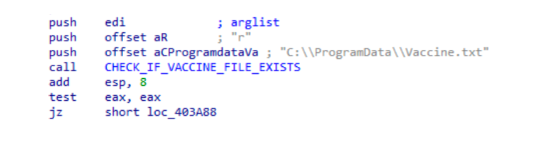
In this analysis we examined the Black Hunt sample shared on X (formerly Twitter), by MalwareHunterTeam. In our investigation we found some interesting techniques and features used by this malware. The recent Black Hunt sample is a C++ executable, which widely reuses the leaked Lockbit ransomware code and shares similarities with several other recently spotted ransomware families.The execution of the ransomware on an infected machine starts with a check for a file named Vaccine.txt under directory C:\ProgramData path
Figure 1 – Check for the existence of Vaccine.txt file
If the file is found, malware terminates its execution. This file detection acts as an anti-exploitation flag for the ransomware. As this is not a well-known anti-sandbox/anti-VM technique, we assume that this file is in use by the threat actor (TA) itself. It is either created by the victim which is instructed to create it after the ransom is paid or dropped by the decryptor, if one is sent to the victim to decrypt the encrypted data. Adding that check is logical if the ransomware operators consider scenarios where their persistence mechanism and the ransomware binary remain on the system even after the ransom is paid and files are decrypted. Moreover, the fact that all files dropped by the ransomware are placed in the C:\ProgramData directory further supports our assessment that this file is associated with the Black Hunt operation.
Next, the malware adjusts the following privileges to processes Access Token by using the `AdjustTokenPrivileges` API function:
Privilege Setting
Description
SeDebugPrivilege
Monitor and manipulate other processes.
SeRestorePrivilege
Bypass file system security to restore files.
SeBackupPrivilege
Read any file, regardless of permissions.
SeTakeOwnershipPrivilege
Take control of critical system resources.
SeAuditPrivilege
Manipulate security audit logs.
SeSecurityPrivilege
Modify security settings of objects.
SeIncreaseBasePriorityPrivilege
Gives service privilege to increase scheduling priority.
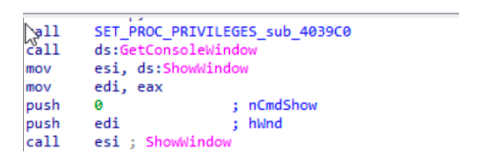
After modifying process privileges, the malware hides its window by invoking the `ShowWindow` function with the `nCmdShow` parameter set to 0, which corresponds to `SW_HIDE`. This action ensures that the malware’s window is not visible to the user, allowing it to operate stealthily in the background without drawing attention.
Figure 3 – Malware hiding its present from the user
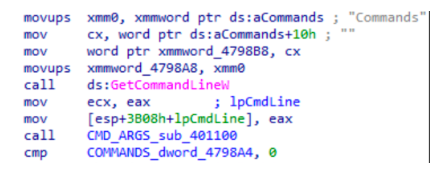
The execution flow continues as the malware invokes the `GetCommandLineW` function. This function retrieves the command-line string for the current process, including the program name and any arguments passed during startup. This function is commonly used by malware and helps to gather information about command-line flags. Following this, another function call is made to `CMD_ARGS`.
Figure 4
The function processes a command-line string and checks if any of the following arguments were passed:
Argument
Description
-local
If passed, the ransomware will skip shared or network drives encryption.
-network
If passed, the ransomware will encrypt only the network drives
If passed, the ransomware will only encrypt the files with .000, .cab, .zip and .rar extensions.
-noencrypt
if passed, the malware will skip encryption.
-p
If passed, specifies a path to be encrypted
-nologs
If passed – If the flag is not set, the ransomware creates a log file named #BlackHunt_Logs.txt under C:\ProgramData directory. Otherwise no log files will be created.
-status
If passed, sets the ransomware console windows to ‘SW_SHOW’ and shows the encryption status in the ransomware console window. The status information contains the System ID, running time, the amount of encrypted files and encrypted volume, as well as errors, alive workers and the code location. The status window constantly updated by the ransomware as long as it runs
-update
If passed, the ransomware shows a fake Window Update screen
-kill
If passed, the ransomware terminates processes from hardcoded process list and stops services from hardcoded service list
-scanner
If passed, the ransomware scans for network shares
-cipher
If passed, when all the encryption process is completed the ransomware uses Windows tool Cipher.exe on all drives to overwrite the deleted data. Same capability was utilized by Vohuk ransomware.
-restart
if set in the end of encryption the following command will be executed to restart the pc ‘shutdown /r /t 15 /f’
The ransomware accepts additional arguments that modify its behavior, including disabling spreading capabilities, adjusting encryption speed, thread count for encryption, skipping mutex creation, and enabling debug mode to collect more information in the log file.
After verifying passed arguments and ensuring the absence of the -nomutex flag, the ransomware proceeds to create a `BLACK_HUNT_MUTEX`. Next, it elevates its process priority to `HIGH_PRIORITY_CLASS` using the `SetPriorityClass` API function.
The ransomware made 200 attempts to load `Fake.dll`, likely as a tactic to slow up/evade the execution in the sandbox. Following this, it employs the `IsDebuggerPresent` API call to detect if debugging is in progress. If a debugger is detected, the ransomware terminates.
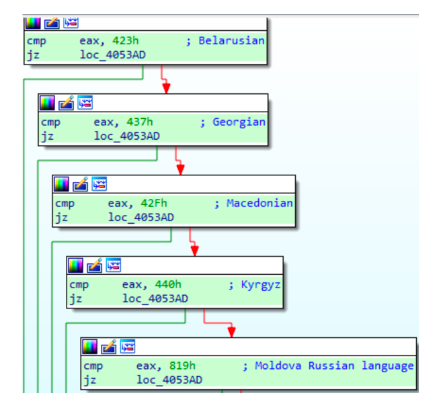
Further analysis revealed that Black Hunt maintains a whitelist of 15 countries, as detailed in the table below.
Language Code
Language
Country
2092
Azeri (Cyrillic)
Azerbaijan
1068
Azeri (Latin)
Azerbaijan
1067
Armenian
Armenia
1059
Belarusian
Belarus
1079
Georgian
Georgia
1071
Macedonian
North Macedonia
1088
Kyrgyz
Kyrgyzstan
2073
Moldovan
Moldova (Russian language)
1064
Tajik (Cyrillic)
Tajikistan
1090
Turkmen
Turkmenistan
2115
Uzbek (Cyrillic)
Uzbekistan
1091
Uzbek (Latin)
Uzbekistan
1058
Ukrainian
Ukraine
1065
Persian
Iran
1055
Turkish
Turkey
The malware uses the `GetSystemDefaultUILanguage` function to identify one of 15 hardcoded languages. If it detects any of these languages, it terminates execution.
Figure 5 – Hardcoded list of languages
Following language detection, the malware attempts to establish an internet connection by calling the `getaddrinfo` function to resolve the domain ip-api.com.
The ransomware checks if `BlackKeys` mutex exists, and if not, it creates it by using `CreateMutexA` API.
Next,the malware begins a key initialization process. First, it attempts to load a key by using `CryptImportKey` with a buffer containing the key. It looks for the key in files named C:\ProgramData\#BlackHunt_Public.key and C:\ProgramData\#BlackHunt_Private.key, and also verifies the presence of C:\ProgramData\#BlackHunt_ID.txt. If the key loading fails, the malware switches to generating a 128-bit RSA key pair.
After initializing encryption keys, the ransomware creates a HKEY_LOCAL_MACHINE\Software\Classes\.Hunt2 registry key to define settings for files with `.Hunt2` extension.It adds a `DefaultIcon` registry key under `.Hunt2` and assigns a default value to the dropped icon file.
Next, the ransomware creates a new {2C5F9FCC-F266-43F6-838DAE269E11} value under HKLM\SOFTWARE\Microsoft\Windows\CurrentVersion\Run registry key and sets it data to C:\ProgramData\#BlackHunt_ReadMe.hta that will make the `.hta` file be executed on reboot.This file is a Black Hunt ransom note. Here we can notice additional proof of reuse of Lockbit ransomware code by BlackHunt operators, the value name is identical to the one LockBit 2.0 used in their attacks.
The Black Hunt ransomware makes several modifications to the Windows registry to disable security measures, alter system functionality, and potentially limit user control over the system. Below are the commands used
Adds an entry to the Windows startup registry key to run C:\ProgramData#BlackHunt_ReadMe.hta
SHChangeNotify(0x8000000, 0, 0, 0);
Notifies the system of changes that might require refreshing icons or interface elements
The list of modified registries can be found in the IOC section or on the Rapid7 Labs GitHub page.
Afterward, the malware checks for various command-line arguments, and its execution flow depends on which arguments are set.
`-p` flag
If set, it proceeds to sets persistence by creating scheduled tasks to execute the malware upon system startup using the command /c SCHTASKS.exe /Create /RU “NT AUTHORITY\SYSTEM” /sc onstart /TN “Windows Critical Update” /TR “%s” /F.
`-safemode` flag
If it is, the malware configures the safe mode setting to ensure its execution after the system boots in safe mode, after which it restarts the machine. For more information on that technique check the Safe Mode section of this article.
If the `-safemode` flag is not set, the malware creates ransom note, primary and secondary contact emails `[email protected]` and `[email protected]`, respectively, a placeholder ID for infected machines, and the Tor address http[:]//sdif9821kjsdvcjlksaf2kjhlksvvnktyoiasuc921f.
`-update` flag
If set, the malware drops `#BlackHunt_Update.hta` to the C:\ProgramData directory and executes it. The purpose of that flag is to create a fake Windows Update screen while encrypting the victim’s data. After that, the malware empties the recycle bin by calling `SHEmptyRecycleBinW`.
`-kill` flag
If set, the malware enumerates running processes and terminates 130 predefined processes and services. The full list of processes and services can be found in the IOC section or on the Rapid7 Labs GitHub page.
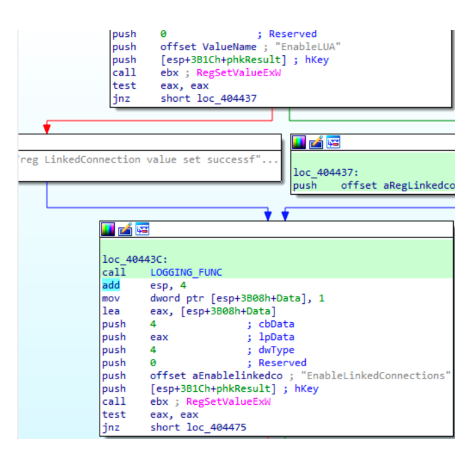
After completing its service termination routine, the malware tries to access the registry key SOFTWARE\Microsoft\Windows\CurrentVersion\Policies\System, known for storing system policies such as User Account Control (UAC) settings. If successful, it modifies two registry values: `EnableLUA` and `EnableLinkedConnections`.
Figure 6-UAC settings modification
By setting`EnableLUA` to 0, the malware effectively disables this security feature, granting itself elevated privileges without user intervention. Additionally, the malware sets the `EnableLinkedConnections` registry key, allowing any user to see network drives that were mapped for other users. This gives ransomware the ability to gain access to sensitive network resources.The malware invokes the `RefreshPolicyEx` API function to enforce the modifications made.
Next, the malware manipulates shadow storage. For conventional disk types, such as DRIVE_FIXED, it executes commands like /c vssadmin resize shadowstorage /for=C:\ /on=C:\ /maxsize=401MB. For disk types not explicitly specified, such as DRIVE_RAMDISK, it uses /c vssadmin resize shadowstorage /for=C:\ /on=C:\
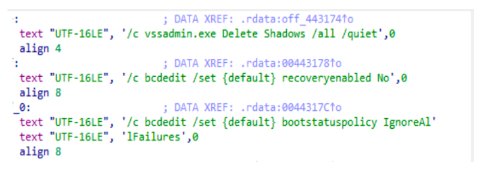
Afterwards , the malware removes the shadow copies using vssadmin.exe Delete Shadows /all /quiet and disables automatic repair by executing bcdedit /set {default} recoveryenabled No.
Figure 7- Shadow storage manipulation
Next, the attackers execute a sequence of commands to clean up the system and implement critical modifications.
Adjusts boot status policy for normal booting despite failures, blocking access to System Image Recovery
fsutil.exe usn deletejournal /disks (D and C)
Deletes Volume USN Journal on disks D and C, disrupting file system change tracking
wbadmin.exe delete catalog -quiet
Silently removes backup catalogs, erasing backup data
Disables System Restore tasks with sc
Halts System Restore functionality, limiting recovery options
If the `-scanner` flag is set the ransomware will attempt to retrieve the ARP cache table and scan the addresses using the servername as a parameter. This function utilizes `NetShareEnum` to gather information about network shares on a given server.
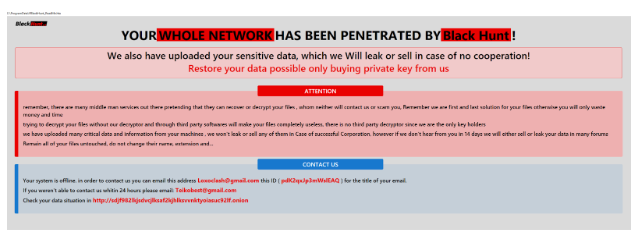
Finally, the encryption routine starts. Encrypted files renamed with `.Hunt2` extension. After the encryption, the ransomware deletes itself, and the ransom note is displayed to the user.
Figure 8 – Black Hunt ransomware note
Additional functionality
Spreading mechanism
Ransomware tries to enumerate shares on the localhost (127.0.0.1) using `NetShareEnum`. If shares are found and no error occurs, the malware tries to process drive paths. It checks each path for specific conditions met and that the path is not a remote path. If these conditions are met, it processes the argument as a local drive path by extracting the drive letter and formatting it as \127.0.0.1{drive_letter}.
The malware attempts to locate a NAS server and paths to files on removable drives. Additionally, it searches for shared folders and attempts to spread by enumerating local shared folders using `NetShareEnum`. If a network share is found, it copies itself to the share using `CopyFileW`. After spreading, it clears setup event logs by executing cmd /c wevtutil.exe.
Safe mode
If the `-safemode` argument is set, the malware executes the encryption process in Safe Mode. To ensure execution after rebooting in Safe Mode, the malware sets up the system as follows:
1) Obtains a user environment variable.
2) Executes the net user username `Black_Hunt_2.0` command to set a new user password.
3) Adds a new `AutoAdminLog` value under the registry key HKEY_LOCAL_MACHINE\SOFTWARE\Microsoft\Windows NT\CurrentVersion\Winlogon and sets it to 1, enabling auto login in Windows.
4) Creates a `DefaultUserName` value under the same registry key and sets it.
5) Creates a `DefaultPassword` registry value and sets it to the changed password.
6) Executes the /c bootcfg /raw /a /safeboot:network /id 1 and /c bcdedit /set {current} safeboot network commands to force the computer to boot into Safe Mode with Networking.
7) Creates a new`BackToNormal` value under HKEY_LOCAL_MACHINE\Software\Microsoft\Windows\CurrentVersion\RunOnce and sets it to bcdedit /deletevalue {current} safeboot” /f.
8) Sets an additional value under the `RunOnce` key named `BlackHunt` and sets it to the current malware running path.
9) Finally, restarts the system by executing shutdown /r /t 7 /f
Rapid7 Customers
For Rapid7 MDR and InsightIDR customers, the following Attacker Behavior Analytics (ABA) rules are currently deployed and alerting on the activity described in this blog:
Suspicious Process – Delete File Shadow Copies With PowerShell
Attacker Technique – Rundll32 Running DLL in Root of ProgramData
Suspicious Process – Regsvr32.exe Registering DLL in ProgramData
Persistence – Run Key Added by Reg.exe
Suspicious Registry Event – Unusual Registry Run Keys
We continue to expand the scope of our assurance programs at Amazon Web Services (AWS), and we’re pleased to announce that AWS has successfully completed the 2023 Cloud Computing Compliance Controls Catalogue (C5) attestation cycle with 170 services in scope. This alignment with C5 requirements demonstrates our ongoing commitment to adhere to the heightened expectations for cloud service providers. AWS customers in Germany and across Europe can run their applications on AWS Regions in scope of the C5 report with the assurance that AWS aligns with C5 requirements.
The C5 attestation scheme is backed by the German government and was introduced by the Federal Office for Information Security (BSI) in 2016. AWS has adhered to the C5 requirements since their inception. C5 helps organizations demonstrate operational security against common cybersecurity threats when using cloud services within the context of the German government’s Security Recommendations for Cloud Computing Providers.
Independent third-party auditors evaluated AWS for the period of October 1, 2022, through September 30, 2023. The C5 report illustrates the compliance status of AWS for both the basic and additional criteria of C5. Customers can download the C5 report through AWS Artifact, a self-service portal for on-demand access to AWS compliance reports. Sign in to AWS Artifact in the AWS Management Console, or learn more at Getting Started with AWS Artifact.
AWS has added the following 16 services to the current C5 scope:
With the 2023 C5 attestation, we’re also expanding the scope to two new Regions — Europe (Spain) and Europe (Zurich). In addition, the services offered in the Asia Pacific (Singapore), Europe (Frankfurt), Europe (Ireland), Europe (London), Europe (Milan), Europe (Paris), and Europe (Stockholm) Regions remain in scope of this attestation. For up-to-date information, see the C5 page of our AWS Services in Scope by Compliance Program.
AWS strives to continuously bring services into the scope of its compliance programs to help you meet your architectural and regulatory needs. If you have questions or feedback about C5 compliance, reach out to your AWS account team.
To learn more about our compliance and security programs, see AWS Compliance Programs. As always, we value your feedback and questions; reach out to the AWS Compliance team through the Contact Us page.
If you have feedback about this post, submit comments in the Comments section below.
On December 4, 2023, AWS was named as a Leader in the 2023 Magic Quadrant for Strategic Cloud Platform Services (SCPS). AWS is the longest-running Magic Quadrant Leader, with Gartner naming AWS a Leader for the thirteenth consecutive year. AWS is placed highest on the Ability to Execute axis.
SCPS, previously known as Magic Quadrant for Cloud Infrastructure and Platform Services (CIPS), is defined as “standardized, automated, public cloud offerings integrating infrastructure services (for example, computing, network, and storage), platform services (for example, managed application and data services) and transformation services (programs/resources that help customers adopt cloud-oriented IT delivery models).”
I have the chance to talk with our customers every single week. When I ask the main reasons why they choose AWS, I consistently hear the following responses:
Breadth and depth. AWS offers more cloud services and features than other providers, including compute, storage, databases, machine learning (ML), data analytics, and Internet of Things (IoT). This allows faster, easier, and cheaper cloud migration of existing apps and building new apps. AWS has the deepest functionality within services, such as a wide variety of purpose-built databases optimized for cost and performance.
A rapid pace of innovation. AWS enables faster experimentation and innovation through the latest technologies. We continually accelerate innovation pace to invent new technologies for business transformation. For example, in 2014, we launched the serverless computing service AWS Lambda, eliminating server provisioning and management for developers. In 2017, we launched the AWS Nitro System, a combination of dedicated hardware and a lightweight hypervisor that enables better performance, increased security, and cost savings for Amazon EC2 instances. At re:Invent 2018, we announcedAWS Graviton, a family of processors designed to deliver the best price performance for your cloud workloads running in Amazon Elastic Compute Cloud (Amazon EC2). And today, we continue to innovate with generative artificial intelligence (AI) services such as Amazon Q or Amazon CodeWhisperer, your coding productivity tool available in developer’s integrated development environment (IDE) and on the command line (CLI).
A large community of customers and partners. AWS has a large, active community with millions of customers and tens of thousands of partners globally. Customers in most industries and of varied sizes use AWS for diverse applications. The AWS Partner Network includes thousands of systems integrators specializing in AWS and tens of thousands of independent software vendors (ISV) adapting their technologies for AWS.
An AWS Region is a physical location in the world where we have multiple Availability Zones. Availability Zones consist of one or more discrete data centers, each with redundant power, networking, and connectivity, housed in separate facilities. Unlike with other cloud providers, who often define a region as a single data center, having multiple Availability Zones allows you to operate production applications and databases that are more highly available, fault-tolerant, and scalable than would be possible from a single data center.
AWS has more than 17 years of experience building its global infrastructure. And, as Werner Vogels, Amazon CTO, keeps repeating, “There’s no compression algorithm for experience,” especially when it comes to scale, security, and performance.
Here is the graphical representation of the 2023 Magic Quadrant for Strategic Cloud Platform Services.
The full Gartner report has details about the features and factors they reviewed. It explains the methodology used and the recognitions. This report can serve as a guide when choosing a cloud provider that helps you innovate on behalf of your customers.
Gartner does not endorse any vendor, product or service depicted in its research publications and does not advise technology users to select only those vendors with the highest ratings or other designation. Gartner research publications consist of the opinions of Gartner’s research organization and should not be construed as statements of fact. Gartner disclaims all warranties, expressed or implied, with respect to this research, including any warranties of merchantability or fitness for a particular purpose.
GARTNER is a registered trademark and service mark of Gartner and Magic Quadrant is a registered trademark of Gartner, Inc. and/or its affiliates in the U.S. and internationally and are used herein with permission. All rights reserved.
This graphic was published by Gartner, Inc. as part of a larger research document and should be evaluated in the context of the entire document. The Gartner document is available upon request from AWS.
A Case Study Presented by CodeWhisperer Customizations
Amazon CodeWhisperer is an AI-powered coding assistant that is trained on a wide variety of data, including Amazon and open-source code. With the launch of CodeWhisperer Customizations, customers can create a customization resource. The customization is produced by augmenting CodeWhisperer using a customer’s private code repositories. This enables organization-specific code recommendations tailored to the customer’s own internal APIs, libraries, and frameworks.
When we started designing CodeWhisperer Customizations, we considered what our guiding principles, our tenets, should be. Customer trust was at the top of the list, but that posed new questions. How could we best earn our customer’s trust with a feature that fundamentally relies on a customer’s sensitive information? How could we properly secure this data so that customers could safely leverage the advanced capabilities we launched for them?
When considering these questions, we analyzed several design principles. It was important to ensure that a customer’s data is never combined, or used alongside, another customer’s. In other words, we needed to store each customer’s data in isolation. Additionally, we also wanted to restrict data processing to single-tenant compute. By this, we mean that any access of the data itself should be done on short-lived and non-shared compute, whenever possible. Another principle we considered was how to prevent unauthorized access of customer data. Across AWS, we build our systems to not only ensure that no customer data is intermingled during normal service operation, but also to mitigate any risk of unauthorized users gaining unintended access to customer data.
These design principles pointed to a set of security controls available via native AWS technologies. We needed to provide data and compute isolation as well as mitigate confused deputy risks at each step of the process. In this blog post, we will consider how each of these security considerations is addressed, utilizing AWS best practices. We will first consider the flow of data through the admin’s management of customization resources. Next, we will outline data interactions when developers send runtime requests to a given customization from their integrated development environment (IDE).
In reading this blog post, you will learn how we developed CodeWhisperer Customizations with security at the forefront. We also hope that you are inspired to leverage some of the same AWS technologies in your own applications.
Diagram
The diagram above depicts the flow of data during an administrator’s management of a customization as well as during a developer’s usage of the customization from their IDE.
API Layer: Authenticates and authorizes each request. Passes data references to the downstream dependencies.
Data Ingestion Layer: Ingests and processes customer data into the format required for CodeWhisperer.
Customization Layer: Produces a customization resource based on the internal representation of the customer data. Shares the customization artifacts for inference.
Model Inference Layer: Provides customer-specific recommendations based on the customization.
AWS IAM Identity Center: Provides user-level authentication.
Organization admins are responsible for managing their customizations. To enable CodeWhisperer to produce these resources, the admin provides access to their private code repositories. CodeWhisperer uses AWS Key Management Service (AWS KMS) encryption for all customization data, and admins can optionally configure their own profile-level encryption keys. Based on the role assumed by the admin in the AWS console, CodeWhisperer accesses and ingests the referenced code data on the user’s behalf.
Data Isolation
During customization management, data storage occurs in two forms:
Short-term/transient (e.g. ephemeral disks on service-managed, serverless compute)
When persisting data in any form, the best security control to apply is encryption. By encrypting the data, only entities with access to the encryption key will be able to see, or use, the data. For example, when encrypted data is stored in Amazon S3, users with access to the bucket can see that the data exists, but will be unable to view the content, unless they also have access to the encryption key.
Within CodeWhisperer, long-term customer data storage in Amazon S3 is cryptographically isolated using KMS keys with customer-level encryption context metadata. The encryption context provides a further safeguard which prevents unauthorized users from accessing the content even if they gain access to the key. It also prevents unintentional, cross-customer data access as the context value is tied to a particular customer’s identity. Having access to the KMS key without this context is like having the physical invitation to a private meeting without knowing the spoken passphrase for the event.
CodeWhisperer gives customers the option to configure their own KMS keys for AWS to use when encrypting their data. Additionally, we restrict programmatic access (i.e. service usage) to Amazon S3 data via scoped-down IAM roles assigned to specific internal components. By doing this, AWS ensures that the KMS grants created for each key are strictly limited to the services that need access to the data for service operation.
When data needs to be persisted for short-term processing, we also encrypt it. CodeWhisperer leverages client-side encryption with service-owned keys for such ephemeral disks. Data is only stored on the disk while the process is executing, and any on-disk data storage is explicitly deleted, alarming on any failures, before the process is terminated. To ensure that there is no cross-over of customer data, each instance of the serverless compute is spun up for a specific operation on a specific resource. No two customer resources are processed by the same workflow or serverless function execution.
Compute Isolation
When creating or activating a customization, customer data is handled in a series of serverless environments. Most of this processing is facilitated through AWS Step Functions workflows – comprised of AWS Lambda, AWS Batch (on AWS Fargate), and nested Step Functions tasks. Each of these serverless tasks are instantiated for a given job in the system. In other words, the compute will not be shared, or reused, between two operations.
The general principle that can be observed here is the reuse of existing AWS services. By leveraging these various serverless options, we did not have to spend undifferentiated development effort on securing the compute usage. Instead, we inherited the security controls baked into these services and focused our energy on enabling the unique capabilities of customizing CodeWhisperer.
Confused Deputy Mitigations
When building a multi-tenant service, it is important to be mindful not only of how data is accessed in the expected cases, but also how it might be accessed in accidental as well as malicious scenarios. This is where the concept of confused deputy mitigations comes into picture.
To prevent cross-customer data access during data ingestion, we have two mitigations in place:
We explicitly check that the AWS credentials received in the request correspond to the account that owns the data reference (i.e. AWS CodeStar Connections ARN).
We utilize a secure token, based on the administrator’s role, to gain permissions to download the data from the customer-provided reference.
Once the data is inside the CodeWhisperer service boundaries though, we are not done. Since CodeWhisperer is built on top of a microservice-based architecture, we also need to ensure that only the expected internal components are able to interact with their respective consumers and dependencies. To prevent unauthorized users from invoking these internal services that handle the customer data, we utilize account-based allowlists. Each internal service is restricted to a set of CodeWhisperer-owned service accounts that have a need to invoke the service’s APIs. No external actors are aware of these internal accounts.
As further protection for the data inside these services, we utilize customer-managed key encryption for all Amazon S3 data. When a customer does not explicitly provide their own key, we utilize a CodeWhisperer-owned KMS key for the same encryption.
KMS key usage requires a grant. These grants provide a given entity the ability to use the key to read, or write, data. To mitigate the risk of improper usage of these grants, we installed certain controls. To limit the number of entities with top-level grant permissions, all grants are managed by a single microservice. To restrict the usage of the grants to the expected CodeWhisperer workflows, the grants are created for the minimum lifecycle. They are immediately retired once the CodeWhisperer operation is complete.
Customization Usage
After an admin creates, activates, and grants access to a customization resource, a developer can select the customization within their IDE. Upon invocation, CodeWhisperer captures the user’s IDE code context and sends it to CodeWhisperer. The request also includes their authentication token and a reference to their target customization resource. Given successful authentication and authorization, CodeWhisperer responds with the customized recommendation(s).
Data Isolation
There is no persistent data storage used during invocations of a customization. These invocations are stateless, meaning that any data passed within the request is not persisted beyond the life of the request itself. To mitigate any data risks within the lifetime of the request, we authenticate and authorize users via IAM Identity Center.
Since a customization is tied to proprietary company data and its recommendations can reproduce such data, it is crucial to maintain tight authorization around the resource access. CodeWhisperer authorizes individual users against the customization resource via Amazon Verified Permissions policies. These policies are configured by a customer admin in the AWS Console when they assign users and groups to a given customization. (Note: CodeWhisperer manages these Verified Permissions policies on behalf of our customers, which is why admins will not see the policies themselves listed in the console directly.) The service internally resolves the policy to the corresponding service-owned resources constituting the customization.
Compute Isolation
The primary compute for CodeWhisperer invocations is an instance hosting the generative model. Generative models run multi-tenanted on a physical host, i.e. each model runs on a dedicated compute resource within a host that has multiple such resources. By tying each request to a particular compute resource, inference calls cannot interact or communicate with any other ongoing inference.
All other runtime processing is executed in independent threads on Amazon Elastic Container Service (Amazon ECS) container instances with Fargate technology. No computation on user data spans across more than one of these threads within a given CodeWhisperer service.
Confused Deputy Mitigations
As we discussed for customization management, confused deputy mitigations are applied to reduce the risk of accidental and malicious access to customer data by unauthorized entities. To address this when a customization is used, we restrict customers, via Verified Permissions permissions, to accessing only the internal resources tied to their selected customization. We further protect against confused deputy risks by configuring a session policy for each inference request. This session policy scopes down the permission to a specific resource name, which is internally managed and not exposed publicly.
Conclusion
In the age of generative AI, data is a chief differentiator for the efficacy of end applications. CodeWhisperer’s foundational model has been trained on a wide array of generic data. This enables CodeWhisperer to boost developer productivity from the baseline and utilize open-source packages that are commonly included throughout software development. To further improve developer productivity, customers can leverage CodeWhisperer’s customization capability to ingest their private data and securely provide tailored recommendations to their developers.
CodeWhisperer Customizations was built with security and customer trust at the forefront. We have the following security invariants baked in from day one:
All asynchronous customer data workloads are fully data isolated.
All customer data is KMS key encrypted at rest, and when possible, encrypted with a customer KMS key.
All customer data access is gated by authorization derived from authenticated contexts obtained from trusted authorities (IAM, Identity Center).
All customer data in customization management workflows is stored in cryptographically enforced isolation.
A common problem in kernel development is controlling when a
specific task should be done. Kernel code often executes in contexts where
some actions (sleeping, for example, or calling into filesystems) are not
possible. Other actions, while possible, may prevent the kernel from
taking care of a more important task in a timely manner. The kernel
community has developed a number of deferred-execution mechanisms designed
to ensure that every task is handled at the right time. One of those
mechanisms, tasklets, has been eyed for removal for years; that removal
might just happen in the near future.
На поредна репресия е подложена разследващата журналистка Валя Ахчиева, която е автор и в сайта „Биволъ“. Този път – от страна на Окръжна прокуратура – Кюстендил. Казусът – смъртта на…
Security updates have been issued by Debian (rear, runc, sudo, and zbar), Fedora (chromium, grub2, libebml, mingw-python-pygments, and python-aiohttp), Gentoo (FreeType, GNAT Ada Suite, Microsoft Edge, NBD Tools, OpenSSL, QtGui, SDDM, Wireshark, and Xen), Mageia (dracut, glibc, nss and firefox, openssl, packages, perl, and thunderbird), Slackware (libxml2), SUSE (java-11-openjdk, java-17-openjdk, perl, python-uamqp, slurm, and xerces-c), and Ubuntu (libssh and openssl).
To provide the best experiences, we use technologies like cookies to store and/or access device information. Consenting to these technologies will allow us to process data such as browsing behavior or unique IDs on this site. Not consenting or withdrawing consent, may adversely affect certain features and functions.
Functional
Always active
The technical storage or access is strictly necessary for the legitimate purpose of enabling the use of a specific service explicitly requested by the subscriber or user, or for the sole purpose of carrying out the transmission of a communication over an electronic communications network.
Preferences
The technical storage or access is necessary for the legitimate purpose of storing preferences that are not requested by the subscriber or user.
Statistics
The technical storage or access that is used exclusively for statistical purposes.The technical storage or access that is used exclusively for anonymous statistical purposes. Without a subpoena, voluntary compliance on the part of your Internet Service Provider, or additional records from a third party, information stored or retrieved for this purpose alone cannot usually be used to identify you.
Marketing
The technical storage or access is required to create user profiles to send advertising, or to track the user on a website or across several websites for similar marketing purposes.