Stay current with the latest serverless innovations that can improve your applications. In this 32nd quarterly recap, discover the most impactful AWS serverless launches, features, and resources from Q1 2026 that you might have missed.
In case you missed our last ICYMI, check out what happened in Q4 2025.
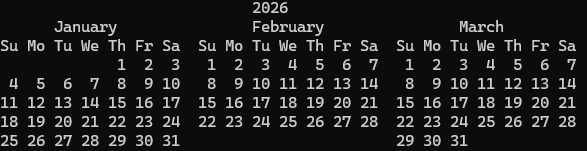
2026 Q1 calendar
Serverless with Mama J
Serverless with Mama J
If you really want to know whether you understand something, try explaining it to your mom!
That’s exactly what Eric Johnson did. His mom, everyone calls her Mama J, wanted to know what serverless actually means and why it matters. So he walked her through it: what servers do, why they’re a headache to manage, and how AWS Lambda lets you skip all that by running code only when it’s needed, scaling automatically, and charging you nothing when nobody’s using it.
AWS is providing a growing set of AI-powered tools to bring serverless expertise directly into your coding assistants. From Model Context Protocol (MCP) servers and Anthropic Claude plugins to Kiro Powers. These tools provide contextual guidance for architecture decisions, implementation patterns, and deployment automation across the full serverless development lifecycle.
For more information on the tools available, see the resources page.
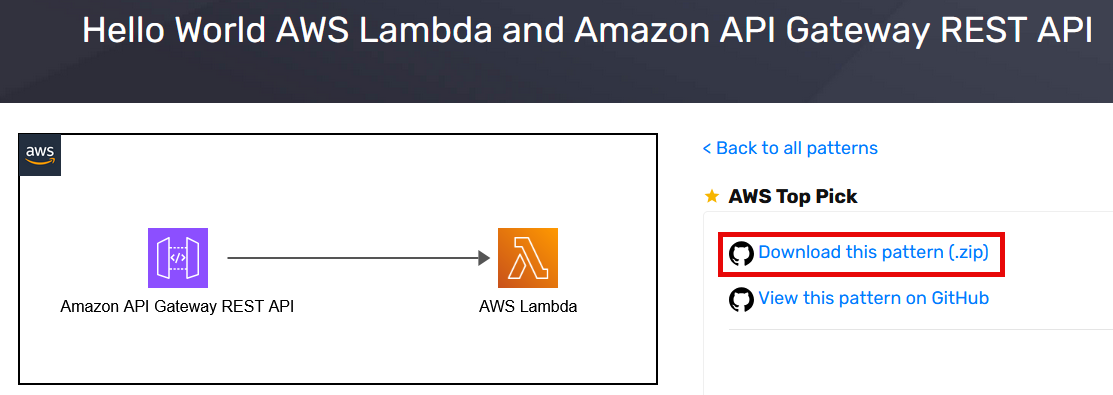
Build fault-tolerant, long-running applications using familiar programming patterns using AWS Lambdadurable functions. You can use Lambda durable functions to write multi-step workflows in your preferred programming language, using built-in methods that automatically handle progress checkpointing and error recovery. This can improve your architecture so that you can focus on your business logic and optimize costs by charging only for active compute time.
Eric Johnson has a new video deep dive showing how to upload videos and scan them with AI. Learn how to coordinate multiple AWS services like Amazon Rekognition and Amazon Transcribe, implement human-in-the-loop approval workflows, and crate a live dashboard for real-time updates.
Lambda now supports the .NET 10 runtime, including support for file-based apps. Developers can take advantage of the latest .NET 10 performance improvements, new language features, and improved startup times for Lambda functions.
You can now see Availability Zone (AZ) metadata in function execution environments. This allows you to determine the AZ ID (e.g., use1-az1) of the AZ your function is running in. This helps build functions that can make AZ-aware routing decisions, such as preferring same-AZ endpoints for downstream services to reduce cross-AZ latency. Operators can also implement AZ-aware resilience patterns like AZ-specific fault injection testing.
Payload size increase
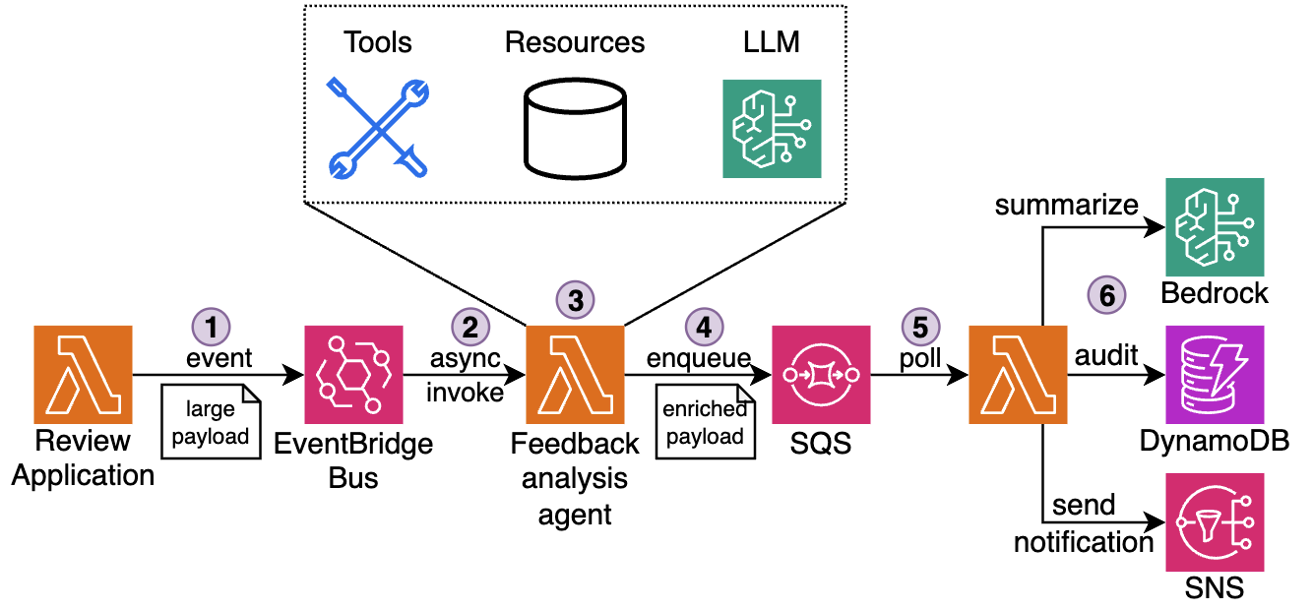
AWS has increased the maximum payload size from 256 KB to 1 MB for a number of services such as asynchronous Lambda invocations, Amazon SQS, and Amazon EventBridge. This gives you more room to build and maintain context-rich event-driven systems and reduce the need for complex workarounds such as data chunking or external large object storage.
This blog post explores a real-world example using rich event context in agentic event-driven architectures
Amazon Bedrock AgentCore is the infrastructure layer for securely deploying and operating AI agents. It works with popular open source frameworks, including Strands Agents, LangGraph and CrewAI, giving you the flexibility to build with your preferred tools without vendor lock-in.
AgentCore Gateway now includes semantic tool search, so you can discover the right tool for a task using natural language queries instead of manually browsing a catalogue. It also adds custom KMS encryption, debugging messages, and resource tagging to give you stronger governance over tool integrations.
Policy in Bedrock AgentCore allows you to define precise boundaries on agent actions and run continuous quality monitoring. This helps you maintain predictable, auditable agent behavior in production without embedding guardrail logic inside each individual agent.
AgentCore Runtime now supports stateful MCP server features, allowing agents to maintain session context across tool calls for richer, more coherent multi-step interactions.
AWS Step Functions introduces an enhanced TestState API that enables API-based testing for validating workflows before deployment. The new API supports testing individual states in isolation or complete workflows end-to-end, making it easier to verify state machine logic without incurring runtime costs.
By integrating TestState API testing into CI/CD pipelines, you can validate workflow logic before deployment, reducing the risk of production issues. Find complete code examples and testing framework in the GitHub repository.
Amazon EventBridge
Amazon EventBridge Scheduler now provides resource count metrics to help you monitor quota usage. These new metrics make it easier to track the number of schedules and schedule groups in your account and proactively manage service quotas.
Amazon DynamoDB
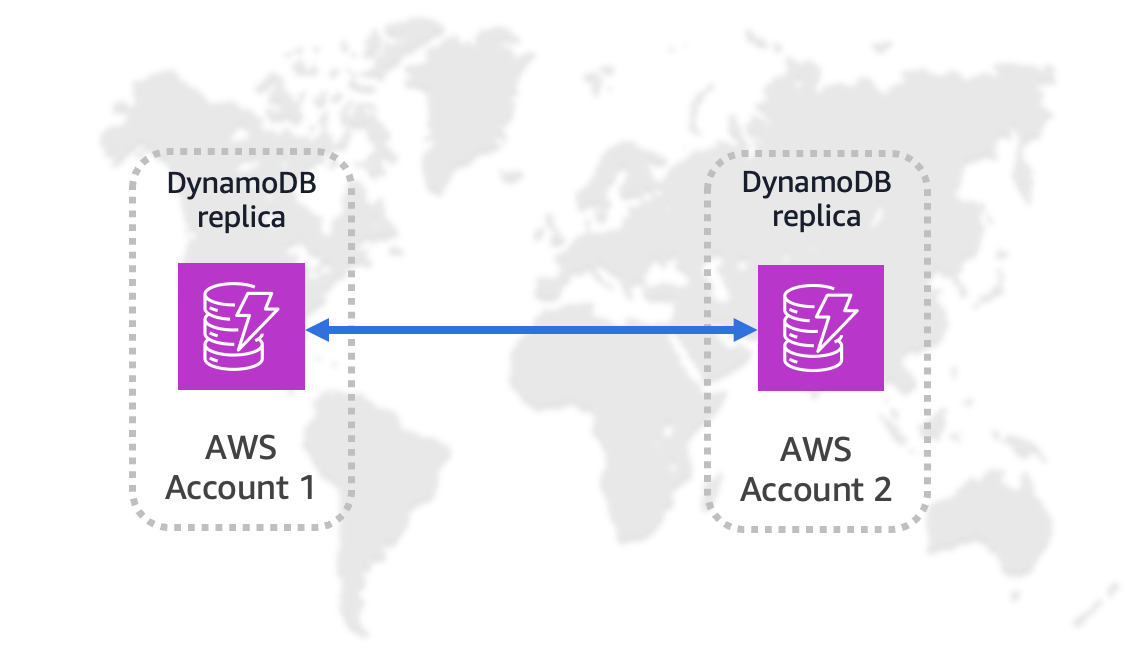
You can replicate Amazon DynamoDB table data across multiple AWS accounts and Regions. This enhances resiliency through account-level isolation, supports tailored security and data-perimeter controls. You can align workloads by business unit or environment and simplify governance requirements.
ECS also now supports Network Load Balancer (NLB) for linear and canary deployment strategies. This helps you perform gradual traffic shifting using NLBs, providing more flexibility in deployment pipelines for latency-sensitive applications.
Join our livestream every Tuesday at 11 AM PT for live discussions, Q&A sessions, and deep dives into serverless technologies. Watch episodes on-demand at serverlessland.com/office-hours.
The Serverless landing page has overall information about building serverless applications. The Lambda resources page contains case studies, webinars, whitepapers, customer stories, reference architectures, and even more Getting Started tutorials.
You can also follow the Developer Advocacy team to see the latest news, follow conversations, and interact with the team.
Hyrum’s Law states that any
observable behavior of a system will eventually be depended upon by
somebody. The kernel community is currently contending with a clear
demonstration of that principle. The recent work to address some restartable-sequences
performance problems in the 6.19 release maintained the documented API
in all respects, but that was not enough; Google’s TCMalloc
library, as it turns out, violates the documented API, prevents other code
from using restartable features, and breaks with 6.19. But the kernel’s
no-regressions rule is forcing developers to find a way to accommodate
TCMalloc’s behavior.
While more than two-thirds of human-generated TLS traffic to Cloudflare is already protected by post-quantum cryptography, the world of site-to-site networking has been a different story. For years, the IPsec community remained caught between the high bar of Internet-scale interoperability and the niche requirements of specialized hardware. That gap is now closing.
Earlier this month, we announced that Cloudflare has moved its target for full post-quantum security forward to 2029, spurred by several recent advances in quantum computing. To advance that goal, we’ve made post-quantum encryption in Cloudflare IPsec generally available.
Using the new IETF draft for hybrid ML-KEM (FIPS 203), we’ve successfully tested interoperability with branch connectors from Fortinet and Cisco — meaning you can start protecting your wide-area network (WAN) against harvest-now-decrypt-later attacks today using hardware you already have.
This post explains how we implemented the new hybrid IPsec handshake, why it took four years longer to land than its TLS counterpart, and how the industry is finally consolidating around a standard that works at Internet scale.
Cloudflare IPsec
Cloudflare IPsec is a WAN Network-as-a-Service that replaces legacy network architectures by connecting data centers, branch offices, and cloud VPCs to Cloudflare’s global IP Anycast network. Customers get simplified configuration, high availability (if a data center becomes unavailable, traffic is automatically rerouted to the nearest healthy one), and the scale of Cloudflare’s global network. This is done through encrypted IPsec tunnels that support both site-to-site WAN, outbound Internet connections, and connectivity to the Cloudflare One SASE platform.
Post-quantum encryption in IPsec
Cloudflare IPsec now uses post-quantum encryption with hybrid ML-KEM (FIPS 203) to stop harvest-now-decrypt-later attacks. These are attacks where an adversary harvests data today and then decrypts later, after Q-Day, when there are powerful quantum computers that can break the classical public key cryptography used across the Internet. Harvest-now-decrypt-later attacks are becoming a concern for more organizations as Q-Day approaches faster than expected.
ML-KEM (Module-Lattice-Based Key-Encapsulation Mechanism) is a post-quantum cryptography algorithm that is based on mathematical assumptions that are not known to be vulnerable to attacks by quantum computers. It does not require special hardware or a dedicated physical link between sender and receiver. ML-KEM is intentionally designed to be implemented in software across standard processors to provide post-quantum encryption of network traffic.
Draft-ietf-ipsecme-ikev2-mlkem specifies post-quantum encryption for IPsec using hybrid ML-KEM, which combines the well-understood security of classical Diffie-Hellman and the post-quantum security of ML-KEM in a single, standards-compliant handshake. Specifically, a classical Diffie-Hellman exchange runs first, its derived key encrypts a second exchange that runs ML-KEM, and the outputs of both are mixed into the session keys that secure IPsec data plane traffic sent using the Encapsulating Security Payload (ESP) protocol.
Our interoperable implementation
Earlier we announced the closed beta of our implementation of draft-ietf-ipsecme-ikev2-mlkem in production in our Cloudflare IPsec product and tested it against a reference implementation (strongswan). Now that we have made this implementation generally available, we have also confirmed interoperability with several other vendors, including Cisco and Fortinet, which is a big win for this new standard.
Fortinet: Customers using Fortinet FortiOS 7.6.6 and later as their branch connector can now establish post-quantum Cloudflare IPsec tunnels to Cloudflare’s global network per draft-ietf-ipsecme-ikev2-mlkem.
The importance of being interoperable
Given that upgrading cryptography is hard and can take years, our 2029 target date for a full update to post-quantum cryptography is going to require concentrated effort. That’s why we hope the IPsec community continues to focus on the development of interoperable standards like draft-ietf-ipsecme-ikev2-mlkem.
Let us explain why these standards are vitally important. A full specification for hybrid ML-KEM in IPsec, draft-ietf-ipsecme-ikev2-mlkem, became available only in late 2025. That’s roughly four years after support for hybrid ML-KEM landed in TLS. (In fact, Cloudflare turned on hybrid post-quantum key agreement with TLS in 2022, even before NIST finalized the standardization of ML-KEM, because the TLS community quickly converged on a single, interoperable approach and pushed it into production. Today more than two-thirds of the human-generated TLS traffic to Cloudflare’s network is protected with hybrid ML-KEM.)
The four-year delay is likely due in part to the IPsec community’s continued interest in Quantum Key Distribution (QKD), as codified in RFC 8784, published in 2020. We’ve written before about why QKD is not part of our post-quantum strategy: QKD requires specialized hardware and a dedicated physical link between the two parties, which fundamentally means it will not operate at Internet scale. Also, QKD does not provide authentication, so you still need post-quantum cryptography anyway to stop active attackers. It’s difficult to find implementations of QKD that interoperate across vendors.
The U.S. NSA, Germany’s BSI, and the UK’s NCSC have all warned against solely relying on QKD. Post-quantum cryptography, by contrast, runs on the hardware you already have, authenticates the parties at both ends, and works end-to-end across the Internet.
RFC 9370, published in 2023, opened the door to post-quantum cryptography in IPsec, allowing up to seven key exchanges to be run in parallel with classical Diffie-Hellman. However, RFC 9370 did not specify which ciphersuites should be used in these parallel key exchanges. In the absence of that specification, some vendors shipped early implementations under RFC 9370 before the hybrid ML-KEM draft was available, defining their own ciphersuites including some which are not NIST-standardized. This is exactly the kind of “ciphersuite bloat” NIST SP 800 52r2 warned against. And the risks to interoperability have played out in practice: Cloudflare IPsec does not yet interoperate with Palo Alto Networks’ RFC 9370–based implementation, because it was launched before draft-ietf-ipsecme-ikev2-mlkem was available.
Fortunately, we now have draft-ietf-ipsecme-ikev2-mlkem that fills in the gaps in RFC 9370, specifying hybrid ML-KEM as one of the key exchange mechanisms that can be operated in parallel with classical Diffie-Hellman. We hope to add Palo Alto Networks to the list of interoperable post-quantum branch connectors as the industry continues to consolidate around draft-ietf-ipsecme-ikev2-mlkem.
But the journey towards interoperable post-quantum IPsec standards is not over yet. While draft-ietf-ipsecme-ikev2-mlkem supports post-quantum encryption, we still need IPsec standards for post-quantum authentication, so that we can stop attacks by quantum adversaries on live systems after Q-Day. Given the shortened timeline for full post-quantum readiness, we hope the IPsec community will continue to focus on interoperable PQC implementations, rather than diverting focus to niche use cases with QKD.
Towards an interoperable post-quantum Internet
At Cloudflare, we’re helping make a secure and post-quantum Internet accessible to everyone, without specialized hardware and at no extra cost to our customers. Post-quantum Cloudflare IPsec is one more step on our path to full post-quantum security by 2029, and we’re doing it in a way that ensures that the Internet remains open and interoperable for years to come.
Version
16.1 of the GNU Compiler Collection (GCC) has been
released.
The C++ frontend now defaults to the GNU C++20 dialect and the corresponding
parts of the standard library are no longer experimental. Several
C++26 features receive experimental support, including Reflection
(-freflection), Contracts, expansion statements and std::simd.
Other changes include the introduction of an experimental compiler
frontend for the Algol68 language,
ability to output GCC diagnostics in HTML form, and more.
Greg Kroah-Hartman has released the 7.0.3, 6.18.26, 6.12.85, 6.6.137, 6.1.170, 5.15.204, and 5.10.254 stable kernels. The 7.0.3 and
6.18.26 kernels only contain fixes needed for Xen users; he advises
that all users of the other kernel series must upgrade.
Coding agents are great at building software. But to deploy to production they need three things from the cloud they want to host their app — an account, a way to pay, and an API token. Until now these have been tasks that humans handle directly. Increasingly, agents handle them on the user’s behalf. The agent needs to perform all the tasks a human customer can. They’re given higher-order problems to solve and choose to use Cloudflare and call Cloudflare APIs.
Starting today, agents can provision Cloudflare on behalf of their users. They can create a Cloudflare account, start a paid subscription, register a domain, and get back an API token to deploy code right away. Humans can be in the loop to grant permission, but no human steps are required from start to finish. There’s no need to go to the dashboard, copy and paste API tokens, or enter credit card details. Without any extra setup, agents have everything they need to deploy a new production application in one shot. And with Cloudflare’s Code Mode MCP server and Agent Skills, they’re even better at it.
This all works via a new protocol that we’ve co-designed with Stripe as part of the launch of Stripe Projects.
We’re excited to launch this new partnership with Stripe, and also to offer $100,000 in Cloudflare credits to all new startups who incorporate using Stripe Atlas. But this new protocol also makes it possible for any platform with signed-in users to integrate with Cloudflare in the same way Stripe does, with zero friction for the end user.
How it works: zero to production without any setup or manual steps
Then prompt your agent to build something new and deploy it to a new domain. You can watch a condensed two-minute video of this entire flow below:
If the email you’re logged into Stripe with already has a Cloudflare account, you’ll be prompted with a typical OAuth flow to grant the agent access. If there is no existing Cloudflare account for the email you’re logged in with, Cloudflare will provision an account automatically for you and your agent, without a human in the loop:
You will see the agent build and deploy a site to a new Cloudflare account, and then use the Stripe Projects CLI to register the domain:
The agent will prompt for input and approval when necessary. For example, if your Stripe account doesn’t yet have a linked payment method, the agent will prompt you to add one:
At the end, the agent has deployed to production, and the app runs on the newly registered domain:
The agent has gone from literal zero, no Cloudflare account at all, without any preconfigured Agent Skills or MCP server, to having:
Provisioned a new Cloudflare account
Obtained an API token
Purchased a domain
Deployed an app to production
But wait — how did the agent discover that it could do all of this? How did it know what services it could provision, and how to purchase a domain? How did it gain the context it needed to understand how to deploy to Cloudflare? Let’s dig in.
How the protocol and integration works
There are three components to the interaction between the agent, Stripe, and Cloudflare shown above:
Discovery — the agent can call a command to query the catalog of available services.
Authorization — the platform attests to the identity of the user, allowing providers to provision accounts or link existing ones, and securely issue credentials back to the agent.
Payment — the platform provides a payment token that providers can use to bill the customer, allowing the agent to start subscriptions, make purchases and be billed on a usage basis.
These build on prior art and existing standards like OAuth, OIDC and payment tokenization — but are used together to remove steps that might otherwise require a human in the loop.
Discovery: how agents find services they can provision themselves
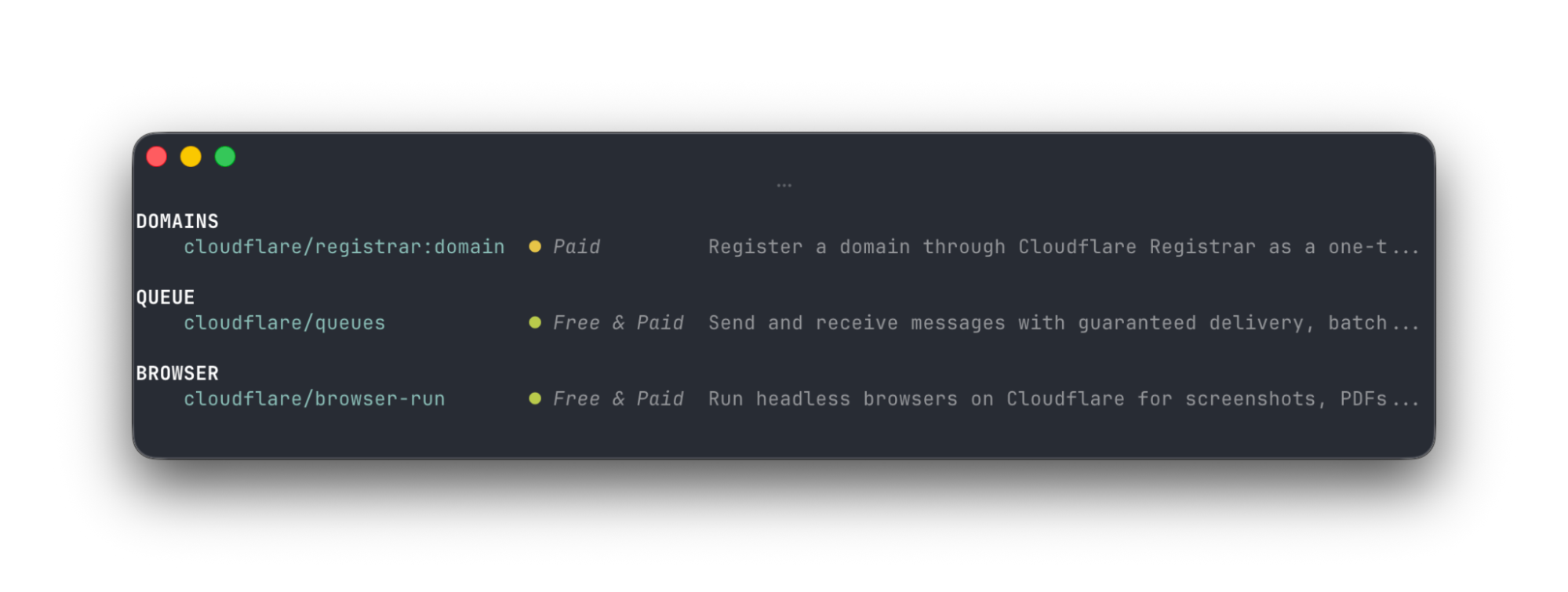
In the agent session above, before the agent ran the CLI command stripe projects add cloudflare/registrar:domain, it first had to discover the Cloudflare Registrar service. It did this by calling the stripe projects catalog command, which returns available services:
The full set of Cloudflare products and services from other providers is long and growing — arguably overwhelming to humans. But for agents, this catalog of services is exactly the context they need. The agent chooses services to use from this catalog based on what the user has asked them to do and the user’s preferences — but the user needs no prior knowledge of what services are offered by which providers, and does not need to provide any input. Providers like Cloudflare make this catalog available via a simple REST API that returns JSON, and that gives agents everything they need.
Authorization: instant account creation for new users
When the agent chooses a service and provisions it (ex: stripe projects add cloudflare/registrar:domain), it provisions the resource within a Cloudflare account. But how is it able to create one on demand, without sending a human to a signup page?
Remember how at the start, the user signed in to their Stripe account? Stripe acts as the identity provider, attesting to the user’s identity. Cloudflare automatically provisions a new account for the user if no account already exists, and returns credentials back to the Stripe Projects CLI, which are securely stored, but available to the agent to use to make authenticated requests to Cloudflare. This means if someone is brand new to Cloudflare or other services, they can start building right away with their agent, without extra steps.
If the user already has a Cloudflare account, they’re sent through a standard OAuth flow to grant access to the Stripe Projects CLI, allowing them to provision resources on their existing Cloudflare account.
Payment: give your agent a budget it can spend, without giving it your credit card info
You might rightly worry, “What if my agent goes a bit overboard and starts buying dozens of domains? Will I end up on the hook for a massive bill? Can I really trust my agent with my credit card?”
The protocol accounts for this in two ways. When an agent provisions a paid service, Stripe includes a payment token in the request to the Provider (Cloudflare). Raw payment details like credit card numbers aren’t ever shared with the agent. Stripe then sets a default limit of $100.00 USD/month as the maximum the agent can spend on any one provider. When you’re ready to raise this limit, you can then set Budget Alerts on your Cloudflare account.
Any platform with signed-in users can integrate with Cloudflare in the same way Stripe does
Any platform with signed-in users can act as the “Orchestrator”, playing the same role Stripe does with Stripe Projects, and integrate with Cloudflare.
Let’s say your product is a coding agent. You’d love for people to be able to take what they’ve built and get it deployed to production, using Cloudflare and other services. But the last thing you want is to send people down a maze of authorization flows and decision trees of where and how to deploy it. You just want to let people ship.
Your platform acts as the Orchestrator, with the already signed-in user. When your user needs a domain, a storage bucket, a sandbox to give their agent, or anything else, you make one API call to Cloudflare to provision a new Cloudflare account to them, and get back a token to make authenticated requests on their behalf.
Or let’s say you want Cloudflare customers to be able to easily provision your service, similar to how Cloudflare is partnering with Planetscale to make it possible to create Planetscale Postgres databases directly from Cloudflare. We started working with Planetscale on this well before this new protocol got off the ground, but the flow here is quite similar. Cloudflare acts as the Orchestrator, letting you connect to your PlanetScale account, create databases, and use the user’s existing payment method for billing.
This new protocol starts to standardize the types of cross-product integrations that many platforms have been doing for years, often in ways that were one off or bespoke to a particular platform. Without a standard, each integration required engineering work that often couldn’t be leveraged for future integrations. Similar to how the OAuth standard made it possible to delegate access to your account to other platforms, the protocol uses OAuth and extends further into payments and account creation, doing so in a way that treats agents as a first-class concern.
We’re excited to continue evolving the standard, and to work with Stripe on sharing a more official specification soon. We’re also excited to integrate with more platforms — email us at [email protected], and tell us how you want your platform to integrate with Cloudflare.
Give your agent the power to provision and pay
Stripe Projects is in open beta, and you can get started even if you don’t yet have a Cloudflare account. Just install the Stripe CLI, log in to Stripe, and then start a new project:
stripe projects init
Prompt your agent to build something new on Cloudflare, and show us what you’ve built!
Така пише в „Там е разликата“ от Джасинто Лукас Пирес: уж игрива, уж детска книга, която си купих от Международния панаир на детската книга в Болоня.
Превеждам си я непохватно и изпитвам облекчение. Най-после някой да каже, че не е все едно,
че разликата по същество е нещо важно, че качеството невинаги губи служебно от количеството.
През последните години е точно обратното; свръхпроизводство на стоки, свръхпроизводство на информация, свръхпроизводство на мнения, на думи, мултиплицирани до безкрайност. Дори самият панаир на детската книга в Болоня при цялата си изумителност може да остави такова чувство: една книга е свят, милиарди книги са туптящи стъпала, парещи очи и глава, която се е замаяла здраво, загубила фокуса си. Книгоиздаването е и индустрия – индустрия, в която има големи и малки, пазарни дялове, права, екранизации, лиценз на стоки, има бестселъри и нишови издания, сигурен мейнстрийм и рискови стъпки встрани. Думата „количество“ витае около всяка нова книга. В какъв тираж ще се отпечата? Колко души ще искат да я прочетат? На колко езика ще се преведе?
Вървим сред множеството книги със Свобода Цекова. Измежду павилионите мярвам Лорънс Шимел, автора на „Късмет“ – книга, издадена на над 30 езика, включително и от мен на български. Освен писател Лорънс е преводач, идва тук от сто години и познава всички. Вярно ли е, пита го Свобода, че тази година панаирът е по-малък? Мда, потвърждава Лорънс. Заради войните няколко страни не дойдоха, Филипините, Индонезия, Австралия също се отказаха. Очевидно и Иран. Тези с лицензите завзеха част от това хале, преди не бяха тук, отбелязва Свобода. Лорънс кимва.
Войните се отразяват и на такива неща като детското книгоиздаване, да. Войната в Украйна – съвсем видимо, може би защото „Старият лъв“ и преди това печелеше много награди със своите ултраконцептуални заглавия. После войните също станаха много, а детските книги – повече обърнати към темата за войната въобще, за нейната цена, за нуждата да изплетеш дома си отново, от нищото, от събрани по пътя нишки.
Такава е темата на Thread by Thread от Алис Бриер-Хакет, илюстрирана с дорисувани снимки на действително плетиво на един миши дом, който внезапно започва да се разплита, мишките бягат с една кука и десетина бримки на нея, преди да започнат отново да сплитат свой пристан – този път по-шарен. (Впрочем другата забележителна „плетена книга“ видях на полския щанд, там преждата беше пъпна връв. Преди три-четири години пък прежда имаше в книга за Луис Буржоа.) Такава беше темата и на ред други книги, включително нашата „Колелото на Кинан“ от Петя Кокудева. Но съзнанието за световния контекст се формираше и по други начини.
Чудех се дали селекцията на иранската художничка Нушин Садегян за визуалната идентичност на фестивала (и изложбата на 45 нейни творби в самото начало на илюстраторската изложба) не е също подобен жест. От друга страна, Нушин действително рисува великолепно, печелила е много други награди и при всякакви обстоятелства би заслужила признание. И все пак…
Но всъщност има ли реално значение какво прави светът на детското книгоиздаване във времена, когато количеството (силата) очевидно беснее над международните правила, над опитите за позоваване на ценности като справедливост, човеколюбие, равенство, уважение към различието – ценности, които тези хиляди детски книги съдържат, но новините след тях опровергават? Не е немислимо и да си представим как дори този свят може да бъде превзет от едни други послания… Не е да не помним такива времена. И не е да не виждаме какви политически реакции будят у нас образованието и културата за деца.
И все пак срещата между човека и книгата е качествена, не количествена. Не само заради наградите и селекциите, които се опитват да балансират пазара. Естеството на четенето е такова. Един човек, една книга, една история. И „малко и голямо“ значат нещо друго в детската литература, където това е магичното съотношение между детето и възрастния – съотношение, което се обръща с времето, но може да запази своята съкровеност, своето връщане към същността. Като в „Голяма и малка“ от Ариана Скилони и Ракел Каталина, където една деветдесетгодишна жена се смалява, смалява, смалява, докато вятърът не я подхваща и тя трябва да се хваща за тревите, докато не почне да се обърква и да губи пътя към дома си, докато не се затваря в него и не подгонва натрапниците с хитроумни способи, като камъчета от прашка и гигантски сенки. Мъничка-мъничка, накрая Наталия се покатерва до ухото на влязъл да си почине странник… и му пее люлчината песен от детството си, с която му припомня кой е.
Изящно, нежно и топло нарисувана книга… която може би ни подсказва какво може детската литература и защо е важно възрастните да я четат на децата: освен всичко друго – заради самите себе си, за да чуят на глас кои са и какво точно ценят.
Един маршируващ е луд, пише в „Там е разликата“ от Джасинто Лукас Пирес.
Много маршируващи са армия. Тълпата прави от символите политика. Отделният човек прави от символите поезия.
Един играч, който нарушава правилата, е измамник. Много играчи, които нарушават правилата, създават нова игра.
Една точка е край. Три точки са…
В емблематичната си колонка „Ходене по буквите“, започната още през 2008 г. във в-к „Култура“, Марин Бодаков ни представяше нови литературни заглавия и питаше с какво точно тези книги ни променят. В началото на 2020 г. той я пренесе в „Тоест“. Вярваме, че е важно тази рубрика да продължи. От човек до човек, с нова книга в ръка. От края на 2021 г. по буквите тръгна Зорница Христова.
Активните дарители на „Тоест“ получават 20% отстъпка от коричната цена на всички книги на над 15 български издателства. Кои са те – вижте в условията на Читателски клуб „Тоест“.
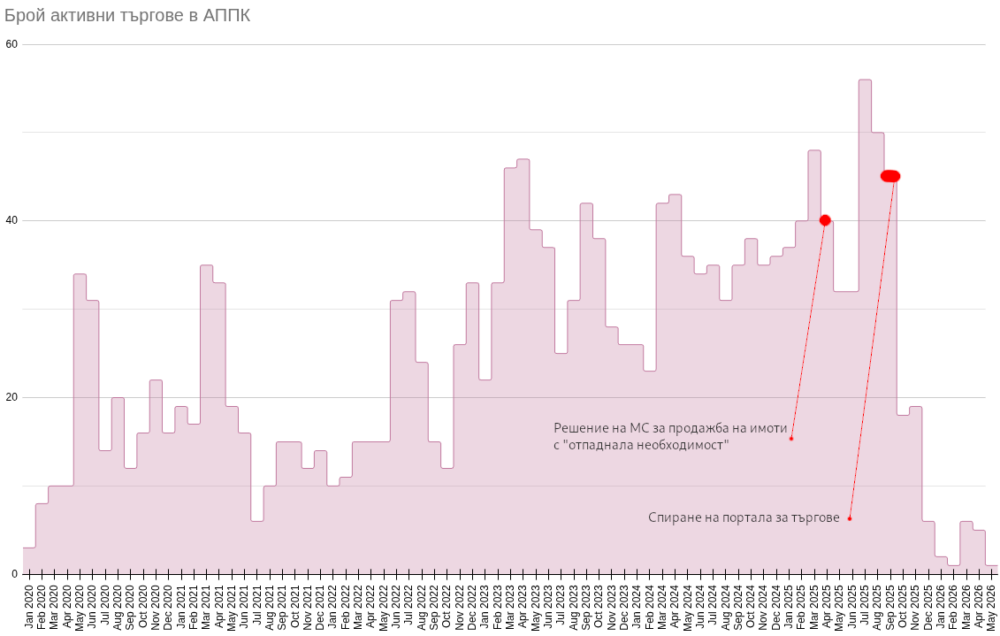
Вчера служебният кабинет на Гюров взе решение да оттегли искането до Народното събрание за одобряване на Програмата за упражняване правата върху имоти – държавна собственост. Припомням, че след като темата нашумя, ГЕРБ и кабинета Желязков твърдяха, че спират продажбите докато парламента не потвърди приетата програма. В действителност се възползваха от отпуската на народните представители, за да потушат скандала. Преди това бяха казали, че само анализират и няма течащи продажби. В през август показах, че това не е вярно и че само дни след изказването на Желязков има насрочени търгове. В края на август спряха платформата за търгове на АППК. През декември показах, че след пик на активните търгове през юни до август има голяма пауза на активните търгове.
Правителството оттегли предложението до Народното събрание на Република България за одобряване на Програмата за упражняване правата върху имоти – държавна собственост, и върху имоти – собственост на държавни публични предприятия, и отмени решения на Министерския съвет.
Към Програмата е проявен значителен обществен и медиен интерес. По тази причина с Решение № 536 от 7 август 2025 г. Министерският съвет предлага на Народното събрание да разгледа и одобри Програмата, както и да приеме решение, с което до одобряването й да не се извършват разпоредителни действия с държавни недвижими имоти в полза на трети лица, освен за нуждите на държавни органи, агенции и комисии, общини и публични предприятия.
Към настоящия момент предложението не е разгледано и прието от 51-то Народно събрание.
Целта на проекта е да се осигури възможност за бъдещото редовно правителство да направи анализ на предложението до 52-то Народно събрание и при преценка да се предложат промени, съобразно провежданата държавна политика и програмата на правителството за управление на страната в областта на държавната собственост.
Това не значи, че програмата е спряна или има повече яснота или прозрачност какво се случва. Означава, че оставят за следващия кабинет да реши какво ще прави с плана, дали ще го прекроява, ще пита отново НС или ще търси други решение. Най-важното в случая е да променят практиката на ГЕРБ и ДПС НН за пълна липса на прозрачност и да вземат пример от служебния кабинет, който сякаш отвори повече данни за няколко месеца, отколкото всички кабинети за много години назад.
Какво се случи с онези 4400 имота всъщност?
През изминалата година от решението на кабинета Желязков няма обновен списък с „ненужни“ имоти, няма отговори как е съставен първият, последващи действа или каквото и да е свързано с темата. Дори оригиналният списък изчезна и повече не е публикуван.
Реших да обновя статистиката на търговете на АППК от декември и да видим какво се случило до сега. Виждаме ясно, че след спирането на портала през септември броят на активните търгове силно намалява и остава нисък. Към началото на март е имало 6 активни търга, а към днешна дата само един – имот на ББР в Разград, с който се надяват да получат поне 1.3 млн. евро.
Равносметката за тази година е, че от регистъра на електронните търгове в АППК, където и както са длъжни да продават всички дружества, научаваме за 92 обявени търгове. От тях 27 са прекратени предварително, а 22 са изтрити. Последното според отговор на агенцията е, защото са оттеглени. Най-много търгове за последната година е провела Земинвест ЕАД – 21, следвани от ББР и „БДЖ-Товарни превози“ ЕООД по 16.
16 от търговете са успешни, т.е. някой ги е спечелил. От тях 6 се отнасят до имоти от списъка на Желязков. Общата сума предполагаемо спечелена така за държавата е не повече от 730 хиляди евро. Казвам предполагаемо, защото това, че е спечелен търг не значи, че сделката е била финализирана, имота прехвърлен и цената платена. Попадал съм на няколко търга за идентични имоти след като за същото е имало успешен търг по-рано.
Продадените имоти са в Тръстеник, с. Голяма Железна, Пловдив и Драгоево. Търговете в Трявна и Бургас се отнасят до повече от един обект от списъка на Желязков и са имало поне два неуспешни търга преди някой да бъде спечелен. Две от тези успешни продажби са направени през юли 2025-та, когато осветлих списъка. Една през септември, една през октомври и още две през ноември. Т.е. поне четири имота от списъка са имали успешни търгове след като кабинета на ГЕРБ и ДПС НН обявиха, че спират с продажбите. За нито един от тези имоти няма публична аргументация защо са ненужни, струват ли пари на държавата или нещо от останалото обещано лично от Желязков.
Всички търгове на АППК, както и данните от оригиналния списък на Желязков и ГЕРБ ще намерите на картата, която пуснах миналата година. Под първата ми статия следяща темата ще намерите списък с всички текстове от поредицата.
Добре скритите публични търгове
Проблемът с тези данни е, че изглежда не обхващат всички търгове с държавни имоти. Както казах, държавните предприятия са длъжни да използват само АППК за прозрачни и електронни търгове. Единствено Министерството на отбраната имаше специален режим и изключения, но и това беше променено. Въпреки това, откриваме, че е имало доста такива продажби.
Пример за това е Национална компания Железопътна инфраструктура (НКЖИ). Директна собственост е на министерството на транспорта. Няма нито един търг в АППК и такива липсват на страницата с търгове на собственият им сайт. Проверка в интернет архива или търсене по ключови думи на страницата им обаче показват, че е имало поне 15 търга за продажба на държавни имоти в последните 12 месеца. Липсва всякаква прозрачност дали тези търгове са спечелени, от кого и за каква сума. Скриват се от страницата за продажби или наеми след като приключат. НКЖИ има 448 имота в списъка на Желязков и не е известно колко са продали междувременно. Същото важи за стотиците други държавни компании.
Затова засегнах в началото колко важна е прозрачността и отворените данни що се отнася до действията на институциите. Не само за проследимост и възстановяването на доверие, но и в случая за постигане на най-добри продажни цени предвид, че не се крият фиктивни търгове за предварително съгласувани облагодетелствани.
Experience AI has grown into a global effort to build AI literacy in schools, supporting educators and young people around the world to better understand and critically engage with AI technologies. We recently brought Experience AI to Uzbekistan through a new collaboration with UNICEF.
Together, we are integrating Experience AI into the Tinkering with Tech programme, which supports Uzbekistani educators and learners to develop 21st-century skills, including computational thinking, and digital and AI literacy skills.
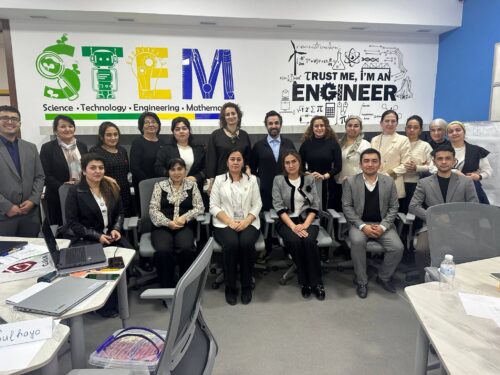
As one of the Learning Managers on the Foundation’s AI literacy team, I travelled to Uzbekistan to lead the AI literacy part of the programme, working closely with local trainers and educators and introducing them to Experience AI.
Experience AI training in action
On the plane to Tashkent, Uzbekistan, I found myself wondering about the level of engagement with AI tools among teachers and educators in Uzbekistan: how interested are teachers and students in AI technologies? Are they more excited or hesitant about AI technologies?
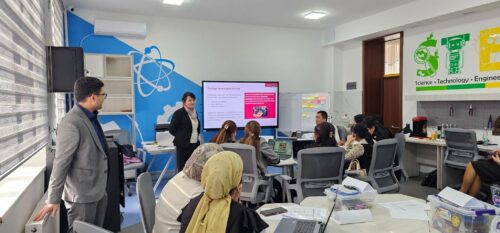
My questions were answered within minutes of the start of the training session in Tashkent. The teachers and trainers, who had travelled from cities and rural areas across the country, were enthusiastic, inquisitive, and already experimenting with AI technologies in their daily lives.
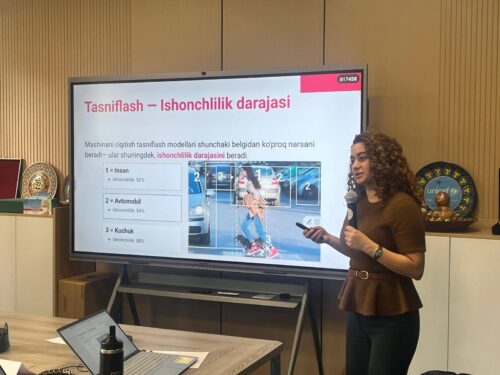
The training session created space for educators to deepen their understanding of both technical concepts like classification and accuracy, but also ethical considerations, including data representation, bias, and the implications of inaccurate AI tools.
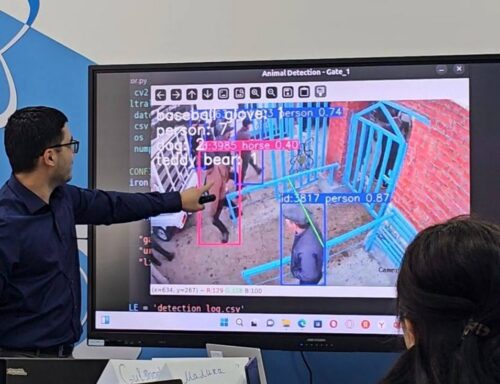
One particularly powerful example of how AI systems can be inaccurate came from a trainer who shared video footage from a local cattle market, where an AI tool classifies animals and monitors traffic. In the video, a human was misclassified as a horse, and a goat misclassified as a human.
While the example was funny and showed a harmless error, it quickly became a meaningful learning opportunity. Together, we used it to have a wider discussion around the implications of these errors. For example, what happens when AI tools fail in higher stakes situations? Would we trust a self-driving car that might misclassify a person in a long, dark coat as a lamp post, or a child in an orange-and-white coat as a traffic cone?
Localisation and representation
Working closely with the partners and trainers, we used localised examples in the training to explore other AI literacy concepts, particularly representation and bias.
In one activity, we used an AI tool to generate an image of Gulistan, a beautiful city in eastern Uzbekistan. The result sparked a range of reactions — while Gulistan is known for its flat landscape and mosques, the AI-generated image showed mountains and churches.
An AI-generated image using Artguru.
This led to a rich discussion about how AI systems represent places and cultures, and what it means when those representations are inaccurate. I asked them: why did the tool produce this image? What data might the underlying model have been trained on? And how do these inaccuracies shape perceptions, especially for those unfamiliar with the place being represented?
This example resonated strongly with the trainers, particularly because it reflected their own context. After a short break, I returned to find everyone still engrossed in a deep discussion around the lack of neutrality of AI tools, and what that meant for them, their students and communities. As one trainer reflected, “I have changed my mind about AI and now I have a better understanding of it.”
Adapting to global classrooms
Spending time with educators in Uzbekistan was also a reminder that classrooms are far from uniform. In some Uzbekistani settings, learners have access to laptops and interactive whiteboards; in others, teaching happens with limited electricity, lower levels of digital literacy, or shared devices among many students.
As we continue to expand Experience AI globally, localisation remains crucial. From South Africa to Saudi Arabia, and from Ukraine to Uzbekistan, flexible, context-aware resources are key to ensuring that all learners have the opportunity to develop a meaningful and critical understanding of AI.
In our ongoing collaboration on the Tinkering with Tech programme with UNICEF, the Micro:bit Educational Foundation, and Arm, we’re supporting teachers to develop the confidence and skills they need to teach AI in ways that are engaging, relevant and grounded in real-world contexts for their students. Together, we aim to equip young people with the knowledge and confidence to shape how these technologies affect their lives and communities.
For more information about Experience AI, visit our website, experience-ai.org.
About Tinkering with Tech and AI: UNICEF is co-developing new learning materials, enhancing AI literacy, and scaling the Tinkering with Tech and AI initiative to reach more learners and education systems worldwide. The initiative benefits from the continued strategic support from Arm and the Government of Finland, along with technical partners the Raspberry Pi Foundation and Micro:bit Educational Foundation. Learn more here.
Да си го признаем – твърдата ръка е на почит в България. Дори сред избирателите на малкото партии, смятани за демократични. Да погледнем отношението към членовете на служебния кабинет на Андрей Гюров, асоцииран (кабинетът, впрочем и Гюров) с ПП–ДБ – единствената проевропейска и що-годе демократична парламентарно представена коалиция. „Звездата“ в правителството обаче се оказа не Андрей Янкулов, олицетворяващ стремежа на ПП–ДБ към правосъдна реформа. Лаврите обра вътрешният министър Емил Дечев в комплект с и.д. главен секретар на МВР Георги Кандев. За последен път споменаването на длъжността главен секретар на МВР пораждаше такова благопочитание преди повече от 20 години, когато постът се заемаше от Бойко Борисов. А вицове за Чък Норис бяха рециклирани с имената на министъра и професионалния ръководител на МВР, например: „Като малък Емил Дечев винаги карал баба си да си изяжда закуската.“
Овациите за Дечев и Кандев впрочем бяха заслужени.
Но не защото те олицетворяваха твърдата ръка, подвизавайки се като шерифи в каубойски филм, както ги представяше народната любов, а именно защото не го правеха. Вместо да организират показни акции с мижав ефект, те разшириха обхвата на проверките за купен и контролиран вот. В навечерието на изборите Дечев отчете повече от 2000 сигнала за изборни нарушения (за сравнение, преди изборите през 2024 г. те са били 612), 534 бързи и досъдебни производства – (през 2024 г. са били 70, а разликата между бързото и досъдебното производство е, че първото е под ръководството на МВР, а второто – на прокуратурата). Без да пропускаме над 1 200 000 конфискувани евро, предназначени вероятно за купуване на гласове. А веднага след края на изборния ден МВР оповести и за кои политически субекти са отправени сигналите. Очаквано – най-много са били за ДПС (631), следвано от ГЕРБ (318). За останалите партии и коалиции са постъпили по по-малко от 20 сигнала.
Как беше преди?
Постигнатото от Дечев и Кандев заедно с министри от правителството на Гюров – като социалния Хасан Адемов и земеделския Иван Христанов – е значимо не само в количествено отношение. А защото не се свежда до обичайния расизъм и етническата дискриминация, в които обикновено се изразява борбата с купения и контролирания вот. Досега тази „борба“ приемаше основно две форми – показни акции в ромски квартали и опити за ограничаване на гласуването на българските изселници в Турция. Известно изключение от ограничаването до тези практики имаше по времето, когато вътрешен министър беше Бойко Рашков, който разпореждаше и проверки във фирми в опит да се ограничи корпоративният вот.
Обичайните акции срещу купения вот в ромски квартали включваха показни арести на лихвари с изземване на събирани от тях лични карти и списъци с имена, както и на магазинери, продаващи на вересия. Задържаха се и хора с криминално минало, у които са намерени я оръжия, я наркотици, я пари, я други забранени или незаконни неща (например стоки без бандерол). Така, от една страна, проблемът с купения и контролирания вот се свеждаше до ромите, от друга – се приравняваше до различни форми на престъпност, нямащи нищо общо с политическите права на гражданите.
Понякога обект на акциите ставаха не само заподозрените, а по-скоро всички, които живеят в определен квартал или просто го посещават. През 2021 г. например, по времето на Рашков, имаше случаи полицията да сформира КПП-та на входа на махали и да проверява всички преминаващи автомобили.
Тази практика обаче бледнее пред размаха на репресивността на бившия кмет на Кюстендил Петър Паунов. През 2011 г. той въведе КПП-та и пропускателен режим в изборния ден на местата, където гласуват роми, с цел „да няма напрежение и провокации и да не се затруднява работата на комисиите“. През 2015 г. пък Паунов организира референдум, на който гражданите на Кюстендил да гласуват дали той да се кандидатира за кмет, като не допусна до него жителите на ромския квартал. Комисията за защита от дискриминация се самосезира по случая.
Опити за възпрепятстване на изселниците в Турция
Интензивността на усилията да се попречи на българските изселници в Турция да гласуват зависи от отношението на властта към партията, за която преобладаващата част от тях възнамеряват да дадат гласа си. А понякога – и от желанието да се попречи на успешното представяне на изборите на нов политически субект, за какъвто биха гласували мнозинството от българите в чужбина. При втората хипотеза изселниците в Турция са „косвена жертва“.
Тази втора хипотеза беше приложена на практика на последните избори през април 2026 г., когато броят на избирателните секции в страните извън ЕС беше ограничен до максимум 20. Основното опасение на парламентарното мнозинство, приело промяната в Изборния кодекс (ИК), беше политическият проект на Румен Радев. Но и Делян Пеевски нямаше интерес изселниците да гласуват, защото в Турция не се радва на особена популярност.
Промяната в ИК е римейк на подобна от 2016 г., инициирана от Патриотичния фронт, чиято основна цел беше да се попречи на българските граждани да гласуват, а косвените жертви се оказаха имигрантите в други страни извън ЕС. Впрочем и тогава мярката беше отчасти в полза на ДПС. Същата година бившият председател на ДПС Лютви Местан създаде своя партия – ДОСТ, с която, в коалиция с НДПС на Орхан Исмаилов, се включи в изборната надпревара през 2017 г., разчитайки най-вече на избирателите от Турция. И макар да получи малко над 17% от гласовете извън България и 21,59% в Кърджали, общият резултат от близо 3% не беше достатъчен за влизане в парламента.
Друга практика за възпрепятстване на изселниците е опитът физически да им се попречи да гласуват в България. През същата 2017 година Валери Симеонов (председател на НФСБ, част от Патриотичния фронт) упражни физическо насилие върху жени, дошли от Турция за изборите. Той нарече една от тях „нагла“, защото „си знаеше правата“, и я определи като „пълничката баба“.
Трябва да се признае, че въпреки расизма и ксенофобията си, акциите в махалите и затрудняването на изселниците в Турция да упражняват правото си на глас са опити за справяне със системни проблеми в българския политически живот. И те са, че местата с компактно ромско население са особено уязвими на контролиран вот, а българските турци – поне до изборите на 19 април 2026 г., когато досегашният модел претърпя сериозни поражения – масово гласуват за ДПС (понякога се появява конкуренция в лицето на друга „турска“ партия, която бързо залязва).
За да е такъв обаче т.нар. етнически вот, има причини и те не се премахват с козметично замазване на симптомите. Основният проблем е
паразитирането върху уязвимостта с политически цели.
Уязвимостта може да има много лица: бедност и задлъжнялост, страх да не разрушат единственото ти жилище, дискриминация и омраза от страна на мнозинството. Но също и увреждане, зависимост от работодател и липса на алтернативи за работа, необходимост от инфраструктура и пр.
Нещата всъщност не опират до етноса, нито до характеристиките на населеното място, макар ромите, турците и хората в малките населени места да са по-уязвими. Но дори софиянци бяха „наказани“, че са избрали за кмет Васил Терзиев, който пък не се е снимал с Пеевски. Докато столичани се ядосват защо е зациклил ремонтът на бул. „Стамболийски“ и защо не се извършват редица подобрения в града, се оказва, че София е получила едва 13% от бюджетното финансиране, което е заявила – по-малко в парично изражение, отколкото например Ветово или Гърмен.
В крайна сметка контролираният вот опира до политически натиск,
който, ако не срещне никаква съпротива, както беше по времето на правителството на Росен Желязков, се разпространява като гангрена далеч отвъд „обичайните заподозрени“ гласоподаватели в ромските квартали и „крепостите“ на ДПС. Ала както беше казал експертът по сигурност и бивш заместник вътрешен министър Филип Гунев, най-лесно е МВР да се концентрира върху криминалния контингент, защото „нагоре вече е опасно“ и „политически рисково“.
Как беше сега?
В опитите за ограничаване на контролирания вот служебното правителство на Андрей Гюров, наред с обичайните акции в рискови ромски квартали, се опита да стигне и там, където „вече е опасно“. То реагираше на сигнали срещу кметове, общински съветници, кандидат-депутати с имунитет.
Мащабът на проверките показа, че опити за влияние върху вота може да се правят на най-различни места. Беше арестуван например директорът на пощата в Кърджали по сигнал, че е отправял заплахи, свързани с изборите. Според МВР той е карал служители на хуманитарна организация (по-късно се разбра, че става дума за Българския червен кръст) да казват, че храната, която дават на уязвими хора, е подарък от ДПС.
Друга форма на натиск са заплахите към хора с увреждания и близките им, които се грижат за тях, че ако не гласуват за определена партия, няма да получат пари за личен асистент или размерът на средствата ще бъде намален. Това е един от разнообразните методи за шантаж, свързан с достъпа до социални програми.
Вотът може да се контролира също чрез работодатели, които нареждат на служителите си за кого да гласуват – под страх от уволнение или намаляване на парите „под масата“, или пък с обещание за „материално стимулиране“. Колкото по-крупни са тези работодатели, толкова по-голям е ефектът. ТЕЦ „Бобов дол“ например е бил тема на журналистически разследвания във връзка с контролирания вот. Няколко дни преди изборите полицаи от управлението на МВР в Кюстендил извършиха проверки и иззеха документи, списъци и пари, които дават сериозни основания да се предположи, че „има нещо гнило“.
Разширяването на периметъра на борбата с изборните нарушения ясно показа,
че проблемът с купения и контролирания вот не е въпрос на етнос, култура или майчин език, а идва отгоре. Както гласи известната до баналност поговорка, рибата се вмирисва откъм главата. Докато правосъдната система обаче е политически зависима, не може да се очаква, че „главата“ ще отговаря за престъпленията си.
Освен това – защото като съдия е наясно докъде се простират границите на действие на един вътрешен министър – Дечев не си позволи зрелищни акции, които впоследствие да се обърнат срещу него – например да изгони Борислав Сарафов от кабинета на главния прокурор, за което беше нееднократно призоваван. За разлика от Бойко Рашков, който през 2022 г. разпореди да бъдат арестувани за 24 часа Бойко Борисов, пиарката му Севдалина Арнаудова и бившият министър на икономиката Владислав Горанов. Макар тази акция да предизвика бурна радост сред критиците на ГЕРБ, тя се оказа фиаско, за което ПП, а покрай тях и ДБ платиха висока цена.
Макар да не стигна до вмирисаната глава, постижението на правителството на Андрей Гюров е, че не се задоволи само с опашката на рибата, а се придвижи малко към перките ѝ, между острите и отровни шипове. Кой знае, ако някое правителство успее да стигне до главата, току-виж се окаже, че тя получава нареждания от друга, по-голяма и по-миризлива глава.
Researchers have reverse-engineered a piece of malware named Fast16. It’s almost certainly state-sponsored, probably US in origin, and was deployed against Iran years before Stuxnet:
“…the Fast16 malware was designed to carry out the most subtle form of sabotage ever seen in an in-the-wild malware tool: By automatically spreading across networks and then silently manipulating computation processes in certain software applications that perform high-precision mathematical calculations and simulate physical phenomena, Fast16 can alter the results of those programs to cause failures that range from faulty research results to catastrophic damage to real-world equipment.”
Живея в една абсурдна политическа среда. Всеки път, когато се случи нещо невъобразимо, си казвам, че това е дъното, но след това се оказва, че има и друго дъно, още по-дълбоко. И така вървим към ядрото на земята. Иска ми се да се събудя от кошмара или да напусна кошмарната кинопрожекция, но и двете не ми се получават. Всички около мен са се вторачили в наближаващите междинни избори тук (САЩ) с надежда, страх и тревожност.
Две партии – две философии за властта
С наближаването на тези избори през ноември 2026 г. Демократическата и Републиканската партия оформят рязко различаващи се стратегии. Разликите са не само идейни, а и философски: как се печели власт, на кого се говори като избирател и кой плаща сметките. Партийните послания са продукт не само на идеология, а и на финансиране, вътрешнопартийни противоречия и структурни предимства. С други думи, не е важно единствено какво казваш, а с кого си свързан, докато го казваш.
Демократите влизат в цикъла на 2026 г. със самочувствието на партията на „гражданската енергия“, малките дарители и активизма „по места“. Доста ранните финансови успехи, почиващи на хиляди малки дарения, и ентусиазмът на прогресивните PAC-ове¹ им позволява да създадат удобен наратив: „Ние сме подкрепяни от хората, не от милиардерите.“ Кандидати като Джеймс Таларико, Джон Ософ и Шерод Браун вече са събрали милиони долари, което говори за мащаба на прогресивния ентусиазъм. Но зад тази вълна от малки дарения се крие старият проблем – вътрешното разделение.
Прогресивното крило настоява за системни реформи, икономическа справедливост и борба с неравенствата. Умерените, особено в колебаещите се райони, предпочитат по-тих тон, стабилност, прагматизъм и „да не плашим центъра“. Общият знаменател? Защита на демокрацията и противопоставяне на политики, асоциирани с Доналд Тръмп. Но тук изпъква един премълчаван проблем: демократите упорито подценяват реалната опасност от нечестни избори. А тя, при управление с открито пренебрежение към институциите, не е хипотеза, а реална възможност.
Още по-проблематично е неразбирането или пренебрегването на културното разделение на обществото. Избирателите все по-рядко гласуват според икономическите си интереси и все по-често – според културната си идентичност. Няма го класовото съзнание на Карл Маркс. Докато демократите обясняват как икономическите им програми „помагат на всички“, републиканците говорят за разпадащия се традиционен свят – такъв, какъвто го знаем и харесваме. И страхът, за разлика от икономическите данни, определя политическия избор.
Републиканците – ред, страх и чекове с много нули
Републиканската партия залага на по-различен подход: организационна мощ, структурни предимства и големи донори. През 2025 г. републиканските национални комитети събраха повече средства от демократите, а ролята на супер PAC-ове като Senate Leadership Fund и Congressional Leadership Fund расте. Като добавим към това щедрите дарения на Илон Мъск, и наративът се оформя: партията на бизнеса ще успокои икономическото недоволство, ще подобри пограничната сигурност и ще се справи с културната тревожност. Този подход енергизира твърдото електорално ядро на MAGA.
Както винаги, социалните мрежи са централната арена на конфликтите. Руското присъствие не повтаря шока от 2016 г., но остава устойчив фон за внасяне на неистини и съмнения. Целта е по-скоро да накараш избирателя да не вярва на нищо. Изкуствен интелект, фалшиви новинарски сайтове, координирани публикации в X, Telegram и периферни платформи работят за задълбочаване на недоверието. Демократите залагат на TikTok и Instagram, на инфлуенсъри и кратки видеа, които „разказват политиката“. Републиканците доминират в екосистеми, построени около личности и завъртени през гнева и усещането за несправедливост. Две различни дигитални пространства почти без припокриване и без шанс да се убеди избирател, чиито медийни алгоритми му представят само това, което очаква да види.
Бунтът като политически жест
Към тези сравнително добре структурирани стратегии трябва да добавим и неструктурираното, а именно емоцията. Най-ефективната ѝ форма днес е популизмът, подправен с обещания за радикална промяна. Преди около две години във Великобритания Киър Стармър спечели с обещание за стабилност и бързо стана непопулярен. В Япония Санае Такаичи победи с конфронтация и радикални предложения и продължава да бъде харесвана в иначе традиционно мъжка политическа среда. Същото видяхме и в Ню Йорк с Мамдани, който се представи като бунтар в кампанията си, и засега подкрепата му продължава да е висока. Изглежда, че в сегашните времена избирателите предпочитат бунта пред реконструкцията. Гласува се със сърцето, а не с разума. Разочарованието идва после.
Трудно ми е да избегна паралелите с българските избори от 19 април. И в България имаше съмнения, изказани от евродепутатка, за руска намеса, а TikTok закри десетки фалшиви акаунти. Социалното и културно разделение е сходно, а търсенето на „рязка промяна“ – същото.
Докато американските партии се мъчат да обединят разцепени крила, българските трудно формулират ясно разпознаваеми послания. Избирателят по традиция се впечатлява от личности, не от програми. От Сакскобургготски, през Станишев, Борисов, до Радев наказателният вот и отричането на статуквото тежат повече от всяка управленска платформа. Освен антикорупционните и антиолигархични послания, подкрепени с близо десет години популизъм по време на президентските мандати на Радев, политическата му програма е неясна. Не може да се разбере и от парламентарните членове на „Прогресивна България“, които засега са група от няколко известни спортисти, някои познати лица от служебните кабинети на Радев и други с неизяснени позиции.
Остава популизмът само с няколко от множеството примери: най-високия пилон с българското знаме в Европа, недопустимия от конституционна гледна точка референдум за еврото, последното новогодишно поздравление като президент, в което той пак критикува приемането на еврото, а в същото време подчертава, че България принадлежи към ЕС заради „цивилизационния си принос“. Всички тези примери, включително имена на успешни атлети в партийните листи, са пряко свързани с големия разказ на българската национална идентичност – гордост, бунт и символи на величие. Политиката се превръща в емоционален спектакъл, а не се държи като програма за бъдещето.
Разумът губи и емоцията печели
Докато републиканците в САЩ определено разчитат на страха и на емоциите, които той предизвиква у избирателите, демократите все още колебливо се опитват да активират други чувства у своите избиратели за междинния вот през 2026 г. А резултатите от българските и други избори показват едно и също: когато недоволството е повсеместно, избирателят търси не най-добрата политика, а най-силното чувство. Питате се дали в Унгария все пак не надделя разумът? Може би разумът надделя, защото страхът от заплахите на Орбан престана да действа.
1PAC (Political Action Committee) е организация, която набира и разходва средства за подкрепа или противопоставяне на кандидати и политики в изборния процес в САЩ.
Catering to the small form factor PC market, Gigabyte has released a low-profile version of its GeForce RTX 5060 card. The RTX 5060 OC LP delivers all of the performance of a full-sized card, but in half the volume
In Part I, we discussed why Grab is investing in a data mesh, referred to as the Signals Marketplace within Grab, as part of our evolving data culture. We also explained how data certification aids teams in reliably reusing data across different domains. However, cultural change doesn’t occur through principles alone; it happens when tools reshape people’s daily behaviors. Therefore, it is crucial for us to develop effective platforms that integrate these practices.
This follow-up focuses on these platforms that make certification work at Grab:
Hubble – the central metadata management platform with a built-in certification engine.
Genchi – the data quality observability platform.
Data Contract Registry – the central service for managing data contracts.
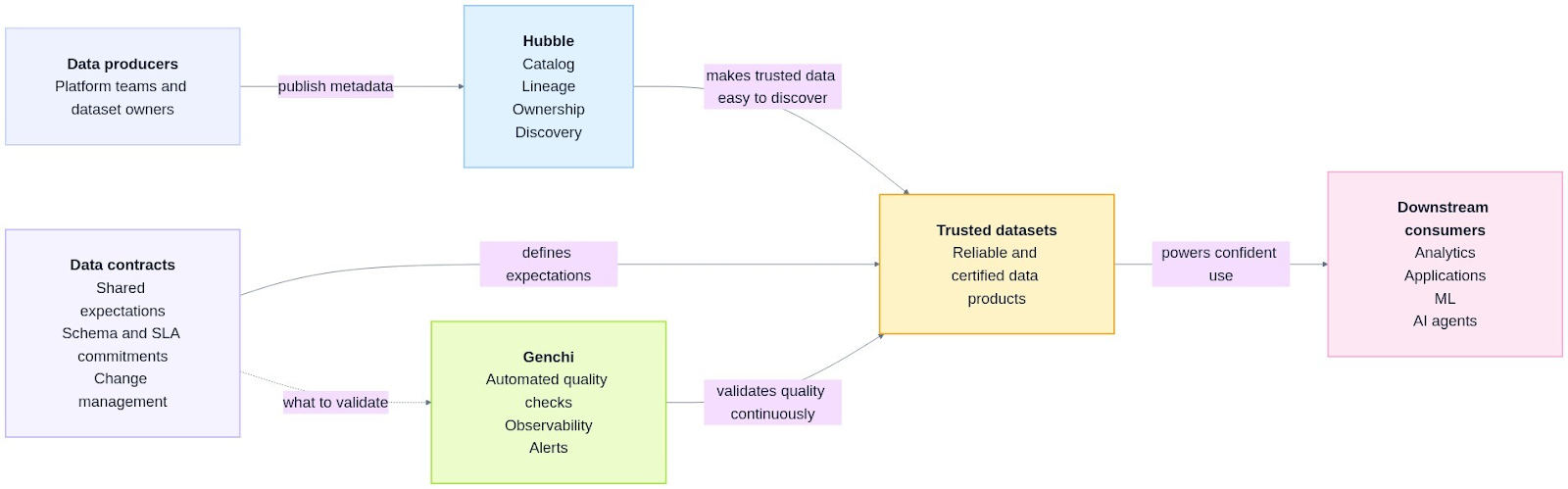
Together, these platforms turn data mesh principles into an operational system that scales across hundreds of thousands of datasets, streams, attributes, and metrics.
Hubble: The data discovery and governance layer
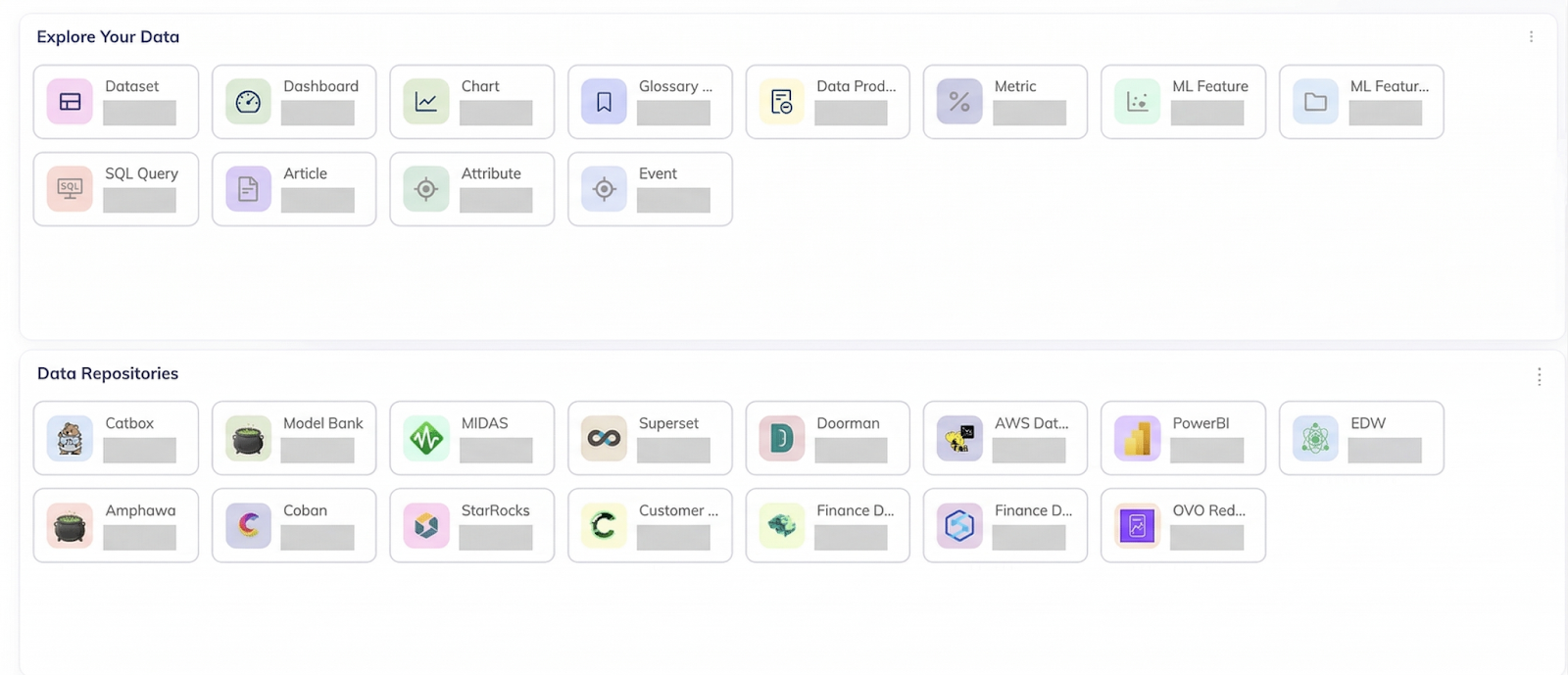
Hubble is Grab’s central metadata management platform and data catalog for all data assets, including datasets, dashboards, metrics, Machine learning (ML) models, and more. Built on top of the open‑source DataHub and heavily extended for Grab’s needs, it is the discovery and governance layer for the Signals Marketplace.
Figure 1. Hubble cataloging data assets across various data platforms in Grab.
What Hubble does for data mesh
For certification and data mesh, Hubble provides a few key capabilities:
Search and discovery: Data analysts/scientists, engineers, and product managers use Hubble to search the rich swath of data assets, then inspect schemas, documentation, lineage, and usage statistics in one place. This replaces back-channel questions and tribal knowledge with a single, self-serve catalog.
Ownership and domains: Every asset is tied to a domain and explicit technical and business owners. This enforces the domain ownership model that Signals Marketplace depends on. Producers are clearly accountable for the quality and lifecycle of the data products they publish.
Data contracts and documentation: Data contracts, classifications, and rich documentation live as structured metadata attached to each asset, not scattered across wikis and slide decks. Producers and consumers share the same source of truth when they ask questions like, “what does this table guarantee?”.
Lineage and impact analysis: Hubble provides table, column, and metric-level lineage so owners can see which teams and pipelines depend on their data before making breaking changes or deprecations. Instead of guessing, they can answer “what will I break?” with a single click.
Certification status: The familiar “Hubble green tick” turns trust into a first-class signal in the catalog. Assets that meet Grab’s certification criteria are clearly marked with a drill-down view of which criteria are satisfied (ownership, documentation, contracts, quality tests, upstream certification) and which are still missing.
From a consumer’s point of view, this collapses a lot of uncertainty into a simple workflow: search → filter to “certified” → pick the most suitable asset. They don’t need to reverse-engineer reliability from table names and hearsay.
Hubble’s system architecture
The open-source DataHub architecture is fundamentally event-driven and designed for high extensibility, moving away from the “passive” catalogs of the past, towards a “living” metadata graph. DataHub models everything as an Entity (e.g., a Dataset), composed of multiple Aspects (atomic versioned metadata like SchemaMetadata or Ownership), connected by Relationships (e.g., DownstreamOf).
Since introducing DataHub as Grab’s central data catalog in 2022, we’ve tailored it to Grab’s specific needs while continuously rebasing onto the latest open-source DataHub releases. This lets us adopt new capabilities from the community quickly, contribute improvements back, and evolve Hubble without forking away from the main project.
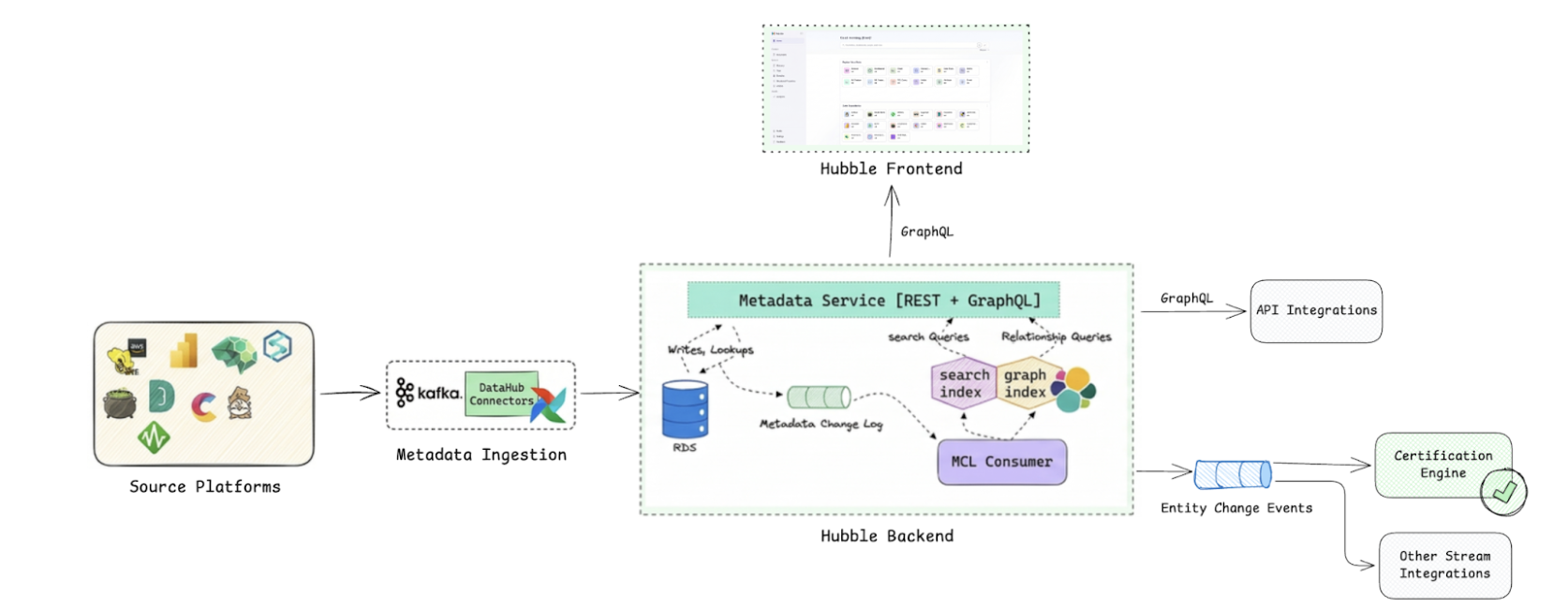
On top of the DataHub foundation, Hubble ingests metadata from Grab’s source platforms in two ways. Source systems either push changes as they happen, or Hubble periodically pulls metadata via Airflow jobs into the central metadata service that exposes GraphQL and REST APIs. Every change is then published to Kafka as metadata events (low-level change logs for indexers and audits, and higher-level semantic events for workflows), keeping Hubble’s search and lineage indices fresh and allowing downstream integrations like certification, deprecation notices, and governance automation to react to metadata changes in near real time.
This architecture is crucial for a data mesh because metadata evolves more rapidly than organizational changes. As domains change, tables are relocated, or pipelines are refactored, Hubble continuously updates, allowing certification to keep pace without the need for manual re-audits.
Figure 2. Hubble’s system architecture.
Computational certification via the certification engine on Hubble
A data asset’s certification state is not a manual label, it is computed by an event-driven certification engine built on the DataHub Actions framework. As source platforms for tables, streams, metrics, and user attributes push metadata into Hubble, every change becomes a metadata event. The engine subscribes to these events and re-evaluates the certification state of the data asset based on the predetermined certification criteria.
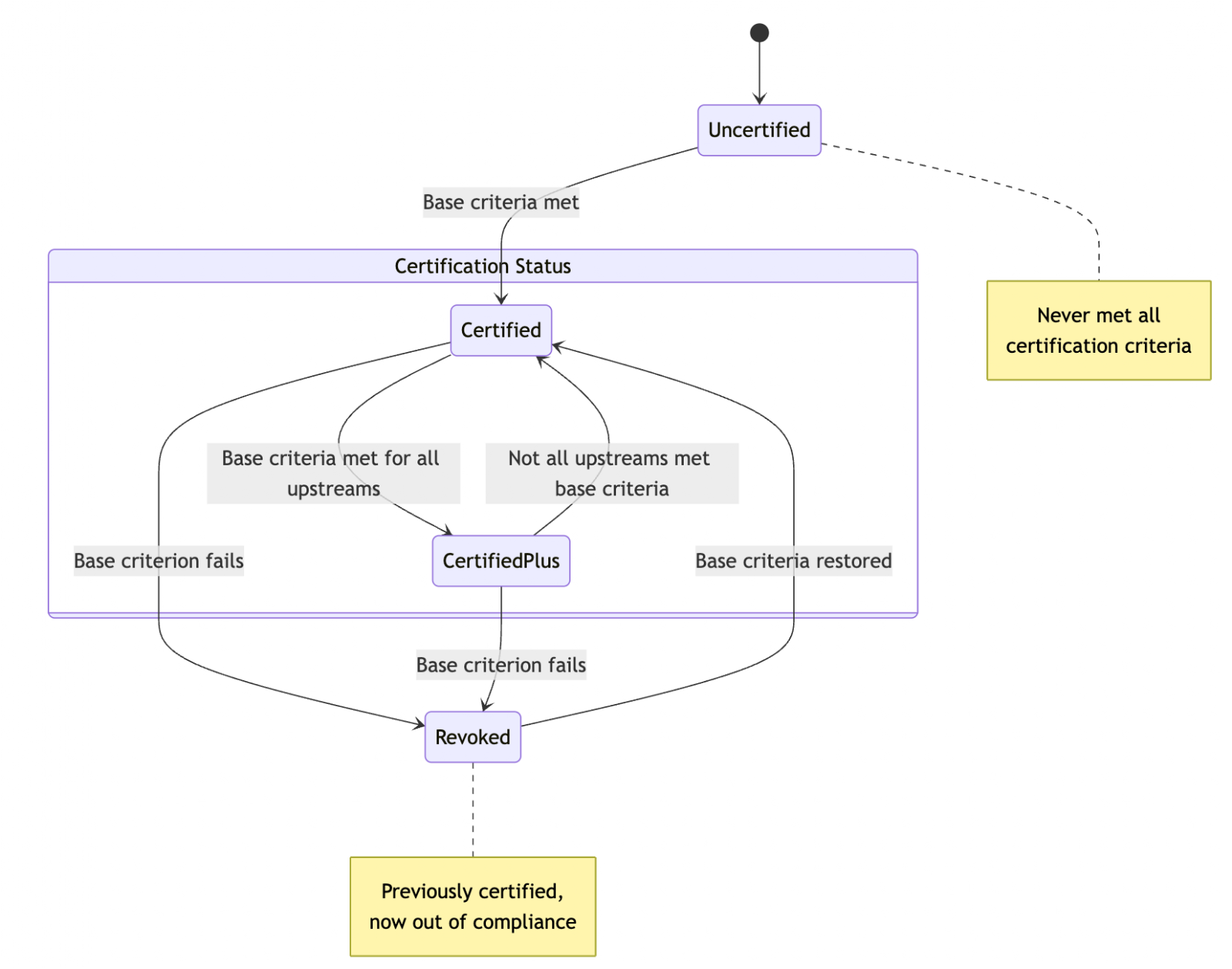
Conceptually, assets move between four states:
Uncertified: Never met all criteria.
Certified: Asset itself meets all required criteria.
CertifiedPlus: Stricter conditions than Certified, requiring both the asset and all of its upstreams to meet the criteria.
Revoked: Previously certified but now out of compliance.
The state diagram below captures how assets move between these states as metadata and upstream health change.
Figure 3. Certification state diagram.
While each asset type can add its own nuances (for example, metrics and attributes may also require explicit endorsement from business data owners), the core certification criteria are consistent:
Ownership and domain: Clear domain assignment plus accountable technical and business data owners.
Documentation and semantics: Table/metric documentation and, where relevant, column-level descriptions so consumers understand what the data means.
Lineage and upstream trust: For stronger levels like CertifiedPlus, upstream lineage must be present, and upstream assets must themselves be certified.
Contracts and runtime quality: Linked data contracts that spell out expectations, backed by required Genchi tests for freshness, volume/completeness, schema stability, and critical business checks.
Governance signals: No conflicting deprecation flags or policy violations (for example, missing required classifications on sensitive data).
If an asset satisfies the base criteria, the engine writes a certification aspect back into Hubble and surfaces it as a green tick; if the asset later falls out of compliance, certification is revoked, and downstream assets are re-evaluated as needed. This is because all certification changes are stored as time-series metadata and driven by events rather than a one-off checklist; certification becomes a continuous, metadata-driven process that keeps pace as the entity evolves.
Genchi: The data quality observability layer
Genchi is Grab’s in-house, self-service data quality observability platform. It allows teams to define and run data quality tests on their datasets, receive alerts when something goes wrong, and integrate those tests directly into data contracts so that issues are caught and contained before they impact downstream consumers.
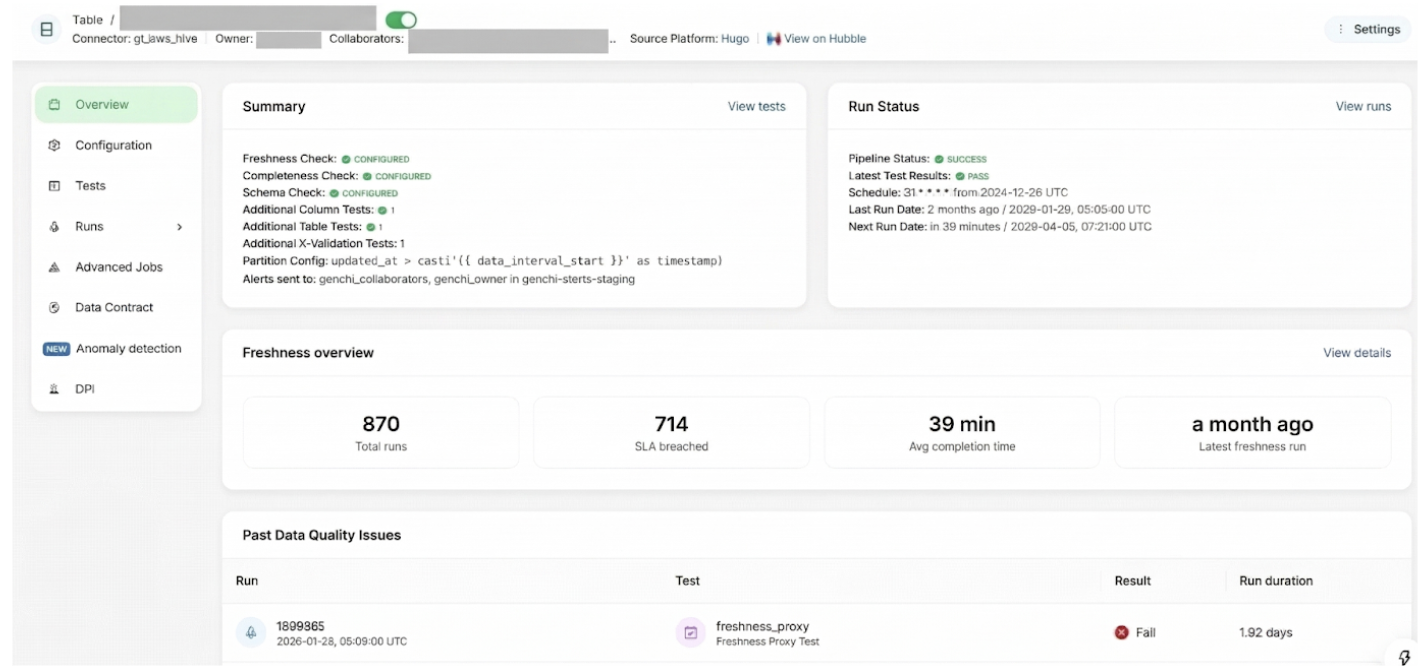
Figure 4. Genchi job configuration page, where dataset owners enroll a table and set up freshness, volume, schema, and other data quality tests for it.
What Genchi does for data mesh
In a data mesh, every domain is responsible for the quality of the data products it publishes. Genchi is the guardrail that makes that responsibility practical at scale. At its core, Genchi turns “good data” into clear, testable pillars that a data asset must satisfy:
Freshness and timeliness: Is the data recent enough to trust? Genchi runs data freshness and pipeline-freshness checks so owners know when today’s numbers are really “today’s” and can spot delayed loads before they hit dashboards or models.
Completeness and volume: Are we seeing all the records we expect? Volume and completeness tests compare current loads against historical baselines or source systems to flag partial backfills, silent drops, or suspicious spikes.
Structural stability (schema): Did the shape of the data change? Schema checks detect added/removed columns and type changes so that teams don’t discover breaking changes only after pipelines or reports start failing.
Semantic validity (values and business rules): Do the values themselves make sense? Column-level and X-Validation tests enforce constraints like uniqueness, ranges, patterns, cross-table reconciliations, and more advanced anomaly detection on row counts and null percentages.
Wrapped around these pillars is the operational layer:
Genchi runs these checks continuously (on schedule or on pipeline completion), emits real-time alerts, and helps teams drill into failing records and trends instead of debugging blind.
Its health signals flow into the catalog and incident tooling, so consumers see quality status alongside metadata and contract breaches are handled consistently.
The result is a mesh where domains publish data products with explicit, machine-enforced quality guarantees, and consumers can safely reuse them without a central team hand-holding every request.
Genchi’s system architecture
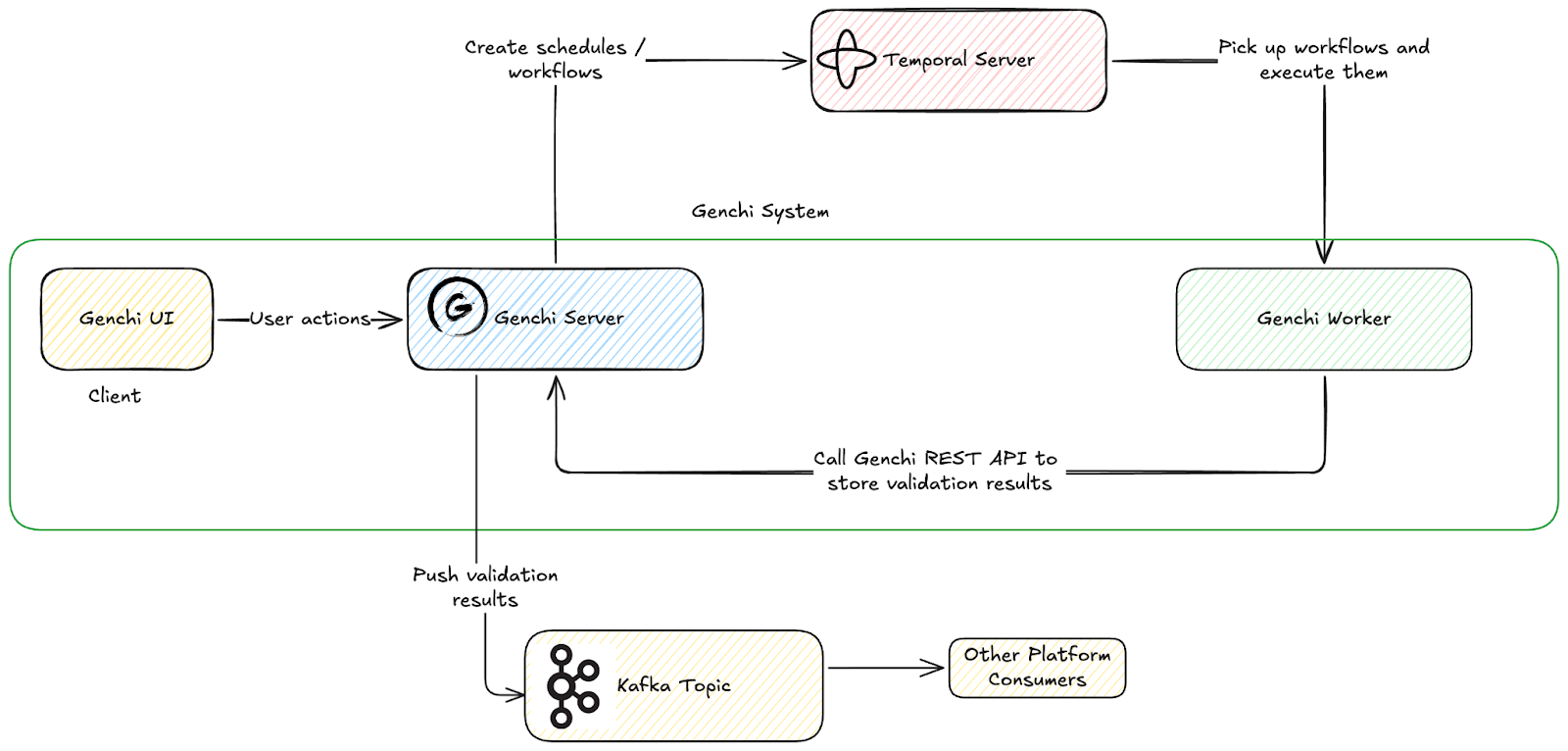
The Genchi system is designed to handle validation workflows triggered by user actions or automated schedules. It utilizes Temporal for reliable workflow orchestration and Kafka for event-driven data distribution to downstream consumers.
Figure 5. Genchi’s system architecture.
Triggering tests on pipeline completion with Sync with Pipeline (SWP)
Before SWP, Genchi tests lived on their own cron schedules, completely decoupled from the Airflow pipelines that actually produced the data. Teams had to manually copy pipeline crons into Genchi, juggle offset/lookback math to point at the “right” pipeline batch, and hope that nothing drifted over time. The result: misconfigured pipeline duration Service Level Agreement (SLA) checks, and tests sometimes running too early, too late, or against the wrong batch. This leads to noisy alerts and false-positive Data Production Issue (DPI).
To solve this, Genchi leans on Lighthouse, Grab’s pipeline execution and monitoring service. Lighthouse tracks when Airflow jobs start, finish, and which data interval they cover, and exposes that as structured execution events that the rest of the observability stack can consume.
SWP then flips Genchi from “best-effort cron alignment” to event-driven orchestration. Instead of guessing when a pipeline should have finished, Genchi listens to Lighthouse execution events. When a pipeline run is completed, Lighthouse emits an event with the run’s schedule and data interval; Genchi consumes that event, spins up an ad-hoc validation run aligned to that execution, and runs data-quality tests on the corresponding slice of data.
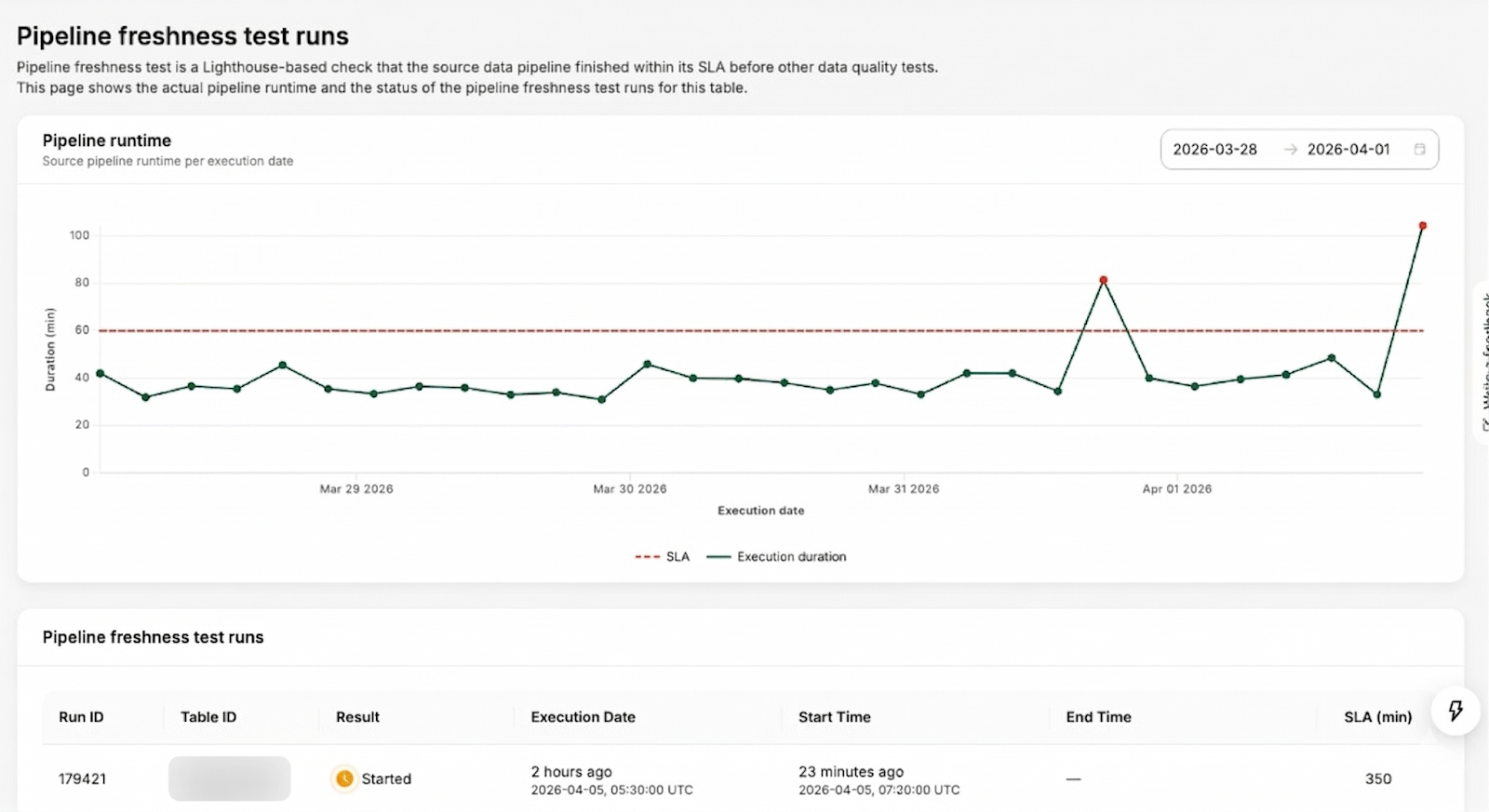
Pipeline-freshness is modeled as its own run type, separate from the data-quality tests that run on pipeline completion. Instead of inspecting rows, it is triggered asynchronously on the same schedule as the pipeline and tracks when each run actually completes in Lighthouse. This gives data producers an intuitive way to get alerted when a pipeline exceeds its expected runtime, and to review historical runtime behavior for any drift over time.
In practice, this makes test orchestration both simpler and more trustworthy. Users no longer need to think about crons or offsets for their data validation jobs. “Run after my pipeline finishes” becomes the default, with advanced overrides for custom schedules when needed. Misconfigured freshness tests and noisy DPIs drop, because Genchi is now anchored to real pipeline execution signals rather than approximations.
Figure 6. Genchi pipeline-freshness run page for a table, showing the historical runtime patterns and the SLA status.
Data Contract Registry: The producer–consumer agreement layer
At Grab, a data contract is the explicit, versioned agreement between a producer and its consumers that defines the data’s shape and semantics, the quality and availability guarantees around it, and the rules for how and for how long it may be used. The Data Contract Registry is the source of truth for these agreements, while Genchi and platform-specific observability stacks continuously verify that reality still matches what the contract promises.
What Data Contract Registry does for data mesh
Within Grab’s data mesh, the Data Contract Registry is the producer–consumer agreement layer: it centralizes contracts for key assets (data lake tables, Kafka streams, metrics) so expectations on shape, quality, SLAs, and lifecycle live in one canonical place instead of being scattered across individual platforms. That single source of truth underpins Hubble certification (only assets with valid contracts can be certified), gives Kinabalu (Grab’s central incident lifecycle orchestrator) the context it needs to open and route DPIs when checks fail, and lets Ouroboros (a table lifecycle management tool) interpret lifecycle clauses consistently.
This is important for a data mesh because it transforms the concept of “data as a product” from a mere slogan into an operational reality. Contracts provide domain teams with a clear and enforceable method to specify their guarantees, offering consumers a solid foundation for trust and data reuse across domains. Importantly, a contract is only valuable if its promises are verifiable and enforceable. Schema expectations, quality checks, and SLAs are all connected to concrete tests and health endpoints, enabling downstream platforms to automatically detect breaches and manage or mitigate breaking changes, rather than treating the contract as static documentation.
On top of storing contracts, the registry also manages contract changes. When a contract evolves, say a schema tweak, a new freshness SLA, or a planned deprecation, it identifies the right stakeholders (direct downstream owners, heavy query users, and, for critical assets, deeper dependencies) and pushes targeted Slack notifications. Producers get a structured way to roll out changes safely while consumers get timely, actionable signals instead of surprise breakages so that both enforcement and change management are baked into the mesh.
In addition to storing contracts, the registry also manages contract changes. When a contract evolves such as a schema adjustment, a new freshness SLA, or a planned deprecation, it identifies the appropriate stakeholder (direct downstream owners, heavy query users, and critical assets with deeper dependencies) and then sends targeted Slack notifications to these stakeholders. This process provides producers with a structured method to implement changes safely, while consumers receive timely and actionable alerts, preventing unexpected disruptions. As a result, both enforcement and change management are seamlessly integrated into the data mesh.
The data contract specification
Under the hood, a data contract in the registry is a JSON construct that follows the contract specification. Grab’s data contract specification is inspired by the public Data Contract Specification, but adapted to our environment so that contracts plug directly into our observability stack and automated incident management workflows.
Notably, we embed data health and test health URLs in the contract itself. Each data-quality rule points to a concrete health endpoint, so Kinabalu can determine contract breaches and create DPIs by calling those test health URLs, without hard-coding what “healthy” means. For example, a completeness test on the latest partition can be marked healthy only if the last N days are complete, not just because the most recent test run happened to pass. The data health URL at the contract root then lets Kinabalu fetch the overall diagnosis and decide who the DPI should be assigned to. More on this will be covered in Part III.
Here’s a simplified example of a contract for a data-lake table:
{"specification_version":1,"asset_urn":"urn:li:dataset:(urn:li:dataPlatform:hive,genchi.validation_jobs,PROD)","entity_type":"datalake_table","health_url":"https://example-hugo.grab.com/assets/genchi.validation_jobs/health","contract_details":{"contact":{"oncall_group":"oncall-genchi","slack_channel":"ask-genchi"},"terms":{"usage":"Source of truth for all genchi validation jobs.","limitations":"Not suitable for real-time use cases.","notice_period_in_days":14},"schema":[{"type":"genchi","health_url":"https://example-genchi.grab.com/assets/genchi.validation_jobs/tests/fundamental_schema_test/health","uid":"fundamental_schema_test","version":1}],"sla":{"freshness":[{"type":"genchi","health_url":"https://example-genchi.grab.com/assets/genchi.validation_jobs/tests/fundamental_freshness_test/health","uid":"fundamental_freshness_test","version":1}],"lifecycle":null},"data_quality":[{"type":"genchi","health_url":"https://example-genchi.grab.com/assets/genchi.validation_jobs/tests/fundamental_completeness_test/health","uid":"fundamental_completeness_test","version":1}]}}
The contract in the registry only stores references to enforceable rules, which are an identifier and version, like the example above, rather than the full configuration body. This keeps contracts lightweight and tool-agnostic, while giving rule-enforcement tools (Genchi for data-quality tests, Ouroboros for table lifecycle) and Kinabalu a stable handle to resolve the actual rule definition in their own systems, without duplicating configuration or letting it drift across platforms.
Conclusion
By bringing Hubble, Genchi, and the Data Contract Registry together, we provide the foundational tools to build trust in certified data assets. Hubble enables discovery and establishes domains and ownership; the Data Contract Registry captures explicit expectations between producers and consumers; and Genchi continuously validates those promises with tests on freshness, volume, schema, and business rules. Hubble’s certification engine then evaluates these ownership, contract, and quality signals to decide whether an asset meets Grab’s standards and surfaces that as a visible certification state. As a result, consumers can confidently default to certified assets, usage converges on a smaller, better-governed pool of datasets, and certification becomes a mechanism that changes producer behavior and guides consumer choice. We saw this convergence in practice. In just one year since the Signals Marketplace campaign began in 2024, the number of P80 datasets (the most used tables that account for 80% of all queries) has dropped by over 58%.
This data foundation is especially important in an AI-first future for Grab. Certified streams, tables, metrics, and attributes give AI agents and automated analytics a default substrate they can rely on. With Hubble and Genchi, data producers have clear ownership, contracts, and observability. Data consumers can discover and trust certified assets without guesswork, and platform teams can measure and improve Signals Marketplace health over time (for example, queries on certified assets, lineage depth, and cost). Together, these capabilities turn “data mesh” from a slogan into an operational, AI-ready marketplace of reliable, reusable signals that power decisions across Grab.
Figure 7. Building trust in certified data assets through discovery, contracts, and continuous validation.
What’s next
In the next blog, we’ll zoom into the DPI process itself with Kinabalu as the incident lifecycle orchestrator:
How Genchi test failures and data contract breaches turn into DPIs.
How DPI is assigned based on root causes and what sets the priority level.
The patterns we’ve seen in “noisy” vs actionable DPIs, and what we’ve changed in our platforms.
How we’re using automation and agents to reduce DPI toil and close the loop back into certification.
We’ll walk through concrete case studies showing how a single broken table moves from first failure, to diagnosis and fix, to updated contracts and a more resilient certified data asset.
Join us
Grab is a leading superapp in Southeast Asia, operating across the deliveries, mobility, and digital financial services sectors, serving over 900 cities in eight Southeast Asian countries: Cambodia, Indonesia, Malaysia, Myanmar, the Philippines, Singapore, Thailand, and Vietnam. Grab enables millions of people every day to order food or groceries, send packages, hail a ride or taxi, pay for online purchases or access services such as lending and insurance, all through a single app. We operate supermarkets in Malaysia under Jaya Grocer and Everrise, which enables us to bring the convenience of on-demand grocery delivery to more consumers in the country. As part of our financial services offerings, we also provide digital banking services through GXS Bank in Singapore and GXBank in Malaysia. Grab was founded in 2012 with the mission to drive Southeast Asia forward by creating economic empowerment for everyone. Grab strives to serve a triple bottom line. We aim to simultaneously deliver financial performance for our shareholders and have a positive social impact, which includes economic empowerment for millions of people in the region, while mitigating our environmental footprint.
Powered by technology and driven by heart, our mission is to drive Southeast Asia forward by creating economic empowerment for everyone. If this mission speaks to you, join our team today!
The collective thoughts of the interwebz
Manage Consent
To provide the best experiences, we use technologies like cookies to store and/or access device information. Consenting to these technologies will allow us to process data such as browsing behavior or unique IDs on this site. Not consenting or withdrawing consent, may adversely affect certain features and functions.
Functional
Always active
The technical storage or access is strictly necessary for the legitimate purpose of enabling the use of a specific service explicitly requested by the subscriber or user, or for the sole purpose of carrying out the transmission of a communication over an electronic communications network.
Preferences
The technical storage or access is necessary for the legitimate purpose of storing preferences that are not requested by the subscriber or user.
Statistics
The technical storage or access that is used exclusively for statistical purposes.The technical storage or access that is used exclusively for anonymous statistical purposes. Without a subpoena, voluntary compliance on the part of your Internet Service Provider, or additional records from a third party, information stored or retrieved for this purpose alone cannot usually be used to identify you.
Marketing
The technical storage or access is required to create user profiles to send advertising, or to track the user on a website or across several websites for similar marketing purposes.