Любомир Попйорданов – за волята и волния човешки дух

Post Syndicated from Ина Иванова original https://www.toest.bg/lyubomir-popyordanov-za-volyata-i-volniya-choveshki-duh/

Любомир Попйорданов – за волята и волния човешки дух

Когато се спомене името Любомир Попйорданов, всички, които го познават, обикновено възкликват: „Любо!“ По светналите им очи се вижда колко откровен, активен и търсещ човек е.

Той е от хората без възраст, които успяват да съвместят в деня си наръч отговорности (без да личи). И да намерят време, за да отскочат да слушат музика на фестивал в Стара планина или да дишат кристалния въздух на Пирин за ден. Човеци като него променят средата, разделяйки времето си между нуждата от тишина, която дава планината, и хъса и въображението, с които да генерират идеи и да търсят пътища за реализирането им.

Роден е в България, но детството му преминава основно в Тунис, където баща му д-р Йордан Попйорданов работи като лекар. Впоследствие завършва Френската гимназия в София и право в Софийския университет.

Баща е на две пораснали дъщери, художнички, и син – студент по архитектура. Страстен планинар. Основател е на агенциите за приключенски туризъм „Одисея-ин“ и „Зиг-Заг Холидейз“, основател и дългогодишен председател на Управителния съвет на Българската асоциация за алтернативен туризъм (БААТ) – организация, която е ангажирана с опазването и устойчивото използване на българското природно, културно и историческо наследство. Именно БААТ въведе в законодателството правната рамка на къщите за гости. Любомир Попйорданов създава първия публичен фестивал за зелен туризъм – „Зелени дни“ – и намира време да основе „Стената“ (магазини, предлагащи специализирана екипировка за туризъм, къмпинг и катерене), да издава книги и да публикува собствена. Вече близо две десетилетия организира Фестивала за приключенско кино и екстремни спортове „Дни на предизвикателствата“. Носител е на награди за отговорен туризъм и корпоративно дарителство. Зад гърба си има залесителни кампании в Пирин и Витоша (конкретно – Софийското Светогорие и Сеславския манастир). Това са част от каузите, на които е посветен, но зад наименованията им стои мрежа от сърцати хора, с които е по човешки свързан.

Мечтата на Любомир Попйорданов е, по собствените му думи, „България да се превърне в най-желаното и скъпо село на Европа“. През годините той неведнъж се е ангажирал с инициативи, които да подобрят законите, свързани с туризма. Председател е и на Асоциация „Планини и хора“, работи върху регулациите, свързани с дейността на планинските водачи в България. В държава като нашата, в която институциите си подхвърлят топката за отговорността по вземането на критично важни решения, хора като него се опитват да променят нещата. Създава анкети с въпроси към колегите си и предлага готови решения с надеждата, че ще съгласуват наученото от практиката със законодателството. 

Всуе или с променлив успех, но Любомир Попйорданов не спира да опитва. Колективните каузи и механизмите на гражданското общество изискват не просто ентусиазъм, а и умението да не се отказваш.

Любомир Попйорданов винаги остро се е противопоставял на опитите туристическият сектор да бъде използван за оправдание на лобистки инвестиционни интереси. Той е активен участник в борбата за защита на националните и природните паркове и срещу опитите за застрояване им – бори се с еднаква страст за морето и за планините на България.


Няма как да не започнем от високото, от планината. Без какво не може в нея? 

Високото ни дава хоризонт, измерение. В планината и най-баналната грешка – подценена екипировка, малко храна или вода – може да има висока цена. Но като че ли на върха на пирамидата стоят личната подготовка и щателното изследване на хипотезите – маршрутът и възможностите да излезем от него, изборът на хората, с които да тръгнем. Това е Животът. 

Изборът е, който ни определя като хора. 

Какво Ви е нужно, за да се усетите цялостен?

Човек е цялостен, когато дава път на скритите пориви на душата и си позволява да върви към мечтите си изправен. Обичам да правя много неща, да се боря да доказвам неща, които за другите са чиста загуба на време, а за мен са кауза. Позицията на пасивен наблюдател на обществените процеси не ми е присъща, но в това не влагам личен интерес. Усещам се цялостен, когато пътешествам, катеря се, ходя на планина, рисувам, споделям много време с хора, които имат нужда от насърчение, и ценя всеки момент със семейството си.

Струва ми се, че напоследък в световен мащаб се формират общности, които се интересуват от преживяване, от отместване на личните граници – алпинизмът стана по-широко достъпен, все повече хора се занимават с ултраспортове. Приключенският туризъм също набира скорост. Това ли е отговорът, с който несъзнателно се оттласкваме от консуматорството?

Чистото преживяване в планината с хора, които са ни важни, или с приятели по свръзка; или приключение с лодка в горещите южни ширини; самотно или споделено навлизане в джунглата на Амазонка; или срещата и вечерта, прекарана в някоя откъсната от света родопска махала – ето това е откъсване от консуматорството. 

За съжаление, приключенският туризъм също върви в руслото на масовия. Важното е тези, които създават пътуванията, а и самите пътуващи, да си дадат сметка за своя социален и екологичен отпечатък достатъчно навреме. Да се опитат да върнат на туризма онзи смисъл, с който той се е родил като такъв: порива към непознатото, мечтата, изследователския стремеж. 

Любомир Попйорданов – за волята и волния човешки дух
Любомир Попйорданов © личен архив

Има ли потенциал алтернативният туризъм да развива дребно предприемачество в изоставените от държавата региони?

Той го и прави, и то далеч преди България да бъде приета в ЕС и да навлязат разните програми, които бяха прочетени и приложени с корист и оставиха петно върху домашното гостоприемство и развитието на туризма. В продължение на над 15 години чрез създадената от съмишленици БААТ успяхме да внесем революционни идеи, за които администрацията и предприемачите в голямата си част не бяха готови. 

Все пак именно в този период (до 2012–2015 г.) се родиха най-добрите примери за устойчив и отговорен туризъм. След това термините бяха употребени, така както и идеите за възобновяеми енергийни източници и Зелената сделка. Политическият елит, който управлява държавата ни, с няколко малки изключения, от 2001 г. насам не работи за обществения интерес. 

По образование сте юрист. По призвание – пишете и рисувате. А по характер?

… съм малко наивен и искам винаги да се случи най-доброто, по един честен начин. Да се знае, че успехът е възможен и с много работа, постоянство, че в България има място за смели идеи и за мечтатели.

Какво Ви тревожи напоследък?

Ако нещо наистина ме тревожи, то е късата историческа памет на българина и неспособността на обществото ни да се мобилизира за смислени каузи. България е в един от най-мрачните си периоди въпреки всички перспективи, които пълноправното членство в ЕС ни дава. Българинът остава оцеляващ вид, самотен играч, лесно податлив на чужди влияния. Ще събира капачки за кувьози, ще дарява за хора, които не познава, но няма да се изправи с името си, за да защити правото си на свободен израз, на правосъдие, еднакво за всеки. 

Любомир Попйорданов – за волята и волния човешки дух
Автопортрет на Любомир Попйорданов

Какъв искахте да станете, когато бяхте дете?

Четях много история на старите цивилизации. Другата посока беше архитектурата. Рисуването беше нещо, което също си позволявах, без да питам дали мога или трябва и дали ще ставам художник. 

Човек не става нещо, той е. 

Когато видя археологически разкопки, съм археолог, а архитектурата продължава да ме изкушава.

Какво научихте за себе си от рисуването? В тишина ли предпочитате да създавате платната си?

Рисувам на приливи и отливи. Понякога – защото искам да се предизвикам и да си докажа, че продължавам да го мога, или е въпрос на вдъхновение, пейзаж, в който искам да експериментирам нова светлина и контрасти, портрет, върху който дълго време съм мислил и който съм носил в себе си. Заниманието е самотно. Навремето много рисувах на музика – класика, рок, джаз, френски шансони.

Бавно живеене или живот на скорост?

Въпросът е стар колкото света. Festina lente („Бързай бавно“, лат. – б.р.). Зад историята на сградите, които бележат епохи, както и при литературните произведения и голямото кино винаги има натрупвания, които в един момент достигат до взрив, задават нова посока в естетическите търсения и внушения, забързват обществените отношения и нашия личен живот. 

Да бързаме бавно. Да внасяме смисъл в скоростта.


Хората, които тихо и кротко променят средата, в която живеят, формират общности и задават посоки, в които има смисъл да тръгнем заедно. Тук ви срещаме с тях. Това са „Тези хора“.


Transforming IT Infrastructure Visibility at Doğan Trend Automotive

Post Syndicated from Michael Kammer original https://blog.zabbix.com/transforming-it-infrastructure-visibility-at-dogan-trend-automotive/30715/

Established in 2020 to consolidate Doğan Group’s automotive and mobility companies and brands under a single entity, Doğan Trend Automotive is a prominent player in their industry. Representing a diverse portfolio ranging from automobiles, motorcycles, and marine engines to electric commercial vehicles, Doğan Trend also delivers innovative solutions to customers through its e-commerce platforms, such as suvmarket.com and vespastoreturkey.com.

The challenge

Doğan Trend’s IT ecosystem spans data centers, remote locations, and multiple units, necessitating seamless operations as well as an efficient monitoring and alert system. The existing infrastructure posed challenges in monitoring, making it difficult to detect potential issues in a timely manner, thus increasing operational risks.

The solution

To address Doğan Trend’s needs, our associates at ASNSKY implemented a Zabbix-based monitoring system. Key highlights of the project included:

  • Centralized dashboards: Custom dashboards were designed for data centers and remote locations, enabling the unified monitoring of IT locations and components from a single interface.
  • A dynamic alert system: Alerts prioritized based on predefined conditions allowed for the swift and effective resolution of critical issues.
  • Seamless operations: Early detection of potential issues prevented operational disruptions and ensured continuity.

Throughout the integration process, ASNSKY’s team collaborated closely with Doğan Trend’s IT department, addressing the specific requirements of different units and providing training for effective system use.

The results

Implementing the new monitoring system rapidly delivered the following results:

  • Enhanced visibility: Real-time monitoring of all IT locations and components made potential issues easy to spot.
  • Proactive issue management: Early detection of critical issues reduced operational downtime.
  • Increased efficiency: The centralized monitoring system drastically improved the responsiveness and effectiveness of Doğan Trend’s IT team.

“This project with the ASNSKY team made our IT infrastructure more transparent and manageable. With Zabbix’s flexible and effective monitoring capabilities, we gained active control over our critical operations. We thank the ASNSKY team for this successful collaboration.” – Burak Altunalan, IT System Management Specialist at Doğan Trend Automotive

In conclusion

Doğan Trend plans to further take advantage of Zabbix’s flexibility to strengthen their resilience and operational efficiency. Their association with ASNSKY marks a significant step toward achieving these objectives.

To learn more about what Zabbix can do for retail customers in every sector, get in touch with us. 

About ASNSKY

ASNSKY enhances its customers’ competitiveness by integrating the power of enterprise-grade open-source-solutions in security and infrastructure with a professional service approach and high quality standards.

Backed by deep industry expertise and a team of seasoned professionals, ASNSKY stands as a trusted partner in your digital transformation journey.

The post Transforming IT Infrastructure Visibility at Doğan Trend Automotive appeared first on Zabbix Blog.

Равенството като инвестиция. Разговор с проф. Лий Баджет

Post Syndicated from original https://www.toest.bg/ravenstvoto-kato-investitsiya-razgovor-s-prof-lee-badgett/

Равенството като инвестиция. Разговор с проф. Лий Баджет

Проф. Мери Вирджиния Лий Баджет (известна като проф. Лий Баджет) е главна икономистка в Koppa LGBTI+ Economic Power Lab и водеща изследователка в областта на равенството за ЛГБТИ+ хора. Преподавала е икономика в Масачузетския университет в Амхърст и е била съдиректорка на Центъра за равенство в заетостта. Тя е старша изследователка в Института „Уилямс“ към Калифорнийския университет в Лос Анджелис (UCLA). Авторка е на книгата „Икономическите аргументи за ЛГБТИ+ равенство. Защо справедливото и равно третиране е от полза за всички нас“, в която анализира икономическите загуби, произтичащи от хомофобията и трансфобията. Проф. Баджет е консултирала Световната банка, Програмата за развитие на ООН и други международни организации по теми, свързани с политиките в областта на ЛГБТИ+ равенството.

Докладът на Института за пазарна икономика (ИПИ) „Икономическата цена на хомофобията в България“, изготвен по поръчка на Фондация GLAS, използва методологията на проф. Баджет и екипа ѝ. Един от изводите на експертите от ИПИ е, че в резултат от дискриминацията на ЛГБТИ+ хората към 2022 г. България е загубила между 2,5 и 4,3 млрд. евро само от чуждестранни инвестиции. 


Проф. Баджет, в книгата си описвате как дискриминацията срещу ЛГБТИ+ хората води до значителни икономически загуби. За какъв вид загуби става дума?

Съществуват различни оценки в зависимост от държавата и използваната методология, но всички показват, че икономическите загуби могат да бъдат сериозни – до 1% от брутния вътрешен продукт (БВП) на една страна. Това е огромна сума. Правила съм такива изследвания за Индия и няколко държави в Югоизточна Азия. Подобни оценки са направени от институции като Световната банка за други страни. Организацията за икономическо сътрудничество и развитие (ОИСР) също публикува основен доклад със заглавие „Икономическите аргументи за по-голямо равенство на ЛГБТИ+ в САЩ“, според който намаляването на ефектите от дискриминацията и стигмата би увеличило БВП на САЩ с 2,6%. Друг добър източник е платформата Open For Business, която анализира как приобщаващата среда подпомага привличането на инвестиции и таланти. В крайна сметка, когато ЛГБТИ+ хората са изключени, техните умения и продуктивност остават неизползвани и това намалява цялостната ефективност на икономиката.

Ако загубите са толкова големи, защо виждаме толкова много анти-ЛГБТИ+ реторика и политики, които набират сила в някои страни със средни и ниски доходи – а дори и в части от ЕС и Съединените щати?

За съжаление, тази реакция често е резултат от дълбоко вкоренена хомофобия и трансфобия. Тези нагласи са ирационални от гледна точка на икономиката, която е насочена към това какво могат да допринесат хората. Уви, хомофобията и трансфобията могат да бъдат политически ефективни. Понякога политици експлоатират тези нагласи, за да привлекат подкрепа от определени групи. Има случаи, в които това се прави и за отвличане на вниманието – например от лошото управление или икономическите неуспехи. От гледна точка на икономистите такава дискриминация просто е неефективна. Ако някой не бъде нает или повишен заради своята сексуална ориентация или джендърна идентичност, а не въз основа на таланта и продуктивността си, икономиката губи. Това е неправилно разпределение на човешкия капитал. Същото важи и за отношението на работното място – ако ЛГБТИ+ служителите са тормозени или се чувстват несигурни сред колегите си, те не могат да дадат най-доброто от себе си, а това е загуба за всички.

Равенството като инвестиция. Разговор с проф. Лий Баджет
С Фил Криън, съучредител на Koppa LGBTI+ Economic Power Lab. Снимка: личен архив

Може ли да споделите примери или данни, които показват как включването на ЛГБТИ+ хора в икономиката носи ползи за обществото като цяло?

Да, включването носи ползи за всички. Когато ЛГБТИ+ хората имат равен достъп до образование и заетост, те по-лесно развиват своите умения, идеи и креативност и допринасят повече. Това увеличава производителността и иновациите. Премахването на дискриминацията и подобряването на достъпа до възможности води до положителни резултати във всички сектори. Бихме могли да видим и по-ниски разходи за здравеопазване, когато дискриминацията намалява, тъй като стигмата, тормозът и страхът са също така основни фактори за психични и физически здравословни проблеми сред ЛГБТИ+ общностите. Икономиките просперират, когато всички хора могат да участват равноправно, без страх.

Кои са основните предизвикателства при събирането на данни за икономическите ефекти от дискриминацията срещу ЛГБТИ+ хора?

Най-голямото предизвикателство е невидимостта. В много страни хомосексуалните, бисексуалните и транс хората са криминализирани или се чувстват несигурни да разкрият идентичността си, така че остават извън официалната статистика. Много правителства не събират данни за сексуалната ориентация или джендърната идентичност или го правят частично, например само за гей мъже. Тази липса на данни затруднява разбирането на пълния мащаб на проблемите.

Но това започва да се променя. В Европейския съюз, Австралия, Нова Зеландия и САЩ се провеждат анкети, които помагат за създаването на политики. Страни като Мексико, Бразилия, Колумбия и Еквадор започнаха да включват въпроси за сексуалната ориентация и джендърната идентичност в националните си проучвания. В Южна Азия някои страни признават „трети пол“ в преброяванията. Правителствата могат да събират такива данни безопасно и етично – така, както правят с друга чувствителна информация. Разполагаме и с дигитални методи, които по-добре защитават поверителността на данните на ЛГБТИ+ хората и позволяват на статистическите агенции да събират тези данни по-ефективно. Когато имаме повече и по-добри данни, това ни помагат да създаваме приобщаващи политики и да проследяваме напредъка.

Какво послание бихте искали да отправите към българските читатели?

Колкото повече научаваме за ЛГБТИ+ хората, толкова по-ясно виждаме колко много допринасят те за нашето общество и икономика. Моето послание към българските читатели е: срещнете се с ЛГБТИ+ хора. Опознайте ги, опознайте ЛГБТИ+ общностите и предизвикателствата, с които се сблъскват – изслушайте ги, чуйте ги, научете се от тях, – и ги подкрепяйте.


Мнението на автора, изразено в този текст, е лично и не отразява позициите на ООН или на нейните държави членки.

Gigabyte G893-ZX1-AAX2 AMD Instinct MI325X Server Review

Post Syndicated from Patrick Kennedy original https://www.servethehome.com/gigabyte-g893-zx1-aax2-amd-instinct-mi325x-server-review/

In our Gigabyte G893-ZX1-AAX2 review, we see how this 8x GPU AMD Instinct MI325X system (2TB of HBM3E!) with dual AMD EPYC CPUs works

The post Gigabyte G893-ZX1-AAX2 AMD Instinct MI325X Server Review appeared first on ServeTheHome.

Announcing the end of support for Node.js 18.x in AWS CDK

Post Syndicated from Charles Meruwoma original https://aws.amazon.com/blogs/devops/announcing-the-end-of-support-for-node-js-18-x-in-aws-cdk/

On November 30th, 2025, the AWS Cloud Development Kit (CDK) will no longer support Node.js 18.x, which reached end of life on April 30, 2025. This change applies to all AWS CDK components that depend on Node.js, including the AWS CDK CLI, the Construct Library, and broader CDK ecosystem projects such as JSII, Projen, and CDK8s.

We encourage you to upgrade to a Node.js Active Long Term Support (LTS) version, which is Node.js 22.x as of July 6, 2025. Given that Node.js 18.x is past end of life, we recommend migrating your CDK projects to newer Node.js LTS versions as soon as possible.

Why are we doing this?

Node.js 18.x reached its End of Life support on April 30, 2025, per the Node.js Release Schedule. This means the Node.js community no longer provides bug fixes or security updates for this version. By dropping support for end-of-life versions, we ensure that AWS CDK users benefit from the latest security patches, performance improvements, and modern Node.js capabilities. This approach aligns with AWS’s commitment to security best practices and our standard policy of supporting only actively maintained runtime versions.

What’s changing?

Starting December 1, 2025, AWS CDK will officially end support for Node.js 18.x. While your existing CDK deployments may continue to function, we will no longer address issues, provide bug fixes, or offer technical support for problems that occur specifically with Node.js 18.x. Any support cases or bug reports related to Node.js 18.x will require reproduction on a supported Node.js version (20.x or 22.x as of June 2025) before we can assist.

Key points

Moving forward, projects that remain on Node.js 18.x will gradually lose access to new AWS CDK capabilities as we develop features using modern Node.js APIs that are not available in older versions. This creates a growing compatibility gap that will make it increasingly challenging to leverage CDK innovations and improvements. The security implications are equally concerning, as any vulnerabilities discovered in the unsupported Node.js 18.x runtime will not receive patches or workarounds from our development team, potentially exposing your infrastructure to known security risks.

The challenges extend throughout the development lifecycle. Without regular compatibility testing against Node.js 18.x, we cannot ensure reliable CDK behavior, and you may encounter unexpected issues in production environments. When problems do arise, our support team will need to reproduce any reported issues on supported Node.js versions before providing assistance, which could delay resolution during critical incidents. Additionally, the broader CDK ecosystem, including third-party libraries and tools your projects depend on, will likely follow similar deprecation schedules, creating compounding compatibility challenges that become more difficult to resolve over time.

Timeline

We’re announcing this change in July 2025, to provide you with a five-month transition period before support officially ends on November 30th, 2025. During this transition window, our team will continue to address issues that arise with Node.js 18.x, giving you time to plan, test, and execute your upgrade strategy without immediate pressure. This period is designed to help you thoroughly validate your CDK projects against newer Node.js versions and ensure smooth deployments in your production environment.

Beginning December 1st, 2025, AWS CDK will officially discontinue support for Node.js 18.x across all components and ecosystem projects. From this point forward, all bug fixes, security patches, and new feature development will target only supported Node.js versions, currently 20.x and 22.x as of June 2025. We strongly recommend using this transition period to migrate to Node.js 22.x, the current Active Long Term Support version, which will provide the longest runway for future compatibility as the Node.js release cycle continues.

Version validation and update steps

Begin your migration by checking which Node.js version you’re currently running across all environments where you deploy CDK projects. Run `node -v` in your local development environment, CI/CD pipelines, and any automated deployment systems to get a complete picture of your current setup.

Once you’ve identified all instances of Node.js 18.x, update your runtime to a supported version using either a version manager like nvm or by downloading the official installer from nodejs.org. We recommend upgrading directly to Node.js 22.x since it’s the current Active Long Term Support version and will provide the longest compatibility runway. After updating your runtime, thoroughly test your CDK projects in non-production environments to ensure your deployment scripts and third-party dependencies work correctly with the new version. Pay particular attention to any custom constructs or complex deployment workflows that may be sensitive to changes in Node.js versions.

Finally, establish a process for staying current with future Node.js releases by bookmarking the AWS CDK Node.js Version Support Timeline, which provides up-to-date information on runtime compatibility and upcoming deprecations. This proactive approach will help you anticipate future changes and plan your upgrade strategies well in advance, avoiding the pressure of last-minute migrations when support windows close.

Conclusion

This deprecation is part of our ongoing commitment to provide a secure, high-quality experience for AWS CDK users. By migrating to a Node.js Active Long Term Support (LTS) version, you will benefit from enhanced performance, ongoing security updates, and continued AWS CDK advancements. If you have any questions or concerns about this deprecation, please reach out and open an issue in our GitHub repo.

Modernizing SOAP applications using Amazon API Gateway and AWS Lambda

Post Syndicated from Daniel Abib original https://aws.amazon.com/blogs/compute/modernizing-soap-applications-using-amazon-api-gateway-and-aws-lambda/

This post demonstrates how you can modernize legacy SOAP applications using Amazon API Gateway and AWS Lambda to create bidirectional proxy architectures that enable integration between SOAP and REST systems without disrupting existing business operations.

Many organizations today face the challenge of maintaining critical business systems that were built decades ago. These legacy applications power essential business operations despite relying on outdated technologies and integration patterns. Although complete system replacement would be ideal, practical constraints such as budget limitations, resource availability, technical complexity, and missing documentation often make modernization efforts challenging.

This post first shows proxy architecture patterns to expose a legacy SOAP server over a REST API. It then shows how to integrate a legacy SOAP client with applications using a REST API.

While SOAP and REST APIs share HTTP as their foundation, SOAP has some limitations compared to REST, like limited HTTP methods (GET/POST only) and mandatory XML formatting. REST is more flexible with multiple HTTP methods and diverse payload formats (plain text, binary, HTML, JSON, XML).

Using API Gateway and Lambda to proxy SOAP service

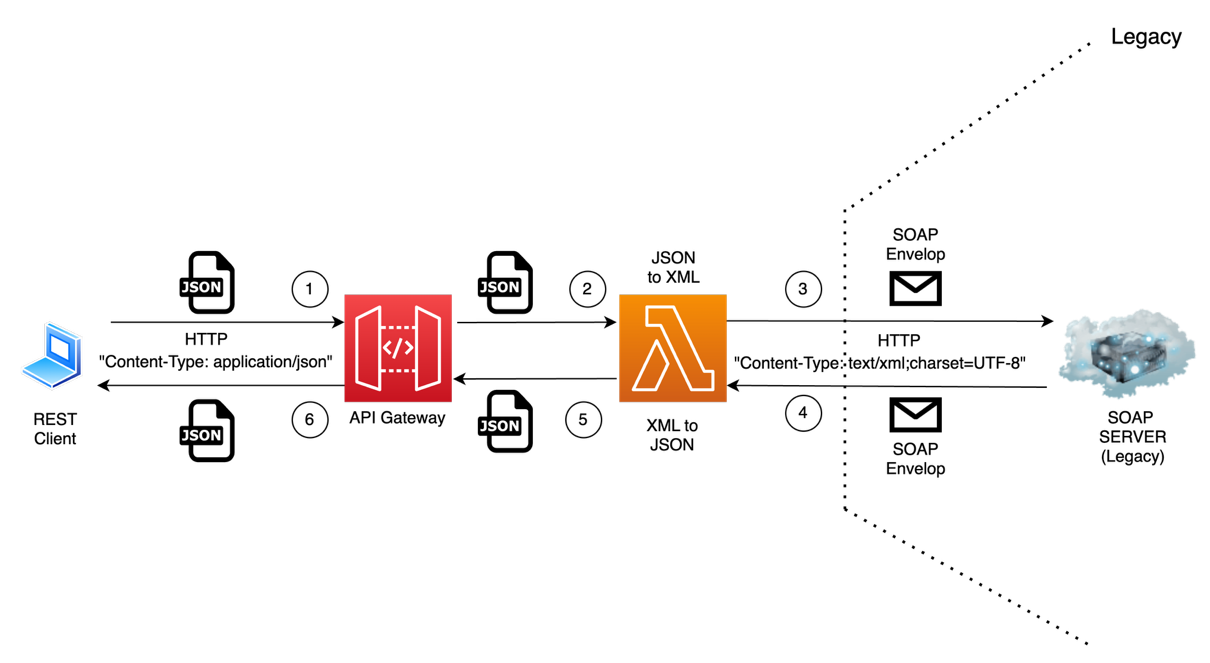
Consider a legacy solution that only supports SOAP. The following diagram shows the architecture for a SOAP proxy server using API Gateway and Lambda.

Figure 1: SOAP Server Proxy for modernized architecture

Figure 1: SOAP Server Proxy for modernized architecture

The proxy exposes the APIs hosted on the SOAP Server (on the right side of the image) over a REST interface. A SOAP service expects the HTTP Content-Type header set to text/xml, and a XML format payload that follows the WSDL specification defined by the server.

In the proposed architecture, the Lambda function is the core transformation engine, handling the bidirectional conversion between JSON and XML formats. Lambda functions can be developed in multiple programming languages such as Python, Node.js, Java, C#, Go, Ruby, and PowerShell, allowing you to use your existing development expertise. The serverless nature of Lambda provides automatic scaling to handle traffic spikes without needing infrastructure management or capacity planning.

API Gateway acts as the intelligent front door, managing all incoming requests and routing them appropriately. It provides enterprise-grade features such as request throttling to protect backend systems from overload, comprehensive authentication and authorization mechanisms, API key management for partner access control, request and response validation, caching capabilities for improved performance, and detailed monitoring and logging. These built-in features remove the need for custom middleware development and provide immediate operational benefits. API Gateway can receive multiple payload format such as XML, JSON, binary data, and plain text. This makes it suitable for diverse integration scenarios.

Using API Gateway and Lambda to support legacy SOAP clients

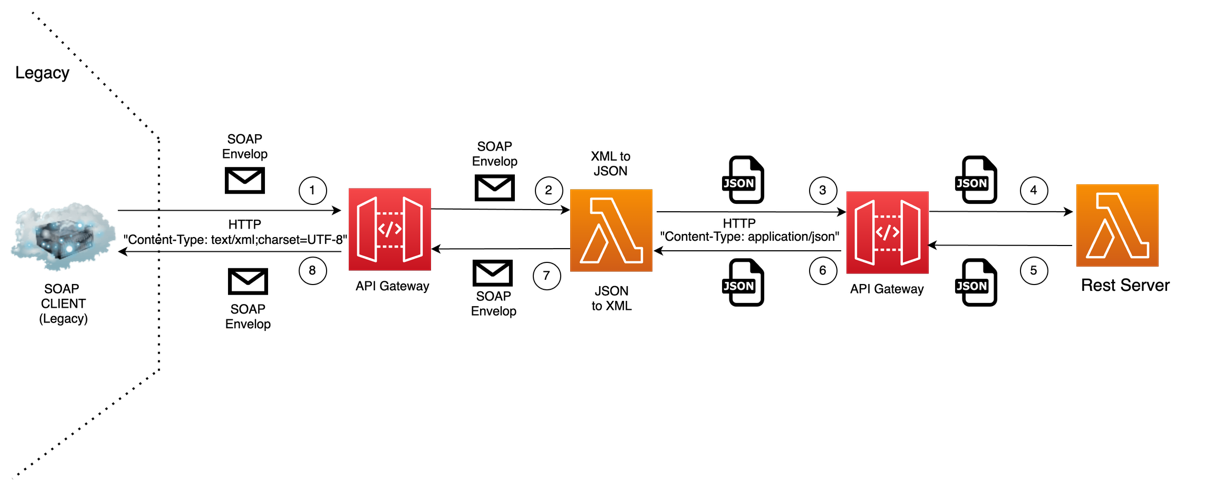
The previous section focused on exposing SOAP services over REST APIs. Organizations also face the reverse challenge where legacy SOAP client applications must access REST services. The architecture for supporting legacy SOAP clients follows a similar pattern but with reversed data flow. In this case, the legacy SOAP client sends XML-formatted requests to what it believes is a SOAP server. However, behind the scenes API Gateway and Lambda work together to translate these requests into REST API calls.

Figure 2: Legacy SOAP client modernization architecture

Figure 2: Legacy SOAP client modernization architecture

The legacy SOAP client application sends XML SOAP messages to API Gateway. The Lambda function receives these SOAP requests, extracts the relevant data from the XML envelope, and transforms it into JSON format for the modern REST service.

The Lambda function wraps the JSON response from the REST services into the SOAP XML format that the legacy client expects. It recreates the appropriate XML structure, SOAP headers, and ensures that the response conforms to the WSDL specification that the client application was designed to consume.

Example scenario

Let’s suppose our legacy client application needs to send a SOAP request to convert an integer number to its word form. The SOAP envelop to convert the number 1519 to its long form “one thousand, five hundred and nine” looks like this:

<?xml version="1.0" encoding="utf-8"?>
<soap:Envelope xmlns:soap="http://schemas.xmlsoap.org/soap/envelope/">
    <soap:Body> \
        <ConvertNumberToWordsSoapIn>
            <NumberToWordsRequest>1519</NumberToWordsRequest>
        </ConvertNumberToWordsSoapIn>
    </soap:Body>
</soap:Envelope>

The REST conversion service expects a JSON payload the as follownig:

jsonObject = {
	"data" : 1519
}

The following code block shows a sample Lambda function implementation for this. This function converts the SOAP XML envelop to JSON, changes the http header to application/json, and converts response from REST service to SOAP format.

var parseString = require('xml2js').parseString;
const axios = require('axios');

exports.handler = async (event, context) => {
    var valueNumber;
    
    try {
        console.log("Parsing XML string");

        // Parsing the XML to obtain data needed for conversion (number to words)
        parseString(event.body, function (err, result) {
            if (!err) {
                valueNumber = result['soap:Envelope']['soap:Body'][0]
                              ['ConvertNumberToWordsSoapIn'][0]
                              ['NumberToWordsRequest'][0];
            } else { 
                console.log (err);
                throw (err);
            }
        });
        console.log("Creating JSON for calling the service");
        // Creating JSON to call service
        var jsonObject = {
            "data" : valueNumber
        }
        
        console.log("Calling Microservice (NumberToWords)");
        const headers = { 
            'Content-Type': 'Application/json'
        };
        
        console.log ("Parameter for NumberToWords URL:" + 
                    JSON.stringify(process.env.NumberToWordMicroservice));

        // Calling numberToWords REST Server
        var resultNumberToWords = await 
            axios.post(process.env.NumberToWordMicroservice, jsonObject, { headers });
        
        // Creating the response
        console.log("Creating response XML");

        var resp =  create_response (JSON.stringify(resultNumberToWords.data.message));
        console.log("Response in XML: "+ resp);
        
        // Returning the value in XML using text/xml content type
        let response = {'statusCode': 200, headers: {"content-type": "text/xml"}, 
                        'body': JSON.stringify(resp)}
        return response;
        
    } catch (err) {
        console.log ("Error: " + err);
        let response = {'statusCode': 500, 
                        headers: {"content-type": "text/xml"}, 'body': err}
        return response;
    }
};

// Function to create a SOAP XML envelope with the result value
function create_response(numberInWords) {
  return '<?xml version="1.0" encoding="utf-8"?> \
            <soap:Envelope xmlns:soap="http://schemas.xmlsoap.org/soap/envelope/">\
            <soap:Body>\
              <m:ConvertNumberToWordsResponse xmlns:m="http://www.dataaccess.com/webservicesserver/"> \
                  <m:ConvertNumberToWordsResponseResult>' + numberInWords + '</m:ConvertNumberToWordsResponseResult> \
              </m:ConvertNumberToWordsResponse> \
            </soap:Body>\
            </soap:Envelope>';
}

With this approach, you can maintain your existing SOAP client applications without modification, allowing them to consume modern REST services. You can preserve investments in legacy client applications while gradually modernizing the overall system. This architecture is particularly valuable in scenarios where multiple legacy SOAP clients need to access the same modern REST services. This is because a single proxy can serve multiple client applications simultaneously. The serverless nature of the architecture makes sure that it scales automatically based on the number of client requests, providing cost-effective operation regardless of usage patterns.

Alternative approach using API Gateway transformation capabilities

The Lambda-based approach provides maximum flexibility and control. API Gateway also offers built-in transformation capabilities that can handle certain SOAP modernization scenarios without the need for compute resources.

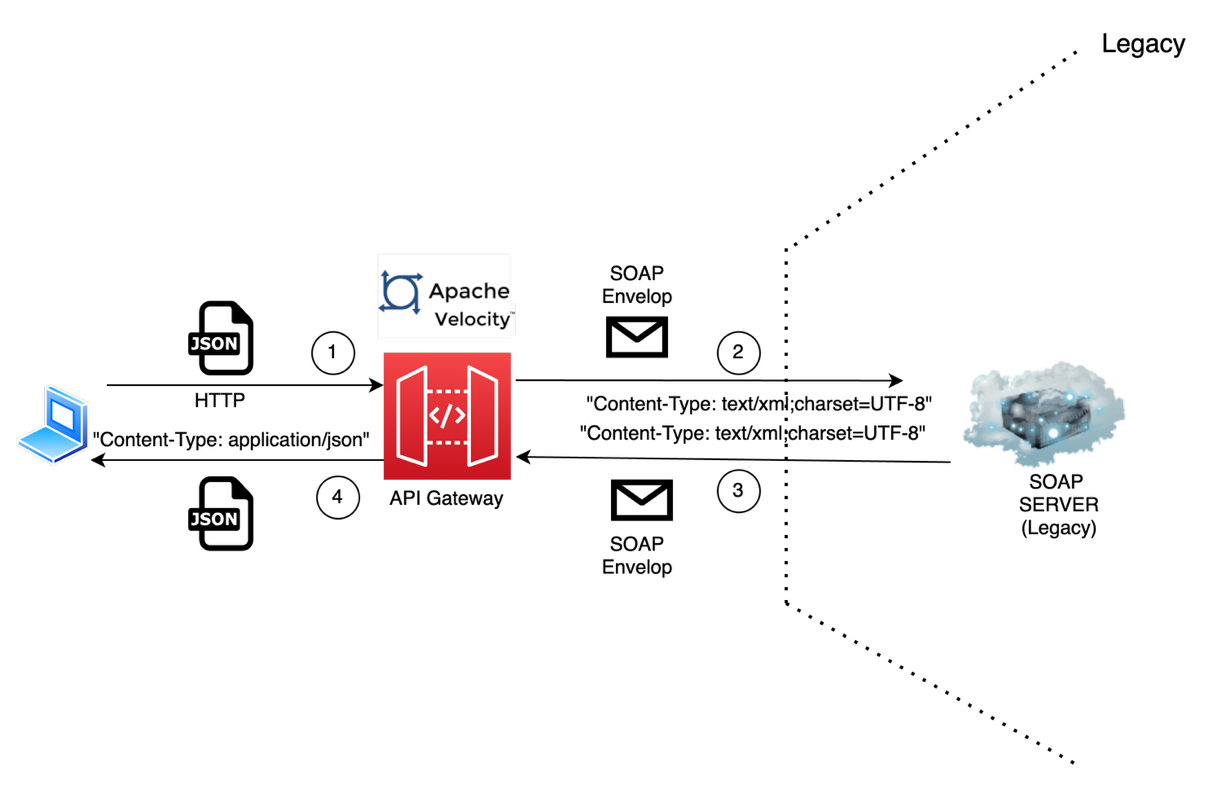
The native API Gateway transformation uses Apache Velocity Template Language mapping templates. It converts the payload directly at the gateway, offering a streamlined solution for specific modernization scenarios.

The VTL approach works by defining mapping templates that handle the conversion process between different payload formats. When modernizing SOAP services, these templates can intercept REST requests with JSON payloads, restructure the data into XML format compatible with your legacy SOAP endpoints, and reverse the process for responses returning to the client.

Figure 3: API Gateway with velocity template language transformation

Figure 3: API Gateway with velocity template language transformation

This gateway-native transformation strategy offers several operational advantages. You benefit from streamlined architecture because the transformation logic resides entirely within the API Gateway service. There are no other infrastructure components to manage or monitor, and the solution avoids the complexity of coordinating between multiple AWS services. Cost efficiency is another key benefit, as there are no compute charges beyond the standard API Gateway pricing.

Consider the previous example of converting a number to its word format. The VTL transformation in API Gateway will look like this:

## Parse the SOAP envelope and extract the number value
#set(\$xmlDoc = \$input.path('\$'))
#set(\$numberToWords = \$xmlDoc.Envelope.Body.ConvertNumberToWordsSoapIn.NumberToWordsRequest)

## Convert to integer if it's a string
#if(\$numberToWords.toString().matches("^\d+\$"))
  #set(\$dataValue = \$numberToWords.toInteger())
#else
  #set(\$dataValue = \$numberToWords)
#end

{
  "data": \$dataValue
}

You should consider VTL transformations when your SOAP services have predictable, stable schemas with relatively direct XML structures. This approach works particularly well for legacy systems that rarely undergo changes and have clear request-response patterns. For more dynamic environments or complex transformation requirements, the Lambda-based solution provides superior flexibility and maintainability.

Security considerations

An important consideration when working with legacy SOAP services is understanding their authentication mechanisms. SOAP protocols often implement authentication through security standards, where authentication credentials and security tokens are embedded directly within the SOAP envelope headers. This includes username tokens, digital signatures, and encryption elements that are part of the XML structure.

When SOAP envelopes contain unencrypted authentication information in the headers, the proxy architecture typically functions without more modifications. This is because the Lambda function can pass through these authentication elements transparently to the backend SOAP service. However, due to the nature of SOAP authentication being tightly integrated with the XML envelope structure, certain scenarios may need custom handling within the Lambda function.

For example, if the SOAP service uses timestamp-based authentication tokens, session management, or needs specific security header modifications, the Lambda function may need customization to properly handle, validate, or refresh these authentication elements during the JSON-to-XML transformation process. Organizations should carefully analyze their SOAP service authentication requirements to determine if more Lambda logic is needed to maintain security compliance.

Moreover, make sure that any SOAP authentication credentials processed by the Lambda function are handled securely and never logged in plain text.

Conclusion

In this post, you learned how cloud-native services can bridge the gap between legacy systems and modern application architectures, allowing you to use your existing investments while adopting contemporary development practices and technologies.

Amazon API Gateway and AWS Lambda enable organizations to create REST services that proxy legacy SOAP servers, allowing modern applications to consume legacy services through JSON payloads while preserving existing SOAP infrastructure. This serverless solution provides cost-effectiveness, automatic scaling, and reduced operational overhead while facilitating company modernization through scalable APIs without abandoning legacy software investments.

This modernization strategy allows you to gradually transition from legacy SOAP services to modern REST APIs without disrupting existing business operations. As your modernization journey progresses, you can extend this pattern to support more SOAP services or implement more sophisticated transformation logic based on your specific business requirements.

For more serverless learning resources, visit Serverless Land.

Parrot 6.4 released

Post Syndicated from corbet original https://lwn.net/Articles/1029857/

Parrot is a Debian-based
distribution with an emphasis on security improvement and tools; the 6.4
release
is now available. “Many tools, like Metasploit, Sliver,
Caido and Empire received important updates, the Linux kernel was updated
to a more recent version, and the latest LTS version of Firefox was
provided with all our privacy oriented patches.
“.

How Scale to Win uses AWS WAF to block DDoS events

Post Syndicated from Ben "Fuzzy" Shonaldmann original https://aws.amazon.com/blogs/architecture/how-scale-to-win-uses-aws-waf-to-block-ddos-events/

This is a guest post coauthored by Ben “Fuzzy” Shonaldmann of Scale to Win.

Scale to Win was created for organizers by organizers. Born out of the 2020 election cycle, a group of friends and former colleagues came out of a whirlwind presidential primary season with frustrations and ideas to improve campaign technology. With extensive outreach experience on high-profile presidential campaigns such as Biden/Harris 2020, Bernie 2016 and 2020, Warren 2020, and Clinton 2016, we knew the power of organizing. We saw how conversations—neighbor to neighbor, friend to friend, volunteer to voter—could transform communities and drive movements. Yet, the tools available for voter contact programs regularly fell short of our needs. We built and launched our first product in April 2020, a peer-to-peer (P2P) texting tool. We’ve since added a dialer tool that allows organizations to easily call voters, and Scale to Win Text, an all-in-one texting tool for organizing and fundraising.

During the 2024 US presidential election campaign season, we were the target of distributed denial of service (DDoS) events. These events reached peaks of over 2 million requests per second from nearly ten thousand unique IPs. After a brief window of downtime at the start of these events, Scale to Win partnered with Amazon Web Services (AWS) to implement AWS WAF, AWS Shield Advanced, and Amazon CloudFront to mitigate these targeted DDoS events.

One key element of our defense was AWS WAF support for Completely Automated Public Turing test to tell Computers and Humans Apart (CAPTCHA) to automatically present a challenge to suspicious-looking clients. We used this to provide a per-IP rate limit for traffic we expected to see from legitimate clients behind a single IP. For IPs that exceed this rate limit, we present a CAPTCHA and provide a higher rate limit to the maximum amount of traffic we expect to come from a single IP, like a campaign office or college campus.

However, the AWS WAF out-of-the-box CAPTCHA had an important caveat—it doesn’t provide protection against an event using a token that is solved and distributed across a network of machines behind multiple IPs. To prevent this class of event, AWS WAF users need to identify CAPTCHA tokens that are being used from multiple IPs and automatically block this traffic.In this post, you’ll learn how Scale to Win configured our network topology to maximize DDoS protection capacity, configured AWS WAF to block DDoS events, segmented machine-to-machine and browser-to-machine traffic to target CAPTCHA interventions, and blocked token reuse across IP addresses.

Network Topology Overview

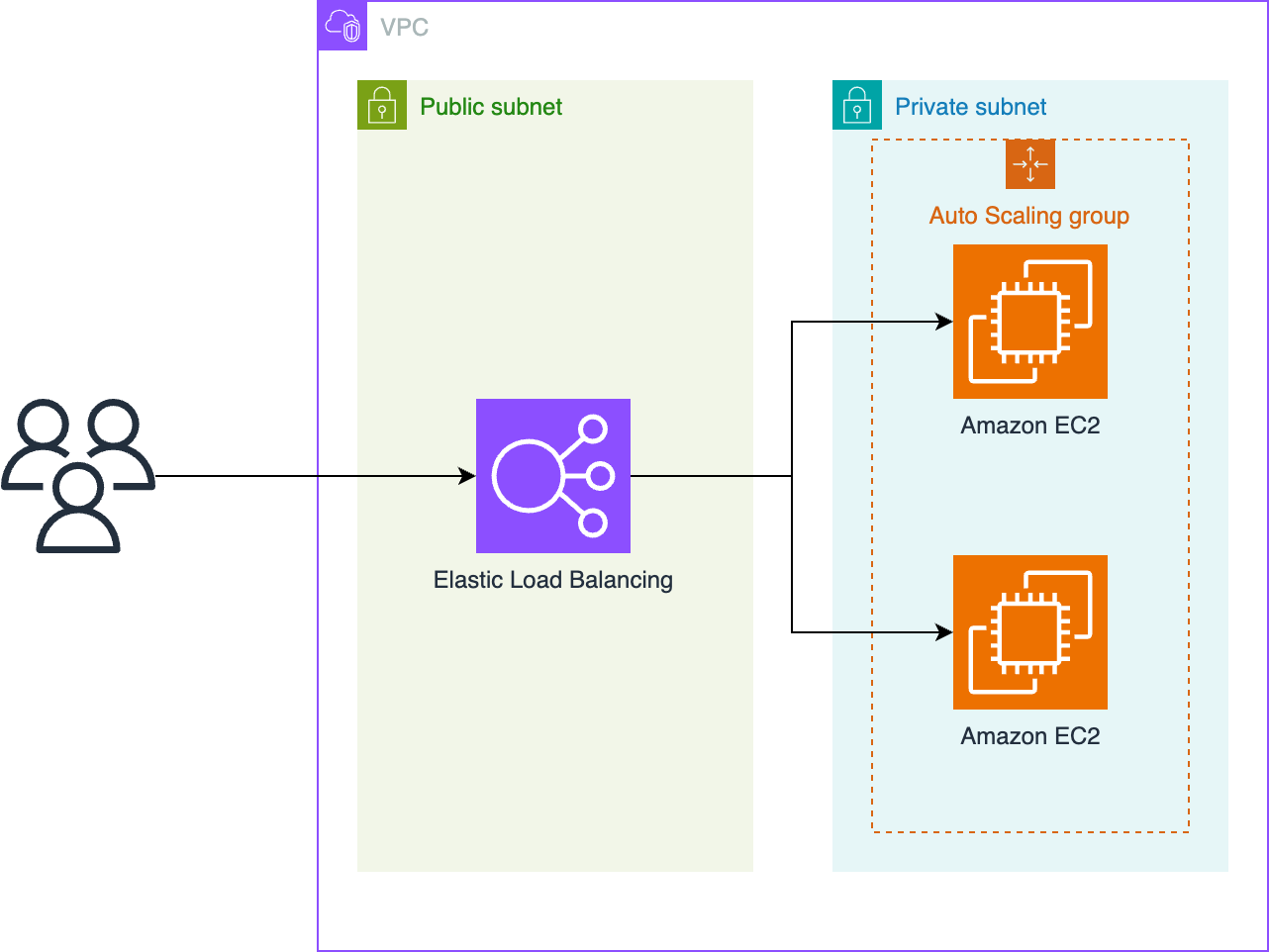
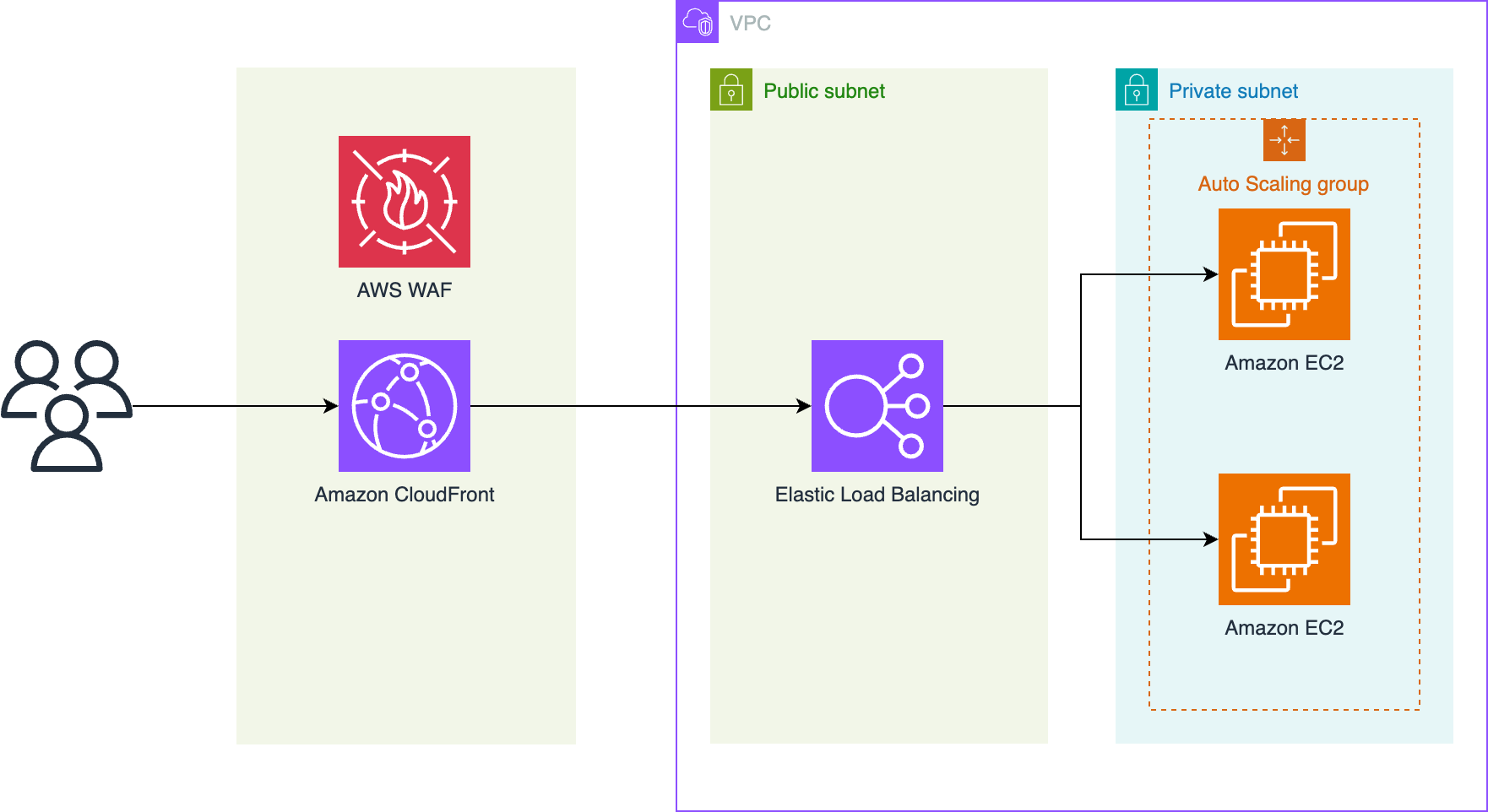
The Scale to Win application runs behind an Application Load Balancer (ALB) that serves as the single point of entry to our application servers. Before implementing AWS WAF, our DNS records resolved to the ALB as shown in the following diagram. The diagram shows a path from users to Elastic Load Balancing to an auto scaling group of Amazon Elastic Compute Cloud (Amazon EC2) instances.

Diagram of a VPC with public and private subnets, Elastic Load Balancing, and Amazon EC2 instances

The recommended pattern for using AWS WAF to protect against DDoS events is to instead route traffic through a CloudFront distribution as shown in the following diagram. The diagram shows a path from users to CloudFront with AWS WAF to Elastic Load Balancing to an auto scaling group of EC2 instances.

VPC architecture with AWS WAF, CloudFront, Load Balancing, and EC2 instances

Using this topology, we can take advantage of the following benefits:

  1. The capacity of CloudFront to handle network-layer events sending TCP traffic that aren’t valid HTTP requests is greater than ALB capacity. Network-level protections are strongest when applied by CloudFront before passing traffic to the ALB.
  2. The edge deployment of AWS WAF has higher quotas and capacity than Regional deployments. AWS scales AWS WAF capacity one-to-one with CloudFront capacity, so AWS WAF always has enough capacity to handle incoming traffic.
  3. When implementing a geographic based block strategy, such as blocking specific countries, CloudFront provides a geographic restriction feature. In event patterns we observed, over half of malicious traffic originated from countries that we blocked completely in CloudFront, resulting in cost savings on our AWS WAF deployment.

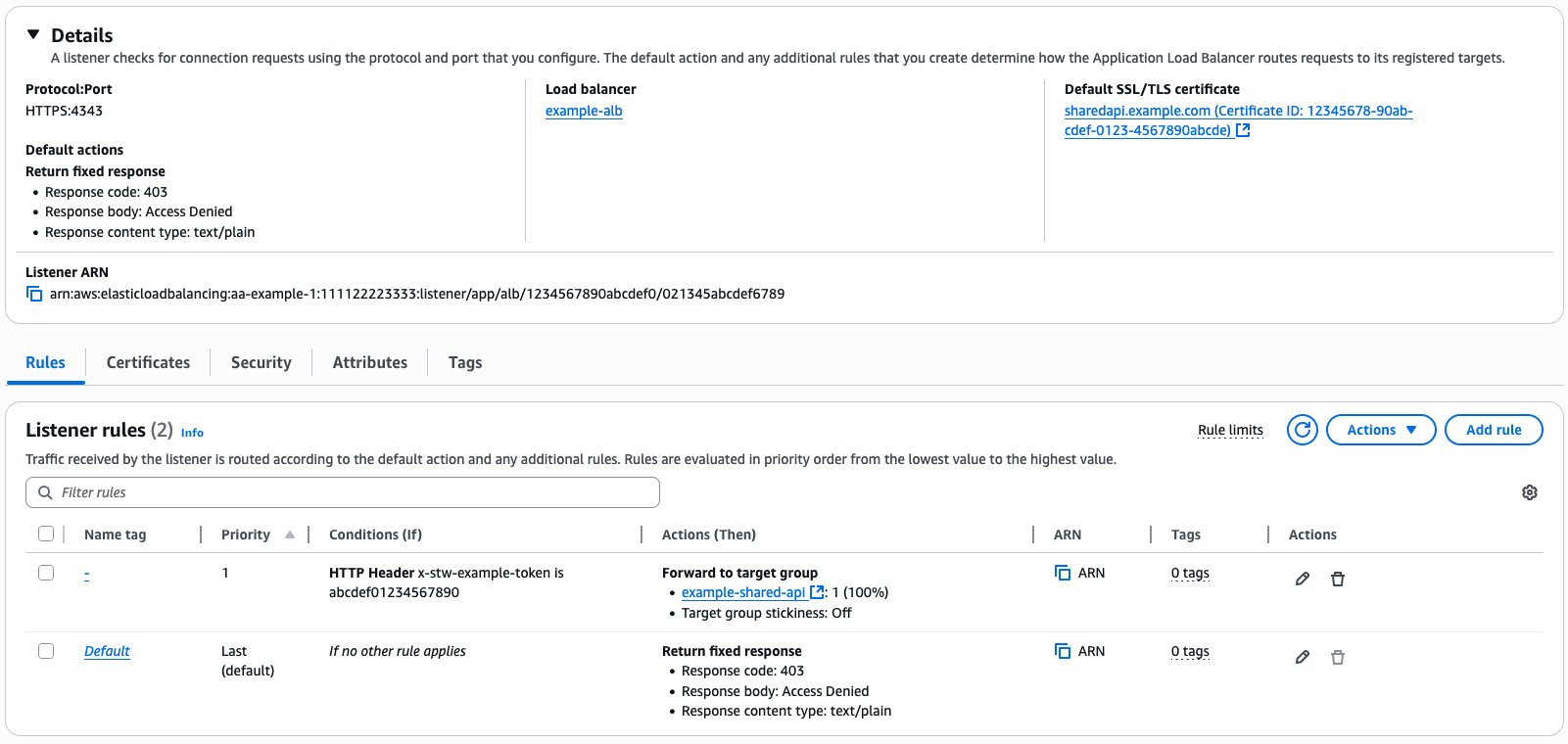
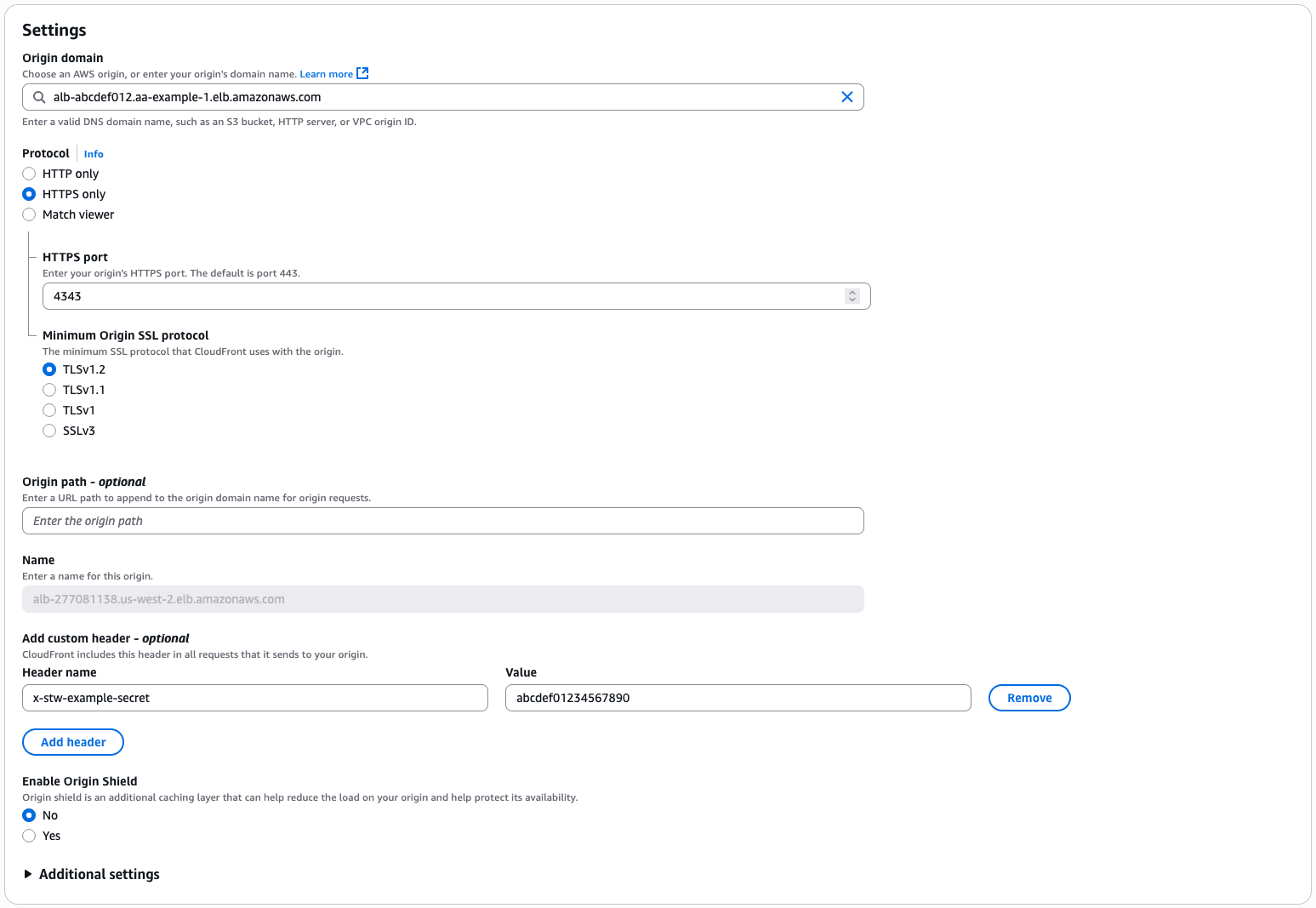
To prevent threat actors from bypassing our CloudFront distribution and AWS WAF, we implemented a security group that allows traffic only from CloudFront edge IP addresses using the managed prefix list to prevent direct connections to the ALB. We then configured the ALB to require a secret, pre-shared token in a request header, for example, our header x-stw-example-secret. We configured the CloudFront distribution to add that request header when forwarding traffic to the origin. This secret isn’t logged to Application Load Balancer logs but is logged to AWS CloudTrail when setting or updating the CloudFront or ALB configuration. It’s possible to rotate this secret on a schedule by generating a random password with AWS Secrets Manager with an AWS Lambda function to update the CloudFront origin configuration and ALB listener configuration, as shown in the following two screenshots. This shared secret between the CloudFront distribution and ALB means that an event can’t bypass the security group control by configuring its own CloudFront distribution with our ALB as an origin.

The following screenshot shows configuration of the Application Load Balancer, showing a priority-1 rule to route traffic to our target group only if the x-stw-example-secret is correct. A default rule returns a 403 if it’s not correct.

AWS Elastic Load Balancing configuration details, displaying the protocol, port, load balancer name, and SSL/TLS certificate for a listener.

The following screenshot shows CloudFront origin settings, showing a custom header configuration to add the shared secret to requests to the origin.

AWS CloudFront origin settings showing domain, protocol, SSL, and custom header options

Configuring AWS WAF rules

We use two approaches to identify and block malicious DDoS traffic, a heuristic approach and a hard limit approach.

For the heuristic approach, we observe event traffic in AWS WAF sample requests and AWS WAF logs, identify patterns in the event, and block those specific patterns. To use this tactic in your own AWS WAF configuration, first identify a characteristic that is common to all or most event traffic but rare in legitimate traffic, like a HTTP header or query parameter. Create a AWS WAF rule that blocks the traffic. Using the Count rule action is helpful to test your rule and find false-positive and false-negative rates by correlating requests that match the rule with IPs that are sending high volumes of traffic. You can query AWS WAF logs with Amazon Athena to find these correlations. When you’re satisfied with your false-positive and false-negative rates, set the rule action to Block to actively block the matched traffic.

A motivated threat actor will notice the event is being blocked and randomize these parameters to bypass your rules. For example, they might replay legitimate session parameters, so that request URIs, query parameters, and request bodies are identical to legitimate traffic. Ultimately, the heuristic approach is a useful tool, and a good reason to set up logging and Athena to quickly query your AWS WAF logs, but it’s a solution that requires active reconfiguration of your AWS WAF as event patterns change.

One specific heuristic that’s worth calling out is JA4 fingerprints and their predecessor, JA3 fingerprints. A JA4 fingerprint is a hash of several parameters presented by TLS clients in the client hello packet. JA4 fingerprints roughly correspond to the specific TLS client parameters of the request, so they’re usually stable for a specific type of client. For example, a specific version of Google Chrome on a particular operating system has a fingerprint, but a version on a different operating system would have a different fingerprint. This makes JA4 fingerprints a useful heuristic for blocking malicious traffic because the botnet sending the traffic is likely to have a small number of different fingerprints. However, there are two caveats with blocking requests based on JA4 fingerprints:

  1. Threat actors might have the same JA4 fingerprint as legitimate users. In our case, we saw malicious traffic with the same fingerprint as a common NodeJS API client and were unable to block that fingerprint without blocking legitimate API clients.
  2. A sophisticated threat actor can randomize some of the TLS connection parameters, such as the order of TLS extensions in the client hello packet, which is done by threat actors to avoid JA3 fingerprint blocking and some browsers to preserve user privacy. Although the newer JA4 specification reduces some randomization elements, the fundamental challenge remains—because end users maintain control over the client hello packet, this creates an ongoing challenge of adaptation and response.

For the hard limit approach, we take advantage of request parameters that the event can’t fake, such as the source IP of the request. Although the source IP of a packet can be forged, these requests are dropped because they don’t successfully complete the TCP or TLS handshake. You can create AWS WAF rules that limit how much traffic can be sent from a single source IP using rate-based rule statements, setting the limit above what a legitimate user would send but below what the event needs to be effective.

The simplest approach with rate-based rule statements would be to have a single limit in the AWS WAF policy, but this has challenges. First, we have APIs that receive high volumes of machine-to-machine traffic. For example, we place outbound phone calls using Twilio, and Twilio sends tens of thousands of webhooks to our API per second to relay delivery status, sometimes from a single Twilio IP. Also, our application is often used by campaign offices or student-led phone banks on college campuses that might have hundreds of users behind a single or handful of IPs, so we can’t assume that a single IP is being used by a single user to calculate our acceptable rates of traffic.

Segmenting human and machine traffic

To address these challenges, we structure our AWS WAF rules to segment human and machine traffic. We do this by request path: AWS WAF rules can match based on request path, so we have a set of rules for machine traffic based on the webhook URLs or API paths where we expect machine traffic. For all other paths, we assume the traffic originates from a user visiting the site from their browser.

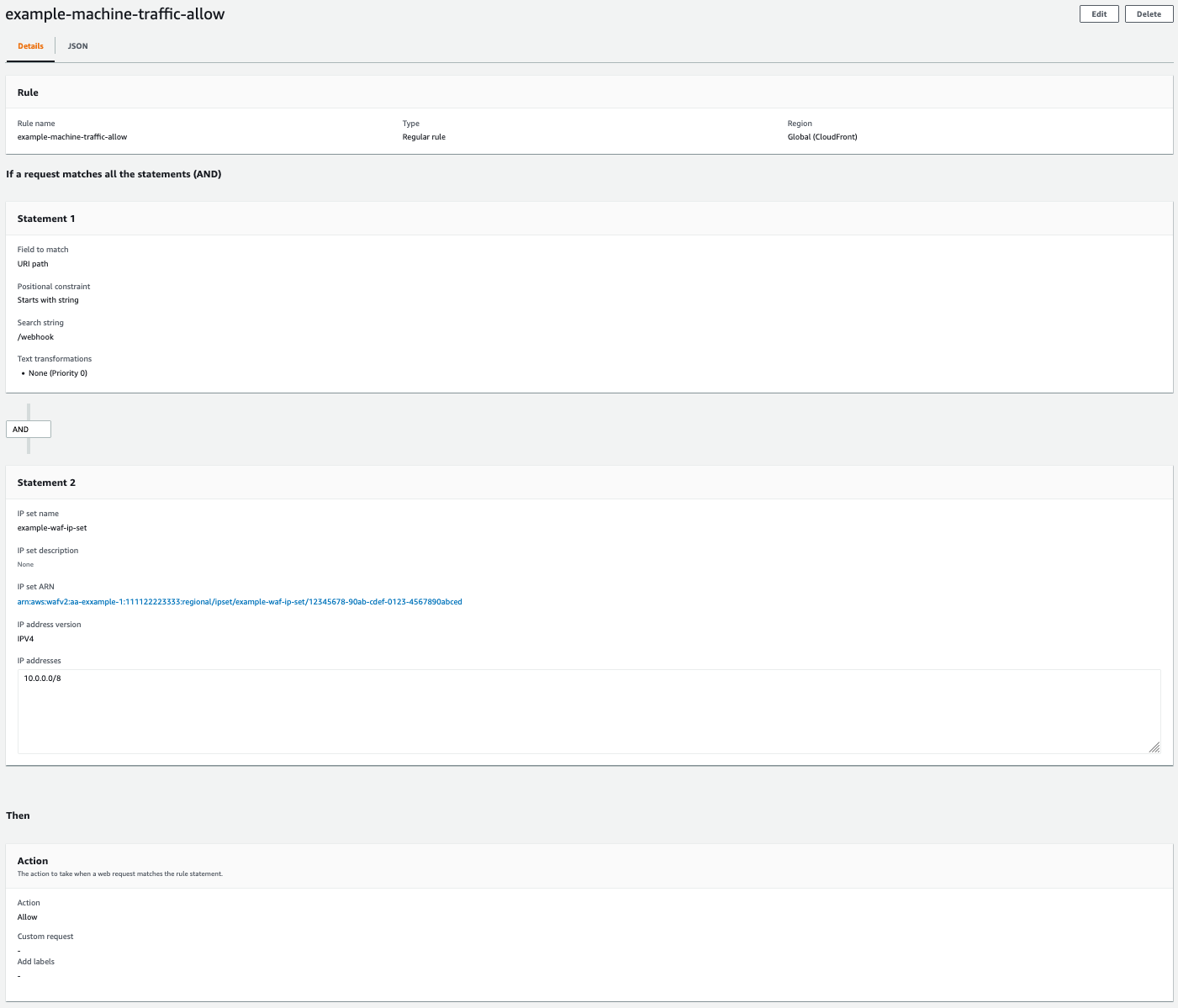
For machine traffic, we can’t use a CAPTCHA. Our API clients and the Twilio webhook infrastructure can’t solve the CAPTCHA, so we validate traffic differently. For our API clients, we set per-IP rate limits to what we expect from a single API client and return a 429 HTTP status when traffic exceeds our limit. We implement automatic retries to handle the occasional 429 error when sending above the limit. For Twilio or other webhook callbacks, we use published IPs from the service provider to create an IP set in AWS WAF. Then, we block requests to our webhook URL that don’t originate from the IP set. Not all service providers use static IPs—for Twilio specifically, we worked with their team to implement their Static Proxy feature to proxy webhook requests from a stable list of IPs. It also makes sense to implement API key authentication, request signing, and certificate-based authentication when possible for your machine traffic. For requests that originate from the IP set, we apply an Allow action in our AWS WAF rule to allow expected machine traffic through, as shown in the following screenshot. These rules allow high-volume machine-to-machine traffic through our AWS WAF configuration before we apply AWS WAF rules to block high volume user-based traffic. The following screenshot shows an example rule allowing expected machine-to-machine traffic.

WAF rule configuration showing machine traffic allow rules with URI path and IP settings

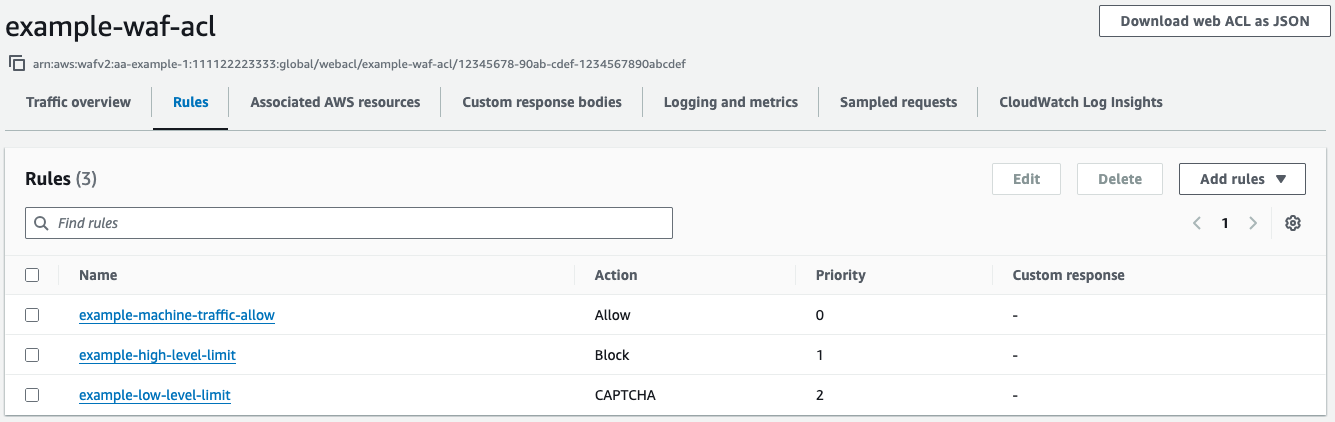
For our browser-based human traffic, we use a tiered rate limit strategy. We implement two tiers of rate limit: a low-level rate limit that corresponds to the maximum rate we expect two to three users to send, and a high-level rate limit that corresponds to the maximum rate we expect from a single IP with hundreds of users sharing the IP. Our low-level rule uses a CAPTCHA rule action when requests exceed the limit. Our high-level rule applies a Block action when requests exceed the limit. We set the high-level rate limit rule priority lower than the low-level rule so it’s processed first, as shown in the following screenshot.

AWS WAF web ACL interface displaying rules for traffic allow, block, and CAPTCHA actions

When a few users are sharing an IP address, they’re unlikely to hit either limit and can use the application without interruption. If a large group of users share an IP address, they’ll need to solve a CAPTCHA. After they solve it, they’re still limited by the high-level rate limit rule, which will prevent a threat actor from solving the CAPTCHA and then sending unlimited traffic using the token issued by AWS WAF.

Handling CAPTCHA on the frontend

For server-rendered applications, AWS WAF handles CAPTCHA challenges automatically through the following process:

  1. When a request matches a CAPTCHA rule without a valid token, AWS WAF presents an AWS managed CAPTCHA challenge page.
  2. Upon successful CAPTCHA completion, AWS WAF issues a Set-Cookie header containing the CAPTCHA token.
  3. Subsequent requests with valid CAPTCHA tokens can pass through AWS WAF for the configured immunity period.

For single-page applications (SPAs) or applications making API requests to a AWS WAF protected backend, additional implementation steps are required:

  1. Configure your frontend to detect blocked requests (HTTP 405 status code indicates CAPTCHA requirement).
  2. Present the CAPTCHA challenge to the user when required.
  3. Resubmit the original request after successful CAPTCHA completion.

The following sample code demonstrates how to implement CAPTCHA handling in a React component using the AWS WAF CAPTCHA JavaScript API:

import { useState, useRef, useEffect, ReactElement } from "react";

declare global {
  class CaptchaError extends Error {
    constructor(message: string);
    kind: "internal_error" | "network_error" | "token_error" | "client_error";
    statusCode?: number;
  }
  interface Window {
    AwsWafCaptcha: {
      renderCaptcha: (
        targetDiv: HTMLElement,
        options: {
          apiKey: string;
          onSuccess: (token: string) => void;
          onError: (err: CaptchaError) => void;
        }
      ) => void;
    };
    AwsWafIntegration: {
      fetch: typeof fetch;
    },
    awsWafCookieDomainList: string[];
  }
}

type DataLoading = {
  state: "loading";
};

type DataError = {
  state: "error";
  message: string;
};

type DataLoaded = {
  state: "loaded";
  data: any;
};

type Data = DataLoading | DataError | DataLoaded;

function MyComponent(): ReactElement {
  const [data, setData] = useState<Data>({ state: "loading" });
  const captchaDiv = useRef<HTMLDivElement>(null);

  useEffect(() => {
    void (async () => {
      try {
        const response = await window.AwsWafIntegration.fetch('/your/api/url');

        if (response.status === 405) {
          // The user needs to solve a captcha. 
          window.AwsWafCaptcha.renderCaptcha(captchaDiv.current!, {
              apiKey: "...API key goes here...",
              onSuccess: async _wafToken => {
                const response = await window.AwsWafIntegration.fetch('/your/api/url');
    
                if (response.status !== 200) {
                  setData({ state: "error", message: "Unable to load data." });
                }
    
                const data = await response.json();
                setData({ state: "loaded", data });
              },
              onError: e => {
                console.error(e);
                setData({ state: "error", message: "Unable to load data." });
              }
              /* ...other configuration parameters as needed... */
          });
          

          return;
        }

        if (response.status !== 200) {
          throw new Error(`Unexpected response status: ${response.status}`);
        }

        const data = await response.json();
        setData({ state: "loaded", data });
      } catch (e) {
        console.error(e);
        setData({ state: "error", message: "Unable to load data." });
      }
    })();
  }, []);

  return (
    <div>
      <div ref={captchaDiv} />
      <div>
        {/* render the data */}
      </div>
    </div>
  );
}

Preventing CAPTCHA token reuse

Although AWS WAF provides built-in CAPTCHA functionality, additional security measures are necessary to prevent token reuse events. In these events, threat actors can solve a CAPTCHA one time and distribute the token across their botnet. AWS WAF Bot Control offers protection against this vulnerability by detecting and blocking CAPTCHA token reuse across multiple IPs, ASNs, or countries.

To implement this protection:

  1. Configure the AWSManagedRulesBotControlRuleSet managed rule group after your rate-limiting rules.
  2. Use the targeted protection level.
  3. Apply Count or Allow actions to specific rules that you don’t want to apply to your traffic instead of a Block or CAPTCHA action.
  4. Monitor and adjust rule actions based on observed traffic patterns.

Conclusion

In this post, you learned how we implemented comprehensive DDoS protection using AWS WAF by:

  • Implementing best practices for AWS WAF network topology using CloudFront
  • Segmenting human and machine traffic in our AWS WAF configuration
  • Using tiered rate limits and CAPTCHA to allow legitimate requests
  • Preventing CAPTCHA token reuse by using AWS WAF Bot Control

To learn more about fine-tuning and optimizing AWS WAF Bot Control, refer to Fine-tune and optimize AWS WAF Bot Control mitigation capability by Dmitriy Novikov in the AWS Security Blog.


About the authors

How UP Tombou Digitally Transformed with Nebosystems (Presented at InfoSec SEE 2025)

Post Syndicated from Dora original https://nebosystems.eu/how-up-tombou-digitally-transformed-with-nebosystems/

About UP Tombou

UP Tombou is one of Bulgaria’s leading providers of food vouchers, gift cards and employee benefit solutions, serving thousands of businesses nationwide for over 30 years.

But despite their strong market presence, Tombou’s internal IT infrastructure was holding them back.

The Challenge: Legacy Systems and Poor IT Support

Prior to partnering with Nebosystems, Tombou faced serious IT hurdles:

  • Outdated and fragmented infrastructure
  • Inconsistent and slow internal IT support
  • Missed deadlines and operational delays
  • Poorly maintained documentation and weak security practices
  • No disaster recovery or business continuity strategy

These weaknesses posed serious risks — both to operations and compliance.

The Turning Point: Partnering with Nebosystems

In early 2024, Tombou signed a long-term contract with Nebosystems to fully manage and modernize their IT environment. The goal: build a secure, scalable and compliant digital infrastructure to support their expanding operations.

Infrastructure Modernization

Nebosystems began with a foundational rebuild:

  • Proxmox host cluster for virtualization and high availability
  • Enterprise-grade IBM storage systems
  • Local and offsite backup systems with automated disaster recovery
  • Regular disaster recovery testing to validate data integrity and recovery speed
  • Implementation of an ISO 27001-compliant Business Continuity Plan (BCP)
  • Modernized network with MikroTik routers, managed switches, and a Next-Gen Firewall

This laid the groundwork for operational resilience and compliance.

Endpoint Security with Bitdefender EDR

Security was a key priority. Bitdefender EDR was deployed across all Windows endpoints, enabling:

  • Real-time threat detection and prevention
  • Centralized policy control for compliance and auditing
  • Defense against ransomware, zero-days, and targeted attacks
  • Automatic alerting to security incidents

This fulfilled essential ISO 27001 requirements while raising the security baseline across the company.

Full Audit & Control with Netwrix

Visibility is everything in modern IT — and UP Tombou now has it. Netwrix Auditor was implemented to:

  • Track all changes in Active Directory
  • Monitor file access and modifications on Windows file servers
  • Deliver real-time alerts on high-risk actions (e.g., mass file deletions)
  • Provide daily reports to ensure proactive oversight and accountability

With Netwrix, Tombou now has a transparent and audit-ready IT environment.

Office 365 Migration & Unified Communication

The internal mail server was successfully migrated to Microsoft 365, improving communication, reliability and integration. A modern virtual phone system was also deployed to replace outdated telephony infrastructure.

24/7 Monitoring and Centralized IT Task Management

To maximize uptime and response speed, Nebosystems deployed:

  • Around-the-clock infrastructure monitoring
  • Automated alerts for hardware and disk issues
  • A centralized ticketing system for efficient IT task management and issue resolution

This success story was featured live at InfoSec SEE 2025, Southeastern Europe’s leading cybersecurity conference. Representatives from Nebosystems and UP Tombou shared the transformation journey with IT leaders and compliance experts from across the region.

InfoSec SEE 2025 Recognition – Netwrix Partner of the Year

Thanks to successful digital transformation projects like this one, Nebosystems was named:

Netwrix Partner of the Year 2025
This recognition affirms Nebosystems’ commitment to high-impact solutions and long-term client success.

The Results

  • Secure, high-availability IT systems
  • Full ISO 27001 technical alignment
  • Increased productivity and zero unplanned downtime
  • Regular backup validation and disaster recovery testing
  • Streamlined IT operations through a professional ticketing system
  • Ongoing partnership built on trust and performance

Ready to Transform Your IT?

If your business is struggling with outdated infrastructure, security concerns or compliance pressure — Nebosystems can help.

Get in touch to learn how we can build a modern, secure, and audit-ready IT environment tailored to your needs.

AWS Weekly Roundup: AWS Builder Center, Amazon Q, Oracle Database@AWS, and more (July 14, 2025)

Post Syndicated from Matheus Guimaraes original https://aws.amazon.com/blogs/aws/aws-weekly-roundup-aws-builder-center-amazon-q-oracle-databaseaws-and-more-july-14-2025/

Summer is well and truly here in the UK! I’m a bit of a summer grinch though so, unlike most people, I’m not crazy about “the glorious sun” scorching me when I’m out and about. On the upside, this provides the perfect excuse to retreat to the comfort of a well-ventilated room where I can focus on coding and curating the latest AWS releases to bring you the highlights.

I also managed to escape the heat for most of yesterday while recording an episode for the AWS Developers Podcast where the wonderful Sebastien Stormaq and Tiffany Souterre interviewed me about games development. If you haven’t discovered it yet, I highly recommend you give it a go as the episodes are full of interesting lessons and insights from not just AWS, but customers and community members who share their stories and expertise in a relaxed conversation.

Alright, ready to discover some of the new things we released last week? Here are the highlights.

AWS Builder Center
There is a new home for AWS builders and community members! AWS Builder Center is a new place where cloud builders can connect, share knowledge, and access resources to enhance their AWS journey. The platform enables users to join community programs, discover trending topics, access AWS Skill Builder courses, participate in technical challenges, and more, using a single Builder ID sign-in.

One the features that I’m personally most excited about is the Wishlist. You can now create wishes and tell AWS directly about ways to improve our products and services or share original ideas that you think could help you and your teams. You can also browse and upvote existing wishes to support any suggestions that you think should be prioritized. The AWS teams will keep an eye on this and if a wish has enough traction it may just be considered!

Read the news blog post for a quick tour through some of the most exciting features or head over to AWS Builder Center and start exploring!

AI
The world of AI keeps moving fast and changing our world, by providing new and exciting ways to do things and become more productive. Here are two releases from last week that caught my attention.

  • Amazon Q chat in the AWS Management Console can now query AWS service data – Amazon Q Developer expands its capabilities by enabling natural language queries of data stored across AWS services like S3, DynamoDB, and CloudWatch, directly from the AWS Console, Slack, Microsoft Teams, and AWS Console Mobile Application. This enhancement streamlines cloud management and troubleshooting by allowing users to access and analyze service data through conversational interfaces, with access controls managed through IAM permissions.
  • Amazon CloudWatch and Application Signals MCP servers for AI-assisted troubleshooting – AWS has released two new Model Context Protocol (MCP) servers – CloudWatch MCP and Application Signals MCP – that enable AI agents to leverage observability data for automated troubleshooting through conversational interfaces. These open-source servers allow AI assistants to analyze metrics, alarms, logs, traces, and service health data across AWS environments, streamlining incident response and root cause analysis without requiring developers to manually navigate multiple AWS consoles.

Oracle Database@AWS
It seems like yesterday when Andy Jassy announced our partnership with Oracle to create Oracle Database@AWS, a jointly offered service that runs Oracle databases on Exadata infrastructure directly within AWS data centers, providing a unified AWS-Oracle experience. Fast forward to last week and Oracle Database@AWS has reached a significant milestone with its general availability release. It is now available in US East (N. Virginia) and US West (Oregon) regions, with plans to expand to 20 additional regions globally.

In addition, VPC Lattice has added support for Oracle Database@AWS enabling seamless connectivity between applications in VPCs and on-premises environments to Oracle database networks. The integration simplifies network management and provides secure access from Oracle Database@AWS to AWS services like Amazon S3 and Amazon Redshift, without requiring complex networking setup.

So if you’re looking to migrate your Oracle database workloads, now is a great time to explore Oracle Database@AWS as it offers a compelling path forward with minimal modifications required.

Additional highlights
Here are some other releases that I think many people will be happy about.

  • AWS Config now supports 12 new resource types – AWS Config has expanded its monitoring capabilities with support for 12 new resource types across services including BackupGateway, CloudFront, EntityResolution, Bedrock, and more. These additions are automatically tracked if you have enabled recording for all resource types, enhancing your ability to discover, assess, and audit AWS resources.
  • Amazon SageMaker Studio now supports remote connections from Visual Studio Code – Amazon SageMaker Studio now supports remote connections from Visual Studio Code, allowing developers to use their familiar VS Code setup while leveraging SageMaker’s scalable compute resources for AI development.
  • AWS Network Firewall: Native AWS Transit Gateway support in all regions – AWS Network Firewall now offers native integration with AWS Transit Gateway across all supported regions, enabling direct attachment and simplified traffic inspection between VPCs and on-premises networks. This integration eliminates the need for managing dedicated VPC subnets and route tables while providing multi-AZ redundancy for improved security and reliability.

Upcoming AWS Events
AWS Summit New York – this is definitely one to watch…literally! Registrations are closed due to capacity but you can tune in to watch live all the announcements and launches! No spoilers, but, trust me, there are a quite a few exciting things in store, so make sure to check it out.

AWS Gen AI Lofts – AWS Gen AI Lofts are multi-day events offering hands-on workshops, expert guidance, and networking opportunities for developers and business leaders looking to explore or advance their generative AI journey. These events are hosted across multiple global locations including San Francisco, Berlin, Dubai, Dublin, Bengaluru, Manchester, Paris, and Tel Aviv, providing accessible opportunities to accelerate your generative AI adoption.

And that’s it for this week! Come back next Monday for more highlights and keep your AWS knowledge up to date as we cover the latest releases.

Matheus Guimaraes | @codingmatheus

Managing Amazon Q Developer Profiles and Customizations in Large Organizations

Post Syndicated from Marco Frattallone original https://aws.amazon.com/blogs/devops/managing-amazon-q-developer-profiles-and-customizations-in-large-organizations/

As organizations scale their development efforts, AI coding assistants that understand organization-specific patterns and standards lead to more efficient development processes and higher quality software delivery. Amazon Q Developer Pro helps address this challenge by allowing organizations to customize the AI assistant with their proprietary code and development practices. Through Amazon Q Developer profiles, teams can efficiently manage access to Amazon Q customizations across different regions and AWS Identity Centers.

In this post, we will explore different approaches for implementing and managing Amazon Q Developer profiles and Amazon Q customizations across large organizations. Using an example with multiple business units, we will explore methods for managing access controls and customization governance while addressing security and compliance requirements.

Amazon Q customization is now available in both the US East (N. Virginia) and EU Central (Frankfurt) regions, giving teams more flexibility to create and deploy customizations closer to their operational hubs while meeting regional data residency requirements.

This blog is not intended to provide recommendations on how to structure your AWS accounts or divide Q Developer subscriptions. Rather, our aim is to explore the full capabilities of Q Developer Customizations in a comprehensive scenario that shows the current art of the possible.

A distributed Amazon Q Developer Pro subscriptions scenario

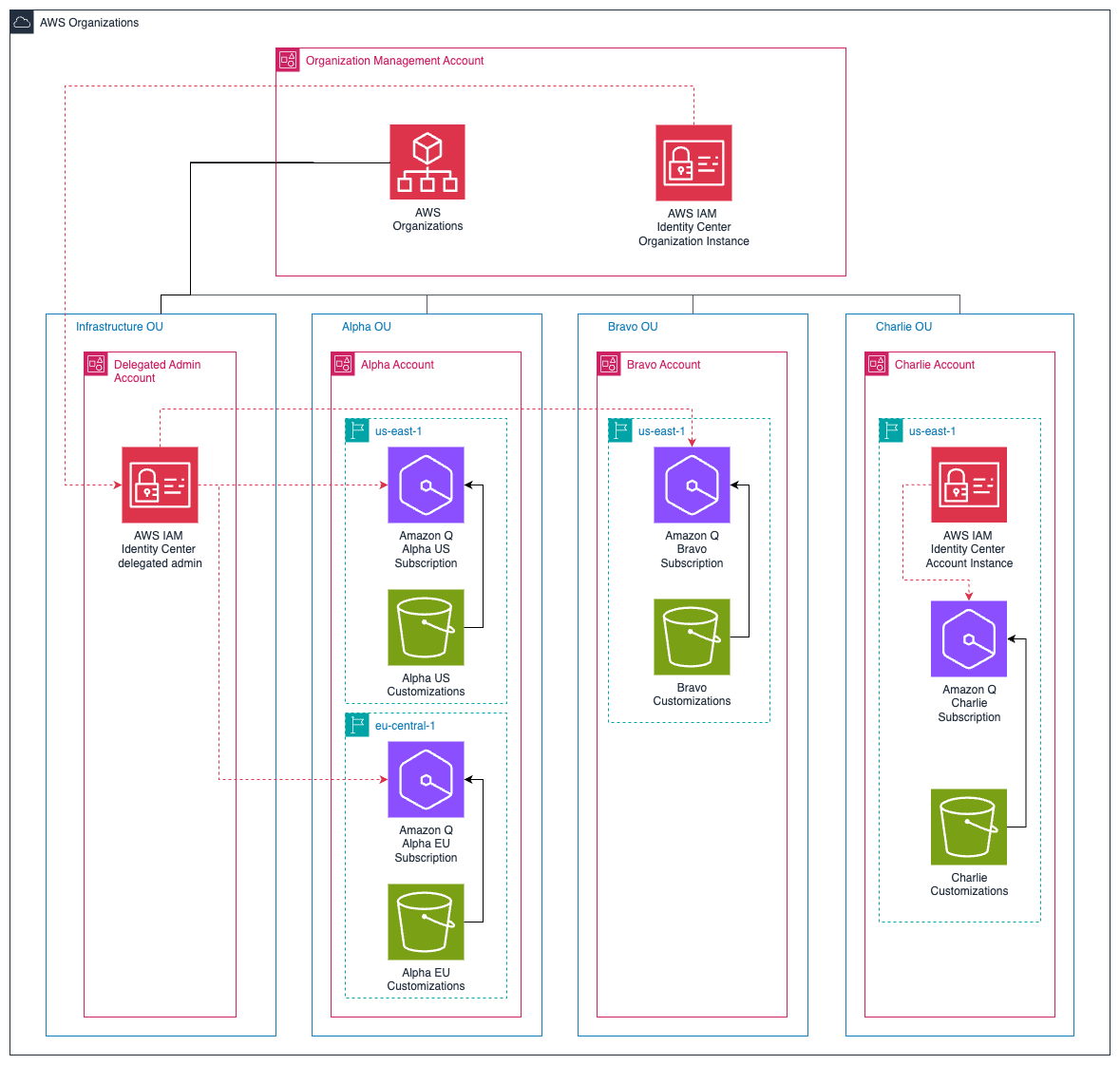
The following diagram illustrates a sample AWS Organizations structure with a Management Account and four Organizational Units (OUs). This is a common enterprise scenario with three business units, each business unit requiring their own Amazon Q Developer Pro subscription and customizations.

Diagram showing AWS Organizations structure with a Management Account at the top, containing AWS Organizations, IAM Identity Center, Amazon Q, Management Customizations, and AWS Cost & Usage Report. Below are four Organizational Units (OUs): Infrastructure, Alpha, Bravo, and Charlie. The structure illustrates the hierarchical relationship and resource allocation across different OUs and regions within an AWS organization.

Figure 1: AWS Organizations Structure and Resource Hierarchy

The Infrastructure OU has a Delegated Admin Account with delegated access to the AWS IAM Identity Center. There are three additional OUs: Alpha, Bravo, and Charlie, each with at least one Amazon Q Developer Pro subscription. Alpha account has Amazon Q Developer subscriptions both in US East (N. Virginia) and EU Central (Frankfurt) region.

Think of each business unit as its own ecosystem within your organization. When you provide dedicated Q Developer Pro subscriptions to different OUs, you’re essentially giving each unit its own personalized AI assistant. This separation is valuable because it allows each team to work independently while maintaining their specific requirements and workflows.

The Charlie OU maintains its own account instance of IAM Identity Center for Amazon Q Developer Pro. In most cases, we recommend using an organization instance of IAM Identity Center with Amazon Q Developer Pro, there are a few situations where member account instances might make sense, for example: when you do not have a single identity provider, or when you haven’t yet decided to deploy it to the whole organization and want to use Amazon Q just for the AWS account you control.

Note: When a developer has a user within an Amazon Q profile tied to two different IAM Identity Center instances (Bravo and Charlie), they will have two user subscriptions and be billed twice. However, if they belong to two different Amazon Q profiles in two different accounts (Alpha and Bravo) but under the same IAM Identity Center, they will only be billed once.

In our example, the Charlie OU requires additional operational overhead in managing separate credentials and authentication flows. Additionally, the dashboard and administrative settings will only be associated with users and groups within this account.
From an administrative perspective, instead of trying to manage one centralized configuration that attempts to serve everyone’s needs, you can distribute administration to each business unit and delegate responsibility to individual teams.

It’s like having different specialized departments in a hospital – while they’re all part of the same organization and can work together when needed, each department has its own specialized tools and protocols that help them perform their specific functions more effectively.

A strategic approach to Customizations through Q Developer profiles

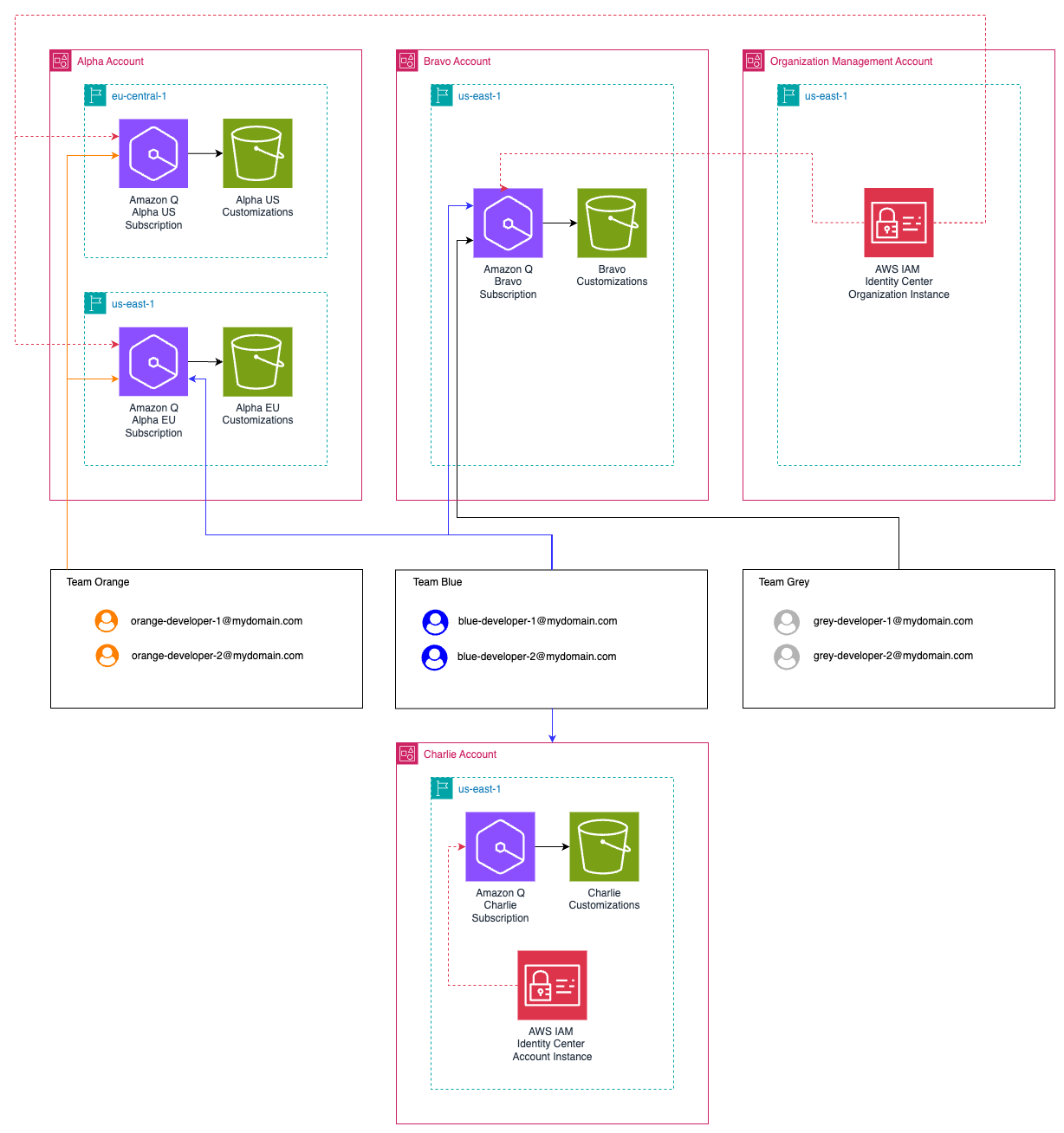
A diagram illustrating the structure of an AWS IAM Identity Center organization with multiple Amazon Q Developer Pro subscriptions and customizations. Each Q Developer Pro Subscription has its own set of users representing developers. Team orange developers have access to Alpha Q Subscription and customizations, Team blue developers have access to Alpha, Bravo and Charlie Q Subscription and customizations, Team Grey developers have only access to Bravo Subscription and customizations. The organization has also an AWS IAM Identity Center instance, with separate Amazon Q Developer Pro subscription and customizations. Team bravo developers are duplicated between the two IAM Identity Centers.

Figure 2 Developers association to Amazon Q Developer Pro Subscriptions, Customizations and IAM Identity Centers

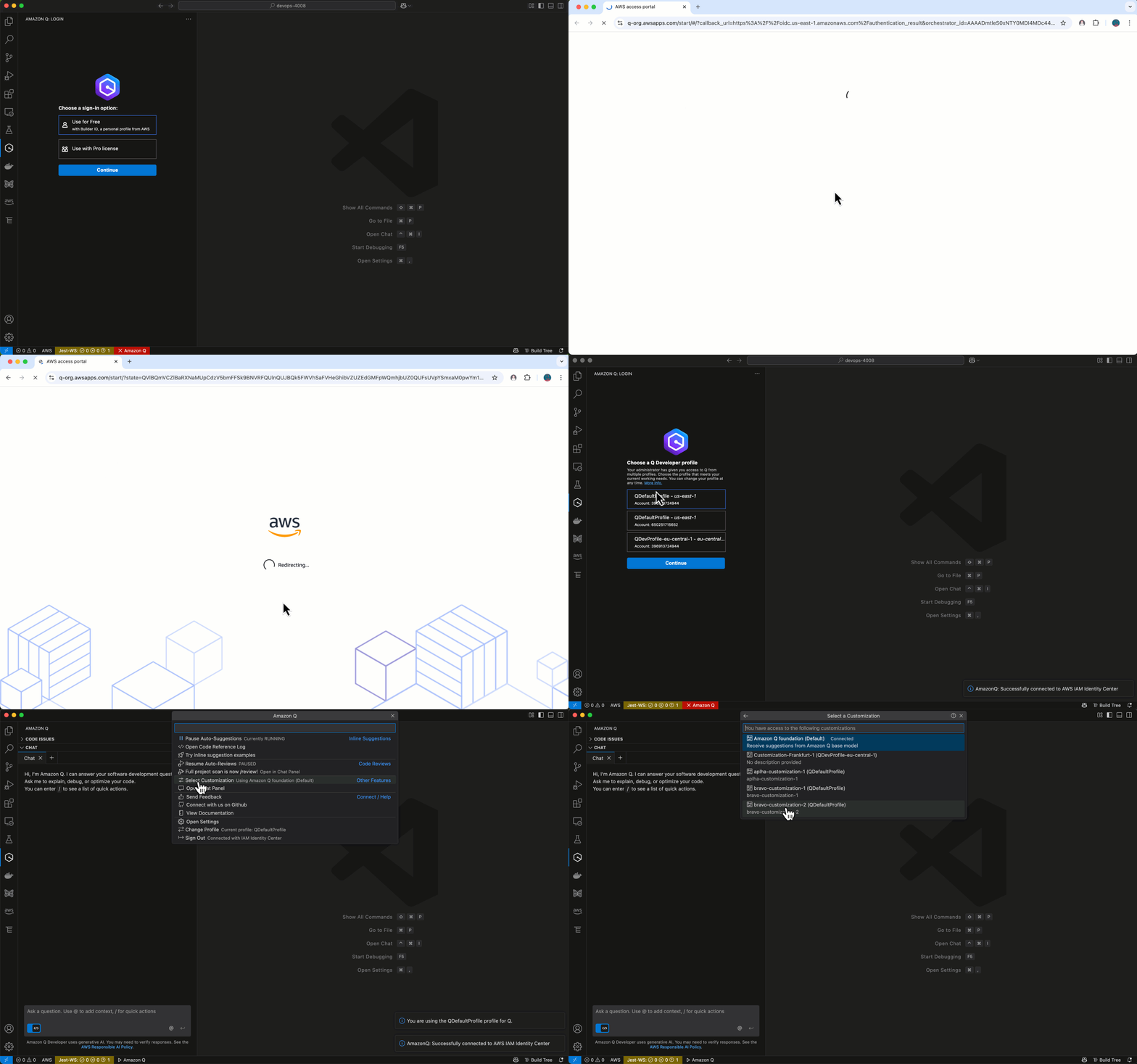
Amazon Q Developer profiles are the way developers connect to different Amazon Q Developer subscriptions through their IDE. Each profile represents a unique combination of an Amazon Q Developer subscription and its associated customizations. After authentication, developers can simply select or switch between profiles in their IDE to access different customizations.

Let’s walk through some scenarios in this architecture.

Scenario 1 – Users accessing two different customizations tied to a single IAM Identity Instance in the management account

Developers from the Orange team with access to Alpha account customizations can configure two different Amazon Q Developer profiles in their IDE:

  • A “US Profile” connected to the US East subscription in the Alpha account
  • An “EU Profile” connected to the EU Central subscription in the Alpha account

Switching between different sets of customizations involves selecting the relevant profile within their IDE.

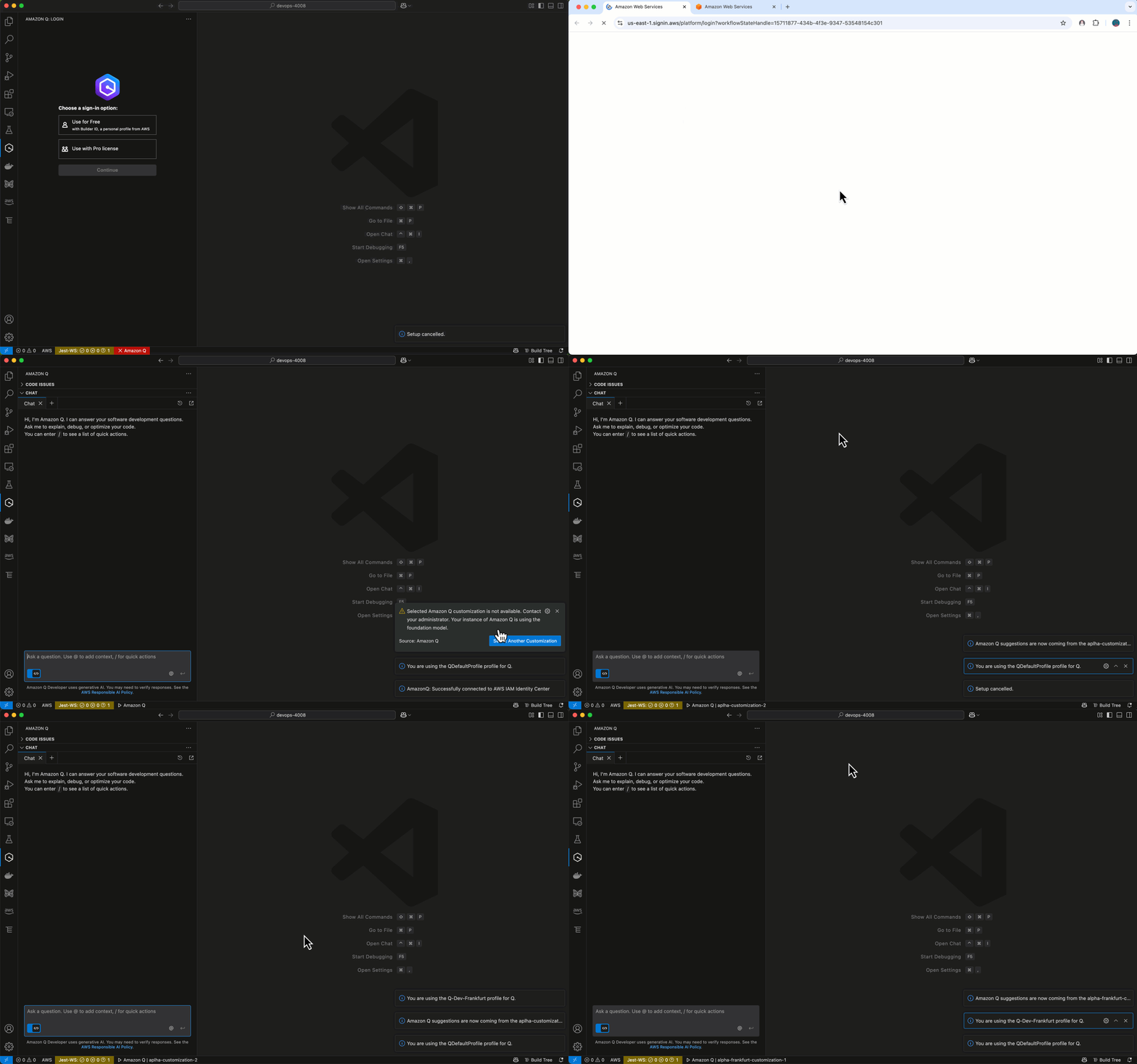
Screenshot of IDE interface showing the Amazon Q Developer customizations panel. Developer switch between US and EU Profiles and their customizations

Figure 3 IDE showing customizations available for Team Orange developers switching between US and EU Profile and their customizations

Note: While developers can access multiple customizations through different Amazon Q Developer profiles, they only incur a single user subscription cost since they are using the organization instance of IAM Identity Center. This is because the subscription is tied to their user identity in the IAM Identity Center organization instance, not to the number of profiles or customizations they access.

Scenario 2 – Users accessing two different customizations tied to a single IAM Identity Instance in the management account
Similarly, developers from the Blue team can also configure multiple profiles:

  • One profile for accessing Alpha and Bravo customizations through the management account AWS IAM Identity Center instance
  • A separate profile for accessing Charlie customizations through the AWS IAM Identity Center member account Instance

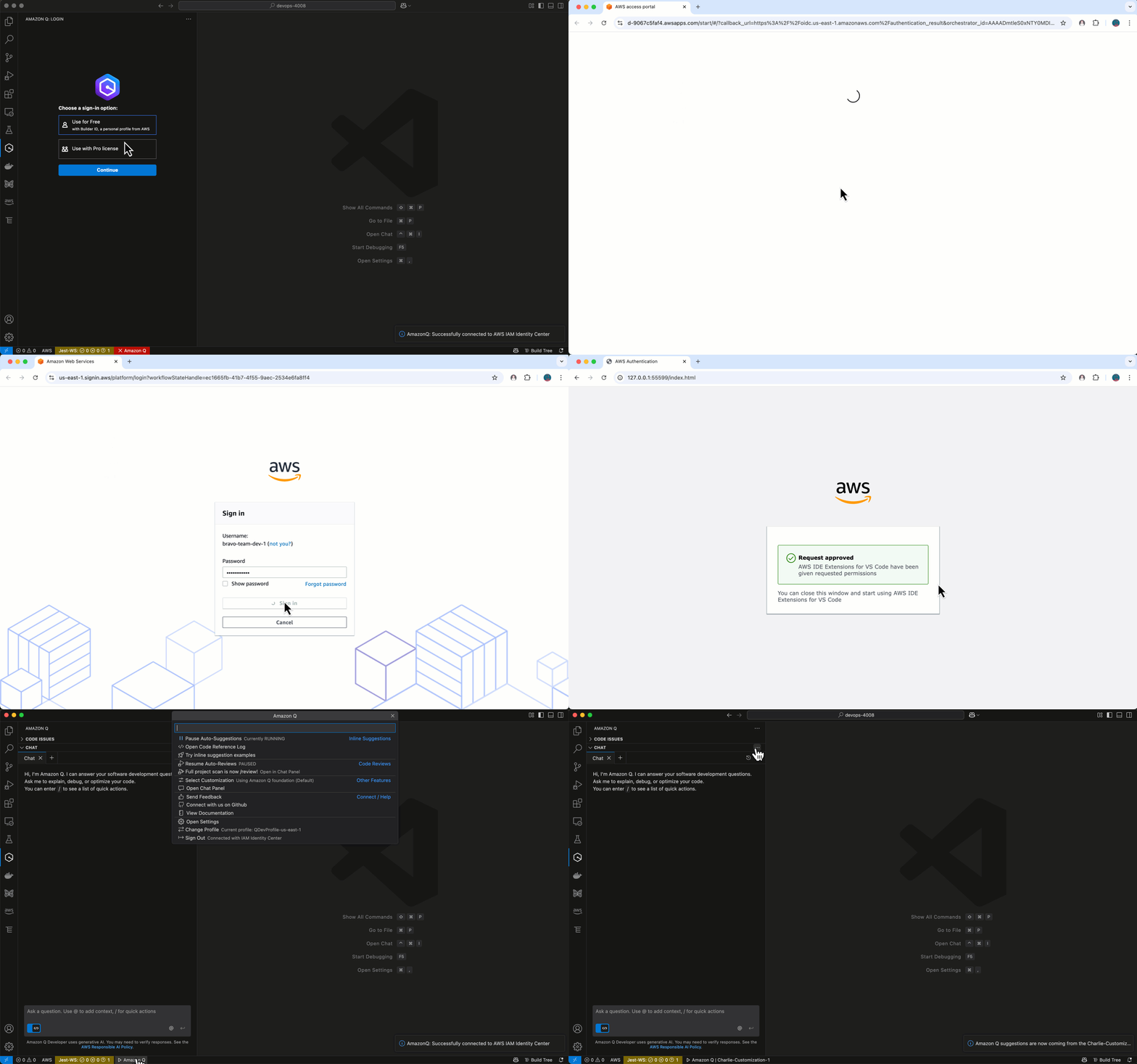
When developers have access to multiple customizations within the same IAM Identity Center configuration and region, they can switch between profiles in their IDE without requiring reauthentication.

Screenshot of IDE interface showing the Amazon Q Developer customizations panel. When authenticated through the AWS IAM Identity Center Organization, Blue developers can see both Alpha and Bravo customizations.

Figure 4 IDE showing customizations available for Team Blue developers when authenticated to AWS IAM Identity center Organization

However, as demonstrated in the blue developers’ case, switching between profiles that use different IAM Identity Center configurations (Organization vs Account Instance) still requires reauthentication.

Note: In this scenario, developers will incur two separate user subscription charges since they are accessing customizations through two different IAM Identity Center configurations (organization and account instance). As mentioned above, this scenario is not recommended except for situations it might make sense and is shown here purely to illustrate how the authentication and profile switching mechanisms work across different IAM Identity Center configurations.

Screenshot of IDE interface showing the Amazon Q Developer customizations panel. When authenticated through the AWS IAM Identity Center Instance, Blue developers can see only Charlie customizations.

Figure 5 IDE showing customizations available for Team Blue developers when authenticated to AWS IAM Identity center Account Instance

One scenario for creating code customizations specific to each profile is that the developers on the Alpha team might need Q to understand specific libraries and internal coding conventions for Java, while Bravo team developers might need Q to be well-versed in your proprietary technologies and development standards with Python. With separate profiles and customizations, each team gets their own “flavored” version of Q that understands their context.

For Blue developers who have access to Alpha, Bravo and Charlie customizations, they need to set up separate profiles since these customizations belong to different IAM Identity Center configurations and AWS Regions. Switching between these profiles requires reauthentication due to the different IAM Identity Center configurations involved.

Developer Team AWS IAM Identity Center Customizations
Orange Organization instance Alpha customizations in US East (N. Virginia)
Alpha customizations in EU Central (Frankfurt)
Blue Organization instance Alpha customizations in US East (N. Virginia)
Bravo customizations
Account instance Charlie customizations
Grey Organization instance Bravo customizations

You can manage access to specific Amazon Q Developer Pro customizations by adding selected users and groups who already have access to Amazon Q Developer Pro subscriptions within the same Identity Center. This granular access control allows you to create targeted customizations that are only accessible to specific team members or groups within your organization.

Conclusion

In this post, we explored comprehensive strategies for implementing Amazon Q Developer customizations across large organizations. We demonstrated how Amazon Q Developer profiles provide a flexible way to manage access to different customizations across AWS regions and IAM Identity Center configurations. By integrating proprietary code repositories, establishing customization governance, and implementing continuous feedback loops, enterprises can maximize the value of their AI-powered development assistant while maintaining code quality and development standards.

The path forward depends on where you are in your Amazon Q Developer customization journey. If you’re just starting, begin with a clear assessment of your codebase and map out your customization approach before implementation. For existing users, review your current customizations and profile configurations to identify optimization opportunities.

In both cases, implement the customization governance we discussed, tailoring them to your specific development patterns and team structures. Remember that customization evolves with your codebase – regular refinements help ensure your AI assistant remains effective as your applications grow and development practices mature. Whether you’re new to Amazon Q Developer customizations or optimizing existing implementations, these practices can help develop an AI assistant that truly understands and aligns with your organization’s unique development environment.

Ready to get started? Visit the Amazon Q Developer guide to learn more about setting up profiles and customizations for your organization. If you need help planning your customization strategy, contact your AWS account team or find an AWS Partner in the AWS Partner Network.

About the authors:

Marco Frattallone

Marco Frattallone is a Senior Technical Account Manager at AWS focused on supporting Partners. He works closely with Partners to help them build, deploy, and optimize their solutions on AWS, providing guidance and leveraging best practices. Marco is passionate about technology and enables Partners stay at the forefront of innovation. Outside work, he enjoys outdoor cycling, sailing, and exploring new cultures.

Francesco Martini

Francesco Martini is a Senior Technical Account Manager at AWS. He helps AWS customers build reliable and cost-effective systems and achieve operational excellence while running workloads on AWS. He is a builder and a technology enthusiast with a background as a full-stack developer. He is passionate about sports in general, especially soccer and tennis.

The collective thoughts of the interwebz