But if an agent (or an MCP server) is going to execute code generated on-the-fly by AI to perform tasks, that code needs to run somewhere, and that somewhere needs to be secure. You can’t just eval() AI-generated code directly in your app: a malicious user could trivially prompt the AI to inject vulnerabilities.
You need a sandbox: a place to execute code that is isolated from your application and from the rest of the world, except for the specific capabilities the code is meant to access.
Sandboxing is a hot topic in the AI industry. For this task, most people are reaching for containers. Using a Linux-based container, you can start up any sort of code execution environment you want. Cloudflare even offers our container runtime and our Sandbox SDK for this purpose.
But containers are expensive and slow to start, taking hundreds of milliseconds to boot and hundreds of megabytes of memory to run. You probably need to keep them warm to avoid delays, and you may be tempted to reuse existing containers for multiple tasks, compromising the security.
If we want to support consumer-scale agents, where every end user has an agent (or many!) and every agent writes code, containers are not enough. We need something lighter.
And we have it.
Dynamic Worker Loader: a lean sandbox
Tucked into our Code Mode post in September was the announcement of a new, experimental feature: the Dynamic Worker Loader API. This API allows a Cloudflare Worker to instantiate a new Worker, in its own sandbox, with code specified at runtime, all on the fly.
Dynamic Worker Loader is now in open beta, available to all paid Workers users.
// Have your LLM generate code like this.
let agentCode: string = `
  export default {
    async myAgent(param, env, ctx) {
      // ...
    }
  }
`;

// Get RPC stubs representing APIs the agent should be able
// to access. (This can be any Workers RPC API you define.)
let chatRoomRpcStub = ...;

// Load a worker to run the code, using the worker loader
// binding.
let worker = env.LOADER.load({
  // Specify the code.
  compatibilityDate: "2026-03-01",
  mainModule: "agent.js",
  modules: { "agent.js": agentCode },

  // Give agent access to the chat room API.
  env: { CHAT_ROOM: chatRoomRpcStub },

  // Block internet access. (You can also intercept it.)
  globalOutbound: null,
});

// Call RPC methods exported by the agent code.
await worker.getEntrypoint().myAgent(param);
That’s it.
100x faster
Dynamic Workers use the same underlying sandboxing mechanism that the entire Cloudflare Workers platform has been built on since its launch, eight years ago: isolates. An isolate is an instance of the V8 JavaScript execution engine, the same engine used by Google Chrome. They are how Workers work.
An isolate takes a few milliseconds to start and uses a few megabytes of memory. That’s around 100x faster and 10x-100x more memory efficient than a typical container.
That means that if you want to start a new isolate for every user request, on-demand, to run one snippet of code, then throw it away, you can.
Unlimited scalability
Many container-based sandbox providers impose limits on global concurrent sandboxes and rate of sandbox creation. Dynamic Worker Loader has no such limits. It doesn’t need to, because it is simply an API to the same technology that has powered our platform all along, which has always allowed Workers to seamlessly scale to millions of requests per second.
Want to handle a million requests per second, where every single request loads a separate Dynamic Worker sandbox, all running concurrently? No problem!
Zero latency
One-off Dynamic Workers usually run on the same machine — the same thread, even — as the Worker that created them. No need to communicate around the world to find a warm sandbox. Isolates are so lightweight that we can just run them wherever the request landed. Dynamic Workers are supported in every one of Cloudflare’s hundreds of locations around the world.
It’s all JavaScript
The only catch, vs. containers, is that your agent needs to write JavaScript.
Technically, Workers (including dynamic ones) can use Python and WebAssembly, but for small snippets of code — like that written on-demand by an agent — JavaScript will load and run much faster.
We humans tend to have strong preferences on programming languages, and while many love JavaScript, others might prefer Python, Rust, or countless others.
But we aren’t talking about humans here. We’re talking about AI. AI will write any language you want it to. LLMs are experts in every major language. Their training data in JavaScript is immense.
JavaScript, by its nature on the web, is designed to be sandboxed. It is the correct language for the job.
Tools defined in TypeScript
If we want our agent to be able to do anything useful, it needs to talk to external APIs. How do we tell it about the APIs it has access to?
MCP defines schemas for flat tool calls, but not programming APIs. OpenAPI offers a way to express REST APIs, but it is verbose, both in the schema itself and the code you’d have to write to call it.
For APIs exposed to JavaScript, there is a single, obvious answer: TypeScript.
Agents know TypeScript. TypeScript is designed to be concise. With very few tokens, you can give your agent a precise understanding of your API.
// Interface to interact with a chat room.
interface ChatRoom {
  // Get the last `limit` messages of the chat log.
  getHistory(limit: number): Promise<Message[]>;

  // Subscribe to new messages. Dispose the returned object
  // to unsubscribe.
  subscribe(callback: (msg: Message) => void): Promise<Disposable>;

  // Post a message to chat.
  post(text: string): Promise<void>;
}

type Message = {
  author: string;
  time: Date;
  text: string;
}
Compare this with the equivalent OpenAPI spec (which is so long you have to scroll to see it all):
openapi: 3.1.0
info:
  title: ChatRoom API
  description: >
    Interface to interact with a chat room.
  version: 1.0.0

paths:
  /messages:
    get:
      operationId: getHistory
      summary: Get recent chat history
      description: Returns the last `limit` messages from the chat log, newest first.
      parameters:
        - name: limit
          in: query
          required: true
          schema:
            type: integer
            minimum: 1
      responses:
        "200":
          description: A list of messages.
          content:
            application/json:
              schema:
                type: array
                items:
                  $ref: "#/components/schemas/Message"

    post:
      operationId: postMessage
      summary: Post a message to the chat room
      requestBody:
        required: true
        content:
          application/json:
            schema:
              type: object
              required:
                - text
              properties:
                text:
                  type: string
      responses:
        "204":
          description: Message posted successfully.

  /messages/stream:
    get:
      operationId: subscribeMessages
      summary: Subscribe to new messages via SSE
      description: >
        Opens a Server-Sent Events stream. Each event carries a JSON-encoded
        Message object. The client unsubscribes by closing the connection.
      responses:
        "200":
          description: An SSE stream of new messages.
          content:
            text/event-stream:
              schema:
                description: >
                  Each SSE `data` field contains a JSON-encoded Message object.
                $ref: "#/components/schemas/Message"

components:
  schemas:
    Message:
      type: object
      required:
        - author
        - time
        - text
      properties:
        author:
          type: string
        time:
          type: string
          format: date-time
        text:
          type: string
We think the TypeScript API is better. It’s fewer tokens and much easier to understand (for both agents and humans).
Dynamic Worker Loader makes it easy to implement a TypeScript API like this in your own Worker and then pass it in to the Dynamic Worker either as a method parameter or in the env object. The Workers Runtime will automatically set up a Cap’n Web RPC bridge between the sandbox and your harness code, so that the agent can invoke your API across the security boundary without ever realizing that it isn’t using a local library.
That means your agent can write code like this:
// Thinking: The user asked me to summarize recent chat messages from Alice.
// I will filter the recent message history in code so that I only have to
// read the relevant messages.
let history = await env.CHAT_ROOM.getHistory(1000);
return history.filter(msg => msg.author == "alice");
HTTP filtering and credential injection
If you prefer to give your agents HTTP APIs, that’s fully supported. Using the globalOutbound option to the worker loader API, you can register a callback to be invoked on every HTTP request, in which you can inspect the request, rewrite it, inject auth keys, respond to it directly, block it, or anything else you might like.
For example, you can use this to implement credential injection (token injection): When the agent makes an HTTP request to a service that requires authorization, you add credentials to the request on the way out. This way, the agent itself never knows the secret credentials, and therefore cannot leak them.
Using a plain HTTP interface may be desirable when an agent is talking to a well-known API that is in its training set, or when you want your agent to use a library that is built on a REST API (the library can run inside the agent’s sandbox).
With that said, in the absence of a compatibility requirement, TypeScript RPC interfaces are better than HTTP:
As shown above, a TypeScript interface requires far fewer tokens to describe than an HTTP interface.
The agent can write code to call TypeScript interfaces using far fewer tokens than equivalent HTTP.
With TypeScript interfaces, since you are defining your own wrapper interface anyway, it is easier to narrow the interface to expose exactly the capabilities that you want to provide to your agent, both for simplicity and security. With HTTP, you are more likely implementing filtering of requests made against some existing API. This is hard, because your proxy must fully interpret the meaning of every API call in order to properly decide whether to allow it, and HTTP requests are complicated, with many headers and other parameters that could all be meaningful. It ends up being easier to just write a TypeScript wrapper that only implements the functions you want to allow.
Battle-hardened security
Hardening an isolate-based sandbox is tricky, as it is a more complicated attack surface than hardware virtual machines. Although all sandboxing mechanisms have bugs, security bugs in V8 are more common than security bugs in typical hypervisors. When using isolates to sandbox possibly-malicious code, it’s important to have additional layers of defense-in-depth. Google Chrome, for example, implemented strict process isolation for this reason, but it is not the only possible solution.
We have nearly a decade of experience securing our isolate-based platform. Our systems automatically deploy V8 security patches to production within hours — faster than Chrome itself. Our security architecture features a custom second-layer sandbox with dynamic cordoning of tenants based on risk assessments. We’ve extended the V8 sandbox itself to leverage hardware features like MPK. We’ve teamed up with (and hired) leading researchers to develop novel defenses against Spectre. We also have systems that scan code for malicious patterns and automatically block them or apply additional layers of sandboxing. And much more.
When you use Dynamic Workers on Cloudflare, you get all of this automatically.
Helper libraries
We’ve built a number of libraries that you might find useful when working with Dynamic Workers:
Code Mode
@cloudflare/codemode simplifies running model-generated code against AI tools using Dynamic Workers. At its core is DynamicWorkerExecutor(), which constructs a purpose-built sandbox with code normalisation to handle common formatting errors, and direct access to a globalOutbound fetcher for controlling fetch() behaviour inside the sandbox — set it to null for full isolation, or pass a Fetcher binding to route, intercept or enrich outbound requests from the sandbox.
The Code Mode SDK also provides two server-side utility functions. codeMcpServer({ server, executor }) wraps an existing MCP Server, replacing its tool surface with a single code() tool. openApiMcpServer({ spec, executor, request }) goes further: given an OpenAPI spec and an executor, it builds a complete MCP Server with search() and execute() tools as used by the Cloudflare MCP Server, and better suited to larger APIs.
In both cases, the code generated by the model runs inside Dynamic Workers, with calls to external services made over RPC bindings passed to the executor.
Dynamic Workers expect pre-bundled modules. @cloudflare/worker-bundler handles that for you: give it source files and a package.json, and it resolves npm dependencies from the registry, bundles everything with esbuild, and returns the module map the Worker Loader expects.
It also supports full-stack apps via createApp — bundle a server Worker, client-side JavaScript, and static assets together, with built-in asset serving that handles content types, ETags, and SPA routing.
@cloudflare/shell gives your agent a virtual filesystem inside a Dynamic Worker. Agent code calls typed methods on a state object — read, write, search, replace, diff, glob, JSON query/update, archive — with structured inputs and outputs instead of string parsing.
Storage is backed by a durable Workspace (SQLite + R2), so files persist across executions. Coarse operations like searchFiles, replaceInFiles, and planEdits minimize RPC round-trips — the agent issues one call instead of looping over individual files. Batch writes are transactional by default: if any write fails, earlier writes roll back automatically.
import { Workspace } from "@cloudflare/shell";
import { stateTools } from "@cloudflare/shell/workers";
import { DynamicWorkerExecutor, resolveProvider } from "@cloudflare/codemode";

const workspace = new Workspace({
  sql: this.ctx.storage.sql, // Works with any DO's SqlStorage, D1, or custom SQL backend
  r2: this.env.MY_BUCKET, // large files spill to R2 automatically
  name: () => this.name   // lazy — resolved when needed, not at construction
});

// Code runs in an isolated Worker sandbox with no network access
const executor = new DynamicWorkerExecutor({ loader: env.LOADER });

// The LLM writes this code; `state.*` calls dispatch back to the host via RPC
const result = await executor.execute(
  `async () => {
    // Search across all TypeScript files for a pattern
    const hits = await state.searchFiles("src/**/*.ts", "answer");
    // Plan multiple edits as a single transaction
    const plan = await state.planEdits([
      { kind: "replace", path: "/src/app.ts",
        search: "42", replacement: "43" },
      { kind: "writeJson", path: "/src/config.json",
        value: { version: 2 } }
    ]);
    // Apply atomically — rolls back on failure
    return await state.applyEditPlan(plan);
  }`,
  [resolveProvider(stateTools(workspace))]
);
The package also ships prebuilt TypeScript type declarations and a system prompt template, so you can drop the full state API into your LLM context in a handful of tokens.
Developers want their agents to write and execute code against tool APIs, rather than making sequential tool calls one at a time. With Dynamic Workers, the LLM generates a single TypeScript function that chains multiple API calls together, runs it in a Dynamic Worker, and returns the final result back to the agent. As a result, only the output, and not every intermediate step, ends up in the context window. This cuts both latency and token usage, and produces better results, especially when the tool surface is large.
Our own Cloudflare MCP server is built exactly this way: it exposes the entire Cloudflare API through just two tools — search and execute — in under 1,000 tokens, because the agent writes code against a typed API instead of navigating hundreds of individual tool definitions.
Building custom automations
Developers are using Dynamic Workers to let agents build custom automations on the fly. Zite, for example, is building an app platform where users interact through a chat interface — the LLM writes TypeScript behind the scenes to build CRUD apps, connect to services like Stripe, Airtable, and Google Calendar, and run backend logic, all without the user ever seeing a line of code. Every automation runs in its own Dynamic Worker, with access to only the specific services and libraries that the endpoint needs.
“To enable server-side code for Zite’s LLM-generated apps, we needed an execution layer that was instant, isolated, and secure. Cloudflare’s Dynamic Workers hit the mark on all three, and out-performed all of the other platforms we benchmarked for speed and library support. The NodeJS compatible runtime supported all of Zite’s workflows, allowing hundreds of third party integrations, without sacrificing on startup time. Zite now services millions of execution requests daily thanks to Dynamic Workers.”
— Antony Toron, CTO and Co-Founder, Zite
Running AI-generated applications
Developers are building platforms that generate full applications from AI — either for their customers or for internal teams building prototypes. With Dynamic Workers, each app can be spun up on demand, then put back into cold storage until it’s invoked again. Fast startup times make it easy to preview changes during active development. Platforms can also block or intercept any network requests the generated code makes, keeping AI-generated apps safe to run.
Pricing
Dynamically-loaded Workers are priced at $0.002 per unique Worker loaded per day (as of this post’s publication), in addition to the usual CPU time and invocation pricing of regular Workers.
For AI-generated “code mode” use cases, where every Worker is a unique one-off, this means the price is $0.002 per Worker loaded (plus CPU and invocations). This cost is typically negligible compared to the inference costs to generate the code.
During the beta period, the $0.002 charge is waived. As pricing is subject to change, please always check our Dynamic Workers pricing for the most current information.
Get Started
If you’re on the Workers Paid plan, you can start using Dynamic Workers today.
Dynamic Workers Starter
Use this “hello world” starter to get a Worker deployed that can load and execute Dynamic Workers.
Dynamic Workers Playground
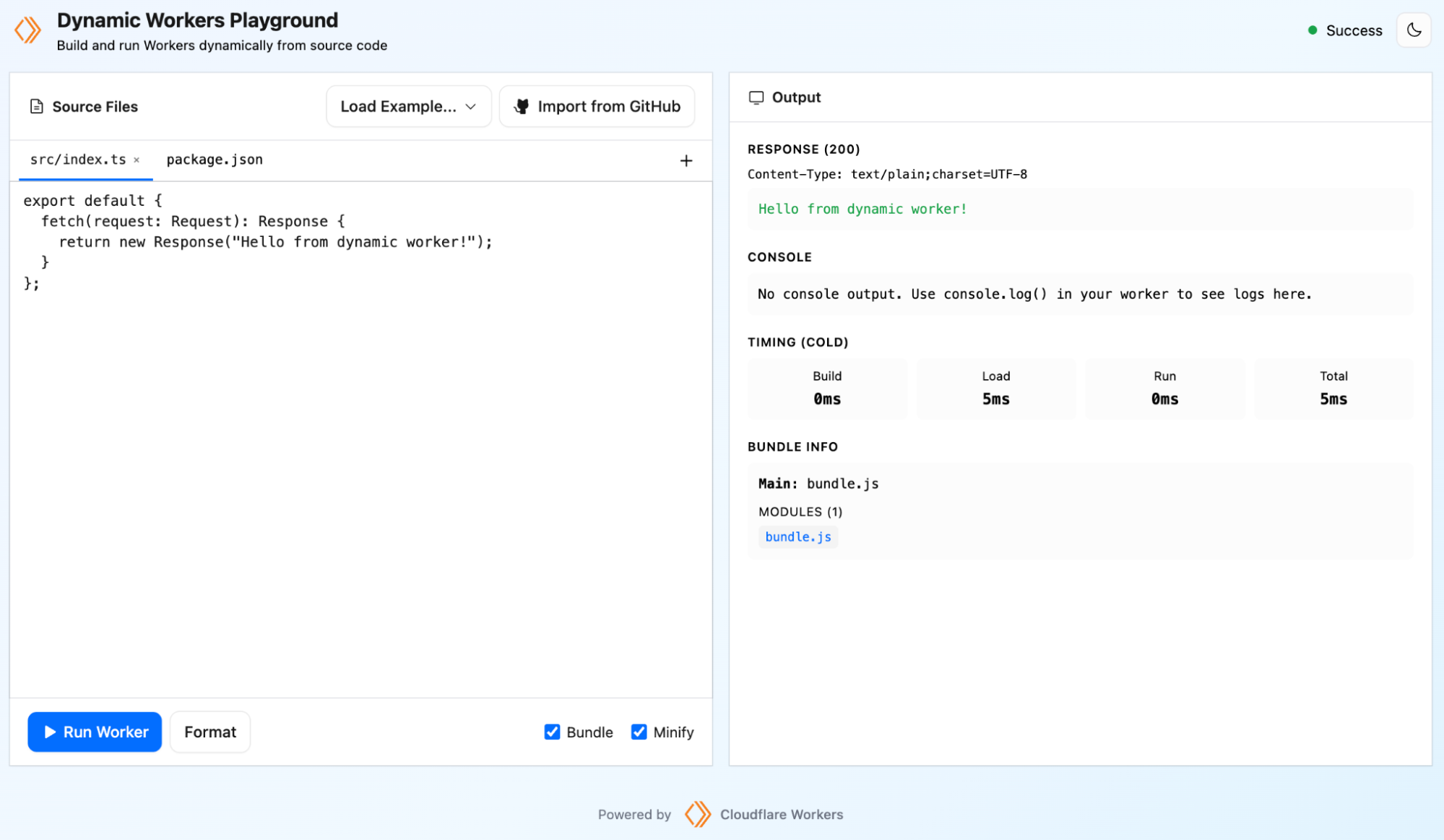
You can also deploy the Dynamic Workers Playground, where you’ll be able to write or import code, bundle it at runtime with @cloudflare/worker-bundler, execute it through a Dynamic Worker, see real-time responses and execution logs.
Dynamic Workers are fast, scalable, and lightweight. Find us on Discord if you have any questions. We’d love to see what you build!
Проучване на Сметната палата за качеството на образованието в България за периода 2019–2023 г. сочи, че 34% от новоназначените учители напускат в рамките на първите три години, а близо половината от завършилите педагогически специалности не се реализират в професията си. Въпреки това интересът към тези специалности е висок, а учителските заплати са нараснали с 60% в изследвания период.
За истински мотивираните учители обаче само заплатата не е достатъчна, за да останат на работа. Преподавателите в училищата днес имат нужда от качествени политики за подкрепа и професионално израстване, но преди това е важно да бъдат подготвени за срещата си с образователната система. Такъв е основният извод, до който стигнах, опитвайки се да разбера парадокса на масовото напускане – въпреки интереса и повишаващите се възнаграждения.
Университетът vs. реалната работна среда
Станимира Паскова и Цветомира Антонова започват учителската си кариера преди 20 години в две различни училища, но срещат един и същ проблем – университетът не ги е подготвил достатъчно добре за реалната училищна среда.
Станимира се среща с професията за първи път през 2002 г. в отдалечено селско училище, в което е единствената с майчин български език сред колегите и учениците си. Езиковата бариера обаче се оказва непреодолима:
Аз бях много разочарована, че толкова се бях старала да се представя по възможно най-добрия начин, така както ме бяха подготвили в университета, но се оказа, че това тотално не върши работа за моите деца. И всъщност те са ме слушали учтиво, без да ме разбират, защото аз съм говорила на някакъв чужд език за тях.
След тази първа година Станимира започва да посещава различни обучения за учители, докато през 2013 г. открива програмата „Нов път в преподаването“, разработена от „Заедно в час“.
Цветомира започва учителския си път през 2004 г. в София с голям ентусиазъм. Чувства се много добре подготвена академично, но днес е категорична, че методическата подготовка в университета не е била модерна и адекватна за времето си. Тя обаче се сблъсква и с друг характерен за учителите проблем –
„бърнаут“.
На петата година вече се чувствах много смазана и от системата. Имах усещането, че трудът ми отива на вятъра и че усилията, които влагам, са много по-големи от резултатите, които виждам,
разказва Цветомира и допълва, че все още не се обръща достатъчно внимание на емоционалното прегаряне, което е причина много млади учители да напуснат професията. Самата тя прекъсва преподавателската си дейност за няколко години, докато през 2013 г. любопитството ѝ не я среща с програмата „Нов път в преподаването“.
Ръководителката на програмата Жаклин Мисирян-Дойчева определи в разговор с „Тоест“ бърнаута като синдром. За някои учители проблемът се корени в невъзможността за ефективно управление на времето. За други е в трудностите да се справят с клас от 26 деца, част от които не посещават часовете или не говорят български език.
Жаклин също е на мнение, че университетите не подготвят бъдещите учители за реалните предизвикателства в професията, сред които са
агресията и ниската мотивация,
които присъстват във всяка класна стая. За преодоляване на тези проблеми е важно ученикът да бъде поставен в центъра и да се вземат предвид неговите нужди и емоции.
Според Станимира решението за справяне с агресията е и в дома, затова е важно да се работи и с родителите. Тя смята, че като учителка на „Заедно в час“ в с. Караджово (Пловдив) е успяла да изгради доверие у учениците си и техните родители чрез посещения в домовете им и на местата, които са важни за конкретната общност, за да им покаже уважение, грижа и заинтересованост:
Всяко едно детенце е индивидуално, така че колкото по-добре го познаваш, колкото по-добре изградиш връзки с него, толкова по-добре се чувства и то. То вече идва със съвсем друга нагласа в твоята класна стая.
Важно за мотивацията в клас е и оценяването. Ако учителят успява да забележи, уважи и оцени различните личности в класа, те ще работят по-добре и концентрацията ще се подобри. За поставянето на оценка обаче е нужно да имаш ясни критерии, категорична е Цветомира, за която обученията на „Заедно в час“ по отношение на оценяването, планирането и развиването на емоционалната интелигентност са били от изключителна полза.
Политиките на МОН за задържане на учителите
През 2016 г. педагогиката е включена в списъка на Министерството на образованието и науката (МОН) с приоритетни направления. Това означава, че студентите, приети по държавна поръчка в специалностите от това направление, не плащат такси за обучението си. От МОН уточниха за „Тоест“, че нарастването на учителските заплати е „ключов фактор за нарастване престижа на учителската професия и за привличане и задържане на новоназначените учители“. Към момента педагогиката все още е приоритетно направление с голям интерес от страна на студентите, макар част от специалностите в това направление да бяха извадени от списъка с приоритетните.
На теория в резултат на тези стимули би следвало днес в България да има достатъчен брой учители за нуждите на системата. Според Люба Йорданова, старши специалист в отдел „Стратегически партньорства“ на „Заедно в час“ обаче, една от предпоставките това да не става е в липсващите критерии за подбор. Тя обобщи ситуацията така: много от студентите в педагогически специалности следват висше образование заради дипломата, а не за да станат учители. Но дори голяма част от тези, които започват работа по специалността, напускат в първите три години заради недостатъчна подготовка в университета, липса на ефективно наставничество и други фактори. И това води до недостиг на качествени учители.
Критериите за подбор на квалифицирани учители са важни, категорична е и Жаклин, тъй като „ние не сме в позицията на хора, които трябва да губим времето на децата“.
Как се измерва качеството на образованието?
Освен липсващите критерии на подбор, демотивиращо за преподавателите може да се окаже и отсъствието на правна рамка, свързана с качеството на образованието. Оценките от външно оценяване и държавните зрелостни изпити все още са индикатор за състоянието на образованието, въпреки че според международното изследване PISA, което се провежда с 15-годишни ученици, голяма част от тях не притежават базови умения. Резултатите от държавните изпити не могат да измерят качеството на образованието в училищата, тъй като много деца посещават частни уроци, което пък поставя учениците от семейства с по-ниски финансови възможности в по-неблагоприятна ситуация спрямо връстниците им. Не се вижда и кои от училищата, където се работи с деца от уязвими групи, с ученици с майчин език, различен от българския, със специални потребности и т.н., са отбелязали напредък.
Заедно с приемането на Закона за предучилищно и училищно образование през 2016 г. влиза в сила и Наредба №16 от 8 декември същата година – за управлението на качеството в институциите, която утвърждава държавния образователен стандарт. Тя е отменена в края на 2017 г., когато образователен министър е Красимир Вълчев, и едва през септември 2025 г. започва обществено обсъждане на нов документ на мястото на стария. След приключване на обсъждането той не е гласуван.
На въпрос на „Тоест“ какви са мотивите за отмяна на наредбата, бившият министър на образованието Красимир Вълчев отговори, че тя не е била оценена като „достатъчно ефективна“. Според него наредбата е произвеждала само „формализъм, а не реална отговорност в управлението на качеството“, тоест писане на стратегически документи, които да се показват по време на проверки, без да има реално съществуваща система.
Макар Вълчев да оценява новата проектонаредба като много по-добра, той каза, че е предпочел да разполага с повече време за работа по нея. Категоричен е обаче, че трябва да има такава наредба и да се създаде култура на управление на качеството.
Как да задържим учителите?
През 2021 г. Световната банка представя резултатите от проучване по поръчка на МОН за нуждите на образователната система. Сред препоръките, изработени на основата на анализа, е създаването на пилотна програма за въвеждане в учителската професия на начинаещи учители чрез наставничество и подкрепа за професионално израстване. Изследването установява текучество на кадри,
като в периода 2015–2018 г. напусналите след третата година учители са близо 75%.
Настоящата практика за наставничество и подкрепа на новоназначените учители не се документира добре, а „системата се нуждае от изграждане на капацитет и постепенно въвеждане на рамкова програма за въвеждане в професията“, пише в доклада върху проучването.
На въпрос на „Тоест“ във връзка с установената от Световната банка потребност от подкрепа за новоназначените учители от МОН отговориха, че
се провежда задължителната въвеждаща квалификация, която се изразява в обучения на новоназначени учители в предучилищното образование и чрез ментори, които са професионалисти с богата експертиза както в преподаването, така и в управлението и обучението на педагогически специалисти.
От пресцентъра на Министерството допълват, че през 2025 г. са проведени 76 майсторски класа в рамките на Националната програма „Квалификация на педагогическите специалисти“. Те са били в три направления: подходи за формиращо оценяване и преподаване в контекста на националното външно оценяване и държавните зрелостни изпити, повишаване на четивната грамотност на учениците и обучения за местни модели за повишаване на резултатите и качеството на подготовка на учениците.
Обученията на практика
Цветомира потвърди, че е посещавала обучения, организирани от МОН,
които уж адресират някакви проблеми, примерно свързани с агресия, с насилие […] но всъщност как протичат обученията – в 4-звезден хотел, със спа, с „Бяла роза“ и това е основният акцент – учителките да си починат за три дни.
В споменатия доклад на Световната банка се повдига и въпросът за липсата на добра подготовка още в университета. В него се прави следният извод:
… университетите не приоритизират достатъчно практическото обучение в училищна среда, организирано в тясно партньорство с базови училища.
Базовите училища в България не са „представителна извадка на всички типове училища в страната“, категорична е Люба Йорданова, и добавя:
Учебните заведения нямат достатъчно стимули да приемат студенти по педагогика. Те трябва да отделят поне един старши или главен учител за наставник на стажантите, бюрокрацията по време на стажовете също не е малка. Хоспитирането (практическите наблюдения на студентите) трябва да започне още в първи или втори курс, а не както е в момента – в трети и четвърти. Важно е също студентите да имат възможността да практикуват както в училища в големи населени места и с високи резултати, така и в такива в малки населени места и изправени пред различни предизвикателства.
В частната езикова школа в Пловдив, в която преподава Станимира, стажуват и млади учители, но от разказите им за университета не е останала с впечатлението, че нещо драстично се е променило от времето, когато тя е била студентка.
„Нов път в преподаването“
Програмата, разработена от „Заедно в час“, се възобновява след прекъсване през 2022 г. Насочена е към педагози с до 5 години опит в професията и предлага подкрепа и наставничество в рамките на две години. Подборът е внимателен, „за да сме сигурни, че в програмата влизат високомотивирани кандидати“, казва Жаклин. Фокусът е върху подкрепата за учители, работещи с деца от уязвими групи или в по-малки населени места, където учениците нямат същите образователни възможности като връстниците си от по-големите градове. Тази година са обхванати град София и областта заедно с Враца, Пазарджик, Пловдив, Стара Загора и Бургас, като целта е да се достигне до малките населени места.
За Станимира програмата е била ценна с оказаната подкрепа от координатор, който посещава учителите регулярно, дискутира с тях казуси от ежедневието им, наблюдава учебните им часове и предоставя конструктивна обратна връзка. Според нея програмата предоставя пълна методическа подкрепа, достъп до ресурси от най-високо качество и непрекъснати надграждащи обучения.
Всъщност никога не си бях представяла как изглеждам отстрани, какво се случва, дали децата ме харесват, дали не ме харесват, дали се справям добре, къде са ми били силните страни в часа, къде мога да направя нещата по друг начин – това е безценна информация за един учител и се отразява на работата ти веднага, още в следващия час […] Посещенията на координатора нямат нищо общо с посещенията на директора, защото по-старото поколение учители свързва посещението преди всичко с налагането на някакви санкции. Влизат, гледат те, осъждат те по някакъв начин,
разказва тя.
Програмата е успяла да уцели „в десетката“ на потребностите на Цветомира да бъде добър учител. Въпреки подкрепата на нейните по-опитни колеги в началото на кариерата ѝ, „Нов път в преподаването“ успява да ѝ помогне да развие преподавателската си методология, да бъде полезна на учениците си и удовлетворена от работата си.
Станимира и Цветомира говориха с много любов за професията си. И двете обаче продължават да са учителки заради вътрешната си мотивация, любопитство и желание за развитие, а не защото държавата е успяла да ги мотивира. В тази връзка политиката на МОН за повишаване на възнагражденията не е изиграла особена роля за кариерното развитие на двете учителки. Истинската подкрепа за педагозите и адекватните отговори на техните нужди все още идват от неправителствения сектор. Грижата за учителите обаче е важна и за качеството на образованието, а то би трябвало да е национална политика.
Japan’s election last month and the rise of the country’s newest and most innovative political party, Team Mirai, illustrates the viability of a different way to do politics.
In this model, technology is used to make democratic processes stronger, instead of undermining them. It is harnessed to root out corruption, instead of serving as a cash cow for campaign donations.
Imagine an election where every voter has the opportunity to opine directly to politicians on precisely the issues they care about. They’re not expected to spend hours becoming policy experts. Instead, an AI Interviewer walks them through the subject, answering their questions, interrogating their experience, even challenging their thinking.
Voters get immediate feedback on how their individual point of view matches—or doesn’t—a party’s platform, and they can see whether and how the party adopts their feedback. This isn’t like an opinion poll that politicians use for calculating short-term electoral tactics. It’s a deliberative reasoning process that scales, engaging voters in defining policy and helping candidates to listen deeply to their constituents.
This is happening today in Japan. Constituents have spent about eight thousand hours engaging with Mirai’s AI Interviewer since 2025. The party’s gamified volunteer mobilization app, Action Board, captured about 100,000 organizer actions per day in the runup to last week’s election.
It’s how Team Mirai, which translates to ‘The Future Party,’ does politics. Its founder, Takahiro Anno, first ran for local office in 2024 as a 33 year old software engineer standing for Governor of Tokyo. He came in fifth out of 56 candidates, winning more than 150,000 votes as an unaffiliated political outsider. He won attention by taking a distinctive stance on the role of technology in democracy and using AI aggressively in voter engagement.
Last year, Anno ran again, this time for the Upper Chamber of the national legislature—the Diet—and won. Now the head of a new national party, Anno found himself with a platform for making his vision of a new way of doing politics a reality.
In this recent House of Representatives election, Team Mirai shot up to win nearly four million votes. In the lower chamber’s proportional representation system, that was good enough for eleven total seats—the party’s first ever representation in the Japanese House—and nearly three times what it achieved in last year’s Upper Chamber election.
Anno’s party stood for election without aligning itself on the traditional axes of left and right. Instead, Team Mirai, heavily associated with young, urban voters, sought to unite across the ideological spectrum by taking a radical position on a different axis: the status quo and the future. Anno told us that Team Mirai believes it can triple its representation in the Diet after the next elections in each chamber, an ostentatious goal that seems achievable given their rapid rise over the past year.
In the American context, the idea of a small party unifying voters across left and right sounds like a pipe dream. But there is evidence it worked in Japan. Team Mirai won an impressive 11% of proportional representation votes from unaffiliated voters, nearly twice the share of the larger electorate. The centerpiece of the party’s policy platform is not about the traditional hot button issues, it’s about democracy itself, and how it can be enhanced by embracing a futuristic vision of digital democracy.
Anno told us how his party arrived at its manifesto for this month’s elections, and why it looked different from other parties’ in important ways. Team Mirai collected more than 38,000 online questions and more than 6,000 discrete policy suggestions from voters using its AI Policy app, which is advertised as a ‘manifesto that speaks for itself.’
After factoring in all this feedback, Team Mirai maintained a contrarian position on the biggest issue of the election: the sales tax and affordability. Rather than running on a reduction of the national sales tax like the major parties, Team Mirai reviewed dozens of suggestions from the public and ultimately proposed to keep that tax level while providing support to families through a child tax credit and lowering the required contribution for social insurance. Anno described this as another future-facing strategy: less price relief in the short term, but sustained funding for essential programs.
Anno has always intended to build a different kind of party. After receiving roughly $1 million in public funding apportioned to Team Mirai based on its single seat in the Upper Chamber last year, Anno began hiring engineers to enhance his software tools for digital democracy.
Anno described Team Mirai to us as a ‘utility party;’ basic infrastructure for Japanese democracy that serves the broader polity rather than one faction. Their Gikai (‘assembly’) app illustrates the point. It provides a portal for constituents to research bills, using AI to generate summaries, to describe their impacts, to surfacing media reporting on the issue, and to answer users’ questions. Like all their software, it’s open source and free for anyone, in any party, to use.
After last week’s victory, Team Mirai now has about $5 million in public funding and ambitions to grow the influence of their digital democracy platform. Anno told us Team Mirai has secured an agreement with the LDP, Japan’s dominant ruling party, to begin using Team Mirai’s Gikai and corruption-fighting Mirumae financial transparency tool.
AI is the issue driving the most societal and economic change we will encounter in our lifetime, yet US political parties are largely silent. But AI and Big Tech companies and their owners are ramping up their political spending to influence the parties. To the extent that AI has shown up in our politics, it seems to be limited to the question of where to site the next generation of data centers and how to channel populist backlash to big tech.
Those are causes worthy of political organizing, but very few US politicians are leveraging the technology for public listening or other pro-democratic purposes. With the midterms still nine months away and with innovators like Team Mirai making products in the open for anyone to use, there is still plenty of time for an American politician to demonstrate what a new politics could look like.
This essay was written with Nathan E. Sanders, and originally appeared in Tech Policy Press.
MSSQLand enables red teams to interact with MS-SQL servers and linked instances in restricted environments without complex T-SQL queries. Assembly-ready tool for lateral movement.
This post is co-authored with Ivan Amemoutou, DevOps and Cloud Lead at Generali Malaysia (“Generali”).
The insurance industry’s shift to cloud computing has accelerated the development and expansion of digital services. To support this transformation, insurers are modernizing their technology stack with solutions that enhance scalability, portability, and operational efficiency. This digital evolution is driven by growing customer expectations for seamless insurance services across all touchpoints. Generali faced this industry-wide challenge head-on, needing both to migrate their legacy applications to the cloud and meet increasing demands for new digital services. To address these needs, they embraced a modern approach by implementing containerized microservices architecture, significantly improving their operational capabilities and service delivery.
Generali started its migration to AWS in 2019. They selected Amazon Elastic Kubernetes Service (Amazon EKS) as the target container service for their modernized applications for its capabilities as an enterprise-grade container management solution and its seamless integration with other AWS services. Previous experience of the Generali DevOps and Cloud team was also a strong factor in selecting Amazon EKS. Although the selection of the target platform was straightforward, the main challenge Generali was facing was to enable the scale of adoption while maintaining a lean operational base.
Today, digital applications and several core insurance solutions are hosted on their EKS clusters, making it an important piece of infrastructure for the company. In this post, we look at how Generali is using Amazon EKS Auto Mode and its integration with other AWS services to enhance performance while reducing operational overhead, optimizing costs, and enhancing security.
Solution overview
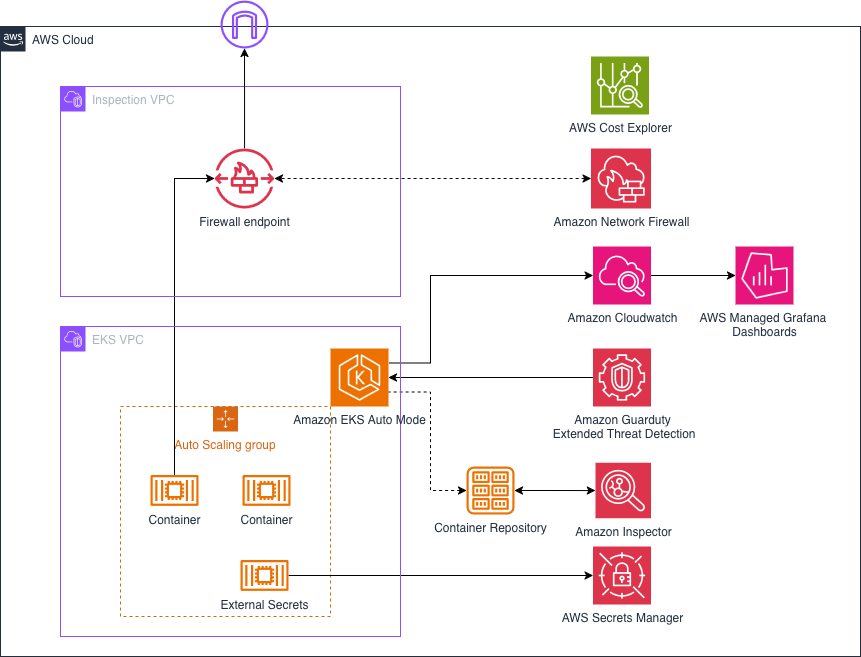
Generali strives to implement Amazon EKS best practices and actively align their implementation with the AWS Well-Architected Framework. To that end, they follow the six pillars of Operational Excellence, Security, Reliability, Performance Efficiency, Cost Optimization, and Sustainability to build a robust and scalable platform. By applying Well-Architected principles to their EKS environment, Generali benefits from improved system resilience through automated operations and monitoring, enhanced security through AWS Identity and Access Management (IAM) integration and network policies, optimized costs through right-sizing and automatic scaling, and sustainable practices that minimize their environmental impact while maintaining high performance and reliability.
The following diagram illustrates the architecture of their EKS cluster and some of its integration points with different AWS services.
This solution offers the following benefits:
Simplified management of multiple containerized applications
Automated node provisioning and scaling
Enhanced security integration
Optimized resource utilization and simplified cost management
Granular multi-tenant observability
In the following sections, we discuss the integration with AWS services in more detail and how these components align with the AWS Well-Architected Framework.
Operational Excellence, Reliability, and Performance Efficiency with Amazon EKS Auto Mode
Generali faced challenges managing their expanding portfolio of containerized applications. The growth of their containerized services introduced operational inefficiencies and complexities: multiple applications from multiple tenants created operational overhead from manual orchestration and scaling to infrastructure maintenance, making it difficult to optimize costs while enforcing security and compliance across diverse application stacks. These challenges led to over-provisioning of resources and inconsistent security postures across different containerized environments.
To address these pain points, Generali has been adopting Amazon EKS Auto Mode, which automates their cluster infrastructure management, provides production-ready environments with minimal operational overhead, dynamically scales resources based on application demands, and implements consistent security practices with automated upgrades, so their teams can focus on application development rather than infrastructure complexity.
EKS Auto Mode manages the underlying nodes, load balancers, and storage configuration automatically. EKS Auto Mode takes care of scaling the cluster depending on the need of the workloads, while optimizing cost across a set of Amazon Elastic Compute Cloud (Amazon EC2) instances types selected by Generali in the node pools configuration.
With EKS Auto Mode’s expanded Shared Responsibility Model, compared to non-Auto Mode clusters, it also takes care of the patching of the underlying operating system (Bottlerocket), the different Amazon EKS add-ons installed by default, and the upgrade of the cluster, so Generali DevOps and Cloud team can focus on supporting their application teams.
While starting up EKS Auto Mode, the Generali DevOps and Cloud team had to adjust their operations to allow for those new features. For example, EKS Auto Mode releases a new version of its AMI, which automatically upgrades nodes on a regular basis, usually every week. To do so, nodes are terminated to be replaced with upgraded ones. The team had to create disruption control configurations to prevent those disruptions from impacting workloads. For example, they specified a maintenance window during off-peak hours for those upgrades. They also specified Pod Disruption Budgets and Node Disruptions Budgets to make sure critical applications would not see all the pods of a micro-service being terminated at the same time. The team can then focus on monitoring the current services and making sure they stay compliant with upcoming Amazon EKS upgrades, an activity that usually takes a fair amount of time every quarter, which is now automated with EKS Auto Mode.
Finally, the Generali DevOps and Cloud team also follow several principles to maintain reliability of their applications: they only allow stateless micro-services, they treat the underlying pods as immutable, they use Helm chart as a standardize deployment mechanism, and they use Horizontal Pod Autoscaler (HPA) to scale services based on traffic.
Security using Amazon GuardDuty, Amazon Inspector, Amazon Network Firewall, and AWS Secrets Manager
Generali implemented Amazon GuardDuty Extended Threat Detection for their EKS clusters to automatically correlate security signals across Amazon EKS audit logs, runtime behaviors, malware execution, and AWS API activity to identify sophisticated multistage attacks that traditional monitoring approaches often miss. By enabling both Amazon GuardDuty Amazon EKS protection and runtime monitoring, Generali gained comprehensive visibility into complex attack patterns such as container exploitation, privilege escalation, and unauthorized movement within their Kubernetes environment, with detailed timelines mapped to MITRE ATT&CK tactics and techniques. The benefits Generali realizes include reduced investigation time through consolidated security insights, rapid assessment of which containerized infrastructure components require immediate attention, and the ability to prioritize remediation efforts on the most critical affected resources while minimizing the potential blast radius of Amazon EKS targeted attacks.
Generali also uses the new Amazon Inspector capability to map Amazon ECR images to running containers, helping their security teams prioritize vulnerabilities based on containers currently running in their environment rather than just identifying vulnerabilities in repository images. The enhanced service provides Generali with visibility into which container images are actively running across their EKS environments, including cluster Amazon Resource Names (ARNs), the number of EKS pods where images are deployed, and last in-use dates for each vulnerability finding. The key benefits Generali realizes include the ability to prioritize remediation efforts based on actual container usage patterns rather than repository events alone, and comprehensive vulnerability management across container images.
Generali set up AWS Network Firewall to filter outbound HTTPS traffic from applications hosted on their EKS cluster by restricting outbound connections to only a set of hostnames provided by Server Name Indication (SNI) in the allow list, deploying their EKS cluster in private subnets with Network Firewall endpoints in public subnets and NAT gateways in protected subnets. The benefits Generali realizes include enhanced security through egress filtering that monitors and restricts outbound network traffic based on certificate hostnames rather than changing IP addresses, the ability to collect and analyze hostnames accessed by applications through Amazon CloudWatch alert logs for traffic pattern analysis, and improved compliance with security requirements by making sure applications can only access approved external services.
Getting secrets into pods can be done either through environment variables or as mounted volumes. Hard-coding them directly into the deployment template is not recommended, and it is better to store them in AWS Secret Manager and retrieve them dynamically. As a best practice and to reduce operational complexity, Generali choses to only host stateless containers in their cluster, alleviating the need for storage volume. To that end, the best option is to retrieve secrets dynamically and add them as environment variables to the pod. To do so, they implemented the External Secrets Operator on their EKS cluster to use Secrets Manager for centralized secret management, which reads the necessary secrets and automatically stores them as Kubernetes secrets without requiring application code changes or daemonsets. The benefits Generali realizes include improved security, management, and auditability of secret usage through centralized secret management outside their Kubernetes clusters and automatic secret synchronization on a recurring basis to capture credential rotations.
Cost Optimization using tags and Savings Plans
Although EKS Auto Mode already offers some cost optimization features, it’s important for Generali to keep track of resource consumption per business project. To that end, Generali uses AWS Billing split cost allocation data for Amazon EKS to analyze and allocate costs using the AWS Billing Console, gaining insights into Kubernetes costs alongside other AWS spend. The feature allows for split along cost allocation tags for some Kubernetes attributes. These tags include aws:eks:cluster-name, aws:eks:deployment, aws:eks:namespace, and aws:eks:node, so the company can map Amazon EKS consumption against lines of business and applications.
Generali also takes advantage of the following:
Amazon EC2 Savings Plans across a list of instance types that are being listed and configured in the node pool for their EKS clusters
Amazon EC2 Graviton based instances, which cost up to 20% less than comparable x86-based instances, by making sure containers images used are compatible with ARM64 architecture
Operational Excellence and observability using custom dashboards in Amazon Managed Grafana
Hosting multiple projects from multiple business unit means that different application owners need their own custom analytics dashboards. To provide per-project granularity, Generali uses the integration between CloudWatch and Amazon Managed Grafana to create observability dashboards per EKS namespace. By connecting CloudWatch as a data source in Amazon Managed Grafana, they can visualize Amazon EKS metrics, logs, and traces through Grafana’s powerful visualization capabilities without managing the underlying Grafana infrastructure. Through this integration, Generali can create unified views of cluster health, node performance, pod resource utilization, and application performance indicators, while using Grafana’s advanced alerting and templating features for dynamic dashboard creation.
Lessons learned
Generali’s adoption of EKS Auto Mode, combined with integrated AWS security services and comprehensive observability tools, has transformed their container operations from a complex, manually managed environment to an automated, secure, and efficient platform. The integration with services like GuardDuty, Amazon CloudWatch Container Insights, and Amazon Managed Grafana has created a cohesive ecosystem that maximizes operational efficiency while minimizing management overhead. This transformation has helped the Generali DevOps and Cloud team shift its focus from infrastructure maintenance to strategic application support, resulting in improved security posture, cost optimization, and overall platform reliability.Generali realized the following key benefits:
Significant reduction in operational overhead with EKS Auto Mode
Enhanced security with automated threat detection and response
Reduction in infrastructure costs through optimization
Improved mean-time-to-resolution
Accelerated application deployment cycles
Conclusion
Amazon EKS Auto Mode has proven to be a transformative service for Generali, helping them build a modern, secure, and efficient container environment that aligns with AWS Well-Architected best practices. With EKS Auto Mode and its integration with AWS services like GuardDuty, Amazon Inspector, and CloudWatch, Generali created a robust foundation that not only enhances their security posture and operational efficiency but also optimizes costs. The Generali DevOps and Cloud team is now able to focus on applications teams’ support with expansion plans to host AI models and upcoming agentic applications.As organizations continue their cloud-based journey, Generali’s experience demonstrates how AWS’s comprehensive container services can help enterprises focus on innovation and business value while maintaining operational excellence, security, and cost-efficiency at scale.
Generali Malaysia is one of the largest general insurers and an emerging life insurer in the country, dedicated to delivering best in class general and life insurance protection solutions for individuals, families, and businesses. As part of the Generali Group, a global insurance leader with over 190 years of heritage, Generali Malaysia carries forward a deep legacy of protection, service excellence, and innovation.
Today, the company is supported by more than 1,600 employees, over 9,000 agents and partners, and an extensive network of branches nationwide. Guided by its ambition to be a trusted Lifetime Partner, Generali Malaysia is committed to its purpose of empowering lives and dreams. The company continues to drive excellence by leveraging AI, data, and customer centric solutions, while embedding sustainability at the heart of its business.
AWS Lambda durable functions extend the Lambda programming model to build fault-tolerant multi-step applications and AI workflows using familiar programming languages. They preserve progress despite interruptions and execution can suspend for up to one year, for human approvals, scheduled delays, or other external events, without incurring compute charges for on-demand functions.
This post walks through a fraud detection system built with durable functions. It also highlights the best practices that you can apply to your own production workflows, from approval processes to data pipelines to AI agent orchestration. You will learn how to handle concurrent notifications, wait for customer responses, and recover from failures without losing progress. If you are new to durable functions, check out the Introduction to Durable Functions blog post first.
Fraud detection with human-in-the-loop
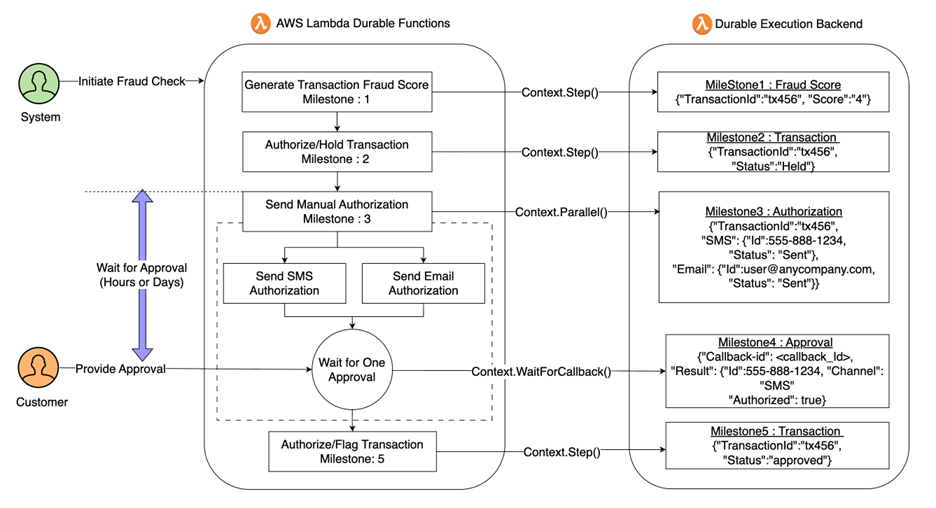
Consider a credit card fraud detection system, which uses an AI agent to analyze incoming transactions and assign risk scores. For ambiguous cases (medium-risk scores), the system needs human approval before authorizing a transaction. The workflow branches based on risk:
Low risk (score < 3): Authorize immediately
High risk (score ≥ 5): Send to the fraud department immediately
Medium risk (score 3–4): Suspend transaction, send SMS and email to cardholder, wait up to 24 hours for confirmation (wait time is customizable)
Figure 1. Agentic Fraud Detection with durable Lambda functions
With human-in-the-loop workflows, response times can vary from minutes to hours. These delays introduce the need to durably preserve the state without consuming compute resources while waiting. With financial systems, we must also implement idempotency to guard against duplicate messages (invocations) and recover from failures without reprocessing completed work. To address these requirements, developers implement polling patterns with external state stores like Amazon DynamoDB or Amazon Simple Storage Service (Amazon S3) to manage idempotency, pay for idle compute while waiting for callbacks, introduce external orchestration components, or build asynchronous message-driven systems to handle long-processing tasks.
Lambda durable functions provide a new alternative to address these challenges through durable execution, a pattern that uses checkpoints (saved state snapshots) to preserve progress and replays from saved state to recover from failures or resume after waiting. With checkpointing capabilities, you no longer need to pay Lambda compute charges while waiting, whether for callbacks, scheduled delays, or external events. Learn how to implement durable functions using the complete fraud detection implementation at this GitHub repository. You can deploy it to your AWS account and experiment with the code as you read. The repository includes deployment instructions, sample data, and helper functions for testing.
As we walk through the code, we’ll focus on best practices for designing workflows with durable execution and how to apply these patterns correctly in production workflows.
Design steps to be idempotent
Durable execution is designed to preserve progress through checkpoints and replay, but that reliability model means step logic can execute more than once. When steps retry, how do you prevent duplicate actions like charges to the credit card or repeated customer SMS or email notifications?
Durable functions use at-least-once execution by default, executing each step at least one time, potentially more if failures occur. When a step fails, it retries. There are two strategies to design idempotent steps that prevent duplicate side effects: using external API idempotency keys and using the at-most-once step semantics built into durable functions.
idempotency_key in API call: If the step retries, the payment processor recognizes it’s a duplicate request and returns the original result
Defense in depth: Two layers of protection: Lambda checkpointing and external API idempotency
Each layer provides independent protection. If Lambda’s checkpoint fails, the external API prevents duplicate charges. For legacy systems without idempotency support, where it’s critical that an operation is not executed more than once, use at-most-once semantics:
Strategy B: Use At-Most-Once Semantics
For legacy systems without idempotency support, use at-most-once execution, a delivery feature that executes each step zero or one time, never more:
This checkpoints before step execution, preventing the step from re-execution on retries. The tradeoff? If the step fails, you must decide whether to retry (risking duplicates) or fail the entire workflow.
Use idempotency for critical side effects like payment processing, database writes, external API calls, state transitions, and resource provisioning. Read more about idempotency here.
Prevent duplicate executions with DurableExecutionName
Idempotent steps prevent duplicate side effects within a single execution, but what about duplicate workflow executions running concurrently? For example, duplicate messages in the queue, users clicking “Submit” multiple times in the UI, or the same event arriving via multiple channels like webhook and API. Without protection, each invocation creates a separate durable execution, potentially running the fraud check multiple times, sending duplicate notifications, and creating confusion about which execution is authoritative. Durable functions provide DurableExecutionName to help ensure only one concurrent execution per unique name.
// Invoke fraud detection function with execution name
await lambda.invoke({
  FunctionName: 'fraud-detection',
  InvocationType: 'Event',
  DurableExecutionName: `tx-${transactionId}`,
  Payload: JSON.stringify({
    id: transactionId,
    amount: 6500,
    location: 'New York, NY',
    vendor: 'Amazon.com'
  })
});
Notice the configuration:
DurableExecutionName: tx-${transactionId}: Uses the transaction ID as a unique execution identifier
One execution per transaction: If three invocations arrive with the same transaction ID, only the first creates an execution. Subsequent requests with the same execution name and payload receive an idempotent response returning the existing execution’s ARN, rather than creating a new execution.
Lambda durable functions work with Lambda event sources, including event source mappings (ESM) such as Amazon Simple Queue Service (Amazon SQS), Amazon Kinesis, and DynamoDB Streams. ESMs invoke durable functions synchronously and inherit Lambda’s 15-minute invocation limit. Therefore, like direct Request/Response invocations, durable functions executions using event source mappings cannot exceed 15 minutes.
For workflows exceeding 15 minutes, use an intermediary Lambda function between the event source mapping and durable function:
// Intermediary function for SQS -> Durable function
export const handler = async (event) => {
  for (const record of event.Records) {
    const transaction = JSON.parse(record.body);
    await lambda.invoke({
      FunctionName: process.env.FRAUD_DETECTION_FUNCTION,
      InvocationType: 'Event',
      DurableExecutionName: `tx-${transaction.id}`,
      Payload: JSON.stringify(transaction)
    });
  }
};
This removes the 15-minute limit, allows executions up to one year, and enables custom execution name parameters for idempotency. Use Powertools for AWS Lambda to prevent duplicate invocations of the durable function when the event source mapping retries the intermediary function. Additionally, configure failure handling for your event source to capture failed invocations for future redrive or replay. For example, dead letter queues for SQS, or on-failure destinations for other event sources.
Match timeouts to invocation type
One important configuration detail ties these patterns together: matching your timeout settings to your invocation type. Lambda synchronous invocations (RequestResponse) have a hard 15-minute timeout limit. If you configure a durable execution to run for 24 hours but invoke it synchronously, the synchronous invocation fails immediately with an exception. Durable functions support workflows up to one year when invoked asynchronously.
Timeout: 300: Lambda function timeout (5 minutes in this example, up to a maximum of 15 minutes). This defines the maximum duration for each active execution phase, including the initial invocation and any subsequent replays. Set this to cover the longest expected active processing time in your workflow.
ExecutionTimeout: { hours: 25 }: Durable execution timeout covers the workflow’s expected total duration including suspension periods. Set this slightly above the longest wait timeout to avoid edge cases.
InvocationType: ‘Event’: Asynchronous invocation removes the 15-minute limit and enables executions up to one year.
The Lambda function timeout applies to active execution phases (AI calls, notification sending). During suspension (waiting for callbacks), the function isn’t running, so this timeout doesn’t apply. Setting the durable execution timeout to a meaningful boundary prevents workflows from running longer than expected. Without an explicit timeout, executions can run up to the maximum lifetime of one year.
Synchronous (RequestResponse)
Asynchronous (Event)
Total duration
Under 15 minutes
Up to 1 year
Caller needs result
Yes
No
Idempotency support
Yes
Yes
Waits with suspension
Yes
Yes
Execute Concurrent Operations with context.parallel()
In the fraud detection workflow, the system notifies the cardholder through multiple channels such as SMS and email. Preserving business logic when executing parallel workflows introduces code complexities such as managing execution state across branches, handling synchronization, and coordinating branch completion. Durable functions simplify parallel workflow implementation using context.parallel(), which executes branches concurrently while maintaining durable checkpoints for each branch and provides configurable options to handle partial completions. By checkpointing and managing the state internally, durable functions help make sure that the state is preserved even if there are retries or failures. Note that context.parallel() manages the internal execution state for each branch. If your branches interact with a shared external state (such as a database), you’re responsible for managing concurrent access to that external state.
maxConcurrency: 2: Both notifications sent at the same time
minSuccessful: 1: We only need one channel to succeed, whichever responds first wins
Each parallel branch waits for its callback independently, and the durable execution checkpoints each branch as part of the execution state. Using the minSuccessful parameter, you control the minimum number of successful branch executions required for the parallel operation to complete. In this example, only one of the two branches needs to succeed. Verifications through SMS or email are both valid, and the workflow resumes as soon as either channel completes successfully. We call this the first-response-wins pattern. This pattern works well when you only need a single successful result from any parallel branch and want the remaining branches to stop blocking progress.
But what happens if neither channel responds? Without timeouts, this workflow could remain suspended for up to the configured execution lifetime.
Always configure callback timeouts
Let’s add timeout protection to the parallel verification from the previous section. context.waitForCallback() accepts a timeout option that bounds how long each branch waits before throwing an exception. By wrapping the parallel call in a try/catch, you can implement fallback logic when users don’t respond in time.
// Enhanced: parallel verification with timeout and error handling
let verified;
try {
  verified = await context.parallel("human-verification", [
    (ctx) => ctx.waitForCallback("SendVerificationEmail",
      async (callbackId) => sendCustomerNotification(callbackId, 'email', tx),
      { timeout: { days: 1 } }  // Wait up to 1 day for email response
    ),
    (ctx) => ctx.waitForCallback("SendVerificationSMS",
      async (callbackId) => sendCustomerNotification(callbackId, 'sms', tx),
      { timeout: { days: 1 } }  // Wait up to 1 day for SMS response
    )
  ], {
    maxConcurrency: 2,
    completionConfig: {
      minSuccessful: 1
    }
  });
} catch (error) {
  const isTimeout = error.message?.includes("timeout");
  if (isTimeout) {
    context.logger.warn("Customer verification timeout", { error, txId: tx.id });
    // Fallback: escalate to fraud department
    return await context.step("sendToFraudDepartment", async () =>
      sendToFraudDepartment(tx, true)
    );
  }
  throw error; // Re-throw non-timeout errors
}
Notice what changed from the previous section:
timeout: { days: 1 }: Each callback branch now has a maximum wait time of 1 day. If neither the email nor SMS callback arrives within that window, a timeout exception is thrown.
try/catch with timeout detection: The catch block distinguishes between timeout errors and other exceptions. When a timeout occurs, the workflow implements fallback logic by escalating the transaction to the fraud department, while non-timeout errors are re-thrown to be handled by the durable execution retry mechanism.
Without this error handling, the entire execution fails unhandled. The timeout also works with the minSuccessful configuration: if one branch times out but the other succeeds, the parallel operation still completes successfully since only one successful result is required.
For advanced use cases where the callback handler performs long-running work, you can also configure a heartbeatTimeout to detect stalled callbacks before the main timeout expires. See the Lambda Developer Guide for details.
Use callback timeouts for human approvals, external API callbacks, asynchronous processing, and third-party integrations.
Putting it all together: complete fraud detection implementation
Now let’s see how all the best practices work together in the complete fraud detection workflow:
Notice how the best practices work together: context.parallel() sends SMS and email concurrently, resuming when either channel responds. Both callbacks configure 1-day timeouts with try/catch handling that escalates on timeout. The DurableExecutionName: tx-${transactionId} parameter (specified at invocation time, shown in the following CLI example) provides execution-level deduplication, while idempotency keys in the authorization steps prevent duplicate charges at the application layer. Asynchronous invocation (InvocationType: 'Event') enables the 24-hour wait period.
Once deployed, invoke the function asynchronously with a sample transaction to see it in action:
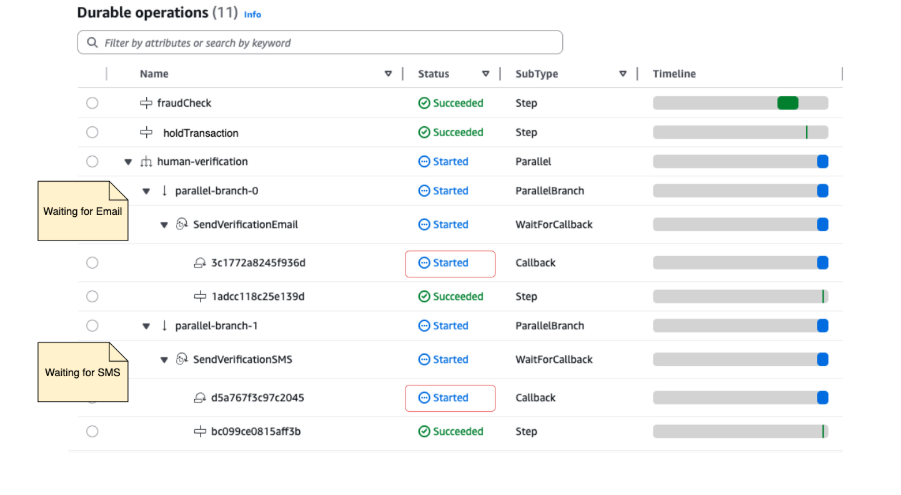
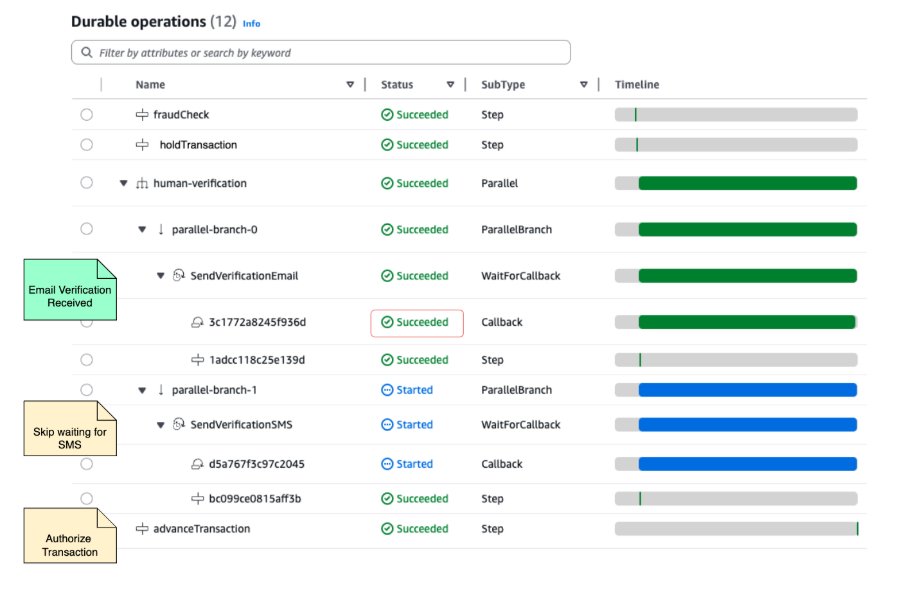
Upon successful invocation, you can view the execution state in the Lambda console’s durable operations view. The execution shows a suspended state, waiting for customer response:
Figure 2: Suspended execution state
Notice the fraudCheck and suspendTransaction steps show as succeeded with checkpointed results. The human-verification parallel operation shows that both SMS and email branches started. The timeline shows the function in a suspended state. Simulate a customer response by sending a callback success through the console, AWS Command Line Interface (AWS CLI) or Lambda API:
Figure 3: Completed execution with customer approval
After receiving the customer’s approval, the durable execution resumes from its checkpoint, authorizes the transaction, and completes. The execution spanned hours but consumed only seconds of compute time.
Conclusion
With durable functions, Lambda extends beyond single-event processing to power core business processes and long-running workflows, while retaining the operational simplicity, reliability, and scale that define Lambda. You can build applications that run for days or months, survive failures, and resume where they left off, all within the familiar event-driven programming model.
On March 23, 2026, Citrix published a security advisory for a critical vulnerability affecting their NetScaler ADC (formerly Citrix ADC) and NetScaler Gateway (formerly Citrix Gateway) products. This vulnerability, CVE-2026-3055, which is classified as an out-of-bounds read and holds a CVSS score of 9.3, allows unauthenticated remote attackers to leak potentially sensitive information from the appliance’s memory.
The Citrix advisory states that systems configured as a SAML Identity Provider (SAML IDP) are vulnerable, whereas default configurations are unaffected. This SAML IDP configuration is likely a very common configuration for organizations utilizing single sign-on. Per the advisory, organizations can determine if they have an appliance configured as a SAML IDP Profile by inspecting their NetScaler Configuration for the specified string: add authentication samlIdPProfile .*
CVE-2026-3055 affects NetScaler ADC and NetScaler Gateway versions 14.1 before 14.1-66.59 and 13.1 before 13.1-62.23, as well as NetScaler ADC 13.1-FIPS and 13.1-NDcPP before 13.1-37.262. The advisory notes that only customer-managed instances are affected, not cloud instances managed by Citrix.
As of the advisory’s publication, there is no known in-the-wild exploitation and no public proof-of-concept (PoC) available. According to Citrix, the vulnerability was identified internally via security review. However, exploitation of CVE-2026-3055 is likely to occur once exploit code becomes public. Therefore, it is crucial that customers running affected Citrix systems remediate this vulnerability as soon as possible; Citrix software has previously seen memory leak vulnerabilities broadly exploited in the wild, including the infamous “CitrixBleed” vulnerability, CVE-2023-4966, in 2023.
Mitigation guidance
Organizations running affected on-premise instances of NetScaler ADC and NetScaler Gateway should prioritize upgrading to fixed versions on an emergency basis to remediate CVE-2026-3055.
Affected components:
NetScaler ADC and NetScaler Gateway versions 14.1, fixed in 14.1-66.59.
NetScaler ADC and NetScaler Gateway versions 13.1, fixed in 13.1-62.23.
NetScaler ADC 13.1-FIPS and 13.1-NDcPP, fixed in 13.1-37.262 (also referred to as 13.1.37.262 in the vendor advisory).
Please read the vendor advisory (CTX696300) for the latest guidance.
Rapid7 customers
Exposure Command, InsightVM, and Nexpose
Exposure Command, InsightVM, and Nexpose customers can assess exposure to CVE-2026-3055 on Citrix NetScaler ADC with an authenticated vulnerability check expected to be available in the March 24 content release.
If you manage data in Amazon Aurora MySQL-Compatible Edition and want to make it available for analytics, machine learning (ML), or cross-service querying in a modern lakehouse format, you’re not alone.
Organizations often need to run analytics, build ML models, or join data across multiple sources. These are examples of workloads that can be resource-intensive and impractical to run directly against a transactional database. By extracting your Aurora MySQL data into Amazon S3 Tables in Apache Iceberg format, you can offload analytical queries from your production database without impacting its performance, while storing data in a fully managed Iceberg table store optimized for analytics. Built on the open Apache Iceberg standard, Amazon Simple Storage Service (Amazon S3) Table data is queryable from engines like Amazon Athena, Amazon Redshift Spectrum, and Apache Spark without additional data copies. You can also combine relational data with other datasets already in your data lake, enabling richer cross-domain insights.
Apache Iceberg and Amazon S3 Tables
Apache Iceberg is a widely adopted open table format that offers Atomicity, Consistency, Isolation, Durability (ACID) transactions, schema evolution, and time travel capabilities. It enables multiple engines to work concurrently on the same dataset, making it a popular choice for building open lakehouse architectures.
Amazon S3 Tables is a purpose-built, fully managed Apache Iceberg table store designed for analytics workloads. It delivers up to 3x faster query performance and up to 10x more transactions per second compared to self-managed Iceberg tables. It also automatically compacts data and removes unreferenced files to optimize storage and performance.
In this post, you learn how to set up an automated, end-to-end solution that extracts tables from Amazon Aurora MySQL Serverless v2 and writes them to Amazon S3 Tables in Apache Iceberg format using AWS Glue. The entire infrastructure is deployed using a single AWS CloudFormation stack.
Requirements
AWS offers zero-ETL integrations from Amazon Aurora to Amazon Redshift and Amazon SageMaker AI, enabling seamless data flow for analytics and machine learning workloads.
However, there isn’t yet a native zero-ETL integration between Amazon Aurora and Amazon S3 Tables. This means that organizations looking to use Amazon S3 Tables for their Lakehouse architecture currently face several requirements:
Setting up ETL pipelines to extract data from Amazon Aurora and transform it into Apache Iceberg format
Configuring networking and security for AWS Glue jobs to access Amazon Aurora databases in private subnets
Coordinating the provisioning of source databases, ETL pipelines, and target table stores
Managing the end-to-end workflow without native automation
Solution overview
In this solution, you automate the extraction of relational database tables from Amazon Aurora MySQL Serverless v2 to Amazon S3 Tables in Apache Iceberg format using AWS Glue 5.0. To help you get started and test this solution, a CloudFormation template is provided. This template provisions the required infrastructure, loads sample data, and configures the Extract, Transform, Load (ETL) pipeline. You can adapt this template for your own scenario.
Sample data
This solution uses the TICKIT sample database, a well-known dataset used in Amazon Redshift documentation. The TICKIT data models a fictional ticket sales system with seven interrelated tables: users, venue, category, date, event, listing, and sales. The dataset is publicly available as mentioned in the Amazon Redshift Getting Started Guide.
Solution flow
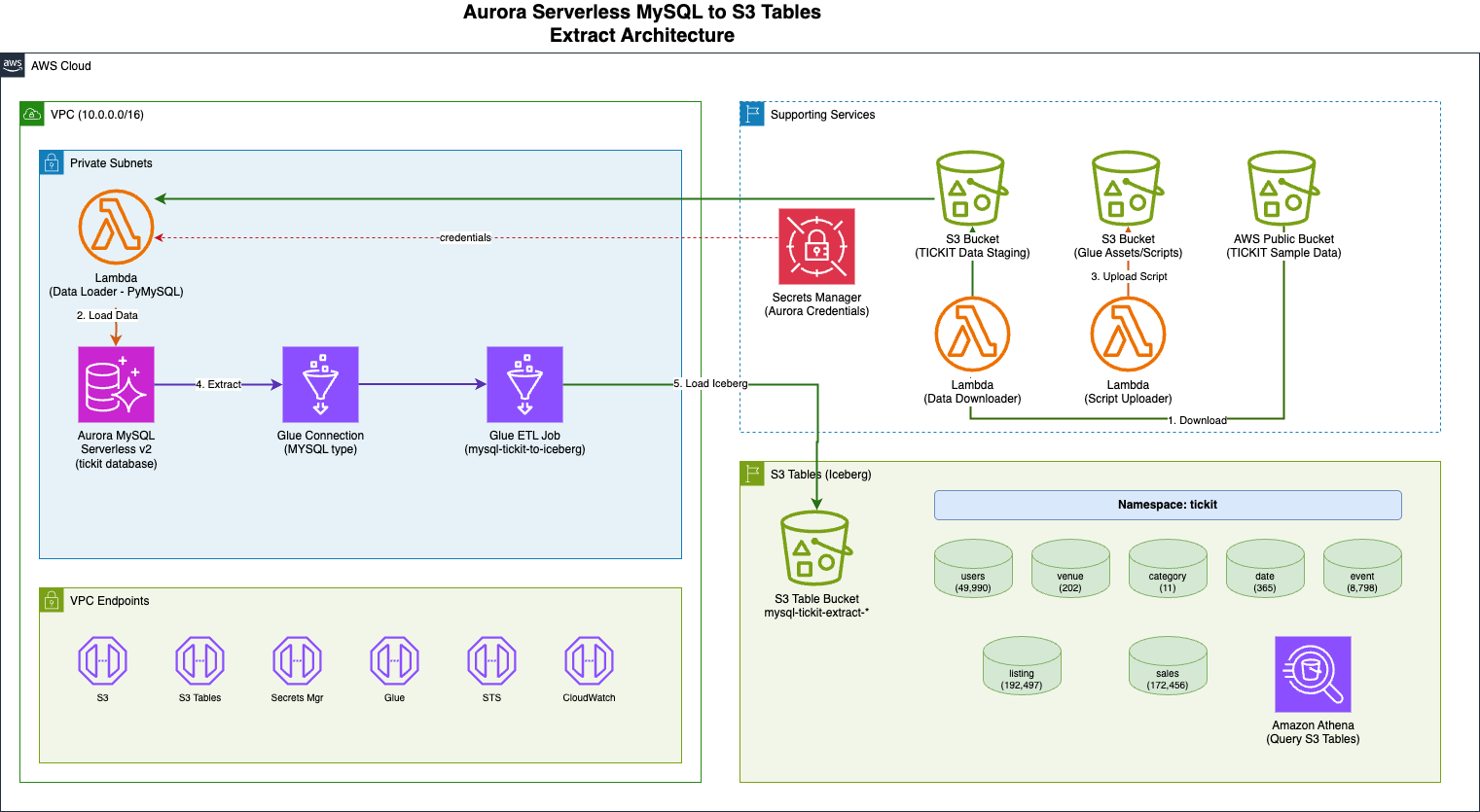
The solution flow as shown in the previous architecture diagram:
An AWS Lambda function downloads the TICKIT sample dataset (a fictional ticket sales system used in Amazon Redshift documentation) from a public Amazon S3 bucket to a staging S3 bucket.
A second Lambda function, using PyMySQL (a Python MySQL client library), loads the staged data files into the Aurora MySQL Serverless v2 database using LOAD DATA LOCAL INFILE.
The AWS Glue job reads seven TICKIT tables from Aurora MySQL through a native MySQL connection and writes them to Amazon S3 Tables in Apache Iceberg format using the S3 Tables REST catalog endpoint with SigV4 authentication.
You can query the migrated data in S3 Tables using Amazon Athena.
The solution consists of the following key components:
Amazon Aurora MySQL Serverless v2 as the source relational database containing the TICKIT sample dataset (users, venue, category, date, event, listing, and sales tables)
Amazon S3 staging bucket for the TICKIT sample data files downloaded from the public redshift-downloads S3 bucket
AWS Lambda functions using PyMySQL to load data into Aurora MySQL
AWS Glue 5.0 job (PySpark) to read tables from Aurora MySQL and write them to S3 Tables in Apache Iceberg format
Amazon S3 Tables as the target storage for the migrated Iceberg tables
Amazon VPC with private subnets and VPC endpoints for Amazon S3, S3 Tables, AWS Glue, Secrets Manager, AWS Security Token Service (AWS STS), CloudWatch Logs, and CloudFormation
Here are some advantages of this architecture:
Fully automated setup: A single CloudFormation stack provisions the required infrastructure, loads sample data, and configures the ETL pipeline.
Serverless and cost-efficient: Aurora MySQL Serverless v2 and AWS Glue both scale based on demand, minimizing idle costs.
Apache Iceberg table format: Data is stored in Apache Iceberg format, enabling ACID transactions, schema evolution, and time travel queries.
Network isolation and credential management: The resources run within private subnets with Virtual Private Cloud (VPC) endpoints, and database credentials are managed through AWS Secrets Manager.
Extensible pattern: The same approach can be adapted for other relational databases (PostgreSQL, SQL Server) and other target formats supported by AWS Glue.
Prerequisites
To follow along, you need an AWS account. If you don’t yet have an AWS account, you must create one. The CloudFormation stack deployment takes approximately 30-45 minutes to complete and requires familiarity with Amazon S3 Tables, AWS CloudFormation, Apache Iceberg, AWS Glue, Amazon Aurora. This solution will incur AWS costs. The main cost drivers are AWS Glue ETL job runs (billed per DPU-hour, proportional to data volume) and Amazon S3 Tables storage and request charges. Remember to clean up resources when you are done to avoid unnecessary charges.
CloudFormation parameters
You can configure the following parameters before deploying the CloudFormation stack:
Parameter
Description
Default
Required
S3TableBucketName
Name of the S3 Tables bucket to create (or use existing)
Yes
DatabaseName
Name of the initial Aurora MySQL database
tickit
No
MasterUsername
Master username for Aurora MySQL
admin
No
VpcCidr
CIDR block for the VPC
10.1.0.0/16
No
S3TableNamespace
Namespace for S3 Tables
tickit
No
Implementation walkthrough
The following steps walk you through the implementation. These steps are to deploy and test an end-to-end solution from scratch. If you are already running some of these components, you may skip to the relevant step. You can also refer to the aws-samples repository, sample-to-write-aurora-mysql-to-s3tables-using-glue for the entire solution.
Step 1: Deploy the CloudFormation stack
Deploy the CloudFormation template scripts/aurora-mysql-to-s3tables-stack.yaml using the AWS Console or the AWS Command Line Interface (AWS CLI). Provide a name for the S3 Tables bucket; the stack will create it automatically (or use an existing one if it already exists).
To deploy using the AWS Console (recommended), navigate to the AWS CloudFormation Console and use the CloudFormation template. Alternatively, to deploy using the AWS CLI first upload the template to an S3 bucket (the template exceeds the 51,200 byte limit for inline –template-body), then create the stack.
# Upload the template to S3
aws s3 cp scripts/aurora-mysql-to-s3tables-stack.yaml \
  s3://<your-s3-bucket>/aurora-mysql-to-s3tables-stack.yaml \
  --region <your-region>
# Create the stack using the S3 template URL
aws cloudformation create-stack \
  --stack-name aurora-mysql-tickit-stack \
  --template-url https://<your-s3-bucket>.s3.<your-region>.amazonaws.com/aurora-mysql-to-s3tables-stack.yaml \
  --parameters \
    ParameterKey=S3TableBucketName,ParameterValue=<your-s3-table-bucket-name> \
  --capabilities CAPABILITY_NAMED_IAM \
  --region <your-region>
The stack will automatically:
Create the S3 Tables bucket (or use existing if it already exists)
Create a VPC with private subnets and VPC endpoints
Provision an Aurora MySQL Serverless v2 cluster
Download TICKIT sample data from the public Amazon S3 bucket
Load the sample data into Aurora MySQL via a Lambda function using PyMySQL
Create a Glue job configured to migrate data to S3 Tables in Iceberg format
Note: The S3 Tables bucket is retained when the stack is deleted to preserve your data.
Step 2: Verify the Aurora MySQL data
Retrieve the AuroraClusterEndpoint, DatabaseName, and SecretArn values from the CloudFormation stack, make a note of the AuroraClusterEndpoint, DatabaseName, and SecretArn. You can navigate to the Amazon Aurora Console, choose the Query Editor, and enter the values from the CloudFormation stack to connect. You can also choose your preferred method of connecting to an Amazon Aurora DB cluster.
Then run the following SQL commands to verify the data load:
-- Verify if the tables are created
SELECT * FROM information_schema.tables WHERE table_schema = 'tickit';

-- Verify if the data is loaded
SELECT 'users' AS table_name, COUNT(*) AS record_count FROM tickit.users
UNION ALL SELECT 'venue', COUNT(*) FROM tickit.venue
UNION ALL SELECT 'category', COUNT(*) FROM tickit.category
UNION ALL SELECT 'date', COUNT(*) FROM tickit.date
UNION ALL SELECT 'event', COUNT(*) FROM tickit.event
UNION ALL SELECT 'listing', COUNT(*) FROM tickit.listing
UNION ALL SELECT 'sales', COUNT(*) FROM tickit.sales;
Step 3: Run the Glue job
Navigate to the AWS Glue Console, choose ETL jobs under Data Integration and ETL from the left panel. Select the AWS Glue job mysql-tickit-to-iceberg-job and choose Run job to start execution. You can also start the ETL job using the AWS CLI:
The AWS Glue job performs the following operations for each of the seven TICKIT tables:
Reads the table from Aurora MySQL through the native MYSQL Glue connection
Converts the data to a Spark DataFrame
Creates the Iceberg table in the S3 Tables namespace using CREATE TABLE IF NOT EXISTS with the USING ICEBERG clause
Inserts the data using INSERT INTO (or INSERT OVERWRITE if the table already exists)
Verifies the record count and displays sample data
Step 4: Verify the results
After the AWS Glue job completes, verify that the tables have been created in your S3 Table bucket by navigating to the Amazon S3 Console. Choose Table buckets under Buckets and select your S3 Table bucket. You can also verify using the AWS CLI:
The S3 Tables bucket is retained by default. To delete it, use the Amazon S3 console or the AWS CLI to remove the table bucket separately. The staging S3 bucket will be automatically emptied and deleted as part of the stack deletion.
In this post, we showed you how to extract data from Amazon Aurora MySQL Serverless v2 and write it to Amazon S3 Tables in Apache Iceberg format using AWS Glue 5.0. By using the native Iceberg support of AWS Glue and the S3 Tables REST catalog endpoint, you can bridge the gap between relational databases and modern lakehouse storage formats. By automating the entire pipeline through CloudFormation, you can quickly set up and replicate this pattern across multiple environments.
As AWS Glue and Amazon S3 Tables continue to evolve, you can take advantage of future enhancements while maintaining this automated migration pattern.
If you have questions or suggestions, leave us a comment.
In this post, we show you how Amazon Managed Streaming for Apache Kafka (Amazon MSK) Express brokers brokers streamline the end-to-end activities for Kafka administration. Apache Kafka has become the de facto standard for real-time data streaming, powering mission-critical applications across industries worldwide. Its popularity stems from its ability to handle high-throughput, fault-tolerant data pipelines at scale. Given its central role in modern data architectures, managing Apache Kafka with high resilience and reliability is essential for business success.
To maintain this level of resilience, administrators need to handle several important operational tasks. Apache Kafka is a distributed stateful system, whose state management requires constant communication and data movement in dynamic cloud environments. Administrators need to carefully size clusters by calculating complex compute, storage, and network requirements. They must provision storage volumes upfront and monitor utilization constantly to avoid disruptions. When workloads grow, scaling the cluster requires hours or days of effort using multiple tools to provision capacity and rebalance load.
With these operational requirements in mind, many administrators ask: is there an easier way to manage Apache Kafka at scale while maintaining the high resilience their applications demand?
Amazon MSK Express addresses these challenges directly. In this post, we show you how MSK Express brokers streamline the end-to-end activities for Kafka administration, including:
Sizing Kafka clusters for optimal performance and cost
Scaling cluster storage up and down with workload changes
Scaling cluster compute in and out over time
Monitoring cluster health
Managing cluster security
Ensuring high availability with fast and automatic broker recovery
What are Amazon MSK Express brokers?
Amazon MSK Express brokers are a transformative breakthrough for customers needing high-throughput Kafka clusters that scale faster and cost less. Express brokers reimagine Kafka’s compute and storage, decoupling to unlock performance and elasticity benefits. Express brokers deliver performance improvements that directly impact your operations:
Up to 3x more throughput per broker, allowing you to handle more data with fewer resources and lower costs
Rebalance partitions across brokers 180x faster, reducing scaling from hours to minutes
Scale up to 20x faster, enabling you to respond to demand spikes without lengthy planning cycles
Recover 90% quicker compared to standard Apache Kafka brokers, minimizing workload disruption and maintaining business continuity
Let’s explore how MSK Express brokers simplify Apache Kafka management.
Sizing an Express cluster
Sizing a traditional Apache Kafka cluster is complex. Working backwards from your ingress and egress load, you need to consider every dimension of your cluster compute, storage, and network limitations. Each node must be carefully sized to handle:
Ingress and egress traffic from your clients
Internal Kafka operations like replication and rebalancing (the process of redistributing partitions across brokers to maintain balance)
High availability with node and Availability Zone failures
Client operations like backfill procedures when reading historical data
These activities impact your cluster storage I/O limits, network ingress/egress limits, and CPU and memory constraints. Beyond this, you need to consider the number of partitions required and determine whether your cluster can scale to handle partition management for your use case.
MSK Express brokers simplify this calculus. Rather than considering these complex variables, you can focus on what matters:
Notice we did not discuss storage in sizing an Express cluster. That is because storage in Express scales nearly infinitely. You pay for storage as you go rather than sizing storage up front.
Scaling Express cluster storage
With sizing simplified by focusing on throughput and partitions, storage management becomes the next operational consideration.
Normally, Apache Kafka clusters need storage volumes pre-provisioned to handle all retained data. You must allocate all storage up-front and pay for that storage no matter what your actual data retention is.
Example: If you store 7 days of data at 1 MB/sec ingress, that’s 600+ GB of storage. This does not include data replication across nodes and buffers for growth and workload variability. This workload requires over 3 TB of storage, allocated up-front, to handle replicas and storage buffers.
As your workload evolves, careful monitoring of storage utilization becomes essential. Adding storage capacity prevents workload disruptions. Often, you cannot reclaim this storage. Once you increase the volume size, you continue paying for additional storage even if your workload scales down and no longer requires additional capacity.
With Express brokers, there is no need for sizing and provisioning storage volumes. You pay for what you use with no provisioning: the data ingested to the cluster and data stored in the cluster per-GB-per-hour. All data stored in the cluster is replicated across 3 Availability Zones for high availability. This pay-as-you-go model eliminates wasted capacity costs and reduces your total infrastructure spend.
As workloads scale up, the cluster uses more storage with no changes needed from you
When workloads scale down, the cluster uses less storage, reducing storage charges automatically
Storage management for Apache Kafka becomes simpler with Express. You focus on ensuring that your per-topic retention is right-sized for each use case. That is the only consideration. Once you set up topic retention, MSK Express automatically manages and cost-optimizes storage on your behalf.
Storage management in MSK Express brokers is far simpler than in a traditional Apache Kafka cluster. So is scaling the compute capacity for an Express-based cluster.
Scaling Express cluster compute
Just as storage scales automatically with your workload, compute capacity can also adapt to changing demands.
As your workload grows and changes, you may find that you exceed your initial sizing estimates. For a traditional Apache Kafka cluster, scaling the cluster capacity is a significant event. Scaling takes effort to provision capacity and rebalance load, it requires using multiple tools to manage the scaling process (compute, storage, DNS, rebalancing, client configs, and more). The scaling process can take hours or days to complete, which can exacerbate application impact. This means you need to plan well ahead to ensure your Kafka cluster is prepared for any load changes.
With MSK Express clusters, this process becomes much simpler and requires little to no upfront planning. It has near zero disruption to your existing workload, allowing your team to focus on building features rather than managing infrastructure.
To scale up an MSK Express cluster, you simply add brokers to the cluster. Once new brokers come online, Express Intelligent Rebalancing automatically rebalances topic partitions to the new nodes. Thanks to the Express storage architecture, the new nodes automatically have almost all the data they need. There is no significant inter-broker communication for rebalancing. This causes no disruption to existing brokers.
The cluster then elects new broker leaders for each partition, enabling producers to direct traffic to the new nodes. The same applies to consumer groups.
Express broker DNS design keeps this in mind. Express broker connection strings abstract away from the nodes themselves. Clients connect to the active broker nodes with one connection string. No changes to DNS, load balancing, or client configurations are needed.
Deciding when to scale in an Express cluster is also simpler than in a traditional Apache Kafka cluster. The simplified Express architecture means less to monitor and manage for long-term cluster operations.
Monitoring Express clusters
With simplified scaling decisions comes simplified monitoring. Express brokers reduce the number of metrics you need to track for cluster health. The below image demonstrates a dashboard which highlights the key metrics for monitoring MSK Express broker health.
In a traditional Apache Kafka cluster, you need to consider dozens of metrics to understand overall cluster health. Express brokers simplify this operational process. They highlight ingress and egress throughput as two critical metrics for workload sizing and scaling. This streamlined monitoring approach reduces the expertise required to operate Kafka clusters and allows smaller teams to manage larger deployments effectively.
Other factors, like poorly designed clients, can incur additional overhead on a cluster. This can cause symptoms such as high CPU utilization without high ingress throughput. It is still important to monitor a variety of metrics with MSK Express brokers.
For Express brokers, the following table shows the critical metrics you must monitor and alert on for cluster health:
Beyond monitoring, cluster management is another area where MSK Express brokers reduce operational complexity.
Express brokers simplify the internal management of Kafka clusters. In a traditional Kafka environment, you use schemes like SASL/SCRAM (username and password-based authentication) or mutual TLS (certificate-based authentication) for client authentication. Once authenticated, you configure complex Kafka ACLs (Access Control Lists—permissions that define who can access which topics) inside the Kafka cluster to authorize client access to topics and data.
These paradigms require you to manage all topics, authentication, and authorization inside Apache Kafka. This includes credential management, rotation, and other operational activities surrounding cluster access.
MSK simplifies this process by integrating with AWS Identity and Access Management (IAM) for access control. Clients can use IAM Roles that clearly specify cluster access boundaries. They also provide topic-level authorization to read and write data to a cluster with Kafka APIs.
Finally, clients can use MSK APIs to directly manage Kafka cluster configurations and Kafka topics, including creating new topics, updating topic configurations and partition counts, and deleting topics. Configurations and topics can be managed with the AWS Console, AWS CLI, and AWS SDK. For more information, refer to Amazon MSK simplifies Kafka topic management with new APIs and console integration.
You can focus only on your existing enterprise standards for IAM access controls, and your existing AWS CloudFormation and AWS CDK automation to manage your cluster with Infrastructure as Code (IaC). This integration reduces the operational overhead of cluster management and accelerates your time to production by leveraging existing security infrastructure.
MSK also supports using SASL/SCRAM and mutual TLS authentication modes alongside IAM access control. This gives you the flexibility to authorize applications outside of AWS. You can also provide access to legacy applications without the need for code changes.
With security simplified through IAM integration, high availability is the final piece of the operational puzzle.
Many of the same considerations we discussed in scaling Express cluster compute align with high availability considerations for MSK Express brokers.
Based on internal testing, MSK Express broker storage improvements enable faster recovery when broker nodes fail—90% faster than standard brokers. The new node can simply start up with almost no disruption to the rest of the cluster without needing to perform significant rebalancing. This contrasts with standard Kafka clusters, where the cluster needs to rebalance partitions to new nodes after recovery.
In addition to these improvements, MSK Express brokers are highly available by default. The service manages critical cluster and topic configurations for high availability and performance on your behalf. This eliminates the need for managing most cluster configurations.
Express fully manages configurations like min.insync.replicas, num.io.threads, and others described in Express brokers’ read-only configurations. This gives you a highly available and performant cluster out of the box.
You no longer need to worry about most cluster-level configurations of an Apache Kafka cluster. You can simply:
Start an MSK Express cluster
Configure topics and retention
Proceed without the fine tuning normally needed to ensure a highly available cluster
Conclusion
In this post, we showed how MSK Express brokers simplify cluster operations for Apache Kafka clusters. They lower the Total Cost of Ownership (TCO) of running an Apache Kafka cluster by simplifying sizing, storage management, compute management, high availability, and access control, while providing high performance, reliability, and cost-efficiency. These simplifications reduce the specialized expertise needed for cluster administration and accelerate your deployment timeline.
With this in mind, we recommend MSK Express brokers for almost all MSK workloads. If you are starting out with a new Kafka cluster or optimizing an existing one, MSK Express brokers provide a strong combination of simplicity, performance, and cost-efficiency.
Ready to simplify your Kafka operations? Get started using Amazon MSK to create your first Express cluster today. You can provision a fully managed, highly available Kafka cluster in minutes and start experiencing the operational benefits immediately. For pricing details, see Amazon MSK pricing.
Hello! I’m Daniel Abib, and this is my first AWS Weekly Roundup. I’m a Senior Specialist Solutions Architect at AWS, focused on the generative AI and Amazon Bedrock. With over 28 years of experience in solution architecture, software development, and cloud architecture, I help Startups & Enterprises harness the power of generative AI with Amazon Bedrock. I’ve been at AWS for more than six and a half years, working closely with customers across Latin America, and I’m also passionate about Serverless technologies.
Outside of work and endurance sports, I’m a dedicated father to Cecília (7) and Rafael (4), who keep me busier—and happier— than any distributed system ever could. I’m based in São Paulo, you can find me on LinkedIn and X (@DCABib), where I share insights about generative AI, Amazon Bedrock, AWS serverless services, and the occasional Ironman throwback.
Now, let’s get into this week’s AWS news…
Last week’s launches Here are some launches and updates from this past week that caught my attention:
Amazon Redshift increases performance for new queries in dashboards and ETL workloads by up to 7x — Amazon Redshift now delivers up to 7x faster performance for new queries in dashboards and ETL workloads. Queries you run for the first time — without cached results — now execute significantly faster, reducing wait times for interactive dashboards and accelerating your ETL pipelines. This is particularly impactful for workloads with high query variability where cache hits are less frequent.
NVIDIA Nemotron 3 Super now available on Amazon Bedrock — NVIDIA Nemotron 3 Super is now available in Amazon Bedrock, expanding the lineup of foundation models you can access through the unified Bedrock API. Nemotron 3 Super is a high-performance language model optimized for tasks such as text generation, complex reasoning, summarization, and code generation. You can now invoke Nemotron 3 Super alongside other foundation models in your existing Bedrock workflows, without managing any infrastructure.
Introducing Nova Forge SDK, a seamless way to customize Nova models for enterprise AI — Nova Forge SDK provides a streamlined way to fine-tune and customize Amazon Nova models for enterprise use cases. You can adapt Nova models to your domain-specific data and deploy them directly within Amazon Bedrock, reducing the complexity of building tailored AI solutions. The SDK handles the heavy lifting of model customization, letting you focus on your business logic rather than the underlying infrastructure.
Amazon Corretto 26 is now generally available — Amazon Corretto 26, the latest long-term support (LTS) release of the no-cost, production-ready distribution of OpenJDK, is now generally available. Corretto 26 includes the latest Java language features, performance improvements, and security patches, all backed by long-term support from AWS. You can use it across development and production environments on Amazon Linux, Windows, macOS, and Docker images.
AWS Lambda now supports Availability Zone metadata — AWS Lambda now provides Availability Zone metadata for your function invocations. You can now identify which Availability Zone your Lambda function is running in, enabling better observability, more informed architectural decisions, and simplified troubleshooting for latency-sensitive and multi-AZ workloads. This is particularly useful when correlating Lambda execution with other AZ-aware services in your architecture.
Amazon CloudWatch Logs now supports log ingestion using HTTP-based protocol — Amazon CloudWatch Logs now supports ingesting logs using an HTTP-based protocol, making it simpler to send logs from applications and services that use standard HTTP endpoints. You can now route logs to CloudWatch Logs without requiring custom agents or additional SDK integrations, lowering the barrier to centralized log management across your workloads.
Amazon EKS announces 99.99% Service Level Agreement and new 8XL scaling tier for Provisioned Control Plane clusters — Amazon EKS now offers a 99.99% Service Level Agreement (SLA) for clusters running on Provisioned Control Plane, up from the 99.95% SLA offered on standard control plane. EKS is also introducing the 8XL scaling tier, the largest available Provisioned Control Plane tier, which doubles the Kubernetes API server request processing capacity of the next lower 4XL tier — ideal for large-scale workloads like AI/ML training, high-performance computing (HPC), and large-scale data processing.
Other AWS news Here are some additional posts and resources that you might find interesting:
Kiro for students — Kiro is now available for students, giving the next generation of builders access to AI-powered development tools at no cost. As Swami Sivasubramanian shared on LinkedIn, “Students are the future decision-makers shaping technology” — and Kiro gives them hands-on experience building with AI from day one. If you’re a student or know someone who is, this is a great opportunity to start building with AI-assisted development.
Strands Steering Hooks achieved 100% agent accuracy — The Strands Agents team published results showing that Steering Hooks can achieve 100% agent accuracy, outperforming both prompt engineering and rigid workflow approaches for controlling agent behavior. As Swami highlighted on LinkedIn, building reliable AI agents often means rethinking how we guide model behavior — and Steering Hooks offer a compelling new path to agent reliability.
Introducing Badges on AWS Builder Center — AWS Builder Center now features badges that recognize your contributions and achievements within the builder community. You can earn badges by sharing solutions, participating in challenges, and engaging with fellow builders. It’s a great way to showcase your expertise and track your growth.
Keep Building Together: The Power of Community — A thoughtful read on the power of community-driven learning and collaboration in the AWS ecosystem. Whether you’re just getting started with AWS or you’ve been building for years, the builder community is a place to connect, share knowledge, and grow together. I highly recommend checking it out.
Upcoming AWS events Check your calendar and sign up for upcoming AWS events:
AWS Summits — Join AWS Summits in 2026, free in-person events where you can explore emerging cloud and AI technologies, learn best practices, and network with industry peers and experts. Upcoming Summits include Paris (April 1), London (April 22), Bengaluru (April 23–24), Singapore (May 6), Tel Aviv (May 6), and Stockholm (May 7).
AWS Community Days — Community-led conferences where content is planned, sourced, and delivered by community leaders, featuring technical discussions, workshops, and hands-on labs. Upcoming events include San Francisco (April 10) and Romania (April 23–24).
AWSome Women Summit LATAM — Taking place on March 28 in Mexico City, this event celebrates and empowers women in cloud technology across Latin America. A fantastic initiative for the LATAM tech community.
Join the AWS Builder Center to connect with builders, share solutions, and access content that supports your development. Browse the AWS Events and Webinars for upcoming AWS-led in-person and virtual events and developer-focused events.
That’s all for this week. Check back next Monday for another Weekly Roundup!
This post is part of our Weekly Roundup series. Check back each week for a quick roundup of interesting news and announcements from AWS!
Част от работата на независимата онлайн медия „Тоест“ е да слага началото на разговор по теми, които често остават встрани, но по невидим начин изграждат обществото ни. С този филм пренасяме диалога отвъд дигиталното пространство и ви каним на прожекциите на новия документален филм „Какво е да остарееш в България“ на Лина Кривошиева.
Прожекции
София: 5 април, 15:00 ч., Дом на киното Стара Загора: 8 април, 18:30 ч., РБ „Захарий Княжески“ Велико Търново: 30 май, 20:00 ч., ТАМ Трявна: 31 май Пловдив: предстои обявяване Шумен: предстои обявяване Межден: предстои обявяване
Входът за всички прожекции е свободен.
След поредицата от срещи с публиката в различните градове филмът ще бъде публикуван и в „Тоест“.
Продължителност: 40 минути Продукция: Фондация „Тоест“ Режисьор, сценарист и оператор: Лина Кривошиева Монтаж: Творческо студио TWO DOGS TWO CATS Език: български, с английски субтитри
Какво означава да остарееш в България днес?
Нарастващото безпокойство от това как изглежда старостта в България, е причината Лина Кривошиева да започне личен разговор с майка си. Между този интимен въпрос и тревожните данни за демографската криза в страната Лина се среща с хора, които разкриват различните лица на старостта днес.
Яна Рупева от „Проект Северозапад“ показва как храната може да бъде не само форма на грижа и подкрепа, а и лек срещу самотата. Домът за възрастни хора в село Межден, създаден от Надя Димова, е добър пример как в България все още съществуват места, където думите „грижа“ и „човечност“ се изпълват със смисъл. Доцентката по етнология Ивелина Ефтимова говори за промяната в статуса на възрастните хора след прехода от традиционно към модерно общество и води Лина в един пенсионерски клуб, където възрастни хора се срещат, разговарят и доказват, че общността е източник на енергия и радост. Лина посещава и 93-годишната бивша учителка по математика Къна Георгиева от Трявна, която продължава да преподава и да живее с вдъхновяващо достойнство.
Филмът завършва там, откъдето е започнал – с разговора между дъщеря и майка за това какво означава да остареем достойно и как да посрещнем времето, което ни предстои.
За автора
Лина Кривошиева е видеограф, документалист и визуален разказвач. Съосновател е на независимата медия „Тоест“ и на творческото студио TWO DOGS TWO CATS. Чрез филми, фотография и редакционни формати тя търси разговор и взаимно разбиране в свят на нарастващи разделения.
Документалният филм „Какво е да остарееш в България“ и прожекциите му в страната са подкрепени от Институт „Отворено общество – София“ и съфинансирани от Европейския съюз в рамките на проекта Media Resilience. Изразените възгледи и мнения са само и изцяло на техните автори и не отразяват непременно възгледите и мненията на Европейския съюз, на Европейската изпълнителна агенция за образование и култура (EACEA) или на Институт „Отворено общество – София“ (ИООС). Нито Европейският съюз, нито EACEA, нито ИООС могат да бъдат държани отговорни за тях.
BPF programs can run in both sleepable and non-sleepable (atomic) contexts.
Currently, sleepable BPF programs are not allowed to enter an atomic context.
Puranjay Mohan has a
new patch set that changes that. The patch set would let BPF programs called
in sleepable contexts temporarily acquire locks that cause the programs to
transition to an atomic context. BPF maintainer Alexei
Starovoitov objected to parts of the implementation, however, so acceptance of
the patch depends on whether Mohan is willing and able to straighten it out.
Linus has released 7.0-rc5 for testing.
“It looks like things are starting to calm down – rc5 is smaller than
the previous rc’s this merge window, although it still tracks a bit larger
than rc5s historically do.“
Digital safety is a pressing concern in an increasingly connected world. In classrooms everywhere, educators face the challenge of supporting young people to learn about cybersecurity and to navigate online risks and the impact of AI tools and social media.
In issue 29 of Hello World, out today for free, educators all over the world share what digital safety and security mean in their classrooms. We hope this new issue will help you to actively empower your learners by equipping them with the understanding and skills to safely navigate our complex digital landscape.
How can educators connect learners to real cybersecurity experiences?
What does youth online safety look like in the Global South?
How is Australia’s youth ban on social media impacting young coders?
Other highlights from Hello World issue 29
Beyond the focus on safety and security, here are three highlights from issue 29:
Shuchi Grover explores what ‘thinking’ means in the current age of large language models (LLMs)
Sethi DeClerq provides a checklist of important questions to ask yourself before spending your precious budget on new education technology
Rachel Fenichel argues that block-based programming isn’t just for kids, highlighting how Blockly can be a helpful abstraction when talking about algorithms at any age or stage
The first episode is another edition of our teacher tips series, where computer science educators and experts from around the globe share practical, actionable tips that you can use in your classroom. In the upcoming episode, teachers will be sharing what works for them to engage students in cybersecurity, protect schools from cybersecurity breaches, and safely introduce generative AI to the classroom.
In the second episode, we’ll talk to Dr. Karla Badillo-Urquiola about her research in online safety in the Global South.
To listen to these podcasts, make sure you follow us in your preferred app, or head to helloworld.cc/podcast.
Share your thoughts and subscribe to Hello World
Visit helloworld.cc/29 to read our newest issue for free today, and let us know what you think by leaving a comment here or on our social media.
helloworld.cc is also where you go to subscribe and find older issues of Hello World magazine.
If you have a moment, do leave us a podcast review or share the magazine with a fellow educator. It really helps more people to discover Hello World.
To provide the best experiences, we use technologies like cookies to store and/or access device information. Consenting to these technologies will allow us to process data such as browsing behavior or unique IDs on this site. Not consenting or withdrawing consent, may adversely affect certain features and functions.
Functional
Always active
The technical storage or access is strictly necessary for the legitimate purpose of enabling the use of a specific service explicitly requested by the subscriber or user, or for the sole purpose of carrying out the transmission of a communication over an electronic communications network.
Preferences
The technical storage or access is necessary for the legitimate purpose of storing preferences that are not requested by the subscriber or user.
Statistics
The technical storage or access that is used exclusively for statistical purposes.The technical storage or access that is used exclusively for anonymous statistical purposes. Without a subpoena, voluntary compliance on the part of your Internet Service Provider, or additional records from a third party, information stored or retrieved for this purpose alone cannot usually be used to identify you.
Marketing
The technical storage or access is required to create user profiles to send advertising, or to track the user on a website or across several websites for similar marketing purposes.