Post Syndicated from Explosm.net original https://explosm.net/comics/hairy
New Cyanide and Happiness Comic
Post Syndicated from Explosm.net original https://explosm.net/comics/hairy
New Cyanide and Happiness Comic
Post Syndicated from Bruce Schneier original https://www.schneier.com/blog/archives/2024/01/friday-squid-blogging-new-foods-from-squid-fins.html
We only eat about half of a squid, ignoring the fins. A group of researchers is working to change that.
As usual, you can also use this squid post to talk about the security stories in the news that I haven’t covered.
Read my blog posting guidelines here.
Post Syndicated from Brendan Watters original https://blog.rapid7.com/2024/01/19/metasploit-weekly-wrap-up-01-19-24/
Our own jheysel-r7 added an exploit leveraging the fascinating tool of php filter chaining to prepend a payload using encoding conversion characters and h00die et. al. have come through and added 3 new Ansible post modules to gather configuration information, read files, and deploy payloads. While none offer instantaneous answers across the universe, they will certainly help in red team exercises.
Authors: h00die and n0tty
Type: Exploit
Pull request: #18627 contributed by h00die
Path: linux/local/ansible_node_deployer
Author: h00die
Type: Post
Pull request: #18627 contributed by h00die
Path: linux/gather/ansible
Authors: h00die and rioasmara
Type: Post
Pull request: #18627 contributed by h00die
Path: linux/gather/ansible_playbook_error_message_file_reader
Description: This adds 3 post-exploitation modules for Ansible. The first one gathers information and configuration. The second exploits an arbitrary file read that enables an attacker to read the first line of a file (typically /etc/shadow), when the compromised account is configured with password-less sudo permissions. The last one is an exploit that can deploy a payload to all the nodes in the network.
Authors: Nex Team, Valentin Lobstein, and jheysel-r7
Type: Exploit
Pull request: #18633 contributed by jheysel-r7
Path: multi/http/wp_backup_migration_php_filter
Description: This adds an exploit module that leverages an unauthenticated RCE in the WordPress plugin Backup Migration versions prior to 1.3.7. This vulnerability is identified as CVE-2023-6553. This also adds a library that implements a technique called PHP Filter Chaining which allows an attacker to prepend bytes to a string by continuously chaining character encoding conversion.
features set smb_session_type true.Msf::Exploit::Local module types to ensure that sysinfo will not break again in the future.uninitialized constant Msf::Simple::Exploit::ExploitDriver exception that could sometimes occur when running Metasploit framework’s payload modules.lib/metasploit/framework/credential.rb to be correct.You can always find more documentation on our docsite at docs.metasploit.com.
PLEASE ADD RN-TAGS TO THESE PULL REQUESTS BEFORE RELEASING THE WRAP UP, AND RERUN THE WRAPUP SCRIPT
auxiliary/admin/scada/modicon_password_recovery, auxiliary/scanner/lotus/lotus_domino_hashes, auxiliary/sniffer/psnuffle, exploits/unix/webapp/vbulletin_vote_sqli_exec exploit modules with a database connected.As always, you can update to the latest Metasploit Framework with msfupdate
and you can get more details on the changes since the last blog post from
GitHub:
If you are a git user, you can clone the Metasploit Framework repo (master branch) for the latest.
To install fresh without using git, you can use the open-source-only Nightly Installers or the
commercial edition Metasploit Pro
Post Syndicated from daroc original https://lwn.net/Articles/958794/
SourceHut has published
a post-mortem of its
outage earlier this month.
The post-mortem covers the causes of the outage and what steps SourceHut
took to mitigate it, ending by saying:
As unfortunate as these events were, we welcome opportunities to stress-test
our emergency procedures; we found them to be compatible with our objectives
for the alpha and we learned a lot of ways to improve our reliability
further for the future. We are going to continue working on our
post-incident tasks, building up our infrastructure’s resilience,
reliability, and scalability as planned. Once we address the high-priority
tasks, though, our first order of business in the immediate future will be
to get some rest.
Post Syndicated from daroc original https://lwn.net/Articles/958468/
Jujutsu is a Git-compatible
distributed version control system originally started as a hobby project by
Martin von Zweigbergk in 2019. It is intended to be a simpler, more performant
Git replacement. Jujutsu boasts a radically simplified user interface and integrates
ideas from patch-based version control systems for a novel take on resolving
merge conflicts. It is written in Rust and available under an Apache 2.0 license.
Post Syndicated from Bruce Schneier original https://www.schneier.com/blog/archives/2024/01/zelle-is-using-my-name-and-voice-without-my-consent.html
Okay, so this is weird. Zelle has been using my name, and my voice, in audio podcast ads—without my permission. At least, I think it is without my permission. It’s possible that I gave some sort of blanket permission when speaking at an event. It’s not likely, but it is possible.
I wrote to Zelle about it. Or, at least, I wrote to a company called Early Warning that owns Zelle about it. They asked me where the ads appeared. This seems odd to me. Podcast distribution networks drop ads in podcasts depending on the listener—like personalized ads on webpages—so the actual podcast doesn’t matter. And shouldn’t they know their own ads? Annoyingly, it seems time to get attorneys involved.
What would help is to have a copy of the actual ad. (Or ads, I’m assuming there’s only one.) So, has anyone else heard me in a Zelle ad? Does anyone happen to have an audio recording? Please email me.
And I will update this post if I learn anything more. Or if there is some actual legal action. (And if this post ever disappears, you’ll know I was required to take it down for some reason.)
Post Syndicated from Nivetha Chandran original https://aws.amazon.com/blogs/security/latest-pci-dss-v4-0-compliance-package-available-in-aws-artifact/
Amazon Web Services is pleased to announce that eight additional AWS services have been added to the scope of our Payment Card Industry Data Security Standard (PCI DSS) v4.0 certification:
Coalfire, a third-party Qualified Security Assessor (QSA), evaluated AWS. For the full list of services in scope, see AWS Services in Scope by Compliance Program.
Customers can access the PCI DSS package in AWS Artifact. The package includes the following:
To learn more about our PCI program and other compliance and security programs, see the AWS Compliance Programs page. As always, we value your feedback and questions; reach out to the AWS Compliance team through the Contact Us page.
Want more AWS Security news? Follow us on Twitter.
Post Syndicated from Talks at Google original https://www.youtube.com/watch?v=2ovnllcQJq0
Post Syndicated from jake original https://lwn.net/Articles/958781/
Internet pioneer and Network Time Protocol (NTP) inventor Dave Mills has died, as reported by Vint Cerf:
His daughter, Leigh, just sent me the news that Dave passed away peacefully
on January 17, 2024. He was such an iconic element of the early Internet.
Network Time Protocol, the Fuzzball routers of the early NSFNET, INARG
taskforce lead, COMSAT Labs and University of Delaware and so much more.
More information about Mills can be found on his Wikipedia page.
Post Syndicated from Explosm.net original https://explosm.net/comics/pineapple
New Cyanide and Happiness Comic
Post Syndicated from Geographics original https://www.youtube.com/watch?v=uhZVu_QsOv4
Post Syndicated from The Hook Up original https://www.youtube.com/watch?v=E_lQ880GQnA
Post Syndicated from Rapid7 original https://blog.rapid7.com/2024/01/19/etr-critical-cves-in-outdated-versions-of-atlassian-confluence-and-vmware-vcenter-server/

Rapid7 is highlighting two critical vulnerabilities in outdated versions of widely deployed software this week. Atlassian disclosed CVE-2023-22527, a template injection vulnerability in Confluence Server with a maxed-out CVSS score of 10, while VMware pushed a fresh update to its October 2023 vCenter Server advisory on CVE-2023-34048 to note that the vulnerability has now been exploited in the wild.
VMware and Atlassian technologies are mainstays in many corporate environments, and they have historically been targeted by a wide range of adversaries, including in large-scale ransomware campaigns. Rapid7 urges customers to ensure that they are using supported, fixed versions of vCenter Server and Confluence Server in their environments, and that, wherever possible, they are adhering to a high-urgency patching schedule for these products.
CVE-2023-34048 is a critical out-of-bounds write vulnerability that affects VMware vCenter Server and VMware Cloud Foundation. The vulnerability arises from an out-of-bounds write flaw in vCenter’s implementation of DCERPC, which, if exploited successfully, could lead to remote code execution. It was originally disclosed in October 2023 alongside fixed versions, including for several end-of-life products. Earlier this week, VMware updated their advisory to note that exploitation of CVE-2023-34048 has been observed in the wild. Fixed versions of vCenter Server that remediate CVE-2023-34048 have been available since October 2023.
Per VMware’s advisory, all versions of vCenter Server are vulnerable to CVE-2023-34048 except the following fixed versions (or later):
Customers should update on an emergency basis if they have not done so before now. Patches are also available for the following end-of-life versions of vCenter Server: 6.7U3, 6.5U3, and VCF 3.x. VMware has information on applying individual product updates to Cloud Foundation environments here.
For more information, see VMware’s original advisory and FAQ. A list of vCenter Server versions and builds is available here.
CVE-2023-22527 is a critical template injection vulnerability in Atlassian Confluence that allows for unauthenticated remote code execution when exploited successfully in vulnerable target environments. As of January 19, 2024, we are not aware of exploitation in the wild targeting CVE-2023-22527.
Affected versions from Atlassian’s advisory:
The most recent supported versions of Confluence Server (as of January 16, 2024) are not affected. Fixed versions for Confluence Server are 8.5.4 and 8.5.5, both of which are on long-term support. For Confluence Data Center, fixed versions are 8.6.0, 8.7.1, and 8.7.2, all of which apply to Confluence Data Center only.
We strongly recommend that Atlassian Confluence customers update to the latest version in their product’s version stream. Customers should refer to the vendor advisory as the source of truth on affected products and fixed versions.
Vulnerability checks for CVE-2023-34048 have been available to InsightVM and Nexpose customers since October 27, 2023. Vulnerability checks for CVE-2023-22527 have been available to InsightVM and Nexpose customers since January 17, 2024.
Post Syndicated from corbet original https://lwn.net/Articles/958438/
The proposed mseal() system call
stirred up some controversy when it was first posted in October 2023.
Since then, it has been evolving in a quieter fashion, and seems to have
reached a point where the relevant commenters are willing to accept it.
Should mseal() be merged in a future development cycle, it will
look rather different than it did at the outset.
Post Syndicated from corbet original https://lwn.net/Articles/958759/
The openSUSE News site has put up a
brief article on how Slowroll fits into the spectrum of openSUSE
distributions.
The idea behind Slowroll is to offer a distribution that improves
stability without losing access to new features in the base
packages such as the kernel, desktop environments and
packaging. These slower update cycles allow for more extensive
testing and validation of packages before their inclusion. Think of
Slowroll as more of a skip than a Leap.
Post Syndicated from jake original https://lwn.net/Articles/958760/
Security updates have been issued by Fedora (chromium, golang-github-facebook-time, podman, and xorg-x11-server-Xwayland), Oracle (.NET 6.0, java-1.8.0-openjdk, java-11-openjdk, and python3.11-cryptography), Red Hat (java-11-openjdk, python-requests, and python-urllib3), SUSE (chromium, kernel, libcryptopp, libuev, perl-Spreadsheet-ParseExcel, suse-module-tools, and xwayland), and Ubuntu (filezilla and xerces-c).
Post Syndicated from LGR original https://www.youtube.com/watch?v=_16fE3BhmlI
Post Syndicated from The History Guy: History Deserves to Be Remembered original https://www.youtube.com/watch?v=Wp80yYqPfnc
Post Syndicated from Bruce Schneier original https://www.schneier.com/blog/archives/2024/01/speaking-to-the-cias-creative-writing-group.html
This is a fascinating story.
Last spring, a friend of a friend visited my office and invited me to Langley to speak to Invisible Ink, the CIA’s creative writing group.
I asked Vivian (not her real name) what she wanted me to talk about.
She said that the topic of the talk was entirely up to me.
I asked what level the writers in the group were.
She said the group had writers of all levels.
I asked what the speaking fee was.
She said that as far as she knew, there was no speaking fee.
What I want to know is, why haven’t I been invited? There are nonfiction writers in that group.
Post Syndicated from Arturs Lontons original https://blog.zabbix.com/improving-snmp-monitoring-performance-with-bulk-snmp-data-collection/27231/
Zabbix 6.4 introduced major improvements to SNMP monitoring, especially when it comes to collecting large numbers of metrics from a single device. This is done by utilizing master-dependent item logic and combining it with low-level discovery and newly introduced preprocessing rules. This blog post will cover the drawbacks of the legacy SNMP monitoring approach, the benefits of the new approach, and the steps required to deploy bulk SNMP metric collection.
Let’s take a look at the SNMP monitoring logic that all of us are used to. For our example here, we will look at network interface discovery on a network switch.
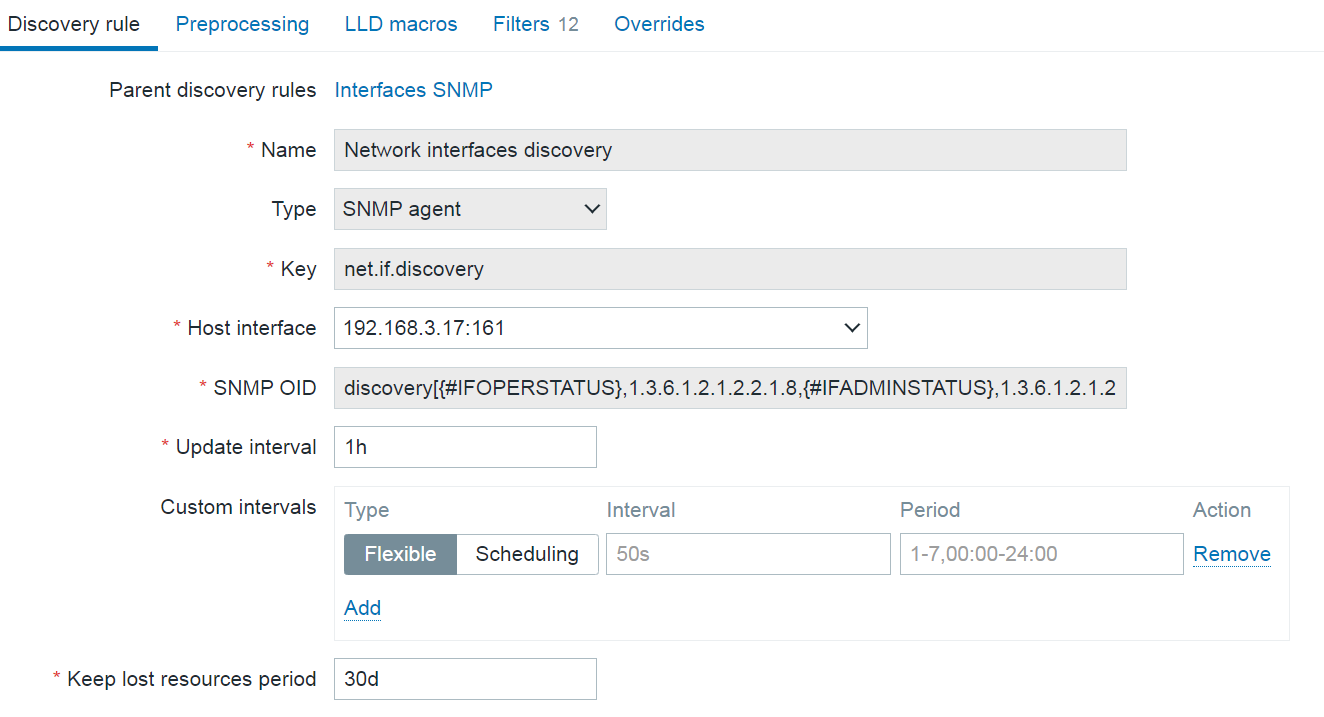
To start off, we create a low-level discovery rule. In the discovery rule, we specify which low-level discovery macros are collected from which OIDs. This way, we create multiple low-level discovery macro and OID pairs. Zabbix then goes through the list of indexes at the end of the specified OIDs and matches the collected values to low-level discovery macros. Zabbix also collects the list of discovered indexes for the specified OIDs and automatically matches them with the {#SNMPINDEX} low-level discovery macros.
An example of regular SNMP discovery key:
discovery[{#IFOPERSTATUS},1.3.6.1.2.1.2.2.1.8,{#IFADMINSTATUS},1.3.6.1.2.1.2.2.1.7,{#IFALIAS},1.3.6.1.2.1.31.1.1.1.18,{#IFNAME},1.3.6.1.2.1.31.1.1.1.1,{#IFDESCR},1.3.6.1.2.1.2.2.1.2,{#IFTYPE},1.3.6.1.2.1.2.2.1.3]
The collected low-level discovery data will look something like this:
[
{
"{#SNMPINDEX}":"3",
"{#IFOPERSTATUS}":"2",
"{#IFADMINSTATUS}":"1",
"{#IFALIAS}":"",
"{#IFNAME}":"3",
"{#IFDESCR}":"3",
"{#IFTYPE}":"6"
},
{
"{#SNMPINDEX}":"4",
"{#IFOPERSTATUS}":"2",
"{#IFADMINSTATUS}":"1",
"{#IFALIAS}":"",
"{#IFNAME}":"4",
"{#IFDESCR}":"4",
"{#IFTYPE}":"6"
},
{
"{#SNMPINDEX}":"5",
"{#IFOPERSTATUS}":"2",
"{#IFADMINSTATUS}":"1",
"{#IFALIAS}":"",
"{#IFNAME}":"5",
"{#IFDESCR}":"5",
"{#IFTYPE}":"6"
},
{
"{#SNMPINDEX}":"6",
"{#IFOPERSTATUS}":"2",
"{#IFADMINSTATUS}":"1",
"{#IFALIAS}":"",
"{#IFNAME}":"6",
"{#IFDESCR}":"6",
"{#IFTYPE}":"6"
},
{
"{#SNMPINDEX}":"7",
"{#IFOPERSTATUS}":"2",
"{#IFADMINSTATUS}":"1",
"{#IFALIAS}":"",
"{#IFNAME}":"7",
"{#IFDESCR}":"7",
"{#IFTYPE}":"6"
}
]
Once the low-level discovery rule is created, we move on to creating item prototypes.
Items created based on this item prototype will collect metrics from the OIDs specified in the SNMP OID field and will create an item per index ( {#SNMPINDEX} macro) collected by the low-level discovery rule. Note that the item type is SNMP agent – each discovered and created item will be a regular SNMP item, polling the device and collecting metrics based on the item OID.
Now, imagine we have hundreds of interfaces and we’re polling a variety of metrics at a rapid interval for each interface. If our device has older or slower hardware, this can cause an issue where the device simply cannot process that many requests. To resolve this, a better way to collect SNMP metrics is required.
Before we move on to the improved SNMP metric collection approach, we need to first take a look at how master-dependent item bulk metric collection and low-level discovery logic are implemented in Zabbix.
The SNMP bulk metric collection and discovery logic is very similar to what is discussed in the previous section, but it is more tailored to SNMP nuances.
Here, to avoid excessive polling, a new walk[] item has been introduced. The item utilizes GetBulk requests with SNMPv2 and v3 interfaces and GetNext for SNMPv1 interfaces to collect SNMP data. GetBulk requests perform much better by design. A GetBulk request retrieves values of all instances at the end of the OID tree in a single go, instead of issuing individual Get requests per each instance.
To utilize this in Zabbix, first we have to create a walk[] master item, specifying the list of OIDs from which to collect values. The retrieved values will be used in both low-level discovery (e.g.: interface names) and items created from low-level discovery item prototypes (e.g.: incoming and outgoing traffic).
Two new preprocessing steps have been introduced to facilitate SNMP bulk data collection:
The workflow for SNMP bulk data collection can be described in the following steps:
Let’s take a look at a simple example which you can use as a starting point for implementing bulk SNMP metric collection for your devices. In the following example we will create a master walk[] item, a dependent low-level discovery rule to discover network interfaces, and dependent item prototypes for incoming and outgoing traffic.
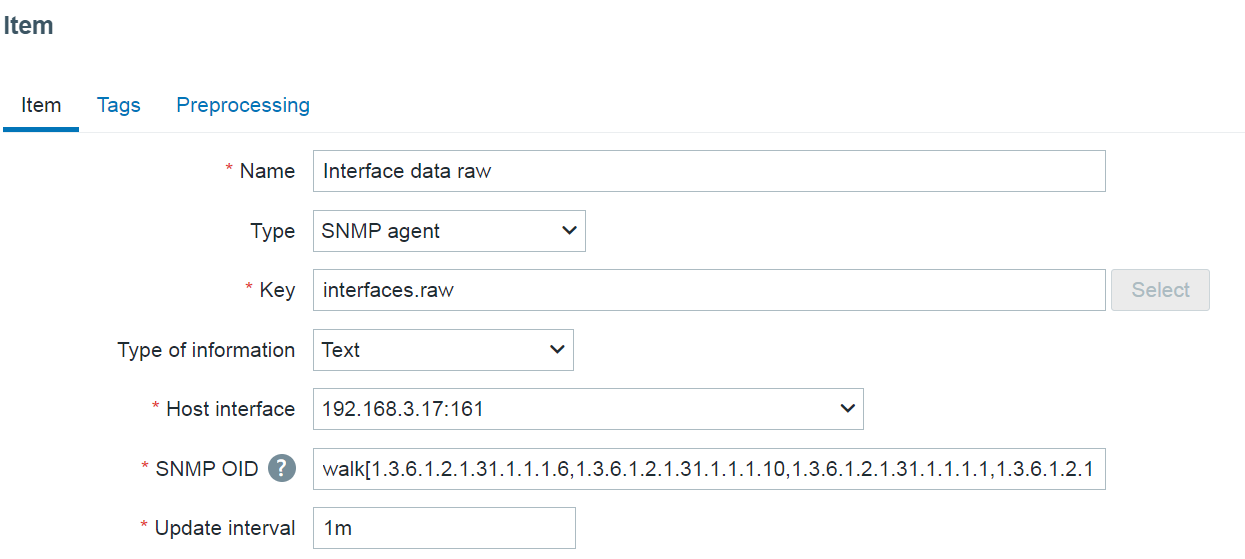
We will start by creating the walk[] SNMP agent master item. The name and the key of the item can be specified arbitrarily. What’s important here is the OID field, where we will specify the list of comma separated OIDs from which their instance values will be collected.
walk[1.3.6.1.2.1.31.1.1.1.6,1.3.6.1.2.1.31.1.1.1.10,1.3.6.1.2.1.31.1.1.1.1,1.3.6.1.2.1.2.2.1.2,1.3.6.1.2.1.2.2.1.3]
The walk[] item will collect values from the following OIDs:
Here we can see the resulting values collected by this item:
Note: For readability, the output has been truncated and some of the interfaces have been left out.
.1.3.6.1.2.1.2.2.1.2.102 = STRING: DEFAULT_VLAN
.1.3.6.1.2.1.2.2.1.2.104 = STRING: VLAN3
.1.3.6.1.2.1.2.2.1.2.105 = STRING: VLAN4
.1.3.6.1.2.1.2.2.1.2.106 = STRING: VLAN5
.1.3.6.1.2.1.2.2.1.2.4324 = STRING: Switch loopback interface
.1.3.6.1.2.1.2.2.1.3.102 = INTEGER: 53
.1.3.6.1.2.1.2.2.1.3.104 = INTEGER: 53
.1.3.6.1.2.1.2.2.1.3.105 = INTEGER: 53
.1.3.6.1.2.1.2.2.1.3.106 = INTEGER: 53
.1.3.6.1.2.1.2.2.1.3.4324 = INTEGER: 24
.1.3.6.1.2.1.31.1.1.1.1.102 = STRING: DEFAULT_VLAN
.1.3.6.1.2.1.31.1.1.1.1.104 = STRING: VLAN3
.1.3.6.1.2.1.31.1.1.1.1.105 = STRING: VLAN4
.1.3.6.1.2.1.31.1.1.1.1.106 = STRING: VLAN5
.1.3.6.1.2.1.31.1.1.1.1.4324 = STRING: lo0
.1.3.6.1.2.1.31.1.1.1.10.102 = Counter64: 0
.1.3.6.1.2.1.31.1.1.1.10.104 = Counter64: 0
.1.3.6.1.2.1.31.1.1.1.10.105 = Counter64: 0
.1.3.6.1.2.1.31.1.1.1.10.106 = Counter64: 0
.1.3.6.1.2.1.31.1.1.1.10.4324 = Counter64: 12073
.1.3.6.1.2.1.31.1.1.1.6.102 = Counter64: 0
.1.3.6.1.2.1.31.1.1.1.6.104 = Counter64: 0
.1.3.6.1.2.1.31.1.1.1.6.105 = Counter64: 0
.1.3.6.1.2.1.31.1.1.1.6.106 = Counter64: 0
.1.3.6.1.2.1.31.1.1.1.6.4324 = Counter64: 12457
By looking at these values we can confirm that the item collects values required for both the low-level discovery rule (interface name, type, and description) and the items created from item prototypes (incoming/outgoing traffic).
As our next step, we will create a dependent low-level discovery rule which will discover interfaces based on the data from the master walk[] item.
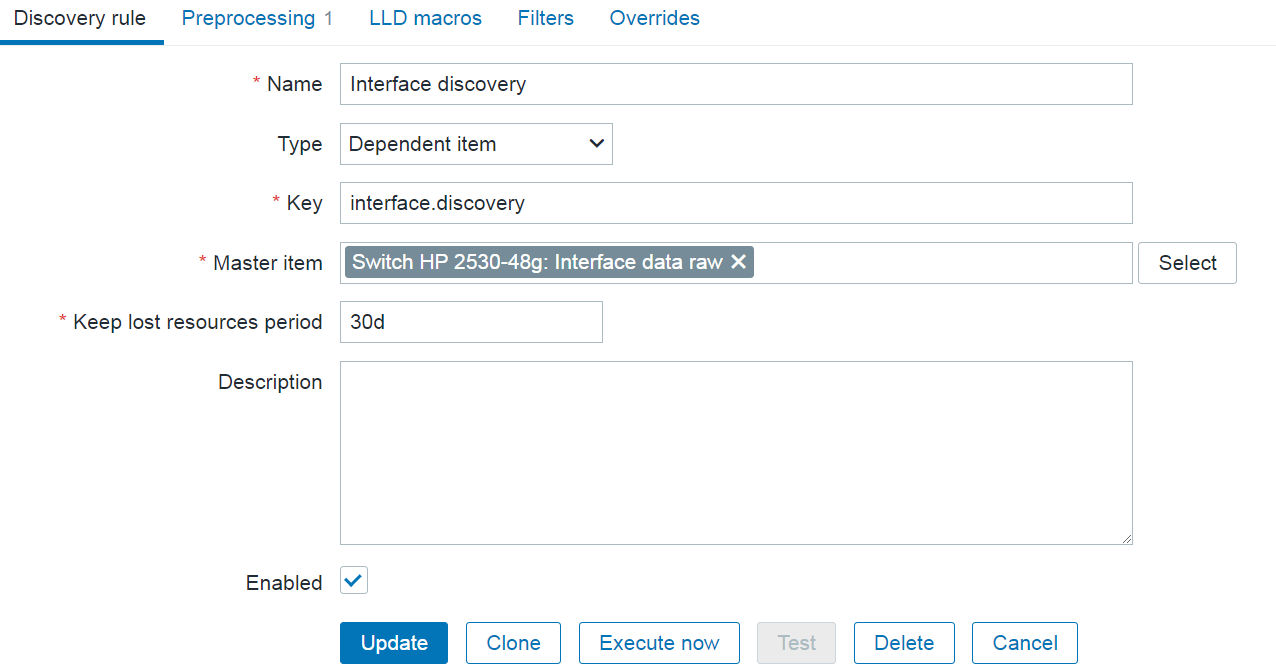
The most important part of configuring the low-level discovery rule lies in defining the SNMP walk to JSON preprocessing step. Here we can assign low-level discovery macros to OIDs. For our example, we will assign the {#IFNAME} macro to the OID containig the values of interface names:
Field name: {#IFNAME}
OID prefix: 1.3.6.1.2.1.31.1.1.1.1
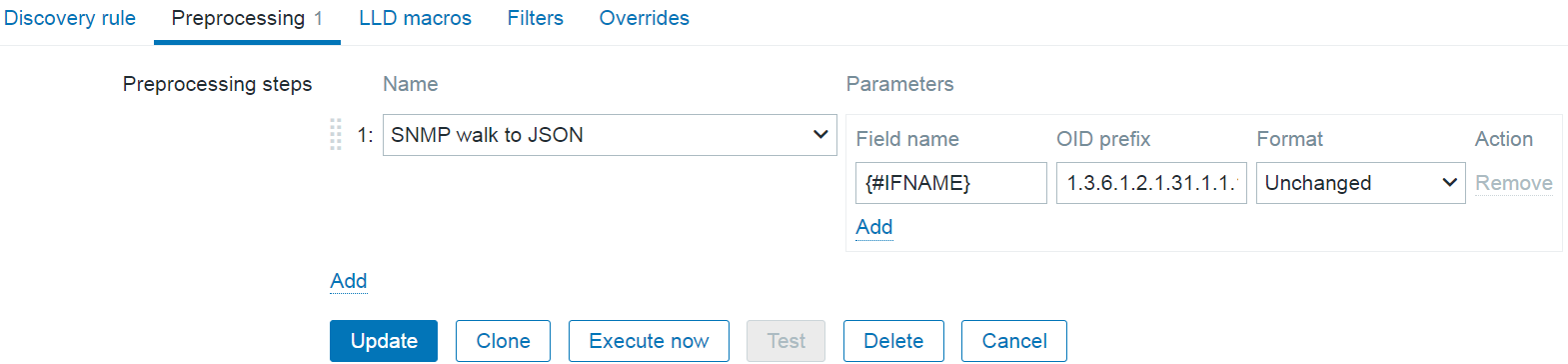
The name and the key of the dependent item can be specified arbitrarily.
Finally, let’s create two dependent item prototypes to collect traffic data from our master item.
Here we will provide an arbitrary name and key containing low-level discovery macros. On items created from the item prototypes, the macros will resolve as our OID values, thus giving each item a unique name and key.
Note: The {#SNMPINDEX} macro is automatically collected by the low-level discovery rule and contains the indexes from the OIDs specified in the SNMP walk to JSON preprocessing step.
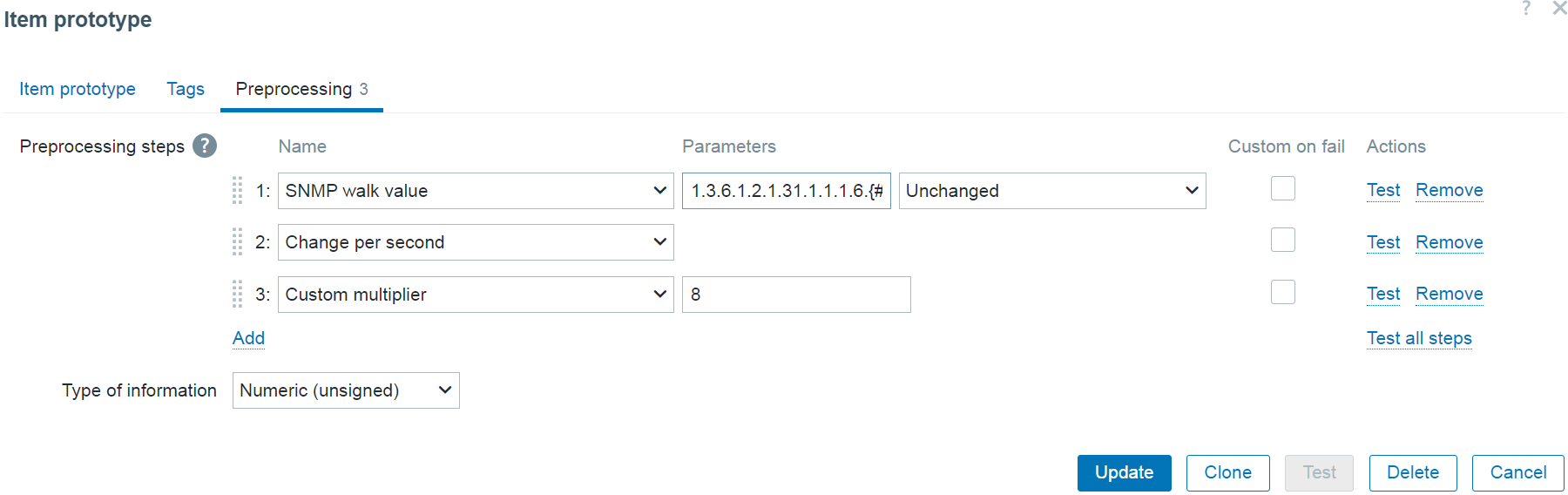
The final step in creating the item prototype is using the SNMP walk value preprocessing step to define which value will be collected by the item. We will also append the {#SNMPINDEX} macro at the end of the OID. This way, each item created from the prototype will collect data from a unique OID corresponding to the correct object instance.
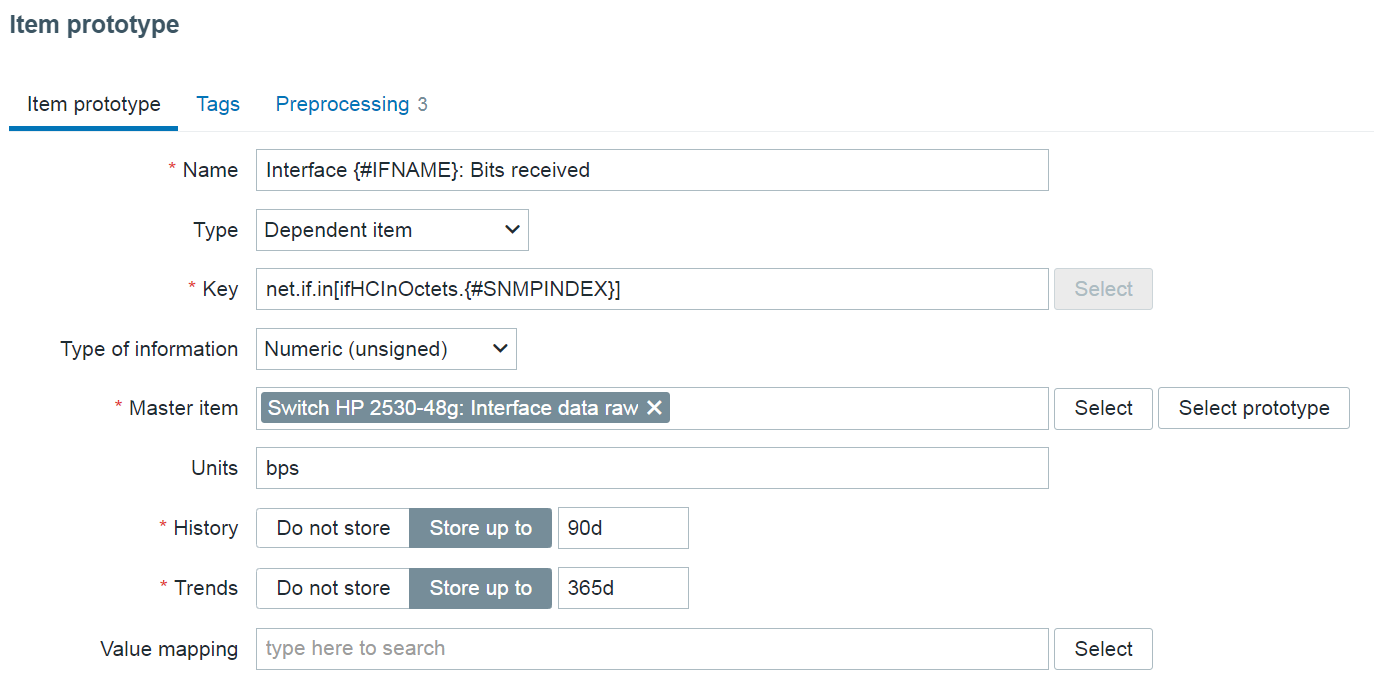
Incoming traffic item prototype preprocessing step:
SNMP walk value: 1.3.6.1.2.1.31.1.1.1.6.{#SNMPINDEX}
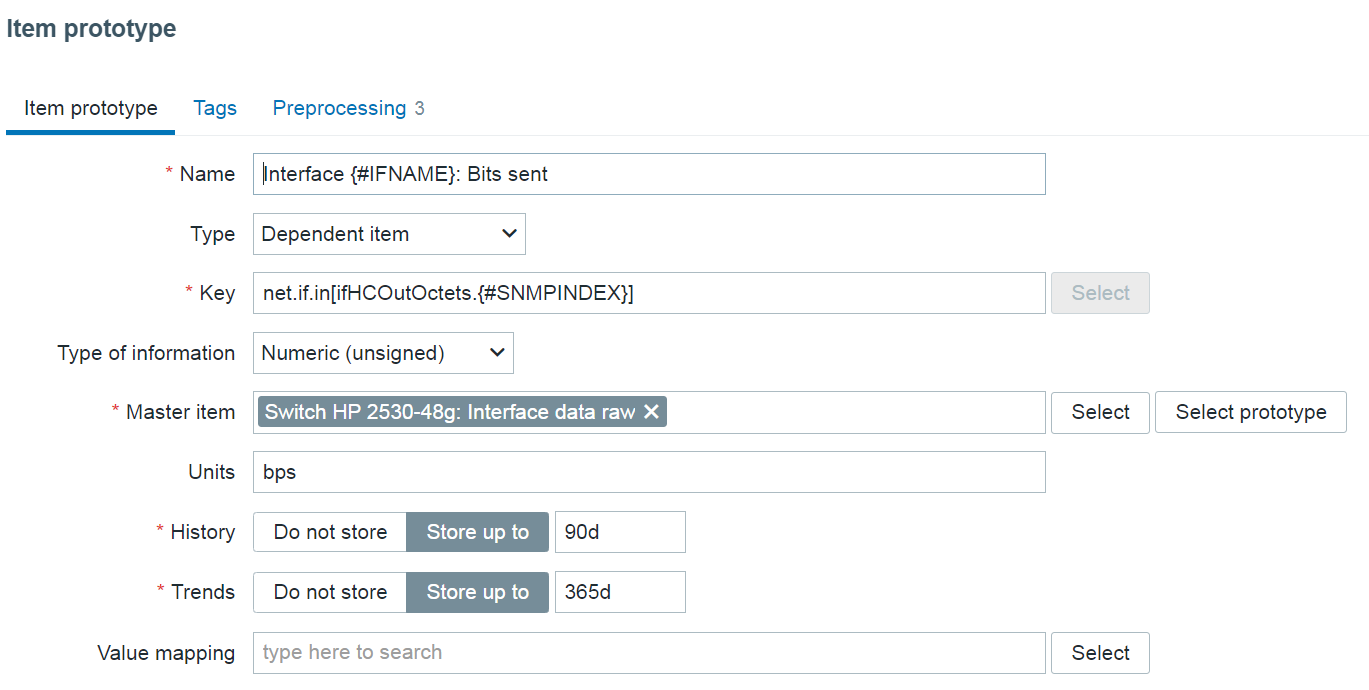
Outgoing traffic item prototype preprocessing step:
SNMP walk value: 1.3.6.1.2.1.31.1.1.1.10.{#SNMPINDEX}
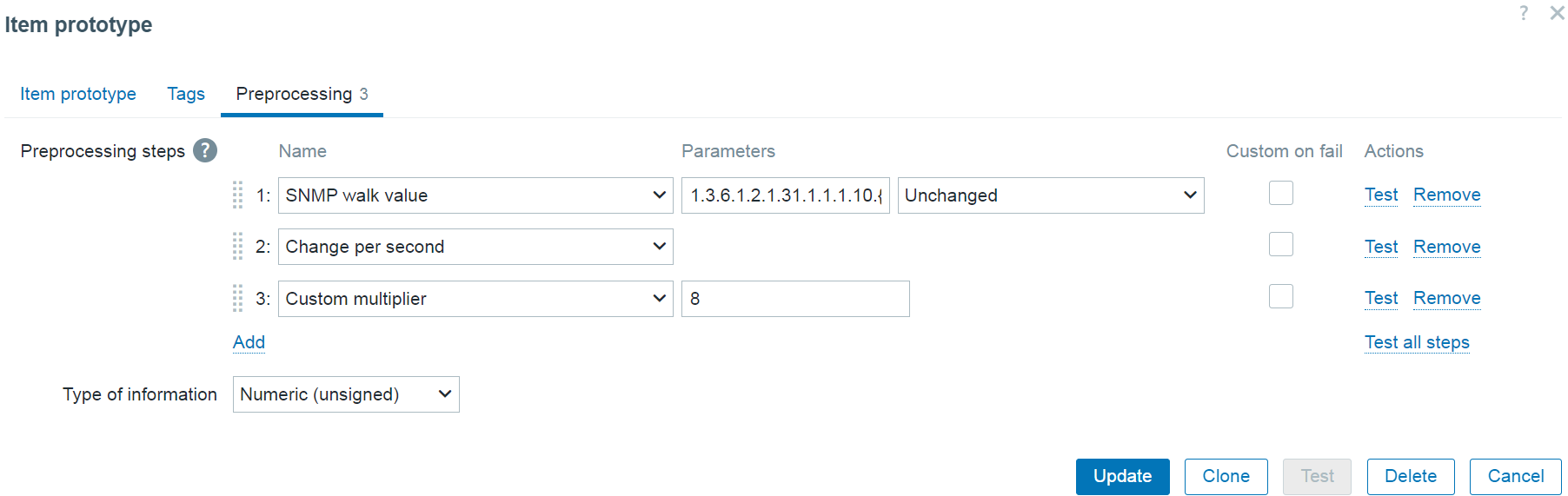
Note: Since the collected traffic values are counter values (always increasing), the Change per second preprocessing step is required to collect the traffic per second values.
Note: Since the values are collected in bytes, we will use the Custom multiplier preprocessing step to convert bytes to bits.
And we’re done! Now all we have to do is wait until the master item update interval kicks in and we should see our items getting discovered by the low-level discovery rule.
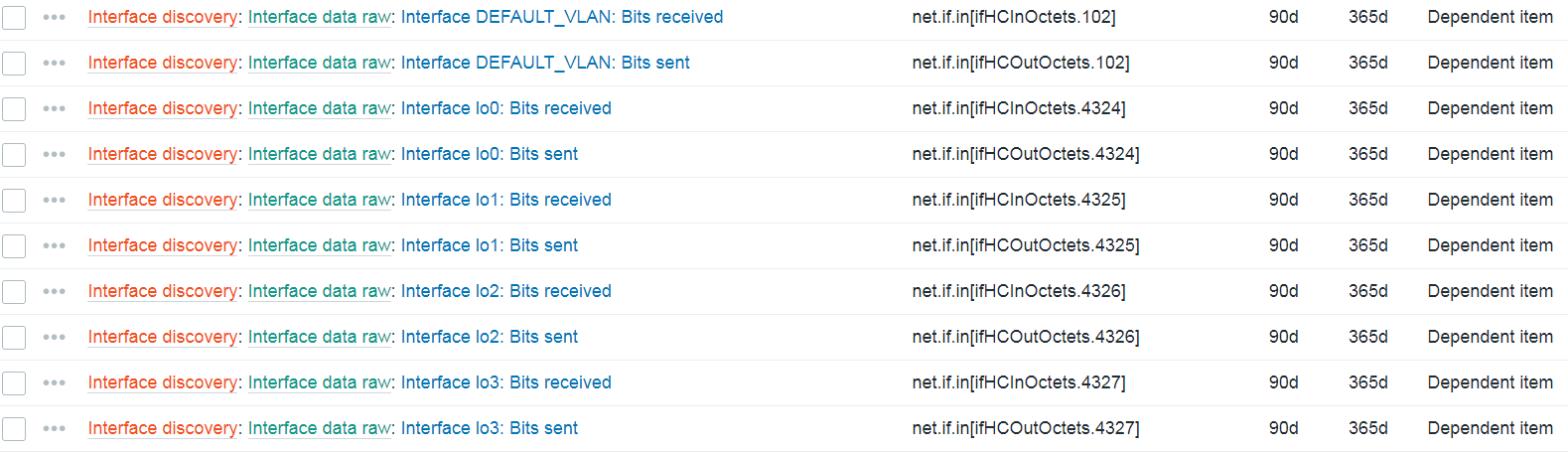
After we have confirmed that our interfaces are getting discovered and the items are collecting metrics from the master item, we should also implement the Discard unchanged with heartbeat preprocessing step on our low-level discovery rule. This way, the low-level discovery rule will not try and discover new entities in situations where we’re getting the same set of interfaces over and over again from our master item. This in turn improves the overall performance of internal low-level discovery processes.
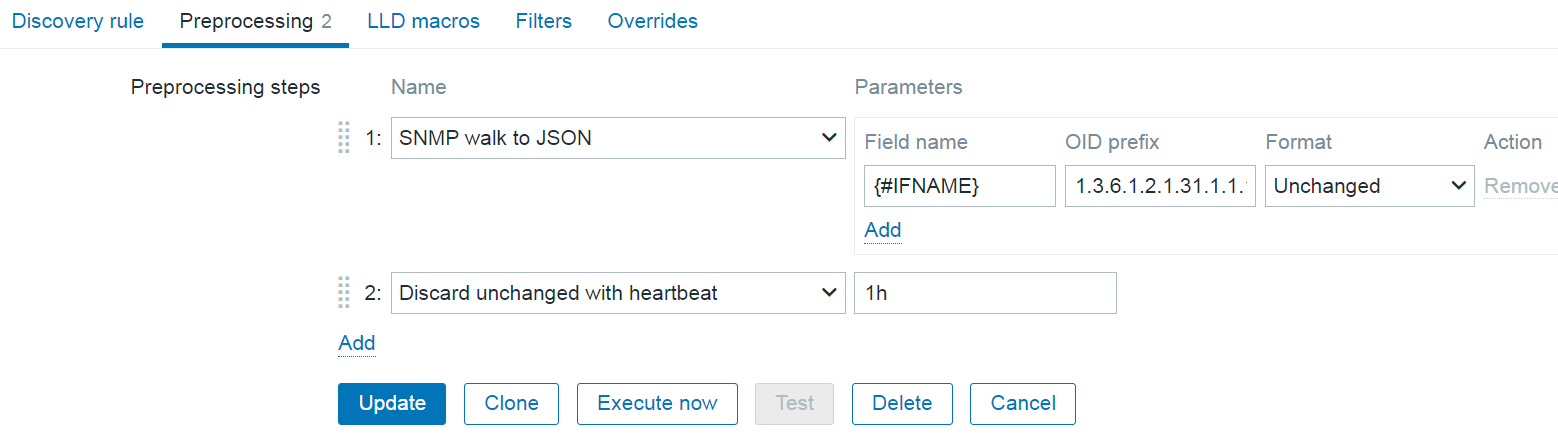
Note that we discovered other interface parameters than just the interface name – interface description and type are also collected in the master item. To use this data, we would have to add additional fields in the low-level discovery rule SNMP walk to JSON preprocessing step and assign low-level discovery macros to the corresponding OIDs containing this information. Once that is done, we can use the new macros in the item prototype to provide additional information in item name or key, or filter the discovered interfaces based on this information (e.g.: only discover interfaces of a particular type).
If you have any questions, comments, or suggestions regarding a topic you wish to see covered next in our blog, don’t hesitate to leave a comment below!
The post Improving SNMP monitoring performance with bulk SNMP data collection appeared first on Zabbix Blog.