Scale read and write workloads with Amazon Redshift

Post Syndicated from Harsha Tadiparthi original https://aws.amazon.com/blogs/big-data/scale-read-and-write-workloads-with-amazon-redshift/

Amazon Redshift is a fast, fully managed, petabyte-scale cloud data warehouse that enables you to analyze large datasets using standard SQL. The concurrency scaling feature in Amazon Redshift automatically adds and removes capacity by adding concurrency scaling to handle demands from thousands of concurrent users, thereby providing consistent SLAs for unpredictable and spiky workloads such as BI reports, dashboards, and other analytics workloads.

Until now, concurrency scaling only supported auto scaling for read queries; write queries had to run on the main cluster. Now, we are extending concurrency scaling to support auto scaling for common write queries including COPY, INSERT, UPDATE, and DELETE. This is available on Amazon Redshift RA3 provisioned instance types in the Regions where concurrency scaling is available. Amazon Redshift serverless comes with built in dynamic auto scaling capability for read workload scaling.

In this post, we discuss how to enable concurrency scaling to offer consistent SLAs for concurrent workloads such as data loads, ETL (extract, transform, and load), and data processing with reduced queue times.

Concurrency scaling overview

With concurrency scaling, Amazon Redshift automatically and elastically scales query processing power to provide consistently fast performance for hundreds of concurrent queries. Concurrency scaling resources are added to your Amazon Redshift cluster transparently in seconds, as concurrency increases, to serve sudden spikes in concurrent requests with fast performance without wait time. When the workload demand subsides, Amazon Redshift automatically shuts down concurrency scaling resources to save you cost.

The following diagram shows how concurrency scaling works at a high level.
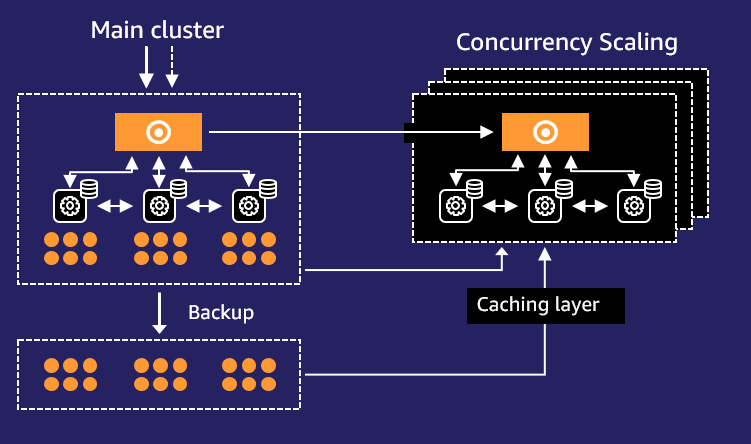
The workflow contains the following steps:

  1. All queries go to the main cluster.
  2. When queries in the designated workload management (WLM) queue begin queuing, Amazon Redshift automatically routes eligible queries to the new clusters, enabling concurrency scaling.
  3. Amazon Redshift automatically spins up a new cluster, processes waiting queries, and shuts down the concurrency scaling cluster when no longer needed.

Enable Amazon Redshift concurrency scaling

You can manage concurrency scaling at the WLM queue level, where you set concurrency scaling policies for specific queues. When concurrency scaling is enabled for a queue, eligible write and read queries are sent to concurrency scaling clusters without having to wait for resources to free up on the main Amazon Redshift cluster. Amazon Redshift handles spinning up concurrency scaling clusters, routing of the queries to the transient clusters, and relinquishing the concurrency clusters.

You can enable concurrency scaling on both automatic and manual WLM.

You first need to determine which parameter group your cluster is. To do so, complete the following steps:

  1. On the Amazon Redshift console, choose Clusters in the navigation pane.
  2. Choose your cluster.
  3. On the Properties tab, note the parameter group associated to the cluster.
    Now you can configure your WLM parameters.
  4. Under Configurations in the navigation pane, choose Workload management.
  5. Choose the parameter group associated to the cluster.If you’re using the default parameter group default.redshift-1.0, you need to create a custom parameter group and assign that to the cluster. The default parameter group has preset values for each of its parameters, and it can’t be modified.
  6. On the Parameters tab, you can choose between 1–10 max_concurrency_scaling_clusters.This is the max number of concurrent Amazon Redshift clusters you can have running at the same time. Ten is the soft limit; this limit can be increased by submitting a service limit increase request with a support case.
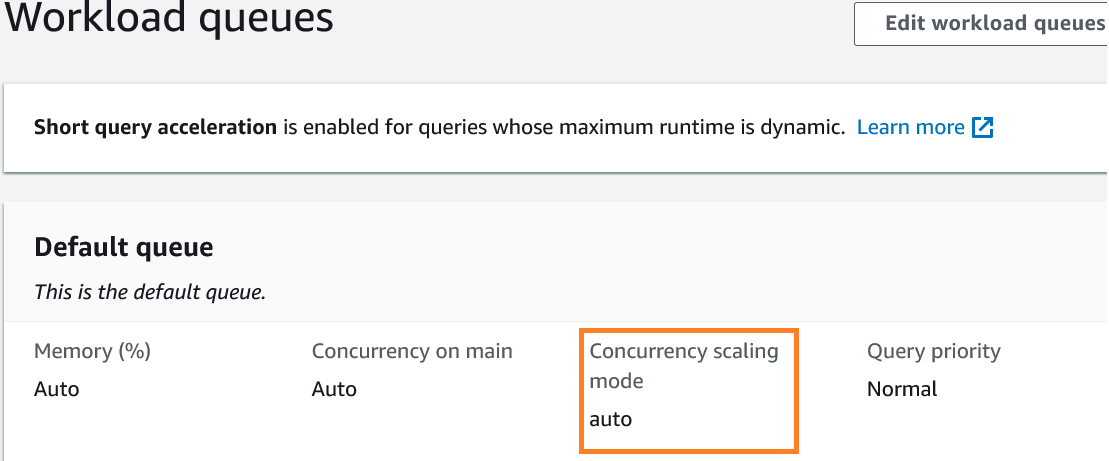
  7. On the Workload management tab, choose auto mode for the concurrency scaling cluster.

Example use cases

In this section, we use three use cases to help you understand how concurrency scaling for read and write heavy workloads can seamlessly scale to improve workload performance SLAs.

We used a 3 TB Cloud DW benchmark dataset. The test included a total of 103 concurrent queries, with each run using a separate database connection. The 103 queries constituted 60 queries from the 99 TPC-DS queries and 43 write queries, with a mix of copy, insert, update and delete statements. We used RA3.4xlarge 5 compute nodes.

The following scenarios showcase how concurrency scaling for reads and writes can seamlessly auto scale and positively impact a heavy concurrent mixed workload:

  • All queries triggered concurrently with concurrency scaling turned off
  • All queries triggered concurrently with concurrency scaling cluster limit set to 5 clusters
  • All queries triggered concurrently with concurrency scaling cluster limit set to 10 clusters

Scenario 1: All queries triggered concurrently with concurrency scaling turned off

In this benchmark test, all queries completed in 299 minutes. The following are the test details.

The Amazon Redshift query optimizer turned the 103 queries into 257 sub-queries for better performance in this run. Amazon Redshift continuous to learn from operational statistics to optimize your workload.

The following screenshot shows how Amazon Redshift auto WLM mode chose to run 16 queries concurrently while queuing the rest. Because concurrency scaling is turned off, no additional clusters are spun up and the queries continue to wait for running queries to complete before they can be processed. Notice the number of queries queued stayed at a higher number for a long period of time and eventually lowered as only a few queries could concurrently run.

No additional concurrent clusters spun up during the window of the workload, as seen in the following screenshot, requiring the primary cluster to process all the queries.

Scenario 2: All queries triggered concurrently with concurrency scaling cluster max limit set to 5 clusters

In this test, all queries completed in 49 minutes.

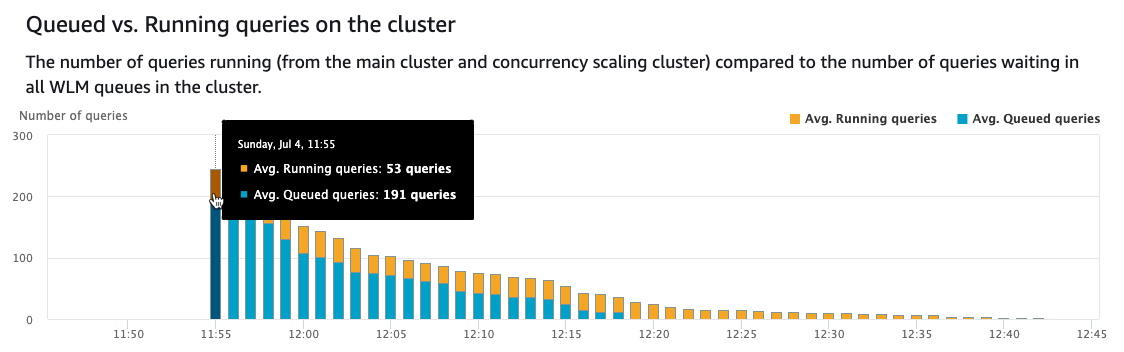
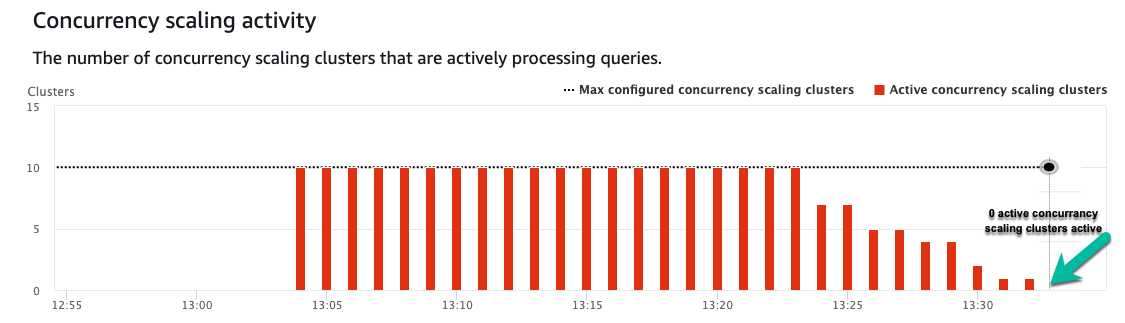
The following screenshot depicts significant queuing. Within seconds, five additional Amazon Redshift clusters are spun up into ready state, allowing 53 queries to run simultaneously. This number can change in your cluster based on the query types. Notice the number of queries queued starts lowering as more queries are completed using the five additional clusters.
Over time, the concurrency scaling clusters start to wind down progressively to 0 as the queries no longer waited.

Scenario 3: All queries triggered concurrently with concurrency scaling cluster limit set to 10 clusters

In this test, all queries completed in 28 minutes.

The following screenshot depicts significant queuing. Within seconds, 10 additional Amazon Redshift clusters are spun up into ready state, allowing multiple queries to run simultaneously. This number can change in your cluster based on the query types. Notice the number of queries queued starts lowering as more queries are completed using the five additional clusters.

Over time, the concurrency scaling clusters start to wind down progressively to 0 as the queries no longer waited.
Test results review

The following table summarizes our test results.

. Test Scenario 1 Test Scenario 2 Test Scenario 3
Total Workload Completion Time 299 Minutes 49 Minutes 28 Minutes

The test results reveal how concurrency scaling for a mixed workload of reads and writes lowered the total workload completion time from 299 minutes to 28 minutes, which is more than 10 times an improvement in SLAs while being cost effective by only paying for the additional clusters when scaling is necessary.

Monitor concurrency scaling

One method to monitor concurrency scaling is via system views. To monitor which queries benefitted from concurrency scaling, you can use concurrency_scaling_status from stl_query. Concurrency scaling of 1 indicates that the query ran on a concurrency scaling cluster. To monitor concurrency scaling usage, you can use the SVCS_CONCURRENCY_SCALING_USAGE system view.

The Amazon CloudWatch metrics ConcurrencyScalingActiveClusters and ConcurrencyScalingSeconds enable you to set up monitoring of concurrency scaling usage. For more information, refer to Monitoring Amazon Redshift using CloudWatch metrics.

Configure usage limit

With every 24 hours used of the main Amazon Redshift cluster, you accrue 1 hour of concurrency scaling credit. This free credit can be used by both read and write queries. For any usage that exceeds the accrued free usage credits, you’re billed on a per-second basis based on the on-demand rate of your Amazon Redshift cluster. You can apply cost controls for concurrency scaling at the cluster level. You can choose to create multiple queues for ETL, Dashboard, and adhoc workload. With this you can choose to turn on concurrency scaling for selective queues.

As shown in the following screenshot, you can choose a time period (daily, weekly, or monthly) and specify the desired usage limit. You can then choose an action option (Alert, Log to system table, or Disable feature). For more details on how to set cost controls for concurrency scaling, refer to Manage and control your cost with Amazon Redshift Concurrency Scaling and Spectrum.

Summary

In this post, we showed how you can enable concurrency scaling to help you meet the SLAs for both read and write workloads by seamlessly scaling out to the maximum number of clusters you configured, thereby increasing your cluster throughput while controlling your costs. Concurrency scaling with read and write capability can enable you to handle a number of scenarios, such as sudden increases in the volume of data in your data pipeline, backfill operations, ad hoc reporting, and month end processing. It’s now time to put this learning into action and begin optimizing your Redshift cluster(s) for both read and write throughput!


About the Authors

Harsha Tadiparthi is a specialist Principal Solutions Architect, Analytics at AWS. He enjoys solving complex customer problems in databases and analytics and delivering successful outcomes. Outside of work, he loves to spend time with his family, watch movies, and travel whenever possible.

Harshida Patel is a Specialist Principal Solutions Architect, Analytics with AWS.

Ramu Ponugumati is a Sr. Technical Account Manager, specialist in Analytics and AI/ML at AWS. He works with enterprise customers to modernize and cost optimize workloads, and helps them build reliable and secure applications on the AWS platform. Outside of work, he loves spending time with his family, playing tennis, and gardening.

Creating an accessible search experience with the QueryBuilder component

Post Syndicated from Lindsey Wild original https://github.blog/2022-12-13-creating-an-accessible-search-experience-with-the-querybuilder-component/

Overview

Throughout the GitHub User Interface (UI), there are complex search inputs that allow you to narrow the results you see based on different filters. For example, for repositories with GitHub Discussions, you can narrow the results to only show open discussions that you created. This is completed with the search bar and the use of defined filters. The current implementation of this input has accessibility considerations that need to be examined at a deeper level, from the styled search input to the way items are grouped, that aren’t natively accessible, so we had to take some creative approaches. This led us to creating the QueryBuilder component, which is a fully accessible component designed for these types of situations.

As we rethought this core pattern within GitHub, we knew we needed to make search experiences accessible so everyone can successfully use them. GitHub is the home for all developers, including those with disabilities. We don’t want to stop at making GitHub accessible; we want to empower other developers to make a similar pattern accessible, which is why we’ll be open sourcing this component!

Process

GitHub is a very large organization with many moving pieces. Making sure that accessibility is considered in every step of the process is important. Our process looked a little something like this:

The first step was that we, the Accessibility Team at GitHub, worked closely with the designers and feature teams to design and build the QueryBuilder component. We wanted to understand the intent of the component and what the user should be able to accomplish. We used this information to help construct the product requirements.

Our designers and accessibility experts worked together on several iterations of what this experience would look like and annotated how it should function. Once everyone agreed on a path forward, it was time to build a proof of concept!

The proof of concept helped to work out some of the trickier parts of the implementation, which we will get to in the following Accessibility Considerations section. An accessibility expert review was conducted at multiple points throughout the process.

The Accessibility Team built the reusable component in collaboration with the Primer Team (GitHub’s Design System), and then collaborated with the GitHub Discussions Team on what it’d take to integrate the component. At this point in time, we have a fully accessible MVP component that can be seen on any GitHub.com Discussions landing page.

Introducing the QueryBuilder component

The main purpose of the QueryBuilder is to allow a user to enter a query that will narrow their results or complete a search. When a user types, a list of suggestions appears based on their input. This is a common pattern on web, which doesn’t sound too complicated, until you start to consider these desired features:

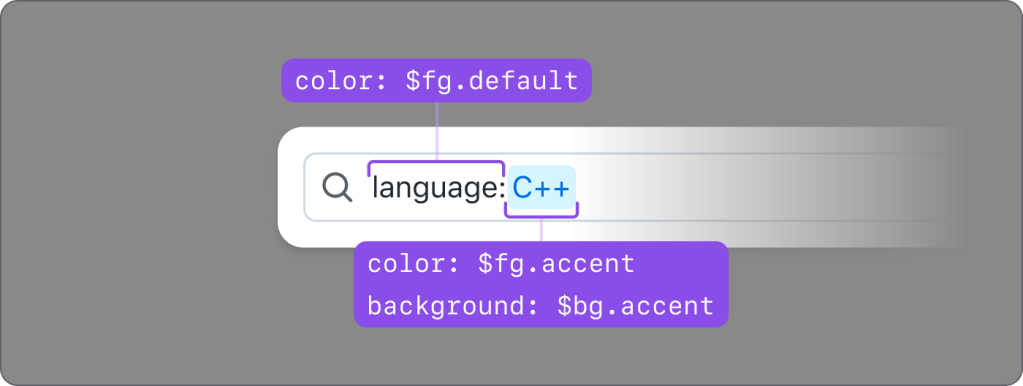
  • The input should contain visual styling that shows a user if they’ve typed valid input.

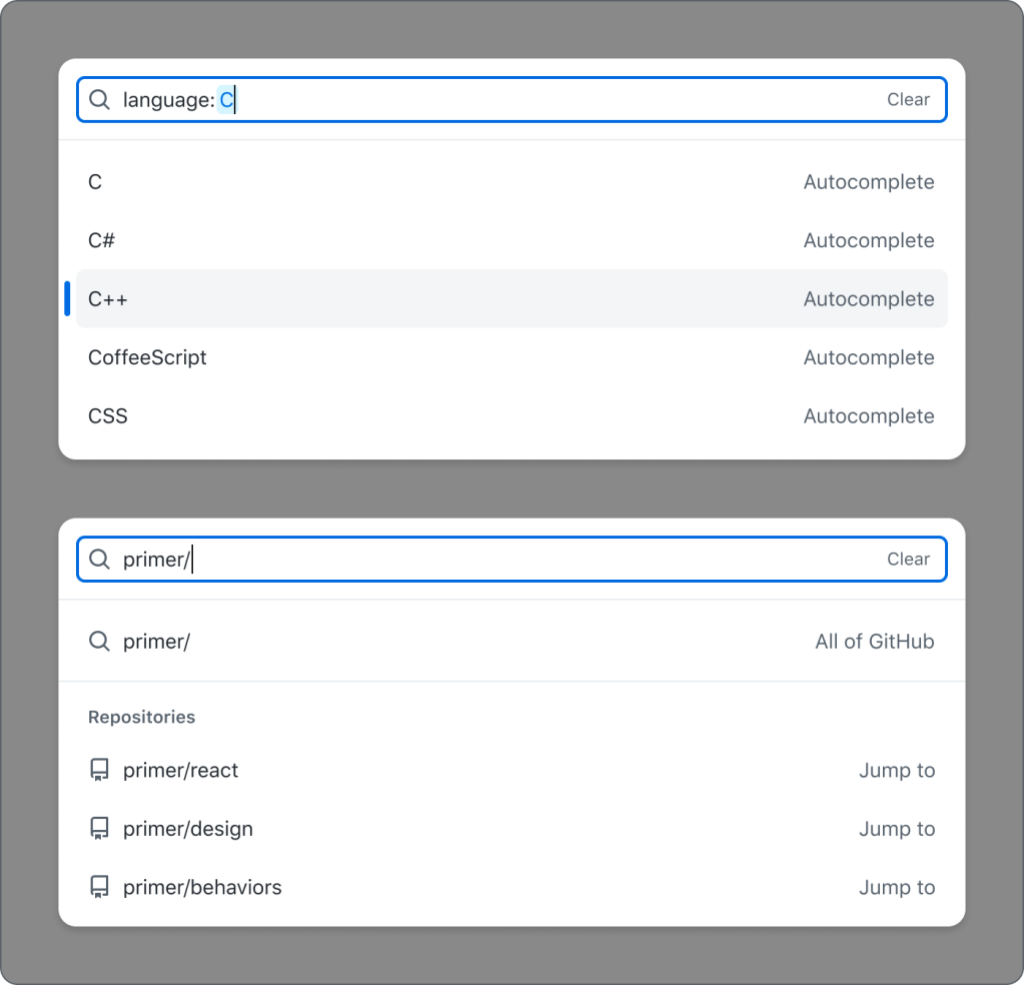
Text input with an icon of a magnifier at the beginning. The input text of "language:" is a dark gray and the value "C++" is a shade of medium blue with a highlight background of a lighter blue.
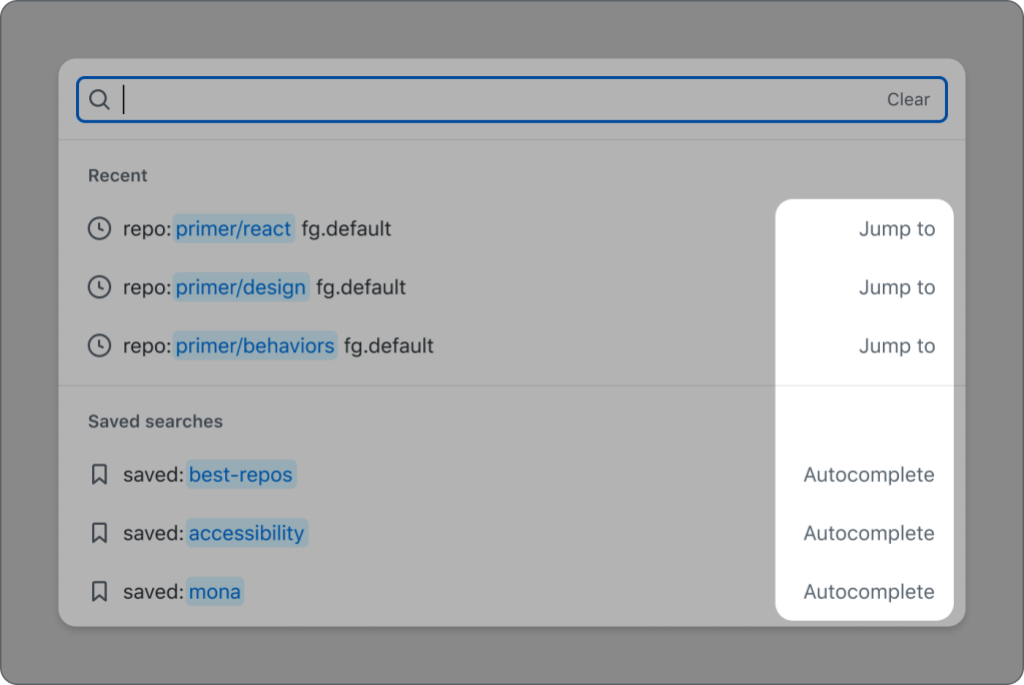
  • When a suggestion is selected, it can either take a user somewhere else (“Jump to”) or append the selection to the input (“Autocomplete”).

Two different search inputs with results. The results in the first example have "Autocomplete" appended to the end of the row of each suggestion. The results in the second example have "Jump to" appended to the end of the row of each suggestion.

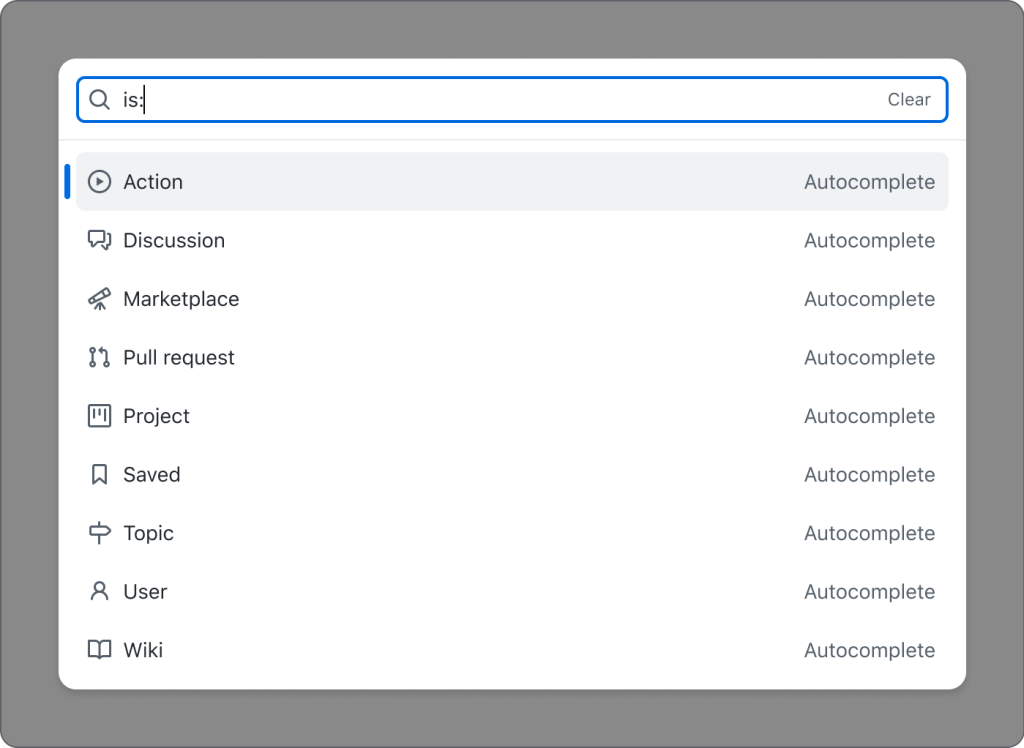
  • The set of suggestions should change based on the entered input.

Text input example "is:" is giving a different list of results than "language:" did: Action, Discussion, Marketplace, Pull request, Project, Saved, Topic, User, and Wiki.

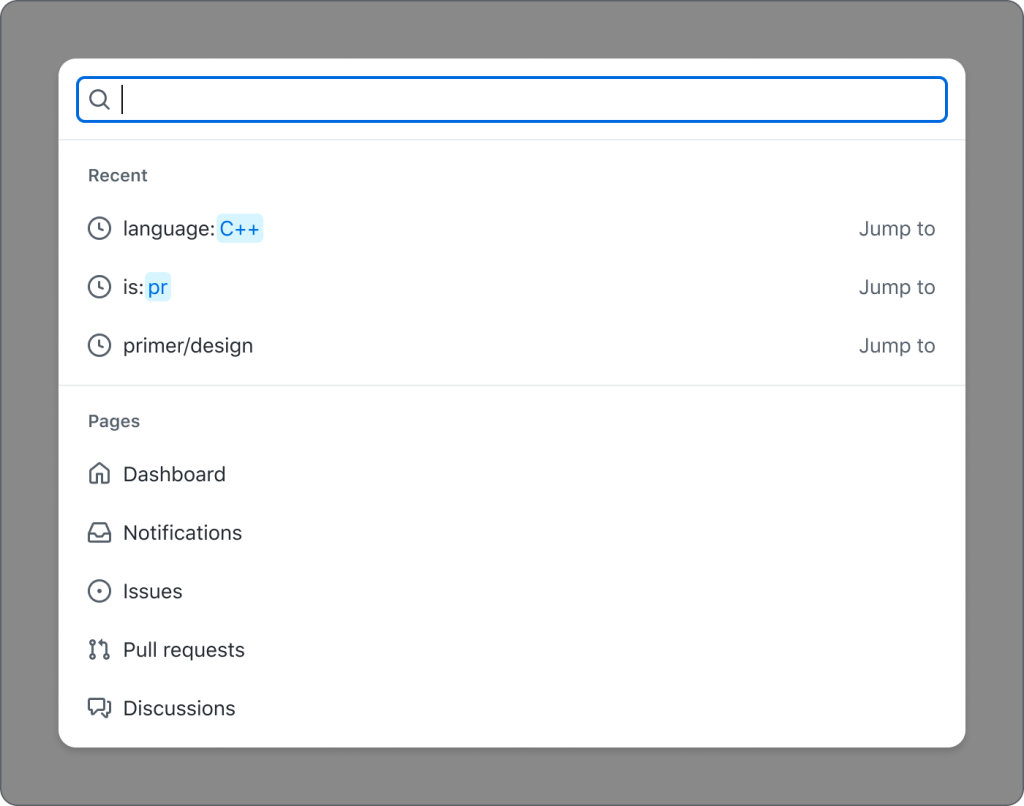
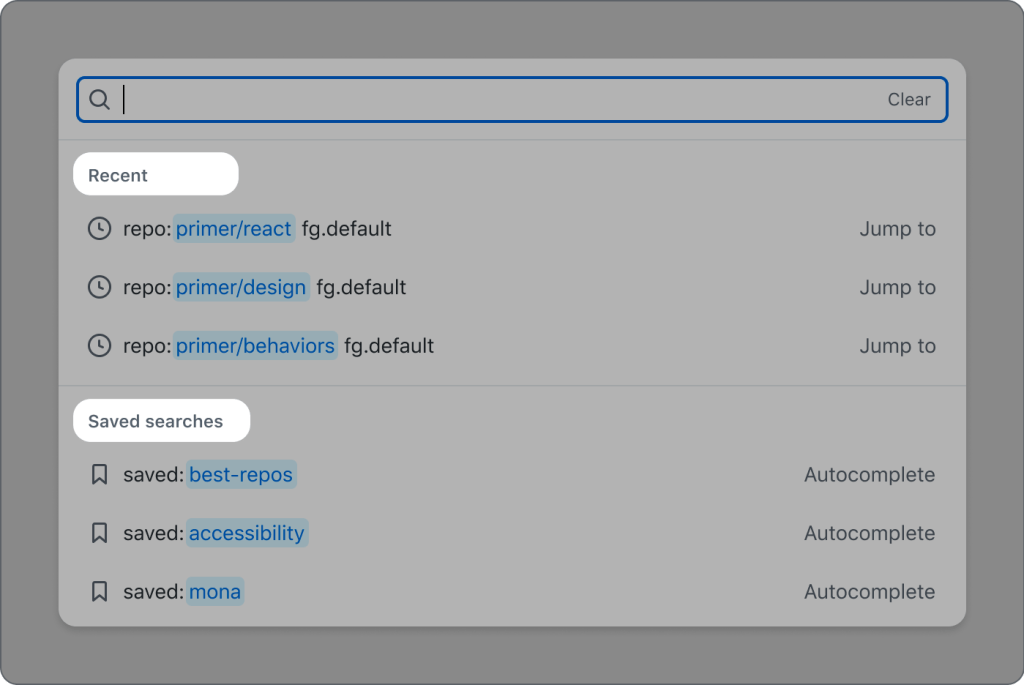
  • There should be groups of suggestions within the suggestion box.

Search input with results; first group of items is "Recent" with the Recent header on top. The second group is "Pages" with the Pages header on top of the second group. There is a line separator between each group of items.

Okay, now we’re starting to get more complicated. Let’s break these features down from an accessibility perspective.

Accessibility considerations

Note: these considerations are not comprehensive to every accessibility requirement for the new component. We wanted to highlight the trickier-to-solve issues that may not have been addressed before.

Semantics

We talked about this component needing to take a user’s input and provide suggestions that a user can select from in a listbox. We are using the Combobox pattern, which does exactly this.

Styled input

Zoomed in look at the styling between a qualifier, in this case "language:" and the value, "C++". The qualifier has a label of "color: $fg.default" which is a dark gray, and the value has a label of "color: $fg.accent; background: $bg.accent”, which are a lighter and darker shade of blue.

Natively, HTML inputs do not allow specific styling for individual characters, unless you use contenteditable. We didn’t consider this to be an accessible pattern; even basic mark-up can disrupt the expected keyboard cursor movement and contenteditable’s support for ARIA attributes is widely inconsistent. To achieve the desired styling, we have a styled element – a <div aria-hidden="true"> with <span> elements inside—that is behind the real <input> element that a user interacts with. It is perfectly lined up visually so all of the keyboard functionality works as expected, the cursor position is retained, input text is duplicated inside, and we can individually style characters within the input. We also tested this at high Zoom levels to make sure that everything scaled correctly. color: transparent was added to the real input’s text, so sighted users will see the styled text from the <div>.

While the styled input adds some context for sighted users, we also explored whether we could make this apparent for people relying on a screen reader. Our research led us to create a proof of concept with live-region-based announcements as the cursor was moved through the text. However, based on testing, the screen reader feedback proved to be quite overwhelming and occasionally flaky, and it would be a large effort to accurately detect and manage the cursor position and keyboard functionality for all types of assistive technology users. Particularly when internationalization was taken into account, we decided that this would not be overly helpful or provide good return on investment.

Items with different actions

Search results displaying the "Jump to" appended text to the results in the Recent group and "Autocomplete" appended to the results in the Saved searches group; there is a rectangular highlight over the appended words for emphasis.

Typical listbox items in a combobox pattern only have one action–and that is to append the selected option’s value to the input. However, we needed something more. We wanted some selected option values to be appended to the input, but others to take you to a different page, such as search results.

For options that will append their values to the input when selected, there is no additional screen reader feedback since this is the default behavior of a listbox option. These options don’t have any visual indication (color, underline, etc.) that they will do anything other than append the selection to the input.

When an option will take a user to a new location, we’ve added an aria-label to that option explaining the behavior. For example, an option with the title README.md and description primer/react that takes you directly to https://github.com/primer/react/blob/main/README.md will have aria-label=”README.md, primer/react, jump to this file”. This explains the file (README.md), description/location of the file (primer/react), action (jump to), and type (this file). Since this is acting as a link, it will have visual text after the value stating the action. Since options may have two different actions, having a visual indicator is important so that a user knows what will happen when they make a selection.

Group support

A text input and an expanded list of suggestions. The group titles, "Recent" and "Saved searches,” which contain list items related to those groups, are highlighted.

Groups are fully supported in an accessible way. role="group" is not widely supported inside of listbox for all assistive technologies, so our approach conveys the intent of grouped items to each user, but in different ways.

For sighted users, there is a visual header and separator for each group of items. The header is not focusable, and it has role="presentation" so that it’s hidden from screen reader users because this information is presented in a different way to them (which is described later in this blog). The wrapping <ul> and <li> elements are also given role="presentation" since a listbox is traditionally a list of <li> items inside of one parent <ul>.

For screen reader users, the grouped options are denoted by an aria-label with the content of each list item and the addition of the type of list item. This is the same aria-label as described in the previous section about items with different actions. An example aria-label for a list item with the value primer/react that takes you to the Primer React repository when chosen is “primer/react, jump to this repository.” In this example, adding “repository” to the aria-label gives the context that the item is part of the “Repository” group, the same way the visual heading helps sighted users determine the groups. We chose to add the item type at the end of the aria-label so that screen reader users hear the name of the item first and can navigate through the suggestions quicker. Since the aria-label is different from the visible label, it has to contain the visible label’s text at the beginning for voice recognition software users.

Screen reader feedback

By default, there is no indication to a screen reader user how many suggestions are displayed or if the input is successfully cleared via the optional clear button.

To address this, we added an aria-live region that updates the text whenever the suggestions change or the input is cleared. A screen reader will receive feedback when they press the “Clear” button that the input has been cleared, focus is restored to the input, and how many suggestions are currently visible.

While testing the aria-live updates, we noticed something interesting; if the same number of results are displayed as a user continues typing, the aria-live region will not update. For example, if a user types “zzz” and there are 0 results, and then they add an additional “z” to their query (still 0 results), the screen reader will not re-read “0 results” since the aria-live API did not detect a change in the text. To address this, we are adding and removing a &nbsp; character if the previous aria-live message is the same as the new aria-live message. The &nbsp; will cause the aria-live API to detect a change and the screen reader will re-read the text without an audible indication that a space was added.

Recap

In conclusion, this was a tremendous effort with a lot of teams involved. Thank you to the many Hubbers who collaborated on this effort, and to our accessibility friends at Prime Access Consulting (PAC). We are excited for users to get their hands on this new experience and really accelerate their efficiency in complex searches. This component is currently in production in a repository with GitHub Discussions enabled, and it will be rolling out to more parts of the UI. Stay tuned for updates about the progress of the component being open sourced.

What’s next

We will integrate this component into additional parts of GitHub’s UI, such as the new global search experience so all users can benefit from this accessible, advanced searching capability. We will continue to add the component to other areas of the GitHub UI and address any bugs or feedback we receive.

As mentioned in the beginning of this post, it will be open sourced in Primer ViewComponents and Primer React along with clear guidelines on how to use this component. The base of the component is a Web Component which allows us to share the functionality between ViewComponents and React. This will allow developers to easily create an advanced, accessible, custom search component without spending time researching how to make this pattern accessible or functional, since we’ve already done that work! It can work with any source of data as long as it’s in the expected format.

Many teams throughout GitHub are constantly working on accessibility improvements to GitHub.com. For more on our vision for accessibility at GitHub, visit accessibility.github.com.

Visualizing the impact of AWS Lambda code updates

Post Syndicated from David Boyne original https://aws.amazon.com/blogs/compute/visualizing-the-impact-of-aws-lambda-code-updates/

This post is written by Brigit Brown (Solutions Architect), and Helen Ashton (Observability Specialist Solutions Architect).

When using AWS Lambda, changes made to code can impact performance, functionality, and cost. It can be challenging to gain insight into how these code changes impact performance.

This blog post demonstrates how to capture, record, and visualize Lambda code deployment data with other data in an Amazon CloudWatch dashboard. This solution enables serverless developers to gain insight into the impact of code changes to Lambda functions and make data-driven decisions.

There are three steps to this solution:

  1. Capture: Lambda function code updates using Amazon EventBridge.
  2. Record: Lambda function code updates by creating an Amazon CloudWatch metric.
  3. Visualize: The relationship between Lambda function code updates and application KPIs by creating a CloudWatch dashboard.

Overview

EventBridge and CloudWatch are used to monitor and visualize the impact of code changes to Lambda functions on key application metrics.

Architecture diagram for capturing, recording, and visualizing Lambda function updates, showing the AWS Lambda function event being detected by Amazon EventBridge, and finally being sent to Amazon CloudWatch

Step 1: Capturing

AWS CloudTrail records all management events for AWS services. These are the operations performed on resources in your AWS account and include Lambda function code updates.

An EventBridge rule can listen for Lambda functions code updates and send these events to other AWS services, in this case to CloudWatch.

You can create EventBridge rules using an example event syntax as reference. To get the example event, update the code of a Lambda function and search in CloudTrail for all events with Event source of lambda.amazonaws.com, and an Event name starting with UpdateFunctionCode. UpdateFunctionCode is one of many events captured for Lambda functions. For example:

{
  "eventVersion": "1.08",
  "userIdentity": {
    "type": "AssumedRole",
    "principalId": "x",
    "arn": "arn:aws:sts::xxxxxxxxxxxx:assumed-role/Admin/x",
    "accountId": "xxxxxxxxxxxx",
    "accessKeyId": "xxxxxxxxxxxxxxxxx",
    "sessionContext": {
      "sessionIssuer": {
        "type": "Role",
        "principalId": "x",
        "arn": "arn:aws:iam::xxxxxxxxxxxx:role/Admin",
        "accountId": "xxxxxxxxxxxx",
        "userName": "Admin"
      },
      "webIdFederationData": {},
      "attributes": {
        "creationDate": "2022-09-22T16:37:04Z",
        "mfaAuthenticated": "false"
      }
    }
  },
  "eventTime": "2022-09-22T16:42:07Z",
  "eventSource": "lambda.amazonaws.com",
  "eventName": "UpdateFunctionCode20150331v2",
  "awsRegion": "us-east-1",
  "sourceIPAddress": "AWS Internal",
  "userAgent": "AWS Internal",
  "requestParameters": {
    "fullyQualifiedArn": {
      "arnPrefix": {
        "partition": "aws",
        "region": "us-east-1",
        "account": "xxxxxxxxxxxx"
      },
      "relativeId": {
        "functionName": "example-function"
      },
      "functionQualifier": {}
    },
    "functionName": "arn:aws:lambda:us-east-1:xxxxxxxxxxxx:function:example-function",
    "publish": false,
    "dryRun": false
  },
  "responseElements": {
    "functionName": "example-function",
    "functionArn": "arn:aws:lambda:us-east-1:xxxxxxxxxxxx:function:example-function",
    "runtime": "python3.8",
    "role": "arn:aws:iam::xxxxxxxxxxxx:role/role-name",
    "handler": "lambda_function.lambda_handler",
    "codeSize": 1011,
    "description": "",
    "timeout": 123,
    "memorySize": 128,
    "lastModified": "2022-09-22T16:42:07.000+0000",
    "codeSha256": "x",
    "version": "$LATEST",
    "environment": {},
    "tracingConfig": {
      "mode": "PassThrough"
    },
    "revisionId": "x",
    "state": "Active",
    "lastUpdateStatus": "InProgress",
    "lastUpdateStatusReason": "The function is being created.",
    "lastUpdateStatusReasonCode": "Creating",
    "packageType": "Zip",
    "architectures": ["x86_64"],
    "ephemeralStorage": {
      "size": 512
    }
  },
  "requestID": "f566f75f-a7a8-4e87-a177-2db001d40382",
  "eventID": "4f90175d-3063-49b4-a467-04150b418457",
  "readOnly": false,
  "eventType": "AwsApiCall",
  "managementEvent": true,
  "recipientAccountId": "113420664689",
  "eventCategory": "Management",
  "sessionCredentialFromConsole": "true"
}

The key fields are eventSource, eventName, functionName, and eventType. This is the event syntax containing only the key fields.

{
    "eventSource": "lambda.amazonaws.com",
    "eventName": "UpdateFunctionCode20150331v2",
    "responseElements": {
        "functionName": "example-function"
        }
    "eventType": "AwsApiCall",
}

Use this example event as a reference to write the EventBridge rule pattern.

{
  "source": ["aws.lambda"],
  "detail-type": ["AWS API Call via CloudTrail"],
  "detail": {
    "eventSource": ["lambda.amazonaws.com"],
    "eventName": [{
      "prefix": "UpdateFunctionCode"
    }],
    "eventType": ["AwsApiCall"]
  }
}

In this EventBridge rule, the detail section contains properties to match the original UpdateFunctionCode event pattern. The values to match are in square brackets using EventBridge syntax.

The eventName changes with each UpdateFunctionCode event, including date and version information within the value (i.e. UpdateFunctionCode20150331v2) and so a prefix matching filter is used to match the start of the eventName.

The source and the detail-type of the event are two additional fields included by EventBridge. For all Lambda CloudTrail calls, the detail-type is [“AWS API Call via CloudTrail”] and the source is “aws.lambda“.

Next, send an event to CloudWatch. Each EventBridge rule can send events to multiple targets, including Amazon SNS and CloudWatch log groups. Choose a target of CloudWatch log groups, with the log group specified as /aws/events/lambda/updates. EventBridge creates this log group in CloudWatch.

Finally, test the EventBridge rule.

  1. To trigger an event, change the code for any Lambda function and deploy.

    AWS Console

  2. To view the event, navigate to the CloudWatch console > Logs > Log groups.

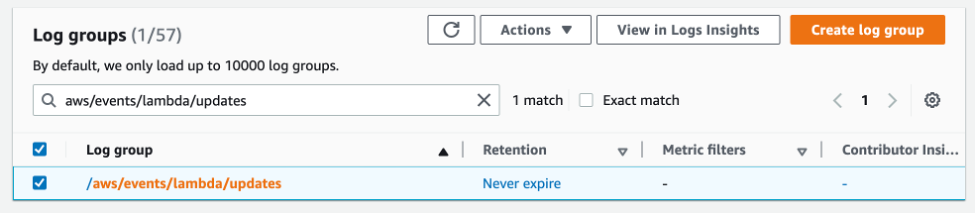
    Log group


  3. Choose the log group (/aws/events/lambda/updates).

    Selected log group

  4. Select the most recent log stream.

    Recent log stream

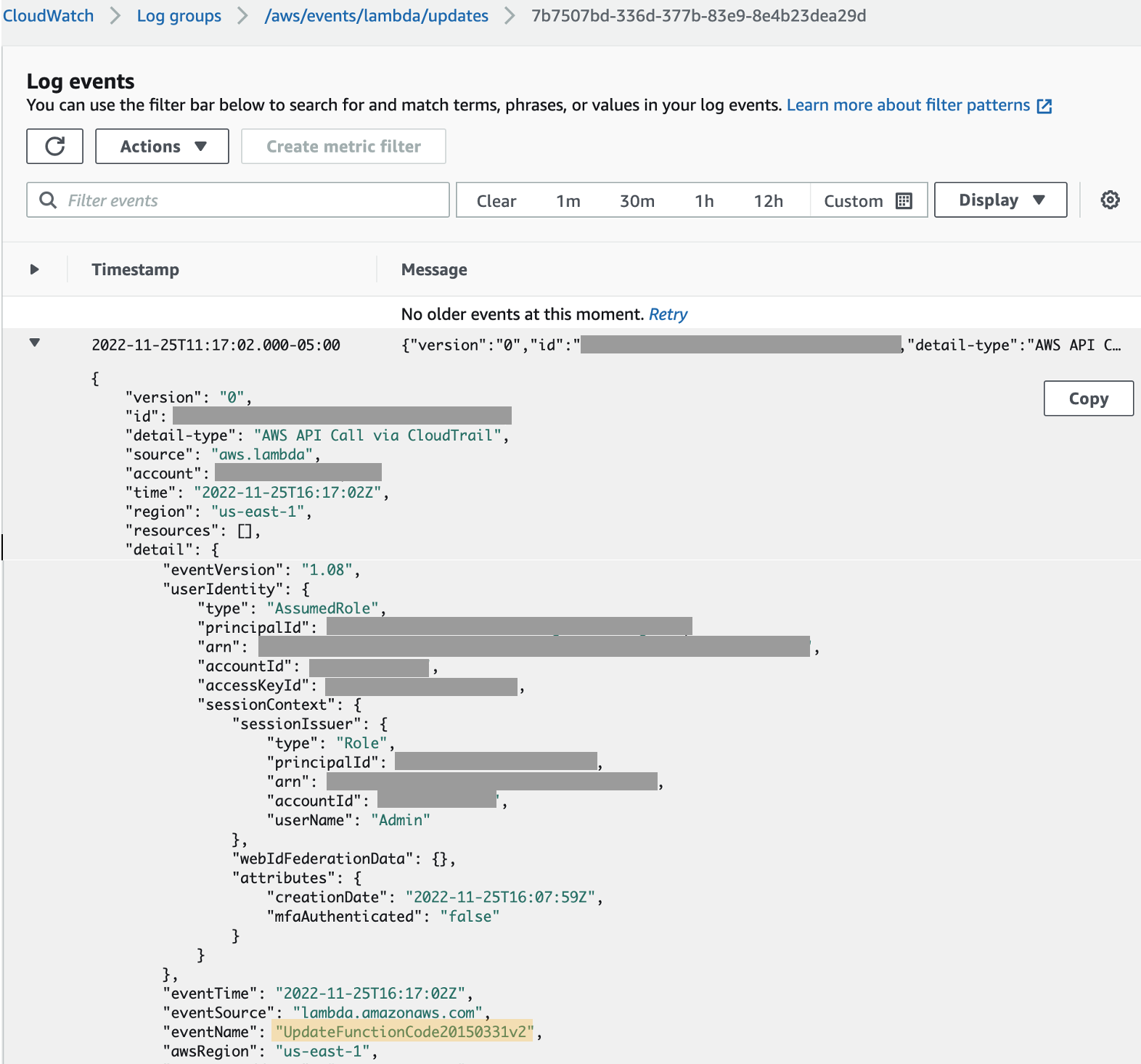
  5. If the EventBridge rule is successful, the Lambda code update event is visible. To see the JSON from the event, expand the event with the arrows to the left and see the detail field.

    Expanded view of event

Step 2: Recording

To display the Lambda function update data alongside other CloudWatch metrics, convert the log event into a metric using metric filters. A metric filter is created on a log group. If a log event matches a metric filter, a metric data point is created.

A metric filter uses a filter pattern to match on specific fields in the JSON event. In this case, the filter pattern matches on the eventName starting with UpdateFunctionCode (note the star as a wildcard).

{ $.detail.eventName=UpdateFunctionCode* }

Create a metric filter with the following:

  • Metric namespace: LambdaEvents
  • Metric name: UpdateFunction
  • Metric value: 1
  • Dimensions: DimensionName: FunctionName; Dimension Value: $.detail.responseElements.functionName

Dimensions allow metadata to be added to metrics. Setting a dimension with the JSON path to $.detail.responseElements.functionName allows the FunctionName value to come from the data in the log event. This makes this a generic metric filter for any Lambda function.

The event pattern of a metric filter can be tested on real data in the Test pattern section. Choose the log stream to test the filter on by using the Select log data drop down and selecting Test pattern. This shows a table with the matched events and the field value.

The CloudWatch console provides a view of the metrics for Lambda functions. To see the metric data, update the code for a Lambda function and navigate to the CloudWatch console. Choose Metrics > All metrics from the left menu, the Custom namespace of LambdaEvents, and dimension of FunctionName (as set in the preceding metric filter). To see the data on the chart, check the box beside the metric of interest. The metric can be added to a CloudWatch dashboard under the Actions menu.

Metric filters only create metrics when a new log event is ingested. You must wait for a new log event to see the metrics.

Step 3: Visualizing

A CloudWatch dashboard enables the visualization of metric data and creation of customized views. The dashboard can contain multiple widgets with data from metrics, logs, and alarms.

The following dashboard shows an example of visualizing Lambda code updates alongside other performance data. There is no single visualization that is right for everyone. The data added to the dashboard depends on the questions and actions the business wants to take. This data can be varied and include performance data, KPIs, and user experience.

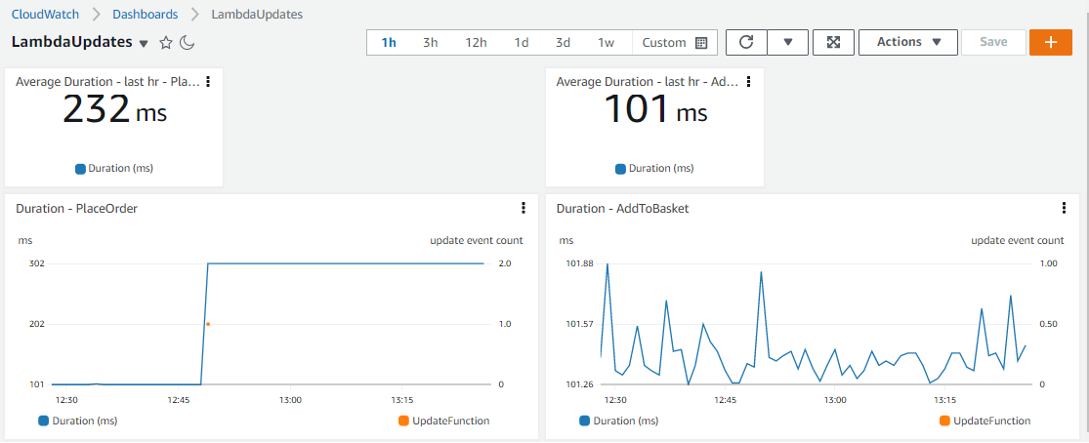
The dashboard displays data on Lambda function code updates and Lambda performance (duration). A metric line widget shows a time chart of Lambda function duration with the update Lambda code metric data. Duration is a performance metric that is provided for all Lambda functions. Read more in Working with Lambda Function metrics.

A CloudWatch dashboard showing visualization of Lambda update code events alongside Lambda function durations for two functions. The duration is shown as an average value for the last hour and a time chart.

This screenshot shows the Lambda function duration for two different functions: PlaceOrder and AddToBasket. The duration for each function is represented in two ways:

  • A single number showing the average duration in the last hour.
  • A chart of the duration over time.

The Lambda function update event is shown on the duration time chart as an orange dot. The different views of duration show a high-level value and the detailed behavior over time. The detailed behavior is important to understanding the outcome. With only the high-level value, it is difficult to see if an increase in the hourly duration results from a short-term increase in duration, an upward trend, or a step change in behavior.

What is clear from this dashboard is that immediately following an update to the Lambda code, the PlaceOrder function duration dramatically increases from an average of ~100ms to ~300ms. This is a step change in behavior. The same deployment does not have the same impact on the duration of the AddToBasket function. While the duration is increasing near the end of the time period, it is less clear that this is because of the deployment. This dashboard provides awareness to the impact of the change at a function level so that the business can decide if the impact is acceptable.

Resources for creating your own dashboard

Conclusion

This blog demonstrates how to create an EventBridge rule and CloudWatch dashboard to visualize the impact of Lambda function code changes on performance data. First, an EventBridge rule is created to capture Lambda function code update events recorded in CloudTrail. EventBridge sends the event to CloudWatch where UpdateFunctionCode events are stored as a metric. The UpdateFunctionCode event data is visualized in a CloudWatch dashboard alongside Lambda performance data. This visibility enables teams to better understand the impact of code changes and make data-driven solutions.

You can modify the concepts in this blog and apply them to a wide variety of use cases. EventBridge can capture AWS CodeCommit and AWS CloudFormation deployments, and send the events to a CloudWatch dashboard to visualize alongside other metrics.

For more serverless learning resources, visit Serverless Land.

Backblaze Adds US East Region, Expanding Location Choices and Cloud Replication Options

Post Syndicated from Tonya Comer original https://www.backblaze.com/blog/backblaze-adds-us-east-region-expanding-location-choices-and-cloud-replication-options/

Customers looking for more local availability and data resilience can get both with the opening of the U.S. East data region, now available to current and future Backblaze users. With an expanded data center footprint, customers can easily store replicated datasets to two or more cloud locations for compliance and continuity. Plus, data egress for Cloud Replication is free, so you can copy data at no expense across the Backblaze platform.

Data Regions Deliver Speed, Security, and Scalability

You can now select the U.S. East data region when you’re storing with Backblaze B2 Cloud Storage to:

  • Achieve redundancy in the cloud. Automatically replicate datasets across North America, whether it’s for compliance, protection from cyberattacks, continuity needs, or to keep data closer to users or customers. (We love a redundant backup plan.)
  • Deliver your data faster. Store data closer to end users to improve latency for primary data sets—especially important if you’re an East Coast-based company.
  • Scale sustainably. Increase or decrease your storage requirements as your business expands—no need to invest in additional hardware. And minimize costs associated with managing a data center, including hardware, software, support, and other costs.

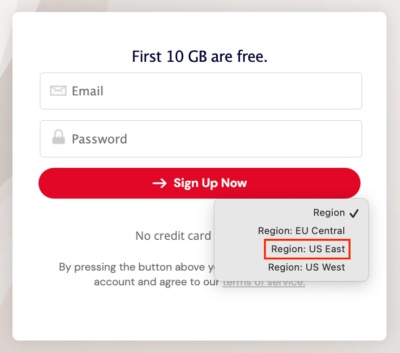
To start storing data in U.S. East today, you can choose “Region: US East” when you create a Backblaze account.

Astonishingly Easy Cloud Replication

Backblaze’s multi-region cloud infrastructure allows you to further take advantage of Cloud Replication to improve reliability, accessibility, and overall fault tolerance. Even better: While other cloud providers charge you to replicate your data, there are no egress fees across the Backblaze platform for Cloud Replication.

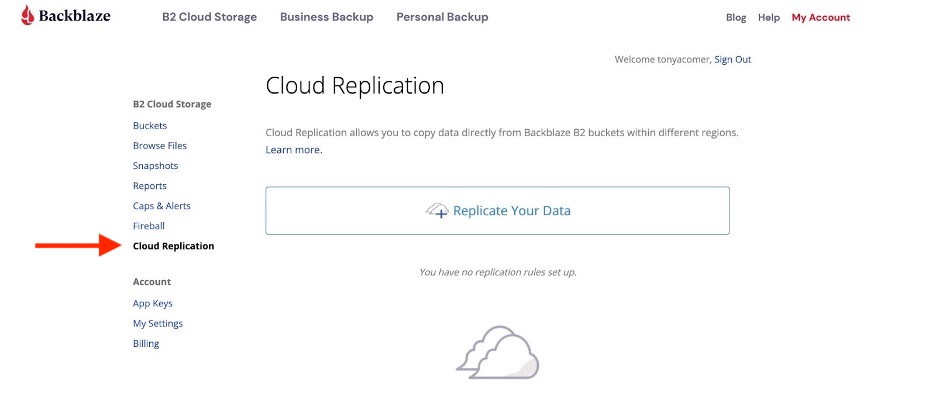
It’s easy to get started. If you’re an existing customer, all you have to do to implement Cloud Replication is to log in to your B2 Storage Cloud account and click on Cloud Replication in the right-hand column. Go to our website for more information, check out our FAQ, and feel free to contact our Support Team if you have any questions.

New Data Region; Same Data Center Standards

Data stored in U.S. East will reside in Backblaze’s newest data center, IAD 1, located in Reston, Virginia. Backblaze has a high standard for our data centers, and this new facility is best-in-class. All Backblaze data centers are SSAE-18/SOC-2 compliant, use biometric security, and have ID checks and area locks that require badge-level access to keep your data safe. In addition to SOC 2 Type 2, this latest data center is ISO 27001, NIST 800-53, and HIPAA compliant.

Cloud Storage That Meets Evolving Needs

The way businesses use and access cloud storage is changing. Rather than relying on local storage, companies are increasingly turning to the cloud to meet their data storage needs, including data protection and redundancy. Opening our U.S. East data region is the next logical step to better serve our customers, now and in the future, as they increasingly adopt cloud-only infrastructures. And for the many customers who continue to store data on-premises, the new region gives them more choices for their backup needs as well.
Look out for Backblaze Evangelist, Andy Klein, to fill you in all the details of our newest data center in an upcoming blog post, and feel free to comment below if you want to know more.

The post Backblaze Adds US East Region, Expanding Location Choices and Cloud Replication Options appeared first on Backblaze Blog | Cloud Storage & Cloud Backup.

How Cloudflare helps protect small businesses

Post Syndicated from Azmina Hashim original https://blog.cloudflare.com/how-cloudflare-helps-protect-small-businesses/

How Cloudflare helps protect small businesses

How Cloudflare helps protect small businesses

Large-scale cyber attacks on enterprises and governments make the headlines, but the impacts of cyberattacks can be felt acutely by small businesses that struggle to keep the lights on during normal times. In this blog, we’ll share new research on how small businesses, including those using our free services, have leveraged Cloudflare services to make their businesses more secure and resistant to disruption, along with a real story about how Cloudflare makes a tangible impact for small business customers.

Research has indicated that 43% of cyber attacks target small businesses [Source: Institute for Security and Technology, Blueprint for Ransomware Defense, 2022]. Small businesses face many of the same cybersecurity challenges as larger organizations, but with fewer resources to plan, design, and manage their IT systems and security protections. Most small businesses say they don’t have the personnel to address IT security adequately or appropriately [Source: Ponemon Institute, 2018 State of Cybersecurity in Small & Medium Size Businesses].

Your local florist, fitness studio, café, or pet shop is likely using a wide variety of cloud-based SaaS apps to stay open for customers, including online accounting software, booking systems, point-of-sale credit card readers, inventory management systems, content management systems, and cloud email providers. Each of these systems can be compromised and used to launch an attack. As the global pandemic showed us, small businesses operate with tight margins and very little room for any sort of disruption to daily operations.

While larger enterprises may be able to absorb the temporary loss of revenue from a system outage or a ransomware attack, small business owners can quickly find themselves headed for disaster after just a short period of degraded service quality or system outages. Without a full time security operations center at their disposal or even a dedicated IT staff to focus attention on security issues, small business owners might feel powerless to predict, stop, or mitigate any cyber attacks that could affect their bottom lines and, more worryingly, their livelihoods.

At Cloudflare, our mission is to help build a better Internet. We believe the Internet should be open and free, and that all Internet properties, no matter how small, should be safe, secure, and fast. We believe that every website should have access to the best security and performance available, whether that website belongs to a large multinational corporation, a local non-profit organization, a global human rights advocacy group, an institution of higher learning, or a clothing boutique with a single location in a small town. And most importantly, we believe that everyone on the Internet deserves protection against cyber attacks, even if they use a Free plan and don’t spend any money with Cloudflare.

Small business users

We identified over 94,000 small customers using at least one Cloudflare service, such as small businesses. What do some of these small customers look like? One is a small clothing and apparel company based in Central Europe. Another is a popular coffee shop in Southeast Asia. The largest group of small customers (around 30%) are located in the United States, though they are present across North America, Europe, South America, Australia, and Asia.

Location Small Business Accounts*
United States 28,558
United Kingdom 6,952
Australia 3,454
Canada 3,444
Germany 3,024
Brazil 2,822
China 2,777
India 2,214
France 1,793
Vietnam 1,666

*Small Customer Accounts Top Ten Locations

In 2022, these small businesses and organizations were responsible for over seven billion cached requests per day. We identified over 38,000 Layer 3 DDoS attacks that Cloudflare helped mitigate for small customers in 2022. For small businesses, stopping a cyber attack means keeping their doors open – and potentially keeping their businesses afloat.

Location Layer 3 attacks on small business customers
United States 18,738
United Kingdom 7,366
China 6,576
Germany 5,423
Canada 2,517
Australia 2,374
Brazil 1,871
Hong Kong 3,365
Russia 4,579
Taiwan 1,666

Free plan users

What about the users on Free plans? As of December 2022, we identified 4.2 million Cloudflare accounts using only services available in our Free plan – representing a 40% increase year-over-year from 2021. Together, these Free plan customers were responsible for roughly 70 trillion requests over the Cloudflare network in 2022 – a value of $7 million of content delivery network services that they received at no cost. Many of our Free plan users are also leveraging Cloudflare Access for free, with over two million free Access seats currently in use.

With so many Free plan users, it can be challenging to know what impact these aggregate numbers have on the individuals who run these accounts. That’s why we were pleased to speak with a user on a Free plan who shared their story.

Customer story

A small local hosting company in the southern United States has the responsibility to protect the websites they host, which all belong to small local businesses – the florists, bakeries, and pet shops who are spending their time and resources supporting the local community and who cannot afford to experience downtime from a cyber attack. Some of these websites have e-commerce capabilities, while others contain WordPress sites. Other properties have some level of customized development in need of protection from SQL injections, spoofing, bot scraping attacks, and other malicious activities. While these small business websites are not being specifically targeted by cyber attackers (and instead experience broad, less focused attacks on a wide range of IP addresses) they suffer the same consequences of reduced performance, downtime, and business disruption as larger properties would.

To help mitigate these consequences, the hosting provider uses our free WAF Managed Ruleset and Bot Fight Mode capabilities to protect customer properties. Cloudflare offers another layer of protection and peace of mind for the websites of small businesses to remain operational. By using Cloudflare’s free services, the hosting provider has significantly reduced the large volumes of malicious traffic coming in from overseas IPs. Since the businesses are small and local, any traffic coming from outside the country is unlikely to be a local customer and clearly is not there to transact with the local businesses.

This hosting provider said that their use of Cloudflare had also cut down on their bandwidth egress fees by $100 per month. That may not seem like much from the perspective of a large enterprise – but it adds up quickly for a smaller company. By caching requests through Cloudflare’s network, the provider also reduces server load, so they have more capacity to handle attacks. Most importantly, the hosting provider finds Cloudflare intuitive to deploy and use, and straightforward to customize for the specific needs of the small business websites that need protection.

We closed our conversation with one final thought: “I can’t believe you’re doing this for free!”

No business of any size should have to face cyber attacks alone, whether they are a paying customer or not. Cloudflare is trusted by millions of Internet properties, from the largest global companies to your corner grocery store. Getting started with Cloudflare is simple, fast, and straightforward. You can sign up for a Free plan in minutes to get the tools you need to secure and accelerate your web presence and keep your small business thriving.

Project Safekeeping – protecting the world’s most vulnerable infrastructure with Zero Trust

Post Syndicated from Carly Ramsey original https://blog.cloudflare.com/project-safekeeping/

Project Safekeeping – protecting the world’s most vulnerable infrastructure with Zero Trust

Project Safekeeping – protecting the world’s most vulnerable infrastructure with Zero Trust

Under-resourced organizations that are vital to the basic functioning of our global communities face relentless cyber attacks, threatening basic needs for health, safety and security.

Cloudflare’s mission is to help make a better Internet. Starting December 13, 2022, we will help support these vulnerable infrastructure by providing our enterprise-level Zero Trust cybersecurity solution to them at no cost, with no time limit.

It is our pleasure to introduce our newest Impact initiative: Project Safekeeping.

Small targets, devastating impacts

Critical infrastructure is an obvious target for cyber attack: by its very definition, these are the organizations and systems that are crucial for the functioning of our society and economy. As such, these organizations cannot have prolonged interruptions in service, or risk having sensitive data exposed.

Our conversations over the past few months with government officials in Australia, Germany, Japan, Portugal, and the United Kingdom show that they are focused on the threat to critical infrastructure, but resource constraints mean that their attention is on protecting large organizations – immense financial institutions, hospital networks, oil pipelines, and airports. Yet, the small critical infrastructure organizations that are the foundation of our communities are also at risk: the neighborhood hospital, water treatment facility, and local energy provider that fulfill our fundamental needs. We tend to ignore the small-yet-vitally-important companies that form the supply chains of our nationwide critical systems.

Unlike large organizations, smaller organizations typically do not have the capacity to manage relentless cyber attacks – usually operating on shoestring budgets, they do not have security personnel, threat insight teams, or the latest technology to keep their organizations secure. The numerous real life examples of cyber attacks against these small but vital organizations best illustrate the devastating impacts: in Japan, ransomware shut down a hospital’s access to patient records for nearly two months, halting the hospital’s ability to accept any new patients, including emergency patients; and in Germany, ransomware compromised a local county’s IT systems and no local public services could be provided to citizens for weeks, while the county is still struggling with the aftermath of the attack one year on.

Project Safekeeping: protecting global vulnerable critical infrastructure with Zero Trust

We at Cloudflare believe in helping to build a better Internet, for everyone. And we think that the welfare of our local communities should not be at risk because of the budget and operational constraints of these small and vulnerable entities. We think that we are particularly well-suited to help: Cloudflare is a global cybersecurity provider that blocked an average of 126 billion cyber threats each day in Q3 2022. And with Project Galileo and the Athenian Project, we have rich experience supporting organizations that are particularly vulnerable to cyber threats and lack the resources to protect themselves.

We want our support to be meaningful in order to allow these entities to focus on what they do best – meeting our communities’ basic needs. As expressed in this blog, Cloudflare provides an innovative and elegant solution to cybersecurity: Zero Trust. Zero Trust is a radical change in the approach to cybersecurity that is both effective and effortless, something that a resource-strapped organization will certainly appreciate.

Earlier this year, in response to the increasing cyber attacks on critical infrastructure stemming from Russia’s invasion of Ukraine, we provided our Zero Trust solution to critical infrastructure in the United States via the Critical Infrastructure Defense Project. Now, we are expanding our support to the global community, initially focusing our efforts in Australia, Japan, Germany, Portugal and the United Kingdom.

Project Safekeeping – protecting the world’s most vulnerable infrastructure with Zero Trust

What Zero Trust services are available?

Depending on their specific needs, eligible entities in these regions will have our enterprise-level Zero Trust cybersecurity services for free and with no time limit – there is no catch and no underlying obligations. Eligible organizations will benefit from the full range of our Zero Trust services:

  • Connecting users to applications: Real-time verification of every user to every protected application in order to protect internal resources and defend against potential data breaches.
  • Filtering traffic: A Secure Web Gateway (SWG) prevents cyber threats and data breaches by filtering unwanted content from web traffic, blocking unauthorized user behavior, and enforcing company security policies.
  • Securing cloud applications: A Cloud Access Security Broker, or CASB, performs several security functions for cloud-hosted services (e.g. SaaS, IaaS, and PaaS applications). Standard CASBs secure confidential data through access control and data loss prevention, reveal shadow IT, and ensure compliance with data privacy regulations.
  • Protecting sensitive data: Data Loss Prevention (DLP) secures your orgnizations’ most sensitive data in transit.
  • Email security: Area 1 preemptively blocks phishing, Business Email Compromise attacks, malware-less fraud, and other incessant attacks coming through email.
  • Safer web browsing: Remote Browser Isolation (RBI) insulates users from untrusted web content and protects data in browser interactions from untrusted users and devices.

In addition to Zero Trust services above, eligible entities will have our world-class application security products – DDOS protection and Web Application Firewall (WAF).

Who can apply?

To be eligible, Project Safekeeping participants must be:

  • Located in Australia, Japan, Germany, Portugal, and the United Kingdom.
  • Considered critical infrastructure by governments in their respective localities.
  • Approximately up to 50 people and/or less than USD $10million in annual revenue/ balance sheet total.

If you think your organization may be eligible, we welcome you to contact us to learn more and apply, please visit: https://www.cloudflare.com/lp/project-safekeeping/.

Project Safekeeping – protecting the world’s most vulnerable infrastructure with Zero Trust

The US government is working on an “Internet for all” plan. We’re on board.

Post Syndicated from Mike Conlow original https://blog.cloudflare.com/internet-for-all-us/

The US government is working on an “Internet for all” plan. We’re on board.

The US government is working on an “Internet for all” plan. We’re on board.

Recently, the United States Department of Commerce announced that all 50 states and every eligible territory had signed on to the “Internet for All” initiative. Internet for All is the US government’s $65 billion initiative to close the Digital Divide once and for all through new broadband deployment and digital equity programs. Cloudflare is on a mission to help build a better Internet, and we support initiatives like this because we want more people using the Internet on high-throughput, low-latency, resilient and affordable Internet connections. It’s been written often since the start of the pandemic because it’s true: it isn’t acceptable that students need to go to a Taco Bell parking lot to do their homework, and a good Internet connection is increasingly important for doing adult jobs as well.

The Internet for All initiative is the result of $65 billion in broadband-related funding appropriated by the US Congress as part of the Infrastructure Investment and Jobs Act (IIJA). It’s been called a “once in a generation” funding opportunity, and compared with the Rural Electrification Act which brought power lines to rural America in the 1930s. The components of the broadband portion of the Infrastructure bill are:

  • \$42.5 billion for broadband deployment – new wires and wireless radios in places that don’t have them – called the Broadband Equity, Access, and Deployment Program (BEAD).
  • \$14.2 billion to make permanent a $30 per month subsidy for low-income families to purchase a home Internet subscription.
  • \$2.75 billion to establish a grant program that will improve digital equity, which means teaching Americans how to make the most of the Internet and their home connection.
  • \$2 billion for new connectivity on tribal lands.
  • \$1 billion to establish new “middle-mile” capacity, which will connect rural communities to the Internet “backbone”.

The US should be applauded for making this kind of investment in broadband infrastructure. By appropriating federal funds, the government is able to ensure the money is used as it’s intended. For example, federal rules will require that areas with no infrastructure and disadvantaged urban areas will receive priority funding. Individual states will have the option of adding their own rules.

There’s significant work to do. According to the latest numbers from the Federal Communications Commission, 12% of Americans lack access to home broadband with throughput of at least 100 Mbps download and 20 Mbps upload.

There’s another way to think about access to broadband. A wire running near your house doesn’t do any good if the residents can’t afford it, or don’t know how to use the Internet. According to Pew Research, 23% of Americans say they don’t have an Internet connection at home. Those aren’t just rural areas without broadband infrastructure, it’s also urban areas where the connection is too expensive.

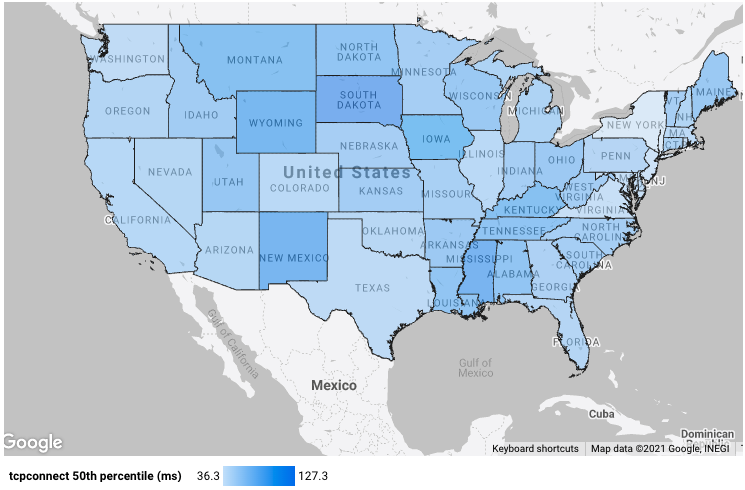
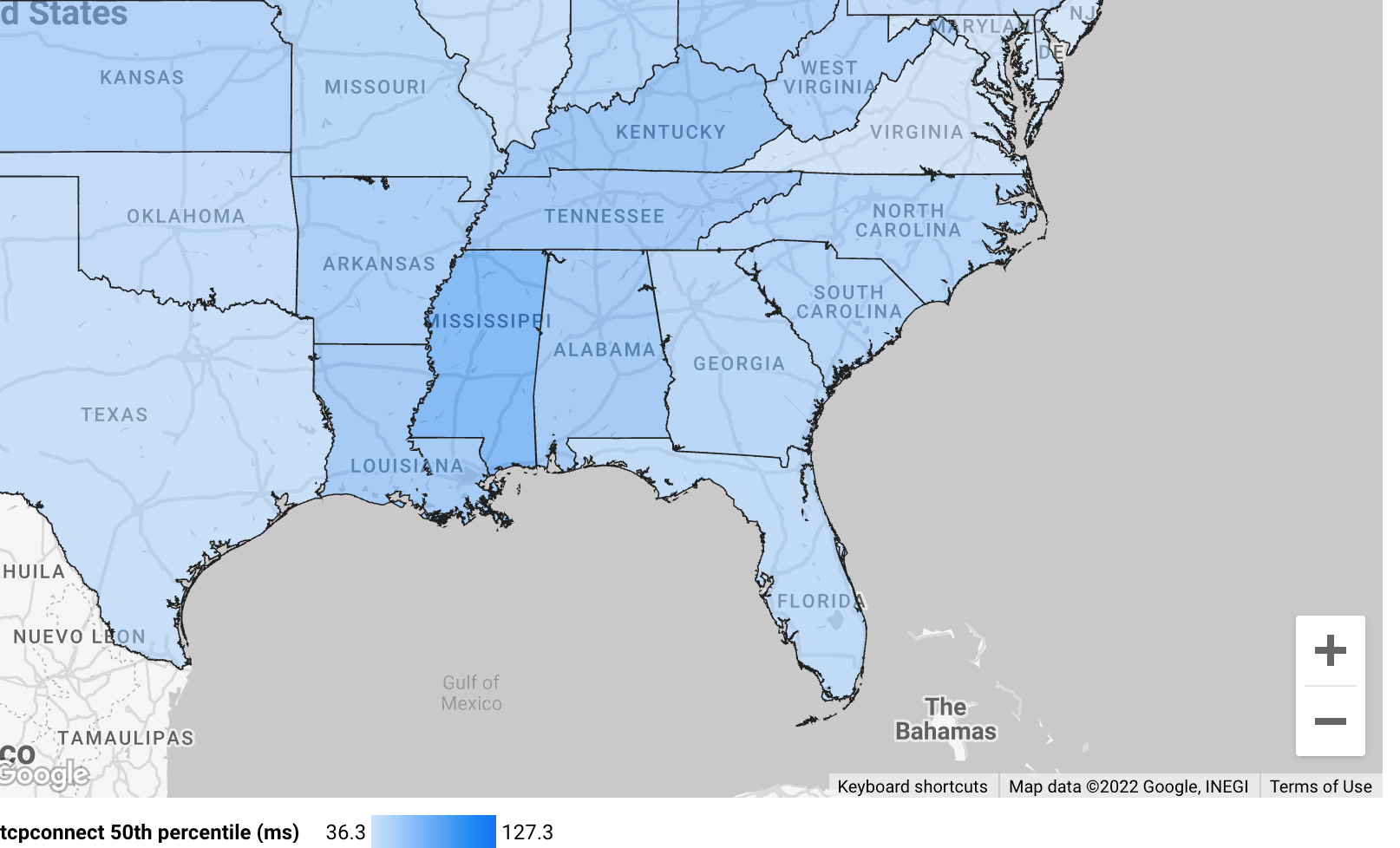
Cloudflare isn’t a disinterested observer. When Internet users don’t have access to good broadband, their experience with our services – the websites, APIs and security products we offer – won’t work as well as they should. In the map below, we use the Resource Timing API to measure the latency between Internet users and the major Content Delivery Networks (CDNs), including Cloudflare. We see rural and southern states have worse performance than the northeastern United States, with Hawaii and Alaska being off the charts in terms of their poor speed.

50th percentile TCP Connect Time (ms) to Major Content Delivery Networks

The US government is working on an “Internet for all” plan. We’re on board.
*Alaska and Hawaii have TCP Connect times of 263 and 160 respectively. 

Access technology, which is how Internet users connect to the Internet (cable, fiber, DSL, wireless, satellite), is one important part of the overall quality of their connection, but there are other, less talked about factors. Another factor is how close geographically the user is to the content and services they are accessing. Midwestern states where requests for data need to travel to Internet hubs in Chicago or Dallas are going to be slower than requests for data from Washington, DC, served by the giant Internet hub around Ashburn, Virginia. To be as close as possible to users geographically, Cloudflare has servers in 51 locations across 28 states in the US, and is still growing.

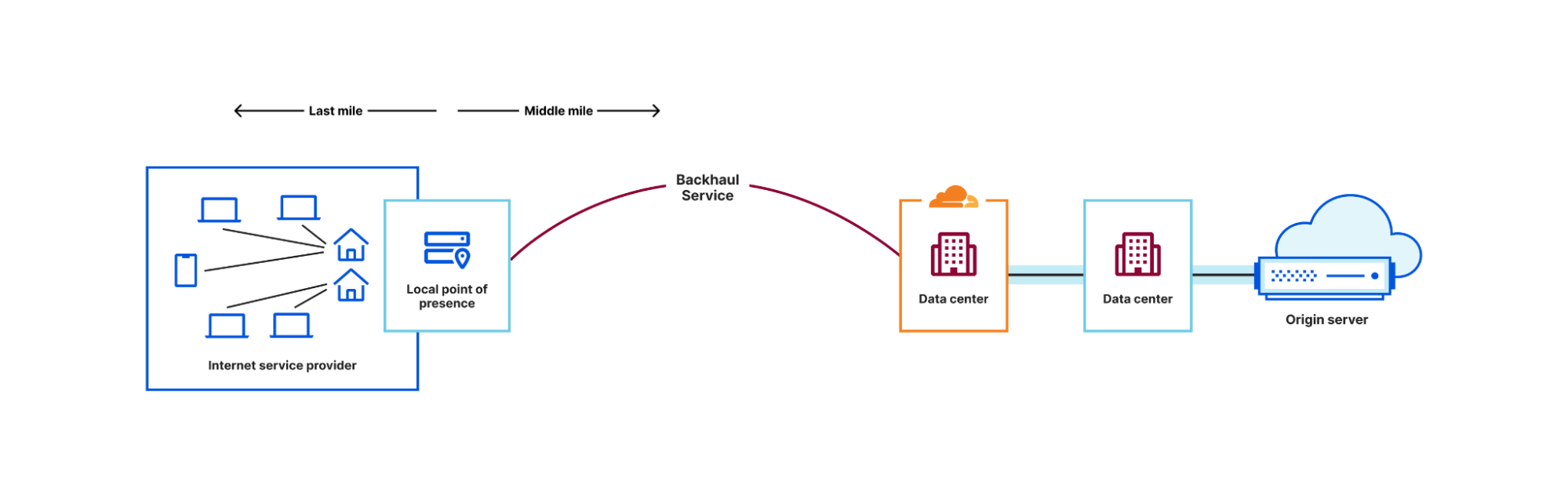
Programs that provide funding for deployment are one piece of the puzzle, but there are important non-financial initiatives as well. For example, the IIJA directed the Federal Communications Commission to come up with “broadband nutrition labels” that will be shown to consumers at the point of purchase for any Internet service. Just a few weeks ago, the FCC announced their implementation. Cloudflare filed comments with the FCC with our suggestions for how to make these labels informative, future-proof, and easy for consumers to understand. We also wrote about it here.

The US government is working on an “Internet for all” plan. We’re on board.

We’d be remiss to not also mention our own contribution to digital divide initiatives – Project Pangea. For community and non-profit networks that have invested in last-mile infrastructure but need a connection to the Internet – “transit” in industry terms – the network can connect to Cloudflare, and we’ll provide that Internet transit at no charge to the network. It’s one piece of the puzzle, and we’re always looking for additional ways to help.

One thing everyone can do is help the FCC build the most accurate broadband map possible by going to the map, entering your address, and verifying the data. The map will show your individual location and all ISPs that claim to serve your address. If there’s a problem – and there can be, it’s a new map and new process – you can file a challenge right from the FCC’s mapping site.

It’s laudable that the US government is stepping up with billions of dollars in funding for broadband networks and digital equity programs. In the shared project of helping build a better Internet, this is an important and big step.

Cloudflare expands Project Pangea to connect and protect (even) more community networks

Post Syndicated from Ben Ritter original https://blog.cloudflare.com/project-pangea-expansion/

Cloudflare expands Project Pangea to connect and protect (even) more community networks

Cloudflare expands Project Pangea to connect and protect (even) more community networks

In July 2021, Cloudflare announced Project Pangea to help underserved community networks get access to the Internet for free. Today, as part of Impact Week, we’re excited to expand this program to support even more communities by relaxing the technical requirements to participate.

Previously, in order to be eligible for Project Pangea, participants would need to bring at least a /24 block of IP space for Cloudflare to advertise on their behalf (referred to as “Bring Your Own IP”). But everyone should have secure, fast, and reliable access to the Internet, without being gated by costly network resources like IPv4 space. Starting now, participants no longer need to bring a /24 in order to access Pangea services: Internet connectivity, DDoS protection, network firewalling, traffic acceleration, and more, are available for free for eligible networks.

How is Project Pangea helping community networks?

The Internet Society, or ISOC, describes community networks as “when people come together to build and maintain the necessary infrastructure for Internet connection.” Most often, community networks emerge from need, and in response to the lack or absence of available Internet connectivity.

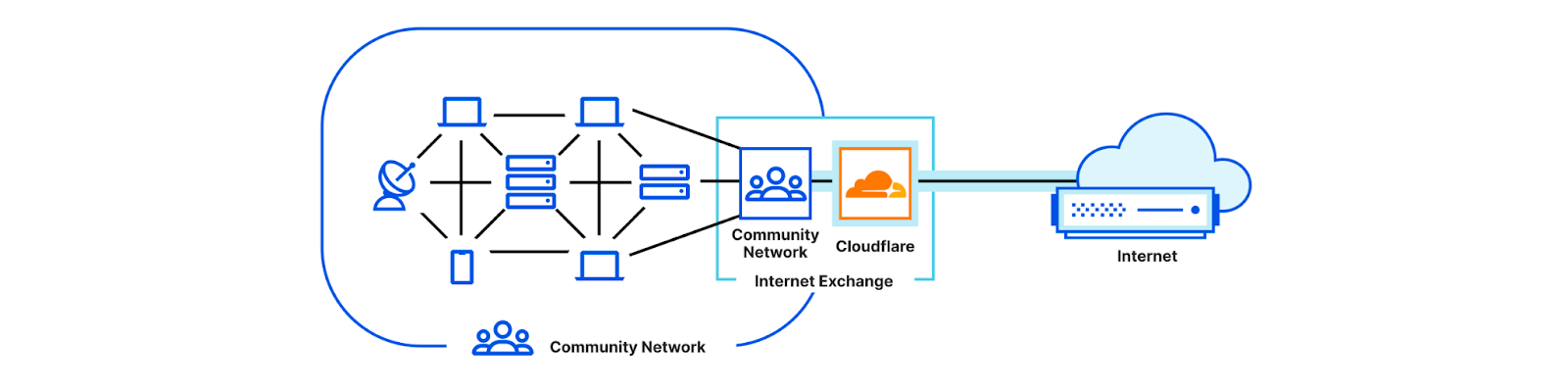
Cloudflare’s global network, which spans more than 275 cities across the world, provides us with the unique opportunity to help community networks of all shapes and sizes. Cloudflare offers community networks secure, fast, and reliable Internet access through Magic Transit, and frees up time for community network operators by mitigating malicious traffic. This empowers operators to focus more on managing the last mile connections to network users.

By placing a community network behind Cloudflare with Magic Transit, those networks are automatically protected against Distributed Denial of Service attacks which often overwhelm network and security devices, or undersized Internet connections. Beyond mitigating DDoS attacks, Cloudflare also offers Magic Firewall through Project Pangea. Magic Firewall is a firewall as a service, and enables operators to remove physical firewalls and still enforce network level firewall rules. Implementing Magic Firewall in place of a physical firewall removes a single point of failure, and another device which needs to be upgraded during a maintenance window.

As community networks grow to support more users, the bandwidth required and the exposure to attack traffic also grows. One challenge with growing a network and providing security is that on premise firewalls need to be replaced or upgraded when they hit specific bandwidth limitations. The security appliance is often an expensive bottleneck to upgrade, preventing networks from helping more users. One unique benefit to using Cloudflare for network connectivity is that unlike an on premise network firewall, operators never need to upgrade Cloudflare. Incoming traffic is distributed across hundreds of locations, allowing Cloudflare to provide security services, and block attacks across the whole Cloudflare network.

Cloudflare expands Project Pangea to connect and protect (even) more community networks
One of several possible deployment models Pangea participants can use to get connected

Pangea participant highlight: Ayva Networks

Ayva Networks is a not-for-profit Wireless Internet Service Provider that provides backbone and Internet services to approximately 400 households in the rural mountain areas west of Boulder, Colorado. In 2023, they will grow their network to provide more gigabit network access. Nick Wilson from Ayva Networks explains that “reliable Internet in our community isn’t a privilege, it’s an essential utility, and often provides the only means of communication for many homes in our region as cellular service is generally rare.

After connecting through Magic Transit, Nick shared “speeds are noticeably better on Magic Transit, especially for those who work with cloud resources” and that “our firewalls deal with a lot less background noise” due to all the attack traffic mitigated by Cloudflare.

Colorado’s environment can be pretty extreme, and present many challenges to running a Wireless Internet Service Provider. Ayva Networks responds to 100+ mph wind, massive hail, blizzards, flooding, insects, lightning, and fire. By using Magic Transit, Ayva Networks is better able “to engineer traffic flows much more granularly than we otherwise are able to with BGP alone, and has become an essential tool for us in mitigating and responding to outages.

What have we learned since launching Project Pangea?

We’ve been privileged to help a lot of great organizations like Ayva Networks connect more people to the Internet. Many community networks are passion projects, and are run by volunteers who want to make a difference in their community. Volunteers often only have limited time to contribute, and this has emphasized how simple we need to make it for organizations of any size to get up and running behind Cloudflare.

Another challenge we did not foresee is that many community networks do not have their own network IP address space. IP addresses are needed by all computers to communicate on the Internet. Until today, Magic Transit and Magic Firewall required that community networks provide their own IP addresses. We recently extended Magic Transit to support customers without their own IP address space with Magic Transit with Cloudflare IPs, and we’re excited to bring this functionality to community networks via Project Pangea.

How can my community network get involved?

Check out our landing page to learn more and apply for Project Pangea today.

The Montgomery, Alabama Internet Exchange is making the Internet faster. We’re happy to be there.

Post Syndicated from Mike Conlow original https://blog.cloudflare.com/montgomery-alabama-ix/

The Montgomery, Alabama Internet Exchange is making the Internet faster. We’re happy to be there.

The Montgomery, Alabama Internet Exchange is making the Internet faster. We’re happy to be there.

Part of the magic of the Internet is in tens of thousands of networks connecting to each other all across the world in an effort to share information more efficiently. Cloudflare is a member of 279 Internet Exchanges (IX for short), but today we want to highlight one such dot on the global Internet map: the Montgomery, Alabama Internet Exchange, called MGMix. Thanks to the hard work of local leaders and the participation of dozens of networks (including Cloudflare), the Internet in Alabama works better today than it did before the IX launched.

Understanding IXs

Before we talk more about Alabama in particular, let’s take a step back to understand the critical role that Internet Exchanges play in our global Internet. In a simple model of exchanging Internet traffic, one person is on their laptop and requests content on a website, uses a video conferencing application, or wants to securely connect to their workplace from home. The person, or “client” in technical terms, is generally using a traditional Internet Service Provider, who they pay to access everything on the Internet. On the other hand, whatever the user is trying to reach – the website, API endpoint, or security service – or “server” in technical terms, is usually on a different network. How the data gets from the client’s network to the server’s network is not something Internet users think much about, but at Cloudflare, we think about it a lot.

One way that a network can reach another network is by paying a 3rd party network to deliver the traffic. This is called “transit” and it’s an appealing option because it’s simple. One “Tier 1” transit provider can reach the entire Internet. Of course, the tradeoff is that convenience comes at a cost – networks pay transit providers based on the quantity of traffic passed over the connection.

At the other end, larger networks often connect directly with what are called Private Network Interconnections (PNI). If one network is consistently sending large volumes of traffic to another network, it will be less expensive to use a PNI than to send the traffic over a transit provider. In this case, the two networks string a fiber cable across the ceiling of a data center where both networks have a presence, from one network’s cage to the other’s.

The Montgomery, Alabama Internet Exchange is making the Internet faster. We’re happy to be there.

Right in the Goldilocks zone between transit providers and PNIs are Internet Exchanges. An IX brings networks together in one place, and lets them freely exchange traffic. Sometimes they’re literally called “meeting rooms”. Once a network joins an IX, they might be able to reach hundreds of other networks without incurring 3rd party transit fees. Thriving IX communities are a power-up for the Internet: they reduce the cost of delivering Internet traffic, incentivizing more networks to join, while making the Internet faster through better interconnection.

Montgomery Internet Exchange (MGMix)

Back to Alabama. Unfortunately, Alabama, and the “Deep South” in general, has some of the worst performing Internet in the country. In Alabama, 15% of locations don’t have access to home Internet with download throughput of 25 Mbps and 3 Mbps upload according to the latest FCC data. In Mississippi, it’s 20%. The national average is 7%. In terms of latency, which is how we measure the speed of the Internet, the Deep South is also well above average.

50th percentile TCP Connect Time (ms) to Major Content Delivery Networks

The Montgomery, Alabama Internet Exchange is making the Internet faster. We’re happy to be there.

One of the reasons for the poor performance is that requests for content often travel to Atlanta, Dallas, or other Internet hubs even farther away before coming all the way back to the user in Alabama or Mississippi. That’s why an IX in Montgomery is so exciting: if networks can exchange traffic in Montgomery, the data doesn’t need to travel as far, and the Internet will be faster.

A few years ago, local leaders in Montgomery started to build up the Montgomery Internet Exchange (MGMix). With the support of the mayor, and the help of city staff, and a cooperative that included the city, county, state, and a nearby Air Force base, they launched the IX in 2016.  Later they formed a technical committee and upgraded to 100 Gbps of capacity.

With a donated switch from Packet Clearing House, MGMix estimated their initial costs at $1,000 per month for data center space and connection to the Internet. At their core, an IX is just a Layer 2 switch where all the networks plug in and advertise their presence to each other. That’s not to say it’s easy. One of the hardest parts is the work to attract networks.

IX’s have a hard chicken-and-egg problem. The first network at an IX doesn’t have anyone to exchange traffic with. Conversely, once there are a lot of networks at an IX, it becomes easy to attract new ones. Additionally, networks like Cloudflare need certain types of networks – transits – to be present. In almost all cases, Cloudflare doesn’t actually host the website or service an Internet user is trying to reach; we protect them, but aren’t the original source. To get content from the original source, we need access to transit networks. The City of Montgomery did the hard work of building up the IX network by network.

MGMix now has a who’s-who of the Internet in Alabama as members. Some are ISPs like Charter, Wide Open West, Uniti Fiber, and Troy Cablevision. Some are big institutions like the State of Alabama, Alabama State University, the City of Montgomery. And still others are the providers of content and services, like Cloudflare, Meta, and Akamai.

From Cloudflare’s perspective, it was an easy decision to join MGMix. We followed the development closely, and joined soon after it opened. After all, it means better Internet performance for a group of southern states that have been historically underserved. Now that it’s established, it’s essentially maintenance-free. It’s set-it-and-forget-it for better Internet performance.

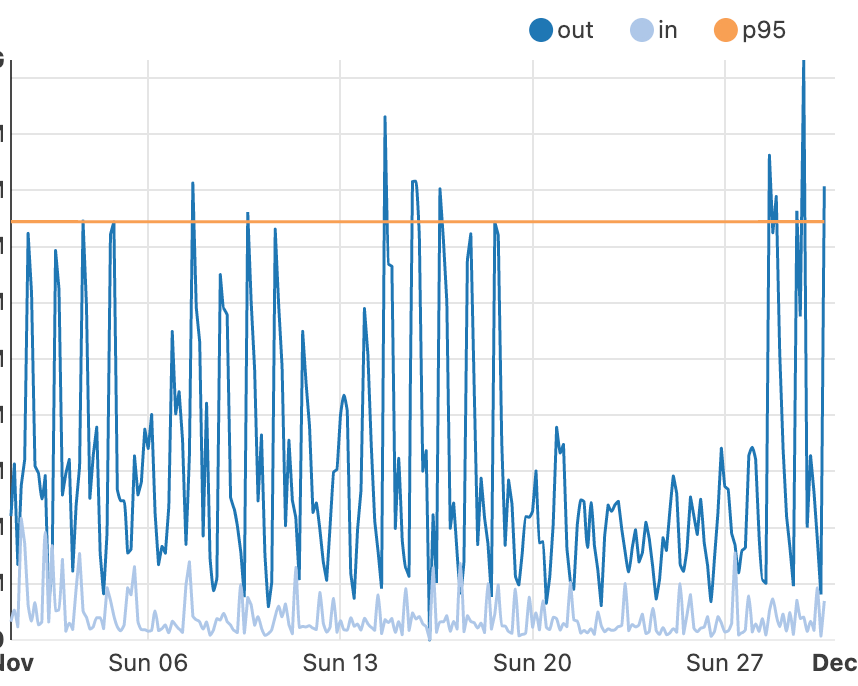
Below is a chart of our traffic through MGMix over the course of November. We see daily spikes in traffic outbound from Cloudflare to other networks that are members of the IX. Interestingly, the traffic is lower from the 20th of November through the 27th of November which is the week of Thanksgiving in the US. It looks like Internet users in Alabama were enjoying a restful week with their families and not using the Internet (as much as usual).

The Montgomery, Alabama Internet Exchange is making the Internet faster. We’re happy to be there.

It has apparently been going so well that MGMix just announced they’re expanding to Auburn, Alabama.

Steven Reed, the current mayor of Montgomery, said of the expansion: “This is a step forward to achieving digital equity across the region, benefiting individuals who live in underserved rural communities. By extending our network fabric to a datacenter in Auburn, the MGMix will improve the efficiency and resiliency of the Internet for the Montgomery area, colleges and businesses along the I-85 corridor, and the entire River Region.

We couldn’t have said it better. IXs are a critical part of a strong Internet interconnection ecosystem. We’re proud members of the MGMix, and will continue to join IXs globally where we can reach Internet users more efficiently and effectively.

Miller: Upcoming releases and more fun stuff

Post Syndicated from original https://lwn.net/Articles/917758/

Bugzilla project lead Dave Miller has posted a plan for several upcoming releases of the bug-tracking tool. The post starts with: “Surprise! Bugzilla’s not dead yet. 🙂“. It is, in effect, an update to his August posting to the Bugzilla developers mailing list. In the new post, he outlines the plan for releases of multiple branches, lists specific areas where help is needed, and describes some project infrastructure improvements.

I would like to put out a new multi-branch release of Bugzilla as soon as we can get all the pieces in place to do so. I was hoping to do this within a few weeks of the original post to the developers list, but that was back in August and it hasn’t happened yet. At this point I think we’ll be really lucky if it happens before the end of December; though mid-January is definitely a possibility. As a forewarning to everyone, there will be security content in it, and that’s part of the holdup.

Bivol on the world map of investigative media Bivol is now part of the Global Investigative Journalism Network

Post Syndicated from Николай Марченко original https://bivol.bg/bivol-is-now-part-of-the-global-investigative-journalism-network.html

вторник 13 декември 2022


Bivol has now been welcomed into the world’s largest family of investigative reporters and journalism nonprofits – the Global Investigative Jourmalism Network (GIJN). Joining GIJN is a great and unequivocal…

Obligatory ChatGPT Post

Post Syndicated from Bruce Schneier original https://www.schneier.com/blog/archives/2022/12/obligatory-chatgpt-post.html

Seems like absolutely everyone everywhere is playing with Chat GPT.

So I did, too….

Write an essay in the style of Bruce Schneier on how ChatGPT will affect cybersecurity.

As with any new technology, the development and deployment of ChatGPT is likely to have a significant impact on the field of cybersecurity. In many ways, ChatGPT and other AI technologies hold great promise for improving the ability of organizations and individuals to defend against cyber threats. At the same time, however, the use of these technologies also raises important questions and concerns about the potential risks and challenges they may pose.

One of the key ways in which ChatGPT is likely to affect cybersecurity is by enabling organizations to more quickly and accurately identify potential security threats. With its ability to analyze vast amounts of data and identify patterns and trends that might be difficult for humans to spot, ChatGPT could be a valuable tool for detecting and responding to cyberattacks. This could be especially useful in the case of complex, coordinated attacks that might otherwise be difficult to identify and defend against.

Another potential benefit of ChatGPT in the realm of cybersecurity is its ability to improve communication and coordination among different organizations and agencies. By enabling these groups to more easily share information and work together to defend against cyber threats, ChatGPT could help to make the overall cybersecurity landscape more effective and efficient. This could be especially important in the case of large-scale attacks that require a coordinated response from multiple organizations.

Of course, as with any new technology, there are also potential risks and challenges associated with the use of ChatGPT in the field of cybersecurity. One key concern is the potential for ChatGPT to be used by malicious actors to conduct cyberattacks. By automating the process of planning and executing attacks, ChatGPT could make it easier for attackers to carry out sophisticated, coordinated attacks at a much faster pace than would be possible without AI. This could potentially make it more difficult for organizations and individuals to defend against such attacks.

Another potential risk is the possibility that ChatGPT could be used to create fake news or propaganda, which could be used to spread misinformation or confusion. In the context of cybersecurity, the spread of false information could potentially lead to confusion and panic, making it more difficult for organizations and individuals to respond effectively to cyber threats. Additionally, the use of ChatGPT to create fake news or propaganda could also undermine trust in information and communications systems, potentially undermining the overall security of these systems.

Overall, the development and deployment of ChatGPT is likely to have a significant impact on the field of cybersecurity. While ChatGPT and other AI technologies hold great promise for improving the ability of organizations and individuals to defend against cyber threats, it is important to carefully consider the potential risks and challenges they may pose, and to take appropriate measures to mitigate these risks. This may include implementing strict security protocols and safeguards to prevent unauthorized access to ChatGPT and other AI systems, as well as ongoing monitoring and evaluation to ensure that these technologies are being used in a safe and responsible manner.

Not bad. I don’t think I can retire, but I probably can go on vacation for a few days. And, of course, it’s going to get better…a lot better…and probably sooner than we expect. This is a big deal.

“Биволъ” – на световната карта на разследващи медии “Биволъ” вече е част от Global Investigative Journalism Network

Post Syndicated from Николай Марченко original https://bivol.bg/%D0%B1%D0%B8%D0%B2%D0%BE%D0%BB%D1%8A-%D0%B2%D0%B5%D1%87%D0%B5-%D0%B5-%D1%87%D0%B0%D1%81%D1%82-%D0%BE%D1%82-global-investigative-journalism-network.html

вторник 13 декември 2022


Сайтът “Биволъ” е приет в най-голямото в света обединение на разследващи репортери, медии и журналистически неправителствени организации – Global Investigative Journalism Network (GIJN). GIJN е регистрирана като неправителствена организация в…

Tis the Season to Be Wary: Three Holiday Shopping Scams To Watch For

Post Syndicated from Marla Rosner original https://blog.rapid7.com/2022/12/13/tis-the-season-to-be-wary-holiday-shopping-scams-to-watch-for/

Tis the Season to Be Wary: Three Holiday Shopping Scams To Watch For

Chestnuts roasting on an open fire, scammers nipping at your bank account… that might not be the carol you were expecting, but unfortunately it’s the frosty truth.

Most everyone has tons of shopping to do in preparation for holidays, whether they’re buying gifts, decorations, or tickets to visit loved ones. And with so many of these transactions happening online, all these shopping sprees add up to a potential goldmine for scammers.

Don’t let those grinches get you down. Fraud might be out in full force, but some simple cyber hygiene is all it takes to stay safe. In the spirit of the holiday season, we’ve made you a list—check it twice, and you’ll find out which online deals are naughty or nice.

1. All They Want for Christmas is Venmo

Not all payment methods are created equal—and scammers know this all too well. So if a seller is insisting you pay for those stocking stuffers with Zelle, gift cards, Dogecoin, or wire transfer, you should probably steer clear.

Peer-to-peer payment apps like Venmo, Zelle, or Cash App are incredibly handy, but they’re designed for paying your friends for your share of brunch, not for sending money to unknown online sellers. These apps offer you little to no recourse in the event of fraud, so stick to using them with close friends and family. No reputable online retailer will request payment through these apps.

Same goes for wire transfers. Wire transfers of money are irreversible, and next to untraceable to boot. So, they’re a popular choice for cybercriminals, and should be a huge red flag for holiday shoppers. Cryptocurrency is the favorite payment method of hackers worldwide for the same reasons; by design, cryptocurrency transactions are anonymous, untrackable, and impossible to reverse.

Gift cards might seem more at home at a lackluster White Elephant party than in a fraudster’s arsenal, but they’re used in online scams with surprising frequency as well. Some scammers offer to accept gift cards as payment—you just need to send them the card number and PIN. But, like all of the other types of payment above, gift cards can’t be tracked and offer no protection to fraud victims, and the fake sellers can quickly and easily convert the gift card’s contents into cash or items.

The bottom line: Stick to credit cards or digital wallets for anything you buy online this December. And of course, be sure to keep a close eye on your statements, so you can alert your credit card company of any transactions you didn’t make.

2. There Might Have Been Some Malware in That New Top Hat You Found

Right about now, online retailers are out in full force advertising their wares over social media and email—and scammers are right there with them. That email you got about a deep discount on PS5s might not actually be from Amazon, and the Instagram ad offering Taylor Swift tickets should definitely be looked at with suspicion. Hackers know all too well that many people are in a hurry to finish up their holiday shopping, or are desperately hunting for a good deal on that perfect gift, and they’re all too ready to take advantage.

Scammers will frequently prop up advertisements or send messages posing as companies you know and trust to get you to let your guard down. The goal, as in all phishing scams, is to get you to click on a link you shouldn’t. Just by clicking, you could be unknowingly downloading malware onto your computer.

Alternatively, these links may send you to a fake online storefront designed to look like a well-known legitimate retailer. These storefronts generally offer popular holiday items or travel fares at irresistible prices. When you make a purchase, the “retailer” might grab your credit card details or other personal information. Or, they might ask for payment in one of the unsecure methods discussed above, and never deliver you the goods.

So, don’t let holiday stress (or an excess of eggnog) get in the way of your better judgment. Be sure to hover over links to check where they actually lead before clicking—or better yet, open up a new tab and navigate to the retailer’s site directly. Make sure you thoroughly vet any seller before making purchases, checking for reviews and feedback. And remember: Any deal that seems too good to be true probably is.

3. Last Christmas, I Gave You My SSN. The Very Next Day, You Stole My Identity

Even if you’ve made all your holiday purchases safely, you’re not out of the woods quite yet. There’s a popular new type of scam on the rise you need to watch out for: fake delivery notifications.

At this time of year, just about everyone is waiting on one package or another, so some scammers send fake texts claiming that your package has been delayed, you missed its delivery, or something along those lines. And, of course, they’ll give you a link to click. Once you do, scammers will often ask for sensitive information—such as your credit card number, SSN, or even just login credentials to an online retailer—so that they can “find” your lost package. Alternatively, they may claim that you owe an extra fee before your package can be delivered.

Luckily, once you’re aware of this scam, it’s also fairly easy to avoid. Take note of tracking information for any online orders you make, so if you get any messages about problems with delivery, you can independently track your package and see what’s really going on. And know that delivery companies like FedEX or UPS will never ask you for sensitive personal information to track a package.

Cyber scams may be coming to town, but that doesn’t mean you have to be a victim. Just a few extra precautions—using safer payment methods, vetting sellers, and avoiding suspicious links—will keep you safe. Deck the halls with good cyber hygiene and make sure you know when those jingle bells should actually be alarm bells.

Coolest Projects Global will be back in 2023

Post Syndicated from Helen Gardner original https://www.raspberrypi.org/blog/coolest-projects-global-will-be-back-in-2023/

Young tech creators, get ready: Coolest Projects Global will be back in 2023 and we want to make this the year of your big idea!

A young person is excited about something on a computer screen.

Coolest Projects Global is the world’s leading online technology showcase for young creators across the world, and we’ll soon be inviting young people to share their creations in the 2023 gallery when project registration opens on 6 February

A group of Coolest Projects participants from all over the world wave their flags.

For young creators, Coolest Projects Global is the unique opportunity to share their big ideas with the whole world. All projects in our open online showcase receive personalised feedback from judges, and all creators get some awesome limited-edition swag too. To bring all the participants together, we’ll host a live-streamed celebration event online on 6 June 2023, where we’ll also reveal the favourite projects of our very special VIP judges.

How does Coolest Projects Global work?

  • Coolest Projects Global is completely free, it’s all online, and it’s open to all digital creators up to age 18 from anywhere in the world. Creators can take part independently or in teams of up to five.
  • Tech creators of all skill levels are encouraged to participate. Coolest Projects is for young people who are beginners, advanced, or anything in between.
  • We love to see works in progress, so projects don’t need to be completed to be registered.
  • Projects can be registered in six categories: Scratch, games, web, mobile apps, hardware, and advanced programming.
  • Creators can choose topics including community, environment, health, fun, art, education, and identity.
  • Judges evaluate projects based on their coolness, complexity, design, usability, and presentation, and give personalised feedback about each project.
  • Project registration opens on 6 February and stays open until 26 April.
  • The livestream event on 6 June will celebrate all the creators’ projects and reveal the judges’ favourites.

Creators who took part in 2022 told us that the coolest thing about Coolest Projects Global is that “so many people around the world get to see and appreciate your projects” and that “anyone can have a go”.

Four young people working together on a tech project.

What makes a coolest project?

Coolest Projects creators make digital tech projects that matter to them and that they want to share with the world. Creators have all different levels of skill — some register their very first coding project, and others have taken part in Coolest Projects for years. We welcome every project from every young person in Coolest Projects. With six project categories from Scratch to hardware, and project topics including environment, health, and fun, creators come up with all kinds of cool ideas.

Two young people working together on a tech project.

Take a look at the online showcase gallery to see the projects young makers shared in the most recent showcase, including an app about recycling, a smiley face game, a trash-collecting boat, and a game to help you eat more healthily

What’s next?

Registration opens on 6 February 2023, and creators can get started on their ideas and make their projects any time.

The post Coolest Projects Global will be back in 2023 appeared first on Raspberry Pi.

AWS Week in Review – December 12, 2022

Post Syndicated from Marcia Villalba original https://aws.amazon.com/blogs/aws/aws-week-in-review-december-12-2022/

This post is part of our Week in Review series. Check back each week for a quick roundup of interesting news and announcements from AWS!

The world is asynchronous, is what Werner Vogels, Amazon CTO, reminded us during his keynote last week at AWS re:Invent. At the beginning of the keynote, he showed us how weird a synchronous world would be and how everything in nature is asynchronous. One example of an event-driven application he showcased during his keynote is Serverlesspresso, a project my team has been working on for the last year. And last week, we announced Serverlesspresso extensions, a new program that lets you contribute to Serverlesspresso and learn how event-driven applications can be extended.

Last Week’s Launches
Here are some launches that got my attention during the previous week.

Amazon SageMaker Studio now supports fine-grained data access control with AWS LakeFormation when accessing data through Amazon EMR. Now, when you connect to EMR clusters to SageMaker Studio notebooks, you can choose what runtime IAM role you want to connect with, and the notebooks will only access data and resources permitted by the attached runtime role.

Amazon Lex has now added support for Arabic, Cantonese, Norwegian, Swedish, Polish, and Finnish. This opens new possibilities to create chat bots and conversational experiences in more languages.

Amazon RDS Proxy now supports creating proxies in Amazon Aurora Global Database primary and secondary Regions. Now, building multi-Region applications with Amazon Aurora is simpler. RDS proxy sits between your application and the database pool and shares established database connections.

Amazon FSx for NetApp ONTAP launched many new features. First, it added the support for Nitro-based encryption of data in transit. It also extended NVMe read cache support to Single-AZ file systems. And it added four new features to ease the use of the service: easily assign a snapshot policy to your volumes, easily create data protection volumes, configure volumes so their tags are automatically copied to the backups, and finally, add or remove VPC route tables for your existing Multi-AZ file systems.

I would also like to mention two launches that happened before re:Invent but were not covered on the News Blog:

Amazon EventBridge Scheduler is a new capability from Amazon EventBridge that allows you to create, run, and manage scheduled tasks at scale. Using this new capability, you can schedule one-time or recurrent tasks across 270 AWS services.

AWS IoT RoboRunner is now generally available. Last year at re:Invent Channy wrote a blog post introducing the preview for this service. IoT RoboRunner is a robotic service that makes it easier to build and deploy applications for fleets of robots working seamlessly together.

For a full list of AWS announcements, be sure to keep an eye on the What’s New at AWS page.

Other AWS News
Some other updates and news that you may have missed:

I would like to recommend this really interesting Amazon Science article about federated learning. This is a framework that allows edge devices to work together to train a global model while keeping customers’ data on-device.

Podcast Charlas Técnicas de AWS – If you understand Spanish, this podcast is for you. Podcast Charlas Técnicas is one of the official AWS podcasts in Spanish, and every other week there is a new episode. Today the final episode for season three launched, and in it, we discussed many of the re:Invent launches. You can listen to all the episodes directly from your favorite podcast app or at AWS Podcasts en español.

AWS open-source news and updates–This is a newsletter curated by my colleague Ricardo to bring you the latest open-source projects, posts, events, and more.

Upcoming AWS Events
Check your calendars and sign up for these AWS events:

AWS Resiliency Hub Activation Day is a half-day technical virtual session to deep dive into the features and functionality of Resiliency Hub. You can register for free here.

AWS re:Invent recaps in your area. During the re:Invent week, we had lots of new announcements, and in the next weeks you can find in your area a recap of all these launches. All the events will be posted on this site, so check it regularly to find an event nearby.

AWS re:Invent keynotes, leadership sessions, and breakout sessions are available on demand. I recommend that you check the playlists and find the talks about your favorite topics in one collection.

That’s all for this week. Check back next Monday for another Week in Review!

— Marcia

Authority to operate (ATO) on AWS Program now available for customers in Spain

Post Syndicated from Greg Herrmann original https://aws.amazon.com/blogs/security/authority-to-operate-on-aws-program-now-available-for-customers-in-spain/

Meeting stringent security and compliance requirements in regulated or public sector environments can be challenging and time consuming, even for organizations with strong technical competencies. To help customers navigate the different requirements and processes, we launched the ATO on AWS Program in June 2019 for US customers. The program involves a community of expert AWS partners to help support and accelerate customers’ ability to meet their security and compliance obligations.

We’re excited to announce that we have now expanded the ATO on AWS Program to Spain. As part of the launch in Spain, we recruited and vetted five partners with a demonstrated competency in helping customers meet Spanish and European Union (EU) regulatory compliance and security requirements, such as the General Data Protection Regulation (GDPR), Esquema Nacional de Seguridad (ENS), and European Banking Authority guidelines.

How Does the ATO on AWS Program support customers?

The primary offering of the ATO on AWS Program is access to a community of vetted, expert partners that specialize in customers’ authorization needs, whether it be architecting, configuring, deploying, or integrating tools and controls. The team also provides direct engagement activities to introduce you to publicly available and no-cost resources, tools, and offerings so you can work to meet your security obligations on AWS. These activities include one-on-one meetings, answering questions, technical workshops (in specific cases), and more.

Who are the partners?

Partners in the ATO on AWS Program go through a rigorous evaluation conducted by a team of AWS Security and Compliance experts. Before acceptance into the program, the partners complete a checklist of criteria and provide detailed evidence that they meet those criteria.

Our initial launch in Spain includes the following five partners that have successfully met the criteria to join the program. Each partner has also achieved the Esquema Nacional de Seguridad certification.

  • ATOS – a global leader in digital transformation, cybersecurity, and cloud and high performance computing. ATOS was ranked #1 in Managed Security Services (MSS) revenue by Gartner in 2021.
  • Indra Sistemas – a global technology and consulting company that provides proprietary solutions for the transport and defense markets. It also offers digital transformation consultancy and information technologies in Spain and Latin America through its affiliate Minsait.
  • NTT Data EMEAL ­– an operational company created from an alliance between everis and NTT DATA EMEAL to support clients in Europe and Latin America. NTT Data EMEAL supports customers through strategic consulting and advisory services, new technologies, applications, infrastructure, IT modernization, and business process outsourcing (BPO).
  • Telefónica Tech – a leading company in digital transformation. Telefónica Tech combines cybersecurity and cloud technologies to help simplify technological environments and build appropriate solutions for customers.
  • T-Systems – a leading service provider for the public sector in Spain. As an AWS Premier Tier Services Partner and Managed Service Provider, T-Systems maintains the Security and Migration Competencies, supporting customers with migration and secure operation of applications.

For a complete list of ATO on AWS Program partners, see the ATO on AWS Partners page.

Engage the ATO on AWS Program

Customers seeking support can engage the ATO on AWS Program and our partners in multiple ways. The best way to reach us is to complete a short, online ATO on AWS Questionnaire so we can learn more about your timeline and goals. If you prefer to engage AWS partners directly, see the complete list of our partners and their contact information at ATO on AWS Partners.

 
If you have feedback about this post, submit comments in the Comments section below. If you have questions about this post, contact AWS Support.

Want more AWS Security news? Follow us on Twitter.

Greg Herrmann

Greg Herrmann

Greg has worked in the security and compliance field for over 18 years, supporting both classified and unclassified workloads for U.S. federal and DoD customers. He has been with AWS for more than 6 years as a Senior Security Partner Strategist for the Security and Compliance Partner Team, working with AWS partners and customers to accelerate security and compliance processes.

Borja Larrumbide

Borja Larrumbide

Borja is a Security Assurance Manager for AWS in Spain and Portugal. Previously, he worked at companies such as Microsoft and BBVA in different roles and sectors. Borja is a seasoned security assurance practitioner with years of experience engaging key stakeholders at national and international levels. His areas of interest include security, privacy, risk management, and compliance.

The collective thoughts of the interwebz