Tag Archives: news

Accelerating CI with AWS CodeBuild: Parallel test execution now available

Post Syndicated from Sébastien Stormacq original https://aws.amazon.com/blogs/aws/accelerating-ci-with-aws-codebuild-parallel-test-execution-now-available/

I’m excited to announce that AWS CodeBuild now supports parallel test execution, so you can run your test suites concurrently and reduce build times significantly.

With the demo project I wrote for this post, the total test time went down from 35 minutes to six minutes, including the time to provision the environments. These two screenshots from the AWS Management Console show the difference.

Sequential execution of the test suite

CodeBuild Parallel Test Results

Parallel execution of the test suite

CodeBuild Parallel Test Results

Very long test times pose a significant challenge when running continuous integration (CI) at scale. As projects grow in complexity and team size, the time required to execute comprehensive test suites can increase dramatically, leading to extended pipeline execution times. This not only delays the delivery of new features and bug fixes, but also hampers developer productivity by forcing them to wait for build results before proceeding with their tasks. I have experienced pipelines that took up to 60 minutes to run, only to fail at the last step, requiring a complete rerun and further delays. These lengthy cycles can erode developer trust in the CI process, contribute to frustration, and ultimately slow down the entire software delivery cycle. Moreover, long-running tests can lead to resource contention, increased costs because of wasted computing power, and reduced overall efficiency of the development process.

With parallel test execution in CodeBuild, you can now run your tests concurrently across multiple build compute environments. This feature implements a sharding approach where each build node independently executes a subset of your test suite. CodeBuild provides environment variables that identify the current node number and the total number of nodes, which are used to determine which tests each node should run. There is no control build node or coordination between nodes at build time—each node operates independently to execute its assigned portion of your tests.

To enable test splitting, configure the batch fanout section in your buildspec.xml, specifying the desired parallelism level and other relevant parameters. Additionally, use the codebuild-tests-run utility in your build step, along with the appropriate test commands and the chosen splitting method.

The tests are split based on the sharding strategy you specify. codebuild-tests-run offers two sharding strategies:

  • Equal-distribution. This strategy sorts test files alphabetically and distributes them in chunks equally across parallel test environments. Changes in the names or quantity of test files might reassign files across shards.
  • Stability. This strategy fixes the distribution of tests across shards by using a consistent hashing algorithm. It maintains existing file-to-shard assignments when new files are added or removed.

CodeBuild supports automatic merging of test reports when running tests in parallel. With automatic test report merging, CodeBuild consolidates tests reports into a single test summary, simplifying result analysis. The merged report includes aggregated pass/fail statuses, test durations, and failure details, reducing the need for manual report processing. You can view the merged results in the CodeBuild console, retrieve them using the AWS Command Line Interface (AWS CLI), or integrate them with other reporting tools to streamline test analysis.

Let’s look at how it works
Let me demonstrate how to implement parallel testing in a project. For this demo, I created a very basic Python project with hundreds of tests. To speed things up, I asked Amazon Q Developer on the command line to create a project and 1,800 test cases. Each test case is in a separate file and takes one second to complete. Running all tests in a sequence requires 30 minutes, excluding the time to provision the environment.

In this demo, I run the test suite on ten compute environments in parallel and measure how long it takes to run the suite.

To do so, I added a buildspec.yml file to my project.

version: 0.2

batch:
  fast-fail: false
  build-fanout:
    parallelism: 10 # ten runtime environments 
    ignore-failure: false

phases:
  install:
    commands:
      - echo 'Installing Python dependencies'
      - dnf install -y python3 python3-pip
      - pip3 install --upgrade pip
      - pip3 install pytest
  build:
    commands:
      - echo 'Running Python Tests'
      - |
         codebuild-tests-run \
          --test-command 'python -m pytest --junitxml=report/test_report.xml' \
          --files-search "codebuild-glob-search 'tests/test_*.py'" \
          --sharding-strategy 'equal-distribution'
  post_build:
    commands:
      - echo "Test execution completed"

reports:
  pytest_reports:
    files:
      - "*.xml"
    base-directory: "report"
    file-format: JUNITXML 

There are three parts to highlight in the YAML file.

First, there’s a build-fanout section under batch. The parallelism command tells CodeBuild how many test environments to run in parallel. The ignore-failure command indicates if failure in any of the fanout build tasks can be ignored.

Second, I use the pre-installed codebuild-tests-run command to run my tests.

This command receives the complete list of test files and decides which of the tests must be run on the current node.

  • Use the sharding-strategy argument to choose between equally distributed or stable distribution as I explain above.
  • Use the files-search argument to pass all the files that are candidates for a run. We recommend to use the provided codebuild-glob-search command for performance reasons, but any file search tool, such as find(1), will work.
  • I pass the actual test command to run on the shard with the test-command argument.

Lastly, the reports section instructs CodeBuild to collect and merge the test reports on each node.

Then, I open the CodeBuild console to create a project and a batch build configuration for this project. There’s nothing new here, so I’ll spare you the details. The documentation has all the details to get you startedParallel testing works on batch builds. Make sure to configure your project to run in batch.

CodeBuild : create a batch build

Now, I’m ready to trigger an execution of the test suite. I can commit new code on my GitHub repository or trigger the build in the console.

CodeBuild : trigger a new build

After a few minutes, I see a status report of the different steps of the build; with a status for each test environment or shard.

CodeBuild: status

When the test is complete, I select the Reports tab to access the merged test reports.

CodeBuild: test reports

The Reports section aggregates all test data from all shards and keeps the history for all builds. I select my most recent build in the Report history section to access the detailed report.

CodeBuild: Test Report

As expected, I can see the aggregated and the individual status for each of my 1,800 test cases. In this demo, they’re all passing, and the report is green.

The 1,800 tests of the demo project take one second each to complete. When I run this test suite sequentially, it took 35 minutes to complete. When I run the test suite in parallel on ten compute environments, it took six minutes to complete, including the time to provision the environments. The parallel run took 17.1 percent of the time of the sequential run. Actual numbers will vary with your projects.

Additional things to know
This new capability is compatible with all testing frameworks. The documentation includes examples for Django, Elixir, Go, Java (Maven), Javascript (Jest), Kotlin, PHPUnit, Pytest, Ruby (Cucumber), and Ruby (RSpec).

For test frameworks that don’t accept space-separated lists, the codebuild-tests-run CLI provides a flexible alternative through the CODEBUILD_CURRENT_SHARD_FILES environment variable. This variable contains a newline-separated list of test file paths for the current build shard. You can use it to adapt to different test framework requirements and format test file names.

You can further customize how tests are split across environments by writing your own sharding script and using the CODEBUILD_BATCH_BUILD_IDENTIFIER environment variable, which is automatically set in each build. You can use this technique to implement framework-specific parallelization or optimization.

Pricing and availability
With parallel test execution, you can now complete your test suites in a fraction of the time previously required, accelerating your development cycle and improving your team’s productivity. The demo project I created to illustrate this post consumes 18.7 percent of the time of a sequential build.

Parallel test execution is available on all three compute modes offered by CodeBuild: on-demand, reserved capacity, and AWS Lambda compute.

This capability is available today in all AWS Regions where CodeBuild is offered, with no additional cost beyond the standard CodeBuild pricing for the compute resources used.

I invite you to try parallel test execution in CodeBuild today. Visit the AWS CodeBuild documentation to learn more and get started with parallelizing your tests.

— seb

PS: Here’s the prompt I used to create the demo application and its test suite: “I’m writing a blog post to announce codebuild parallel testing. Write a very simple python app that has hundreds of tests, each test in a separate test file. Each test takes one second to complete.”


How is the News Blog doing? Take this 1 minute survey!

(This survey is hosted by an external company. AWS handles your information as described in the AWS Privacy Notice. AWS will own the data gathered via this survey and will not share the information collected with survey respondents.)

Firewall support for AWS Amplify hosted sites

Post Syndicated from Sébastien Stormacq original https://aws.amazon.com/blogs/aws/firewall-support-for-aws-amplify-hosted-sites/

Today, we’re announcing the general availability of the AWS WAF integration with AWS Amplify Hosting.

Web application owners are constantly working to protect their applications from a variety of threats. Previously, if you wanted to implement a robust security posture for your Amplify Hosted applications, you needed to create architectures using Amazon CloudFront distributions with AWS WAF protection, which required additional configuration steps, expertise, and management overhead.

With the general availability of AWS WAF in Amplify Hosting, you can now directly attach a web application firewall to your AWS Amplify apps through a one-click integration in the Amplify console or using infrastructure as code (IaC). This integration gives you access to the full range of AWS WAF capabilities including managed rules, which provide protection against common web exploits and vulnerabilities like SQL injection and cross-site scripting (XSS). You can also create your own custom rules based on your specific application needs.

This new capability helps you implement defense-in-depth security strategies for your web applications. You can take advantage of AWS WAF rate-based rules to protect against distributed denial of service (DDoS) attacks by limiting the rate of requests from IP addresses. Additionally, you can implement geo-blocking to restrict access to your applications from specific countries, which is particularly valuable if your service is designed for specific geographic regions.

Let’s see how it works
Setting up AWS WAF protection for your Amplify app is straightforward. From the Amplify console, navigate to your app settings, select the Firewall tab, and choose the predefined rules you want to apply to your configuration. AWS WAF integration in AWS Amplify Hosting

Amplify hosting simplifies configuring firewall rules. You can activate four categories of protection.

  • Amplify-recommended firewall protection – Protect against the most common vulnerabilities found in web applications, block IP addresses from potential threats based on Amazon internal threat intelligence, and protect against malicious actors discovering application vulnerabilities.
  • Restrict access to amplifyapp.com – Restrict access to the default Amplify generated amplifyapp.com domain. This is useful when you add a custom domain to prevent bots and search engines from crawling the domain.
  • Enable IP address protection – Restrict web traffic by allowing or blocking requests from specified IP address ranges.
  • Enable country protection – Restrict access based on specific countries.

Protections enabled through the Amplify console will create an underlying web access control list (ACL) in your AWS account. For fine-grained rulesets, you can use the AWS WAF console rule builder.

After a few minutes, the rules are associated to your app and AWS WAF blocks suspicious requests.

If you want to see AWS WAF in action, you can simulate an attack and monitor it using the AWS WAF request inspection capabilities. For example, you can send a request with an empty User-Agent value. It will trigger a blocking rule in AWS WAF.

Let’s first send a valid request to my app.

curl -v -H "User-Agent: MyUserAgent" https://main.d3sk5bt8rx6f9y.amplifyapp.com/
* Host main.d3sk5bt8rx6f9y.amplifyapp.com:443 was resolved.
...(redacted for brevity)...
> GET / HTTP/2
> Host: main.d3sk5bt8rx6f9y.amplifyapp.com
> Accept: */*
> User-Agent: MyUserAgent
> 
* Request completely sent off
< HTTP/2 200 
< content-type: text/html
< content-length: 0
< date: Mon, 10 Mar 2025 14:45:26 GMT
 

We can observe that the server returned an HTTP 200 (OK) message.

Then, send a request with no value associated to the User-Agent HTTP header.

 curl -v -H "User-Agent: " https://main.d3sk5bt8rx6f9y.amplifyapp.com/ 
* Host main.d3sk5bt8rx6f9y.amplifyapp.com:443 was resolved.
... (redacted for brevity) ...
> GET / HTTP/2
> Host: main.d3sk5bt8rx6f9y.amplifyapp.com
> Accept: */*
> 
* Request completely sent off
< HTTP/2 403 
< server: CloudFront
... (redacted for brevity) ...
<TITLE>ERROR: The request could not be satisfied</TITLE>
</HEAD><BODY>
<H1>403 ERROR</H1>
<H2>The request could not be satisfied.</H2>

We can observe that the server returned an HTTP 403 (Forbidden) message.

AWS WAF provide visibility into request patterns, helping you fine-tune your security settings over time. You can access logs through Amplify Hosting or the AWS WAF console to analyze traffic trends and refine security rules as needed.

AWS WAF integration in AWS Amplify Hosting - Dashboard

Availability and pricing
Firewall support is available in all AWS Regions in which Amplify Hosting operates. This integration falls under an AWS WAF global resource, similar to Amazon CloudFront. Web ACLs can be attached to multiple Amplify Hosting apps, but they must reside in the same Region.

The pricing for this integration follows the standard AWS WAF pricing model, You pay for the AWS WAF resources you use based on the number of web ACLs, rules, and requests. On top of that, AWS Amplify Hosting adds $15/month when you attach a web application firewall to your application. This is prorated by the hour.

This new capability brings enterprise-grade security features to all Amplify Hosting customers, from individual developers to large enterprises. You can now build, host, and protect your web applications within the same service, reducing the complexity of your architecture and streamlining your security management.

To learn more, visit the AWS WAF integration documentation for Amplify or try it directly in the Amplify console.

— seb


How is the News Blog doing? Take this 1 minute survey!

(This survey is hosted by an external company. AWS handles your information as described in the AWS Privacy Notice. AWS will own the data gathered via this survey and will not share the information collected with survey respondents.)

Detailed geographic information for all AWS Regions and Availability Zones is now available

Post Syndicated from Prasad Rao original https://aws.amazon.com/blogs/aws/now-available-geography-information-for-all-aws-regions-and-availability-zones/

Starting today, you can get more granular visibility of geographic location information for AWS Regions and AWS Availability Zones (AZs). This detailed information will help you choose the Regions and AZs that align with your regulatory, compliance, and operational requirements.

We continue to expand the AWS global infrastructure to meet your business requirements and now have 114 AZs across 36 Regions. We have announced plans to add 12 more AZs and four Regions in New Zealand, Kingdom of Saudi Arabia, Taiwan, and the AWS European Sovereign Cloud.

One of the things we’ve learned from our customers is the need to have more visibility into the specific location of infrastructure within an AWS Region. This is important for customers in highly regulated industries such as the financial industry or gaming, where there are specific requirements for the physical placement of infrastructure. For example, FanDuel, a leading sports gaming company based in the U.S., is scaling into new markets across the U.S. and Canada. They are taking advantage of the improved geographic transparency to make more informed decisions and ensure they’re meeting data residency requirements as they scale their business quickly.

Geographies for AWS Regions
To find the geographic information for your Region, you can visit the AWS Global Infrastructure Regions and Availability Zones page. Once you navigate to this page, you can choose any tab on the map and scroll to the bottom to review the geographic information for each Region. See the following image for an example showing the North America Regions. As would be expected, the infrastructure for the US West (Oregon) Region is located in the United States of America, and the Canada (Central) Region is located in Canada.

Geographies for Availability Zones
To find the specific geographic information for an AZ, you can visit the AWS Regions and Availability Zones page in AWS Documentation. Choose the Region you’re interested in and you’ll find a table showing you the geography for that Region. As you see in the following screenshot, the infrastructure of the AZ with AZ ID use1-az1 is located in Virginia, United States of America.

Geographies_AZs

Stay tuned
We will update these pages to reflect new geographic information as we continue to grow our AWS Global infrastructure footprint and add more AWS Regions and AZs.

Quick links
To learn more, visit the AWS Global Infrastructure Regions and Availability Zones page or AWS Regions and Availability Zones in AWS Documentation, and send feedback to AWS re:Post or through your usual AWS Support contacts.

Prasad


How is the News Blog doing? Take this 1 minute survey!

(This survey is hosted by an external company. AWS handles your information as described in the AWS Privacy Notice. AWS will own the data gathered via this survey and will not share the information collected with survey respondents.)

AWS Weekly Roundup: Omdia recognition, Amazon Bedrock RAG evaluation, International Women’s Day events, and more (March 24, 2025)

Post Syndicated from Betty Zheng (郑予彬) original https://aws.amazon.com/blogs/aws/aws-weekly-roundup-omdia-recognition-amazon-bedrock-rag-evaluation-international-womens-day-events-and-more-march-24-2025/

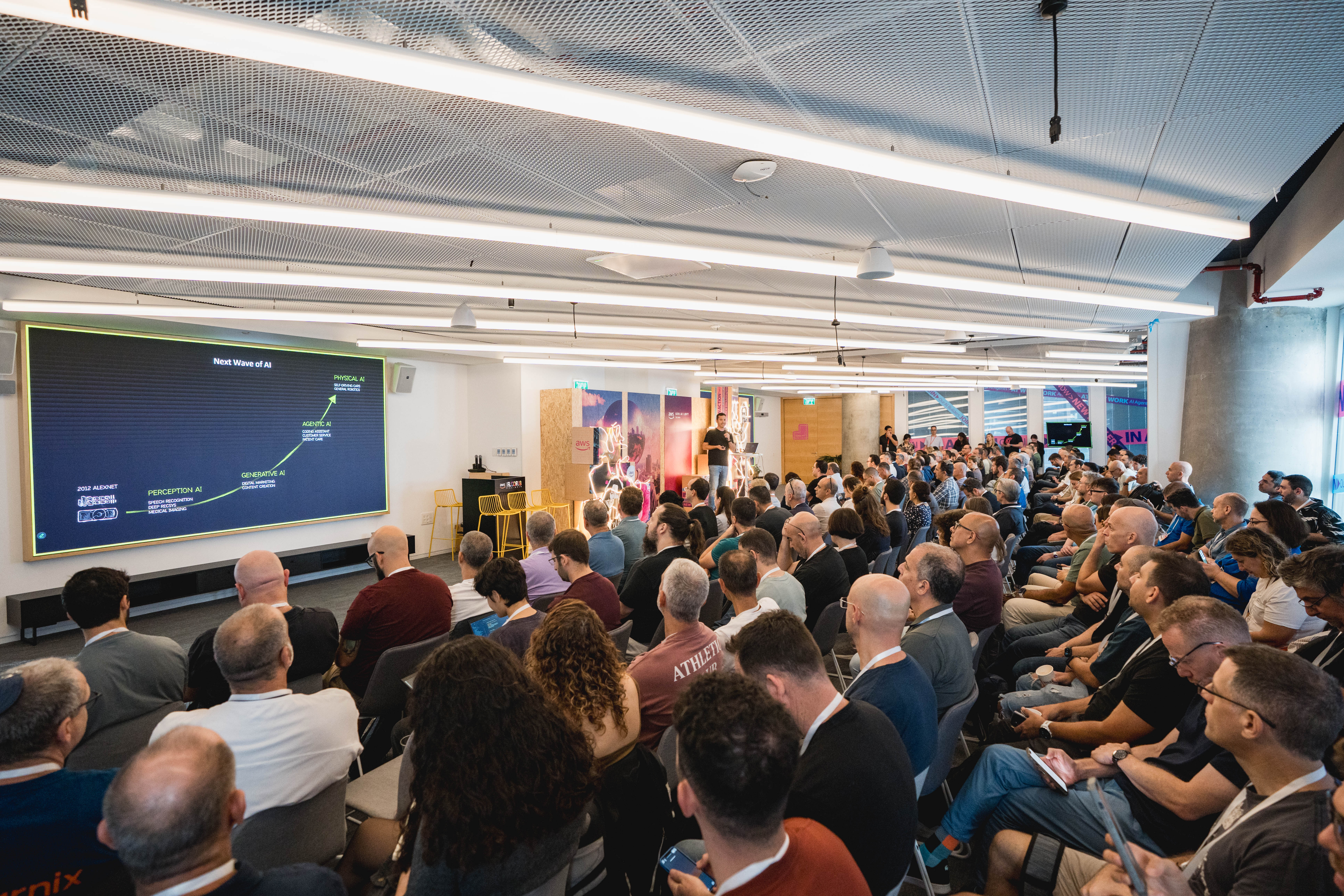
As we celebrate International Women’s Day (IWD) this March, I had the privilege of attending the ‘Women in Tech’ User Group meetup in Shenzhen last weekend. I was inspired to see over 100 women in tech from different industries come together to discuss AI ethics from a female perspective. Together, we explored strategies such as reducing gender bias in AI systems and promoting diverse representation in model training data. In the AWS Cloud Lab, participants used Amazon Bedrock with large language models (LLMs) to generate rose bloom videos, which was the most popular part of this meetup.

These gatherings are crucial to our efforts to engage more women in AI technology exploration and development, and to help make sure that the generative AI era evolves without gender bias. The collaborative spirit and technical curiosity displayed throughout the event is further proof that diverse teams truly build inclusive and effective solutions.

Speaking of vibrant community engagement, I also had the honor of presenting at Kubernetes Community Day (KCD) Beijing 2025 this weekend. The enthusiasm Omdia Universe: Cloud Container Management & Services 2024-25 reportfor container technologies was remarkable, with nearly 300 developers gathering to share experiences and best practices. During my keynote introducing the DoEKS project from Amazon Web Services (AWS), I was struck by the depth of interest in managed Kubernetes services. The audience’s questions revealed how widely adopted services such as Amazon Elastic Kubernetes Service (Amazon EKS) and Amazon Elastic Container Service (Amazon ECS) have become among Chinese developers building mission-critical applications.This strong community interest aligns perfectly with findings from the Omdia Universe: Cloud Container Management & Services 2024–25 report. In this comprehensive evaluation of container management solutions hosted on public clouds, AWS was recognized as a Leader. The report specifically highlights that AWS offers “widest range of options for working with Kubernetes or its own container management service, across cloud, edge, and on-premises environments.” You can read the full report about AWS offerings to learn more about our comprehensive container portfolio and how we’re helping builders deploy scalable, reliable containerized applications.

Last Week’s launches

In addition to the inspiring community events, here are some AWS launches that caught my attention.

Amazon Q Business browser extension gets upgrades – The Amazon Q Business browser extension now features significant enhancements designed to streamline browser-based tasks. Users gain access to their company’s indexed knowledge alongside web content, direct PDF support within the browser, image file attachment capabilities, and controls to remove irrelevant attachments from conversation context. The expanded context window accommodates larger web pages and more detailed prompts, resulting in more helpful responses. For advanced needs, the extension offers seamless transition to the full Amazon Q Business web experience with access to Actions and Amazon Q Apps. Review the Enhancing web browsing with Amazon Q Business in the documentation for detailed setup instructions and feature descriptions to learn more about this announcement.

Amazon Bedrock RAG evaluation is now generally available – Offering comprehensive assessment of both Bedrock Knowledge Bases and custom Retrieval Augmented Generation (RAG) systems through LLM-as-a-judge methodology. The service evaluates retrieval quality and end-to-end generation with metrics for relevance, correctness, and hallucination detection, and the newly added support for custom RAG pipeline evaluations lets you bring your own input-output pairs and retrieved contexts directly into the evaluation job, along with new citation precision metrics and Amazon Bedrock Guardrails integration for more flexible RAG system optimization. To learn more, visit the Amazon Bedrock Evaluations page and What is Amazon Bedrock? in the documentation.

Amazon Nova expands Tool Choice options for Converse API – We’ve enhanced Amazon Nova with expanded Tool Choice capabilities for the Converse API, giving developers more flexibility in building sophisticated AI applications. This update allows models to determine when to use tools to fulfill user requests more effectively. Learn more in the announcement about expands Tool Choice options.

Amazon Bedrock Guardrails adds policy-based enforcement for responsible AI – Our builders can now enforce responsible AI policies at scale with Amazon Bedrock Guardrails’ new AWS Identity and Access Management (IAM) policy-based enforcement capabilities. This feature helps you to specify required guardrails through IAM policies using the bedrock:GuardrailIdentifiercondition key, so that all model inference calls comply with your organization’s AI safety standards. When your teams make Amazon Bedrock Invoke or Converse API calls, requests are automatically rejected if they don’t include the mandated guardrails, providing consistent protection against undesirable content, sensitive information exposure, and model hallucinations. Refer to the Set up permissions to use Guaidrails for content filtering in the technical documentation and the Amazon Bedrock Guardrails product page to learn more about the announcement about policy based enforcement for responsible AI.

Next generation of Amazon Connect released – We’ve launched the next generation of Amazon Connect, featuring AI-powered interactions designed to strengthen customer relationships and improve business outcomes. This major update brings enhanced agent experiences, smarter customer interactions, and deeper operational insights to contact centers of all sizes. Learn more from the new launch post in the AWS Contact Center Blog.

Amazon Redshift Serverless introduces Current and Trailing release tracksAmazon Redshift Serverless now offers two release tracks to give users more control over their update cadence. The Current track delivers the most up-to-date certified release with the latest features and security updates, while the Trailing track remains on the previous certified release. This dual-track approach allows organizations to validate new releases on select workgroups before implementing them across production environments. Users can easily switch between tracks through the Amazon Redshift console, providing the flexibility to balance innovation with stability for mission-critical workloads. This capability is available in all AWS Regions where Amazon Redshift Serverless is offered. Refer to Tracks for Amazon Redshift provisioned cluster and serverless work groups to learn more about the Current and Trailing tracks in Amazon Redshift Serverless.

AWS WAF now supports URI fragment field matchingAWS WAF has expanded its capability to include URI fragment field matching, allowing security teams to create rules that inspect and match against the fragment portion of URLs. This enhancement enables more precise security controls for web applications that use URI fragments to identify specific sections within pages. Security professionals can now implement more targeted protections, such as restricting access to sensitive page elements, detecting suspicious navigation patterns, and enhancing bot mitigation by analyzing fragment usage patterns characteristic of automated attacks. This feature is available in all AWS Regions where AWS WAF is supported. For more information about URI field for matching, visit the AWS WAF Developer Guide.

For a full list of AWS announcements, be sure to keep an eye on the What’s New at AWS.

Other AWS news

Here are some other additional projects and blog posts that you might find interesting.

Build your generative AI skills at AWS Gen AI Lofts – AWS has established more than 10 global hubs offering training and networking for developers and startups in 2025, where you can gain practical, hands-on experience with the latest AI technologies. These revamped spaces feature dedicated zones where you can participate in workshops on prompt engineering, foundation model (FM) selection, and implementing AI in production environments. If you’re near San Francisco, New York, Tokyo, or other major tech hubs with AWS Gen AI Lofts, stop by to access these free resources and accelerate your generative AI development skills. Check out all of the AWS Gen AI Loft locations and events and to read 5 ways to build your AI skills on AWS Gen AI Loft to learn more.

AWS Lambda‘s architecture for billions of asynchronous invocations – A recent technical article reveals how AWS Lambda handles massive scale through sophisticated engineering approaches. The Lambda asynchronous invocation path employs multiple queuing strategies, consistent hashing for intelligent partitioning, and shuffle-sharding techniques to minimize noisy neighbor effects. The system relies on key observability metrics (AsyncEventReceived, AsyncEventAge, and AsyncEventDropped) to maintain optimal performance. These architectural decisions enable Lambda to process tens of trillions of monthly invocations across 1.5 million active customers while providing reliable scalability and performance isolation. For details read Handling billions of invocations – best practices from AWS Lambda in the AWS computing blog.

AWS is reducing prices by more than 11% for its high-memory U7i instances across all Regions and pricing models. The reduction applies to four instances: u7i-12tb.224xlarge, u7in-16tb.224xlarge, u7in-24tb.224xlarge, and u7in-32tb.224xlarge. The new On-Demand pricing, which covers shared, dedicated, and host tenancy options is retroactive, to March 1, 2025. For new Savings Plan purchases, pricing is effective immediately.

Create your AWS Builder ID and reserve your alias – Builder ID is a universal login credential that gives you access beyond the AWS Management Console to AWS tools and resources, including over 600 free training courses, community features, and developer tools such as Amazon Q Developer.

From community.aws
Here are some of my favorite posts from community.aws.

Model Context Protocol (MCP): why it matters – The recently introduced Model Context Protocol (MCP) creates a standardized way for AI applications to communicate with multiple FMs using consistent prompts and tools.

Build serverless GenAI Apps faster with Amazon Q Developer CLI agent – Discover how Amazon Q Developer CLI Agent revolutionizes cloud development by building a complete serverless generative AI application in minutes instead of days.

Automating code reviews with Amazon Q and GitHub actions – A new developer tutorial demonstrates how to integrate Amazon Q Developer with GitHub Actions to automatically analyze pull requests and provide AI-powered code feedback.

DeepSeek on AWS – A new technical guide demonstrates how to deploy DeepSeek’s powerful open-source AI models on AWS infrastructure. The tutorial provides step-by-step instructions for setting up these cutting-edge models using Amazon SageMaker, Amazon Elastic Compute Cloud (Amazon EC2) instances with GPUs, or through integration with Amazon Bedrock. The guide covers optimization techniques, sample applications, and best practices for balancing performance with cost efficiency.
Upcoming AWS events
Check your calendars and sign up for these upcoming AWS events.

Empowering Futures – Women Leading the Way in Tech and Non-Tech Careers – Whether you’re here to expand your professional circle, learn about the AWS Cloud or gain wisdom from inspiring speakers, this event has something for everyone. This is a public event open to everyone in the Seattle area—for free—on March 27, 2025.

AWS at KubeCon + CloudNativeCon London 2025 – Join us at KubeCon London on April 1 – April 4 , at Excel booth S300 for live product demonstrations that help you simplify Kubernetes operations, optimize costs and performance, harness the power of artificial learning and machine learning (AI/ML), and build scalable platform strategies.

That’s all for this week. Check back next Monday for another Weekly Roundup!

Betty

This post is part of our Weekly Roundup series. Check back each week for a quick roundup of interesting news and announcements from AWS!


How is the News Blog doing? Take this 1 minute survey!

(This survey is hosted by an external company. AWS handles your information as described in the AWS Privacy Notice. AWS will own the data gathered via this survey and will not share the information collected with survey respondents.)
AWS Weekly Roundup: AWS Pi Day, Amazon Bedrock multi-agent collaboration, Amazon SageMaker Unified Studio, Amazon S3 Tables, and more

Post Syndicated from Prasad Rao original https://aws.amazon.com/blogs/aws/aws-weekly-roundup-aws-pi-day-amazon-bedrock-multi-agent-collaboration-amazon-sagemaker-unified-studio-amazon-s3-tables-and-more/

Thanks to everyone who joined us for the fifth annual AWS Pi Day on March 14. Since its inception in 2021, commemorating the Amazon Simple Storage Service (Amazon S3) 15th anniversary, AWS Pi Day has grown into a flagship event highlighting the transformative power of cloud technologies in data management, analytics, and AI.

This year’s virtual event featured in-depth discussions with Amazon Web Services (AWS) product teams showcasing our continued innovation in helping customers build robust data foundations for analytics and AI workloads.

Missed the live event? You can still access all content on-demand at the event page. Whether you’re developing data lakehouses, training AI models, creating generative AI applications, or optimizing analytics workloads, the shared insights will help you maximize the value of your data.

Last week’s launches
Here are some launches that got my attention during the previous week.

Amazon Bedrock now supports multi-agent collaboration – With the availability of multi-agent collaboration in Amazon Bedrock, you can create networks of specialized agents that communicate and coordinate under the guidance of a supervisor agent. You can build, deploy, and manage networks of AI agents that work together to execute complex, multi-step workflows efficiently.

Availability of fully managed DeepSeek-R1 model in Amazon Bedrock – AWS is the first cloud service provider (CSP) to deliver DeepSeek-R1 as a fully managed, generally available model. Use the capabilities of DeepSeek-R1 for your generative AI applications with a single API through this fully managed service in Amazon Bedrock.

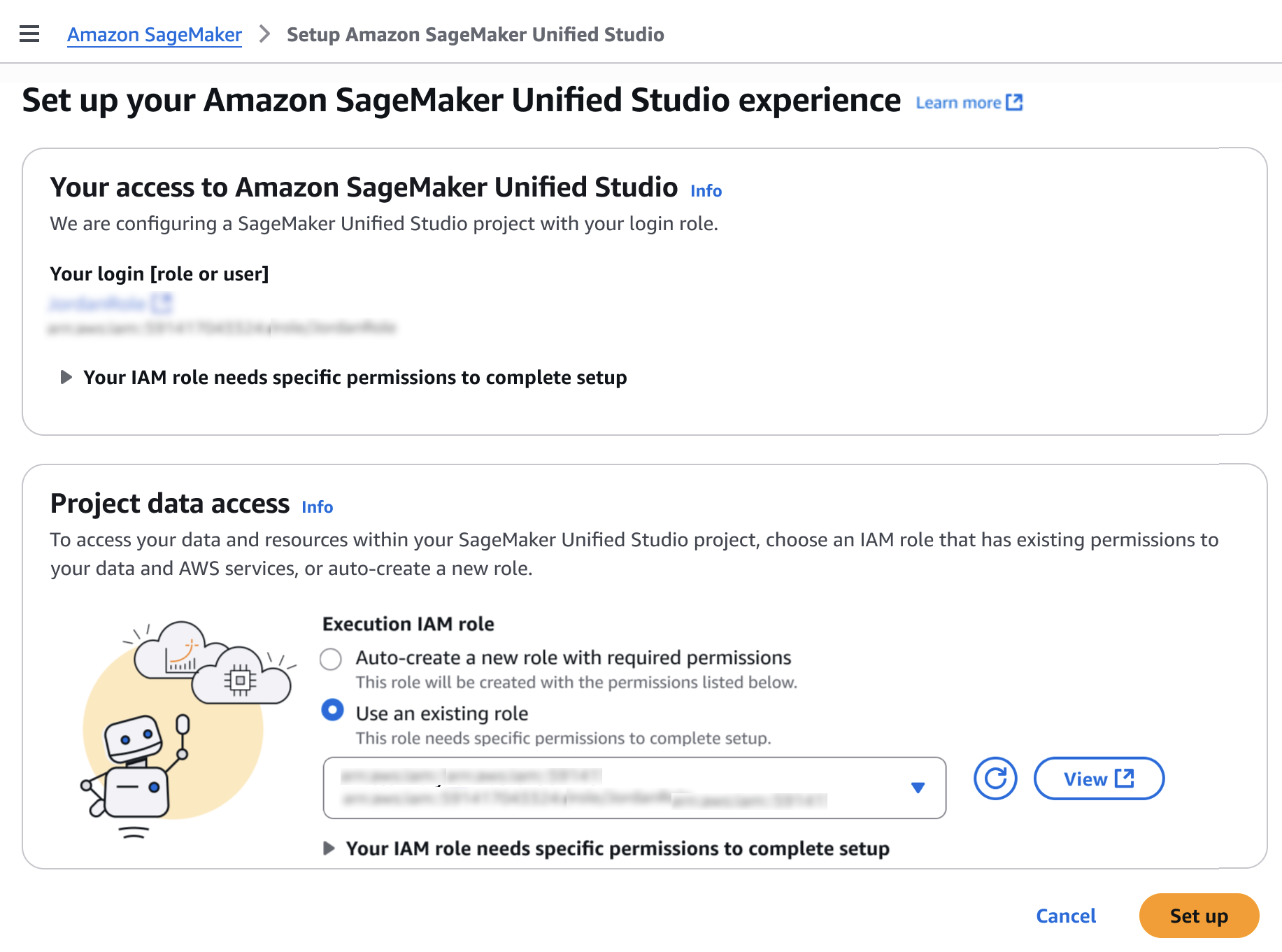
Amazon SageMaker Unified Studio is now generally available – You can now use Amazon SageMaker Unified Studio as your single data and AI development environment, where you can find and access all of your organization’s data and work using the best tools for your specific needs. With the new simplified permissions management, you can easily bring your existing AWS resources into the unified studio. You’ll be able to find, access, and query your organization’s data and AI assets while collaborating with your team to securely build and share your analytics and AI artifacts—from data and models to generative AI applications.

Amazon Bedrock’s capabilities now generally available within Amazon SageMaker Unified Studio – SageMaker Unified Studio brings selected capabilities from Amazon Bedrock into SageMaker. You can now rapidly prototype, customize, and share generative AI applications using foundation models (FMs) and advanced features such as Amazon Bedrock Knowledge BasesAmazon Bedrock GuardrailsAmazon Bedrock Agents, and Amazon Bedrock Flows to create tailored solutions aligned with your requirements and responsible AI guidelines all within SageMaker.

Amazon S3 Tables integration with Amazon SageMaker Lakehouse is now generally availableAmazon S3 Tables now seamlessly integrate with Amazon SageMaker Lakehouse, making it easy for you to query and join S3 Tables with data in S3 data lakes, Amazon Redshift data warehouses, and third-party data sources. S3 Tables deliver the first cloud object store with built-in Apache Iceberg support.

Amazon S3 Tables now support create and query table operations directly from the S3 console using Amazon Athena – Amazon S3 Tables adds create and query table support in the S3 console. With this new feature, you can now create a table, populate it with data, and query it directly from the S3 console using Amazon Athena, making it easier to get started and analyze data in S3 table buckets.

Amazon S3 reduces pricing for S3 object tagging by 35% – Amazon S3 reduces pricing for S3 object tagging by 35% in all AWS Regions to $0.0065 per 10,000 tags per month. Object tags are key-value pairs applied to S3 objects that can be created, updated, or deleted at any time during the lifetime of the object.

Serverless Land Patterns available in Visual Studio CodeServerless Land‘s extensive application pattern library is now available directly into the Visual Studio Code (VS Code) IDE, making it easier for developers to build serverless applications. This integration eliminates the need to switch between your development environment and external resources when building serverless architectures by enabling you to browse, search, and implement pre-built serverless patterns directly in VS Code IDE.

Amplify Hosting Announces Skew Protection SupportAWS Amplify Hosting now offers Skew Protection, a feature that guarantees version consistency across your deployments. This feature ensures frontend requests are always routed to the correct server backend version—eliminating version skew and making deployments more reliable.

Amazon Route 53 Traffic Flow introduces a new visual editor to improve DNS policy editingAmazon Route 53 Traffic Flow now offers an enhanced user interface for improved DNS traffic policy editing. With this release, you can more easily understand and change the way traffic is routed between users and endpoints using the new features of the visual editor.

From community.aws
Here are some of my favorite posts from community.aws. Create your AWS Builder ID to start sharing your tips and connect with fellow builders. Your Builder ID is a universal login credential that gives you access, beyond the AWS Management Console, to AWS tools and resources, including over 600 free training courses, community features, and developer tools such as Amazon Q Developer.

Seamless SQL Server Recovery on EC2 with AWS Systems Manager (Greg Vinton) – This guide explains how to use the AWSEC2-RestoreSqlServerDatabaseWithVss automation runbook to restore a Microsoft SQL Server database on an Amazon Elastic Compute Cloud (Amazon EC2) instance.

Secure Deployment Strategies in Amazon EKS with Azure DevOps (Abhishek Nanda) – Build and Deploy containerized applications on Amazon Elastic Kubernetes Service (Amazon EKS) using Azure DevOps.

Connect Your Favorite LLM Client to Bedrock (Qinjie Zhang) – It’s common to use desktop applications like MSTY, Chatbox AI, LM Studio to simplify the use of Large Language Models (LLM) models. This blog provides a step-by-step guide on how you can connect your favorite local LLM clients to Amazon Bedrock.

From PHP to Python with the help of Amazon Q Developer (Ricardo Sueiras) – In this blog post, Ricardo showcases how to use Amazon Q Developer CLI to refactor code from one programming language to another.

Upcoming AWS events
Check your calendars and sign up for these upcoming AWS events:

AWS Community Days – Join community-led conferences that feature technical discussions, workshops, and hands-on labs led by expert AWS users and industry leaders from around the world: Milan, Italy (April 2), Bay Area – Security Edition (April 4), Timișoara, Romania (April 10), and Prague, Czech Republic (April 29).

AWS Innovate: Generative AI + Data – Join a free online conference focusing on generative AI and data innovations in Latin America on April 8.

AWS Summits – The AWS Summit season is coming along! Join free online and in-person events that bring the cloud computing community together to connect, collaborate, and learn about AWS. Register in your nearest city: Paris (April 9), Amsterdam (April 16), London (April 30), and Poland (May 5).

AWS re:Inforce (June 16–18) – Our annual learning event devoted to all things AWS Cloud security in Philadelphia, PA. Registration opens in March, so be ready to join more than 5,000 security builders and leaders.

AWS DevDays are free, technical events where developers can learn about some of the hottest topics in cloud computing. DevDays offer hands-on workshops, technical sessions, live demos, and networking with AWS technical experts and your peers. Register to access AWS DevDays sessions on demand.

That’s all for this week. Check back next Monday for another Weekly Roundup!

Prasad

This post is part of our Weekly Roundup series. Check back each week for a quick roundup of interesting news and announcements from AWS!


How is the News Blog doing? Take this 1 minute survey!

(This survey is hosted by an external company. AWS handles your information as described in the AWS Privacy Notice. AWS will own the data gathered via this survey and will not share the information collected with survey respondents.)

Collaborate and build faster with Amazon SageMaker Unified Studio, now generally available

Post Syndicated from Donnie Prakoso original https://aws.amazon.com/blogs/aws/collaborate-and-build-faster-with-amazon-sagemaker-unified-studio-now-generally-available/

Today, we’re announcing the general availability of Amazon SageMaker Unified Studio, a single data and AI development environment where you can find and access all of the data in your organization and act on it using the best tool for the job across virtually any use case. Introduced as preview during AWS re:Invent 2024, my colleague, Antje, summarized it as:

SageMaker Unified Studio (preview) is a single data and AI development environment. It brings together functionality and tools from the range of standalone “studios,” query editors, and visual tools that we have today in Amazon AthenaAmazon EMRAWS GlueAmazon RedshiftAmazon Managed Workflows for Apache Airflow (Amazon MWAA), and the existing SageMaker Studio.

Here’s a video to see Amazon SageMaker Unified Studio in action:

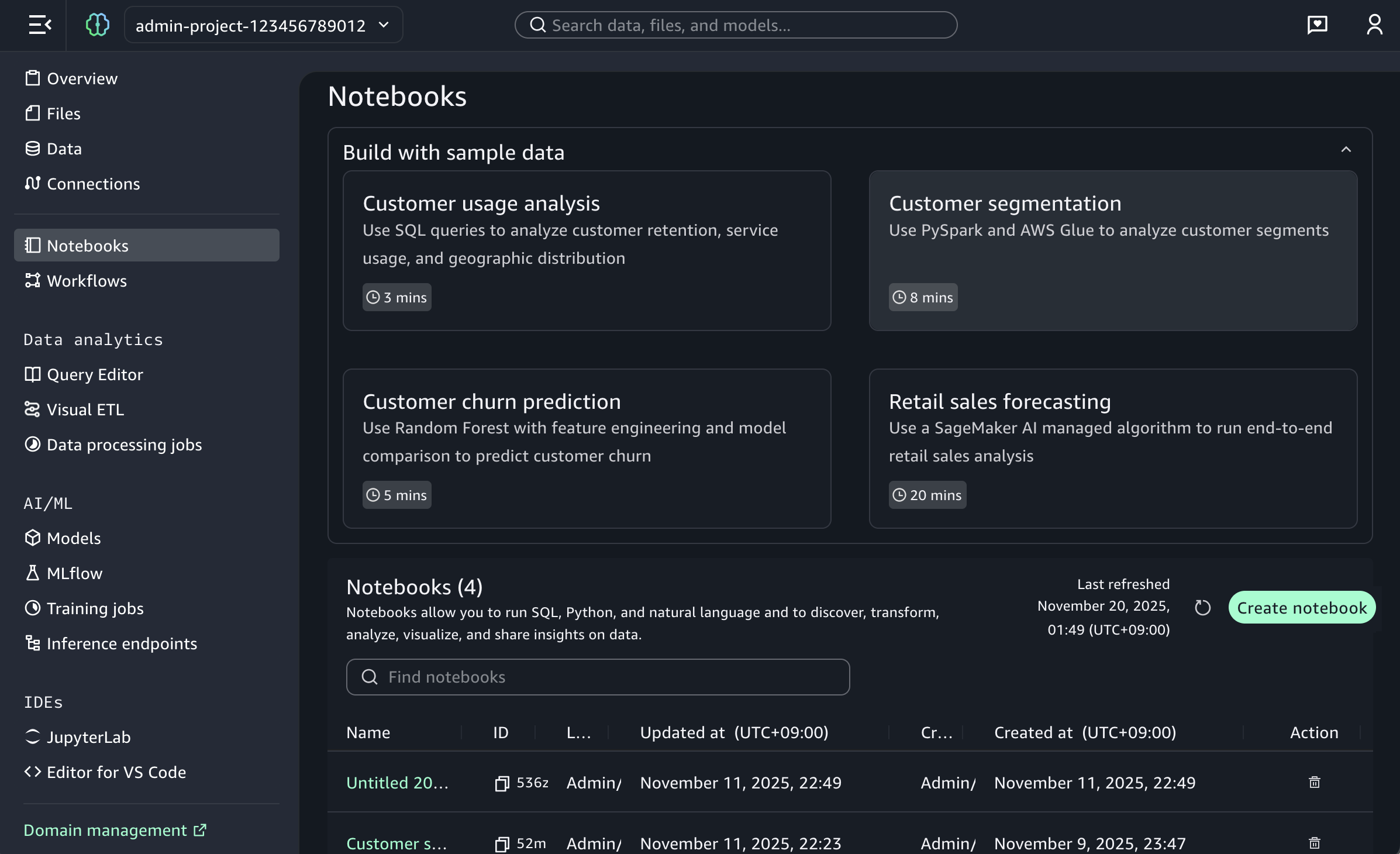
SageMaker Unified Studio breaks down silos in data and tools, giving data engineers, data scientists, data analysts, ML developers and other data practitioners a single development experience. This saves development time and simplifies access control management so data practitioners can focus on what really matters to them—building data products and AI applications.

This post focuses on several important announcements that we’re excited to share:

To get started, go to the Amazon SageMaker console and create a SageMaker Unified Studio domain. To learn more, visit Create an Amazon SageMaker Unified Studio domain in the AWS documentation.

New capabilities for Amazon Bedrock in SageMaker Unified Studio
The capabilities of Amazon Bedrock within Amazon SageMaker Unified Studio offer a governed collaborative environment for developers to rapidly create and customize generative AI applications. This intuitive interface caters to developers of all skill levels, providing seamless access to the high-performance FMs offered in Amazon Bedrock and advanced customization tools for collaborative development of tailored generative AI applications.

Since the preview launch, several new FMs have become available in Amazon Bedrock and are fully integrated with SageMaker Unified Studio, including Anthropic’s Claude 3.7 Sonnet and DeepSeek-R1. These models can be used for building generative AI apps and chatting in the playground in SageMaker Unified Studio.

Here’s how you can choose Anthropic’s Claude 3.7 Sonnet on the model selection in your project.

You can also source data or documents from S3 folders within your project and select specific FMs when creating knowledge bases. 

During preview, we introduced Amazon Bedrock Guardrails to help you implement safeguards for your Amazon Bedrock application based on your use cases and responsible AI policies. Now, Amazon Bedrock Guardrails is extended to Amazon Bedrock Flows with this general availability release.

Additionally, we have streamlined generative AI setup for associated accounts with a new user management interface in SageMaker Unified Studio, making it straightforward for domain administrators to grant associated account admins access to model governance projects. This enhancement eliminates the need for command line operations, streamlining the process of configuring generative AI capabilities across multiple AWS accounts.

These new features eliminate barriers between data, tools, and builders in the generative AI development process. You and your team will gain a unified development experience by incorporating the powerful generative AI capabilities of Amazon Bedrock — all within the same workspace.

Amazon Q Developer is now generally available in SageMaker Unified Studio
Amazon Q Developer is now generally available in Amazon SageMaker Unified Studio, providing data professionals with generative AI–powered assistance across the entire data and AI development lifecycle.

Amazon Q Developer integrates with the full suite of AWS analytics and AI/ML tools and services within SageMaker Unified Studio, including data processing, SQL analytics, machine learning model development, and generative AI application development, to accelerate collaboration and help teams build data and AI products faster. To get started, you can select Amazon Q Developer icon.

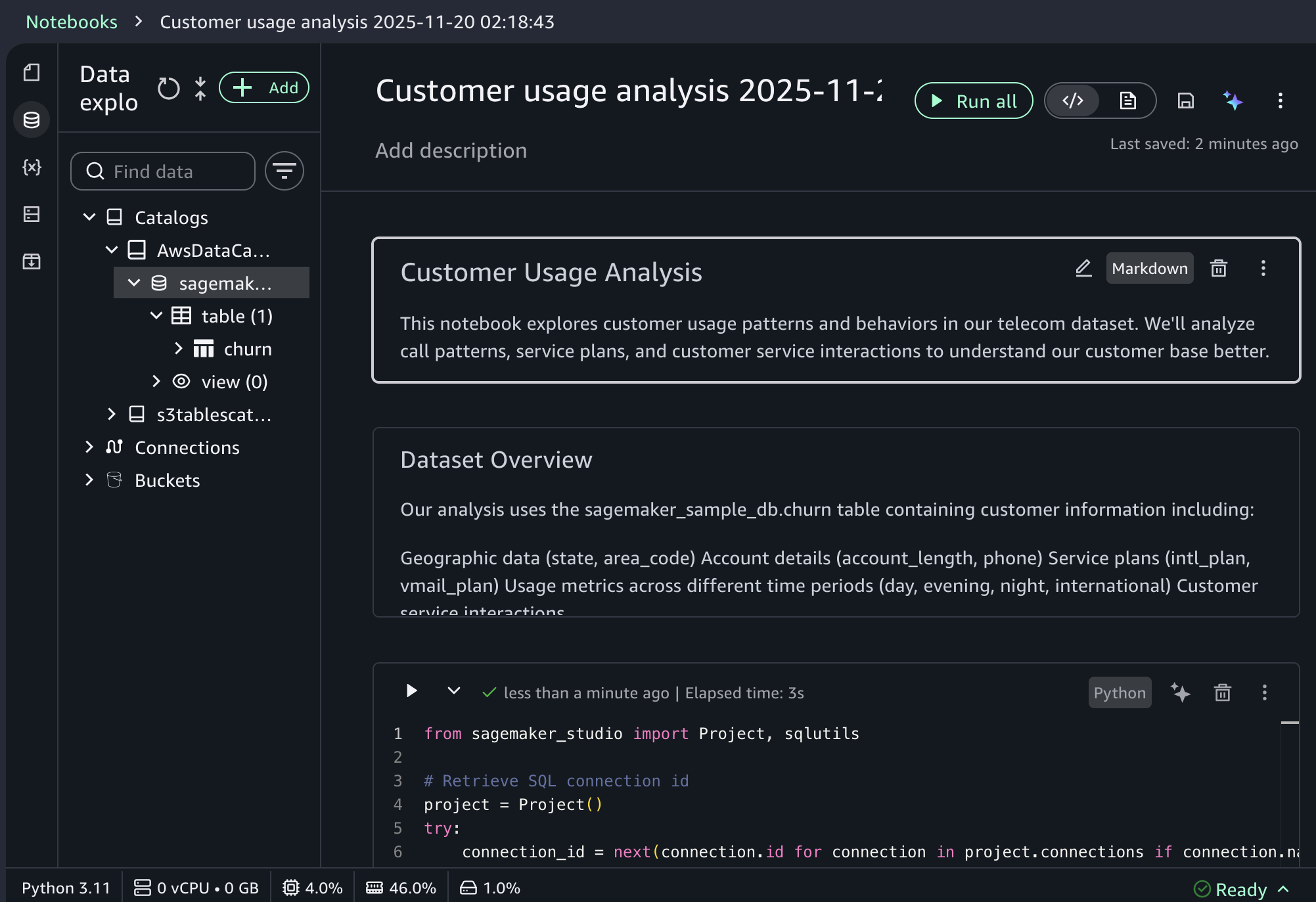
For new users of SageMaker Unified Studio, Amazon Q Developer serves as an invaluable onboarding assistant. It can explain core concepts such as domains and projects, provide guidance on setting up environments, and answer your questions.

Amazon Q Developer helps you discover and understand data using powerful natural language interactions with SageMaker Catalog. What makes this implementation particularly powerful is how Amazon Q Developer combines broad knowledge of AWS analytics and AI/ML services with the user’s context to provide personalized guidance.

You can chat about your data assets through a conversational interface, asking questions such as “Show all payment related datasets” without needing to navigate complex metadata structures.

Amazon Q Developer offers SQL query generation through its integration with the built-in query editor available in SageMaker Unified Studio. Data professionals of varying skill levels can now express their analytical needs in natural language, receiving properly formatted SQL queries in return.

For example, you can ask, “Analyze payment method preferences by age group and region” and Amazon Q Developer will generate the appropriate SQL with proper joins across multiple tables.

Additionally, Amazon Q Developer is also available to assist with troubleshooting and generating real-time code suggestions in SageMaker Unified Studio Jupyter notebooks, as well as building ETL jobs.

Now available

  • Availability — Amazon SageMaker Unified Studio is now available in the following AWS Regions: US East (N. Virginia, Ohio), US West (Oregon), Asia Pacific (Seoul, Singapore, Sydney, Tokyo), Canada (Central), Europe (Frankfurt, Ireland, London), South America (São Paulo). Learn more about the availability of these capabilities on supported Region documentation page.
  • Amazon Q Developer subscription — The free tier of Amazon Q Developer is available by default in SageMaker Unified Studio, requiring no additional setup or configuration. If you already have Amazon Q Developer Pro Tier subscriptions, you can use those enhanced capabilities within the SageMaker Unified Studio environment. For more information, visit the documentation page.
  • Amazon Bedrock capabilities — To learn more about the capabilities of Amazon Bedrock in Amazon SageMaker Unified Studio, refer to this documentation page

Start building with Amazon SageMaker Unified Studio today. For more information, visit the Amazon SageMaker Unified Studio page.

Happy building!

Donnie Prakoso

— How is the News Blog doing? Take this 1 minute survey! (This survey is hosted by an external company. AWS handles your information as described in the AWS Privacy Notice. AWS will own the data gathered via this survey and will not share the information collected with survey respondents.)

Amazon S3 Tables integration with Amazon SageMaker Lakehouse is now generally available

Post Syndicated from Channy Yun (윤석찬) original https://aws.amazon.com/blogs/aws/amazon-s3-tables-integration-with-amazon-sagemaker-lakehouse-is-now-generally-available/

At re:Invent 2024, we launched Amazon S3 Tables, the first cloud object store with built-in Apache Iceberg support to streamline storing tabular data at scale, and Amazon SageMaker Lakehouse to simplify analytics and AI with a unified, open, and secure data lakehouse. We also previewed S3 Tables integration with Amazon Web Services (AWS) analytics services for you to stream, query, and visualize S3 Tables data using Amazon Athena, Amazon Data Firehose, Amazon EMR, AWS Glue, Amazon Redshift, and Amazon QuickSight.

Our customers wanted to simplify the management and optimization of their Apache Iceberg storage, which led to the development of S3 Tables. They were simultaneously working to break down data silos that impede analytics collaboration and insight generation using the SageMaker Lakehouse. When paired with S3 Tables and SageMaker Lakehouse in addition to built-in integration with AWS analytics services, they can gain a comprehensive platform unifying access to multiple data sources enabling both analytics and machine learning (ML) workflows.

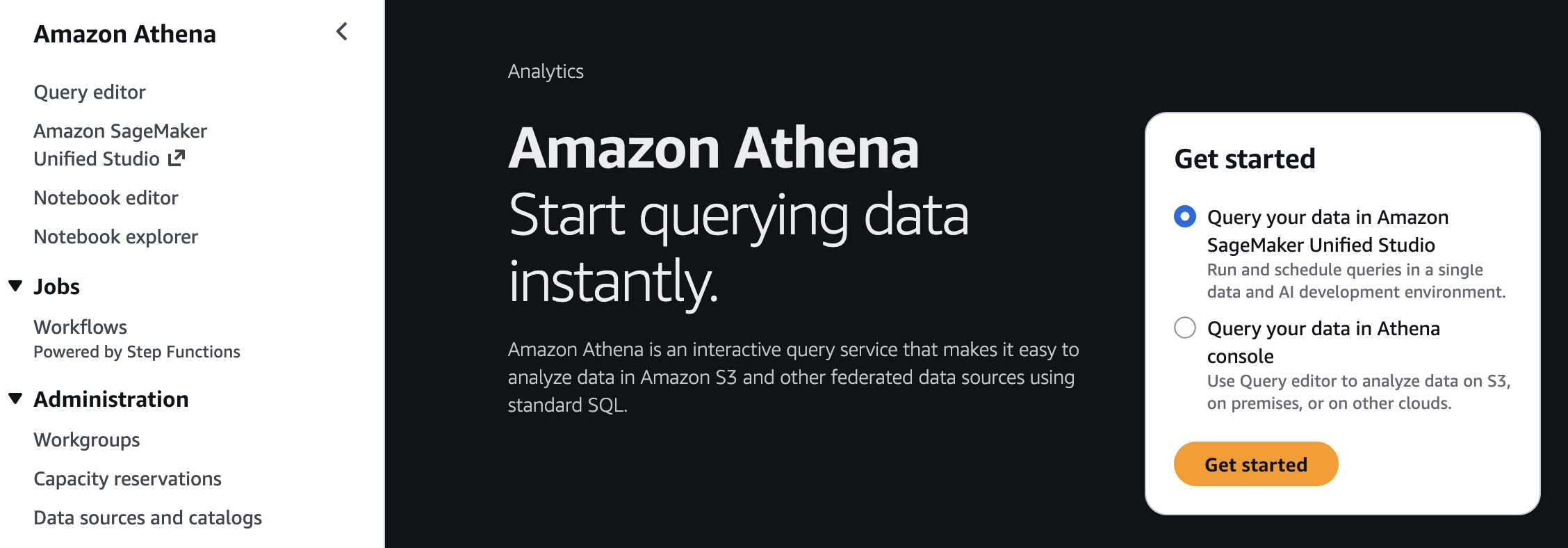
Today, we’re announcing the general availability of Amazon S3 Tables integration with Amazon SageMaker Lakehouse to provide unified S3 Tables data access across various analytics engines and tools. You can access SageMaker Lakehouse from Amazon SageMaker Unified Studio, a single data and AI development environment that brings together functionality and tools from AWS analytics and AI/ML services. All S3 tables data integrated with SageMaker Lakehouse can be queried from SageMaker Unified Studio and engines such as Amazon Athena, Amazon EMR, Amazon Redshift, and Apache Iceberg-compatible engines like Apache Spark or PyIceberg.

With this integration, you can simplify building secure analytic workflows where you can read and write to S3 Tables and join with data in Amazon Redshift data warehouses and third-party and federated data sources, such as Amazon DynamoDB or PostgreSQL.

You can also centrally set up and manage fine-grained access permissions on the data in S3 Tables along with other data in the SageMaker Lakehouse and consistently apply them across all analytics and query engines.

S3 Tables integration with SageMaker Lakehouse in action
To get started, go to the Amazon S3 console and choose Table buckets from the navigation pane and select Enable integration to access table buckets from AWS analytics services.

Now you can create your table bucket to integrate with SageMaker Lakehouse. To learn more, visit Getting started with S3 Tables in the AWS documentation.

1. Create a table with Amazon Athena in the Amazon S3 console
You can create a table, populate it with data, and query it directly from the Amazon S3 console using Amazon Athena with just a few steps. Select a table bucket and select Create table with Athena, or you can select an existing table and select Query table with Athena.

2. Create tables with Athena

When you want to create a table with Athena, you should first specify a namespace for your table. The namespace in an S3 table bucket is equivalent to a database in AWS Glue, and you use the table namespace as the database in your Athena queries.

Choose a namespace and select Create table with Athena. It goes to the Query editor in the Athena console. You can create a table in your S3 table bucket or query data in the table.

2. Query with Athena

2. Query with SageMaker Lakehouse in the SageMaker Unified Studio
Now you can access unified data across S3 data lakes, Redshift data warehouses, third-party and federated data sources in SageMaker Lakehouse directly from SageMaker Unified Studio.

To get started, go to the SageMaker console and create a SageMaker Unified Studio domain and project using a sample project profile: Data Analytics and AI-ML model development. To learn more, visit Create an Amazon SageMaker Unified Studio domain in the AWS documentation.

After the project is created, navigate to the project overview and scroll down to project details to note down the project role Amazon Resource Name (ARN).

3. Project details in SageMaker Unified Studio

Go to the AWS Lake Formation console and grant permissions for AWS Identity and Access Management (IAM) users and roles. In the in the Principals section, select the <project role ARN> noted in the previous paragraph. Choose Named Data Catalog resources in the LF-Tags or catalog resources section and select the table bucket name you created for Catalogs. To learn more, visit Overview of Lake Formation permissions in the AWS documentation.

4. Grant permissions in Lake Formation console

When you return to SageMaker Unified Studio, you can see your table bucket project under Lakehouse in the Data menu in the left navigation pane of project page. When you choose Actions, you can select how to query your table bucket data in Amazon Athena, Amazon Redshift, or JupyterLab Notebook.

5. S3 Tables in Unified Studio

When you choose Query with Athena, it automatically goes to Query Editor to run data query language (DQL) and data manipulation language (DML) queries on S3 tables using Athena.

Here is a sample query using Athena:

select * from "s3tablecatalog/s3tables-integblog-bucket”.”proddb"."customer" limit 10;

6. Athena query in Unified Studio

To query with Amazon Redshift, you should set up Amazon Redshift Serverless compute resources for data query analysis. And then you choose Query with Redshift and run SQL in the Query Editor. If you want to use JupyterLab Notebook, you should create a new JupyterLab space in Amazon EMR Serverless.

3. Join data from other sources with S3 Tables data
With S3 Tables data now available in SageMaker Lakehouse, you can join it with data from data warehouses, online transaction processing (OLTP) sources like relational or non-relational database, Iceberg tables, and other third party sources to gain more comprehensive and deeper insights.

For example, you can add connections to data sources such as Amazon DocumentDB, Amazon DynamoDB, Amazon Redshift, PostgreSQL, MySQL, Google BigQuery, or Snowflake and combine data using SQL without extract, transform, and load (ETL) scripts.

Now you can run the SQL query in the Query editor to join the data in the S3 Tables with the data in the DynamoDB.

Here is a sample query to join between Athena and DynamoDB:

select * from "s3tablescatalog/s3tables-integblog-bucket"."blogdb"."customer", 
              "dynamodb1"."default"."customer_ddb" where cust_id=pid limit 10;

To learn more about this integration, visit Amazon S3 Tables integration with Amazon SageMaker Lakehouse in the AWS documentation.

Now available
S3 Tables integration with SageMaker Lakehouse is now generally available in all AWS Regions where S3 Tables are available. To learn more, visit the S3 Tables product page and the SageMaker Lakehouse page.

Give S3 Tables a try in the SageMaker Unified Studio today and send feedback to AWS re:Post for Amazon S3 and AWS re:Post for Amazon SageMaker or through your usual AWS Support contacts.

In the annual celebration of the launch of Amazon S3, we will introduce more awesome launches for Amazon S3 and Amazon SageMaker. To learn more, join the AWS Pi Day event on March 14.

Channy

How is the News Blog doing? Take this 1 minute survey!

(This survey is hosted by an external company. AWS handles your information as described in the AWS Privacy Notice. AWS will own the data gathered via this survey and will not share the information collected with survey respondents.)

DeepSeek-R1 now available as a fully managed serverless model in Amazon Bedrock

Post Syndicated from Channy Yun (윤석찬) original https://aws.amazon.com/blogs/aws/deepseek-r1-now-available-as-a-fully-managed-serverless-model-in-amazon-bedrock/

As of January 30, DeepSeek-R1 models became available in Amazon Bedrock through the Amazon Bedrock Marketplace and Amazon Bedrock Custom Model Import. Since then, thousands of customers have deployed these models in Amazon Bedrock. Customers value the robust guardrails and comprehensive tooling for safe AI deployment. Today, we’re making it even easier to use DeepSeek in Amazon Bedrock through an expanded range of options, including a new serverless solution.

The fully managed DeepSeek-R1 model is now generally available in Amazon Bedrock. Amazon Web Services (AWS) is the first cloud service provider (CSP) to deliver DeepSeek-R1 as a fully managed, generally available model. You can accelerate innovation and deliver tangible business value with DeepSeek on AWS without having to manage infrastructure complexities. You can power your generative AI applications with DeepSeek-R1’s capabilities using a single API in the Amazon Bedrock’s fully managed service and get the benefit of its extensive features and tooling.

According to DeepSeek, their model is publicly available under MIT license and offers strong capabilities in reasoning, coding, and natural language understanding. These capabilities power intelligent decision support, software development, mathematical problem-solving, scientific analysis, data insights, and comprehensive knowledge management systems.

As is the case for all AI solutions, give careful consideration to data privacy requirements when implementing in your production environments, check for bias in output, and monitor your results. When implementing publicly available models like DeepSeek-R1, consider the following:

  • Data security – You can access the enterprise-grade security, monitoring, and cost control features of Amazon Bedrock that are essential for deploying AI responsibly at scale, all while retaining complete control over your data. Users’ inputs and model outputs aren’t shared with any model providers. You can use these key security features by default, including data encryption at rest and in transit, fine-grained access controls, secure connectivity options, and download various compliance certifications while communicating with the DeepSeek-R1 model in Amazon Bedrock.
  • Responsible AI – You can implement safeguards customized to your application requirements and responsible AI policies with Amazon Bedrock Guardrails. This includes key features of content filtering, sensitive information filtering, and customizable security controls to prevent hallucinations using contextual grounding and Automated Reasoning checks. This means you can control the interaction between users and the DeepSeek-R1 model in Bedrock with your defined set of policies by filtering undesirable and harmful content in your generative AI applications.
  • Model evaluation – You can evaluate and compare models to identify the optimal model for your use case, including DeepSeek-R1, in a few steps through either automatic or human evaluations by using Amazon Bedrock model evaluation tools. You can choose automatic evaluation with predefined metrics such as accuracy, robustness, and toxicity. Alternatively, you can choose human evaluation workflows for subjective or custom metrics such as relevance, style, and alignment to brand voice. Model evaluation provides built-in curated datasets, or you can bring in your own datasets.

We strongly recommend integrating Amazon Bedrock Guardrails and using Amazon Bedrock model evaluation features with your DeepSeek-R1 model to add robust protection for your generative AI applications. To learn more, visit Protect your DeepSeek model deployments with Amazon Bedrock Guardrails and Evaluate the performance of Amazon Bedrock resources.

Get started with the DeepSeek-R1 model in Amazon Bedrock
If you’re new to using DeepSeek-R1 models, go to the Amazon Bedrock console, choose Model access under Bedrock configurations in the left navigation pane. To access the fully managed DeepSeek-R1 model, request access for DeepSeek-R1 in DeepSeek. You’ll then be granted access to the model in Amazon Bedrock.

Next, to test the DeepSeek-R1 model in Amazon Bedrock, choose Chat/Text under Playgrounds in the left menu pane. Then choose Select model in the upper left, and select DeepSeek as the category and DeepSeek-R1 as the model. Then choose Apply.

Using the selected DeepSeek-R1 model, I run the following prompt example:

A family has $5,000 to save for their vacation next year. They can place the money in a savings account earning 2% interest annually or in a certificate of deposit earning 4% interest annually but with no access to the funds until the vacation. If they need $1,000 for emergency expenses during the year, how should they divide their money between the two options to maximize their vacation fund?

This prompt requires a complex chain of thought and produces very precise reasoning results.

To learn more about usage recommendations for prompts, refer to the README of the DeepSeek-R1 model in its GitHub repository.

By choosing View API request, you can also access the model using code examples in the AWS Command Line Interface (AWS CLI) and AWS SDK. You can use us.deepseek.r1-v1:0 as the model ID.

Here is a sample of the AWS CLI command:

aws bedrock-runtime invoke-model \
     --model-id us.deepseek-r1-v1:0 \
     --body "{\"messages\":[{\"role\":\"user\",\"content\":[{\"type\":\"text\",\"text\":\"[n\"}]}],max_tokens\":2000,\"temperature\":0.6,\"top_k\":250,\"top_p\":0.9,\"stop_sequences\":[\"\\n\\nHuman:\"]}" \
     --cli-binary-format raw-in-base64-out \
     --region us-west-2 \
     invoke-model-output.txt

The model supports both the InvokeModel and Converse API. The following Python code examples show how to send a text message to the DeepSeek-R1 model using the Amazon Bedrock Converse API for text generation.

import boto3
from botocore.exceptions import ClientError

# Create a Bedrock Runtime client in the AWS Region you want to use.
client = boto3.client("bedrock-runtime", region_name="us-west-2")

# Set the model ID, e.g., Llama 3 8b Instruct.
model_id = "us.deepseek.r1-v1:0"

# Start a conversation with the user message.
user_message = "Describe the purpose of a 'hello world' program in one line."
conversation = [
    {
        "role": "user",
        "content": [{"text": user_message}],
    }
]

try:
    # Send the message to the model, using a basic inference configuration.
    response = client.converse(
        modelId=model_id,
        messages=conversation,
        inferenceConfig={"maxTokens": 2000, "temperature": 0.6, "topP": 0.9},
    )

    # Extract and print the response text.
    response_text = response["output"]["message"]["content"][0]["text"]
    print(response_text)

except (ClientError, Exception) as e:
    print(f"ERROR: Can't invoke '{model_id}'. Reason: {e}")
    exit(1)

To enable Amazon Bedrock Guardrails on the DeepSeek-R1 model, select Guardrails under Safeguards in the left navigation pane, and create a guardrail by configuring as many filters as you need. For example, if you filter for “politics” word, your guardrails will recognize this word in the prompt and show you the blocked message.

4. Apply the Bedrock Guardrails to the DeepSeek-R1 model

You can test the guardrail with different inputs to assess the guardrail’s performance. You can refine the guardrail by setting denied topics, word filters, sensitive information filters, and blocked messaging until it matches your needs.

To learn more about Amazon Bedrock Guardrails, visit Stop harmful content in models using Amazon Bedrock Guardrails in the AWS documentation or other deep dive blog posts about Amazon Bedrock Guardrails on the AWS Machine Learning Blog channel.

Here’s a demo walkthrough highlighting how you can take advantage of the fully managed DeepSeek-R1 model in Amazon Bedrock:

Now available
DeepSeek-R1 is now available fully managed in Amazon Bedrock in the US East (N. Virginia), US East (Ohio), and US West (Oregon) AWS Regions through cross-Region inference. Check the full Region list for future updates. To learn more, check out the DeepSeek in Amazon Bedrock product page and the Amazon Bedrock pricing page.

Give the DeepSeek-R1 model a try in the Amazon Bedrock console today and send feedback to AWS re:Post for Amazon Bedrock or through your usual AWS Support contacts.

Channy

Updated on March 10, 2025 — Fixed a screenshot of model selection and model ID.

AWS Weekly Roundup: Amazon Q CLI agent, AWS Step Functions, AWS Lambda, and more (March 10, 2025)

Post Syndicated from Danilo Poccia original https://aws.amazon.com/blogs/aws/aws-weekly-roundup-amazon-q-cli-agent-aws-step-functions-aws-lambda-and-more-march-10-2025/

As the weather improves in the Northern hemisphere, there are more opportunities to learn and connect. This week, I’ll be in San Francisco, and we can meet at the Nova Networking Night at the AWS GenAI Loft where we’ll dive into the world of Amazon Nova foundation models (FMs) with live demos and real-world implementations.

AWS Pi Day is now a yearly tradition. It started in 2021 as a celebration of the 15th anniversary of Amazon S3. This year, there will be in-depth discussions with AWS product teams on how to build a data foundation for a unified seamless experience, managing and using data for analytics and AI workloads. Join us online to learn about the latest innovations through hands-on demos, and ask questions during our interactive livestream.

Last week’s launches
Another busy week, here are the launches that got my attention.

Amazon Q Developer – You can now use an enhanced agent within the Amazon Q command line interface (CLI) to give you more dynamic conversations, help you read and write files locally, query AWS resources, or create code. This enhanced CLI agent is powered by Anthropic’s most intelligent model to date, Claude 3.7 Sonnet. Read more about this agenic coding experience and how to try it out. Here’s a visual demo of the new capabilities of Amazon Q CLI, by Nathan Peck.

Amazon Q Business – Now supports the ingestion of audio and video data. This capability streamlines information retrieval, enhances knowledge sharing, and improves decision-making processes, by making multimedia content as searchable and accessible as text-based documents.

Amazon BedrockBedrock Data Automation is now generally available, so you can automate the generation of valuable insights from unstructured multimodal content such as documents, images, video, and audio files. Learn more and see code examples in my blog post. Amazon Bedrock Knowledge Bases support for GraphRAG is now also generally available. GraphRAG is a capability that enhances Retrieval-Augmented Generation (RAG) by incorporating graph data and delivers more comprehensive, relevant, and explainable responses by leveraging relationships within your data, improving how Generative AI applications retrieve and synthesize information.

Amazon Nova – The Amazon Nova Pro foundation model now supports latency-optimized inference in preview on Amazon Bedrock, enabling faster response times and improved responsiveness for generative AI applications.

AWS Step Functions – Workflow Studio for VS Code is now available, a visual builder you can use to compose workflows on a canvas. You can generate workflow definitions in the background to create workflows in your local development environment. Read more about this enhanced local IDE experience.

AWS Lambda – Now supports Amazon CloudWatch Logs Live Tail in VS Code. We previously introduced support for Live Tail in the Lambda console to simplify how you can view and analyze Lambda logs in real time. Now, you can also monitor Lambda function logs in real time while staying within the VS Code development environment.

AWS Amplify – Now supports HttpOnly cookies for server-rendered Next.js applications when using Amazon Cognito’s managed login. Because cookies with the HttpOnly attribute can’t be accessed by JavaScript, your applications can gain an additional layer of protection against cross-site scripting (XSS) attacks.

Amazon CognitoYou can now customize access tokens for machine-to-machine (M2M) flows, enabling you to implement fine-grained authorization in your applications, APIs, and workloads. M2M authorization is commonly used for automated processes such as scheduled data synchronization tasks, event-driven workflows, microservices communication, or real-time data streaming between systems.

AWS CodeBuild – Now supports builds on Linux x86, Arm, and Windows on-demand fleets directly on the host operating system without containerization. In this way, you can now execute build commands that require direct access to the host system resources or have specific requirements that make containerization challenging. For example, this is useful when building device drivers, running system-level tests, or working with tools that require host machine access. CodeBuild has also added support for Node 22, Python 3.13, and Go 1.23 in Linux x86, Arm, Windows, and macOS platforms.

Bottlerocket – The open source Linux-based operating system purpose-built for containers now supports NVIDIA’s Multi-Instance GPU (MIG) to help partition NVIDIA GPUs into multiple GPU instances on Kubernetes nodes and maximize GPU resource utilization. Bottlerocket now also supports AWS Neuron accelerated instance types and provides a default bootstrap container image that simplifies system setup tasks.

Amazon GameLift – Introducing Amazon GameLift Streams, a new managed capability that developers can use to stream games at up to 1080p resolution and 60 frames per second to any device with a WebRTC-enabled browser. To learn more, explore Donnie’s blog post.

Amazon FSx for NetApp ONTAP – Starting March 5, 2025, the SnapLock licensing fees for data stored in SnapLock volumes has been eliminated, making it more cost-effective.

Other AWS news
Here are some additional projects, blog posts, and news items that you might find interesting:

Accelerate AWS Well-Architected reviews with Generative AI – In this post, we explore a generative AI solution to streamline the Well-Architected Framework Reviews (WAFRs) process. We demonstrate how to build an intelligent, scalable system that analyzes architecture documents and generates insightful recommendations based on best practices.

Architectural diagram

Build a Multi-Agent System with LangGraph and Mistral on AWS – The Multi-Agent City Information System demonstrated in this post exemplifies the potential of agent-based architectures to create sophisticated, adaptable, and highly capable AI applications.

Reference architecture

Evaluate RAG responses with Amazon Bedrock, LlamaIndex and RAGAS – How to enhance your Retrieval Augmented Generation (RAG) implementations with practical techniques to evaluate and optimize your AI systems and enable more accurate, context-aware responses that align with your specific needs.

Architectural diagram

From community.aws
Here are some of my favorite posts from community.aws. Create your AWS Builder ID to start sharing your tips and connect with fellow builders. Your Builder ID is a universal login credential that gives you access, beyond the AWS Management Console, to AWS tools and resources, including over 600 free training courses, community features, and developer tools such as Amazon Q Developer.

Optimize AWS Lambda Costs with Automated Compute Optimizer Insights (Zechariah Kasina) – An automated and scalable method for optimizing AWS Lambda memory configurations to enhance cost efficiency and performance.

Optimize AWS Costs: Auto-Shutdown for EC2 Instances (Adeleke Adebowale Julius) – Using Amazon CloudWatch alarms to dynamically shut down instances based on inactivity.

The Evolution of the Developer Role in an AI-Assisted Future (Aaron Sempf) – While AI is transforming software development, the need for developing talent remains crucial.

Amazon Q Developer CLI – More coffee, less remembering commands (Cobus Bernard) – Now that you can use Amazon Q Developer directly from your terminal to interact with your files, so let’s add some convenience automations.

Upcoming AWS events
Check your calendars and sign up for these upcoming AWS events:

AWS Community Days – Join community-led conferences that feature technical discussions, workshops, and hands-on labs led by expert AWS users and industry leaders from around the world: Milan, Italy (April 2), Bay Area – Security Edition (April 4), Timișoara, Romania (April 10), and Prague, Czech Republic (April 29).

AWS Innovate: Generative AI + Data – Join a free online conference focusing on generative AI and data innovations. Available in multiple geographic regions: North America (March 13), Greater China Region (March 14), and Latin America (April 8).

AWS Summits – The AWS Summit season is coming along! Join free online and in-person events that bring the cloud computing community together to connect, collaborate, and learn about AWS. Register in your nearest city: Paris (April 9), Amsterdam (April 16), London (April 30), and Poland (May 5).

AWS re:Inforce (June 16–18) – Our annual learning event devoted to all things AWS Cloud security. This year is in Philadelphia, PA. Registration opens in March, so be ready to join more than 5,000 security builders and leaders.

AWS DevDays are free, technical events where developers can learn about some of the hottest topics in cloud computing. DevDays offer hands-on workshops, technical sessions, live demos, and networking with AWS technical experts and your peers. Register to access AWS DevDays sessions on demand.

That’s all for this week. Check back next Monday for another Weekly Roundup!

Danilo

This post is part of our Weekly Roundup series. Check back each week for a quick roundup of interesting news and announcements from AWS!

How is the News Blog doing? Take this 1 minute survey!

(This survey is hosted by an external company. AWS handles your information as described in the AWS Privacy Notice. AWS will own the data gathered via this survey and will not share the information collected with survey respondents.)

Scale and deliver game streaming experiences with Amazon GameLift Streams

Post Syndicated from Donnie Prakoso original https://aws.amazon.com/blogs/aws/scale-and-deliver-game-streaming-experiences-with-amazon-gamelift-streams/

Since 2016, game developers have been using Amazon GameLift to power games with dedicated, scalable server hosting capable of supporting 100M concurrent users (CCU) in a single game. Responding to customer requests for additional managed compute capabilities beyond game servers, we’re announcing Amazon GameLift Streams — a new capability in Amazon GameLift to help game publishers build and deliver global, direct-to-player game streaming experiences. As part of this announcement, existing capabilities in Amazon GameLift are now known as Amazon Gamelift Servers, continuing to serve hundreds of developers including industry leaders Ubisoft, Zynga, WB Games, and Meta.

Amazon GameLift Streams helps you deliver game streaming experiences at up to 1080p resolution and 60 frames per second across devices including iOS, Android, and PCs. In just a few clicks, you can deploy games built with a variety of 3D engines, without modifications, onto fully-managed cloud-based GPU instances and stream games through the AWS Network Backbone directly to any device with a web browser.

Amazon GameLift Streams helps you distribute your games direct-to-players, without having to invest millions of dollars in infrastructure and software development to build your own service. Players can start gaming in just a few seconds, without waiting for downloads or installs.

Here’s a quick look at Amazon GameLift Streams:

You can use the Amazon GameLift Streams SDK to integrate with your existing identity services, storefronts, game launchers, websites, or newly created experiences such as playable demos, and begin streaming to players. You can monitor active streams and usage from within the AWS console, and seamlessly scale your streaming infrastructure across multiple regions on the AWS global network to reach more players around the world with low-latency gameplay. Amazon GameLift Streams is the only solution that enables you to upload your game content onto fully-managed GPU instances in the cloud and start streaming in minutes, with little or no modification of your code.

Players can access AAA, AA, and indie games on PCs, phones, tablets, smart TVs, or any device with a WebRTC-enabled browser. Amazon GameLift Streams allows you to dynamically scale streaming capacity to match player demand, ensuring you only pay for what you need. You can choose from a selection of GPU instances that offer a range of price performance, and rely on the built-in security of AWS to protect your intellectual property.

Let’s get started
To begin using Amazon GameLift Streams, I need an existing Amazon GameLift Streams implementation. I prepare my game files by following the Amazon GameLift Streams documentation.

Then, I’ll upload my files to Amazon Simple Storage Service (Amazon S3). I can use the AWS Management Console or this AWS Command Line Interface (AWS CLI) command to upload my game files:

aws s3 sync my-game-folder s3://my-bucket/my-game-path

The next step is to create an Amazon GameLift Streams application. I navigate to the Amazon GameLift Streams console. This is how the new AWS GameLift Streams console looks:

On the Amazon GameLift Streams console, I choose Create application.

In the Runtime settings, I select the runtime environment for my game application.

Then, I need to select my S3 bucket and folder from the previous step, then set the path to my game’s main executable.

I also have the option to configure the automatic transfer of application-generated log files into a S3 bucket. After I’m done with this configuration, I choose Create application.

After my application setup is completed, I need to create a stream group, a collection of compute resources to run and stream the application. I navigate to Stream groups in the left navigation pane of the Amazon GameLift Streams console.

On this page, I define a description for my new stream group.

Here, I select the capabilities and pricing of my stream group. Since my application is using Microsoft Windows Server 2022 Base, I make sure to select one of the compatible stream classes.

Next, I need to link with the application I created in the previous step.

On the Configure stream settings page, I can configure additional locations for my stream group, bringing in additional capacity from other AWS Regions. There are two capacity options that I can choose, always-on capacity and on-demand capacity. The default capacity setting provides one streaming slot, which is sufficient for initial testing.

Then, I need to review my configuration and choose Create stream group.

With stream groups configured, I can test my game streaming. I navigate to the Test stream page on the console to launch my application as a stream. I select this stream group and select Choose.

On the next page, I can configure any command line arguments or environment variables to run my application. I don’t need any extra configurations and choose Test stream.

Then, I can see that my application is running as expected. I can also interact with my game. This test helps me verify that my game works properly in streaming mode and serves as an initial proof of concept.

After I’ve confirmed everything works, I can integrate the Web SDK into my own website. The Web SDK and AWS Software Development Kit (AWS SDK) with Amazon GameLift Streams APIs help me to embed game streams, similar to what I tested in the console, into any web page I manage.

Additional things to know

  • Availability – Amazon GameLift Streams is currently available in the following AWS Regions: US East (Ohio), US West (Oregon), Asia Pacific (Tokyo), Europe (Frankfurt). Additional streaming capacity can also be configured in US East (N. Virginia) and Europe (Ireland).
  • Supported operating systems – Amazon GameLift Streams supports games running on Windows, Linux, or Proton, offering easy onboarding and compatibility with game binaries. Learn more on Choosing a configuration in Amazon GameLift Streams documentation page.
  • Programmatic access – This new capability provides comprehensive tools including service APIs, client streaming SDKs, and AWS CLI for content packaging.

Now available
Explore how to streamline your game distribution using Amazon GameLift Streams. Learn more about getting started on the Amazon GameLift Streams page.

Happy streaming!

Donnie

How is the News Blog doing? Take this 1 minute survey!

(This survey is hosted by an external company. AWS handles your information as described in the AWS Privacy Notice. AWS will own the data gathered via this survey and will not share the information collected with survey respondents.)

New year, new Heroes – March 2025

Post Syndicated from Taylor Jacobsen original https://aws.amazon.com/blogs/aws/new-year-new-heroes-march-2025/

As we dive into 2025, we’re thrilled to announce our latest group of AWS Heroes! These exceptional individuals have demonstrated outstanding expertise and innovation, and are committed to sharing knowledge. Their contributions to the AWS community are greatly appreciated, and today we’re excited to celebrate them.

Ahmed Bebars – New Jersey, USA

Container Hero Ahmed Bebars is a Principal Engineer at The New York Times, where he leads the design and delivery of scalable developer platforms that enhance productivity and empower engineering teams. With deep expertise in containers, Kubernetes, and cloud-native technologies, Ahmed builds robust infrastructure solutions that streamline development workflows and support innovation. As an active member of the AWS and Cloud Native communities, he frequently shares his expertise at events like KubeCon, AWS re:Invent, AWS Community Days, and Kubernetes Community Days. Through his initiative, “Level Up with Ahmed,” he shares practical insights and resources to help engineers grow their skills and stay ahead in the evolving tech landscape.

Badri Narayanan Kesavan – Singapore

Community Hero Badri Narayanan Kesavan is an Engineering Lead and Solutions Architect with over a decade of professional experience, specializing in AWS Cloud solutions, platform engineering, and DevOps automation. Badri’s passion lies in learning and sharing with the community. He has delivered several talks at AWS Singapore Summit, AWS Summit ASEAN 2023, AWS Community Days, and various user group meetups. As an active AWS community leader, he organizes meetups and workshops under the AWS Singapore User Group where he regularly conducts sessions on diverse AWS topics, engaging a wide audience to foster innovation and collaboration. He has also authored the book “Mastering Amazon EC2)” which is a comprehensive guide to building robust and resilient applications on Amazon Elastic Compute Cloud (Amazon EC2).

Marcelo Paiva – Goiânia, Brazil

Community Hero Marcelo Paiva has over 30 years of experience in technology and is the CTO at Softprime Soluções, leading product development and research in digital biometrics, facial recognition, and artificial intelligence (AI). With more than a decade working with cloud computing, he specializes in building scalable and innovative solutions using AWS. Passionate about tech communities, Marcelo founded the AWS User Group in Goiânia in 2018, helping grow the local community. Today, he organizes events such as JoinCommunity and Cloud Summit Cerrado, fostering learning and networking in the Cerrado region.

Raphael Jambalos – Quezon City, Philippines

Community Hero Raphael Jambalos manages the Cloud Native development team at eCloudValley Philippines. His team has implemented dozens of cloud-native applications across multiple industries for customers in the Philippines. He is active in helping the AWS User Groups grow in the Philippines, and is passionate about connecting with the community beyond Manila. In his free time, he loves to read books and write about cloud technologies on his Dev.to blog.

Stav Ochakovski – Tel Aviv, Israel

Container Hero Stav Ochakovski is a DevOps Engineer at Beacon and a cybersecurity expert, managing highly scalable multi-cloud environments. With a background in DevOps engineering and instruction, Stav seamlessly transitioned into the dynamic cybersecurity start-up scene. A champion of container technologies and Amazon Elastic Kubernetes Service (Amazon EKS), she brings deep expertise in Kubernetes, CI/CD pipelines, and logging solutions to the AWS community. Stav actively shares her expertise by speaking at AWS community events, as well as security and container conferences. She is also a leader of the Israel AWS User Group and is a pastry-chef school graduate and licensed skipper.

Learn More

Visit the AWS Heroes website if you’d like to learn more about the AWS Heroes program, or to connect with a Hero near you.

Taylor

Get insights from multimodal content with Amazon Bedrock Data Automation, now generally available

Post Syndicated from Danilo Poccia original https://aws.amazon.com/blogs/aws/get-insights-from-multimodal-content-with-amazon-bedrock-data-automation-now-generally-available/

Many applications need to interact with content available through different modalities. Some of these applications process complex documents, such as insurance claims and medical bills. Mobile apps need to analyze user-generated media. Organizations need to build a semantic index on top of their digital assets that include documents, images, audio, and video files. However, getting insights from unstructured multimodal content is not easy to set up: you have to implement processing pipelines for the different data formats and go through multiple steps to get the information you need. That usually means having multiple models in production for which you have to handle cost optimizations (through fine-tuning and prompt engineering), safeguards (for example, against hallucinations), integrations with the target applications (including data formats), and model updates.

To make this process easier, we introduced in preview during AWS re:Invent Amazon Bedrock Data Automation, a capability of Amazon Bedrock that streamlines the generation of valuable insights from unstructured, multimodal content such as documents, images, audio, and videos. With Bedrock Data Automation, you can reduce the development time and effort to build intelligent document processing, media analysis, and other multimodal data-centric automation solutions.

You can use Bedrock Data Automation as a standalone feature or as a parser for Amazon Bedrock Knowledge Bases to index insights from multimodal content and provide more relevant responses for Retrieval-Augmented Generation (RAG).

Today, Bedrock Data Automation is now generally available with support for cross-region inference endpoints to be available in more AWS Regions and seamlessly use compute across different locations. Based on your feedback during the preview, we also improved accuracy and added support for logo recognition for images and videos.

Let’s have a look at how this works in practice.

Using Amazon Bedrock Data Automation with cross-region inference endpoints
The blog post published for the Bedrock Data Automation preview shows how to use the visual demo in the Amazon Bedrock console to extract information from documents and videos. I recommend you go through the console demo experience to understand how this capability works and what you can do to customize it. For this post, I focus more on how Bedrock Data Automation works in your applications, starting with a few steps in the console and following with code samples.

The Data Automation section of the Amazon Bedrock console now asks for confirmation to enable cross-region support the first time you access it. For example:

Console screenshot.

From an API perspective, the InvokeDataAutomationAsync operation now requires an additional parameter (dataAutomationProfileArn) to specify the data automation profile to use. The value for this parameter depends on the Region and your AWS account ID:

arn:aws:bedrock:<REGION>:<ACCOUNT_ID>:data-automation-profile/us.data-automation-v1

Also, the dataAutomationArn parameter has been renamed to dataAutomationProjectArn to better reflect that it contains the project Amazon Resource Name (ARN). When invoking Bedrock Data Automation, you now need to specify a project or a blueprint to use. If you pass in blueprints, you will get custom output. To continue to get standard default output, configure the parameter DataAutomationProjectArn to use arn:aws:bedrock:<REGION>:aws:data-automation-project/public-default.

As the name suggests, the InvokeDataAutomationAsync operation is asynchronous. You pass the input and output configuration and, when the result is ready, it’s written on an Amazon Simple Storage Service (Amazon S3) bucket as specified in the output configuration. You can receive an Amazon EventBridge notification from Bedrock Data Automation using the notificationConfiguration parameter.

With Bedrock Data Automation, you can configure outputs in two ways:

  • Standard output delivers predefined insights relevant to a data type, such as document semantics, video chapter summaries, and audio transcripts. With standard outputs, you can set up your desired insights in just a few steps.
  • Custom output lets you specify extraction needs using blueprints for more tailored insights.

To see the new capabilities in action, I create a project and customize the standard output settings. For documents, I choose plain text instead of markdown. Note that you can automate these configuration steps using the Bedrock Data Automation API.

Console screenshot.

For videos, I want a full audio transcript and a summary of the entire video. I also ask for a summary of each chapter.

Console screenshot.

To configure a blueprint, I choose Custom output setup in the Data automation section of the Amazon Bedrock console navigation pane. There, I search for the US-Driver-License sample blueprint. You can browse other sample blueprints for more examples and ideas.

Sample blueprints can’t be edited, so I use the Actions menu to duplicate the blueprint and add it to my project. There, I can fine-tune the data to be extracted by modifying the blueprint and adding custom fields that can use generative AI to extract or compute data in the format I need.

Console screenshot.

I upload the image of a US driver’s license on an S3 bucket. Then, I use this sample Python script that uses Bedrock Data Automation through the AWS SDK for Python (Boto3) to extract text information from the image:

import json
import sys
import time

import boto3

DEBUG = False

AWS_REGION = '<REGION>'
BUCKET_NAME = '<BUCKET>'
INPUT_PATH = 'BDA/Input'
OUTPUT_PATH = 'BDA/Output'

PROJECT_ID = '<PROJECT_ID>'
BLUEPRINT_NAME = 'US-Driver-License-demo'

# Fields to display
BLUEPRINT_FIELDS = [
    'NAME_DETAILS/FIRST_NAME',
    'NAME_DETAILS/MIDDLE_NAME',
    'NAME_DETAILS/LAST_NAME',
    'DATE_OF_BIRTH',
    'DATE_OF_ISSUE',
    'EXPIRATION_DATE'
]

# AWS SDK for Python (Boto3) clients
bda = boto3.client('bedrock-data-automation-runtime', region_name=AWS_REGION)
s3 = boto3.client('s3', region_name=AWS_REGION)
sts = boto3.client('sts')


def log(data):
    if DEBUG:
        if type(data) is dict:
            text = json.dumps(data, indent=4)
        else:
            text = str(data)
        print(text)

def get_aws_account_id() -> str:
    return sts.get_caller_identity().get('Account')


def get_json_object_from_s3_uri(s3_uri) -> dict:
    s3_uri_split = s3_uri.split('/')
    bucket = s3_uri_split[2]
    key = '/'.join(s3_uri_split[3:])
    object_content = s3.get_object(Bucket=bucket, Key=key)['Body'].read()
    return json.loads(object_content)


def invoke_data_automation(input_s3_uri, output_s3_uri, data_automation_arn, aws_account_id) -> dict:
    params = {
        'inputConfiguration': {
            's3Uri': input_s3_uri
        },
        'outputConfiguration': {
            's3Uri': output_s3_uri
        },
        'dataAutomationConfiguration': {
            'dataAutomationProjectArn': data_automation_arn
        },
        'dataAutomationProfileArn': f"arn:aws:bedrock:{AWS_REGION}:{aws_account_id}:data-automation-profile/us.data-automation-v1"
    }

    response = bda.invoke_data_automation_async(**params)
    log(response)

    return response

def wait_for_data_automation_to_complete(invocation_arn, loop_time_in_seconds=1) -> dict:
    while True:
        response = bda.get_data_automation_status(
            invocationArn=invocation_arn
        )
        status = response['status']
        if status not in ['Created', 'InProgress']:
            print(f" {status}")
            return response
        print(".", end='', flush=True)
        time.sleep(loop_time_in_seconds)


def print_document_results(standard_output_result):
    print(f"Number of pages: {standard_output_result['metadata']['number_of_pages']}")
    for page in standard_output_result['pages']:
        print(f"- Page {page['page_index']}")
        if 'text' in page['representation']:
            print(f"{page['representation']['text']}")
        if 'markdown' in page['representation']:
            print(f"{page['representation']['markdown']}")


def print_video_results(standard_output_result):
    print(f"Duration: {standard_output_result['metadata']['duration_millis']} ms")
    print(f"Summary: {standard_output_result['video']['summary']}")
    statistics = standard_output_result['statistics']
    print("Statistics:")
    print(f"- Speaket count: {statistics['speaker_count']}")
    print(f"- Chapter count: {statistics['chapter_count']}")
    print(f"- Shot count: {statistics['shot_count']}")
    for chapter in standard_output_result['chapters']:
        print(f"Chapter {chapter['chapter_index']} {chapter['start_timecode_smpte']}-{chapter['end_timecode_smpte']} ({chapter['duration_millis']} ms)")
        if 'summary' in chapter:
            print(f"- Chapter summary: {chapter['summary']}")


def print_custom_results(custom_output_result):
    matched_blueprint_name = custom_output_result['matched_blueprint']['name']
    log(custom_output_result)
    print('\n- Custom output')
    print(f"Matched blueprint: {matched_blueprint_name}  Confidence: {custom_output_result['matched_blueprint']['confidence']}")
    print(f"Document class: {custom_output_result['document_class']['type']}")
    if matched_blueprint_name == BLUEPRINT_NAME:
        print('\n- Fields')
        for field_with_group in BLUEPRINT_FIELDS:
            print_field(field_with_group, custom_output_result)


def print_results(job_metadata_s3_uri) -> None:
    job_metadata = get_json_object_from_s3_uri(job_metadata_s3_uri)
    log(job_metadata)

    for segment in job_metadata['output_metadata']:
        asset_id = segment['asset_id']
        print(f'\nAsset ID: {asset_id}')

        for segment_metadata in segment['segment_metadata']:
            # Standard output
            standard_output_path = segment_metadata['standard_output_path']
            standard_output_result = get_json_object_from_s3_uri(standard_output_path)
            log(standard_output_result)
            print('\n- Standard output')
            semantic_modality = standard_output_result['metadata']['semantic_modality']
            print(f"Semantic modality: {semantic_modality}")
            match semantic_modality:
                case 'DOCUMENT':
                    print_document_results(standard_output_result)
                case 'VIDEO':
                    print_video_results(standard_output_result)
            # Custom output
            if 'custom_output_status' in segment_metadata and segment_metadata['custom_output_status'] == 'MATCH':
                custom_output_path = segment_metadata['custom_output_path']
                custom_output_result = get_json_object_from_s3_uri(custom_output_path)
                print_custom_results(custom_output_result)


def print_field(field_with_group, custom_output_result) -> None:
    inference_result = custom_output_result['inference_result']
    explainability_info = custom_output_result['explainability_info'][0]
    if '/' in field_with_group:
        # For fields part of a group
        (group, field) = field_with_group.split('/')
        inference_result = inference_result[group]
        explainability_info = explainability_info[group]
    else:
        field = field_with_group
    value = inference_result[field]
    confidence = explainability_info[field]['confidence']
    print(f'{field}: {value or '<EMPTY>'}  Confidence: {confidence}')


def main() -> None:
    if len(sys.argv) < 2:
        print("Please provide a filename as command line argument")
        sys.exit(1)
      
    file_name = sys.argv[1]
    
    aws_account_id = get_aws_account_id()
    input_s3_uri = f"s3://{BUCKET_NAME}/{INPUT_PATH}/{file_name}" # File
    output_s3_uri = f"s3://{BUCKET_NAME}/{OUTPUT_PATH}" # Folder
    data_automation_arn = f"arn:aws:bedrock:{AWS_REGION}:{aws_account_id}:data-automation-project/{PROJECT_ID}"

    print(f"Invoking Bedrock Data Automation for '{file_name}'", end='', flush=True)

    data_automation_response = invoke_data_automation(input_s3_uri, output_s3_uri, data_automation_arn, aws_account_id)
    data_automation_status = wait_for_data_automation_to_complete(data_automation_response['invocationArn'])

    if data_automation_status['status'] == 'Success':
        job_metadata_s3_uri = data_automation_status['outputConfiguration']['s3Uri']
        print_results(job_metadata_s3_uri)


if __name__ == "__main__":
    main()

The initial configuration in the script includes the name of the S3 bucket to use in input and output, the location of the input file in the bucket, the output path for the results, the project ID to use to get custom output from Bedrock Data Automation, and the blueprint fields to show in output.

I run the script passing the name of the input file. In output, I see the information extracted by Bedrock Data Automation. The US-Driver-License is a match and the name and dates in the driver’s license are printed in output.

python bda-ga.py bda-drivers-license.jpeg

Invoking Bedrock Data Automation for 'bda-drivers-license.jpeg'................ Success

Asset ID: 0

- Standard output
Semantic modality: DOCUMENT
Number of pages: 1
- Page 0
NEW JERSEY

Motor Vehicle
 Commission

AUTO DRIVER LICENSE

Could DL M6454 64774 51685                      CLASS D
        DOB 01-01-1968
ISS 03-19-2019          EXP     01-01-2023
        MONTOYA RENEE MARIA 321 GOTHAM AVENUE TRENTON, NJ 08666 OF
        END NONE
        RESTR NONE
        SEX F HGT 5'-08" EYES HZL               ORGAN DONOR
        CM ST201907800000019 CHG                11.00

[SIGNATURE]


- Custom output
Matched blueprint: US-Driver-License-copy  Confidence: 1
Document class: US-drivers-licenses

- Fields
FIRST_NAME: RENEE  Confidence: 0.859375
MIDDLE_NAME: MARIA  Confidence: 0.83203125
LAST_NAME: MONTOYA  Confidence: 0.875
DATE_OF_BIRTH: 1968-01-01  Confidence: 0.890625
DATE_OF_ISSUE: 2019-03-19  Confidence: 0.79296875
EXPIRATION_DATE: 2023-01-01  Confidence: 0.93359375

As expected, I see in output the information I selected from the blueprint associated with the Bedrock Data Automation project.

Similarly, I run the same script on a video file from my colleague Mike Chambers. To keep the output small, I don’t print the full audio transcript or the text displayed in the video.

python bda.py mike-video.mp4
Invoking Bedrock Data Automation for 'mike-video.mp4'.......................................................................................................................................................................................................................................................................... Success

Asset ID: 0

- Standard output
Semantic modality: VIDEO
Duration: 810476 ms
Summary: In this comprehensive demonstration, a technical expert explores the capabilities and limitations of Large Language Models (LLMs) while showcasing a practical application using AWS services. He begins by addressing a common misconception about LLMs, explaining that while they possess general world knowledge from their training data, they lack current, real-time information unless connected to external data sources.

To illustrate this concept, he demonstrates an "Outfit Planner" application that provides clothing recommendations based on location and weather conditions. Using Brisbane, Australia as an example, the application combines LLM capabilities with real-time weather data to suggest appropriate attire like lightweight linen shirts, shorts, and hats for the tropical climate.

The demonstration then shifts to the Amazon Bedrock platform, which enables users to build and scale generative AI applications using foundation models. The speaker showcases the "OutfitAssistantAgent," explaining how it accesses real-time weather data to make informed clothing recommendations. Through the platform's "Show Trace" feature, he reveals the agent's decision-making process and how it retrieves and processes location and weather information.

The technical implementation details are explored as the speaker configures the OutfitAssistant using Amazon Bedrock. The agent's workflow is designed to be fully serverless and managed within the Amazon Bedrock service.

Further diving into the technical aspects, the presentation covers the AWS Lambda console integration, showing how to create action group functions that connect to external services like the OpenWeatherMap API. The speaker emphasizes that LLMs become truly useful when connected to tools providing relevant data sources, whether databases, text files, or external APIs.

The presentation concludes with the speaker encouraging viewers to explore more AWS developer content and engage with the channel through likes and subscriptions, reinforcing the practical value of combining LLMs with external data sources for creating powerful, context-aware applications.
Statistics:
- Speaket count: 1
- Chapter count: 6
- Shot count: 48
Chapter 0 00:00:00:00-00:01:32:01 (92025 ms)
- Chapter summary: A man with a beard and glasses, wearing a gray hooded sweatshirt with various logos and text, is sitting at a desk in front of a colorful background. He discusses the frequent release of new large language models (LLMs) and how people often test these models by asking questions like "Who won the World Series?" The man explains that LLMs are trained on general data from the internet, so they may have information about past events but not current ones. He then poses the question of what he wants from an LLM, stating that he desires general world knowledge, such as understanding basic concepts like "up is up" and "down is down," but does not need specific factual knowledge. The man suggests that he can attach other systems to the LLM to access current factual data relevant to his needs. He emphasizes the importance of having general world knowledge and the ability to use tools and be linked into agentic workflows, which he refers to as "agentic workflows." The man encourages the audience to add this term to their spell checkers, as it will likely become commonly used.
Chapter 1 00:01:32:01-00:03:38:18 (126560 ms)
- Chapter summary: The video showcases a man with a beard and glasses demonstrating an "Outfit Planner" application on his laptop. The application allows users to input their location, such as Brisbane, Australia, and receive recommendations for appropriate outfits based on the weather conditions. The man explains that the application generates these recommendations using large language models, which can sometimes provide inaccurate or hallucinated information since they lack direct access to real-world data sources.

The man walks through the process of using the Outfit Planner, entering Brisbane as the location and receiving weather details like temperature, humidity, and cloud cover. He then shows how the application suggests outfit options, including a lightweight linen shirt, shorts, sandals, and a hat, along with an image of a woman wearing a similar outfit in a tropical setting.

Throughout the demonstration, the man points out the limitations of current language models in providing accurate and up-to-date information without external data connections. He also highlights the need to edit prompts and adjust settings within the application to refine the output and improve the accuracy of the generated recommendations.
Chapter 2 00:03:38:18-00:07:19:06 (220620 ms)
- Chapter summary: The video demonstrates the Amazon Bedrock platform, which allows users to build and scale generative AI applications using foundation models (FMs). [speaker_0] introduces the platform's overview, highlighting its key features like managing FMs from AWS, integrating with custom models, and providing access to leading AI startups. The video showcases the Amazon Bedrock console interface, where [speaker_0] navigates to the "Agents" section and selects the "OutfitAssistantAgent" agent. [speaker_0] tests the OutfitAssistantAgent by asking it for outfit recommendations in Brisbane, Australia. The agent provides a suggestion of wearing a light jacket or sweater due to cool, misty weather conditions. To verify the accuracy of the recommendation, [speaker_0] clicks on the "Show Trace" button, which reveals the agent's workflow and the steps it took to retrieve the current location details and weather information for Brisbane. The video explains that the agent uses an orchestration and knowledge base system to determine the appropriate response based on the user's query and the retrieved data. It highlights the agent's ability to access real-time information like location and weather data, which is crucial for generating accurate and relevant responses.
Chapter 3 00:07:19:06-00:11:26:13 (247214 ms)
- Chapter summary: The video demonstrates the process of configuring an AI assistant agent called "OutfitAssistant" using Amazon Bedrock. [speaker_0] introduces the agent's purpose, which is to provide outfit recommendations based on the current time and weather conditions. The configuration interface allows selecting a language model from Anthropic, in this case the Claud 3 Haiku model, and defining natural language instructions for the agent's behavior. [speaker_0] explains that action groups are groups of tools or actions that will interact with the outside world. The OutfitAssistant agent uses Lambda functions as its tools, making it fully serverless and managed within the Amazon Bedrock service. [speaker_0] defines two action groups: "get coordinates" to retrieve latitude and longitude coordinates from a place name, and "get current time" to determine the current time based on the location. The "get current weather" action requires calling the "get coordinates" action first to obtain the location coordinates, then using those coordinates to retrieve the current weather information. This demonstrates the agent's workflow and how it utilizes the defined actions to generate outfit recommendations. Throughout the video, [speaker_0] provides details on the agent's configuration, including its name, description, model selection, instructions, and action groups. The interface displays various options and settings related to these aspects, allowing [speaker_0] to customize the agent's behavior and functionality.
Chapter 4 00:11:26:13-00:13:00:17 (94160 ms)
- Chapter summary: The video showcases a presentation by [speaker_0] on the AWS Lambda console and its integration with machine learning models for building powerful agents. [speaker_0] demonstrates how to create an action group function using AWS Lambda, which can be used to generate text responses based on input parameters like location, time, and weather data. The Lambda function code is shown, utilizing external services like OpenWeatherMap API for fetching weather information. [speaker_0] explains that for a large language model to be useful, it needs to connect to tools providing relevant data sources, such as databases, text files, or external APIs. The presentation covers the process of defining actions, setting up Lambda functions, and leveraging various tools within the AWS environment to build intelligent agents capable of generating context-aware responses.
Chapter 5 00:13:00:17-00:13:28:10 (27761 ms)
- Chapter summary: A man with a beard and glasses, wearing a gray hoodie with various logos and text, is sitting at a desk in front of a colorful background. He is using a laptop computer that has stickers and logos on it, including the AWS logo. The man appears to be presenting or speaking about AWS (Amazon Web Services) and its services, such as Lambda functions and large language models. He mentions that if a Lambda function can do something, then it can be used to augment a large language model. The man concludes by expressing hope that the viewer found the video useful and insightful, and encourages them to check out other videos on the AWS developers channel. He also asks viewers to like the video, subscribe to the channel, and watch other videos.

Things to know
Amazon Bedrock Data Automation is now available via cross-region inference in the following two AWS Regions: US East (N. Virginia) and US West (Oregon). When using Bedrock Data Automation from those Regions, data can be processed using cross-region inference in any of these four Regions: US East (Ohio, N. Virginia) and US West (N. California, Oregon). All these Regions are in the US so that data is processed within the same geography. We’re working to add support for more Regions in Europe and Asia later in 2025.

There’s no change in pricing compared to the preview and when using cross-region inference. For more information, visit Amazon Bedrock pricing.

Bedrock Data Automation now also includes a number of security, governance and manageability related capabilities such as AWS Key Management Service (AWS KMS) customer managed keys support for granular encryption control, AWS PrivateLink to connect directly to the Bedrock Data Automation APIs in your virtual private cloud (VPC) instead of connecting over the internet, and tagging of Bedrock Data Automation resources and jobs to track costs and enforce tag-based access policies in AWS Identity and Access Management (IAM).

I used Python in this blog post but Bedrock Data Automation is available with any AWS SDKs. For example, you can use Java, .NET, or Rust for a backend document processing application; JavaScript for a web app that processes images, videos, or audio files; and Swift for a native mobile app that processes content provided by end users. It’s never been so easy to get insights from multimodal data.

Here are a few reading suggestions to learn more (including code samples):

Danilo

How is the News Blog doing? Take this 1 minute survey!

AWS Weekly Roundup: Anthropic Claude 3.7, JAWS Days, cross-account access, and more (March 3, 2025)

Post Syndicated from Veliswa Boya original https://aws.amazon.com/blogs/aws/aws-weekly-roundup-anthropic-claude-3-7-jaws-days-cross-account-access-and-more-march-3-2025/

I have fond memories of the time I built an application live at the AWS GenAI Loft London last September. AWS GenAI Lofts are back in locations such as San Francisco, Berlin, and more, to continue providing collaborative spaces and immersive experiences for startups and developers. Find a loft near you for hands-on access to AI products and services, events, workshops, and networking opportunities, that you can’t miss!

Last week’s launches
Here are some launches that got my attention during the previous week.

Four ways to grant cross-account access in AWS — For some situations, you might want to enable centralized operations across multiple AWS accounts or share resources across teams, or projects within your teams. In these cases, you may be concerned about security, availability, or the manageability of granting this cross-account access. We’ve announced four ways to grant cross-account access in AWS and detail each of the methods and its unique trade-offs.

Amazon ECS adds support for additional IAM condition keys — We’ve launched eight new service-specific condition keys for Identity and Access Management (IAM). These new condition keys let you create IAM policies as well as srvice control policies (SCPs) to better enforce your organizational policies in containerized environments. You can use IAM condition keys to author policies that enforce access control based on API request context.

AWS Chatbot is now named Amazon Q Developer — AWS Chatbot has been renamed to Amazon Q Developer, representing an enhancement to developer productivity through generative AI-powered capabilities. Furthermore, this update is an enhancement of our chat-based DevOps capabilities. By combining the proven functionality of AWS Chatbot with the generative AI capabilities of Amazon Q, we’re providing developers with more intuitive, efficient tools for cloud resource management.

Anthropic’s Claude 3.7 Sonnet hybrid reasoning model is now available in Amazon Bedrock — We’re expanding the foundation models (FM) offerings of Amazon Bedrock and we’ve announced the availability of Anthropic’s Claude 3.7 Sonnet FM in Amazon Bedrock. Claude 3.7 Sonnet is Anthropic’s most intelligent model to date. It stands out as their first hybrid reasoning model capable of producing quick responses or extended thinking, meaning it can work through difficult problems using careful, step-by-step reasoning.

Other AWS news
JAWS-UG (Japan AWS User Group) is the largest AWS user group in the world, and holds JAWS Days every year with over a thousand participants from Japan, Korea, Taiwan, and Hong Kong. The March 1st event started with a keynote speech on next-generation development by Jeff Barr (VP of AWS Evangelism), and included over 100 technical and community experience sessions, lightning talks, and workshops such as Game Days, Builders Card Challenges, and networking parties. If you want to experience the most active AWS community event in the world, I recommend attending next year.


Amazon Q Developer now generally available in Amazon SageMaker Canvas — Announced as available in preview at AWS reinvent 2024, Amazon Q Developer is now generally available in Amazon SageMaker Canvas to help you build machine learning (ML) models using natural language.

Applications for the 2025 AWS Cloud Club Captains Program are still open through March 6th. AWS Cloud Clubs are student-led groups for post-secondary and independent students, 18 years old and over. Find a club near you on the Meetup page.

From community.aws
Here are some of my favorite posts from community.aws:

DevSecOps on AWS: Secure, Automate, and Have a Laugh Along the Way – Discover how DevSecOps on AWS transforms your development pipeline by integrating security from the very first commit to production deployment, by Ahmed Mohamed.

Find out how to earn 100 percent free AWS certification vouchers in Opportunity to earn free AWS Certification Vouchers, published by Anand Joshi.

In the post, Boost SaaS Onboarding & Retention with AWS AI & Automation, Kaumudi Tiwari details how to navigate endless forms, generic guides, and a cluttered interface when signing up for a new software as a service (SaaS) platform.

My colleague Dennis Traub has published helpful step-by-step guides on how to use reasoning capabilities with Anthropic’s Claude 3.7 Sonnet in your C#/.NET, Java, JavaScript, or Python applications. Find these posts and much more generative AI-related content in the Gen AI Space on community.aws.

Upcoming AWS events
Check your calendars and sign up for these upcoming AWS events:

AWS Community Days – Join community-led conferences that feature technical discussions, workshops, and hands-on labs led by expert AWS users and industry leaders from around the world: Milan, Italy (April 2), Bay Area – Security Edition (April 4), Timișoara, Romania (April 10), and Prague, Czech Republic (April 29).

AWS Innovate: Generative AI + Data – Join a free online conference focusing on generative AI and data innovations. Available in multiple geographic regions: APJC and EMEA (March 6), North America (March 13), Greater China Region (March 14), and Latin America (April 8).

AWS Summits – Join free online and in-person events that bring the cloud computing community together to connect, collaborate, and learn about AWS. Register in your nearest city: Paris (April 9), Amsterdam (April 16), London (April 30), and Poland (May 5).

AWS re:Inforce – AWS re:Inforce (June 16–18) in Philadelphia, PA, is our annual learning event devoted to all things AWS Cloud security. Registration opens in March, so be ready to join more than 5,000 security builders and leaders.

AWS DevDays are free, technical events where developers can learn about some of the hottest topics in cloud computing. DevDays offer hands-on workshops, technical sessions, live demos, and networking with AWS technical experts and your peers. Register to access AWS DevDays sessions on demand.

Create your AWS Builder ID and reserve your alias. Builder ID is a universal login credential that gives you access—beyond the AWS Management Console—to AWS tools and resources, including over 600 free training courses, community features, and developer tools such as Amazon Q Developer.

AWS Training and Certification hosts free training events, both online and in-person, that help you get the most out of the AWS Cloud. Register to gain foundational cloud knowledge or dive deep in a technical area. Join AWS experts for training events that meet your goals, such as AWS Discovery Days, in-person. and virtual events at AWS Skills Centers including the one in Cape Town.

You can browse all upcoming in-person and virtual events here.

That’s all for this week. Check back next Monday for another Weekly Roundup!

– Veliswa

This post is part of our Weekly Roundup series. Check back each week for a quick roundup of interesting news and announcements from AWS!

How is the News Blog doing? Take this 1 minute survey!

NIS2 Requirement Support: The Zabbix Advantage

Post Syndicated from Michael Kammer original https://blog.zabbix.com/nis2-requirement-support-the-zabbix-advantage/29743/

In order to stay on top of a constantly-evolving cybersecurity landscape, the European Union has made the Network and Information Security (NIS2) Directive the cornerstone of their efforts to guarantee a uniform level of cybersecurity across all member states.

Introduced in 2020 and coming into effect on January 16, 2023, the NIS2 Directive is a continuation and expansion of NIS, the previous EU cybersecurity directive. NIS2 strengthens NIS, expands its scope, and introduces new requirements to help protect vital infrastructure, critical services, and key sectors from cyber threats.

In this post, we’ll go into detail about 8 key NIS2 requirements and see how Zabbix can help organizations meet each one.

NIS2 Requirement 1: Analyze risks and provide information system security.

Zabbix is set up to detect anomalies, suspicious activities, resource overload, downtime, and many other “red flags.” It can also monitor bandwidth usage and network interface metrics, and track the integrity of important files, including password and configuration files.

Monitoring critical services that prevent potential attacks (such as firewalls) is simple and intuitive, as is checking for open ports and insecure webpages. Not only that, Zabbix can track sensors in data centers to detect any physical security breaches and set up a customized alerting workflow for specific events.

NIS2 Requirement 2: Have procedures in place to handle security incidents as they arise.

Zabbix can provide real-time monitoring and alert users to potential incidents, keep a comprehensive log history for root cause analysis, and support multiple notification channels and scenarios for incident reporting. It can also share real-time incident data with external systems (via integrations or APIs) and display custom dashboards and reports about ongoing incidents.

NIS2 Requirement 3: Have backup management, disaster recovery, and crisis management plans in place to provide business continuity.

Zabbix supports Veeam (OOB) and Bacula data platforms, as well as many others. It can also monitor the backup execution process while tracking the storage and usage of backup servers.

NIS2 Requirement 4: Maintain supply chain security, including security-related aspects concerning the relationships between each entity and its direct suppliers or service providers.

Zabbix users can easily monitor third-party services and dependencies (such as APIs or libraries) for availability and performance, while being alerted to any potential vulnerabilities or disruptions in supply chain services. What’s more, Zabbix can also handle service monitoring and SLA reporting, keeping users updated around the clock on progress against predefined SLAs.

NIS2 Requirement 5: Provide security in network and information systems acquisition, development, and maintenance – including vulnerability handling and disclosure.

With Zabbix, a user can easily track software versions and check for outdated components, thanks to Zabbix’s ability to integrate with external tools for checking vulnerabilities.

NIS2 Requirement 6: Have policies and procedures in place regarding the use of cryptography and encryption.

Zabbix makes it simple for organizations of any size to comprehensively monitor encryption certificates for expiration.

NIS2 Requirement 7: Maintain HR security by providing accessible control and asset management policies.

Zabbix allows organizations to quickly and easily monitor user actions via log files.

NIS2 Requirement 8: Implement multi-factor authentication (MFA) or continuous authentication solutions, secured voice, video and text communications, and secured emergency communication systems.

Zabbix is set up to monitor the performance and uptime of any identity provider (IdP), using APIs provided by the IdPs themselves to query MFA policies and user login events. Zabbix can also monitor logs for MFA-related events while providing custom dashboards and reports on MFA usage.

In conclusion:

NIS2 is reshaping the cybersecurity landscape, and Zabbix has what it takes to equip organizations with the knowledge they need to thrive in this new regulatory environment. Trusting your monitoring to Zabbix can enhance your overall cybersecurity posture and supporting a comprehensive NIS2 implementation strategy.

To learn more, visit our website.

The post NIS2 Requirement Support: The Zabbix Advantage appeared first on Zabbix Blog.

Anthropic’s Claude 3.7 Sonnet hybrid reasoning model is now available in Amazon Bedrock

Post Syndicated from Esra Kayabali original https://aws.amazon.com/blogs/aws/anthropics-claude-3-7-sonnet-the-first-hybrid-reasoning-model-is-now-available-in-amazon-bedrock/

Amazon Bedrock is expanding its foundation model (FM) offerings as the generative AI field evolves. Today, we’re excited to announce the availability of Anthropic’s Claude 3.7 Sonnet foundation model in Amazon Bedrock. As Anthropic’s most intelligent model to date, Claude 3.7 Sonnet stands out as their first hybrid reasoning model capable of producing quick responses or extended thinking, meaning it can work through difficult problems using careful, step-by-step reasoning. Additionally, today we are adding Claude 3.7 Sonnet to the list of models used by Amazon Q Developer. Amazon Q is built on Bedrock, and with Amazon Q you can use the most appropriate model for a specific task such as Claude 3.7 Sonnet, for more advanced coding workflows that enable developers to accelerate building across the entire software development lifecycle.

Key highlights of Claude 3.7 Sonnet
Here are several notable features and capabilities of Claude 3.7 Sonnet in Amazon Bedrock.

The first Claude model with hybrid reasoning – Claude 3.7 Sonnet takes a different approach to how models think. Instead of using separate models—one for quick answers and another for solving complex problems—Claude 3.7 Sonnet integrates reasoning as a core capability within a single model. This combination is more similar to how the human brains works. After all, we use the same brain whether we’re answering a simple question or solving a difficult puzzle.

The model has two modes—standard and extended thinking mode—which can be toggled in Amazon Bedrock. In standard mode, Claude 3.7 Sonnet is an improved version of Claude 3.5 Sonnet. In extended thinking mode, Claude 3.7 Sonnet takes additional time to analyze problems in detail, plan solutions, and consider multiple perspectives before providing a response, allowing it to make further gains in performance. You can control speed and cost by choosing when to use reasoning capabilities. Extended thinking tokens count towards the context window and are billed as output tokens.

Anthropic’s most powerful model for coding – Claude 3.7 Sonnet is state-of-the art for coding, excelling in understanding context and creative problem solving, and according to Anthropic, achieves an industry-leading 70.3% for standard mode on SWE-bench Verified. Claude 3.7 Sonnet also performs better than Claude 3.5 Sonnet across the majority of benchmarks. These enhanced capabilities make Claude 3.7 Sonnet ideal for powering AI agents and complex workflows.

Claude 3.7 Sonnet benchmarks

Source: https://www.anthropic.com/news/claude-3-7-sonnet

Over 15x longer output capacity than its predecessor – Compared to Claude 3.5 Sonnet, this model offers significantly expanded output length. This enhanced capacity is particularly useful when you explicitly request more detail, ask for multiple examples, or request additional context or background information. To achieve long outputs, try asking for a detailed outline (for writing use cases, you can specify outline detail down to the paragraph level and include word count targets). Then, ask for the response to index its paragraphs to the outline and reiterate the word counts. Claude 3.7 Sonnet supports outputs up to 128K tokens long (up to 64K as generally available and up to 128K as a beta).

Adjustable reasoning budget – You can control the budget for thinking when you use Claude 3.7 Sonnet in Amazon Bedrock. This flexibility helps you weigh the trade-offs between speed, cost, and performance. By allocating more tokens to reasoning for complex problems or limiting tokens for faster responses, you can optimize performance for your specific use case.

Claude 3.7 Sonnet in action
As for any new model, I have to request access in the Amazon Bedrock console. In the navigation pane, I choose Model access under Bedrock configurations. Then, I choose Modify model access to request access for Claude 3.7 Sonnet.

Model access in Amazon Bedrock

To try Claude 3.7 Sonnet, I choose Chat / Text under Playgrounds in the navigation pane. Then I choose Select model and choose Anthropic under the Categories and Claude 3.7 Sonnet under the Models. To enable the extended thinking mode, I toggle Model reasoning under Configurations. I type the following prompt, and choose Run:

You're the manager of a small restaurant facing these challenges:

Three staff members called in sick for tonight's dinner service
You're expecting a full house (80 seats)
There's a large party of 20 coming at 7 PM
Your main chef is available but two kitchen helpers are among those who called in sick
You have 2 regular servers and 1 trainee available
How would you:

Reorganize the available staff to handle the situation
Prioritize tasks and service
Determine if you need to make any adjustments to reservations
Handle the large party while maintaining service quality
Minimize negative impact on customer experience
Explain your reasoning for each decision and discuss potential trade-offs


Chat / Text playground

Here’s the result with an animated image showing the reasoning process of the model.

Testing Claude 3.7 Sonnet reasoning

To test image-to-text vision capabilities, I upload an image of a detailed architectural site plan created using Amazon Bedrock. I receive a detailed analysis and reasoned insights of this site plan.

Claude 3.7 Sonnet can also be accessed through AWS SDK by using Amazon Bedrock API. To learn more about Claude 3.7 Sonnet’s features and capabilities, visit the Anthropic’s Claude in Amazon Bedrock product detail page.

Get started with Claude 3.7 Sonnet today
Claude 3.7 Sonnet’s enhanced capabilities can benefit multiple industry use cases. Businesses can create advanced AI assistants and agents that interact directly with customers. In fields such as healthcare, it can assist in medical imaging analysis and research summarization, and financial services can benefit from its abilities to solve complex financial modeling problems. For developers, it serves as a coding companion that can review code, explain technical concepts, and suggest improvements across different languages.

Anthropic’s Claude 3.7 Sonnet is available today in the US East (N. Virginia), US East (Ohio), and US West (Oregon) Regions. Check the full Region list for future updates.

Claude 3.7 Sonnet is priced competitively and matches the price of Claude 3.5 Sonnet. For pricing details, refer to the Amazon Bedrock pricing page.

To get started with Claude 3.7 Sonnet in Amazon Bedrock, visit the Amazon Bedrock console and Amazon Bedrock documentation.

— Esra