All posts by Betty Zheng (郑予彬)

AWS Weekly Roundup: Amazon Bedrock agent workflows, Amazon SageMaker private connectivity, and more (February 2, 2026)

Post Syndicated from Betty Zheng (郑予彬) original https://aws.amazon.com/blogs/aws/aws-weekly-roundup-amazon-bedrock-agent-workflows-amazon-sagemaker-private-connectivity-and-more-february-2-2026/

Over the past week, we passed Laba festival, a traditional marker in the Chinese calendar that signals the final stretch leading up to the Lunar New Year. For many in China, it’s a moment associated with reflection and preparation, wrapping up what the year has carried, and turning attention toward what lies ahead.

Looking forward, next week also brings Lichun, the beginning of spring and the first of the 24 solar terms. In Chinese tradition, spring is often seen as the season when growth begins and new cycles take shape. There’s a common saying that “a year’s plans begin in spring,” capturing the idea that this is a time to set one’s direction and start fresh.

Last week’s launches
Here are the launches that got my attention this week:

  • Amazon Bedrock enhances support for agent workflows with server-side tools and extended prompt caching – Amazon Bedrock introduced two updates that improve how developers build and operate AI agents. The Responses API now supports server-side tool use, so agents can perform actions such as web search, code execution, and database updates within AWS security boundaries. Bedrock also adds a 1-hour time-to-live (TTL) option for prompt caching, which helps improve performance and reduce the cost for long-running, multi-turn agent workflows. Server-side tools are available with OpenAI GPT OSS 20B and 120B models, and the 1-hour prompt caching TTL is generally available for select Claude models by Anthropic in Amazon Bedrock.
  • Amazon SageMaker Unified Studio adds private VPC connectivity with AWS PrivateLinkAmazon SageMaker Unified Studio now supports AWS PrivateLink, providing private connectivity between your VPC and SageMaker Unified Studio without routing customer data over the public internet. With SageMaker service endpoints onboarded into a VPC, data traffic remains within the AWS network and is governed by IAM policies, supporting stricter security and compliance requirements.
  • Amazon S3 adds support for changing object encryption without data movementAmazon S3 now supports changing the server-side encryption type of existing encrypted objects without moving or re-uploading data. Using the UpdateObjectEncryption API, you can switch from SSE-S3 to SSE-KMS, rotate customer -managed AWS Key Management Service (AWS KMS) keys, or standardize encryption across buckets at scale with S3 Batch Operations while preserving object properties and lifecycle eligibility.
  • Amazon Keyspaces introduces table pre-warming for predictable high-throughput workloads – Amazon Keyspaces (for Apache Cassandra) now supports table pre-warming, which helps you proactively set warm throughput levels so tables can handle high read and write traffic instantly without cold-start delays. Pre-warming helps reduce throttling during sudden traffic spikes, such as product launches or sales events, and works with both on-demand and provisioned capacity modes, including multi-Region tables. The feature supports consistent, low-latency performance while giving you more control over throughput readiness.
  • Amazon DynamoDB MRSC global tables integrate with AWS Fault Injection ServiceAmazon DynamoDB multi-Region strong consistency (MRSC) global tables now integrate with AWS Fault Injection Service. With this integration, you can simulate Regional failures, test replication behavior, and validate application resiliency for strongly consistent, multi-Region workloads.

Additional updates
Here are some additional projects, blog posts, and news items that I found interesting:

  • Building zero-trust access across multi-account AWS environments with AWS Verified Access – This post walks through how to implement AWS Verified Access in a centralized, shared-services architecture. It shows how to integrate with AWS IAM Identity Center and AWS Resource Access Manager (AWS RAM) to apply zero trust access controls at the application layer and reduce operational overhead across multi-account AWS environments.
  • Amazon EventBridge increases event payload size to 1 MB – Amazon EventBridge now supports event payloads up to 1 MB, an increase from the previous 256 KB limit. This update helps event-driven architectures carry richer context in a single event, including complex JSON structures, telemetry data, and machine learning (ML) or generative AI outputs, without splitting payloads or relying on external storage.
  • AWS MCP Server adds deployment agent SOPs (preview) – AWS introduced deployment standard operating procedures (SOPs) that AI agents can deploy web applications to AWS from a single natural language prompt in MCP -compatible integrated development environments (IDEs) and command line interfaces (CLIs) such as Kiro, Cursor, and Claude Code. The agent generates AWS Cloud Development Kit (AWS CDK) infrastructure, deploys AWS CloudFormation stacks, and sets up continuous integration and continuous delivery (CI/CD) workflows following AWS best practices. The preview supports frameworks including React, Vue.js, Angular, and Next.js.
  • AWS Network Firewall adds generation AI traffic visibility with web category filtering – AWS Network Firewall now provides visibility into generative AI application traffic through predefined web categories. You can use these categories directly in firewall rules to govern access to generative AI tools and other web services. When combined with TLS inspection, category-based filtering can be applied at the full URL level.
  • AWS Lambda adds enhanced observability for Kafka event source mappingsAWS Lambda introduced enhanced observability for Kafka event source mappings, providing Amazon CloudWatch Logs and metrics to monitor event polling configuration, scaling behavior, and event processing state. The update improves visibility into Kafka-based Lambda workloads, helping teams diagnose configuration issues, permission errors, and function failures more efficiently. The capability supports both Amazon Managed Streaming for Apache Kafka (Amazon MSK) and self-managed Apache Kafka event sources.
  • AWS CloudFormation 2025 year in review – This year-in-review post highlights CloudFormation updates delivered throughout 2025, with a focus on early validation, safer deployments, and improved developer workflows. It covers enhancements such as improved troubleshooting, drift-aware change sets, stack refactoring, StackSets updates, and new -IDE and AI -assisted tooling, including the CloudFormation language server and the Infrastructure as Code (IaC) MCP server.

Upcoming AWS events
Check your calendars so that you can sign up for this upcoming event:

AWS Community Day Romania (April 23–24, 2026) – This community-led AWS event brings together developers, architects, entrepreneurs, and students for more than 10 professional sessions delivered by AWS Heroes, Solutions Architects, and industry experts. Attendees can expect expert-led technical talks, insights from speakers with global conference experience, and opportunities to connect during dedicated networking breaks, all hosted at a premium venue designed to support collaboration and community engagement.

If you’re looking for more ways to stay connected beyond this event, join the AWS Builder Center to learn, build, and connect with builders in the AWS community.

Check back next Monday for another Weekly Roundup.
betty

Introducing Database Savings Plans for AWS Databases

Post Syndicated from Betty Zheng (郑予彬) original https://aws.amazon.com/blogs/aws/introducing-database-savings-plans-for-aws-databases/

Since Amazon Web Services (AWS) introduced Savings Plans, customers have been able to lower the cost of running sustained workloads while maintaining the flexibility to manage usage across accounts, resource types, and AWS Regions. Today, we’re extending this flexible pricing model to AWS managed database services with the launch of Database Savings Plans, which help customers reduce database costs by up to 35% when they commit to a consistent amount of usage ($/hour) over a 1-year term. Savings automatically apply each hour to eligible usage across supported database services, and any additional usage beyond the commitment is billed at on-demand rates.

As organizations build and manage data-driven and AI applications, they often use different database services, engines and deployment types, including instance-based and serverless options, to meet evolving business needs. Database Savings Plans provide the flexibility to choose how workloads run while maintaining cost efficiency. If customers are in the middle of a migration or modernization effort, they can switch database engines and adjust deployment types, such as from provisioned to serverless as part of ongoing cost optimization, while continuing to receive discounted rates. If a customer’s business expands globally, they can also shift usage across AWS Regions and continue to benefit from the same commitment. By applying a consistent hourly commitment, customers can maintain predictable spend even as usage patterns evolve and analyze coverage and utilization using familiar cost management tools.

New Savings Plans
Each plan defines where pricing applies, the range of available discounts, and the level of flexibility provided across supported database engines, instance families, sizes, deployment options, or AWS Regions.

The hourly commitment automatically applies to all eligible usage regardless of Region, with support for Amazon Aurora, Amazon Relational Database Service (Amazon RDS), Amazon DynamoDB, Amazon ElastiCache, Amazon DocumentDB (with MongoDB compatibility), Amazon Neptune, Amazon Keyspaces (for Apache Cassandra), Amazon Timestream, and AWS Database Migration Service (AWS DMS). As new eligible database offerings, instance types, or Regions become available, Savings Plans will automatically apply to that usage.

Discounts vary by deployment model and service type. Serverless deployments provide up to 35% savings compared to on-demand rates. Provisioned instances across supported database services deliver up to 20% savings. For Amazon DynamoDB and Amazon Keyspaces, on-demand throughput workloads receive up to 18% savings, and provisioned capacity offers up to 12%. Together, these savings help customers optimize costs while maintaining consistent coverage for database usage. To learn more about the pricing and eligible usage, visit the Database Savings Plans pricing page.

Purchasing Database Savings Plans
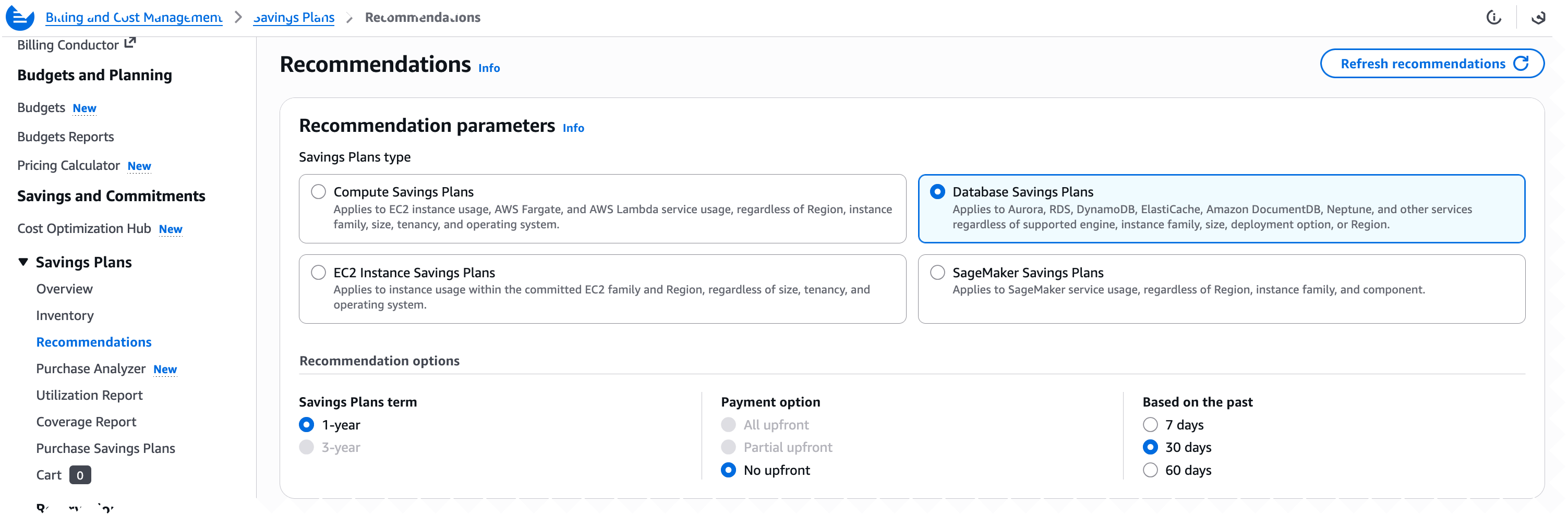
AWS Billing and Cost Management Console helps you choose Savings Plans and guides you through the purchase process. You can get started from the AWS Management Console or use the AWS Command Line Interface (AWS CLI) and the API. There are two ways to evaluate Database Savings Plans purchases, in the Recommendations view and in the Purchase Analyzer.

Recommendations – are automatically generated from your recent on-demand usage. To reach the Recommendations view in the Billing and Cost Management console, choose Savings and Commitments, Savings Plans, and Recommendations in the navigation pane. In the Recommendations view, select Database Savings Plans and configure the Recommendation options. AWS Savings Plans recommendations analyze your historical on-demand usage to identify the hourly commitment that delivers the highest overall savings.

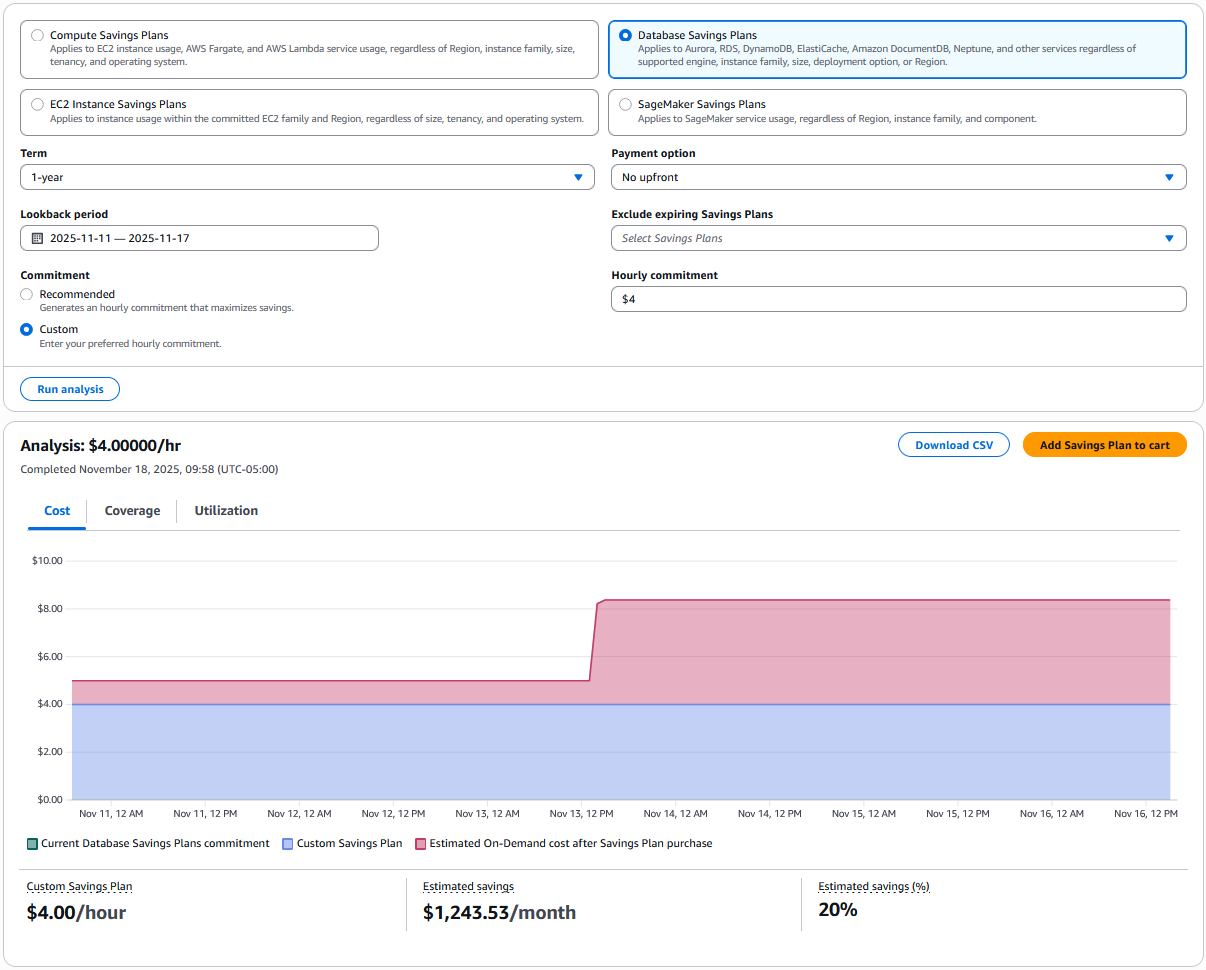
The Purchase Analyzer – is designed for modeling custom commitment levels. If you want to purchase a different amount than the recommended commitment on the Purchase Analyzer page, select Database Savings Plans and configure Lookback period and Hourly commitment to simulate alternative commitment levels and see the projected impact on Cost, Coverage, and Utilization.

This way is preferred if your purchasing strategy includes smaller, incremental commitments over time or if you expect future usage changes that could affect your ideal purchase amount.

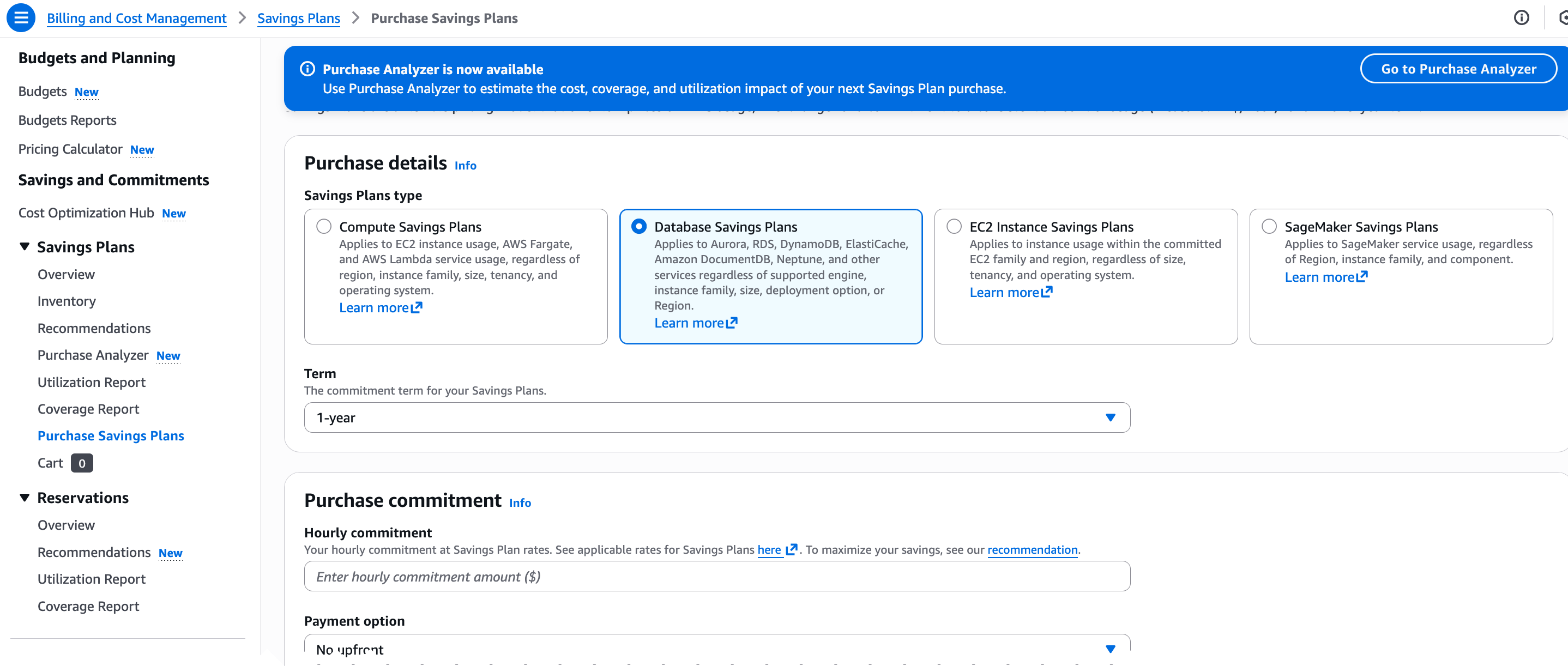
After reviewing the recommendations or running simulations in Savings Plans Recommendations or Savings Plans Purchase Analyzer, choose Add to cart to proceed with your chosen commitment. If you prefer to purchase directly, you can also navigate to the Purchase Savings Plans page. The console updates estimated discounts and coverage in real time as you adjust each setting, so you can evaluate the impact before completing your order.

You can learn more about how to choose and purchase Database Saving Plans by visiting the Savings Plans User Guide documents.

Now available
Database Savings Plans are available in all AWS Regions outside of China. Give them a try and start shaping your database strategy with more flexibility and predictable costs.

– Betty

Amazon GuardDuty adds Extended Threat Detection for Amazon EC2 and Amazon ECS

Post Syndicated from Betty Zheng (郑予彬) original https://aws.amazon.com/blogs/aws/amazon-guardduty-adds-extended-threat-detection-for-amazon-ec2-and-amazon-ecs/

Today, we’re announcing new enhancements to Amazon GuardDuty Extended Threat Detection with the addition of two attack sequence findings for Amazon Elastic Compute Cloud (Amazon EC2) instances and Amazon Elastic Container Service (Amazon ECS) tasks. These new findings build on the existing Extended Threat Detection capabilities, which already combine sequences involving AWS Identity and Access Management (IAM) credential misuse, unusual Amazon Simple Storage service (Amazon S3) bucket activity, and Amazon Elastic Kubernetes Service (Amazon EKS) cluster compromise. By adding coverage for EC2 instance groups and ECS clusters, this launch expands sequence-level visibility to virtual machine and container environments that support the same application. Together, these capabilities provide a more consistent and unified way to detect multistage activity across diverse Amazon Web Services (AWS) workloads.

Modern cloud environments are dynamic and distributed, often running virtual machines, containers, and serverless workloads at scale. Security teams strive to maintain visibility across these environments and connect related activities that might indicate complex, multistage attack sequences. These sequences can involve multiple steps, such as establishing initial access and persistence, providing missing credentials or performing unexpected data access, that unfold over time and across different sources. GuardDuty Extended Threat Detection automatically links these signals using AI and machine learning (ML) models trained at AWS scale to build a complete picture of the activity and surface high-confidence insights to help customers prioritize response actions. By combining evidence from diverse sources, this analysis produces high-fidelity, unified findings that would otherwise be difficult to infer from individual events.

How it works
Extended Threat Detection analyzes multiple types of security signals, including runtime activity, malware detections, VPC Flow Logs, DNS queries, and AWS CloudTrail events to identify patterns that represent a multistage attack across Amazon EC2 and Amazon ECS workloads. Detection works with the GuardDuty foundational plan, and turning on Runtime Monitoring for EC2 or ECS adds deeper process and network-level telemetry that strengthens signal analysis and increases the completeness of each attack sequence.

The new attack sequence findings combine runtime and other observed behaviors across the environment into a single critical-severity sequence. Each sequence includes an incident summary, a timeline of observed events, mapped MITRE ATT&CK® tactics and techniques, and remediation guidance to help you understand how the activity unfolded and which resources were affected.

EC2 instances and ECS tasks are often created and replaced automatically through Auto Scaling groups, shared launch templates, Amazon Machine Images (AMIs), IAM instance profiles, or cluster-level deployments. Because these resources commonly operate as part of the same application, activity observed across them might originate from a single underlying compromise. The new EC2 and ECS findings analyze these shared attributes and consolidate related signals into one sequence when GuardDuty detects a pattern affecting the group.

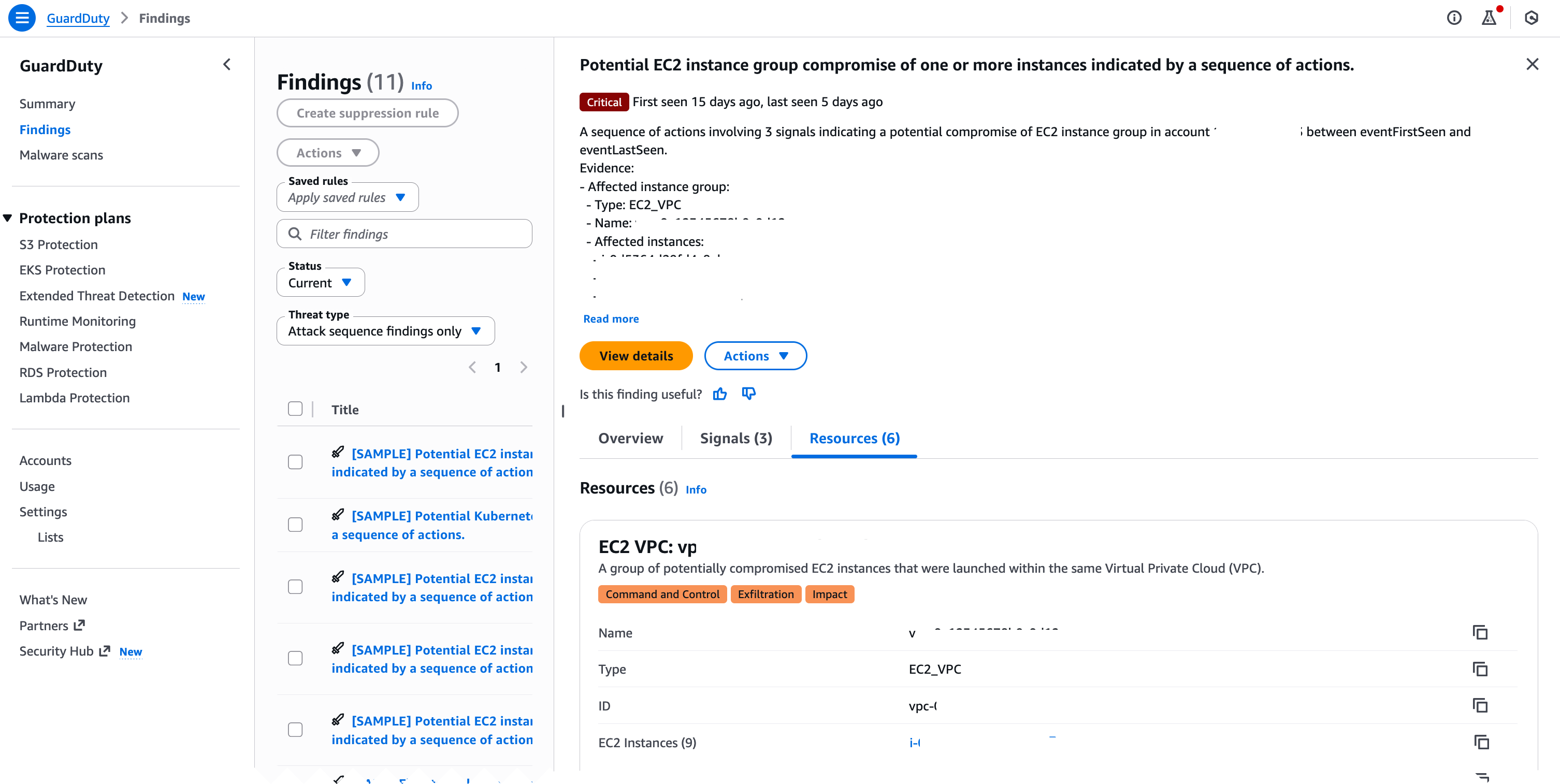
When a sequence is detected, the GuardDuty console highlights any critical-severity sequence findings on the Summary page, with the affected EC2 instance group or ECS cluster already identified. Selecting a finding opens a consolidated view that shows how the resources are connected, which signals contributed to the sequence, and how the activity progressed over time, helping you quickly understand the scope of impact across virtual machine and container workloads.

In addition to viewing sequences in the console, you can also see these findings in AWS Security Hub, where they appear on the new exposure dashboards alongside other GuardDuty findings to help you understand your overall security risk in one place. This detailed view establishes the context for interpreting how the analysis brings related signals together into a broader attack sequence.

Together, the analysis model and grouping logic give you a clearer, consolidated view of activity across virtual machine and container workloads, helping you focus on the events that matter instead of investigating numerous individual findings. By unifying related behaviors into a single sequence, Extended Threat Detection helps you assess the full context of an attack path and prioritize the most urgent remediation actions.

Now available
Amazon GuardDuty Extended Threat Detection with expanded coverage for EC2 instances and ECS tasks is now available in all AWS Regions where GuardDuty is offered. You can start using this capability today to detect coordinated, multistage activity across virtual machine and container workloads by combining signals from runtime activity, malware execution, and AWS API activity.

This expansion complements the existing Extended Threat Detection capabilities for Amazon EKS, providing unified visibility into coordinated, multistage activity across your AWS compute environment. To learn more, visit the Amazon GuardDuty product page.

Betty

AWS Weekly Roundup: Project Rainier online, Amazon Nova, Amazon Bedrock, and more (November 3, 2025)

Post Syndicated from Betty Zheng (郑予彬) original https://aws.amazon.com/blogs/aws/aws-weekly-roundup-project-rainier-online-amazon-nova-amazon-bedrock-and-more-november-3-2025/

Last week I met Jeff Barr at the AWS Shenzhen Community Day. Jeff shared stories about how builders around the world are experimenting with generative AI and encouraged local developers to keep pushing ideas into real prototypes. Many attendees stayed after the sessions to discuss model grounding, evaluation, and how to bring generative AI into real applications.
Community builders showcased creative Kiro-themed demos, AI-powered IoT projects, and student-led experiments. It was inspiring to see new developers, students, and long-time Amazon Web Services (AWS) community leaders connecting over shared curiosity and excitement for generative AI innovation.

Project Rainier, one of the world’s most powerful operational AI supercomputers is now online. Built by AWS in close collaboration with Anthropic, Project Rainier brings nearly 500,000 AWS custom-designed Trainium2 chips into service using a new Amazon Elastic Compute (Amazon EC2) UltraServer and EC2 UltraCluster architecture designed for high-bandwidth, low-latency model training at hyperscale.

Anthropic is already training and running inference for Claude on Project Rainier, and is expected to scale to more than one million Trainium2 chips across direct usage and Amazon Bedrock by the end of 2025. For architecture details, deployment insights, and behind-the-scenes video of an UltraServer coming online, refer to AWS activates Project Rainier for the full announcement.

Last week’s launches
Here are the launches that got my attention this week:

Additional updates
Here are some additional projects, blog posts, and news items that I found interesting:

  • Building production-ready 3D pipelines with AWS VAMS and 4D Pipeline – A reference architecture for creating scalable, cloud-based 3D asset pipelines using AWS Visual Asset Management System (VAMS) and 4D Pipeline, supporting ingest, validation, collaborative review, and distribution across games, visual effects (VFX), and digital twins.
  • Amazon Location Service introduces new API key restrictions – You can now create granular security policies with bundle IDs to restrict API access to specific mobile applications, improving access control and strengthening application-level security across location-based workloads.
  • AWS Clean Rooms launches advanced SQL configurations – A performance enhancement for Spark SQL workloads that supports runtime customization of Spark properties and compute sizes, plus table caching for faster and more cost-efficient processing of large analytical queries.
  • AWS Serverless MCP Server adds event source mappings (ESM) tools – A capability for event-driven serverless applications that supports configuration, performance tuning, and troubleshooting of AWS Lambda event source mappings, including AWS Serverless Application Model (AWS SAM) template generation and diagnostic insights.
  • AWS IoT Greengrass releases an AI agent context pack – A development accelerator for cloud-connected edge applications that provides ready-to-use instructions, examples, and templates, helping teams integrate generative AI tools such as Amazon Q for faster software creation, testing, and fleet-wide deployment. It’s available as open source on the GitHub repository.
  • AWS Step Functions introduces a new metrics dashboard – You can now view usage, billing, and performance metrics at the state-machine level for standard and express workflows in a single console view, improving visibility and troubleshooting for distributed applications.

Upcoming AWS events
Check your calendars so that you can sign up for these upcoming events:

  • AWS Builder Loft – A community tech space in San Francisco where you can learn from expert sessions, join hands-on workshops, explore AI and emerging technologies, and collaborate with other builders to accelerate their ideas. Browse the upcoming sessions and join the events that interest you.
  • AWS Community Days – Join community-led conferences that feature technical discussions, workshops, and hands-on labs led by experienced AWS users and industry leaders from around the world: Hong Kong (November 2), Abuja (November 8), Cameroon (November 8), and Spain (November 15).
  • AWS Skills Center Seattle 4th Anniversary Celebration – A free, public event on November 20 with a keynote, learned panels, recruiter insights, raffles, and virtual participation options.

Join the AWS Builder Center to learn, build, and connect with builders in the AWS community. Browse here for upcoming in-person events, developer-focused events, and events for startups.

That’s all for this week. Check back next Monday for another Weekly Roundup!

Betty

Introducing AWS RTB Fabric for real-time advertising technology workloads

Post Syndicated from Betty Zheng (郑予彬) original https://aws.amazon.com/blogs/aws/introducing-aws-rtb-fabric-for-real-time-advertising-technology-workloads/

Today, we’re announcing AWS RTB Fabric, a fully managed service purpose built for real-time bidding (RTB) advertising workloads. The service helps advertising technology (AdTech) companies seamlessly connect with their supply and demand partners, such as Amazon Ads, GumGum, Kargo, MobileFuse, Sovrn, TripleLift, Viant, Yieldmo and more, to run high-volume, latency-sensitive RTB workloads on Amazon Web Services (AWS) with consistent single-digit millisecond performance and up to 80% lower networking costs compared to standard networking costs.

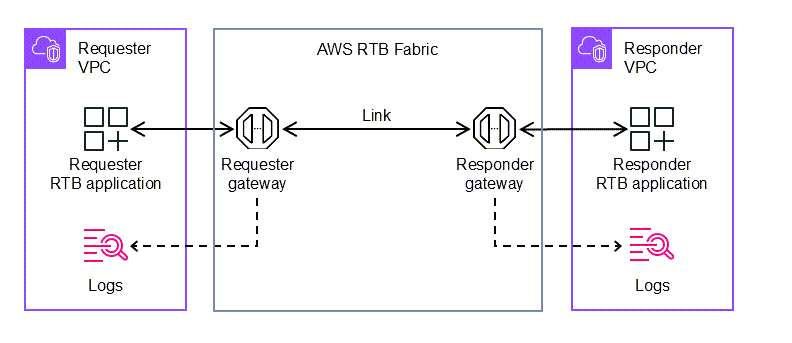
AWS RTB Fabric provides a dedicated, high-performance network environment for RTB workloads and partner integrations without requiring colocated, on-premises infrastructure or upfront commitments. The following diagram shows the high-level architecture of RTB Fabric.

AWS RTB Fabric also includes modules, a capability that helps customers bring their own and partner applications securely into the compute environment used for real-time bidding. Modules support containerized applications and foundation models (FMs) that can enhance transaction efficiency and bidding effectiveness. At launch, AWS RTB Fabric includes modules for optimizing traffic management, improving bid efficiency, and increasing bid response rates, all running inline within the service for consistent low-latency execution.

The growth of programmatic advertising has created a need for low-latency, cost-efficient infrastructure to support RTB workloads. AdTech companies process millions of bid requests per second across publishers, supply-side platforms (SSPs), and demand-side platforms (DSPs). These workloads are highly sensitive to latency because most RTB auctions must complete within 200–300 milliseconds and require reliable, high-speed exchange of OpenRTB requests and responses among multiple partners. Many companies have addressed this by deploying infrastructure in colocation data centers near key partners, which reduces latency but adds operational complexity, long provisioning cycles, and high costs. Others have turned to cloud infrastructure to gain elasticity and scale, but they often face complex provisioning, partner-specific connectivity, and long-term commitments to achieve cost efficiency. These gaps add operational overhead and limit agility. AWS RTB Fabric solves these challenges by providing a managed private network built for RTB workloads that delivers consistent performance, simplifies partner onboarding, and achieves predictable cost efficiency without the burden of maintaining colocation or custom networking setups.

Key capabilities
AWS RTB Fabric introduces a managed foundation for running RTB workloads at scale. The service provides the following key capabilities:

  • Simplified connectivity to AdTech partners – When you register an RTB Fabric gateway, the service automatically generates secure endpoints that can be shared with selected partners. Using the AWS RTB Fabric API, you can create optimized, private connections to exchange RTB traffic securely across different environments. External Links are also available to connect with partners who aren’t using RTB Fabric, such as those operating on premises or in third-party cloud environments. This approach shortens integration time and simplifies collaboration among AdTech participants.
  • Dedicated network for low-latency advertising transactions – AWS RTB Fabric provides a managed, high-performance network layer optimized for OpenRTB communication. It connects AdTech participants such as SSPs, DSPs, and publishers through private, high-speed links that deliver consistent single-digit millisecond latency. The service automatically optimizes routing paths to maintain predictable performance and reduce networking costs, without requiring manual peering or configuration.
  • Pricing model aligned with RTB economics – AWS RTB Fabric uses a transaction-based pricing model designed to align with programmatic advertising economics. Customers are billed per billion transactions, providing predictable infrastructure costs that align with how advertising exchanges, SSPs, and DSPs operate.
  • Built-in traffic management modules – AWS RTB Fabric includes configurable modules that help AdTech workloads operate efficiently and reliably. Modules such as Rate Limiter, OpenRTB Filter, and Error Masking help you control request volume, validate message formats, and manage response handling directly in the network path. These modules execute inline within the AWS RTB Fabric environment, maintaining network-speed performance without adding application-level latency. All configurations are managed through the AWS RTB Fabric API, so you can define and update rules programmatically as your workloads scale.

Getting started
Today, you can start building with AWS RTB Fabric using the AWS Management Console, AWS Command Line Interface (AWS CLI), or infrastructure-as-code (IaC) tools such as AWS CloudFormation and Terraform.

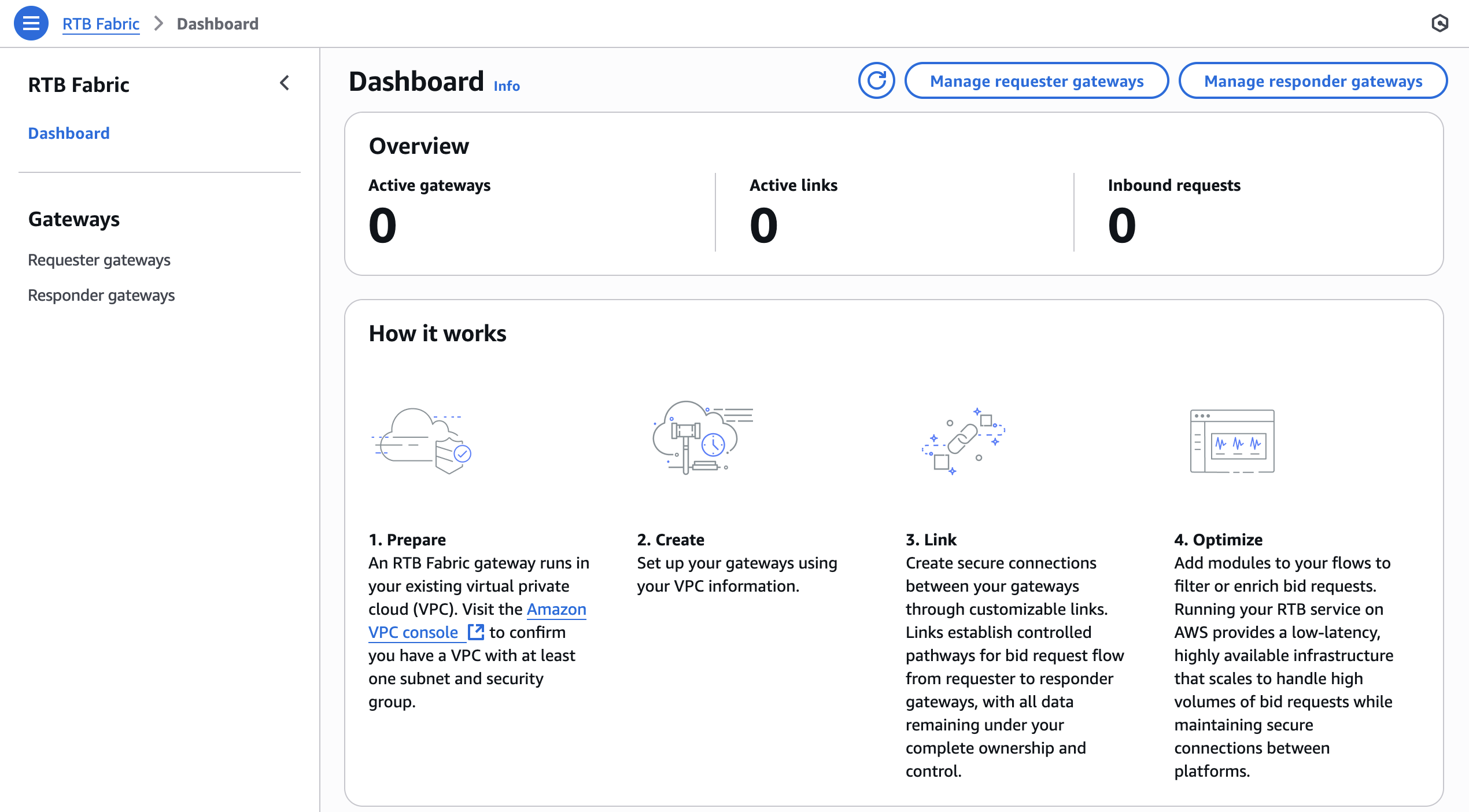
The console provides a visual entry point to view and manage RTB gateways and links, as shown on the Dashboard of the AWS RTB Fabric console.

You can also use the AWS CLI to configure gateways, create links, and manage traffic programmatically. When I started building with AWS RTB Fabric, I used the AWS CLI to configure everything from gateway creation to link setup and traffic monitoring. The setup ran inside my Amazon Virtual Private Cloud (Amazon VPC) endpoint while AWS managed the low-latency infrastructure that connected workloads.

To begin, I created a requester gateway to send bid requests and a responder gateway to receive and process bid responses. These gateways act as secure communication points within the AWS RTB Fabric.

# Create a requester gateway with required parameters
aws rtbfabric create-requester-gateway \
  --description "My RTB requester gateway" \
  --vpc-id vpc-12345678 \
  --subnet-ids subnet-abc12345 subnet-def67890 \
  --security-group-ids sg-12345678 \
  --client-token "unique-client-token-123"
# Create a responder gateway with required parameters
aws rtbfabric create-responder-gateway \
  --description "My RTB responder gateway" \
  --vpc-id vpc-01f345ad6524a6d7 \
  --subnet-ids subnet-abc12345 subnet-def67890 \
  --security-group-ids sg-12345678 \
  --dns-name responder.example.com \
  --port 443 \
  --protocol HTTPS

After both gateways were active, I created a link from the requester to the responder to establish a private, low-latency communication path for OpenRTB traffic. The link handled routing and load balancing automatically.

# Requester account creating a link from requester gateway to a responder gateway
aws rtbfabric create-link \
  --gateway-id rtb-gw-requester123 \
  --peer-gateway-id rtb-gw-responder456 \
  --log-settings '{"applicationLogs:{"sampling":"errorLog":10.0,"filterLog":10.0}}'
# Responder account accepting a link from requester gateway to responder gateway
aws rtbfabric accept-link \
  --gateway-id rtb-gw-responder456 \
  --link-id link-reqtoresplink789 \
  --log-settings '{"applicationLogs:{"sampling":"errorLog":10.0,"filterLog":10.0}}'

I also connected with external partners using External Links, which extended my RTB workloads to on-premises or third-party environments while maintaining the same latency and security characteristics.

# Create an inbound external link endpoint for an external partner to send bid requests to
aws rtbfabric create-inbound-external-link \
  --gateway-id rtb-gw-responder456
# Create an outbound external link for sending bid requests to an external partner
aws rtbfabric create-outbound-external-link \
  --gateway-id rtb-gw-requester123 \
  --public-endpoint "https://my-external-partner-responder.com"

To manage traffic efficiently, I added modules directly into the data path. The Rate Limiter module controlled request volume, and the OpenRTB Filter validated message formats inline at network speed.

# Attach a rate limiting module
aws rtbfabric update-link-module-flow \
  --gateway-id rtb-gw-responder456 \
  --link-id link-toresponder789 \
  --modules '{"name":"RateLimiter":"moduleParameters":{"rateLimiter":{"tps":10000}}}'

Finally, I used Amazon CloudWatch to monitor throughput, latency, and module performance, and I exported logs to Amazon Simple Storage Service (Amazon S3) for auditing and optimization.

All configurations can also be automated with AWS CloudFormation or Terraform, allowing consistent, repeatable deployment across multiple environments. With RTB Fabric, I could focus on optimizing bidding logic while AWS maintained predictable, single-digit millisecond performance across my AdTech partners.

For more details, refer to the AWS RTB Fabric User Guide.

Now available
AWS RTB Fabric is available today in the following AWS Regions: US East (N. Virginia), US West (Oregon), Asia Pacific (Singapore), Asia Pacific (Tokyo), Europe (Frankfurt), and Europe (Ireland).

AWS RTB Fabric is continually evolving to address the changing needs of the AdTech industry. The service expands its capabilities to support secure integration of advanced applications and AI-driven optimizations in real-time bidding workflows that help customers simplify operations and improve performance on AWS. To learn more about AWS RTB Fabric, visit the AWS RTB Fabric page.

Betty

AWS Transfer Family SFTP connectors now support VPC-based connectivity

Post Syndicated from Betty Zheng (郑予彬) original https://aws.amazon.com/blogs/aws/aws-transfer-family-sftp-connectors-now-support-vpc-based-connectivity/

Many organizations rely on the Secure File Transfer Protocol (SFTP) as the industry standard for exchanging critical business data. Traditionally, securely connecting to private SFTP servers required custom infrastructure, manual scripting, or exposing endpoints to the public internet.

Today, AWS Transfer Family SFTP connectors now support connectivity to remote SFTP servers through Amazon Virtual Private Cloud (Amazon VPC) environments. You can transfer files between Amazon Simple Storage Service (Amazon S3) and private or public SFTP servers while applying the security controls and network configurations already defined in your VPC. This capability helps you integrate data sources across on-premises environments, partner-hosted private servers, or internet-facing endpoints, with the operational simplicity of a fully managed Amazon Web Services (AWS) service.

New capabilities with SFTP connectors
The following are the key enhancements:

  • Connect to private SFTP servers – SFTP connectors can now reach endpoints that are only accessible within your AWS VPC connection. These include servers hosted in your VPC or a shared VPC, on-premises systems connected over AWS Direct Connect, and partner-hosted servers connected through VPN tunnels.
  • Security and compliance – All file transfers are routed through the security controls already applied in your VPC, such as AWS Network Firewall or centralized ingress and egress inspection. Private SFTP servers remain private and don’t need to be exposed to the internet. You can also present static Elastic IP or bring your own IP (BYOIP) addresses to meet partner allowlist requirements.
  • Performance and simplicity – By using your own network resources such as NAT gateways, AWS Direct Connect or VPN connections, connectors can take advantage of higher bandwidth capacity for large-scale transfers. You can configure connectors in minutes through the AWS Management Console,  AWS Command Line Interface (AWS CLI), or AWS SDKs without building custom scripts or third-party tools.

How VPC- based SFTP connections work
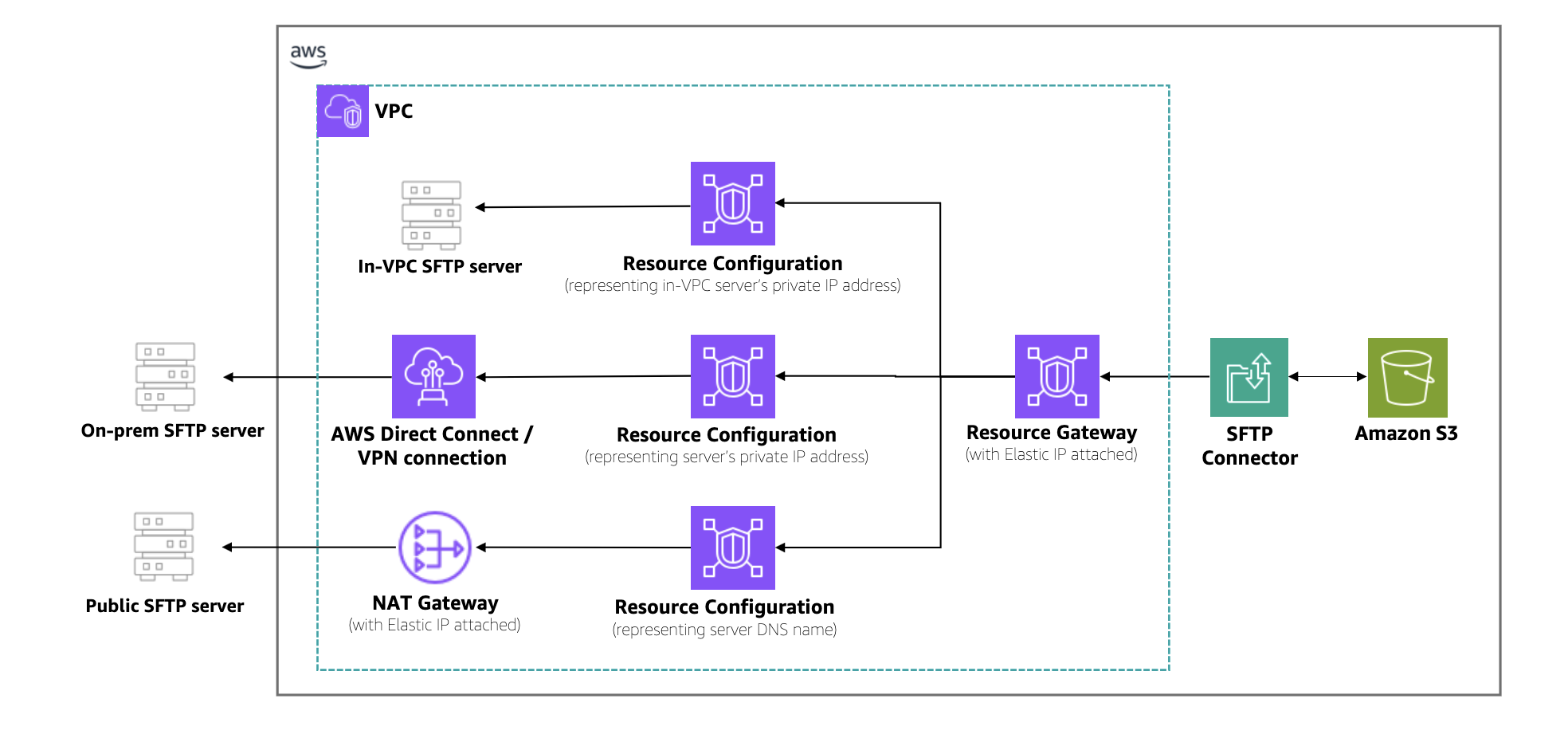
SFTP connectors use Amazon VPC Lattice resources to establish secure connectivity through your VPC. Key constructs include a resource configuration and a resource gateway. The resource configuration represents the target SFTP server, which you specify using a private IP address or public DNS name. The resource gateway provides SFTP connector access to these configurations, enabling file transfers to flow through your VPC and its security controls.

The following architecture diagram illustrates how traffic flows between Amazon S3 and remote SFTP servers. As shown in the architecture, traffic flows from Amazon S3 through the SFTP connector into your VPC. A resource gateway is the entry point that handles inbound connections from the connector to your VPC resources. Outbound traffic is routed through your configured egress path, using Amazon VPC NAT gateways with Elastic IPs for public servers or AWS Direct Connect and VPN connections for private servers. You can use existing IP addresses from your VPC CIDR range, simplifying partner server allowlists. Centralized firewalls in the VPC enforce security policies, and customer-owned NAT gateways provide higher bandwidth for large-scale transfers.

When to use this feature
With this capability, developers and IT administrators can simplify workflows while meeting security and compliance requirements across a range of scenarios:

  • Hybrid environments – Transfer files between Amazon S3 and on-premises SFTP servers using AWS Direct Connect or AWS Site-to-Site VPN, without exposing endpoints to the internet.
  • Partner integrations – Connect with business partners’ SFTP servers that are only accessible through private VPN tunnels or shared VPCs. This avoids building custom scripts or managing third-party tools, reducing operational complexity.
  • Regulated industries – Route file transfers through centralized firewalls and inspection points in VPCs to comply with financial services, government, or healthcare security requirements.
  • High-throughput transfers – Use your own network configurations such as NAT gateways, AWS Direct Connect, or VPN connections with Elastic IP or BYOIP to handle large-scale, high-bandwidth transfers while retaining IP addresses already on partner allowlists.
  • Unified file transfer solution – Standardize on Transfer Family for both internal and external SFTP connectivity, reducing fragmentation across file transfer tools.

Start building with SFTP connectors
To begin transferring files with SFTP connectors through my VPC environment, I follow these steps:

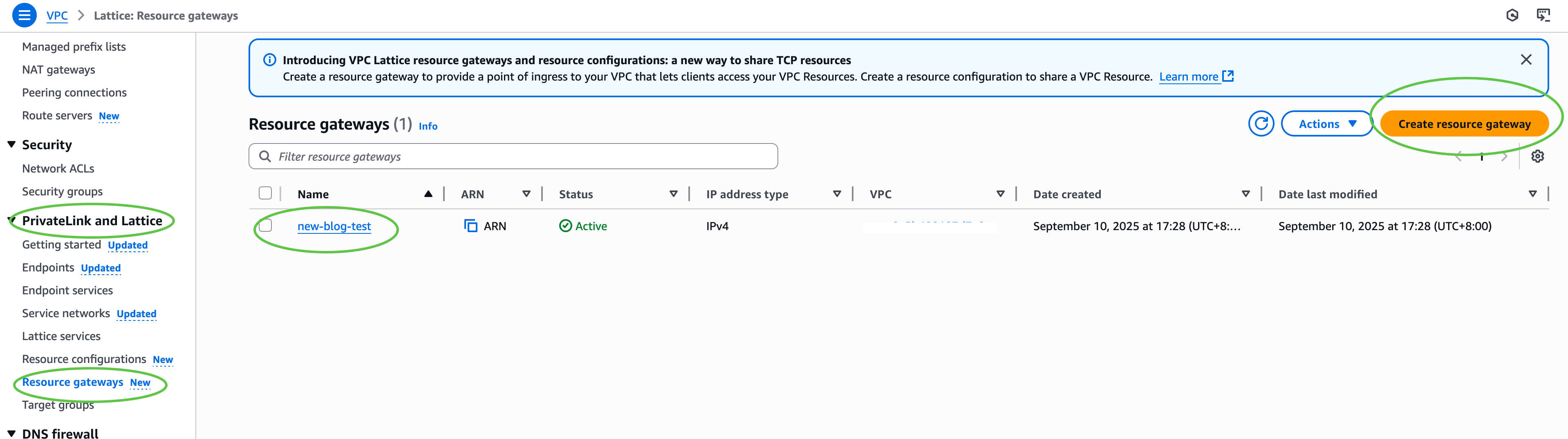
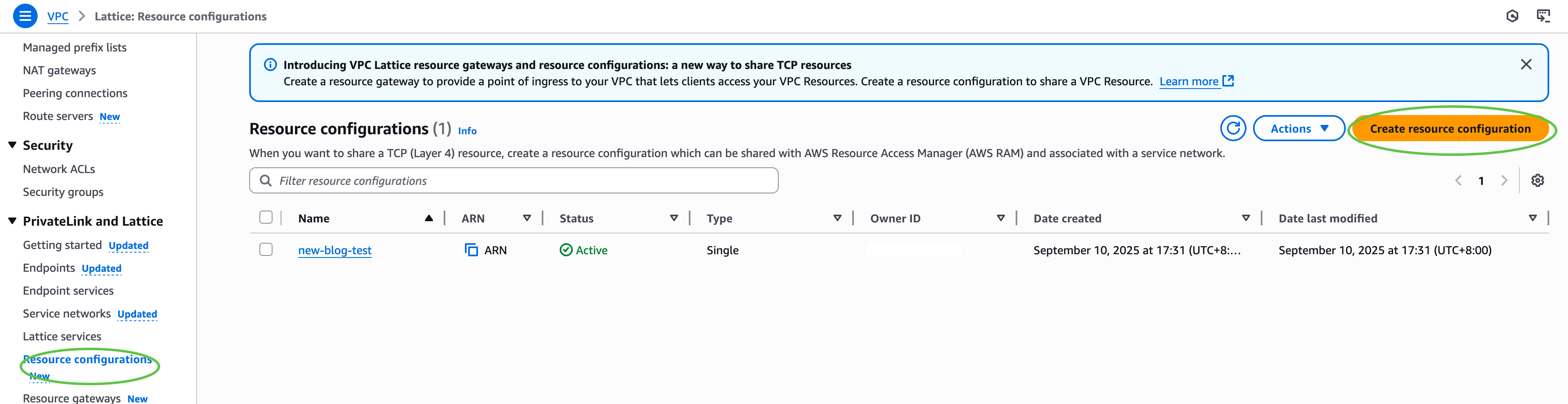
First, I configure my VPC Lattice resources. In the Amazon VPC console, under PrivateLink and Lattice in the navigation pane, I choose Resource gateways, choose Create resource gateway to create one to act as the ingress point into my VPC. Next, under PrivateLink and Lattice in the navigation pane, I choose Resource configuration and choose Create resource configuration to create a resource configuration for my target SFTP server. Specify the private IP address or public DNS name, and the port (typically 22).

Then, I configure AWS Identity and Access Management (IAM) permissions. I ensure that the IAM role used for connector creation has transfer:* permissions, and VPC Lattice permissions (vpc-lattice:CreateServiceNetworkResourceAssociation, vpc-lattice:GetResourceConfiguration, vpc-lattice:AssociateViaAWSService). I update the trust policy on the IAM role to specify transfer.amazonaws.com as a trusted principal. This enables AWS Transfer Family to assume the role when creating and managing my SFTP connectors.

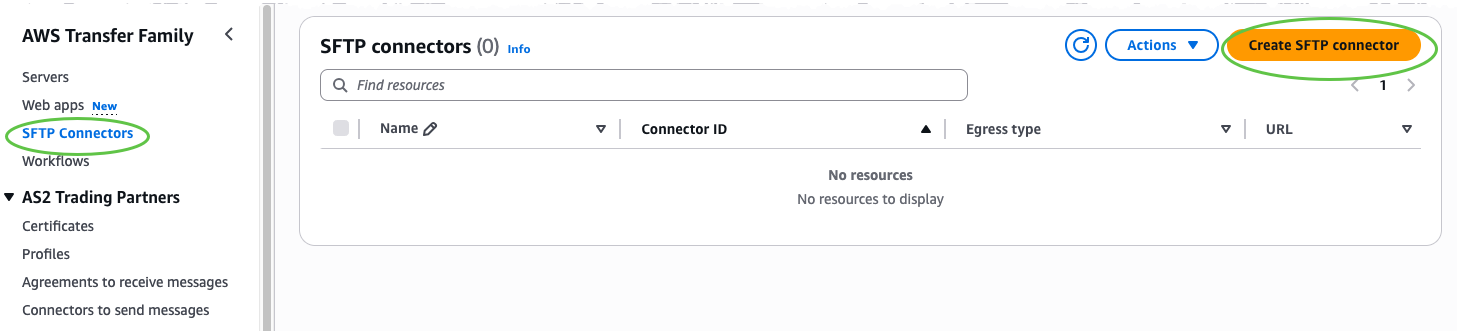
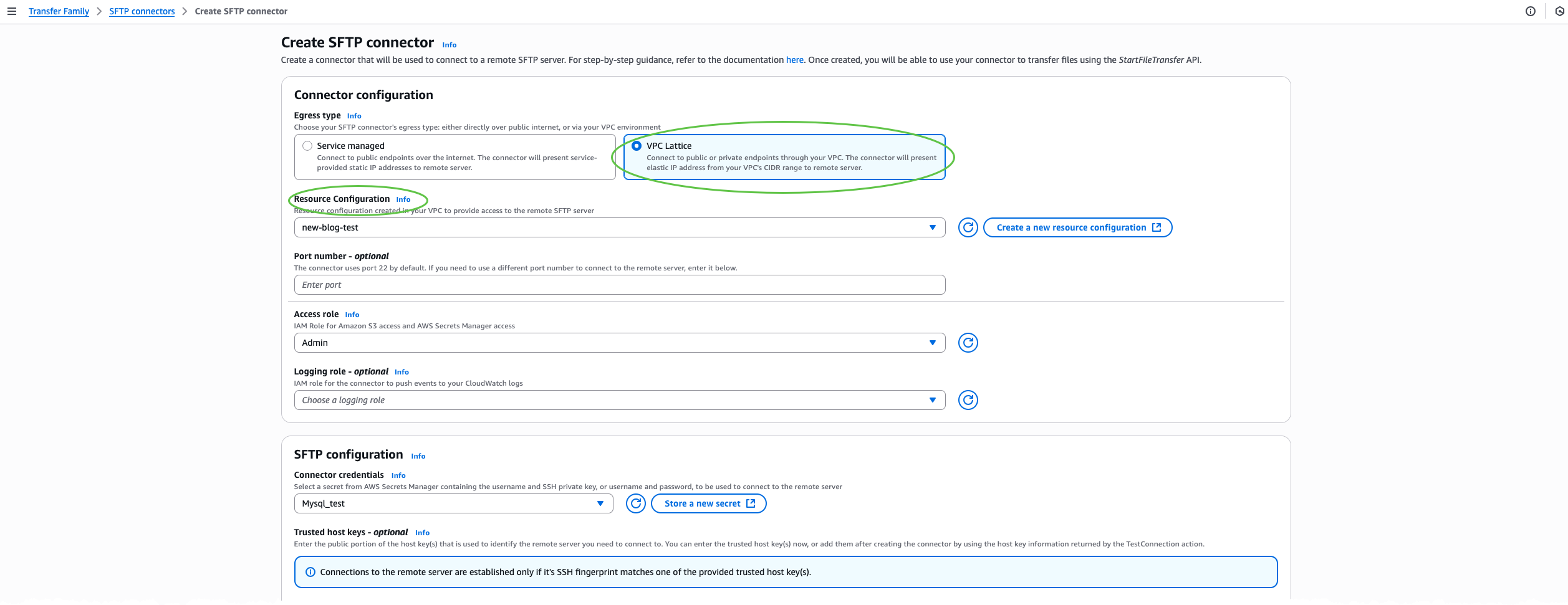
After that, I create an SFTP connector through the AWS Transfer Family console. I choose SFTP Connectors and then choose Create SFTP connector. In the Connector configuration section, I select VPC Lattice as the egress type, then provide the Amazon Resource Name (ARN) of the Resource Configuration, Access role, and Connector credentials. Optionally, include a trusted host key for enhanced security, or override the default port if my SFTP server uses a nonstandard port.

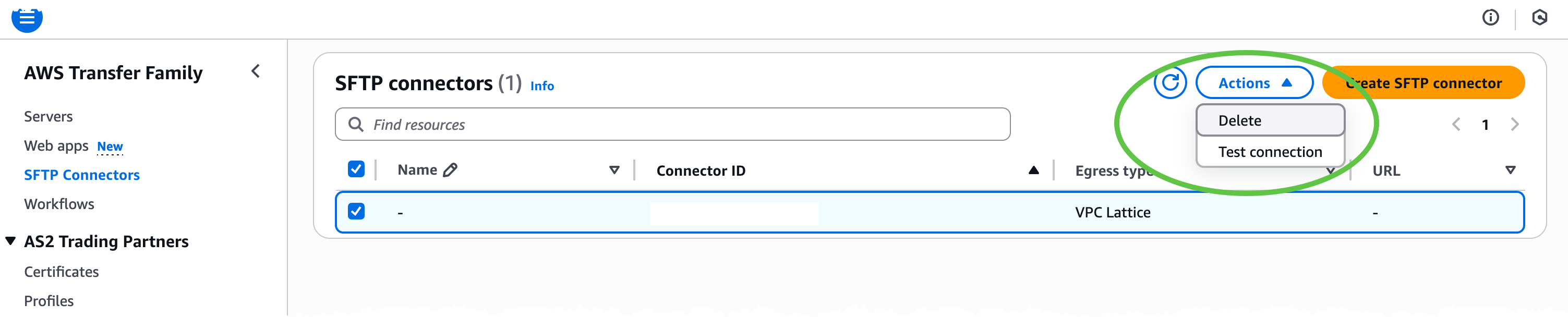
Next, I test the connection. On the Actions menu, I choose Test connection to confirm that the connector can reach the target SFTP server.

Finally, after the connector status is ACTIVE, I can begin file operations with my remote SFTP server programmatically by calling Transfer Family APIs such as StartDirectoryListing, StartFileTransfer, StartRemoteDelete, or StartRemoteMove. All traffic is routed through my VPC using my configured resources such as NAT gateways, AWS Direct Connect, or VPN connections together with my IP addresses and security controls.

For the complete set of options and advanced workflows, refer to the AWS Transfer Family documentation.

Now available

SFTP connectors with VPC-based connectivity are now available in 21 AWS Regions. Check the AWS Services by Region for the latest supported AWS Regions. You can now securely connect AWS Transfer Family SFTP connectors to private, on-premises, or internet-facing servers using your own VPC resources such as NAT gateways, Elastic IPs, and network firewalls.

Betty

New general-purpose Amazon EC2 M8a instances are now available

Post Syndicated from Betty Zheng (郑予彬) original https://aws.amazon.com/blogs/aws/new-general-purpose-amazon-ec2-m8a-instances-are-now-available/

Today, we’re announcing the availability of Amazon Elastic Compute Cloud (Amazon EC2) M8a instances, the latest addition to the general-purpose M instance family. These instances are powered by the 5th Generation AMD EPYC (codename Turin) processors with a maximum frequency of 4.5GHz. Customers can expect up to 30% higher performance and up to 19% better price performance compared to M7a instances. They also provide higher memory bandwidth, improved networking and storage throughput, and flexible configuration options for a broad set of general-purpose workloads.

Improvements in M8a
M8a instances deliver up to 30% better performance per vCPU compared to M7a instances, making them ideal for applications that require benefit from high performance and high throughput such as financial applications, gaming, rendering, application servers, simulation modeling, midsize data stores, application development environments, and caching fleets.

They provide 45% more memory bandwidth compared to M7a instances, accelerating in-memory databases, distributed caches, and real-time analytics.

For workloads with high I/O requirements, M8a instances provide up to 75 Gbps of networking bandwidth and 60 Gbps of Amazon Elastic Block Store (Amazon EBS) bandwidth, a 50% improvement over the previous generation. These enhancements support modern applications that rely on rapid data transfer and low-latency network communication.

Each vCPU on an M8a instance corresponds to a physical CPU core, meaning there is no simultaneous multithreading (SMT). In application benchmarks, M8a instances delivered up to 60% faster performance for GroovyJVM and up to 39% faster performance for Cassandra compared to M7a instances.

M8a instances support instance bandwidth configuration (IBC), which provides flexibility to allocate resources between networking and EBS bandwidth. This gives customers the flexibility to scale network or EBS bandwidth by up to 25% and improve database performance, query processing, and logging speeds.

M8a is available in ten virtualized sizes and two bare metal options (metal-24xl and metal-48xl), providing deployment choices that scale from small applications to large enterprise workloads. All of these improvements are built on the AWS Nitro System, which delivers low virtualization overhead, consistent performance, and advanced security across all instance sizes. These instances are built using the latest sixth generation AWS Nitro Cards, which offload and accelerate I/O for functions, increasing overall system performance.

M8a instances feature sizes of up to 192 vCPU with 768GiB RAM. Here are the detailed specs:

M8a vCPUs Memory (GiB) Network bandwidth (Gbps) EBS bandwidth (Gbps)
medium 1 4 Up to 12.5 Up to 10
large 2 8 Up to 12.5 Up to 10
xlarge 4 16 Up to 12.5 Up to 10
2xlarge 8 32 Up to 15 Up to 10
4xlarge 16 64 Up to 15 Up to 10
8xlarge 32 128 15 10
12xlarge 48 192 22.5 15
16xlarge 64 256 30 20
24xlarge 96 384 40 30
48xlarge 192 768 75 60
metal-24xl 96 384 40 30
metal-48xl 192 768 75 60

For a complete list of instance sizes and specifications, refer to the Amazon EC2 M8a instances page.

When to use M8a instances
M8a is a strong fit for general-purpose applications that need a balance of compute, memory, and networking. M8a instances are ideal for web and application hosting, microservices architectures, and databases where predictable performance and efficient scaling are important.

These instances are SAP certified and also well suited for enterprise workloads such as financial applications and enterprise resource planning (ERP) systems. They’re equally effective for in-memory caching and customer relationship management (CRM), in addition to development and test environments that require cost efficiency and flexibility. With this versatility, M8a supports a wide spectrum of workloads while helping customers improve price performance.

Now available
Amazon EC2 M8a instances are available today in US East (Ohio) US West (Oregon) and Europe (Spain) AWS Regions. M8a instances can be purchased as On-Demand, Savings Plans, and Spot Instances. M8a instances are also available on Dedicated Hosts. To learn more, visit the Amazon EC2 Pricing page.

To learn more, visit the Amazon EC2 M8a instances page and send feedback to AWS re:Post for EC2 or through your usual AWS support contacts.

Betty

AWS Weekly Roundup: Amazon Aurora 10th anniversary, Amazon EC2 R8 instances, Amazon Bedrock and more (August 25, 2025)

Post Syndicated from Betty Zheng (郑予彬) original https://aws.amazon.com/blogs/aws/aws-weekly-roundup-amazon-aurora-10th-anniversary-amazon-ec2-r8-instances-amazon-bedrock-and-more-august-25-2025/

As I was preparing for this week’s roundup, I couldn’t help but reflect on how database technology has evolved over the past decade. It’s fascinating to see how architectural decisions made years ago continue to shape the way we build modern applications. This week brings a special milestone that perfectly captures this evolution in cloud database innovation as Amazon Aurora celebrated 10 years of database innovation.

Birthday cake with words Happy Birthday Amazon Aurora!

Amazon Web Services (AWS) Vice President Swami Sivasubramanian reflected on LinkedIn about his journey with Amazon Aurora, calling it “one of the most interesting products” he’s worked on. When Aurora launched in 2015, it shifted the database landscape by separating compute and storage. Now trusted by hundreds of thousands of customers across industries, Aurora has grown from a MySQL-compatible database to a comprehensive platform featuring innovations such as Aurora DSQL, serverless capabilities, I/O-Optimized pricing, zero-ETL integrations, and generative AI support. Last week’s celebration on August 21 highlighted this decade-long transformation that continues to simplify database scaling for customers.

Last week’s launches

In addition to the inspiring celebrations, here are some AWS launches that caught my attention:

  • AWS Billing and Cost Management introduces customizable Dashboards — This new feature consolidates cost data into visual dashboards with multiple widget types and visualization options, combining information from Cost Explorer, Savings Plans, and Reserved Instance reports to help organizations track spending patterns and share standardized cost reporting across accounts.
  • Amazon Bedrock simplifies access to OpenAI open weight models — AWS has streamlined access to OpenAI’s open weight models (gpt-oss-120b and gpt-oss-20b), making them automatically available to all users without manual activation while maintaining administrator control through IAM policies and service control policies.
  • Amazon Bedrock adds batch inference support for Claude Sonnet 4 and GPT-OSS models —This feature provides asynchronous processing of multiple inference requests with 50 percent lower pricing compared to on-demand inference, optimizing high-volume AI tasks such as document analysis, content generation, and data extraction with Amazon CloudWatch metrics for tracking batch workload progress
  • AWS launching Amazon EC2 R8i and R8i-flex memory-optimized instances — Powered by custom Intel Xeon 6 processors, these new instances deliver up to 20 percent better performance and 2.5 times higher memory throughput than R7i instances, making them ideal for memory-intensive workloads like databases and big data analytics, with R8i-flex offering additional cost savings for applications that don’t fully utilize compute resources.
  • Amazon S3 introduces batch data verification feature — A new capability in S3 Batch Operations that offers efficient verification of billions of objects using multiple checksum algorithms without downloading or restoring data, generating detailed integrity reports for compliance and audit purposes regardless of storage class or object size.

Other AWS news

Here are some additional projects and blog posts that you might find interesting:

  • Amazon introduces DeepFleet foundation models for multirobot coordination — Trained on millions of hours of data from Amazon fulfillment and sortation centers, these pioneering models predict future traffic patterns for robot fleets, representing the first foundation models specifically designed for coordinating multiple robots in complex environments.
  • Building Strands Agents with a few lines of code — A new blog demonstrates how to build multi-agent AI systems with a few lines of code, enabling specialized agents to collaborate seamlessly, handle complex workflows, and share information through standardized protocols for creating distributed AI systems beyond individual agent capabilities.
  • AWS Security Incident Response introduces ITSM integrations — New integrations with Jira and ServiceNow provide bidirectional synchronization of security incidents, comments, and attachments, streamlining response while maintaining existing processes, with open source code available on GitHub for customization and extension to additional IT service management (ITSM) platforms.
  • Finding root-causes using a network digital twin graph and agentic AI — A detailed blog post shows how AWS collaborated with NTT DOCOMO to build a network digital twin using graph databases and autonomous AI agents, helping telecom operators to move beyond correlation to identify true root causes of complex network issues, predict future problems, and improve overall service reliability.

Upcoming AWS events
Check your calendars and sign up for these upcoming AWS events:

  • AWS Summits — Join free online and in-person events that bring the cloud computing community together to connect, collaborate, and learn about AWS. Register in your nearest city: Toronto (September 4), Los Angeles (September 17), and Bogotá (October 9).
  • AWS re:Invent 2025 — This flagship annual conference is coming to Las Vegas from December 1–5. The event catalog is now available. Mark your calendars for this not to be missed gathering of the AWS community.
  • AWS Community Days — Join community-led conferences that feature technical discussions, workshops, and hands-on labs led by expert AWS users and industry leaders from around the world: Adria (September 5), Baltic (September 10), Aotearoa (September 18), South Africa (September 20), Bolivia (September 20), Portugal (September 27).

Join the AWS Builder Center to learn, build, and connect with builders in the AWS community. Browse here for upcoming in-person and virtual developer-focused events.

That’s all for this week. Check back next Monday for another Weekly Roundup!

Betty

Announcing Amazon Nova customization in Amazon SageMaker AI

Post Syndicated from Betty Zheng (郑予彬) original https://aws.amazon.com/blogs/aws/announcing-amazon-nova-customization-in-amazon-sagemaker-ai/

Today, we’re announcing a suite of customization capabilities for Amazon Nova in Amazon SageMaker AI. Customers can now customize Nova Micro, Nova Lite, and Nova Pro across the model training lifecycle, including pre-training, supervised fine-tuning, and alignment. These techniques are available as ready-to-use Amazon SageMaker recipes with seamless deployment to Amazon Bedrock, supporting both on-demand and provisioned throughput inference.

Amazon Nova foundation models power diverse generative AI use cases across industries. As customers scale deployments, they need models that reflect proprietary knowledge, workflows, and brand requirements. Prompt optimization and retrieval-augmented generation (RAG) work well for integrating general-purpose foundation models into applications, however business-critical workflows require model customization to meet specific accuracy, cost, and latency requirements.

Choosing the right customization technique
Amazon Nova models support a range of customization techniques including: 1) supervised fine-tuning, 2) alignment, 3) continued pre-training, and 4) knowledge distillation. The optimal choice depends on goals, use case complexity, and the availability of data and compute resources. You can also combine multiple techniques to achieve your desired outcomes with the preferred mix of performance, cost, and flexibility.

Supervised fine-tuning (SFT) customizes model parameters using a training dataset of input-output pairs specific to your target tasks and domains. Choose from the following two implementation approaches based on data volume and cost considerations:

  • Parameter-efficient fine-tuning (PEFT) — updates only a subset of model parameters through lightweight adapter layers such as LoRA (Low-Rank Adaptation). It offers faster training and lower compute costs compared to full fine-tuning. PEFT-adapted Nova models are imported to Amazon Bedrock and invoked using on-demand inference.
  • Full fine-tuning (FFT) — updates all the parameters of the model and is ideal for scenarios when you have extensive training datasets (tens of thousands of records). Nova models customized through FFT can also be imported to Amazon Bedrock and invoked for inference with provisioned throughput.

Alignment steers the model output towards desired preferences for product-specific needs and behavior, such as company brand and customer experience requirements. These preferences may be encoded in multiple ways, including empirical examples and policies. Nova models support two preference alignment techniques:

  • Direct preference optimization (DPO) — offers a straightforward way to tune model outputs using preferred/not preferred response pairs. DPO learns from comparative preferences to optimize outputs for subjective requirements such as tone and style. DPO offers both a parameter-efficient version and a full-model update version. The parameter-efficient version supports on-demand inference.
  • Proximal policy optimization (PPO) — uses reinforcement learning to enhance model behavior by optimizing for desired rewards such as helpfulness, safety, or engagement. A reward model guides optimization by scoring outputs, helping the model learn effective behaviors while maintaining previously learned capabilities.

Continued pre-training (CPT) expands foundational model knowledge through self-supervised learning on large quantities of unlabeled proprietary data, including internal documents, transcripts, and business-specific content. CPT followed by SFT and alignment through DPO or PPO provides a comprehensive way to customize Nova models for your applications.

Knowledge distillation transfers knowledge from a larger “teacher” model to a smaller, faster, and more cost-efficient “student” model. Distillation is useful in scenarios where customers do not have adequate reference input-output samples and can leverage a more powerful model to augment the training data. This process creates a customized model of teacher-level accuracy for specific use cases and student-level cost-effectiveness and speed.

Here is a table summarizing the available customization techniques across different modalities and deployment options. Each technique offers specific training and inference capabilities depending on your implementation requirements.

Recipe Modality Training Inference
Amazon Bedrock Amazon SageMaker Amazon Bedrock On-demand Amazon Bedrock Provisioned Throughput
Supervised fine tuning Text, image, video
Parameter-efficient fine-tuning (PEFT) ✅ ✅ ✅ ✅
Full fine-tuning ✅ ✅
Direct preference optimization (DPO)  Text, image, video
Parameter-efficient DPO ✅ ✅ ✅
Full model DPO ✅ ✅
Proximal policy optimization (PPO)  Text-only ✅ ✅
Continuous pre-training  Text-only ✅ ✅
Distillation Text-only ✅ ✅ ✅ ✅

Early access customers, including Cosine AI, Massachusetts Institute of Technology (MIT) Computer Science and Artificial Intelligence Laboratory (CSAIL), Volkswagen, Amazon Customer Service, and Amazon Catalog Systems Service, are already successfully using Amazon Nova customization capabilities.

Customizing Nova models in action
The following walks you through an example of customizing the Nova Micro model using direct preference optimization on an existing preference dataset. To do this, you can use Amazon SageMaker Studio.

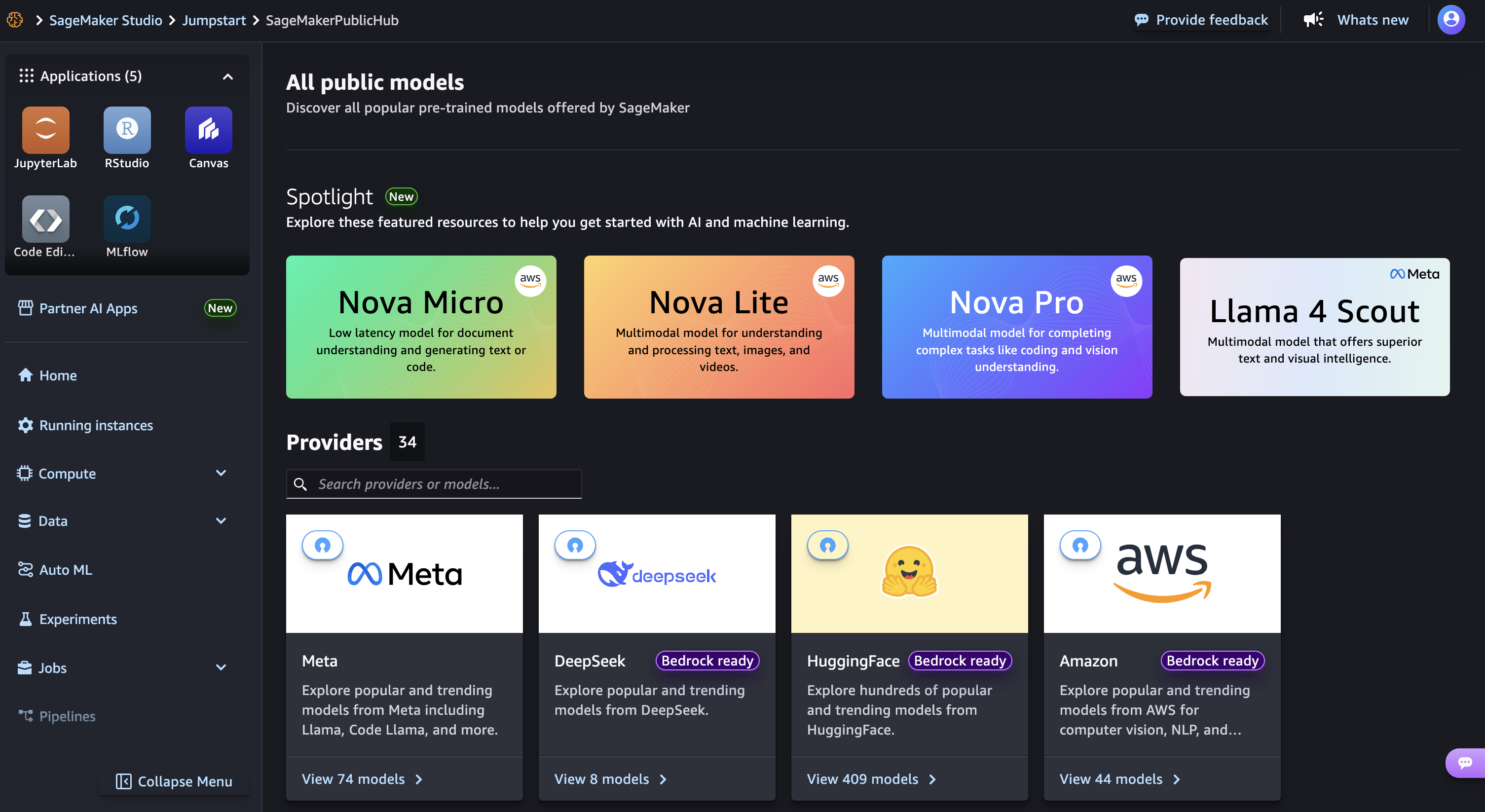
Launch your SageMaker Studio in the Amazon SageMaker AI console and choose JumpStart, a machine learning (ML) hub with foundation models, built-in algorithms, and pre-built ML solutions that you can deploy with a few clicks.

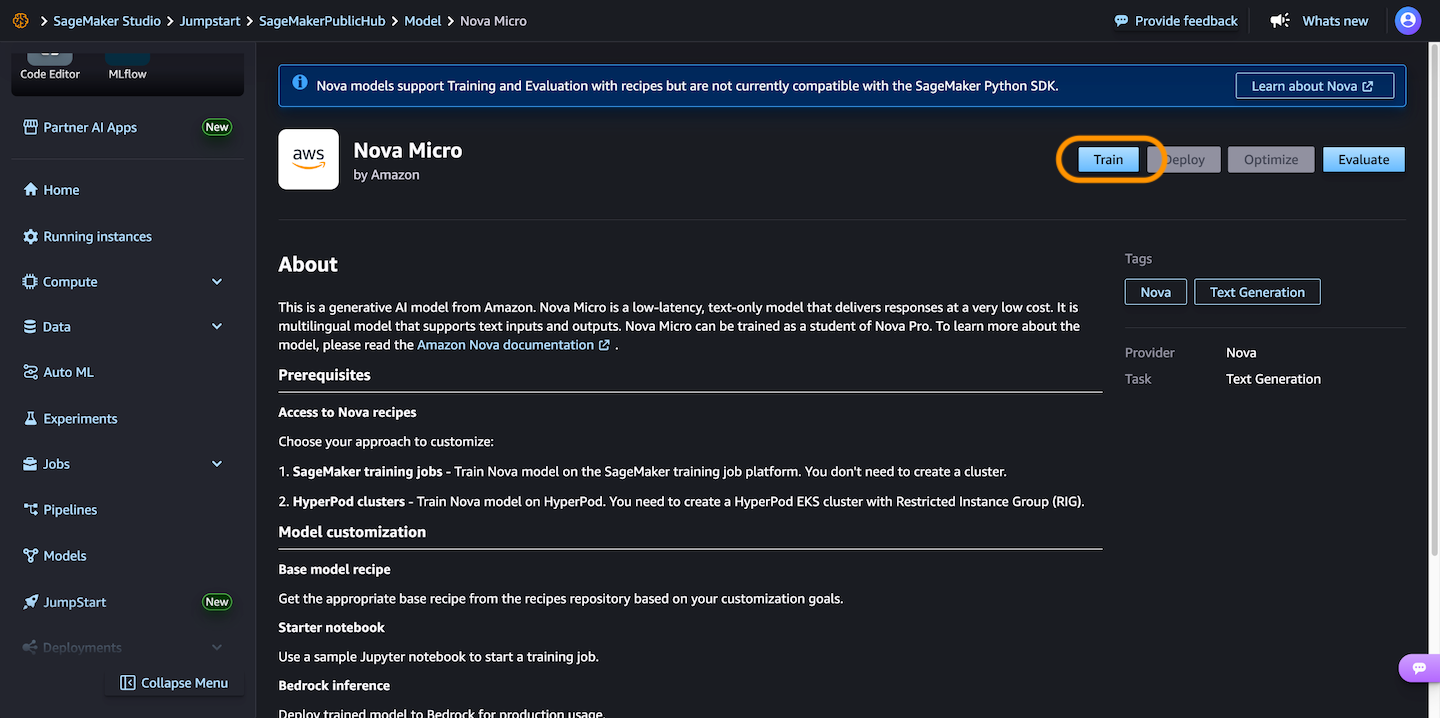
Then, choose Nova Micro, a text-only model that delivers the lowest latency responses at the lowest cost per inference among the Nova model family, and then choose Train.

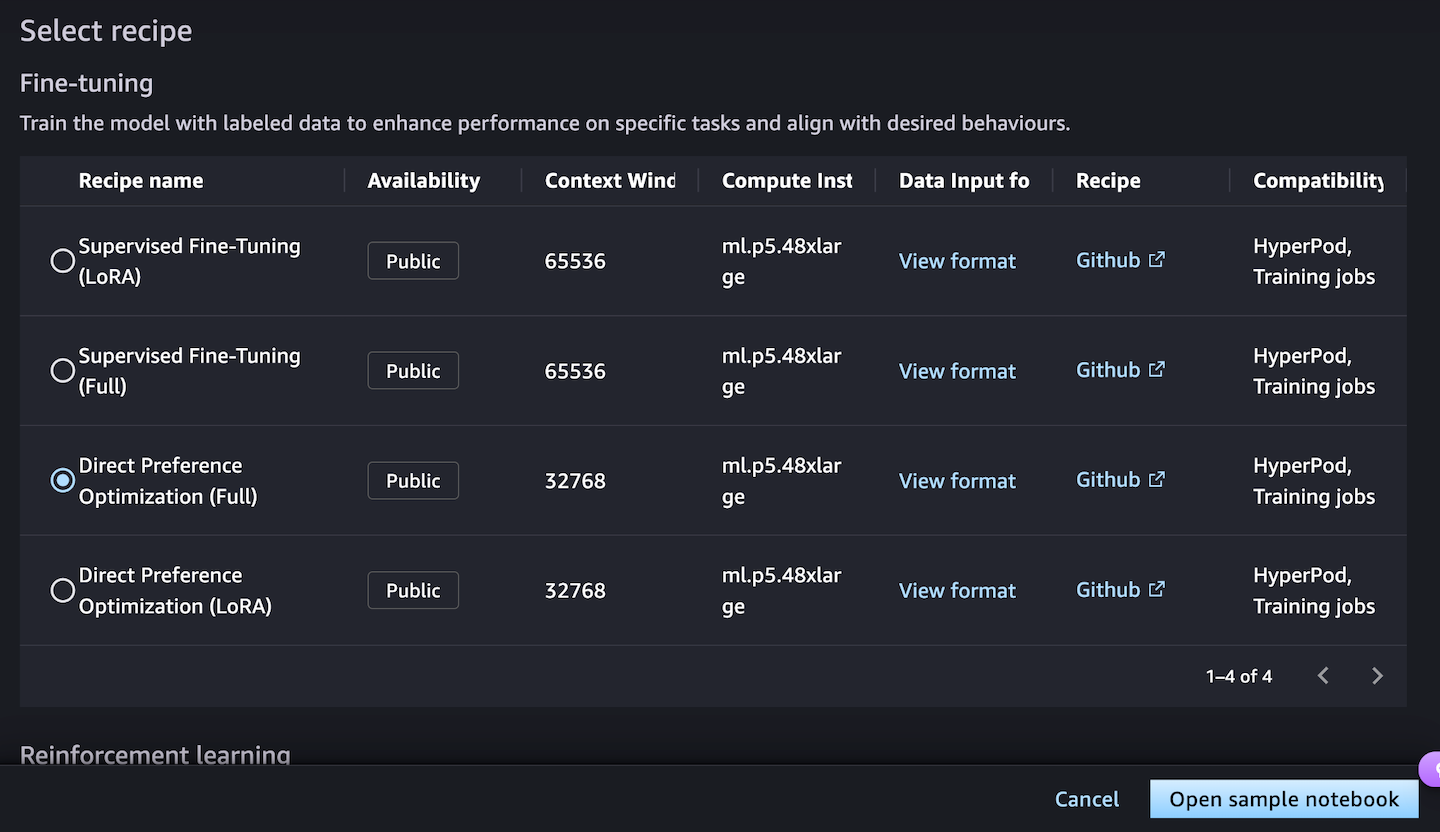
Next, you can choose a fine-tuning recipe to train the model with labeled data to enhance performance on specific tasks and align with desired behaviors. Choosing the Direct Preference Optimization offers a straightforward way to tune model outputs with your preferences.

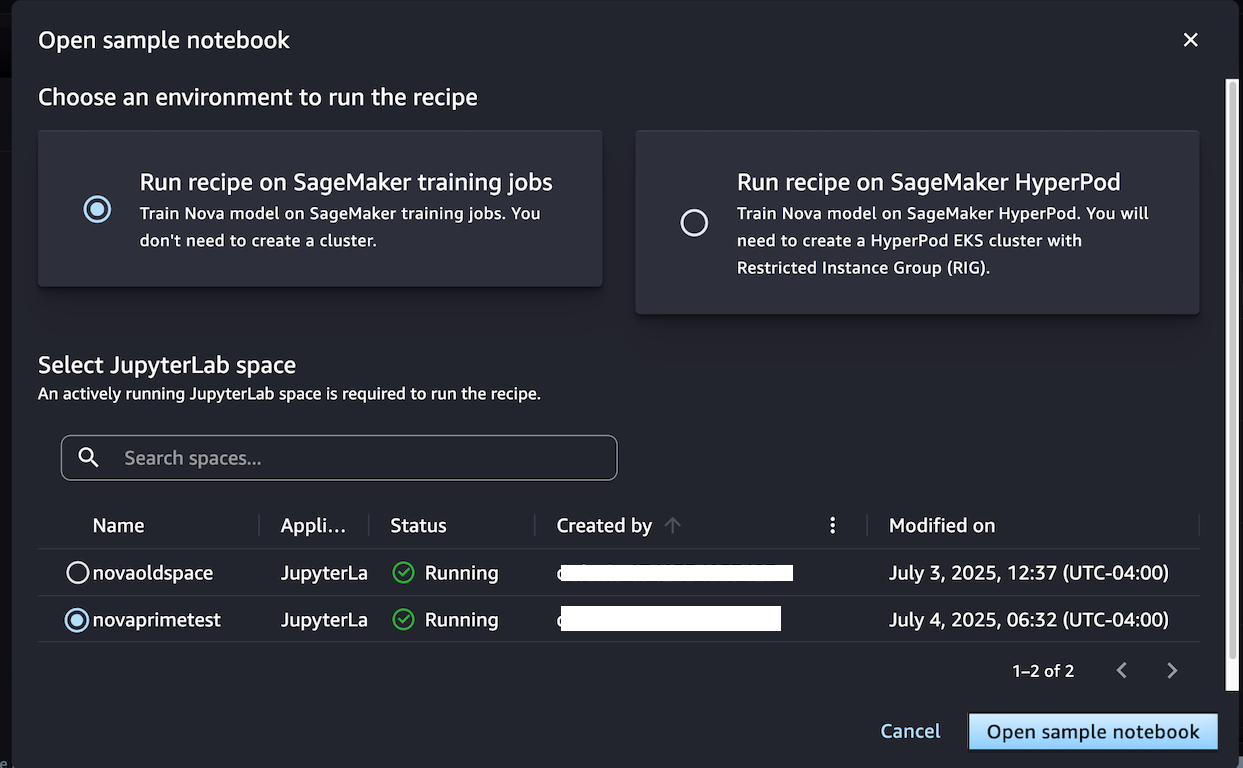
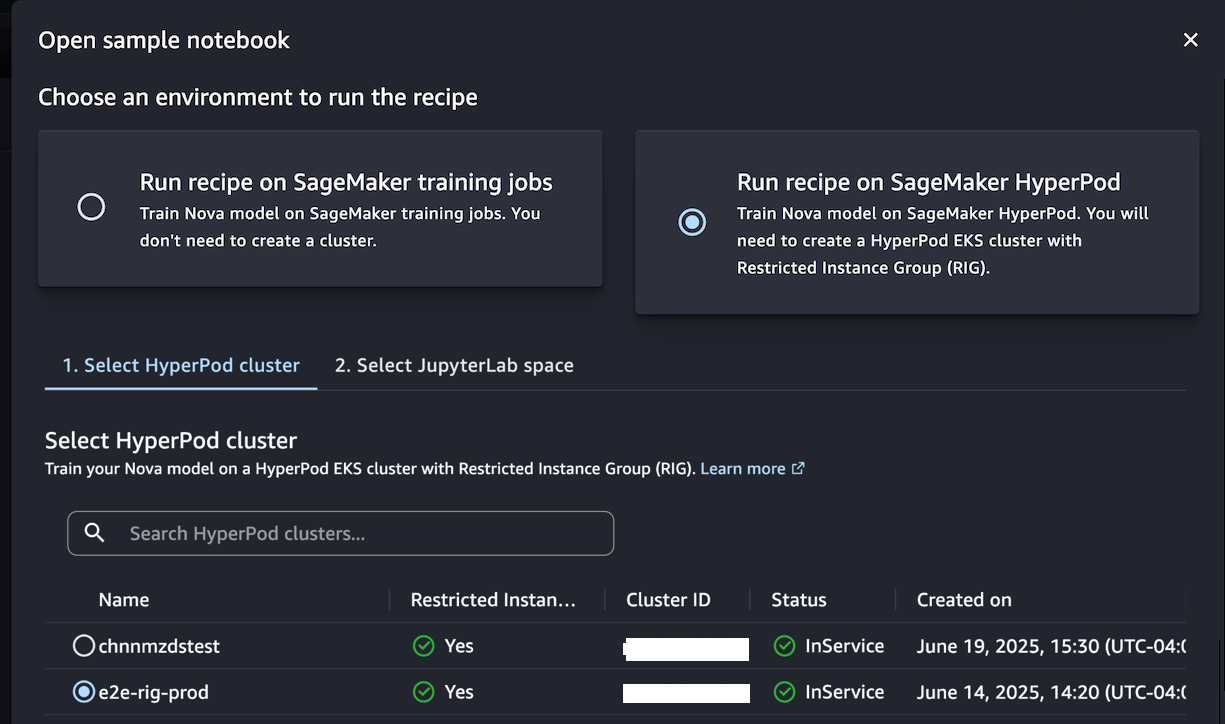
When you choose Open sample notebook, you have two environment options to run the recipe: either on the SageMaker training jobs or SageMaker Hyperpod:

Choose Run recipe on SageMaker training jobs when you don’t need to create a cluster and train the model with the sample notebook by selecting your JupyterLab space.

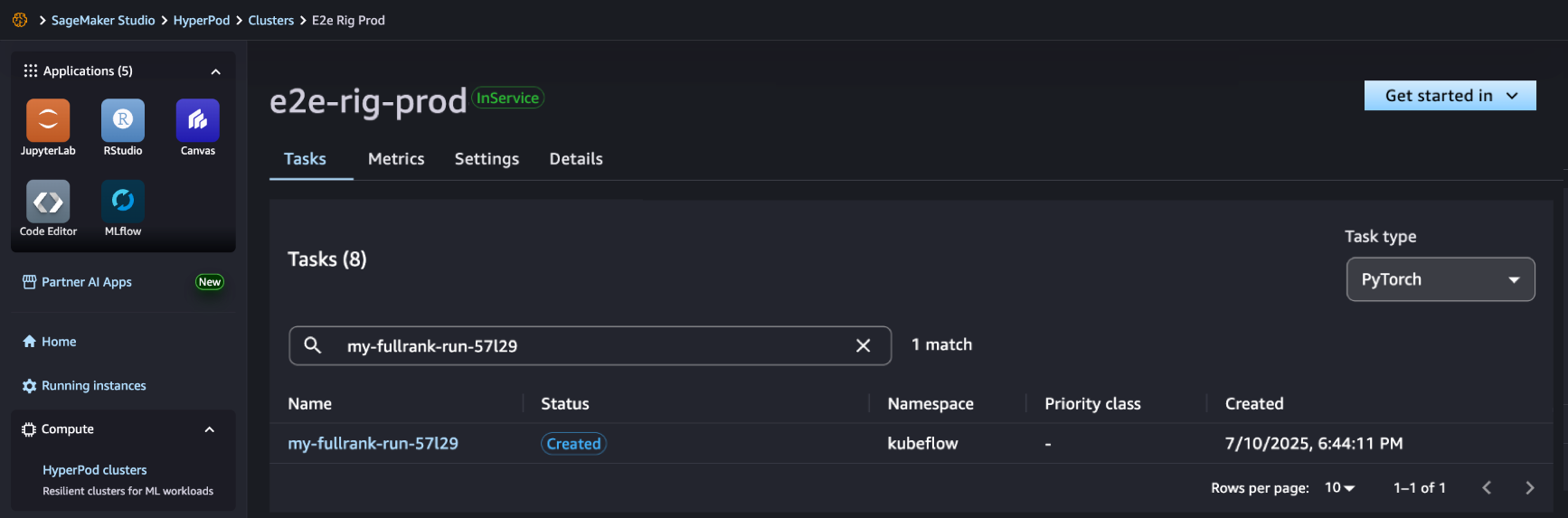
Alternately, if you want to have a persistent cluster environment optimized for iterative training processes, choose Run recipe on SageMaker HyperPod. You can choose a HyperPod EKS cluster with at least one restricted instance group (RIG) to provide a specialized isolated environment, which is required for such Nova model training. Then, choose your JupyterLabSpace and Open sample notebook.

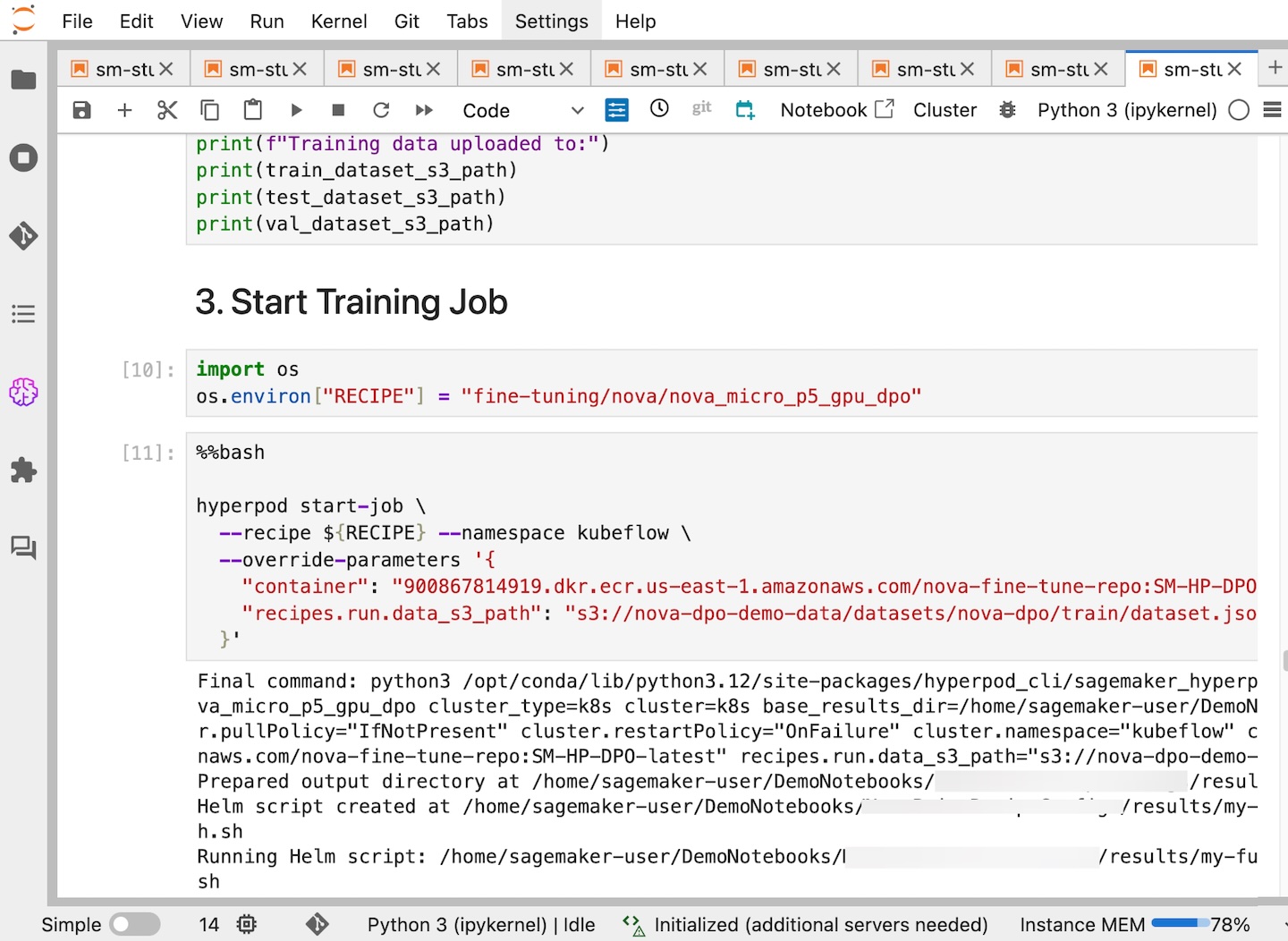
This notebook provides an end-to-end walkthrough for creating a SageMaker HyperPod job using a SageMaker Nova model with a recipe and deploying it for inference. With the help of a SageMaker HyperPod recipe, you can streamline complex configurations and seamlessly integrate datasets for optimized training jobs.

In SageMaker Studio, you can see that your SageMaker HyperPod job has been successfully created and you can monitor it for further progress.

After your job completes, you can use a benchmark recipe to evaluate if the customized model performs better on agentic tasks.

For comprehensive documentation and additional example implementations, visit the SageMaker HyperPod recipes repository on GitHub. We continue to expand the recipes based on customer feedback and emerging ML trends, ensuring you have the tools needed for successful AI model customization.

Availability and getting started
Recipes for Amazon Nova on Amazon SageMaker AI are available in US East (N. Virginia). Learn more about this feature by visiting the Amazon Nova customization webpage and Amazon Nova user guide and get started in the Amazon SageMaker AI console.

Betty

AWS Weekly Roundup: New AWS Heroes, Amazon Q Developer, EC2 GPU price reduction, and more (June 9, 2025)

Post Syndicated from Betty Zheng (郑予彬) original https://aws.amazon.com/blogs/aws/aws-weekly-roundup-new-aws-heroes-amazon-q-developer-ec2-gpu-price-reduction-and-more-june-9-2025/

The AWS Heroes program recognizes a vibrant, worldwide group of AWS experts whose enthusiasm for knowledge-sharing has a real impact within the community. Heroes go above and beyond to share knowledge in a variety of ways in developer community. We introduce our newest AWS Heroes in the second quarter of 2025.

To find and connect with more AWS Heroes near you, visit the categories in which they specialize Community Heroes, Container Heroes, Data Heroes, DevTools Heroes, Machine Learning Heroes, Security Heroes, and Serverless Heroes.

Last week’s launches
In addition to the inspiring celebrations, here are some AWS launches that caught my attention.

For a full list of AWS announcements, be sure to keep an eye on What’s New at AWS.

Other AWS news
Here are some additional projects, blog posts that you might find interesting:

  • Up to 45 percent price reduction for Amazon EC2 NVIDIA GPU-accelerated instances – AWS is reducing the price of NVIDIA GPU-accelerated Amazon EC2 instances (P4d, P4de, P5, and P5en) by up to 45 percent for On-Demand and Savings Plan usage. We are also making the very new P6-B200 instances available through Savings Plans to support large-scale deployments.
  • Introducing public AWS API models – AWS now provides daily updates of Smithy API models on GitHub, enabling developers to build custom SDK clients, understand AWS API behaviors, and create developer tools for better AWS service integration.
  • The AWS Asia Pacific (Taipei) Region is now open – The new Region provides customers with data residency requirements to securely store data in Taiwan while providing even lower latency. Customers across industries can benefit from the secure, scalable, and reliable cloud infrastructure to drive digital transformation and innovation.
  • Amazon EC2 has simplified the AMI cleanup workflow – Amazon EC2 now supports automatically deleting underlying Amazon Elastic Block Store (Amazon EBS) snapshots when deregistering Amazon Machine Images (AMIs).
  • The Lab where AWS designs custom chips – Visit Annapurna Labs in Austin, Texas—a combination of offices, workshops, and even a mini data center—where Amazon Web Services (AWS) engineers are designing the future of computing.

Upcoming AWS events
Check your calendars and sign up for these upcoming AWS events.

  • Join re:Inforce from anywhere – If you aren’t able to make it to Philadelphia (June 16–18), tune in remotely. Get free access to the re:Inforce keynote and innovation talks live as they happen.
  • AWS Summits – Join free online and in-person events that bring the cloud computing community together to connect, collaborate, and learn about AWS. Register in your nearest city: Shanghai (June 19 – 20), Milano (June 18), Mumbai (June 19) and Japan (June 25 – 26).
  • AWS re:Invent – Mark your calendars for AWS re:Invent (December 1 – 5) in Las Vegas. Registration is now open
  • AWS Community Days – Join community-led conferences that feature technical discussions, workshops, and hands-on labs led by expert AWS users and industry leaders from around the world: Mexico (June 14), Nairobi, Kenya (June 14) and Colombia (June 28)

That’s all for this week. Check back next Monday for another Weekly Roundup!

Betty

Now open – AWS Asia Pacific (Taipei) Region

Post Syndicated from Betty Zheng (郑予彬) original https://aws.amazon.com/blogs/aws/now-open-aws-asia-pacific-taipei-region/

Today, Amazon Web Services (AWS) announced that AWS Asia Pacific (Taipei) Region is generally available with three Availability Zones and Region code ap-east-2. The new Region brings AWS infrastructure and services closer to customers in Taiwan.

Skyline of Taipei including the Taipei 101 building

Skyline of Taipei including the Taipei 101 building

As the first infrastructure Region in Taipei and the fifteenth Region in Asia Pacific, the new Region expands the AWS global footprint to 117 Availability Zones across 37 geographic Regions worldwide. The new AWS Region will help developers, startups, and enterprises, as well as education, entertainment, financial services, healthcare, manufacturing, and nonprofit organizations run their applications and serve end users while maintaining data residency in Taiwan.

AWS in Taiwan

AWS has maintained a presence in Taiwan for more than a decade, starting with the opening of the AWS Taipei office in 2014. Since then, AWS has introduced many infrastructure offerings in Taiwan including:

In 2014, AWS launched the first Amazon CloudFront edge location and added another in 2018, offering customers a secure and efficient content delivery network for accelerating data, video, application, and API delivery worldwide.

In 2018, AWS established two AWS Direct Connect locations in Taiwan to enhance connectivity options. With the launch of the AWS Asia Pacific (Taipei) Region, we’ve added a new Direct Connect location in Taiwan to provide customers with higher speed and bandwidth.

In 2020, AWS launched AWS Outposts in Taiwan, helping customers seamlessly extend AWS infrastructure and services to their on-premises or edge locations for a consistent hybrid experience.

In 2022, AWS launched AWS Local Zone in Taipei to support low-latency applications requiring single-digit millisecond responsiveness.

Today, with the launch of the AWS Asia Pacific (Taipei) Region, we further strengthen our commitment to support innovation in Taiwan. Organizations in regulated industries will be able to store data locally while maintaining complete control over data location and movement. From high-tech manufacturing to semiconductor companies and small and medium enterprises (SMEs), businesses will gain access to the scalable infrastructure needed for growth and innovation.

AWS customers in Taiwan

Organizations across Taiwan are already using AWS to innovate and deliver differentiated experiences to their customers, for example:

Cathay Financial Holdings (CFH) is a leader in financial technology in Taiwan. It continuously introduces the latest technology to create a full-scenario financial service ecosystem. Since 2021, CFH has built a cloud environment on AWS that strengthens its security control and meets compliance requirements.

“Cathay Financial Holdings will continue to accelerate digital transformation in the industry, also improve the stability, security, timeliness, and scalability of our financial services,” said Marcus Yao, senior executive vice president of CFH. “With the new AWS Region in Taiwan, CFH is expected to provide customers with even more diverse and convenient financial services.”

Gamania Group is revolutionizing the entertainment landscape by integrating AI with celebrity IP through their innovative Vyin AI platform. Gamania utilized the robust and scalable infrastructure of AWS to develop secure, responsive AI interactions.

Benjamin Chen, chief strategy officer and head of Innovation Lab, said: “The core goal of Vyin AI is to create a digital identity that is fully interactive, lifelike, and safe to use. This demands technologies that are stable, responsive, and secure. To that end, we rely on the robust and resilient cloud infrastructure of AWS, and look forward to the low-latency advantages offered by the AWS Region in Taiwan. AWS provides a highly stable and secure environment for Vyin AI to provide users with secure and AI hallucination free interactions. AWS Cloud services allow us to focus more on core AI technology innovation and the enhancement of the ‘hyper-personalized interactive’ user experience, thereby accelerating product iteration and optimization.”

Chunghwa Telecom is a leader in cloud network services in Taiwan with the broadest mainstream 5G bandwidth, exceptional network speed, and globally recognized mobile internet capabilities. Chunghwa Telecom utilizes generative AI platforms such as Amazon Bedrock to build innovative services and create intelligent applications for various industries.

Dr. Rong-Shy Lin, president of CHT, stated: “With the launch of the AWS Region in Taiwan, CHT’s partnership with AWS has entered a new phase. We will deepen the integration of key advantages of the AWS Region, such as low latency and local data storage, combining them with CHT’s extensive backbone network, rich cloud experience, and professional team that has obtained multiple AWS Competency certifications. This will allow CHT to provide solutions that meet strict security and compliance requirements for government, financial, critical infrastructure, and highly regulated industries. At the same time, we are utilizing AWS technologies such as Amazon Bedrock to develop innovative applications and accelerate digital transformation and AI adoption. We will continue to provide optimized cloud and network services in Taiwan while supporting customers’ global expansion.”

AWS Partners in Taiwan

The AWS Partner Network in Taiwan plays a crucial role in helping customers adopt cloud technologies and maximize value from the new AWS Asia Pacific (Taipei) Region. These specialized partners combine deep technical expertise with local market knowledge to accelerate digital transformation across industries.

eCloudvalley Digital Technology Group is an AWS Premier Tier Services Partner with a team of cloud experts with more than 600 certifications.

“eCloudvalley Group has always embraced our mission of being a cloud evangelist, driving the adoption of cloud technology across Taiwan’s industries,” said MP Tsai, chairman of eCloudvalley Group. “With over a decade of close collaboration with AWS, we are honored to help more and more customers and industries move to the cloud while being part of customers’ digital transformation journey on AWS. We believe that the launch of the AWS Asia Pacific (Taipei) Region will further support Taiwan companies’ digital transformation and innovation in Taiwan with its world-leading cloud technology, while industries with higher local data residency requirements, such as finance and healthcare, will be able to further advance their cloud transformation journey.”

Nextlink Technology Inc. is an AWS Premier Consulting Partner, certified Managed Service Provider (MSP) and has AWS Level 1 Managed Security Service Provider (MSSP) and Government Consulting Competency.

“The investment of AWS in local infrastructure will help drive the digital transformation of Taiwan companies, boosting the development of various industries spanning from traditional industries to emerging digital sectors,” said Shasta Ho, the CEO of Nextlink Technology Inc. “We look forward to continuing working with AWS to help enterprises across industries deeply utilize the new AWS Asia Pacific (Taipei) Region. This local advantage will address customer needs in data localization, low latency, compliance, and high performance computing workloads. We also look forward to using AWS world-leading cloud technologies to power customers’ digital transformation journeys while contributing to the diversification of Taiwan’s economy.”

SAP has been a strategic partner of AWS for more than a decade, with thousands of enterprise customers worldwide running their SAP workloads on AWS.

“SAP is thrilled to see AWS establish new data centers in Taiwan,” said George Chen, SAP global vice president and managing director for Taiwan, Hong Kong, and Macau. “This investment provides Taiwan enterprises with greater choice, lower service latency, and enhanced operational flexibility. As a long-term strategic partner, SAP is committed to accelerating cloud transformation for these businesses. Through RISE with SAP, we can help customers seamlessly migrate to the cloud, enjoying greater flexibility, scalability, and reduced operational costs. By combining SAP’s enterprise solutions with the robust cloud platform of AWS, we’ll jointly empower Taiwan’s enterprises to unlock innovative AI applications and run their core businesses securely and reliably locally, driving Taiwan enterprise cloud transformation together.”

Supporting sustainable innovation in Taiwan

As Taiwan progresses toward its goal of net-zero emissions by 2050, AWS Cloud solutions are empowering organizations to enhance operational efficiency while reducing environmental impact. The new AWS Asia Pacific (Taipei) Region incorporates the AWS commitment to sustainability, helping organizations meet both technical and environmental objectives.

Ace Energy is a pioneer in Taiwan’s energy management sector. Since 2013, Ace Energy has been using AWS services such as Amazon Simple Storage Service (Amazon S3), Amazon Elastic Compute Cloud (Amazon EC2), and AWS IoT Core to provide innovative energy solutions through their Energy Saving Performance Contract model. Ace Energy has deployed energy management solutions across 1,000 locations, helped a semiconductor manufacturer reduce steam consumption by 65 percent, achieved 22 million new Taiwan dollars in annual energy savings, and decreased carbon emissions by 8,000 tons through their waste heat recovery technology.

Taiwan Power Company (Taipower) is Taiwan’s state power utility and has revolutionized its operations through AWS since 2018. By implementing smart grid technologies with drones, robotics, and virtual reality for smart patrol, Taipower has enhanced customer experience through the “Taiwan Power” application. The company has improved operational efficiency through data-driven decision-making and earned six consecutive Platinum Awards in the Corporate Sustainability category at the Taiwan Corporate Sustainability Awards.

Building cloud skills together

Since 2014, AWS has built comprehensive programs for cloud education and skills development in Taiwan. For example, educational programs such as AWS Academy, AWS Educate, and AWS Skill Builder have helped train more than 200,000 people in Taiwan on cloud skills. These programs will expand alongside our infrastructure investments to build a foundation for Taiwan’s digital future.

Taiwan boasts a vibrant AWS community that welcomes your involvement. Take part in knowledge-sharing and networking at local AWS User Groups in Taipei, engage with the four celebrated AWS Heroes in Taiwan, or consider becoming part of the growing community of AWS enthusiasts by joining the ranks of the 17 AWS Community Builders already contributing to Taiwan’s cloud ecosystem. All these community connections provide valuable opportunities to accelerate your cloud journey through local expertise and collaborative learning.

Stay tuned
The AWS Asia Pacific (Taipei) Region is ready to support your business. You can find a detailed list of the services available in this Region on the AWS Services by Region page. For news about AWS Region openings, check out the Regional news of the AWS News Blog.

Start building on the Asia Pacific (Taipei) Region now.

Betty

Amazon API Gateway now supports dual-stack (IPv4 and IPv6) endpoints

Post Syndicated from Betty Zheng (郑予彬) original https://aws.amazon.com/blogs/aws/amazon-api-gateway-now-supports-dual-stack-ipv4-and-ipv6-endpoints/

Today, we are launching IPv6 support for Amazon API Gateway across all endpoint types, custom domains, and management APIs, in all commercial and AWS GovCloud (US) Regions. You can now configure REST, HTTP, and WebSocket APIs, and custom domains, to accept calls from IPv6 clients alongside the existing IPv4 support. You can also call API Gateway management APIs from dual-stack (IPv6 and IPv4) clients. As organizations globally confront growing IPv4 address scarcity and increasing costs, implementing IPv6 becomes critical for future-proofing network infrastructure. This dual-stack approach helps organizations maintain future network compatibility and expand global reach. To learn more about dualstack in the Amazon Web Services (AWS) environment, see the IPv6 on AWS documentation.

Creating new dual-stack resources

This post focuses on two ways to create an API or a domain name with a dualstack IP address type: AWS Management Console and AWS Cloud Development Kit (CDK).

AWS Console

When creating a new API or domain name in the console, select IPv4 only or dualstack (IPv4 and IPv6) for the IP address type.

As shown in the following image, you can select the dualstack option when creating a new REST API.
For custom domain names, you can similarly configure dualstack as shown in the next image.

If you need to revert to IPv4-only for any reason, you can modify the IP address type setting, with no need to redeploy your API for the update to take effect.

REST APIs of all endpoint types (EDGE, REGIONAL and PRIVATE) support dualstack. Private REST APIs only support dualstack configuration.

AWS CDK

With AWS CDK, start by configuring a dual-stack REST API and domain name.

const api = new apigateway.RestApi(this, "Api", {
  restApiName: "MyDualStackAPI",
  endpointConfiguration: {ipAddressType: "dualstack"}
});

const domain_name = new apigateway.DomainName(this, "DomainName", {
  regionalCertificateArn: 'arn:aws:acm:us-east-1:111122223333:certificate/a1b2c3d4-5678-90ab',
  domainName: 'dualstack.example.com',
  endpointConfiguration: {
    types: ['Regional'],
    ipAddressType: 'dualstack'
  },
  securityPolicy: 'TLS_1_2'
});

const basepathmapping = new apigateway.BasePathMapping(this, "BasePathMapping", {
  domainName: domain_name,
  restApi: api
});

IPv6 Source IP and authorization

When your API begins receiving IPv6 traffic, client source IPs will be in IPv6 format. If you use resource policies, Lambda authorizers, or AWS Identity and Access Management (IAM) policies that reference source IP addresses, make sure they’re updated to accommodate IPv6 address formats.

For example, to permit traffic from a specific IPv6 range in a resource policy.

{
  "Version": "2012-10-17",
  "Statement": [
    {
      "Effect": "Allow",
      "Principal": "*",
      "Action": "execute-api:Invoke",
      "Resource": "execute-api:stage-name/*",
      "Condition": {
        "IpAddress": {
          "aws:SourceIp": [
            "192.0.2.0/24",
            "2001:db8:1234::/48"
          ]
        }
      }
    }
  ]
}

Summary

API Gateway dual-stack support helps manage IPv4 address scarcity and costs, comply with government and industry mandates, and prepare for the future of networking. The dualstack implementation provides a smooth transition path by supporting both IPv4 and IPv6 clients simultaneously.

To get started with API Gateway dual-stack support, visit the Amazon API Gateway documentation. You can configure dualstack for new APIs or update existing APIs with minimal configuration changes.

Betty

Special thanks to Ellie Frank (elliesf), Anjali Gola (anjaligl), and Pranika Kakkar (pranika) for providing resources, answering questions, and offering valuable feedback during the writing process. This blog post was made possible through the collaborative support of the service and product management teams.


How is the News Blog doing? Take this 1 minute survey!

(This survey is hosted by an external company. AWS handles your information as described in the AWS Privacy Notice. AWS will own the data gathered via this survey and will not share the information collected with survey respondents.)

AWS Weekly Roundup: Omdia recognition, Amazon Bedrock RAG evaluation, International Women’s Day events, and more (March 24, 2025)

Post Syndicated from Betty Zheng (郑予彬) original https://aws.amazon.com/blogs/aws/aws-weekly-roundup-omdia-recognition-amazon-bedrock-rag-evaluation-international-womens-day-events-and-more-march-24-2025/

As we celebrate International Women’s Day (IWD) this March, I had the privilege of attending the ‘Women in Tech’ User Group meetup in Shenzhen last weekend. I was inspired to see over 100 women in tech from different industries come together to discuss AI ethics from a female perspective. Together, we explored strategies such as reducing gender bias in AI systems and promoting diverse representation in model training data. In the AWS Cloud Lab, participants used Amazon Bedrock with large language models (LLMs) to generate rose bloom videos, which was the most popular part of this meetup.

These gatherings are crucial to our efforts to engage more women in AI technology exploration and development, and to help make sure that the generative AI era evolves without gender bias. The collaborative spirit and technical curiosity displayed throughout the event is further proof that diverse teams truly build inclusive and effective solutions.

Speaking of vibrant community engagement, I also had the honor of presenting at Kubernetes Community Day (KCD) Beijing 2025 this weekend. The enthusiasm Omdia Universe: Cloud Container Management & Services 2024-25 reportfor container technologies was remarkable, with nearly 300 developers gathering to share experiences and best practices. During my keynote introducing the DoEKS project from Amazon Web Services (AWS), I was struck by the depth of interest in managed Kubernetes services. The audience’s questions revealed how widely adopted services such as Amazon Elastic Kubernetes Service (Amazon EKS) and Amazon Elastic Container Service (Amazon ECS) have become among Chinese developers building mission-critical applications.This strong community interest aligns perfectly with findings from the Omdia Universe: Cloud Container Management & Services 2024–25 report. In this comprehensive evaluation of container management solutions hosted on public clouds, AWS was recognized as a Leader. The report specifically highlights that AWS offers “widest range of options for working with Kubernetes or its own container management service, across cloud, edge, and on-premises environments.” You can read the full report about AWS offerings to learn more about our comprehensive container portfolio and how we’re helping builders deploy scalable, reliable containerized applications.

Last Week’s launches

In addition to the inspiring community events, here are some AWS launches that caught my attention.

Amazon Q Business browser extension gets upgrades – The Amazon Q Business browser extension now features significant enhancements designed to streamline browser-based tasks. Users gain access to their company’s indexed knowledge alongside web content, direct PDF support within the browser, image file attachment capabilities, and controls to remove irrelevant attachments from conversation context. The expanded context window accommodates larger web pages and more detailed prompts, resulting in more helpful responses. For advanced needs, the extension offers seamless transition to the full Amazon Q Business web experience with access to Actions and Amazon Q Apps. Review the Enhancing web browsing with Amazon Q Business in the documentation for detailed setup instructions and feature descriptions to learn more about this announcement.

Amazon Bedrock RAG evaluation is now generally available – Offering comprehensive assessment of both Bedrock Knowledge Bases and custom Retrieval Augmented Generation (RAG) systems through LLM-as-a-judge methodology. The service evaluates retrieval quality and end-to-end generation with metrics for relevance, correctness, and hallucination detection, and the newly added support for custom RAG pipeline evaluations lets you bring your own input-output pairs and retrieved contexts directly into the evaluation job, along with new citation precision metrics and Amazon Bedrock Guardrails integration for more flexible RAG system optimization. To learn more, visit the Amazon Bedrock Evaluations page and What is Amazon Bedrock? in the documentation.

Amazon Nova expands Tool Choice options for Converse API – We’ve enhanced Amazon Nova with expanded Tool Choice capabilities for the Converse API, giving developers more flexibility in building sophisticated AI applications. This update allows models to determine when to use tools to fulfill user requests more effectively. Learn more in the announcement about expands Tool Choice options.

Amazon Bedrock Guardrails adds policy-based enforcement for responsible AI – Our builders can now enforce responsible AI policies at scale with Amazon Bedrock Guardrails’ new AWS Identity and Access Management (IAM) policy-based enforcement capabilities. This feature helps you to specify required guardrails through IAM policies using the bedrock:GuardrailIdentifiercondition key, so that all model inference calls comply with your organization’s AI safety standards. When your teams make Amazon Bedrock Invoke or Converse API calls, requests are automatically rejected if they don’t include the mandated guardrails, providing consistent protection against undesirable content, sensitive information exposure, and model hallucinations. Refer to the Set up permissions to use Guaidrails for content filtering in the technical documentation and the Amazon Bedrock Guardrails product page to learn more about the announcement about policy based enforcement for responsible AI.

Next generation of Amazon Connect released – We’ve launched the next generation of Amazon Connect, featuring AI-powered interactions designed to strengthen customer relationships and improve business outcomes. This major update brings enhanced agent experiences, smarter customer interactions, and deeper operational insights to contact centers of all sizes. Learn more from the new launch post in the AWS Contact Center Blog.

Amazon Redshift Serverless introduces Current and Trailing release tracksAmazon Redshift Serverless now offers two release tracks to give users more control over their update cadence. The Current track delivers the most up-to-date certified release with the latest features and security updates, while the Trailing track remains on the previous certified release. This dual-track approach allows organizations to validate new releases on select workgroups before implementing them across production environments. Users can easily switch between tracks through the Amazon Redshift console, providing the flexibility to balance innovation with stability for mission-critical workloads. This capability is available in all AWS Regions where Amazon Redshift Serverless is offered. Refer to Tracks for Amazon Redshift provisioned cluster and serverless work groups to learn more about the Current and Trailing tracks in Amazon Redshift Serverless.

AWS WAF now supports URI fragment field matchingAWS WAF has expanded its capability to include URI fragment field matching, allowing security teams to create rules that inspect and match against the fragment portion of URLs. This enhancement enables more precise security controls for web applications that use URI fragments to identify specific sections within pages. Security professionals can now implement more targeted protections, such as restricting access to sensitive page elements, detecting suspicious navigation patterns, and enhancing bot mitigation by analyzing fragment usage patterns characteristic of automated attacks. This feature is available in all AWS Regions where AWS WAF is supported. For more information about URI field for matching, visit the AWS WAF Developer Guide.

For a full list of AWS announcements, be sure to keep an eye on the What’s New at AWS.

Other AWS news

Here are some other additional projects and blog posts that you might find interesting.

Build your generative AI skills at AWS Gen AI Lofts – AWS has established more than 10 global hubs offering training and networking for developers and startups in 2025, where you can gain practical, hands-on experience with the latest AI technologies. These revamped spaces feature dedicated zones where you can participate in workshops on prompt engineering, foundation model (FM) selection, and implementing AI in production environments. If you’re near San Francisco, New York, Tokyo, or other major tech hubs with AWS Gen AI Lofts, stop by to access these free resources and accelerate your generative AI development skills. Check out all of the AWS Gen AI Loft locations and events and to read 5 ways to build your AI skills on AWS Gen AI Loft to learn more.

AWS Lambda‘s architecture for billions of asynchronous invocations – A recent technical article reveals how AWS Lambda handles massive scale through sophisticated engineering approaches. The Lambda asynchronous invocation path employs multiple queuing strategies, consistent hashing for intelligent partitioning, and shuffle-sharding techniques to minimize noisy neighbor effects. The system relies on key observability metrics (AsyncEventReceived, AsyncEventAge, and AsyncEventDropped) to maintain optimal performance. These architectural decisions enable Lambda to process tens of trillions of monthly invocations across 1.5 million active customers while providing reliable scalability and performance isolation. For details read Handling billions of invocations – best practices from AWS Lambda in the AWS computing blog.

AWS is reducing prices by more than 11% for its high-memory U7i instances across all Regions and pricing models. The reduction applies to four instances: u7i-12tb.224xlarge, u7in-16tb.224xlarge, u7in-24tb.224xlarge, and u7in-32tb.224xlarge. The new On-Demand pricing, which covers shared, dedicated, and host tenancy options is retroactive, to March 1, 2025. For new Savings Plan purchases, pricing is effective immediately.

Create your AWS Builder ID and reserve your alias – Builder ID is a universal login credential that gives you access beyond the AWS Management Console to AWS tools and resources, including over 600 free training courses, community features, and developer tools such as Amazon Q Developer.

From community.aws
Here are some of my favorite posts from community.aws.

Model Context Protocol (MCP): why it matters – The recently introduced Model Context Protocol (MCP) creates a standardized way for AI applications to communicate with multiple FMs using consistent prompts and tools.

Build serverless GenAI Apps faster with Amazon Q Developer CLI agent – Discover how Amazon Q Developer CLI Agent revolutionizes cloud development by building a complete serverless generative AI application in minutes instead of days.

Automating code reviews with Amazon Q and GitHub actions – A new developer tutorial demonstrates how to integrate Amazon Q Developer with GitHub Actions to automatically analyze pull requests and provide AI-powered code feedback.

DeepSeek on AWS – A new technical guide demonstrates how to deploy DeepSeek’s powerful open-source AI models on AWS infrastructure. The tutorial provides step-by-step instructions for setting up these cutting-edge models using Amazon SageMaker, Amazon Elastic Compute Cloud (Amazon EC2) instances with GPUs, or through integration with Amazon Bedrock. The guide covers optimization techniques, sample applications, and best practices for balancing performance with cost efficiency.

Upcoming AWS events
Check your calendars and sign up for these upcoming AWS events.

Empowering Futures – Women Leading the Way in Tech and Non-Tech Careers – Whether you’re here to expand your professional circle, learn about the AWS Cloud or gain wisdom from inspiring speakers, this event has something for everyone. This is a public event open to everyone in the Seattle area—for free—on March 27, 2025.

AWS at KubeCon + CloudNativeCon London 2025 – Join us at KubeCon London on April 1 – April 4 , at Excel booth S300 for live product demonstrations that help you simplify Kubernetes operations, optimize costs and performance, harness the power of artificial learning and machine learning (AI/ML), and build scalable platform strategies.

That’s all for this week. Check back next Monday for another Weekly Roundup!

Betty

This post is part of our Weekly Roundup series. Check back each week for a quick roundup of interesting news and announcements from AWS!


How is the News Blog doing? Take this 1 minute survey!

(This survey is hosted by an external company. AWS handles your information as described in the AWS Privacy Notice. AWS will own the data gathered via this survey and will not share the information collected with survey respondents.)

AWS Weekly Roundup: New Asia Pacific Region, DynamoDB updates, Amazon Q developer, and more (January 13, 2025)

Post Syndicated from Betty Zheng (郑予彬) original https://aws.amazon.com/blogs/aws/aws-weekly-roundup-new-asia-pacific-region-dynamodb-updates-amazon-q-developer-and-more-january-13-2025/

As we move into the second week of 2025, China is celebrating Laba Festival (腊八节), a traditional holiday, which marks the beginning of Chinese New Year preparations. On this day, Chinese people prepare Laba congee, a special porridge combining various grains, dried fruits, and nuts. This

nutritious mixture symbolizes harmony, prosperity, and good fortune — with each ingredient representing the diversity and abundance of life. This traditional practice dates back to when Buddha achieved enlightenment after consuming rice porridge, making it a symbol of both material and spiritual nourishment. The festival, occurring on the eighth day of the twelfth lunar month, marks the countdown to Spring Festival, China’s most significant traditional holiday celebrating family reunion and renewal.

As our global tech community grows, such cultural celebrations remind us of the importance of inclusive innovation and shared progress.

Last week’s launches

Let’s take a look at what Amazon Web Services (AWS) launched in this week.

New AWS Asia Pacific (Thailand) Region– AWS has expanded its global infrastructure with the launch of the new Asia Pacific (Thailand) AWS Region, featuring three Availability Zones. With this addition, customers in Thailand and throughout Southeast Asia can serve customers with reduced latency while maintaining data residency within Thailand. The newly launched Region supports the complete range of AWS services and strengthens our presence in the rapidly growing ASEAN market.

New AWS Direct Connect location in Bangkok – Following the launch of our Thailand Region, we’ve established a new AWS Direct Connect location in Bangkok and expanded our existing infrastructure. This addition provides customers in Thailand with improved connectivity options and reduced network latency when accessing AWS services.

Database and analytics

Configurable point-in-time recovery periods for Amazon DynamoDBAmazon DynamoDB now enables customizable point-in-time recovery (PITR) periods, which means customers can specify recovery durations ranging from 1 to 35 days on a per-table basis. This enhancement enables organizations to meet precise compliance requirements while maximizing cost-efficiency. The feature is now available across all AWS Regions, including AWS GovCloud (US West) and China Regions. This flexibility in data recovery periods empowers customers to align their backup policies precisely with their business requirements and regulatory obligations.

Amazon MSK Connect APIs with AWS PrivateLinkAmazon Managed Streaming for Apache Kafka Connect (Amazon MSK Connect) APIs now support AWS PrivateLink, giving customers access to MSK Connect APIs through private endpoints within their virtual private cloud (VPC). This enhancement provides increased security and reduced data exposure by keeping traffic within the AWS network.

Generative AI and machine learning

Amazon Q Developer in SageMaker Code EditorAmazon Q Developer is now integrated into the Amazon SageMaker Code Editor integrated development environment (IDE), enhancing the developer’s experience with AI-powered code assistance. Intelligent code suggestions, documentation assistance, and contextual recommendations are now directly available within the SageMaker development environment.

Management and governance

AWS Systems Manager Automation in AWS ChatbotAWS Chatbot now offers 20 additional AWS Systems Manager Automation runbook recommendations, expanding its capabilities for automated operations management. These new recommendations help customers streamline their operational tasks and implement best practices more efficiently through chat-based interactions.

AWS Transit Gateway cost analysis enhancement – We’ve introduced new capabilities for analyzing Transit Gateway data processing charges using cost allocation tags. This feature provides improved visibility and control over networking costs, enabling organizations to track and optimize AWS Transit Gateway usage efficiently. The enhanced cost analysis tools deliver detailed insights into network traffic patterns and associated costs.

Other AWS news and highlights

2024’s most popular DevOps blog posts – The retrospective blog post “The most visited DevOps and Developer Productivity blog posts in 2024” has reached the top one position on this week’s AWS most popular articles chart. This compilation presents the most influential DevOps content from 2024, offering insights into trending topics and best practices. The collection examines key developments in continuous integration and continuous development (CI/CD), infrastructure as code (IaC), and automation practices.

New security course for generative AIAWS Skill Builder has released a new course focusing on securing generative AI applications on AWS. This comprehensive training teaches professionals to implement security best practices for artificial intelligence and machine learning (AI/ML) workloads, addressing data protection, model security, and compliance requirements. The course meets the growing demand for specialized security knowledge in the rapidly evolving field of generative AI.

Amazon Connect Contact Lens free trials – We’re introducing free trials for first-time users of Amazon Connect Contact Lens conversational analytics and performance evaluations. New customers can process up to 100,000 voice minutes monthly at no cost for 2 months, and first-time performance evaluation users receive a 30-day free trial starting with their first evaluation. With this initiative, customers can experience Contact Lens capabilities in their environment without additional costs. The free trials are available across all AWS Regions where Contact Lens is supported.

For a full list of AWS announcements, be sure to keep an eye on the What’s New with AWS page.

Whether you’re a developer, architect, business leader, or you’re starting your cloud journey – and regardless of what 2024 brought your way – 2025 presents new opportunities for everyone.

This post is part of our Weekly Roundup series. Check back each week for a quick roundup of interesting news and announcements from AWS!

Betty

New AWS Security Incident Response helps organizations respond to and recover from security events

Post Syndicated from Betty Zheng (郑予彬) original https://aws.amazon.com/blogs/aws/new-aws-security-incident-response-helps-organizations-respond-to-and-recover-from-security-events/

Today, we announce AWS Security Incident Response, a new service designed to help organizations manage security events quickly and effectively. The service is purpose-built to help customers prepare for, respond to, and recover from various security events, including account takeovers, data breaches, and ransomware attacks.

Security Incident Response automates the triage and investigation of security findings from Amazon GuardDuty and integrated third party threat detection tools through AWS Security Hub. It facilitates communication and coordination and provides 24/7 access to security experts from the AWS Customer Incident Response Team (CIRT) who can assist during security events. The service aims to provide customers with more comprehensive support across the phases of incident response lifecycle, from preparation to detection, analysis, and recovery.

Security events are becoming more pervasive and complex for customers. Security teams often face an overwhelming number of daily alerts, leading to potential misplaced priorities of resources and reduced effectiveness. Manual investigation of findings strains resources and may cause customers to overlook critical security alerts. Additionally, coordinating responses across multiple stakeholders, managing permissions in various environments, and documenting actions complicate the process. There is an opportunity to better support customers and remove various points of undifferentiated heavy lifting that customers face during security events.

Key capabilities

AWS Security Incident Response addresses these challenges through three main core capabilities that help customers effectively prepare for, respond to, and recover from security events :

  1. Security Incident Response automatically triages security findings from GuardDuty and supported third-party tools through Security Hub to identify high-priority incidents requiring immediate attention. The service uses automation and customer-specific information to filter and suppress security findings based on expected behavior, helping teams focus on critical security alerts.
  2. The service simplifies incident response by offering preconfigured notification rules and permission settings that can be extended to both internal and external stakeholders, including third-party security providers. Customers can access a centralized console with integrated features, such as messaging, secure data transfer, and video conference scheduling, all accessible through service APIs or the AWS Management Console. Additional capabilities include automated case history tracking and reporting, allowing security teams to focus on remediation and recovery efforts.
  3. Customers gain access to self-service investigation tools and 24/7 support from the AWS CIRT. Customers also have the ability to handle incidents independently or interoperate with third-party security vendors. These options allow customers to choose, manage, and conduct their incident response based on their specific needs and requirements.

In addition to the core capabilities, customers benefit from a service dashboard with metrics that help them measure, monitor, and improve their security incident response performance over time. These metrics include mean time to resolution (MTTR), number of active and closed cases within a specific period, number of triaged findings, and other key performance indicators. Customers can access these metrics instantly without needing to collate information or create one-time reports.

How to get started

The onboarding process can be completed in a few steps. Security Incident Response integrates with AWS Organizations to provide comprehensive security coverage for your current and future accounts with an added layer of security. Customers begin by selecting a central account within their organization, where all active and historical security events can be created and managed.

Next, customers can enable the proactive incident response feature, which creates service-level permissions allowing Security Incident Response to monitor and investigate findings from GuardDuty or third-party detection tools through Security Hub. These findings are then automatically sorted and remediated using service automation and customer-specific data, including common IP addresses, AWS Identity and Access Management (IAM) principals, and other relevant attributes. For findings that can’t be automatically remediated, Security Incident Response creates a security case and notifies the appropriate stakeholders within the customer’s organization.

Customers can also configure permissions for the service to execute containment actions by deploying specific IAM roles. By using these Security Incident Response containment capabilities, customers can achieve faster incident response times and potentially minimize the impact of security events on accounts and resources.

Availability and getting started

AWS Security Incident Response is now available in 12 AWS Regions globally: US East (N. Virginia, Ohio), US West (Oregon), Asia Pacific (Seoul, Singapore, Sydney, Tokyo), Canada (Central), and Europe (Frankfurt, Ireland, London, Stockholm).

Learn more about AWS Security Incident Response by visiting the product page.

Betty

Amazon MemoryDB Multi-Region is now generally available

Post Syndicated from Betty Zheng (郑予彬) original https://aws.amazon.com/blogs/aws/amazon-memorydb-multi-region-is-now-generally-available/

Providing highly available applications while maintaining low latency reads and writes across AWS Regions is a common challenge faced by many customers. Accessing data from different Regions can cause a delay of hundreds of milliseconds compared to microseconds within the same Region. The necessity for developers to create complex custom solutions for data replication and conflict resolution can lead to increased operational workload and potential errors. Beyond multi-Region replication, these customers have to implement manual database failover procedures and provide data consistency and recovery to deliver highly available applications and data durability.

Today, Amazon Web Services (AWS) announced the general availability of Amazon MemoryDB Multi-Region, a fully managed, active-active, multi-Region database that you can use to build applications with up to 99.999 percent availability, microsecond read, and single-digit millisecond write latencies across multiple AWS Regions. MemoryDB Multi-Region is available for Valkey, which is a Redis Open Source Software (OSS) drop-in replacement stewarded by Linux Foundation. This new feature builds upon the existing benefits of Amazon MemoryDB, such as multi-AZ durability and high throughput across multiple AWS Regions, and addresses these common challenges faced by many customers.

In this post, we discuss the benefits of MemoryDB Multi-Region and demonstrate how to get started with it using the AWS Management Console and the AWS Command Line Interface (AWS CLI).

Benefits of MemoryDB Multi-Region

MemoryDB Multi-Region provides the following benefits to customers:

  • High availability and disaster recovery – With MemoryDB Multi-Region, you can build applications with up to 99.999 percent availability. It also makes sure that if an application is unable to connect to MemoryDB in a local Region, the application can connect to MemoryDB from another AWS Regional endpoint with full read and write access to the data. When the application reconnects to the original MemoryDB Regional endpoint, MemoryDB Multi-Region will automatically synchronize data across all AWS Regions.
  • Microsecond read and single-digit millisecond write latency for multi-Region distributed applications – MemoryDB Multi-Region offers active-active replication, so you can serve both reads and writes locally from the Regions closest to your customers with microsecond read and single-digit millisecond write latency at any scale. It automatically replicates data asynchronously between AWS Regions with data typically propagated in less than one second.
  • Adhere to compliance and regulatory requirements where data needs to reside in a specific geography – There are compliance and regulatory requirements under which data needs to be within a geographic location. MemoryDB Multi-Region can help you meet these requirements as it allows customers to choose which region they want their data to reside.

Getting started with Amazon MemoryDB Multi-Region

Setting up MemoryDB Multi-Region is straightforward and can be accomplished through the AWS Management Console, AWS SDK, or AWS CLI.

Getting started with MemoryDB Multi-Region using the console

To set up your MemoryDB Multi-Region cluster using the console, complete the following steps:

On the MemoryDB console, choose Clusters in the navigation pane, choose Create cluster, select Multi-Region cluster for Cluster type, and Create new cluster for the Cluster creation method.

started with console

You can select the Node type and number of shards based on your workload requirement when you set up your Multi-Region cluster.

Create the Regional cluster within your Multi-Region cluster with the appropriate cluster settings.

You can add a second Regional cluster to your Multi-Region cluster by choosing Add AWS region after the Multi-Region cluster and the first Regional cluster are set up.

When the cluster creation workflow finishes successfully, you can observe that there are two Regional clusters within the Multi-Region cluster.

Cluster was builted

Here are the steps to get started using the AWS CLI

To begin, create a new MemoryDB Multi-Region cluster:

aws memorydb create-multi-region-cluster \
--multi-region-cluster-name-suffix testmrrlp \
--endpoint-url https://elasticache-qa.us-east-1.amazonaws.com \
--description "testdescription" \
--node-type db.r7g.xlarge \
--region us-east-1 \
--no-verify-ssl 

Next, create a Regional cluster in the Multi-Region cluster:

aws memorydb create-cluster \
--cluster-name testmrrlp-member1 \
--multi-region-cluster-name ldgnf-testmrrlp \
--node-type db.r7g.xlarge \
--num-replicas-per-shard 1 \
--snapshot-retention-limit 10 \
--endpoint-url <value> \
--acl-name open-access \
--region us-east-1 \
--no-verify-ssl

After verifying the successful creation of the first cluster, create the second cluster in a different Region:

aws memorydb create-cluster \
--cluster-name testmrrlp-member2 \
--multi-region-cluster-name ldgnf-testmrrlp \
--node-type db.r7g.xlarge \
--num-replicas-per-shard 1 \
--snapshot-retention-limit 10 \
--endpoint-url https://elmo-qa.fra.aws-border.com \
--acl-name open-access \
--region eu-central-1 \
--no-verify-ssl

Check the status of the Multi-Region cluster:

aws memorydb describe-multi-region-clusters \
--multi-region-cluster-name ldgnf-testmrrlp \
--region us-east-1 \
--show-member-cluster-details \
--endpoint-url https://elasticache-qa.us-east-1.amazonaws.com \
--no-verify-ssl 

Now available

Amazon MemoryDB Multi-Region is available for Valkey and in the following AWS Regions: US East (N. Virginia, Ohio), US West (N. California, Oregon), Asia Pacific (Mumbai, Seoul, Singapore, Sydney, Tokyo), and Europe (Frankfurt, Ireland, London).

To learn more, visit the MemoryDB features page and documentation. For pricing, refer to Amazon MemoryDB pricing.

Betty

AWS Weekly Roundup: HIPAA eligible with Amazon Q Business, Amazon DCV, AWS re:Post Agent, and more (Oct 07, 2024)

Post Syndicated from Betty Zheng (郑予彬) original https://aws.amazon.com/blogs/aws/aws-weekly-roundup-amazon-q-business-is-hipaa-eligible-amazon-dcv-aws-repost-agent-and-more-oct-07-2024/

Last Friday, I had the privilege of attending China Engineer’s Day 2024(CED 2024) in Hangzhou as the Amazon Web Services (AWS) speaker. The event was organized by the China Computer Federation (CCF), one of the most influential professional developer communities in China.

At CED 2024, I spoke about how AI development tools can improve developer productivity. I was honored to receive a certificate of excellence from CCF, and Amazon Q garnered significant attention from the attendees.

Now, let’s turn to other exciting news in the AWS universe from last week.

Last week’s launches
Here are some launches that got my attention:

Amazon Q Business is now HIPAA eligible Amazon Q business has received Health Insurance Portability and Accountability Act (HIPAA) certification. This means healthcare and life sciences organizations such as health insurance companies and healthcare providers can now use Amazon Q Business to run sensitive workloads regulated under the US HIPAA law.

NICE DCV renames to Amazon DCV – NICE DCV is rebranded to Amazon DCV. This high performance remote display protocol allows secure delivery of remote desktops and application streaming from any cloud or data center to any device, even over varying network conditions. Amazon DCV supports both Windows and major Linux distributions on the server side. Clients can use native DCV client for Windows, Linux, or macOS, as well as web browsers, to receive desktops and application streamings. The DCV server and client only transfer encrypted pixels, not data, ensuring no confidential information is downloaded. When using Amazon DCV on AWS with Amazon Elastic Compute Cloud (Amazon EC2), you can take advantage of the AWS 108 Availability Zones across the 33 geographic Regions and 31 local zones. The 2024.0 release now supports the latest Ubuntu 24.04 LTS. For more details, check out Sébastien Stormacq’s new launch blog post.

AWS re:Post launches re:Post AgentAWS re:Post provides access to curated knowledge and a vibrant community that helps users become even more successful on AWS. re:Post Agent is a generative AI assistant designed to provide rapid, intelligent responses to questions in the re:Post community. It expands the available AWS knowledge base, and community experts will earn reputation points by reviewing the AI-generated answers.

Advanced configuration with Amazon Timestream for InfluxDB – This new launch introduces a feature that allows uses to monitor instance CPU, memory, and disk utilization metrics directly from the AWS Management Console.

A new stop ingestion API of Amazon Bedrock Knowledge Bases – This new API allows users to halt ongoing ingestion jobs at will. Providing greater control over data ingestion workflows, users can quickly stop accidental or unwanted ingestion processes without waiting for completion. By using the new StopIngestionJob API, you can respond rapidly to evolving needs and potentially reduce costs. This capability is available across all AWS Regions where Amazon Bedrock Knowledge Bases are offered.

Higher storage limit of Amazon AppStream 2.0Amazon AppStream 2.0 has expanded the default size limit for application settings persistence from 1 GB to 5 GB. This increase allows end users to store more application data and settings without manual intervention and without affecting performance or session setup time.

There were over 40 launches and releases last week. It was difficult for me to select the important ones. In addition to those already mentioned, here’s a list of potentially important feature updates:

For a full list of AWS announcements, be sure to keep an eye on AWS’s What’s New Feed page.

Other AWS news
Here are some other noteworthy items from last week.

Amazon WorkSpaces Thin Client – Amazon WorkSpaces Thin Client inventory is now available to purchase in the UK on Amazon Business, in addition to the US, France, Germany, Italy, and Spain. It’s a sleek, cost-effective device that brings secure access to AWS end user computing services right to your fingertips. This nifty gadget is like a digital fortress, preventing unauthorized data storage and applications, while giving IT admins the tools to manage and monitor their fleet of thin clients with ease.

Helping communities impacted by Hurricane HeleneAWS Disaster Response team is working closely with local partners and humanitarian organizations to deliver critical supplies to those in need in the Southeast. We’re also deploying AWS technology to help with re-connectivity, aid relief operations on the ground, and support food distribution needs in the region.

The life of a prescription at Amazon Pharmacy – Read the Amazon Pharmacy AI use case to remove the complexity of the process of dispensing medications and improve patients’ experiences. The system transcribes raw prescription data into standardized formats, transforms medical abbreviations into full-text equivalents, and validates medication details against an industry database. This automated process, followed by pharmacist review, has reduced potential medication errors by 50 percent and improved processing speed by up to 90 percent, allowing pharmacists to focus on critical tasks and personalized care.

A thought leadership article on generative AI in the WIRED magazine – Read Antje‘s news column in Wired. It discusses how AWS opens the transformative power of AI to organizations of any size and level of experience. I recommend it to all AI enthusiasts and business innovators. AWS is on a mission to bring generative AI magic to businesses of all sizes, offering a buffet of AI tools for tech wizards and newcomers alike. Whether you’re a startup with big dreams or a corporate giant looking to stay ahead, AWS is rolling out the red carpet to the AI revolution. Don’t miss this chance to turn your wildest tech fantasies into reality!

Upcoming AWS events
Check your calendars and sign up for these AWS events:

AWS re:Invent 2024 Registration is now open for the annual tech extravaganza, taking place December 2 – 6 in Las Vegas. I’m eager to learn about the new launches and excited to contribute to two chalk talks focusing on security topics (Dev311 – Enhance code security with generative AI and SEC228 – Navigate multi-level protection scheme compliance in AWS China Regions).

AWS Innovate Migrate, Modernize, and Build Whether you are new to the cloud or an experienced user, you will learn something new at AWS Innovate. This is a free online conference. Register at a time and region convenient to North America (October 15), or Europe, Middle East & Africa (October 24).

AWS Community Days Join community-led conferences featuring technical discussions, workshops, and hands-on labs led by expert AWS users and industry leaders from around the world. Don’t miss out on the AWS Community Days happening on October 12 in Sofia and October 19 in Vadodara, Spain, and Guatemala.

Browse more upcoming AWS led in-person and virtual events and developer-focused events.

That’s all for this week. Check back next Monday for another Weekly Roundup!

— Betty

This post is part of our Weekly Roundup series. Check back each week for a quick roundup of interesting news and announcements from AWS!

Data engineering professional certificate: New hands-on specialization by DeepLearning.AI and AWS

Post Syndicated from Betty Zheng (郑予彬) original https://aws.amazon.com/blogs/aws/data-engineering-professional-certificate-new-hands-on-specialization-by-deeplearning-ai-and-aws/

Data engineers play a crucial role in the modern data-driven landscape, managing essential tasks from data ingestion and processing to transformation and serving. Their expertise is particularly valuable in the era of generative AI, where harnessing the value of vast datasets is paramount.

To empower aspiring and experienced data professionals, DeepLearning.AI and Amazon Web Services (AWS) have partnered to launch the Data Engineering Specialization, an advanced professional certificate on Coursera. This comprehensive program covers a wide range of data engineering concepts, tools, and techniques relevant to modern organizations. It’s designed for learners with some experience working with data who are interested in learning the fundamentals of data engineering. The specialization comprises four hands-on courses, each culminating in a Coursera course certificate upon completion.

Specialization overview

This Data Engineering Specialization is a joint initiative by AWS and DeepLearning.AI, a leading provider of world-class AI education founded by renowned machine learning (ML) pioneer Andrew Ng.

Joe Reis, a prominent figure in data engineering and coauthor of the bestselling book Fundamentals of Data Engineering, leads the program as a primary instructor. By providing a foundational framework, the curriculum ensures learners gain a holistic understanding of the data engineering lifecycle, while covering key aspect such as data architecture, orchestration, DataOps, and data management.

Further enhancing the learning experience, the program features hands-on labs and technical assessments hosted on the AWS Cloud. These practical, cloud-based exercises were designed in partnership with AWS technical experts, including Gal Heyne, Navnit Shukla, and Morgan Willis. Learners will apply theoretical concepts using AWS services and tools, such as Amazon Kinesis, AWS Glue, Amazon Simple Storage Service (Amazon S3), and Amazon Redshift, equipping them with hands-on skill and experience.

Specialization highlights

Participants will be introduced to several key learning opportunities.

Acquisition of core skills and strategies

The specialization equips data engineers with the ability to design data engineering solutions for various use cases, select the right technologies for their data architecture, and circumvent potential pitfalls. The skills gained universally apply across various platforms and technologies, offering learners a program that is versatile.

Unparalleled approach to data engineering education

Unlike conventional courses focused on specific technologies, this specialization provides a comprehensive understanding of data engineering fundamentals. It emphasizes the importance of aligning data engineering strategies with broader business goals, fostering a more integrated and effective approach to building and maintaining data solutions.

Holistic understanding of data engineering

By using the insights from the Fundamentals of Data Engineering book, the curriculum offers a well-rounded education that prepares professionals for success in the data-driven focused industries.

Practical skills through AWS cloud labs

The hands-on labs hosted by AWS Partner Vocareum let learners apply the techniques directly in an AWS environment provided with the course. This practical experience is crucial for mastering the intricacies of data engineering and developing the skills needed to excel in the industry.

Why choose this specialization?

  • Structured learning path–The specification is thoughtfully structured to provide a step-by-step learning journey, from foundational concepts to advanced applications.
  • Expert insights–Gain insights from the authors of Fundamentals of Data Engineering and other industry experts. Learn how to apply practical knowledge to build modern data architecture on the cloud, using cloud services for data engineering.
  • Hands-on experience–Engage in hands-on labs in the AWS Cloud, where you not only learn but also apply the knowledge in real-world scenarios.
  • Comprehensive curriculum–This program encompasses all aspects of the data engineering lifecycle, including data generation in source systems, ingestion, transformation, storage, and serving. It also addresses key undercurrents of data engineering, such as security, data management, and orchestration.

At the end of this specialization, learners will be well-equipped with the necessary skills and expertise to embark on a career in data engineering, an in-demand role at the core of any organization that is looking to use data to create value. Data-centric ML and analytics would not be possible without the foundation of data engineering.

Course modules

The Data Engineering Specialization comprises four courses:

  • Course 1–Introduction to Data Engineering–This foundational module explores the collaborative nature of data engineering, identifying key stakeholders and understanding their requirements. The course delves into a mental framework for building data engineering solutions, emphasizing holistic ecosystem understanding, critical factors like data quality and scalability, and effective requirements gathering. The course then examines the data engineering lifecycle, illustrating interconnections between stages. By showcasing the AWS data engineering stack, the course teaches how to use the right technologies. By the end of this course, learners will have the skills and mindset to tackle data engineering challenges and make informed decisions.
  • Course 2–Source Systems, Data Ingestion, and Pipelines–In this course, data engineers dive deep into the practical aspects of working with diverse data sources, ingestion patterns, and pipeline construction. Learners explore the characteristics of different data formats and the appropriate source systems for generating each type of data, equipping them with the knowledge to design effective data pipelines. The course covers the fundamentals of relational and NoSQL databases, including ACID compliance and CRUD operations, so that engineers learn to interact with a wide range of data source systems. The course covers the significance of cloud networking, resolving database connection issues, and using message queues and streaming platforms—crucial skills for creating strong and scalable data architectures. By mastering the concepts in this course, data engineers will be able to automate data ingestion processes, optimize connectivity, and establish the foundation for successful data engineering projects.
  • Course 3–Data Storage and Queries–This course equips data engineers with principles and best practices for designing robust, efficient data storage and querying solutions. Learners explore the data lake house concept, implementing a medallion-like architecture and using open table formats to build transactional data lakes. The course enhances SQL proficiency by teaching advanced queries, such as aggregations and joins on streaming data, while also exploring data warehouse and data lake capabilities. Learners compare storage performance and discover optimization strategies, like indexing. Data engineers can achieve high performance and scalability in data services by comprehending query execution and processing.
  • Course 4–Data Modeling, Transformation, and Serving–In this capstone course, data engineers explore advanced data modeling techniques, including data vault and star schemas. Learners differentiate between modeling approaches like Inmon and Kimball, gaining the ability to transform data and structure it for optimal analytical and ML use cases. The course equips data engineers with preprocessing skills for textual, image, and tabular data. Learners understand the distinctions between supervised and unsupervised learning, as well as classification and regression tasks, empowering them to design data solutions supporting a range of predictive applications. By mastering these data modeling, transformation, and serving concepts, data engineers can build robust, scalable, and business-aligned data architectures to deliver maximum value.

Enrollment

Whether you’re new to data engineering or looking to enhance your skills, this specialization provides a balanced mix of theory and hands-on experience through 4 courses, each culminating in a Coursera course certificate.

Embark on your data engineering journey from here:

By enrolling in these courses, you’ll also earn the DeepLearning.AI Data Engineering Professional Certificate upon completing all four courses.

Enroll now and take the first step towards mastering data engineering with this comprehensive and practical program, built on the foundation of Fundamentals of Data Engineering and powered by AWS.