Post Syndicated from The History Guy: History Deserves to Be Remembered original https://www.youtube.com/watch?v=0gECPXjRPUc
What’s Up, Home? – Zabbix the Climate Remote
Post Syndicated from Janne Pikkarainen original https://blog.zabbix.com/whats-up-home-zabbix-the-climate-remote/23207/
Can you control your air conditioner using Zabbix? Of course, you can!
By day, I am a monitoring technical lead in a global cyber security company. By night, I monitor my home with Zabbix and Grafana and do some weird experiments with them. Welcome to my weekly blog about this project.
A few months ago I added our recently bought air conditioner to Zabbix monitoring by utilizing MQTT. Reading values is nice and mandatory for monitoring; but can we also send commands to the air conditioner using Zabbix? Yes.

Testing, testing
MQTT is a little unknown area for me, so please don’t hit me too hard if I’m doing this completely wrong. Anyway, this seems to work! I know that Zabbix supports MQTT for reading data, but I’m not sure if it can do writing, so that’s why I am using a command line and external scripts for my example.
At first, I tested if my whole idea would work just by using the command line:

The mosquitto_pub command might sound like a bar where some summer-time insects spend their free time, but no, this one instead publishes an MQTT message with value 22 to that aircon topic. In other words, I tried to change the temperature to 22 degrees Celsius.
And it worked!
From here, the rest was easy. I created three shell one-liners:
- One for setting AC mode (off, cooling, etc.)
- One for setting AC fan speed
- One for setting AC temperature
These then receive some value from Zabbix by taking the command line argument. Yeah, I know, I didn’t add any input validation here.

Adding it to Zabbix
Now that I have my scripts, I then went to Zabbix Administration –> Scripts and added some scripts there.

I gave these scripts a menu tree structure, so from now on I can control my AC from Zabbix and it looks like this.
Setting fan speed:

Setting AC mode:

Setting temperature:

… and whenever I execute any of these, I get mosquitto_pub command output back, here setting the temperature to 22 C.

Of course, the scripts could be hooked with triggers, so if for example, our living room would be too hot, Zabbix could power on the AC automatically. For now, I’m not taking the automatic route as we might not be at home all the time.
A Grafana dashboard
And, like for so many other monitored items, I also have a separate Grafana dashboard for our air conditioning, with values being read from Zabbix. From the dashboard, I can easily see whenever our AC has been on or off, what’s the fan speed and so on.

And btw, those of you using Zabbix 6.2 and Grafana — please make sure you upgrade your Grafana Zabbix plugin to at least version 4.2.9 (released on July 12th, 2022), as the previous versions did not work with Zabbix 6.2 at all. I found this out the hard way at home, but I patiently waited for the update.
I have been working at Forcepoint since 2014 and it never has been cooler to work from home. — Janne Pikkarainen
This post was originally published on the author’s LinkedIn account.
The post What’s Up, Home? – Zabbix the Climate Remote appeared first on Zabbix Blog.
Елегия за пасти и избиратели
Post Syndicated from Емилия Милчева original https://toest.bg/elegiya-za-pasti-izbirateli/
Предизборната кампания e времето, в което българските политици се запознават с избирателите – с тези, които ще гласуват, и с тези, които няма да гласуват. Обещават им пасти, а гражданите не им вярват, защото са зрели хора и са наясно, че пастите ще си ги изядат политиците. Също и първото, и второто преди пастите, след като сложат табелата „Забранено за външни лица“.
Политиците наричат това предизборни платформи, гражданите – реалност, иначе си е политически цинизъм. Медиите дежурно критикуват, че партиите (пак) не представят идеи и политики, макар и те, и аудиториите им да са наясно, че повечето избиратели не четат предизборни програми, дори да ги има, а политическите сили не ги изпълняват, когато спечелят властта.
Парадоксът на обещанията
Защо политиците нарушават обещанията си, които са техният залог да бъдат избирани от гражданите? Лъжат съзнателно, неискрени са, знаейки, че могат да се справят само с някои проблеми, или наистина си вярват? Разбира се, обещанията се изпълняват по-често, когато една политическа формация не трябва да споделя властта с други, както е в коалиционните правителства. Макар че и първият самостоятелен кабинет на ГЕРБ не изпълни най-значимото обещание, с което Бойко Борисов дойде на власт – да накаже за корупцията на тройната коалиция. Впоследствие този Батман на политическия ни Готъм се утвърди чрез други митологеми – като Строителя например.
Коалиционното управление вече е норма за българската политика, което означава политики на компромиса. В българския модел коалицията се разбира не като споделена, а разпарчетосана власт на принципа „всяка коза за свой крак“ – тоест „концесиониране“ на министерства. Въпреки това някои червени линии в бившата четворна коалиция се оказаха непреодолими. Например онази на БСП да не се изпраща оръжие за Украйна. Други, като получервената линия за „депутинизация“ на страната ни, заявена от „Демократична България“, си остана на ниво декларация. „Продължаваме промяната“ пък преди изборите през ноември м.г. предлагаше закриване на Българския енергиен холдинг, но впоследствие от тази идея не остана и помен, след като БСП се възпротивиха на масата на преговорите. Така че няма гаранция за изпълнение на нито едно предизборно обещание, дадено от политическите сили с шанс за представителство в 48-мия парламент.
Освен коалиционните компромиси, фактори за изпълнение на обещанията са и икономическата ситуация, бизнес лобитата зад съответните политически сили, ефективното лидерство и също така предишен управленски опит. Последното се оказа съществен проблем за управлявалата половин година коалиция, тъй като, с изключение на БСП, нито една от останалите три политически сили нямаше такъв опит, а в добавка – и кадрови капацитет. В контекста на войната в Украйна обаче някои компромиси са просто неприемливи – като например кремълският уклон на „Позитано“ 20, който ПП и ДБ се правеха, че не забелязват преди 24 февруари.
Битка, ама не съвсем
Предизборната кампания в България щеше да придобие смисъл и добавена стойност, ако имаше поредица дебати между политическите сили по проблеми, които най-силно вълнуват избирателите. Но не в познатия формат по БНР и БНТ, където журналистите са секунданти, а кандидат-депутатите – високоговорители. В настоящия си вид кампанията е скучна като слово на чиновник от обреден дом, движейки се по пунктира на опорките: „говорете това“, „не говорете онова“, „повтаряйте и потретяйте следното“, изливайки се в официални или скрити платени форми. Преглед на сайтовете на политическите сили и профилите им в YouTube и социалните мрежи показва нейната вялост и еднообразие.
Отваряте например сайта на ГЕРБ и Бойко Борисов е на преден – и всякакъв – план. Борисов тук, Борисов там, Борисов каза, Борисов на трибуна, на пресконференция, сред мъже, жени и деца, награбил баби и гражданки, че и Лили Иванова в Стара Загора. Шестнайсети поредни избори „Граждани за европейско развитие на България“ все още е равно на Борисов. Лидерът иска да вдъхне оптимизъм, защото „държавата е счупена“, да въведе ред, изобщо – да я поправи. И както му отива на такъв ред, от ГЕРБ извадиха и антикризисна програма – единствени. Година и половина откакто партията на Борисов загуби властта, бездействието на прокуратурата по множество сигнали в комбинация с войната в Украйна притъпи спомените за „наследството“ от ГЕРБ – корупцията и безправовата държава.
Иначе в обкръжението на граждани Борисов е естествен, благ, насмешлив, даже костюмиран и внушава онова, което в криза всички ожидат – ста-бил-ност. Но въпреки тия феромони ГЕРБ не регистрира ръст на подкрепящите я. Само Борисов вече не е достатъчен.
А обиколката на автобуса на Промяната, срещан радушно от хората по места в кампанията миналата есен, този път не проработи. Затова липсват видеа, в които Кирил Петков, Асен Василев и други от ПП слизат по стъпалата и ги понася потокът от екзалтирани граждани. Визуалните материали от обиколките са доста селектирани, повечето видеа показват говорещи глави, а коментарите под тях са впечатляващо еднотипни – „Успех“ и „С вас сме“. Срещите с хора са сведени до възторжени изблици или ръкуване и кратък диалог – като този от Монтана.
От изброените три успеха – увеличението на пенсиите, безплатните детски градини и спрения канал на ГКПП „Капитан Андреево“ – видно този път ПП са се прицелили в пенсионерите. И не обелват дума срещу президента дори когато той ги напада с откровено неверни твърдения – че огромният скок в цената на газа се дължи на два танкера за втечнен газ, договорени през юли. От изявления на енергийни експерти и мениджъри на „Булгаргаз“ стана ясно, че втечненият газ, закупен от американската компания „Шениер“, е по-евтин от руския газ. Освен това танкерите дойдоха през юни, а „Булгаргаз“ предложи с 13% по-ниска цена на природния газ от 1 юни.
И все пак от ПП замълчаха. Ще им се да си върнат ония гласове, които получиха през ноември м.г. – и не говорят за геополитика, Русия и газови зависимости.
Самураи, физзарядка, платна, гъби… и „кални бани“
ГЕРБ и ПП, на които известните до момента социологически проучвания отреждат съответно първо и второ място, влизат в леки схватки – като спаринг партньори. Кирил Петков подхвърля нещо за пенсиониране на Бойко Борисов, който пък му отвръща, че е най-скоростно пенсионираният премиер – и толкоз. Като цяло до момента между политическите сили липсват сериозни атаки, както беше с „изчегъртването“ на ГЕРБ миналата година. Сега работата опря май само до изчегъртване на Борисов. Всички в момента ходят на пръсти и не преиграват повече от минимума, нужен за предизборна кампания. Дори в парламента бяха по-настървени.
Този стереотип бива разчупен от „криейтив“, който особено забавлява публиката. Като самураите с мечове от предизборния клип на „Има такъв народ“ или „физзарядката“ на ПП при откриването на кампанията в Пловдив, на която партийците изобразяват българския трикольор с цветни листове в ръце.
Кампанията на „Демократична България“ – коалицията между „Да, България“, ДСБ и Зеленото движение, също се отличи с проблясък. Лидерът на ДСБ ген. Атанас Атанасов, изпратен да води във Варна (ДСБ за първи път няма водач в нито една от трите софийски листи), пусна видео от платноходка с призив да „вдигаме платната“. Чудесно, но вдигането на платната означава само едно – да отплаваме. Видеото вече е свалено, оставени са само снимки от откриването на кампанията.
„Атака“ пробват с анимирано видео, озаглавено „Ти отказа ли ментетата“, в което главният герой се разхожда в гора, натъква се на две гъби (не халюциногенни, а като от детска книжка за Гъбарко) и се колебае коя от двете да избере. Избира отровния двойник… Развръзката – в образа на Волен Сидеров.
В кампанията бе употребена и човешката трагедия – калният потоп, унищожил домове, покъщнина, дърва за огрев и зимнина на хората от няколко карловски села. Селфи с текст „На кални бани сме. Честит празник!“ пуснаха двама кандидати на „Демократична България“ – Теодор Михайлов и Елисавета Белобрадова, широко усмихнати. По-късно неуместната снимка бе изтрита, останаха фотоси как помагат за разчистването на терена. Последваха ги и от „Продължаваме промяната“ – Кирил Петков, който се бори с лопата, при това по тениска, брандирана с логото на ПП, и Никола Минчев, който се преоблича в защитен костюм, за да направи същото. Щеше да е по-полезно вместо този изблик на хуманизъм да бяха купили дърва за колкото семейства могат – мнозина загубиха огрева си за зимата в потопа. Е, нямаше как да има снимки в социалните мрежи, но и от тези имиджовият ефект едва ли ще е значим.
Иначе кампанията си бълбука – като за начало. До 2 октомври може и да се ожълти. А „Български възход“ на Стефан Янев я стартира в Бургас, от откритата сцена „Охлюва“. Чудесно място да вдигнат платната.
Заглавна снимка: © Севда Семер
Interruption
Post Syndicated from original https://xkcd.com/2670/
Introducing message data protection for Amazon SNS
Post Syndicated from Julian Wood original https://aws.amazon.com/blogs/compute/introducing-message-data-protection-for-amazon-sns/
This post is written by Otavio Ferreira, Senior Software Development Manager, Marc Pinaud, Senior Product Manager, Usman Nisar, Senior Software Engineer, Hardik Vasa, Senior Solutions Architect, and Mithun Mallick, Senior Specialist Solution Architect.
Today, we are announcing the public preview release of new data protection capabilities for Amazon Simple Notification Service (SNS), message data protection. This is a new way to discover and protect sensitive data in motion at scale, without writing custom code.
SNS is a fully managed serverless messaging service. It provides topics for push-based, many-to-many pub/sub messaging for decoupling distributed systems, microservices, and event-driven serverless applications. As applications grow, so does the amount of data transmitted and the number of systems sending and receiving data. When moving data between different applications, guardrails can help you comply with data privacy regulations that require you to safeguard sensitive personally identifiable information (PII) or protected health information (PHI).
With message data protection for SNS, you can scan messages in real time for PII/PHI data and receive audit reports containing scan results. You can also prevent applications from receiving sensitive data by blocking inbound messages to an SNS topic or outbound messages to an SNS subscription. Message data protection for SNS supports a repository of over 25 unique PII/PHI data identifiers. These include people’s names, addresses, social security numbers, credit card numbers, and prescription drug codes.
These capabilities can help you adhere to a variety of compliance regulations, including HIPAA, FedRAMP, GDPR, and PCI. For more information, including the complete list of supported data identifiers, see message data protection in the SNS Developer Guide.
Overview
SNS topics enable you to integrate distributed applications more easily. As applications become more complex, it can become challenging for topic owners to manage the data flowing through their topics. Developers that publish messages to a topic may inadvertently send sensitive data, increasing regulatory risk. Message data protection enables SNS topic owners to protect sensitive application data with built-in, no-code, scalable capabilities.
To discover and protect data flowing through SNS topics with message data protection, topic owners associate data protection policies to their topics. Within these policies, you can write statements that define which types of sensitive data you want to discover and protect. As part of this, you can define whether you want to act on data flowing inbound to a topic or outbound to a subscription, which AWS accounts or specific AWS Identity and Access Management (AWS IAM) principals the policy is applicable to, and the actions you want to take on the data.
Message data protection provides two actions to help you protect your data. Auditing, to report on the amount of PII/PHI found, and blocking, to prevent the publishing or delivery of payloads that contain PII/PHI data. Once the data protection policy is set, message data protection uses pattern matching and machine learning models to scan your messages in real time for PII/PHI data identifiers and enforce the data protection policy.
For auditing, you can choose to send audit reports to Amazon Simple Storage Service (S3) for archival, Amazon Kinesis Data Firehose for analytics, or Amazon CloudWatch for logging and alarming. Message data protection does not interfere with the topic owner’s ability to use message data encryption at rest, nor with the subscriber’s ability to filter out unwanted messages using message filtering.
Applying message data protection in a use case
Consider an application that processes a variety of transactions for a set of health clinics, an organization that operates in a regulated environment. Compliance frameworks require that the organization take measures to protect both sensitive health records and financial information.

The application is based on an event-driven serverless architecture. It has a data protection policy attached to the topic to audit for sensitive data and prevent downstream systems from processing certain data types.
The application publishes an event to an SNS topic every time a patient schedules a visit or sees a doctor at a clinic. The SNS topic fans out the event to two subscribed systems, billing and scheduling. Each system stores events in an Amazon SQS queue, which is processed using an AWS Lambda function.
Setting a data protection policy to an SNS topic
You can apply a data protection policy to an SNS topic using the AWS Management Console, the AWS CLI, or the AWS SDKs. You can also use AWS CloudFormation to automate the provisioning of the data protection policy.
This example uses CloudFormation to provision the infrastructure. You have two options for deploying the resources:
- Deploy the resources by using the message data protection deploy script within the aws-sns-samples repository in GitHub.
- Alternatively, use the following four CloudFormation templates in order. Allow time for each stack to complete before deploying the next stack, to create the following resources:
1. Prerequisites template
- Two IAM roles with a managed policy that allows access to receive messages from the SNS topic, one for the billing and another for scheduling system, respectively.
2. Topic owner template
- SNS topic that delivers events to two distinct systems.
- A data protection policy that defines both auditing and blocking actions for specific types of PII and PHI.
- S3 bucket to archive audit findings.
- CloudWatch log group to monitor audit findings.
- Kinesis Data Firehose to deliver audit findings to other destinations.
3. Scheduling subscriber template
- SQS queue for the Scheduling system.
- Lambda function for the Scheduling system.
4. Billing subscriber template
- SQS queue for the Billing system.
- Lambda function for the Billing system.
CloudFormation creates the following data protection policy as part of the topic owner template:
  ClinicSNSTopic:
    Type: 'AWS::SNS::Topic'
    Properties:
      TopicName: SampleClinic
      DataProtectionPolicy:
        Name: data-protection-example-policy
        Description: Policy Description
        Version: 2021-06-01
        Statement:
          - Sid: audit
            DataDirection: Inbound
            Principal:
             - '*'
            DataIdentifier:
              - 'arn:aws:dataprotection::aws:data-identifier/Address'
              - 'arn:aws:dataprotection::aws:data-identifier/AwsSecretKey'
              - 'arn:aws:dataprotection::aws:data-identifier/DriversLicense-US'
              - 'arn:aws:dataprotection::aws:data-identifier/EmailAddress'
              - 'arn:aws:dataprotection::aws:data-identifier/IpAddress'
              - 'arn:aws:dataprotection::aws:data-identifier/NationalDrugCode-US'
              - 'arn:aws:dataprotection::aws:data-identifier/PassportNumber-US'
              - 'arn:aws:dataprotection::aws:data-identifier/Ssn-US'
            Operation:
              Audit:
                SampleRate: 99
                FindingsDestination:
                  CloudWatchLogs:
                    LogGroup: !Ref AuditCWLLogs
                  Firehose:
                    DeliveryStream: !Ref AuditFirehose
                NoFindingsDestination:
                  S3:
                    Bucket: !Ref AuditS3Bucket
          - Sid: deny-inbound
            DataDirection: Inbound
            Principal:
              - '*'
            DataIdentifier:
              - 'arn:aws:dataprotection::aws:data-identifier/PassportNumber-US'
              - 'arn:aws:dataprotection::aws:data-identifier/Ssn-US'
            Operation:
              Deny: {}
          - Sid: deny-outbound-billing
            DataDirection: Outbound
            Principal:
              - !ImportValue "BillingRoleExportDataProtectionDemo"
            DataIdentifier:
              - 'arn:aws:dataprotection::aws:data-identifier/NationalDrugCode-US'
            Operation:
              Deny: {}
          - Sid: deny-outbound-scheduling
            DataDirection: Outbound
            Principal:
              - !ImportValue "SchedulingRoleExportDataProtectionDemo"
            DataIdentifier:
              - 'arn:aws:dataprotection::aws:data-identifier/Address'
              - 'arn:aws:dataprotection::aws:data-identifier/CreditCardNumber'
            Operation:
              Deny: {}
This data protection policy defines:
- Metadata about the data protection policy, for example name, description, version, and statement IDs (sid).
- The first statement (sid: audit) scans inbound messages from all principals for addresses, social security numbers, driver’s license, email addresses, IP addresses, national drug codes, passport numbers, and AWS secret keys.
- The sampling rate is set to 99% so almost all messages are scanned for the defined PII/PHI.
- Audit results with findings are delivered to CloudWatch Logs and Kinesis Data Firehose for analytics. Audit results without findings are archived to S3.
- The second statement (sid: deny-inbound) blocks inbound messages to the topic coming from any principal, if the payload includes either a social security number or passport number.
- The third statement (sid: deny-outbound-billing) blocks the delivery of messages to subscriptions created by the BillingRole, if the messages include any national drug codes.
- The fourth statement (sid: deny-outbound-scheduling) blocks the delivery of messages to subscriptions created by the SchedulingRole, if the messages include any credit card numbers or addresses.
Testing the capabilities
Test the message data protection capabilities using the following steps:
- Publish a message without PII/PHI data to the Clinic Topic. In the CloudWatch console, navigate to the log streams of the respective Lambda functions to confirm that the message is delivered to both subscribers. Both messages are delivered because the payload contains no sensitive data for the data protection policy to deny. The log message looks as follows:
"This is a demo! received from queue arn:aws:sqs:us-east-1:111222333444:Scheduling-SchedulingQueue" - Publish a message with a social security number (try ‘SSN: 123-12-1234’) to the Clinic Topic. The request is denied, and an audit log is delivered to your CloudWatch Logs log group and Firehose delivery stream.
- Navigate to the CloudWatch log console and confirm that the audit log is visible in the
/aws/vendedlogs/clinicauditCloudWatch log group. The following example shows that the data protection policy (sid: deny-inbound) denied the inbound message as the payload contains a US social security number (SSN) between the 5th and the 15th character.{ "messageId": "77ec5f0c-5129-5429-b01d-0457b965c0ac", "auditTimestamp": "2022-07-28T01:27:40Z", "callerPrincipal": "arn:aws:iam::111222333444:role/Admin", "resourceArn": "arn:aws:sns:us-east-1:111222333444:SampleClinic", "dataIdentifiers": [ { "name": "Ssn-US", "count": 1, "detections": [ { "start": 5, "end": 15 } ] } ] } - You can use the CloudWatch metrics, MessageWithFindings and MessageWithNoFindings, to track how frequently PII/PHI data is published to an SNS topic. Here’s an example of what the CloudWatch metric graph looks like as the amount of sensitive data published to a topic varies over time:

- Publish a message with an address (try ‘410 Terry Ave N, Seattle 98109, WA’). The request is only delivered to the Billing subscription. The data protection policy (sid: deny-outbound-scheduling) denies the outbound message to the Scheduling subscription as the payload contains an address.
- Confirm that the message is only delivered to the Billing Lambda function by navigating to the CloudWatch console and inspecting the logs of the two respective Lambda functions. The CloudWatch log of the Billing Lambda function contains the sensitive message that was delivered to it as it was an authorized subscriber. Here’s an example of what the log contains:
410 Terry Ave N, Seattle 98109, WA received from queue arn:aws:sqs:us-east-1:111222333444:Billing-BillingQueue - Publish a message with a drug code (try ‘NDC: 0777-3105-02’). The request is only delivered to the Scheduling subscription. The data protection policy (sid: deny-outbound-billing) denies the outbound message to the Billing subscription as the payload contains a drug code.
- Confirm that the message is only delivered to the Scheduling Lambda function by navigating to the CloudWatch console and inspecting the logs of the two respective Lambda functions. The CloudWatch log of the Scheduling Lambda function contains the sensitive message that was delivered to it as it was an authorized subscriber. Here’s an example of what the log contains:
NDC: 0777-3105-02 received from queue arn:aws:sqs:us-east-1:111222333444:Scheduling-SchedulingQueue

Cleaning up
After testing, avoid incurring usage charges by deleting the resources that you created. Navigate to the CloudFormation console and delete the four CloudFormation stacks that you created during the walkthrough. Remember, you must delete all the objects from the S3 bucket before deleting the stack.
Conclusion
This post shows how message data protection enables a topic owner to discover and protect sensitive data that is exchanged through SNS topics. The example shows how to create a data protection policy that generates audit reports for sensitive data and blocks messages from delivery to specific subscribers if the payload contains sensitive data.
Get started with SNS and message data protection by using the AWS Management Console, AWS Command Line Interface (CLI), AWS SDKs, or CloudFormation.
For more details, see message data protection in the SNS Developer Guide. For information on pricing, see SNS pricing.
For more serverless learning resources, visit Serverless Land.
New stable kernels
Post Syndicated from original https://lwn.net/Articles/907522/
Greg Kroah-Hartman has announced the release of the 5.19.8, 5.15.66, and 5.10.142. As usual, those contain important
fixes throughout the kernel tree. Immediately thereafter, he released
5.15.67 to fix a permissions problem on a
kernel build script.
Home Assistant Yellow powered by Surface Pro 4 #shorts
Post Syndicated from BeardedTinker original https://www.youtube.com/watch?v=qpGqffeSfQk
[$] The transparent huge page shrinker
Post Syndicated from original https://lwn.net/Articles/906511/
Huge pages are a mechanism implemented by the CPU that allows the management
of memory in larger chunks. Use of huge pages can increase performance
significantly, which is why the kernel has a “transparent huge page”
mechanism to try to create them when possible. But a huge page will only
be helpful if most of the memory contained within it is actually in use;
otherwise it is just an expensive waste of memory. This patch
set from Alexander Zhu implements a mechanism to detect underutilized
huge pages and recover that wasted memory for other uses.
Spectrum Analysis on iPhone! WiFiMan Wizard Announced…
Post Syndicated from Crosstalk Solutions original https://www.youtube.com/watch?v=gpCZ4NJ39gg
Integrate AWS IAM Identity Center (successor to AWS Single Sign-On) with AWS Lake Formation fine-grained access controls
Post Syndicated from Benon Boyadjian original https://aws.amazon.com/blogs/big-data/integrate-aws-iam-identity-center-successor-to-aws-single-sign-on-with-aws-lake-formation-fine-grained-access-controls/
Data lakes are a centralized repository for storing structured and unstructured data at scale. Data lakes enable you to create dashboards, perform big data processing and real-time analytics, and create machine learning (ML) models on your data to drive business decisions.
Many customers are choosing AWS Lake Formation as their data lake management solution. Lake Formation is an integrated data lake service that makes it simple for you to ingest, clean, catalog, transform, and secure your data and make it available for analysis and ML.
However, some companies require account authentication and authorization to be managed through AWS IAM Identity Center (successor to AWS Single Sign-On), which doesn’t have a built-in integration with Lake Formation.
Integrating Lake Formation with IAM Identity Center can help you manage data access at the organization level, consolidating AWS account and data lake authentication and authorization.
In this post, we walk through the steps to integrate IAM Identity Center with Lake Formation.
Solution overview
In this post, we configure IAM Identity Center with permission sets for your data lake personas. These are the permissions that allow your data lake users to access Lake Formation. When the permission sets are assigned to your data lake account, IAM Identity Center creates Identity and Access Management (IAM) roles in that account. The IAM roles are prefixed with AWSReservedSSO_<Permission Set Name>.
In Lake Formation, you can grant data resource permissions to IAM users and roles. To integrate with IAM Identity Center, you will grant data resource access to the IAM roles created by IAM Identity Center.
Now, when users access the data lake account through the IAM Identity Center portal, they assume an IAM role that has access to Lake Formation resources.
The following diagram illustrates this solution architecture.

To implement the solution, complete the following high-level steps:
- Create a permission set within IAM Identity Center
- Grant Users or Groups access to the data lake account in IAM Identity Center
- Assign an IAM Identity Center role as a Data Lake Administrator
- Grant IAM Identity Center generated IAM role data lake permissions in Lake Formation
- Grant IAM Identity Center generated IAM role data location permissions in Lake Formation
Prerequisites
For this walkthrough, you should have the following prerequisites:
- Have AWS Organizations set up (for instructions, refer to How do I get started with AWS Organizations?)
- Configure IAM Identity Center
- Verify that your Lake Formation data lake account is part of your organization
Create a permission set with IAM Identity Center
To create your permission set, complete the following steps:
- Sign into the AWS Management Console with your management account and go to the Region where IAM Identity Center is configured.
- On the IAM Identity Center Console, choose Permissions sets in the navigation pane.
- Choose Create permission set.

- Select Custom permission set, then choose Next.

- Next, you must specify policies. The first permission set you create should have data lake admin privileges.
AWS recommends granting data lake admins the following AWS managed policies:AWSGlueConsoleFullAccess,AWSLakeFormationCrossAccountManager,AWSLakeFormationDataAdmin,AmazonAthenaFullAccess, andCloudWatchLogsReadOnlyAccess. However, if these permissions are too permissive or not permissive enough, you may prefer using customer managed policies.

- Choose Next
- Specify permission set details, then choose Next.

- Review your settings, then choose Create.


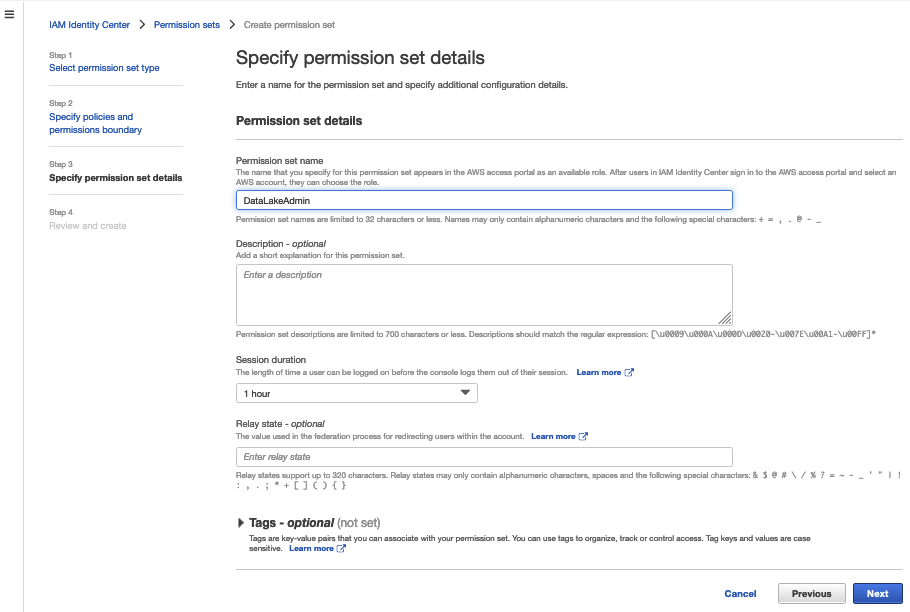

Repeat the steps to create a data analyst role to grant Lake Formation access. For this post, we created the role LakeFormationDataAnalyst with the policy AmazonAthenaFullAccess.
Grant users or groups access to the data lake account in IAM Identity Center
To grant access to users and groups, complete the following steps:
- On the IAM Identity Center console, chose AWS accounts in the navigation pane.
- Choose Assign users or groups.

- Select the user or group you want to assign the data lake account permissions to (
DataLakeAdmin). - Choose Next.

- Select the permission you created earlier.
- Choose Next.

- Review your settings, then choose Submit.


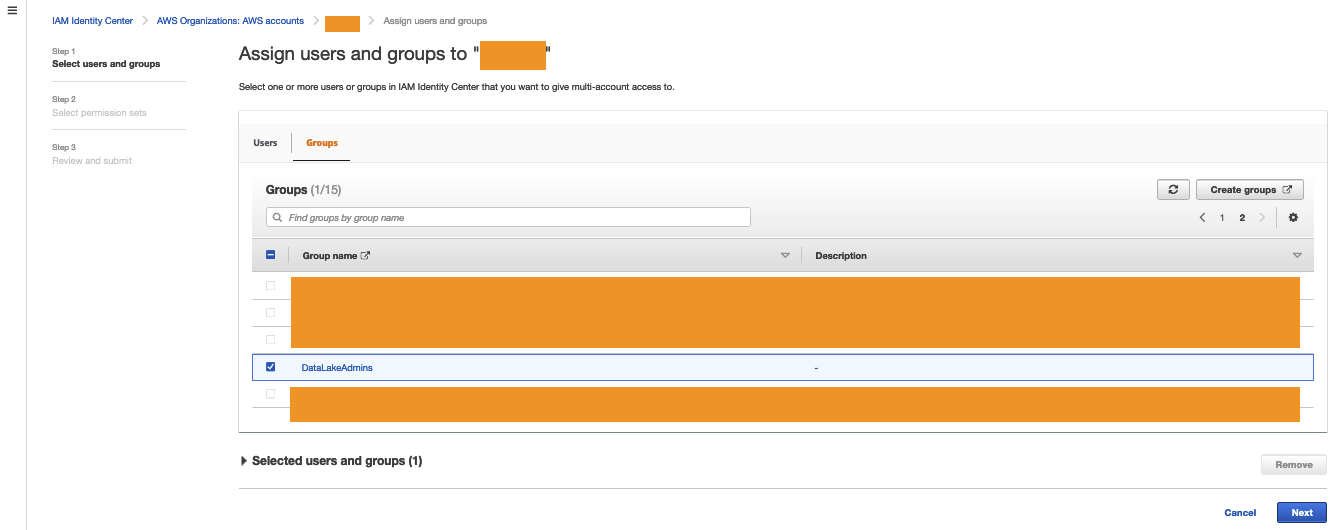
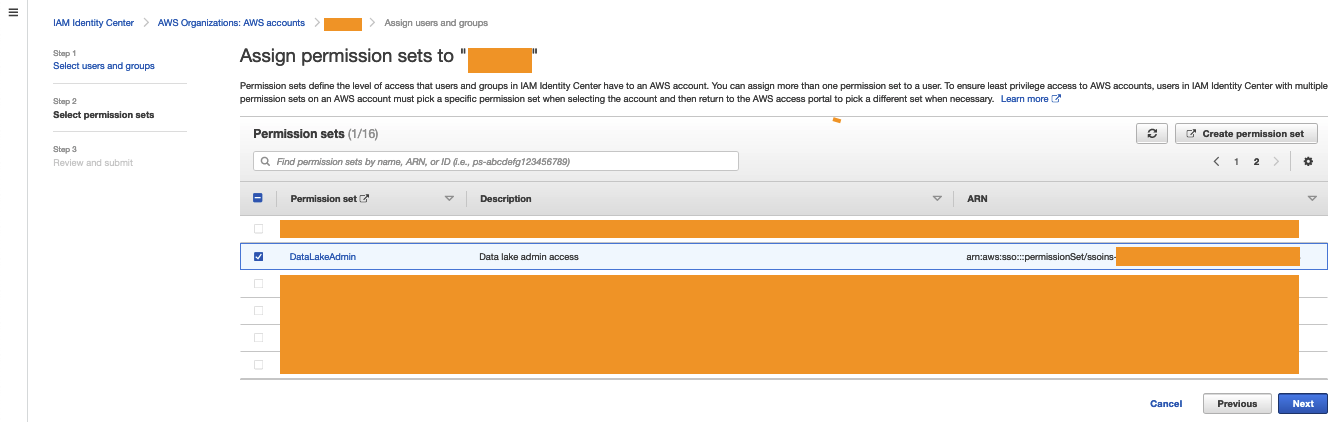

Verify your IAM Identity Center permissions have been successfully granted by visiting your IAM Identity Center Portal, choosing the data lake admin, and signing in to the console.

Assign an IAM Identity Center role as a data lake administrator
The following steps set up a data lake administrator with the IAM role created by IAM Identity Center. Administrators have full access to the Lake Formation console, and control the initial data configuration and access permissions. For all users and groups that don’t need to be data lake administrators, skip to the next series of steps.
- Sign in to the console as the data lake account with admin access.
- Open the Lake Formation console.A pop-up window appears, prompting you to define your administrators.
- Select Add other AWS users or roles.
- Choose the permission set you created earlier (starting with
AWSReservedSSO_DataLakeAdmin). - Choose Get started.

- On the Administrative roles and tasks page, under Database creators, choose Grant.

- Choose your data lake admin role.
- Select Create database under Catalog permissions and Grantable permissions.
- Choose Grant.


You now have an IAM Identity Center-generated IAM principal that is assigned as the data lake administrator and database creator.
Grant the IAM Identity Center role data lake permissions in Lake Formation
You now manage data lake permissions. For more information, refer to Managing Lake Formation permissions.
Whether you’re managing permissions with LF-tags or named resources, the steps for granting access remain the same
- On the Lake Formation console, under Permissions in the navigation pane, choose Data lake permissions.
- Choose Grant.

- Select IAM users and roles.
- Choose the
AWSReservedSSO_LakeFormationDataAnalystrole. - Grant access to database and table permissions as applicable, then choose Grant.

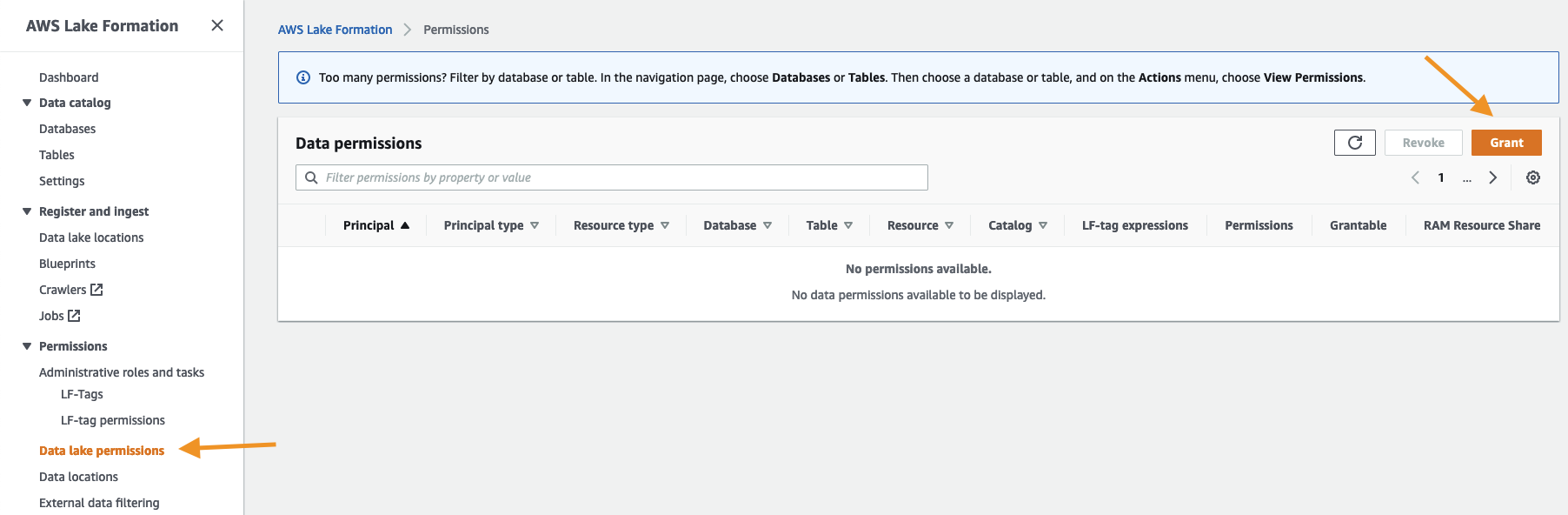

You now have an IAM Identity Center-generated IAM principal data permissions.
Grant the IAM Identity Center role data location permissions in Lake Formation
When granting access to data locations, the process remains the same.
- On the Lake Formation console, under Permissions in the navigation pane, choose Data locations.
- Choose Grant.

- Choose the
AWSReservedSSO_LakeFormationDataAnalystrole. - Complete the remaining fields and choose Grant.

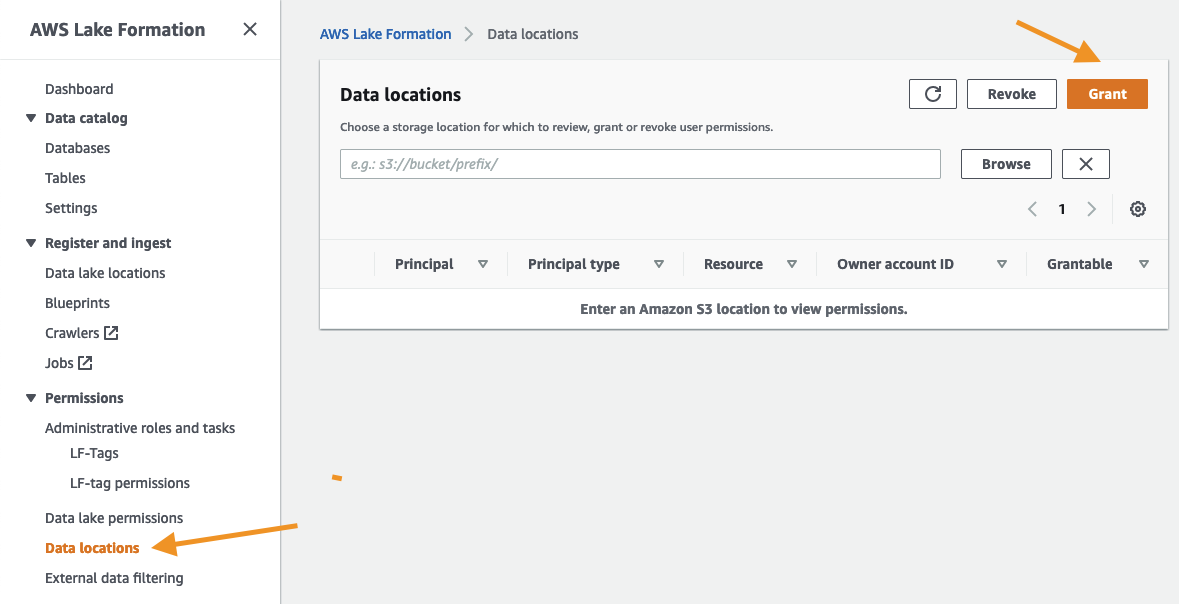

You now have an IAM Identity Center-generated IAM principal with Data location access.
Validate data access
We now validate data access for the IAM Identity Center principal.
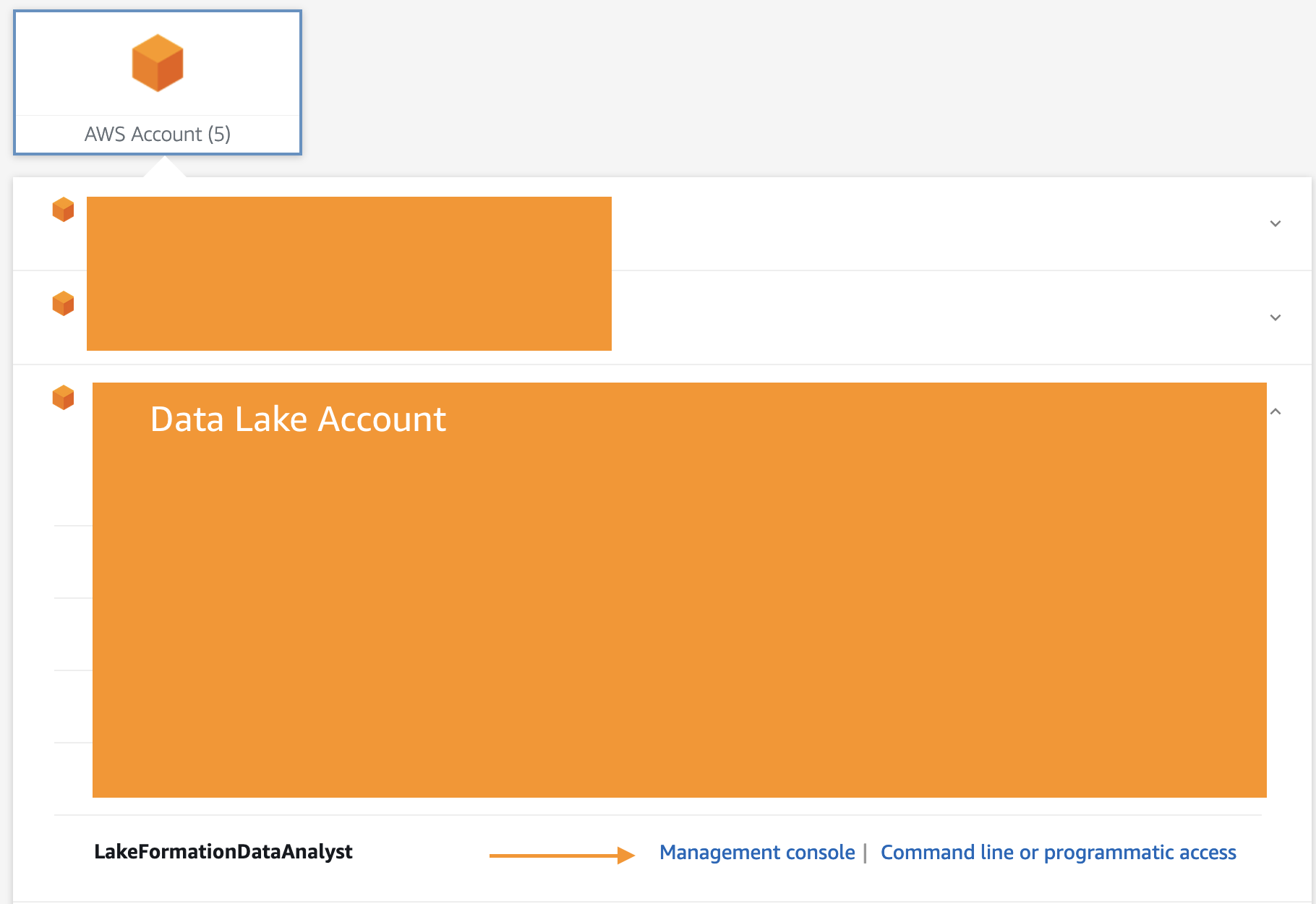
- Sign in to the console through IAM Identity Center as the principal you granted access to. For this post, we’re logging in as the
LakeFormationDataAnalystrole.

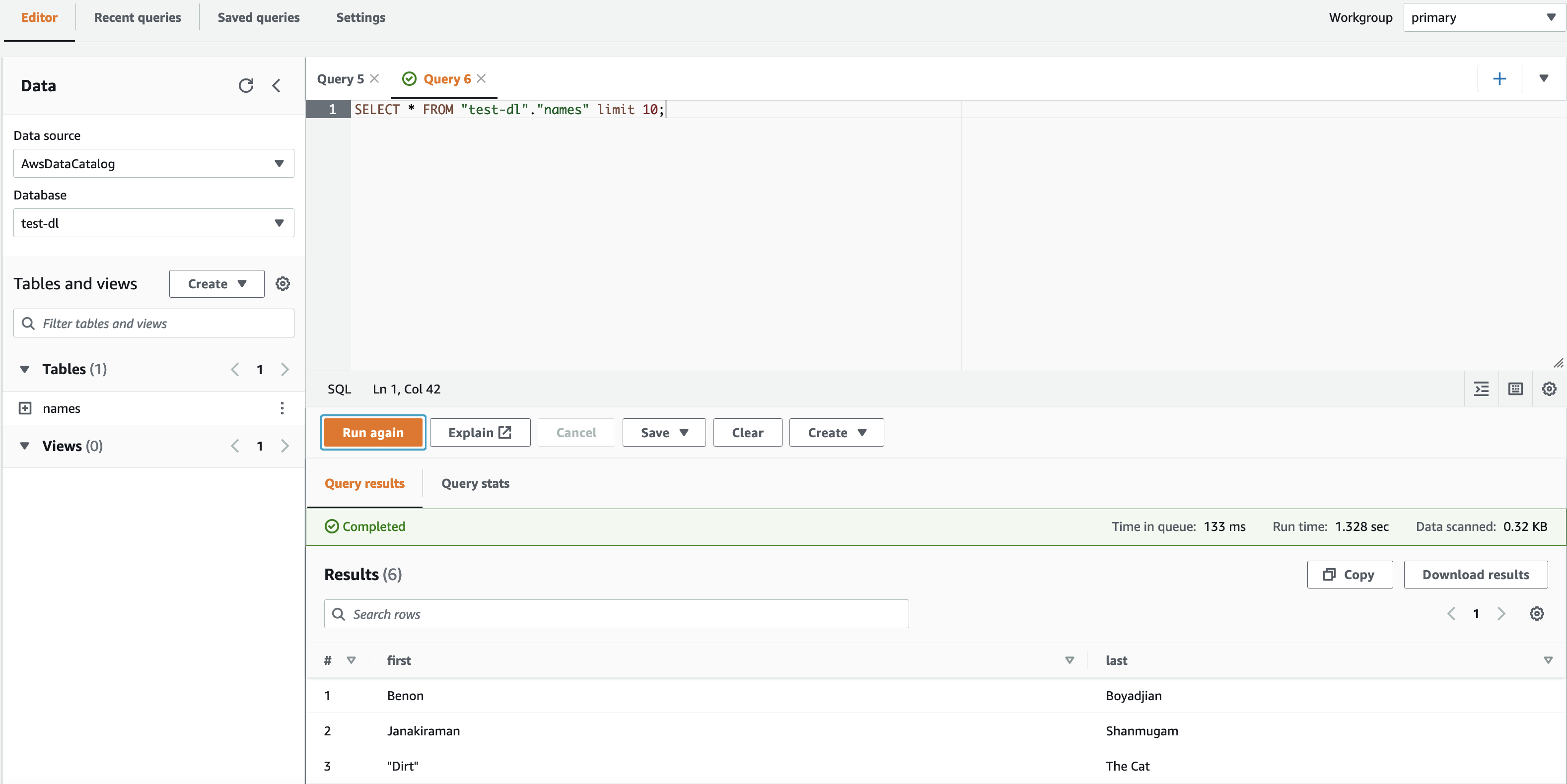
To test data access, we run some queries in Amazon Athena. - On the Athena console, choose Query editor.
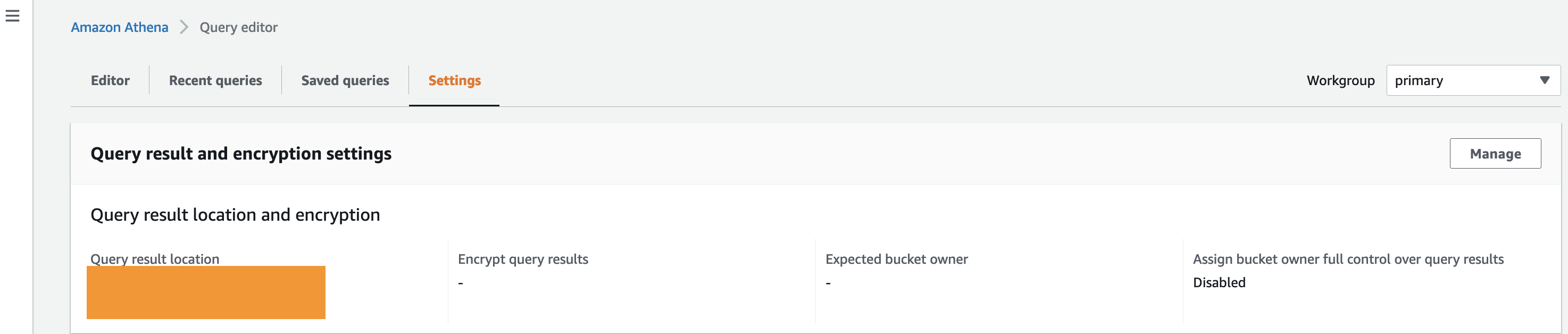
- On the Settings tab, confirm that a query result location is set up.

- If you don’t have a query result location, choose Manage and configure your query result location and encryption.

- In the Athena query editor, on the Editor tab, choose the database that you granted access to.If the principal doesn’t have access to the Lake Formation table and data location, you won’t be able to view data in Athena.
- Choose the menu icon next to your table and choose Generate table DDL.



Confirm that the data appears on the Query results tab.
Conclusion
In this post, we demonstrated how to integrate IAM Identity Center with Lake Formation permissions. You can now grant IAM Identity Center identities administrator, database creation, database and table, and data location access in Lake Formation. Managing data lake permissions through IAM Identity Center allows you to control data access from your management account, helping to improve your scalability and security.
If you’re wondering how to adapt this solution to Tag-based access control, read Easily manage your data lake at scale using AWS Lake Formation Tag-based access control and apply the techniques you learned from this blog.
About the authors
 Benon Boyadjian is a Private Equity Solutions Architect at AWS. He is passionate about helping customers understand the impact AWS can have on their businesses and guiding their AWS implementations. In his free time, he enjoys swimming, snowboarding, and playing with his cat Dirt.
 Janakiraman Shanmugam is a Senior Data Architect at Amazon Web Services . He has a focus in Data & Analytics and enjoys helping customers to solve Big data & machine learning problems. Outside of the office, he loves to be with his friends and family and spend time outdoors.
Baxter SIGMA Spectrum Infusion Pumps: Multiple Vulnerabilities (FIXED)
Post Syndicated from Deral Heiland original https://blog.rapid7.com/2022/09/08/baxter-sigma-spectrum-infusion-pumps-multiple-vulnerabilities-fixed/

Rapid7, Inc. (Rapid7) discovered vulnerabilities in two TCP/IP-enabled medical devices produced by Baxter Healthcare. The affected products are:
- SIGMA Spectrum Infusion Pump (Firmware Version 8.00.01)
- SIGMA Wi-Fi Battery (Firmware Versions 16, 17, 20 D29)
Rapid7 initially reported these issues to Baxter on April 20, 2022. Since then, members of our research team have worked alongside the vendor to discuss the impact, resolution, and a coordinated response for these vulnerabilities.
Product description
Baxter’s SIGMA Spectrum product is a commonly used brand of infusion pumps, which are typically used by hospitals to deliver medication and nutrition directly into a patient’s circulatory system. These TCP/IP-enabled devices deliver data to healthcare providers to enable more effective, coordinated care.
Credit
The vulnerabilities in two TCP/IP-enabled medical devices were discovered by Deral Heiland, Principal IoT Researcher at Rapid7. They are being disclosed in accordance with Rapid7’s vulnerability disclosure policy after coordination with the vendor.
Vendor statement
“In support of our mission to save and sustain lives, Baxter takes product security seriously. We are committed to working with the security researcher community to verify and respond to legitimate vulnerabilities and ask researchers to participate in our responsible reporting process. Software updates to disable Telnet and FTP (CVE-2022-26392) are in process. Software updates to address the format string attack (CVE-2022-26393) are addressed in WBM version 20D30 and all other WBM versions. Authentication is already available in Spectrum IQ (CVE-2022-26394). Instructions to erase all data and settings from WBMs and pumps before decommissioning and transferring to other facilities (CVE-2022-26390) are in process for incorporation into the Spectrum Operator’s Manual and are available in the Baxter Security Bulletin.”
Exploitation and remediation
This section details the potential for exploitation and our remediation guidance for the issues discovered and reported by Rapid7, so that defenders of this technology can gauge the impact of, and mitigations around, these issues appropriately.
Battery units store Wi-Fi credentials (CVE-2022-26390)
Rapid7 researchers tested Spectrum battery units for vulnerabilities. We found all units that were tested store Wi-Fi credential data in non-volatile memory on the device.
When a Wi-Fi battery unit is connected to the primary infusion pump and the infusion pump is powered up, the pump will transfer the Wi-Fi credential to the battery unit.
Exploitation
An attacker with physical access to an infusion pump could install a Wi-Fi battery unit (easily purchased on eBay), and then quickly power-cycle the infusion pump and remove the Wi-Fi battery – allowing them to walk away with critical Wi-Fi data once a unit has been disassembled and reverse-engineered.
Also, since these battery units store Wi-Fi credentials in non-volatile memory, there is a risk that when the devices are de-acquisitioned and no efforts are made to overwrite the stored data, anyone acquiring these devices on the secondary market could gain access to critical Wi-Fi credentials of the organization that de-acquisitioned the devices.
Remediation
To mitigate this vulnerability, organizations should restrict physical access by any unauthorized personnel to the infusion pumps or associated Wi-Fi battery units.
In addition, before de-acquisitioning the battery units, batteries should be plugged into a unit with invalid or blank Wi-Fi credentials configured and the unit powered up. This will overwrite the Wi-Fi credentials stored in the non-volatile memory of the batteries. Wi-Fi must be enabled on the infusion pump unit for this overwrite to work properly.
Format string vulnerabilities
“Hostmessage” (CVE-2022-26392)
When running a telnet session on the Baxter Sigma Wi-Fi Battery Firmware Version 16, the command “hostmessage” is vulnerable to format string vulnerability.
Exploitation
An attacker could trigger this format string vulnerability by entering the following command during a telnet session:

To view the output of this format string vulnerability, `settrace state=on` must be enabled in the telnet session. `set trace` does not need to be enabled for the format string vulnerability to be triggered, but it does need to be enabled if the output of the vulnerability is to be viewed.
Once `set trace` is enabled and showing output within the telnet session screen, the output of the vulnerability can be viewed, as shown below, where each `%x` returned data from the device’s process stack.

SSID (CVE-2022-26393)
Rapid7 also found another format string vulnerability on Wi-Fi battery software version 20 D29. This vulnerability is triggered within SSID processing by the `get_wifi_location (20)` command being sent via XML to the Wi-Fi battery at TCP port 51243 or UDP port 51243.

Exploitation
This format string vulnerability can be triggered by first setting up a Wi-Fi access point containing format string specifiers in the SSID. Next, an attacker could send a `get_wifi_location (20)` command via TCP Port 51243 or UDP port 51243 to the infusion pump. This causes the device to process the SSID name of the access point nearby and trigger the exploit. The results of the triggering of format strings can be viewed with trace log output within a telnet session as shown below.

The SSID of `AAAA%x%x%x%x%x%x%x%x%x%x%x%x%x%x` allows for control of 4 bytes on the stack, as shown above, using the `%x` to walk the stack until it reaches 41414141. By changing the leading `AAAA` in the SSID, a malicious actor could potentially use the format string injection to read and write arbitrary memory. At a minimum, using format strings of `%s` and `%n` could allow for a denial of service (DoS) by triggering an illegal memory read (`%s`) and/or illegal memory write (`%n`).
Note that in order to trigger this DoS effect, the attacker would need to be within normal radio range and either be on the device’s network or wait for an authorized `get_wifi_location` command (the latter would itself be a usual, non-default event).
Remediation
To prevent exploitation, organizations should restrict access to the network segments containing the infusion pumps. They should also monitor network traffic for any unauthorized host communicating over TCP and UDP port 51243 to infusion pumps. In addition, be sure to monitor Wi-Fi space for rogue access points containing format string specifiers within the SSID name.
Unauthenticated network reconfiguration via TCP/UDP (CVE-2022-26394)
All Wi-Fi battery units tested (versions 16, 17, and 20 D29) allowed for remote unauthenticated changing of the SIGMA GW IP address. The SIGMA GW setting is used for configuring the back-end communication services for the devices operation.
Exploitation
An attacker could accomplish a remote redirect of SIGMA GW by sending an XML command 15 to TCP or UDP port 51243. During testing, only the SIGMA GW IP was found to be remotely changeable using this command. An example of this command and associated structure is shown below:
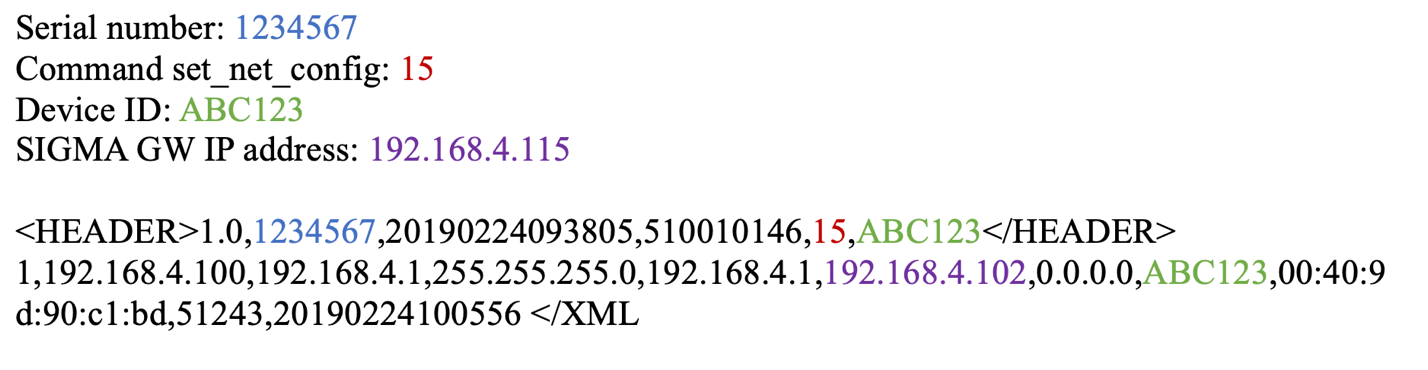
This could be used by a malicious actor to man-in-the-middle (MitM) all the communication initiated by the infusion pump. This could lead to information leakage and/or data being manipulated by a malicious actor.
Remediation
Organizations using SIGMA Spectrum products should restrict access to the network segments containing the infusion pumps. They should also monitor network traffic for any unauthorized host communicating over TCP and UDP port 51243 to the infusion pumps.
UART configuration access to Wi-Fi configuration data (additional finding)
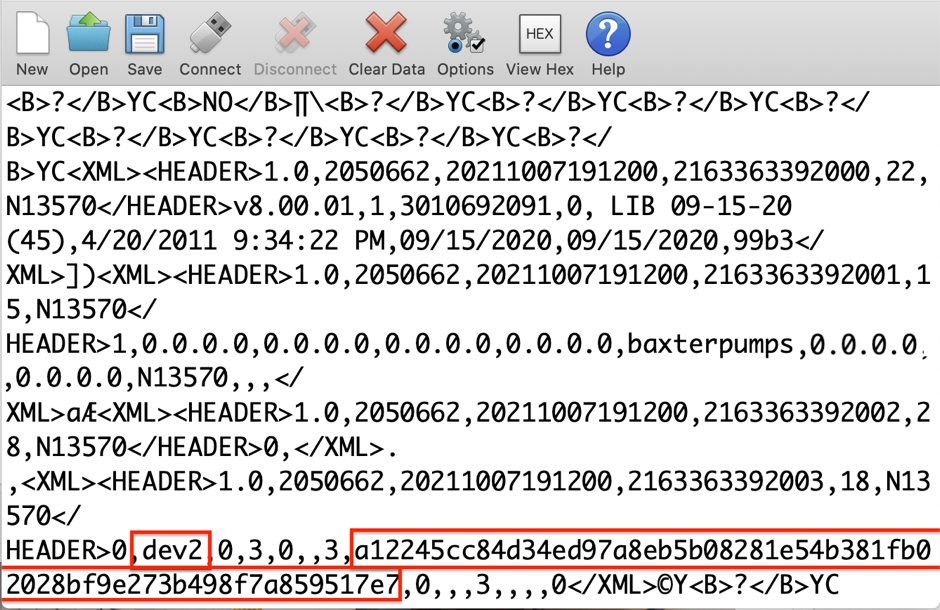
The SIGMA Spectrum infusion pump unit transmits data unencrypted to the Wi-Fi battery unit via universal asynchronous receiver-transmitter (UART). During the power-up cycle of the infusion pump, the first block of data contains the Wi-Fi configuration data. This communication contains the SSID and 64-Character hex PSK.
Exploitation
A malicious actor with physical access to an infusion pump can place a communication shim between the units (i.e., the pump and the Wi-Fi battery) and capture this data during the power-up cycle of the unit.

Remediation
To help prevent exploitation, organizations should restrict physical access by unauthorized persons to the infusion pumps and associated Wi-Fi battery units.
Note that this is merely an additional finding based on physical, hands-on access to the device. While Baxter has addressed this finding through better decommissioning advice to end users, this particular issue does not rank for its own CVE identifier, as local encryption is beyond the scope of the hardware design of the device.
Disclosure timeline
Baxter is an exemplary medical technology company with an obvious commitment to patient and hospital safety. While medtech vulnerabilities can be tricky and expensive to work through, we’re quite pleased with the responsiveness, transparency, and genuine interest shown by Baxter’s product security teams.
- April, 2022: Issues discovered by Deral Heiland of Rapid7
- Wed, April 20, 2022: Issues reported to Baxter product security
- Wed, May 11, 2022: Update requested from Baxter
- Wed, Jun 1, 2022: Teleconference with Baxter and Rapid7 presenting findings
- Jun-Jul 2022: Several follow up conversations and updates between Baxter and Rapid7
- Tue, Aug 2, 2022: Coordination tracking over VINCE and more teleconferencing involving Baxter, Rapid7, CERT/CC, and ICS-CERT (VU#142423)
- Wed, Aug 31, 2022: Final review of findings and mitigations
- Thu Sep 8, 2022: Baxter advisory published
- Thu, Sep 8, 2022: Public disclosure of these issues
- Thu, Sep 8, 2022: ICS-CERT advisory published
Additional reading:
- Rapid7 Discovered Vulnerabilities in Cisco ASA, ASDM, and FirePOWER Services Software
- CVE-2022-31660 and CVE-2022-31661 (FIXED): VMware Workspace ONE Access, Identity Manager, and vRealize Automation LPE
- QNAP Poisoned XML Command Injection (Silently Patched)
- Primary Arms PII Disclosure via IDOR (FIXED)
Facebook Has No Idea What Data It Has
Post Syndicated from Bruce Schneier original https://www.schneier.com/blog/archives/2022/09/facebook-has-no-idea-what-data-it-has.html
This is from a court deposition:
Facebook’s stonewalling has been revealing on its own, providing variations on the same theme: It has amassed so much data on so many billions of people and organized it so confusingly that full transparency is impossible on a technical level. In the March 2022 hearing, Zarashaw and Steven Elia, a software engineering manager, described Facebook as a data-processing apparatus so complex that it defies understanding from within. The hearing amounted to two high-ranking engineers at one of the most powerful and resource-flush engineering outfits in history describing their product as an unknowable machine.
The special master at times seemed in disbelief, as when he questioned the engineers over whether any documentation existed for a particular Facebook subsystem. “Someone must have a diagram that says this is where this data is stored,” he said, according to the transcript. Zarashaw responded: “We have a somewhat strange engineering culture compared to most where we don’t generate a lot of artifacts during the engineering process. Effectively the code is its own design document often.” He quickly added, “For what it’s worth, this is terrifying to me when I first joined as well.”
[…]
Facebook’s inability to comprehend its own functioning took the hearing up to the edge of the metaphysical. At one point, the court-appointed special master noted that the “Download Your Information” file provided to the suit’s plaintiffs must not have included everything the company had stored on those individuals because it appears to have no idea what it truly stores on anyone. Can it be that Facebook’s designated tool for comprehensively downloading your information might not actually download all your information? This, again, is outside the boundaries of knowledge.
“The solution to this is unfortunately exactly the work that was done to create the DYI file itself,” noted Zarashaw. “And the thing I struggle with here is in order to find gaps in what may not be in DYI file, you would by definition need to do even more work than was done to generate the DYI files in the first place.”
The systemic fogginess of Facebook’s data storage made answering even the most basic question futile. At another point, the special master asked how one could find out which systems actually contain user data that was created through machine inference.
“I don’t know,” answered Zarashaw. “It’s a rather difficult conundrum.”
I’m not surprised. These systems are so complex that no humans understand them anymore. That allows us to do things we couldn’t do otherwise, but it’s also a problem.
EDITED TO ADD: Another article.
Handy Tips #37: Collecting metrics from HTTP endpoints with HTTP agent items
Post Syndicated from Arturs Lontons original https://blog.zabbix.com/handy-tips-37-collecting-metrics-from-http-endpoints-with-http-agent-items/23160/
The post Handy Tips #37: Collecting metrics from HTTP endpoints with HTTP agent items appeared first on Zabbix Blog.
Security updates for Thursday
Post Syndicated from original https://lwn.net/Articles/907508/
Security updates have been issued by Debian (libgoogle-gson-java), Fedora (autotrace, insight, and open-vm-tools), Oracle (open-vm-tools), Red Hat (open-vm-tools, openvswitch2.13, openvswitch2.15, openvswitch2.16, openvswitch2.17, ovirt-host, and rh-nodejs14-nodejs and rh-nodejs14-nodejs-nodemon), Scientific Linux (open-vm-tools), Slackware (python3), SUSE (clamav, gdk-pixbuf, gpg2, icu, ImageMagick, java-1_8_0-ibm, libyajl, mariadb, udisks2, webkit2gtk3, and yast2-samba-provision), and Ubuntu (dnsmasq).
VeloCON 2022: Digging Deeper Together!
Post Syndicated from Carlos Canto original https://blog.rapid7.com/2022/09/08/velocon-2022-digging-deeper-together/

September 15, 2022 | Live at 9 am EDT | Virtual and Free

Join the open-source digital forensics and incident response (DFIR) community for a day-long, virtual summit as we DIG DEEPER TOGETHER!
Have you ever wanted to share your passion and interest in Velociraptor with the rest of the community? VeloCON is your chance! Come together with other DFIR experts and enthusiasts from around the world on September 15th as we delve into new ideas, workflows, and features that will take Velociraptor to the next level of endpoint management, detection, and response.
The first annual VeloCON summit will be held Thursday Sept 15th, 2022 at 9 am EDT. It is a 1-day event focused on the Velociraptor community – a forum to share experiences in using and developing Velociraptor to address the needs of the wider DFIR community. This year, the conference will be online and completely free! User-created presentations will be streamed live via Zoom webinar and on the Velociraptor YouTube channel, and will be archived on our Velociraptor website.
Registration is completely free. Here is the speaker list and agenda at a glance:
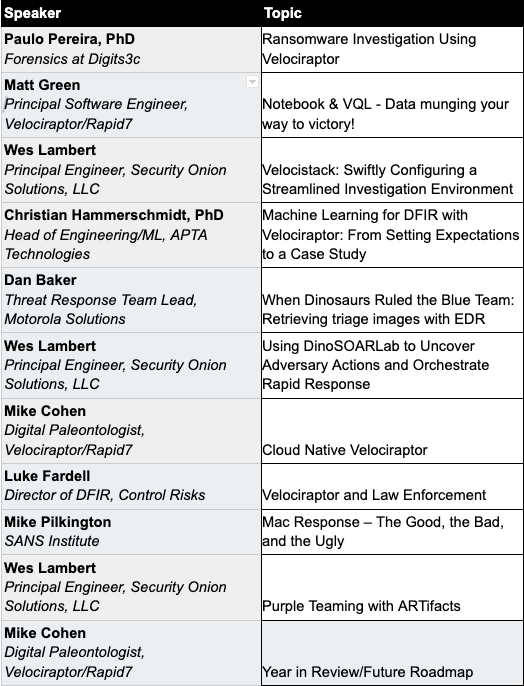
We look forward to seeing you at VeloCON. If you can’t make the event live, be sure to catch a replay of the event, which we’ll have posted to our website and YouTube channel.
Register for VeloCON today! Learn more about Velociraptor by visiting any of our web and social media channels below:
Additional reading:
- [The Lost Bots] S02E03: Browser-in-Browser Attacks — Don’t Get (Cat)-Phished
- Cybersecurity Analysts: Job Stress Is Bad, but Boredom Is Kryptonite
- OCSF: Working Together to Standardize Data
- Velociraptor Version 0.6.5: Table Transformations, Multi-Lingual Support, and Better VQL Error-Handling Let You Dig Deeper Than Ever
Backblaze Rides the Nautilus Data Center Wave
Post Syndicated from original https://www.backblaze.com/blog/backblaze-rides-the-nautilus-data-center-wave/
On the outside and on the inside, our newest data center (DC) is more than a little different: there are no cooling towers chugging on the roof, no chillers, or coolants at all. No, we’re not doing a drive stats experiment on how well data centers run at 54° Celsius. This data center, owned and developed by Nautilus Data Technologies, is nice and cool inside. Built with a unique mix of proven maritime and industrial water-cooling technologies that use river water to cool everything inside—racks, servers, switches, and people—this new DC is innovative, environmentally awesome, secure, fascinating, and other such words and phrases, all rolled into one. And it just happens to be located on a barge on a river in California.
It’s a unique setup, one that might raise a few eyebrows. It certainly did for us. But once our team dug in, we didn’t just find room for another exabyte of data, we found an extremely resilient data center that supports our durability requirements and decreases our environmental impact of providing you cloud storage. You can do a deep dive into the Nautilus technology on their website, but of course I needed to make my own visit to look into this shiny new tech on my own. What follows is an overview of what I learned: how the technology works and why we decided to make the Nautilus data center part of our cloud storage platform.

Nautilus Data Center Overview
In the Port of Stockton in California, an odd looking barge is moored next to the shore of the San Joaquin River. If you were able to get close enough, you might notice the massive mooring poles the barge is attached to. And if you were a student of such things, you might recognize these mooring poles as having the same rating as the mooring poles whose attached boats and barges survived hurricane Katrina. The barge isn’t going anywhere.
Above deck are the data center halls. Once inside, it feels like, well, a data center—almost. The power distribution units (PDUs) and other power-related equipment hum quietly and racks of servers and networking gear are lined up across the floor, but there are no hot and cold aisles, and no air conditioning grates or ductwork either. Instead the ceiling is lined with an orderly arrangement of pipes carrying water that’s been cooled by the river outside.
Upriver from the data center, water is collected from the river and filtered before running through the heat exchanger that cools water circulating in a closed loop inside the data center. River water never enters the data center hall.
The technology used to collect and filter the water has been used for decades in power plants, submarines, aircraft carriers, and so on. The entire collection system is marine wildlife-friendly and certified by multiple federal and state agencies, commissions, and water boards, including the California Department of Fish and Wildlife. One of the reasons Nautilus chose the Port of Stockton was the truism that, if you can get something certified for operation in the state of California, then you can typically get it certified pretty much anywhere.

Inside the data center, at specific intervals, water supply and return lines run down to the rear door on each rack. The server fans expel hot air through the rear door and the water inside the door removes the heat to deliver cool air into the room. We use ColdLogik Rear Door Coolers to perform the heat exchange process. The closed loop water system is under vacuum—meaning that it’s leak proof, so water will never touch the servers. A nice bit of innovation by the Nautilus designers and engineers.
Downriver from the data center, the water is discharged. The water can be up to 4° Fahrenheit warmer than when it started upriver. As we mentioned before, the various federal and state authorities worked with Nautilus engineers to select a discharge location which was marine wildlife-friendly. Within seconds of being discharged the water is back to river temperature and continues its journey to the Sacramento Delta. The water spends less than 15 seconds end-to-end in the system which operates with no additional water, uses no chemicals, and adds zero pollutants to the river.
Why Nautilus
For Backblaze, the process of choosing a data center location is a bit more rigorous than throwing a dart at a map and putting some servers there. Our due diligence checklist is long and thorough, taking into consideration redundancy, capacity, scalability, cost, network providers, power providers, stability of the data center owner, and so on. The Nautilus facility passed all of our tests and will enable us to store over an exabyte of data on-site to optimize our operational scalability. In addition, the Nautilus relationship brings us a few additional benefits not traditionally heard of when talking about data centers.
Innovation
Storage Pods, Drive Farming, Drive Stats, and even Backblaze B2 Cloud Storage are all innovations in their own way as they changed market dynamics or defined a different way to do things. They all have in common the trait of putting together proven ideas and technologies in a new way that adds value to the marketplace. In this case, Nautilus marries proven maritime and industrial water cooling and distribution technologies with a new approach to data center infrastructure. The result is an innovative way to use a precious resource to help meet the ever-increasing demand for data storage. This is the kind of engineering and innovation we admire and respect.
Environmental Awesomeness
We can appreciate the environmental impact of the Nautilus data center from two perspectives. The first is obvious: taking a precious resource, river water, and using it to not only lower the carbon footprint of the data center (Nautilus projects by up to 30%), but to also do so without permanently affecting the resource and ecosystem. That’s awesome. The world has been harnessing the power of Mother Nature for thousands of years, yet doing so responsibly has not always been top-of-mind in the process. In the case of Nautilus, the environmental impact is at the top of their list.
The second reason this is awesome is that Nautilus chose to do this in California, coming face-to-face with probably the most stringent environmental requirements in the United States. Almost anywhere else would have been easier, but if you are looking to show your environmental credibility and commitment, then California is the place to start. We commend them for their effort.
Unique Security
Like any well-run data center site, Nautilus has a multitude of industry standard security practices in place: a 24x7x365 security staff, cameras, biometric access, and so on. But the security doesn’t stop there. Being a data center on a barge also means that divers regularly inspect the underwater systems and the barge itself for maintenance and security purposes. In addition, by nature of being a data center on a barge in the Port of Stockton, the data center has additional security: the port itself is protected by the U.S. Department of Homeland Security (DHS) and the waterways are patrolled by the U.S. Coast Guard. This enhanced collection of protective resources is unique for data centers in the U.S., except possibly the kind of data centers we are not supposed to know anything about.
The Manatee in the River
Let’s get to the elephant in the room here: is there risk in putting a data center on a barge in a river? Yes—but no more so than putting one in a desert, or near any body of water, or near a forest, or in an abandoned mine, or near a mountain, or in a city. You get the idea: they all have some level of risk. We’d argue that this new data center—with its decreased reliance on energy and air conditioning and its protection by DHS, among other positives—is quite a bit more reliable than most places the world stores its data. As always, though, we continue to encourage folks to have their data in multiple places.
Still, putting a data center on a river is novel. We’re sure some people will make jokes, and probably pretty funny ones—we’re happy to laugh at our own expense. (It’s certainly happened before.) We are also sure some competitors will use this as part of their sales and marketing—FUD (fear, uncertainty and doubt) as it is called behind your back. We don’t play that game, and, as with our past innovations, we’re used to people sniping a bit when we move out ahead on technology. As always, we encourage you to dig in, get the facts, and be comfortable with the choice you make. Here at Backblaze, we won’t sell you up the river, but we may put your data there.
The post Backblaze Rides the Nautilus Data Center Wave appeared first on Backblaze Blog | Cloud Storage & Cloud Backup.
Back to school 2022: Our support for teachers
Post Syndicated from Dan Fisher original https://www.raspberrypi.org/blog/back-to-school-2022-support-teachers-computing-computer-science/
The summer months are an exciting time at the Foundation: you can feel the buzz of activity as we prepare for the start of a new school year in many parts of the world. Across our range of fantastic (and free) programmes, everyone works hard to create new and improved resources that help teachers and students worldwide.
We’ve asked some of our programme leads to tell you what’s new in their respective areas. We hope that you’ll come away with a good idea of the breadth and depth of teacher support that’s on offer. Is there something we aren’t doing yet that we should be? Tell us in the comments below.

Sway Grantham has been at the forefront of writing resources for our Teach Computing Curriculum over the last three years. The Curriculum is part of the wider National Centre for Computing Education (NCCE) and provides hundreds of free classroom resources for teachers, from Key Stage 1 to 4. Each resource includes lesson plans, slides, activity sheets, homework, and assessments. Since we published the Curriculum in 2020, all lessons have been reviewed and updated at least once. Managing the process of continuously improving these resources is a key part of Sway’s work.
Hi Sway, what updates have you been making to the Teach Computing Curriculum to help teachers this year?
We make changes to the Teach Computing Curriculum all the time! However, specific things we are excited about ahead of the new school year are updates to how our content is presented on the website so that it’s really easy to see which unit you should be teaching in each half term. We’ve also renamed some of the units to make it clearer what they cover. And to help Key Stage 3 teachers launch Computing in secondary school with skills that are foundational for progress through the requirements of the Key Stage 3 curriculum, we’ve updated the first Year 7 unit, now called Clear messaging in digital media.
You recently asked for teachers’ feedback as part of an annual impact survey. What did you find out?
We are still in the process of looking through the feedback in detail, but I can share some high-level insights. 96% of teachers who responded to the survey gave a score between 7 and 10 for recommending that other teachers use the Teach Computing Curriculum. Over 80% reported that the Teach Computing Curriculum has improved their confidence, subject knowledge, and the quality of their teaching ‘a little’ or ‘a lot’. Finally, over 90% of respondents said the Curriculum is effective at supporting teachers, developing teachers’ subject knowledge, and saving teachers’ time.
We are grateful to the 907 people who took part in the survey! You have all helped us to ensure the Curriculum has a positive impact on teachers and learners throughout England and beyond.

James Robinson dedicates his work at the Foundation to creating free pedagogical resources that underpin the classroom practice of computing teachers worldwide. He has led the creation of the Pedagogy Quick Reads and the Research Bytes newsletter for the NCCE, and the development of our 12 principles of computing pedagogy, available as a handy poster. He also works on our Hello World magazine, produces the associated Hello World podcast, and curates Hello World’s special issues, such as The Big Book of Computing Pedagogy.
James, why is it so important for teachers to underpin their classroom practice with best-practice pedagogical approaches?
In order to teach any area of the curriculum effectively, educators need to understand both the content they are teaching and the most effective ways to deliver that content. Computing is a broad discipline made up of lots of inter-connected knowledge. Different areas of the subject benefit from different approaches, and this may vary depending on the experience of the learners and the context within which they are learning. Understanding which approaches are best suited to different content helps educators support learners effectively.
Computing education research related to school-aged learners is still in its early stages compared to other subjects, and new approaches and pedagogies are being developed, tested, and evaluated. Staying aware of these developments is important for educators and that’s why it’s something the Foundation is dedicated to supporting.
What do you have in store for teachers this year?
This year we continue to share best practice and hear from educators applying new ideas in their classroom through Hello World magazine and podcast. Educators should also keep a look out for our second Hello World special edition exploring the breadth and depth of Computing. To get hold of a copy of this later this year, make sure you’re subscribed to Hello World.

Allen Heard and his team have very recently completed a huge project: creating a full curriculum of GCSE topics and associated questions for Isaac Computer Science, our free online learning platform for teachers and students. The new topics cover the entirety of the GCSE exam board specifications for AQA, Edexcel, Eduqas, OCR, and WJEC, and are integrated with our existing A level computer science resources. They are great to pick up and use for classwork, homework, and revision.
Allen, what has gone into the making of these new GCSE resources?
I think one of the biggest and most important things that’s been evident to me while working on this project is the care and thought that our content creators have put into each and every piece they worked on. To the end user it will simply be material on a web page, but sitting behind each page are countless discussions involving the whole team around how to present certain facts, concepts, or processes. Sometimes these discussions have even caused us to reevaluate our own thinking around how we deliver computer science content. We have debated the smallest things such as glossary terms, questioning every word to make sure we are as clear and concise as possible. Hopefully the care, expertise, and dedication of the team shines through in what really is a fantastic source of information for teachers and learners.
What do you have in store for teachers and learners this year?
With 96% of teachers and 88% of students reporting that the content is of high quality and easily accessible, we still need to continue to support them to ultimately enable learners to achieve their potential. Looking ahead, there is still lots of work to do to make sure Isaac offers the best possible user experience. And we plan to add a lot more questions to really bolster the numbers of questions at varying levels of difficulty for learners. This will have the added benefit of being useful for any teachers wanting to up-skill too! A massive strength of the platform is its questions, and we are really keen to give as wide a range of them as possible.

Tamasin Greenough Graham leads the team at Code Club, our global network of free, in-school coding clubs for young people aged 9 to 13. In Code Clubs, participants learn to code while having fun getting creative with their new skills. Clubs can be run by anyone who wants to help young people explore digital technologies — you don’t need coding experience at all. The Code Club team offers everything you need, including coding projects with easy-to-follow, step-by-step instructions, and lots of resources to help you support your club members. They are also on hand to answer your questions.
Tamasin, what kind of support can teachers expect when they decide to set up a Code Club?
Running a Code Club really is simple and a lot of fun! We have free training to suit everyone, including webinars that guide you through getting started, a self-study online course you can take to prepare for running your Code Club, and drop-in online Q&A sessions where you can chat about your questions to our friendly team or to other educators who run clubs.
Once you have registered your Code Club, you’ll get access to an online dashboard packed with useful resources: from guidance on preparing and delivering your first session, to certificates to celebrate your club members’ successes, and unplugged activities for learners to do away from the screen.
What experience do you need to run a Code Club?
You don’t need to have any coding experience to run a club, as we provide a giant range of fun coding projects and support materials that can be easily followed by educators and young people alike. You just need to support and encourage your young coders, and you can get in touch with the Code Club team if you need any help!
The project paths we offer provide a framework for young coders to develop their skills, whatever their starting point is. Each path starts with three Explore projects, where coders learn new coding concepts and skills. The next two Design projects in the path help them practise these skills through creating fun games, animations, or websites. The final Invent project of the path gives a design brief, and based on this learners have the space to use their new skills and their creativity to code something based on their own ideas.
Our project paths start with the basics of Scratch, and work through to creating websites in HTML and CSS, and to text-based coding in Python. For more advanced or adventurous coders, we also offer project paths to make physical projects with Raspberry Pi Pico, create 3D models in Blender, or even build 3D worlds in Unity.
Why is it important to teach coding to primary-aged children?
Lots of primary-aged children use digital technology every day, whether that be a TV, a phone, playing video games, or a computer at school. But they don’t have to be just consumers of technology. Through learning to code, young people become able to create their own technology, and our projects are designed to help them see how these new skills allow them to express themselves and solve problems that matter to them.
What young people do with their new skills is up to them – that’s the exciting part! Computing skills open paths to a wide range of projects and work where digital skills are helpful. And while learning coding is fun and useful, it also helps learners develop a many other important skills to do with problem solving, teamwork, and creativity.

Martin O’Hanlon heads the team that produces our free online courses programme. If you’re looking for continued professional development in computer science, look no further than to our more than 35 courses. (For teachers in England, a large number of the courses count towards the NCCE’s Primary, Secondary, or GCSE certificates.) Curated in 13 curated learning pathways, all of our courses provide high-quality training that you can take at home, at a time that suits you.
Martin, what can learners expect from taking one of our online courses?
Our online computing courses are free and have something for everyone who is interested in computing. We offer pathways for learning to program in Python or Scratch, teaching computing in the classroom, getting started with physical computing, and many more.
We vary the materials and formats used in our courses, including videos, written articles, quizzes, and discussions to help learners get the most out of the experience. You will find a lot of practical activities and opportunities to practice what you learn. There are loads of opportunities to interact with and learn from others who are doing the course at the same time as you. And educators from the Raspberry Pi Foundation join the courses during facilitation periods to give their advice, support, and encouragement.
What is the idea behind the course pathways?
We have a large catalogue of online training courses, and the pathways give learners a starting point. They group the courses into useful collections, offering a recommended path for everyone, whether that’s people who are brand-new to computing or who have identified a gap in their existing computing skills or knowledge.
Our aim is that these pathways help people find the right course at the right point in their computing journey.
Thanks, everyone.
One more thing…
We’re also very excited to work on new research projects this school year, to help deepen the computing education community’s understanding of how to teach the subject in schools. Are you a primary teacher in England who is interested in making computing culturally relevant for your pupils?

We’re currently looking for teachers to take part in our research project around primary school culturally adapted resources, running from October 2022 to July 2023. Find out more about what taking part involves.
The post Back to school 2022: Our support for teachers appeared first on Raspberry Pi.
Automatic rule backtesting with large quantities of data
Post Syndicated from Grab Tech original https://engineering.grab.com/automatic-rule-backtesting
Introduction
Analysts need to analyse and simulate a rule on historical data to check the performance and accuracy of the rule. Backtesting enables analysts to run simulations of the rules and manage the results from the rule engine UI.
Backtesting helps analysts to:
- Define the desired impact of the rule for our business and users.
- Evaluate the accuracy of the rule based on historical data.
- Compare and analyse results with data points, such as known false positives, user segments, risk profile of a user or transaction, and so on.
Currently, the analytics process to test performance of a rule is not standardised, and is inaccurate and inefficient. Analysts from different teams have different approaches:
- Offline process using Presto tables. This process is lengthy and inaccurate.
- Offline process based on the rule engine payload. The setup takes time, and the process is not streamlined.
- Running rules in shadow mode. This process takes days to get the desired result.
- A team in Grab uses different rule engines to manage rules and do backtesting. This doubles the effort for analysts and engineers.
In our vision for backtesting, it should allow analysts to:
- Efficiently run and manage their jobs.
- Create custom metrics, reports and dimensions for backtesting.
- Add external data points and metrics to do a deep dive.
For the purpose of establishing a minimum viable product (MVP), backtesting will support basic capabilities and enable analysts to access required metrics and data points. Thus, analysts can:
- Run backtesting jobs from the rule engine UI.
- Get fixed reports and dimensions for every checkpoint.
- Get access to relevant data to analyse backtesting results.
Background
Assume a simple use case: A rule to detect the transaction risk.
Each transaction has a transaction_id, user_id, currency, amount, timestamp. The rule engine also provides a treatment (Approve or Decline) based on the rule logic for the transaction.
In this specific use case, we would like to see what will be the aggregation number of the total transactions, total distinct users, and the sum of the amount, based on the dimensions of date, treatment, and currency in the last couple of weeks.
The result may look like the following data:
| Dimension | Dimension | Dimension | metric | metric | metric |
|---|---|---|---|---|---|
| Date | Treatment | Currency | Total tx | Distinct user | Total amount |
| 2020-05-1 | Approve | SGD | 100 | 80 | 10020 |
| 2020-05-1 | Decline | SGD | 50 | 40 | 450 |
| 2020-05-1 | Approve | MYR | 110 | 100 | 1200 |
| 2020-05-1 | Decline | MYR | 30 | 15 | 400 |
* This data does not reflect actual Grab data and is for illustrative purposes only.
Solution
- Use a cloud-agnostic Spark-based data pipeline to replay any existing or proposed rule to check performance.
- Use a Web Portal to:
- Create or select a rule to replay, with replay time range.
- Display and download the result, such as total events and hit counts.
- Replay any existing or proposed rule for checking performance.
- Allow users to create or select a rule to replay in the rule engine UI, with provided replay time range.
- Display the replay result in the rule engine UI, such as total events and hit counts.
- Provide a way to download all testing results in the rule engine UI (for example, all rule responses).
- Remove dependency on the specific cloud provider stack, so other teams in Grab can use it instead of Google Cloud Platform (GCP).
Architecture details
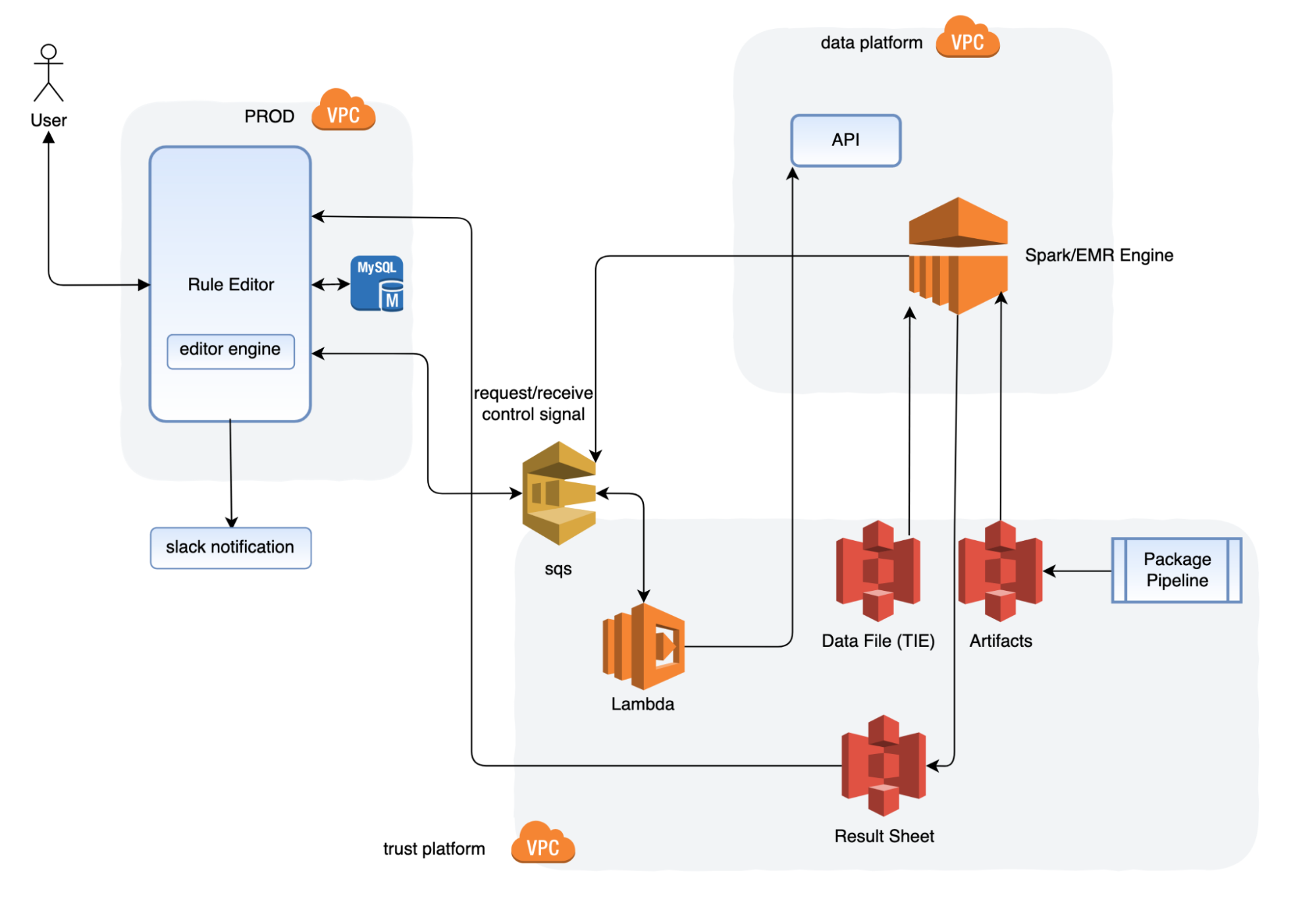
The rule editor UI reacts to the user input. Its engine sends a job command to the Amazon Simple Queue Service (SQS) to initialise the job. After that, the rule editor also performs the following processes in the background:
- Lambda listens to the request SQS queue and invokes a job via the Spark jobs API.
- The job fetches the executable artifacts, data source. After the job is completed, the job script saves the result sheet as required to S3.
- The Spark script pushes the job final status (success, failure, timeout) through the shutdown hook to respond to the SQS queue.
- The rule editor engine listens to response callback messages, and processes the job metadata to the database, or sends notifications.
- The rule editor displays the job metadata on the UI.
- The package pipeline builds and deploys the executable artifacts to S3 as a manageable structure.
- The Spark script takes the filter logic as its input parameters.
Workflow
Historical data preparation
The historical events are published by the rule engine through Kafka, and stored into the S3 bucket based on time. The Backtesting system then fetches these data for testing based on the time range requested.
By using a Kubernetes stream pipeline, we also save the trust inference stream to Trust AWS subaccount. With the customer bucket and file format, we can improve the efficiency of the data processing, and also avoid any delay from the data lake.
Engineering specifications
- Target location:
    s3a://stg-trust-inference-event/<engine-name>/<predict-name>/<YYYY>/MM/DD/hh/mm/ss/<000001>.snappy.parquet
    s3a://prd-trust-inference-event/<engine-name>/<predict-name>/<YYYY>/MM/DD/hh/mm/ss/<000001>.snappy.parquet
Description: Following the fields of steam definition, the engine name would be ruleengine, or catwalk. The predict-name would be preride (checkpoint name), or cnpu (model name).
- File Format: avro
- File Compression: Snappy
- There is no auto retention on sub-account S3. We will implement the archive process in the future.
- The default pipeline and the new pipeline will run in parallel until the Data Engineering team is ready to retire the default pipeline.
Backtesting
- Upon scheduling, the Backtesting Portal sends a message to SQS, which is then captured by the listening Lambda.
- Lambda invokes a Spark job over the AWS elastic mapreduce engine (EMR).
- The EMR engine fetches the executable artifacts containing the rule script and historical data from S3, and starts a Spark job to apply the rule script over historical data. Depending on the size of data, the Spark cluster will scale automatically to ensure timely completion.
- Once completed, a report file is generated and available on Backtesting UI.
UI
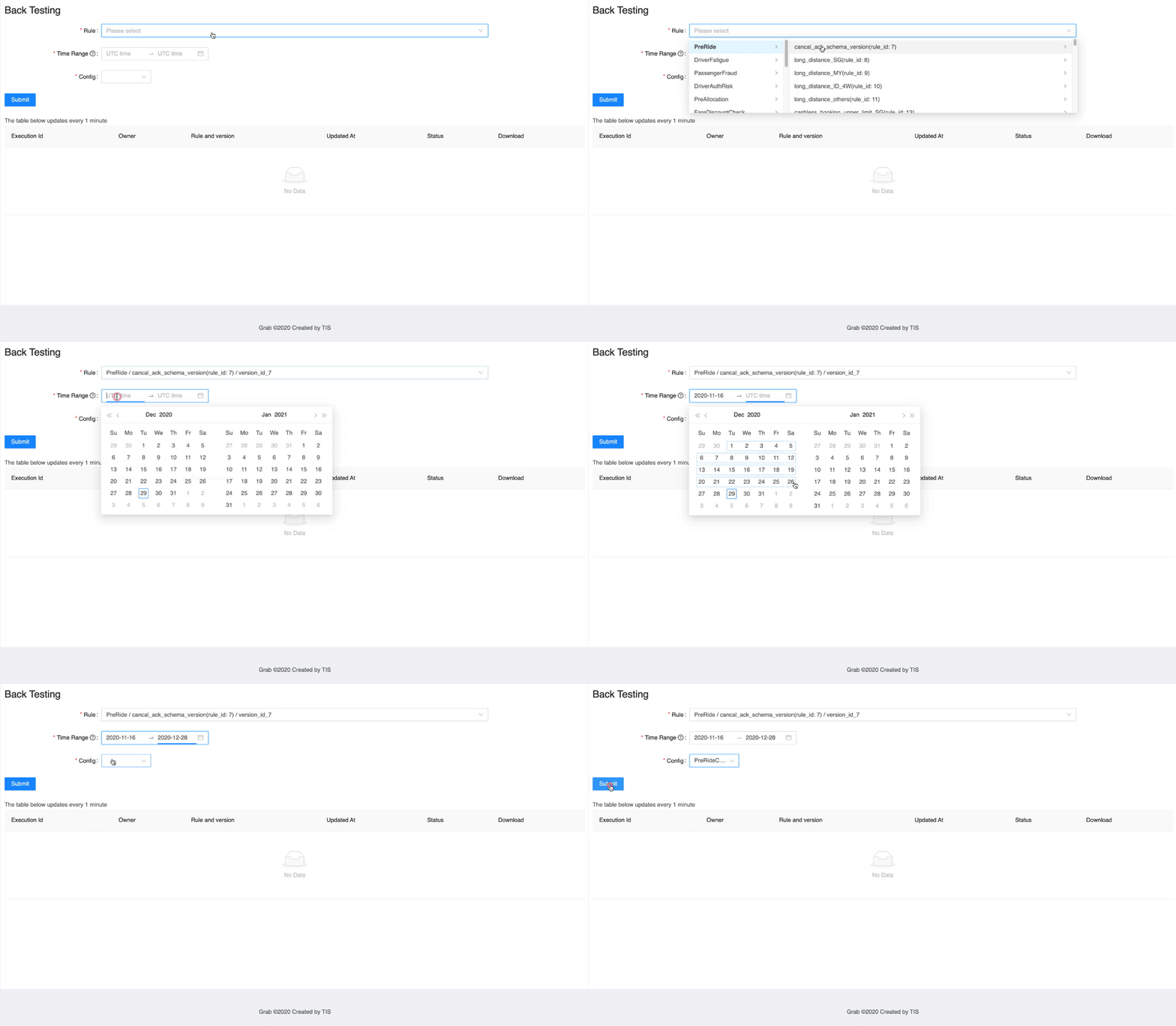
Learnings and conclusions
After the release, here’s what our data analysers had to say:
- For trust analysts, testing a rule on historical data happens outside the rule engine UI and is not user-friendly, leading to analysts wasting significant time.
- For financial analysts, as analysts migrate to the rule engine UI, the existing solution will be deprecated with no other solution.
- An alternative to simulate a rule; we no longer need to run a rule in shadow mode because we can use historical data to determine the outcome. This new approach saves us weeks of effort on the rule onboarding process.
What’s next?
The underlying Spark jobs in this tool were developed by knowledgeable data engineers, which is a disadvantage because it requires a high level of expertise to modify the analytics. To mitigate this restriction, we are looking into using domain-specific language (DSL) to allow users to input desired attributes and dimensions, and provide the job release pipeline for self-serving jobs.
Thanks to Jia Long Loh for the support on the offline infrastructure engineering.
Join us
Grab is the leading superapp platform in Southeast Asia, providing everyday services that matter to consumers. More than just a ride-hailing and food delivery app, Grab offers a wide range of on-demand services in the region, including mobility, food, package and grocery delivery services, mobile payments, and financial services across 428 cities in eight countries.
Powered by technology and driven by heart, our mission is to drive Southeast Asia forward by creating economic empowerment for everyone. If this mission speaks to you, join our team today!
[$] LWN.net Weekly Edition for September 8, 2022
Post Syndicated from original https://lwn.net/Articles/906796/
The LWN.net Weekly Edition for September 8, 2022 is available.
GitHub Availability Report: August 2022
Post Syndicated from Jakub Oleksy original https://github.blog/2022-09-07-github-availability-report-august-2022/
In August, we experienced one incident resulting in significant impact and degraded state of availability to Codespaces. This report also sheds light into an incident that impacted Codespaces in July.
August 29 12:51 UTC (lasting 5 hours and 40 minutes)
Our alerting systems detected an incident that impacted most Codespaces customers. Due to the recency of this incident, we are still investigating the contributing factors and will provide a more detailed update on cause and remediation in the September Availability Report, which will publish the first Wednesday of October.
Follow up to July 27 22:29 UTC (lasting 7 hours and 55 minutes)
As mentioned in the July Availability Report, we are now providing a more detailed update on this incident following further investigation. During this incident, a subset of codespaces in the East US and West US regions using 2-core and 4-core machine types could not be created or restarted.
On July 27, 2022 at approximately 21:30 UTC we started experiencing a high rate of failures creating new virtual machines (VMs) for Codespaces in the East US and West US regions. The rate of codespace creations and starts on the 2-core and 4-core machine types exceeded the rate of successful VM creations needed to run, which eventually led to resource exhaustion of the underlying VMs. At 22:29 UTC, the pools for 2-core and 4-core VMs were drained and unable to keep up with demand, so we statused yellow. Impacted codespaces took longer than normal to start while waiting for an available VM, and many ended up timing out and failing.
Each codespace runs on an isolated VM for security. The Codespaces platform builds a host VM image on a regular cadence, and then all host VMs are instantiated from that base image. This incident started when our cloud provider began rolling out an update in the East US and West US regions that was incompatible with the way we built our host VM image. Troubleshooting the failures was difficult because our cloud provider was reporting that the VMs were being created successfully even though some critical processes that were required to be started during VM creation were not running.
We applied temporary mitigations, including scaling up our VM pools to absorb the high failure rate, as well as adjusting timeouts to accelerate failure for VMs that were unlikely to succeed. While these mitigations helped, the failure rate continued to increase as our cloud provider’s update rolled out more broadly. Our cloud provider recommended adjusting our image generalization process in a way that would work with the new update. Once we made the recommended change to our image build pipeline, VM creation success rates recovered and enabled the backlog of queued codespace creation and start requests to be fulfilled with VMs to run the codespaces.
Following this incident, we have audited our VM image building process to ensure it aligns with our cloud provider’s guidance to prevent similar issues going forward. In addition, we have improved our service logic and monitoring to be able to verify that all critical operations are executed during VM creation rather than only looking at the result reported by our cloud provider. We have also updated our alerting to detect VM creation failures earlier before there is any user impact. Together, these changes will prevent this class of issue from happening, detect other failure modes earlier, and enable us to quickly diagnose and mitigate other VM creation errors in the future.
In summary
We will continue to keep you updated on the progress and investments we’re making to ensure the reliability of our services. To receive real-time updates on status changes, please follow our status page. You can also learn more about what we’re working on on the GitHub Engineering Blog.