Post Syndicated from corbet original https://lwn.net/Articles/998144/
The LWN.net Weekly Edition for November 21, 2024 is available.
Post Syndicated from corbet original https://lwn.net/Articles/998144/
The LWN.net Weekly Edition for November 21, 2024 is available.
Post Syndicated from Matheus Guimaraes original https://aws.amazon.com/blogs/aws/introducing-amazon-cloudfront-vpc-origins-enhanced-security-and-streamlined-operations-for-your-applications/
I’m happy to introduce the release of Amazon CloudFront Virtual Private Cloud (VPC) origins, a new feature that enables content delivery from applications hosted in private subnets within their Amazon Virtual Private Cloud (Amazon VPC). This makes it easy to secure web applications, allowing you to focus on growing your businesses while improving security and maintaining high-performance and global scalability with CloudFront.
Customers serving content from Amazon Simple Storage Solution (Amazon S3), AWS Elemental Services and AWS Lambda Function URLs can use Origin Access Control as a managed solution to secure their origins, and make CloudFront the single front-door to your application. However, this was more difficult to achieve for applications that are hosted on Amazon Elastic Compute Cloud (Amazon EC2) or using load balancers, because you had to create your own solution to achieve the same result. You would have to use a combination of methods such as using access control lists (ACLs), managing firewall rules, or using logic such as header validation and a few other techniques to ensure that the endpoint remained exclusive to CloudFront.
CloudFront VPC origins removes the need for this kind of undifferentiated work by offering a managed solution that can be used to point CloudFront distributions directly to Application Load Balancers (ALBs), Network Load Balancers (NLBs), or EC2 instances inside your private subnets. This ensures that CloudFront becomes the sole ingress point for those resources with minimum configuration effort, providing you with improved performance and a cost-saving opportunity because it also eliminates the need for public IP addresses.
Configuring a CloudFront VPC origin
CloudFront VPC origins is available at no additional cost, making it an accessible option for all AWS customers. It can be integrated with new or existing CloudFront distributions using the Amazon CloudFront console or the AWS Command Line Interface (AWS CLI).
Imagine that you have an application hosted privately on an AWS Fargate for Amazon ECS fronted through an ALB. Let’s create a CloudFront distribution that uses the ALB directly inside the private subnet.
Start by navigating to the CloudFront console and select the new menu option: VPC origins.

Creating a new VPC origin is straightforward. You only need to select from a few options. In the Origin ARN, you can search for available resources that are hosted in private subnets or enter it directly. You select the resources that you want, choose a friendly name for your VPC origin alongside some security options, and then confirm. Please note that, at launch, the VPC origin resource must be in the same AWS Account as the CloudFront distribution, although support for resources across all accounts is coming soon.

After the creation process is complete, your VPC origin will be deployed and ready to go! You can check its status on the VPC origins page.

With this, we have created a CloudFront distribution that serves content directly from a resource hosted on a private subnet in a few clicks! After your VPC origin is created, you can navigate to your Distribution window, and add the VPC origin to your Distribution by either selecting the ARN from the dropdown or copy-pasting the ARN manually.
Remember, though, that it’s important to still continue to layer your application’s security by using services such as AWS Web Application Firewall (WAF) to protect from web exploits, or AWS Shield for managed DDos protection, and other services to achieve a full-spectrum protection.
Conclusion
CloudFront VPC Origins offers a new way for organizations to deliver secure, high-performance applications by enabling CloudFront distributions to serve content directly from resources hosted within private subnets. This reduces the complexity and cost of maintaining public-facing origins while ensuring that your application remains secure.
To learn more, see the getting started guide.
Post Syndicated from Sébastien Stormacq original https://aws.amazon.com/blogs/aws/amazon-cloudfront-now-accepts-your-applications-grpc-calls/
Starting today, you can deploy Amazon CloudFront, our global content delivery network (CDN), in front of your gRPC API endpoints.
gRPC is a modern, efficient, and language-agnostic framework for building APIs. It uses Protocol Buffers (protobuf) as its interface definition language (IDL), which enable you to define services and message types in a platform-independent manner. With gRPC, communication between services is achieved through lightweight and high-performance remote procedure calls (RPCs) over HTTP/2. This promotes efficient and low-latency communication across services, making it ideal for microservices architectures.
gRPC offers features such as bidirectional streaming, flow control, and automatic code generation for a variety of programming languages. It’s well-suited for scenarios in which you require high performance, efficient communication, and real-time data streaming. If your application needs to handle a large amount of data or requires low-latency communication between client and server, gRPC can be a good choice. However, gRPC might be more challenging to learn compared to REST. For example, gRPC relies on the protobuf serialization format, which requires developers to define their data structures and service methods in .proto files.
I see two benefits of deploying CloudFront in front of your gRPC API endpoints.
First, it allows the reduction of latency between the client application and your API implementation. CloudFront offers a global network of over 600+ edge locations with intelligent routing to the closest edge. Edge locations provide TLS termination and optional caching for your static content. CloudFront transfers client application requests to your gRPC origin through the fully managed, low-latency, and high-bandwidth private AWS network.
Secondly, your applications benefit from additional security services deployed on edge locations, such as traffic encryption, the validation of the HTTP headers through AWS Web Application Firewall, and AWS Shield Standard protection against distributed denial of service (DDoS) attacks.
Let’s see it in action
To start this demo, I use the gRPC route-guide demo from the official gRPC code repository. I deploy this example application in a container for ease of deployment (but any other deployment option is supported too).
I use this Dockerfile
FROM python:3.7
RUN pip install protobuf grpcio
COPY ./grpc/examples/python/route_guide .
CMD python route_guide_server.py
EXPOSE 50051
I also use the AWS Copilot command line to deploy my container on Amazon Elastic Container Service (Amazon ECS). The Copilot command prompts me to collect the information it requires to build and deploy the container. Then, it creates the ECS cluster, the ECS service, and the ECS task automatically. It also creates a TLS certificate and the load balancer for me. I test the client application by modifying line 122 to use the DNS name of the load balancer listener endpoint. I also change the client application code to use grpc.secure_channel instead of grpc.insecure_channel because the load balancer provides the application with an HTTPS endpoint.

When I’m confident my API is correctly deployed and working, I proceed and configure CloudFront.
First, in the CloudFront section of the AWS Management Console, I select Create distribution.

Under Origin, I enter my gRPC endpoint DNS name as Origin domain. I enable HTTPS only as Protocol and leave the HTTPS port as is (443). Then I choose a Name for the distribution.

Under Viewer, I select HTTPS only as Viewer protocol policy. Then, I select GET, HEAD, OPTIONS, PUT, POST, PATCH, DELETE as Allowed HTTP methods. I select Enable for Allow gRPC requests over HTTP/2.

Under Cache key and origin requests, I select AllViewer as Origin request policy.
The default cache policy is CacheOptimized, but gRPC isn’t cacheable API traffic. Therefore, I select CachingDisabled as Cache policy.

AWS WAF helps protect you against common web exploits and bots that can affect availability, compromise security, or consume excessive resources. For gRPC traffic, AWS WAF can inspect the HTTP headers of the request and enforce access control. It doesn’t inspect the request body in protobuf format.
For this demo, I choose to not use AWS WAF. Under Web Application Firewall (WAF), I select Do not enable security protections.

I also keep all the other options with their default value. HTTP/2 support is selected by default. Do not disable it because it is required for gRPC.
Finally, I select Create distribution.

There is only one switch to enable gRPC on top of the usual setup. When turned on, with HTTP/2 and HTTP POST enabled, CloudFront detects gRPC client traffic and forwards it to your gRPC origin.
After a few minutes, the distribution is ready. I copy and paste the endpoint URL of the CloudFront distribution, and I change the client-side app to make it point to CloudFront instead of the previously created load balancer.

I test the application again, and it works.

Pricing and Availability
gRPC origins are available on all the more than 600 CloudFront edge locations at no additional cost. The usual requests and data transfer fees apply.
Go and point your CloudFront origin to a gRPC endpoint today.
Post Syndicated from José Salvador original https://blog.cloudflare.com/bigger-and-badder-how-ddos-attack-sizes-have-evolved-over-the-last-decade
Distributed Denial of Service (DDoS) attacks are cyberattacks that aim to overwhelm and disrupt online services, making them inaccessible to users. By leveraging a network of distributed devices, DDoS attacks flood the target system with excessive requests, consuming its bandwidth or exhausting compute resources to the point of failure. These attacks can be highly effective against unprotected sites and relatively inexpensive for attackers to launch. Despite being one of the oldest types of attacks, DDoS attacks remain a constant threat, often targeting well-known or high traffic websites, services, or critical infrastructure. Cloudflare has mitigated over 14.5 million DDoS attacks since the start of 2024 — an average of 2,200 DDoS attacks per hour. (Our DDoS Threat Report for Q3 2024 contains additional related statistics).
If we look at the metrics associated with large attacks mitigated in the last 10 years, does the graph show a steady increase in an exponential curve that keeps getting steeper, especially over the last few years, or is it closer to linear growth? We found that the growth is not linear, but rather is exponential, with the slope dependent on the metric we are looking at.
Why is this question interesting? Simple. The answer to it provides valuable insights into the evolving strategies of attackers, the sophistication of their tools, and the readiness of defense mechanisms.
As an example, an upward curve of the number of requests per second (rps) suggests that the attackers are changing something on their side that enables them to generate larger volumes of requests. This is an insight that prompts us to investigate more and look at other data to understand if anything new is happening.
For instance, at one of those moments, we looked at the source of the traffic and saw a shift from subscriber/enterprise IP address space (suggesting IoT) to cloud provider IP address space (suggesting VMs), and realized there was a shift in the type and capabilities of devices used by attackers.
As another example: when the HTTP/2 Rapid Reset attack happened, the record number of requests per second seen at that time suggested that a new technique was being employed by attackers, prompting us to swiftly investigate what was being executed and adapt our defenses.
Delimiting an individual attack in time is surprisingly blurry. First of all, an attack analysis can provide inconsistent observations at different layers of the OSI model. The footprint seen at all these different layers may tell different stories for the same attack. There are, however, some variables that together can allow us to create a fingerprint and enable us to group a set of events, establishing that they are part of the same individual attack. Examples include:
Do we see the same attack vector(s) being used across this set of events?
Are all the attack events focused on the same target(s)?
Do the payloads on events share the same signature? (Specific data payloads or request types unique to certain types of attacks or botnets, like Mirai, which may use distinctive HTTP request headers or packet structures).
Before we dive into a growth analysis of DDoS attacks over the last 10 years, let’s take a step back and have a look at the metrics typically used to measure them: requests per second (rps), packets per second (pps), and bits per second (bps). Each metric captures a different aspect of the attack’s scale and impact.
Requests per second (rps): Measures the number of HTTP or similar protocol requests made each second. This metric is particularly relevant for application-layer attacks (Layer 7), where the intent is to overwhelm a specific application or service by overloading its request handling, and is useful for measuring attacks targeting web servers, APIs, or applications because it reflects the volume of requests, not just raw data transfer.
Packets per second (pps): Represents the number of individual packets sent to the target per second, regardless of their size. This metric is critical for network-layer attacks (Layers 3 and 4), where the goal is to overwhelm network infrastructure by exceeding its packet-processing capacity. pps measurements are useful for volumetric attacks, identifying a quantity of packets that can impact routers, switches, or firewalls.
Bits per second (bps): This measures the total data transferred per second and is especially useful in evaluating network-layer attacks that aim to saturate the bandwidth of the target or its upstream provider. bps is widely used measuring Layer 3 and 4 attacks, such as UDP floods, where the attack intends to clog network bandwidth. This metric is often highlighted for DDoS attacks because high bps values (often measured in gigabits or terabits) signal bandwidth saturation, which is a common goal of large-scale DDoS campaigns.
So, how have DDoS attack sizes changed in the last decade? During this period, DDoS attacks have grown bigger and stronger, each year having the potential to be more disruptive.
If we look at the metrics associated with large attacks seen in the last 10 years, does it look like we have a steady increase in an exponential curve that keeps steepening, especially in the last few years, or is it closer to a linear growth? We found that it is exponential, so let’s have a look at the details around why we came to that conclusion.
In this analysis, we used attacks that Google has seen from 2010 until 2022 as a baseline (Figure 1) that we extended with attacks that Cloudflare has seen in 2023 and 2024 (Figure 2).
Going back in time, early in the 2010s, the largest attacks were measured in the Gigabits per second (Gbps) scale, but these days, it’s all about Terabits per second (Tbps). The number of requests per second (rps) and bits per second (bps) are also significantly higher these days, as we will see.
The historical data from Google shown below in Figure 1 reveals a rising trend in requests per second during DDoS attacks observed between 2010 and 2022, peaking at 6 Million requests per second (Mrps) in 2020. The increase highlights a significant escalation in attack volume across the decade.

Figure 1. Largest known DDoS attacks, 2010 – 2022. (Source: Google)
Figure 2 (below) provides a view of trends seen across the different metrics. The escalation seen in Google’s statistics is also visible in Cloudflare’s data regarding large mitigated DDoS attacks observed in 2023 and 2024, reaching 201 Mrps (green line) in September 2024. The rate of packets per second (pps) demonstrates (blue line) a slight exponential growth over time, rising from 230 Mpps in 2015 to 2,100 Mpps in 2024, suggesting that attackers are achieving higher throughput. For bits per second (bps), the trend is also exponential and with a steeper upwards curve (red line), building from a 309 Gbps attack in 2013 to a 5.6 Tbps (5,600 Gbps) attack in 2024.
Over roughly the last decade, attacks driving these metrics have seen significant growth rates:
Bits per second increased by 20x between 2013 and 2024
Packets per second increased by 10x between 2015 and 2024
Requests per second increased by 70x between 2014 and 2024

Figure 2. Data from Figure 1 extended with large attacks observed by Cloudflare in 2023 and 2024.
The blog posts listed in Table 1 highlight some of the attacks that we observed from 2021 to 2024.
|
Month |
Attack size |
Blog post |
|
August 2021 |
17.2 Mrps |
Cloudflare thwarts 17.2M rps DDoS attack — the largest ever reported |
|
April 2022 |
15 Mrps |
|
|
June 2022 |
26 Mrps |
Cloudflare mitigates 26 million request per second DDoS attack |
|
February 2023 |
71 Mrps |
Cloudflare mitigates record-breaking 71 million request-per-second DDoS attack |
|
September 2024 |
3.8 Tbps |
How Cloudflare auto-mitigated world record 3.8 Tbps DDoS attack |
|
October 2024 |
4.2 Tbps |
4.2 Tbps of bad packets and a whole lot more: Cloudflare’s Q3 DDoS report |
|
October 2024 |
5.6 Tbps |
Table 1. Notable DDoS attacks observed by Cloudflare between 2021 – 2024.
An overview of other selected significant high volume DDoS attacks that have occurred over the last decade, including 2018’s Memcached abuse and 2023’s HTTP/2 “Rapid Reset” attacks, can be found on the Cloudflare Learning Center.
Attack duration is not an effective metric to use to qualify attack aggressiveness because establishing a duration of a single attack or campaign is challenging, due to their possible intermittent nature, the potential for a multitude of attack vectors being used at the same time, or how the different defense layers triggered over time.
The attack patterns can differ considerably, with some consisting of a single large spike, while others featuring multiple tightly grouped spikes, or a continuous load maintained over a period of time, along with other changing characteristics.
DDoS attacks are increasingly shifting from IoT-based botnets to more powerful VM-based botnets. This change is primarily due to the higher computational and throughput capabilities of cloud-hosted virtual machines, which allow attackers to launch massive attacks with far fewer devices.
This shift is facilitated by several factors: VM botnets can be easier to establish than IoT botnets, as they don’t necessarily require widespread malware infections, since attackers can deploy them on cloud provider infrastructure anonymously using stolen payment details from data breaches or Magecart attacks.
This trend points to the evolution of DDoS tactics, as attackers exploit both the processing power of VMs and anonymized access to cloud resources, enabling smaller, more efficient botnets capable of launching large-scale attacks without the complexities involved in infecting and managing fleets of IoT devices.
Cloudflare’s Connectivity Cloud, built on our expansive anycast global network, plays a crucial role in defending against DDoS attacks by leveraging automated detection, traffic distribution, and rapid response capabilities. Here’s how it strengthens DDoS protection:
Automated attack detection and mitigation: Cloudflare’s DDoS protection relies heavily on automation, using machine learning algorithms to identify suspicious traffic patterns in real time. By automating the detection process, Cloudflare can quickly recognize and block DDoS attacks without requiring manual intervention, which is critical in high-volume attacks that would overwhelm human responders.
Global traffic distribution with IP anycast: Cloudflare’s network spans over 330 cities worldwide, and DDoS traffic gets distributed across our multiple data centers. IP anycast allows us to distribute traffic across this global network, and this wide distribution helps absorb and mitigate large-scale attacks, as attack traffic is not directed towards a single point, reducing strain on individual servers and networks.
Layered defense: Cloudflare’s Connectivity Cloud offers defense across multiple layers, including network (Layer 3), transport (Layer 4), and application (Layer 7). This layered approach allows for tailored defense strategies depending on the attack type, ensuring that even complex, multi-layered attacks can be mitigated effectively. Learn more about DDoS protection at layers 3, 4, and 7 in our DDoS protection documentation.
Unmetered DDoS mitigation: Pioneering this approach since 2017 to ensure Internet security, Cloudflare provides unmetered DDoS protection, meaning customers are protected without worrying about bandwidth or cost limitations during attacks. This approach helps ensure that businesses, regardless of size or budget, can benefit from robust DDoS protection.
Cloudflare’s distributed cloud infrastructure and advanced technology allows us to detect, absorb, and mitigate DDoS attacks in a way that is both scalable and responsive, avoiding downtime and maintaining service reliability, providing a robust solution to tackle the rising intensity and frequency of DDoS attacks compared to traditional options.
Protecting against DDoS attacks is essential for organizations of every size. Although humans initiate these attacks, they’re carried out by bots, so effective defense requires automated tools to counter bot-driven threats. Real-time detection and mitigation should be as automated as possible, since relying solely on human intervention puts defenders at a disadvantage as attackers adapt to new barriers and can change attack vectors, traffic behavior, payload signatures, among others, creating an unpredicted scenario and thus rendering some manual configurations useless. Cloudflare’s automated systems continuously identify and block DDoS attacks on behalf of our customers, enabling tailored protection that meets individual needs.
Our mission is to help build a better Internet, and providing resilience in the face of DDoS threats is a part of accomplishing that mission.
Read more about Cloudflare DDoS protection in our public technical documentation.
Post Syndicated from David Belson original https://blog.cloudflare.com/resilient-internet-connectivity-baltic-cable-cuts
When cable cuts occur, whether submarine or terrestrial, they often result in observable disruptions to Internet connectivity, knocking a network, city, or country offline. This is especially true when there is insufficient resilience or alternative paths — that is, when a cable is effectively a single point of failure. Associated observations of traffic loss resulting from these disruptions are frequently covered by Cloudflare Radar in social media and blog posts. However, two recent cable cuts that occurred in the Baltic Sea resulted in little-to-no observable impact to the affected countries, as we discuss below, in large part because of the significant redundancy and resilience of Internet infrastructure in Europe.
On Sunday, November 17 2024, the BCS East-West Interlink submarine cable connecting Sventoji, Lithuania and Katthammarsvik, Sweden was reportedly damaged around 10:00 local (Lithuania) time (08:00 UTC). A Data Center Dynamics article about the cable cut quotes the CTO of Telia Lietuva, the telecommunications provider that operates the cable, and notes “The Lithuanian cable carried about a third of the nation’s Internet capacity, but capacity was carried via other routes.”
As the Cloudflare Radar graphs below show, there was no apparent impact to traffic volumes in either country at the time that the cables were damaged. The NetFlows graphs represent the number of bytes that Cloudflare sends to users and clients in response to their requests.
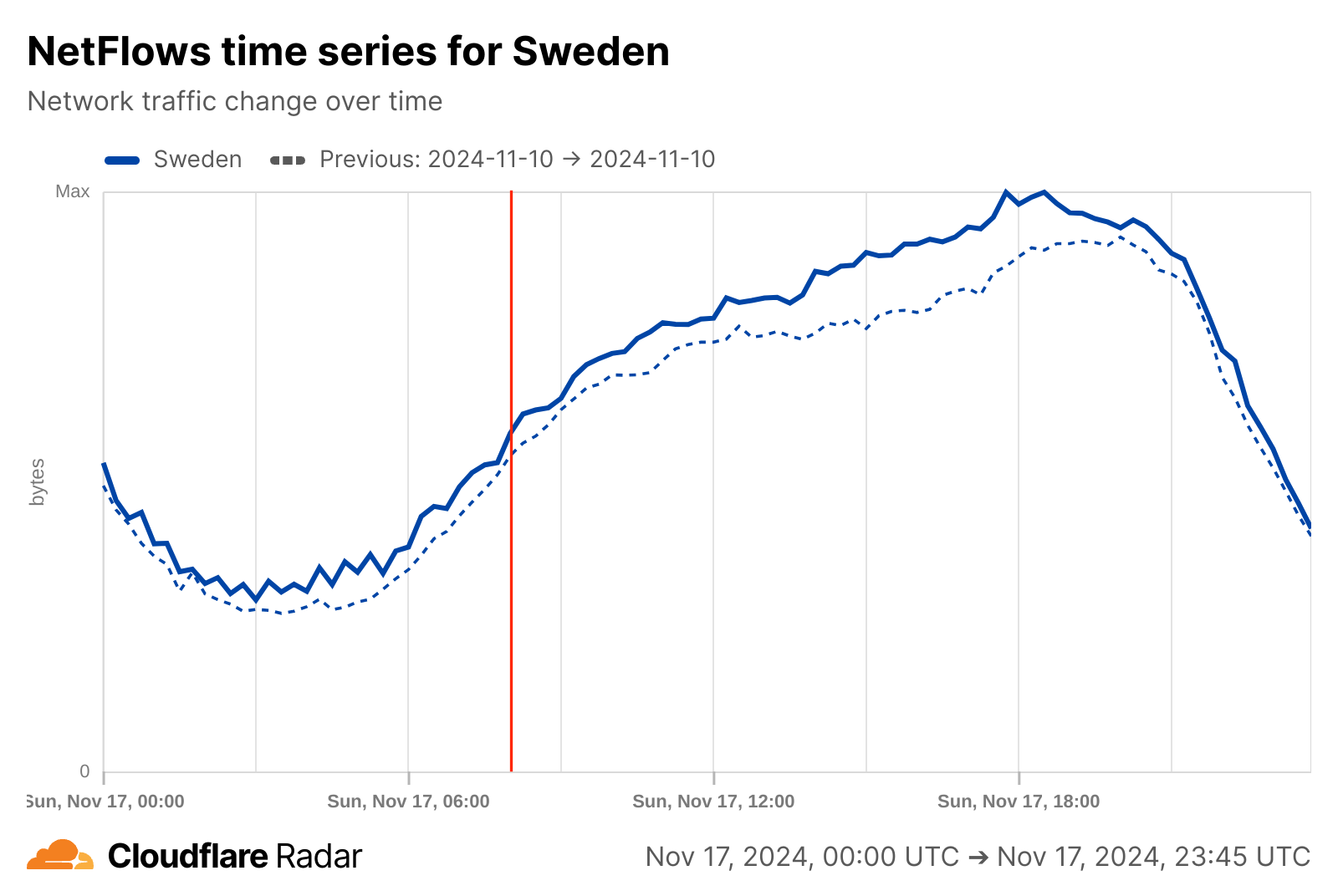


Internet quality metrics for both countries show changes in measured bandwidth and latency throughout the day on Sunday, but with no sudden anomalous shifts visible around the time of the cable cut. (The loss of connectivity associated with a cable cut potentially manifests itself as an increase in latency and concurrent decrease in bandwidth due to loss of capacity.) The latency graph for Sweden does show an increase in latency, but it began before the cable cut occurred, is similar to a pattern visible several hours earlier, and is matched by an increase in measured bandwidth, so it is unlikely to be related to the cable cut event.


BGP announcements are a way for network providers to communicate routing information to other networks, and announcement activity observed on Telia Lietuva’s autonomous systems around the time of the cable cut may be related to the re-routing referenced in the article. No change in announced IP address space was visible for any of these autonomous systems, suggesting no loss of connectivity as the capacity was re-routed.
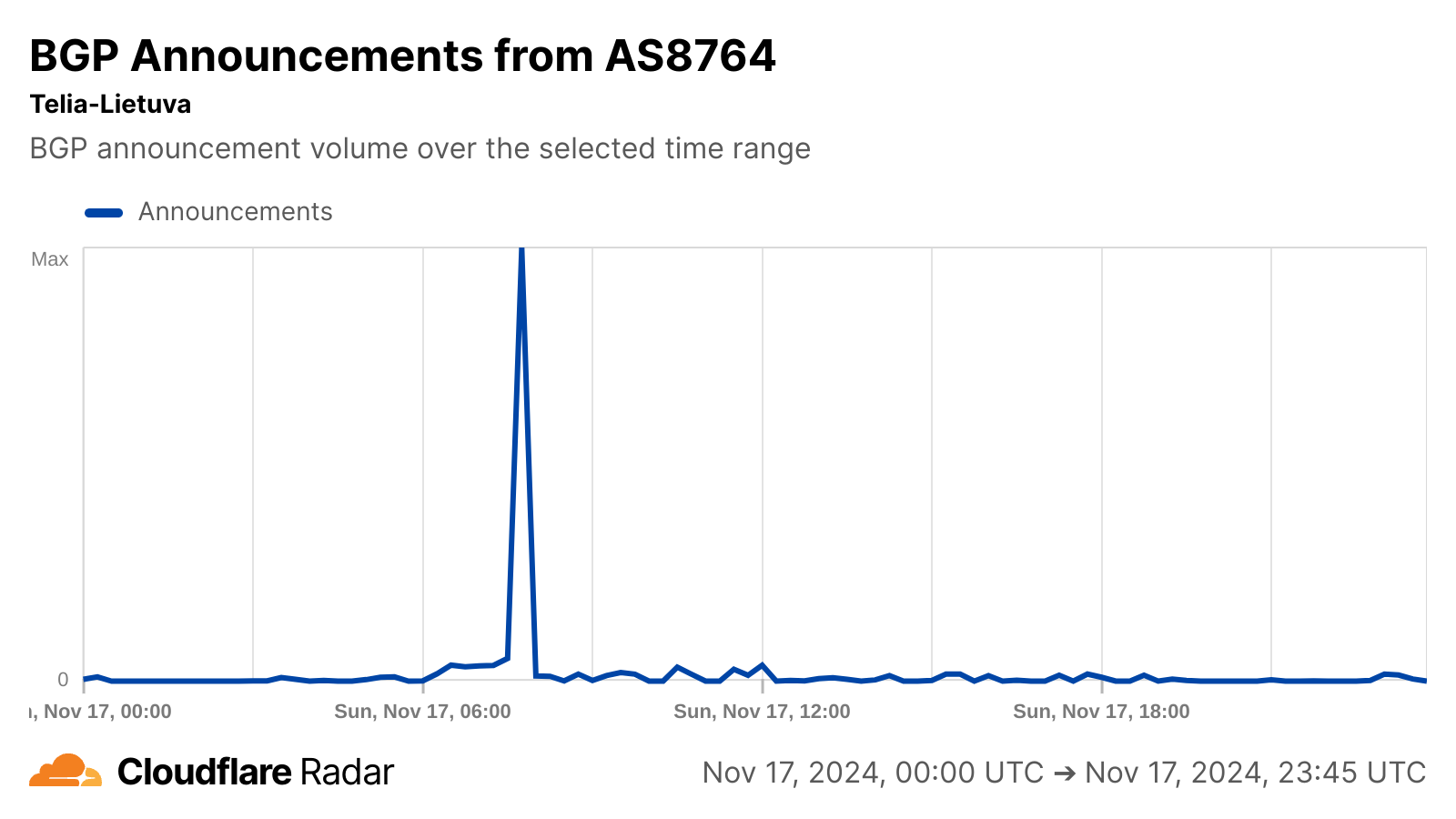

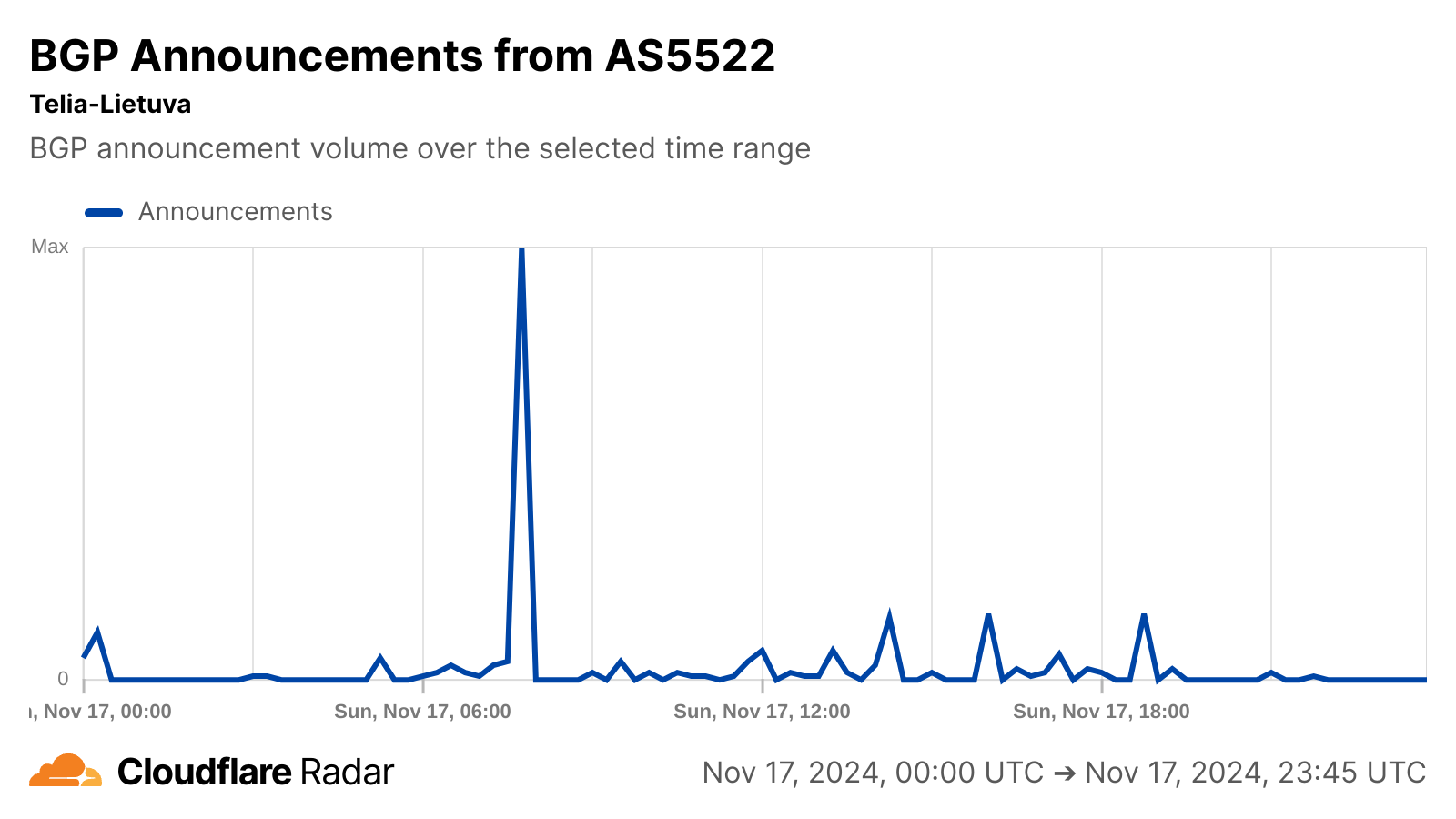
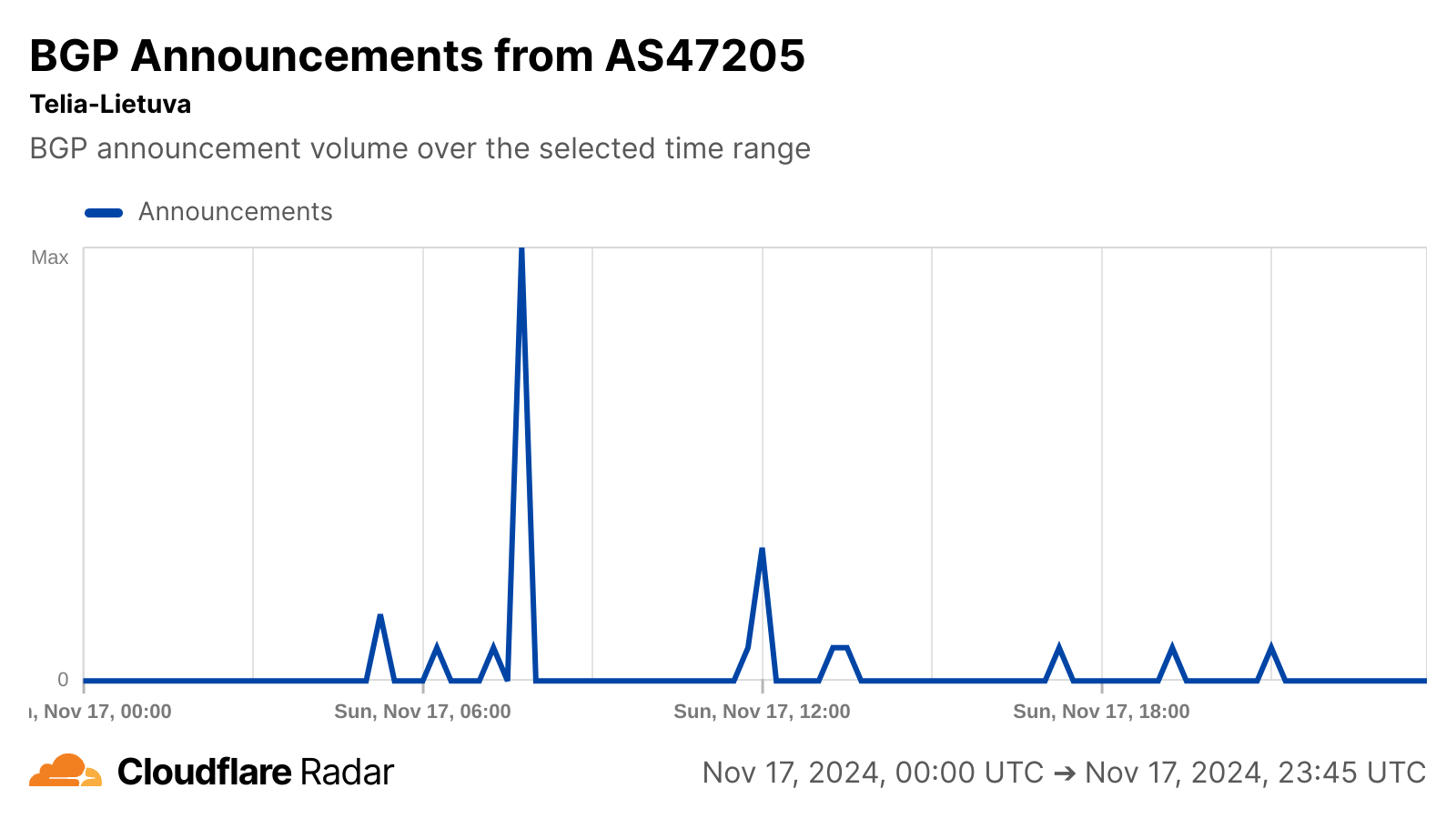
Telegeography’s submarinecablemap.com illustrates, at least in part, the resilience in connectivity enjoyed by these two countries. In addition to the damaged cable, it shows that Lithuania is connected to neighboring Latvia as well as to the Swedish mainland. Over 20 submarine cables land in Sweden, connecting it to multiple countries across Europe. In addition to the submarine resilience, network providers in both countries can take advantage of terrestrial fiber connections to neighboring countries, such as those illustrated in a European network map from Arelion (formerly Telia), which is only one of the large European backbone providers.
Less than a day later, the C-Lion1 submarine cable, which connects Helsinki, Finland and Rostock Germany was reportedly damaged during the early morning hours of Monday, November 18. Cinia, the telecommunications company that owns the cable, said that the cable stopped working at about 02:00 UTC.
In this situation as well, as the Cloudflare Radar graphs below show, there was no apparent impact to traffic volumes in either country at the time that the cables were damaged. The Finland graphs, week-on-week, show fewer bytes transferred and fewer HTTP requests, but that difference is present before the cable cut at 02:00 UTC. However, the trend of the current line does not change after the cable cut, so the two events would appear unrelated.


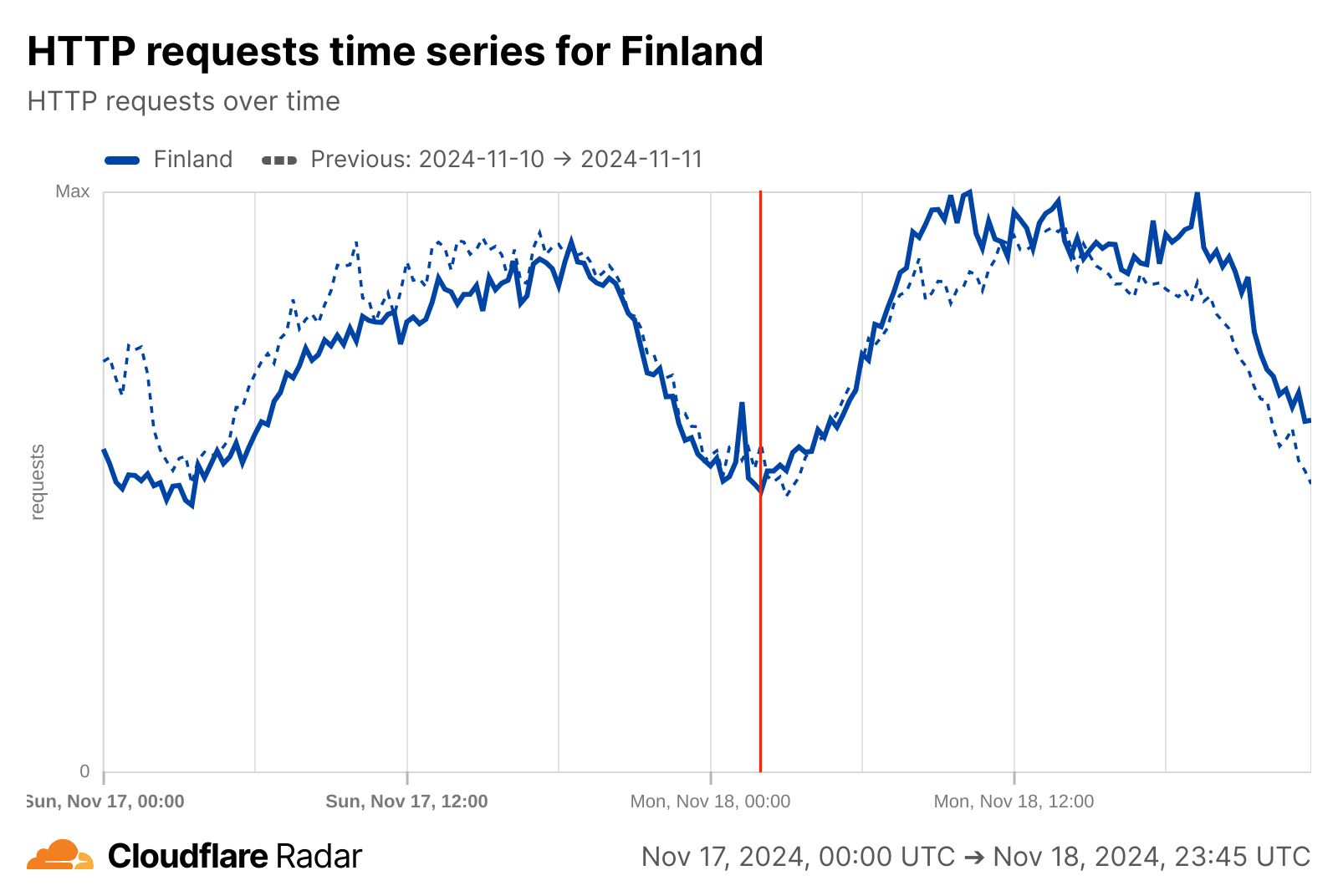
By looking at volume-related metrics, alone, Internet connectivity would appear to be unaffected by the cable cut.
If, however, we change perspective and look at Internet quality, a brief yet interesting change is visible for Finland around the reported time of the cable damage, though it isn’t clear whether it is related in any way. Just after midnight, median measured bandwidth, previously consistent around 50 Mbps begins to grow, peaking just over 200 Mbps around 03:00 UTC. Around that same time, measured median latency also begins to drop, falling from around 30 ms to a low of 13 ms, also around 03:00 UTC. Median bandwidth returned to normal levels around 06:00 UTC, while latency took about two hours longer to return to normal levels. These observed improvements in bandwidth and latency could have been due to traffic being re-routed to along paths with better connectivity to measurement endpoints, but because the shifts began before the cable damage occurred, and recovered shortly thereafter, that is unlikely to be the root cause.
In Germany, a brief minor increase in median bandwidth peaked around 02:45 UTC, while no notable changes were observed in latency.
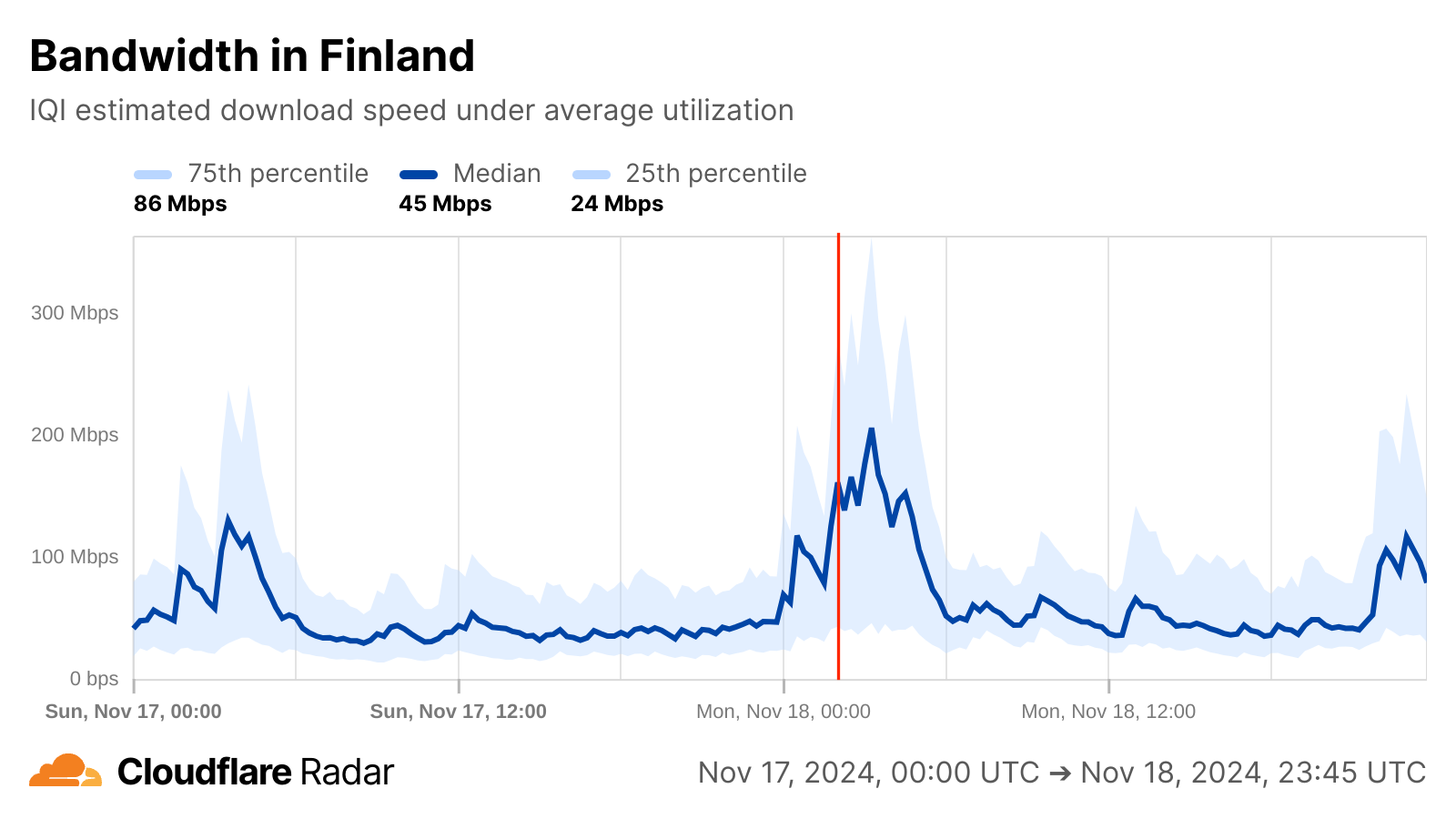
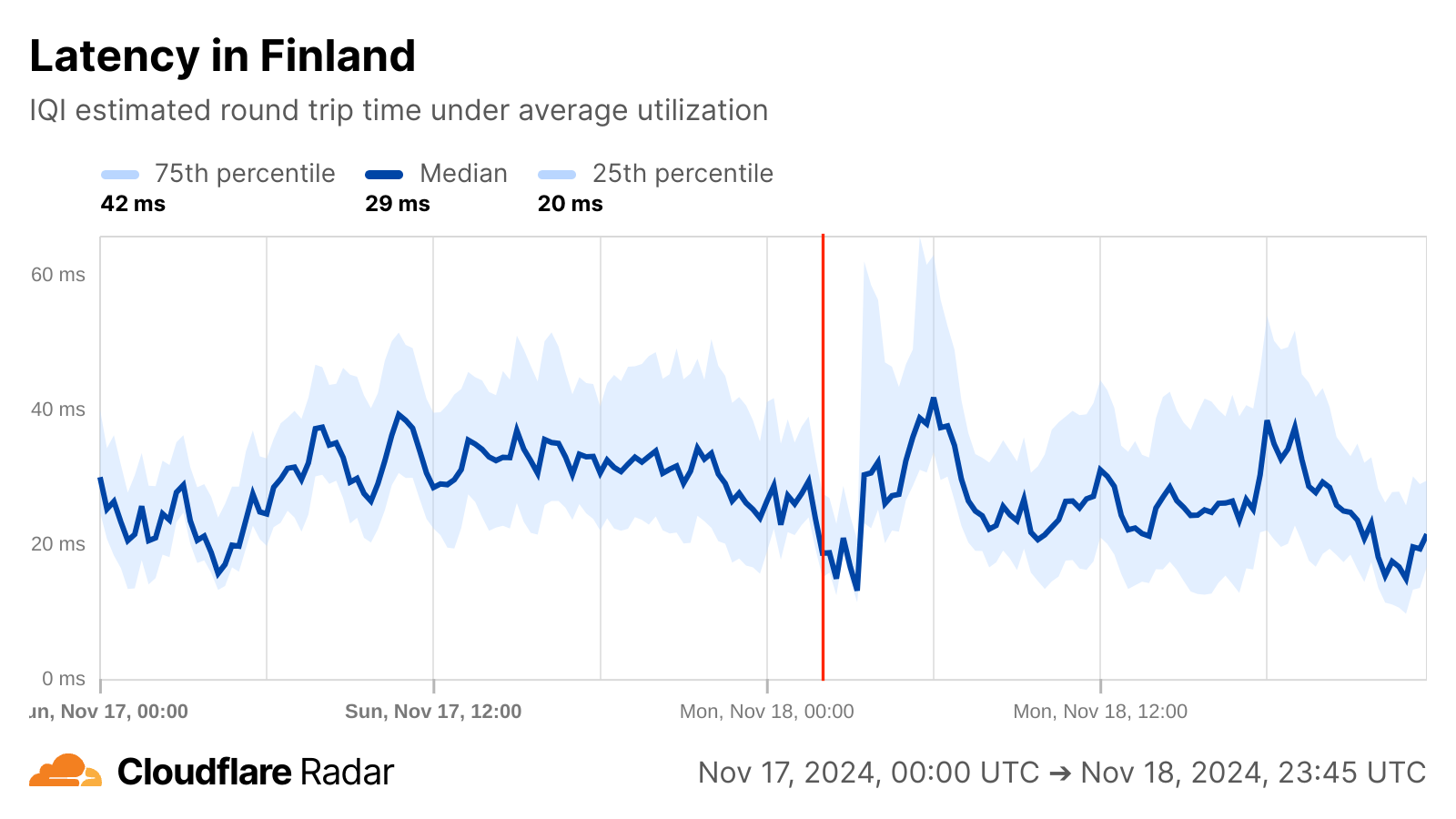

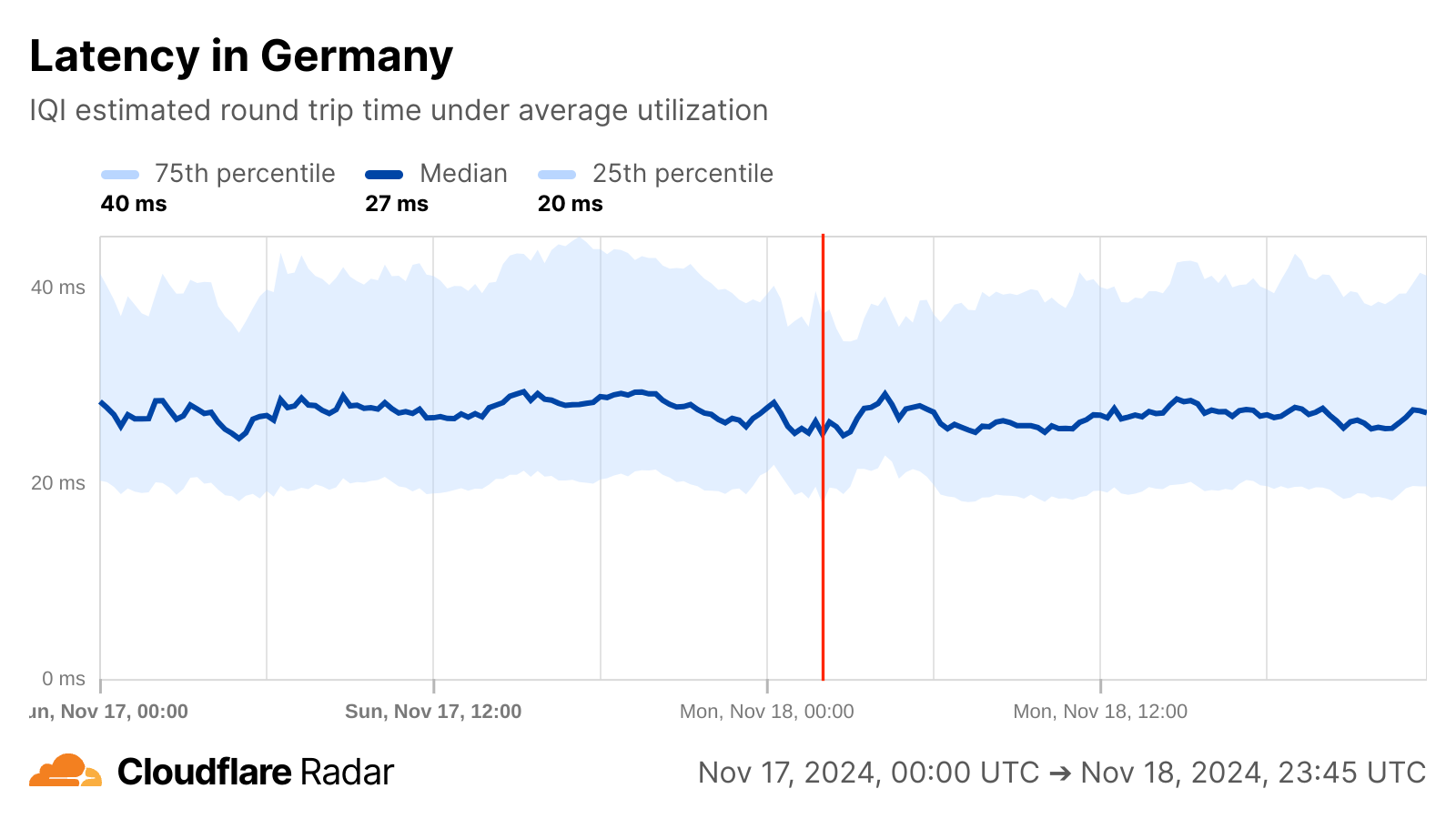
From a routing perspective, there was no notable BGP announcement activity observed for top autonomous systems in either Finland or Germany around 02:00 on November 18, and total announced IP address space aggregated at a country level also demonstrated no change.
Telegeography’s submarinecablemap.com shows that both Finland and Germany also have significant redundancy and resilience from a submarine cable perspective, with over 10 cables landing in Finland, and nearly 10 landing in Germany, including Atlantic Crossing-1 (AC-1), which connects to the United States over two distinct paths. Terrestrial fiber maps from Arelion and eunetworks (as just two examples) show multiple redundant fiber routes within both countries, as well as cross-border routes to other neighboring countries, enabling more resilient Internet connectivity.
As we have discussed in multiple prior blog posts (Jersey, 2016; AAE-1/SMW5, 2022; WACS/MainOne/SAT3/ACE, 2024; EASSy/Seacom, 2024), cable cuts often cause significant disruptions to Internet connectivity, in many cases because they represent a concentrated point of vulnerability, whether for an individual network provider, city/state, or country. These disruptions are often quite lengthy as well, due to the time needed to marshal repair resources, identify the location of the damage, etc. Although it is not always feasible due to financial or geographic constraints, building redundant and resilient network architecture, at multiple levels, is a best practice. This includes the sending traffic over multiple physical cables (both submarine and terrestrial), connecting to multiple peer and upstream network providers, and even avoiding single points of failure in core Internet resources like DNS servers.
The Cloudflare Radar team continually monitors the status of Internet connectivity in countries/regions around the world, and we share our observations on the Cloudflare Radar Outage Center, via social media, and in posts on blog.cloudflare.com. Follow us on social media at @CloudflareRadar (X), https://noc.social/@cloudflareradar (Mastodon), and radar.cloudflare.com (Bluesky), or contact us via email.
Post Syndicated from LGR original https://www.youtube.com/watch?v=MMW05XnMNlM
Post Syndicated from Ramesh H Singh original https://aws.amazon.com/blogs/big-data/enhance-data-governance-with-enforced-metadata-rules-in-amazon-datazone/
We’re excited to announce a new feature in Amazon DataZone that offers enhanced metadata governance for your subscription approval process. With this update, domain owners can define and enforce metadata requirements for data consumers when they request access to data assets. By making it mandatory for data consumers to provide specific metadata, domain owners can achieve compliance, meet organizational standards, and support audit and reporting needs.
Many organizations require additional metadata from data consumers during the subscription request process to align with internal workflows and regulatory requirements. With enforced metadata rules, domain unit owners can establish consistent governance practices across all data subscriptions. For example, financial services organizations can mandate specific compliance-related metadata when data consumers request access to sensitive financial data. Similarly, healthcare providers can enforce metadata requirements to align with regulatory standards for patient data access. This feature simplifies the approval process by guiding data consumers through completing mandatory fields and enabling data owners to make informed decisions, ensuring data access requests meet organizational policies.
By streamlining metadata governance, Amazon DataZone empowers customers to meet compliance standards, maintain audit readiness, and simplify access workflows for enhanced efficiency and control. For example, one of our customers, Bristol Myers Squibb (BMS), leverages Amazon DataZone to address their specific data governance needs. Sitikantha Sarangi, Director of Data Engineering and ML Ops Platform at BMS, says:
“At BMS, our teams have been leveraging Amazon DataZone’s comprehensive data governance solution to catalog and enable secure data subscriptions across the organization within governed project environments. With the new custom metadata enforcement feature, we now can more easily navigate our data catalog. This capability allows us to set specific requirements for data consumers, such as providing a compliance certification link or detailing data usage intentions, ensuring that access requests for sensitive data are thoroughly reviewed and approved in alignment with our standards. This customization helps us more efficiently ensure we are appropriately utilizing data while facilitating efficient, secure data sharing across teams.”
The feature benefits multiple stakeholders. Domain unit owners can ensure compliance by enforcing metadata requirements, granting access only after thorough reviews. Data consumers benefit from a streamlined subscription request process, guided by metadata requirements that reduce complexity. Data producers gain clarity with detailed subscription requests, enabling informed decisions aligned with required standards. Overall, the key benefits are:
In this post, we walk you through setting up and using metadata enforcement to create seamless, compliant data access workflows.
The solution in this post is composed of two parts. In the first part, we walk through the steps necessary to enforce metadata for subscription requests for managed assets. In the second part, we walk through the steps necessary to request subscriptions for custom assets.
To follow this post, user should already have Amazon DataZone setup with respective projects to publish and consume the assets. The publisher of the Retail project must have published a shipments data asset in Amazon DataZone. The domain owner or admin must have created a metadata form required for the subscription request.
This feature also supports metadata enforcement for subscription requests of a data product. For instructions on how to set this up, refer to Amazon DataZone data products.
To perform the solution in this post, follow the steps in the next sections.
To enforce metadata for subscription requests, use the following steps.
Domain unit owners can configure metadata enforcement in Amazon DataZone as follows:


You can select multiple forms for enforcement on subscription requests.


Create metadata form rule as below:


After metadata enforcement is configured, data consumers follow these steps to request access:
shipments data asset, as shown in following screenshot.


After submitting, an event is generated in Amazon EventBridge, which can be used in custom workflows outside of Amazon DataZone as needed.
After a data consumer submits a subscription request, they review the metadata. The data producer receives the subscription request with all metadata provided by the data consumer.


Now, data consumers follow these steps:

shipments in Amazon Athena, with below query and as shown in the screenshot.

Customers can manage access grants for unmanaged assets using Amazon DataZone. When a subscription to an asset in the business data catalog is approved by the data owner, Amazon DataZone publishes an event in Amazon EventBridge in the account along with all the necessary information in the payload that you can use to create the access grants between the source and the target. Using metadata enforcement for unmanaged assets, customers can provide all context in the single request.
To create a custom asset type Metrics with an attached metadata form to describe the metric asset type, follow these steps:
Below is an example of a custom asset type – “Metrics” which has two fields 1/Dashboard Link and 2/Calculation

The data producer creates a Conversion Rate Metric with all metadata along with associated metadata forms by following these steps:
Below is “Conversion Rate Metric” asset created in DataZone. The highlighted boxes show that is an Unmanaged asset and of type “Metrics” that was created in the previous step.

Domain unit owners can configure metadata enforcement in Amazon DataZone as follows:


MetricsRequestForm, as shown in the following screenshot.


To set up an EventBridge rule, follow these steps:
For this blog, set the below event pattern that triggers the lambda only for new Subscription requests.

After metadata enforcement is configured, data consumers follow these steps to request access:


You will receive notification confirming that your subscription request is submitted, as shown in the following screenshot.

For the request, EventBridge will capture the following request event and send it to the setup target:
The data steward and asset owner can get details for the request with the GetSubscriptionRequestDetails API and view the asset details and form associated with the request:
The data and asset owner can use these details to orchestrate an approval workflow using the Lambda function. After it has been validated, the asset owner or steward can then call the AcceptSubscriptionRequest API to grant access. The data consumer will be notified after access is approved. The following screenshot shows the notification that the subscription was approved.

Now that the subscription is approved, users can use the dashboard URL to access the metric.
To make sure no additional charges are incurred after testing, delete the Amazon DataZone domain. Refer to Delete Amazon DataZone domains for the process.
The new metadata enforcement rule for subscription requests in Amazon DataZone strengthens data governance by empowering domain unit owners to establish clear metadata requirements for data consumers, streamlining access requests and enhancing data governance. This feature enables organizations to align with the organization’s metadata standards, implement custom workflows, and provide a consistent, governed data access experience.
The feature is supported in all AWS Regions where Amazon DataZone is available at the time of this writing. To check which Regions are available, refer to AWS Services by Region. Check out the video below to learn more about how to set up metadata rules for subscription workflows. Get started with the technical documentation.
 Ramesh H Singh is a Senior Product Manager Technical (External Services) at AWS in Seattle, Washington, currently with the Amazon DataZone team. He is passionate about building high-performance ML/AI and analytics products that enable enterprise customers to achieve their critical goals using cutting-edge technology. Connect with him on LinkedIn.
 Pradeep Misra is a Principal Analytics Solutions Architect at AWS. He works across Amazon to architect and design modern distributed analytics and AI/ML platform solutions. He is passionate about solving customer challenges using data, analytics, and AI/ML. Outside of work, Pradeep likes exploring new places, trying new cuisines, and playing board games with his family. He also likes doing science experiments, building LEGOs and watching anime with his daughters.
 Lakshmi Nair is a Senior Analytics Specialist Solutions Architect at AWS. She specializes in designing advanced analytics systems across industries. She focuses on crafting cloud-based data platforms, enabling real-time streaming, big data processing, and robust data governance.
 Santhosh Padmanabhan is a Software Development Manager at AWS, leading the Amazon DataZone engineering team. His team designs, builds, and operates services specializing in data, machine learning, and AI governance. With deep expertise in building distributed data systems at scale, Santhosh plays a key role in advancing AWS’s data governance capabilities.
Post Syndicated from Kirankumar Chandrashekar original https://aws.amazon.com/blogs/devops/proactively-validate-your-aws-cloudformation-templates-with-aws-lambda/
AWS CloudFormation is a service that allows you to define, manage, and provision your AWS cloud infrastructure using code. To enhance this process and ensure your infrastructure meets your organization’s standards, AWS offers CloudFormation Hooks. These Hooks are extension points that allow you to invoke custom logic at specific points during CloudFormation stack operations, enabling you to perform validations, make modifications, or trigger additional processes. Among these, the Lambda hook is a powerful option provided by AWS. This managed hook allows you to use Lambda functions to validate your CloudFormation templates before deployment. By using a Lambda hook, you can invoke custom logic to check infrastructure configurations on create or update or delete CloudFormation resources or stacks or change sets, as well as create or update operations for AWS Cloud Control API (CCAPI) resources. This enables you to enforce defined policies for your infrastructure-as-code (IaC), preventing the deployment of non-compliant resources or emitting warnings for potential issues. In this blog post, you will explore how to use a Lambda hook to validate your CloudFormation templates before deployment, ensuring your infrastructure is compliant and secure from the start.
The Lambda hook is an AWS-provided managed hook with the type AWS::Hooks::LambdaHook. It simplifies the integration of custom logic into CloudFormation stacks. This powerful feature allows you to focus on building and testing your custom logic as a Lambda function, without the complexity of creating a hook from scratch.
By using the Lambda hook, you can activate a pre-built hook and deploy your custom logic into a Lambda function using familiar tools like AWS CLI or AWS Serverless Application Model (SAM) or AWS Cloud Development Kit (CDK). This approach reduces the number of components you need to manage in your workflow, allowing for more streamlined operations. The Lambda hook also offers flexible evaluation capabilities, enabling you to respond to specific template properties or configurations as needed.
One of the key advantages of the Lambda hook is the enhanced control it provides. You can benefit from features such as VPC integration, local logging, and granular resource management, all while leveraging the power of AWS Lambda functions. To get started with the Lambda hook, you’ll need to activate it in your AWS account. This activation process eliminates the need for authoring, testing, packaging, and deploying a custom hook using the AWS CloudFormation Command Line Interface (CFN-CLI), significantly simplifying your workflow.
This blog post demonstrates using the Lambda hook to validate S3 Bucket versioning before deployment. While focused on S3 buckets, this approach can be applied to other resource types, properties, stack, and change set operations.
By leveraging the Lambda hook, you’ll streamline custom logic integration into your CloudFormation stacks. The process involves:
AWS::Hooks::LambdaHook in your accountThis example showcases how to enhance your infrastructure-as-code practices, ensuring compliant and secure deployments from the start.
This section shows you how the Lambda hook and Lambda function work together to enhance your CloudFormation deployments.
First, you need to create a Lambda function with the business logic to respond to the hook. Then, you need to create an IAM execution role with the necessary permissions to invoke the Lambda Function. Once you have the Lambda function and the IAM execution role, you can activate the AWS provided Lambda hook. Follow the steps in the documentation to activate a Lambda hook from the AWS console. Alternatively, you can activate it using the AWS Command Line Interface (AWS CLI) by using the activate-type and set-type-configuration commands. Lastly, you can also use AWS::CloudFormation::LambdaHook as a CloudFormation resource to activate and configure Lambda hook from a CloudFormation template. You can share this resource across your other accounts and regions using AWS CloudFormation StackSets by following this blog.
The following diagram and explanation illustrate the step-by-step workflow of how Lambda hook integrates with your CloudFormation operations, providing a visual representation of the process from template creation to resource deployment or modification.

Diagram 1: Lambda hooks in action
The architecture diagram illustrates the step-by-step flow of how the Lambda hook is used during a CloudFormation stack operation.
This workflow demonstrates how Lambda hook seamlessly integrates into the CloudFormation stack deployment process, allowing you to implement custom validations, enforce policies, and extend the capabilities of your infrastructure-as-code deployments through the power of Lambda functions. By leveraging the Lambda hook and the custom Lambda function, customers can extend the capabilities of their CloudFormation deployments, enabling advanced use cases such as resource validation, or additional task execution.
This section shows you how to enable the Lambda hook, which is of type AWS::Hooks::LambdaHook, and add the business logic in the Lambda function to validate the versioning configuration of an S3 bucket. The sample solution shown in this blog post demonstrates the hook triggering for the resource type AWS::S3::Bucket, and if you want to trigger this for every resource type, then you can use the Resource filter within Hook filters configuration that can take wildcard "AWS::*::*" as a value or multiple targets of resource types for example "AWS::S3::Bucket", "AWS::DynamoDB::Table", and you’ll also want to make sure that the Lambda Function has the logic to handle the additional resource type. You can also add additional Hook targets , for example to validate your STACK or CHANGE_SET.
In the example used in this blog post, you will configure the hook and activate on create and update operations operations. For more information about TargetFilters, see Hook configuration schema and for more information about Lambda hook see here. With these modifications, you need to consider two important points: First, you will need to handle the business logic to deal with different resource types in your Lambda function code. Second, additional pricing may apply based on your resource usage, for more details see the Lambda pricing page.
You can create a Lambda function in several ways – on the AWS Console, using CloudFormation, using AWS CLI, or by directly invoking the API via SDK. In this section, we will cover creating a Lambda function with a few clicks on the AWS console. See Using Lambda with infrastructure as code (IaC) for deploying Lambda Function using SAM CLI, CDK or CloudFormation.
Create the Lambda function on the AWS console by following create a Lambda function with the console instructions and use the following sample Python code.
"""Example Lambda function called by AWS::Hooks::LambdaHook."""


import logging


HOOK_INVOCATION_POINTS = [
    "CREATE_PRE_PROVISION",
    "UPDATE_PRE_PROVISION",
    "DELETE_PRE_PROVISION",
]

TARGET_NAMES = [
    "AWS::S3::Bucket",
]

LOGGER = logging.getLogger()

LOGGER.setLevel("INFO")


def lambda_handler(event, context):
  """Define the entry point of the function."""
  try:
    request = event

    LOGGER.info(f"Request: {request}")

    invocation_point = request["actionInvocationPoint"]
    LOGGER.info(f"Invocation point: {invocation_point}")

    target_name = request["requestData"]["targetName"]
    LOGGER.info(f"Target name: {target_name}")

    clientRequestToken = request["clientRequestToken"]

    if (
      invocation_point not in HOOK_INVOCATION_POINTS
      or target_name not in TARGET_NAMES
    ):
      message = (
        f"Skipping {target_name} evaluation for {invocation_point}."
      )
      LOGGER.info(message)
      payload = {
        "clientRequestToken": clientRequestToken,
        "hookStatus": "SUCCESS",
        "errorCode": None,
        "message": message,
        "callbackContext": None,
        "callbackDelaySeconds": 0,
      }
      LOGGER.debug(payload)
      return payload

    target_model = request["requestData"]["targetModel"]

    resource_properties = (
      target_model.get("resourceProperties")
      if target_model and target_model.get("resourceProperties")
      else None
    )
    LOGGER.debug(f"Resource properties: {resource_properties}")

    versioning_configuration = (
      resource_properties.get("VersioningConfiguration")
      if resource_properties
      and resource_properties.get("VersioningConfiguration")
      else None
    )
    versioning_configuration_status = (
      versioning_configuration.get("Status")
      if versioning_configuration
      and versioning_configuration.get("Status")
      else None
    )
    if (
      not resource_properties
      or not versioning_configuration
      or not versioning_configuration_status
      or not versioning_configuration_status == "Enabled"
    ):
      message = "Versioning not set or not enabled for the S3 bucket."
      LOGGER.error(message)
      payload = {
        "clientRequestToken": clientRequestToken,
        "hookStatus": "FAILED",
        "errorCode": "NonCompliant",
        "message": message,
      }
    else:
      message = "Versioning is enabled for the S3 bucket."
      LOGGER.info(message)
      payload = {
        "clientRequestToken": clientRequestToken,
        "hookStatus": "SUCCESS",
        "errorCode": None,
        "message": message,
      }

    LOGGER.debug(payload)
    return payload
  except Exception as exception:
    message = str(exception)
    payload = {
      "clientRequestToken":  event["clientRequestToken"],
      "hookStatus": "FAILED",
      "errorCode": "InternalFailure",
      "message": message,
      "callbackContext": None,
      "callbackDelaySeconds": 0,
    }
    LOGGER.error(message)
return payloadThe Lambda Function code is designed to process the event received from the Lambda hook and validate the versioning configuration of the target S3 bucket resource. Here’s a detailed explanation of the code:
HOOK_INVOCATION_POINTS list and if the target resource type is AWS::S3::Bucket. If not, the function returns a success response, skipping the validation for this particular invocation.Note: this code that skips the validation is put here as a fallback logic in the event the user has not chosen to use TargetFilters. As this is a wildcard hook, without TargetFilters the hook will always be invoked for any AWS resource type described in the template, and since the hook targets preCreate, preUpdate, and preDelete by default, the hook will be invoked for these invocation points by default. To narrow the scope and reduce costs by avoiding to invoke the hook for all AWS resource type targets and invocation points, use TargetFilters.
VersioningConfiguration property and its Status.VersioningConfiguration property is not present or its Status is not set to Enabled, the function returns a failure response, indicating that the versioning is not enabled for the S3 bucket.
Diagram 2: Create a Hook with Lambda console page
You will see the page explaining how the Lambda function work as a hook.

Diagram 3: Provide a Lambda function to Hook Console page
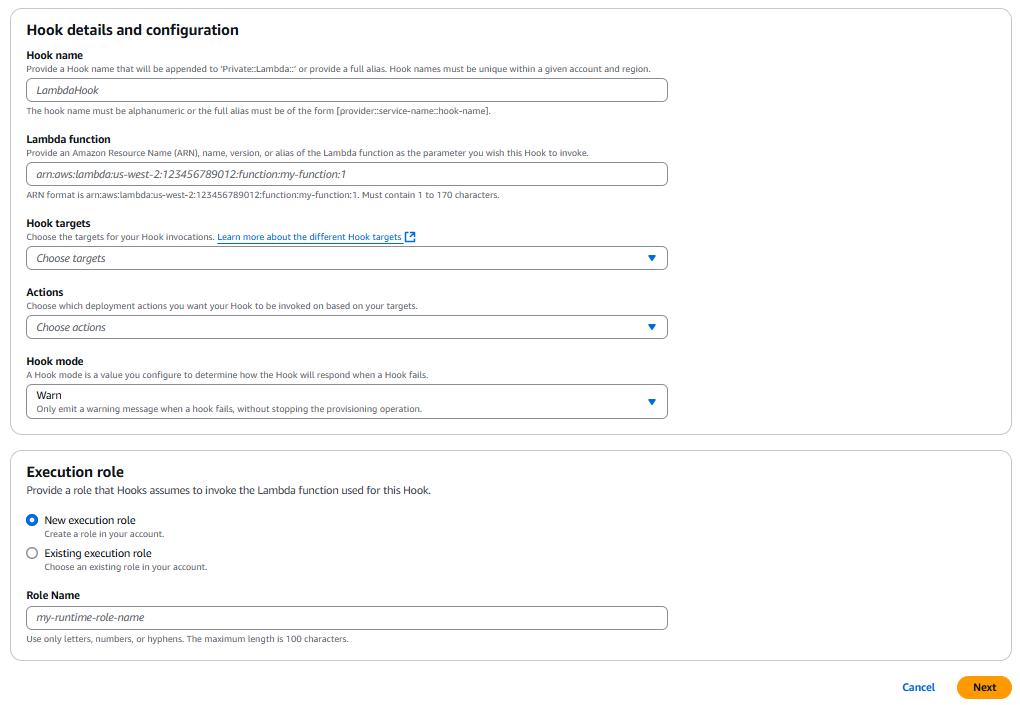
Diagram 3: Provide a Lambda function to Hook Console page
You can review the Lambda hook and activate it from the next page.

Diagram 4: Review Lambda hook Console page
In this section, you will test the hook and the Lambda Function that you activated for a S3 bucket resource.
Create an S3 Bucket without versioning
AWSTemplateFormatVersion: "2010-09-09"

Description: This CloudFormation template provisions an S3 Bucket without versioning enabled

Resources:
  S3Bucket:
    DeletionPolicy: Delete
    Type: AWS::S3::Bucket
    Properties:
      BucketName: !Sub test-bucket-versioning-1-${AWS::Region}-${AWS::AccountId}
You will see the hook invoking Lambda function and the Lambda Function responding back with a failure message since the Versioning is not enabled.
When you create or update a stack with the template above, the Lambda hook will be invoked, and the Lambda Function will respond with a failure message since bucket versioning is not enabled. The Lambda Function code will extract the resourceProperties from the event, check the VersioningConfiguration property, and find that the Status is not set to Enabled. As a result, if you use the example template above where you describe the S3 bucket without versioning enabled, the Lambda Function will send a failure response back to the hook, causing the CloudFormation stack operation to fail as shown in the following screenshot.

Diagram 5: Lambda Hook failure Stack
Create an S3 Bucket with versioning enabled You can try creating an S3 Bucket with versioning enabled to see how Hooks assessment succeeded.
AWSTemplateFormatVersion: "2010-09-09"

Description: This CloudFormation template provisions an S3 Bucket with Versioning enabled

Resources:
  S3Bucket:
    DeletionPolicy: Delete
    Type: AWS::S3::Bucket
    Properties:
      BucketName: !Sub test-bucket-versioning-2-${AWS::Region}-${AWS::AccountId}
      VersioningConfiguration:
        Status: Enabled
In this case, you will see the hook invoking the Lambda function and getting a success message since the Versioning is enabled
When you create a stack with this CloudFormation template, the Lambda hook will be invoked, and the Lambda Function will respond with a success message since the versioning is enabled. The Lambda Function code will extract the resourceProperties from the event, check the VersioningConfiguration property, and find that the Status is set to Enabled. As a result, the Lambda Function will send a success response back to the hook, allowing the CloudFormation stack operation to proceed as shown in the following screenshot.
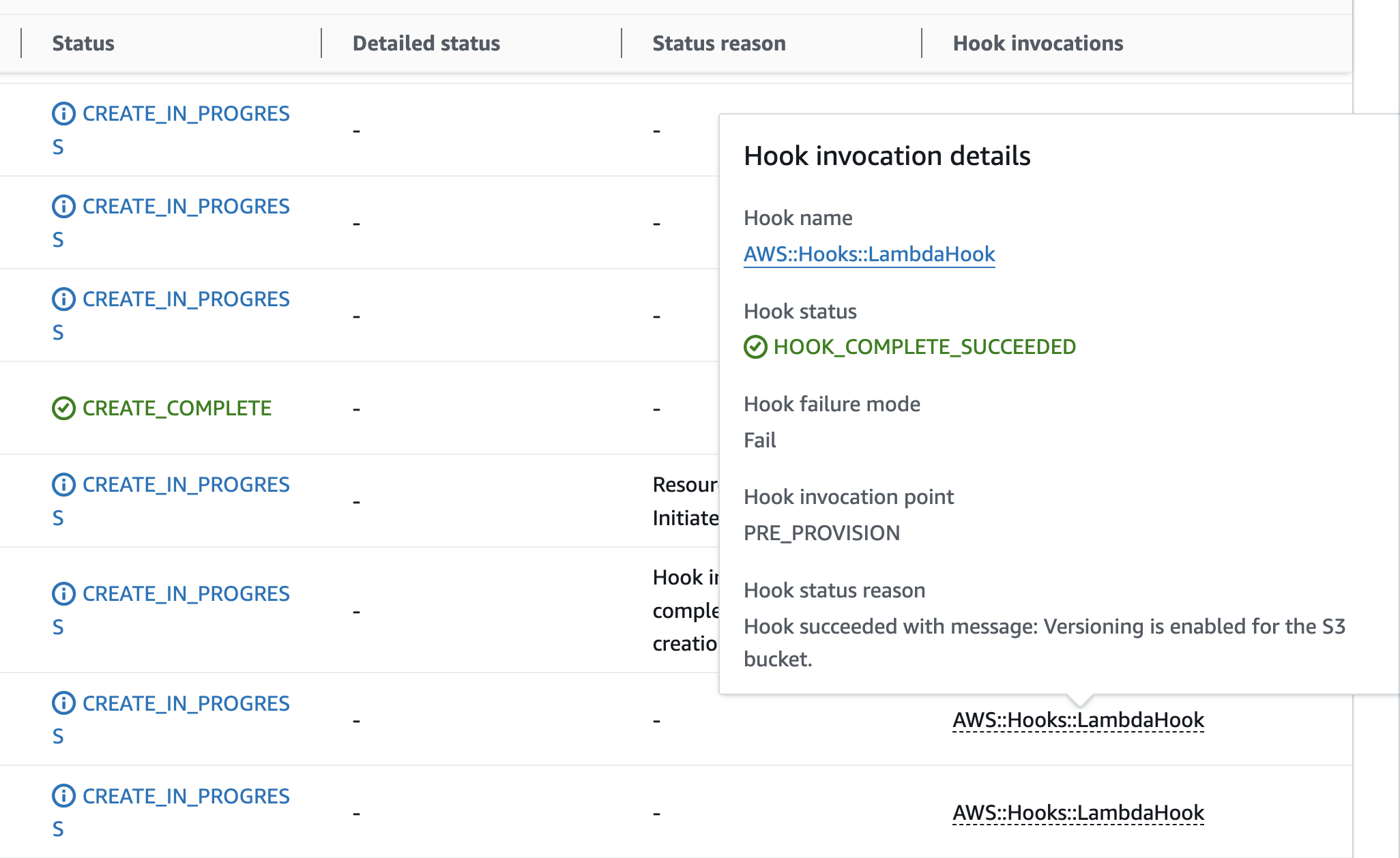
Diagram 6: Lambda Hook success Stack
By testing these two scenarios, you can verify that the Lambda hook and the associated Lambda Function are working as expected, enforcing the S3 bucket versioning policy during CloudFormation stack operations.
To clean up, refer to the following documentation to delete CloudFormation Stacks: Deleting a stack on the AWS CloudFormation console or Deleting a stack using AWS CLI. Refer to documentation to deactivate the hook.
In this blog post, you explored the capabilities of CloudFormation Hooks and how they can be leveraged to extend the functionality of your infrastructure-as-code deployments. Specifically, you learned about the Lambda hook, a pre-built hook that simplifies the process of integrating custom logic into your CloudFormation stacks.
By activating the Lambda hook, and deploying a custom Lambda Function, you were able to validate the versioning configuration of an S3 bucket during the CloudFormation stack creation and update processes. This approach allows you to enforce infrastructure-as-code policies and ensure compliance at the point of deployment, rather than relying on post-deployment checks or indirect governance mechanisms. The ability to leverage familiar tools and workflows, such as the AWS CLI, AWS SAM, CI/CD pipelines, or the AWS CDK, makes it easier to incorporate custom logic into your CloudFormation deployments. This reduces the overhead and complexity associated with traditional hook orchestration and packaging, empowering you to streamline your infrastructure-as-code practices.
As you continue to build and deploy your cloud infrastructure, consider exploring the various CloudFormation Hooks available, for example, see aws-cloudformation/aws-cloudformation-samples and aws-cloudformation/community-registry-extensions GitHub repositories. The approach demonstrated in this blog post can be applied to other resource types supported by CloudFormation, allowing you to validate and enforce policies for a wide range of infrastructure components, from EC2 instances and VPCs to databases and application services.

Kirankumar Chandrashekar is a Sr. Solutions Architect for Strategic Accounts at AWS. He focuses on leading customers in architecting DevOps, modernization using serverless, containers and container orchestration technologies like Docker, ECS, EKS to name a few. Kirankumar is passionate about DevOps, Infrastructure as Code, modernization and solving complex customer issues. He enjoys music, as well as cooking and traveling.
 Stella Hie is a Sr. Product Manager Technical for AWS Infrastructure as Code. She focuses on proactive control and governance space, working on delivering the best experience for customers to use AWS solutions safely. Outside of work, she enjoys hiking, playing piano, and watching live shows.
Post Syndicated from Brian Terry original https://aws.amazon.com/blogs/devops/introducing-a-managed-hook-for-guard/
In today’s cloud-driven world, maintaining compliance and enforcing organizational policies across your infrastructure is more critical than ever. AWS CloudFormation, a service that enables you to model, provision, and manage AWS and third-party resources through Infrastructure as Code (IaC), has been a cornerstone for automating cloud deployments. While CloudFormation simplifies resource management, ensuring compliance with internal and external standards requires robust tools and strategies to align with organizational and regulatory requirements.
Enter the new managed hook for Guard, a new hook designed to seamlessly integrate compliance into your AWS CloudFormation workflows. AWS CloudFormation Hooks are a powerful tool that allow you to validate and enforce policies during the provisioning and management of resources in your CloudFormation stacks. With a Guard hook, you can now bring your AWS CloudFormation Guard rules directly into your CloudFormation stacks, change sets, and individual resources. This feature eliminates the need to incorporate the Guard runtime into custom hooks, simplifying compliance enforcement and enhancing your security posture.
A Guard hook is a service-managed CloudFormation Hook that integrates AWS CloudFormation Guard—a policy-as-code tool—directly into your CloudFormation deployment process. AWS CloudFormation Guard uses a domain-specific language (DSL) to define compliance rules in an easily readable and reusable format, enabling you to codify and enforce organizational policies. This hook allows you to automatically validate your CloudFormation templates against these established compliance rules, enforcing policies seamlessly without the need to manage custom Lambda functions or Guard runtimes. By identifying non-compliant resources early, it helps streamline deployments and ensures that your infrastructure aligns with organizational standards right from the start.
Guard hooks provide unique advantages by combining the flexibility of CloudFormation Hooks with the expressiveness of the Guard Domain Specific Language (DSL), giving you a powerful tool for infrastructure compliance and security. As a fully managed CloudFormation hook, Guard hooks eliminate the need for a custom hook implementation and management, allowing you to leverage AWS’s service-driven infrastructure to streamline policy enforcement.With a Guard hook, you can express compliance rules and configurations directly in the Guard DSL.
Guard hooks specifically add value by enabling these Guard-based compliance policies to be applied automatically during stack operations. This helps validate that your infrastructure consistently aligns with security and compliance standards, reducing the risks of misconfiguration and non-compliance. Additionally, Guard hooks allow you to take advantage of CloudFormation’s native stack-level and resource-level hooks, adding depth to your compliance by enforcing policies across entire stacks and individual resources alike.
Guard hooks can be applied in various scenarios to enhance compliance and security. In security compliance, for instance, it can ensure that all databases and storage services have encryption enabled or prevent security groups from allowing unrestricted inbound traffic. Regarding resource configuration, it can enforce the use of approved EC2 instance types or require specific tags on all resources for cost tracking and management.
For operational governance, Guard hooks can validate that resources do not exceed predefined thresholds, such as storage size, ensuring that resources are provisioned within acceptable limits. It can also enforce network policies by ensuring the use of approved VPCs and subnets, maintaining network security and compliance with organizational standards.
A resource hook in CloudFormation targets individual resources within a template, such as EC2 instances, S3 buckets, or IAM roles. It is particularly useful for enforcing specific standards or compliance requirements on individual resources, thereby helping customers ensure each one meets defined criteria. For instance, you could use a resource-level hook to enforce that every S3 bucket created through CloudFormation has server-side encryption enabled. In contrast, a stack or change set hook targets the entire CloudFormation stack as a single entity, allowing for the application of guardrails or validation requirements across all resources within the stack collectively. This helps to ensure that the entire stack, not just individual resources, aligns with set policies before the stack is created or updated. For example, a stack-level hook could be used to prevent a stack from containing certain types of resources or to ensure that a specific number of resources are created in each stack. Together, these hooks provide different layers of validation to enforce compliance and configuration standards at both the resource and stack levels.
Getting started with a Guard hook involves configuring the hook, uploading your Guard rules to Amazon S3, activating the hook, and enabling it to run against your CloudFormation stacks. Below are the detailed steps to help you set up and start using Guard Hook effectively.
If you do not have one already, you will need to create an S3 bucket in your region. This bucket will hold your Guard policy files and optionally the full Guard evaluation output if so desired.
In this section, you will provide an example of AWS CloudFormation Guard rules that help enforce best practices for Amazon S3 buckets. Please create a file called safebucket.guard and include the following rules:
In this file, you can define rules to prevent public write access and require versioning on all S3 buckets. Here’s what the two rules in this example do:
PublicAccessBlockConfiguration properties enabled to block public ACLs, block public policies, ignore public ACLs, and restrict public buckets. If a bucket does not meet these criteria, a violation message is triggered, instructing the user to set these properties to true.VersioningConfiguration property exists and has its Status set to 'Enabled'. If this configuration is missing or set incorrectly, it alerts the user to enable versioning on the S3 bucket, providing an additional layer of data protection.These rules help you maintain strict security and operational best practices by ensuring that S3 buckets are configured according to compliance requirements. Place these rules in safebucket.guard, and you’re ready to start applying them to your CloudFormation templates using Guard Hook to enforce policies without any manual intervention.
The Guard hook expects your policy files to be uploaded to an S3 bucket to then be pulled down during hook execution time. The hook expects your rules to be either a single .guard file, or multiple .guard files uploaded as a .zip or .tar.gz
Once you have uploaded your Guard rule or Guard rules bundle to S3, take note of the S3 URI of the uploaded object, as you will need this later to configure the Guard hook. Example: s3://your-bucket-name/safebucket.guard
You can also get the S3 URI by copy-pasting it from the console

You can author and activate a Guard hook from the console, CLI, and using the AWS::CloudFormation::GuardHook CloudFormation resource.
You can use the new console flow to define and activate your hook. Click on Create a Hook and choose With Guard.

My::Company::GuardHook.Stacks and Resources. By selecting both Stacks and Resources under Hook Targets, you’re instructing CloudFormation to apply your hook validations at both levels. This ensures that individual resources and the overall stack comply with your defined policies, providing a comprehensive safeguard across deployments.Fail.my-guard-hook-role for the name if you want CloudFormation to create the necessary role and permissions. Alternatively, an IAM role ARN you created manually (learn more here).


export AWS_ACCOUNT_ID=<Your_Account_Id>

aws cloudformation activate-type --type HOOK \
--type-name AWS::Hooks::GuardHook \
--publisher-id aws-hooks \
--type-name-alias MyCompany::Hooks::GuardHook \
--execution-role arn:aws:iam::${AWS_ACCOUNT_ID}:role/<Your_ExecutionRole_Name> \
--region eu-central-1
Note: You can create your own type-name-alias → MyCompany::Hooks::GuardHook is just an example
Using the AWS::CloudFormation::GuardHook resource in a CloudFormation template allows you to enforce compliance checks and validations on your AWS resources before creating, modifying, or deleting them within a stack. By specifying Guard rules using the Guard domain-specific language (DSL), you can define policies to assess resource configurations and security standards. When integrated into a CloudFormation template, AWS::CloudFormation::GuardHook evaluates the resources during stack operations and can either block non-compliant actions or provide warnings, depending on the configuration. This tool benefits organizations by automating governance, enhancing security, and reducing manual intervention, which help ensure that deployments adhere to best practices and compliance requirements consistently across environments.
Here is an example of how to create a Guard hook with the AWS::CloudFormation::GuardHook resource in a YAML file.
AWSTemplateFormatVersion: '2010-09-09'
Resources:
  GuardHookRole:
    Type: AWS::IAM::Role
    Properties:
      RoleName: GuardHookExecutionRole
      AssumeRolePolicyDocument:
        Version: '2012-10-17'
        Statement:
          - Effect: Allow
            Principal:
              Service: hooks.cloudformation.amazonaws.com
            Action: sts:AssumeRole
      Policies:
        - PolicyName: S3AccessPolicy
          PolicyDocument:
            Version: '2012-10-17'
            Statement:
              - Effect: Allow
                Action:
                  - s3:GetObject
                  - s3:GetObjectVersion
                  - s3:PutObject
                  - s3:ListBucket
                Resource:
                  - arn:aws:s3:::<YourBucket>/*
                  - arn:aws:s3:::<YourBucket>

  MyGuardHook:
    Type: AWS::CloudFormation::GuardHook
    Properties:
      Alias: "my::guard::hook"
      ExecutionRole: !GetAtt GuardHookRole.Arn
      FailureMode: FAIL
      HookStatus: ENABLED
      LogBucket: "mysafebucket"
      RuleLocation:
        Uri: "s3://<YourBucket>/safebucket.guard"
      TargetOperations:
        - STACK
        - RESOURCE
For more about AWS::CloudFormation::GuardHook , see our docs.
Now at this point, the Guard Hook should be running against all S3 buckets deployed via CloudFormation stacks in your account. We can confirm this by creating a new stack, from the CLI.
To do so, create a file named s3-fail.yaml and add the following content:
AWSTemplateFormatVersion: "2010-09-09"
Description: This template creates a simple s3 bucket

Resources:
  DemoBucket:
   Type: AWS::S3::Bucket
Create a stack, and specify your template in the AWS Command Line Interface (AWS CLI). In the following example, specify the stack name as my-fail-stack and the template name as s3-fail.yaml.
aws cloudformation create-stack --stack-name my-fail-stack --template-body file://s3-fail.yaml

aws cloudformation describe-stack-events --stack-name my-fail-stackdescribe-stack-events. As the Hook Failure Mode is set to Fail, you can see the stack status: CREATE_FAILED due to Hook failure.
            ...
            "EventId": "my-fail-stack-d7943992-9366-4d3a-8bad-9695a5f6b310",
            "StackName": "my-fail-stack",
            "LogicalResourceId": "my-fail-stack",
            "PhysicalResourceId": "",
            "ResourceType": "STACK",
            "Timestamp": "2024-11-12T15:54:29.582000+00:00",
            "ResourceStatus": "CREATE_IN_PROGRESS",
            "HookType": "My::Company::GuardHook",
            "HookStatus": "HOOK_COMPLETE_FAILED",
            "HookStatusReason": "Hook failed with message: Template failed validation, the following rule(s) failed: S3_BUCKET_PUBLIC_WRITE_PROHIBITED, S3_BUCKET_VERSIONING_ENABLED.",
            "HookInvocationPoint": "PRE_PROVISION",
            "HookFailureMode": "FAIL"
}If you specified the logging bucket, now you can view the Guard hook invocation json and evaluate the output stored in your S3 bucket.

You can download the log file by running the command below:
aws s3api get-object --bucket <Your log bucket> --key <insert_the-cfn-guard-validate-report-key.json> <Your_Outfile_DirectoryandName>
For more information about downloading S3 Object, see our docs.
To do so, create a file named s3-pass.yaml and add the following content:
AWSTemplateFormatVersion: "2010-09-09"
Description: This template creates a simple S3 bucket with versioning enabled and public write access disabled

Resources:
  DemoBucket:
   Type: AWS::S3::Bucket
   Properties:
      VersioningConfiguration:
        Status: Enabled
      PublicAccessBlockConfiguration:
        BlockPublicAcls: true
        IgnorePublicAcls: true
        BlockPublicPolicy: true
        RestrictPublicBuckets: true
Notice in the template, our bucket now does not allow public write access and enables versioning.
Create a stack, and specify your template in the AWS Command Line Interface (AWS CLI). In the following example, specify the stack name as my-pass-stack and the template name as s3-pass.yaml.
aws cloudformation create-stack --stack-name my-pass-stack --template-body file://s3-pass.yaml

aws cloudformation describe-stack-events --stack-name my-pass-stackdescribe-stack-event
           ...
            "StackName": "my-pass-stack",
            "LogicalResourceId": "DemoBucket",
            "PhysicalResourceId": "my-pass-stack-demobucket-rmm9cngo70xq",
            "ResourceType": "AWS::S3::Bucket",
            "Timestamp": "2024-11-12T17:01:41.898000+00:00",
            "ResourceStatus": "CREATE_COMPLETE",
            "ResourceProperties": "{\"PublicAccessBlockConfiguration\":{\"RestrictPublicBuckets\":\"true\",\"BlockPublicPolicy\":\"true\",\"BlockPublicAcls\":\"true\",\"IgnorePublicAcls\":\"true\"},\"VersioningConfiguration\":{\"Status\":\"Enabled\"}}",
            "ClientRequestToken": "Console-CreateStack-46ec0d77-5d2b-3e2a-9c82-fcce5e60a2f5"
        },
Guard hooks revolutionize the way you enforce compliance and security policies within your AWS infrastructure. By leveraging a service-managed hook, you can seamlessly integrate policy validation into your CloudFormation deployments without additional operational overhead.
Ready to enhance your cloud compliance and security? Start integrating Guard hooks into your CloudFormation templates and experience a new level of simplicity and efficiency in policy enforcement.
Post Syndicated from Kendall Gassner original https://github.blog/engineering/user-experience/how-to-make-storybook-interactions-respect-user-motion-preferences/
Recently, while browsing my company’s Storybook, I came across something that seemed broken: a flickering component that appeared to be re-rendering repeatedly. The open source tool that helps designers, developers, and others build and use reusable components was behaving weirdly. As I dug in, I realized I was seeing the unintended effects of the Storybook Interactions addon, which allows developers to simulate user interactions within a story, in action.
Storybook Interactions can be a powerful tool, enabling developers to simulate and test user behaviors quickly. But if you’re unfamiliar with Interactions—especially if you’re just looking to explore available components—the simulated tests jumping around on the screen can feel disorienting.
This can be especially jarring for users who have the prefers-reduced-motion setting enabled in their operating system. When these users encounter a story that includes an interaction, their preferences are ignored and they have no option to disable or enable it. Instead, the Storybook Interaction immediately plays on page load, regardless. These rapid screen movements can cause disorientation for users or in some cases can even trigger a seizure.
At this time, Storybook does not have built-in capabilities to toggle interactions on or off. Until this feature can be baked in I am hoping this blog will provide you with an alternative way to make your work environment more inclusive. Now, let’s get into building an addon that respects user’s motion preferences and allows users to toggle interactions on and off.
prefers-reduced-motion enabled MUST have interactions off by default.prefers-reduced-motion enabled MUST have a way to toggle the feature on or off without altering their operating system user preferences.Storybook allows developers to create custom addons. In this case, we will create one that will allow users to toggle Interactions on or off, while respecting the prefers-reduced-motion setting.
Add the following code to a file in your project’s .storybook folder:
import React, {useCallback, useEffect} from 'react'

import {IconButton} from '@storybook/components'
import {PlayIcon, StopIcon} from '@storybook/icons'

export const ADDON_ID = 'toggle-interaction'
export const TOOL_ID = `${ADDON_ID}/tool`

export const INTERACTION_STORAGE_KEY = 'disableInteractions'

export const InteractionToggle = () => {
  const [disableInteractions, setDisableInteractions] = React.useState(
       window?.localStorage.getItem(INTERACTION_STORAGE_KEY) === 'true',
  )

  useEffect(() => {
    const reducedMotion = matchMedia('(prefers-reduced-motion)')

    if (window?.localStorage.getItem(INTERACTION_STORAGE_KEY) === null && reducedMotion.matches) {
      window?.localStorage?.setItem(INTERACTION_STORAGE_KEY, 'true')
      setDisableInteractions(true)
    }
  }, [])

  const toggleMyTool = useCallback(() => {
    window?.localStorage?.setItem(INTERACTION_STORAGE_KEY, `${!disableInteractions}`)
    setDisableInteractions(!disableInteractions)
      // Refreshes the page to cause the interaction to stop/start
      window.location.reload()
}, [disableInteractions, setDisableInteractions])

  return (
    <IconButton
      key={TOOL_ID}
      aria-label="Disable Interactions"
      onClick={toggleMyTool}
      defaultChecked={disableInteractions}
      aria-pressed={disableInteractions}
    >
      {disableInteractions ? <PlayIcon /> : <StopIcon />}
      Interactions
    </IconButton>
  )
}
This addon stores user preferences for Interactions using window.localStorage. When the addon first loads, it checks whether the preference is already set and, if so, it defaults to the user’s preference.
const [disableInteractions, setDisableInteractions] = React.useState(
       window?.localStorage.getItem(INTERACTION_STORAGE_KEY) === 'true',
  )
This useEffect hook checks if a user has their motion preferences set to prefers-reduced-motion and ensures that Interactions are turned off if the user hasn’t already set a preference in Storybook.
useEffect(() => {
    const reducedMotion = matchMedia('(prefers-reduced-motion)')

    if (window?.localStorage.getItem(INTERACTION_STORAGE_KEY) === null && reducedMotion.matches) {
      window?.localStorage?.setItem(INTERACTION_STORAGE_KEY, 'true')
      setDisableInteractions(true)
    }
  }, [])
When a user clicks the toggle button, preferences are updated and the page is refreshed to reflect the changes.
const toggleMyTool = useCallback(() => {
    window?.localStorage?.setItem(INTERACTION_STORAGE_KEY, `${!disableInteractions}`)
    setDisableInteractions(!disableInteractions)
      // Refreshes the page to cause the interaction to stop/start
      window.location.reload()
  }, [disableInteractions, setDisableInteractions])
In your .storybook/manager file, register your new addon:
addons.register(ADDON_ID, () => {
  addons.add(TOOL_ID, {
    title: 'toggle interaction',
    type: types.TOOL as any,
    match: ({ viewMode, tabId }) => viewMode === 'story' && !tabId,
    render: () => <InteractionToggle />,
  })
})
This adds the toggle button to the Storybook toolbar, which will allow users to change their Storybook Interaction preferences.
Finally, create a function that checks whether Interactions should be played and add it to your interaction stories:
import {INTERACTION_STORAGE_KEY} from './.storybook/src/InteractionToggle'

export const shouldInteractionPlay = () => {
  const disableInteractions = window?.localStorage?.getItem(INTERACTION_STORAGE_KEY)
  return disableInteractions === 'false' || disableInteractions === null
}


 export const SomeComponentStory = {
  render: SomeComponent,
  play: async ({context}) => {
    if (shouldInteractionPlay()) {
...
    }
  })
 }
With this custom addon, you can ensure your workplace remains accessible to users with motion sensitivities while benefiting from Storybook’s Interactions. For those with prefers-reduced-motion enabled, motion will be turned off by default and all users will be able to toggle interactions on or off.
The post How to make Storybook Interactions respect user motion preferences appeared first on The GitHub Blog.
Post Syndicated from Talks at Google original https://www.youtube.com/watch?v=OEG8XpoA03k
Post Syndicated from Ryan Emmons original https://blog.rapid7.com/2024/11/20/multiple-vulnerabilities-in-wowza-streaming-engine-fixed/

Wowza Streaming Engine below v4.9.1 is vulnerable to multiple vulnerabilities on Linux and Windows. An unauthenticated attacker can poison the Wowza Streaming Engine Manager web dashboard with a stored cross-site scripting (“XSS”) payload. When an administrator views the poisoned dashboard, additional authenticated vulnerabilities will automatically be exploited for remote code execution on the underlying server. The code execution context is privileged: root on Linux, LocalSystem on Windows. These vulnerabilities are tracked as CVE-2024-52052, CVE-2024-52053, CVE-2024-52054, CVE-2024-52055, and CVE-2024-52056. All five were patched on November 20, 2024, with the release of Wowza Streaming Engine v4.9.1.
Wowza Streaming Engine is media server software used by many organizations for livestream broadcasts, video on-demand, closed captioning, and media system interoperability. The Wowza Streaming Engine Manager component is a web application, and it’s used to manage and monitor Wowza Media Server instances. At the time of publication, approximately 18,500 Wowza Streaming Engine servers are exposed to the public internet, and many of those systems also expose the Manager web application.
These issues were reported to the Wowza Media Systems team by Ryan Emmons, Lead Security Researcher at Rapid7. The vulnerabilities are being disclosed in accordance with Rapid7’s vulnerability disclosure policy. Rapid7 is grateful to the Wowza team for their assistance and collaboration.
The testing target was Wowza Streaming Engine v4.8.27+5, the latest version available at the time of research. Rapid7 identified multiple security vulnerabilities as part of this research project, and those vulnerabilities are outlined in the table below.
| CVE | Description | CVSS |
|---|---|---|
| CVE-2024-52052 | An authenticated administrator can define a custom application property and poison a stream target for high-privilege remote code execution. | 9.4 |
| CVE-2024-52053 | An unauthenticated attacker can inject client-side JavaScript into the administrator dashboard to automatically hijack admin accounts. | 8.7 |
| CVE-2024-52054 | An injection permits an administrator user to create an XML file anywhere on the file system. | 5.1 |
| CVE-2024-52055 | An injection permits an administrator user to read any file on the file system if the target directory contains an XML file. | 8.2 |
| CVE-2024-52056 | An injection permits an administrator user to delete any directory on the host system if the target directory contains an XML file. | 6.9 |
Exploitation was tested against Wowza Streaming Engine on two different operating systems: Ubuntu Linux 22.04.1 and Windows Server 2022. Based on information provided by the vendor, the unauthenticated injection vulnerability affects all Wowza Streaming Engine Manager versions, while the four authenticated vulnerabilities were introduced in v4.3.0.
“We at Wowza Media Systems are focused on security excellence, and by partnering with trusted researchers like Rapid7, we proactively respond to and fix vulnerabilities to safeguard our customers’ interests.”
Per to the vendor, issues in this disclosure can be remediated by upgrading to Wowza Streaming Engine version 4.9.1 or any future version.
InsightVM and Nexpose customers will be able to assess their exposure to CVE-2024-52052, CVE-2024-52053, CVE-2024-52054, CVE-2024-52055, and CVE-2024-52056 with authenticated vulnerability checks expected to be available in the November 20, 2024 content release.
July 30, 2024 – September 3, 2024: Rapid7 attempts to contact the vendor to disclose vulnerabilities discovered in Wowza Streaming Engine.
September 3, 2024: Rapid7 makes contact with the vendor, who acknowledges disclosure materials.
September 5, 2024 – September 18, 2024: Rapid7 and vendor discuss coordinated vulnerability disclosure steps and timeline.
October 2, 2024: Vendor communicates Q4 remediation timeline.
October 31, 2024: Patch shared with Rapid7 for testing.
November 4, 2024: Rapid7 confirms the patch is successful.
November 5, 2024: Rapid7 provides CVE IDs.
November 15, 2024: Vendor proposes Wednesday, November 20 for coordinated vulnerability disclosure. Rapid7 agrees.
November 20, 2024: This disclosure.
Post Syndicated from Bruce Schneier original https://www.schneier.com/blog/archives/2024/11/steve-bellovins-retirement-talk.html
Steve Bellovin is retiring. Here’s his retirement talk, reflecting on his career and what the cybersecurity field needs next.
Post Syndicated from BeardedTinker original https://www.youtube.com/watch?v=6FzdJknJTiU
Post Syndicated from jake original https://lwn.net/Articles/997850/
At the 2024 X.Org Developers
Conference (XDC), Lyude Paul gave a talk on the work she has been doing
as part of the Nova
project, which is an effort build an NVIDIA
GPU driver in Rust. She wanted to provide an introduction to RVKMS, which
is being used to develop Rust kernel mode setting (KMS)
bindings; RVKMS is a port of the virtual KMS (VKMS)
driver to Rust. In addition, she wanted to give her opinion on Rust, and why she
thinks it is
a “game-changer for the kernel
“, noting that the reasons are not
related to the oft-mentioned, “headline” feature of the language: memory
safety.
Post Syndicated from corbet original https://lwn.net/Articles/998863/
Version 4.3 of
the Blender animation system has been released. “Brush assets, faster
“
sculpting, a revolutionized Grease Pencil, and more. Blender 4.3 got you
covered.
Post Syndicated from daroc original https://lwn.net/Articles/998856/
CHICKEN Scheme, a portable Scheme compiler, is gearing up for its next major release. Maintainer Felix Winkelmann has
shared
an article about what changes to expect in version 6 of the language, including better Unicode support and support for the
R7RS (small) Scheme standard.
Every major release is a chance of fixing long-standing problems with the codebase and address bad design decisions. CHICKEN is now nearly 25 years old and we had many major overhauls of the system. Sometimes these caused a lot of pain, but still we always try to improve things and hopefully make it more enjoyable and practical for our users. There are places in the code that are messy, too complex, or that require cleanup or rewrite, always sitting there waiting to be addressed. On the other hand CHICKEN has been relatively stable compared to many other language implementations and has a priceless community of users that help us improving it. Our users never stop reminding us of what could be better, where the shortcomings are, where things are hard to use or inefficient.
Post Syndicated from Ryan Blanchard original https://blog.rapid7.com/2024/11/20/rapid7-extends-aws-support-to-include-coverage-for-newly-launched-resource-control-policies-rcps/

In today’s cloud-first world, security and innovation go hand-in-hand. Rapid7 is excited to announce our support for Amazon Web Services’ (AWS) new Resource Control Policies (RCPs), a powerful tool designed to bolster security controls for organizations using AWS infrastructure. As a launch partner for this feature, Rapid7’s Exposure Command now extends its capabilities even further, helping organizations set precise, scalable guardrails within their AWS environments.
Cloud platforms like AWS have transformed business agility by enabling rapid development, fast deployments, and real-time scalability. Yet, as organizations increase their reliance on cloud infrastructure, they face a heightened risk landscape. Rapid development cycles and AI-driven cloud services often result in more identities, permissions, and resources—all of which can lead to excessive access and increased risk.
The need for stringent guardrails has never been more urgent. Without them, organizations risk unintentionally exposing data or resources as they rapidly scale operations.
AWS addresses this challenge with two main types of policies:
Exposure Command supports AWS RCPs through features that enhance security posture and operational insight by providing a centralized view of RCP use within the organization, enabling teams to monitor usage and governance of these policies. Cloud and Security teams can easily search, inspect, and understand RCP impacts on cloud resources, allowing for proactive adjustments with best practice recommendations that guide users through best practices in adopting RCPs.
This RCP support further extends the robust identity analysis capabilities offered by Exposure Command and InsightCloudSec, enabling organizations to automatically refine permissions organization-wide, uncovering and addressing overly permissive roles or unused access. By doing so, security teams are able to implement and effectively scale LPA adherence across AWS resources, enhancing security without compromising agility.
Exposure Command and InsightCloudSec support broad AWS coverage that extends well beyond RCPs and SCPs, encompassing a suite of tools to secure AWS cloud resources:
As organizations embrace the cloud’s full potential, maintaining robust security while supporting rapid growth is critical. Rapid7’s Exposure Command, now with AWS RCP support, empowers security teams to adopt a zero-trust approach while maintaining the agility and flexibility that cloud environments demand. Together with AWS, we’re committed to helping organizations reduce risk, ensure compliance, and innovate confidently in the cloud.
Interested in learning more about RCPs and our expanded AWS support? Be sure to swing by booth #697 at AWS Re:Invent to chat and see the Command Platform in action!
Post Syndicated from Светла Енчева original https://www.toest.bg/za-kupaneto-i-higienata-v-bulgaria-i-v-zapadna-evropa-bez-kompleksi/

Страстите около пиесата на Джордж Бърнард Шоу от 1894 г. „Оръжията и човекът“, поставена от Джон Малкович в Народния театър, започнаха да поотшумяват. Един от поводите за протест срещу постановката беше представянето на българите в нея като къпещи се веднъж в седмицата (ако изобщо). И следва да признаем, че макар кампанията срещу „Оръжията и човекът“ да беше резултат от грижливо подготвено активно мероприятие, доста хора искрено се възмутиха от иронизирането на хигиената на сънародниците ни отпреди век и 30 години. Затова е време за една трезва ретроспекция на къпането и хигиената – не само в България.
Критики към шегата на тема хигиена в „Оръжията и човекът“ се отправят скоро след поставянето на пиесата за първи път, разказва историкът Стефан Дечев. Според него „Шоу не е много убедителен“, когато твърди, че всъщност е иронизирал британците, а не българите, понеже поради мръсния въздух в големите градове сънародниците му трябвало да се къпят по-често. Шоу казва и че
ни най-малко не е имал намерение да внуши, че българският майор, който се мие веднъж седмично заради социалното си положение, или неговият баща, който не се е къпал през живота си, са нечистоплътни хора.
Също така провалянето на премиерата през 2024 г. в София не е прецедент. Звучи, като да се е случило век по-късно, но през 20-те години на ХХ век ВМРО проваля опит за поставянето на спектакъла в Петрич, а през 1921 г. български студенти протестират срещу него във Виена. И макар най-пиперливите пасажи да са премахнати от текста, пиесата е свалена след четири дни.
Накрая обиденият писател решава, че българите нямат чувство за хумор и самоирония. А това според него е белег на недостатъчно цивилизована култура. Той не поставя под въпрос собствената си позиция на привилегирован представител на висш социален слой на доминираща политически и културно държава.
За първи път „Оръжията и човекът“ (под заглавието „Шоколадовият войник“) се играе на българска сцена чак 101 години след създаването ѝ – през 1995 г. във Враца. След това – през 2000 г. в Русе. И двата пъти поставянето на пиесата минава без скандали.
Допускането, че в края на XIX век българите се къпят веднъж седмично, впрочем е твърде оптимистично. Дечев се позовава на свидетелства и изследвания, според които някои са били къпани само по време на кръщене, след като умрат или ако ги навали дъжд. Други са отивали на баня по Великден и по Коледа.
И няма как да е било иначе. Не можем да очакваме хората да се къпят всеки ден, ако нямат съответните условия в дома си.
Никой няма да тръгне да се къпе, когато няма вода, а сложните заплитания на момите изискват много време. Това е излишно хабене на ресурс, на време,
казва етноложката Виолета Коцева пред Нова телевизия, която е авторка на книгата „Честита баня“.
В 300-те ѝ страници са представени изследванията ѝ върху хигиената на българите след 1878 г.
Къпането в неделя, обяснява Коцева, не е било свързано с хигиената, а се е правело (доколкото изобщо се е правело) по-скоро по религиозни съображения – да отидеш на църква „чист духовно и физически“. Разбирането, че има връзка между чистотата и здравето, не се е радвало на особена популярност. По-скоро хората са се страхували да не настинат на течение. Оттам и „разпространеното мнение, че от некъпане никой не е умрял, но от настинки гробищата са пълни“.
Британските протестантски мисионери, дошли по българските земи по време на Възраждането, схващат себе си, подобно на Бърнард Шоу, като носители на цивилизационно и културно превъзходство. Него те предават и на българските пастори, които обучават.
За отбелязване е, че първата работа на евангелските работници е била да обучат населението на най-елементарни познания по хигиена: да се мият, да си режат косите, да си готвят храната, да се обличат,
се казва в сборника „Вестители на истината. История на евангелските църкви в България“ под редакцията на Кристо Куличев.
Цитираният в сборника пастор Димитър Фурнаджиев пък разказва, че когато пастор Никола Бояджиев пристигнал в Ямбол през 1874 г.,
намерил хората да спят на земята, върху пръстта и влагата, да ядат седешком на земята с дебели дървени лъжици, които не всеки ден виждали вода за измиване. […] Една от първите му работи била да научи хората да живеят като възпитани и разумни хора […], изобщо да се отучат да живеят „така, както е останало от баба и дядо.
Фактът, че едни българи се опитват да „цивилизоват“ други българи, навежда на мисълта, че отношението към хигиената не е въпрос толкова на националност, колкото на начин на живот и социален статус.
В студията си „Психология на военната дисциплина“, включена в „Оптимистична теория за нашия народ“, Иван Хаджийски описва два основни типа войници в периода преди Втората световна война в България. Единият, когото Хаджийски самоиронично нарича Иван, е от средите на градската буржоазия. Тренчо пък е от село и не се е докосвал много-много до цивилизацията. Иван притежава развита индивидуалност, която животът в казармата пречупва. При Тренчо няма нищо за пречупване – него казармата по-скоро го изгражда и окултурява.
За Иван например, който е свикнал да си чете сутрешния вестник в домашната тоалетна, липсата на лично пространство в казармения клозет е мъчение. Докато Тренчо се чувства „като финландец в банята си. Бави се, води оживени разговори, пуща шеги, забавлява се и се чуди защо го карат да мие нужниците и да ги варосва. Най-сетне роптае, че му забраняват да прави своите излияния, където намери за по-удобно и по-близо: до дърво или в някое кьоше“.
По същия начин, докато казармената хигиена е крайно недостатъчна за Иван, на Тренчо трябва „всеки ден да проверяват врата, ръцете и ноктите, за да се види дали ги е докоснал до тази безцветна и безсмислена течност, наречена „вода“. Толкова борба трябва да се води, за да го накарат да не плюе по пода, да се пере и си сменя гащите, ризата, да си мие краката, да си пере миризливите вълнени чорапи, да иде на баня“.
По времето на социализма протича процес на урбанизация – повече хора се преселват от селата в градовете. В градовете пък се строят жилищни блокове, в които вътрешната баня и тоалетна стават подразбиращ се стандарт. Същевременно немалка част от населението продължава да живее в къщи, много от които са без баня, често с външна тоалетна, а топла вода тече само през проточния бойлер „Юнга“ в кухнята.
Затова обществените бани (в населените места, в които ги има) се посещават масово чак до 90-те години. Неделята продължава да бъде „ден за баня“, но вече не по религиозни съображения, а по традиция и най-вече защото е почивен и неучебен ден.
Макар социалистическата пропаганда да призовава към хигиенни навици, посланията ѝ са доста по-различни от днешните представи за хигиена. От социалистическия човек се очаква сутрин не да си тегли душ, а да си измие лицето с вода. А в книга с наставления за правилния начин на живот може да прочетем следното:
Личното бельо не трябва да се преносва повече от една седмица, а при усилена работа – повече от четири дни.
Културата има свойството да се променя по-бавно от условията за живот. От наличието на баня у дома не следва, че обитателите на съответния дом автоматично ще започнат да я използват всекидневно. Ако са свикнали, че човек се къпе веднъж седмично – в неделя, те с голяма вероятност ще продължат да го правят. И нищо чудно да твърдят, че всекидневната баня е вредна.
Нерядко промяната настъпва чак при следващите поколения, чиито представители имат баня вкъщи, откакто се помнят, и са изложени на повече внушения, представящи честото къпане като нещо естествено и правилно. Затова не е учудващ отговорът на възрастния мъж в репортажа на Нова телевизия за етноложката Виолета Коцева, който казва, че се къпе веднъж на 4–5 дни.
По данни на НСИ 11,5% от съвременните жилища в България не разполагат с вътрешна тоалетна, а близо 7% са без баня. В селата вътрешна тоалетна нямат 20% от домакинствата. Делът на хората без тоалетна и/или баня със сигурност е в пъти по-голям от този на жилищата и домакинствата – по данни от последното преброяване едно градско домакинство се състои средно от 2,2 членове, а селското – от 2,4. Освен това едно жилище може да се обитава от повече домакинства.
Връщам се след три дни. Не се къпи,
гласи известно писмо на Наполеон до съпругата му Жозефин.
От съвременна гледна точка тази заръка звучи, меко казано, странно. Но допреди някой и друг век не само по българските земи, а и в Западна Европа естествената телесна миризма не се възприема като гнусна, а може дори да е възбуждаща.
В книгата си „Относно процеса на цивилизация“ немският социолог Норберт Елиас изследва прехода от средновековно към модерно общество. Противно на разпространеното мнение за рестриктивното Средновековие, Елиас привежда доказателства, че срамът от собственото тяло и естествените потребности и изобщо способността да се самоконтролираш и самопринуждаваш са плод на Ренесанса и Просвещението и все повече се усилват през модерността.
При това връзката на самоконтрола с хигиената е много късна „опера“ – чак от XIX век нататък. Преди това тялото става по-скоро обект на срам, а този срам може и да е в противоречие с хигиената. През 1558 г. например Джовани дела Каза, архиепископ на Беневент, съветва:
Когато се връща от отходното място, [човек] не си измива ръцете пред отбрано общество, ако причината, поради която се мие, ще накара людете да си представят някаква гнусота.
По времето на индустриалната революция къпането става белег на социален статус. Градовете се препълват с нископлатени работници, живеещи сред мръсотия и без достъп до чиста вода. За разлика от тях, представителите на висшите класи толкова се привързват към своите бани, че дори си имат вани за пътуване. Бедността се възприема не само като недостойна, а и като смрадлива.
Хигиената впрочем става част от модерната култура не поради някакви възвишени съображения, а по необходимост. Лошите условия, в които живеят и се трудят работниците през XIX век, води до серия епидемии от холера. Междувременно Луи Пастьор открива връзка между микробите и болестите. И така, втората половина на XIX век във Великобритания става време на опити за реформиране на общественото здраве, за прокарване на водопроводи и канализация, изграждане на тоалетни, контрол на чистотата в кланици и магазини.
И все пак и през миналото столетие всекидневното къпане не е повсеместно разпространено не само в страни като България, а и в Западна Европа, защото и там в немалко домове е липсвала баня. И за хората, които са ги обитавали, както и за българите, обичайният вариант е бил ходене на баня веднъж седмично.
По-рядкото къпане в не толкова далечното минало в сравнение с наши дни се иронизира в някои германски сериали. Действието в „Берлински Вавилон“ например се развива от края на 20-те до края на 30-те години на ХХ век. Още в първия епизод виждаме как Шарлоте Ритер, главната героиня, небрежно се позамива с вода от леген след дълга нощ на сексуален труд. В един от следващите сезони инспектор Гереон Рат не заварва Шарлоте вкъщи, защото „днес ѝ е ден за баня“.
Действието в друг сериал – „Ku’damm 56“ – се развива през 50-те години на ХХ век в престижен район на Берлин. След като майката на една от героините продължава да се опитва да я сватоса с мъж, който я е изнасилил, младата жена споделя, че се чувства мръсна. „Ами изкъпи се! Нищо че днес е сряда“ – отговаря майката, правейки се, че не разбира.
Впрочем би било наивно да допускаме, че и през XXI век на Запад всички се къпят поне по веднъж ден. Не само защото и там не всички разполагат със съответните условия. А и защото някои съзнателно избират да не се къпят толкова редовно – било защото принадлежат към определена субкултура, било по здравословни съображения – защото смятат, че твърде честото миене разрушава естествения микробиом на кожата и прави организма по-податлив на инфекции.
Като погледнем на къпането в по-широка перспектива, виждаме, че всъщност нямаме никакво основание да се обиждаме. Дори ако Бърнард Шоу, а след него и Джон Малкович гледат на българите от позицията на някакво културно и цивилизационно превъзходство. Защото общество, в което всички се къпят всеки ден, не е съществувало нито в края на XIX век, нито има такова днес. Модерната цивилизация е повече шарена, отколкото чиста. И понякога понамирисва.
Post Syndicated from Patrick Kennedy original https://www.servethehome.com/this-is-the-microsoft-azure-hbv5-and-amd-mi300c-nvidia/
At SC24 we saw the custom 96 core AMD MI300C HBM3 CPU and four-socket system powering the Microsoft Azure HBv5 instances
The post This is the Microsoft Azure HBv5 and AMD MI300C appeared first on ServeTheHome.