Amazon OpenSearch Service search enhancements: 2023 roundup

Post Syndicated from Dagney Braun original https://aws.amazon.com/blogs/big-data/amazon-opensearch-service-search-enhancements-2023-roundup/

What users expect from search engines has evolved over the years. Just returning lexically relevant results quickly is no longer enough for most users. Now users seek methods that allow them to get even more relevant results through semantic understanding or even search through image visual similarities instead of textual search of metadata. Amazon OpenSearch Service includes many features that allow you to enhance your search experience. We are excited about the OpenSearch Service features and enhancements we’ve added to that toolkit in 2023.

2023 was a year of rapid innovation within the artificial intelligence (AI) and machine learning (ML) space, and search has been a significant beneficiary of that progress. Throughout 2023, Amazon OpenSearch Service invested in enabling search teams to use the latest AI/ML technologies to improve and augment your existing search experiences, without having to rewrite your applications or build bespoke orchestrations, resulting in unlocking rapid development, iteration, and productization. These investments include the introduction of new search methods as well as functionality to simplify implementation of the methods available, which we review in this post.

Background: Lexical and semantic search

Before we get started, let’s review lexical and semantic search.

Lexical search

In lexical search, the search engine compares the words in the search query to the words in the documents, matching word for word. Only items that have words the user typed match the query. Traditional lexical search, based on term frequency models like BM25, is widely used and effective for many search applications. However, lexical search techniques struggle to go beyond the words included in the user’s query, resulting in highly relevant potential results not always being returned.

Semantic search

In semantic search, the search engine uses an ML model to encode text or other media (such as images and videos) from the source documents as a dense vector in a high-dimensional vector space. This is also called embedding the text into the vector space. It similarly codes the query as a vector and then uses a distance metric to find nearby vectors in the multi-dimensional space to find matches. The algorithm for finding nearby vectors is called k-nearest neighbors (k-NN). Semantic search doesn’t match individual query terms—it finds documents whose vector embedding is near the query’s embedding in the vector space and therefore semantically similar to the query. This allows you to return highly relevant items even if they don’t contain any of the words that were in the query.

OpenSearch has provided vector similarity search (k-NN and approximate k-NN) for several years, which has been valuable for customers who adopted it. However, not all customers who have the opportunity to benefit from k-NN have adopted it, due to the significant engineering effort and resources required to do so.

2023 releases: Fundamentals

In 2023 several features and improvements were launched on OpenSearch Service, including new features which are fundamental building blocks for continued search enhancements.

The OpenSearch Compare Search Results tool

The Compare Search Results tool, generally available in OpenSearch Service version 2.11, allows you to compare search results from two ranking techniques side by side, in OpenSearch Dashboards, to determine whether one query produces better results than the other. For customers who are interested in experimenting with the latest search methods powered by ML-assisted models, the ability to compare search results is critical. This can include comparing lexical search, semantic search, and hybrid search techniques to understand the benefits of each technique against your corpus, or adjustments such as field weighting and different stemming or lemmatization strategies.

The following screenshot shows an example of using the Compare Search Results tool.


To learn more about semantic search and cross-modal search and experiment with a demo of the Compare Search Results tool, refer to Try semantic search with the Amazon OpenSearch Service vector engine.

Search pipelines

Search practitioners are looking to introduce new ways to enhance search queries as well as results. With the general availability of search pipelines, starting in OpenSearch Service version 2.9, you can build search query and result processing as a composition of modular processing steps, without complicating your application software. By integrating processors for functions such as filters, and with the ability to add a script to run on newly indexed documents, you can make your search applications more accurate and efficient and reduce the need for custom development.

Search pipelines incorporate three built-in processors: filter_query, rename_field, and script request, as well as new developer-focused APIs to enable developers who want to build their own processors to do so. OpenSearch will continue adding additional built-in processors to further expand on this functionality in the coming releases.

The following diagram illustrates the search pipelines architecture.

Byte-sized vectors in Lucene

Until now, the k-NN plugin in OpenSearch has supported indexing and querying vectors of type float, with each vector element occupying 4 bytes. This can be expensive in memory and storage, especially for large-scale use cases. With the new byte vector feature in OpenSearch Service version 2.9, you can reduce memory requirements by a factor of 4 and significantly reduce search latency, with minimal loss in quality (recall). To learn more, refer to Byte-quantized vectors in OpenSearch.

Support for new language analyzers

OpenSearch Service previously supported language analyzer plugins such as IK (Chinese), Kuromoji (Japanese), and Seunjeon (Korean), among several others. We added support for Nori (Korean), Sudachi (Japanese), Pinyin (Chinese), and STConvert Analysis (Chinese). These new plugins are available as a new package type, ZIP-PLUGIN, along with the previously supported TXT-DICTIONARY package type. You can navigate to the Packages page of the OpenSearch Service console to associate these plugins to your cluster, or use the AssociatePackage API.

2023 releases: Ease-of-use enhancements

The OpenSearch Service also made improvements in 2023 to enhance ease of use within key search features.

Semantic search with neural search

Previously, implementing semantic search meant that your application was responsible for the middleware to integrate text embedding models into search and ingest, orchestrating the encoding the corpus, and then using a k-NN search at query time.

OpenSearch Service introduced neural search in version 2.9, enabling builders to create and operationalize semantic search applications with significantly reduced undifferentiated heavy lifting. Your application no longer needs to deal with the vectorization of documents and queries; semantic search does that, and invokes k-NN during query time. Semantic search via the neural search feature transforms documents or other media into vector embeddings and indexes both the text and its vector embeddings in a vector index. When you use a neural query during search, neural search converts the query text into a vector embedding, uses vector search to compare the query and document embeddings, and returns the closest results. This functionality was initially released as experimental in OpenSearch Service version 2.4, and is now generally available with version 2.9.

AI/ML connectors to enable AI-powered search features

With OpenSearch Service 2.9, you can use out-of-the-box AI connectors to AWS AI and ML services and third-party alternatives to power features like neural search. For instance, you can connect to external ML models hosted on Amazon SageMaker, which provides comprehensive capabilities to manage models successfully in production. If you want to use the latest foundation models via a fully managed experience, you can use connectors for Amazon Bedrock to power use cases like multimodal search. Our initial release includes a connector to Cohere Embed, and through SageMaker and Amazon Bedrock, you have access to more third-party options. You can configure some of these integrations on your domains through the OpenSearch Service console integrations (see the following screenshot), and even automate model deployment to SageMaker.

Integrated models are cataloged in your OpenSearch Service domain, so that your team can discover the variety of models that are integrated and readily available for use. You even have the option to enable granular security controls on your model and connector resources to govern model and connector level access.

To foster an open ecosystem, we created a framework to empower partners to easily build and publish AI connectors. Technology providers can simply create a blueprint, which is a JSON document that describes secure RESTful communication between OpenSearch and your service. Technology partners can publish their connectors on our community site, and you can immediately use these AI connectors—whether for a self-managed cluster or on OpenSearch Service. You can find blueprints for each connector in the ML Commons GitHub repository.

Hybrid search supported by score combination

Semantic technologies such as vector embeddings for neural search and generative AI large language models (LLMs) for natural language processing have revolutionized search, reducing the need for manual synonym list management and fine-tuning. On the other hand, text-based (lexical) search outperforms semantic search in some important cases, such as part numbers or brand names. Hybrid search, the combination of the two methods, gives 14% higher search relevancy (as measured by NDCG@10—a measure of ranking quality) than BM25 alone, so customers want to use hybrid search to get the best of both. For more information about detailed benchmarking score accuracy and performance, refer to Improve search relevance with hybrid search, generally available in OpenSearch 2.10.

Until now, combining them has been challenging given the different relevancy scales for each method. Previously, to implement a hybrid approach, you had to run multiple queries independently, then normalize and combine scores outside of OpenSearch. With the launch of the new hybrid score combination and normalization query type in OpenSearch Service 2.11, OpenSearch handles score normalization and combination in one query, making hybrid search easier to implement and a more efficient way to improve search relevance.

New search methods

Lastly, OpenSearch Service now features new search methods.

Neural sparse retrieval

OpenSearch Service 2.11 introduced neural sparse search, a new kind of sparse embedding method that is similar in many ways to classic term-based indexing, but with low-frequency words and phrases better represented. Sparse semantic retrieval uses transformer models (such as BERT) to build information-rich embeddings that solve for the vocabulary mismatch problem in a scalable way, while having similar computational cost and latency to lexical search. This new sparse retrieval functionality with OpenSearch offers two modes with different advantages: a document-only mode and a bi-encoder mode. The document-only mode can deliver low-latency performance more comparable to BM25 search, with limitations for advanced syntax as compared to dense methods. The bi-encoder mode can maximize search relevance while performing at higher latencies. With this update, you can now choose the method that works best for your performance, accuracy, and cost requirements.

Multi-modal search

OpenSearch Service 2.11 introduces text and image multimodal search using neural search. This functionality allows you to search image and text pairs, like product catalog items (product image and description), based on visual and semantic similarity. This enables new search experiences that can deliver more relevant results. For instance, you can search for “white blouse” to retrieve products with images that match that description, even if the product title is “cream colored shirt.” The ML model that powers this experience is able to associate semantics and visual characteristics. You can also search by image to retrieve visually similar products or search by both text and image to find the products most similar to a particular product catalog item.

You can now build these capabilities into your application to connect directly to multimodal models and run multimodal search queries without having to build custom middleware. The Amazon Titan Multimodal Embeddings model can be integrated with OpenSearch Service to support this method. Refer to Multimodal search for guidance on how to get started with multimodal semantic search, and look out for more input types to be added in future releases. You can also try out the demo of cross-modal textual and image search, which shows searching for images using textual descriptions.

Summary

OpenSearch Service offers an array of different tools to build your search application, but the best implementation will depend on your corpus and your business needs and goals. We encourage search practitioners to begin testing the search methods available in order to find the right fit for your use case. In 2024 and beyond, you can expect to continue to see this fast pace of search innovation in order to keep the latest and greatest search technologies at the fingertips of OpenSearch search practitioners.


About the Authors

Dagney Braun is a Senior Manager of Product at Amazon Web Services OpenSearch Team. She is passionate about improving the ease of use of OpenSearch, and expanding the tools available to better support all customer use-cases.

Stavros Macrakis is a Senior Technical Product Manager on the OpenSearch project of Amazon Web Services. He is passionate about giving customers the tools to improve the quality of their search results.

Dylan Tong is a Senior Product Manager at Amazon Web Services. He leads the product initiatives for AI and machine learning (ML) on OpenSearch including OpenSearch’s vector database capabilities. Dylan has decades of experience working directly with customers and creating products and solutions in the database, analytics and AI/ML domain. Dylan holds a BSc and MEng degree in Computer Science from Cornell University.

The OpenWrt One project

Post Syndicated from corbet original https://lwn.net/Articles/957255/

OpenWrt developer John Crispin says:
In 2024 the OpenWrt project turns 20 years! Let’s celebrate this
anniversary by launching our own first and fully upstream supported
hardware design.
” The rest of the message describes the proposed
OpenWrt-native network-routing system, based Banana Pi boards; the project is
being organized through the Software Freedom Conservancy. (Thanks to Dave
Täht).

Leemhuis: Regression tracking: state of the union early 2024

Post Syndicated from corbet original https://lwn.net/Articles/957252/

Thorsten Leemhuis writes
about his plans
for improving the kernel’s regression handling in the
coming year.

Top-priority will be “make regzbot more useful for kernel subsystem
maintainers” from now on. My tracking efforts of course will
continue, but everything except regressions in the current and the
previous mainline cycle might not see much attention from my
side. This refocusing also means that I won’t work much on
resolving some ambiguities around “how regressions are supposed to
be handled” which lead to tension quite a few times. But all that
should be for the best in the long term.

Building a generative AI Marketing Portal on AWS

Post Syndicated from Tristan Nguyen original https://aws.amazon.com/blogs/messaging-and-targeting/building-a-generative-ai-marketing-portal-on-aws/

Introduction

In the preceding entries of this series, we examined the transformative impact of Generative AI on marketing strategies in “Building Generative AI into Marketing Strategies: A Primer” and delved into the intricacies of Prompt Engineering to enhance the creation of marketing content with services such as Amazon Bedrock in “From Prompt Engineering to Auto Prompt Optimisation”. We also explored the potential of Large Language Models (LLMs) to refine prompts for more effective customer engagement.

Continuing this exploration, we will articulate how Amazon Bedrock, Amazon Personalize, and Amazon Pinpoint can be leveraged to construct a marketer portal that not only facilitates AI-driven content generation but also personalizes and distributes this content effectively. The aim is to provide a clear blueprint for deploying a system that crafts, personalizes, and distributes marketing content efficiently. This blog will guide you through the deployment process, underlining the real-world utility of these services in optimizing marketing workflows. Through use cases and a code demonstration, we’ll see these technologies in action, offering a hands-on perspective on enhancing your marketing pipeline with AI-driven solutions.

The Challenge with Content Generation in Marketing

Many companies struggle to streamline their marketing operations effectively, facing hurdles at various stages of the marketing operations pipeline. Below, we list the challenges at three main stages of the pipeline: content generation, content personalization, and content distribution.

Content Generation

Creating high-quality, engaging content is often easier said than done. Companies need to invest in skilled copywriters or content creators who understand not just the product but also the target audience. Even with the right talent, the process can be time-consuming and costly. Moreover, generating content at scale while maintaining quality and compliance to industry regulations is the key blocker for many companies considering adopting generative AI technologies in production environments.

Content Personalization

Once the content is created, the next hurdle is personalization. In today’s digital age, generic content rarely captures attention. Customers expect content tailored to their needs, preferences, and behaviors. However, personalizing content is not straightforward. It requires a deep understanding of customer data, which often resides in siloed databases, making it difficult to create a 360-degree view of the customer.

Content Distribution

Finally, even the most captivating, personalized content is ineffective if it doesn’t reach the right audience at the right time. Companies often grapple with choosing the appropriate channels for content distribution, be it email, social media, or mobile notifications. Additionally, ensuring that the content complies with various regulations and doesn’t end up in spam folders adds another layer of complexity to the distribution phase. Sending at scale requires paying attention to deliverability, security and reliability which often poses significant challenges to marketers.

By addressing these challenges, companies can significantly improve their marketing operations and empower their marketers to be more effective. But how can this be achieved efficiently and at scale? The answer lies in leveraging the power of Amazon Bedrock, Amazon Personalize, and Amazon Pinpoint, as we will explore in the following solution.

The Solution In Action

Before we dive into the details of the implementation, let’s take a look at the end result through the linked demo video.

Use Case 1: Banking/Financial Services Industry

You are a relationship manager working in the Consumer Banking department of a fictitious company called AnyCompany Bank. You are assigned a group of customers and would like to send out personalized and targeted communications to the channel of choice to every members of this group of customer.

Behind the scene, the marketer is utilizing Amazon Pinpoint to create the segment of customers they would like to target. The customers’ information and the marketer’s prompt are then fed into Amazon Bedrock to generate the marketing content, which is then sent to the customer via SMS and email using Amazon Pinpoint.

  • In the Prompt Iterator page, you can employ a process called “prompt engineering” to further optimize your prompt to maximize the effectiveness of your marketing campaigns. Please refer to this blog on the process behind engineering the prompt as well as how to apply an additional LLM model for auto-prompting. To get started, simply copy the sample banking prompt which has gone through the prompt engineering process in this page.
  • Next, you can either upload your customer group by uploading a .csv file (through “Importing a Segment”) or specify a customer group using pre-defined filter criteria based on your current customer database using Amazon Pinpoint.

UseCase1Segment

E.g.: The screenshot shows a sample filtered segment named ManagementOrRetired that only filters to customers who are management or retirees.

  • Once done, you can log into the marketer portal and choose the relevant segment that you’ve just created within the Amazon Pinpoint console.

PinpointSegment

  • You can then preview the customers and their information stored in your Amazon Pinpoint’s customer database. Once satisfied, we’re ready to start generating content for those customers!
  • Click on 1:1 Content Generator tab, your content is automatically generated for your first customer. Here, you can cycle through your customers one by one, and depending on the customer’s preferred language and channel, an email or SMS in the preferred language is automatically generated for them.
    • Generated SMS in English

PostiveSMS

    • A negative example showing proper prompt-engineering at work to moderate content. This happens if we try to insert data that does not make sense for the marketing content generator to output. In this case, the marketing generator refuses to output (justifiably) an advertisement for a 6-year-old on a secured instalment loan.

NegativeSMS

  • Finally, we choose to send the generated content via Amazon Pinpoint by clicking on “Send with Amazon Pinpoint”. In the back end, Amazon Pinpoint will orchestrate the sending of the email/SMS through the appropriate channels.
    • Alternatively, if the auto-generated content still did not meet your needs and you want to generate another draft, you can Disagree and try again.

Use Case 2: Travel & Hospitality

You are a marketing executive that’s working for an online air ticketing agency. You’ve been tasked to promote a specific flight from Singapore to Hong Kong for AnyCompany airline. You’d first like to identify which customers would be prime candidates to promote this flight leg to and then send out hyper-personalized message to them.

Behind the scene, instead of using Amazon Pinpoint to manually define the segment, the marketer in this case is leveraging AIML capabilities of Amazon Personalize to define the best group of customers to recommend the specific flight leg to them. Similar to the above use case, the customers’ information and LLM prompt are fed into the Amazon Bedrock, which generates the marketing content that is eventually sent out via Amazon Pinpoint.

  • Similar to the above use case, you’d need to go through a prompt engineering process to ensure that the content the LLM model is generating will be relevant and safe for use. To get started quickly, go to the Prompt Iterator page, you can use the sample airlines prompt and iterate from there.
  • Your company offers many different flight legs, aggregated from many different carriers. You first filter down to the flight leg that you want to promote using the Filters on the left. In this case, we are filtering for flights originating from Singapore (SRCCity) and going to Hong Kong (DSTCity), operated by AnyCompany Airlines.

PersonalizeInstructions

  • Now, let’s choose the number of customers that you’d like to generate. Once satisfied, you choose to start the batch segmentation job.
  • In the background, Amazon Personalize generates a group of customers that are most likely to be interested in this flight leg based on past interactions with similar flight itineraries.
  • Once the segmentation job is finished as shown, you can fetch the recommended group of customers and start generating content for them immediately, similar to the first use case.

Setup instructions

The setup instructions and deployment details can be found in the GitHub link.

Conclusion

In this blog, we’ve explored the transformative potential of integrating Amazon Bedrock, Amazon Personalize, and Amazon Pinpoint to address the common challenges in marketing operations. By automating the content generation with Amazon Bedrock, personalizing at scale with Amazon Personalize, and ensuring precise content distribution with Amazon Pinpoint, companies can not only streamline their marketing processes but also elevate the customer experience.

The benefits are clear: time-saving through automation, increased operational efficiency, and enhanced customer satisfaction through personalized engagement. This integrated solution empowers marketers to focus on strategy and creativity, leaving the heavy lifting to AWS’s robust AI and ML services.

For those ready to take the next step, we’ve provided a comprehensive guide and resources to implement this solution. By following the setup instructions and leveraging the provided prompts as a starting point, you can deploy this solution and begin customizing the marketer portal to your business’ needs.

Call to Action

Don’t let the challenges of content generation, personalization, and distribution hold back your marketing potential. Deploy the Generative AI Marketer Portal today, adapt it to your specific needs, and watch as your marketing operations transform. For a hands-on start and to see this solution in action, visit the GitHub repository for detailed setup instructions.

Have a question? Share your experiences or leave your questions in the comment section.

About the Authors

Tristan (Tri) Nguyen

Tristan (Tri) Nguyen

Tristan (Tri) Nguyen is an Amazon Pinpoint and Amazon Simple Email Service Specialist Solutions Architect at AWS. At work, he specializes in technical implementation of communications services in enterprise systems and architecture/solutions design. In his spare time, he enjoys chess, rock climbing, hiking and triathlon.

Philipp Kaindl

Philipp Kaindl

Philipp Kaindl is a Senior Artificial Intelligence and Machine Learning Solutions Architect at AWS. With a background in data science and
mechanical engineering his focus is on empowering customers to create lasting business impact with the help of AI. Outside of work, Philipp enjoys tinkering with 3D printers, sailing and hiking.

Bruno Giorgini

Bruno Giorgini

Bruno Giorgini is a Senior Solutions Architect specializing in Pinpoint and SES. With over two decades of experience in the IT industry, Bruno has been dedicated to assisting customers of all sizes in achieving their objectives. When he is not crafting innovative solutions for clients, Bruno enjoys spending quality time with his wife and son, exploring the scenic hiking trails around the SF Bay Area.

Shaw: Python 3.13 gets a JIT

Post Syndicated from corbet original https://lwn.net/Articles/957239/

Anthony Shaw describes
the new copy-and-patch JIT
that has been proposed for Python 3.13.

Copy-and-patch was selected because the compilation from bytecodes
to machine code is done as a set of “templates” that are then
stitched together and patched at runtime with the correct
values. This means that your average Python user isn’t running this
complex JIT compiler architecture inside their Python
runtime. Python writing it’s own IL and JIT would also be
unreasonable since so many are available off-the-shelf like LLVMs
and ryuJIT. But a full-JIT would require those being bundled with
Python and all the added overheads. A copy-and-patch JIT only
requires the LLVM JIT tools be installed on the machine where
CPython is compiled from source, and for most people that means the
machines of the CI that builds and packages CPython for python.org.

DDoS threat report for 2023 Q4

Post Syndicated from Omer Yoachimik http://blog.cloudflare.com/author/omer/ original https://blog.cloudflare.com/ddos-threat-report-2023-q4


Welcome to the sixteenth edition of Cloudflare’s DDoS Threat Report. This edition covers DDoS trends and key findings for the fourth and final quarter of the year 2023, complete with a review of major trends throughout the year.

What are DDoS attacks?

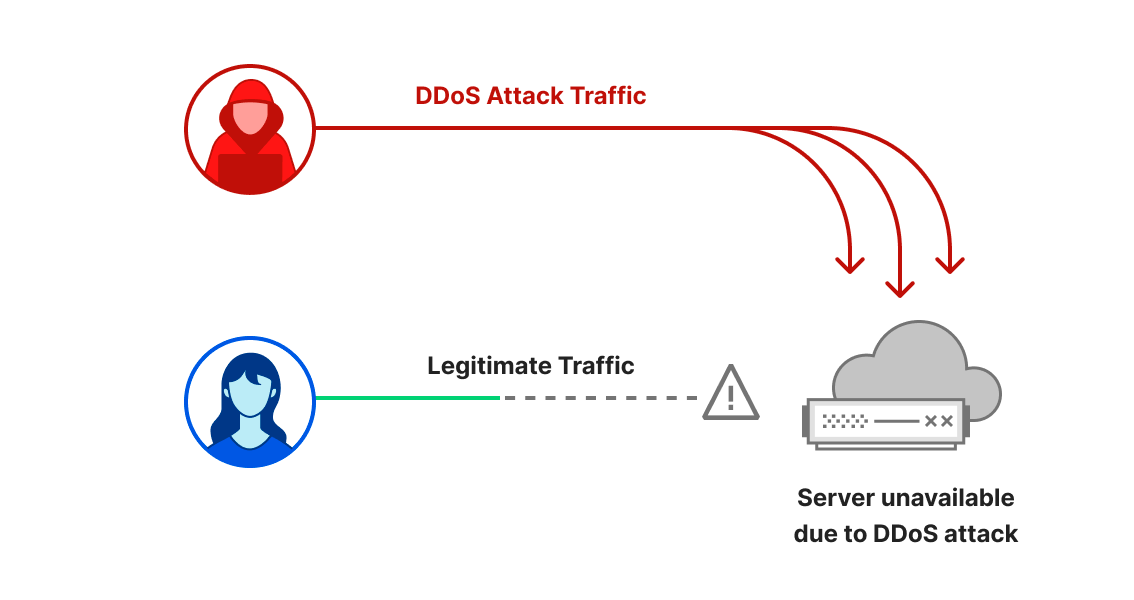
DDoS attacks, or distributed denial-of-service attacks, are a type of cyber attack that aims to disrupt websites and online services for users, making them unavailable by overwhelming them with more traffic than they can handle. They are similar to car gridlocks that jam roads, preventing drivers from getting to their destination.

There are three main types of DDoS attacks that we will cover in this report. The first is an HTTP request intensive DDoS attack that aims to overwhelm HTTP servers with more requests than they can handle to cause a denial of service event. The second is an IP packet intensive DDoS attack that aims to overwhelm in-line appliances such as routers, firewalls, and servers with more packets than they can handle. The third is a bit-intensive attack that aims to saturate and clog the Internet link causing that ‘gridlock’ that we discussed. In this report, we will highlight various techniques and insights on all three types of attacks.

Previous editions of the report can be found here, and are also available on our interactive hub, Cloudflare Radar. Cloudflare Radar showcases global Internet traffic, attacks, and technology trends and insights, with drill-down and filtering capabilities for zooming in on insights of specific countries, industries, and service providers. Cloudflare Radar also offers a free API allowing academics, data sleuths, and other web enthusiasts to investigate Internet usage across the globe.

To learn how we prepare this report, refer to our Methodologies.

Key findings

  1. In Q4, we observed a 117% year-over-year increase in network-layer DDoS attacks, and overall increased DDoS activity targeting retail, shipment and public relations websites during and around Black Friday and the holiday season.
  2. In Q4, DDoS attack traffic targeting Taiwan registered a 3,370% growth, compared to the previous year, amidst the upcoming general election and reported tensions with China. The percentage of DDoS attack traffic targeting Israeli websites grew by 27% quarter-over-quarter, and the percentage of DDoS attack traffic targeting Palestinian websites grew by 1,126% quarter-over-quarter — as the military conflict between Israel and Hamas continues.
  3. In Q4, there was a staggering 61,839% surge in DDoS attack traffic targeting Environmental Services websites compared to the previous year, coinciding with the 28th United Nations Climate Change Conference (COP 28).

For an in-depth analysis of these key findings and additional insights that could redefine your understanding of current cybersecurity challenges, read on!

Illustration of a DDoS attack

Hyper-volumetric HTTP DDoS attacks

2023 was the year of uncharted territories. DDoS attacks reached new heights — in size and sophistication. The wider Internet community, including Cloudflare, faced a persistent and deliberately engineered campaign of thousands of hyper-volumetric DDoS attacks at never before seen rates.

These attacks were highly complex and exploited an HTTP/2 vulnerability. Cloudflare developed purpose-built technology to mitigate the vulnerability’s effect and worked with others in the industry to responsibly disclose it.
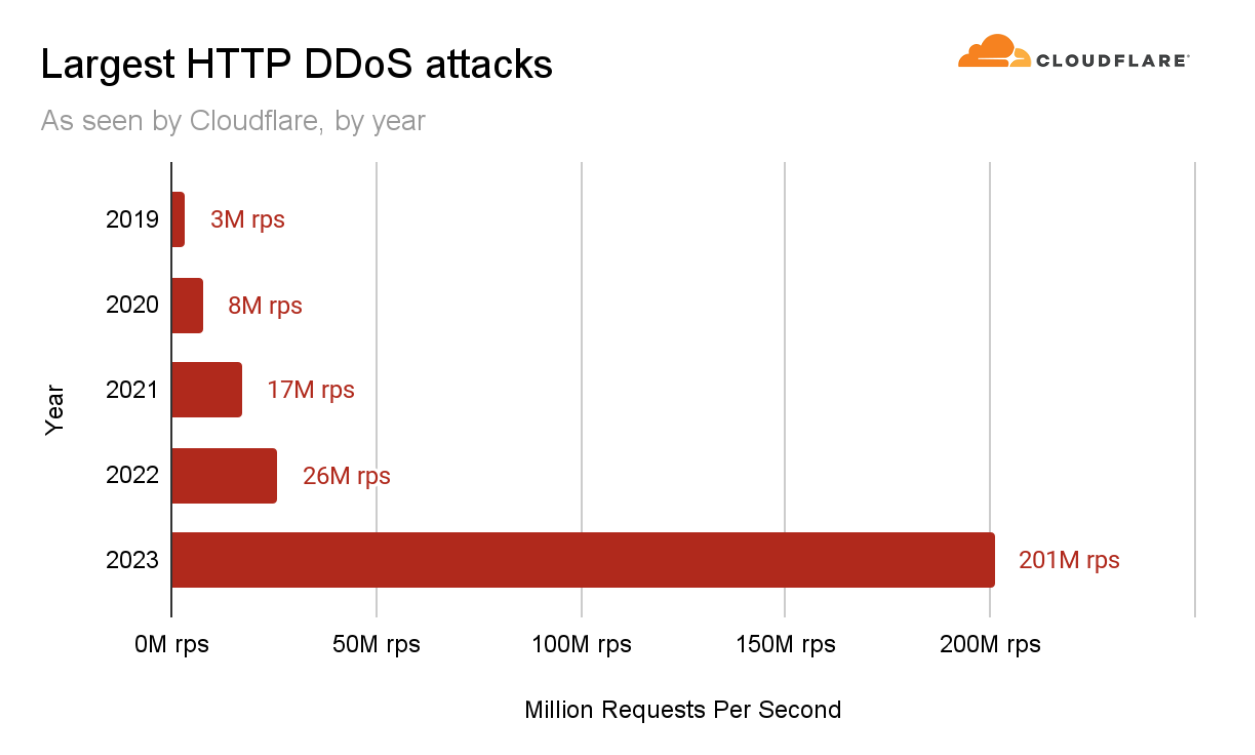
As part of this DDoS campaign, in Q3 our systems mitigated the largest attack we’ve ever seen — 201 million requests per second (rps). That’s almost 8 times larger than our previous 2022 record of 26 million rps.

Largest HTTP DDoS attacks as seen by Cloudflare, by year

Growth in network-layer DDoS attacks

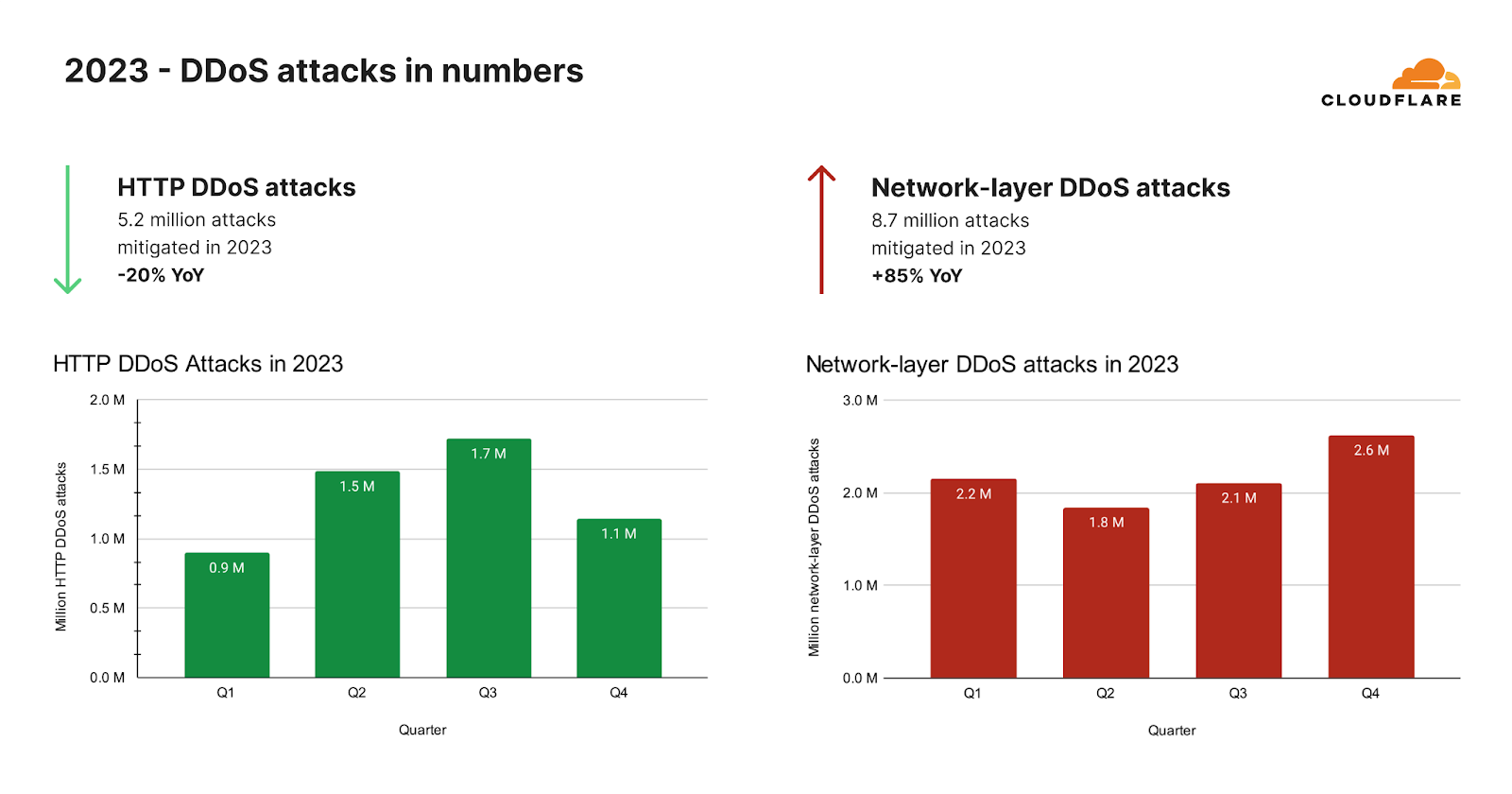
After the hyper-volumetric campaign subsided, we saw an unexpected drop in HTTP DDoS attacks. Overall in 2023, our automated defenses mitigated over 5.2 million HTTP DDoS attacks consisting of over 26 trillion requests. That averages at 594 HTTP DDoS attacks and 3 billion mitigated requests every hour.

Despite these astronomical figures, the amount of HTTP DDoS attack requests actually declined by 20% compared to 2022. This decline was not just annual but was also observed in 2023 Q4 where the number of HTTP DDoS attack requests decreased by 7% YoY and 18% QoQ.

On the network-layer, we saw a completely different trend. Our automated defenses mitigated 8.7 million network-layer DDoS attacks in 2023. This represents an 85% increase compared to 2022.

In 2023 Q4, Cloudflare’s automated defenses mitigated over 80 petabytes of network-layer attacks. On average, our systems auto-mitigated 996 network-layer DDoS attacks and 27 terabytes every hour. The number of network-layer DDoS attacks in 2023 Q4 increased by 175% YoY and 25% QoQ.

HTTP and Network-layer DDoS attacks by quarter

DDoS attacks increase during and around COP 28

In the final quarter of 2023, the landscape of cyber threats witnessed a significant shift. While the Cryptocurrency sector was initially leading in terms of the volume of HTTP DDoS attack requests, a new target emerged as a primary victim. The Environmental Services industry experienced an unprecedented surge in HTTP DDoS attacks, with these attacks constituting half of all its HTTP traffic. This marked a staggering 618-fold increase compared to the previous year, highlighting a disturbing trend in the cyber threat landscape.

This surge in cyber attacks coincided with COP 28, which ran from November 30th to December 12th, 2023. The conference was a pivotal event, signaling what many considered the ‘beginning of the end’ for the fossil fuel era. It was observed that in the period leading up to COP 28, there was a noticeable spike in HTTP attacks targeting Environmental Services websites. This pattern wasn’t isolated to this event alone.

Looking back at historical data, particularly during COP 26 and COP 27, as well as other UN environment-related resolutions or announcements, a similar pattern emerges. Each of these events was accompanied by a corresponding increase in cyber attacks aimed at Environmental Services websites.

In February and March 2023, significant environmental events like the UN’s resolution on climate justice and the launch of United Nations Environment Programme’s Freshwater Challenge potentially heightened the profile of environmental websites, possibly correlating with an increase in attacks on these sites​​​​.

This recurring pattern underscores the growing intersection between environmental issues and cyber security, a nexus that is increasingly becoming a focal point for attackers in the digital age.

DDoS attacks and Iron Swords

It’s not just UN resolutions that trigger DDoS attacks. Cyber attacks, and particularly DDoS attacks, have long been a tool of war and disruption. We witnessed an increase in DDoS attack activity in the Ukraine-Russia war, and now we’re also witnessing it in the Israel-Hamas war. We first reported the cyber activity in our report Cyber attacks in the Israel-Hamas war, and we continued to monitor the activity throughout Q4.

Operation “Iron Swords” is the military offensive launched by Israel against Hamas following the Hamas-led 7 October attack. During this ongoing armed conflict, we continue to see DDoS attacks targeting both sides.

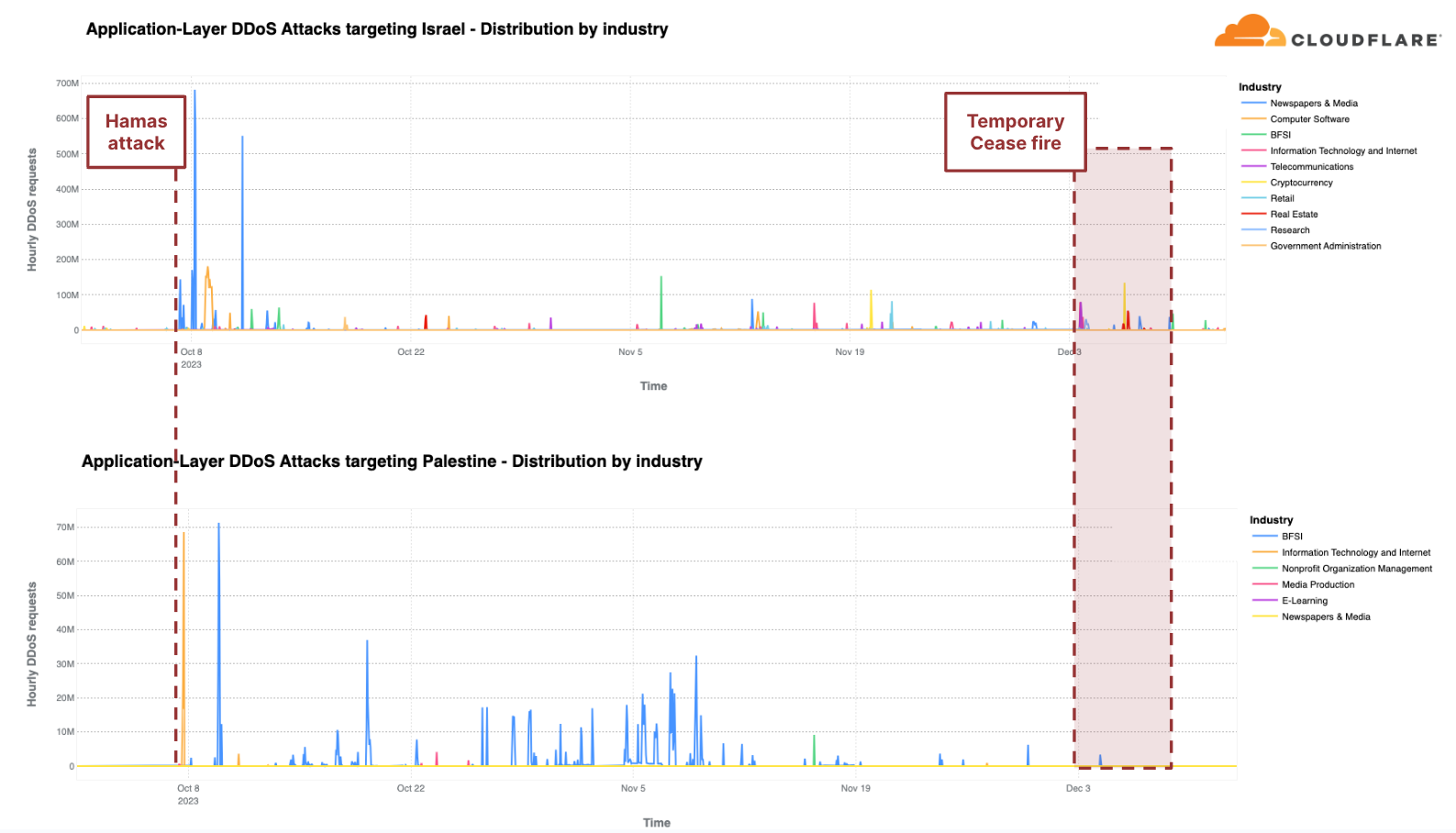
DDoS attacks targeting Israeli and Palestinian websites, by industry

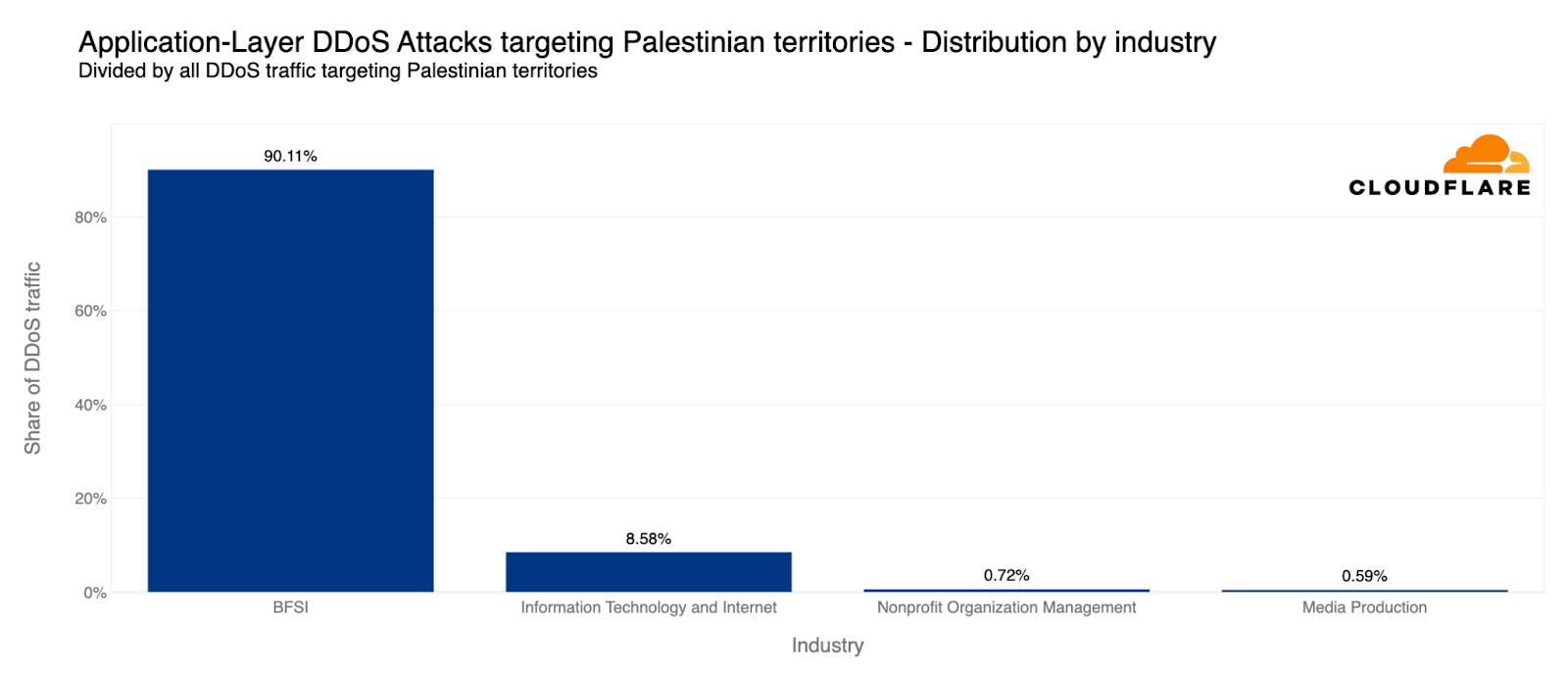
Relative to each region’s traffic, the Palestinian territories was the second most attacked region by HTTP DDoS attacks in Q4. Over 10% of all HTTP requests towards Palestinian websites were DDoS attacks, a total of 1.3 billion DDoS requests — representing a 1,126% increase in QoQ. 90% of these DDoS attacks targeted Palestinian Banking websites. Another 8% targeted Information Technology and Internet platforms.

Top attacked Palestinian industries

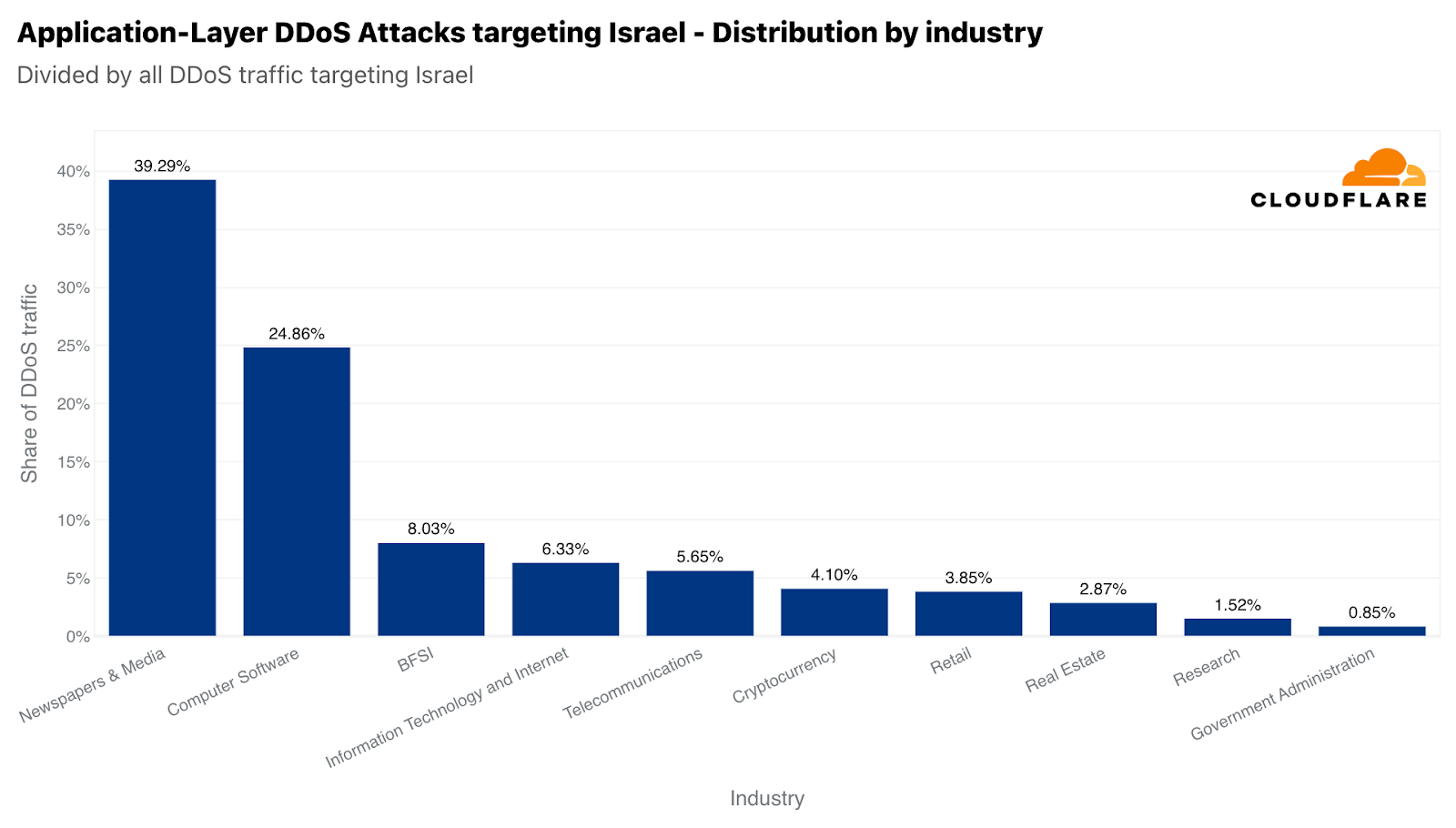
Similarly, our systems automatically mitigated over 2.2 billion HTTP DDoS requests targeting Israeli websites. While 2.2 billion represents a decrease compared to the previous quarter and year, it did amount to a larger percentage out of the total Israel-bound traffic. This normalized figure represents a 27% increase QoQ but a 92% decrease YoY. Notwithstanding the larger amount of attack traffic, Israel was the 77th most attacked region relative to its own traffic. It was also the 33rd most attacked by total volume of attacks, whereas the Palestinian territories was 42nd.

Of those Israeli websites attacked, Newspaper & Media were the main target — receiving almost 40% of all Israel-bound HTTP DDoS attacks. The second most attacked industry was the Computer Software industry. The Banking, Financial Institutions, and Insurance (BFSI) industry came in third.

Top attacked Israeli industries

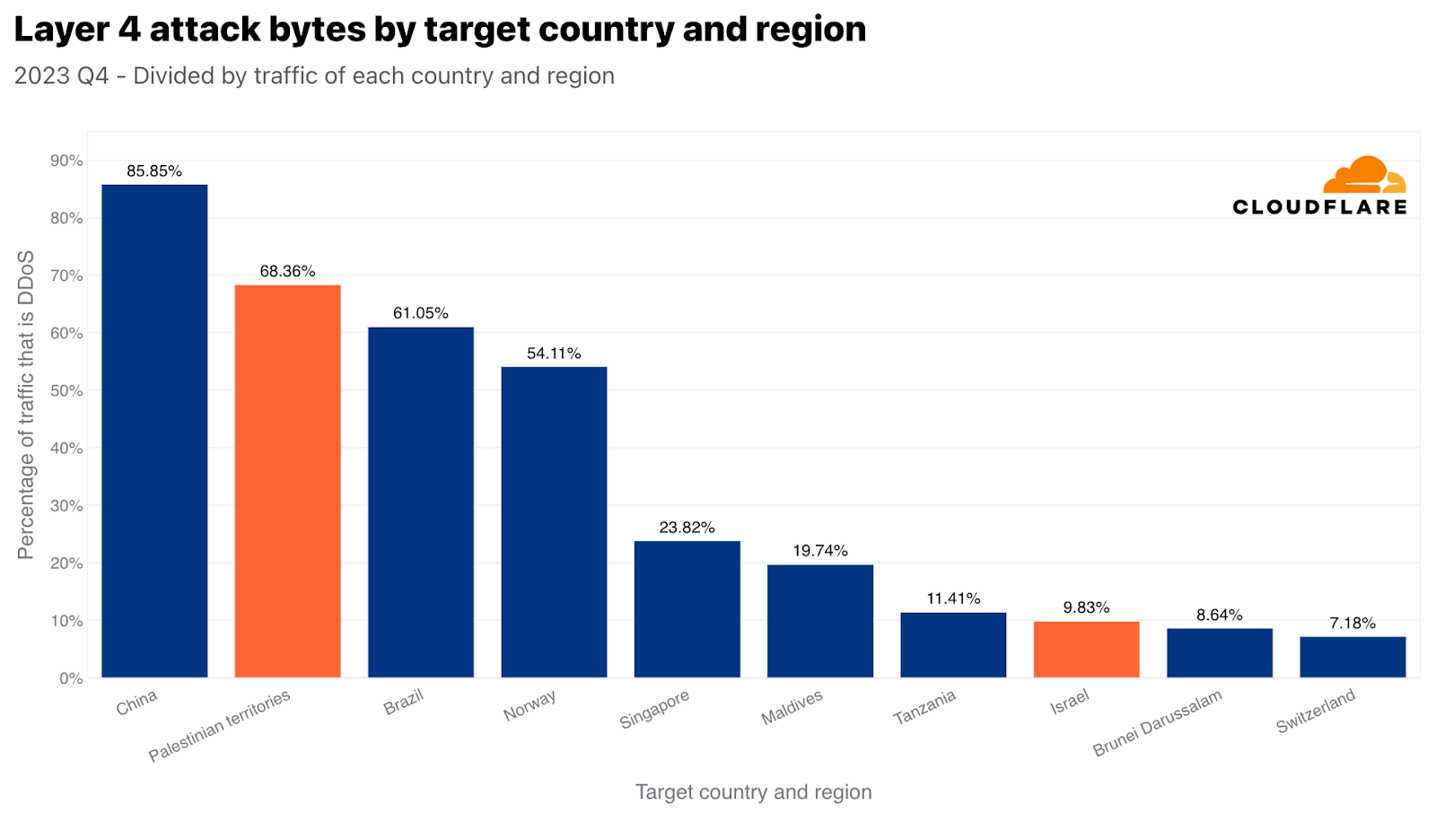
On the network layer, we see the same trend. Palestinian networks were targeted by 470 terabytes of attack traffic — accounting for over 68% of all traffic towards Palestinian networks. Surpassed only by China, this figure placed the Palestinian territories as the second most attacked region in the world, by network-layer DDoS attack, relative to all Palestinian territories-bound traffic. By absolute volume of traffic, it came in third. Those 470 terabytes accounted for approximately 1% of all DDoS traffic that Cloudflare mitigated.

Israeli networks, though, were targeted by only 2.4 terabytes of attack traffic, placing it as the 8th most attacked country by network-layer DDoS attacks (normalized). Those 2.4 terabytes accounted for almost 10% of all traffic towards Israeli networks.

Top attacked countries

When we turned the picture around, we saw that 3% of all bytes that were ingested in our Israeli-based data centers were network-layer DDoS attacks. In our Palestinian-based data centers, that figure was significantly higher — approximately 17% of all bytes.

On the application layer, we saw that 4% of HTTP requests originating from Palestinian IP addresses were DDoS attacks, and almost 2% of HTTP requests originating from Israeli IP addresses were DDoS attacks as well.

Main sources of DDoS attacks

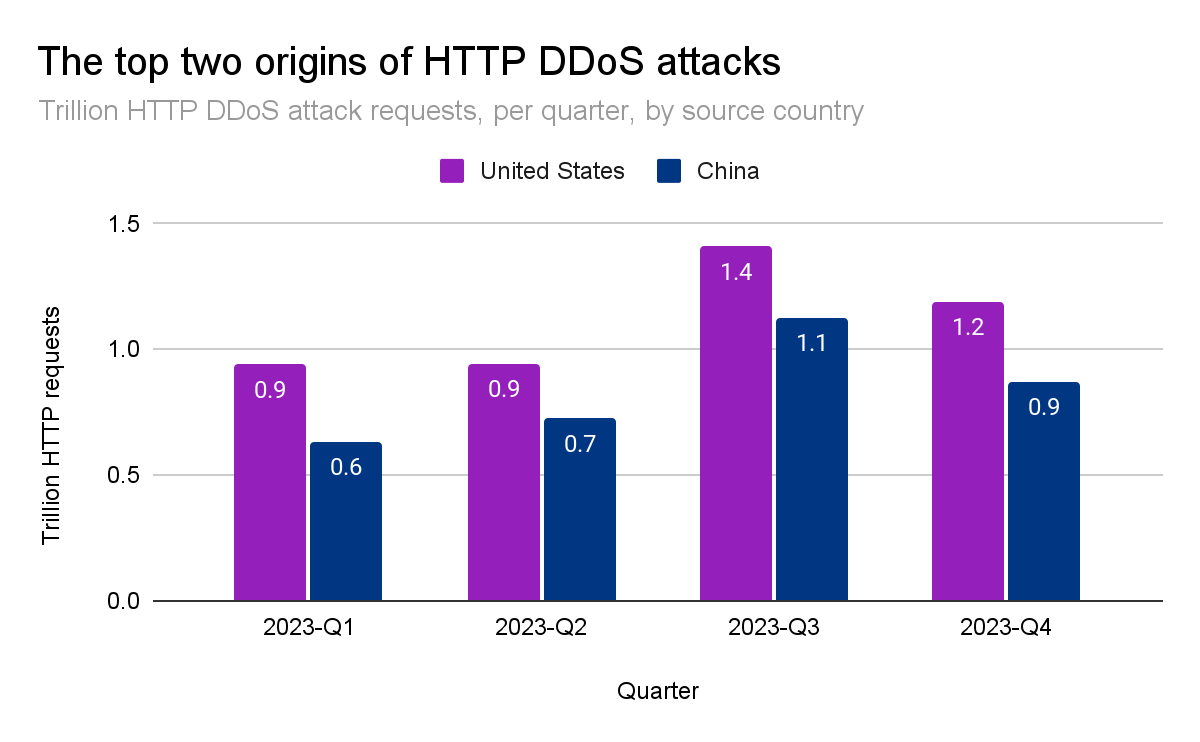
In the third quarter of 2022, China was the largest source of HTTP DDoS attack traffic. However, since the fourth quarter of 2022, the US took the first place as the largest source of HTTP DDoS attacks and has maintained that undesirable position for five consecutive quarters. Similarly, our data centers in the US are the ones ingesting the most network-layer DDoS attack traffic — over 38% of all attack bytes.

HTTP DDoS attacks originating from China and the US by quarter

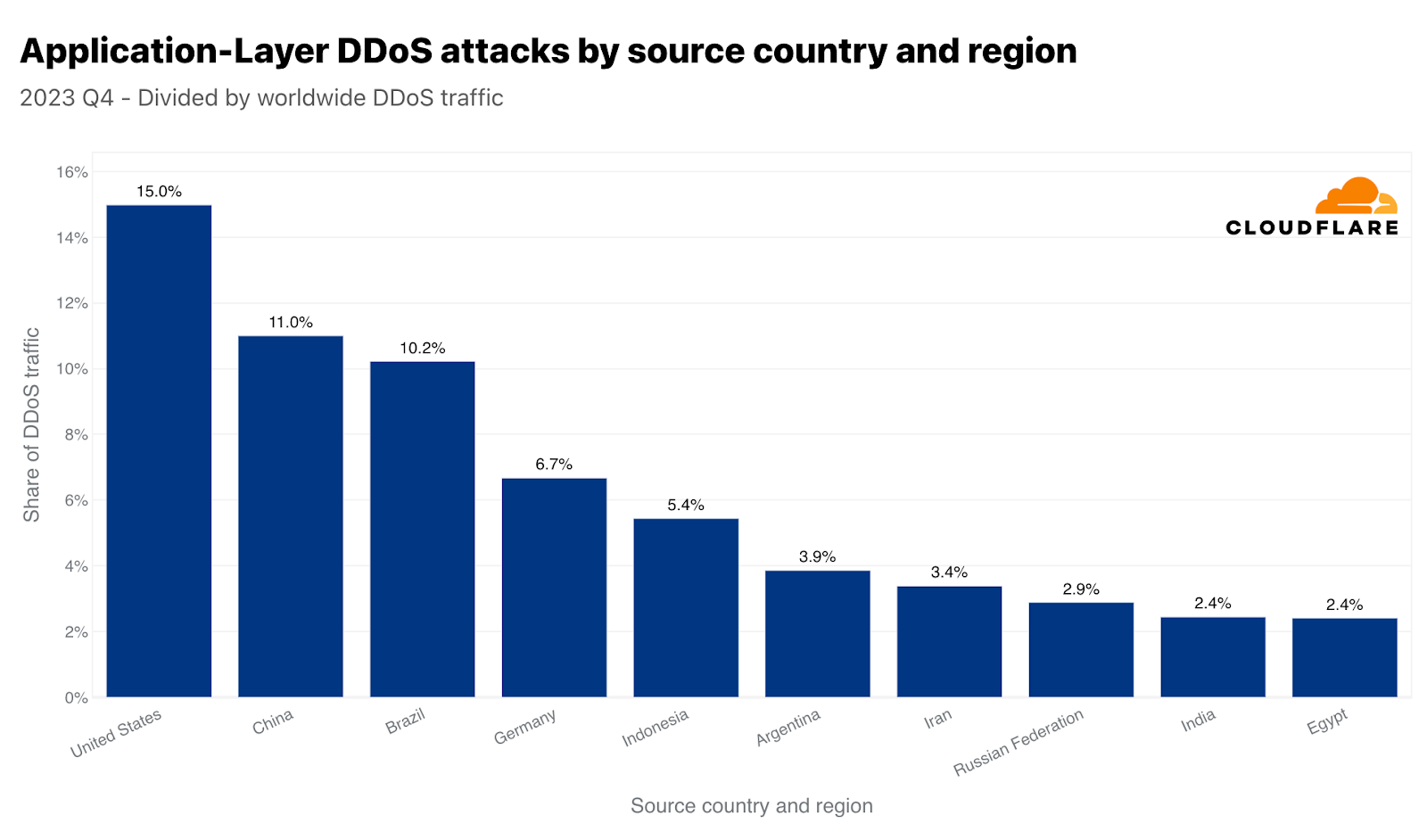
Together, China and the US account for a little over a quarter of all HTTP DDoS attack traffic in the world. Brazil, Germany, Indonesia, and Argentina account for the next twenty-five percent.

Top source of HTTP DDoS attacks

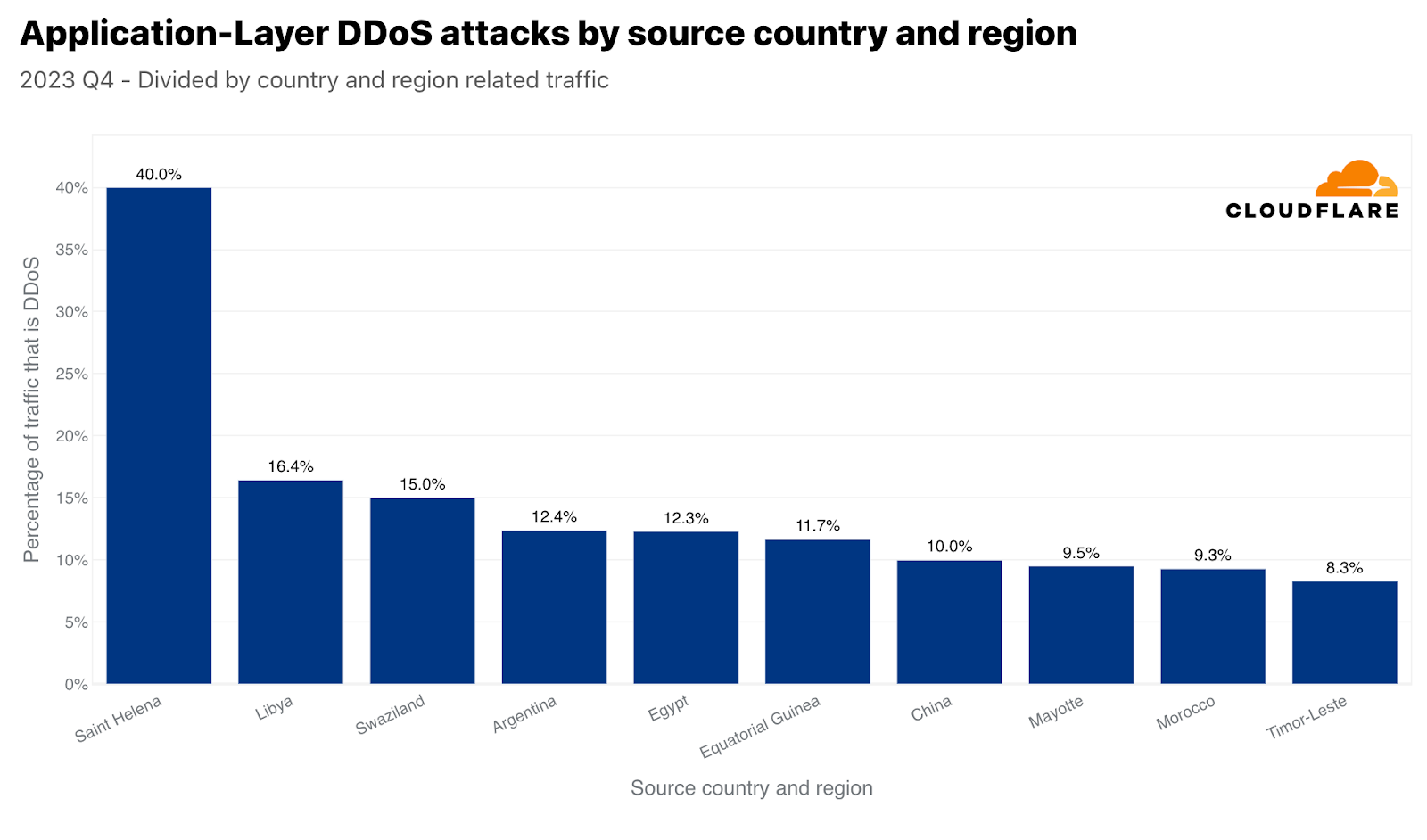
These large figures usually correspond to large markets. For this reason, we also normalize the attack traffic originating from each country by comparing their outbound traffic. When we do this, we often get small island nations or smaller market countries that a disproportionate amount of attack traffic originates from. In Q4, 40% of Saint Helena’s outbound traffic were HTTP DDoS attacks — placing it at the top. Following the ‘remote volcanic tropical island’, Libya came in second, Swaziland (also known as Eswatini) in third. Argentina and Egypt follow in fourth and fifth place.

Top source of HTTP DDoS attacks with respect to each country’s traffic

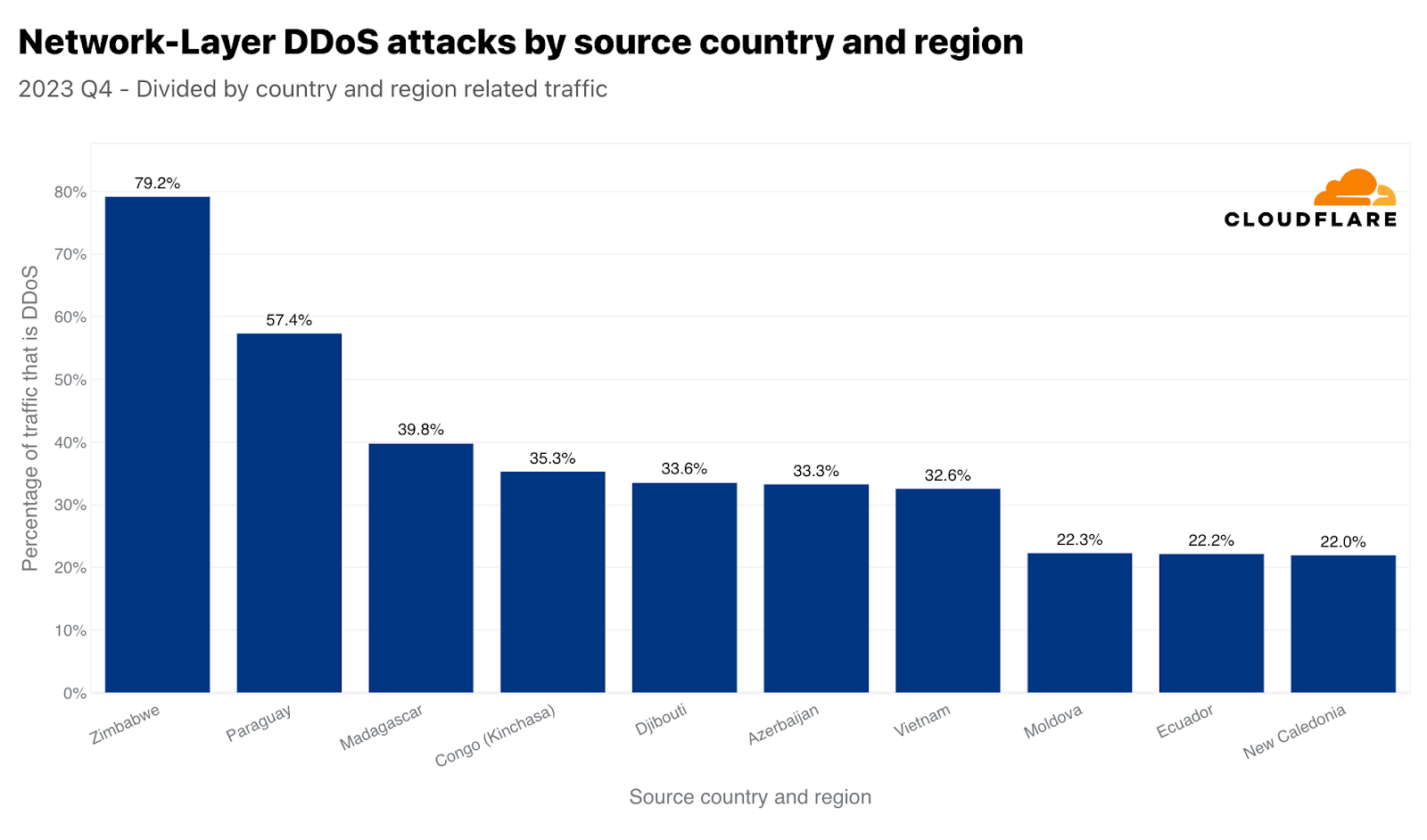
On the network layer, Zimbabwe came in first place. Almost 80% of all traffic we ingested in our Zimbabwe-based data center was malicious. In second place, Paraguay, and Madagascar in third.

Top source of Network-layer DDoS attacks with respect to each country’s traffic

Most attacked industries

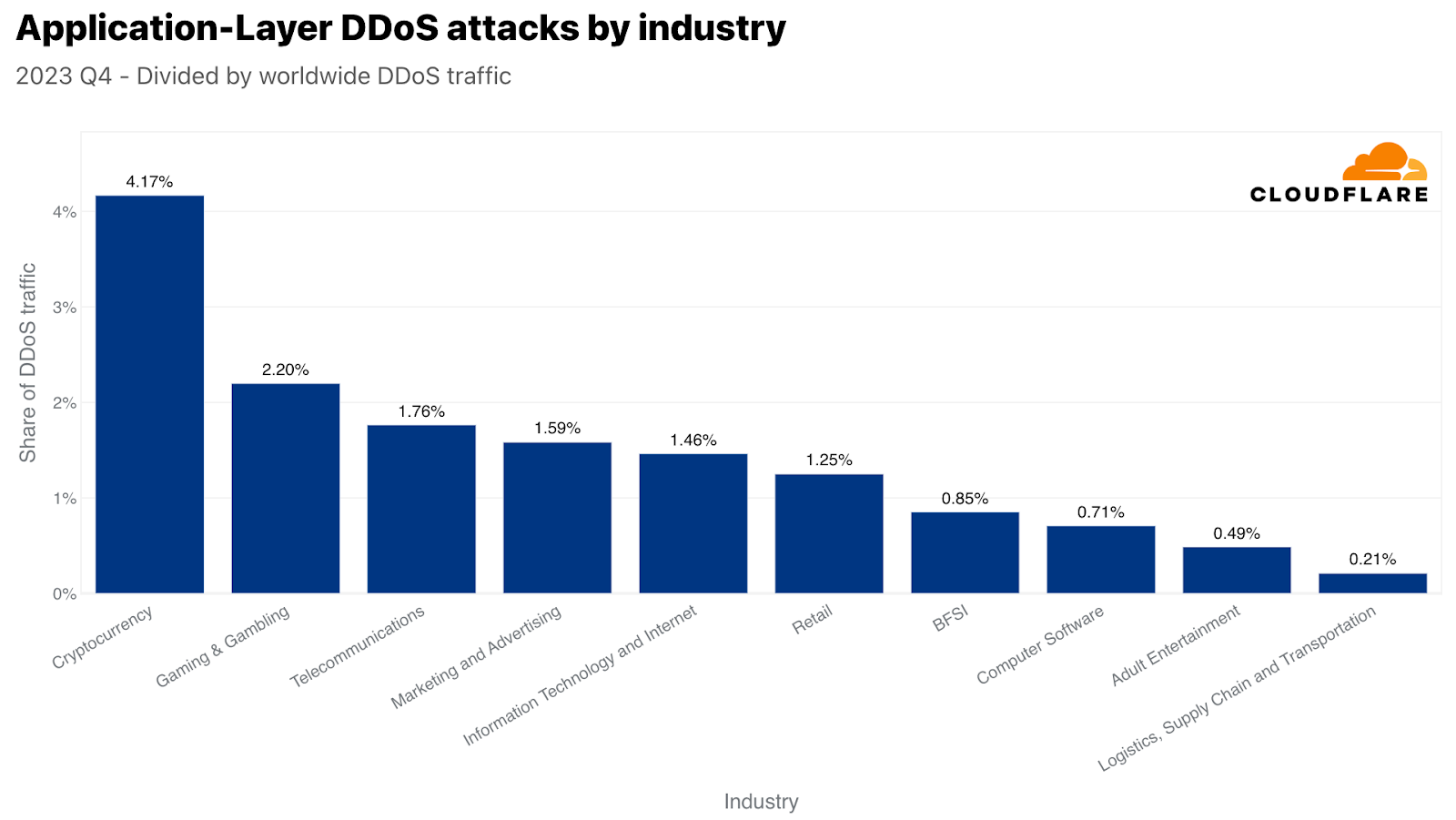
By volume of attack traffic, Cryptocurrency was the most attacked industry in Q4. Over 330 billion HTTP requests targeted it. This figure accounts for over 4% of all HTTP DDoS traffic for the quarter. The second most attacked industry was Gaming & Gambling. These industries are known for being coveted targets and attract a lot of traffic and attacks.

Top industries targeted by HTTP DDoS attacks

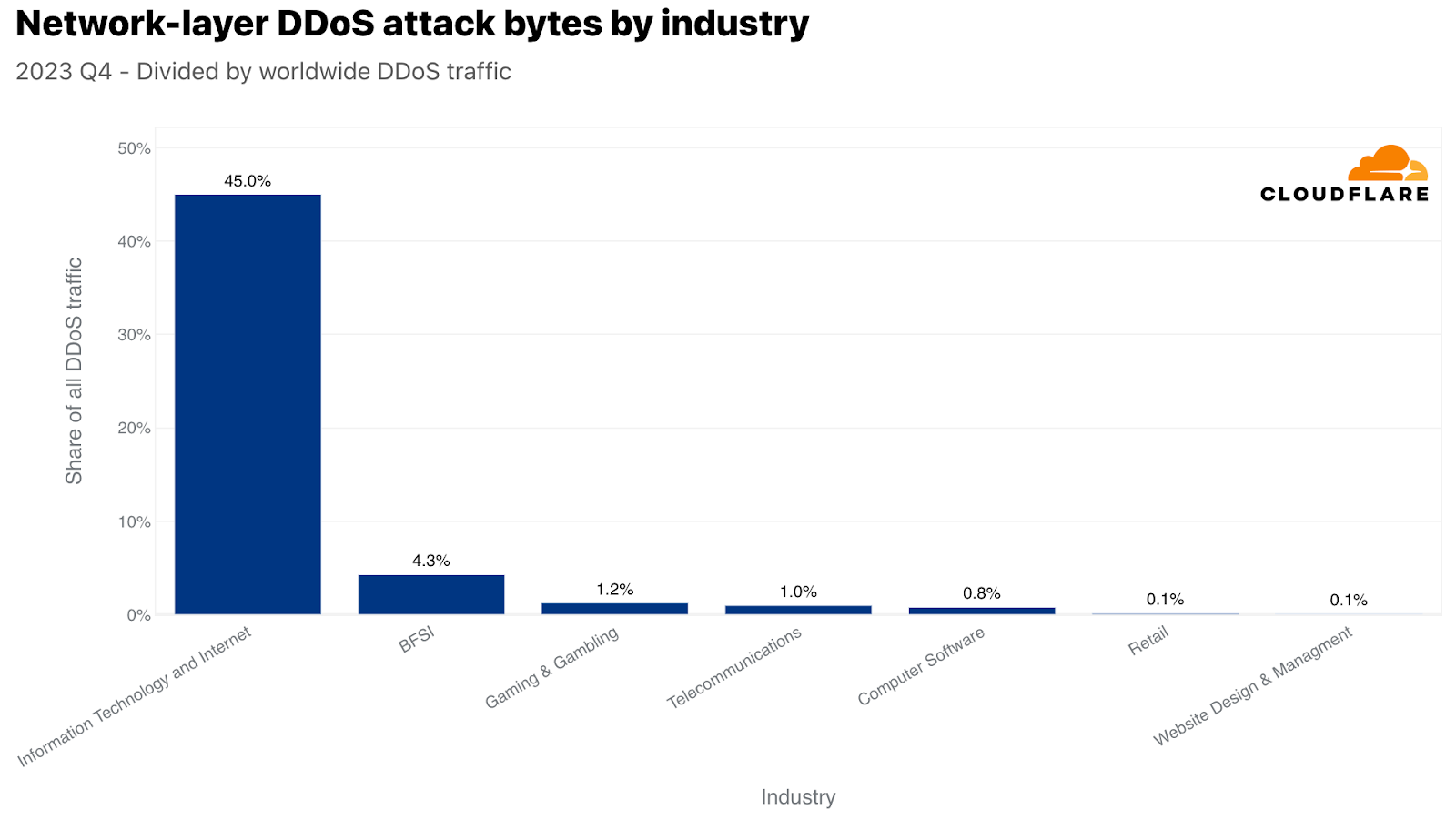
On the network layer, the Information Technology and Internet industry was the most attacked — over 45% of all network-layer DDoS attack traffic was aimed at it. Following far behind were the Banking, Financial Services and Insurance (BFSI), Gaming & Gambling, and Telecommunications industries.

Top industries targeted by Network-layer DDoS attacks

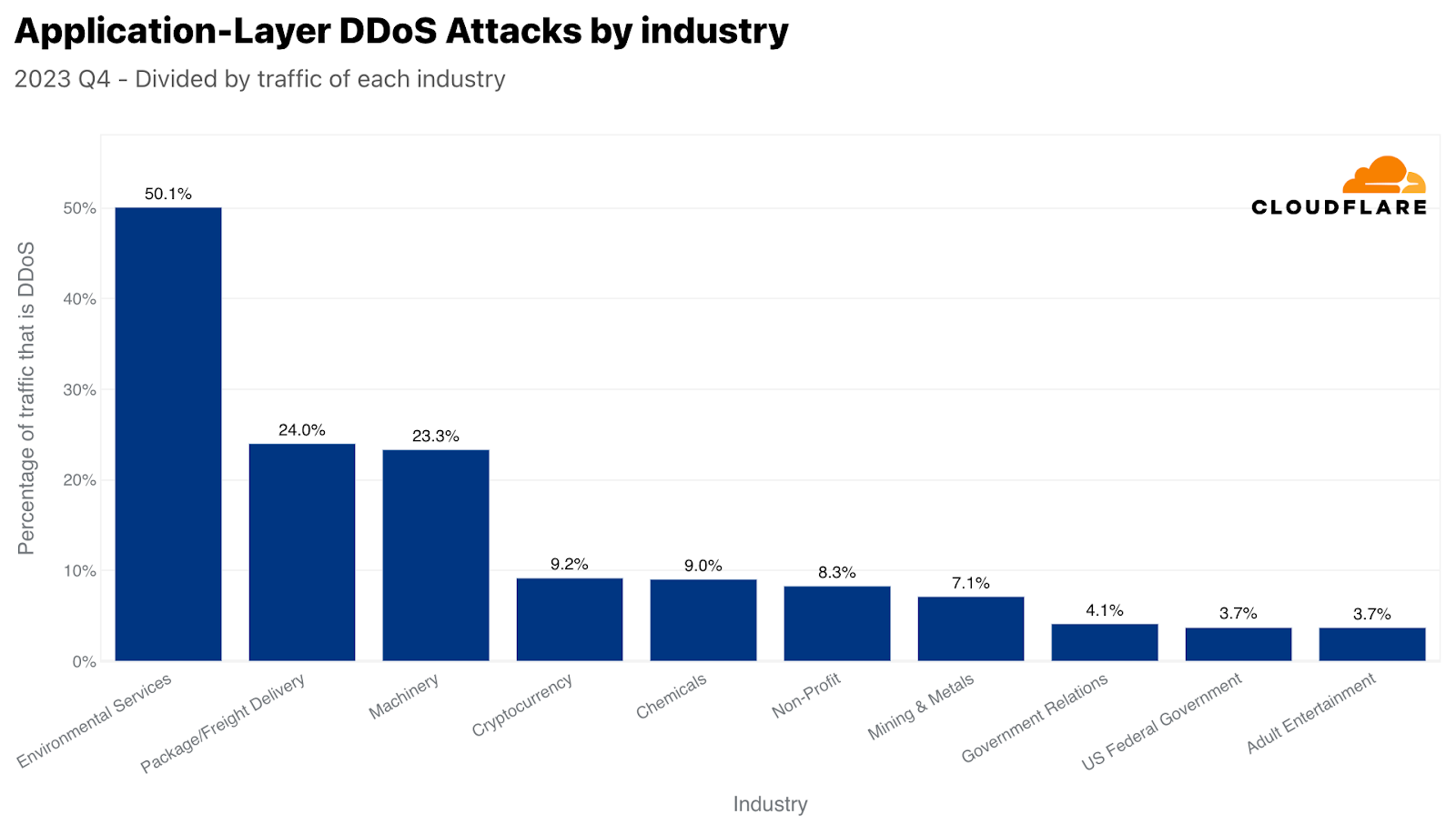
To change perspectives, here too, we normalized the attack traffic by the total traffic for a specific industry. When we do that, we get a different picture.

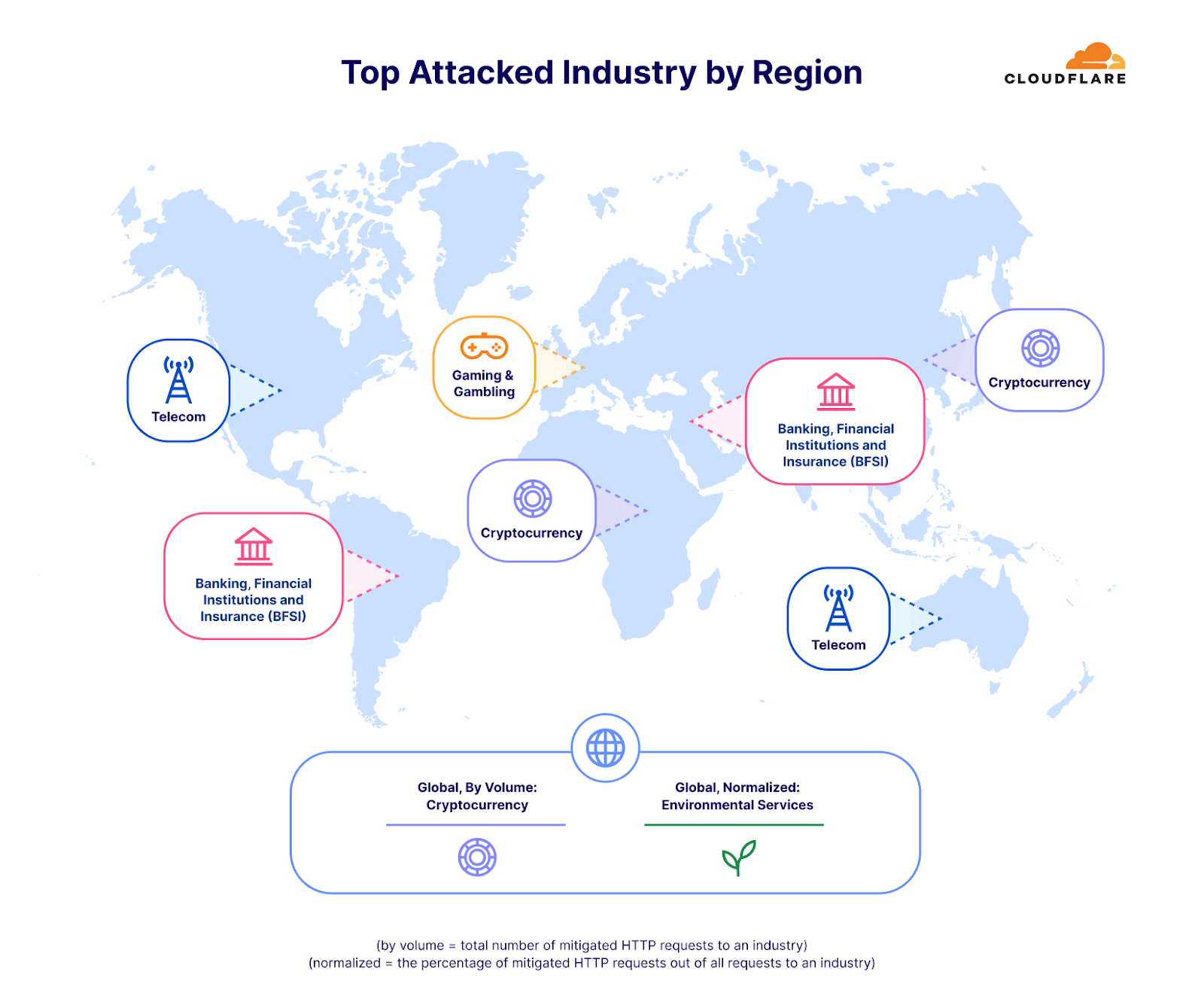
Top attacked industries by HTTP DDoS attacks, by region

We already mentioned in the beginning of this report that the Environmental Services industry was the most attacked relative to its own traffic. In second place was the Packaging and Freight Delivery industry, which is interesting because of its timely correlation with online shopping during Black Friday and the winter holiday season. Purchased gifts and goods need to get to their destination somehow, and it seems as though attackers tried to interfere with that. On a similar note, DDoS attacks on retail companies increased by 23% compared to the previous year.

Top industries targeted by HTTP DDoS attacks with respect to each industry’s traffic

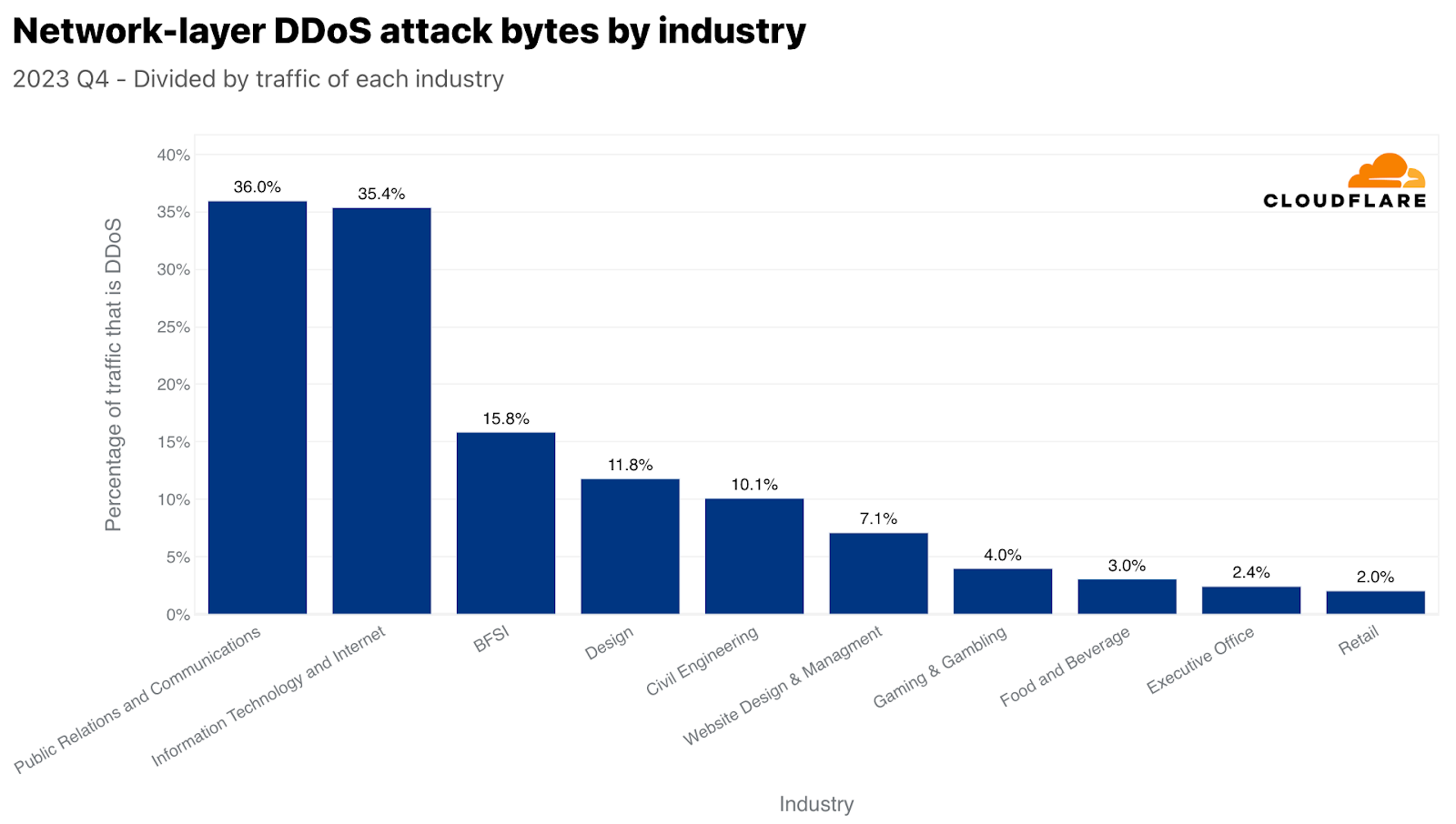
On the network layer, Public Relations and Communications was the most targeted industry — 36% of its traffic was malicious. This too is very interesting given its timing. Public Relations and Communications companies are usually linked to managing public perception and communication. Disrupting their operations can have immediate and widespread reputational impacts which becomes even more critical during the Q4 holiday season. This quarter often sees increased PR and communication activities due to holidays, end-of-year summaries, and preparation for the new year, making it a critical operational period — one that some may want to disrupt.

Top industries targeted by Network-layer DDoS attacks with respect to each industry’s traffic

Most attacked countries and regions

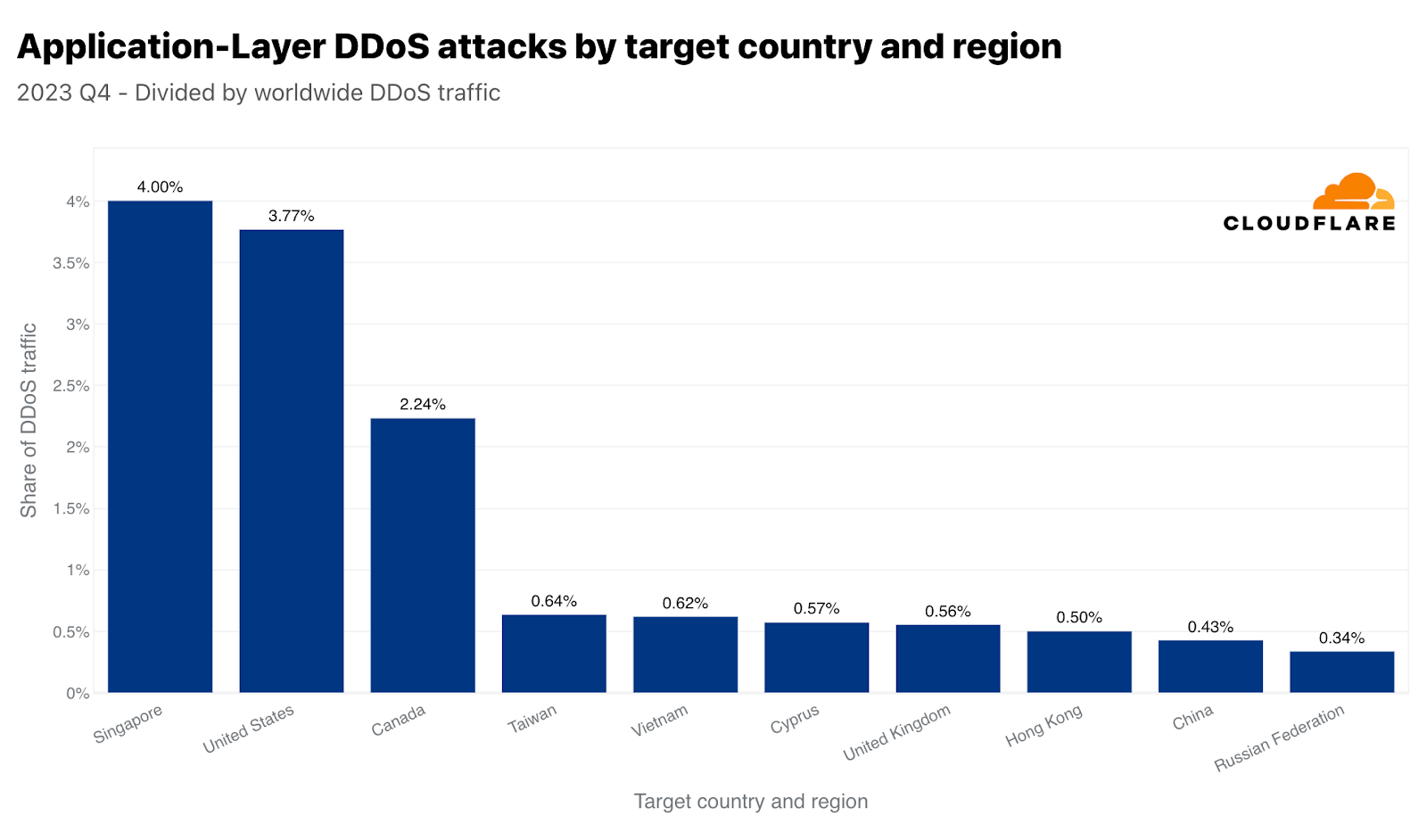
Singapore was the main target of HTTP DDoS attacks in Q4. Over 317 billion HTTP requests, 4% of all global DDoS traffic, were aimed at Singaporean websites. The US followed closely in second and Canada in third. Taiwan came in as the fourth most attacked region — amidst the upcoming general elections and the tensions with China. Taiwan-bound attacks in Q4 traffic increased by 847% compared to the previous year, and 2,858% compared to the previous quarter. This increase is not limited to the absolute values. When normalized, the percentage of HTTP DDoS attack traffic targeting Taiwan relative to all Taiwan-bound traffic also significantly increased. It increased by 624% quarter-over-quarter and 3,370% year-over-year.

Top targeted countries by HTTP DDoS attacks

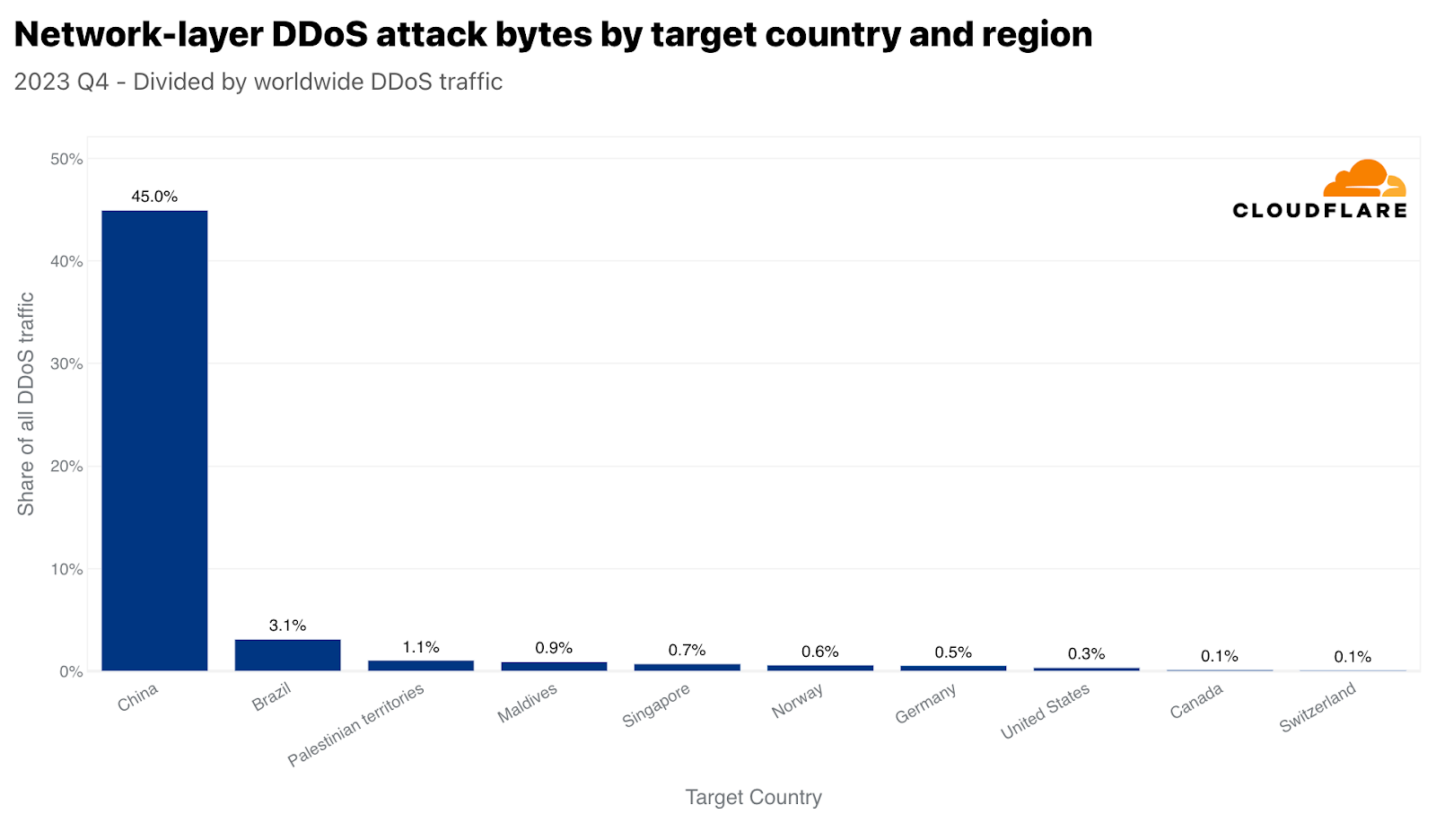
While China came in as the ninth most attacked country by HTTP DDoS attacks, it’s the number one most attacked country by network-layer attacks. 45% of all network-layer DDoS traffic that Cloudflare mitigated globally was China-bound. The rest of the countries were so far behind that it is almost negligible.

Top targeted countries by Network-layer DDoS attacks

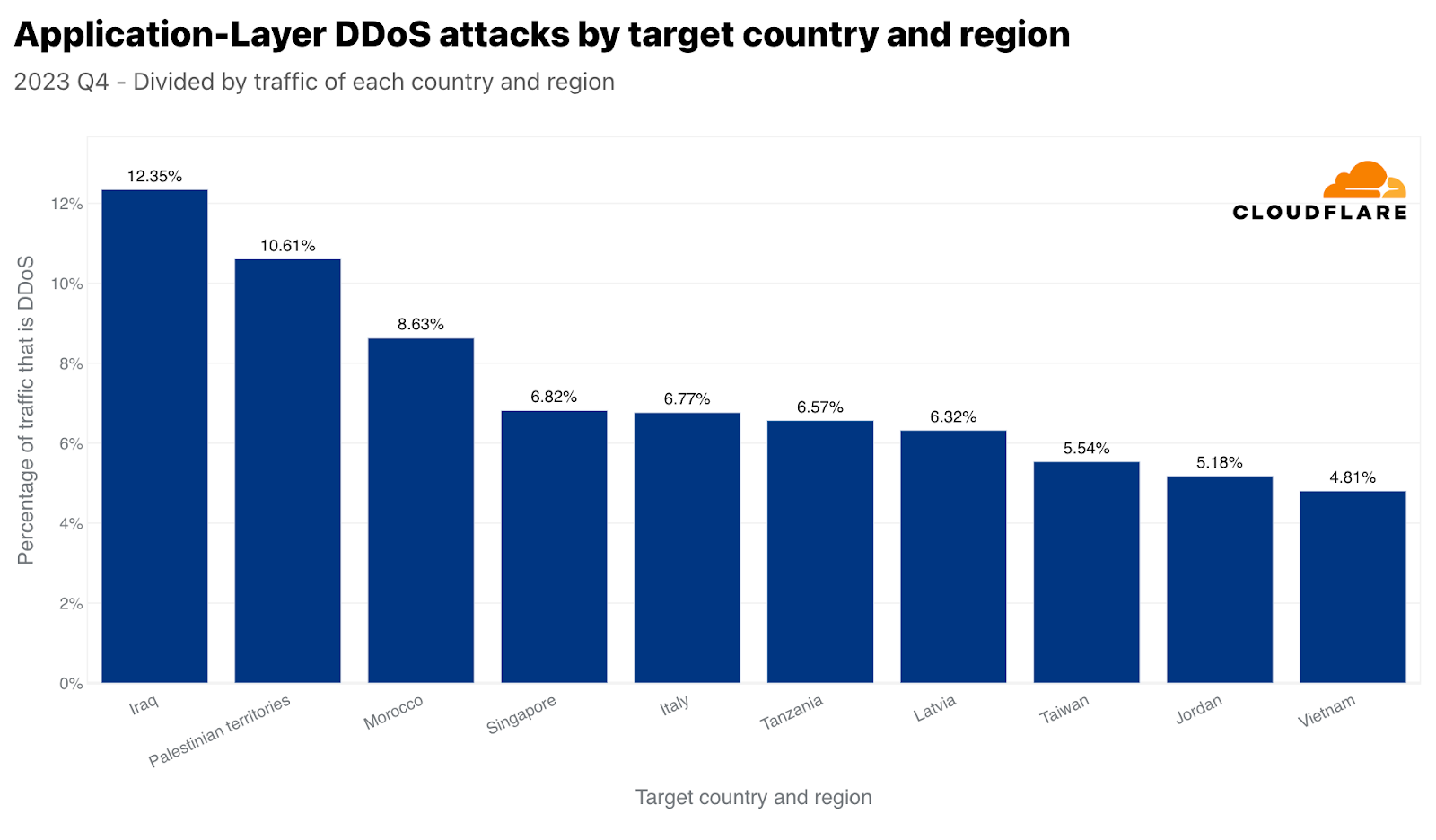
When normalizing the data, Iraq, Palestinian territories, and Morocco take the lead as the most attacked regions with respect to their total inbound traffic. What’s interesting is that Singapore comes up as fourth. So not only did Singapore face the largest amount of HTTP DDoS attack traffic, but that traffic also made up a significant amount of the total Singapore-bound traffic. By contrast, the US was second most attacked by volume (per the application-layer graph above), but came in the fiftieth place with respect to the total US-bound traffic.

Top targeted countries by HTTP DDoS attacks with respect to each country’s traffic

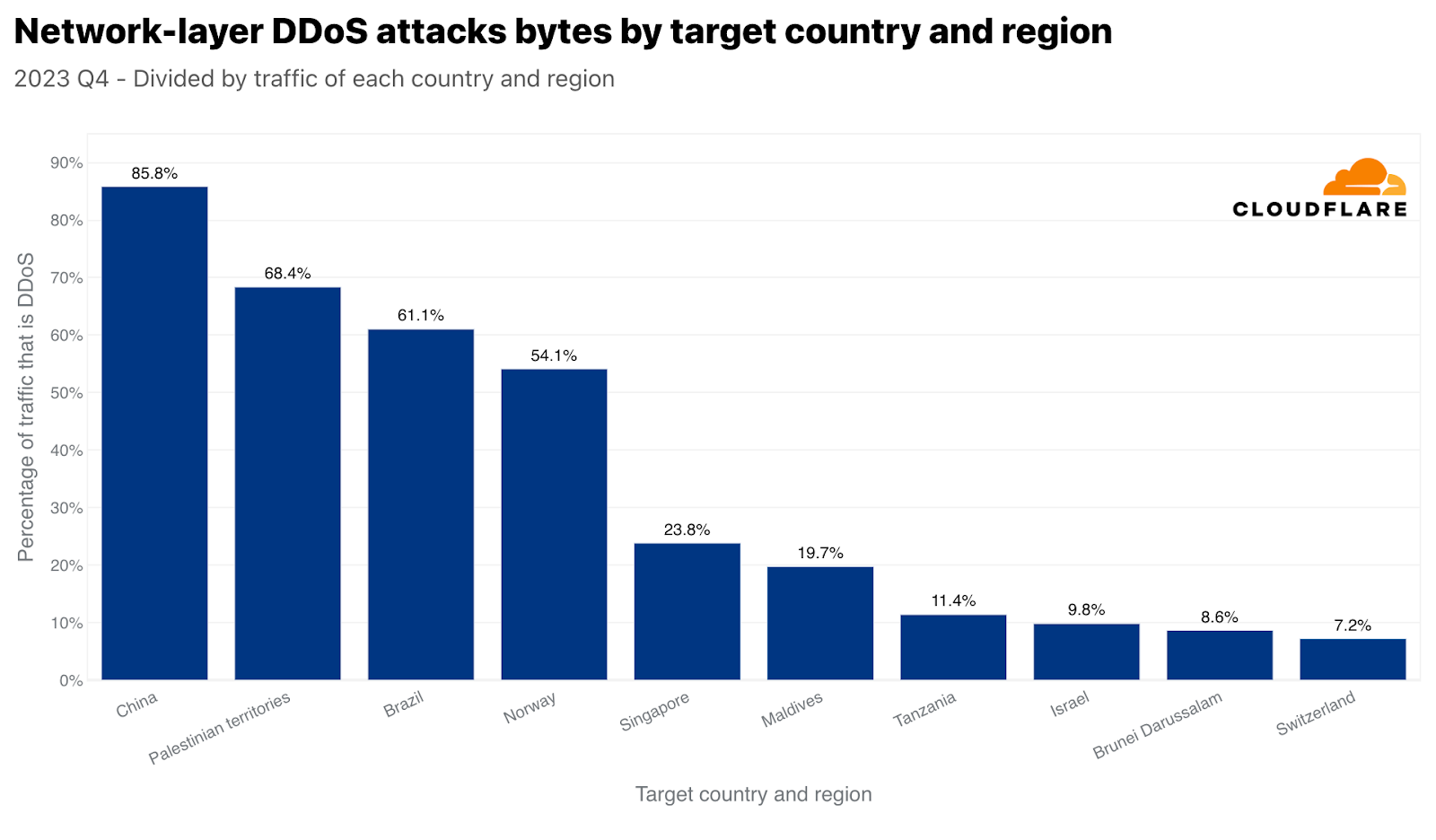
Similar to Singapore, but arguably more dramatic, China is both the number one most attacked country by network-layer DDoS attack traffic, and also with respect to all China-bound traffic. Almost 86% of all China-bound traffic was mitigated by Cloudflare as network-layer DDoS attacks. The Palestinian territories, Brazil, Norway, and again Singapore followed with large percentages of attack traffic.

Top targeted countries by Network-layer DDoS attacks with respect to each country’s traffic

Attack vectors and attributes

The majority of DDoS attacks are short and small relative to Cloudflare’s scale. However, unprotected websites and networks can still suffer disruption from short and small attacks without proper inline automated protection — underscoring the need for organizations to be proactive in adopting a robust security posture.

In 2023 Q4, 91% of attacks ended within 10 minutes, 97% peaked below 500 megabits per second (mbps), and 88% never exceeded 50 thousand packets per second (pps).

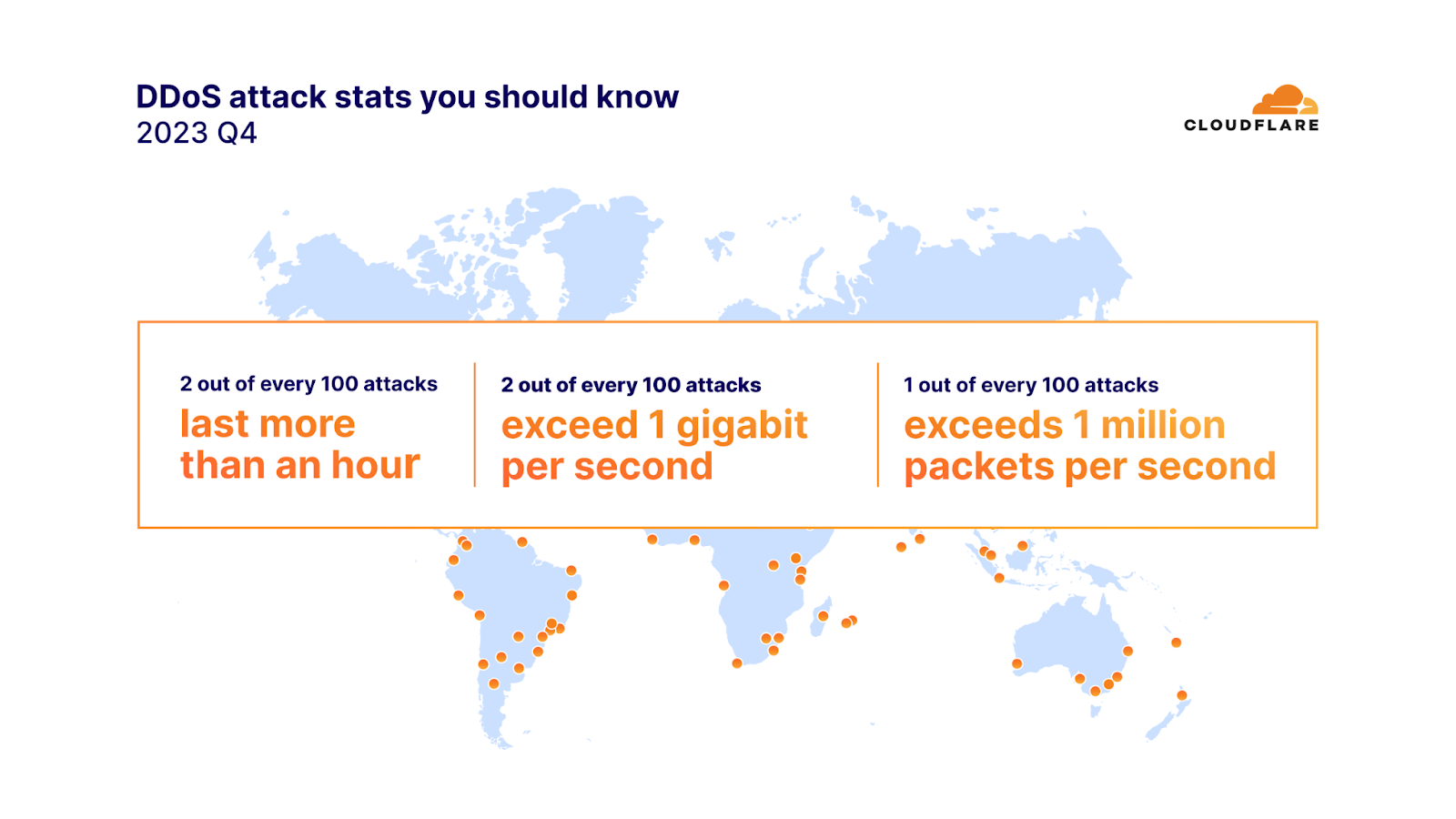
Two out of every 100 network-layer DDoS attacks lasted more than an hour, and exceeded 1 gigabit per second (gbps). One out of every 100 attacks exceeded 1 million packets per second. Furthermore, the amount of network-layer DDoS attacks exceeding 100 million packets per second increased by 15% quarter-over-quarter.

DDoS attack stats you should know

One of those large attacks was a Mirai-botnet attack that peaked at 160 million packets per second. The packet per second rate was not the largest we’ve ever seen. The largest we’ve ever seen was 754 million packets per second. That attack occurred in 2020, and we have yet to see anything larger.

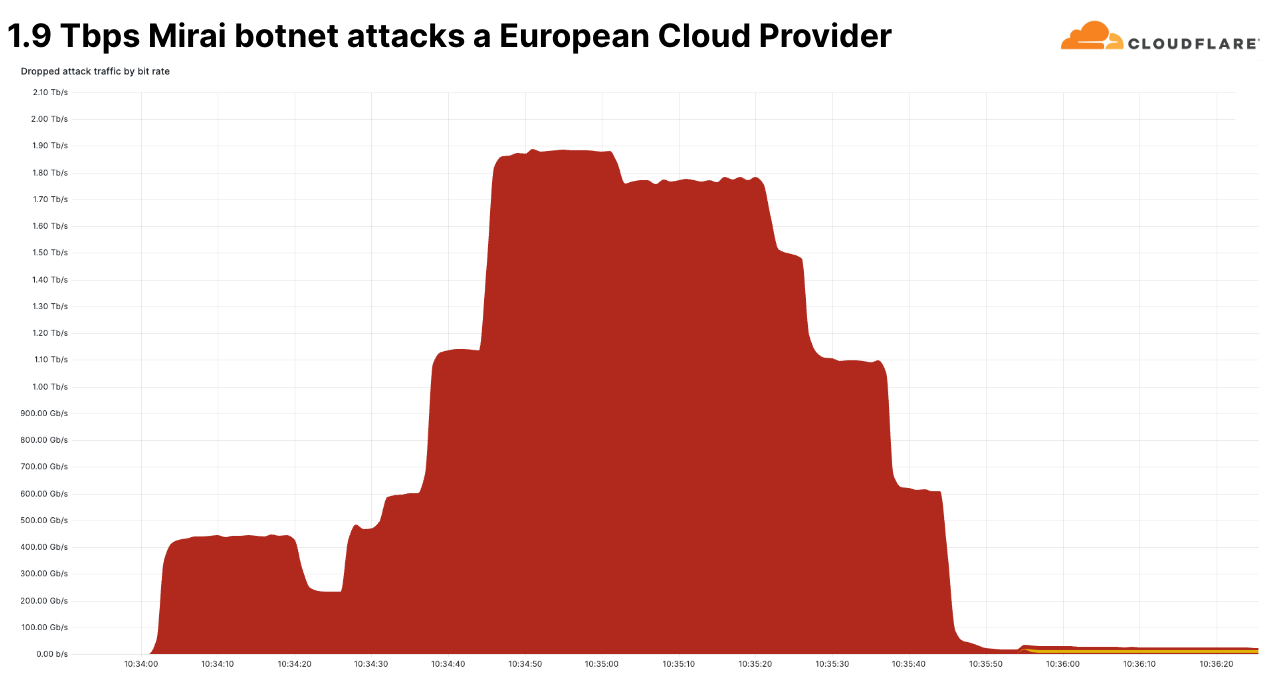
This more recent attack, though, was unique in its bits per second rate. This was the largest network-layer DDoS attack we’ve seen in Q4. It peaked at 1.9 terabits per second and originated from a Mirai botnet. It was a multi-vector attack, meaning it combined multiple attack methods. Some of those methods included UDP fragments flood, UDP/Echo flood, SYN Flood, ACK Flood, and TCP malformed flags.

This attack targeted a known European Cloud Provider and originated from over 18 thousand unique IP addresses that are assumed to be spoofed. It was automatically detected and mitigated by Cloudflare’s defenses.

This goes to show that even the largest attacks end very quickly. Previous large attacks we’ve seen ended within seconds — underlining the need for an in-line automated defense system. Though still rare, attacks in the terabit range are becoming more and more prominent.

1.9 Terabit per second Mirai DDoS attacks

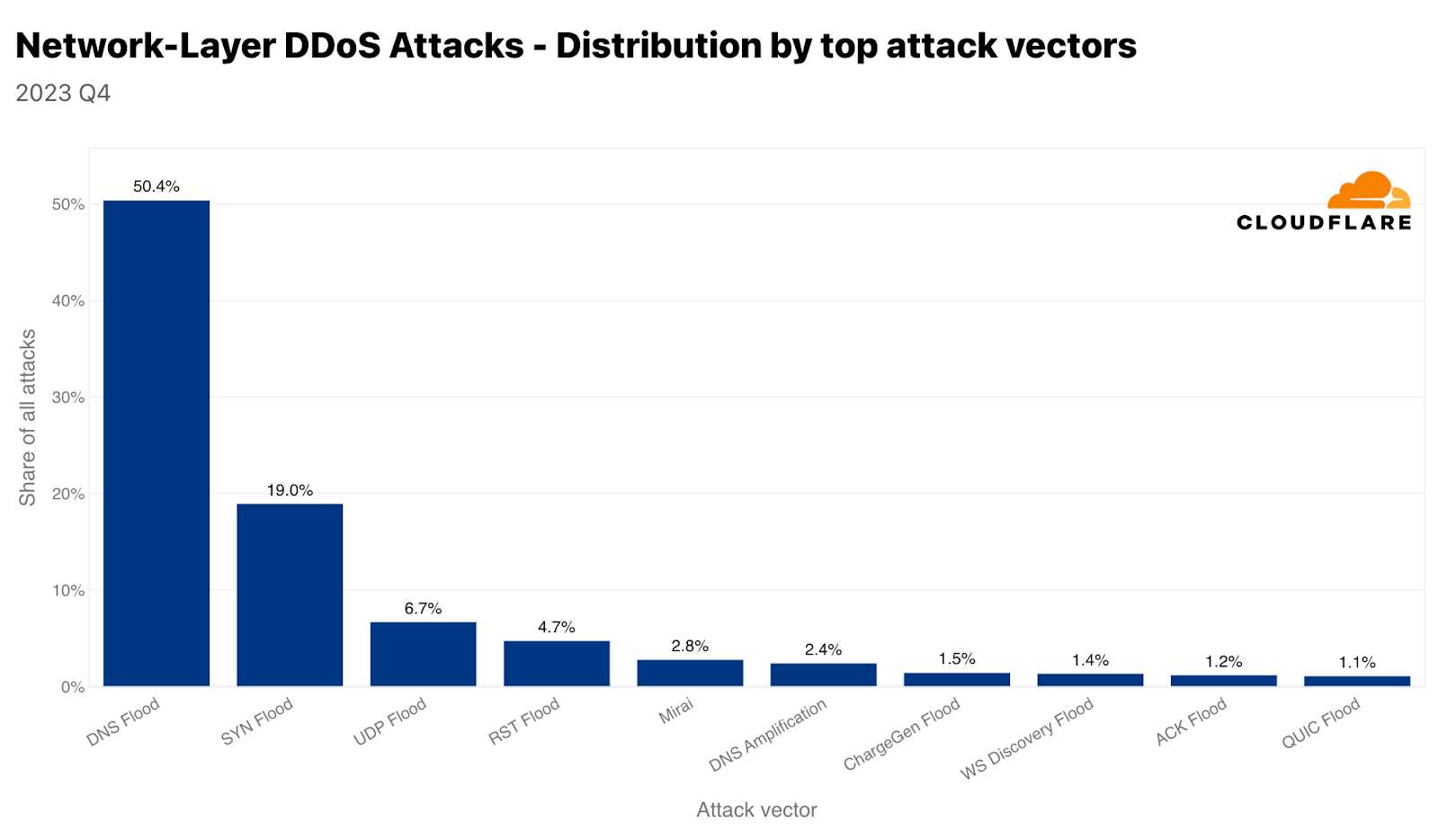
The use of Mirai-variant botnets is still very common. In Q4, almost 3% of all attacks originate from Mirai. Though, of all attack methods, DNS-based attacks remain the attackers’ favorite. Together, DNS Floods and DNS Amplification attacks account for almost 53% of all attacks in Q4. SYN Flood follows in second and UDP floods in third. We’ll cover the two DNS attack types here, and you can visit the hyperlinks to learn more about UDP and SYN floods in our Learning Center.

DNS floods and amplification attacks

DNS floods and DNS amplification attacks both exploit the Domain Name System (DNS), but they operate differently. DNS is like a phone book for the Internet, translating human-friendly domain names like “www.cloudfare.com” into numerical IP addresses that computers use to identify each other on the network.

Simply put, DNS-based DDoS attacks comprise the method computers and servers used to identify one another to cause an outage or disruption, without actually ‘taking down’ a server. For example, a server may be up and running, but the DNS server is down. So clients won’t be able to connect to it and will experience it as an outage.

A DNS flood attack bombards a DNS server with an overwhelming number of DNS queries. This is usually done using a DDoS botnet. The sheer volume of queries can overwhelm the DNS server, making it difficult or impossible for it to respond to legitimate queries. This can result in the aforementioned service disruptions, delays or even an outage for those trying to access the websites or services that rely on the targeted DNS server.

On the other hand, a DNS amplification attack involves sending a small query with a spoofed IP address (the address of the victim) to a DNS server. The trick here is that the DNS response is significantly larger than the request. The server then sends this large response to the victim’s IP address. By exploiting open DNS resolvers, the attacker can amplify the volume of traffic sent to the victim, leading to a much more significant impact. This type of attack not only disrupts the victim but also can congest entire networks.

In both cases, the attacks exploit the critical role of DNS in network operations. Mitigation strategies typically include securing DNS servers against misuse, implementing rate limiting to manage traffic, and filtering DNS traffic to identify and block malicious requests.

Top attack vectors

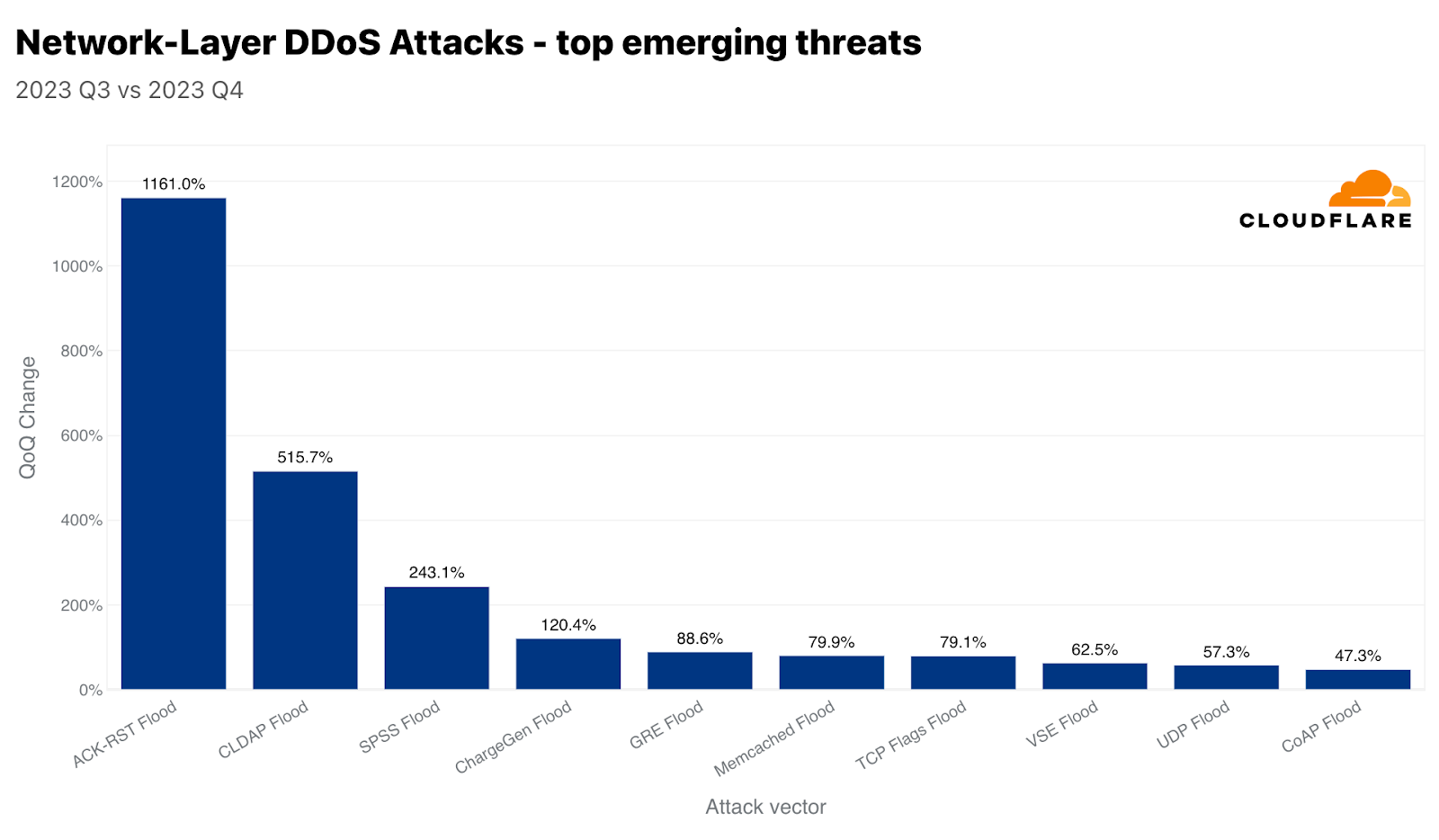
Amongst the emerging threats we track, we recorded a 1,161% increase in ACK-RST Floods as well as a 515% increase in CLDAP floods, and a 243% increase in SPSS floods, in each case as compared to last quarter. Let’s walk through some of these attacks and how they’re meant to cause disruption.

Top emerging attack vectors

ACK-RST floods

An ACK-RST Flood exploits the Transmission Control Protocol (TCP) by sending numerous ACK and RST packets to the victim. This overwhelms the victim’s ability to process and respond to these packets, leading to service disruption. The attack is effective because each ACK or RST packet prompts a response from the victim’s system, consuming its resources. ACK-RST Floods are often difficult to filter since they mimic legitimate traffic, making detection and mitigation challenging.

CLDAP floods

CLDAP (Connectionless Lightweight Directory Access Protocol) is a variant of LDAP (Lightweight Directory Access Protocol). It’s used for querying and modifying directory services running over IP networks. CLDAP is connectionless, using UDP instead of TCP, making it faster but less reliable. Because it uses UDP, there’s no handshake requirement which allows attackers to spoof the IP address thus allowing attackers to exploit it as a reflection vector. In these attacks, small queries are sent with a spoofed source IP address (the victim’s IP), causing servers to send large responses to the victim, overwhelming it. Mitigation involves filtering and monitoring unusual CLDAP traffic.

SPSS floods

Floods abusing the SPSS (Source Port Service Sweep) protocol is a network attack method that involves sending packets from numerous random or spoofed source ports to various destination ports on a targeted system or network. The aim of this attack is two-fold: first, to overwhelm the victim’s processing capabilities, causing service disruptions or network outages, and second, it can be used to scan for open ports and identify vulnerable services. The flood is achieved by sending a large volume of packets, which can saturate the victim’s network resources and exhaust the capacities of its firewalls and intrusion detection systems. To mitigate such attacks, it’s essential to leverage in-line automated detection capabilities.

Cloudflare is here to help – no matter the attack type, size, or duration

Cloudflare’s mission is to help build a better Internet, and we believe that a better Internet is one that is secure, performant, and available to all. No matter the attack type, the attack size, the attack duration or the motivation behind the attack, Cloudflare’s defenses stand strong. Since we pioneered unmetered DDoS Protection in 2017, we’ve made and kept our commitment to make enterprise-grade DDoS protection free for all organizations alike — and of course, without compromising performance. This is made possible by our unique technology and robust network architecture.

It’s important to remember that security is a process, not a single product or flip of a switch. Atop of our automated DDoS protection systems, we offer comprehensive bundled features such as firewall, bot detection, API protection, and caching to bolster your defenses. Our multi-layered approach optimizes your security posture and minimizes potential impact. We’ve also put together a list of recommendations to help you optimize your defenses against DDoS attacks, and you can follow our step-by-step wizards to secure your applications and prevent DDoS attacks. And, if you’d like to benefit from our easy to use, best-in-class protection against DDoS and other attacks on the Internet, you can sign up — for free! — at cloudflare.com. If you’re under attack, register or call the cyber emergency hotline number shown here for a rapid response.

Introducing Cloudflare’s 2024 API security and management report

Post Syndicated from John Cosgrove http://blog.cloudflare.com/author/john-cosgrove/ original https://blog.cloudflare.com/2024-api-security-report


You may know Cloudflare as the company powering nearly 20% of the web. But powering and protecting websites and static content is only a fraction of what we do. In fact, well over half of the dynamic traffic on our network consists not of web pages, but of Application Programming Interface (API) traffic — the plumbing that makes technology work. This blog introduces and is a supplement to the API Security Report for 2024 where we detail exactly how we’re protecting our customers, and what it means for the future of API security. Unlike other industry API reports, our report isn’t based on user surveys — but instead, based on real traffic data.
If there’s only one thing you take away from our report this year, it’s this: many organizations lack accurate API inventories, even when they believe they can correctly identify API traffic. Cloudflare helps organizations discover all of their public-facing APIs using two approaches. First, customers configure our API discovery tool to monitor for identifying tokens present in their known API traffic. We then use a machine learning model that scans not just these known API calls, but all HTTP requests, identifying API traffic that may be going unaccounted for. The difference between these approaches is striking: we found 30.7% more API endpoints through machine learning-based discovery than the self-reported approach, suggesting that nearly a third of APIs are “Shadow APIs” — and may not be properly inventoried and secured.

Read on for extras and highlights from our inaugural API security report. In the full report, you’ll find updated statistics about the threats we see and prevent, along with our predictions for 2024. We predict that a lack of API security focus at organizations will lead to increased complexity and loss of control, and increased access to generative AI will lead to more API risk. We also anticipate an increase in API business logic attacks in 2024. Lastly, all of the above risks will necessitate growing governance around API security.
Hidden attack surfaces

How are web pages and APIs different? APIs are a quick and easy way for applications to retrieve data in the background, or ask that work be done from other applications. For example, anyone can write a weather app without being a meteorologist: a developer can write the structure of the page or mobile application and ask a weather API for the forecast using the user’s location. Critically, most end users don’t know that the data was provided by the weather API and not the app’s owner.
While APIs are the critical plumbing of the Internet, they’re also ripe for abuse. For example, flaws in API authentication and authorization at Optus led to a threat actor offering 10 million user records for sale, and government agencies have warned about these exact API attacks. Developers in an organization will often create Internet-facing APIs, used by their own applications to function more efficiently, but it’s on the security team to protect these new public interfaces. If the process of documenting APIs and bringing them to the attention of the security team isn’t clear, they become Shadow APIs — operating in production but without the organization’s knowledge. This is where the security challenge begins to emerge.

To help customers solve this problem, we shipped API Discovery. When we introduced our latest release, we mentioned how few organizations have accurate API inventories. Security teams sometimes are forced to adopt an “email and ask” approach to build an inventory, and in doing so responses are immediately stale upon the next application release when APIs change. Better is to track API changes by code base changes, keeping up with new releases. However, this still has a drawback of only inventorying actively maintained code. Legacy applications may not see new releases, despite receiving production traffic.

Cloudflare’s approach to API management involves creating a comprehensive, accurate API inventory using a blend of machine learning-based API discovery and network traffic inspection. This is integral to our API Gateway product, where customers can manage their Internet-facing endpoints and monitor API health. The API Gateway also allows customers to identify their API traffic using session identifiers (typically a header or cookie), which aids in specifically identifying API traffic for the discovery process.

As noted earlier, our analysis reveals that even knowledgeable customers often overlook significant portions of their API traffic. By comparing session-based API discovery (using API sessions to pinpoint traffic) with our machine learning-based API discovery (analyzing all incoming traffic), we found that the latter uncovers on average 30.7% more endpoints! Without broad traffic analysis, you may be missing almost a third of your API inventory.

If you aren’t a Cloudflare customer, you can still get started building an API inventory. APIs are typically cataloged in a standardized format called OpenAPI, and many development tools can build OpenAPI formatted schema files. If you have a file with that format, you can start to build an API inventory yourself by collecting these schemas. Here is an example of how you can pull the endpoints out of a schema file, assuming your have an OpenAPI v3 formatted file named my_schema.json:

import json
import csv
from io import StringIO

# Load the OpenAPI schema from a file
with open("my_schema.json", "r") as file:
    schema = json.load(file)

# Prepare CSV output
output = StringIO()
writer = csv.writer(output)

# Write CSV header
writer.writerow(["Server", "Path", "Method"])

# Extract and write data to CSV
servers = schema.get("servers", [])
for server in servers:
    url = server['url']
    for path, methods in schema['paths'].items():
        for method in methods.keys():
            writer.writerow([url, path, method])

# Get and print CSV string
csv_output = output.getvalue().strip()
print(csv_output)

Unless you have been generating OpenAPI schemas and tracking API inventory from the beginning of your application’s development process, you’re probably missing some endpoints across your production application API inventory.

Precise rate limits minimize attack potential

When it comes to stopping abuse, most practitioners’ thoughts first come to rate limiting. Implementing limits on your API is a valuable tool to keep abuse in check and prevent accidental overload of the origin. But how do you know if you’ve chosen the correct rate limiting approach? Approaches can vary, but they generally come down to the error code chosen, and the basis for the limit value itself.

For some APIs, practitioners configure rate limiting errors to respond with an HTTP 403 (forbidden), while others will respond with HTTP 429 (too many requests). Using HTTP 403 sounds innocent enough until you realize that other security tools are also responding with 403 codes. When you’re under attack, it can be hard to decipher which tools are responsible for which errors / blocking.

Alternatively, if you utilize HTTP 429 for your rate limits, attackers will instantly know that they’ve been rate limited and can “surf” right under the limit without being detected. This can be OK if you’re only limiting requests to ensure your back-end stays alive, but it can tip your cards to attackers. In addition, attackers can “scale out” to more API clients to effectively request above the rate limit.

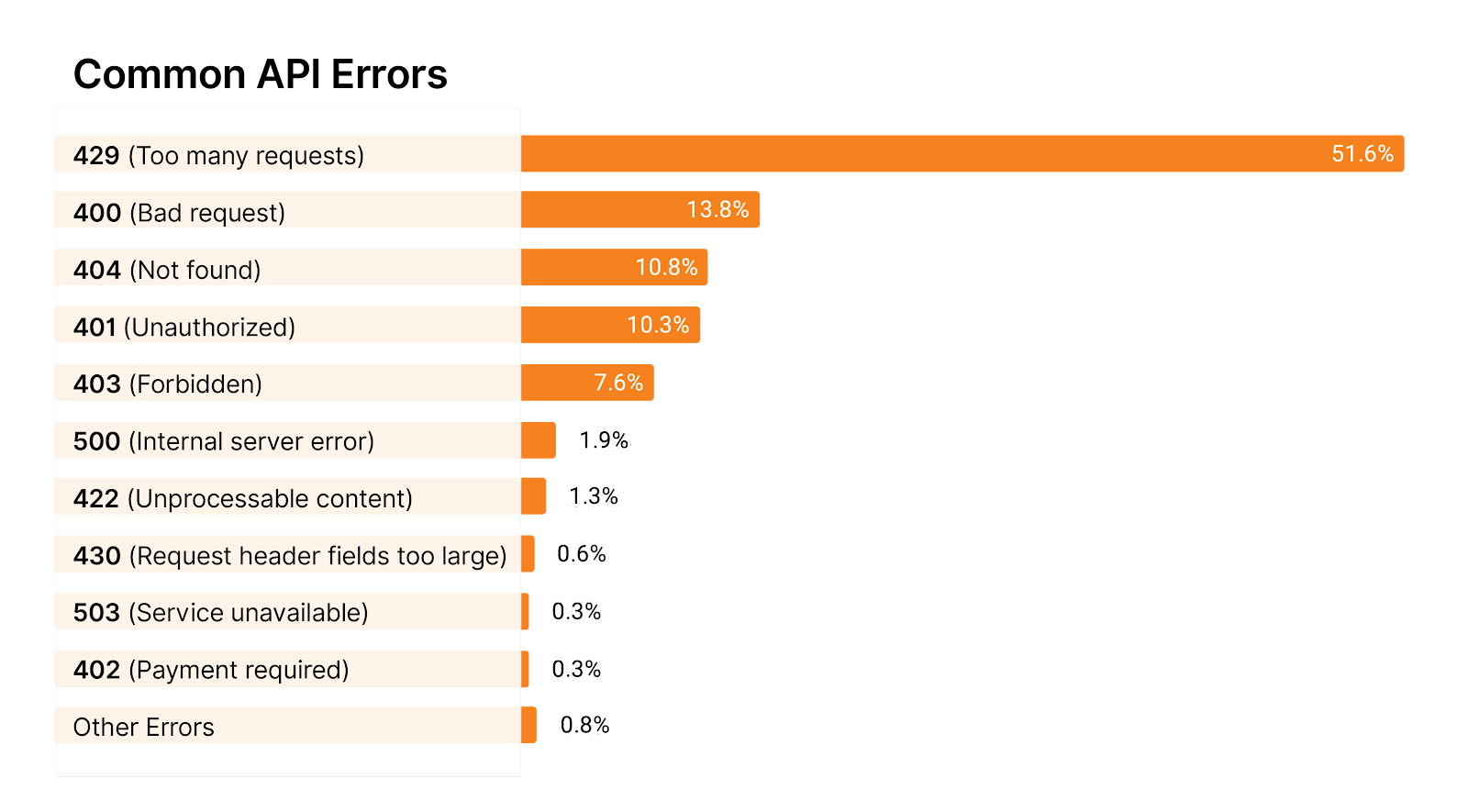
There are pros and cons to both approaches, but we find that by far most APIs respond with HTTP 429 out of all the 4xx and 5xx error messages (almost 52%).

What about the logic of the rate limit rule itself, not just the response code? Implementing request limits on IP addresses can be tempting, but we recommend you base the limit on a session ID as a best practice and only fall back to IP address (or IP + JA3 fingerprint) when session IDs aren’t available. Setting rate limits on user sessions instead of IPs will reliably identify your real users and minimize false positives due to shared IP space. Cloudflare’s Advanced Rate Limiting and API Gateway’s volumetric abuse protection make it easy to enforce these limits by profiling session traffic on each API endpoint and giving one-click solutions to set up the per-endpoint rate limits.

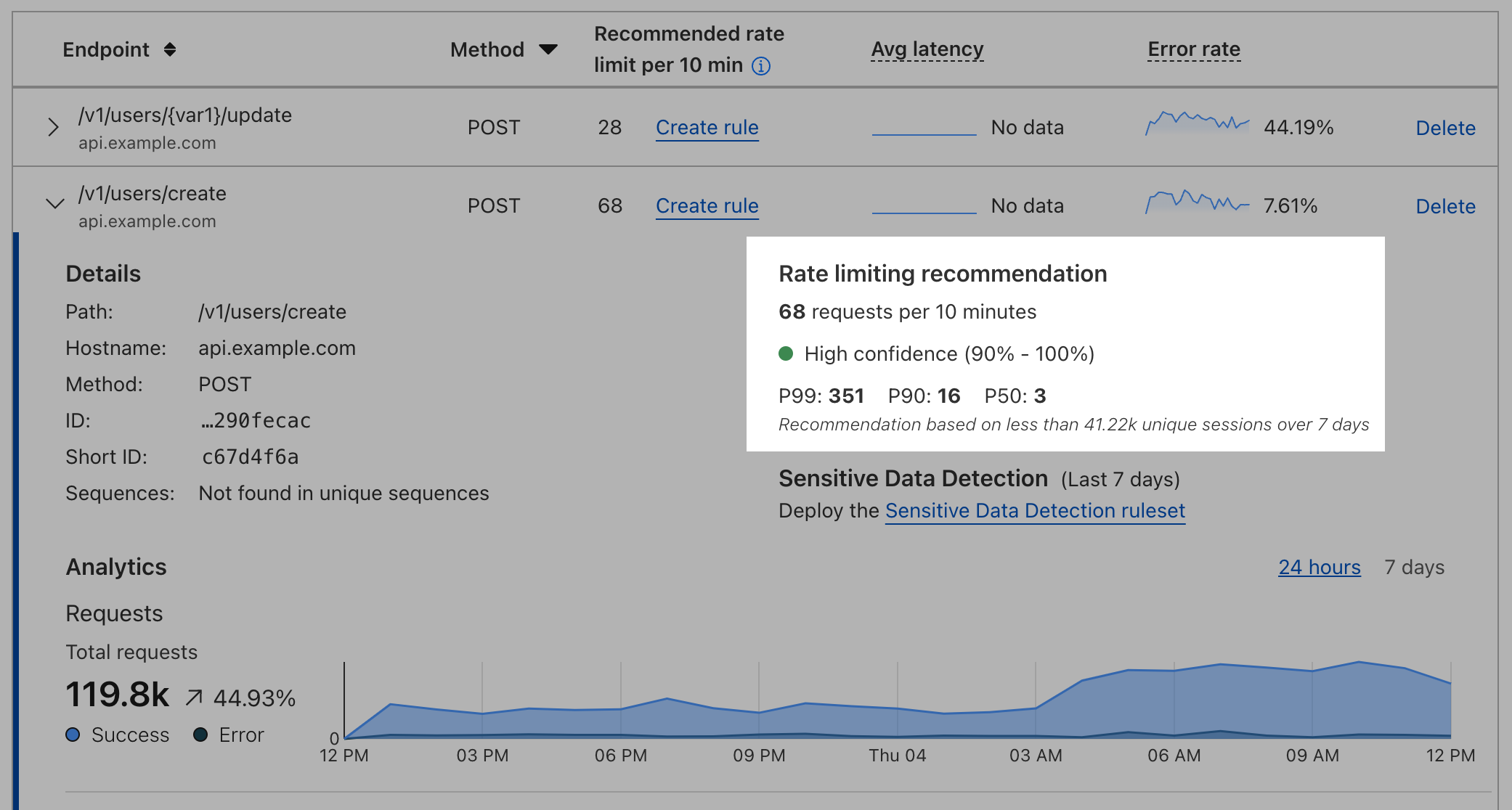
To find values for your rate limits, Cloudflare API Gateway computes session request statistics for you. We suggest a limit by looking at the distribution of requests per session across all sessions to your API as identified by the customer-configured API session identifier. We then compute statistical p-levels — which describe the request rates for different cohorts of traffic — for p50, p90, and p99 on this distribution and use the variance of the distribution to come up with a recommended threshold for every single endpoint in your API inventory. The recommendation might not match the p-levels, which is an important distinction and a reason not to use p-levels alone. Along with the recommendation, API Gateway informs users of our confidence in the recommendation. Generally, the more API sessions we’re able to collect, the more confident we’ll be in the recommendation.

Activating a rate limit is as easy as clicking the ‘create rule’ link, and API Gateway will automatically bring your session identifier over to the advanced rate limit rule creation page, ensuring your rules have pinpoint accuracy to defend against attacks and minimize false positives compared to traditional, overly broad limits.

APIs are also victim to web application attacks

APIs aren’t immune from normal OWASP Top 10 style attacks like SQL injection. The body of API requests can also find its way as a database input just like a web page form input or URL argument. It’s important to ensure that you have a web application firewall (WAF) also protecting your API traffic to defend against these styles of attacks.

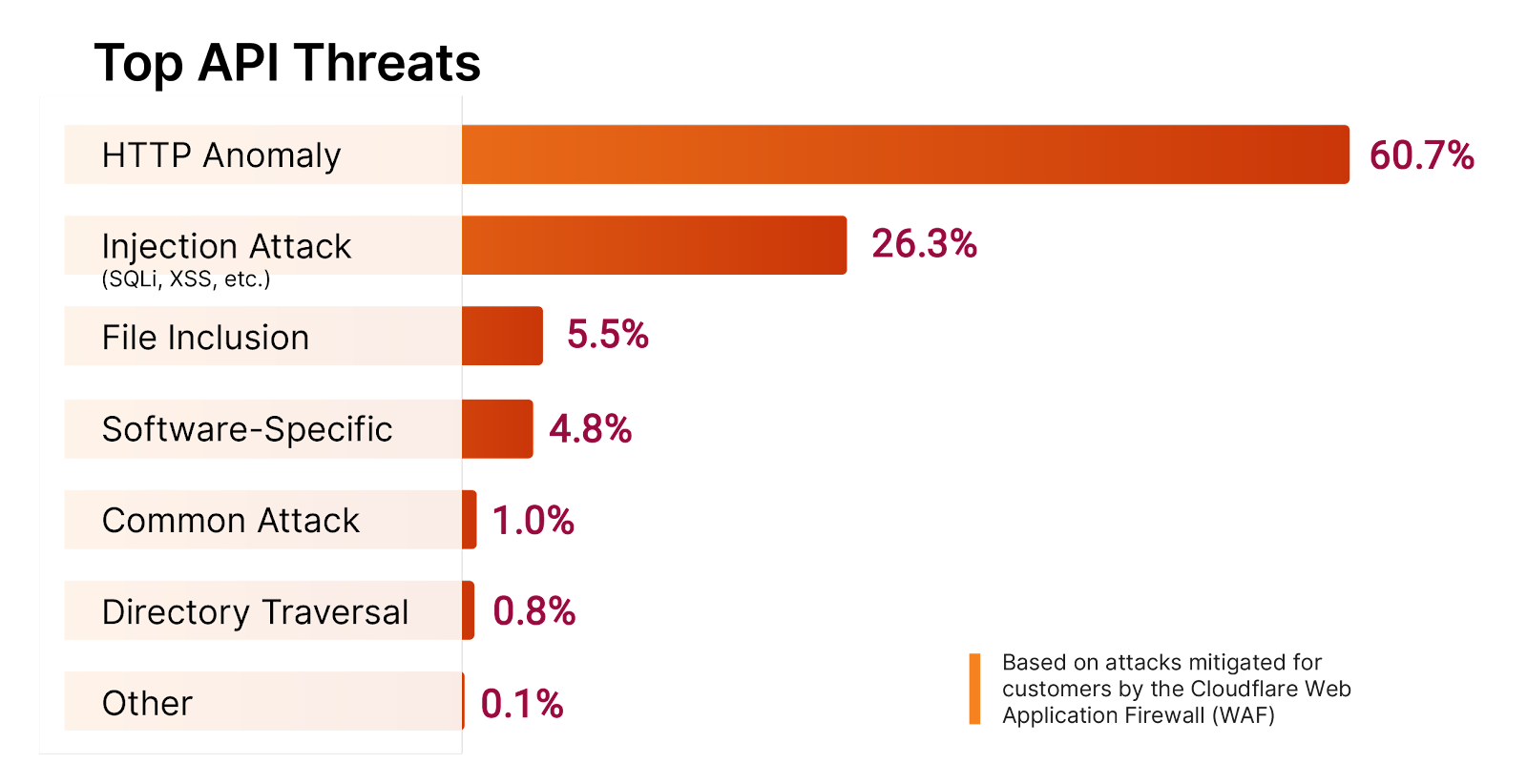
In fact, when we looked at Cloudflare’s WAF managed rules, injection attacks were the second most common threat vector Cloudflare saw carried out on APIs. The most common threat was HTTP Anomaly. Examples of HTTP anomalies include malformed method names, null byte characters in headers, non-standard ports or content length of zero with a POST request. Here are the stats on the other top threats we saw against APIs:

Absent from the chart is broken authentication and authorization. Broken authentication and authorization occur when an API fails to check whether the entity sending requests for information to an API actually has the permission to request that data or not. It can also happen when attacks try to forge credentials and insert less restricted permissions into their existing (valid) credentials that have more restricted permissions. OWASP categorizes these attacks in a few different ways, but the main categories are Broken Object Level Authorization (BOLA) and Broken Function Level Authorization (BFLA) attacks.

The root cause of a successful BOLA / BFLA attack lies in an origin API not checking proper ownership of database records against the identity requesting those records. Tracking these specific attacks can be difficult, as the permission structure may be simply absent, inadequate, or improperly implemented. Can you see the chicken-and-egg problem here? It would be easy to stop these attacks if we knew the proper permission structure, but if we or our customers knew the proper permission structure or could guarantee its enforcement, the attacks would be unsuccessful to begin with. Stay tuned for future API Gateway feature launches where we’ll use our knowledge of API traffic norms to automatically suggest security policies that highlight and stop BOLA / BFLA attacks.

Here are four ways to plug authentication loopholes that may exist for your APIs, even if you don’t have a fine-grained authorization policy available:

  1. First, enforce authentication on each publicly accessible API unless there’s a business approved exception. Look to technologies like mTLS and JSON Web Tokens.
  2. Limit the speed of API requests to your servers to slow down potential attackers.
  3. Block abnormal volumes of sensitive data outflow.
  4. Block attackers from skipping legitimate sequences of API requests.

APIs are surprisingly human driven, not machine driven anymore

If you’ve been around technology since the pre-smartphone days when fewer people were habitually online, it can be tempting to think of APIs as only used for machine-to-machine communication in something like an overnight batch job process. However, the truth couldn’t be more different. As we’ve discussed, many web and mobile applications are powered by APIs, which facilitate everything from authentication to transactions to serving media files. As people use these applications, there is a corresponding increase in API traffic volume.

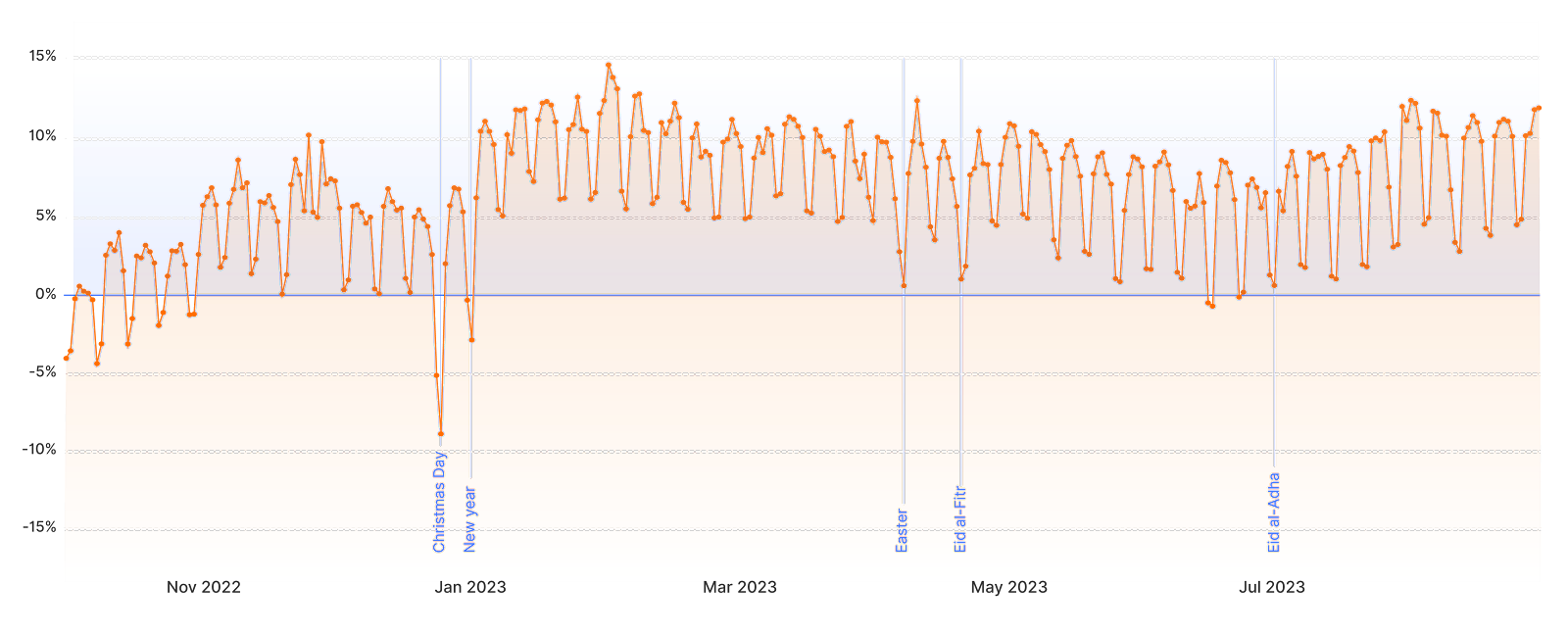
We can illustrate this by looking at the API traffic patterns observed during holidays, when people gather around friends and family and spend more time socializing in person and less time online. We’ve annotated the following Worldwide API traffic graph with common holidays and promotions. Notice how traffic peaks around Black Friday and Cyber Monday around the +10% level when people shop online, but then traffic drops off for the festivities of Christmas and New Years days.

This pattern closely resembles what we observe in regular HTTP traffic. It’s clear that APIs are no longer just the realm of automated processes but are intricately linked with human behaviors and social trends.

Recommendations

There is no silver bullet for holistic API security. For the best effect, Cloudflare recommends four strategies for increasing API security posture:

  1. Combine API application development, visibility, performance, and security with a unified control plane that can keep an up-to-date API inventory.
  2. Use security tools that utilize machine learning technologies to free up human resources and reduce costs.
  3. Adopt a positive security model for your APIs (see below for an explanation on positive and negative security models).
  4. Measure and improve your organization’s API maturity level over time (also see below for an explanation of an API maturity level).

What do we mean by a ‘positive’ or ‘negative’ security model? In a negative model, security tools look for known signs of attack and take action to stop those attacks. In a positive model, security tools look for known good requests and only let those through, blocking all else. APIs are often so structured that positive security models make sense for the highest levels of security. You can also combine security models, such as using a WAF in a negative model sense, and using API Schema Validation in a positive model sense.

Here’s a quick way to gauge your organization’s API security maturity level over time: Novice organizations will get started by assembling their first API inventory, no matter how incomplete. More mature organizations will strive for API inventory accuracy and automatic updates. The most mature organizations will actively enforce security checks in a positive security model on their APIs, enforcing API schema, valid authentication, and checking behavior for signs of abuse.

Predictions

In closing, our top four predictions for 2024 and beyond:

Increased loss of control and complexity: we surveyed practitioners in the API Security and Management field and 73% responded that security requirements interfere with their productivity and innovation. Coupled with increasingly sprawling applications and inaccurate inventories, API risks and complexity will rise.

Easier access to AI leading to more API risks: the rise in generative AI brings potential risks, including AI models’ APIs being vulnerable to attack, but also developers shipping buggy, AI-written code. Forrester predicts that, in 2024, without proper guardrails, “at least three data breaches will be publicly blamed on insecure AI-generated code – either due to security flaws in the generated code itself or vulnerabilities in AI-suggested dependencies.”

Increase in business logic-based fraud attacks: professional fraudsters run their operations just like a business, and they have costs like any other. We anticipate attackers will run fraud bots efficiently against APIs even more than in previous years.

Growing governance: The first version of PCI DSS that directly addresses API security will go into effect in March 2024. Check your industry’s specific requirements with your audit department to be ready for requirements as they come into effect.

If you’re interested in the full report, you can download the 2024 API Security Report here, which includes full detail on our recommendations.

Cloudflare API Gateway is our API security solution, and it is available for all Enterprise customers. If you aren’t subscribed to API Gateway, click here to view your initial API Discovery results and start a trial in the Cloudflare dashboard. To learn how to use API Gateway to secure your traffic, click here to view our development docs and here for our getting started guide.

2023년 4분기 DDoS 위협 보고서

Post Syndicated from Omer Yoachimik http://blog.cloudflare.com/author/omer/ original https://blog.cloudflare.com/ddos-threat-report-2023-q4-ko-kr


Cloudflare DDoS 위협 보고서 제16호에 오신 것을 환영합니다. 이번 호에서는 2023년 4분기이자 마지막 분기의 DDoS 동향과 주요 결과를 다루며, 연중 주요 동향을 검토합니다.

DDoS 공격이란 무엇일까요?

DDoS 공격 또는 분산 서비스 거부 공격은 웹 사이트와 온라인 서비스가 처리할 수 있는 트래픽을 초과하여 사용자를 방해하고 서비스를 사용할 수 없게 만드는 것을 목표로 하는 사이버 공격의 한 유형입니다. 이는 교통 체증으로 길이 막혀 운전자가 목적지에 도착하지 못하는 것과 유사합니다.

이 보고서에서 다룰 DDoS 공격에는 크게 세 가지 유형이 있습니다. 첫 번째는 HTTP 서버가 처리할 수 있는 것보다 더 많은 요청으로 서버를 압도하여 서비스 거부 이벤트를 발생시키는 것을 목표로 하는 HTTP 요청집중형 DDoS 공격입니다. 두 번째는 라우터, 방화벽, 서버 등의 인라인 장비에서 처리할 수 있는 패킷보다 많은 패킷을 전송하여 서버를 압도하는 것을 목표로 하는IP 패킷집중형 DDoS 공격입니다. 세 번째는 비트 집중형 공격으로, 인터넷 링크를 포화 상태로 만들어 막히게 함으로써 앞서 설명한 ‘정체’를 유발하는 것을 목표로 합니다. 이 보고서에서는 세 가지 유형의 공격에 대해 다양한 기법과 인사이트를 중점적으로 다룹니다.

보고서의 이전 버전은 여기에서 확인할 수 있으며, 대화형 허브인Cloudflare Radar에서도 확인할 수 있습니다. Cloudflare Radar는 전 세계 인터넷 트래픽, 공격, 기술 동향, 인사이트를 보여주며, 드릴 다운 및 필터링 기능을 통해 특정 국가, 산업, 서비스 공급자에 대한 인사이트를 확대할 수 있습니다. Cloudflare Radar는 학자, 데이터 전문가, 기타 웹 애호가가 전 세계 인터넷 사용량을 조사할 수 있는 무료 API도 제공합니다.

Cloudflare에서 이 보고서를 작성한 방법을 알아보려면 방법론을 참조하세요.

핵심 결과

  1. Cloudflare에서 관찰한 바에 따르면, 4분기에는 네트워크 계층 DDoS 공격이 전년 동기 대비 117% 증가했으며, 블랙 프라이데이와 연말연시를 전후해 소매, 배송, 홍보 웹 사이트를 겨냥한 DDoS 활동이 전반적으로 증가했습니다.
  2. 4분기에 대만을 겨냥한 DDoS 공격 트래픽은 총선이 다가오고 중국과의 긴장이 고조된 가운데 전년 대비     3,370% 증가했습니다. 이스라엘과 하마스 간의 군사적 갈등이 지속됨에 따라 이스라엘 웹 사이트를 겨냥한     DDoS 공격 트래픽의 비율은 전 분기 대비 27% 증가했으며, 팔레스타인 웹 사이트를 의 군사적 갈등이 지속됨에 따라 이스라엘 웹 사이트를 겨냥한 DDoS 공격 트래픽의 비율은 전 분기 대비 1,126% 증가했습니다.
  3. 4분기에는 제28차 유엔 기후변화회의(COP 28)가 열린 시기와 맞물려 환경 서비스 웹 사이트를 겨냥한 DDoS 공격 트래픽이 전년 대비 무려 61,839% 급증했습니다.

이러한 주요 조사 결과에 대한 심층 분석과 현재의 사이버 보안 과제에 대한 이해를 새롭게 정의할 수 있는 추가 인사이트를 확인하려면 계속 읽어보세요!

DDoS 공격에 대한 그림

대규모 볼류메트릭 HTTP DDoS 공격

2023년은 미지의 영역이 펼쳐지는 해였습니다. DDoS 공격은 규모와 정교함에 있어서 새로운 차원에 도달했습니다. Cloudflare를 포함한 광범위한 인터넷 커뮤니티에서는 전례 없는 속도로 수천 건에 이르며 지속적이고 의도적으로 설계된 대규모 볼류메트릭 DDoS 공격 캠페인에 직면했습니다.

이러한 공격은 매우 복잡하고 HTTP/2 취약점을 악용했습니다. Cloudflare에서는 취약점의 영향을 완화하기 위해 특수하게 마련한 기술을 개발했으며, 업계의 다른 기업들과 협력하여 취약점을 공개하는 일을 담당했습니다.

이러한 DDoS 캠페인의 일환으로 3분기에 Cloudflare의 시스템에서는 초당 2억 100만 건에 달하는 사상 최대 규모의 요청으로 이루어진 공격을 방어했습니다. 이는 지난 2022년의 기록인 초당 2,600만 요청보다 거의 8배나 많은 수치입니다.

Cloudflare에서 관찰한 연도별 최대 HTTP DDoS 공격 규모

네트워크 계층 DDoS 공격의 증가

대규모 캠페인이 진정된 후 우리는 HTTP DDoS 공격이 예상치 않게 감소하는 것을 확인했습니다. 2023년 전체적으로는 26조 건이 넘는 요청으로 이루어진 520만 건 이상의 HTTP DDoS 공격을 자동화된 방어 기능으로 막아냈습니다. 이는 시간당 평균 594건의 HTTP DDoS 공격과 30억 건의 요청을 완화한 수치입니다.

이러한 천문학적 수치에도 불구하고 HTTP DDoS 공격 요청량은 실제로 2022년에 비해 20% 감소했습니다. 이러한 감소세는 연간뿐만 아니라 2023년 4분기에도 관찰되었는데, HTTP DDoS 공격 요청 건수는 전년 동기 대비 7%, 전 분기 대비 18% 감소했습니다.

네트워크 계층에서는 완전히 다른 추세를 확인했습니다. Cloudflare에서는 자동화된 방어 기능으로2023년에 870만 건의 네트워크 계층 DDoS 공격을 방어했습니다. 이는 2022년에 비해 85% 증가한 수치입니다.

2023년 4분기에 Cloudflare에서는 자동화된 방어 기능으로 80페타바이트가 넘는 네트워크 계층 공격을 완화했습니다. 평균적으로 우리 시스템에서는 매시간 996건의 네트워크 계층 DDoS 공격과 27테라바이트를 자동으로 방어했습니다. 2023년 4분기의 네트워크 계층 DDoS 공격 건수는 전년 동기 대비 175%, 전 분기 대비25% 증가했습니다.

분기별 HTTP 및 네트워크 계층 DDoS 공격

COP 28 기간과 그 전후의DDoS 공격 증가

2023년 마지막 분기에는 사이버 위협의 환경이 크게 변화했습니다. 초기에는 암호화폐 분야가 HTTP DDoS 공격 요청량 측면에서 선두를 달리고 있었지만, 새로운 공격 대상이 주요 피해자로 등장했습니다. 환경 서비스 업계를 겨냥한 HTTP DDoS 공격이 전례 없이 급증했으며, 이 공격이 전체 HTTP 트래픽의 절반을 차지했습니다. 이는 전년 대비 무려 618배 증가한 수치로, 사이버 위협 환경의 불안한 추세를 보여줍니다.

이처럼 사이버 공격이 급증한 시기는 2023년 11월 30일부터 12월12일까지 열린 유엔기후변화협약 당사국총회(COP 28)와 맞물렸습니다. 이 회의는 중추적인 이벤트로, 많은 사람이 화석 연료 시대의 ‘종말의 시작’이라고 생각했던 것을 알리는 신호탄이었습니다. COP 28을 앞둔 기간 동안 환경 서비스 웹 사이트를 겨냥한 HTTP 공격이 눈에 띄게 급증한 것으로 관찰되었습니다. 이러한 패턴은 이 이벤트에만 국한된 것이 아니었습니다.

특히 COP 26과 COP 27, 그리고 다른 유엔 환경 관련 결의안이나 발표의 과거 데이터를 살펴보면 비슷한 패턴이 나타납니다. 이러한 이벤트가 있을 때마다 환경 서비스 웹 사이트를 겨냥한 사이버 공격도 함께 증가했습니다.

2023년 2월과 3월, 유엔의 기후 정의 결의안과 유엔환경계획의 담수 챌린지시작과 같은 중요한 환경 이벤트 때문에 환경 웹 사이트의 인지도가 높아졌고, 이는 이러한 사이트에 대한 공격의 증가와 관련이 있을 수 있습니다.

이러한 반복적인 패턴을 보면 환경 문제와 사이버 보안이 점점 더 밀접하게 연관되어 있으며, 사이버 보안은 디지털 시대에 점점 더 공격자의 초점이 되고 있음을 실감할 수 있습니다.

DDoS 공격과 철검

DDoS 공격을 촉발하는 것은 유엔 결의안만이 아닙니다. 사이버 공격, 특히 DDoS 공격은 오랫동안 전쟁과 혼란의 도구로 사용되어 왔습니다. 우크라이나와 러시아 사이의 전쟁에서 DDoS 공격 활동이 증가되는 것이 관찰되었고, 이제는 이스라엘과 하마스 사이의 전쟁에서도 DDoS 공격이 증가하고 있습니다. Cloudflare에서는 이스라엘-하마스 전쟁에서의 사이버 공격 보고서에서 사이버 활동을 처음 보고했으며, 4분기 내내 지속해서 사이버 활동을 모니터링했습니다.

“철검” 작전은 하마스가 주도한 10월 7일 공격 이후 이스라엘이 하마스를 상대로 시작한 군사 공격입니다. 이 무력 충돌이 계속되는 Cloudflare에서는 동안 양측을 겨냥한DDoS 공격을 계속 목격하고 있습니다.

이스라엘 및 팔레스타인 웹 사이트를 겨냥한 DDoS 공격, 산업별

지역별 트래픽을 기준으로 볼 때, 팔레스타인 지역은 4분기에 HTTP DDoS 공격이 두 번째로 많이 발생한 지역이었습니다. 팔레스타인 웹 사이트를 향한 전체 HTTP 요청의 10% 이상이 DDoS 공격이었으며, 총 13억 건의DDoS 요청이 발생하여 전 분기 대비 1,126% 증가했습니다. 이러한 DDoS 공격의 90%는 팔레스타인 은행 웹 사이트를 겨냥했습니다. 또 다른 8%는 정보 기술 및 인터넷 플랫폼을 겨냥했습니다.

가장 많이 공격받은 팔레스타인 산업

유사하게, Cloudflare의 시스템에서는 이스라엘 웹 사이트를 겨냥한 22억 건 이상의 HTTP DDoS 요청을 자동으로 방어했습니다. 22억 건은 전 분기 및 전년 동기 대비 감소한 수치이지만, 이스라엘로 향하는 전체 트래픽 중에서 차지하는 비중은 여전히 높았습니다. 이 정규화 수치는 전 분기 대비 27% 증가했지만, 전년 동기 대비로는 92% 감소한 수치입니다. 공격 트래픽의 양이 많음에도 불구하고 이스라엘은 자국 트래픽 대비 77번째로 공격을 많이 받은 지역이었습니다. 또한 총 공격 건수 기준으로는 33번째로 공격을 많이 받은 반면 팔레스타인 영토는 42번째로 공격을 많이 받았습니다.

공격받은 이스라엘 웹 사이트 중 신문 및 미디어가 주요 표적이었으며, 이스라엘을 향하는 HTTP DDoS 공격의 약 40%를 신문 및 미디어 부문에서 받았습니다. 두 번째로 공격을 많이 받은 산업은 컴퓨터 소프트웨어 산업이었습니다. 은행, 금융 기관 및 보험(BFSI) 산업이 3위를 차지했습니다.

가장 많이 공격받은 이스라엘 산업

네트워크 계층에서도 동일한 추세를 확인할 수 있습니다. 팔레스타인 네트워크는 470테라바이트에 이르는 공격 트래픽의 표적이 되었으며, 이는 팔레스타인 네트워크에 대한 전체 트래픽의 68% 이상을 차지했습니다. 이는 중국에만 뒤지는 수치로, 팔레스타인 지역으로 향하는 모든 트래픽을 기준으로, 팔레스타인이 네트워크 계층 DDoS 공격이 세계에서 두 번째로 많이 발생한 지역이 되었습니다. 절대적인 트래픽 규모로는 3위를 차지했습니다. 이 470테라바이트는 Cloudflare에서 완화한 전체 DDoS 트래픽의 약 1%를 차지합니다.

하지만 이스라엘 네트워크에서 받은 공격 트래픽은 2.4테라바이트 밖에 되지 않아, 네트워크 계층 DDoS 공격을 가장 많이 받은 국가(정상화 기준) 순위에서 8위에 올랐습니다. 이 2.4테라바이트는 이스라엘 네트워크로 향하는 전체 트래픽의 거의 10%를 차지했습니다.

가장 많이 공격받은 국가

우리는 이스라엘에 위치한 우리 데이터 센터에서 수집된 전체 바이트의 3%가 네트워크 계층 DDoS 공격이라는 사실을 확인했습니다. 팔레스타인에 위치한 우리 데이터 센터에서는 이 수치가 전체 바이트의 약 17%로 훨씬 더 높았습니다.

애플리케이션 계층에서는 팔레스타인 IP 주소에서 시작된 HTTP 요청의 4%가 DDoS 공격이며, 이스라엘 IP 주소에서 시작된 HTTP 요청의 약 2%도 DDoS 공격인 것으로 나타났습니다.

DDoS 공격의 주요 출처

2022년 3분기에는 중국이 HTTP DDoS 공격 트래픽의 최대 출처였습니다. 그러나 2022년 4분기부터는 미국이 HTTP DDoS 공격의 최대 출처가 되었으며, 이후 5분기 연속으로 이 바람직하지 않은 위치를 유지하고 있습니다. 마찬가지로 미국의 데이터 센터는 전체 공격 바이트의 38%가 넘는 네트워크 레이어 DDoS 공격 트래픽을 가장 많이 수집하는 곳입니다.

중국과 미국에서 기원한 분기별 HTTP DDoS 공격 건수

중국과 미국은 함께 전 세계 HTTP DDoS 공격 트래픽의 4분의 1 이상을 차지합니다. 브라질, 독일, 인도네시아, 아르헨티나가 그 다음 25%를 차지합니다.

HTTP DDoS 공격의 상위 출처

이러한 큰 수치는 일반적으로 큰 시장에 들어맞습니다. 그러한 이유로 각 국가의 아웃바운드 트래픽을 비교하여 각 국가에서 기원하는 공격 트래픽을 정규화하기도 합니다. 이 작업을 수행하면 작은 섬나라나 시장 규모가 작은 국가에서 불균형적인 공격 트래픽이 기원하는 경우가 종종 있습니다. 4분기에는, 세인트 헬레나의 아웃바운드 트래픽 중 40%가 HTTP DDoS 공격으로 1위를 차지했습니다. 이 ‘외딴 열대 화산 섬‘에 이어 리비아가 2위, 스와질란드(에스와티니라고도 함)가 3위를 차지했습니다. 아르헨티나와 이집트가 그 뒤를 이어 각각 4위와 5위를 차지했습니다.

국가별 트래픽과 관련한 HTTP DDoS 공격의 상위 출처

네트워크 계층에서는 짐바브웨가 1위에 올랐습니다. 짐바브웨에 위치한 Cloudflare 데이터 센터에서 수집한 전체 트래픽의 거의 80%가 악의적 트래픽이었습니다. 2위는 파라과이, 3위는 마다가스카르가 차지했습니다.

국가별 트래픽과 관련한 네트워크 계층 DDoS 공격의 상위 출처

가장 많이 공격받는 산업

공격 트래픽 규모 기준으로 4분기에 가장 많이 공격을 받은 산업은 암호화폐 산업이었습니다. 3,300억 건 이상의 HTTP 요청이 이 산업을 겨냥했습니다. 이 수치는 해당 분기 전체 HTTP DDoS 트래픽의 4% 이상을 차지합니다. 두 번째로 공격을 많이 받은 산업은 게임 및 도박이었습니다. 이들 산업은 탐나는 표적으로 알려져 있으며 많은 트래픽과 공격을 유발합니다.

HTTP DDoS 공격의 표적이 된 상위 산업

네트워크 계층에서는 정보 기술 및 인터넷 산업이 가장 많은 공격을 받았으며, 전체 네트워크 계층 DDoS 공격 트래픽의 45% 이상이 이 산업을 겨냥했습니다. 은행, 금융 서비스, 보험(BFSI), 게임 및 도박, 통신 산업이 그 뒤를 이었습니다.

네트워크 계층 DDoS 공격의 표적이 된 상위 산업

관점을 바꾸기 위해 여기에서도 공격 트래픽을 특정 산업의 전체 트래픽으로 정규화했습니다. 그럴 경우 그림이 달라집니다.

HTTP DDoS 공격으로 가장 많이 공격받은 산업, 지역별 현황

이 보고서의 서두에서 이미 환경 서비스 산업이 자체 트래픽 대비 가장 많은 공격을 받았다고 언급한 바 있습니다. 2위는 포장 및 화물 배송 산업으로, 블랙 프라이데이 및 겨울 휴가철 온라인 쇼핑과 시기상으로 상관관계가 있다는 점에서 흥미로웠습니다. 판매된 선물과 상품을 어떻게든 목적지에 보내야 하는데, 공격자가 이를 방해하려고 시도한 것으로 보입니다. 마찬가지로 소매업체에 대한 DDoS 공격도 전년 대비 23% 증가했습니다.

각 산업별 트래픽과 관련하여 HTTP DDoS 공격의 표적이 된 상위 산업

네트워크 계층에서 가장 많이 표적이 된 산업은 홍보 및 커뮤니케이션으로, 전체 트래픽의 36%가 악의적 트래픽이었습니다. 이 역시 시기를 고려할 때 매우 흥미롭습니다. 홍보 및 커뮤니케이션 기업은 일반적으로 대중의 인식 및 커뮤니케이션 관리와 관련이 있습니다. 이러한 기업의 운영이 중단되면 평판에 즉각적이고 광범위한 영향이 미칠 수 있으며, 이는 4분기 연말연시 시즌에 더욱 중요해집니다. 이 분기에는 휴일, 연말 결산, 새해 준비 등으로 인해 홍보 및 커뮤니케이션 활동이 증가하는 경우가 많습니다. 따라서 일부에서는 이 시기를 누군가가 업무를 방해하기를 원할 수 있는 중요한 운영 기간으로 여기기도 합니다.

각 산업 트래픽과 관련하여 네트워크 계층 DDoS 공격의 표적이 된 상위 산업

가장 많이 공격받은 국가 및 지역

싱가포르는 4분기에 HTTP DDoS 공격의 주요 표적이었습니다. 전 세계 DDoS 트래픽의 4%인3,170억 건이 넘는 HTTP 요청이 싱가포르 웹 사이트를 겨냥했습니다. 뒤이어 미국이 2위, 캐나다가 3위를 차지했습니다. 대만은 다가오는 총선과 중국과의 긴장 관계로 인해 네 번째로 공격을 많이 받은 지역으로  기록되었습니다. 4분기에 대만을 향한 공격 트래픽은 전년 대비 847%, 전 분기 대비2,858% 증가했습니다. 이러한 증가는 절대값에만 국한되지 않습니다. 정규화했을 때, 대만을 향한 전체 트래픽 대비 대만을 겨냥한HTTP DDoS 공격 트래픽의 비율도 전 분기 대비 624%, 전년 동기 대비 3,370%로 크게 증가했습니다.

HTTP DDoS 공격 상위 대상 국가

중국은 HTTP DDoS 공격을 가장 많이 받은 국가 중 9번째이지만, 네트워크 계층 공격을 가장 많이 받은 국가로는 1위에 올랐습니다. Cloudflare에서 전 세계에 걸쳐 완화한 모든 네트워크 계층 DDoS 트래픽의 45%가 중국을 향한 트래픽이었습니다. 나머지 국가들은 거의 무시할 수 있을 정도로 뒤져 있었습니다.

네트워크 계층 DDoS 공격을 받은 상위 대상 국가

데이터를 정규화하면 이라크, 팔레스타인 지역, 모로코가 총 인바운드 트래픽 대비 가장 많은 공격을 받은 지역으로 나타났습니다. 흥미롭게도 싱가포르가 4위에 올랐습니다. 따라서 싱가포르는 가장 많은 양의 HTTP DDoS 공격 트래픽에 직면해 있을 뿐만 아니라 해당 트래픽은 싱가포르를 향한 전체 트래픽의 상당 부분을 차지합니다. 이와는 대조적으로, 미국은(위의 애플리케이션 계층 그래프에 따르면) 양적으로는 두 번째로 많은 공격을 받았지만, 미국으로 향하는 전체 트래픽을 기준으로 보면 50위에 그쳤습니다.

국가별 트래픽과 관련하여 HTTP DDoS 공격을 많이 받은 상위 국가

싱가포르와 유사하지만, 훨씬 더 극적일 수 있는 중국은 네트워크 계층 DDoS 공격 트래픽 및 중국으로 향하는 모든 트래픽에 있어서 가장 많이 공격받는 국가입니다. 중국으로 향하는 전체 트래픽의 거의 86%가 네트워크 계층 DDoS 공격으로, Cloudflare에 의해 완화되었습니다. 팔레스타인 지역, 브라질, 노르웨이, 그리고 다시 싱가포르가 공격 트래픽 비율이 높은 국가로 그 뒤를 이었습니다.

국가별 트래픽과 관련하여 네트워크 계층 DDoS 공격을 많이 받은 상위 국가

공격 벡터 및 속성

대부분의 DDoS 공격은 Cloudflare의 기준으로 볼 때 짧고 규모가 작습니다. 그러나 보호되지 않은 웹 사이트와 네트워크는 적절한 인라인 자동 보호 기능이 없으면 짧은 소규모의 공격으로도 중단될 수 있으며, 따라서 조직에서 강력한 보안 태세를 선제적으로 도입해야 할 필요성이 강조됩니다.

2023년 4분기에는 공격의 91%가 10분 이내에 종료되었고, 97%는 정점에서도 초당 500메가비트(mbps) 미만이었으며, 88%는 초당 5만 패킷(pps)을 넘은 적이 없었습니다.

네트워크 계층 DDoS 공격 100건 중 2건은 1시간 이상 지속되었고, 초당 1기가비트(gbps)를 초과했습니다. 100건 중 1건의 공격이 초당 100만 패킷을 초과했습니다. 또한 초당 1억 패킷을 초과하는 네트워크 계층 DDoS 공격의 양은 전 분기 대비 15% 증가했습니다.

알아두어야 할 DDoS 공격 통계

이러한 대규모 공격 중 하나는 초당 1억 6천만 개의 패킷을 전송한 Mirai 봇넷 공격이었습니다. 초당 패킷 전송량은 역대 최대가 아니었습니다. 역대 최대 규모는 초당 7억 5,400만 패킷이었습니다. 이 공격은 2020년에 발생했으며, 이보다 더 큰 규모의 공격은 아직 관찰된 적이 없습니다.

하지만 최근에 발생한 이 공격은 초당 비트 전송률이 특이했습니다. 이 공격은 4분기에 발생한 네트워크 계층 공격 중 가장 큰 규모의 DDoS 공격이었습니다. 이 공격은 초당 1.9 테라비트로 최고치를  기록했으며 Mirai 봇넷으로부터 시작되었습니다. 이 공격은 여러 가지 공격 방법이 결합된 멀티 벡터 공격이었습니다. 이러한 방법 중 일부에는 UDP 조각 폭주, UDP/Echo 폭주, SYN 폭주, ACK 폭주, TCP 기형 폭주가 포함되었습니다.

이 공격은 알려진 유럽 클라우드 공급자를 겨냥했으며, 스푸핑된 것으로 추정되는 18,000여 개의 고유 IP 주소에서 시작되었습니다. 이 공격은 Cloudflare의 방어 기능에서 자동으로 감지되어 완화되었습니다.

이는 최대 규모의 공격도 매우 빠르게 종료된다는 것을 보여줍니다. Cloudflare에서 확인한 이전의 대규모 공격들은 몇 초 만에 종료되었으므로 인라인 자동 방어 시스템의 필요성이 강조되었습니다. 아직은 드물지만, 테라비트 규모 범위의 공격이 점점 더 두드러지고 있습니다.

초당 1.9 테라비트 Mirai DDoS 공격

Mirai 변종 봇넷의 사용은 여전히 아주 흔합니다. 4분기에는 전체 공격의 약 3%가 Mirai에서 비롯되었습니다. 하지만 모든 공격 방법 중에서 DNS 기반 공격은 여전히 공격자들이 가장 선호하는 방법입니다. DNS 폭주와 DNS 증폭 공격을 합할 경우 4분기 전체 공격의 약 53%를 차지합니다. SYN 폭주가 뒤를 이어  2위, UDP 폭주가 3위를 차지했습니다. 여기에서는 두 가지 DNS 공격 유형에 대해 다루며, 학습 센터에서 하이퍼링크로 이동하여 UDP 폭주와 SYN 폭주에 대해 자세히 알아볼 수 있습니다.

DNS 폭주 및 증폭 공격

DNS 폭주와 DNS 증폭 공격은 모두 도메인 네임 시스템(DNS)을 악용하지만, 작동 방식은 다릅니다. DNS는 인터넷의 전화번호부와 같습니다. “www.cloudfare.com”과 같이 사람에게 친숙한 도메인 이름을 숫자로 된 IP 주소로 변환하며, 이를 컴퓨터가 네트워크에서 상호 식별하는 데 사용하는 합니다.

간단히 말해, DNS 기반 DDoS 공격은 실제로 서버를 ‘다운’시키지 않고도 컴퓨터와 서버가 서로를 식별하여 서비스 중단 또는 장애를 유발하는 방법입니다. 예를 들어 서버는 가동 중이지만, DNS 서버가 다운되었을 수 있습니다. 따라서 클라이언트는 DNS 서버에 연결할 수 없으며 중단을 경험하게 됩니다.

DNS 폭주 공격은 압도적인 수의 DNS 쿼리로 DNS 서버를 폭주시키는 공격입니다. 이는 일반적으로 DDoS 봇넷을 사용하여 수행됩니다. 엄청난 양의 쿼리로 DNS 서버가 압도되어 정상적인 쿼리에 응답하기 어렵거나 불가능하게 될 수 있습니다. 이로 인해 앞서 언급한 서비스 중단, 지연, 심지어는 웹 사이트나 공격 대상 DNS 서버에 의존하는 서비스에 액세스하려는 사용자의 서비스 중단이 발생할 수 있습니다.

반면, DNS 증폭 공격은 스푸핑된 IP 주소(피해자의 주소)가 포함된 작은 쿼리를 DNS 서버로 전송하는 것입니다. 여기서 비결은 DNS 응답이 요청보다 훨씬 크다는 것입니다. 그러면 서버는 이 큰 응답을 피해자의 IP 주소로 보냅니다. 공격자는 개방형 DNS 확인자를 악용하여 피해자에게 전송되는 트래픽의 양을 증폭시켜 훨씬 더 큰 영향을 미칠 수 있습니다. 이러한 유형의 공격은 피해자를 방해할 뿐만 아니라 전체 네트워크를 정체시킬 수 있습니다.

두 경우 모두 공격자는 네트워크 운영에서DNS의 중요한 역할을 악용합니다. 완화 전략에는 일반적으로 DNS 서버 오용 방지, 트래픽 관리를 위한 레이트 리미팅 구현, 악의적 요청 식별 및 차단을 위한 DNS 트래픽 필터링이 포함됩니다.

상위 공격 벡터

Cloudflare에서 추적하는, 새롭게 떠오르는 위협 중 지난 분기에 비해ACK-RST 폭주가 1,161%, CLDAP 폭주가 515%, SPSS 폭주가 243% 각각 증가했습니다. 이들 공격의 종류와 이들 공격이 어떻게 업무 중단을 유발하는지를 살펴보겠습니다.

새롭게 떠오르는 상위 공격 벡터

ACK-RST 폭주

ACK-RST 폭주는 피해자에게 많은 ACK 및 RST 패킷을 전송하여 전송 제어 프로토콜(TCP)을 악용합니다. 이로 인해 피해자가 이 패킷을 처리하고 응답하는 능력이 과부하되어 서비스 중단으로 이어집니다. 이 공격은 각 ACK 또는 RST 패킷이 피해자의 시스템에서 응답을 유도하여 리소스를 소모하기 때문에 효과적입니다. ACK-RST 폭주는 합법적인 트래픽을 모방하므로 필터링이 어려운 경우가 많아 감지 및 방어가 어렵습니다.

CLDAP 폭주

연결 없는 경량 디렉터리 액세스 프로토콜(CLDAP)는 경량 디렉터리 액세스 프로토콜(LDAP)의 변형입니다. CLDAP는 IP 네트워크에서 실행되는 디렉터리 서비스를 쿼리하고 수정하는 데 사용됩니다. CLDAP는 연결이 필요 없고 TCP 대신 UDP를 사용하므로 더 빠르지만, 안정성이 떨어집니다. UDP를 사용하므로 공격자가 IP 주소를 스푸핑할 수 있는 핸드셰이크가 필요하지 않으므로 공격자가 이를 반사 벡터로 악용할 수 있습니다. 이러한 공격에서는 스푸핑된 소스 IP 주소(피해자의 IP)로 작은 쿼리를 전송하여 서버가 피해자에게 대량의 응답을 전송하여 서버를 과부하시키도록 합니다. 완화 조치에는 비정상적인 CLDAP 트래픽을 필터링하고 모니터링하는 것이 포함됩니다.

SPSS 폭주

Source Port Service Sweep(SPSS) 프로토콜을 악용하는 폭주는 무작위 또는 스푸핑된 많은 원본 포트에서 표적 시스템 또는 네트워크의 다양한 대상 포트로 패킷을 전송하는 네트워크 공격 방법입니다. 이 공격의 목적은 두 가지입니다. 첫째, 피해자의 처리 능력을 압도하여 서비스 중단 또는 네트워크 중단을 유발하고, 둘째, 열린 포트를 검색하고 취약한 서비스를 식별하는 데 사용하는 것입니다. 폭주는 대량의 패킷을 전송하여 피해자의 네트워크 리소스를 포화시키고 방화벽과 침입 감지 시스템의 용량을 소진시켜 이루어질 수 있습니다. 이 공격을 완화하려면 인라인 자동 감지 기능을 활용하는 것이 필수적입니다.

공격 유형, 규모, 기간과 관계없이 Cloudflare에서 지원합니다

Cloudflare의 사명은 더 나은 인터넷을 구축하는 것이며, 더 나은 인터넷이란 안전하고 성능이 뛰어나며 누구나 이용할 수 있는 인터넷이라고 믿습니다. 공격 유형, 공격 규모, 공격 지속 시간, 공격의 동기와 상관없이 Cloudflare의 방어는 강력합니다. Cloudflare에서는 2017년 무제한 DDoS 방어를 선도적으로 출시한 이래, 모든 조직에서 성능 저하 없이 엔터프라이즈급 DDoS 방어를 무료로 이용할 수 있도록 하겠다는 약속을 지키기 위해 노력해 왔습니다. 이러한 약속을 지킬 수 있었던 것은 Cloudflare의 독보적인 기술과 강력한 네트워크 아키텍처 덕분입니다.

보안은 하나의 제품이나 스위치 하나로 해결되는 것이 아니라 하나의 프로세스라는 점을 기억해야 합니다. 자동화된DDoS 방어 시스템 외에도 우리는 방화벽, 봇 감지, API 보호, 캐싱 등의 포괄적인 기능을 번들로 제공하여 방어 체계를 강화합니다. Cloudflare에서는 다계층 접근 방식을 통해 보안 태세를 최적화하고 잠재적 영향을 최소화합니다. 또한  DDoS 공격에 대한 방어를 최적화하는 데 도움이 되는 권장 사항 목록을 마련했으며, 고객은 단계별 마법사를 따라 애플리케이션을 보호하고 DDoS 공격을 방지할 수 있습니다. DDoS 및 기타 인터넷 공격에 대한 업계 최고의 보호 기능을 간편하게 이용하고 싶으시면 Cloudflare.com에서 무료로 가입하실 수 있습니다! 공격을 받고 있다면 여기에 표시된 사이버 긴급 핫라인 번호로 등록하거나 전화하여 신속하게 대응하세요.

Serverless ICYMI Q4 2023

Post Syndicated from Eric Johnson original https://aws.amazon.com/blogs/compute/serverless-icymi-q4-2023/

Welcome to the 24th edition of the AWS Serverless ICYMI (in case you missed it) quarterly recap. Every quarter, we share all the most recent product launches, feature enhancements, blog posts, webinars, live streams, and other interesting things that you might have missed!

In case you missed our last ICYMI, check out what happened last quarter here.

2023 Q4 Calendar

2023 Q4 Calendar

ServerlessVideo

ServerlessVideo at re:Invent 2024

ServerlessVideo at re:Invent 2024

ServerlessVideo is a demo application built by the AWS Serverless Developer Advocacy team to stream live videos and also perform advanced post-video processing. It uses several AWS services including AWS Step Functions, Amazon EventBridge, AWS Lambda, Amazon ECS, and Amazon Bedrock in a serverless architecture that makes it fast, flexible, and cost-effective. Key features include an event-driven core with loosely coupled microservices that respond to events routed by EventBridge. Step Functions orchestrates using both Lambda and ECS for video processing to balance speed, scale, and cost. There is a flexible plugin-based architecture using Step Functions and EventBridge to integrate and manage multiple video processing workflows, which include GenAI.

ServerlessVideo allows broadcasters to stream video to thousands of viewers using Amazon IVS. When a broadcast ends, a Step Functions workflow triggers a set of configured plugins to process the video, generating transcriptions, validating content, and more. The application incorporates various microservices to support live streaming, on-demand playback, transcoding, transcription, and events. Learn more about the project and watch videos from reinvent 2023 at video.serverlessland.com.

AWS Lambda

AWS Lambda enabled outbound IPv6 connections from VPC-connected Lambda functions, providing virtually unlimited scale by removing IPv4 address constraints.

The AWS Lambda and AWS SAM teams also added support for sharing test events across teams using AWS SAM CLI to improve collaboration when testing locally.

AWS Lambda introduced integration with AWS Application Composer, allowing users to view and export Lambda function configuration details for infrastructure as code (IaC) workflows.

AWS added advanced logging controls enabling adjustable JSON-formatted logs, custom log levels, and configurable CloudWatch log destinations for easier debugging. AWS enabled monitoring of errors and timeouts occurring during initialization and restore phases in CloudWatch Logs as well, making troubleshooting easier.

For Kafka event sources, AWS enabled failed event destinations to prevent functions stalling on failing batches by rerouting events to SQS, SNS, or S3. AWS also enhanced Lambda auto scaling for Kafka event sources in November to reach maximum throughput faster, reducing latency for workloads prone to large bursts of messages.

AWS launched support for Python 3.12 and Java 21 Lambda runtimes, providing updated libraries, smaller deployment sizes, and better AWS service integration. AWS also introduced a simplified console workflow to automate complex network configuration when connecting functions to Amazon RDS and RDS Proxy.

Additionally in December, AWS enabled faster individual Lambda function scaling allowing each function to rapidly absorb traffic spikes by scaling up to 1000 concurrent executions every 10 seconds.

Amazon ECS and AWS Fargate

In Q4 of 2023, AWS introduced several new capabilities across its serverless container services including Amazon ECS, AWS Fargate, AWS App Runner, and more. These features help improve application resilience, security, developer experience, and migration to modern containerized architectures.

In October, Amazon ECS enhanced its task scheduling to start healthy replacement tasks before terminating unhealthy ones during traffic spikes. This prevents going under capacity due to premature shutdowns. Additionally, App Runner launched support for IPv6 traffic via dual-stack endpoints to remove the need for address translation.

In November, AWS Fargate enabled ECS tasks to selectively use SOCI lazy loading for only large container images in a task instead of requiring it for all images. Amazon ECS also added idempotency support for task launches to prevent duplicate instances on retries. Amazon GuardDuty expanded threat detection to Amazon ECS and Fargate workloads which users can easily enable.

Also in November, the open source Finch container tool for macOS became generally available. Finch allows developers to build, run, and publish Linux containers locally. A new website provides tutorials and resources to help developers get started.

Finally in December, AWS Migration Hub Orchestrator added new capabilities for replatforming applications to Amazon ECS using guided workflows. App Runner also improved integration with Route 53 domains to automatically configure required records when associating custom domains.

AWS Step Functions

In Q4 2023, AWS Step Functions announced the redrive capability for Standard Workflows. This feature allows failed workflow executions to be redriven from the point of failure, skipping unnecessary steps and reducing costs. The redrive functionality provides an efficient way to handle errors that require longer investigation or external actions before resuming the workflow.

Step Functions also launched support for HTTPS endpoints in AWS Step Functions, enabling easier integration with external APIs and SaaS applications without needing custom code. Developers can now connect to third-party HTTP services directly within workflows. Additionally, AWS released a new test state capability that allows testing individual workflow states before full deployment. This feature helps accelerate development by making it faster and simpler to validate data mappings and permissions configurations.

AWS announced optimized integrations between AWS Step Functions and Amazon Bedrock for orchestrating generative AI workloads. Two new API actions were added specifically for invoking Bedrock models and training jobs from workflows. These integrations simplify building prompt chaining and other techniques to create complex AI applications with foundation models.

Finally, the Step Functions Workflow Studio is now integrated in the AWS Application Composer. This unified builder allows developers to design workflows and define application resources across the full project lifecycle within a single interface.

Amazon EventBridge

Amazon EventBridge announced support for new partner integrations with Adobe and Stripe. These integrations enable routing events from the Adobe and Stripe platforms to over 20 AWS services. This makes it easier to build event-driven architectures to handle common use cases.

Amazon SNS

In Q4, Amazon SNS added native in-place message archiving for FIFO topics to improve event stream durability by allowing retention policies and selective replay of messages without provisioning separate resources. Additional message filtering operators were also introduced including suffix matching, case-insensitive equality checks, and OR logic for matching across properties to simplify routing logic implementation for publishers and subscribers. Finally, delivery status logging was enabled through AWS CloudFormation.

Amazon SQS

Amazon SQS has introduced several major new capabilities and updates. These improve visibility, throughput, and message handling for users. Specifically, Amazon SQS enabled AWS CloudTrail logging of key SQS APIs. This gives customers greater visibility into SQS activity. Additionally, SQS increased the throughput quota for the high throughput mode of FIFO queues. This was significantly increased in certain Regions. It also boosted throughput in Asia Pacific Regions. Furthermore, Amazon SQS added dead letter queue redrive support. This allows you to redrive messages that failed and were sent to a dead letter queue (DLQ).

Serverless at AWS re:Invent

Serverless videos from re:Invent

Serverless videos from re:Invent

Visit the Serverless Land YouTube channel to find a list of serverless and serverless container sessions from reinvent 2023. Hear from experts like Chris Munns and Julian Wood in their popular session, Best practices for serverless developers, or Nathan Peck and Jessica Deen in Deploying multi-tenant SaaS applications on Amazon ECS and AWS Fargate.

EDA Day Nashville

EDA Day Nashville

EDA Day Nashville

The AWS Serverless Developer Advocacy team hosted an event-driven architecture (EDA) day conference on October 26, 2022 in Nashville, Tennessee. This inaugural GOTO EDA day convened over 200 attendees ranging from prominent EDA community members to AWS speakers and product managers. Attendees engaged in 13 sessions, two workshops, and panels covering EDA adoption best practices. The event built upon 2022 content by incorporating additional topics like messaging, containers, and machine learning. It also created opportunities for students and underrepresented groups in tech to participate. The full-day conference facilitated education, inspiration, and thoughtful discussion around event-driven architectural patterns and services on AWS.

Videos from EDA Day are now available on the Serverless Land YouTube channel.

Serverless blog posts

October

November

December

Serverless container blog posts

October

November

December

Serverless Office Hours

Serverless office hours: Q4 videos

October

November

December

Containers from the Couch

Containers from the Couch

October

November

December

FooBar

FooBar

October

November

December

Still looking for more?

The Serverless landing page has more information. The Lambda resources page contains case studies, webinars, whitepapers, customer stories, reference architectures, and even more Getting Started tutorials.

You can also follow the Serverless Developer Advocacy team on Twitter to see the latest news, follow conversations, and interact with the team.

And finally, visit the Serverless Land and Containers on AWS websites for all your serverless and serverless container needs.

PIN-Stealing Android Malware

Post Syndicated from Bruce Schneier original https://www.schneier.com/blog/archives/2024/01/pin-stealing-android-malware.html

This is an old piece of malware—the Chameleon Android banking Trojan—that now disables biometric authentication in order to steal the PIN:

The second notable new feature is the ability to interrupt biometric operations on the device, like fingerprint and face unlock, by using the Accessibility service to force a fallback to PIN or password authentication.

The malware captures any PINs and passwords the victim enters to unlock their device and can later use them to unlock the device at will to perform malicious activities hidden from view.

Happy New Year! AWS Weekly Roundup – January 8, 2024

Post Syndicated from Channy Yun original https://aws.amazon.com/blogs/aws/happy-new-year-aws-weekly-roundup-january-8-2024/

Happy New Year! Cloud technologies, machine learning, and generative AI have become more accessible, impacting nearly every aspect of our lives. Amazon CTO Dr. Werner Vogels offers four tech predictions for 2024 and beyond:

  • Generative AI becomes culturally aware
  • FemTech finally takes off
  • AI assistants redefine developer productivity
  • Education evolves to match the speed of technology

Read how these technology trends will converge to help solve some of society’s most difficult problems. Download the Werner Vogels’ Tech Predictions for 2024 and Beyond ebook or read Werner’s All Things Distributed blog.

AWS re:Invent 2023To hear insights from AWS and industry thought leaders, grow your skills, and get inspired, watch AWS re:Invent 2023 videos on demand for keynotes, innovation talks, breakout sessions, and AWS Hero guide playlists.

Launches from the last few weeks
Since our last week in review on December 18, 2023, I’d like to highlight some launches from year end, as well as last week:

New AWS Canada West (Calgary) Region – We are opening a new and second Region and in Canada, AWS Canada West (Calgary). At the end of 2023, AWS had 33 AWS Regions and 105 Availability Zones (AZs) globally. We preannounced 12 additional AZs in four future Regions in Malaysia, New Zealand, Thailand, and the AWS European Sovereign Cloud. We will share more information on these Regions in 2024. Please stay tuned.

DNS over HTTPS in Amazon Route 53 Resolver – You can use the DNS over HTTPS (DoH) protocol for both inbound and outbound Route 53 Resolver endpoints. As the name suggests, DoH supports HTTP or HTTP/2 over TLS to encrypt the data exchanged for Domain Name System (DNS) resolutions.

Automatic enrollment to Amazon RDS Extended Support – Your MySQL 5.7 and PostgreSQL 11 database instances running on Amazon Aurora and Amazon RDS will be automatically enrolled into Amazon RDS Extended Support starting on February 29, 2024. You can have more control over when you want to upgrade the major version of your database after the community end of life (EoL).

New Amazon CloudWatch Network Monitor – This is a new feature of Amazon CloudWatch that helps monitor network availability and performance between AWS and your on-premises environments. Network Monitor needs zero manual instrumentation and gives you access to real-time network visibility to proactively and quickly identify issues within the AWS network and your own hybrid environment. For more information, read Monitor hybrid connectivity with Amazon CloudWatch Network Monitor.

Amazon Aurora PostgreSQL integrations with Amazon Bedrock – You can use two methods to integrate Aurora PostgreSQL databases with Amazon Bedrock to power generative AI applications. You can use the SQL query with Aurora ML integration with Amazon Bedrock and Aurora vector store with Knowledge Bases for Amazon Bedrock for Retrieval Augmented Generation (RAG).

New WordPress setup on Amazon Lightsail – Set up your WordPress website on Amazon Lightsail with the new workflow to eliminate complexity and time spent configuring your website. The workflow allows you to complete all the necessary steps, including setting up a Secure Sockets Layer (SSL) certificate to secure your website with HTTPS.

For a full list of AWS announcements, be sure to keep an eye on the What’s New at AWS page.

Other AWS News
Here are some other news items that you may find interesting in the new year:

Book recommendations for AWS customer executives – Plan for the new year and catch up on what others are doing and thinking. AWS Enterprise Strategy team recommends what books are most important for our AWS customer executives to read.

Best practices for scaling AWS CDK adoption with Platform Engineering – A recent evolution in DevOps is the introduction of platform engineering teams to build services, toolchains, and documentation to support workload teams. This blog post introduces strategies and best practices for accelerating CDK adoption within your organization. You can learn how to scale the lessons learned from the pilot project across your organization through platform engineering.

High performance running HPC applications on AWS Graviton instances – When running the Parallel Lattice Boltzmann Solver (Palabos) on Amazon EC2 Hpc7g instances to solve computational fluid dynamics (CFD) problems, performance increased by up to 70% and price performance was up to 3x better than on the previous generation of Graviton instances.

The new AWS open source newsletter, #181 – Check up on all the latest open source content, which this week includes AWS Amplify, Amazon Corretto, dbt, Apache Flink, Karpenter, LangChain, Pinecone, and more.

Upcoming AWS Events
Check your calendars and sign up for these AWS events in the new year:

AWS at CES 2024 (January 9-12) – AWS will be representing some of the latest cloud services and solutions that are purpose built for the automotive, mobility, transportation, and manufacturing industries. Join us to learn about the latest cloud capabilities across generative AI, software define vehicles, product engineering, sustainability, new digital customer experiences, connected mobility, autonomous driving, and so much more in Amazon Experience Area.

APJ Builders Online Series (January 18) – This online conference is designed for you to learn core AWS concepts, and step-by-step architectural best practices, including demonstrations to help you get started and accelerate your success on AWS.

You can browse all upcoming AWS-led in-person and virtual events, and developer-focused events such as AWS DevDay.

That’s all for this week. Check back next Monday for another Week in Review!

— Channy

This post is part of our Week in Review series. Check back each week for a quick roundup of interesting news and announcements from AWS!

Looking beyond code coverage with Amazon CodeWhisperer

Post Syndicated from Saurabh Kumar original https://aws.amazon.com/blogs/devops/looking-beyond-code-coverage-with-amazon-codewhisperer/

Code coverage is a code quality metric leveraging unit tests. Coming up with test cases with every combination of parameters requires developer’s time, which is already scarce. Developers’ focus is (mis)directed at just meeting the coverage threshold. In doing so, quality of code may be compromised and resulting code may still result in unexpected outcomes.

In this blog, we will walk you through a Java application and demonstrate how to look beyond code coverage by leveraging Amazon CodeWhisperer, an AI coding companion, for generating a combination of test cases, including boundary conditions which are often overlooked due to time and resource constraints. Taking this approach, you can improve code quality as well as improve your productivity.

Prerequisites

  1. Create an AWS Account. If you don’t already have an AWS account, you’ll need to create one in order to follow the steps outlined to AWS Management Console. For this, it is recommended to create a new user.
  2. To set up CodeWhisperer for your development environment, follow the setup instructions AWS Toolkit.
  3. Download and set up Java: Install the Java SE Development Kit.
  4. Install Maven.
  5. You can use any IDE of your choice such as Eclipse, Spring Tools, VS Code or IntelliJ. For this blog, we have used IntelliJ community edition which you can download from here. You can use IntelliJ Ultimate if you have a license for it.
  6. Clone repo: Looking beyond code coverage with CodeWhisperer.
  7. Import cloned project in IntelliJ following importing-a-project guide.

Following the above steps, you would have setup the project locally. Figure1 below shows how the initial project should look after you have imported it as maven project in your IDE:

Figure1. initial Java project

Figure1. initial Java project

The following screen recording shows how you can use CodeWhisperer to generate code for ‘add’ method using the comment “//method for adding two numbers”.

ScreenRecording 1. Initial application code generation

ScreenRecording 1. Initial application code generation

Now let’s generate one simple test case using CodeWhisperer as shown in the ScreenRecording 2. First test case generation:

ScreenRecording 2. First test case generation

ScreenRecording 2. First test case generation

Let’s run the test case with code coverage. In figure2. “First test with code coverage”, you can see that we have achieved 100% coverage on the Calculator class. If we just go by the coverage, we can conclude that the code is ready.

Figure2. First test with code coverage

Figure2. First test with code coverage

Just one unit test is not sufficient to ensure quality and side-effect-free code. Next, you will see how CodeWhisperer can assist in generating additional test cases. As soon as you begin typing a comment like, “// Test,” it provides suggestions for new test cases, such as “// test with one negative number,” “// test with two negative numbers,” “Test with one zero number,” etc. This feature, as shown in the ScreenRecording 3 titled ‘Generating additional test cases’ below, makes the task of generating a variety of test cases easier and enables developers to create more tests in a shorter amount of time.

ScreenRecording 3. Generating additional test cases

ScreenRecording 3. Generating additional test cases

So far, we have generated test cases with different arguments and still have 100% code coverage. Let’s now turn our focus towards safety of the code and think about different arguments that can lead to unexpected outcomes. Each argument should fall within the range of -2,147,483,648 (the minimum value of type int) to 2,147,483,647 (the maximum value of type int). Let’s use CodeWhisperer to generate additional test cases to challenge code safety as shown in the screen recording below:

ScreenRecording 4. Generating test for boundary conditions

ScreenRecording 4. Generating test for boundary conditions

Here, CodeWhisperer first generated a test case which adds 1 to maximum value of integer. We have also added a statement to print the result to console so that we can see the actual value ‘add’ method returns when this use case is executed. Point to note here: the generated test case is expecting the output to be the MINIMUM value of type int. Upon execution, the test case prints something unexpected. Because of the way signed integer operations work, adding 1 to max int results in the min value.

Let’s consider this in more practical terms. Imagine using the ‘add’ method in a banking system, where every time a customer deposits money into their bank account, you add up the recent deposit to calculate the final amount in their account. Now, imagine a customer’s reaction when they find their balance to be negative after depositing $2.14 billion, and they now owe huge overdraft charges.

This example demonstrates that even code with 100% coverage has unexpected side effects. The focus should be identifying combinations of parameters which can potentially produce unexpected outcomes so that code can be corrected before it manifests this behavior in production.

Now, let’s use CodeWhisperer to generate another test case that could create an unexpected result: “add -1 to the minimum value of ‘int’”. Again, adding -1 to the minimum int value results in the MAXIMUM value. Using the same example as above, a customer would be more than happy to notice that they still have money in their bank account, even after withdrawing $2.14 billion.

Again, the point is that developers should focus on ensuring that the code doesn’t have unwanted, unexpected consequences, rather than chasing a coverage target.

Now that we have seen that the add methods runs into integer overflow in certain conditions, let’s improve the code using CodeWhisperer using comment “check a and b for integer overflow”:

ScreenRecording 5. Code improvement- overflow check

ScreenRecording 5. Code improvement- overflow check

After adding the safety checks, the test cases are not resulting in unexpected outcomes and resulting in ArithmaticException as shown in the above screen recording. However, the test cases are failing, and failing test cases can interrupt the CI/CD pipeline. So, let’s refactor these test cases to expect this runtime exception and pass the test case as shown in the screen recording below.

ScreenRecording 6. Test case improvement- overflow checks

ScreenRecording 6. Test case improvement- overflow checks

Having rerun the test cases with coverage, you can see that the test cases are not only passing, but also have 100% code coverage.

For this blog, the majority of the code and its corresponding test cases are generated by CodeWhisperer, an AI coding companion. This tool enables us to enhance code by easily exploring libraries. In our example, this led us to the ‘Math.addExact’ method, which provides checks for boundary conditions relevant to our task. Let’s refactor the code to utilize this method, as shown below in Figure 3 final code.

Figure 3. Final code

Figure 3. Final code

If we rerun the test suite with coverage, we find that all the test cases are passing and coverage is also maintained at 100%.

Figure 4. Final tests with coverage

Figure 4. Final tests with coverage

Conclusion:

Through this blog post, we have demonstrated that high code coverage alone does not guarantee high quality code. Tools like Amazon CodeWhisperer can boost developer productivity by generating code and as well as corresponding test suite, including boundary conditions. This frees up developers to concentrate on business logic and to learn new frameworks and libraries, thereby resulting in overall improvement in quality and safety of code.

While our example focused on Java, this concept applies to other programming languages as well. Checkout the complete list of programming languages and IDEs supported by CodeWhisperer in the FAQs.

Try out CodeWhisperer Individual Tier for free to see how it can help you write high-quality code more efficiently using CodeWhisperer getting started guides.

Happy coding!

      
Saurabh Kumar's picture

Saurabh Kumar

Saurabh Kumar is a Solutions Architect at AWS based out of Raleigh, NC. He is passionate about helping customers solve their business challenges and technical problems from migration to modernization and optimization. Outside of work, he likes gardening and spending time with his family.

Bineesh Ravindran's picture

Bineesh Ravindran

Bineesh is Solutions Architect at Amazon Webservices (AWS) who is passionate about technology and love to help customers solve problems. Bineesh has over 20 years of experience in designing and implementing enterprise applications. He works with AWS partners and customers to provide them with architectural guidance for building scalable architecture and execute strategies to drive adoption of AWS services. When he’s not working, he enjoys biking, aqua scaping and playing badminton.

Architectural patterns for real-time analytics using Amazon Kinesis Data Streams, part 1

Post Syndicated from Raghavarao Sodabathina original https://aws.amazon.com/blogs/big-data/architectural-patterns-for-real-time-analytics-using-amazon-kinesis-data-streams-part-1/

We’re living in the age of real-time data and insights, driven by low-latency data streaming applications. Today, everyone expects a personalized experience in any application, and organizations are constantly innovating to increase their speed of business operation and decision making. The volume of time-sensitive data produced is increasing rapidly, with different formats of data being introduced across new businesses and customer use cases. Therefore, it is critical for organizations to embrace a low-latency, scalable, and reliable data streaming infrastructure to deliver real-time business applications and better customer experiences.

This is the first post to a blog series that offers common architectural patterns in building real-time data streaming infrastructures using Kinesis Data Streams for a wide range of use cases. It aims to provide a framework to create low-latency streaming applications on the AWS Cloud using Amazon Kinesis Data Streams and AWS purpose-built data analytics services.

In this post, we will review the common architectural patterns of two use cases: Time Series Data Analysis and Event Driven Microservices. In the subsequent post in our series, we will explore the architectural patterns in building streaming pipelines for real-time BI dashboards, contact center agent, ledger data, personalized real-time recommendation, log analytics, IoT data, Change Data Capture, and real-time marketing data. All these architecture patterns are integrated with Amazon Kinesis Data Streams.

Real-time streaming with Kinesis Data Streams

Amazon Kinesis Data Streams is a cloud-native, serverless streaming data service that makes it easy to capture, process, and store real-time data at any scale. With Kinesis Data Streams, you can collect and process hundreds of gigabytes of data per second from hundreds of thousands of sources, allowing you to easily write applications that process information in real-time. The collected data is available in milliseconds to allow real-time analytics use cases, such as real-time dashboards, real-time anomaly detection, and dynamic pricing. By default, the data within the Kinesis Data Stream is stored for 24 hours with an option to increase the data retention to 365 days. If customers want to process the same data in real-time with multiple applications, then they can use the Enhanced Fan-Out (EFO) feature. Prior to this feature, every application consuming data from the stream shared the 2MB/second/shard output. By configuring stream consumers to use enhanced fan-out, each data consumer receives dedicated 2MB/second pipe of read throughput per shard to further reduce the latency in data retrieval.

For high availability and durability, Kinesis Data Streams achieves high durability by synchronously replicating the streamed data across three Availability Zones in an AWS Region and gives you the option to retain data for up to 365 days. For security, Kinesis Data Streams provide server-side encryption so you can meet strict data management requirements by encrypting your data at rest and Amazon Virtual Private Cloud (VPC) interface endpoints to keep traffic between your Amazon VPC and Kinesis Data Streams private.

Kinesis Data Streams has native integrations with other AWS services such as AWS Glue and Amazon EventBridge to build real-time streaming applications on AWS. Refer to Amazon Kinesis Data Streams integrations for additional details.

Modern data streaming architecture with Kinesis Data Streams

A modern streaming data architecture with Kinesis Data Streams can be designed as a stack of five logical layers; each layer is composed of multiple purpose-built components that address specific requirements, as illustrated in the following diagram:

The architecture consists of the following key components:

  • Streaming sources – Your source of streaming data includes data sources like clickstream data, sensors, social media, Internet of Things (IoT) devices, log files generated by using your web and mobile applications, and mobile devices that generate semi-structured and unstructured data as continuous streams at high velocity.
  • Stream ingestion – The stream ingestion layer is responsible for ingesting data into the stream storage layer. It provides the ability to collect data from tens of thousands of data sources and ingest in real time. You can use the Kinesis SDK for ingesting streaming data through APIs, the Kinesis Producer Library for building high-performance and long-running streaming producers, or a Kinesis agent for collecting a set of files and ingesting them into Kinesis Data Streams. In addition, you can use many pre-build integrations such as AWS Database Migration Service (AWS DMS), Amazon DynamoDB, and AWS IoT Core to ingest data in a no-code fashion. You can also ingest data from third-party platforms such as Apache Spark and Apache Kafka Connect
  • Stream storage – Kinesis Data Streams offer two modes to support the data throughput: On-Demand and Provisioned. On-Demand mode, now the default choice, can elastically scale to absorb variable throughputs, so that customers do not need to worry about capacity management and pay by data throughput. The On-Demand mode automatically scales up 2x the stream capacity over its historic maximum data ingestion to provide sufficient capacity for unexpected spikes in data ingestion. Alternatively, customers who want granular control over stream resources can use the Provisioned mode and proactively scale up and down the number of Shards to meet their throughput requirements. Additionally, Kinesis Data Streams can store streaming data up to 24 hours by default, but can extend to 7 days or 365 days depending upon use cases. Multiple applications can consume the same stream.
  • Stream processing – The stream processing layer is responsible for transforming data into a consumable state through data validation, cleanup, normalization, transformation, and enrichment. The streaming records are read in the order they are produced, allowing for real-time analytics, building event-driven applications or streaming ETL (extract, transform, and load). You can use Amazon Managed Service for Apache Flink for complex stream data processing, AWS Lambda for stateless stream data processing, and AWS Glue & Amazon EMR for near-real-time compute. You can also build customized consumer applications with Kinesis Consumer Library, which will take care of many complex tasks associated with distributed computing.
  • Destination – The destination layer is like a purpose-built destination depending on your use case. You can stream data directly to Amazon Redshift for data warehousing and Amazon EventBridge for building event-driven applications. You can also use Amazon Kinesis Data Firehose for streaming integration where you can light stream processing with AWS Lambda, and then deliver processed streaming into destinations like Amazon S3 data lake, OpenSearch Service for operational analytics, a Redshift data warehouse, No-SQL databases like Amazon DynamoDB, and relational databases like Amazon RDS to consume real-time streams into business applications. The destination can be an event-driven application for real-time dashboards, automatic decisions based on processed streaming data, real-time altering, and more.

Real-time analytics architecture for time series

Time series data is a sequence of data points recorded over a time interval for measuring events that change over time. Examples are stock prices over time, webpage clickstreams, and device logs over time. Customers can use time series data to monitor changes over time, so that they can detect anomalies, identify patterns, and analyze how certain variables are influenced over time. Time series data is typically generated from multiple sources in high volumes, and it needs to be cost-effectively collected in near real time.

Typically, there are three primary goals that customers want to achieve in processing time-series data:

  • Gain insights real-time into system performance and detect anomalies
  • Understand end-user behavior to track trends and query/build visualizations from these insights
  • Have a durable storage solution to ingest and store both archival and frequently accessed data.

With Kinesis Data Streams, customers can continuously capture terabytes of time series data from thousands of sources for cleaning, enrichment, storage, analysis, and visualization.

The following architecture pattern illustrates how real time analytics can be achieved for Time Series data with Kinesis Data Streams:

Build a serverless streaming data pipeline for time series data

The workflow steps are as follows:

  1. Data Ingestion & Storage – Kinesis Data Streams can continuously capture and store terabytes of data from thousands of sources.
  2. Stream Processing – An application created with Amazon Managed Service for Apache Flink can read the records from the data stream to detect and clean any errors in the time series data and enrich the data with specific metadata to optimize operational analytics. Using a data stream in the middle provides the advantage of using the time series data in other processes and solutions at the same time. A Lambda function is then invoked with these events, and can perform time series calculations in memory.
  3. Destinations – After cleaning and enrichment, the processed time series data can be streamed to Amazon Timestream database for real-time dashboarding and analysis, or stored in databases such as DynamoDB for end-user query. The raw data can be streamed to Amazon S3 for archiving.
  4. Visualization & Gain insights – Customers can query, visualize, and create alerts using Amazon Managed Service for Grafana. Grafana supports data sources that are storage backends for time series data. To access your data from Timestream, you need to install the Timestream plugin for Grafana. End-users can query data from the DynamoDB table with Amazon API Gateway acting as a proxy.

Refer to Near Real-Time Processing with Amazon Kinesis, Amazon Timestream, and Grafana showcasing a serverless streaming pipeline to process and store device telemetry IoT data into a time series optimized data store such as Amazon Timestream.

Enriching & replaying data in real time for event-sourcing microservices

Microservices are an architectural and organizational approach to software development where software is composed of small independent services that communicate over well-defined APIs. When building event-driven microservices, customers want to achieve 1. high scalability to handle the volume of incoming events and 2. reliability of event processing and maintain system functionality in the face of failures.

Customers utilize microservice architecture patterns to accelerate innovation and time-to-market for new features, because it makes applications easier to scale and faster to develop. However, it is challenging to enrich and replay the data in a network call to another microservice because it can impact the reliability of the application and make it difficult to debug and trace errors. To solve this problem, event-sourcing is an effective design pattern that centralizes historic records of all state changes for enrichment and replay, and decouples read from write workloads. Customers can use Kinesis Data Streams as the centralized event store for event-sourcing microservices, because KDS can 1/ handle gigabytes of data throughput per second per stream and stream the data in milliseconds, to meet the requirement on high scalability and near real-time latency, 2/ integrate with Flink and S3 for data enrichment and achieving while being completely decoupled from the microservices, and 3/ allow retry and asynchronous read in a later time, because KDS retains the data record for a default of 24 hours, and optionally up to 365 days.

The following architectural pattern is a generic illustration of how Kinesis Data Streams can be used for Event-Sourcing Microservices:

The steps in the workflow are as follows:

  1. Data Ingestion and Storage – You can aggregate the input from your microservices to your Kinesis Data Streams for storage.
  2. Stream processing Apache Flink Stateful Functions simplifies building distributed stateful event-driven applications. It can receive the events from an input Kinesis data stream and route the resulting stream to an output data stream. You can create a stateful functions cluster with Apache Flink based on your application business logic.
  3. State snapshot in Amazon S3 – You can store the state snapshot in Amazon S3 for tracking.
  4. Output streams – The output streams can be consumed through Lambda remote functions through HTTP/gRPC protocol through API Gateway.
  5. Lambda remote functions – Lambda functions can act as microservices for various application and business logic to serve business applications and mobile apps.

To learn how other customers built their event-based microservices with Kinesis Data Streams, refer to the following:

Key considerations and best practices

The following are considerations and best practices to keep in mind:

  • Data discovery should be your first step in building modern data streaming applications. You must define the business value and then identify your streaming data sources and user personas to achieve the desired business outcomes.
  • Choose your streaming data ingestion tool based on your steaming data source. For example, you can use the Kinesis SDK for ingesting streaming data through APIs, the Kinesis Producer Library for building high-performance and long-running streaming producers, a Kinesis agent for collecting a set of files and ingesting them into Kinesis Data Streams, AWS DMS for CDC streaming use cases, and AWS IoT Core for ingesting IoT device data into Kinesis Data Streams. You can ingest streaming data directly into Amazon Redshift to build low-latency streaming applications. You can also use third-party libraries like Apache Spark and Apache Kafka to ingest streaming data into Kinesis Data Streams.
  • You need to choose your streaming data processing services based on your specific use case and business requirements. For example, you can use Amazon Kinesis Managed Service for Apache Flink for advanced streaming use cases with multiple streaming destinations and complex stateful stream processing or if you want to monitor business metrics in real time (such as every hour). Lambda is good for event-based and stateless processing. You can use Amazon EMR for streaming data processing to use your favorite open source big data frameworks. AWS Glue is good for near-real-time streaming data processing for use cases such as streaming ETL.
  • Kinesis Data Streams on-demand mode charges by usage and automatically scales up resource capacity, so it’s good for spiky streaming workloads and hands-free maintenance. Provisioned mode charges by capacity and requires proactive capacity management, so it’s good for predictable streaming workloads.
  • You can use the Kinesis Shared Calculator to calculate the number of shards needed for provisioned mode. You don’t need to be concerned about shards with on-demand mode.
  • When granting permissions, you decide who is getting what permissions to which Kinesis Data Streams resources. You enable specific actions that you want to allow on those resources. Therefore, you should grant only the permissions that are required to perform a task. You can also encrypt the data at rest by using a KMS customer managed key (CMK).
  • You can update the retention period via the Kinesis Data Streams console or by using the IncreaseStreamRetentionPeriod and the DecreaseStreamRetentionPeriod operations based on your specific use cases.
  • Kinesis Data Streams supports resharding. The recommended API for this function is UpdateShardCount, which allows you to modify the number of shards in your stream to adapt to changes in the rate of data flow through the stream. The resharding APIs (Split and Merge) are typically used to handle hot shards.

Conclusion

This post demonstrated various architectural patterns for building low-latency streaming applications with Kinesis Data Streams. You can build your own low-latency steaming applications with Kinesis Data Streams using the information in this post.

For detailed architectural patterns, refer to the following resources:

If you want to build a data vision and strategy, check out the AWS Data-Driven Everything (D2E) program.


About the Authors

Raghavarao Sodabathina is a Principal Solutions Architect at AWS, focusing on Data Analytics, AI/ML, and cloud security. He engages with customers to create innovative solutions that address customer business problems and to accelerate the adoption of AWS services. In his spare time, Raghavarao enjoys spending time with his family, reading books, and watching movies.

Hang Zuo is a Senior Product Manager on the Amazon Kinesis Data Streams team at Amazon Web Services. He is passionate about developing intuitive product experiences that solve complex customer problems and enable customers to achieve their business goals.

Shwetha Radhakrishnan is a Solutions Architect for AWS with a focus in Data Analytics. She has been building solutions that drive cloud adoption and help organizations make data-driven decisions within the public sector. Outside of work, she loves dancing, spending time with friends and family, and traveling.

Brittany Ly is a Solutions Architect at AWS. She is focused on helping enterprise customers with their cloud adoption and modernization journey and has an interest in the security and analytics field. Outside of work, she loves to spend time with her dog and play pickleball.