Да владееш или да не владееш? Как Западът се върна към началото на XX век

Post Syndicated from Искрен Иванов original https://www.toest.bg/da-vladeesh-ili-da-ne-vladeesh-kak-zapadut-se-vurna-kum-nachaloto-na-xx-vek/

Войната не се заплаща във военно време, сметката винаги идва по-късно.

Да владееш или да не владееш? Как Западът се върна към началото на XX век

С тези думи един от бащите основатели на САЩ Бенджамин Франклин завършва своето историческо писмо от 1755 г., в което апелира към богатите жители на американските колонии да допринасят солидарно за Седемгодишната война между Британската империя и Франция. В продължителната си кореспонденция Франклин ясно предупреждава британската корона, че дългът ѝ е нараснал тройно и че дори при евентуална победа ще се стигне до нови финансови тежести, с които крал Джордж ще трябва да се справя във време, когато американските му владения отдавна вече не са си плащали сметките. 

Да владееш или да не владееш? Как Западът се върна към началото на XX век
„Присъедини се или умри.“ Политическа карикатура от 1754 г., рисувана от Бенджамин Франклин и публикувана в „Пенсилвания Газет“, Филаделфия. Изображението илюстрира разединението на Тринайсетте колонии по време на Френската и индианска война. Източник: Wikimedia

Въпреки че Седемгодишната война е по-слабо засегнат конфликт в европейската литература, тя е съществен исторически урок за англосаксонците, тъй като представлява вододел в британския колониален модел. Унизителното отношение на британците към коренното население на завладените земи по-късно ще вдъхнови идеологическата трансформация на Франклин – от заявен лоялист на британците той ще се превърне в американски патриот и в един от архитектите на американския политически проект.

Защо, Америка, защо?

Това беше въпросът, който много европейски политици отправиха към американския президент Доналд Тръмп, когато започна военната операция срещу Венецуела и когато американската администрация предяви в доста по-решителен тон апетитите си към най-големия остров в света – Гренландия. Дилемата на Европа обаче сякаш излъчва някакво дълбоко непознаване на начина, по който Америка направлява външната си политика. За останалите глобални актьори, като Китай, Индия и Русия, този въпрос не стои на дневен ред, тъй като те са доста по-наясно с Вашингтон, отколкото с Европа. Както сочи и историята на Студената война, никой не познава толкова добре Вашингтон, колкото Москва, и никой не познава Москва толкова добре, колкото Вашингтон.

Поради липсата на единна външна политика и на отбранителна идентичност Европа в продължение на десетилетия, и то особено след разпада на СССР, не разбира политиката на САЩ. И когато в Белия дом е избран президент, чиято доктрина се базира на стремежа към запазване на американската хегемония, европейците сякаш не успяват да прозрат, че външната политика на Америка винаги е имала една-единствена цел: да гарантира, че САЩ ще бъдат в състояние както да сдържат своите противници, така и да балансират своите съюзници, проправяйки си път към статуса на неоспорим владетел в системата на международните отношения. Към същата цел са се придържали всички президенти на Америка от началото на XX век, било то с твърда или с мека сила.

Важно е да уточним, че отношението на САЩ към европейските им съюзници далеч не е прецедент. В публикуваната Стратегия за национална сигурност на администрацията на Тръмп от 2025 г. съществуват множество догадки каква точно ще е политиката на Америка по време на неговия мандат, но това, което е видимо, е, че доктрината „Тръмп“ на практика модифицира доктрината „Никсън“. 

Този цикличен процес в американската външна политика обикновено прожектира пред очите на останалия свят сериала на добрите президенти, желаещи да спасят света от лошите политици, които искат да го разрушат. Показателни са нагласите на Ричард Никсън от началото на мандата му, че САЩ трябва да преговарят от позицията на силния, превръщайки НАТО в буфер за ядрено сдържане пред СССР. В същото време неговата външна политика, възприемайки вплетения от Кисинджър принцип на селективната намеса, категорично се противопоставя на подхода „Кенеди“, който е категоричен в подкрепата си за всички американски съюзници.

Да владееш или да не владееш? Как Западът се върна към началото на XX век
Президентът Ричард Никсън в Овалния кабинет. Кисинджър е най-вляво. 13 октомври 1973 г. Източник: Wikimedia

Тук трябва да си дадем сметка и за още нещо: динамиката на евроатлантическите отношения е пряко обвързана с общия образ на врага, който присъства в представите на САЩ и на европейските им съюзници. Този аспект от възприятията на държавните актьори е ключов, като по този въпрос реалисти, либерали, конструктивисти и дори функционалисти са единодушни, че събирателният образ на опонента е онова, което те мотивира да се защитаваш. По време на Студената война този враг е СССР, а след нейния край и разпадането на Съветския съюз – глобалният тероризъм. 

Оказва се обаче, че тероризмът няма как да бъде напълно изкоренен поради недържавния му характер – предизвикателство, с което нито една политическа теория все още не успява да се справи. С времето радикализацията и различните форми на насилие пуснаха корени на Запад и западните демокрации решиха всеки да се справя с терористите както може. С изчезването, или по-скоро с фрагментирането на този образ на врага евроатлантическото единство постепенно започна да се топи. Процесът се забави значително при администрацията на Обама, която обрисува нов враг – белия екстремизъм, започнал опасно да набира сила в Америка. Не всички европейци обаче бяха готови да купят новия американски продукт, което породи аналогична реакция отляво. 

В тези условия влизането на Байдън в Белия дом беше сантиментален символ, който за последен път припомни на европейските елити, че някога Европа и Америка са били най-близките съюзници. Със завръщането на Тръмп обаче общия образ на врага вече го няма – от една страна, защото САЩ смятат Китай за по-голям проблем от Русия, а от друга, защото за Америка Близкият изток и Пасификът имат по-сериозно значение, отколкото Европа.

Венецуела и Колумбия – новите измерения на доктрината „Тръмп“

Приетата от администрацията на Тръмп Стратегия за национална сигурност ясно дава да се разбере, че Америка ще воюва само за собствените си интереси. В останалото време ще подпомага индиректно съюзниците си, и то само онези, които споделят нейната визия за света. Погледната от този ъгъл, военната намеса във Венецуела също не трябва да се възприема като уникален момент в историята на САЩ. Тя е проявление на доктрината „Монро“, за която вече говорят всички и с която първоначално Америка заявява на Европа да не се меси в Централна и Латинска Америка. Впоследствие Теодор Рузвелт я развива с т.нар. Политика на голямата тояга, която легитимира правото на САЩ да стопанисват района, намесвайки се в делата на латиноамериканските държави, за да защитят своя интерес. 

Да владееш или да не владееш? Как Западът се върна към началото на XX век
Президентът Рузвелт с „голямата тояга“ в Карибския басейн. 1904 г. Източник: Wikimedia

Тръмп хвърля ръкавицата на останалите държави, които имат претенцията да бъдат Велики сили, със своето допълнение към доктрината, изразяващо готовността на Вашингтон да използва твърда сила, в случай че „задният му двор гори“. До този момент предизвикателството прие единствено Русия, която изпрати свои кораби и подводница, за да защитават петролните танкери, идващи от Венецуела, но и тази операция се превърна във военно фиаско и завърши с пленяването на танкера „Маринера“ от САЩ.

Следва да се отбележи, че действията на Мадуро представляваха реална заплаха за американската национална сигурност. От една страна – защото Венецуела се превърна във важен опорен пункт за външното присъствие на Китай в Латинска Америка. Това се изразяваше най-вече в дългосрочни дипломатически и икономически отношения с режима на Николас Мадуро – под формата на кредити, инфраструктурни проекти и задълбочаваща се финансова зависимост. В този контекст Китай преследва стратегически интереси, свързани с глобалното си икономическо разширяване и с търсенето на политическо влияние в региони, традиционно смятани за зона на американско влияние.

Към това все пак се прибавя и проблемът с наркотрафика към САЩ, който обаче следва да бъде разглеждан по-диференцирано. Мадуро е обвинен от американските власти за участие в кокаинов трафик, основният източник на кокаин в региона остават Колумбия, Боливия и Перу, а Венецуела по-скоро функционира като транзитна територия. В същото време връзката между Китай, организираната престъпност и наркотиците се проявява най-вече по линия на фентанила – чрез китайско производство на прекурсори, които се изкупуват от мексиканските картели, за да се произведе наркотикът, впоследствие достигащ до американския пазар.

Тази комбинация от държавна слабост, международна престъпност и геополитическо съперничество напомня на онова, което в Европа се обозначава като „хибридни заплахи“ – но в случая въздействието е насочено не към общественото мнение, а към общественото здраве и социалната стабилност на Съединените щати.


Втората причина е по-скоро икономическа и се отнася за петролните залежи на Венецуела, които са важни за Америка не само от гледна точка на енергийната ѝ сигурност, но и защото контролът върху тях ще остави Куба и дори Русия (която вече може да разчита само на Иран за петрол) без възможност за редовни доставки на черното злато. Това би довело до ефект на доминото, с чиято помощ режимите в тези държави могат да се разклатят и да се разпаднат сами, без да се налага Америка да разпростира силите си по цялото земно кълбо. Нещо повече, контролът върху Венецуела и нейните партньори би помогнал на САЩ да изолират Китай от глобалната сцена така, както Пекин се опита да загради задния двор на Вашингтон с инвестициите си в Латинска Америка. 

Голямото предизвикателство в целия план на Тръмп обаче остава Мексико, тъй като мексиканците едва ли ще сътрудничат доброволно на американската администрация, а голяма част от политическия и финансов елит на страната много отдавна е свързан с наркокартелите и със стремежа им да разширяват зоната си на влияние към южните щати на Америка.

Гренландската мечта на Тръмп

Гренландия има ключово значение за системата на американското ядрено сдържане. Важно е да отбележим интересния исторически факт, че американското военно командване е изпълнявало секретен план за построяването на подземна мрежа от мобилни ядрени установки на острова. Това става през далечната 1960 година и за тези преговори датският премиер Ханс Хансен дори не уведомява своето правителство. Причината е, че когато неговите предшественици съобщават на Комитета по външна политика на Дания за идеите на САЩ, датските политици отказват да подкрепят американския проект за „Гренландската карта“.

В САЩ изчисляват, че ако проектът за изграждането на лагера се осъществи, ще имат възможността не само да нанасят изпреварващи ядрени удари дълбоко в територията на СССР, но и да отговорят на евентуална съветска агресия, без да рискуват атака на своя територия. Когато обаче САЩ и СССР едва не започват ядрена война две години по-късно, по време на Кубинската ракетна криза, суперсилите си дават сметка, че подобни проекти крият прекалено голям риск от ескалация. Така Хрушчов изоставя идеята си да разположи ядрени ракети в Куба, а Кенеди решава да замрази проект „Леден червей“, който предвижда изграждането на секретната ядрена база.

Да владееш или да не владееш? Как Западът се върна към началото на XX век
Въздушна снимка на Camp Century, Гренландия. Източник: Wikimedia

Дали Доналд Тръмп иска да възроди американската ядрена мечта от времето на Студената война, можем само да гадаем. Ясно е единствено, че ако САЩ установят контрол върху Гренландия и разположат там своя военна инфраструктура, американската земя става неуязвима за Русия и Китай както от конвенционална гледна точка, така и по отношение на ядреното сдържане. Тази неуязвимост обаче няма как да бъде проектирана върху европейските съюзници и за тях тя може да послужи единствено като сдържаща гаранция за сигурността им – аналогична на американския ядрен чадър, състоящ се от бойните глави в Европа, които американското военно командване е споделило с НАТО. 

В същото време контролът върху острова ще даде възможност на Америка по всяко време да нанася изпреварващи удари върху Русия и Китай, с чиято помощ да ликвидира критичната им инфраструктура и да се утвърди като хегемон в системата на международните отношения. Тези планове на американската администрация идват на фона на едно отслабено и разединено НАТО, както и при пълното оголване на Западното крайбрежие на САЩ. Причината за последното е сдобиването на Русия с балистични ракети от Северна Корея, които са в състояние да достигнат американска земя.

Насилственото придобиване на острова от САЩ и евентуалната европейска реакция обаче ще положат началото на краткосрочни дезинтеграционни процеси в НАТО. В зависимост от това как ще се осъществи придобиването и каква ще бъде реакцията, отговорност ще носят и двете страни. Защото различията между Америка и Европа вече са толкова големи, колкото сериозна е и геополитическата реалност, че традиционните инструменти за ядрено сдържане и балансът на силите, утвърден след края на Студената война, вече не работят. 

Гренландия може да стане мирно част от Америка само ако датското правителство се съгласи да я продаде или ако формално Дания поиска от САЩ да разширят военното си присъствие в Арктика по силата на съюзническите си ангажименти към Алианса. Тук неизбежно се натрупват и идеологическите различия между съюзниците – във Вашингтон управляват консерватори, а в големите европейски икономики – либерали. Това е може би единственият сигурен успех на руската стратегия – че успява да разедини Запада, както СССР никога не успя.

Преходът от еднополюсен към двуполюсен свят изисква компромиси, за да могат и САЩ, и Европа, за да запазят единството си. Съществуването на Европейския съюз не е под заплаха, стига европейците да успеят да изградят бързо своя система за отбрана, която да гарантира, че Русия няма да нападне Стария континент. 

НАТО, от друга страна, е дългосрочен стратегически проект, но неговата трансформация не трябва да се изключва, тъй като евроатлантическото семейство не е единно по въпросите коя е основната заплаха. Както отбелязва Стивън Уолт, НАТО е колективна система за сигурност, в която съюзниците са споделили своята визия за отбрана, а Америка – ядрения си суверенитет, за да запази Европа цяла.

Това обаче е и най-голямата слабост на Алианса – когато неговите членове нямат обща визия какво ги заплашва, или са толкова объркани, че не могат да различат приятел от враг, НАТО не може да функционира. При такава конфигурация на геополитическата карта в Белия дом управлява президент, който избира подход като на предшествениците си Никсън и Буш-младши, а Русия най-сетне може би ще осъзнае границите на своето геополитическо влияние, отвъд които единствената алтернатива за нея е Трета световна война. Ред е на Китай и Европа да очертаят своите червени линии. Тези проекции могат да бъдат началото на нов оздравителен процес в системата на международните отношения или на поделянето ѝ на сфери на влияние, в които всеки хегемон ще действа с правото на силата.
Patch Tuesday – January 2026

Post Syndicated from Adam Barnett original https://www.rapid7.com/blog/post/em-patch-tuesday-january-2026

Microsoft is publishing 114 vulnerabilities this January 2026 Patch Tuesday. Today’s menu includes just one vulnerability marked as exploited in the wild, as well as two vulnerabilities where Microsoft is aware of public disclosure. There are no critical remote code execution or elevation of privilege vulnerabilities. So far this month, Microsoft has already provided patches to address one browser vulnerability and around a dozen vulnerabilities in open source products, which are not included in the Patch Tuesday count above.
Windows DWM: exploited-in-the-wild information disclosure

The Windows Desktop Windows Manager (DWM) is a high value target for vulnerability researchers and threat actors, and CVE-2026-20805 is the latest in an occasional series of exploited-in-the-wild zero-day vulnerabilities to have emerged from it. DWM is responsible for drawing everything on the display of a Windows system, which means it offers an enticing combination of privileged access and universal availability, since just about any process might need to display something. In this case, exploitation leads to improper disclosure of an ALPC port section address, which is a section of user mode memory where Windows components coordinate various actions between themselves.

The CVSS v3 score of 5.5 evaluates to medium severity, which wouldn’t typically scream “patch me first”, but Microsoft evaluates CVE-2026-20805 as important on their proprietary severity scale, and information disclosure vulnerabilities by their very nature tend to end up with lower CVSS scores, since there’s no direct impact on integrity or availability. Also, Microsoft information disclosure vulnerabilities very rarely end up marked as exploited in the wild; any that do are very likely to be part of a longer exploit chain. In this case, it’s likely that the improperly disclosed memory address gives an attacker a starting point in the hunt for the in-memory address of the DWM process, sidestepping Address Space Layout Randomization (ASLR), and greatly increasing the chance of developing a stable elevation of privilege exploit for DWM rather than a flakey blue screen of death generator.

Windows Agere modem driver: publicly disclosed elevation of privilege

Back in October 2025, Microsoft removed a specific modem driver ltmdm64.sys from all versions of Windows, after it was implicated in CVE-2025-24052, an exploited-in-the-wild elevation of privilege vulnerability. Today sees another couple of modem drivers removed from Windows for a broadly similar reason: Microsoft is aware of functional exploit code for an elevation of privilege vulnerability in a very similar modem driver, tracked as CVE-2023-31096. That’s not a typo; this vulnerability was originally published via MITRE over two years ago, along with a credible public writeup by the original researcher. Today’s Windows patches remove agrsm64.sys and agrsm.sys. All three modem drivers were originally developed by the same now-defunct third party, and have been included in Windows for decades. These driver removals will pass unnoticed for most people, but you might find active modems still in a few contexts, including some industrial control systems.

Two questions remain: how many more legacy modem drivers are still present on a fully-patched Windows asset, and how many more elevation-to-SYSTEM vulnerabilities will emerge from them before Microsoft cuts off attackers who have been enjoying living off the land[line] by exploiting an entire class of dusty old device drivers? Although Microsoft doesn’t claim evidence of exploitation for CVE-2023-31096, the relevant 2023 write-up and the 2025 removal of the other Agere modem driver have provided two strong signals for anyone looking for Windows exploits in the meantime. In case you were wondering, there is no need to have a modem connected; the mere presence of the driver is enough to render an asset vulnerable.

Secure Boot: critical security feature bypass

Today sees the publication of CVE-2026-21265, which is a critical security feature bypass vulnerability affecting Windows Secure Boot. Fifteen years is a very long time indeed in information security, but the clock is running out on the Microsoft root certificates which have been signing essentially everything in the Secure Boot ecosystem since the days of Stuxnet. Microsoft issued replacement certificates back in 2023, alongside CVE-2023-24932 which covered relevant Windows patches as well as subsequent steps to remediate the Secure Boot bypass exploited by the BlackLotus bootkit.

Once the ancient 2011 certificates expire later this year, Windows devices that do not have the new 2023 certificates can no longer receive Secure Boot security fixes. When updating the bootloader and BIOS, it is essential to prepare fully ahead of time for the specific OS and BIOS combination you’re working with, since incorrect remediation steps can lead to an unbootable system.

Microsoft lifecycle update

Visual Studio 2022 LTSC 17.10 reaches end of support today, so now is a good time to upgrade to a newer minor version. Dynamics CRM 2016 (also known as Dynamics 365) also reaches end of life. There are no other significant Microsoft product lifecycle changes this month.

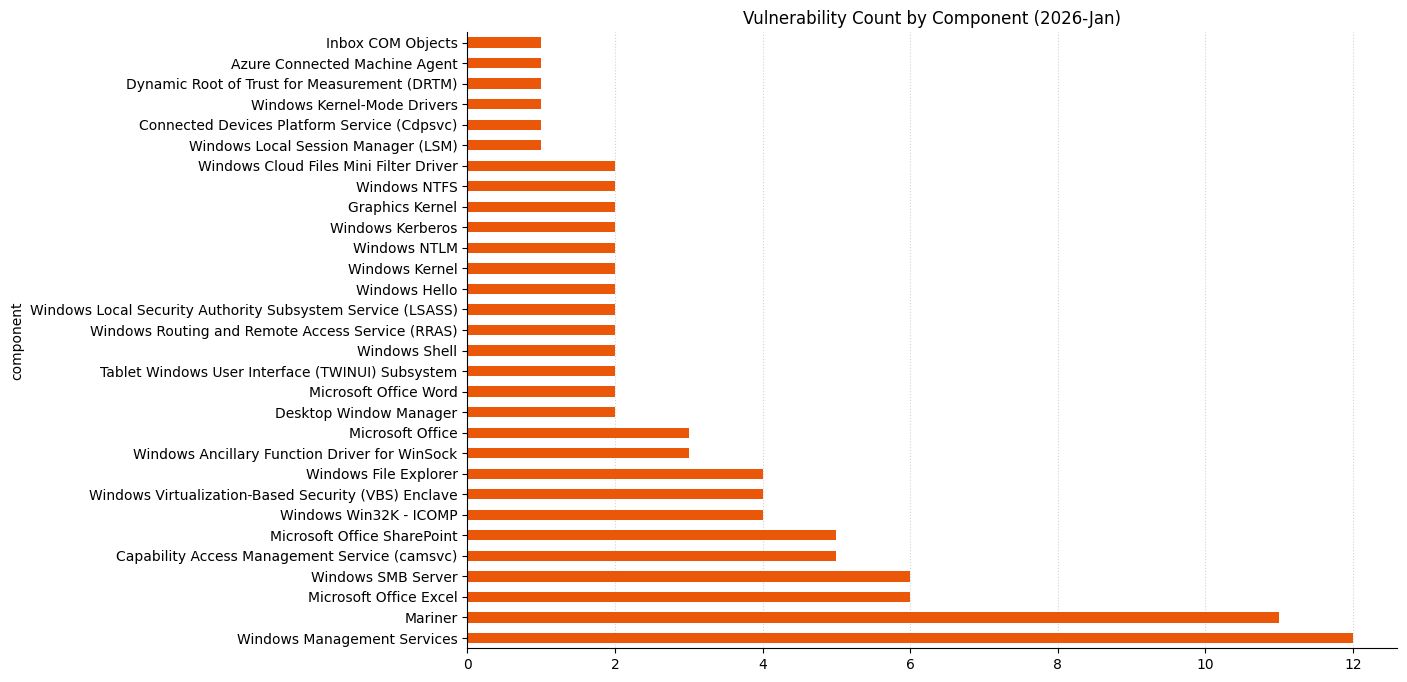
A bar chart showing vulnerability count by component for Microsoft Patch Tuesday 2026-Jan
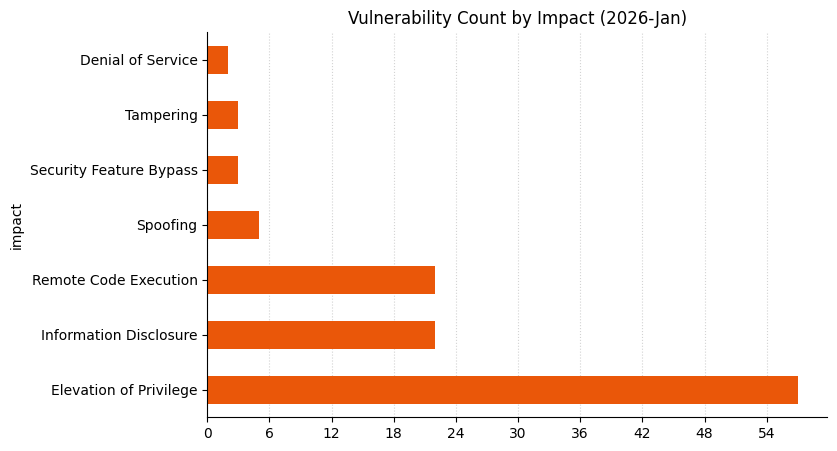
A bar chart showing vulnerability count by impact for Microsoft Patch Tuesday 2026-Jan
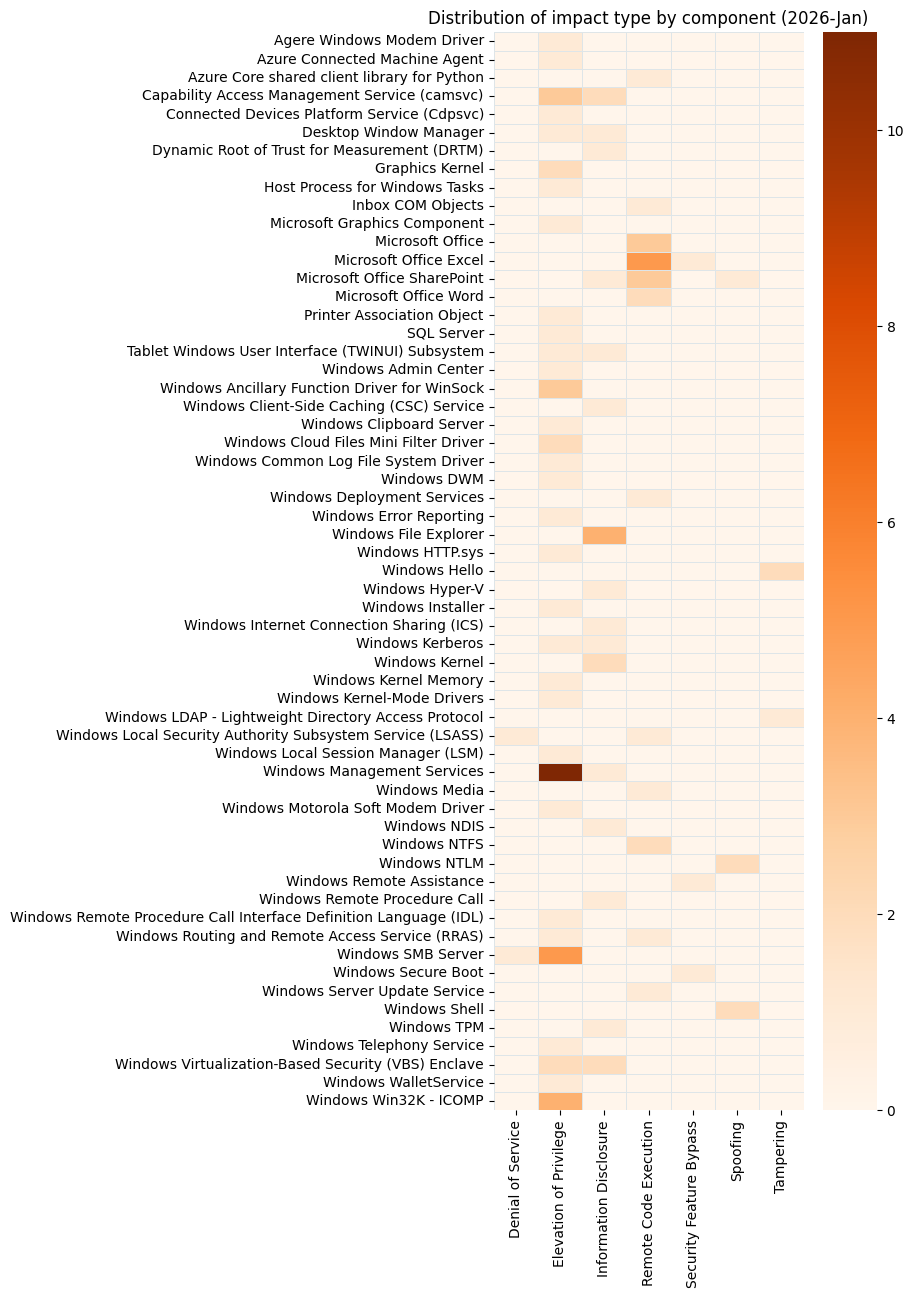
A bar chart showing distribution of impact type by component for Microsoft Patch Tuesday 2026-Jan

Vulnerabilities by Product Family

Azure vulnerabilities

CVE

Title

Exploitation status

Publicly disclosed?

CVSS v3 base score

CVE-2026-21224

Azure Connected Machine Agent Elevation of Privilege Vulnerability

Exploitation Less Likely

No

7.8

CVE-2026-21226

Azure Core shared client library for Python Remote Code Execution Vulnerability

Exploitation Less Likely

No

7.5

CVE-2026-20965

Windows Admin Center Elevation of Privilege Vulnerability

Exploitation Less Likely

No

7.5

Developer Tools vulnerabilities

CVE

Title

Exploitation status

Publicly disclosed?

CVSS v3 base score

CVE-2026-21219

Inbox COM Objects (Global Memory) Remote Code Execution Vulnerability

Exploitation Unlikely

No

7.0

ESU vulnerabilities

CVE

Title

Exploitation status

Publicly disclosed?

CVSS v3 base score

CVE-2026-20805

Desktop Window Manager Information Disclosure Vulnerability

Exploitation Detected

No

5.5

CVE-2026-20847

Microsoft Windows File Explorer Spoofing Vulnerability

Exploitation Unlikely

No

6.5

CVE-2023-31096

MITRE: CVE-2023-31096 Windows Agere Soft Modem Driver Elevation of Privilege Vulnerability

Exploitation More Likely

Yes

7.8

CVE-2026-20925

NTLM Hash Disclosure Spoofing Vulnerability

Exploitation Less Likely

No

6.5

CVE-2026-20872

NTLM Hash Disclosure Spoofing Vulnerability

Exploitation Less Likely

No

6.5

CVE-2026-20821

Remote Procedure Call Information Disclosure Vulnerability

Exploitation Unlikely

No

6.2

CVE-2026-21265

Secure Boot Certificate Expiration Security Feature Bypass Vulnerability

Exploitation Less Likely

Yes

6.4

CVE-2026-20831

Windows Ancillary Function Driver for WinSock Elevation of Privilege Vulnerability

Exploitation Less Likely

No

7.8

CVE-2026-20860

Windows Ancillary Function Driver for WinSock Elevation of Privilege Vulnerability

Exploitation More Likely

No

7.8

CVE-2026-20839

Windows Client-Side Caching (CSC) Service Information Disclosure Vulnerability

Exploitation Unlikely

No

5.5

CVE-2026-20940

Windows Cloud Files Mini Filter Driver Elevation of Privilege Vulnerability

Exploitation Unlikely

No

7.8

CVE-2026-20820

Windows Common Log File System Driver Elevation of Privilege Vulnerability

Exploitation More Likely

No

7.8

CVE-2026-0386

Windows Deployment Services Remote Code Execution Vulnerability

Exploitation Unlikely

No

7.5

CVE-2026-20929

Windows HTTP.sys Elevation of Privilege Vulnerability

Exploitation Unlikely

No

7.5

CVE-2026-20816

Windows Installer Elevation of Privilege Vulnerability

Exploitation More Likely

No

7.8

CVE-2026-20849

Windows Kerberos Elevation of Privilege Vulnerability

Exploitation Unlikely

No

7.5

CVE-2026-20833

Windows Kerberos Information Disclosure Vulnerability

Exploitation Less Likely

No

5.5

CVE-2026-20809

Windows Kernel Memory Elevation of Privilege Vulnerability

Exploitation Less Likely

No

7.8

CVE-2026-20875

Windows Local Security Authority Subsystem Service (LSASS) Denial of Service Vulnerability

Exploitation Less Likely

No

7.5

CVE-2026-20869

Windows Local Session Manager (LSM) Elevation of Privilege Vulnerability

Exploitation Less Likely

No

7.0

CVE-2024-55414

Windows Motorola Soft Modem Driver Elevation of Privilege Vulnerability

Exploitation Unlikely

No

7.8

CVE-2026-20936

Windows NDIS Information Disclosure Vulnerability

Exploitation Unlikely

No

4.3

CVE-2026-20840

Windows NTFS Remote Code Execution Vulnerability

Exploitation More Likely

No

7.8

CVE-2026-20922

Windows NTFS Remote Code Execution Vulnerability

Exploitation More Likely

No

7.8

CVE-2026-20824

Windows Remote Assistance Security Feature Bypass Vulnerability

Exploitation Less Likely

No

5.5

CVE-2026-20828

Windows rndismp6.sys Information Disclosure Vulnerability

Exploitation Less Likely

No

4.6

CVE-2026-20843

Windows Routing and Remote Access Service (RRAS) Elevation of Privilege Vulnerability

Exploitation More Likely

No

7.8

CVE-2026-20868

Windows Routing and Remote Access Service (RRAS) Remote Code Execution Vulnerability

Exploitation Less Likely

No

8.8

CVE-2026-20856

Windows Server Update Service (WSUS) Remote Code Execution Vulnerability

Exploitation Less Likely

No

8.1

CVE-2026-20927

Windows SMB Server Denial of Service Vulnerability

Exploitation Unlikely

No

5.3

CVE-2026-20919

Windows SMB Server Elevation of Privilege Vulnerability

Exploitation Unlikely

No

7.5

CVE-2026-20921

Windows SMB Server Elevation of Privilege Vulnerability

Exploitation Unlikely

No

7.5

CVE-2026-20926

Windows SMB Server Elevation of Privilege Vulnerability

Exploitation Unlikely

No

7.5

CVE-2026-20934

Windows SMB Server Elevation of Privilege Vulnerability

Exploitation Unlikely

No

7.5

CVE-2026-20848

Windows SMB Server Elevation of Privilege Vulnerability

Exploitation Unlikely

No

7.5

CVE-2026-20834

Windows Spoofing Vulnerability

Exploitation Less Likely

No

4.6

CVE-2026-20931

Windows Telephony Service Elevation of Privilege Vulnerability

Exploitation Unlikely

No

8.0

Microsoft Office vulnerabilities

CVE

Title

Exploitation status

Publicly disclosed?

CVSS v3 base score

CVE-2026-20946

Microsoft Excel Remote Code Execution Vulnerability

Exploitation Less Likely

No

7.8

CVE-2026-20955

Microsoft Excel Remote Code Execution Vulnerability

Exploitation Less Likely

No

7.8

CVE-2026-20956

Microsoft Excel Remote Code Execution Vulnerability

Exploitation Less Likely

No

7.8

CVE-2026-20950

Microsoft Excel Remote Code Execution Vulnerability

Exploitation Less Likely

No

7.8

CVE-2026-20957

Microsoft Excel Remote Code Execution Vulnerability

Exploitation Less Likely

No

7.8

CVE-2026-20949

Microsoft Excel Security Feature Bypass Vulnerability

Exploitation Less Likely

No

7.8

CVE-2026-20943

Microsoft Office Click-To-Run Elevation of Privilege Vulnerability

Exploitation Less Likely

No

7.0

CVE-2026-20953

Microsoft Office Remote Code Execution Vulnerability

Exploitation Less Likely

No

8.4

CVE-2026-20952

Microsoft Office Remote Code Execution Vulnerability

Exploitation Less Likely

No

8.4

CVE-2026-20958

Microsoft SharePoint Information Disclosure Vulnerability

Exploitation Less Likely

No

5.4

CVE-2026-20963

Microsoft SharePoint Remote Code Execution Vulnerability

Exploitation Less Likely

No

8.8

CVE-2026-20951

Microsoft SharePoint Server Remote Code Execution Vulnerability

Exploitation Less Likely

No

7.8

CVE-2026-20947

Microsoft SharePoint Server Remote Code Execution Vulnerability

Exploitation Unlikely

No

8.8

CVE-2026-20959

Microsoft SharePoint Server Spoofing Vulnerability

Exploitation Less Likely

No

4.6

CVE-2026-20944

Microsoft Word Remote Code Execution Vulnerability

Exploitation Less Likely

No

8.4

CVE-2026-20948

Microsoft Word Remote Code Execution Vulnerability

Exploitation Less Likely

No

7.8

SQL Server vulnerabilities

CVE

Title

Exploitation status

Publicly disclosed?

CVSS v3 base score

CVE-2026-20803

Microsoft SQL Server Elevation of Privilege Vulnerability

Exploitation Less Likely

No

7.2

Windows vulnerabilities

CVE

Title

Exploitation status

Publicly disclosed?

CVSS v3 base score

CVE-2026-20815

Capability Access Management Service (camsvc) Elevation of Privilege Vulnerability

Exploitation Less Likely

No

7.0

CVE-2026-20830

Capability Access Management Service (camsvc) Elevation of Privilege Vulnerability

Exploitation Unlikely

No

7.0

CVE-2026-21221

Capability Access Management Service (camsvc) Elevation of Privilege Vulnerability

Exploitation Unlikely

No

7.0

CVE-2026-20835

Capability Access Management Service (camsvc) Information Disclosure Vulnerability

Exploitation Less Likely

No

5.5

CVE-2026-20851

Capability Access Management Service (camsvc) Information Disclosure Vulnerability

Exploitation Less Likely

No

6.2

CVE-2026-20805

Desktop Window Manager Information Disclosure Vulnerability

Exploitation Detected

No

5.5

CVE-2026-20871

Desktop Windows Manager Elevation of Privilege Vulnerability

Exploitation More Likely

No

7.8

CVE-2026-20814

DirectX Graphics Kernel Elevation of Privilege Vulnerability

Exploitation Less Likely

No

7.0

CVE-2026-20836

DirectX Graphics Kernel Elevation of Privilege Vulnerability

Exploitation Less Likely

No

7.0

CVE-2026-20962

Dynamic Root of Trust for Measurement (DRTM) Information Disclosure Vulnerability

Exploitation Less Likely

No

4.4

CVE-2026-20941

Host Process for Windows Tasks Elevation of Privilege Vulnerability

Exploitation Less Likely

No

7.8

CVE-2026-20812

LDAP Tampering Vulnerability

Exploitation Less Likely

No

6.5

CVE-2026-20842

Microsoft DWM Core Library Elevation of Privilege Vulnerability

Exploitation Less Likely

No

7.0

CVE-2026-20847

Microsoft Windows File Explorer Spoofing Vulnerability

Exploitation Unlikely

No

6.5

CVE-2023-31096

MITRE: CVE-2023-31096 Windows Agere Soft Modem Driver Elevation of Privilege Vulnerability

Exploitation More Likely

Yes

7.8

CVE-2026-20925

NTLM Hash Disclosure Spoofing Vulnerability

Exploitation Less Likely

No

6.5

CVE-2026-20872

NTLM Hash Disclosure Spoofing Vulnerability

Exploitation Less Likely

No

6.5

CVE-2026-20821

Remote Procedure Call Information Disclosure Vulnerability

Exploitation Unlikely

No

6.2

CVE-2026-21265

Secure Boot Certificate Expiration Security Feature Bypass Vulnerability

Exploitation Less Likely

Yes

6.4

CVE-2026-20826

Tablet Windows User Interface (TWINUI) Subsystem Information Disclosure Vulnerability

Exploitation Less Likely

No

7.8

CVE-2026-20827

Tablet Windows User Interface (TWINUI) Subsystem Information Disclosure Vulnerability

Exploitation Unlikely

No

5.5

CVE-2026-20829

TPM Trustlet Information Disclosure Vulnerability

Exploitation Less Likely

No

5.5

CVE-2026-20811

Win32k Elevation of Privilege Vulnerability

Exploitation Less Likely

No

7.8

CVE-2026-20920

Win32k Elevation of Privilege Vulnerability

Exploitation Unlikely

No

7.8

CVE-2026-20863

Win32k Elevation of Privilege Vulnerability

Exploitation Less Likely

No

7.0

CVE-2026-20810

Windows Ancillary Function Driver for WinSock Elevation of Privilege Vulnerability

Exploitation Less Likely

No

7.8

CVE-2026-20831

Windows Ancillary Function Driver for WinSock Elevation of Privilege Vulnerability

Exploitation Less Likely

No

7.8

CVE-2026-20860

Windows Ancillary Function Driver for WinSock Elevation of Privilege Vulnerability

Exploitation More Likely

No

7.8

CVE-2026-20839

Windows Client-Side Caching (CSC) Service Information Disclosure Vulnerability

Exploitation Unlikely

No

5.5

CVE-2026-20844

Windows Clipboard Server Elevation of Privilege Vulnerability

Exploitation Less Likely

No

7.4

CVE-2026-20857

Windows Cloud Files Mini Filter Driver Elevation of Privilege Vulnerability

Exploitation Unlikely

No

7.8

CVE-2026-20940

Windows Cloud Files Mini Filter Driver Elevation of Privilege Vulnerability

Exploitation Unlikely

No

7.8

CVE-2026-20820

Windows Common Log File System Driver Elevation of Privilege Vulnerability

Exploitation More Likely

No

7.8

CVE-2026-20864

Windows Connected Devices Platform Service Elevation of Privilege Vulnerability

Exploitation Unlikely

No

7.8

CVE-2026-0386

Windows Deployment Services Remote Code Execution Vulnerability

Exploitation Unlikely

No

7.5

CVE-2026-20817

Windows Error Reporting Service Elevation of Privilege Vulnerability

Exploitation More Likely

No

7.8

CVE-2026-20808

Windows File Explorer Elevation of Privilege Vulnerability

Exploitation Less Likely

No

7.0

CVE-2026-20823

Windows File Explorer Information Disclosure Vulnerability

Exploitation Unlikely

No

5.5

CVE-2026-20932

Windows File Explorer Information Disclosure Vulnerability

Exploitation Unlikely

No

5.5

CVE-2026-20937

Windows File Explorer Information Disclosure Vulnerability

Exploitation Unlikely

No

5.5

CVE-2026-20939

Windows File Explorer Information Disclosure Vulnerability

Exploitation Unlikely

No

5.5

CVE-2026-20822

Windows Graphics Component Elevation of Privilege Vulnerability

Exploitation Less Likely

No

7.8

CVE-2026-20804

Windows Hello Tampering Vulnerability

Exploitation Unlikely

No

7.7

CVE-2026-20852

Windows Hello Tampering Vulnerability

Exploitation Less Likely

No

7.7

CVE-2026-20929

Windows HTTP.sys Elevation of Privilege Vulnerability

Exploitation Unlikely

No

7.5

CVE-2026-20825

Windows Hyper-V Information Disclosure Vulnerability

Exploitation Less Likely

No

4.4

CVE-2026-20816

Windows Installer Elevation of Privilege Vulnerability

Exploitation More Likely

No

7.8

CVE-2026-20849

Windows Kerberos Elevation of Privilege Vulnerability

Exploitation Unlikely

No

7.5

CVE-2026-20833

Windows Kerberos Information Disclosure Vulnerability

Exploitation Less Likely

No

5.5

CVE-2026-20818

Windows Kernel Information Disclosure Vulnerability

Exploitation Unlikely

No

6.2

CVE-2026-20838

Windows Kernel Information Disclosure Vulnerability

Exploitation Less Likely

No

5.5

CVE-2026-20809

Windows Kernel Memory Elevation of Privilege Vulnerability

Exploitation Less Likely

No

7.8

CVE-2026-20859

Windows Kernel-Mode Driver Elevation of Privilege Vulnerability

Exploitation Less Likely

No

7.8

CVE-2026-20875

Windows Local Security Authority Subsystem Service (LSASS) Denial of Service Vulnerability

Exploitation Less Likely

No

7.5

CVE-2026-20854

Windows Local Security Authority Subsystem Service (LSASS) Remote Code Execution Vulnerability

Exploitation Less Likely

No

7.5

CVE-2026-20869

Windows Local Session Manager (LSM) Elevation of Privilege Vulnerability

Exploitation Less Likely

No

7.0

CVE-2026-20858

Windows Management Services Elevation of Privilege Vulnerability

Exploitation Less Likely

No

7.8

CVE-2026-20865

Windows Management Services Elevation of Privilege Vulnerability

Exploitation Less Likely

No

7.8

CVE-2026-20877

Windows Management Services Elevation of Privilege Vulnerability

Exploitation Less Likely

No

7.8

CVE-2026-20918

Windows Management Services Elevation of Privilege Vulnerability

Exploitation Unlikely

No

7.8

CVE-2026-20923

Windows Management Services Elevation of Privilege Vulnerability

Exploitation Less Likely

No

7.8

CVE-2026-20924

Windows Management Services Elevation of Privilege Vulnerability

Exploitation Less Likely

No

7.8

CVE-2026-20861

Windows Management Services Elevation of Privilege Vulnerability

Exploitation Less Likely

No

7.8

CVE-2026-20866

Windows Management Services Elevation of Privilege Vulnerability

Exploitation Less Likely

No

7.8

CVE-2026-20867

Windows Management Services Elevation of Privilege Vulnerability

Exploitation Unlikely

No

7.8

CVE-2026-20873

Windows Management Services Elevation of Privilege Vulnerability

Exploitation Less Likely

No

7.8

CVE-2026-20874

Windows Management Services Elevation of Privilege Vulnerability

Exploitation Less Likely

No

7.8

CVE-2026-20862

Windows Management Services Information Disclosure Vulnerability

Exploitation Unlikely

No

5.5

CVE-2026-20837

Windows Media Remote Code Execution Vulnerability

Exploitation Less Likely

No

7.8

CVE-2024-55414

Windows Motorola Soft Modem Driver Elevation of Privilege Vulnerability

Exploitation Unlikely

No

7.8

CVE-2026-20936

Windows NDIS Information Disclosure Vulnerability

Exploitation Unlikely

No

4.3

CVE-2026-20840

Windows NTFS Remote Code Execution Vulnerability

Exploitation More Likely

No

7.8

CVE-2026-20922

Windows NTFS Remote Code Execution Vulnerability

Exploitation More Likely

No

7.8

CVE-2026-20824

Windows Remote Assistance Security Feature Bypass Vulnerability

Exploitation Less Likely

No

5.5

CVE-2026-20832

Windows Remote Procedure Call Interface Definition Language (IDL) Elevation of Privilege Vulnerability

Exploitation Less Likely

No

7.8

CVE-2026-20828

Windows rndismp6.sys Information Disclosure Vulnerability

Exploitation Less Likely

No

4.6

CVE-2026-20843

Windows Routing and Remote Access Service (RRAS) Elevation of Privilege Vulnerability

Exploitation More Likely

No

7.8

CVE-2026-20868

Windows Routing and Remote Access Service (RRAS) Remote Code Execution Vulnerability

Exploitation Less Likely

No

8.8

CVE-2026-20856

Windows Server Update Service (WSUS) Remote Code Execution Vulnerability

Exploitation Less Likely

No

8.1

CVE-2026-20927

Windows SMB Server Denial of Service Vulnerability

Exploitation Unlikely

No

5.3

CVE-2026-20919

Windows SMB Server Elevation of Privilege Vulnerability

Exploitation Unlikely

No

7.5

CVE-2026-20921

Windows SMB Server Elevation of Privilege Vulnerability

Exploitation Unlikely

No

7.5

CVE-2026-20926

Windows SMB Server Elevation of Privilege Vulnerability

Exploitation Unlikely

No

7.5

CVE-2026-20934

Windows SMB Server Elevation of Privilege Vulnerability

Exploitation Unlikely

No

7.5

CVE-2026-20848

Windows SMB Server Elevation of Privilege Vulnerability

Exploitation Unlikely

No

7.5

CVE-2026-20834

Windows Spoofing Vulnerability

Exploitation Less Likely

No

4.6

CVE-2026-20931

Windows Telephony Service Elevation of Privilege Vulnerability

Exploitation Unlikely

No

8.0

CVE-2026-20876

Windows Virtualization-Based Security (VBS) Enclave Elevation of Privilege Vulnerability

Exploitation Less Likely

No

6.7

CVE-2026-20938

Windows Virtualization-Based Security (VBS) Enclave Elevation of Privilege Vulnerability

Exploitation Less Likely

No

7.8

CVE-2026-20819

Windows Virtualization-Based Security (VBS) Information Disclosure Vulnerability

Exploitation Less Likely

No

5.5

CVE-2026-20935

Windows Virtualization-Based Security (VBS) Information Disclosure Vulnerability

Exploitation Less Likely

No

6.2

CVE-2026-20853

Windows WalletService Elevation of Privilege Vulnerability

Exploitation Less Likely

No

7.4

CVE-2026-20870

Windows Win32 Kernel Subsystem Elevation of Privilege Vulnerability

Exploitation Less Likely

No

7.8

What came first: the CNAME or the A record?

Post Syndicated from Sebastiaan Neuteboom original https://blog.cloudflare.com/cname-a-record-order-dns-standards/

On January 8, 2026, a routine update to 1.1.1.1 aimed at reducing memory usage accidentally triggered a wave of DNS resolution failures for users across the Internet. The root cause wasn’t an attack or an outage, but a subtle shift in the order of records within our DNS responses.

While most modern software treats the order of records in DNS responses as irrelevant, we discovered that some implementations expect CNAME records to appear before everything else. When that order changed, resolution started failing. This post explores the code change that caused the shift, why it broke specific DNS clients, and the 40-year-old protocol ambiguity that makes the “correct” order of a DNS response difficult to define.

Timeline

All timestamps referenced are in Coordinated Universal Time (UTC).

Time

Description

2025-12-02

The record reordering is introduced to the 1.1.1.1 codebase

2025-12-10

The change is released to our testing environment

2026-01-07 23:48

A global release containing the change starts

2026-01-08 17:40

The release reaches 90% of servers

2026-01-08 18:19

Incident is declared

2026-01-08 18:27

The release is reverted

2026-01-08 19:55

Revert is completed. Impact ends

What happened?

While making some improvements to lower the memory usage of our cache implementation, we introduced a subtle change to CNAME record ordering. The change was introduced on December 2, 2025, released to our testing environment on December 10, and began deployment on January 7, 2026.

How DNS CNAME chains work

When you query for a domain like www.example.com, you might get a CNAME (Canonical Name) record that indicates one name is an alias for another name. It’s the job of public resolvers, such as 1.1.1.1, to follow this chain of aliases until it reaches a final response:

www.example.com → cdn.example.com → server.cdn-provider.com → 198.51.100.1

As 1.1.1.1 traverses this chain, it caches every intermediate record. Each record in the chain has its own TTL (Time-To-Live), indicating how long we can cache it. Not all the TTLs in a CNAME chain need to be the same:

www.example.com → cdn.example.com (TTL: 3600 seconds) # Still cached
cdn.example.com → 198.51.100.1    (TTL: 300 seconds)  # Expired

When one or more records in a CNAME chain expire, it’s considered partially expired. Fortunately, since parts of the chain are still in our cache, we don’t have to resolve the entire CNAME chain again — only the part that has expired. In our example above, we would take the still valid www.example.com → cdn.example.com chain, and only resolve the expired cdn.example.com A record. Once that’s done, we combine the existing CNAME chain and the newly resolved records into a single response.

The logic change

The code that merges these two chains is where the change occurred. Previously, the code would create a new list, insert the existing CNAME chain, and then append the new records:

impl PartialChain {
    /// Merges records to the cache entry to make the cached records complete.
    pub fn fill_cache(&self, entry: &mut CacheEntry) {
        let mut answer_rrs = Vec::with_capacity(entry.answer.len() + self.records.len());
        answer_rrs.extend_from_slice(&self.records); // CNAMEs first
        answer_rrs.extend_from_slice(&entry.answer); // Then A/AAAA records
        entry.answer = answer_rrs;
    }
}

However, to save some memory allocations and copies, the code was changed to instead append the CNAMEs to the existing answer list:

impl PartialChain {
    /// Merges records to the cache entry to make the cached records complete.
    pub fn fill_cache(&self, entry: &mut CacheEntry) {
        entry.answer.extend(self.records); // CNAMEs last
    }
}

As a result, the responses that 1.1.1.1 returned now sometimes had the CNAME records appearing at the bottom, after the final resolved answer.

Why this caused impact

When DNS clients receive a response with a CNAME chain in the answer section, they also need to follow this chain to find out that www.example.com points to 198.51.100.1. Some DNS client implementations handle this by keeping track of the expected name for the records as they’re iterated sequentially. When a CNAME is encountered, the expected name is updated:

;; QUESTION SECTION:
;; www.example.com.        IN    A

;; ANSWER SECTION:
www.example.com.    3600   IN    CNAME  cdn.example.com.
cdn.example.com.    300    IN    A      198.51.100.1

  1. Find records for www.example.com

  2. Encounter www.example.com. CNAME cdn.example.com

  3. Find records for cdn.example.com

  4. Encounter cdn.example.com. A 198.51.100.1

When the CNAME suddenly appears at the bottom, this no longer works:

;; QUESTION SECTION:
;; www.example.com.	       IN    A

;; ANSWER SECTION:
cdn.example.com.    300    IN    A      198.51.100.1
www.example.com.    3600   IN    CNAME  cdn.example.com.

  1. Find records for www.example.com

  2. Ignore cdn.example.com. A 198.51.100.1 as it doesn’t match the expected name

  3. Encounter www.example.com. CNAME cdn.example.com

  4. Find records for cdn.example.com

  5. No more records are present, so the response is considered empty

One such implementation that broke is the getaddrinfo function in glibc, which is commonly used on Linux for DNS resolution. When looking at its getanswer_r implementation, we can indeed see it expects to find the CNAME records before any answers:

for (; ancount > 0; --ancount)
  {
    // ... parsing DNS records ...
    
    if (rr.rtype == T_CNAME)
      {
        /* Record the CNAME target as the new expected name. */
        int n = __ns_name_unpack (c.begin, c.end, rr.rdata,
                                  name_buffer, sizeof (name_buffer));
        expected_name = name_buffer;  // Update what we're looking for
      }
    else if (rr.rtype == qtype
             && __ns_samebinaryname (rr.rname, expected_name)  // Must match!
             && rr.rdlength == rrtype_to_rdata_length (type:qtype))
      {
        /* Address record matches - store it */
        ptrlist_add (list:addresses, item:(char *) alloc_buffer_next (abuf, uint32_t));
        alloc_buffer_copy_bytes (buf:abuf, src:rr.rdata, size:rr.rdlength);
      }
  }

Another notable affected implementation was the DNSC process in three models of Cisco ethernet switches. In the case where switches had been configured to use 1.1.1.1 these switches experienced spontaneous reboot loops when they received a response containing the reordered CNAMEs. Cisco has published a service document describing the issue.

Not all implementations break

Most DNS clients don’t have this issue. For example, systemd-resolved first parses the records into an ordered set:

typedef struct DnsAnswerItem {
        DnsResourceRecord *rr; // The actual record
        DnsAnswerFlags flags;  // Which section it came from
        // ... other metadata
} DnsAnswerItem;


typedef struct DnsAnswer {
        unsigned n_ref;
        OrderedSet *items;
} DnsAnswer;

When following a CNAME chain it can then search the entire answer set, even if the CNAME records don’t appear at the top.

What the RFC says

RFC 1034, published in 1987, defines much of the behavior of the DNS protocol, and should give us an answer on whether the order of CNAME records matters. Section 4.3.1 contains the following text:

If recursive service is requested and available, the recursive response to a query will be one of the following:

– The answer to the query, possibly preface by one or more CNAME RRs that specify aliases encountered on the way to an answer.

While “possibly preface” can be interpreted as a requirement for CNAME records to appear before everything else, it does not use normative key words, such as MUST and SHOULD that modern RFCs use to express requirements. This isn’t a flaw in RFC 1034, but simply a result of its age. RFC 2119, which standardized these key words, was published in 1997, 10 years after RFC 1034.

In our case, we did originally implement the specification so that CNAMEs appear first. However, we did not have any tests asserting the behavior remains consistent due to the ambiguous language in the RFC.

The subtle distinction: RRsets vs RRs in message sections

To understand why this ambiguity exists, we need to understand a subtle but important distinction in DNS terminology.

RFC 1034 section 3.6 defines Resource Record Sets (RRsets) as collections of records with the same name, type, and class. For RRsets, the specification is clear about ordering:

The order of RRs in a set is not significant, and need not be preserved by name servers, resolvers, or other parts of the DNS.

However, RFC 1034 doesn’t clearly specify how message sections relate to RRsets. While modern DNS specifications have shown that message sections can indeed contain multiple RRsets (consider DNSSEC responses with signatures), RFC 1034 doesn’t describe message sections in those terms. Instead, it treats message sections as containing individual Resource Records (RRs).

The problem is that the RFC primarily discusses ordering in the context of RRsets but doesn’t specify the ordering of different RRsets relative to each other within a message section. This is where the ambiguity lives.

RFC 1034 section 6.2.1 includes an example that demonstrates this ambiguity further. It mentions that the order of Resource Records (RRs) is not significant either:

The difference in ordering of the RRs in the answer section is not significant.

However, this example only shows two A records for the same name within the same RRset. It doesn’t address whether this applies to different record types like CNAMEs and A records.

CNAME chain ordering

It turns out that this issue extends beyond putting CNAME records before other record types. Even when CNAMEs appear before other records, sequential parsing can still break if the CNAME chain itself is out of order. Consider the following response:

;; QUESTION SECTION:
;; www.example.com.              IN    A

;; ANSWER SECTION:
cdn.example.com.           3600  IN    CNAME  server.cdn-provider.com.
www.example.com.           3600  IN    CNAME  cdn.example.com.
server.cdn-provider.com.   300   IN    A      198.51.100.1

Each CNAME belongs to a different RRset, as they have different owners, so the statement about RRset order being insignificant doesn’t apply here.

However, RFC 1034 doesn’t specify that CNAME chains must appear in any particular order. There’s no requirement that www.example.com. CNAME cdn.example.com. must appear before cdn.example.com. CNAME server.cdn-provider.com.. With sequential parsing, the same issue occurs:

  1. Find records for www.example.com

  2. Ignore cdn.example.com. CNAME server.cdn-provider.com. as it doesn’t match the expected name

  3. Encounter www.example.com. CNAME cdn.example.com

  4. Find records for cdn.example.com

  5. Ignore server.cdn-provider.com. A 198.51.100.1 as it doesn’t match the expected name

What should resolvers do?

RFC 1034 section 5 describes resolver behavior. Section 5.2.2 specifically addresses how resolvers should handle aliases (CNAMEs):

In most cases a resolver simply restarts the query at the new name when it encounters a CNAME.

This suggests that resolvers should restart the query upon finding a CNAME, regardless of where it appears in the response. However, it’s important to distinguish between different types of resolvers:

  • Recursive resolvers, like 1.1.1.1, are full DNS resolvers that perform recursive resolution by querying authoritative nameservers

  • Stub resolvers, like glibc’s getaddrinfo, are simplified local interfaces that forward queries to recursive resolvers and process the responses

The RFC sections on resolver behavior were primarily written with full resolvers in mind, not the simplified stub resolvers that most applications actually use. Some stub resolvers evidently don’t implement certain parts of the spec, such as the CNAME-restart logic described in the RFC.

The DNSSEC specifications provide contrast

Later DNS specifications demonstrate a different approach to defining record ordering. RFC 4035, which defines protocol modifications for DNSSEC, uses more explicit language:

When placing a signed RRset in the Answer section, the name server MUST also place its RRSIG RRs in the Answer section. The RRSIG RRs have a higher priority for inclusion than any other RRsets that may have to be included.

The specification uses “MUST” and explicitly defines “higher priority” for RRSIG records. However, “higher priority for inclusion” refers to whether RRSIGs should be included in the response, not where they should appear. This provides unambiguous guidance to implementers about record inclusion in DNSSEC contexts, while not mandating any particular behavior around record ordering.

For unsigned zones, however, the ambiguity from RFC 1034 remains. The word “preface” has guided implementation behavior for nearly four decades, but it has never been formally specified as a requirement.

Do CNAME records come first?

While in our interpretation the RFCs do not require CNAMEs to appear in any particular order, it’s clear that at least some widely-deployed DNS clients rely on it. As some systems using these clients might be updated infrequently, or never updated at all, we believe it’s best to require CNAME records to appear in-order before any other records.

Based on what we have learned during this incident, we have reverted the CNAME re-ordering and do not intend to change the order in the future.

To prevent any future incidents or confusion, we have written a proposal in the form of an Internet-Draft to be discussed at the IETF. If consensus is reached on the clarified behavior, this would become an RFC that explicitly defines how to correctly handle CNAMEs in DNS responses, helping us and the wider DNS community navigate the protocol. The proposal can be found at https://datatracker.ietf.org/doc/draft-jabley-dnsop-ordered-answer-section. If you have suggestions or feedback we would love to hear your opinions, most usefully via the DNSOP working group at the IETF.

[$] A high-level quality-of-service interface

Post Syndicated from daroc original https://lwn.net/Articles/1051982/

Quality-of-service (QoS) mechanisms attempt to prioritize some processes (or
network traffic, disk I/O, etc.) over others in order to meet a system’s
performance goals. This is a difficult topic to handle in the world of Linux,
where workloads, hardware, and user expectations vary wildly. Qais Yousef spoke
at the 2025 Linux Plumbers Conference, alongside his collaborators John Stultz,
Steven Rostedt, and Vincent Guittot, about their plans for introducing a
high-level QoS API for Linux in a way that leaves end users in control of its
configuration. The talk focused specifically on a QoS mechanism for the
scheduler, to prioritize access to CPU resources differently for different kinds
of processes.
(slides;
video)

Optimizing storage performance for Amazon EKS on AWS Outposts

Post Syndicated from Arun Kumar original https://aws.amazon.com/blogs/compute/optimizing-storage-performance-for-amazon-eks-on-aws-outposts/

Amazon Elastic Kubernetes Service (Amazon EKS) on AWS Outposts brings the power of managed Kubernetes to your on-premises infrastructure. Use Amazon EKS on Outposts rack to create hybrid cloud deployments that maintain consistent AWS experiences across environments. As organizations increasingly adopt edge computing and hybrid architectures, storage optimization and performance tuning become critical for successful workload deployment.

Outposts extend AWS infrastructure, services, APIs, and tools to virtually any datacenter, co-location space, or on-premises facility. In this blog post you will learn about your storage options and their performance characteristics which is essential for building resilient, high-performing applications using Amazon EKS on Outposts.

Amazon EKS on Outposts deployment options

The following two sections outline the differences between Amazon EKS extended and local cluster deployment options available on Outposts.

Amazon EKS extended cluster architecture

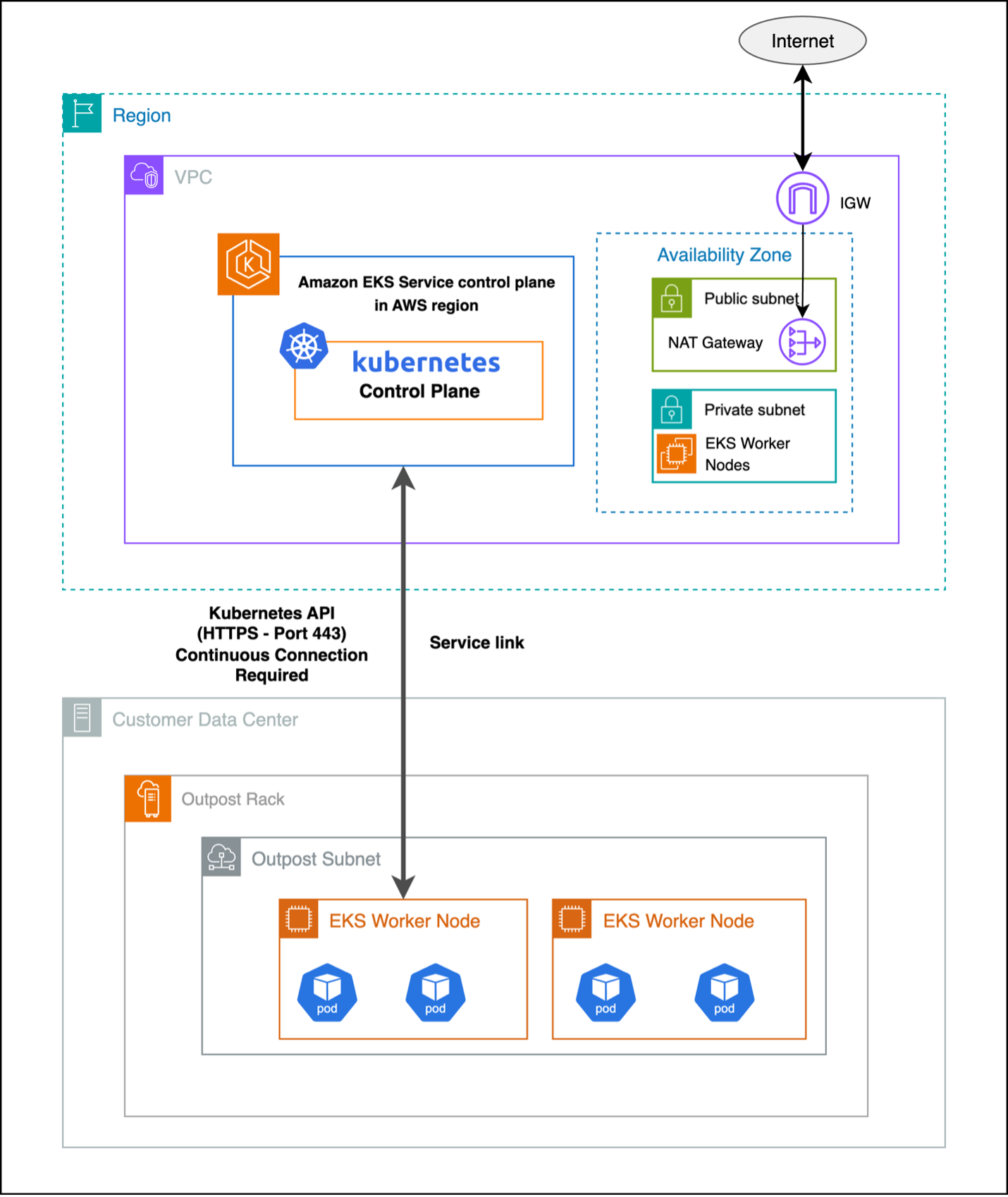
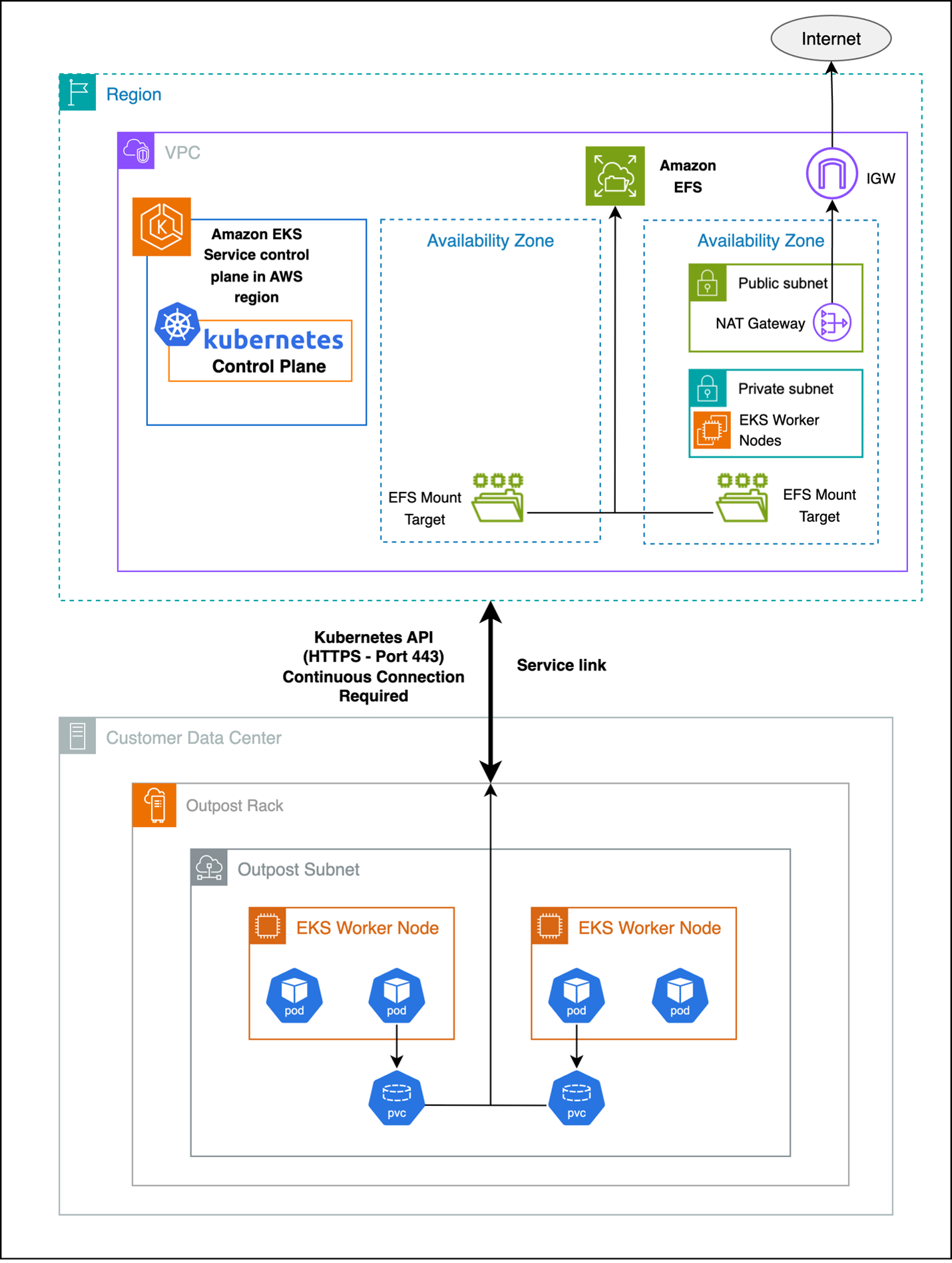
Amazon EKS extended clusters on Outposts provide a powerful solution for organizations seeking to use the benefits of Kubernetes while maintaining certain workloads on-premises, as shown in the following figure. This hybrid architecture allows businesses to extend their EKS clusters from the AWS Cloud to their own data centers or edge locations using Outposts. The Kubernetes control plane remains in the AWS Region, providing centralized management and benefiting from the AWS infrastructure in the cloud and on the Outpost.

Outposts is designed to be a connected service, and needs reliable network connectivity to the AWS Region using the Outposts service link.

Figure 1 : Extended cluster

Amazon EKS local cluster architecture

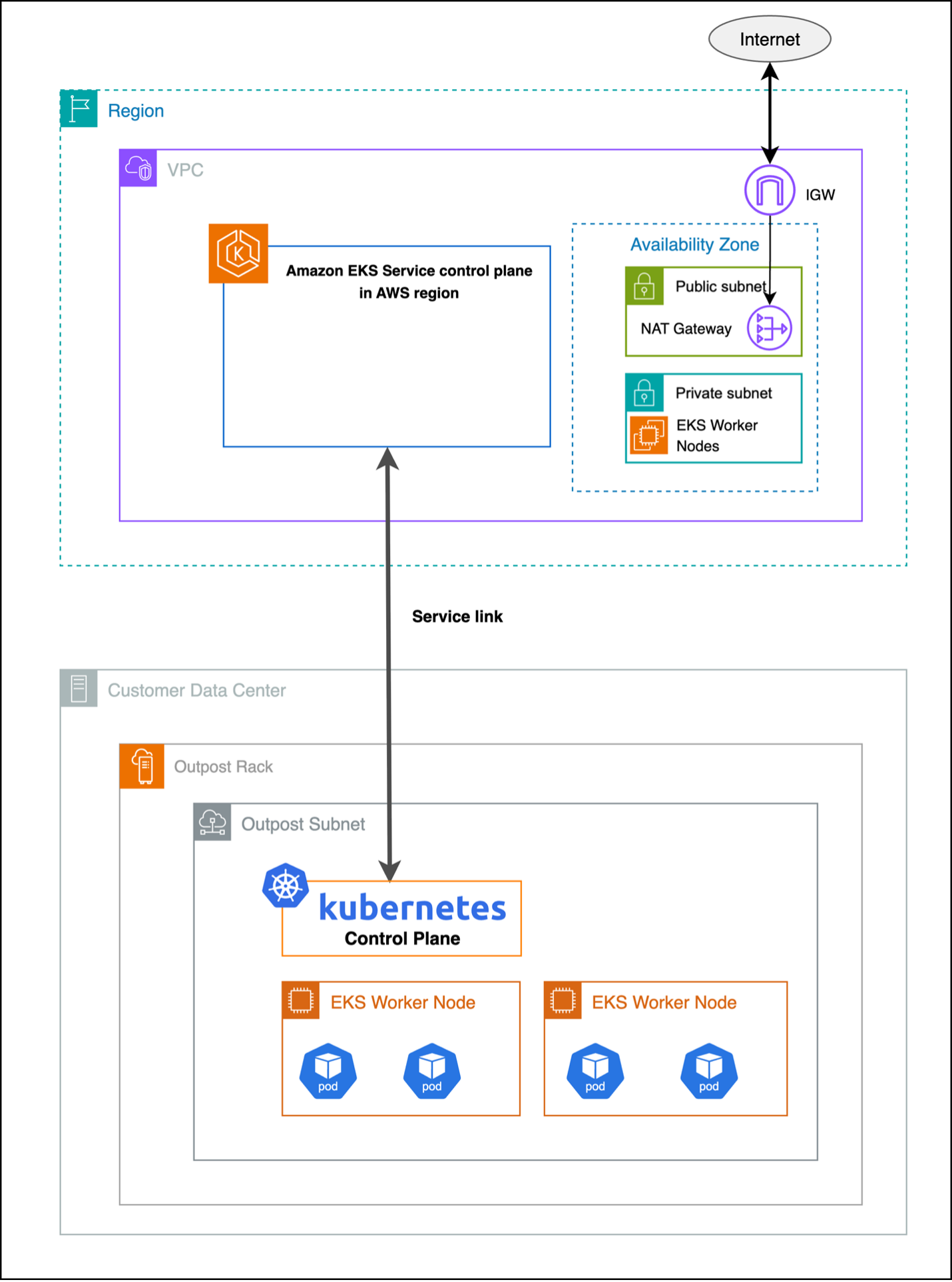
Amazon EKS local clusters deploy the Kubernetes control plane on your Outpost, as shown in the following figure. This provides greater network resilience against outages as cluster operations run entirely on the Outposts and reduces the dependency on network connectivity to the AWS Region. Having the Kubernetes control plane hosted on your Outpost also reduces latency for cluster operations.

  Figure 2: Local cluster

Storage options for Amazon EKS extended clusters on Outposts

Persistent Volumes (PV) and Persistent Volume Claims (PVC) serve as a critical abstraction layer in Kubernetes, separating the storage consumption details from storage provisioning, and allowing administrators to manage storage resources independently from how applications consume them. PVs and PVCs make sure of data persistence across pod restarts and rescheduling events, making them essential for applications that need to maintain state, such as databases, file storage systems, and other data-intensive workloads. The abstraction provided by PV and PVC enables platform-agnostic storage management, where applications can request storage through PVCs without needing to know the underlying storage implementation details. PVs and PVCs support dynamic provisioning through Storage Classes, allowing for automated storage allocation based on application demands, while also providing features such as access modes, capacity management, and reclaim policies to effectively manage the storage lifecycle in a Kubernetes cluster.

Integrating Amazon EBS with Amazon EKS

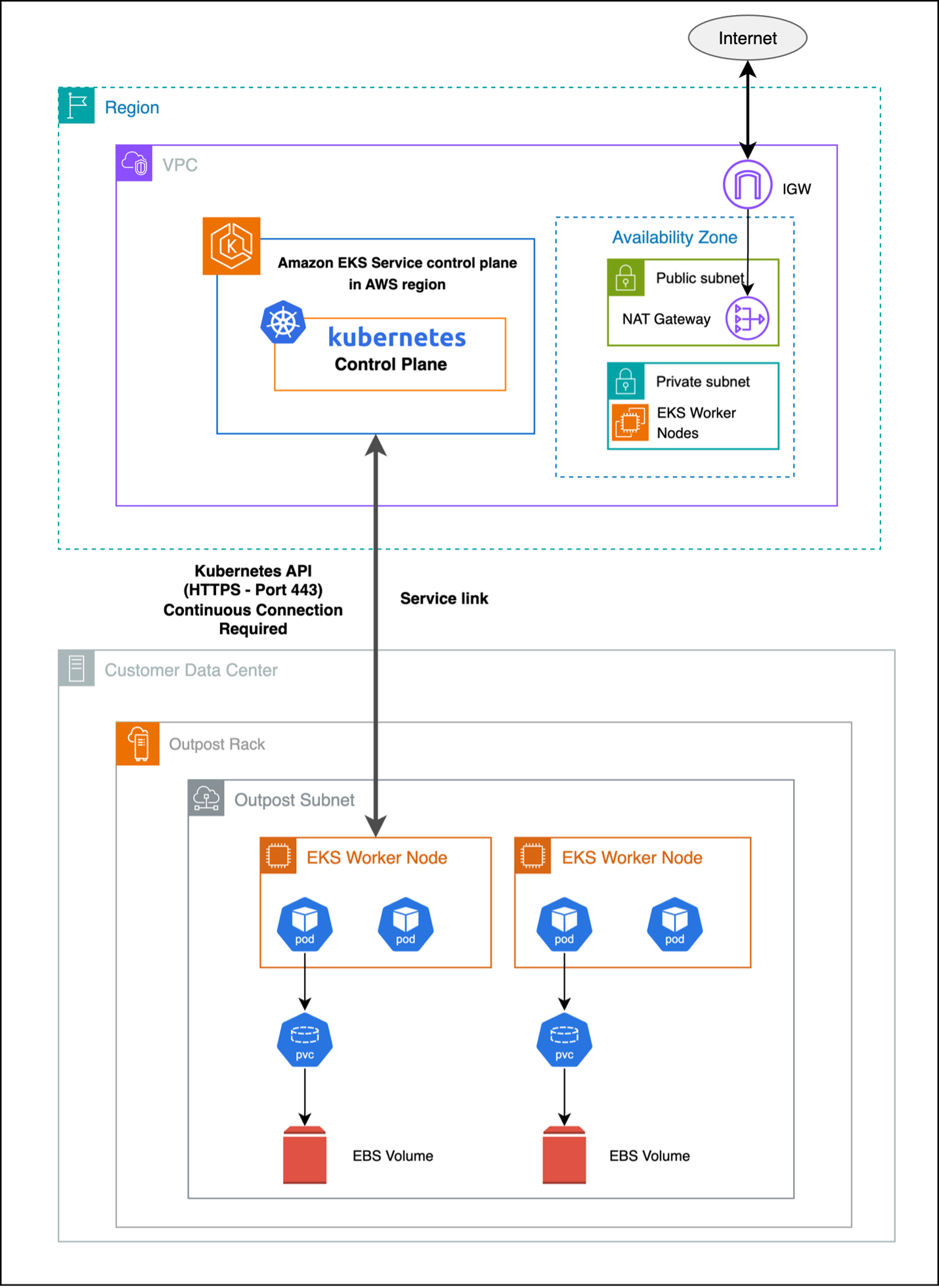
Amazon Elastic Block Store (Amazon EBS) provides high-performance block storage that’s ideal for low-latency applications providing consistent performance. When deployed on Outposts racks, EBS volumes are stored on the Outposts hardware, providing significant performance advantages over network-attached storage solutions, as shown in the following figure.

Figure 3 : Integrating Amazon EBS with Amazon EKS on Outposts

Benefits and use cases

  • Storage: EBS volumes on Outposts racks provide data access without dependency on external connectivity.
  • Performance: Local storage delivers consistent latency and high IOPS/throughput.
  • Cost: On-premises storage eliminates data transfer costs and reduces bandwidth needs, lowering the total cost of ownership.

Implementation considerations

Consider the following when using EBS on Outposts rack:

  • EBS volumes on Outposts are tied to a single rack and the availability zone the Outpost is homed to, needing applications to address single-point-of-failure risks.
  • Protect data using EBS snapshots in the parent Region and schedule regular backups.
  • Capacity on Outposts is finite, monitor Outposts storage usage and plan expansions proactively to avoid insufficient capacity errors.

Refer to Dynamic Volume Provisioning to learn more about deploying pod with the EBS volume attached.

Amazon EFS with Amazon EKS

Amazon Elastic File System (Amazon EFS) provides scalable, shared file storage that can be accessed across multiple AWS Availability Zones (AZs) and on-premises environments. Although Amazon EFS with Amazon EKS on Outposts maintains the same setup procedures as standard cloud deployments, there is a critical dependency on the service link connection between your Outposts and the AWS Region. Amazon EFS is not a locally supported service on Outposts, so connectivity to the AWS Region is required to use this service with your Outpost.

Amazon EFS allows multiple pods to concurrently access shared file systems. It is well-suited for applications that need collaborative data access, content management, and distributed processing workloads.

Amazon EFS as a persistent storage solution for Amazon EKS extended cluster instances

Amazon EFS as a PV for your Amazon EKS extended cluster operates through a hybrid architecture where the Amazon EFS file system resides in the Region, but mount points can be created on the worker nodes running on Outposts subnets through the service link as shown in the following figure.

Figure 4 : Amazon EFS as a persistent storage solution for extended clusters

Benefits and use cases

  • Shared storage capabilities: multiple pods can access a centralized file system, enabling shared data, code, and assets across instances.
  • Scalability: storage capacity and performance automatically scale with usage, eliminating manual provisioning and upfront planning.
  • Compliance: Amazon EFS provides full file system features and compatibility for traditional applications, such as locking, permissions, and directory structure.

Challenges and limitations

Consider the following when using Amazon EFS with Outposts:

  • Network latency: file access involves network traversal to Amazon EFS in the Region, adding more latency and making small or metadata operations potentially slow for latency-sensitive applications.
  • Throughput: aggregate throughput is restricted by the available bandwidth on the service link between the Outposts and AWS Region. This impacts concurrent access and large file transfers during peak usage.
  • Dependency on AWS Region connectivity: Amazon EFS needs continuous connectivity to the parent Region. Disruptions may affect file system availability, operations, and disaster recovery processes.
  • Data Transfer charges: Since EFS is in AWS Parent region and EKS worker nodes and pods are in Outpost additional charges are applicable.

You can refer to Amazon EFS Features and When to Choose Amazon EFS for more detailed insights into its capabilities and use cases.

Deploying pods on extended clusters using Amazon EFS as PV

Refer to Use Elastic File System Storage with Amazon EFS for deployment guidance. Note, Create Amazon EFS mount targets in subnets that are in the same Availability Zone (AZ) as the Outposts subnets.

Amazon S3 with Amazon EKS extended cluster

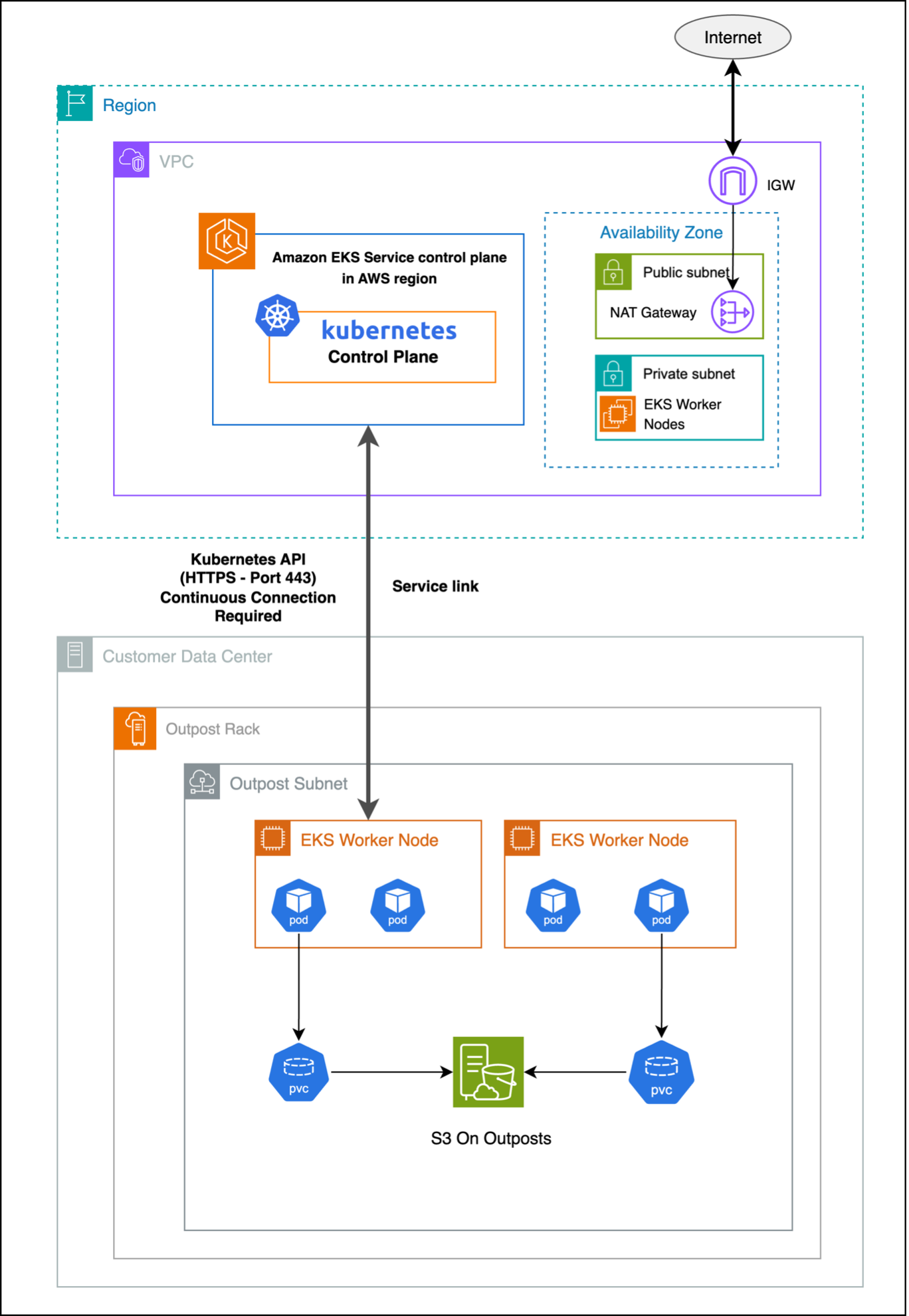
Amazon Simple Storage Service (Amazon S3) on Outposts delivers local object storage on your Outposts, allowing applications to use Amazon S3 APIs for storing and retrieving data while keeping it onsite. It is ideal for workloads that need Amazon S3 compatibility, low latency access to object data, and local data residency.

You should use Amazon S3 access point Amazon Resource Names (ARNs) and not bucket ARNs for proper integration with Amazon EKS workloads.

Learn more about Amazon S3 on Outposts.

Figure 5 : Amazon S3 with Amazon EKS extended cluster on Outposts

Benefits and use cases

  • Data archiving and compliance: Enables cost-effective, locally retained storage for logs, audit trails, regulatory compliance, backups, and sensitive healthcare data with strict residency requirements.
  • Content distribution and media: Provides ultra-low latency local storage for serving static content, media streaming, digital asset management, and gaming asset delivery.
  • Data lake and analytics: Supports local data processing for analytics, ETL, machine learning (ML), real-time Internet of Things (IoT) data handling, and business intelligence with reduced latency and transfer costs.
  • Application integration: Seamlessly integrates with Amazon S3 compatible apps for backup, synchronization, microservices storage, API-driven workflows, and container image management on-premises.

Refer to How is Amazon S3 on Outposts different from Amazon S3 and the Amazon S3 on Outposts documentation to learn more.

Deploying pods on extended clusters using Amazon S3 as PV

Step 1: Create Amazon S3 on Outposts bucket
Step 2: Create Amazon S3 Access Point (necessary for Amazon EKS integration)
Step 3: Configure IAM roles and policies
Step 4: Install Amazon S3 CSI driver
Step 5: Deploying your pod with Amazon S3 volume attached
Step 6: Complete Amazon S3 configuration with Kubernetes

Refer to the documentation Static Provisioning on Outposts bucket for more details on Step 5.

Best practices for optimizing performance

Optimizing performance starts with selecting the right storage type for your workload: Amazon EBS for low-latency, high-throughput block storage; Amazon EFS for shared POSIX-compliant file systems; and Amazon S3 for scalable object storage with API compatibility. Ensure proper volume sizing, monitor usage proactively, and configure CPU and memory requests accurately to balance performance and efficiency—auto scaling and QoS classes can further optimize resource management. Improve data locality by using local storage, apply caching with intelligent eviction, and design for efficient, asynchronous, and compressed data access patterns.

Monitoring and observability

Monitoring key performance metrics is essential to maintain storage efficiency and application reliability. For Amazon EBS, track IOPS, throughput, latency, burst balance, queue depth, and snapshot performance to avoid degradation—see the Amazon CloudWatch metrics for Amazon EBS for the full list. For Amazon EFS, monitor total I/O, throughput, client connections, metadata operations, burst credits, and Regional data transfers to support effective capacity planning—refer to CloudWatch metrics for Amazon EFS. For Amazon S3, observe request and error rates, data transfer, storage usage, latency, multipart upload efficiency, and access patterns to optimize performance and cost—see Metrics and dimensions.

Security considerations

Strong security practices are critical for Amazon EKS on Outposts. Use AWS Key Management Service (AWS KMS) for Amazon EBS encryption, encrypt Amazon EFS data at rest and in transit, and enable server- or client-side encryption for Amazon S3. Enforce TLS for all data transfers and apply key rotation with compliance controls. Implement least privilege IAM policies, scoped roles, and Kubernetes Role-Based Access Control (RBAC) for granular pod access. Secure traffic with security groups and NACLs, and maintain audit logs for all storage operations.

Cost optimization strategies

Manage storage costs by right-sizing volumes, automating lifecycle policies, selecting appropriate storage classes, monitoring data transfer, and using de-duplication and compression where applicable. Lower operational expenses through automated backups, infrastructure as code (IaC), monitoring automation, leveraging managed services, applying cost allocation tags, and conducting regular usage reviews.

Conclusion

Amazon EKS on Outposts empowers organizations to build hybrid applications with storage options that align to performance, compliance, and data residency needs. By selecting the right storage solution for each workload and leveraging Outposts’ local infrastructure, you can reduce latency, minimize network dependencies, and maintain consistency across environments. As Outposts capabilities continue to evolve, they offer a strong foundation for modern, resilient, and cost-efficient hybrid cloud architectures.

Reach out to your AWS account team, or fill out this form to learn more about running containarized applications on Outposts.

Streamline security response at scale with AWS Security Hub automation

Post Syndicated from Ahmed Adekunle original https://aws.amazon.com/blogs/security/streamline-security-response-at-scale-with-aws-security-hub-automation/

A new version of AWS Security Hub, is now generally available, introducing new ways for organizations to manage and respond to security findings. The enhanced Security Hub helps you improve your organization’s security posture and simplify cloud security operations by centralizing security management across your Amazon Web Services (AWS) environment. The new Security Hub transforms how organizations handle security findings through advanced automation capabilities with real-time risk analytics, automated correlation, and enriched context that you can use to prioritize critical issues and reduce response times. Automation also helps ensure consistent response procedures and helps you meet compliance requirements.

AWS Security Hub CSPM (cloud security posture management) is now an integral part of the detection engines for Security Hub. Security Hub provides centralized visibility across multiple AWS security services to give you a unified view of your cloud environment, including risk-based prioritization views, attack path visualization, and trend analytics that help you understand security patterns over time.

This is the third post in our series on the new Security Hub capabilities. In our first post, we discussed how Security Hub unifies findings across AWS services to streamline risk management. In the second post, we shared the steps to conduct a successful Security Hub proof of concept (PoC).

In this post, we explore how you can enhance your security operations using AWS Security Hub automation rules and response automation.

We walk through the setup and configuration of automation rules, share best practices for creating effective response workflows, and provide real-world examples of how these tools can be used to automate remediation, escalate high-severity findings, and support compliance requirements.

Security Hub automation enables automatic response to security findings to help ensure critical findings reach the right teams quickly, so that they can reduce manual effort and response time for common security incidents while maintaining consistent remediation processes.

Note: Automation rules evaluate new and updated findings that Security Hub generates or ingests after you create them, not historical findings. These automation capabilities help ensure critical findings reach the right teams quickly.

Why automation matters in cloud security

Organizations often operate across hundreds of AWS accounts, multiple AWS Regions, and diverse services—each producing findings that must be triaged, investigated, and acted upon. Without automation, security teams face high volumes of alerts, duplication of effort, and the risk of delayed responses to critical issues.

Manual processes can’t keep pace with cloud operations; automation helps solve this by changing your security operations in three ways. Automation filters and prioritizes findings based on your criteria, showing your team only relevant alerts. When issues are detected, automated responses trigger immediately—no manual intervention needed.

If you’re managing multiple AWS accounts, automation applies consistent policies and workflows across your environment through centralized management, shifting your security team from chasing alerts to proactively managing risk before issues escalate.

Designing routing strategies for security findings

With Security Hub configured, you’re ready to design a routing strategy for your findings and notifications. When designing your routing strategy, ask whether your existing Security Hub configuration meets your security requirements. Consider whether Security Hub automations can help you meet security framework requirements like NIST 800-53 and identify KPIs and metrics to measure whether your routing strategy works.

Security Hub automation rules and automated responses can help you meet the preceding requirements, however it’s important to understand how your compliance teams, incident responders, security operations personnel, and other security stakeholders operate on a day-to-day basis. For example, do teams use the AWS Management Console for AWS Security Hub regularly? Or do you need to send most findings downstream to an IT systems management (ITSM) tool (such as Jira or ServiceNow) or third-party security orchestration, automation, and response (SOAR) platforms for incident tracking, workflow management, and remediation?

Next, create and maintain an inventory of critical applications. This helps you adjust finding severity based on business context and your incident response playbooks.

Consider the scenario where Security Hub identifies a medium-severity vulnerability on an Elastic Compute Cloud instance. In isolation, this might not trigger immediate action. When you add business context—such as strategic objectives or business criticality—you might discover that this instance hosts a critical payment processing application, revealing the true risk. By implementing Security Hub automation rules with enriched context, this finding can be upgraded to critical severity and automatically routed to ServiceNow for immediate tracking. In addition, by using Security Hub automation with Amazon EventBridge, you can trigger an AWS Systems Manager Automation document to isolate the EC2 instance for security forensics work to then be carried out.

Because Security Hub offers OCSF format and schema, you can use the extensive schema elements that OCSF offers you to target findings for automation and help your organization meet security strategy requirements.

Example use cases

Security Hub automation supports many use cases. Talk with your teams to understand which fit your needs and security objectives. The following are some examples of how you can use security hub automation:

Automated finding remediation

Use automated finding remediation to automatically fix security issues as they’re detected.

Supporting patterns:

  • Direct remediation: Trigger AWS Lambda functions to fix misconfigurations
  • Resource tagging: Add tags to non-compliant resources for tracking
  • Configuration correction: Update resource configurations to match security policies
  • Permission adjustment: Modify AWS Identity and Access Management (IAM) policies to remove excessive permissions

Example:

  • IF finding.type = “Software and Configuration Checks/Industry and Regulatory Standards/CIS AWS Foundations Benchmark”
  • AND finding.title CONTAINS “S3 buckets should have server-side encryption enabled”
  • THEN invoke Lambda function “enable-s3-encryption”

Security finding workflow integration

Integrate findings into your workflow by routing them to the appropriate teams and systems.

Supporting patterns:

  • Ticket creation: Generate JIRA or ServiceNow tickets for manual review
  • Team assignment: Route findings to specific teams based on resource ownership
  • Severity-based routing: Direct critical findings to incident response, others to regular queues
  • Compliance tracking: Send compliance-related findings to GRC systems

Example:

  • IF finding.severity = “CRITICAL” AND finding.productName = “Amazon GuardDuty”
  • THEN send to SNS topic “security-incident-response-team”
  • ELSE IF finding.productFields.resourceOwner = “payments-team”
  • THEN send to SNS topic “payments-security-review”

Automated finding enrichment

Use finding enrichment to add context to findings to improve triage efficiency.

Supporting patterns:

  • Resource context addition: Add business context, owner information, and data classification
  • Historical analysis: Add information about previous similar findings
  • Risk scoring: Calculate custom risk scores based on asset value and threat context
  • Vulnerability correlation: Link findings to known Common Vulnerabilities and Exposures (CVEs) or threat intelligence

Example:

  • IF finding.type CONTAINS “Vulnerability/CVE”
  • THEN invoke Lambda function “enrich-with-threat-intelligence”

Custom security controls

Use custom security controls to meet organization-specific security requirements.

Supporting patterns:

  • Custom policy enforcement: Check for compliance with internal standards
  • Business-specific rules: Apply rules based on business unit or application type
  • Compensating controls: Implement alternatives when primary controls can’t be applied
  • Temporary exceptions: Handle approved deviations from security standards

Example:

  • IF finding.resourceType = “AWS::EC2::Instance” AND
    • finding.resourceTags.Environment = “Production” AND
    • finding.title CONTAINS “vulnerable software version”
  • THEN invoke Lambda function “enforce-patching-policy”

Compliance reporting and evidence collection

Streamline compliance documentation and evidence gathering.

Supporting patterns:

  • Evidence capture: Store compliance evidence in designated S3 buckets
  • Audit trail creation: Document remediation actions for auditors
  • Compliance dashboarding: Update compliance status metrics
  • Regulatory mapping: Tag findings with relevant compliance frameworks

Example:

  • IF finding.complianceStandards CONTAINS “PCI-DSS”
  • THEN invoke Lambda function “capture-pci-compliance-evidence”
  • AND send to SNS topic “compliance-team-notifications”

Set up Security Hub automation

In this section, you’ll walk through enabling up Security Hub and related services and creating automation rules.

Step 1: Enable Security Hub and integrated services

As the first step, follow the instructions in Enable Security Hub.

Note: Security Hub is powered by Amazon GuardDuty, Amazon Inspector, AWS Security Hub CSPM, and Amazon Macie, and these services also need to be enabled to get value from Security Hub.

Step 2: Create automation rules to update finding details and third-party integration

After Security Hub collects findings you can create automation rules to update and route the findings to the appropriate teams. The steps to create automation rules that update finding details or to a set up a third-party integration—such as Jira or ServiceNow—based on criteria you define can be found in Creating automation rules in Security Hub.

With automation rules, Security Hub evaluates findings against the defined rule and then makes the appropriate finding update or calls the APIs to send findings to Jira or ServiceNow. Security Hub sends a copy of every finding to Amazon EventBridge so that you can also implement your own automated response (if needed) for use cases outside of using Security Hub automation rules.

In addition to sending a copy of every finding to EventBridge, Security Hub classifies and enriches security findings according to business context, then delivers them to the appropriate downstream services (such as ITSM tools) for fast response.

Best practices

AWS Security Hub automation rules offer capabilities for automatically updating findings and integrating with other tools. When implementing automation rules, follow these best practices:

  • Centralized management: Only the Security Hub administrator account can create, edit, delete, and view automation rules. Ensure proper access control and management of this account.
  • Regional deployment: Automation rules can be created in one AWS Region and then applied across configured Regions. When using Region aggregation, you can only create rules in the home Region. If you create an automation rule in an aggregation Region, it will be applied in all included Regions. If you create an automation rule in a non-linked Region, it will be applied only in that Region. For more information, see Creating automation rules in Security Hub.
  • Define specific criteria: Clearly define the criteria that findings must match for the automation rule to apply. This can include finding attributes, severity levels, resource types, or member account IDs.
  • Understand rule order: Rule order matters when multiple rules apply to the same finding or finding field. Security Hub applies rules with a lower numerical value first. If multiple findings have the same RuleOrder, Security Hub applies a rule with an earlier value for the UpdatedAt field first (that is, the rule which was most recently edited applies last). For more information, see Updating the rule order in Security Hub.
  • Provide clear descriptions: Include a detailed rule description to provide context for responders and resource owners, explaining the rule’s purpose and expected actions.
  • Use automation for efficiency: Use automation rules to automatically update finding fields (such as severity and workflow status), suppress low-priority findings, or create tickets in third-party tools such as Jira or ServiceNow for findings matching specific attributes.
  • Consider EventBridge for external actions: While automation rules handle internal Security Hub finding updates, use EventBridge rules to trigger actions outside of Security Hub, such as invoking Lambda functions or sending notifications to Amazon Simple Notification Service (Amazon SNS) topics based on specific findings. Automation rules take effect before EventBridge rules are applied. For more information, see Automation rules in EventBridge.
  • Manage rule limits: This is a maximum limit of 100 automation rules per administrator account. Plan your rule creation strategically to stay within this limit.
  • Regularly review and refine: Periodically review automation rules, especially suppression rules, to ensure they remain relevant and effective, adjusting them as your security posture evolves.

Conclusion

You can use Security Hub automation to triage, route, and respond to findings faster through a unified cloud security solution with centralized management. In this post, you learned how to create automation rules that route findings to ticketing systems integrations and upgrade critical findings for immediate response. Through the intuitive and flexible approach to automation that Security Hub provides, your security teams can make confident, data-driven decisions about Security Hub findings that align with your organization’s overall security strategy.

With Security Hub automation features, you can centrally manage security across hundreds of accounts while your teams focus on critical issues that matter most to your business. By implementing the automation capabilities described in this post, you can streamline response times at scale, reduce manual effort, and improve your overall security posture through consistent, automated workflows.

If you have feedback about this post, submit comments in the Comments section. If you have questions about this post, start a new thread on AWS Security, Identity, and Compliance re:Post or contact AWS Support.
 

Ahmed Adekunle
Ahmed Adekunle

Ahmed is a Security Specialist Solutions Architect focused on detection and response services at AWS. Before AWS, his background was in business process management and AWS technology consulting, helping customers use cloud technology to transform their business. Outside of work, Ahmed enjoys playing soccer, supporting less privileged activities, traveling, and eating spicy food, specifically African cuisine.
Alex Wadell
Alex Wadell

Alex is a Senior Security Specialist Solutions Architect at AWS based in Scotland. Alex provides security architectural guidance and operational best practices to customers of all sizes, helping them implement AWS security services. When not working, Alex enjoys spending time sampling rum from around the world, walking his dogs in the local forest trails, and traveling.
Kyle Shields
Kyle Shields

Kyle is a WW Security Specialist Solutions Architect at AWS focused on threat detection and incident response. With over 10 years in cybersecurity and more than 20 years of Army service, he helps customers build effective incident response capabilities while implementing information and cyber security best practices.

Why “Build” Is a Bigger Distraction Than You Think for Neoclouds

Post Syndicated from Maddie Presland original https://www.backblaze.com/blog/why-build-is-a-bigger-distraction-than-you-think-for-neoclouds/

A decorative image showing different columns with a dollar sign indicator.

The rise of the neocloud and open cloud ecosystem are dethroning the major cloud providers. Companies like Vultr, Akamai, and CoreWeave are proving that developers don’t need a walled garden to build world-class applications. Instead, teams can build their own best-of-breed stacks and choose specialized providers that do just one thing exceptionally well, such as high-performance compute, AI inference, or databases.

But this new stack creates a critical decision point: What about storage?

For the neocloud model to work, data needs to be open and flexible. Consider the economics of the split-stack. If a neocloud lacks a robust storage layer, the customer often defaults to keeping their data with a major cloud company like AWS. This creates a financial trap where every time the neocloud application needs to process that data, it must retrieve it from the big three cloud providers’ walled gardens. The resulting egress fees can negate the cost savings of moving to a neocloud provider in the first place.

For a technical-first neocloud CTO, the default answer is almost reflexive. “We’ll build it. It’s just storage. How hard can it be?”

It’s a fair question, and it usually kicks off an internal engineering debate that sounds something like this:

  • Should we use Ceph on commodity hardware, or design our own purpose-built architecture?
  • Do we currently have the data center capacity to stand up multi-petabyte-scale storage clusters?
  • Can we repurpose our existing older generation hardware, or do we need to order all-new equipment?
  • Is commodity object storage really the best use of our precious rack space, or would offering this service require an expensive data center expansion?

These are the right questions. But the answers often lead to a trap.

The build trap: When storage becomes the wrong problem

Whether you choose the software route (Ceph) or the hardware route (purpose-built), you aren’t just adding a new service feature. Both paths risk distracting your best engineers from your core business by forcing them to master a new (and expensive) specialty: storage infrastructure.

This guide reveals the true costs of both “build” paths, and why the smartest move for a neocloud might be to not build at all.

Path 1: The Ceph approach

On paper, Ceph is the obvious choice. It’s open-source and scalable. It unifies object, block, and file storage. And it runs on commodity hardware.

But people and complexity make Ceph more expensive than you’d think. 

First of all, Ceph is not “set it and forget it.” It is notoriously complex to deploy, manage, and tune at petabyte scale. That means you can’t just assign Ceph to a junior sysadmin. You’ll have to hire and retain a dedicated team of expensive, hard-to-find Ceph specialists. 

This creates a massive resource drain. Instead of allocating your engineering headcount to build your next great compute plan or AI feature, you’re burning the budget on operational overhead. And that overhead is significant because getting real-world performance out of Ceph depends on a deep, constant tuning of CRUSH maps, OSDs, and the perfect (and constantly evolving) co-design of the underlying hardware.

Ultimately, Ceph isn’t just a software choice; it’s a strategic commitment to building a storage operations division that works in tandem with all your other ops and engineering teams.

Path 2: The “purpose-built” approach

This approach gives you a lot of control. You can design hardware specifically for your cost model, data center layout, and performance needs.

But it comes with a catch: it means becoming a hardware R&D company.

Trust us, we know. It’s the path we took over 15 years ago. It worked for us, but looking back, it only made sense for two reasons:

  1. The era. The operational realities of cloud storage were different back in 2007 when we launched the company. We simply didn’t have the options—and therefore, the competition around pricing and features—that we have now.
  1. The pivot. We very quickly shifted our focus from being a single-product, consumer-focused company to a cloud storage provider whose first customer was Backblaze Computer Backup. We chose to double down on the infrastructure investment we’d made to support that scale.

The reality of the R&D treadmill

Our original Storage Pod, which we open sourced in the Petabytes on a Budget blog, required deep R&D to design a custom chassis, source specific components, and solve physics problems such as mass drive vibration and power draw.

However, solving those physics problems once was just the beginning. To stay competitive, we had to keep innovating. In fact, we’ve gone through seven major versions of our Storage Pods (1.0, 2.0, 3.0, 4.0, 4.5, 5.0, 6.0). After all that R&D, we eventually found that the build/buy incentives had flipped and commodification had finally caught up. 

But to even make the decision to stop building custom chassis, we had to perform the same kind of testing we did for every previous version. Each iteration required new engineering to solve for higher drive densities, extended chassis lengths, changing cooling needs, and updated networking.

The operational reality

You’re not just “one and done” on drives or servers. Data centers are in constant flux. You are continually replacing old drives with new ones in existing chassis. Each time a new drive model enters the fleet, it must go through extensive testing to ensure it improves (or at least maintains) operations within the data center environment.

And drives are just one part of the equation. You also have to get files into and out of the data center efficiently. This requires constant, forward-thinking improvements in areas such as:

In other words, choosing the purpose-built path is a strategic commitment to becoming a full-time hardware and software engineering, supply chain, cybersecurity, and logistics company. If that sounds exhausting, that’s because it is.

Choose your distraction

The ultimate choice you need to make isn’t Ceph vs. purpose-built. The choice is, which resource-draining specialty do you want your product, engineering, and ops teams to be distracted by?

Do you want your best (and most expensive) engineers spending their days troubleshooting esoteric Ceph tuning parameters? Or would you rather have them re-designing a server chassis to introduce new CPU and GPU hardware and figuring out how to add essential security features with minimal overhead?

The answer is neither.

You want them focused on your specialty—building a better compute service, a faster AI model, or a more resilient database. Every hour they spend fighting with storage infrastructure is an hour they aren’t spending on the product your customers actually pay for.

The ideal solution: Storage as a specialty partner

This is why we exist. 

Backblaze was built on the fundamental belief that storage is a specialty. We’ve spent 15+ years solving these hardware and operational problems so that you don’t have to.

A symbiotic relationship

The neocloud ecosystem thrives on interoperability. It functions best not when every provider tries to build the full stack, but when they connect with independent, open, and easy-to-use layers.

When neoclouds partner with Backblaze, the dynamic shifts from building to enabling. You gain a petabyte-scale storage layer that is:

  • Instantly available. No lead times, no hardware sourcing, no build-out.
  • S3 compatible. It fits seamlessly into your existing tools and your customers’ workflows.
  • Zero overhead. None of the R&D distraction and operational weight we outlined above.

We provide the foundational storage that enables the entire open cloud ecosystem to compete on equal footing against the “Big Three” cloud providers.

Focus on what makes your neocloud great. Let Backblaze handle the storage. Learn more about Powered by Backblaze, or reach out to our storage experts to start a conversation. 

The post Why “Build” Is a Bigger Distraction Than You Think for Neoclouds appeared first on Backblaze Blog | Cloud Storage & Cloud Backup

Firefox 147 released

Post Syndicated from jzb original https://lwn.net/Articles/1053995/

Version
147.0
of the Firefox web browser has been released. Notable
changes in this release include support for the XDG Base
Directory specification
, enabling local
network access restrictions
for users with enhanced
tracking protection
(ETP) set to “Strict”, and a fix that improves
Firefox’s rendering with GNOME on fractionally scaled
displays. Firefox 147 also includes a number of security
fixes
, including several sandbox-escape vulnerabilities.

Security updates for Tuesday

Post Syndicated from jzb original https://lwn.net/Articles/1053988/

Security updates have been issued by AlmaLinux (mariadb10.11, mariadb:10.11, mariadb:10.3, mariadb:10.5, and tar), Debian (net-snmp), Fedora (coturn, NetworkManager-l2tp, openssh, and tuxanci), Mageia (libtasn1), Oracle (buildah, cups, httpd, kernel, libpq, libsoup, libsoup3, mariadb:10.11, mariadb:10.3, openssl, and podman), SUSE (cpp-httplib, ImageMagick, libtasn1, python-cbor2, util-linux, valkey, and wget2), and Ubuntu (google-guest-agent, linux-iot, and python-urllib3).

Learning from Code Clubs around the world: How approaches differ but values are shared

Post Syndicated from Sarah Lygoe original https://www.raspberrypi.org/blog/learning-from-code-clubs-around-the-world-how-approaches-differ-but-values-are-shared/

Every week, young people around the world gather in libraries, classrooms, community centres, and makerspaces to create with code. From Gujarat to Glasgow, Nairobi to New Jersey, the settings may differ, but the energy is unmistakable. 

Code Club meeting at the shared hub at AEF Reuben in Kenya

We set out to learn from the wealth of experiences within the global Code Club community: how clubs adapt to local needs, and which practices consistently support young people’s learning. Although we found small differences in how clubs make Code Club work locally, what stands out far more are the shared principles that make it work everywhere. Here we share stories from across our network that collectively paint a vibrant picture of what makes this movement work.

Inspiration from the people who make Code Club thrive

One theme runs through every story: Code Club is powered by people who really understand the needs of their community.

During a visit to a set of Code Clubs in India, our team met a group of girls who once faced barriers to attending school. Now, they are confidently creating Scratch projects and exploring new technologies. Their club leader explained how a simple change — allowing girls to attend school wearing traditional attire — opened doors for families. Seeing these young creators code with pride is a vivid reminder of how opportunity can reshape futures.

Welspun Vapi Code Club in Gujarat

A club leader at Better Juniors Digital Club at Better Life Primary and Junior School in Kenya described how their programme began with just one laptop. Rather than letting that limit what learners could do, he found solutions everywhere: applying for grants, borrowing digital space from a nearby hub, and setting up equipment so children could work on projects together. His determination effectively created a bridge between schools and resources, opening up real opportunities for every child to learn.

We also heard from educators whose clubs have become long-standing pillars of their communities. At Rhiwbina Library in Wales, leaders have been running Code Club for over a decade, creating a space where older creators naturally guide new ones. When asked about club rules, one child replied: “There’s only one and that’s ‘respect’.” That simple principle continues to shape a joyful, collaborative atmosphere.

Fiona Lindsay and pupils at Hillside Primary School in Scotland

And sometimes the inspiration comes from the young people themselves. At Hillside Primary in Scotland, an enthusiastic creator took it upon himself to run taster sessions and codealongs for new members, helping them discover whether Code Club was right for them. His enthusiasm and leadership were infectious, and that spirit of young people lifting up their peers is something we’ve seen in clubs all over the world.

Moments of joyful learning capture the spirit of Code Club

In one club that meets across three different venues in Pennsylvania, USA — a creative arts centre, a coffee shop, and a library — the excitement became contagious. The librarian, Miss Sandy, was so inspired by the learners’ projects — including the moment they added “Shredder Cat”, the library’s pet mascot, into their digital creations — that she has begun learning to code alongside them.

Miss Sandy, Ruth, and her Code Club in Pennsylvania
Miss Sandy, Ruth, and her Code Club in Pennsylvania 

At one showcase event in India, learners proudly demonstrated text-to-speech and video-sensing projects — remarkable achievements for many of them in their first year of coding. They explained their ideas with confidence and clarity, sharing the logic behind their work as parents, teachers, and mentors looked on with pride. 

In the UK, we experienced a beautiful moment at Fakenham Academy where the room filled with a chorus of squarks, clicking, tapping, and squeaking sounds as learners adapted the Grow a Dragonfly project in their own creative ways.

From applause erupting whenever a project is finished to a room buzzing with micro:bits or young people debugging together on a shared laptop, these snapshots show Code Club at its best.

All about community: Belonging, identity, and a resourceful spirit

Whatever the context or setting, Code Club leaders are resourceful. They are not waiting for others to solve their challenges; together with their creators, they are finding local solutions that work. Communities share equipment, mentor each other, offer space, and build continuity for learners in imaginative ways. Young people are gaining far more than digital skills: they are developing belonging, confidence, and a clear sense that they are part of something bigger.

For example, in a club in Kenya, two groups learnt side by side in a shared space. Younger learners were welcomed by older peers who acted as mentors, creating a real sense of community — collaborative, vibrant, and full of pride in each other’s achievements.

Learners in a Code Club in Kenya.

We also saw how deeply this work is woven into people’s identities. One team member visiting three clubs in Malvern, UK, wrote about Bob Bilsland, a Code Club champion for 13 years, describing how naturally he connected with learners at their own level and how fully he embodied the role of mentor and champion:

“Seeing his versatility as he mentored, sparked excitement and connected with creators at their own level was a thing to behold… he truly walks the talk.”

The impact can sometimes show up in unexpected ways. Holly, a leader from Illinois, USA, shared that her learners wear their Code Club t-shirts to school as “spirit gear” on Fridays. She told us how much this meant to her students:

“They absolutely love their shirts and are thrilled to be able to wear them… It makes them feel like a team.” A reminder that belonging matters just as much as skills.

Across every example, we saw resilience, creativity, and generosity in action because Code Clubs grow from strong communities.

Locally rooted but globally informed

These stories underscore something essential: Code Club grows not because of any one model, but because communities everywhere make it their own. Sandra Keeru, Programme Coordinator in Kenya, put it beautifully when she reflected that:

“Code Club is locally rooted but globally informed.” 

Each club reflects the needs, culture, and creativity of its community, yet everywhere the same shared values shine through: curiosity, inclusion, and the belief that young people can achieve remarkable things.

Code Club is more than just learning to code; it’s about creating opportunities, encouraging confidence, and building a global network of digital creators. Whether you’re a mentor, educator, or young digital maker, there’s a place for you in the community. Start your Code Club journey today and join a global community of digital creators.

The post Learning from Code Clubs around the world: How approaches differ but values are shared appeared first on Raspberry Pi Foundation.

1980s Hacker Manifesto

Post Syndicated from Bruce Schneier original https://www.schneier.com/blog/archives/2026/01/1980s-hacker-manifesto.html

Forty years ago, The Mentor—Loyd Blankenship—published “The Conscience of a Hacker” in Phrack.

You bet your ass we’re all alike… we’ve been spoon-fed baby food at school when we hungered for steak… the bits of meat that you did let slip through were pre-chewed and tasteless. We’ve been dominated by sadists, or ignored by the apathetic. The few that had something to teach found us willing pupils, but those few are like drops of water in the desert.

This is our world now… the world of the electron and the switch, the beauty of the baud. We make use of a service already existing without paying for what could be dirt-cheap if it wasn’t run by profiteering gluttons, and you call us criminals. We explore… and you call us criminals. We seek after knowledge… and you call us criminals. We exist without skin color, without nationality, without religious bias… and you call us criminals. You build atomic bombs, you wage wars, you murder, cheat, and lie to us and try to make us believe it’s for our own good, yet we’re the criminals.

Yes, I am a criminal. My crime is that of curiosity. My crime is that of judging people by what they say and think, not what they look like. My crime is that of outsmarting you, something that you will never forgive me for.

Stronger Together: Succeeding with the Zabbix Partner Program

Post Syndicated from Michael Kammer original https://blog.zabbix.com/stronger-together-succeeding-with-the-zabbix-partner-program/32425/

Ready to scale faster and grow smarter in 2026? If so, it might just be time to take a fresh look at the Zabbix Partner Program.

As we’ve mentioned before on this blog, the Partner Program is a lot more than just an extra layer on top of the software. It’s an invitation to be part of a community, a chance to gain access to advanced Zabbix training and certifications, an opportunity to dramatically expand your business reach, and a way to level up from skilled Zabbix practitioners to globally recognized experts.

What’s new in the Zabbix Partner Program?

In 2025, we made a good thing even better by revising and updating our Partner Program in order to bring Zabbix services to new users, in more locations, and in additional languages. Some of these changes include:

  • Granting more freedom to the Premium partners and supporting their business in cases outside their original territory.
  • Giving outstanding partners the visibility they deserve.
  • Engaging partners in a wider variety of activities and leveraging their expertise.
  • Sharing more business with partners.
  • Communicating better with partners about expectations and how to work with Zabbix.

As evidence of how becoming a Zabbix Partner can give your business a boost, here are a few success stories from five of our top partners.

Somone

Specialists in IT supervision and observability, Somone offers their clients strategic management of services and business indicators. Their experience with a variety of monitoring tools and track record of success with major accounts makes them a key player in the surveillance and observability spheres.

When the Paris-based company became a Zabbix Partner in 2023, they immediately took advantage of Zabbix Certified training and got all their employees certified as Zabbix users. This gave every employee a personal stake in the partnership and quickly brought everyone from the sales team to technical experts up to speed on Zabbix.

The company also notably encouraged its employees to speak at Zabbix events, which strengthened the relationship with Zabbix and encouraged a free exchange of ideas, which in turn helped Somone’s employees bring new ideas to life and improve processes.

As a result, Somone’s own Zabbix training offer has brought a host of new customers and increased their credibility in a crowded and competitive marketplace. In addition, having their own Zabbix team has been an enormous benefit – they have gone from having no real Zabbix strategy to building a dedicated team with their own sales and project leads.

Metricio

A Zabbix Partner for 5 years, Metricio is a Swedish IT services and consulting company that provides professional services and monitoring solutions for the Nordic market. They rely on Zabbix to deliver a cost-efficient and reliable monitoring solution that strengthens their portfolio and helps their customers achieve a higher level of efficiency.

When Metricio first became a Zabbix Partner, they found the Zabbix Partner team’s guidance to be invaluable. They have since advised other partners that they should not hesitate to reach out in the event of questions or concerns. In addition, they have organized several Zabbix-related meetings and events in Sweden, all of which have been more effective thanks to the presence of Zabbix team members.

Metricio worked hard during their first year to strengthen their position and set a goal to become Zabbix Premium Partners by their second year. Today, more than 70% of their leads come from the Zabbix Partner page or joint events. Teaming up with Zabbix has become the foundation of Metricio’s growth, their brand, and their success in the Swedish market.

ASPL Info

ASPL Info is a technology enterprise that aims to revolutionize businesses with best-in-class IT services and digital transformations. They boast a track record of success with global enterprises from a wide variety of sectors and geographies, including HP, Titan, Karnataka Bank, Trust Bank, Tata Sky, William Penn, Bajaj, Maruti, Emirates, Marico, Lupin, Dhanalaxmi Bank, HPE (Ministry of Home Affairs – MHA), Alstom, Birlasoft, Sify Digital, Tamilnad Mercantile Bank, Bank of Baroda, Union Bank of India, Tata-Elxsi, and Airtel.

As a Zabbix Premium Zabbix Partner, ASPL Info has broadened their horizons by working closely with the Zabbix OEM team, engaging early in joint opportunity planning, solution design and roadmap discussions. This has enabled faster project delivery and stronger customer outcomes. Meanwhile, building a highly skilled and certified team via Zabbix Certified trainings has guaranteed consistent delivery quality, better customer confidence, and a deeper understanding of enterprise-scale deployments.

The team at ASPL Info has also greatly benefited from active participation in Zabbix community and partner initiatives, including webinars, regional events, and marketing collaborations. These interactions not only enhance technical expertise but create valuable networking opportunities and visibility, while leveraging Zabbix’s cobranding, marketing and joint engagement initiatives have amplified ASPL Info’s credibility and supported business growth across new markets.

By getting the most out of their Zabbix partnership, ASPL Info has been able to rapidly streamline solution design, accelerate deployment, and strengthen customer confidence, while encouraging their engineers to pursue Zabbix certifications and continuous learning has built deeper in-house expertise, which in turn has allowed them to deliver more value and greater flexibility to their clients.

Since teaming up with Zabbix, ASPL Info have grown around 30–35% in service delivery engagements, maintained a consistent 97% resolution rate for customer queries and complaints related to Zabbix, and achieved 98% customer retention by continuing high-quality services and support throughout and even after the renewal process.

The ATS Group

As the sole Premium Zabbix Partner in North America, the ATS Group has seen strong growth by combining deep technical expertise with Zabbix’s proven monitoring platform and building a practical, collaborative relationship that’s based on accessibility, responsiveness, and mutual trust.

Their team has benefited greatly by engaging directly with the Zabbix team, finding out time and time again that open communication and quick access to the right people make a meaningful difference when delivering results for clients. Another key takeaway they have noted is the benefits of aligning Zabbix with a broader service conversation. Rather than leading with product features, they instead focus on outcomes, highlighting the ways in which Zabbix supports automation, observability, and operational excellence within modern IT environments.

The ATS Group’s partnership with Zabbix has led to new enterprise engagements and an increased awareness of Zabbix in North America through joint marketing activities and technical enablement efforts. The flexibility and support provided by the Zabbix team have been instrumental in helping their team tailor solutions to client needs while growing their monitoring and automation services.

OpenSource ICT Solutions

With a truly global footprint and Zabbix Premium Partner status, OpenSource ICT Solutions serves as a great example of how far being a Zabbix partner can take a business. In many regions they hold the status of “Certified Partner” or “Premium Delivery Partner.” They also operate as an official Zabbix reseller — meaning they can sell Zabbix support and services to customers while offering Zabbix consultancy and implementation services, providing official Zabbix training, and supplying support and managed services.

Their Premium Partner status and close relationship with the Zabbix team has taught them a few very important lessons – first and foremost of which is that Zabbix simply isn’t for everyone. It’s a great fit for many customers, but not all. Their policy is to always be honest about that and to never try to sell something that doesn’t make sense for the client.

They also recommend solving a problem rather than selling a product – in their view, the focus should be on delivering solutions that address real customer needs instead of pushing features. When in doubt, they always reach out to Partners team at Zabbix, who are always there to support them and who have access to valuable internal resources that let them come up with insights and materials that can make a real difference.

The team at OpenSource ICT Solutions also stresses the merits of participating in Zabbix meetings consistently, with every event they’ve attended leading to new customer relationships and strengthening existing ones. Additionally, they have found that blog posts and webinars have been highly effective, as they build visibility and showcase expertise, ultimately strengthening the team’s reputation and customer trust.

Lessons learned

The companies mentioned above are all very different and have used their status as members of the Zabbix Partner Program to achieve different goals, but there are a number of strategies for success and common best practices that apply to all of them, including:

  • Participation. Every partner mentioned above gained significant advantages by participating in Zabbix conferences and meetings, including better visibility and brand recognition, direct access to new leads and business opportunities, early insights Into the Zabbix roadmap and upcoming features, the opportunity to share expertise, and a strengthened relationship with the Zabbix team.
  • Engagement. Working more closely with the Zabbix Partner team provides tangible benefits in the form of more leads and co-selling opportunities, access to exclusive resources (like sales kits, marketing materials, and campaign support), direct access to Zabbix engineers (for architectural guidance, complex deployments, and troubleshooting), and strategic influence via feedback on product roadmaps and participation in advisory discussions.
  • Knowledge acquisition. Up-skilling and cross-skilling teams via Zabbix Certified trainings and our new Zabbix Academy courses benefits partners by ensuring that partner teams have the best possible understanding of Zabbix architecture, deployment, tuning, and troubleshooting, resulting in more efficient and stable deployments, faster problem resolution, and the ability to handle more complex customer environments. Partners can also use Zabbix certification to demonstrate competence during pre-sales, differentiate themselves from non-certified competitors, and build overall customer confidence in their services.

In conclusion

If your company provides IT services, system integration, managed services, or consulting, joining the Zabbix Partner Program is not just an extra benefit or a nice-to-have — it can become a core pillar of business growth. Reach out to our team and get started on the road to greater opportunity today!

The post Stronger Together: Succeeding with the Zabbix Partner Program appeared first on Zabbix Blog.

Fall 2025 PCI DSS compliance package available now

Post Syndicated from Tushar Jain original https://aws.amazon.com/blogs/security/fall-2025-pci-dss-compliance-package-available-now/

Amazon Web Services (AWS) is pleased to announce that two additional AWS services and one additional AWS Region have been added to the scope of our Payment Card Industry Data Security Standard (PCI DSS) certification:

Newly added services:

Newly added AWS Region:

  • Asia Pacific (Taipei)

This certification allows customers to use these services while maintaining PCI DSS compliance, enabling innovation without compromising security. The full list of services can be found on the AWS Services in Scope by Compliance Program. The PCI DSS compliance package includes two key components:

  • Attestation of Compliance (AOC) demonstrating that AWS was successfully validated against the PCI DSS standard.
  • AWS Responsibility Summary provides guidance to help AWS customers understand their responsibility in developing and operating a highly secure environment on AWS for handling payment card data.

AWS was evaluated by Coalfire, a third-party Qualified Security Assessor (QSA).

This refreshed PCI certification offers customers greater flexibility in deploying regulated workloads while reducing compliance overhead. Customers can access the PCI DSS certification through AWS Artifact. This self-service portal provides on-demand access to AWS compliance reports, streamlining audit processes.

AWS is excited to be the first cloud service provider to offer compliance reports to customers in NIST’s Open Security Controls Assessment Language (OSCAL), an open source, machine-readable (JSON) format for security information. The PCI DSS report package (which includes both the PCI DSS AOC and the AWS Responsibility Summary) in OSCAL format is now available separately in AWS Artifact, marking a milestone towards open, standards-based compliance automation. This machine-readable version of the PCI DSS report package enables workflow automation to reduce manual processing time and modernize security and compliance processes. Your use cases for this content are innovative and we want to hear about them through the contact information found in the OSCAL report package.

To learn more about our PCI programs and other compliance and security programs, see the AWS Compliance Programs page. As always, we value your feedback and questions; reach out to the AWS Compliance team through the Compliance Support page.

If you have feedback about this post, submit comments in the Comments section below. If you have questions about this post, contact AWS Support.

Tushar Jain
Tushar Jain

Tushar is a Compliance Program Manager at AWS where he leads multiple security and privacy initiatives Tushar holds a Master of Business Administration from Indian Institute of Management Shillong, India and a Bachelor of Technology in electronics and telecommunication engineering from Marathwada University, India. He has over 13 years of experience in information security and holds CISM, CCSK and CSXF certifications.
Will Black
Will Black

Will is a Compliance Program Manager at AWS where he leads multiple security and compliance initiatives. Will has 10 years of experience in compliance and security assurance and holds a degree in Management Information Systems from Temple University. Additionally, he is a PCI Internal Security Assessor (ISA) for AWS and holds the CCSK and ISO 27001 Lead Implementer certifications.
Fritz Kunstler
Fritz Kunstler

Fritz is a Principal Security Engineer at AWS, currently focused on AI applications to transform security governance, risk, and compliance. Fritz has been an AWS customer since 2008 and an Amazonian since 2016.
Brian Ruf
Brian Ruf

Brian is co-creator of the Open Security Controls Assessment Language (OSCAL). He is an independent consultant at AWS providing modeling and advisory services to ensure accurate and compliant OSCAL generation. Brian has a Bachelor of Information Science from Stockton University. He has 35 years of experience in information technology, including 25 years in cybersecurity, data modeling, and process improvement/automation experience and holds CISSP, CCSP and PMP certifications.

What we know about Iran’s Internet shutdown

Post Syndicated from David Belson original https://blog.cloudflare.com/iran-protests-internet-shutdown/

In late December 2025, wide-scale protests erupted across multiple cities in Iran. While these protests were initially fueled by frustration over inflation, food prices, and currency depreciation, they have grown into demonstrations demanding a change in the country’s leadership regime. 

In the last few days, Internet traffic from Iran has effectively dropped to zero. This is evident in the data available in Cloudflare Radar, as we’ll describe in this post. 

Background

The Iranian government has a history of cutting off Internet connectivity when such protests take place. In November 2019, protests erupted following the announcement of a significant increase in fuel prices. In response, the Iranian government implemented an Internet shutdown for more than five days. In September 2022, protests and demonstrations erupted across Iran in response to the death in police custody of Mahsa/Zhina Amini, a 22-year-old woman from the Kurdistan Province of Iran. Internet services were disrupted across multiple network providers in the following days.

Amid the current protests, lower traffic volumes were already observed at the start of the year, indicating potential connectivity issues leading into the more dramatic shutdown that has followed. 

Internet connectivity in Iran plummeted on January 8

Some traffic anomalies were seen in the first few days of 2026 (described in further detail below), though peak traffic levels recovered by January 5, and exceeded expected levels during the following days.


However, this strong recovery proved to be short-lived. IPv6-related shifts observed on January 8 provided the first indication of the changes to come. At 11:50 UTC (15:20 local time), the amount of IPv6 address space announced by Iranian networks dropped by 98.5%, falling from over 48 million /48s (blocks of 2^80 IPv6 addresses) to just over 737,000 /48s. A drop in announced IP address space (whether IPv6 or IPv4) means that the announcing networks are no longer telling the world how to reach those addresses. A major drop like this one can signal an intentional disruption to Internet connectivity, as there is no longer a path to the clients or servers using those IP addresses.


This drop in announced IPv6 address space served to reduce IPv6’s share of human-generated traffic from around 12% to around 2%.


As seen in the graph below, this drop in IPv6 traffic stayed at a relatively consistent level for approximately 100 minutes, before falling further just before 13:30 UTC (17:00 local time). This second drop resulted in IPv6 traffic from Iran all but disappearing.


Several hours later, we observed overall traffic levels from the country begin to decline rapidly. Between 16:30 – 17:00 UTC (20:00 – 20:30 local time), traffic volumes fell nearly 90%, fueled by a loss of traffic from the major Iranian network providers, including MCCI (AS197207), IranCell (AS44244), and TCI (AS58224).


Around 18:45 UTC, Internet traffic from Iran dropped to effectively zero, signaling a complete shutdown in the country and disconnection from the global Internet.


Brief windows of connectivity on January 9 — but they don’t last

After the shutdown took hold the previous day, internal traffic data showed an extremely low volume of traffic from Iran, amounting to less than 0.01% of pre-shutdown peaks, starting around 10:00 UTC (13:30 local time) on January 9. It appears that access to Cloudflare’s public DNS resolver, 1.1.1.1, also became available again around 10:00 UTC (13:30 local time), leading request traffic to briefly spike well above the expected range. However, after spiking, only a small amount of request traffic to 1.1.1.1 remained visible.


Several Iranian universities also saw connectivity briefly restored, starting around 11:30 UTC (15:00 local time). These included University of Tehran Informatics Center (AS29068), Sharif University of Technology (AS12660), Tehran University of Medical Science (AS43965), and Tarbita Modares University (AS57745). It is unclear whether this restoration was intentional, but traffic from these networks was once again non-existent after 15:00 UTC (18:30 local time).


Changes in HTTP traffic preceded the Internet shutdown

Alongside the lower traffic levels observed at the start of the year, as discussed above, a clear shift in HTTP version usage from human-generated traffic was also observed across leading network providers, as seen in the graphs below. Prior to that point, as much as 40% of HTTP requests on IranCell (AS44244) used HTTP/3, but that figure fell to just 5% at 20:00 UTC (23:30 local time) on December 31, and continued to decline over the following days. Usage of QUIC from the network followed a similar pattern, as it relies on HTTP/3. 

On TCI (AS58224), HTTP/3 also accounted for as much as 40% of requests at peak, but gradually declined starting on January 1 before falling below 5% starting around 07:00 UTC (10:30 local time) on January 3. QUIC usage on this network followed a similar pattern as well. MahsaNet, an organization that fights against Internet censorship in Iran, suggested that these shifts could indicate that “Severe filtering and layered, upgraded whitelisting are clearly evident and being implemented” (translation via X).


The shutdown continues

As we noted in social media posts (X, Mastodon, Bluesky), no significant changes have been observed in Iran’s Internet traffic since January 10. The country remains almost entirely cut off from the global Internet, with internal data showing traffic volumes remaining at a fraction of a percent of previous levels.


We will continue to monitor the state of Internet connectivity in Iran, and will continue to post updates on our social media accounts. Use Cloudflare Radar’s Traffic and Routing pages for Iran and the top networks within the country for near-real time insights into these metrics.

Navigating architectural choices for a lakehouse using Amazon SageMaker

Post Syndicated from Lakshmi Nair original https://aws.amazon.com/blogs/big-data/navigating-architectural-choices-for-a-lakehouse-using-amazon-sagemaker/

Organizations today are using data more than ever to drive decision-making and innovation. Because they work with petabytes of information, they have traditionally gravitated towards two distinct paradigms—data lakes and data warehouses. While each paradigm excels at specific use cases, they often create unintended barriers between the data assets. 

Data lakes are often built on object storage such as Amazon Simple Storage Service (Amazon S3), which provide flexibility by supporting diverse data formats and schema-on-read capabilities. This enables multi-engine access where various processing frameworks (such as Apache Spark, Trino, and Presto) can query the same data. On the other hand, data warehouses (such as Amazon Redshift) excel in areas such as ACID (atomicity, consistency, isolation and durability) compliance, performance optimization, and straightforward deployment, making them suitable for structured and complex queries. As data volumes grow and analytics needs become more complex, organizations seek to bridge these silos and use the strengths of both paradigms. This is where the concept of lakehouse architecture is applied, offering a unified approach to data management and analytics. 

Over time, several distinct lakehouse approaches have emerged. In this post, we show you how to evaluate and choose the right lakehouse pattern for your needs.

The data lake centric lakehouse approach begins with the scalability, cost-effectiveness, and flexibility of a traditional data lake built on object storage. The goal is to add a layer of transactional capabilities and data management traditionally found in databases, primarily through open table formats (such as Apache Hudi, Delta Lake, or Apache Iceberg). While open table formats have made significant strides by introducing ACID guarantees for single-table operations in data lakes, implementing multi-table transactions with complex referential integrity constraints and joins remains challenging. The fundamental nature of querying petabytes of files on object storage, often through distributed query engines, can result in slow interactive queries at high concurrency when compared to a highly optimized, indexed, and materialized data warehouse. Open table formats introduce compaction and indexing, but the full suite of intelligent storage optimizations found in highly mature, proprietary data warehouses is still evolving in data lake-centric architecture. 

The data warehouse centric lakehouse approach offers robust analytical capabilities but has significant interoperability challenges. Though data warehouses provide JAVA Database Connectivity (JDBC) and Open Database Connectivity (ODBC) drivers for external access, the underlying data remains in proprietary formats, making it difficult for external tools or services to directly access it without complex extract, transform, and load (ETL) or API layers. This can lead to data duplication and latency. A data warehouse architecture might support reading open table formats, but its ability to write to them or participate in their transactional layers can be limited. This restricts true interoperability and can create shadow data silos. 

On AWS, you can build a modern, open lakehouse architecture to achieve unified access to both data warehouses and data lakes. By using this approach, you can build sophisticated analytics, machine learning (ML), and generative AI applications while maintaining a single source of truth for their data. You don’t have to choose between a data lake or data warehouse. You can use existing investments and preserve the strengths of both paradigms while eliminating their respective weaknesses. The lakehouse architecture on AWS embraces open table formats such as Apache Hudi, Delta Lake, and Apache Iceberg.

You can accelerate your lakehouse journey with the next generation of Amazon SageMaker, which delivers an integrated experience for analytics and AI with unified access to data. SageMaker is built on an open lakehouse architecture that is fully compatible with Apache Iceberg. By extending support for Apache Iceberg REST APIs, SageMaker significantly adds interoperability and accessibility across various Apache Iceberg-compatible query engines and tools. At the core of this architecture is a metadata management layer built on AWS Glue Data Catalog and AWS Lake Formation, which provide unified governance and centralized access control.

Foundations of the Amazon SageMaker lakehouse architecture

The lakehouse architecture of Amazon SageMaker has four main components that work together to create a unified data platform. 

  • Flexible storage to adapt to the workload patterns and requirements
  • Technical catalog that serves as a single source of truth for all metadata
  • Integrated permission management with fine-grained access control across all data assets
  • Open access framework built on Apache Iceberg REST APIs for universal compatibility

Catalogs and permissions

When building an open lakehouse, the catalog—your central repository of metadata—is a critical component for data discovery and governance. There are two types of catalogs in the lakehouse architecture of Amazon SageMaker: managed catalogs and federated catalogs.

You can use an AWS Glue crawler to automatically discover and register this metadata in Data Catalog. Data Catalog stores the schema and table metadata of your data assets, effectively turning files into logical tables. After your data is cataloged, the next challenge is controlling who can access it. While you could use complex S3 bucket policies for every folder, this approach is difficult to manage and scale. Lake Formation provides a centralized database-style permissions model on the Data Catalog, giving you the flexibility to grant or revoke fine-grained access at row, column, and cell levels for individual users or roles. 

Open access with Apache Iceberg REST APIs

The lakehouse architecture described in the preceding section and shown in the following figure also uses the AWS Glue Iceberg REST catalog through the service endpoint, which provides OSS compatibility, enabling increased interoperability for managing Iceberg table metadata across Spark and other open source analytics engines. You can choose the appropriate API based on table format and use case requirements.

The lakehouse architecture of Amazon SageMaker

In this post, we explore various lakehouse architecture patterns, focusing on how to optimally use data lake and data warehouse to create robust, scalable, and performance-driven data solutions. 

Bringing data into your lakehouse on AWS

When building a lakehouse architecture, you can choose from three distinct patterns to access and integrate your data, each offering unique advantages for different use cases.

  • Traditional ETL is the classic method of extracting data, transforming it and loading it into your lakehouse. 

When to use it:

    • You need complex transformations and require highly curated and optimized data sets for downstream applications for better performance
    • You need to perform historical data migrations
    • You need data quality enforcement and standardization at scale
    • You need highly governed curated data in a lakehouse

  • Zero-ETL is a modern architectural pattern where data automatically and continuously replicates from a source system to lakehouse with minimal or no manual intervention or custom code. Behind the scenes, the pattern uses change data capture (CDC) to automatically stream all new inserts, updates, and deletes from the source to the target. This architectural pattern is effective when the source system maintains a high degree of data cleanliness and structure, minimizing the need for heavy pre-load transformations, or when data refinement and aggregation can occur at the target end within lakehouse. Zero-ETL replicates data with minimal delay, and the transformation logic is performed on the target end closer to where the insights are generated by shifting it to a more efficient, post-load phase. 

When to use it:

    • You need to reduce operational complexity and gain flexible control over data replication for both near real-time and batch use cases.
    • You need limited customization. While zero-ETL implies minimal work, some light transformations might still be required on the replicated data.
    • You need to minimize the need for specialized ETL expertise.
    • You need to maintain data freshness without processing delays and reduce risk of data inconsistencies. Zero-ETL facilitates faster time-to-insight.

zero-etl architecture

  • Data federation (no-movement approach) is a method that enables querying and combining data from multiple disparate sources without physically moving or copying it into a single centralized location. This query-in-place approach allows the query engine to connect directly to the external source systems, delegate and execute queries, and combine results on the fly for presentation to the user. The effectiveness of this architecture pattern depends on three key factors: network latency between systems, source system performance capabilities, and the query engine’s ability to push down predicates to optimize query execution. This no-movement approach can significantly reduce data duplication and storage costs while providing real-time access to source data.

When to use it:

    • You need to query the source system directly to use operational analytics.
    • You don’t want to duplicate data to save on storage space and associated costs within your Lakehouse.
    • You’re willing to trade some query performance and governance for immediate data availability and one-time analysis of live data.
    • You don’t need to frequently query the data.

Understanding the storage layer of your lakehouse on AWS

Now that you’ve seen different ways to get data into a lakehouse, the next question is where to store the data. As shown in the following figure, you can architect a modern open lakehouse on AWS by storing the data in a data lake (Amazon S3 or Amazon S3 Tables) or data warehouse (Redshift Managed Storage), so you can optimize for both flexibility and performance based on your specific workload requirements.

A modern lakehouse isn’t a single storage technology but a strategic combination of them. The decision of where and how to store your data impacts everything from the speed of your dashboards to the efficiency of your ML models. You must consider not only the initial cost of storage but also the long-term costs of data retrieval, the latency required by your users, and the governance necessary to maintain a single source of truth. In this section, we delve into architectural patterns for the data lake and the data warehouse and provide a clear framework for when to use each storage pattern. While they have historically been seen as competing architectures, the modern and open lakehouse approach uses both to create a single, powerful data platform.

General purpose S3

A general purpose S3 bucket in Amazon S3 is the standard, foundational bucket type used for storing objects. It provides flexibility so that you can store your data in its native format without a rigid upfront schema. Because of the ability of an S3 bucket to decouple storage from compute, you can store the data in a highly scalable location, while a variety of query engines can access and process it independently. This means that you can choose the right tool for the job without having to move or duplicate the data. You can store petabytes of data without ever having to provision or manage storage capacity, and its tiered storage classes provide significant cost savings by automatically moving less-frequently accessed data to more affordable storage.

The existing Data Catalog functions as a managed catalog. It’s identified by the AWS account number, which means there is no migration needed for existing Data Catalogs; they’re already available in the lakehouse and become the default catalog for the new data, as shown in the following figure.

A foundational data lake on general purpose S3 is highly efficient for append-only workloads. However, its file-based nature lacks the transactional guarantees of a traditional database. This is where you can use the support of open-source transactional table formats such as Apache Hudi, Delta Lake, and Apache Iceberg. With these table formats, you can implement multi-version concurrency control, allowing multiple readers and writers to operate simultaneously without conflicts. They provide snapshot isolation, so that readers see consistent views of data even during write operations. A typical medallion architecture pattern with Apache Iceberg is depicted in the following figure. When building a lakehouse on AWS with Apache Iceberg, customers can choose between two primary approaches for storing their data on Amazon S3: General purpose S3 buckets with self-managed Iceberg or using the fully managed S3 Tables. Each path has distinct advantages, and the right choice depends on your specific needs for control, performance, and operational overhead. 

General purpose S3 with Self-managed Iceberg

Using general purpose S3 buckets with self-managed Iceberg is a traditional approach where you store both data and Iceberg metadata files in standard S3 buckets. With this option, you maintain full control but are responsible for managing the complete Iceberg table lifecycle, including essential maintenance tasks such as compaction and garbage collection.

When to use it:

  • Maximum control: This approach provides complete control over the entire data life cycle. You can fine-tune every aspect of table maintenance, such as defining your own compaction schedules and strategies, which can be crucial for specific high-performance workloads or to optimize costs.
  • Flexibility and customization: It is ideal for organizations with strong in-house data engineering expertise that need to integrate with a wider range of open-source tools and custom scripts. You can use Amazon EMR or Apache Spark to manage the table operations. 
  • Lower upfront costs: You pay only for Amazon S3 storage, API requests, and the compute resources you use for maintenance. This can be more cost-effective for smaller or less-frequent workloads where continuous, automated optimization isn’t necessary.

Note: The query performance depends entirely on your optimization strategy. Without continuous, scheduled jobs for compaction, performance can degrade over time as data gets fragmented. You must monitor these jobs to ensure efficient querying.

S3 Tables

S3 Tables provides S3 storage that’s optimized for analytic workloads and provides Apache Iceberg compatibility to store tabular data at scale. You can integrate S3 table buckets and tables with Data Catalog and register the catalog as a Lake Formation data location from the Lake Formation console or using service APIs, as shown in the following figure. This catalog will be registered and mounted as a federated lakehouse catalog.

When to use it:

  • Simplified operations: S3 Tables automatically handles table maintenance tasks such as compaction, snapshot management and orphan file cleanup in the background. This automation eliminates the need to build and manage custom maintenance jobs, significantly reducing your operational overhead.
  • Automated optimization: S3 Tables provides built-in automatic optimizations that improve query performance. These optimizations include background processes such as file compaction to address the small files problem and data layout optimizations specific to tabular data. However, this automation trades flexibility for convenience. Because you can’t control the timing or method of compaction operations, workloads with specific performance requirements might experience varying query performance. 
  • Focus on data usage: S3 Tables reduces the engineering overhead and shifts the focus to data consumption, data governance and value creation. 
  • Simplified entry to open table formats: It’s suitable for teams who are new to the concept of Apache Iceberg but want to use transactional capabilities on data lake. 
  • No external catalog: Suitable for smaller teams who don’t want to manage an external catalog.

Redshift managed storage

While the data lake serves as the central source of truth for all your data, it’s not the most suitable data store for every job. For the most demanding business intelligence and reporting workloads, the data lake’s open and flexible nature can introduce performance unpredictability. To help ensure the desired performance, consider transitioning a curated subset of your data from the data lake to a data warehouse for the following reasons:

  • High concurrency BI and reporting: When hundreds of business users are concurrently running complex queries on live dashboards, a data warehouse is specifically optimized to handle these workloads with predictable, sub-second query latency.
  • Predictable performance SLAs:– For critical business processes that require data to be delivered at a guaranteed speed, such as financial reporting or end-of-day sales analysis, a data warehouse provides consistent performance. 
  • Complex SQL workloads: While data lakes are powerful, they can struggle with highly complex queries involving numerous joins and massive aggregations. A data warehouse is purpose-built to run these relational workloads efficiently.

The lakehouse architecture on AWS supports Redshift Managed Storage (RMS), a storage option provided by Amazon Redshift, a fully managed, petabyte-scale data warehouse service in the cloud. RMS storage supports the automatic table optimization offered in Amazon Redshift such as built-in query optimizations for data warehousing workloads, automated materialized views, and AI-driven optimizations and scaling for frequently running workloads.

Federated RMS catalog: Onboard existing Amazon Redshift data warehouses to lakehouse

Implementing a federated catalog with existing Amazon Redshift data warehouses creates a metadata-only integration that requires no data movement. This approach lets you extend your established Amazon Redshift investments into a modern open lakehouse framework while maintaining compatibility with existing workflows. Amazon Redshift uses a hierarchical data organization structure: 

  • Cluster level: Starts with a namespace 
  • Database level: Contains multiple databases 
  • Schema level: Organizes tables within databases

When you register your existing Amazon Redshift provisioned or serverless namespaces as a federated catalog in Data Catalog, this hierarchy maps directly into the lakehouse metadata layer. The lakehouse implementation on AWS supports multiple catalogs using a dynamic hierarchy to organize and map the underlying storage metadata.

After you register a namespace, the federated catalog automatically mounts across all Amazon Redshift data warehouses in your AWS Region and account. During this process, Amazon Redshift internally creates external databases that correspond to data shares. This mechanism remains completely abstracted from end users. By using federated catalogs, you can create and use immediate visibility and accessibility across your data ecosystem. Permissions on the federated catalogs can be managed by Lake Formation for both same account and cross account access. 

The real capability of federated catalogs emerges when accessing Amazon Redshift-managed storage from external AWS engines such as Amazon Athena, Amazon EMR, or open source Spark. Because Amazon Redshift uses proprietary block-based storage that only Amazon Redshift engines can read natively, AWS automatically provisions a service-managed Amazon Redshift Serverless instance in the background. This service-managed instance acts as a translation layer between external engines and Amazon Redshift managed storage. AWS establishes automatic data shares between your registered federated catalog and the service-managed Amazon Redshift Serverless instance to enable secure, efficient data access. AWS also creates a service-managed Amazon S3 bucket in the background for data transfer.

 When an external engine such as Athena submits queries against Amazon Redshift federated catalog, Lake Formation handles the credential vending by providing the temporary credentials to the requesting service. The query executes through the service-managed Amazon Redshift Serverless, which accesses data through automatically established data shares, processes results, offloads them to a service-managed Amazon S3 staging area, and then returns results to the original requesting engine.

To track the compute cost of the federated catalog of existing Amazon Redshift warehouse, use the following tag.

aws:redshift-serverless:LakehouseManagedWorkgroup value: "True"

To activate the AWS generated cost allocation tags for billing insight, follow the activation instructions. You can also view the computational cost of the resources in AWS Billing.

When to use it:

  • Existing Amazon Redshift investments: Federated catalogs are designed for organizations with existing Amazon Redshift deployments who want to use their data across multiple services without migration.
  • Cross-service data sharing:– Implement so teams can share existing data in an Amazon Redshift data warehouse across different warehouses and centralize their permissions.
  • Enterprise integration requirements: This approach is suitable for organizations that need to integrate with established data governance. It also maintains compatibility with current workflows while adding lakehouse capabilities.
  • Infrastructure control and pricing:– You can retain full control over compute capacity for their existing warehouses for predictable workloads. You can optimize compute capacity, choose between on-demand and reserved capacity pricing, and fine-tune performance parameters. This provides cost predictability and performance control for consistent workloads.

When implementing lakehouse architecture with multiple catalog types, selecting the appropriate query engine is crucial for both performance and cost optimization. This post focuses on the storage foundation of lakehouse, however for critical workloads involving extensive Amazon Redshift data operations, consider executing queries within Amazon Redshift or using Spark when possible. Complex joins spanning multiple Amazon Redshift tables through external engines might result in higher compute costs if the engines don’t support full predicate push-down. 

Other use-cases

Build a multi-warehouse architecture

Amazon Redshift supports data sharing, which you can use to share live data between source and target Amazon Redshift clusters. By using data sharing, you can share live data without creating copies or moving data, enabling uses cases such as workload isolation (hub and spoke architecture) and cross group collaboration (data mesh architecture). Without a lakehouse architecture, you must create an explicit data share between source and target Amazon Redshift clusters. While managing these data shares in small deployments is relatively straightforward, it becomes complex in data mesh architectures.

The lakehouse architecture addresses this challenge so customers can publish their existing Amazon Redshift warehouses as federated catalogs. These federated catalogs are automatically mounted and made available as external databases in other consumer Amazon Redshift warehouses within the same account and Region. By using this approach, you can maintain a single copy of data and use multiple data warehouses to query it, eliminating the need to create and manage multiple data shares and scale with workload isolation. The permission management becomes centralized through Lake Formation, streamlining governance across the entire multi-warehouse environment.

Near real-time analytics on petabytes of transactional data with no pipeline management:

Zero-ETL integrations seamlessly replicate transactional data from OLTP data sources to Amazon Redshift, general purpose S3 (with self-managed Iceberg) or S3 Tables. This approach eliminates the need to maintain complex ETL pipelines, reducing the number of moving parts in your data architecture and potential points of failure. Business users can analyze fresh operational data immediately rather than working with stale data from the last ETL run. 

See Aurora zero-ETL integrations for a list of OLTP data sources that can be replicated to an existing Amazon Redshift warehouse.

See Zero-ETL integrations for information about other supported data sources that can be replicated to an existing Amazon Redshift warehouse, general purpose S3 with self-managed Iceberg, and S3 Tables.

Conclusion

A lakehouse architecture isn’t about choosing between a data lake and a data warehouse. Instead, it’s an approach to interoperability where both frameworks coexist and serve different purposes within a unified data architecture. By understanding fundamental storage patterns, implementing effective catalog strategies, and using native storage capabilities, you can build scalable, high-performance data architectures that support both your current analytics needs and future innovation. For more information, see The lakehouse architecture of Amazon SageMaker. 


About the authors

Lakshmi Nair

Lakshmi Nair

Lakshmi is a Senior Analytics Specialist Solutions Architect at AWS. She specializes in designing advanced analytics systems across industries. She focuses on crafting cloud-based data platforms, enabling real-time streaming, big data processing, and robust data governance.

Saman Irfan

Saman Irfan

Saman is a Senior Specialist Solutions Architect at Amazon Web Services, based in Berlin, Germany. Saman is passionate about helping organizations modernize their data architectures and unlock the full potential of their data to drive innovation and business transformation. Outside of work, she enjoys spending time with her family, watching TV series, and staying updated with the latest advancements in technology.

The collective thoughts of the interwebz