Post Syndicated from original https://xkcd.com/2567/

Post Syndicated from original https://xkcd.com/2567/
Post Syndicated from original https://lwn.net/Articles/880859/rss
Enterprise distributions are famous for maintaining the same versions of
software throughout their, normally five-year-plus, support windows. But
many of the projects those distributions are based on have far shorter
support periods; part of what the enterprise distributions sell is patching
over those mismatches. But openSUSE Leap is not exactly an
enterprise distribution, so some users are chafing under the restrictions
that come from Leap being based on SUSE Enterprise Linux (SLE). In
particular, shipping Python 3.6, which reached its end of life at the
end of 2021, is seen as problematic for the upcoming Leap 15.4 release.
Post Syndicated from Greg Wiseman original https://blog.rapid7.com/2022/01/11/patch-tuesday-january-2022/

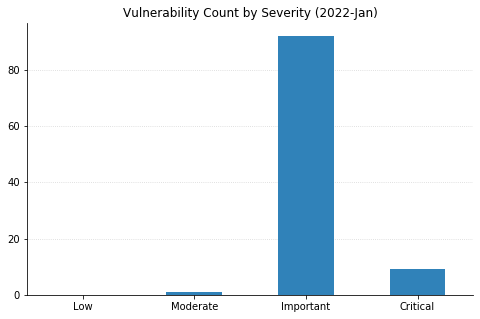
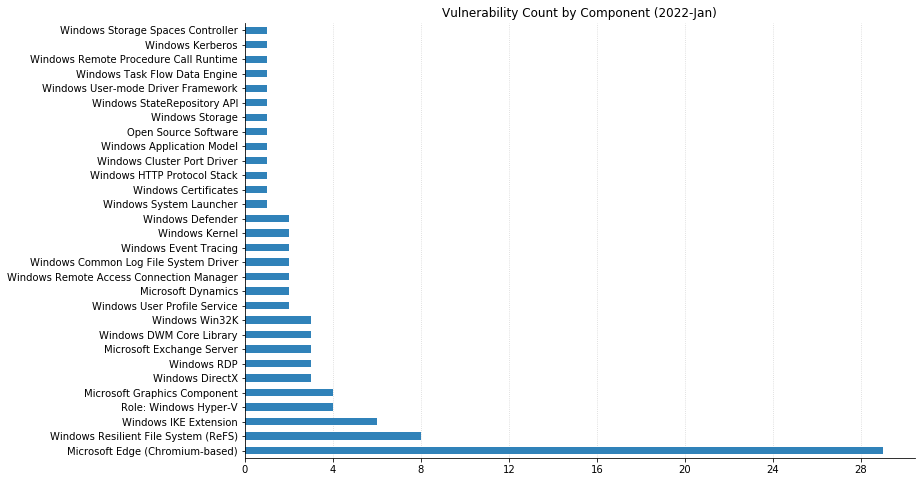
The first Patch Tuesday of 2022 sees Microsoft publishing fixes for over 120 CVEs across the bulk of their product line, including 29 previously patched CVEs affecting their Edge browser via Chromium. None of these have yet been seen exploited in the wild, though six were publicly disclosed prior to today. This includes two Remote Code Execution (RCE) vulnerabilities in open source libraries that are bundled with more recent versions of Windows: CVE-2021-22947, which affects the curl library, and CVE-2021-36976 which affects libarchive.
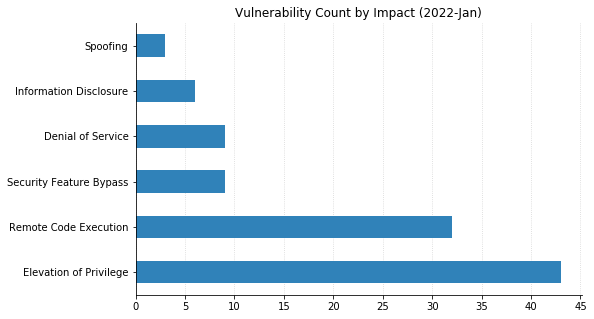
The majority of this month’s patched vulnerabilities, such as CVE-2022-21857 (affecting Active Directory Domain Services), allow attackers to elevate their privileges on systems or networks they already have a foothold in.
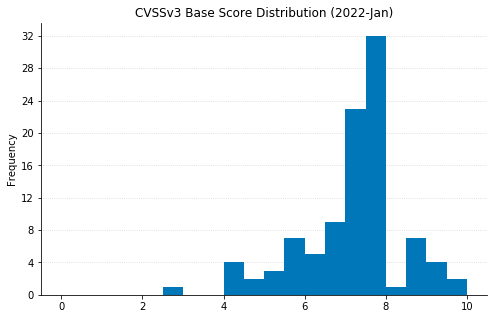
Besides CVE-2021-22947 (libcurl), several other Critical RCE vulnerabilities were also fixed. Most of these have caveats that reduce their scariness to some degree. The worst of these is CVE-2021-21907, affecting the Windows HTTP protocol stack. Although it carries a CVSSv3 base score of 9.8 and is considered potentially “wormable” by Microsoft, similar vulnerabilities have not proven to be rampantly exploited (see the AttackerKB analysis for CVE-2021-31166).
Not quite as bad is CVE-2022-21840, which affects all supported versions of Office, as well as Sharepoint Server. Exploitation would require social engineering to entice a victim to open an attachment or visit a malicious website – thankfully the Windows preview pane is not a vector for this attack.
CVE-2022-21846 affects Exchange Server, but cannot be exploited directly over the public internet (attackers need to be “adjacent” to the target system in terms of network topology). This restriction also applies to CVE-2022-21855 and CVE-2022-21969, two less severe RCEs in Exchange this month.
CVE-2022-21912 and CVE-2022-21898 both affect DirectX Graphics and require local access. CVE-2022-21917 is a vulnerability in the Windows Codecs library. In most cases, systems should automatically get patched; however, some organizations may have the vulnerable codec preinstalled on their gold images and disable Windows Store updates.
Defenders should prioritize patching servers (Exchange, Sharepoint, Hyper-V, and IIS) followed by web browsers and other client software.
| CVE | Title | Exploited | Publicly disclosed | CVSSv3 base | Additional FAQ |
|---|---|---|---|---|---|
| CVE-2022-21930 | Microsoft Edge (Chromium-based) Remote Code Execution Vulnerability | No | No | 4.2 | Yes |
| CVE-2022-21931 | Microsoft Edge (Chromium-based) Remote Code Execution Vulnerability | No | No | 4.2 | Yes |
| CVE-2022-21929 | Microsoft Edge (Chromium-based) Remote Code Execution Vulnerability | No | No | 2.5 | Yes |
| CVE-2022-21954 | Microsoft Edge (Chromium-based) Elevation of Privilege Vulnerability | No | No | 6.1 | Yes |
| CVE-2022-21970 | Microsoft Edge (Chromium-based) Elevation of Privilege Vulnerability | No | No | 6.1 | Yes |
| CVE-2022-0120 | Chromium: CVE-2022-0120 Inappropriate implementation in Passwords | No | No | nan | Yes |
| CVE-2022-0118 | Chromium: CVE-2022-0118 Inappropriate implementation in WebShare | No | No | nan | Yes |
| CVE-2022-0117 | Chromium: CVE-2022-0117 Policy bypass in Service Workers | No | No | nan | Yes |
| CVE-2022-0116 | Chromium: CVE-2022-0116 Inappropriate implementation in Compositing | No | No | nan | Yes |
| CVE-2022-0115 | Chromium: CVE-2022-0115 Uninitialized Use in File API | No | No | nan | Yes |
| CVE-2022-0114 | Chromium: CVE-2022-0114 Out of bounds memory access in Web Serial | No | No | nan | Yes |
| CVE-2022-0113 | Chromium: CVE-2022-0113 Inappropriate implementation in Blink | No | No | nan | Yes |
| CVE-2022-0112 | Chromium: CVE-2022-0112 Incorrect security UI in Browser UI | No | No | nan | Yes |
| CVE-2022-0111 | Chromium: CVE-2022-0111 Inappropriate implementation in Navigation | No | No | nan | Yes |
| CVE-2022-0110 | Chromium: CVE-2022-0110 Incorrect security UI in Autofill | No | No | nan | Yes |
| CVE-2022-0109 | Chromium: CVE-2022-0109 Inappropriate implementation in Autofill | No | No | nan | Yes |
| CVE-2022-0108 | Chromium: CVE-2022-0108 Inappropriate implementation in Navigation | No | No | nan | Yes |
| CVE-2022-0107 | Chromium: CVE-2022-0107 Use after free in File Manager API | No | No | nan | Yes |
| CVE-2022-0106 | Chromium: CVE-2022-0106 Use after free in Autofill | No | No | nan | Yes |
| CVE-2022-0105 | Chromium: CVE-2022-0105 Use after free in PDF | No | No | nan | Yes |
| CVE-2022-0104 | Chromium: CVE-2022-0104 Heap buffer overflow in ANGLE | No | No | nan | Yes |
| CVE-2022-0103 | Chromium: CVE-2022-0103 Use after free in SwiftShader | No | No | nan | Yes |
| CVE-2022-0102 | Chromium: CVE-2022-0102 Type Confusion in V8 | No | No | nan | Yes |
| CVE-2022-0101 | Chromium: CVE-2022-0101 Heap buffer overflow in Bookmarks | No | No | nan | Yes |
| CVE-2022-0100 | Chromium: CVE-2022-0100 Heap buffer overflow in Media streams API | No | No | nan | Yes |
| CVE-2022-0099 | Chromium: CVE-2022-0099 Use after free in Sign-in | No | No | nan | Yes |
| CVE-2022-0098 | Chromium: CVE-2022-0098 Use after free in Screen Capture | No | No | nan | Yes |
| CVE-2022-0097 | Chromium: CVE-2022-0097 Inappropriate implementation in DevTools | No | No | nan | Yes |
| CVE-2022-0096 | Chromium: CVE-2022-0096 Use after free in Storage | No | No | nan | Yes |
| CVE | Title | Exploited | Publicly disclosed | CVSSv3 base | Additional FAQ |
|---|---|---|---|---|---|
| CVE-2022-21911 | .NET Framework Denial of Service Vulnerability | No | No | 7.5 | No |
| CVE | Title | Exploited | Publicly disclosed | CVSSv3 base | Additional FAQ |
|---|---|---|---|---|---|
| CVE-2022-21924 | Workstation Service Remote Protocol Security Feature Bypass Vulnerability | No | No | 5.3 | No |
| CVE-2022-21834 | Windows User-mode Driver Framework Reflector Driver Elevation of Privilege Vulnerability | No | No | 7 | No |
| CVE-2022-21919 | Windows User Profile Service Elevation of Privilege Vulnerability | No | Yes | 7 | No |
| CVE-2022-21885 | Windows Remote Access Connection Manager Elevation of Privilege Vulnerability | No | No | 7.8 | No |
| CVE-2022-21914 | Windows Remote Access Connection Manager Elevation of Privilege Vulnerability | No | No | 7.8 | Yes |
| CVE-2022-21920 | Windows Kerberos Elevation of Privilege Vulnerability | No | No | 8.8 | Yes |
| CVE-2022-21908 | Windows Installer Elevation of Privilege Vulnerability | No | No | 7.8 | No |
| CVE-2022-21843 | Windows IKE Extension Denial of Service Vulnerability | No | No | 7.5 | Yes |
| CVE-2022-21883 | Windows IKE Extension Denial of Service Vulnerability | No | No | 7.5 | Yes |
| CVE-2022-21848 | Windows IKE Extension Denial of Service Vulnerability | No | No | 7.5 | Yes |
| CVE-2022-21889 | Windows IKE Extension Denial of Service Vulnerability | No | No | 7.5 | Yes |
| CVE-2022-21890 | Windows IKE Extension Denial of Service Vulnerability | No | No | 7.5 | Yes |
| CVE-2022-21900 | Windows Hyper-V Security Feature Bypass Vulnerability | No | No | 4.6 | Yes |
| CVE-2022-21905 | Windows Hyper-V Security Feature Bypass Vulnerability | No | No | 4.6 | Yes |
| CVE-2022-21880 | Windows GDI+ Information Disclosure Vulnerability | No | No | 7.5 | Yes |
| CVE-2022-21915 | Windows GDI+ Information Disclosure Vulnerability | No | No | 6.5 | Yes |
| CVE-2022-21904 | Windows GDI Information Disclosure Vulnerability | No | No | 7.5 | Yes |
| CVE-2022-21903 | Windows GDI Elevation of Privilege Vulnerability | No | No | 7 | No |
| CVE-2022-21899 | Windows Extensible Firmware Interface Security Feature Bypass Vulnerability | No | No | 5.5 | No |
| CVE-2022-21916 | Windows Common Log File System Driver Elevation of Privilege Vulnerability | No | No | 7.8 | No |
| CVE-2022-21897 | Windows Common Log File System Driver Elevation of Privilege Vulnerability | No | No | 7.8 | No |
| CVE-2022-21838 | Windows Cleanup Manager Elevation of Privilege Vulnerability | No | No | 5.5 | Yes |
| CVE-2022-21836 | Windows Certificate Spoofing Vulnerability | No | Yes | 7.8 | Yes |
| CVE-2022-21925 | Windows BackupKey Remote Protocol Security Feature Bypass Vulnerability | No | No | 5.3 | No |
| CVE-2022-21862 | Windows Application Model Core API Elevation of Privilege Vulnerability | No | No | 7 | No |
| CVE-2022-21859 | Windows Accounts Control Elevation of Privilege Vulnerability | No | No | 7 | No |
| CVE-2022-21833 | Virtual Machine IDE Drive Elevation of Privilege Vulnerability | No | No | 7.8 | No |
| CVE-2022-21922 | Remote Procedure Call Runtime Remote Code Execution Vulnerability | No | No | 8.8 | Yes |
| CVE-2022-21893 | Remote Desktop Protocol Remote Code Execution Vulnerability | No | No | 8.8 | Yes |
| CVE-2022-21850 | Remote Desktop Client Remote Code Execution Vulnerability | No | No | 8.8 | Yes |
| CVE-2022-21851 | Remote Desktop Client Remote Code Execution Vulnerability | No | No | 8.8 | Yes |
| CVE-2022-21835 | Microsoft Cryptographic Services Elevation of Privilege Vulnerability | No | No | 7.8 | No |
| CVE-2022-21884 | Local Security Authority Subsystem Service Elevation of Privilege Vulnerability | No | No | 7.8 | No |
| CVE-2022-21913 | Local Security Authority (Domain Policy) Remote Protocol Security Feature Bypass | No | No | 5.3 | No |
| CVE-2022-21857 | Active Directory Domain Services Elevation of Privilege Vulnerability | No | No | 8.8 | Yes |
| CVE | Title | Exploited | Publicly disclosed | CVSSv3 base | Additional FAQ |
|---|---|---|---|---|---|
| CVE-2022-21846 | Microsoft Exchange Server Remote Code Execution Vulnerability | No | No | 9 | Yes |
| CVE-2022-21855 | Microsoft Exchange Server Remote Code Execution Vulnerability | No | No | 9 | Yes |
| CVE-2022-21969 | Microsoft Exchange Server Remote Code Execution Vulnerability | No | No | 9 | Yes |
| CVE | Title | Exploited | Publicly disclosed | CVSSv3 base | Additional FAQ |
|---|---|---|---|---|---|
| CVE-2022-21932 | Microsoft Dynamics 365 Customer Engagement Cross-Site Scripting Vulnerability | No | No | 7.6 | No |
| CVE-2022-21891 | Microsoft Dynamics 365 (on-premises) Spoofing Vulnerability | No | No | 7.6 | No |
| CVE | Title | Exploited | Publicly disclosed | CVSSv3 base | Additional FAQ |
|---|---|---|---|---|---|
| CVE-2022-21842 | Microsoft Word Remote Code Execution Vulnerability | No | No | 7.8 | Yes |
| CVE-2022-21837 | Microsoft SharePoint Server Remote Code Execution Vulnerability | No | No | 8.3 | Yes |
| CVE-2022-21840 | Microsoft Office Remote Code Execution Vulnerability | No | No | 8.8 | Yes |
| CVE-2022-21841 | Microsoft Excel Remote Code Execution Vulnerability | No | No | 7.8 | Yes |
| CVE | Title | Exploited | Publicly disclosed | CVSSv3 base | Additional FAQ |
|---|---|---|---|---|---|
| CVE-2022-21895 | Windows User Profile Service Elevation of Privilege Vulnerability | No | No | 7.8 | No |
| CVE-2022-21864 | Windows UI Immersive Server API Elevation of Privilege Vulnerability | No | No | 7 | No |
| CVE-2022-21866 | Windows System Launcher Elevation of Privilege Vulnerability | No | No | 7 | No |
| CVE-2022-21875 | Windows Storage Elevation of Privilege Vulnerability | No | No | 7 | No |
| CVE-2022-21863 | Windows StateRepository API Server file Elevation of Privilege Vulnerability | No | No | 7 | No |
| CVE-2022-21874 | Windows Security Center API Remote Code Execution Vulnerability | No | Yes | 7.8 | No |
| CVE-2022-21892 | Windows Resilient File System (ReFS) Remote Code Execution Vulnerability | No | No | 6.8 | Yes |
| CVE-2022-21958 | Windows Resilient File System (ReFS) Remote Code Execution Vulnerability | No | No | 6.8 | Yes |
| CVE-2022-21959 | Windows Resilient File System (ReFS) Remote Code Execution Vulnerability | No | No | 6.8 | Yes |
| CVE-2022-21960 | Windows Resilient File System (ReFS) Remote Code Execution Vulnerability | No | No | 6.8 | Yes |
| CVE-2022-21961 | Windows Resilient File System (ReFS) Remote Code Execution Vulnerability | No | No | 6.8 | Yes |
| CVE-2022-21962 | Windows Resilient File System (ReFS) Remote Code Execution Vulnerability | No | No | 6.8 | Yes |
| CVE-2022-21963 | Windows Resilient File System (ReFS) Remote Code Execution Vulnerability | No | No | 6.4 | Yes |
| CVE-2022-21928 | Windows Resilient File System (ReFS) Remote Code Execution Vulnerability | No | No | 6.3 | Yes |
| CVE-2022-21867 | Windows Push Notifications Apps Elevation Of Privilege Vulnerability | No | No | 7 | No |
| CVE-2022-21888 | Windows Modern Execution Server Remote Code Execution Vulnerability | No | No | 7.8 | No |
| CVE-2022-21881 | Windows Kernel Elevation of Privilege Vulnerability | No | No | 7 | No |
| CVE-2022-21879 | Windows Kernel Elevation of Privilege Vulnerability | No | No | 5.5 | No |
| CVE-2022-21849 | Windows IKE Extension Remote Code Execution Vulnerability | No | No | 9.8 | Yes |
| CVE-2022-21901 | Windows Hyper-V Elevation of Privilege Vulnerability | No | No | 9 | Yes |
| CVE-2022-21847 | Windows Hyper-V Denial of Service Vulnerability | No | No | 6.5 | No |
| CVE-2022-21878 | Windows Geolocation Service Remote Code Execution Vulnerability | No | No | 7.8 | No |
| CVE-2022-21872 | Windows Event Tracing Elevation of Privilege Vulnerability | No | No | 7 | No |
| CVE-2022-21839 | Windows Event Tracing Discretionary Access Control List Denial of Service Vulnerability | No | Yes | 6.1 | No |
| CVE-2022-21868 | Windows Devices Human Interface Elevation of Privilege Vulnerability | No | No | 7 | No |
| CVE-2022-21921 | Windows Defender Credential Guard Security Feature Bypass Vulnerability | No | No | 4.4 | No |
| CVE-2022-21906 | Windows Defender Application Control Security Feature Bypass Vulnerability | No | No | 5.5 | No |
| CVE-2022-21852 | Windows DWM Core Library Elevation of Privilege Vulnerability | No | No | 7.8 | No |
| CVE-2022-21902 | Windows DWM Core Library Elevation of Privilege Vulnerability | No | No | 7.8 | No |
| CVE-2022-21896 | Windows DWM Core Library Elevation of Privilege Vulnerability | No | No | 7 | No |
| CVE-2022-21858 | Windows Bind Filter Driver Elevation of Privilege Vulnerability | No | No | 7.8 | No |
| CVE-2022-21860 | Windows AppContracts API Server Elevation of Privilege Vulnerability | No | No | 7 | No |
| CVE-2022-21876 | Win32k Information Disclosure Vulnerability | No | No | 5.5 | Yes |
| CVE-2022-21882 | Win32k Elevation of Privilege Vulnerability | No | No | 7 | Yes |
| CVE-2022-21887 | Win32k Elevation of Privilege Vulnerability | No | No | 7 | Yes |
| CVE-2022-21873 | Tile Data Repository Elevation of Privilege Vulnerability | No | No | 7 | No |
| CVE-2022-21861 | Task Flow Data Engine Elevation of Privilege Vulnerability | No | No | 7 | No |
| CVE-2022-21870 | Tablet Windows User Interface Application Core Elevation of Privilege Vulnerability | No | No | 7 | No |
| CVE-2022-21877 | Storage Spaces Controller Information Disclosure Vulnerability | No | No | 5.5 | Yes |
| CVE-2022-21894 | Secure Boot Security Feature Bypass Vulnerability | No | No | 4.4 | No |
| CVE-2022-21964 | Remote Desktop Licensing Diagnoser Information Disclosure Vulnerability | No | No | 5.5 | Yes |
| CVE-2021-22947 | Open Source Curl Remote Code Execution Vulnerability | No | Yes | nan | Yes |
| CVE-2022-21871 | Microsoft Diagnostics Hub Standard Collector Runtime Elevation of Privilege Vulnerability | No | No | 7 | No |
| CVE-2022-21910 | Microsoft Cluster Port Driver Elevation of Privilege Vulnerability | No | No | 7.8 | No |
| CVE-2021-36976 | Libarchive Remote Code Execution Vulnerability | No | Yes | nan | Yes |
| CVE-2022-21907 | HTTP Protocol Stack Remote Code Execution Vulnerability | No | No | 9.8 | Yes |
| CVE-2022-21917 | HEVC Video Extensions Remote Code Execution Vulnerability | No | No | 7.8 | Yes |
| CVE-2022-21912 | DirectX Graphics Kernel Remote Code Execution Vulnerability | No | No | 7.8 | Yes |
| CVE-2022-21898 | DirectX Graphics Kernel Remote Code Execution Vulnerability | No | No | 7.8 | No |
| CVE-2022-21918 | DirectX Graphics Kernel File Denial of Service Vulnerability | No | No | 6.5 | No |
| CVE-2022-21865 | Connected Devices Platform Service Elevation of Privilege Vulnerability | No | No | 7 | No |
| CVE-2022-21869 | Clipboard User Service Elevation of Privilege Vulnerability | No | No | 7 | No |
Post Syndicated from Temi Adebambo original https://aws.amazon.com/blogs/security/2021-aws-security-focused-workshops/
Every year, Amazon Web Services (AWS) looks to help our customers gain more experience and knowledge of our services through hands-on workshops. In 2021, we unfortunately couldn’t connect with you in person as much as we would have liked, so we wanted to create and share new ways to learn and build on AWS. We built and published several security-focused workshops that help you learn how to use or configure new services and features securely. Workshops are hands-on learning modules designed to teach or introduce practical skills, techniques, or concepts you can use to solve business problems.
In this blog post, we highlight the newest AWS security-focused workshops below. There are also several other workshops that were developed before 2021; you can find them on AWS Workshops, AWS Security Workshops, and AWS Samples. Here’s the list:
|
Workshop Title |
Abstract |
|
In this workshop, get familiar with Amazon Macie and learn to scan and classify data in your Amazon Simple Storage Service (Amazon S3) buckets. Work with Macie (data classification) and AWS Security Hub (centralized security view) to see how data in your environment is stored, and to understand any changes in S3 bucket policies that may affect your security posture. Learn to create a custom data identifier and to create and scope data discovery and classification jobs in Macie. Finally, use Macie to filter and investigate the results from the scans you create. |
|
|
AWS makes it easy to protect your data with encryption. This hands-on workshop provides an opportunity to dive deep into encryption at rest options with AWS. Learn AWS server-side encryption with AWS Key Management Service (AWS KMS) for services such as Amazon S3, Amazon Elastic Block Store (Amazon EBS), and Amazon Relational Database Service (Amazon RDS). Also, learn best practices for using AWS KMS across multiple accounts and Regions and how to scale while optimizing for performance. |
|
|
Store, retrieve, and manage sensitive credentials in AWS Secrets Manager |
In this workshop, learn how to integrate AWS Secrets Manager in your development platform, backed by serverless applications. Work through a sample application, and use Secrets Manager to retrieve credentials as well as work with attribute-based access control using tags. Also, learn how to monitor the compliance of secrets and implement incident response workflows that will rotate the secret, restore the resource policy, alert the SOC, and deny access to the offender. |
|
Building and operating a Private Certificate Authority on AWS |
This workshop covers private certificate management on AWS, employing the concepts of least privilege, separation of duties, monitoring, and automation. Participants learn operational aspects of creating a complete certificate authority (CA) hierarchy, building a simple web application, and issuing private certificates. It also covers how job functions—including CA administrators, application developers, and security administrators—can follow the principle of least privilege to perform various functions associated with certificate management. Finally, learn about IoT certificates, code-signing, and certificate templates to enable all your use cases. |
|
Amazon S3 provides many security and access settings to help you secure your data, controls that ensure that those settings remain in place, and features to help you audit those settings and controls. This workshop walks you through these Amazon S3 capabilities and scenarios, to help you apply them for different security requirements. |
|
|
Amazon S3 Object Lambda works with your existing applications, and allows you to add your own code using AWS Lambda functions to automatically process and transform data from Amazon S3 before returning it to an application. This enables different views of the same object depending on user identity, such as restricting access to confidential information, or disallowing access to personally identifiable information (PII) data. In this workshop, learn how to use Amazon S3 Object Lambda to modify objects during GET requests, so you no longer need to store multiple views of the same document. |
|
|
In this hands-on workshop, learn how to use AWS Nitro Enclaves to isolate highly-sensitive data from your users, applications, and third-party libraries on your Amazon Elastic Compute Cloud (Amazon EC2) instances. Explore AWS Nitro Enclaves, discuss common use cases, and build and run your own enclave. During this workshop, learn about enclave isolation, cryptographic attestation, enclave image files, local Vsock communication channels, common debugging scenarios, and the enclave lifecycle. |
|
|
Learn how to use the protective, detective and monitoring controls in AWS to protect your data in S3 from ransomware threats. Set up Amazon GuardDuty for S3 and AWS Identity and Access Management (IAM) Access Analyzer, and learn to read and respond to findings and create IAM invariants. Create a tiered storage approach to backup and recovery, and learn to use Amazon S3 Object Lock, versioning, and replication to provide immutable storage and protect against accidental or malicious deletion. |
|
Operating multiple AWS accounts under an organization is how many users consume AWS Cloud services. In this workshop, learn how to build foundational security monitoring in multi-account environments. Walk through an initial setup of AWS Security Hub for centralized aggregation of findings across your AWS Organizations organization. Additionally, learn how to centralize Amazon GuardDuty findings, Amazon Detective functions, AWS Identity and Access Management (IAM) Access Analyzer findings (if available), AWS Config rule evaluations, and AWS CloudTrail logs into the central security monitoring account (security tools account). Finally, implement a service control policy (SCP) that denies the ability to disable these security controls. |
|
|
Automation and simplification are key to managing compliance at scale. Remediation is one of the essential elements of simplifying and managing risk. In this workshop, see how to build a remediation workflow using AWS Config and AWS Systems Manager automation. Learn how this workflow can be deployed at scale and monitored with AWS Security Hub to oversee the entire organization and how to use AWS Audit Manager to easily access evidence of risk management. |
|
Want to analyze Identity and Access Management (IAM) policies at scale? Want to help your developers write secure IAM policies? This workshop provides you the hands-on opportunity to run IAM Access Analyzer policy validation on your AWS CloudFormation templates in a continuous integration/continuous deployment (CI/CD) pipeline. |
|
|
In this workshop, learn how to create a data perimeter by building controls that allow access to data only from expected network locations and by trusted identities. The workshop consists of five modules, each designed to illustrate a different Identity and Access Management (IAM) or network control. Learn where and how to implement the appropriate controls based on different risk scenarios. Discover how to implement these controls as service control policies, identity- and resource-based policies, and Amazon Virtual Private Cloud (Amazon VPC) endpoint policies. |
|
Build a Zero Trust architecture for service-to-service workloads on AWS |
In this workshop, get hands-on experience implementing a Zero Trust architecture for service-to-service workloads on AWS. Learn how to use services such as Amazon API Gateway and Virtual Private Cloud (Amazon VPC) endpoints to integrate network and identity controls while using Amazon GuardDuty, Lambda, and Amazon DynamoDB to take advantage of native service controls. Learn how these services allow you to authorize specific flows between components to reduce lateral network mobility risk and improve the overall security posture of your workload. |
|
Enterprise users adopting machine learning (ML) on AWS often look for prescriptive guidance on implementing security best practices, establishing governance, securing their ML models, and meeting compliance standards. Building a repeatable solution provides users with standardization and governance over what gets provisioned in their AWS account. In this workshop, learn steps you can take to secure third-party ML model deployments. We provide cloud infrastructure-as-code templates to automate the setup of a hardened Amazon SageMaker environment. These templates include private networking, VPC endpoints, end-to-end encryption, logging and monitoring, and enhanced governance and access controls through AWS Service Catalog. |
|
|
Building Prowler into a QuickSight-powered AWS security dashboard |
In this workshop, get hands-on experience with Prowler, AWS Security Hub, and Amazon QuickSight by building a custom security dashboard for the AWS environment. Using a multi-account deployment of Prowler integrated into Security Hub, learn to identify and analyze Prowler findings and integrate QuickSight to visualize the information. Discover how to get the most from QuickSight and Prowler with automatically created datasets. |
|
Integration, prioritization, and response with AWS Security Hub |
This workshop is designed to get you familiar with AWS Security Hub, so you can better understand how to use it in your own AWS environment. This workshop has two sections. The first section demonstrates the features and functions of AWS Security Hub. The second section shows you how to use AWS Security Hub to import findings from different data sources, analyze findings so you can prioritize response work, and implement responses to findings to help improve your security posture. |
|
Building an AWS incident response plan using Jupyter notebooks |
This workshop guides you through building an incident response plan for your AWS environment using Jupyter notebooks. Walk through an easy-to-follow sample incident, using building blocks as a ready-to-use playbook in a Jupyter notebook. Then, follow simple steps to add additional programmatic and documented steps to your incident response plan. |
|
In this hands-on workshop, learn about several AWS services involved in threat detection and response as you walk through real-world threat scenarios. Learn about the threat detection capabilities of Amazon GuardDuty, Amazon Macie, and AWS Security Hub and the available response options. For each hands-on scenario, review methods to detect and respond to threats using the following services: AWS CloudTrail, Virtual Private Cloud (Amazon VPC) Flow Logs, Amazon CloudWatch Events, AWS Lambda, Amazon Inspector, Amazon GuardDuty, and AWS Security Hub. |
|
|
In this workshop, learn how to develop incident response playbooks. Explore the incident response lifecycle, including preparation, detection and analysis, containment, eradication and recovery, and post-incident activity. To get the most out of this workshop, you should have advanced experience with AWS services and responsibilities aligned with incident response frameworks such as NIST SP 800-61 R2. |
This list is representative of the security workshops created in 2021 to help customers on their journey in AWS. If you’d like to find more workshops, please go to AWS Workshops and select Security in the top navigation bar, or you can also check out AWS Security Workshops for a subset of workshops curated by AWS Security Specialists. We hope you enjoy these workshops!
If you have feedback about this post, submit comments in the Comments section below.
Want more AWS Security news? Follow us on Twitter.
Post Syndicated from Roneel Kumar original https://aws.amazon.com/blogs/architecture/using-amazon-aurora-global-database-for-low-latency-without-application-changes/
Deploying global applications has many challenges, especially when accessing a database to build custom pages for end users. One example is an application using AWS Lambda@Edge. Two main challenges include performance and availability.
This blog explains how you can optimally deploy a global application with fast response times and without application changes.
The Amazon Aurora Global Database enables a single database cluster to span multiple AWS Regions by asynchronously replicating your data within subsecond timing. This provides fast, low-latency local reads in each Region. It also enables disaster recovery from Region-wide outages using multi-Region writer failover. These capabilities minimize the recovery time objective (RTO) of cluster failure, thus reducing data loss during failure. You will then be able to achieve your recovery point objective (RPO).
However, there are some implementation challenges. Most applications are designed to connect to a single hostname with atomic, consistent, isolated, and durable (ACID) consistency. But Global Aurora clusters provide reader hostname endpoints in each Region. In the primary Region, there are two endpoints, one for writes, and one for reads. To achieve strong data consistency, a global application requires the ability to:
These capabilities typically require additional development.
The Heimdall Proxy coupled with Amazon Route 53 allows edge-based applications to access the Aurora Global Database seamlessly, without application changes. Features include automated Read/Write split with ACID compliance and edge results caching.

Figure 1. Heimdall Proxy architecture
The architecture in Figure 1 shows Aurora Global Databases primary Region in AP-SOUTHEAST-2, and secondary Regions in AP-SOUTH-1 and US-WEST-2. The Heimdall Proxy uses latency-based routing to determine the closest Reader Instance for read traffic, and redirects all write traffic to the Writer Instance. The Heimdall Configuration stores the Amazon Resource Name (ARN) of the global cluster. It automatically detects failover and cross-Region on the cluster, and directs traffic accordingly.
With an Aurora Global Database, there are two approaches to failover:
The Heimdall Proxy automatically detects Amazon Relational Database Service (RDS) / Amazon Aurora configuration changes based on the ARN of the Aurora Global cluster. Therefore, both managed planned and manual unplanned failovers are supported.
Implementing the Heimdall Proxy has many benefits for global applications:
For more information on configuring the Heimdall Proxy and Amazon Route 53 for a global database, read the Heimdall Proxy for Aurora Global Database Solution Guide.
Download a free trial from the AWS Marketplace.
Resources:
Heimdall Data, based in the San Francisco Bay Area, is an AWS Advanced ISV partner. They have AWS Service Ready designations for Amazon RDS and Amazon Redshift. Heimdall Data offers a database proxy that offloads SQL improving database scale. Deployment does not require code changes.
Post Syndicated from Nipun Chagari original https://aws.amazon.com/blogs/big-data/transform-data-and-create-dashboards-using-aws-glue-databrew-and-tableau/
Before you can create visuals and dashboards that convey useful information, you need to transform and prepare the underlying data. With AWS Glue DataBrew, you can now easily transform and prepare datasets from Amazon Simple Storage Service (Amazon S3), an Amazon Redshift data warehouse, Amazon Aurora, and other Amazon Relational Database Service (Amazon RDS) databases and upload them into Amazon S3 to visualize the transformed data in a dashboard using Amazon QuickSight or other business intelligence (BI) tools like Tableau.
DataBrew now also supports writing prepared data into Tableau Hyper format, allowing you to easily take prepared datasets from Amazon S3 and upload them into Tableau for further visualization and analysis. Hyper is Tableau’s in-memory data engine technology optimized for fast data ingest and analytical query processing on large or complex datasets.
In this post, we use DataBrew to extract data from Amazon Redshift, cleanse and transform data using DataBrew to Tableau Hyper format without any coding, and store it in Amazon S3.
The following diagram illustrates the architecture of the solution.
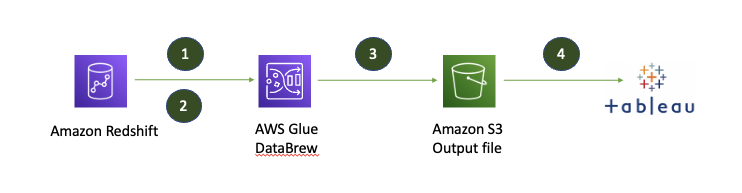
The solution workflow includes the following steps:
For this walkthrough, you should have the following prerequisites:
The following screenshots show the configuration for creating an Amazon Redshift cluster using the Amazon Redshift console with demo sales data. For more information about network security for the cluster, see Setting Up a VPC to Connect to JDBC Data Stores.
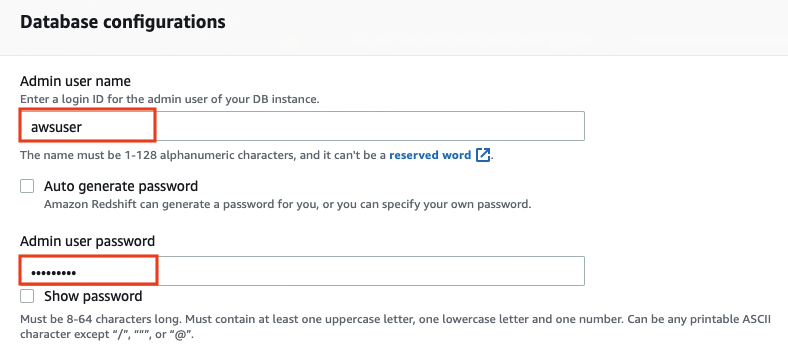
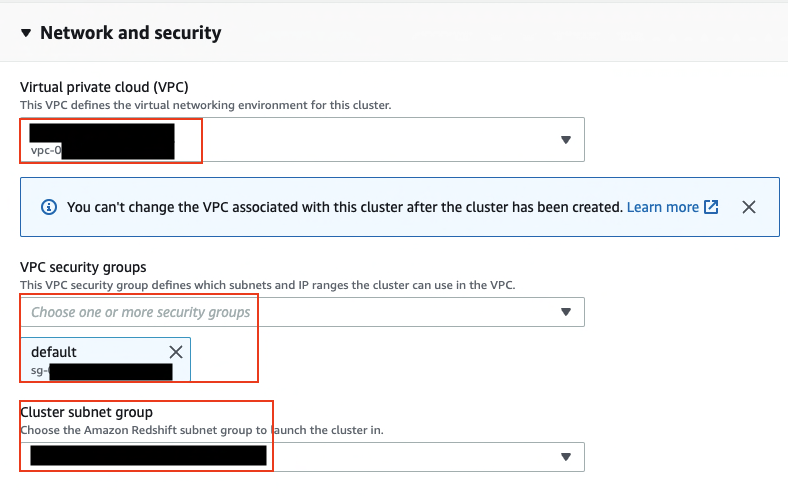
For this post, we use the sample data that comes with the Amazon Redshift cluster.
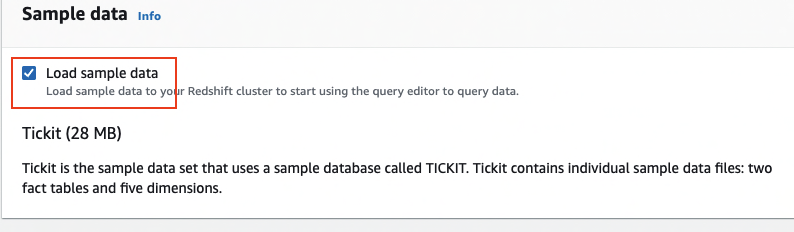
In this post, we only demonstrate how to transform your Amazon Redshift data to Hyper format; uploading the file for further analysis is out of scope.
In this step, you use the DataBrew console to create an Amazon Redshift connection.
ticket-db-connection).
To create a new dataset, complete the following steps:
sales.
AwsGlueDataBrew-tickit-sales-db-connection).DataBrew uses this bucket to store the intermediate results.
 If your query is taking too much time, then add
LIMIT clause in your Select statement.To create a new project, complete the following steps:
sales-project.sales-project-recipe.
sales dataset.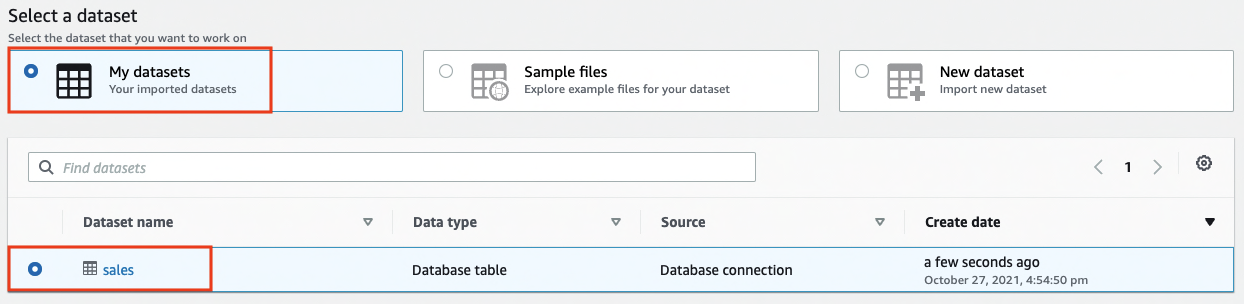

When the project is opened, a DataBrew interactive session is created. DataBrew retrieves sample data based on your sampling configuration selection.
When we connect a dataset to an Amazon Redshift cluster in your VPC, DataBrew provisions an elastic network interface in your VPC without a public IPV4 address. Because of this, you need to provision a NAT gateway in your VPC as well as an appropriate subnet route table configured for the subnets associated with the AWS Glue network interfaces. To use DataBrew with a VPC subnet without a NAT, you must have a gateway VPC endpoint to Amazon S3 and a VPC endpoint for the AWS Glue interface in your VPC. For more information, see Create a gateway endpoint and Interface VPC endpoints (AWS PrivateLink).
In this step, we perform some feature engineering techniques (transformations) to prepare our dataset and drop the unnecessary columns from our dataset that aren’t required for this exercise.

pricepaid and commissions.
With DataBrew, you can now use IF, AND, OR, and CASE logical conditions to create transformations based on functions. With this feature, you have the flexibility to use custom values or reference other columns within the expressions, and can create adaptable transformations for their specific use cases.
To add a logical condition to your transformation recipe, complete the following steps:

qtysold.2.opportunity.
The following screenshot shows the full recipe that we applied to our dataset.
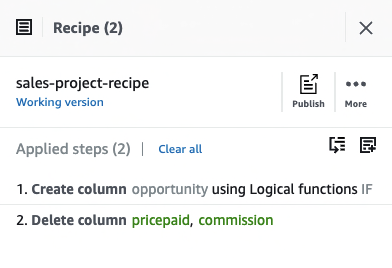
Now that we have built the recipe, we can create and run the DataBrew recipe job.
sales-opportunities.
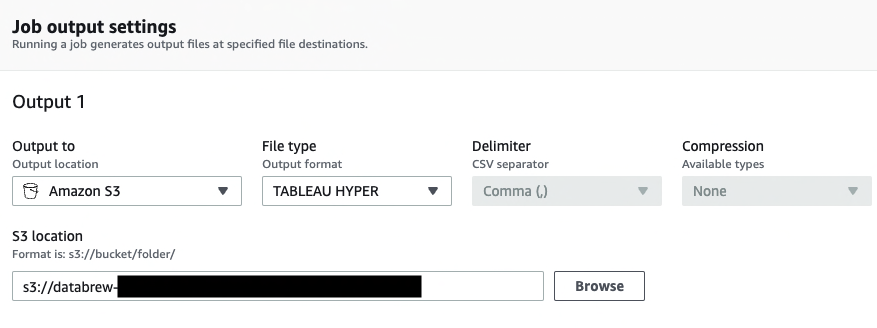
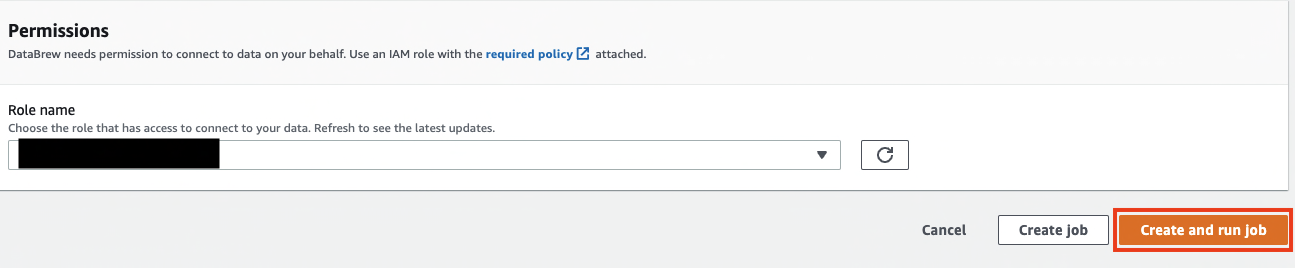
sales-opportunity job to complete.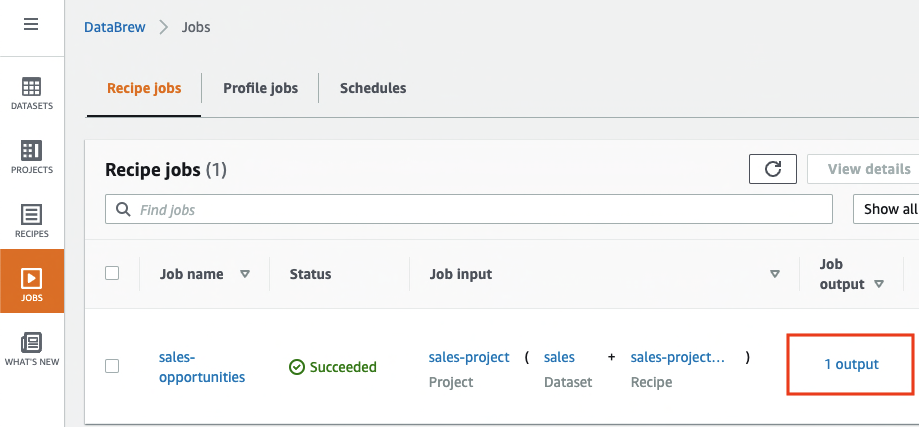

To avoid incurring future charges, delete the resources you created:
sales-project and its associated recipe sales-project-recipeIn this post, we showed you how to connect to an Amazon Redshift cluster and create a DataBrew dataset.
We saw how easy it is to get data from Amazon Redshift into DataBrew and apply transformations without any coding. We then ran a recipe job to convert this dataset to Tableau Hyper format file and store it in Amazon S3 for visualization using Tableau. Learn more about all the products and service integrations that AWS Glue DataBrew supports.
 Nipun Chagari is a Senior Solutions Architect at AWS, where he helps customers build highly available, scalable, and resilient applications on the AWS Cloud. He is currently focused on helping customers leverage serverless technology to meet their business objectives.
 Mohit Malik is a Senior Solutions Architect at Amazon Web Services who specializes in compute, networking, and serverless technologies. He enjoys helping customers learn how to operate efficiently and effectively in the cloud. In his spare time, Mohit enjoys spending time with his family, reading books, and watching movies.
Post Syndicated from Molly Clancy original https://www.backblaze.com/blog/five-ways-to-use-object-lock-immutability/

If you want to understand how Object Lock immutability works, think of a valuable necklace sitting behind a window. If someone really wants that necklace, they will find a way to break that window. Reinforce the glass, add a silent alarm, none of it will change the fact that thieves can find a way.
With Object Lock immutability, there is no window. Instead, picture a fully realistic holographic representation of the necklace. You can still see your necklace, you can still enjoy its sparkle, but nothing anyone does to that hologram can alter the actual physical necklace.
Object Lock immutability works in a similar fashion, at least metaphorically speaking. (Object Lock doesn’t create a facsimile, per se, but it does protect objects from being manipulated, copied, encrypted, changed, or deleted for as long as the lock is set.) And it protects something far more valuable than some trinket: It protects your data.
In this post, learn about five different ways you can use Object Lock as well as some tips for using Object Lock effectively.
In functional programming, immutability is a characteristic of an object whose state cannot be changed after it has been created. Conversely, mutable objects are variable. But what does all that mean when it comes to Object Lock? By creating a model in which an individual object (i.e., a unit of data that contains all of the bytes that constitute what you would typically think of as a “file”) remains static and unchangeable, Object Lock immutability prevents important files from being deleted, corrupted, or otherwise damaged. Your files can, however, be freely accessed, giving you free rein to view important documents. This Write Once, Read Many (WORM) model is the cornerstone of Object Lock immutability.
Those of us above a certain age may recall the days when data was regularly transferred via floppy disc. Back in those dark days of dial-up, there was a simple plastic switch on each floppy disc that marked the disc as read-only or read-and-write. If the switch was flipped, the data on the disc could be read or transferred at will, but it was a one-way street. You were unable to alter the original data stored on the disc.
Object Lock Immutability serves the same function as that plastic switch, only it operates entirely within the code of your storage software. You can view, share, and open files at will. But the contents of that file cannot be changed.
With the right approach, Object Lock immutability can be used to solve a few problems, including:
Ransomware attacks are a major challenge for many businesses. In our research on the true cost of ransomware, we found that the cost of these incidents can exceed $1 million! That’s the bad news.
The good news is advanced planning can make it easier to recover from attacks. Specifically, preserving data backups with Object Lock is a helpful way to speed up your recovery from ransomware attacks. For example, you might decide to make daily backups of your most critical files and retain those backups for three months. In this case, you would have plenty of options for how to recover from an attack.
To achieve consistent security protection, we recommend integrating Object Lock into your IT security policy. For further guidance on how to do this, see our post, “How to Add Object Lock to Your IT Security Policy.”
Until recently, the most common way to protect data from being overwritten, corrupted, or deleted was by creating an “air gap” by way of LTO tapes. Under this system, sensitive files would be backed up to a tape and then physically removed from the drive. This created an effective shield of literal, physical air around the data by removing it entirely from your network, but it came at a cost.
Tape systems require an up-front investment and require ongoing maintenance, management, and eventual replacement. With Object Lock immutability as part of your cloud backup solution, the entire process of creating an air gap happens virtually, saving time and money while accomplishing the same goal. You can calculate the savings between cloud storage and tape yourself.
Your company probably has a variety of records retention requirements to fulfill. For example, the finance department likely has to retain records in case you are audited by tax authorities. In addition, your contracts with customers may expect you to retain records for a specific project for a set period. Once you determine which records need to be retained, Object Lock can preserve the records so they cannot be modified or deleted for the required duration. Object Lock means accidental deletion of records is much less likely.
Lawsuits and disputes are a fact of life in today’s environment, but there are steps you can take to reduce the impact and expense associated with them.
By applying Object Lock, your company will be better able to navigate the challenges of a lawsuit. You can focus on the substance of the dispute rather than spending endless hours answering questions about your data integrity.
New versions of files are created on a nearly constant basis during software development projects. Some software projects release new versions every day or every week. With many different software versions on your plate, there is a risk your team might get disorganized. Now, imagine if a new release of your software ends up having a serious security or performance flaw. In that case, rolling back to the previous version may save a tremendous amount of time and energy.
By using Object Lock on previous versions of your software, you can have confidence in your ability to access previous versions. For companies that produce custom software for clients, enhancing version control through Object Lock may be helpful for other reasons. In the event of a problem, a client might ask for access to earlier versions of the software. Preserving earlier versions of your software development with Object Lock makes it easier to respond to such requests.
As with any technology, achieving optimal results from Object Lock requires a thoughtful, guided approach. From a technical standpoint, there is no limit to how much data you can protect with Object Lock. However, excessive use of Object Lock may consume a significant amount of your data storage resources, negating any time and cost savings you’ve achieved.
Altering the amount of time an object is placed in Object Lock is just one way to ensure you’re getting the most out of this technology. Others include:
As a concept, Object Lock immutability is fairly easy to understand and even easier to use in protecting your vital data from incursion, corruption or deletion. Beyond simply protecting valuable data from cyber threats, it can create a clear timeline in case of litigation or simplify complicated development projects. By understanding how this tool works and how best to use it, you can secure your data, increase your efficiency, and improve the operation of your cloud storage.
The post Five Ways to Use Object Lock Immutability appeared first on Backblaze Blog | Cloud Storage & Cloud Backup.
Post Syndicated from Clara Lim original https://aws.amazon.com/blogs/security/new-irap-full-assessment-report-is-now-available-on-aws-artifact-for-australian-customers/
We are excited to announce that a new Information Security Registered Assessors Program (IRAP) report is now available on AWS Artifact, after a successful full assessment completed in December 2021 by an independent ASD (Australian Signals Directorate) certified IRAP assessor.
The new IRAP report includes reassessment of the existing 111 services which are already in scope for IRAP, as well as the 14 additional services listed below, and the new Melbourne region. For the full list of in-scope services, see the AWS Services in Scope page on the IRAP tab. All services in scope are available in the Asia Pacific (Sydney) Region.
The IRAP assessment report is developed in accordance with the Australian Cyber Security Centre (ACSC) Cloud Security Guidance and their Anatomy of a Cloud Assessment and Authorisation framework, which addresses guidance within the Australian Government Information Security Manual (ISM), the Attorney-General’s Department Protective Security Policy Framework (PSPF), and the Digital Transformation Agency (DTA) Secure Cloud Strategy.
We have created the IRAP documentation pack on AWS Artifact, which includes the AWS Consumer Guide and the whitepaper Reference Architectures for ISM PROTECTED Workloads in the AWS Cloud, which was created to help Australian government agencies and their partners plan, architect, and risk assess workloads based on AWS Cloud services.
Please reach out to your AWS representatives to let us know which additional services you would like to see in scope for coming IRAP assessments. We strive to bring more services into the scope of the IRAP PROTECTED level, based on your requirements.
If you have feedback about this post, submit comments in the Comments section below.
Want more AWS Security how-to content, news, and feature announcements? Follow us on Twitter.
Post Syndicated from Netflix Technology Blog original https://netflixtechblog.com/experimentation-is-a-major-focus-of-data-science-across-netflix-f67923f8e985
Martin Tingley with Wenjing Zheng, Simon Ejdemyr, Stephanie Lane, Colin McFarland, Andy Rhines, Sophia Liu, Mihir Tendulkar, Kevin Mercurio, Veronica Hannan, Ting-Po Lee
Earlier posts in this series covered the basics of A/B tests (Part 1 and Part 2 ), core statistical concepts (Part 3 and Part 4), and how to build confidence in decisions based on A/B test results (Part 5). Here we describe the role of Experimentation and A/B testing within the larger Data Science and Engineering organization at Netflix, including how our platform investments support running tests at scale while enabling innovation. The subsequent and final post in this series will discuss the importance of the culture of experimentation within Netflix.
Experimentation and causal inference is one of the primary focus areas within Netflix’s Data Science and Engineering organization. To directly support great decision-making throughout the company, there are a number of data science teams at Netflix that partner directly with Product Managers, engineering teams, and other business units to design, execute, and learn from experiments. To enable scale, we’ve built, and continue to invest in, an internal experimentation platform (XP for short). And we intentionally encourage collaboration between the centralized experimentation platform and the data science teams that partner directly with Netflix business units.
Curious to learn more about other Data Science and Engineering functions at Netflix? To learn about Analytics and Viz Engineering, have a look at Analytics at Netflix: Who We Are and What We Do by Molly Jackman & Meghana Reddy and How Our Paths Brought Us to Data and Netflix by Julie Beckley & Chris Pham. Curious to learn about what it’s like to be a Data Engineer at Netflix? Hear directly from Samuel Setegne, Dhevi Rajendran, Kevin Wylie, and Pallavi Phadnis in our “Data Engineers of Netflix” interview series.
Experimentation and causal inference data scientists who work directly with Netflix business units develop deep domain understanding and intuition about the business areas where they work. Data scientists in these roles apply the scientific method to improve the Netflix experience for current and future members, and are involved in the whole life cycle of experimentation: data exploration and ideation; designing and executing tests; analyzing results to help inform decisions on tests; synthesizing learnings from numerous tests (and other sources) to understand member behavior and identify opportunity areas for innovation. It’s a virtuous, scientifically rigorous cycle of testing specific hypotheses about member behaviors and preferences that are grounded in general principles (deduction), and generalizing learning from experiments to build up our conceptual understanding of our members (induction). In success, this cycle enables us to rapidly innovate on all aspects of the Netflix service, confident that we are delivering more joy to our members as our decisions are backed by empirical evidence.
Curious to learn more? Have a look at “A Day in the Life of an Experimentation and Causal Inference Scientist @ Netflix” by Stephanie Lane, Wenjing Zheng, and Mihir Tendulkar.
Success in these roles requires a broad technical skill set, a self-starter attitude, and a deep curiosity about the domain space. Netflix data scientists are relentless in their pursuit of knowledge from data, and constantly look to go the extra distance and ask one more question. “What more can we learn from this test, to inform the next one?” “What information can I synthesize from the last year of tests, to inform opportunity sizing for next year’s learning roadmap?” “What other data and intuition can I bring to the problem?” “Given my own experience with Netflix, where might there be opportunities to test and improve on the current experience?” We look to our data scientists to push the boundaries on both the design and analysis of experiments: what new approaches or methods may yield valuable insights, given the learning agenda in a particular part of the product? These data scientists are also sought after as trusted thought partners by their business partners, as they develop deep domain expertise about our members and the Netflix experience.
Here are quick summaries of a few of the experimentation areas at Netflix and some of the innovative work that’s come out of each. This is not an exhaustive list, and we’ve focused on areas where opportunities to learn and deliver a better member experience through experimentation may be less obvious.
At Netflix, we want to entertain the world! Our growth team advertises on social media platforms and other websites to share news about upcoming titles and new product features, with the ultimate goal of growing the number of Netflix members worldwide. Data Scientists play a vital role in building automated systems that leverage causal inference to decide how we spend our advertising budget.
In advertising, the treatments (the ads that we purchase) have a direct monetary cost to Netflix. As a result, we are risk averse in decision making and actively mitigate the probability of purchasing ads that are not efficiently attracting new members. Abiding by this risk aversion is challenging in our domain because experiments generally have low power (see Part 4). For example we rely on difference-in-differences techniques for unbiased comparisons between the potentially different audiences experiencing each advertising treatment, and these approaches effectively reduce the sample size (more details for the very interested reader). One way to address these power reductions would be to simply run longer experiments — but that would slow down our overall pace of innovation.
Here we highlight two related problems for experimentation in this domain and briefly describe how we address them while maintaining a high cadence of experimentation.
Recall that Part 3 and Part 4 described two types of errors: false positives (or Type-I errors) and false negatives (Type-II errors). Particularly in regimes where experiments are low-powered, two other error types can occur with high probability, so are important to consider when acting upon a statistically significant test result:
If we simply declare statistically significant test results (with positive metric movements) to be winners, a Type-S error would imply that we actually selected the wrong treatment to promote to production, and all our future advertising spend would be producing suboptimal results. A Type-M error means that we are over-estimating the impact of the treatment. In the short term, a Type-M error means we would overstate our result, and in the long-term it could lead to overestimating our optimal budget level, or even misprioritizing future research tracks.
To reduce the impact of these errors, we take a Bayesian approach to experimentation in growth advertising. We’ve run many tests in this area and use the distribution of metric movements from past tests as an additional input to the analysis. Intuitively (and mathematically) this approach results in estimated metric movements that are smaller in magnitude and that feature narrower confidence intervals (Part 3). Combined, these two effects reduce the risk of Type-S and Type-M errors.
As the benefits from ending suboptimal treatments early can be substantial, we would also like to be able to make informed, statistically-valid decisions to end experiments as quickly as possible.This is an active research area for the team, and we’ve investigated Group Sequential Testing and Bayesian Inference as methods to allow for optimal stopping (see below for more on both of those). The latter, when combined with decision theoretic concepts like expected loss (or risk) minimization, can be used to formally evaluate the impact of different decisions — including the decision to end the experiment early.
The payments team believes that the methods of payment (credit card, direct debit, mobile carrier billing, etc) that a future or current member has access to should never be a barrier to signing up for Netflix, or the reason that a member leaves Netflix. There are numerous touchpoints between a member and the payments team: we establish relationships between Netflix and new members, maintain those relationships with renewals, and (sadly!) see the end of those relationships when members elect to cancel.
We innovate on methods of payment, authentication experiences, text copy and UI designs on the Netflix product, and any other place that we may smooth the payment experience for members. In all of these areas, we seek to improve the quality and velocity of our decision-making, guided by the testing principles laid out in this series.
Decision quality doesn’t just mean telling people, “Ship it!” when the p-value (see Part 3) drops below 0.05. It starts with having a good hypothesis and a clear decision framework — especially one that judiciously balances between long-term objectives and getting a read in a pragmatic timeframe. We don’t have unlimited traffic or time, so sometimes we have to make hard choices. Are there metrics that can yield a signal faster? What’s the tradeoff of using those? What’s the expected loss of calling this test, versus the opportunity cost of running something else? These are fun problems to tackle, and we are always looking to improve.

We also actively invest in increasing decision velocity, often in close partnership with the Experimentation Platform team. Over the past year, we’ve piloted models and workflows for three approaches to faster experimentation: Group Sequential Testing (GST), Gaussian Bayesian Inference, and Adaptive Testing. Any one of these techniques would enhance our experiment throughput on their own; together, they promise to alter the trajectory of payments experimentation velocity at Netflix.
We want all of our members to enjoy a high quality experience whenever and however they access Netflix. Our partnerships teams work to ensure that the Netflix app and our latest technologies are integrated on a wide variety of consumer products, and that Netflix is easy to discover and use on all of these devices. We also partner with mobile and PayTV operators to create bundled offerings to bring the value of Netflix to more future members.
In the partnerships space, many experiences that we want to understand, such as partner-driven marketing campaigns, are not amenable to the A/B testing framework that has been the focus of this series. Sometimes, users self-select into the experience, or the new experience is rolled out to a large cluster of users all at once. This lack of randomization precludes the straightforward causal conclusions that follow from A/B tests. In these cases, we use quasi experimentation and observational causal inference techniques to infer the causal impact of the experience we are studying. A key aspect of a data scientist’s role in these analyses is to educate stakeholders on the caveats that come with these studies, while still providing rigorous evaluation and actionable insights, and providing structure to some otherwise ambiguous problems. Here are some of the challenges and opportunities in these analyses:
Treatment selection confounding. When users self-select into the treatment or control experience (versus the random assignment discussed in Part 2), the probability that a user ends up in each experience may depend on their usage habits with Netflix. These baseline metrics are also naturally correlated with outcome metrics, such as member satisfaction, and therefore confound the effect of the observed treatment on our outcome metrics. The problem is exacerbated when the treatment choice or treatment uptake varies with time, which can lead to time varying confounding. To deal with these cases, we use methods such as inverse propensity scores, doubly robust estimators, difference-in-difference, or instrumental variables to extract actionable causal insights, with longitudinal analyses to account for the time dependence.
Synthetic controls and structural models. Adjusting for confounding requires having pre-treatment covariates at the same level of aggregation as the response variable. However, sometimes we do not have access to that information at the level of individual Netflix members. In such cases, we analyze aggregate level data using synthetic controls and structural models.
Sensitivity analysis. In the absence of true A/B testing, our analyses rely on using the available data to adjust away spurious correlations between the treatment and the outcome metrics. But how well we can do so depends on whether the available data is sufficient to account for all such correlations. To understand the validity of our causal claims, we perform sensitivity analyses to evaluate the robustness of our findings.
At Netflix, we are always looking for ways to help our members choose content that’s great for them. We do this on the Netflix product through the personalized experience we provide to every member. But what about other ways we can help keep members informed about new or relevant content, so they’ve something great in mind when it’s time to relax at the end of a long day?
Messaging, including emails and push notifications, is one of the key ways we keep our members in the loop. The messaging team at Netflix strives to provide members with joy beyond the time when they are actively watching content. What’s new or coming soon on Netflix? What’s the perfect piece of content that we can tell you about so you can plan “date time movie night” on the go? As a messaging team, we are also mindful of all the digital distractions in our members’ lives, so we work tirelessly to send just the right information to the right members at the right time.
Data scientists in this space work closely with product managers and engineers to develop messaging solutions that maximize long term satisfaction for our members. For example, we are constantly working to deliver a better, more personalized messaging experience to our members. Each day, we predict how each candidate message would meet a members’ needs, given historical data, and the output informs what, if any, message they will receive. And to ensure that innovations on our personalized messaging approach result in a better experience for our members, we use A/B testing to learn and confirm our hypotheses.

An exciting aspect of working as a data scientist on messaging at Netflix is that we are actively building and using sophisticated learning models to help us better serve our members. These models, based on the idea of bandits, continuously balance learning more about member messaging preferences with applying those learnings to deliver more satisfaction to our members. It’s like a continuous A/B test with new treatments deployed all the time. This framework allows us to conduct many exciting and challenging analyses without having to deploy new A/B tests every time.
When a member opens the Netflix application, our goal is to help them choose a title that is a great fit for them. One way we do this is through constantly improving the recommendation systems that produce a personalized home page experience for each of our members. And beyond title recommendations, we strive to select and present artwork, imagery and other visual “evidence” that is likewise personalized, and helps each member understand why a particular title is a great choice for them — particularly if the title is new to the service or unfamiliar to that member.
Creative excellence and continuous improvements to evidence selection systems are both crucial in achieving this goal. Data scientists working in the space of evidence selection use online experiments and offline analysis to provide robust causal insights to power product decisions in both the creation of evidence assets, such as the images that appear on the Netflix homepage, and the development of models that pair members with evidence.
Sitting at the intersection of content creation and product development, data scientists in this space face some unique challenges:
Predicting evidence performance. Say we are developing a new way to generate a piece of evidence, such as a trailer. Ideally, we’d like to have some sense of the positive outcomes of the new evidence type prior to making a potentially large investment that will take time to pay off. Data scientists help inform investment decisions like these by developing causally valid predictive models.
Matching members with the best evidence. High quality and properly selected evidence is key to a great Netflix experience for all of our members. While we test and learn about what types of evidence are most effective, and how to match members to the best evidence, we also work to minimize the potential downsides by investing in efficient approaches to A/B tests that allow us to rapidly stop suboptimal treatment experiences.

Providing timely causal feedback on evidence development. Insights from data, including from A/B tests, are used extensively to fuel the creation of better artwork, trailers, and other types of evidence. In addition to A/B tests, we work on developing experimental design and analysis frameworks that provide fine-grained causal inference and can keep up with the scale of our learning agenda. We use contextual bandits that minimize regret in matching members to evidence, and through a collaboration with our Algorithms Engineering team, we’ve built the ability to log counterfactuals: what would a different selection policy have recommended? These data provide us with a platform to run rich offline experiments and derive causal inferences that meet our challenges and answer questions that may be slow to answer with A/B tests.
Now that you’ve signed up for Netflix and found something exciting to watch, what happens when you press play? Behind the scenes, Netflix infrastructure has already kicked into gear, finding the fastest way to deliver your chosen content with great audio and video quality.
The numerous engineering teams involved in delivering high quality audio and video use A/B tests to improve the experience we deliver to our members around the world. Innovation areas include the Netflix app itself (across thousands of types of devices), encoding algorithms, and ways to optimize the placement of content on our global Open Connect distribution network.
Data science roles in this business area emphasize experimentation at scale and support for autonomous experimentation for engineering teams: how do we enable these teams to efficiently and confidently execute, analyze, and make decisions based on A/B tests? We’ll touch upon four ways that partnerships between data science and engineering teams have benefited this space.
Automation. As streaming experiments are numerous (thousands per year) and tend to be short lived, we’ve invested in workflow automations. For example, we piggyback on Netflix’s amazing tools for safe deployment of the Netflix client by integrating the experimentation platform’s API directly with Spinnaker deployment pipelines. This allows engineers to set up, allocate, and analyze the effects of changes they’ve made using a single configuration file. Taking this model even further, users can even ‘automate the automation’ by running multiple rounds of an experiment to perform sequential optimizations.
Beyond average treatment effects. As many important streaming video and audio metrics are not well approximated by a normal distribution, we’ve found it critical to look beyond average treatment effects. To surmount these challenges, we partnered with the experimentation platform to develop and integrate high-performance bootstrap methods for compressed data, making it fast to estimate distributions and quantile treatment effects for even the most pathological metrics. Visualizing quantiles leads to novel insights about treatment effects, and these plots, now produced as part of our automated reporting, are often used to directly support high-level product decisions.
Alternatives to A/B testing. The Open Connect engineering team faces numerous measurement challenges. Congestion can cause interactions between treatment and control groups; in other cases we are unable to randomize due to the nature of our traffic steering algorithms. To address these and other challenges, we are investing heavily in quasi-experimentation methods. We use Metaflow to pair existing infrastructure for metric definitions and data collection from our Experimentation Platform with custom analysis methods that are based on a difference-in-difference approach. This workflow has allowed us to quickly deploy self-service tools to measure changes that cannot be measured with traditional A/B testing. Additionally, our modular approach has made it easy to scale quasi-experiments across Open Connect use cases, allowing us to swap out data sources or analysis methods depending on each team’s individual needs.

Support for custom metrics and dimensions. Last, we’ve developed a (relatively) frictionless path that allows all experimenters (not just data scientists) to create custom metrics and dimensions in a snap when they are needed. Anything that can be logged can be quickly passed to the experimentation platform, analyzed, and visualized alongside the long-lived quality of experience metrics that we consider for all tests in this domain. This allows our engineers to use paved paths to ask and answer more precise questions, so they can spend less time head-scratching and more time testing out exciting ideas.
To support the scale and complexity of the experimentation program at Netflix, we’ve invested in building out our own experimentation platform (referred to as “XP” internally). Our XP provides robust and automated (or semi automated) solutions for the full lifecycle of experiments, from experience management through to analysis, and meets the data scale produced by a high throughput of large tests.

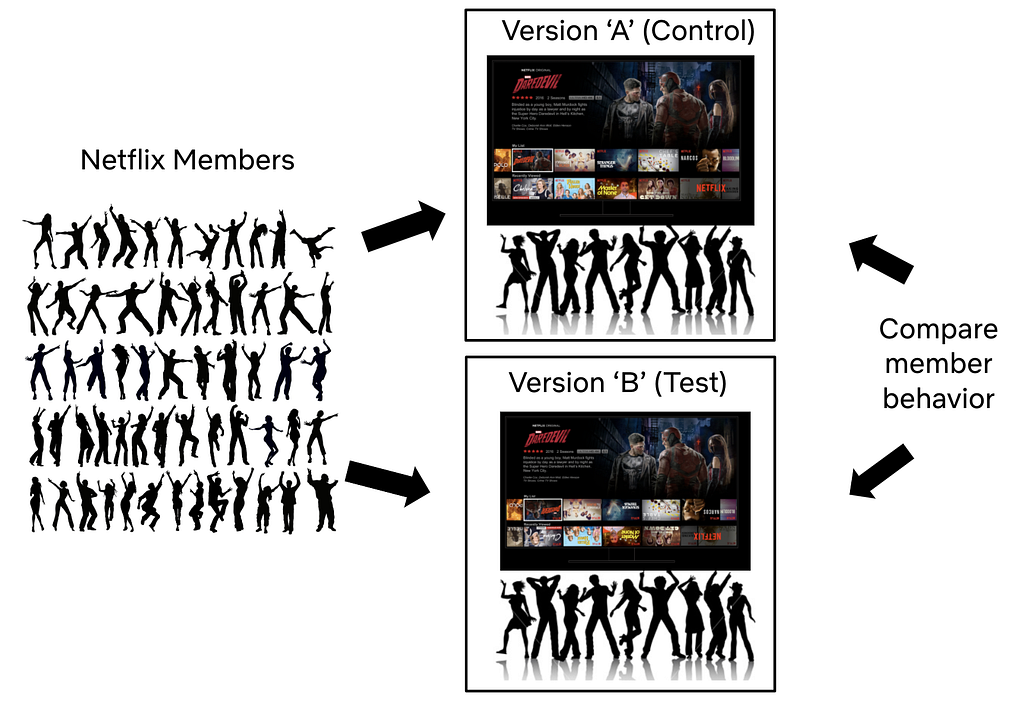
XP provides a framework that allows engineering teams to define sets of test treatment experiences in their code, and then use these to configure an experiment. The platform then randomly selects members (or other units we might experiment on, like playback sessions) to assign to experiments, before randomly assigning them to an experience within each experiment (control or one of the treatment experiences). Calls by Netflix services to XP then ensure that the correct experiences are delivered, based on which tests a member is part of, and which variants within those tests. Our data engineering systems collect these test metadata, and then join them with our core data sets: logs on how members and non members interact with the service, logs that track technical metrics on streaming video delivery, and so forth. These data then flow through automated analysis pipelines and are reported in ABlaze, the front end for reporting and configuring experiments at Netflix. Aligned with Netflix culture, results from tests are broadly accessible to everyone in the company, not limited to data scientists and decision makers.
The Netflix XP balances execution of the current experimentation program with a focus on future-looking innovation. It’s a virtuous flywheel, as XP aims to take whatever is pushing the boundaries of our experimentation program this year and turn it into next year’s one-click solution. That may involve developing new solutions for allocating members (or other units) to experiments, new ways of tracking conflicts between tests, or new ways of designing, analyzing, and making decisions based on experiments. For example, XP partners closely with engineering teams on feature flagging and experience delivery. In success, these efforts provide a seamless experience for Netflix developers that fully integrates experimentation into the software development lifecycle.
For analyzing experiments, we’ve built the Netflix XP to be both democratized and modular. By democratized, we mean that data scientists (and other users) can directly contribute metrics, causal inference methods for analyzing tests, and visualizations. Using these three modules, experimenters can compose flexible reports, tailored to their tests, that flow through to both our frontend UI and a notebook environment that supports ad hoc and exploratory analysis.
This model supports rapid prototyping and innovation as we abstract away engineering concerns so that data scientists can contribute code directly to our production experimentation platform — without having to become software engineers themselves. To ensure that platform capabilities are able to support the required scale (number and size of tests) as analysis methods become more complex and computationally intensive, we’ve invested in developing expertise in performant and robust Computational Causal Inference software for test analysis.

It takes a village to build an experimentation platform: software engineers to build and maintain the backend engineering infrastructure; UI engineers to build out the ABlaze front end that is used to manage and analyze experiments; data scientists with expertise in causal inference and numerical computing to develop, implement, scale, and socialize cutting edge methodologies; user experience designers who ensure our products are accessible to our stakeholders; and product managers who keep the platform itself innovating in the right direction. It’s an incredibly multidisciplinary endeavor, and positions on XP provide opportunities to develop broad skill sets that span disciplines. Because experimentation is so pervasive at Netflix, those working on XP are exposed to challenges, and get to collaborate with colleagues, from all corners of Netflix. It’s a great way to learn broadly about ‘how Netflix works’ from a variety of perspectives.
At Netflix, we’ve invested in data science teams that use A/B tests, other experimentation paradigms, and the scientific method more broadly, to support continuous innovation on our product offerings for current and future members. In tandem, we’ve invested in building out an internal experimentation platform (XP) that supports the scale and complexity of our experimentation and learning program.
In practice, the dividing line between these two investments is blurred and we encourage collaboration between XP and business-oriented data scientists, including through internal events like A/B Experimentation Workshops and Causal Inference Summits. To ensure that experimentation capabilities at Netflix evolve to meet the on-the-ground needs of experimentation practitioners, we are intentional in ensuring that the development of new measurement and experiment management capabilities, and new software systems to both enable and scale research, is a collaborative partnership between XP and experimentation practitioners. In addition, our intentionally collaborative approach provides great opportunities for folks to lead and contribute to high-impact projects that deliver new capabilities, spanning engineering, measurement, and internal product development. And because of the strategic value Netflix places on experimentation, these collaborative efforts receive broad visibility, including from our executives.
So far, this series has covered the why, what and how of A/B testing, all of which are necessary to reap the benefits of an experimentation-based approach to product development. But without a little magic, these basics are still not enough. That magic will be the focus of the next and final post in this series: the learning and experimentation culture that pervades Netflix. Follow the Netflix Tech Blog to stay up to date.

Experimentation is a major focus of Data Science across Netflix was originally published in Netflix TechBlog on Medium, where people are continuing the conversation by highlighting and responding to this story.
Post Syndicated from Bruce Schneier original https://www.schneier.com/blog/archives/2022/01/apples-private-relay-is-being-blocked.html
Some European cell phone carriers, and now T-Mobile, are blocking Apple’s Private Relay anonymous browsing feature.
This could be an interesting battle to watch.
Slashdot thread.
Post Syndicated from original https://lwn.net/Articles/881005/rss
Security updates have been issued by Debian (clamav, vim, and wordpress), Mageia (ghostscript, osgi-core, apache-commons-compress, python-django, squashfs-tools, and suricata), openSUSE (libsndfile, net-snmp, and systemd), Oracle (httpd:2.4, kernel, and kernel-container), SUSE (libsndfile, libvirt, net-snmp, and systemd), and Ubuntu (exiv2, linux, linux-aws, linux-aws-5.11, linux-azure, linux-azure-5.11, linux-gcp, linux-gcp-5.11, linux-hwe-5.11, linux-kvm, linux-oem-5.10, linux-oracle, linux-oracle-5.11, linux-raspi, linux-oem-5.13, and linux-oem-5.14).
Post Syndicated from original https://lwn.net/Articles/880973/rss
The GTK-based Anaconda installer has long been used to set up Fedora,
CentOS, and RHEL systems. This Fedora Community Blog entry describes
some significant changes that will appear in a future version of
Anaconda:
We will rewrite the new UI as a web browser-based UI using existing
Cockpit technology. We are taking this approach because Cockpit is
a mature solution with great support for the backend (Anaconda
DBus). The Cockpit team is also providing us with great support and
they have significant knowledge which we could use. We thank them
for helping us a lot with the prototype and creating a foundation
for the future development.
Post Syndicated from sersor original https://blog.zabbix.com/take-advantage-of-zabbix-services-online-by-sergejs-sorokins-zabbix-summit-online-2021/18716/
From Turnkeys to Upgrades and Training courses – Zabbix offers a wast selection of services to help you get the most value out of your Zabbix environment. In this blog post, we will take a look at the new and existing Zabbix online services and learn how they can benefit both Zabbix veterans and newcomers to the monitoring world.
Zabbix images are available for the most popular cloud services providers, including – AWS, Azure, Google Cloud Platform, and many others. Let’s talk about what applications and services are available for those of you, that choose to take this Zabbix deployment route.

What does it take to deploy Zabbix in a public cloud?
Zabbix Technical support services are one of the most popular services with our customers. Zabbix support services offer 5 tiers of support.
Starting from the Silver tier, which covers the basic customer requirements such as answering customer tech support questions, to the Enterprise and Global tiers, which include not only technical support services but also remote assistance, performance tuning, training, on-site visits, and more. Each customer can pick a support tier depending on their requirements and budget.
The technical support service provides multiple obvious and not so obvious benefits:
We can divide the Zabbix training into two types of courses – core courses and one-day courses. Both of these types of courses are unique in the knowledge that they aim to deliver.
The core courses are multi-day courses that range from the Zabbix Certified User course to Zabbix Certified Expert.
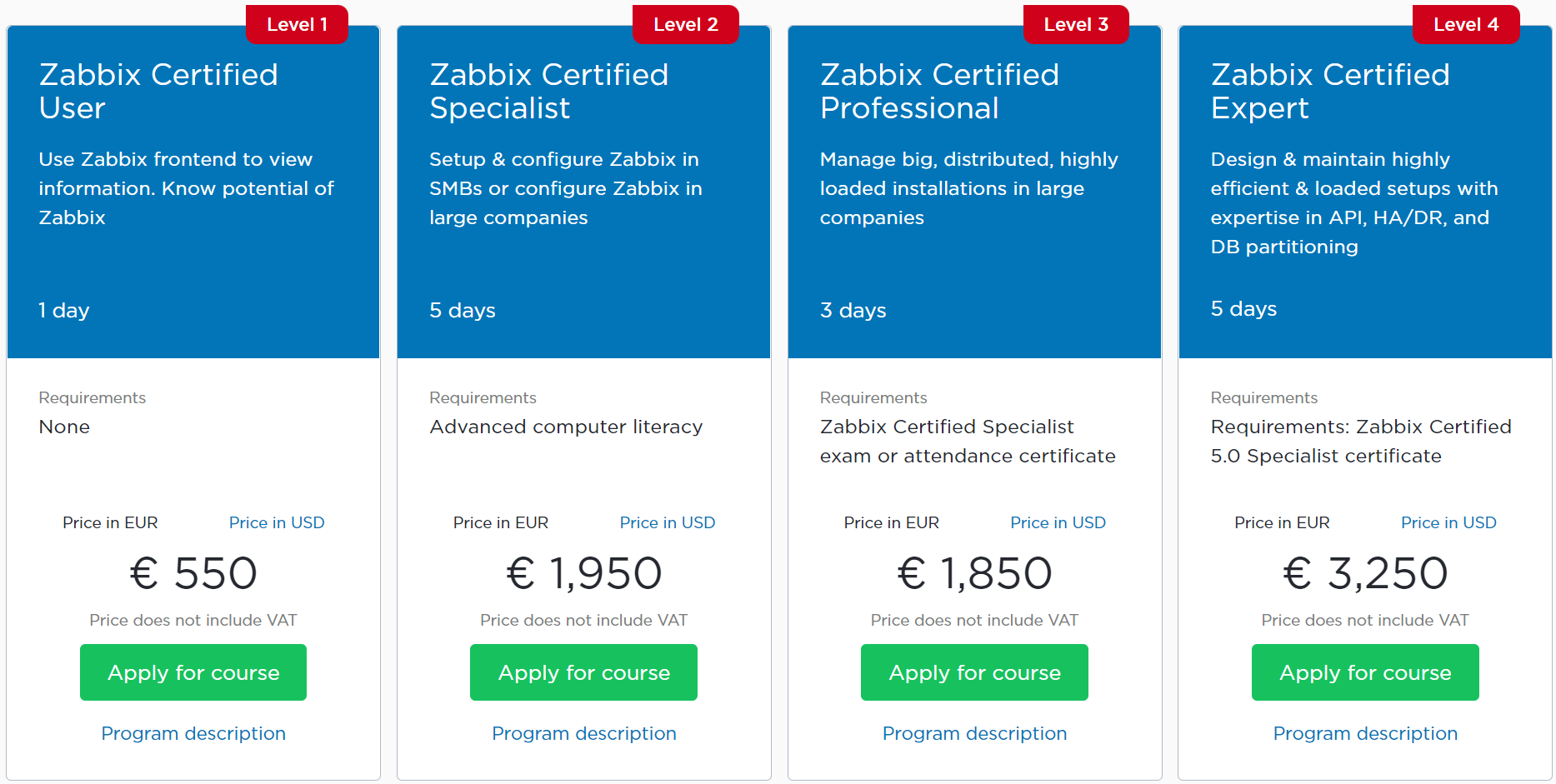
The goal of the Zabbix one-day courses is to take an in-depth look at a particular topic and provide all of the available knowledge on specific Zabbix features. These are one-day courses with a large focus on practical tasks. The content of these courses is unique. Therefore it doesn’t matter if you’re a newcomer or a season Zabbix expert – the information covered in the courses will be useful to you in any scenario.
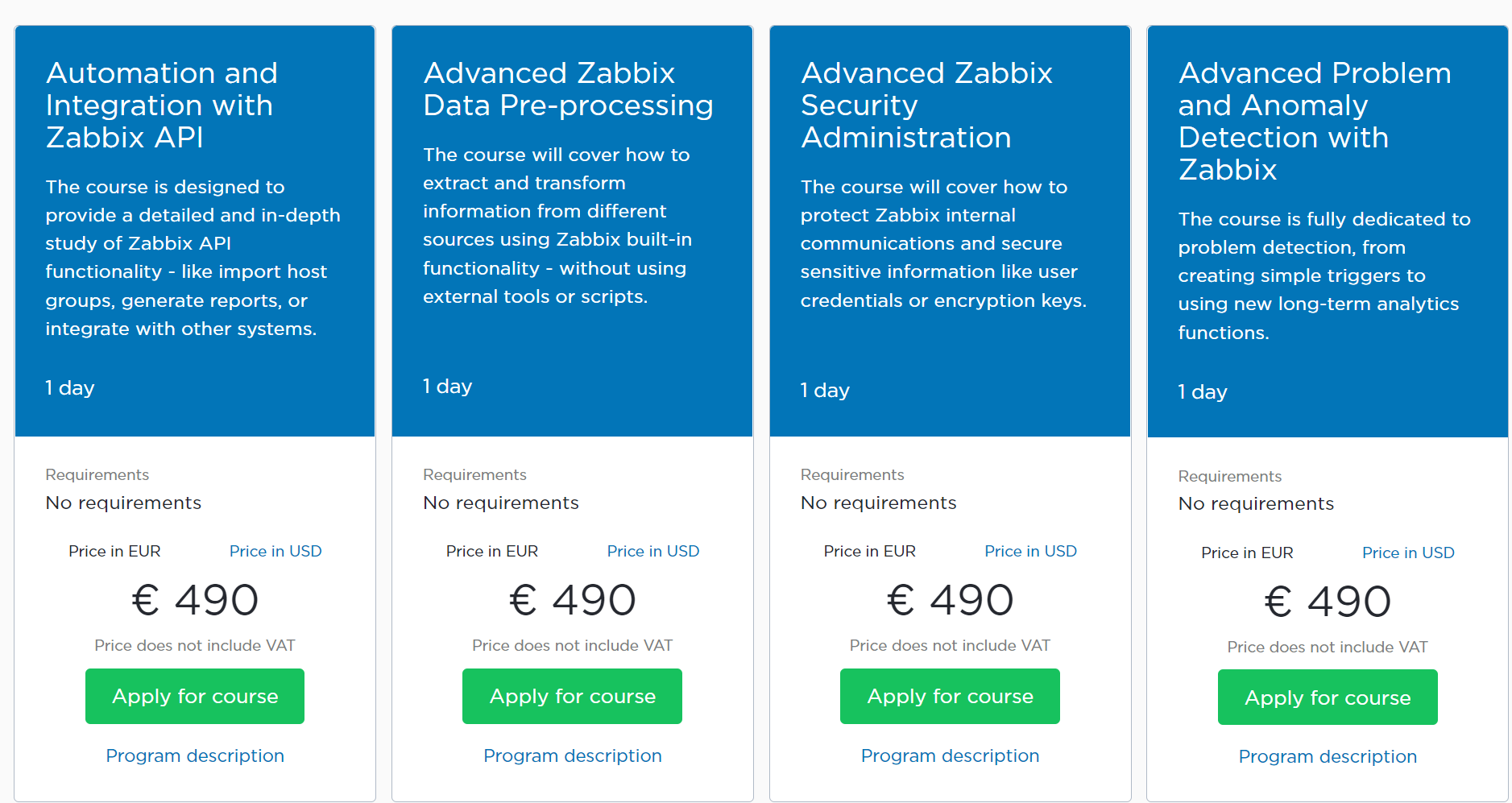
All of the aforementioned courses are widely available all over the world. Zabbix provides courses in different languages, for different time zones both online and on-site.
What we covered here is just a small part of the overall service offering that Zabbix provides. In addition to the aforementioned services, you can visit the Zabbix Professional Services page to find a full list of Zabbix services – from consultancy hours to turnkey deployments and integration services. If you’re interested in any kind of assistance from Zabbix, feel free to get in touch with our Sales department – [email protected] and together we will tailor the best service offering for you.
Q: What pre-requisites are required for the attendees of Zabbix training courses?
A: For the Zabbix Certified User course there are no pre-requisites. As for the Zabbix Certified Specialist – some basic IT knowledge and at least surface-level ability to navigate the Linux operating system would be useful for the attendees. On the other hand, the Zabbix Certified Professional course requires the completion of the Zabbix Certified Specialist course. Similarly – the Zabbix Certified Expert course requires the completion of the Zabbix Certified Professional course.
Q: With the release of Zabbix 6.0 LTS right around the corner – should our users simply wait until Zabbix 6.0 LTS training is available or they can certify in Zabbix 5.0 LTS?
A: Since Zabbix 5.0 LTS courses are still available, I would look at what you plan to stick with for the foreseeable future. If there are no plans to upgrade to Zabbix 6.0 LTS, then the Zabbix 5.0 LTS course could be the best for you. On the other hand, if a Zabbix upgrade is already scheduled – then 6.0 LTS might just benefit you more.
Q: What If I have the Zabbix 5.0 LTS specialist certificate – will I be able to attend the Zabbix 6.0 LTS professional course or do I have to start over?
A: With the release of Zabbix 6.0 LTS we plan to introduce the Zabbix Certified Upgrade course. This will be a one-day course that will allow Zabbix 5.0 certified specialists and professionals to upgrade their certification to the Zabbix 6.0 certified specialist or professional.
The upgrade course has the extra benefit of preparing you for the Zabbix 6.0 LTS changes before you actually perform the jump to the Zabbix 6.0 LTS release. With the upgrade certificate in hand, you will be aware of all of the changes and new features that await you in the latest Zabbix LTS release.
The post Take advantage of Zabbix services online by Sergejs Sorokins / Zabbix Summit Online 2021 appeared first on Zabbix Blog.
Post Syndicated from Jake Baines original https://blog.rapid7.com/2022/01/11/cve-2021-20038-42-sonicwall-sma-100-multiple-vulnerabilities-fixed-2/

Over the course of routine security research, Rapid7 researcher Jake Baines discovered and reported five vulnerabilities involving the SonicWall Secure Mobile Access (SMA) 100 series of devices, which includes SMA 200, 210, 400, 410, and 500v. The most serious of these issues can lead to unauthenticated remote code execution (RCE) on affected devices. We reported these issues to SonicWall, who published software updates and have released fixes to customers and channel partners on December 7, 2021. Rapid7 urges users of the SonicWall SMA 100 series to apply these updates as soon as possible. The table below summarizes the issues found.
| CVE ID | CWE ID | CVSS | Fix |
|---|---|---|---|
| CVE-2021-20038 | CWE-121: Stack-Based Buffer Overflow | 9.8 | SNWLID-2021-0026 |
| CVE-2021-20039 | CWE-78: Improper Neutralization of Special Elements used in an OS Command (“OS Command Injection”) | 7.2 | SNWLID-2021-0026 |
| CVE-2021-20040 | CWE-23: Relative Path Traversal | 6.5 | SNWLID-2021-0026 |
| CVE-2021-20041 | CWE-835: Loop With Unreachable Exit Condition (“Infinite Loop”) | 7.5 | SNWLID-2021-0026 |
| CVE-2021-20042 | CWE-441: Unintended Proxy or Intermediary (“Confused Deputy”) | 6.5 | SNWLID-2021-0026 |
The rest of this blog post goes into more detail about the issues. Vulnerability checks are available to InsightVM and Nexpose customers for all five of these vulnerabilities.
The SonicWall SMA 100 series is a popular edge network access control system, which is implemented as either a standalone hardware device, a virtual machine, or a hosted cloud instance. More about the SMA 100 series of products can be found here.
Testing was performed on the SMA 500v firmware versions 9.0.0.11-31sv and 10.2.1.1-19sv. CVE-2021-20038 and CVE-2021-20040 affect only devices running version 10.2.x, while the remaining issues affect both firmware versions. Note that the vendor has released updates and at their KB article, SNWLID-2021-0026, to address all these issues.
These issues were discovered by Jake Baines, Lead Security Researcher at Rapid7. These issues are being disclosed in accordance with Rapid7’s vulnerability disclosure policy.
Affected version: 10.2.1.2-24sv
The web server on tcp/443 (/usr/src/EasyAccess/bin/httpd) is a slightly modified version of the Apache httpd server. One of the notable modifications is in the mod_cgi module (/lib/mod_cgi.so). Specifically, there appears to be a custom version of the cgi_build_command function that appends all the environment variables onto a single stack-based buffer using strcat.
There is no bounds-checking on this environment string buildup, so if a malicious attacker were to generate an overly long QUERY_STRING, they can overflow the stack-based buffer. The buffer itself is declared at the top of the cgi_handler function as a 202 byte character array (although, it’s followed by a lot of other stack variables, so the depth to cause the overflow is a fair amount more).
Regardless, the following curl command demonstrates the crash when sent by a remote and unauthenticated attacker:
curl --insecure "https://10.0.0.7/?AAAA[1794 more A's here for a total of 1798 A's]"
The above will trigger the following crash and backtrace:
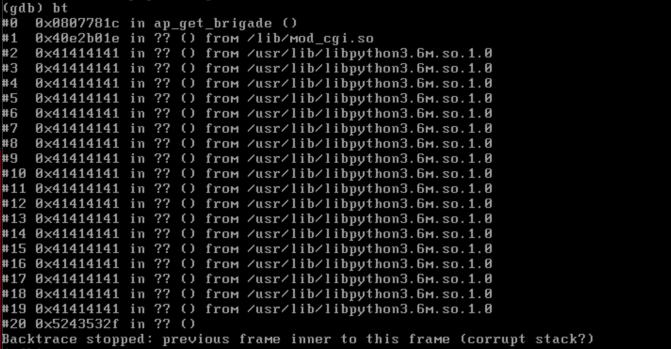
Technically, the above crash is due to an invalid read, but you can see the stack has been successfully overwritten above. A functional exploit should be able to return to an attacker’s desired address. The system does have address space layout randomization (ASLR) enabled, but it has three things working against this protection:
Because of these factors, a reliable exploit for this issue is plausible. It’s important to note that httpd is running as the “nobody” user, so attackers don’t get to go straight to root access, but it’s one step away, as the exploit payload can su to root using the password “password.”
This stack-based buffer overflow has a suggested CVSS score of 9.8 out of 10 — by exploiting this issue, an attack can get complete control of the device or virtual machine that’s running the SMA 100 series appliance. This can allow attackers to install malware to intercept authentication material from authorized users, or reach back into the networks protected by these devices for further attack. Edge-based network control devices are especially attractive targets for attackers, so we expect continued interest in these kinds of devices by researchers and criminal attackers alike.
Affected versions: 9.0.0.11-31sv, 10.2.0.8-37sv, and 10.2.1.2-24sv
The web interface uses a handful of functions to scan user-provided strings for shell metacharacters in order to prevent command injection vulnerabilities. There are three functions that implement this functionality (all of which are defined in libSys.so): isSafeCommandArg, safeSystemCmdArg, and safeSystemCmdArg2.
These functions all scan for the normal characters (&|$><;’ and so on), but they do not scan for the new line character (‘\n’). This is problematic because, when used in a string passed to system, it will act as a terminator. There are a variety of vectors an attacker could use to bypass these checks and hit system, and one (but certainly not the only) example is /cgi-bin/viewcert, which we’ll describe in more detail here.
The web interface allows authenticated individuals to upload, view, or delete SSL certificates. When deleting a certificate, the user provides the name of the directory that the certificate is in. These names are auto-generated by the system in the format of newcert-1, newcert-2, newcert-3, etc. A normal request would define something like CERT=newcert-1. The CERT variable makes it to a system call as part of an rm -rf %s command. Therefore, an attacker can execute arbitrary commands by using the ‘\n’ logic in CERT. For example, the following would execute ping to 10.0.0.9:
CERT=nj\n ping 10.0.0.9 \n
To see that in a real request, we have to first log in:
curl -v --insecure -F username=admin -F password=labpass1 -F domain=LocalDomain -F portalname=VirtualOffice -F ajax=true https://10.0.0.6/cgi-bin/userLogin
The system will set a swap cookie. That’s your login token, which can be copied into the following request. The following requests executes ping via viewcert:
curl -v --insecure --Cookie swap=WWR0MElDSXJuTjdRMElTa3lQTmRPcndnTm5xNWtqN0tQQUlLZjlKZTM1QT0= -H "User-Agent: SonicWALL Mobile Connect" -F buttontype=delete -F $'CERT=nj \nping 10.0.0.9 \n' https://10.0.0.6/cgi-bin/viewcert
It’s important to note that viewcert elevates privileges so that when the attacker hits system, they have root privileges.
Note that this vulnerability is post-authentication and leverages the administrator account (only administrators can manipulate SSL certificates). An attacker would already need to know (or guess) a working username and password in order to elevate access from administrator to root-level privileges. In the ideal case, this is a non-trivial barrier to entry for attackers. That said, the SMA 100 series does ship with a default password for the administrator account, and most organizations allow administrators to choose their own password, and we also know that the number of users for any device that stick with the default or easily guessed passwords is non-zero.
Affected version: 10.2.0.8-37sv and 10.2.1.2-34sv
The SMA 100 series allows users to interact with remote SMB shares through the HTTPS server. This functionality resides in the endpoint https://address/fileshare/sonicfiles/sonicfiles. Most of the functionality simply flows through the SMA series device and doesn’t actually leave anything on the device itself, with the notable exception of RacNumber=43. That is supposed to write a file to the /tmp directory, but it is vulnerable to path traversal attacks.
To be a bit more specific, RacNumber=43 takes two parameters:
swcctn: This value gets combined with /tmp/ + the current date to make a filename.There is no validation applied to swcctn, so an attacker can provide arbitrary code. The example below writes the file "hello.html.time" to the web server’s root directory:
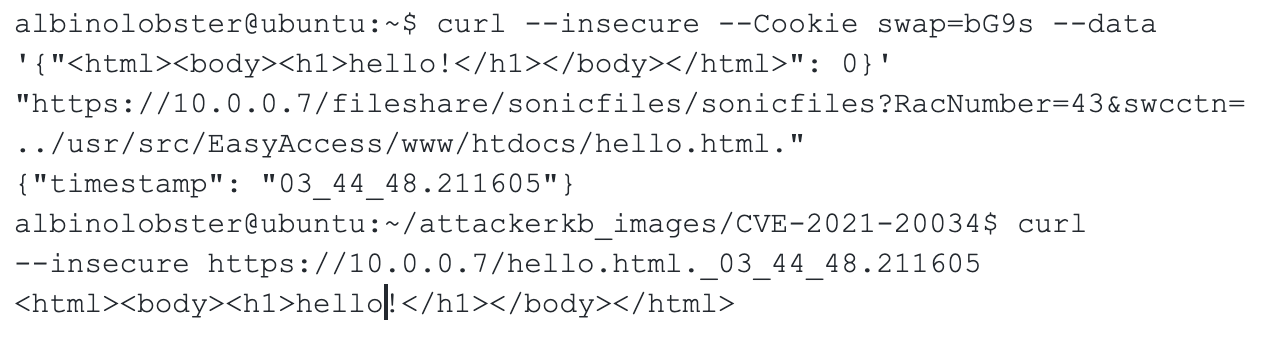
This results in:
There are some real limitations to exploiting CVE-2021-20040:
File writing is done with nobody privileges. That limits where an attacker can write significantly, although being able to write to the web server’s root feels like a win for the attacker.
The attacker can’t overwrite any existing file due to the random digits attached to the filename.
Given these limitations, an attack scenario will likely involve tricking users into believing their custom-created content is a legitimate function of the SMA 100, for example, a password "reset" function that takes a password.
Affected versions: 9.0.0.11-31sv, 10.2.0.8-37sv, and 10.2.1.2-24sv
An unauthenticated, remote adversary can consume all of the device’s CPU due to crafted HTTP requests sent to hxxps://address/fileshare/sonicfiles/sonicfiles, resulting in an infinite loop in the fileexplorer process. The infinite loop is due to the way fileexplorer parses command line options. When parsing an option that takes multiple parameters, fileexplorer incorrectly handles parameters that lack spaces or use the = symbol with the parameter. For example, the following requests results in the infinite loop:
curl --insecure -v --Cookie swap=bG9s "https://10.0.0.6/fileshare/sonicfiles/sonicfiles?RacNumber=25&Arg1=smb://10.0.0.1/lol/test&Arg2=-elol&User=test&Pass=test"
The above request will result in fileexplorer being invoked like so:
/usr/sbin/fileexplorer -g smb://10.0.0.9/lol/test -elol -u test:test
Parsing the "-elol" portion triggers the infinite loop. Each new request will spin up a new fileexplorer process. Technically speaking, on the SMA 500v, only two such requests will result in ~100% CPU usage indefinitely. Output from top:
A number of additional requests are required to truly deny availability, as this is not a one-shot denial of service request. It should also be noted that this is a parameter injection issue — specifically, the -e parameter is injected, and if the injection in this form didn’t result in an infinite loop, the attack would have been able to exfiltrate arbitrary files (which of course would be more useful to an attacker).
Affected versions: 9.0.0.11-31sv, 10.2.0.8-37sv, and 10.2.1.2-24sv
An unauthenticated, remote attack can use SMA 100 series devices as an "unintended proxy or intermediary," also known as a Confused Deputy attack. In short, that means an outside attacker can use the SMA 100 series device to access systems reachable via the device’s internal facing network interfaces. This is due to the fact that the sonicfiles component does not appear to validate the requestor’s authentication cookie until after the fileexplorer request is made on the attacker’s behalf. Furthermore, the security check validating that the endpoint fileexplorer is accessing is allowed is commented out from RacNumber 25 (aka COPY_FROM). Note the "_is_url_allow" logic below:
This results in the following:
Just as a purely theoretical example, the following requests sends a SYN to 8.8.8.8:80:
curl --insecure -v --Cookie swap=bG9s "https://10.0.0.6/fileshare/sonicfiles/sonicfiles?RacNumber=25&Arg1=smb://8.8.8.8:80/test&Arg2=test&User=test&Pass=test"
There are two significant limitations to this attack:
Given these constraints, an attacker does not command complete control of resources on the protected side of the network with this issue and is likely only able to map responsive services from the protected network (with the notable exception of being able to write to, but not read from, unprotected SMB shares).
SonicWall routinely collaborates with third-party researchers, penetration testers, and forensic analysis firms to ensure that its products meet or exceed security best practices. One of these valued allies, Rapid7, recently identified a range of vulnerabilities to the SMA 100 series VPN product line, which SonicWall quickly verified. SonicWall designed, tested, and published patches to correct the issues and communicated these mitigations to customers and partners. At the time of publishing, there are no known exploitations of these vulnerabilities in the wild.
As these devices are designed to be exposed to the internet, the only effective remediation for these issues is to apply the vendor-supplied updates.
Post Syndicated from Will Valle original https://blog.cloudflare.com/former-rd-engineer-wins-round-2-of-project-jengo-and-cloudflare-wins-at-the-patent-office/
The classic children’s fairy tale The Three Billy Goats Gruff tells the story of three goats trying to cross a bridge to a field of yummy grass, despite the monstrous troll that lives underneath the bridge and threatens to eat them. To beat the troll, the goats played on his greed and proceeded across the bridge in order from smallest to largest – and holding the troll at bay each time with promises of a larger meal if he waited for the larger goat to follow. In the end, the troll passed on attacking the smaller goats and was left to do battle with the largest goat who was able to defeat the troll, toss him off the bridge, and watch him float downstream. The goats were then able to enjoy the yummy grass, troll-free. In our fight against Sable Networks (patent troll), we plan on being that third goat, and our recent wins suggest we might be on track to do just that.
We started Project Jengo 2 last year as a prior art search contest, so we could enlist your help in the battle against Sable Networks. We committed $100,000 in cash prizes to be shared by the winners who were successful in finding such prior art, and last quarter, we gave out $20,000 to three lucky winners. This quarter, we are excited to announce our second round winner who will take home $10,000! The winner submitted prior art related to the asserted ’431 patent.

We are happy to announce the winner for this round is Jean-Pierre Le Rouzic. Although Jean-Pierre is retired and living in Rennes, France, he decided to put his patent knowledge to work when he saw Project Jengo discussed on Hacker News. Jean-Pierre is a former telecommunications R&D engineer who wrote twelve patents in the 2000s that relate to online authentication and identity management. Impressively, he was one of the first users of Java at his company, and recalls using Java as early as 1996!
Jean-Pierre’s career experience certainly helped in his research – his Jengo submission was 24 pages and included a meticulously detailed claim chart. In particular, he addressed vulnerabilities in Sable’s extremely large scope for the ’431 patent addressing “micro-flow management.” You can read more detailed information about Jean-Pierre’s findings in the appendix to this blog post or all of the findings of Jean-Pierre and other submissions are available to anyone who may face a challenge from Sable’s claims here.
We enjoyed Jean-Pierre’s response to the good news:
I do not master enough English to express how happy I am, and how happy I am for Cloudflare if my work is useful. I find the idea of patent trolls hideous. The patent regulations should really be updated to enter the XXI century.
Jean-Pierre’s reasons for participating in Jengo were different from most other participants. As his current interest is in neurodegenerative diseases, specially ALS, and he said part of his motive stemmed from what he has seen in the medical industry:
The challenge faced by Cloudflare is close to my heart, because of its similarity to what is happening in the world of medical drugs. Cloudflare is facing an entity which is unreasonably stretching the meaning of their patent claims.
We could not agree more — we think Sable is beyond unreasonable, which is why we intend to change the incentive structure that makes things so easy for them, and we are so grateful for Jean-Pierre’s support (and all the other Jengo participants).
Also, worth noting, we were excited to see that both he and one of his daughters is a current user of Cloudflare!
My blog (padiracinnovation.org) uses Cloudflare, and I am a very satisfied user. The online shop of one of my daughter’s also uses Cloudflare.
Last year, we announced that we were facing a challenge from a patent troll called Sable Networks that was trying to weaponize decades-old and unused patents against us. With your help through the relaunch of Project Jengo, we became determined to outsmart the troll.
One of the steps we are taking, as Ethan mentioned in our August blog post, is seeking to invalidate the four asserted patents in the lawsuit through a procedure with the U.S. Patent and Trademark Office (Patent Office) known as inter partes review (IPR). As we previously explained, IPR is a trial proceeding that lasts for one year, conducted before the Patent Office, to determine whether or not a patent (or some of its constituent claims) should be invalidated. Importantly, the IPR process is only instituted after a party files an extensive petition that is reviewed by a panel of three administrative patent judges — who will only institute an IPR, if they believe a petitioner has a reasonable likelihood of succeeding in invalidating at least one claim from the challenged patent.
In December, after months of hard work and considerable attorney’s fees and expenses, we found out the efforts Ethan described last August had paid off — the first two of our four IPR petitions were granted by the Patent Office! For each of the challenged patents — the ’593 and the ’932 patents — an IPR proceeding has been instituted on every single claim — a total of 76 claims between the two patents. This is exceptional news for us, as the Patent Office has made a preliminary determination that we are likely to succeed on invalidating a vast majority of those claims, giving us a chance to invalidate those two patents in their entirety. This provides an independent path for defeating Sable’s lawsuit, because if the Patent Office declares a patent to be invalid — meaning that patent never should have been issued in the first place — the patent no longer exists, and we have effectively pushed the troll off the bridge. Now that we have two IPRs instituted, the Patent Office has one year from the date of institution to make their final decision on whether the challenged claims are valid or not.
And, by the way, it was pretty nice to see our diligence recognized:
“Moreover, the undisputed evidence here shows that [Cloudflare] acted diligently, filing its Petition only seven weeks after service of the complaint and well before preliminary infringement contentions were served.”
Decision Granting Institution of Inter Partes Review at p. 12 (IPR2021-00909) (Nov. 19, 2021)
But this was only half the battle. There are four Sable patents at issue in the litigation. For the ’919 and ’431 patents, we filed separate IPR petitions on all 38 claims from those two patents last year. In response to our petitions, Sable voluntarily canceled 34 out of 38 claims from its own patents, which says a lot about what they think about the quality of their decades-old patents. The Patent Office subsequently declined to institute IPR on the four remaining claims. Sable is now left with only 4 out of the 38 claims to pursue in the litigation, and those four claims are far removed from Cloudflare’s products and services.
We are happy to see some more press coverage on the fight against Sable Networks. More press means that more people become aware of this issue and can help put a stop to future patent trolls. Most trolls merely send threatening letters and hope they can get a quick settlement from their threats without having to see the light of day by going to court or to the Patent Office to defend their claims. We are just one entity (that has enlisted your help) fighting against a villainous patent troll — but would it not be great to see other big companies fight back when they encounter their next troll?
We could not have gotten to this point without the help of the many Project Jengo participants. We have received hundreds of prior art references on Sable’s ten patents, and we have used many of those references to help kill off the four patents that Sable asserted against us. While we have made some great progress together, we cannot let our guard down now. We will continue to fight vigorously, but just as in the Three Billy Goats Gruff, we need your support to take down a ravenous troll. Please consider submitting to our prior art contest, and please share the contest with co-workers, family and friends. On behalf of the Cloudflare community, thanks to everyone who has participated so far!
The ’431 patent leveraged by Sable is titled “Micro-Flow Management” and concerns Internet switching technology for network service providers. The patent claims priority all the way back to April 19, 2000. The ’431 patent discloses a router that puts a label on packets for a given “microflow,” and forwards all the packets in that same microflow based on the label.
Our first blog post about Sable’s claims explained that the ’431 patent assertions were so broad, they could stretch to possibly even the “conventional routers” from the 2000s that routed each packet independently.
Thankfully, Jean-Pierre noted some similarities between the asserted ’431 patent and the patent he tracked down. US Patent No. 7,406,098 was first publicly available as early as 1999. The ’098 patent is related to the allocation of communication resources of a single node among a multitude of subscribers. In Jean-Pierre’s words, both the asserted patent and the ’098 patent concern “the need to allocate switched packets resources to a single communication among many.”
The first claim in ’431 is for “a method for managing data traffic through a network”, while the first claim in the ’098 is for “a method of allocating a resource in a communication system” — both of which Jean-Pierre found to read quite similar. As he described, in both cases there is a need to “allocate Internet (switched packets) resources to a single communication among many, this allocation is based on a classification.” Ultimately, the ’098 patent is noteworthy in that it demonstrates the obviousness of what Sable claims the ’431 patent covers. People of skill in the art (like the Qualcomm inventors from the ’098 patent), long before the ’431 patent, knew how to manage the flow of data using queues.
Take a look at the snapshot from the claim chart Jean-Pierre submitted:
The language in Claim 1 of the ’431 patent deals with the “delegating” of “microflows”, while Claim 14 of the ’098 patent deals with the “assigning” of “application flows”. We have hardly scraped the surface here, as there are plenty of other similarities between the two patents — take a look for yourselves!
We are grateful for Jean-Pierre’s participation in Project Jengo, and we are looking forward to receiving more prior art as we continue to fight Sable Networks!
Post Syndicated from Henna Gorsia original https://www.raspberrypi.org/blog/ai-sytems-in-education-learner-support-research-seminar/
We are hosting a series of free research seminars about how to teach artificial intelligence (AI) and data science to young people, in partnership with The Alan Turing Institute.
In the fifth seminar of this series, we heard from Rose Luckin, Professor of Learner Centred Design at the University College London (UCL) Knowledge Lab. Rose is Founder of EDUCATE Ventures Research Ltd., a London consultancy service working with start-ups, researchers, and educators to develop evidence-based educational technology.

Based on her experience at EDUCATE, Rose spoke about how AI-based analysis could help educators gain a deeper understanding of their students, and how educators could work with AI systems to provide better learning resources to their students. This provided us with a different angle to the first four seminars in our current series, where we’ve been thinking about how young people learn to understand AI systems.

AI systems have the potential to impact education in a number of different ways, which Rose distilled into three areas:
It is clear that the three areas are interconnected, meaning developments in one area will affect the others. Rose’s focus during the seminar was the second area: educating people about AI.
Through giving examples of existing AI-based systems used for education, Rose described what in particular it is about AI systems that can be useful in an education setting. The first point she raised was that AI systems can adapt based on learning from data. Her main example was the AI-based platform ENSKILLS, which detects the user’s level of competency with spoken English through the user’s interactions with a virtual character, and gradually adapts the character to the user’s level. Other examples of adaptive AI systems for education include Carnegie Learning and Century Intelligent Learning.
We know that AI systems can respond to different forms of data. Rose introduced the example of OyaLabs to demonstrate how AI systems can gather and process real-time sensory data. This is an app that parents can use in a young child’s room to monitor the child’s interactions with others. The app analyses the data it gathers and produces advice for parents on how they can support their child’s language development.
AI system creators can also combine adaptivity and real-time sensory data processing in their systems. One example Rosa gave of this was SimSensei from the University of Southern California. This is a simulated coach, which a student can interact with and which gathers real-time data about how the student is speaking, including their tone, speed of speech, and facial expressions. The system adapts its coaching advice based on these interactions and on what it learns from interactions with other students.
For the remainder of her presentation, Rose focused on the framework she is involved in developing, as part of the EDUCATE service, to support organisations to prepare for implementing AI systems, including educators within these organisations. The aim of this ETHICAI framework is to enable organisations and educators to understand:
Rose described the seven steps of the framework as:
She then went on to demonstrate how the framework is applied using the example of online teaching. Online teaching has been a key part of education throughout the coronavirus pandemic; AI systems could be used to analyse datasets generated during online teaching sessions, in order to make decisions for and recommendations to educators.
The first step of the ETHICAI framework is educate, enthuse, excite. In Rose’s example, this step consisted of choosing online teaching as a scenario, because it is very pertinent to a teacher’s practice. The second step is to tailor and hone in on particular challenges that are to be the focus, capitalising on what AI systems can do. In Rose’s example, the challenge is assessing the quality of online lessons in a way that would be useful to educators. The third step of the framework is to identify what data is required to perform this quality assessment.
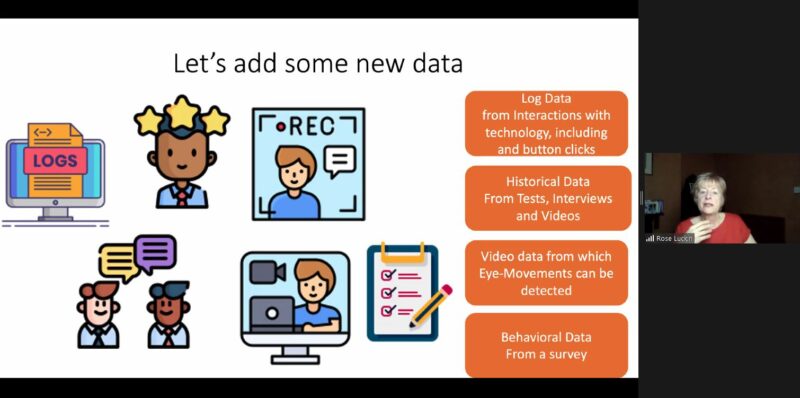
The fourth step is the collection of new data relevant to the focus of the project. The aim is to gain an increased understanding of what happens in online learning across thousands of schools. Walking through the online learning example, Rose suggested we might be able to collect the following types of data:
It is important to consider the ethical implications of gathering all this data about students, something that was a recurrent theme in both Rose’s presentation and the Q&A at the end.
Step five of the ETHICAI framework focuses on applying AI techniques to the relevant data to combine and process it. The figure below shows that in preparation, the various data sets need to be collated, cleaned, organised, and transformed.
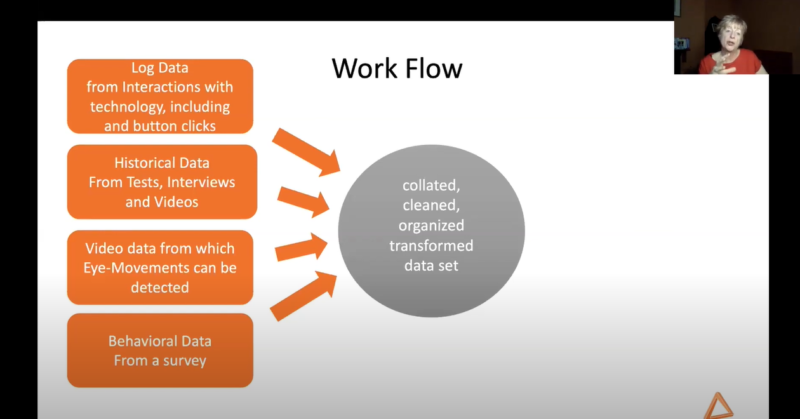
From the correctly prepared data, interaction profiles can be produced in order to put characteristics from different lessons into groups/profiles. Rose described how cluster analysis using a combination of both AI and human intelligence could be used to sort lessons into groups based on common features.
The sixth step in Rose’s example focused on what may be learned from analysing collected data linked to the particular challenge of online teaching and learning. Rose said that applying an AI system to students’ behavioural data could, for example, give indications about students’ focus and confidence, and make or recommend interventions to educators accordingly.
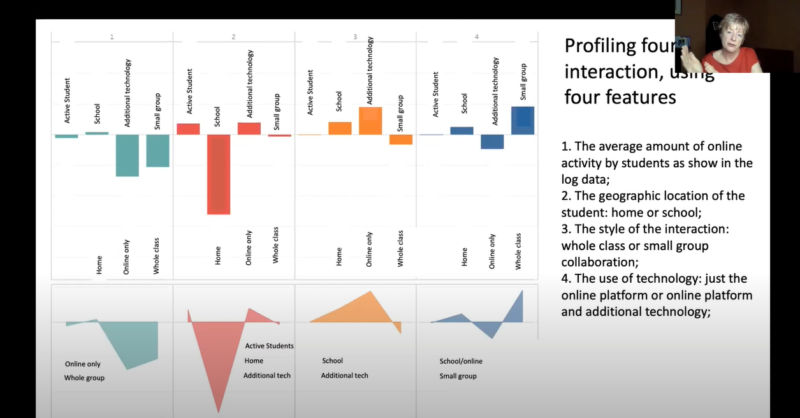
Rose described that AI systems can possess some types of intelligence humans have or can develop: interdisciplinary academic intelligence, meta-knowing intelligence, and potentially social intelligence. However, there are types such as meta-contextual intelligence and perceived self-efficacy that AI systems are not able to demonstrate in the way humans can.
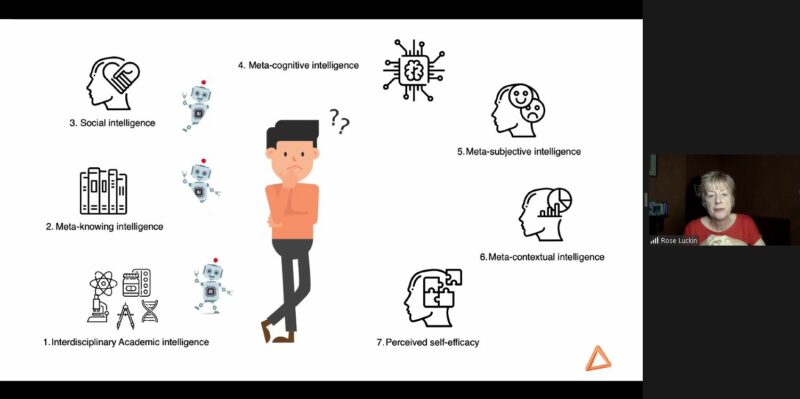
The use of AI systems in education can cause ethical issues. As an example, Rose pointed out the use of virtual glasses to identify when students need help, even if they do not realise it themselves. A system like this could help educators with assessing who in their class needs more help, and could link this back to student performance. However, using such a system like this has obvious ethical implications, and some of these were the focus of the Q&A that followed Rose’s presentation.
It’s clear that, in the education domain as in all other domains, both positive and negative outcomes of integrating AI are possible. In a recent paper written by Wayne Holmes (also from the UCL Knowledge Lab) and co-authors, ‘Ethics of AI in Education: Towards a Community Wide Framework’ [1], the authors suggest that the interpretation of data, consent and privacy, data management, surveillance, and power relations are all ethical issues that should be taken into consideration. Finding consensus for a practical ethical framework or set of principles, with all stakeholders, at the very start of an AI-related project is the only way to ensure ethics are built into the project and the AI system itself from the ground up.

Ethical issues of AI systems more broadly, and how to involve young people in discussions of AI ethics, were the focus of our seminar with Dr Mhairi Aitken back in September. You can revisit the seminar recording, presentation slides, and summary blog post.
I really enjoyed both the focus and content of Rose’s talk: educators understanding how AI systems may be applied to education in order to help them make more informed decisions about how to best support their students. This is an important factor to consider in the context of the bigger picture of what young people should be learning about AI. The work that Rose and her colleagues are doing also makes an important contribution to translating research into practical models that teachers can use.
You may still have time to sign up for our Tuesday 11 January seminar, today at 17:00–18:30 GMT, where we will welcome Dave Touretzky and Fred Martin, founders of the influential AI4K12 framework, which identifies the five big ideas of AI and how they can be integrated into education.
Next month, on 1 February at 17:00–18:30 GMT, Tara Chklovski (CEO of Technovation) will give a presentation called Teaching youth to use AI to tackle the Sustainable Development Goals at our seminar series.
If you want to join any of our seminars, click the button below to sign up and we will send you information on how to join. We look forward to seeing you there!
You’ll always find our schedule of upcoming seminars on this page. For previous seminars, you can visit our past seminars and recordings page.
The post How can AI-based analysis help educators support students? appeared first on Raspberry Pi.
Post Syndicated from Channy Yun original https://aws.amazon.com/blogs/aws/new-amazon-ec2-hpc6a-instance-optimized-for-high-performance-computing/
High Performance Computing (HPC) allows scientists and engineers to solve complex, compute-intensive problems such as computational fluid dynamics (CFD), weather forecasting, and genomics. HPC applications typically require instances with high memory bandwidth, a low latency, high bandwidth network interconnect and access to a fast parallel file system.
Many customers have turned to AWS to run their HPC workloads. For example, Descartes Labs used AWS to power a TOP500 LINPACK benchmarking (the most powerful commercially available computer systems) run that delivered 1.93 PFLOPS, landing at position 136 on the TOP500 list in June 2019. That run made use of 41,472 cores on a cluster of Amazon EC2 C5 instances. Last year Descartes Labs ran the LINPACK benchmark again and placed within the top 40 on the June 2021 TOP500 list with 172,692 cores on a cluster of EC2 instances, which represents a 417 percent performance increase in just two years.
AWS enables you to increase the speed of research and reduce time-to-results by running HPC in the cloud and scaling to tens of thousands of parallel tasks that wouldn’t be practical in most on-premises environments. AWS helps you reduce costs by providing CPU, GPU, and FPGA instances on-demand, Elastic Fabric Adapter (EFA), an EC2 network device that improves throughput and scaling tightly coupled workloads, and AWS ParallelCluster, an open-source cluster management tool that makes it easy for you to deploy and manage HPC clusters on AWS.
Announcing EC2 Hpc6a Instances for HPC Workloads
Customers today across various industries use compute-optimized EFA-enabled Amazon EC2 instances (for example, C5n, R5n, M5n, and M5zn) to maximize the performance of a variety of HPC workloads, but as these workloads scale to tens of thousands of cores, cost-efficiency becomes increasingly important. We have found that customers are not only looking to optimize performance for their HPC workloads but want to optimize costs as well.
As we pre-announced in November 2021, Hpc6a, a new HPC-optimized EC2 instance, is generally available beginning today. This instance delivers 100 Gbps networking through EFA with 96 third-generation AMD EPYC processor (Milan) cores with 384 GB RAM, and offers up to 65 percent better price-performance over comparable x86-based compute-optimized instances.
You can launch Hpc6a instances today in the US East (Ohio) and GovCloud (US-West) Regions in On-Demand and Dedicated Hosting or as part of a Savings Plan. Here are the detailed specs:
| Instance Name | CPUs* | RAM | EFA Network Bandwidth | Attached Storage |
| hpc6a.48xlarge | 96 | 384 GiB | Up to 100 Gbps | EBS Only |
*Hpc6a instances have simultaneous multi-threading disabled to optimize for HPC codes. This means that unlike other EC2 instances, Hpc6a vCPUs are physical cores, not threads.
To enable predictable thread performance and efficient scheduling for HPC workloads, simultaneous multi-threading is disabled. Thanks to AWS Nitro System, no cores are held back for the hypervisor, making all cores available to your code.
Hpc6a instances introduce a number of targeted features to deliver cost and performance optimizations for customers running tightly coupled HPC workloads that rely on high levels of inter-instance communications. These instances enable EFA networking bandwidth of 100 Gbps and are designed to efficiently scale large tightly coupled clusters within a single Availability Zone.
We hear from many of our engineering customers, such as those in the automotive sector, that they want to reduce the need for physical testing and move towards an increasingly virtual simulation-based product design process faster at a lower cost.
According to our benchmarking results for Siemens Simcenter STAR-CCM+ automotive CFD simulation, when the Hpc6a scales up to 400 nodes (approximately 40,000 cores), with the help of EFA networking, it is able to maintain approximately 100 percent scaling efficiency. Hpc6a instance shows 70 percent lower cost compared to c5n, meaning companies can deliver new designs faster and at a lower cost when using Hpc6a instances. This means companies can deliver new designs faster and at a lower cost when using Hpc6a instances.
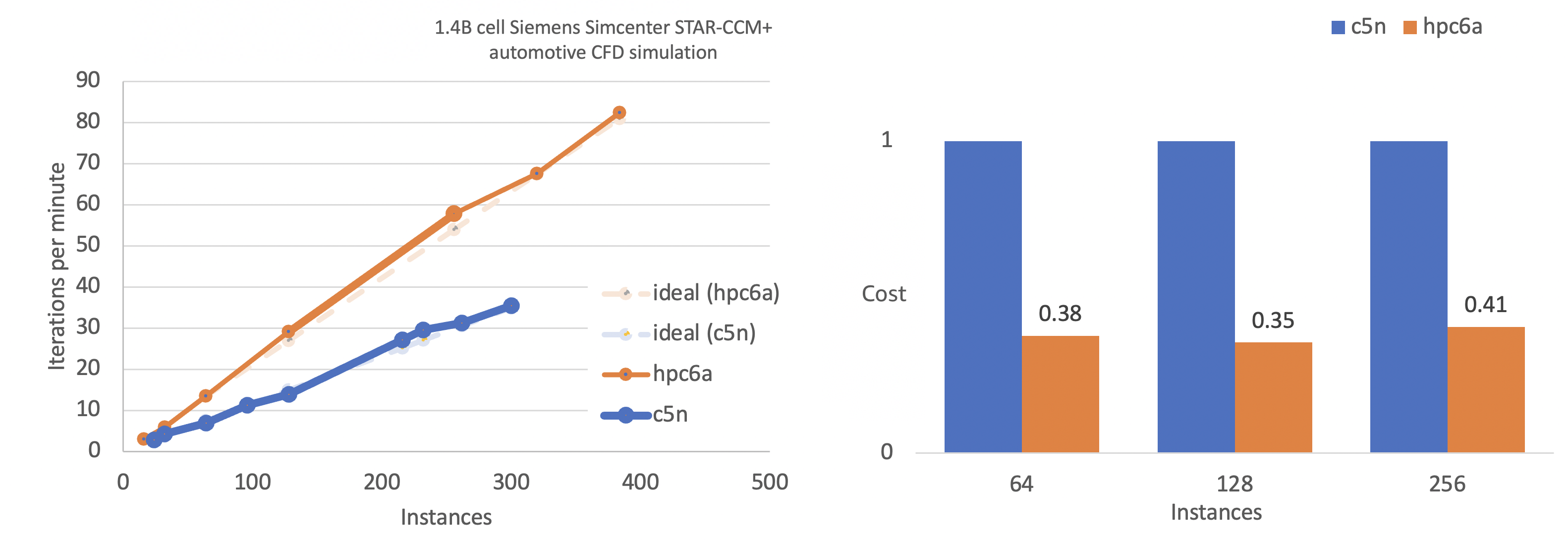
You can use the Hpc6a instance with AMD EPYC third-generation (Milan) processors to run your largest and most complex HPC simulations on EC2 and optimize for cost and performance. Customers can also use the new Hpc6a instances with AWS Batch and AWS ParallelCluster to simplify workload submission and cluster creation.
To learn more, visit our Hpc6a instance page and get in touch with our HPC team, AWS re:Post for EC2, or through your usual AWS Support contacts.
— Channy
Post Syndicated from Pranaya Anshu original https://aws.amazon.com/blogs/compute/aws-compute-optimizer-supports-aws-graviton-migration-guidance/
This post is written by Letian Feng, Principal Product Manager for AWS Compute Optimizer, and Steve Cole, Senior EC2 Spot Specialist Solutions Architect.
Today, AWS Compute Optimizer is launching a new capability that makes it easier for you to optimize your EC2 instances by leveraging multiple CPU architectures, including x86-based and AWS Graviton-based instances. Compute Optimizer is an opt-in service that recommends optimal AWS resources for your workloads to reduce costs and improve performance by analyzing historical utilization metrics. AWS Graviton processors are custom-built by Amazon Web Services using 64-bit Arm cores to deliver the best price performance for your cloud workloads running in Amazon EC2, with the potential to realize up to 40% better price performance over comparable current generation x86-based instances. As a result, customers interested in Graviton have been asking for a scalable way to understand which EC2 instances they should prioritize in their Graviton migration journey. Starting today, you can use Compute Optimizer to find the workloads that will deliver the biggest return for the smallest migration effort.
Compute Optimizer helps you find the workloads with the biggest return for the smallest migration effort by providing a migration effort rating. The migration effort rating, ranging from very low to high, reflects the level of effort that might be required to migrate from the current instance type to the recommended instance type, based on the differences in instance architecture and whether the workloads are compatible with the recommended instance type.
Clues about the type of workload running are useful for estimating the migration effort to Graviton. For some workloads, transitioning to Graviton is as simple as updating the instance types and associated Amazon Machine Images (AMIs) directly or in various launch or CloudFormation templates. For other workloads, you might need to use different software versions or change source codes. The quickest and easiest workloads to transition are Linux-based open-source applications. Many open source projects already support Arm64, and by extension Graviton. Therefore, many customers start their Graviton migration journey by checking whether their workloads are among the list of Graviton-compatible applications. They then combine this information with estimated savings from Compute Optimizer to build a list of Graviton migration opportunities.
Because Compute Optimizer cannot see into an instance, it looks to instance attributes for clues about the workload type running on the EC2 instance. The clues Compute Optimizer uses are based on the instance attributes customers provide, such as instance tags, AWS Marketplace product names, AMI names, and CloudFormation templates names. For example, when an instance is tagged with “key:application-type” and “value:hadoop”, Compute Optimizer will identify the application –Apache Hadoop in this example. Then, because we know that major frameworks, such as Apache Hadoop, Apache Spark, and many others, run on Graviton, Compute Optimizer will indicate that there is low migration effort to Graviton, and point customers to documentation that outlines the required steps for migrating a Hadoop application to Graviton.
As another example, when Compute Optimizer sees an instance is using a Microsoft Windows SQL Server AMI, Compute Optimizer will infer that SQL Server is running. Then, because it takes a lot of effort to modernize and migrate a SQL Server workload to Arm, Compute Optimizer will indicate that there is a high migration effort to Graviton. The most effective way to give Compute Optimizer clues about what application is running is by putting an “application-type” tag onto each instance. If Compute Optimizer doesn’t have enough clues, it will indicate that it doesn’t have enough information to offer migration guidance.
The following shows the different levels of migration effort:
More and more applications support Graviton every day. If you’re running an application that you know has low migration effort, but Compute Optimizer isn’t yet aware, please tell us! Shoot us an email at [email protected] with the application type, and we’ll update our migration guidance mappings as quickly as we can. You can also put an “application-type” tag on your instances so that Compute Optimizer can infer your application type with high confidence.
Customers who have already opted into Compute Optimizer recommendations will have immediate access to this new capability. Customers who haven’t can opt-in with a single console click or API, enabling all Compute Optimizer features.
Now, let’s take a look at how to get started with Graviton recommendation on Compute Optimizer. When you open the Compute Optimizer console, you will see the dashboard page that provides you with a summary of all optimization opportunities in your account. Graviton recommendation is available for EC2 instances and Auto Scaling groups.
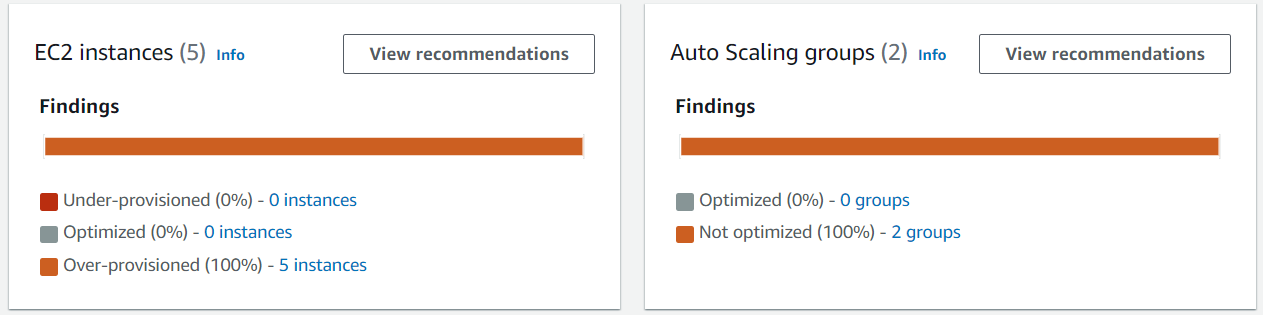
After you click on View recommendations for EC2 instances, you will come to the EC2 recommendation list view. Here is where you can see a list of your EC2 instances, their current instance type, our finding (over-provisioned, under-provisioned, or optimized), the recommended optimal instance type, and the estimated savings if there is a downsizing opportunity. By default, we will show you the best-fit instance type for the price regardless of CPU architecture. In many cases this means that Graviton will be recommended because EC2 offers a wide selection of Graviton instances with comparatively high price/performance ratio. If you’d like to only look at recommendations with your current architecture, you can use the CPU architecture preference dropdown to tell Compute Optimizer to show recommendations with only the current CPU architecture.

Here you can see two new columns — Migration effort and Inferred workload types. The Inferred workload types field shows the type of workload Compute Optimizer has inferred your instance is running. The Migration effort field shows how much effort you might need to spend if you migrate from your current instance type to recommended instance type based on the inferred workload type. When there is no change in CPU architecture (i.e. moving from an x86-instance type to another x86-instance type, like in the third row), the migration effort will be Very low. For x86-instances that are running Graviton-compatible applications, such as Apache Hadoop, NGINX, Memcached, etc., when you migrate the instance to Graviton, the effort will be Low. If Compute Optimizer cannot identify the applications, the migration effort from x86 to Graviton will be Medium, and you can provide application type data by putting an application-type tag key onto the instance. You can click on each row to see more detailed recommendation. Let’s click on the first row.

Compute Optimizer identifies this instance to be running Apache Hadoop workloads because there’s Amazon EMR system tag associated with it. It shows a banner that details why Compute Optimizer considers this as a low-effort Graviton migration candidate, and offers a migration guide when you click on Learn more.

The same Graviton recommendation can also be retrieved through Compute Optimizer API or CLI. Here’s a sample CLI that retrieves the same recommendation as discussed above:
aws compute-optimizer get-ec2-instance-recommendations --instance-arns arn:aws:ec2:us-west-2:020796573343:instance/i-0b5ec1bb9daabf0f3 --recommendation-preferences "{\"cpuVendorArchitectures\": [\"CURRENT\" , \"AWS_ARM64\"]}"
{
    "instanceRecommendations": [
        {
            "instanceArn": "arn:aws:ec2:us-west-2:000000000000:instance/i-0b5ec1bb9daabf0f3",
            "accountId": "000000000000",
            "instanceName": "Compute Intensive",
            "currentInstanceType": "r5.large",
            "finding": "UNDER_PROVISIONED",
            "findingReasonCodes": [
                "CPUUnderprovisioned",
                "EBSIOPSOverprovisioned"
            ],
            "inferredWorkloadTypes": [
                "ApacheHadoop"
            ],
            "utilizationMetrics": [
                {
                    "name": "CPU",
                    "statistic": "MAXIMUM",
                    "value": 100.0
                },
                {
                    "name": "EBS_READ_OPS_PER_SECOND",
                    "statistic": "MAXIMUM",
                    "value": 0.0
                },
                {
                    "name": "EBS_WRITE_OPS_PER_SECOND",
                    "statistic": "MAXIMUM",
                    "value": 4.943333333333333
                },
                {
                    "name": "EBS_READ_BYTES_PER_SECOND",
                    "statistic": "MAXIMUM",
                    "value": 0.0
                },
                {
                    "name": "EBS_WRITE_BYTES_PER_SECOND",
                    "statistic": "MAXIMUM",
                    "value": 880541.9921875
                },
                {
                    "name": "NETWORK_IN_BYTES_PER_SECOND",
                    "statistic": "MAXIMUM",
                    "value": 18113.96638888889
                },
                {
                    "name": "NETWORK_OUT_BYTES_PER_SECOND",
                    "statistic": "MAXIMUM",
                    "value": 90.37638888888888
                },
                {
                    "name": "NETWORK_PACKETS_IN_PER_SECOND",
                    "statistic": "MAXIMUM",
                    "value": 2.484055555555556
                },
                {
                    "name": "NETWORK_PACKETS_OUT_PER_SECOND",
                    "statistic": "MAXIMUM",
                    "value": 0.3302777777777778
                }
            ],
            "lookBackPeriodInDays": 14.0,
            "recommendationOptions": [
                {
                    "instanceType": "r6g.large",
                    "projectedUtilizationMetrics": [
                        {
                            "name": "CPU",
                            "statistic": "MAXIMUM",
                            "value": 70.76923076923076
                        }
                    ],
                    "platformDifferences": [
                        "Architecture"
                    ],
                    "migrationEffort": "Low",
                    "performanceRisk": 1.0,
                    "rank": 1
                },
                {
                    "instanceType": "t4g.xlarge",
                    "projectedUtilizationMetrics": [
                        {
                            "name": "CPU",
                            "statistic": "MAXIMUM",
                            "value": 33.33333333333333
                        }
                    ],
                    "platformDifferences": [
                        "Hypervisor",
                        "Architecture"
                    ],
                    "migrationEffort": "Low",
                    "performanceRisk": 3.0,
                    "rank": 2
                },
                {
                    "instanceType": "m6g.xlarge",
                    "projectedUtilizationMetrics": [
                        {
                            "name": "CPU",
                            "statistic": "MAXIMUM",
                            "value": 33.33333333333333
                        }
                    ],
                    "platformDifferences": [
                        "Architecture"
                    ],
                    "migrationEffort": "Low",
                    "performanceRisk": 1.0,
                    "rank": 3
                }
            ],
            "recommendationSources": [
                {
                    "recommendationSourceArn": "arn:aws:ec2:us-west-2:000000000000:instance/i-0b5ec1bb9daabf0f3",
                    "recommendationSourceType": "Ec2Instance"
                }
            ],
            "lastRefreshTimestamp": "2021-12-28T11:00:03.576000-08:00",
            "currentPerformanceRisk": "High",
            "effectiveRecommendationPreferences": {
                "cpuVendorArchitectures": [
                    "CURRENT",
                    "AWS_ARM64"
                ],
                "enhancedInfrastructureMetrics": "Inactive"
            }
        }
    ],
    "errors": []
}
Compute Optimizer Graviton recommendations are available in in US East (Ohio), US East (N. Virginia), US West (N. California), US West (Oregon), Asia Pacific (Mumbai), Asia Pacific (Seoul), Asia Pacific (Singapore), Asia Pacific (Sydney), Asia Pacific (Tokyo), Canada (Central), Europe (Frankfurt), Europe (Ireland), Europe (London), Europe (Paris), Europe (Stockholm), and South America (São Paulo) Regions at no additional charge. To get started with Compute Optimizer, visit the Compute Optimizer webpage.
Post Syndicated from Hubert Asamer original https://aws.amazon.com/blogs/architecture/detect-real-time-anomalies-and-failures-in-industrial-processes-using-apache-flink/
For a long time, industrial control systems were the heart of the manufacturing process which allows collecting, processing, and acting on data from the shop floor. Process manufacturers used a distributed control system (DCS) to do the automated control and operation of an industrial process or plant.
With the convergence of operational technology and information technology (IT), customers such as Yara are integrating their DCS with additional intelligence from the IT side. This provides customers with a holistic view of the different data sources to make more complex decisions with advanced analytics.
In this blog post, we show how to start with advanced analytics on streaming data coming from the shop floor. The sensor data, such as pressure and temperature, is typically published by a DCS. It is then ingested with a local edge gateway and streamed to the cloud with streaming and industrial internet of things (IoT) technology. Analytics on the streaming data is typically done before all data points are stored in the data layer. Figure 1 shows how the data flow can be modeled and visualized with AWS services.

Figure 1: High-level ingestion and analytics architecture
In this example, we are concentrating on the streaming analytics part in the Cloud. We will generate data from a simulated DCS to Amazon Kinesis Data Streams where you have a gateway such as AWS IoT Greengrass and maybe other IoT services in-between.
For the simulated process that the DCS is controlling, we use a well-documented industrial process for creating a chemical compound (acetic anhydride) called the Tennesee Eastman process (TEP). There are several simulations available as open source. We demonstrate how to use this data as a constant stream with more than 30 real-time measurement parameters, ingest to Kinesis Data Streams, and run in-stream analytics using Apache Flink. Within Apache Flink, data is grouped and mapped to the respective stages and parts of the industrial process, and constantly analyzed by calculating anomalies of all process stages. All raw data, plus the derived anomalies and failure patterns, are then ingested from Apache Flink to Amazon Timestream for further use in near real-time dashboards.
Note: Refer to steps 1 to 6 in Figure 2.
As a starting point for a realistic and data intensive measurement source, we use an already existing (TEP) simulation framework written in C++ originally created from National Institute of Standards and Technology, and published as open source. The GitHub Blog repository contains a small patch which adds AWS connectivity with the software development kits (SDKs) and modifications to the command line arguments. The programs provided by this framework are (step 1) a simulation process starter with configurable starting conditions and timestep configurations and a real-time client (step 2) which connects to the simulation and sends the simulation output data to the AWS Cloud.
Tennesee Eastman process (TEP) background
A paper by Downs & Vogel, A plant-wide industrial process control problem, from 1991 states:
“This chemical standard process consists of a reactor/separator/recycle arrangement involving two simultaneous gas-liquid exothermic reactions.”
“The process produces two liquid products from four reactants. Also present are an inert and a byproduct making a total of eight components. Two additional byproduct reactions also occur. The process has 12 valves available for manipulation and 41 measurements available for monitoring or control.“
The simulation framework used can control all of the 12 valve settings and produces 41 measurement variables with varying sampling frequency.
Data ingestion
The 41 measurement variables, named xmeas_1 to xmeas_41, are emitted by the real-time client (step 2) as key-value JSON messages. The client code is configured to produce 100 messages per second. A built-in C++ Kinesis SDK allows the real-time client to directly stream JSON messages to a Kinesis data stream (step 3).

Figure 2 – Detailed system architecture
Stream processing with Apache Flink
Messages sent to Amazon Kinesis Data Stream are processed in configurable batch sizes by an Apache Flink application, deployed in Amazon Kinesis Data Analytics. Apache Flink is an open-source stream processing framework, written and usable in Java or Scala. As described in Figure 3, it allows the definition of various data sources (for example, a Kinesis data stream) and data sinks for storing processing results. In-between data can be processed by a range of operators—typically mapping and reducing functions (step 4).
In our case, we use a mapping operator where each batch of incoming messages is processed. In Code snippet 1, we apply a custom mapping function to the raw data stream. For rapid and iterative development purposes it’s possible to have the complete stream processing pipeline running in a local Java or Scala IDE such as Maven, Eclipse, or IntelliJ.

Figure 3: Flink execution plan (green: streaming data sources; yellow: data sinks)
public class StreamingJob extends AnomalyDetector {
---
  public static DataStream<String> createKinesisSource
    (StreamExecutionEnvironment env,
     ParameterTool parameter)
    {
    // create Stream
    return kinesisStream;
  }
---
  public static void main(String[] args) {
    // set up the execution environment
    final StreamExecutionEnvironment env =
      StreamExecutionEnvironment.getExecutionEnvironment();
---
    DataStream<List<TimestreamPoint>> mainStream =
      createKinesisSource(env, parameter)
      .map(new AnomalyJsonToTimestreamPayloadFn(parameter))
      .name("MaptoTimestreamPayload");
---
    env.execute("Amazon Timestream Flink Anomaly Detection Sink");
  }
}
Code snippet 1: Flink application main class
In-stream anomaly detection
Within the Flink mapping operator, a statistical outlier detection (anomaly detection) is implemented. Flink allows the inclusion of custom libraries within its operators. The library used here is published by AWS—a Random Cut Forest implementation available from GitHub. Random Cut Forest is a well understood statistical method which can operate on batches of measurements. It then calculates an anomaly score for each new measurement by comparing a new value with a cached pool (=forest) of older values.
The algorithm allows the creation of grouped anomaly scores, where a set of variables is combined to calculate a single anomaly score. In the simulated chemical process (TEP), we can group the measurement variables into three process stages:
Each group consists of 5–10 measurement variables. We’re getting anomaly scores for a, b, and c. In Code snippet 2 we can learn how an anomaly detector is created. The class AnomalyDetector is instantiated and extended then three times (for our three distinct process stages) within the mapping function as described in Code snippet 3.
Flink distributes this calculation across its worker nodes and handles data deduplication processes within its system.
---
public class AnomalyDetector {
    protected final ParameterTool parameter;
    protected final Function<RandomCutForest, LineTransformer> algorithmInitializer;
    protected LineTransformer algorithm;
    protected ShingleBuilder shingleBuilder;
    protected double[] pointBuffer;
    protected double[] shingleBuffer;
    public AnomalyDetector(
      ParameterTool parameter,
      Function<RandomCutForest,LineTransformer> algorithmInitializer)
    {
      this.parameter = parameter;
      this.algorithmInitializer = algorithmInitializer;
    }
    public List<String> run(Double[] values) {
            if (pointBuffer == null) {
                prepareAlgorithm(values.length);
            }
      return processLine(values);
    }
    protected void prepareAlgorithm(int dimensions) {
---
      RandomCutForest forest = RandomCutForest.builder()
        .numberOfTrees(Integer.parseInt(
          parameter.get("RcfNumberOfTrees", "50")))
        .sampleSize(Integer.parseInt(
          parameter.get("RcfSampleSize", "8192")))
        .dimensions(shingleBuilder.getShingledPointSize())
        .lambda(Double.parseDouble(
          parameter.get("RcfLambda", "0.00001220703125")))
        .randomSeed(Integer.parseInt(
          parameter.get("RcfRandomSeed", "42")))
      .build();
---
    algorithm = algorithmInitializer.apply(forest);
  }
Code snippet 2: AnomalyDetector base class, which gets extended by the streaming applications main class
public class AnomalyJsonToTimestreamPayloadFn extends
    RichMapFunction<String, List<TimestreamPoint>> {
  protected final ParameterTool parameter;
  private final Logger logger =

  public AnomalyJsonToTimestreamPayloadFn(ParameterTool parameter) {
    this.parameter = parameter;
  }

  // create new instance of StreamingJob for running our Forest
  StreamingJob overallAnomalyRunner1;
  StreamingJob overallAnomalyRunner2;
  StreamingJob overallAnomalyRunner3;
---

  // use `open`method as RCF initialization
  @Override
  public void open(Configuration parameters) throws Exception {
    overallAnomalyRunner1 = new StreamingJob(parameter);
    overallAnomalyRunner2 = new StreamingJob(parameter);
    overallAnomalyRunner3 = new StreamingJob(parameter);
  super.open(parameters);
}
---
Code snippet 3: Mapping Function uses the Flink RichMapFunction open routine to initialize three distinct Random Cut Forests
Data persistence – Flink data sinks
After all anomalies are calculated, we can decide where to send this data. Flink provides various ready-to-use data sinks. In these examples, we fan out all (raw and processed) data to Amazon Kinesis Data Firehose for storing in Amazon Simple Storage Service (Amazon S3) (long term) (step 5) and to Amazon Timestream (short term) (step 5). Kinesis Data Firehose is configured with a small AWS Lambda function to reformat data from JSON to CSV, and data is stored with automated partitioning to Amazon S3. A Timestream data sink does not come pre-bundled with Flink. A custom Timestream ingestion code is used in these examples. Flink provides extensible operator interfaces for the creation of custom map and sink functions.
Timeseries handling
Timestream, in combination with Grafana, is used for near real-time monitoring. Grafana comes bundled with a Timestream data source plugin and can constantly query and visualize Timestream data (step 6).
Our architecture is available as a deployable AWS CloudFormation template. The simulation framework comes packed as a docker image, with an option to install it locally on a linux host.
To implement this architecture, you will need:
We recommend running a local and recent Linux environment. It is assumed that you are using AWS Cloud9, deployed with CloudFormation, within your AWS account.
Follow these steps to deploy the solution and play with the simulation framework. At the end, detected anomalies derived from Flink are stored next to all raw data in Timestream and presented in Grafana. We’re using AWS Cloud9 and its Linux terminal capabilities here to fire up a Grafana instance, then manually run the simulation to ingest data to Kinesis and optionally manually start the Flink app from the console using Maven.
Deploy stack
After you’re logged in to the AWS Management console you can deploy the CloudFormation stack. This stack creates a fully configured AWS Cloud9 environment with the related GitHub Repo already in place, a Kinesis data stream, Kinesis Data Firehose delivery stream, Kinesis Data Analytics with Flink app deployed, Timestream database, and an S3 bucket.

After successful deployment, record two important facts from the CloudFormation console: the chosen stack name and the attribute 03Cloud9EnvUrl displayed in the Output Section of the stack. The attribute’s URL will take you directly to our deployed AWS Cloud9 environment.
Run post install step within AWS Cloud9
The deployed stack created an AWS Cloud9 environment and an AWS Identity and Access Management (IAM) instance profile. We apply this instance profile to AWS Cloud9 to interact with Kinesis, Timestream, and Amazon S3 throughout the next steps. The used script also configures and installs other required tools.
1. Open a terminal window.
$ cd flinkAnomalySteps/deployment
$ source c9-postInstall.sh
---SETTING UP IAM INSTANCE PROFILE
Please enter cloudformation stack name (default: flink-rcf-app):
# enter your stack name
Start a Grafana development server
In this section we are starting a Grafana server using docker. Cloud 9 allows us to expose web applications (for demo & development purposes) on container port 8080.
1. Open a terminal window.
$ cd ../src/grafana-dashboard
$ docker volume create grafana-storage
# this creates a docker volume for persisting your Grafana settings
$./start-grafana.sh
# this starts a recent Grafana using docker with Timestream plugin and a pre-configured dashboard in place
2. Open the preview panel by selecting Preview, and then select Preview Running Application.

3. Next, in the preview pane, select Pop out into new Window.

4. A new browser tab with Grafana opens.
5. Choose any username and password combination.
6. In Grafana use the “Search dashboards” icon on the left and choose “TEP-SIM-DEV”. This pre-configured dashboard displays data from Amazon Timestream (see step “Open Grafana”).
TEP simulation procedure
Within your local or AWS Cloud9 Linux environment, fetch the simulation docker image from the public AWS container registry, or build the simulation binaries locally, for building manually check the GitHub repo.
Start simulation (in separate terminal)
# starts container and switch into the container-shell
$ docker run -it --rm \
  --network host \
  --name tesim-runner \
  tesim-runner:01 \
 /bin/bash
# then inside container
$ ./tesim --simtime 100  --external-ctrl
# simulation started…
Manipulate simulation (in separate terminal)
Follow the steps here for a basic process disturbance task. Review the aspects of influencing the simulation in the GitHub-Repo. The rtclient program has a range of commands to use for introducing disturbances.
# first switch into running simulation container
$ docker exec -it tesim-runner /bin/bash
# now we can access the shared storage of the simulation process…
$ ./rtclient –setidv 6
# this enables one of the built in process disturbances (1-20)
$ ./rtclient –setidv 7
$ ./rtclient –setidv 8
$ …
Stream Simulation data to Amazon Kinesis DataStream (in separate terminal)
The client has a built-in record frequency of 50 messages per second. One message contains more than 50 measurements, so we have approximately 2,500 measurements per second.
$ ./rtclient -k

AWS libcrypto resolve: found static libcrypto 1.1.1 HMAC symbols
AWS libcrypto resolve: found static libcrypto 1.1.1 EVP_MD symbols
{"xmeas_1": 3649.739476,"xmeas_2": 4451.32071,"xmeas_3": 9.223142558,"xmeas_4": 32.39290913,"xmeas_5": 47.55975621,"xmeas_6": 2798.975688,"xmeas_7": 64.99582601,"xmeas_8": 122.8987929,"xmeas_9": 0.1978264656,…}
# Messages in JSON sent to Kinesis DataStream visible via stdout
Compile and start Flink Application (optional step)
If you want deeper insights into the Flink Application, we can start this as well from the AWS Cloud9 instance. Note: this is only appropriate in development.
$ cd flinkAnomalySteps/src
$ cd flink-rcf-app
$ mvn clean compile
# the Flink app gets compiled
$ mvn exec:java -Dexec.mainClass= \
    "com.amazonaws.services.kinesisanalytics.StreamingJob"
# Flink App is started with default settings in place…
…
Open Grafana dashboard (from the step Start a Grafana development server)
Process anomalies are visible instantly after you start the simulation. Use Grafana to drill down into the data as needed.
/**example - simplest possible Timestream query used for Viz:**/

SELECT CREATE_TIME_SERIES(time, measure_value::double) as anomaly_stream6 FROM "kdaflink"."kinesisdata1"

    WHERE measure_name='anomaly_score_stream6' AND

    time between ago(15m) and now()
Code snippet 4: Timestream SQL example; Timestream database is `kdaflink` – table is `kinesisdata1`

Figure 4 – Grafana dashboard showing near real-time simulation data, three anomalies, mapped to the TEP process, are constantly calculated by Flink
S3 raw metrics bucket
For the sake of completeness and potential usefulness, the Flink Application emits all raw data in an intermediate step to Kinesis Data Firehose. The service converts all JSON data to CSV format by using a small AWS Lambda function.
$ aws s3 ls flink-rcf-app-rawmetricsbucket-<CFN-UUID>/tep-raw-csv/2021/11/26/19/Delete the deployed CloudFormation stack. All resources (excluding S3 buckets) are permanently deleted.
In this blog post, we learned that in-stream anomaly detection and constant measurement data insights can work together. The Apache Flink framework offers a ready-to-use platform that is mission critical for future adoption across manufacturing and other industries. Other applications of the presented Flink pattern can run on capable edge compute devices. Integration with AWS IoT Greengrass and AWS Greengrass Stream Manager are part of the GitHub Blog repository.
Another extension includes measurement data pattern detection routines, which can coexist with in-stream anomaly detection and can detect specific failure patterns over time using time-windowing features of the Flink framework. You can refer to the GitHub repo which accompanies this blog post. Give it a try and let us know your feedback in the comments!