Post Syndicated from Talks at Google original https://www.youtube.com/watch?v=kblMacUtSrQ
CVE-2024-24919: Check Point Security Gateway Information Disclosure
Post Syndicated from Rapid7 original https://blog.rapid7.com/2024/05/30/etr-cve-2024-24919-check-point-security-gateway-information-disclosure/

On May 28, 2024, Check Point published an advisory for CVE-2024-24919, a high-severity information disclosure vulnerability affecting Check Point Security Gateway devices configured with either the “IPSec VPN” or “Mobile Access” software blade.
On May 29, 2024, security firm mnemonic published a blog reporting that they have observed in-the-wild exploitation of CVE-2024-24919 since April 30, 2024, with threat actors leveraging the vulnerability to enumerate and extract password hashes for all local accounts, including accounts used to connect to Active Directory. They’ve also observed adversaries moving laterally and extracting the “ntds.dit” file from compromised customers’ Active Directory servers, within hours of an initial attack against a vulnerable Check Point Gateway.
On May 30, 2024, watchTowr published technical details of CVE-2024-24919 including a PoC.
The vulnerability allows an unauthenticated remote attacker to read the contents of an arbitrary file located on the affected appliance. For example, this allows an attacker to read the appliances /etc/shadow file, disclosing the password hashes for local accounts. The attacker is not limited to reading this file and may read other files that contain sensitive information. An attacker may be able to crack the password hashes for these local accounts, and if the Security Gateway allows password only authentication, the attacker may use the cracked passwords to authenticate.
Mitigation Guidance
According to the vendor advisory, the following products are vulnerable to CVE-2024-24919:
- CloudGuard Network
- Quantum Maestro
- Quantum Scalable Chassis
- Quantum Security Gateways
- Quantum Spark Appliances
Check Point has advised that a Security Gateway is vulnerable if one of the following configuration is applied:
- If the “IPSec VPN” blade has been enabled and the Security Gateway device is part of the “Remote Access” VPN community.
- If the “Mobile Access” blade has been enabled.
Check Point has released hotfixes for Quantum Security Gateway, Quantum Maestro, Quantum Scalable Chassis, and Quantum Spark Appliances. We advise customers to refer to the Check Point advisory for the most current information on affected versions and hotfixes.
The vendor supplied hotfixes should be applied immediately. Rapid7 strongly recommends that Check Point Security Gateway customers examine their environments for signs of compromise and reset local account credentials in addition to applying vendor-provided fixes.
Check Point notes that exploit attempts their team has observed “focus on remote access scenarios with old local accounts with unrecommended password-only authentication.” The company recommends that customers check for local account usage, disable any unused local accounts, and add certificate-based authentication rather than password-only authentication. More information and recommendations on user and client authentication for remote access is available here.
Rapid7 Customers
A vulnerability check is in development for InsightVM and Nexpose customers to assess exposure to CVE-2024-24919. This blog will be updated with the latest information as and when it is available
InsightIDR and Managed Detection and Response customers have existing detection coverage through Rapid7’s expansive library of detection rules. Rapid7 recommends installing the Insight Agent on all applicable hosts to ensure visibility into suspicious processes and proper detection coverage. Below is a non-exhaustive list of detections that are deployed and will alert on post-exploitation behavior related to this vulnerability:
- Suspicious Web Server Request – Successful Path Traversal Attack
- Suspicious Web Request – Possible Check Point VPN (CVE-2024-24919) Exploitation
Let’s Architect! Learn About Machine Learning on AWS
Post Syndicated from Luca Mezzalira original https://aws.amazon.com/blogs/architecture/lets-architect-learn-about-machine-learning-on-aws/
A data-driven approach empowers businesses to make informed decisions based on accurate predictions and forecasts, leading to improved operational efficiency and resource optimization. Machine learning (ML) systems have the remarkable ability to continuously learn and adapt, improving their performance over time as they are exposed to more data. This self-learning capability ensures that organizations can stay ahead of the curve, responding dynamically to changing market conditions and customer preferences, ultimately driving innovation and enhancing competitiveness.
By leveraging the power of machine learning on AWS, businesses can unlock benefits that enhance efficiency, improve decision-making, and foster growth.
AWS re:Invent 2023 – Zero to machine learning: Jump-start your data-driven journey
In this session, see how organizations with constrained resources (budgets, skill gaps, time) can jump start their data-driven journey with advanced analytics and ML capabilities. Learn AWS Working Backwards best practices to drive forward data-related projects that address tangible business value. Then dive into AWS analytics and AI/ML capabilities that simplify and expedite data pipeline delivery and business value from ML workloads. Hear about low-code no-code (LCNC) AWS services within the context of a complete data pipeline architecture.

Figure 1. See an architecture to analyze customer churn using AWS services
Introduction to MLOps engineering on AWS
As artificial intelligence (AI) continues to revolutionize industries, the ability to operationalize and scale ML models has become a critical challenge. This session introduces the concept of MLOps, a discipline that builds upon and extends the widely adopted DevOps practices prevalent in software development. By applying MLOps principles, organizations can streamline the process of building, training, and deploying ML models, ensuring efficient and reliable model lifecycle management. By mastering MLOps, organizations can bridge the gap between AI development and operations, enabling them to unlock the full potential of their ML initiatives.

Figure 2. MLOps maturity level will help to assess your organization and understand how to reach the next level.
Behind-the-scenes look at generative AI infrastructure at Amazon
To power generative AI applications while keeping costs under control, AWS designs and builds machine learning accelerators like AWS Trainium and AWS Inferentia. This session introduces purpose-built ML hardware for model training and inference, and shows how Amazon and AWS customers take advantage of those solutions to optimize costs and reduce latency.
You can learn from practical examples showing the impact of those solutions and explanations about how these chips work. ML accelerators are not only beneficial for generative AI workloads; they can also be applied to other use cases, including representation learning, recommender systems, or any scenario with deep neural network models.

Figure 3. Discover the technology that powers our AI services
How our customers are implementing machine learning on AWS
The following resources drill down into the ML infrastructure that’s used to train large models at Pinterest and the experimentation framework built by Booking.com.
The Pinterest video discusses the strategy to create an ML development environment, orchestrate training jobs, ingest data into the training loop, and accelerate the training speed. You can also learn about the advantages derived from containers in the context of ML and how Pinterest decided to set up the entire ML lifecycle, including distributed model training.
The second resource covers how Booking.com accelerated the experimentation process by leveraging Amazon SageMaker for data analysis, model training, and online experimentation. This resulted in shorter development times for their ranking models and increased speed for the data science teams.
Take me to Booking.com blog post

Figure 4. Let’s discover how Pinterest is using AWS services for machine learning workloads
SageMaker Immersion Day
Amazon SageMaker Immersion Day helps customers and partners provide end-to-end understanding of building ML use cases. From feature engineering to understanding various built-in algorithms, with a focus on training, tuning, and deploying the ML model in a production-like scenario, this workshop guides you to bring your own model to perform lift-and-shift from on-premises to the Amazon SageMaker platform. It further demonstrates more advanced concepts like model debugging, model monitoring, and AutoML.

Figure 5. Train, tune and deploy your workload using Amazon SageMaker
See you next time!
Thanks for reading! With this post, introduced you to the art of possibility on using AWS machine learning services. In the next blog, we will talk about cloud migrations.
To revisit any of our previous posts or explore the entire series, visit the Let’s Architect! page.
Cheap Aliexpress Window Robot that does it all
Post Syndicated from BeardedTinker original https://www.youtube.com/watch?v=F92RnFDZty4
UALink will be the NVLink Standard Backed by AMD Intel Broadcom Cisco and More
Post Syndicated from Patrick Kennedy original https://www.servethehome.com/ualink-will-be-the-nvlink-standard-backed-by-amd-intel-broadcom-cisco-and-more/
AMD, Intel, Broadcom, Cisco, Meta, Goole, Microsoft and more are backing the UALink standard as an industry alternative to NVIDIA NVLink
The post UALink will be the NVLink Standard Backed by AMD Intel Broadcom Cisco and More appeared first on ServeTheHome.
How to issue use-case bound certificates with AWS Private CA
Post Syndicated from Chris Morris original https://aws.amazon.com/blogs/security/how-to-issue-use-case-bound-certificates-with-aws-private-ca/
In this post, we’ll show how you can use AWS Private Certificate Authority (AWS Private CA) to issue a wide range of X.509 certificates that are tailored for specific use cases. These use-case bound certificates have their intended purpose defined within the certificate components, such as the Key Usage and Extended Key usage extensions. We will guide you on how you can define your usage by applying your required Key Usage and Extended Key usage values with the IssueCertificate API operation.
Background
With the AWS Private CA service, you can build your own public key infrastructure (PKI) in the AWS Cloud and issue certificates to use within your organization. Certificates issued by AWS Private CA support both the Key Usage and Extended Key Usage extensions. By using these extensions with specific values, you can bind the usage of a given certificate to a particular use case during creation. Binding certificates to their intended use case, such as SSL/TLS server authentication or code signing, provides distinct security benefits such as accountability and least privilege.
When you define certificate usage with specific Key Usage and Extended Key Usage values, this helps your organization understand what purpose a given certificate serves and the use case for which it is bound. During audits, organizations can inspect their certificate’s Key Usage and Extended Key Usage values to determine the certificate’s purpose and scope. This not only provides accountability regarding a certificate’s usage, but also a level of transparency for auditors and stakeholders. Furthermore, by using these extensions with specific values, you will follow the principle of least privilege. You can grant least privilege by defining only the required Key Usage and Extended Key Usage values for your use case. For example, if a given certificate is going to be used only for email protection (S/MIME), you can assign only that extended key usage value to the certificate.
Certificate templates and use cases
In AWS Private CA, the Key Usage and Extended Key Usage extensions and values are specified by using a configuration template, which is passed with the IssueCertificate API operation. The base template provided by AWS handles the most common certificate use cases, such as SSL/TLS server authentication or code signing. However, there are additional use cases for certificates that are not defined in base templates. To issue certificates for these use cases, you can pass blank certificate templates in your IssueCertificate requests, along with your required Key Usage and Extended Key usage values.
Such use cases include, but are not limited to the following:
- Certificates for SSL/TLS
- Issue certificates with an Extended Key Usage value of Server Authentication, Client Authentication, or both.
- Certificates for email protection (S/MIME)
- Issue certificates with an Extended Key Usage value of E-mail Protection
- Certificates for smart card authentication (Microsoft Smart Card Login)
- Issue certificates with an Extended Key Usage value of Smart Card Logon
- Certificates for document signing
- Issue certificates with an Extended Key Usage value of Document Signing
- Certificates for code signing
- Issue certificates with an Extended Key Usage value of Code Signing
- Certificates that conform to the Matter connectivity standard
- Matter-compliant device attestation certificates
- Matter-compliant subordinate CA certificates
- Matter-compliant node operational certificate
- More Matter-compliant certificates
If your certificates require less-common extended key usage values not defined in the AWS documentation, you can also pass object identifiers (OIDs) to define values in Extended Key Usage. OIDs are dotted-string identifiers that are mapped to objects and attributes. OIDs can be defined and passed with custom extensions using API passthrough. You can also define OIDs in a CSR (certificate signing request) with a CSR passthrough template. Such uses include:
- Certificates that require IPSec or virtual private network (VPN) related extensions
- Issue certificates with Extended Key Usage values:
OID: 1.3.6.1.5.5.7.3.5 (IPSEC_END_SYSTEM)OID: 1.3.6.1.5.5.7.3.6 (IPSEC_TUNNEL)OID: 1.3.6.1.5.5.7.3.7 (IPSEC_USER)
- Issue certificates with Extended Key Usage values:
- Certificates that conform to the ISO/IEC standard for mobile driving license (mDL)
- Pass the ISO/IEC 18013-5 OID reserved for mDL DS: 1.0.18013.5.1.2 by using custom extensions.
It’s important to note that blank certificate templates aren’t limited to just end-entity certificates. For example, the BlankSubordinateCACertificate_PathLen0_APICSRPassthrough template sets the Basic constraints parameter to CA:TRUE, allowing you to issue a subordinate CA certificate with your own Key Usage and Extended Key Usage values.
Using blank certificate templates
When you browse through the AWS Private CA certificate templates, you may see that base templates don’t allow you to define your own Key Usage or Extended Key Usage extensions and values. They are preset to the extensions and values used for the most common certificate types in order to simplify issuing those types of certificates. For example, when using EndEntityCertificate/V1, you will always get a Key Usage value of Critical, digital signature, key encipherment and an Extended Key Usage value of TLS web server authentication, TLS web client authentication. The following table shows all of the values for this base template.
| EndEntityCertificate/V1 | |
| X509v3 parameter | Value |
| Subject alternative name | [Passthrough from certificate signing request (CSR)] |
| Subject | [Passthrough from CSR] |
| Basic constraints | CA:FALSE |
| Authority key identifier | [Subject key identifier from CA certificate] |
| Subject key identifier | [Derived from CSR] |
| Key usage | Critical, digital signature, key encipherment |
| Extended key usage | TLS web server authentication, TLS web client authentication |
| CRL distribution points | [Passthrough from CA configuration] |
When you look at blank certificate templates, you will see that there is more flexibility. For one example of a blank certificate template, BlankEndEntityCertificate_APICSRPassthrough/V1, you can see that there are fewer predefined values compared to EndEntityCertificate/V1. You can pass your own values for Extended Key Usage and Key Usage.
| BlankEndEntityCertificate_APICSRPassthrough/V1 | |
| X509v3 parameter | Value |
| Subject alternative name | [Passthrough from API or CSR] |
| Subject | [Passthrough from API or CSR] |
| Basic constraints | CA:FALSE |
| Authority key identifier | [Subject key identifier from CA certificate] |
| Subject key identifier | [Derived from CSR] |
| CRL distribution points
Note: CRL distribution points are included in the template only if the CA is configured with CRL generation enabled. |
[Passthrough from CA configuration or CSR] |
To specify your desired extension and value, you must pass them in the IssueCertificate API call. There are two ways of doing so: the API Passthrough and CSR Passthrough templates.
- API Passthrough – Extensions and their values defined in the IssueCertificate parameter APIPassthrough are copied over to the issued certificate.
- CSR Passthrough – Extensions and their values defined in the CSR are copied over to the issued certificate.
To accommodate the different ways of passing these values, there are three varieties of blank certificate templates. If you would like to pass extensions defined only in your CSR file to the issued certificate, you can use the BlankEndEntityCertificate_CSRPassthrough/V1 template. Similarly, if you would like to pass extensions defined only in the APIPassthrough parameter, you can use the BlankEndEntityCertificate_APIPassthrough/V1 template. Finally, if you would like to use a combination of extensions defined in both the CSR and APIPassthrough, you can use the BlankEndEntityCertificate_APICSRPassthrough/V1 template. It’s important to remember these points when choosing your template:
- The template definition will always have the higher priority over the values specified in the CSR, regardless of what template variety you use. For example, if the template contains a Key Usage value of digital signature and your CSR file contains key encipherment, the certificate will choose the template definition digital signature.
- API passthrough values are only respected when you use an API passthrough or APICSR passthrough template. CSR passthrough is only respected when you use a CSR passthrough or APICSR passthrough template. When these sources of information are in conflict (the CSR contains the same extension or value as what’s passed in API passthrough), a general rule usually applies: For each extension value, the template definition has highest priority, followed by API passthrough values, followed by CSR passthrough extensions. Read more about the template order of operations in the AWS documentation.
How to issue use-case bound certificates in the AWS CLI
To get started issuing certificates, you must have appropriate AWS Identity and Access Management (IAM) permissions as well as an AWS Private CA in an “Active” status. You can verify if your private CA is active by running the aws acm-pca list-certificate-authorities command from the AWS Command Line Interface (CLI). You should see the following:
"Status": "ACTIVE"
After verifying the status, make note of your private CA Amazon Resource Name (ARN).
To issue use-case bound certificates, you must use the Private CA API operation IssueCertificate.
In the AWS CLI, you can call this API by using the command issue-certificate. There are several parameters you must pass with this command:
- (
--certificate-authority-arn) – The ARN of your private CA. - (
--csr) – The CSR in PEM format. It must be passed as a blob , like fileb://. - (
--validity) – Sets the “Not After” date (expiration date) for the certificate. - (
--signing-algorithm) – The signing algorithm to be used to sign the certificate. The value you choose must match the algorithm family of the private CA’s algorithm (RSA or ECDSA). For example, if the private CA uses RSA_2048, the signing algorithm must be an RSA variant, like SHA256WITHRSA.You can check your private CA’s algorithm family by referring to its key algorithm. The command aws acm-pca describe-certificate-authority will show the corresponding KeyAlgorithm value.
- (
--template-arn) – This is where the blank certificate template is defined. The template should be an AWS Private CA template ARN. The full list of AWS Private CA template ARNs are shown in the AWS documentation.
We’ll now demonstrate how to issue use-case bound end-entity certificates by using blank end-entity certificate templates. We will issue two different certificates. One will be bound for email protection, and one will be bound for smart card authentication. Email protection and smart card authentication certificates have specific Extended Key Usage values which are not defined by any base template. We’ll use CSR passthrough to issue the smart card authentication certificate and use API passthrough to issue the email protection certificate.
The certificate templates that we will use are:
- For CSR passthrough: BlankEndEntityCertificate_CSRPassthrough/V1
- For API Passthrough: BlankEndEntityCertificate_APIPassthrough/V1
Important notes about this demo:
- These commands are for demo purposes only. Depending on your specific use case, email protection certificates and smart card authentication certificates may require different extensions than what’s shown in this demo.
- You will be generating RSA 2048 private keys. Private keys need to be protected and stored properly and securely. For example, encrypting private keys or storing private keys in a hardware security module (HSM) are some methods of protection that you can use.
- We will be using the OpenSSL command line tool, which is installed by default on many operating systems such as Amazon Linux 2023. If you don’t have this tool installed, you can obtain it by using the software distribution facilities of your organization or your operating system, as appropriate.
Use API passthrough
We will now demonstrate how to issue a certificate that is bound for email protection. We’ll specify Key Usage and Extended Key Usage values, and also a subject alternative name through API passthrough. The goal is to have these extensions and values in the email protection certificate.
Extensions:
To issue a certificate bound for email protection
- Use the following command to create your keypair and CSR with OpenSSL. Define your distinguished name in the OpenSSL prompt.
- Use the following command to issue an end-entity certificate specifying the EMAIL_PROTECTION extended key usage value, the Digital Signature and Key Encipherment Key Usage values, and the subject alternative name [email protected]. We will use the Rfc822Name subject alternative name type, because the value is an email address.
Make sure to replace the data in arn:aws:acm-pca:<region>:<accountID>:certificate-authority/11111111-1111-1111-1111-111111111111 with your private CA ARN, and adjust the signing algorithm according to your private CA’s algorithm. Assuming my PCA is type RSA, I am using SHA256WITHRSA.
If the command is successful, then the ARN of the issued certificate is shown as the result:
- Proceed to the Retrieve the Certificate section of this post to retrieve the certificate and certificate chain PEM from the CertificateArn.
Use CSR passthrough
We’ll now demonstrate how to issue a certificate that is bound for smart card authentication. We will specify Key Usage, Extended Key Usage, and subject alternative name extensions and values through CSR passthrough. The goal is to have these values in the smart card authentication certificate.
Extensions:
We’ll generate our CSR by requesting these specific extensions and values with OpenSSL. When we call IssueCertificate, the CSR passthrough template will acknowledge the requested extensions and copy them over to the issued certificate.
To issue a certificate bound for smart card authentication
- Use the following command to create the private key.
- Create a file called openssl_csr.conf to define the distinguished name and the requested CSR extensions.
Following is an example of OpenSSL configuration file content. You can copy this configuration to the openssl_csr.conf file and adjust the values to your requirements. You can find further reference on the configuration in the OpenSSL documentation.
In this example, you can specify your Key Usage and Extended Key Usage values in the
[ my_req_ext ]section of the configuration. In the extendedKeyUsage line, you may also define extended key usage OIDs, like 1.3.6.1.4.1.311.20.2.2. Possible values are defined in the OpenSSL documentation. - Create the CSR, defining the configuration file.
- (Optional) You can use the following command to decode the CSR to make sure it contains the information you require.
The output should show the requested extensions and their values, as follows.
- Issue the certificate by using the issue-certificate command. We will use a CSR passthrough template so that the requested extensions and values in the CSR file are copied over to the issued certificate.
Make sure to replace the data in arn:aws:acm-pca:us-east-1:<accountID>:certificate-authority/11111111-1111-1111-1111-111111111111 with your private CA ARN and adjust the signing algorithm and validity to for your use case. Assuming my PCA is type RSA, I am using SHA256WITHRSA.
If the command is successful, then the ARN of the issued certificate is shown as the result:
Retrieve the certificate
After using issue-certificate with API passthrough or CSR passthrough, you can retrieve the certificate material in PEM format. Use the get-certificate command and specify the ARN of the private CA that issued the certificate, as well as the ARN of the certificate that was issued:
You can use the --query command with the AWS CLI to get the certificate and certificate chain in separate files.
Certificate
Certificate chain
After you retrieve the certificate, you can decode it with the openssl x509 command. This will allow you to view the details of the certificate, including the extensions and values that you defined.
Conclusion
In AWS Private CA, you can implement the security benefits of accountability and least privilege by defining the usage of your certificates. The Key Usage and Extended Key Usage values define the usage of your certificates. Many certificate use cases require a combination of Key Usage and Extended Key Usage values, which cannot be defined with base certificate templates. Some examples include document signing, smart card authentication, and mobile driving license (mDL) certificates. To issue certificates for these specific use cases, you can use blank certificate templates with the IssueCertificate API call. In addition to the blank certificate template, you must also define the specific combination of Key Usage and Extended Key Usage values through CSR passthrough, API passthrough, or both.
If you have feedback about this post, submit comments in the Comments section below. If you have questions about this post, contact AWS Support.
Want more AWS Security news? Follow us on Twitter.
[$] New APIs for filesystems
Post Syndicated from jake original https://lwn.net/Articles/975444/
A discussion of extensions to the statx()
system call comes up frequently at the Linux Storage,
Filesystem, Memory Management, and BPF Summit; this year’s edition was
no exception. Kent Overstreet led the first filesystem-only session at the
summit on querying information about filesystems that have subvolumes and
snapshots. While it was billed as a discussion on statx()
additions, it ranged more widely over new APIs needed for modern filesystems.
Disrupting FlyingYeti’s campaign targeting Ukraine
Post Syndicated from Cloudforce One original https://blog.cloudflare.com/disrupting-flyingyeti-campaign-targeting-ukraine

Cloudforce One is publishing the results of our investigation and real-time effort to detect, deny, degrade, disrupt, and delay threat activity by the Russia-aligned threat actor FlyingYeti during their latest phishing campaign targeting Ukraine. At the onset of Russia’s invasion of Ukraine on February 24, 2022, Ukraine introduced a moratorium on evictions and termination of utility services for unpaid debt. The moratorium ended in January 2024, resulting in significant debt liability and increased financial stress for Ukrainian citizens. The FlyingYeti campaign capitalized on anxiety over the potential loss of access to housing and utilities by enticing targets to open malicious files via debt-themed lures. If opened, the files would result in infection with the PowerShell malware known as COOKBOX, allowing FlyingYeti to support follow-on objectives, such as installation of additional payloads and control over the victim’s system.
Since April 26, 2024, Cloudforce One has taken measures to prevent FlyingYeti from launching their phishing campaign – a campaign involving the use of Cloudflare Workers and GitHub, as well as exploitation of the WinRAR vulnerability CVE-2023-38831. Our countermeasures included internal actions, such as detections and code takedowns, as well as external collaboration with third parties to remove the actor’s cloud-hosted malware. Our effectiveness against this actor prolonged their operational timeline from days to weeks. For example, in a single instance, FlyingYeti spent almost eight hours debugging their code as a result of our mitigations. By employing proactive defense measures, we successfully stopped this determined threat actor from achieving their objectives.
Executive Summary
- On April 18, 2024, Cloudforce One detected the Russia-aligned threat actor FlyingYeti preparing to launch a phishing espionage campaign targeting individuals in Ukraine.
- We discovered the actor used similar tactics, techniques, and procedures (TTPs) as those detailed in Ukranian CERT’s article on UAC-0149, a threat group that has primarily targeted Ukrainian defense entities with COOKBOX malware since at least the fall of 2023.
- From mid-April to mid-May, we observed FlyingYeti conduct reconnaissance activity, create lure content for use in their phishing campaign, and develop various iterations of their malware. We assessed that the threat actor intended to launch their campaign in early May, likely following Orthodox Easter.
- After several weeks of monitoring actor reconnaissance and weaponization activity (Cyber Kill Chain Stages 1 and 2), we successfully disrupted FlyingYeti’s operation moments after the final COOKBOX payload was built.
- The payload included an exploit for the WinRAR vulnerability CVE-2023-38831, which FlyingYeti will likely continue to use in their phishing campaigns to infect targets with malware.
- We offer steps users can take to defend themselves against FlyingYeti phishing operations, and also provide recommendations, detections, and indicators of compromise.
Who is FlyingYeti?
FlyingYeti is the cryptonym given by Cloudforce One to the threat group behind this phishing campaign, which overlaps with UAC-0149 activity tracked by CERT-UA in February and April 2024. The threat actor uses dynamic DNS (DDNS) for their infrastructure and leverages cloud-based platforms for hosting malicious content and for malware command and control (C2). Our investigation of FlyingYeti TTPs suggests this is likely a Russia-aligned threat group. The actor appears to primarily focus on targeting Ukrainian military entities. Additionally, we observed Russian-language comments in FlyingYeti’s code, and the actor’s operational hours falling within the UTC+3 time zone.
Campaign background
In the days leading up to the start of the campaign, Cloudforce One observed FlyingYeti conducting reconnaissance on payment processes for Ukrainian communal housing and utility services:
- April 22, 2024 – research into changes made in 2016 that introduced the use of QR codes in payment notices
- April 22, 2024 – research on current developments concerning housing and utility debt in Ukraine
- April 25, 2024 – research on the legal basis for restructuring housing debt in Ukraine as well as debt involving utilities, such as gas and electricity
Cloudforce One judges that the observed reconnaissance is likely due to the Ukrainian government’s payment moratorium introduced at the start of the full-fledged invasion in February 2022. Under this moratorium, outstanding debt would not lead to evictions or termination of provision of utility services. However, on January 9, 2024, the government lifted this ban, resulting in increased pressure on Ukrainian citizens with outstanding debt. FlyingYeti sought to capitalize on that pressure, leveraging debt restructuring and payment-related lures in an attempt to increase their chances of successfully targeting Ukrainian individuals.
Analysis of the Komunalka-themed phishing site
The disrupted phishing campaign would have directed FlyingYeti targets to an actor-controlled GitHub page at hxxps[:]//komunalka[.]github[.]io, which is a spoofed version of the Kyiv Komunalka communal housing site https://www.komunalka.ua. Komunalka functions as a payment processor for residents in the Kyiv region and allows for payment of utilities, such as gas, electricity, telephone, and Internet. Additionally, users can pay other fees and fines, and even donate to Ukraine’s defense forces.
Based on past FlyingYeti operations, targets may be directed to the actor’s Github page via a link in a phishing email or an encrypted Signal message. If a target accesses the spoofed Komunalka platform at hxxps[:]//komunalka[.]github[.]io, the page displays a large green button with a prompt to download the document “Рахунок.docx” (“Invoice.docx”), as shown in Figure 1. This button masquerades as a link to an overdue payment invoice but actually results in the download of the malicious archive “Заборгованість по ЖКП.rar” (“Debt for housing and utility services.rar”).
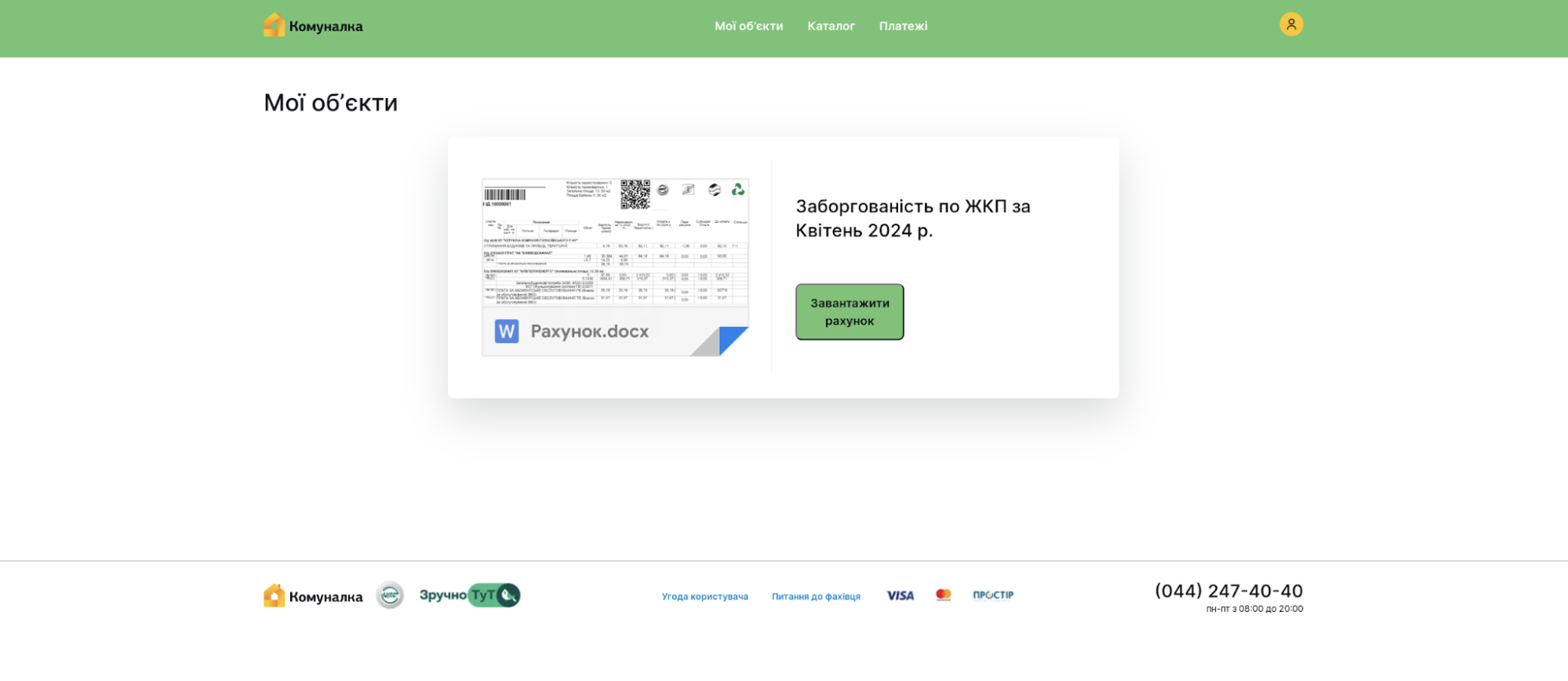
A series of steps must take place for the download to successfully occur:
- The target clicks the green button on the actor’s GitHub page hxxps[:]//komunalka.github[.]io
- The target’s device sends an HTTP POST request to the Cloudflare Worker worker-polished-union-f396[.]vqu89698[.]workers[.]dev with the HTTP request body set to “user=Iahhdr”
- The Cloudflare Worker processes the request and evaluates the HTTP request body
- If the request conditions are met, the Worker fetches the RAR file from hxxps[:]//raw[.]githubusercontent[.]com/kudoc8989/project/main/Заборгованість по ЖКП.rar, which is then downloaded on the target’s device
Cloudforce One identified the infrastructure responsible for facilitating the download of the malicious RAR file and remediated the actor-associated Worker, preventing FlyingYeti from delivering its malicious tooling. In an effort to circumvent Cloudforce One’s mitigation measures, FlyingYeti later changed their malware delivery method. Instead of the Workers domain fetching the malicious RAR file, it was loaded directly from GitHub.
Analysis of the malicious RAR file
During remediation, Cloudforce One recovered the RAR file “Заборгованість по ЖКП.rar” and performed analysis of the malicious payload. The downloaded RAR archive contains multiple files, including a file with a name that contains the unicode character “U+201F”. This character appears as whitespace on Windows devices and can be used to “hide” file extensions by adding excessive whitespace between the filename and the file extension. As highlighted in blue in Figure 2, this cleverly named file within the RAR archive appears to be a PDF document but is actually a malicious CMD file (“Рахунок на оплату.pdf[unicode character U+201F].cmd”).
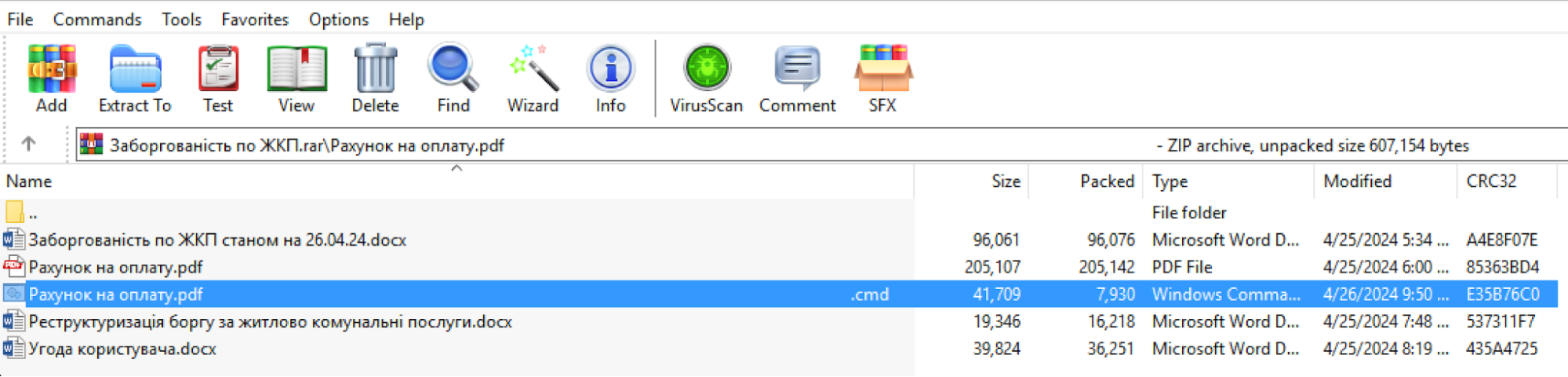
FlyingYeti included a benign PDF in the archive with the same name as the CMD file but without the unicode character, “Рахунок на оплату.pdf” (“Invoice for payment.pdf”). Additionally, the directory name for the archive once decompressed also contained the name “Рахунок на оплату.pdf”. This overlap in names of the benign PDF and the directory allows the actor to exploit the WinRAR vulnerability CVE-2023-38831. More specifically, when an archive includes a benign file with the same name as the directory, the entire contents of the directory are opened by the WinRAR application, resulting in the execution of the malicious CMD. In other words, when the target believes they are opening the benign PDF “Рахунок на оплату.pdf”, the malicious CMD file is executed.
The CMD file contains the FlyingYeti PowerShell malware known as COOKBOX. The malware is designed to persist on a host, serving as a foothold in the infected device. Once installed, this variant of COOKBOX will make requests to the DDNS domain postdock[.]serveftp[.]com for C2, awaiting PowerShell cmdlets that the malware will subsequently run.
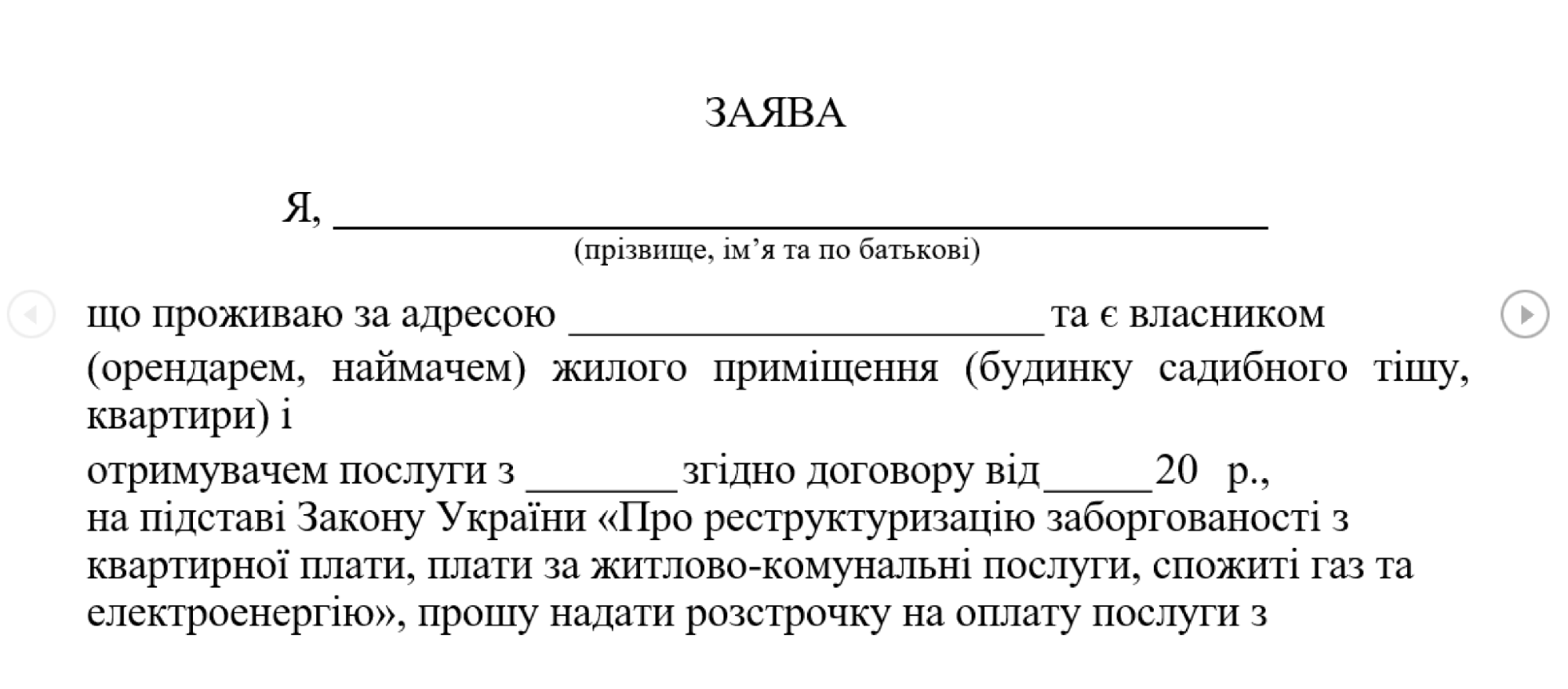
Alongside COOKBOX, several decoy documents are opened, which contain hidden tracking links using the Canary Tokens service. The first document, shown in Figure 3 below, poses as an agreement under which debt for housing and utility services will be restructured.
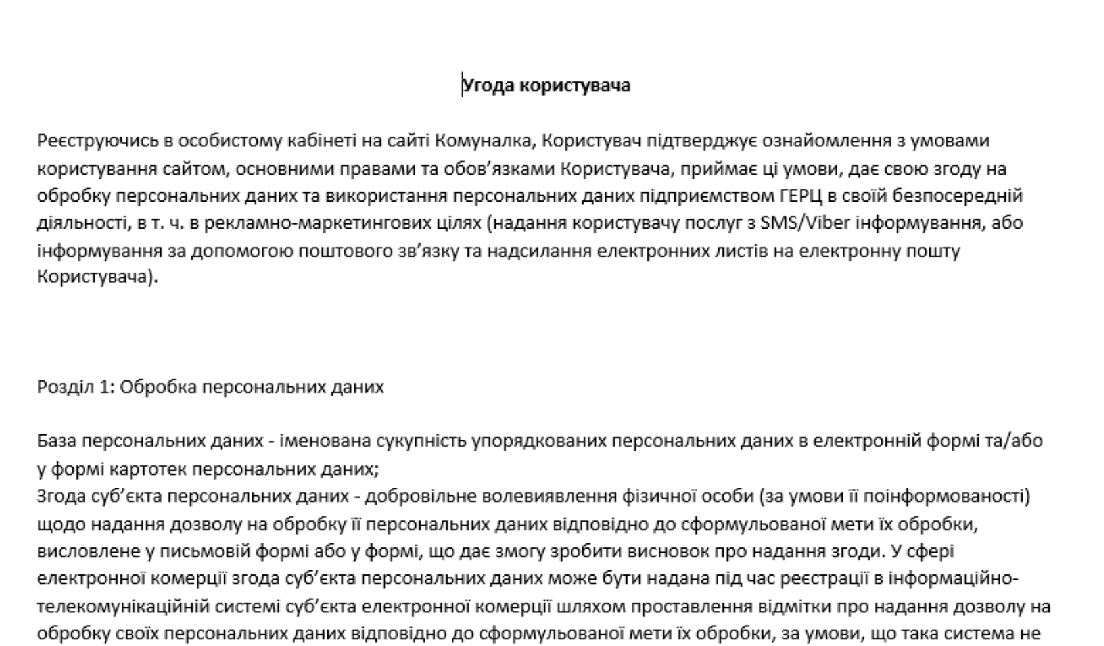
The second document (Figure 4) is a user agreement outlining the terms and conditions for the usage of the payment platform komunalka[.]ua.
The use of relevant decoy documents as part of the phishing and delivery activity are likely an effort by FlyingYeti operators to increase the appearance of legitimacy of their activities.
The phishing theme we identified in this campaign is likely one of many themes leveraged by this actor in a larger operation to target Ukrainian entities, in particular their defense forces. In fact, the threat activity we detailed in this blog uses many of the same techniques outlined in a recent FlyingYeti campaign disclosed by CERT-UA in mid-April 2024, where the actor leveraged United Nations-themed lures involving Peace Support Operations to target Ukraine’s military. Due to Cloudforce One’s defensive actions covered in the next section, this latest FlyingYeti campaign was prevented as of the time of publication.
Mitigating FlyingYeti activity
Cloudforce One mitigated FlyingYeti’s campaign through a series of actions. Each action was taken to increase the actor’s cost of continuing their operations. When assessing which action to take and why, we carefully weighed the pros and cons in order to provide an effective active defense strategy against this actor. Our general goal was to increase the amount of time the threat actor spent trying to develop and weaponize their campaign.
We were able to successfully extend the timeline of the threat actor’s operations from hours to weeks. At each interdiction point, we assessed the impact of our mitigation to ensure the actor would spend more time attempting to launch their campaign. Our mitigation measures disrupted the actor’s activity, in one instance resulting in eight additional hours spent on debugging code.
Due to our proactive defense efforts, FlyingYeti operators adapted their tactics multiple times in their attempts to launch the campaign. The actor originally intended to have the Cloudflare Worker fetch the malicious RAR file from GitHub. After Cloudforce One interdiction of the Worker, the actor attempted to create additional Workers via a new account. In response, we disabled all Workers, leading the actor to load the RAR file directly from GitHub. Cloudforce One notified GitHub, resulting in the takedown of the RAR file, the GitHub project, and suspension of the account used to host the RAR file. In return, FlyingYeti began testing the option to host the RAR file on the file sharing sites pixeldrain and Filemail, where we observed the actor alternating the link on the Komunalka phishing site between the following:
- hxxps://pixeldrain[.]com/api/file/ZAJxwFFX?download=one
- hxxps://1014.filemail[.]com/api/file/get?filekey=e_8S1HEnM5Rzhy_jpN6nL-GF4UAP533VrXzgXjxH1GzbVQZvmpFzrFA&pk_vid=a3d82455433c8ad11715865826cf18f6
We notified GitHub of the actor’s evolving tactics, and in response GitHub removed the Komunalka phishing site. After analyzing the files hosted on pixeldrain and Filemail, we determined the actor uploaded dummy payloads, likely to monitor access to their phishing infrastructure (FileMail logs IP addresses, and both file hosting sites provide view and download counts). At the time of publication, we did not observe FlyingYeti upload the malicious RAR file to either file hosting site, nor did we identify the use of alternative phishing or malware delivery methods.
A timeline of FlyingYeti’s activity and our corresponding mitigations can be found below.
Event timeline
| Date | Event Description |
|---|---|
| 2024-04-18 12:18 | Threat Actor (TA) creates a Worker to handle requests from a phishing site |
| 2024-04-18 14:16 | TA creates phishing site komunalka[.]github[.]io on GitHub |
| 2024-04-25 12:25 | TA creates a GitHub repo to host a RAR file |
| 2024-04-26 07:46 | TA updates the first Worker to handle requests from users visiting komunalka[.]github[.]io |
| 2024-04-26 08:24 | TA uploads a benign test RAR to the GitHub repo |
| 2024-04-26 13:38 | Cloudforce One identifies a Worker receiving requests from users visiting komunalka[.]github[.]io, observes its use as a phishing page |
| 2024-04-26 13:46 | Cloudforce One identifies that the Worker fetches a RAR file from GitHub (the malicious RAR payload is not yet hosted on the site) |
| 2024-04-26 19:22 | Cloudforce One creates a detection to identify the Worker that fetches the RAR |
| 2024-04-26 21:13 | Cloudforce One deploys real-time monitoring of the RAR file on GitHub |
| 2024-05-02 06:35 | TA deploys a weaponized RAR (CVE-2023-38831) to GitHub with their COOKBOX malware packaged in the archive |
| 2024-05-06 10:03 | TA attempts to update the Worker with link to weaponized RAR, the Worker is immediately blocked |
| 2024-05-06 10:38 | TA creates a new Worker, the Worker is immediately blocked |
| 2024-05-06 11:04 | TA creates a new account (#2) on Cloudflare |
| 2024-05-06 11:06 | TA creates a new Worker on account #2 (blocked) |
| 2024-05-06 11:50 | TA creates a new Worker on account #2 (blocked) |
| 2024-05-06 12:22 | TA creates a new modified Worker on account #2 |
| 2024-05-06 16:05 | Cloudforce One disables the running Worker on account #2 |
| 2024-05-07 22:16 | TA notices the Worker is blocked, ceases all operations |
| 2024-05-07 22:18 | TA deletes original Worker first created to fetch the RAR file from the GitHub phishing page |
| 2024-05-09 19:28 | Cloudforce One adds phishing page komunalka[.]github[.]io to real-time monitoring |
| 2024-05-13 07:36 | TA updates the github.io phishing site to point directly to the GitHub RAR link |
| 2024-05-13 17:47 | Cloudforce One adds COOKBOX C2 postdock[.]serveftp[.]com to real-time monitoring for DNS resolution |
| 2024-05-14 00:04 | Cloudforce One notifies GitHub to take down the RAR file |
| 2024-05-15 09:00 | GitHub user, project, and link for RAR are no longer accessible |
| 2024-05-21 08:23 | TA updates Komunalka phishing site on github.io to link to pixeldrain URL for dummy payload (pixeldrain only tracks view and download counts) |
| 2024-05-21 08:25 | TA updates Komunalka phishing site to link to FileMail URL for dummy payload (FileMail tracks not only view and download counts, but also IP addresses) |
| 2024-05-21 12:21 | Cloudforce One downloads PixelDrain document to evaluate payload |
| 2024-05-21 12:47 | Cloudforce One downloads FileMail document to evaluate payload |
| 2024-05-29 23:59 | GitHub takes down Komunalka phishing site |
| 2024-05-30 13:00 | Cloudforce One publishes the results of this investigation |
Coordinating our FlyingYeti response
Cloudforce One leveraged industry relationships to provide advanced warning and to mitigate the actor’s activity. To further protect the intended targets from this phishing threat, Cloudforce One notified and collaborated closely with GitHub’s Threat Intelligence and Trust and Safety Teams. We also notified CERT-UA and Cloudflare industry partners such as CrowdStrike, Mandiant/Google Threat Intelligence, and Microsoft Threat Intelligence.
Hunting FlyingYeti operations
There are several ways to hunt FlyingYeti in your environment. These include using PowerShell to hunt for WinRAR files, deploying Microsoft Sentinel analytics rules, and running Splunk scripts as detailed below. Note that these detections may identify activity related to this threat, but may also trigger unrelated threat activity.
PowerShell hunting
Consider running a PowerShell script such as this one in your environment to identify exploitation of CVE-2023-38831. This script will interrogate WinRAR files for evidence of the exploit.
CVE-2023-38831
Description:winrar exploit detection
open suspios (.tar / .zip / .rar) and run this script to check it

function winrar-exploit-detect(){
$targetExtensions = @(".cmd" , ".ps1" , ".bat")
$tempDir = [System.Environment]::GetEnvironmentVariable("TEMP")
$dirsToCheck = Get-ChildItem -Path $tempDir -Directory -Filter "Rar*"
foreach ($dir in $dirsToCheck) {
    $files = Get-ChildItem -Path $dir.FullName -File
    foreach ($file in $files) {
        $fileName = $file.Name
        $fileExtension = [System.IO.Path]::GetExtension($fileName)
        if ($targetExtensions -contains $fileExtension) {
            $fileWithoutExtension = [System.IO.Path]::GetFileNameWithoutExtension($fileName); $filename.TrimEnd() -replace '\.$'
            $cmdFileName = "$fileWithoutExtension"
            $secondFile = Join-Path -Path $dir.FullName -ChildPath $cmdFileName

            if (Test-Path $secondFile -PathType Leaf) {
                Write-Host "[!] Suspicious pair detected "
                Write-Host "[*]  Original File:$($secondFile)" -ForegroundColor Green
                Write-Host "[*] Suspicious File:$($file.FullName)" -ForegroundColor Red

                # Read and display the content of the command file
                $cmdFileContent = Get-Content -Path $($file.FullName)
                Write-Host "[+] Command File Content:$cmdFileContent"
            }
        }
    }
}
}
winrar-exploit-detect
Microsoft Sentinel
In Microsoft Sentinel, consider deploying the rule provided below, which identifies WinRAR execution via cmd.exe. Results generated by this rule may be indicative of attack activity on the endpoint and should be analyzed.
DeviceProcessEvents
| where InitiatingProcessParentFileName has @"winrar.exe"
| where InitiatingProcessFileName has @"cmd.exe"
| project Timestamp, DeviceName, FileName, FolderPath, ProcessCommandLine, AccountName
| sort by Timestamp desc
Splunk
Consider using this script in your Splunk environment to look for WinRAR CVE-2023-38831 execution on your Microsoft endpoints. Results generated by this script may be indicative of attack activity on the endpoint and should be analyzed.
| tstats `security_content_summariesonly` count min(_time) as firstTime max(_time) as lastTime from datamodel=Endpoint.Processes where Processes.parent_process_name=winrar.exe `windows_shells` OR Processes.process_name IN ("certutil.exe","mshta.exe","bitsadmin.exe") by Processes.dest Processes.user Processes.parent_process_name Processes.parent_process Processes.process_name Processes.process Processes.process_id Processes.parent_process_id
| `drop_dm_object_name(Processes)`
| `security_content_ctime(firstTime)`
| `security_content_ctime(lastTime)`
| `winrar_spawning_shell_application_filter`
Cloudflare product detections
Cloudflare Email Security
Cloudflare Email Security (CES) customers can identify FlyingYeti threat activity with the following detections.
- CVE-2023-38831
- FLYINGYETI.COOKBOX
- FLYINGYETI.COOKBOX.Launcher
- FLYINGYETI.Rar
Recommendations
Cloudflare recommends taking the following steps to mitigate this type of activity:
- Implement Zero Trust architecture foundations:
- Deploy Cloud Email Security to ensure that email services are protected against phishing, BEC and other threats
- Leverage browser isolation to separate messaging applications like LinkedIn, email, and Signal from your main network
- Scan, monitor and/or enforce controls on specific or sensitive data moving through your network environment with data loss prevention policies
- Ensure your systems have the latest WinRAR and Microsoft security updates installed
- Consider preventing WinRAR files from entering your environment, both at your Cloud Email Security solution and your Internet Traffic Gateway
- Run an Endpoint Detection and Response (EDR) tool such as CrowdStrike or Microsoft Defender for Endpoint to get visibility into binary execution on hosts
- Search your environment for the FlyingYeti indicators of compromise (IOCs) shown below to identify potential actor activity within your network.
If you’re looking to uncover additional Threat Intelligence insights for your organization or need bespoke Threat Intelligence information for an incident, consider engaging with Cloudforce One by contacting your Customer Success manager or filling out this form.
Indicators of Compromise
| Filename | SHA256 Hash | Description |
|---|---|---|
| Заборгованість по ЖКП.rar | a0a294f85c8a19be048ffcc05ede6fd5a7ac5e2f0032a3ca0050dc1ae960c314 | RAR archive |
| Рахунок на оплату.pdf .cmd |
0cca8f795c7a81d33d36d5204fcd9bc73bdc2af7de315c1449cbc3551ef4fb59 | COOKBOX Sample (contained in RAR archive) |
| Реструктуризація боргу за житлово комунальні послуги.docx | 915721b94e3dffa6cef3664532b586be6cf989fec923b26c62fdaf201ee81d2c | Benign Word Document with Tracking Link (contained in RAR archive) |
| Угода користувача.docx | 79a9740f5e5ea4aa2157d9d96df34ee49a32e2d386fe55fedfd1aa33e151c06d | Benign Word Document with Tracking Link (contained in RAR archive) |
| Рахунок на оплату.pdf | 19e25456c2996ded3e29577b609de54a2bef90dad8f868cdad795c18df05a79b | Random Binary Data (contained in RAR archive) |
| Заборгованість по ЖКП станом на 26.04.24.docx | e0d65e2d36afd3db1b603f10e0488cee3f58ade24d8abc6bee240314d8696708 | Random Binary Data (contained in RAR archive) |
| Domain / URL | Description |
|---|---|
| komunalka[.]github[.]io | Phishing page |
| hxxps[:]//github[.]com/komunalka/komunalka[.]github[.]io | Phishing page |
| hxxps[:]//worker-polished-union-f396[.]vqu89698[.]workers[.]dev | Worker that fetches malicious RAR file |
| hxxps[:]//raw[.]githubusercontent[.]com/kudoc8989/project/main/Заборгованість по ЖКП.rar | Delivery of malicious RAR file |
| hxxps[:]//1014[.]filemail[.]com/api/file/get?filekey=e_8S1HEnM5Rzhy_jpN6nL-GF4UAP533VrXzgXjxH1GzbVQZvmpFzrFA&pk_vid=a3d82455433c8ad11715865826cf18f6 | Dummy payload |
| hxxps[:]//pixeldrain[.]com/api/file/ZAJxwFFX?download= | Dummy payload |
| hxxp[:]//canarytokens[.]com/stuff/tags/ni1cknk2yq3xfcw2al3efs37m/payments.js | Tracking link |
| hxxp[:]//canarytokens[.]com/stuff/terms/images/k22r2dnjrvjsme8680ojf5ccs/index.html | Tracking link |
| postdock[.]serveftp[.]com | COOKBOX C2 |
Celebrating Excellence: Joanne Guarglia and Kelly Hiscoe Recognized as CRN’s 2024 Women of the Channel
Post Syndicated from Rapid7 original https://blog.rapid7.com/2024/05/30/celebrating-excellence-joanne-guarglia-and-kelly-hiscoe-recognized-as-crns-2024-women-of-the-channel/

We are thrilled to announce that two of our exceptional team members, Joanne Guarglia and Kelly Hiscoe, have been recognized as CRN’s 2024 Women of the Channel. This recognition celebrates the achievements and leadership of women within the channel community, and we are incredibly proud to see Joanne and Kelly honored for their contributions.
Kelly Hiscoe: Driving innovation in partner programs
Kelly Hiscoe and her team are at the forefront of designing and launching partner programs, optimizing our operations to support Rapid7’s global channel ecosystem. Their commitment to creating highly effective and streamlined partner experiences ensures seamless execution within our channel. Engaging continuously with partners, Kelly’s team drives simplified, scalable, and predictable experiences that benefit all stakeholders.
Kelly’s dedication to improving our operational infrastructure and incentive programs is unwavering. Kelly said: “We will never be done focusing on creating improved programs and processes. We will continue to be laser focused on enhancing our operational infrastructure and incentive programs because we care deeply about the partner experience with Rapid7.”
Her leadership and vision are integral to our ongoing success and the satisfaction of our partners.

Joanne Guarglia: Building lasting relationships
Joanne Guarglia has demonstrated exceptional skill in building and nurturing lasting relationships with our partners, an area in which Rapid7 are investing heavily – making strides with the channel community more than ever.
“What I enjoy most is being able to build lasting relationships with our partners. Partners want to work with trusted brands who are leaders in the space, and we have that here at Rapid7. Being that trusted voice and growing the relationship, while educating them about our offerings, enables me to have a positive impact,” Joanne said.
Her dedication to partner success and her ability to educate and inform are key components of her impactful work.

Commitment to excellence
At Rapid7, we are committed to fostering an environment where talented individuals like Joanne and Kelly can thrive. Their recognition as CRN’s 2024 Women of the Channel underscores our dedication to excellence and our focus on building a strong, supportive channel ecosystem. We look forward to their continued contributions and to the ongoing success of our partners.
Please join us in celebrating Joanne and Kelly for their outstanding achievements and their unwavering commitment to excellence in the channel community.
Learn more about Rapid7 global partnerships here.
Stable kernels 6.9.3 and 6.8.12
Post Syndicated from jake original https://lwn.net/Articles/976007/
Greg Kroah-Hartman has announced the release of the 6.9.3 and 6.8.12 stable kernels. As usual, they contain
lots of important fixes throughout the tree. Note that 6.8.12 is the end
of the line for the 6.8.x stable kernel series.
Security updates for Thursday
Post Syndicated from jake original https://lwn.net/Articles/976006/
Security updates have been issued by Debian (python-pymysql), Fedora (chromium, mingw-python-requests, and thunderbird), Mageia (perl-Email-MIME and qtnetworkauth5 & qtnetworkauth6), Red Hat (gdisk and python39:3.9 and python39-devel:3.9 modules), SUSE (freerdp, gdk-pixbuf, gifsicle, glib2, java-1_8_0-ibm, kernel, libfastjson, libredwg, nodejs16, python, python3, python36, rpm, warewulf4, and xdg-desktop-portal), and Ubuntu (gst-plugins-base1.0, python-werkzeug, and tpm2-tss).
Cloudflare acquires BastionZero to extend Zero Trust access to IT infrastructure
Post Syndicated from Kenny Johnson original https://blog.cloudflare.com/cloudflare-acquires-bastionzero
We’re excited to announce that BastionZero, a Zero Trust infrastructure access platform, has joined Cloudflare. This acquisition extends our Zero Trust Network Access (ZTNA) flows with native access management for infrastructure like servers, Kubernetes clusters, and databases.
Security teams often prioritize application and Internet access because these are the primary vectors through which users interact with corporate resources and external threats infiltrate networks. Applications are typically the most visible and accessible part of an organization’s digital footprint, making them frequent targets for cyberattacks. Securing application access through methods like Single Sign-On (SSO) and Multi-Factor Authentication (MFA) can yield immediate and tangible improvements in user security.
However, infrastructure access is equally critical and many teams still rely on castle-and-moat style network controls and local resource permissions to protect infrastructure like servers, databases, Kubernetes clusters, and more. This is difficult and fraught with risk because the security controls are fragmented across hundreds or thousands of targets. Bad actors are increasingly focusing on targeting infrastructure resources as a way to take down huge swaths of applications at once or steal sensitive data. We are excited to extend Cloudflare One’s Zero Trust Network Access to natively protect infrastructure with user- and device-based policies along with multi-factor authentication.
Application vs. infrastructure access
Application access typically involves interacting with web-based or client-server applications. These applications often support modern authentication mechanisms such as Single Sign-On (SSO), which streamline user authentication and enhance security. SSO integrates with identity providers (IdPs) to offer a seamless and secure login experience, reducing the risk of password fatigue and credential theft.
Infrastructure access, on the other hand, encompasses a broader and more diverse range of systems, including servers, databases, and network devices. These systems often rely on protocols such as SSH (Secure Shell), RDP (Remote Desktop Protocol), and Kubectl (Kubernetes) for administrative access. The nature of these protocols introduces additional complexities that make securing infrastructure access more challenging.
- SSH Authentication: SSH is a fundamental tool for accessing Linux and Unix-based systems. SSH access is typically facilitated through public key authentication, through which a user is issued a public/private key pair that a target system is configured to accept. These keys must be distributed to trusted users, rotated frequently, and monitored for any leakage. If a key is accidentally leaked, it can grant a bad actor direct control over the SSH-accessible resource.
- RDP Authentication: RDP is widely used for remote access to Windows-based systems. While RDP supports various authentication methods, including password-based and certificate-based authentication, it is often targeted by brute force and credential stuffing attacks.
- Kubernetes Authentication: Kubernetes, as a container orchestration platform, introduces its own set of authentication challenges. Access to Kubernetes clusters involves managing roles, service accounts, and kubeconfig files along with user certificates.
Infrastructure access with Cloudflare One today
Cloudflare One facilitates Zero Trust Network Access (ZTNA) for infrastructure resources with an approach superior to traditional VPNs. An administrator can define a set of identity, device, and network-aware policies that dictate if a user can access a specific IP address, hostname, and/or port combination. This allows you to create policies like “Only users in the identity provider group ‘developers’ can access resources over port 22 (default SSH port) in our corporate network,” which is already much finer control than a VPN with basic firewall policies would allow.
However, this approach still has limitations, as it relies on a set of assumptions about how corporate infrastructure is provisioned and managed. If an infrastructure resource is configured outside of the assumed network structure, e.g. SSH over a non-standard port is allowed, all network-level controls may be bypassed. This leaves only the native authentication protections of the specific protocol protecting that resource and is often how leaked SSH keys or database credentials can lead to a wider system outage or breach.
Many organizations will leverage more complex network structures like a bastion host model or complex Privileged Access Management (PAM) solutions as an added defense-in-depth strategy. However, this leads to significantly more cost and management overhead for IT security teams and sometimes complicates challenges related to least-privileged access. Tools like bastion hosts or PAM solutions end up eroding least-privilege over time because policies expand, change, or drift from a company’s security stance. This leads to users incorrectly retaining access to sensitive infrastructure.
How BastionZero fits in
While our goal for years has been to help organizations of any size replace their VPNs as simply and quickly as possible, BastionZero expands the scope of Cloudflare’s VPN replacement solution beyond apps and networks to provide the same level of simplicity for extending Zero Trust controls to infrastructure resources. This helps security teams centralize the management of even more of their hybrid IT environment, while using standard Zero Trust practices to keep DevOps teams productive and secure. Together, Cloudflare and BastionZero can help organizations replace not only VPNs but also bastion hosts; SSH, Kubernetes, or database key management systems; and redundant PAM solutions.
BastionZero provides native integration to major infrastructure access protocols and targets like SSH, RDP, Kubernetes, database servers, and more to ensure that a target resource is configured to accept connections for that specific user, instead of relying on network level controls. This allows administrators to think in terms of resources and targets, not IP addresses and ports. Additionally, BastionZero leverages OpenPubKey, an open source library that uses two forms of authentication to generate an OpenID Connect (OIDC) token, which avoids single point of failure risks inherent to a standalone Identity Provider.
BastionZero will add the following capabilities to Cloudflare’s SASE platform:
- The elimination of long-lived keys/credentials through frictionless infrastructure privileged access management (PAM) capabilities that modernize credential management (e.g., SSH keys, kubeconfig files, database passwords) through a new ephemeral, decentralized approach.
- A DevOps-based approach for securing SSH connections to support least privilege access that records sessions and logs every command for better visibility to support compliance requirements. Teams can operate in terms of auto-discovered targets, not IP addresses or networks, as they define just-in-time access policies and automate workflows.
- Clientless RDP to support access to desktop environments without the overhead and hassle of installing a client on a user’s device.
What’s next for BastionZero
The BastionZero team will be focused on integrating their infrastructure access controls directly into Cloudflare One. During the third and fourth quarters of this year, we will be announcing a number of new features to facilitate Zero Trust infrastructure access via Cloudflare One. All functionality delivered this year will be included in the Cloudflare One free tier for organizations less than 50 users. We believe that everyone should have access to world-class security controls.
We are looking for early beta testers and teams to provide feedback about what they would like to see with respect to infrastructure access. If you are interested in learning more, please sign up here.
Monitor new Zabbix releases natively
Post Syndicated from Brian van Baekel original https://blog.zabbix.com/monitor-new-zabbix-releases-natively/28105/
In this blog post, I’ll guide you through building your own template to monitor the latest Zabbix releases directly from the Zabbix UI. Follow the simple walkthrough to know how.
Introduction
With the release of Zabbix 7.0, it is possible to see which Zabbix version you are running and what the latest version is:

A great improvement obviously but (at least in 7.0.0rc1) I am missing the triggers to notify me and perhaps also really interesting, there is nothing available about older versions.
Once I saw the above screenshot, I became curious about where that data actually came from, and what’s available. A quick deep-dive into the sourcecode ( https://git.zabbix.com/projects/ZBX/repos/zabbix/browse/ui/js/class.software-version-check.js#18 ) gave away the URL that is used for this feature: https://services.zabbix.com/updates/v1 Once you visit that URL you will get a nice JSON formatted output:
{
  "versions": [
    {
      "version": "5.0",
      "end_of_full_support": true,
      "latest_release": {
        "created": "1711361454",
        "release": "5.0.42"
      }
    },
    {
      "version": "6.0",
      "end_of_full_support": false,
      "latest_release": {
        "created": "1716274679",
        "release": "6.0.30"
      }
    },
    {
      "version": "6.4",
      "end_of_full_support": false,
      "latest_release": {
        "created": "1716283254",
        "release": "6.4.15"
      }
    }
  ]
}
And as you may know, Zabbix is quite good at parsing JSON formatted data. So, I built a quick template to get this going and be notified once a new version is released.
In the examples below I used my 6.4 instance, but this also works on 6.0 and of course 7.0.
Template building
Before we jump into the building part, it’s important to think of the best approach for this template. I think there are 2:
- Create 1 HTTP item and a few dependent items for the various versions
- Create 1 HTTP item, a LLD rule and a few item prototypes.
I prefer the LLD route, as that is making the template as dynamic as possible (less time to maintain it) but also more fun to build!
Let’s go.
First, you go to Data Collection -> Templates and create a new template there:
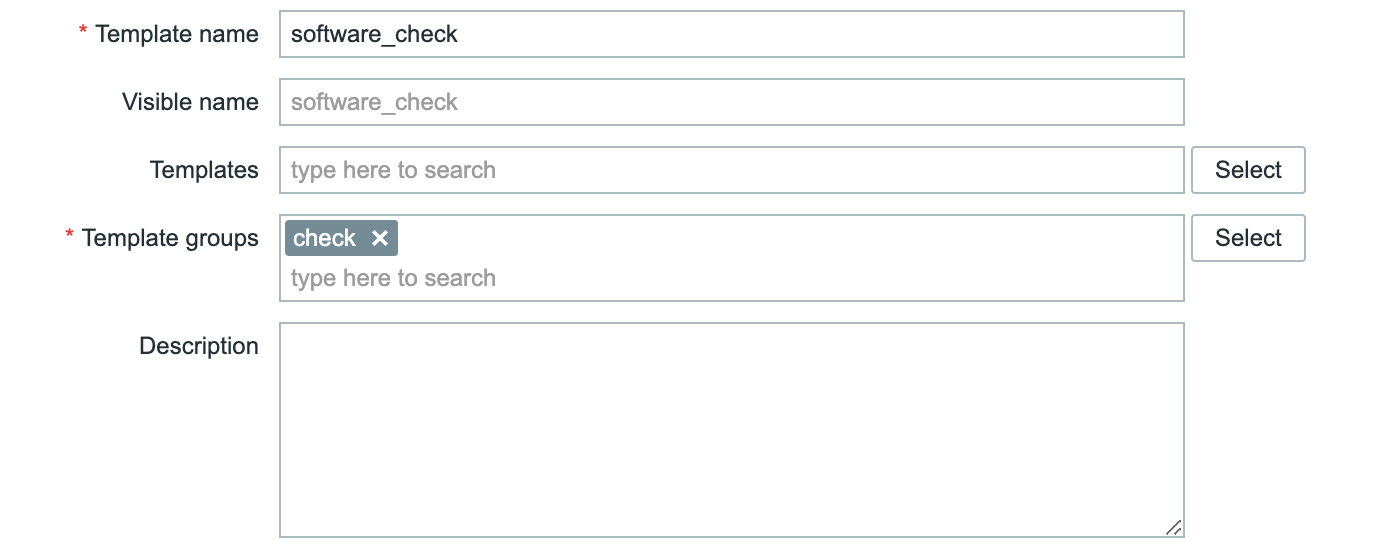
Of course, you can change the name of the template and the group. It’s completely up to you.
Once the template is created, it’s still an empty shell and we need to populate it. We will start with a normal item of type HTTP agent:
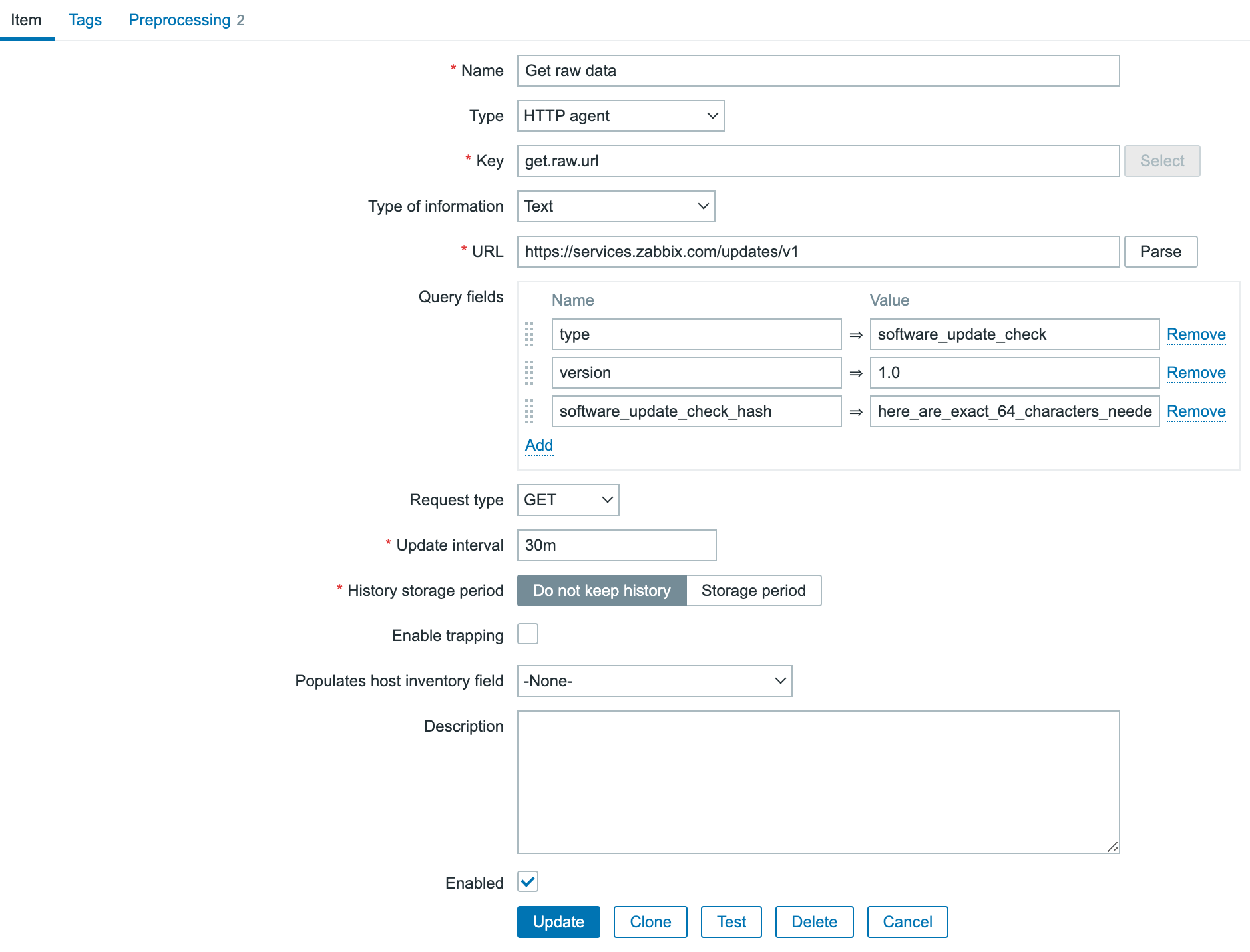
(note: screenshot is truncated)
We need to add 3 query fields:
- ‘type’ with value ‘software_update_check’
- ‘version’ with value ‘1.0’
- ‘software_update_check_hash’ with a 64 characters: you can do funny things here
 for the example i just used ‘here_are_exact_64_characters_needed_as_a_custom_hash_for_zabbix_’
 for the example i just used ‘here_are_exact_64_characters_needed_as_a_custom_hash_for_zabbix_’
As we go for the LLD route, I already set the “History Storage period” to “Do not keep history”. If you are building the template, it’s advised to keep the history and make sure you’ve got data to work with for the rest of the template. Once everything works, go back to this item and make sure to change the History storage period.
In the above screenshot, you can see I applied 2 preprocessing steps already.
The first is to replace the text ‘versions’ with ‘data’. This is done because Zabbix expects an array ‘data’ for its LLD logic. That ‘data’ is not available, so I just replaced the text ‘versions’. Quick and dirty.
The second preprocessing step is a “discard unchanged with heartbeat”. As long as there is no new release, I do not care about the data that came in, yet I want to store it once per day to make sure the item is still working. With this approach, we monitor the URL every 30 minutes so we get ‘quick’ updates but still do not use a lot of disk space.
The result of the preprocessing configuration:

Now it’s time to hit the “test all steps” button and see if everything works. The result you’ll get is:
{
  "data": [
    {
      "version": "5.0",
      "end_of_full_support": true,
      "latest_release": {
        "created": "1711361454",
        "release": "5.0.42"
      }
    },
    {
      "version": "6.0",
      "end_of_full_support": false,
      "latest_release": {
        "created": "1716274679",
        "release": "6.0.30"
      }
    },
    {
      "version": "6.4",
      "end_of_full_support": false,
      "latest_release": {
        "created": "1716283254",
        "release": "6.4.15"
      }
    }
  ]
}
This is almost identical to the information directly from the URL, except that ‘versions’ is replaced by ‘data’. Great. So as soon as you save this item we will monitor the releases now (don’t forget to link the template to a host otherwise nothing will happen)!
At the same time, this information is absolutely not useful at all, as it’s just a text portion. We need to parse it, and LLD is the way to go.
In the template, we go to “Discovery rules” and click on “Create discovery rule” in the upper right corner.
Now we create a new LLD rule, which is not going to query the website itself, but will get its information from the HTTP agent we’ve just created.
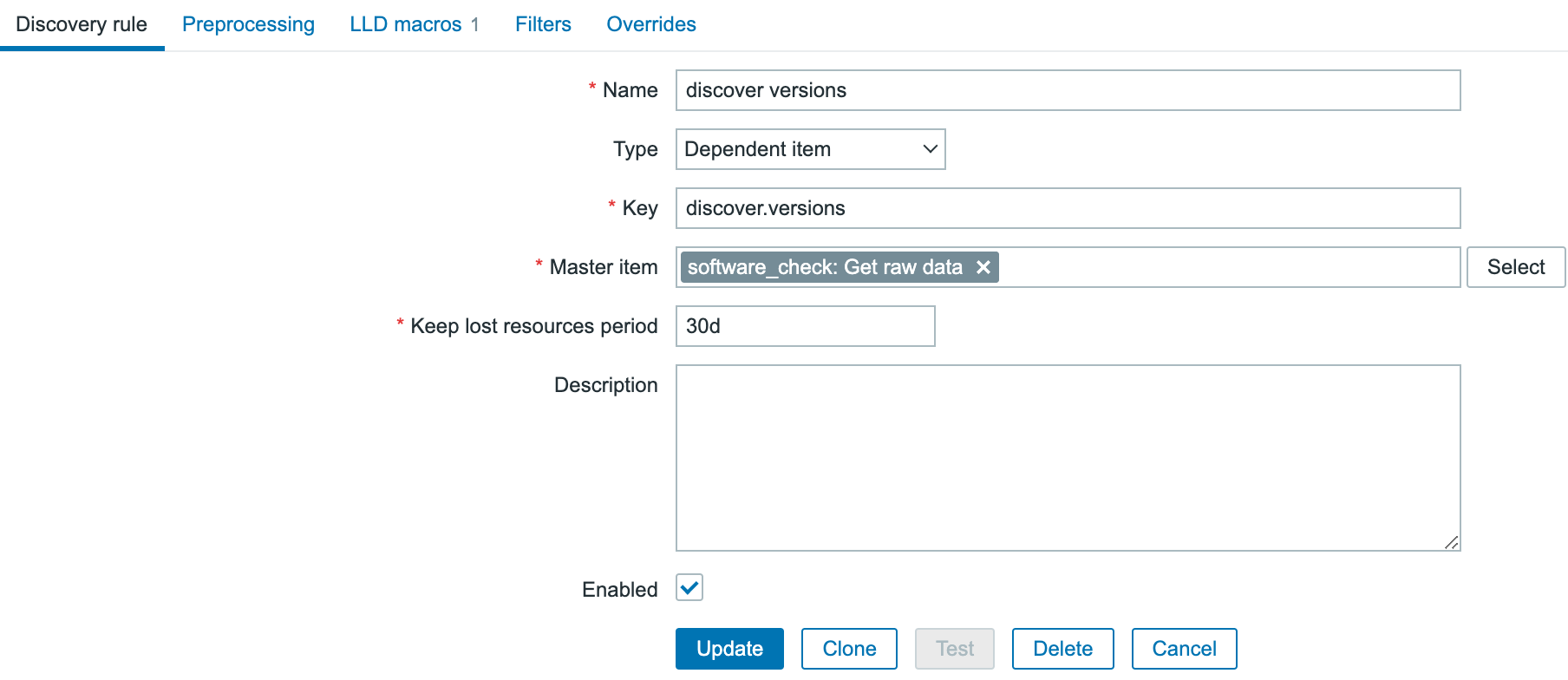
In the above screenshot, you see how it’s configured. a name, type ‘Dependent item’ some key just because Zabbix requires a key, and the Master item is the HTTP agent item we just created.
Now all data from the http agent item is pushed into the LLD rule as soon as it’s received, and we need to create LLD macros out of it. So in the Discovery rule, you jump to the 3rd tab ‘LLD macros’ and add a new macro there:
{#VERSION} with JSONPATH$..version.first()

Once this is done save the LLD rule and let’s create some item prototypes.
The first item prototype is the most complicated, the rest are “copy/paste”, more or less.
We create a new item prototype that looks like this:

As the type is dependent and it is getting all its information from the HTTP agent master item, there is preprocessing needed to filter out only that specific piece of information that is needed. You go to the preprocessing tab and add a JSONpath step there:
For copy/paste purposes: $.data.[?(@.version=='{#VERSION}’)].latest_release.created.first()
There is quite some magic happening in that step. We tell it to use a JSONpath to find the correct value, but there is also a lookup:
[?(@.version=='{#VERSION}')]
What we are doing here is telling it to go into the data array, look for an array ‘version’ with the value {#VERSION}. Of course that {#VERSION} LLD macro is going to be replaced dynamically by the discovery rule with the correct version. Once it found the version object, go in and find the object ‘latest_release’ and from that object we want the value of ‘created’. Now we will get back the epoch time of that release, and in the item we parse that with Unit unixtime.
Save the item, and immediately clone it to create the 2nd item prototype to get the support state:

Here we change the type of information and of course the preprocessing should be slightly different as we are looking for a different object:

JSONPath:
$.data.[?(@.version=='{#VERSION}')].end_of_full_support.first()
Save this item as well, and let’s create our last item to get the minor release number presented:

The preprocessing is again slightly different:

JSONPath:
$.data.[?(@.version=='{#VERSION}')].latest_release.release.first()
At this point you should have 1 master item, 1 LLD rule and 3 Item prototypes.
Now, create a new host, and link this template to it. Fairly quick you should see data coming in and everything should be nicely parsed:
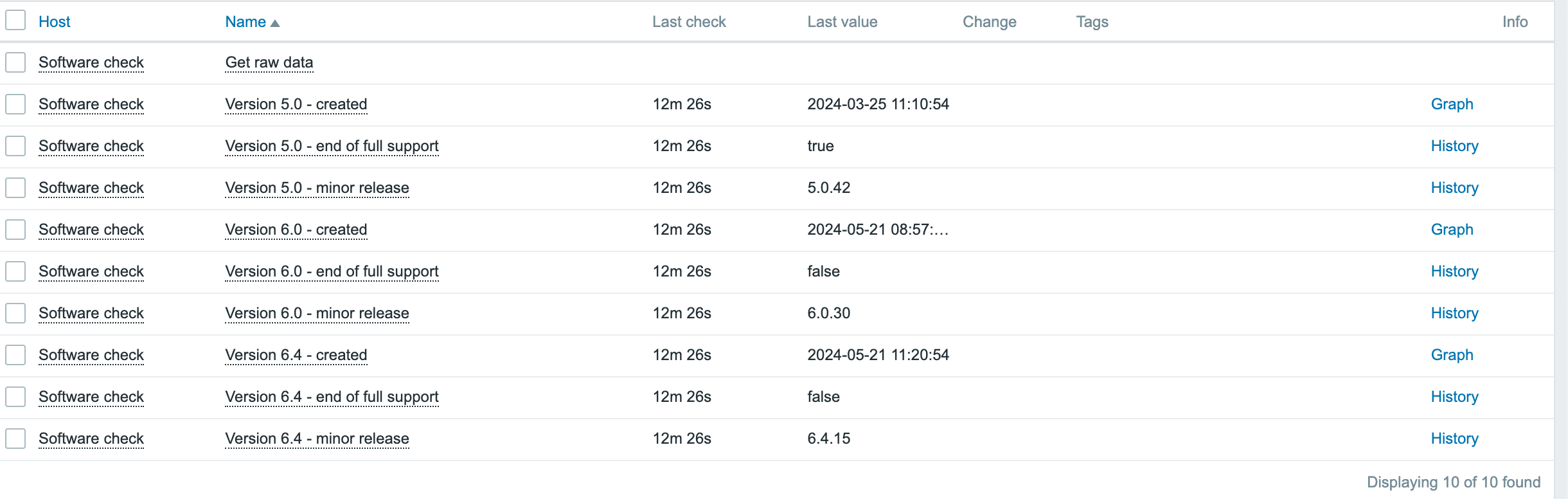
The only thing that is missing now is a trigger to get alerted once a new version has been released, so let’s go back into the template, discovery rule and find the trigger prototypes. Create a new one that looks like this:
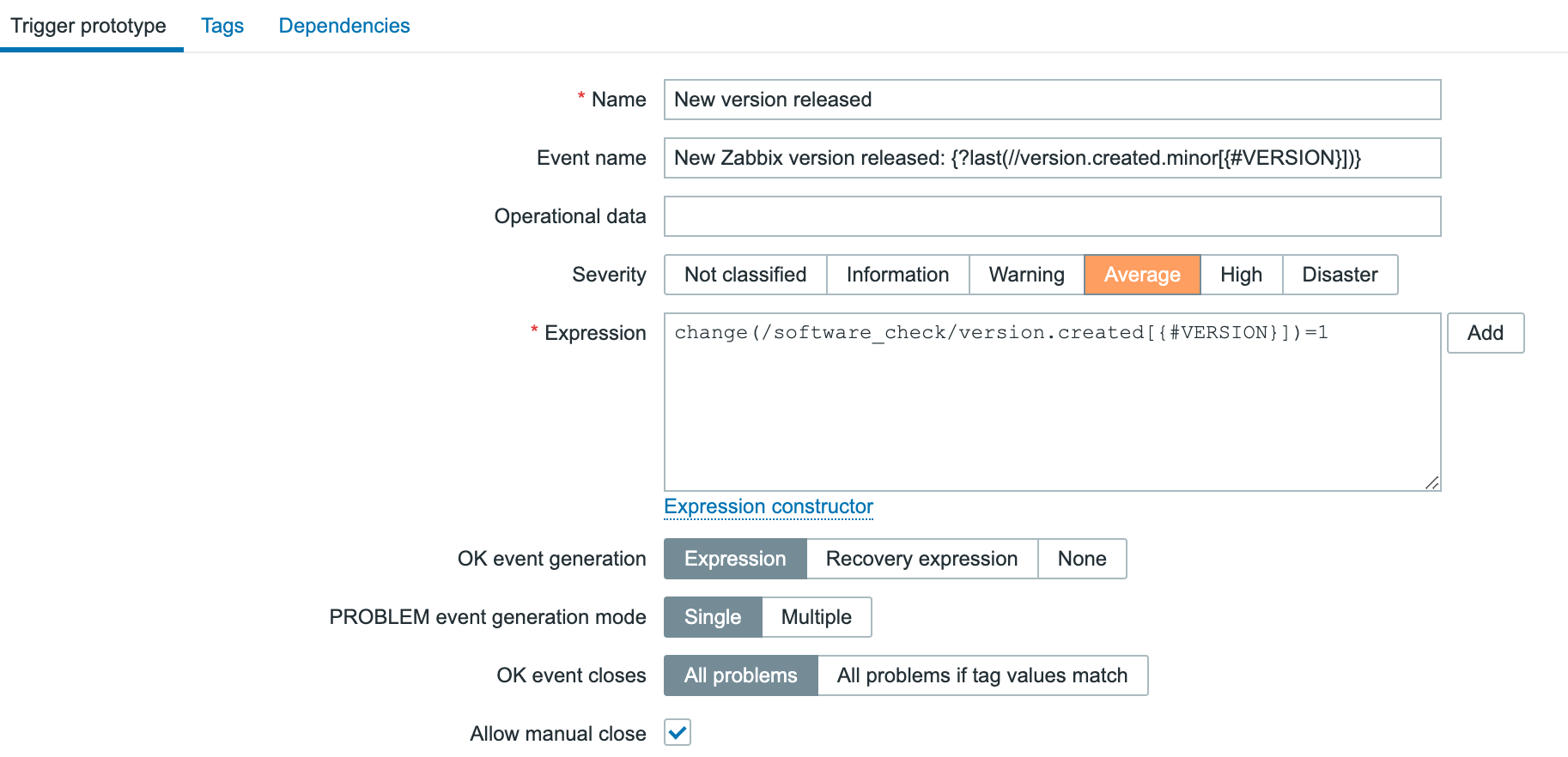
Since we populated the even name as well, our problem name will reflect the most recent version already:

Enjoy your new template! 
The post Monitor new Zabbix releases natively appeared first on Zabbix Blog.
Supply Chain Attack against Courtroom Software
Post Syndicated from Bruce Schneier original https://www.schneier.com/blog/archives/2024/05/supply-chain-attack-against-courtroom-software.html
No word on how this backdoor was installed:
A software maker serving more than 10,000 courtrooms throughout the world hosted an application update containing a hidden backdoor that maintained persistent communication with a malicious website, researchers reported Thursday, in the latest episode of a supply-chain attack.
The software, known as the JAVS Viewer 8, is a component of the
JAVS Suite 8, an application package courtrooms use to record, play back, and manage audio and video from proceedings. Its maker, Louisville, Kentucky-based Justice AV Solutions, says its products are used in more than 10,000 courtrooms throughout the US and 11 other countries. The company has been in business for 35 years.
It’s software used by courts; we can imagine all sort of actors who want to backdoor it.
Russia’s Psychological Warfare Against Ukraine
Post Syndicated from The Atlantic original https://www.youtube.com/watch?v=k-eeofPqve8
The Clubs Conference is coming back
Post Syndicated from Tom Hadfield original https://www.raspberrypi.org/blog/the-clubs-conference-is-coming-back/
Following the huge success of last year’s Clubs Conference, we are delighted to announce that we will be hosting the second-ever Clubs Conference on Saturday 30 November and Sunday 1 December 2024 in Cambridge, UK.

The event will be a weekend of learning and connecting for volunteers and educators involved in Code Club, CoderDojo, and other initiatives we support. We’d love for you to join us!
What you can look forward to
This year, we’re bringing the conference home to our offices in the centre of Cambridge.
On Friday 29 November, you’ll have the opportunity to register early and attend an informal networking event with community members, including the Foundation team.
Saturday 30 November and Sunday 1 December will be filled with learning and development opportunities for you, including:
- Thought-provoking talks and discussions
- Hands-on, easy-to-follow workshops exploring a range of coding and digital making activities and related topics
- Opportunities to connect with a diverse range of volunteers and educators
Join us to learn from your peers running clubs in various contexts, develop your digital making skills, and share your own insights. We look forward to learning with you.

Interested in attending or contributing to the Clubs Conference?
If you think you might want to attend the Clubs Conference, please fill in our form to express your interest. We will then get in touch when you can book your tickets. Tickets will be £5 for both days combined.
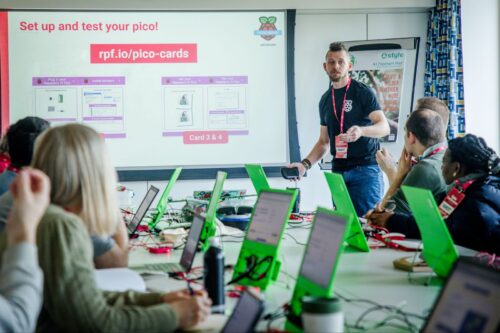
Part of what made last year’s Clubs Conference so special was the range of exciting activities led by community members. If you’d like to host or co-host an activity this year, please also indicate this in the expression of interest form. We’ll be in touch in a few weeks to ask you more about your plans.
Possible activities include:
- Workshops
- Discussion sessions
- Talks
- Project demonstrations
Check out last year’s talks for inspiration.
Bursaries for participants in the UK and Ireland
If you would love to participate but you feel the costs of travelling would prevent you, you may be able to apply for a travel bursary.
To be eligible for a bursary, you need to:
- Be registered as a club leader or volunteer at a Code Club or CoderDojo within the UK or Ireland
- Be available to attend the Clubs Conference in Cambridge on both Saturday 30 November and Sunday 1 December 2024
Please let us know whether you require a travel bursary when you fill in the expression of interest form.
If you’re not in the UK or Ireland and have any questions about travel, please send us a message through our contact page using the subject ‘Clubs Conference’.
If you have any suggestions about the Clubs Conference, we’d love to hear them. Let us know through the contact page, or on social with the tag #ClubsCon24.
The post The Clubs Conference is coming back appeared first on Raspberry Pi Foundation.
Избори 2024 – секциите в чужбина
Post Syndicated from Боян Юруков original https://yurukov.net/blog/2024/izbori24-sekcii-2/
На 9-ти юни ще се проведат избори за Народно събрание и Европейски парламент. Остават само дни и имаме на разположение доста секции в чужбина, в които да упражним правото си на глас. Министерство на външните работи вече излезе с адресите на 673 места, където ще има 769 секции. В последните два дни промениха адресите на 5 от тях, което беше отразено на картата.
Ето няколко съвета по процедурата на гласуване и важни неща, които е добре да имате предвид:
- Изборният ден започва в 7:00 сутринта местно време и свършва в 8:00 часа вечерта
- Може да гласува всеки български гражданин независимо дали е подал заявление или не
- Секциите отбелязани горе са актуални към 30-ти май. Възможно е в следващата седмица да има промени или корекции. Затова Ви препоръчвам да проверите преди изборния ден отново на картата и на сайта на МВнР.
- Независимо от отбелязаната в заявлението Ви секция, може да гласувате където и да е в чужбина
- При влизане в изборната секция кажете ясно дали искате да гласувате както за народно събрание, така и за европейски парламент или само за единия вот. Въз основа на това ще предоставят правилните декларации
- В чужбина може да гласува всеки български гражданин независимо от обичайното му пребиваване. Това означава, че ако пътувате зад граница по работа или на почивка, може да упражните гласа си в близка до Вас секция. Отново, няма значение дали сте подавали заявление.
- За Европейските парламент в чужбина може да гласуват само български граждани, чието обичайно пребиваване е в рамките на Европейския съюз. Това означава, че ако пътувате извън ЕС, но живеете в него, ще може все пак да гласувате за българските кандидати в секциите в посолствата ни след попълване на декларация.
- За българските кандидати за Европейски парламент може да гласувате единствено, ако не сте гласували и нямате намерение да гласувате за кандидати на друга държава. След изборите има стриктна проверка за това.
- Ако все пак сте в България по време на изборите, може да гласувате само по постоянен адрес. Тогава попълвате приложение 18, че не сте гласували в чужбина и са длъжни да Ви отбележат. Присъствате в списъка и след името Ви е отбелязано МВнР
- В чужбина за народно събрание има възможност да гласувате само за партия/коалиция. Възможност за преференции, каквито има в страната, има само за европейски парламент. Причината за това е ефективното блокиране на МИР Чужбина от една страна и липсата на дистанционно гласуване от друга. Така гласът Ви само помага на конкретната коалиция да влезе в парламента. Запознайте се и с бюлетините за народно събрание и европейски парламент.
- Препоръчвам да се гласува с машина. Гласуването с машина гарантира, че гласът Ви ще бъде преброен и няма шанс да бъде отбелязан като невалиден.
- Препоръчвам да се гласува възможно най-рано, тъй като опитът показва, че с хартиено гласуване с напредването на деня стават струпвания на някои места. Ако имате съмнения и спомени за такива и имате друга близка секция с по-малко натоварване, препоръчваме да отидете там. На картата на Glasuvam.org може също да споделяте и преглеждате обратна връзка от други колко са чакали на това място.
В този смисъл, ако живеете в България, но на 9-ти сте на почивка или по работа извън страната, е достатъчно да отидете в която и да е секция зад граница с лична карта или паспорт и може да гласувате. Няма нужда от предварително заявление или други документи. Единственото ограничение е, че не може да гласувате с преференции за народно събрание, но можете за европейски парламент. Ако сте в Гърция, например, ще намерите адресите на секциите на картата.
The post Избори 2024 – секциите в чужбина first appeared on Блогът на Юруков.
Какъв искате да бъде вашият премиер?
Post Syndicated from Емилия Милчева original https://www.toest.bg/kakuv-iskate-da-bude-vashiyat-premier/

Предизборно скандалът с билбордовете с ликовете на Николай Денков (ПП–ДБ), Бойко Борисов (ГЕРБ) и Делян Пеевски (ДПС) и надпис „Какъв искате да бъде вашият премиер?“ може да се окаже по-ефективен от самите билбордове. По-всяка вероятност винилът с изображенията ще си стои до изборите на 9 юни, тъй като „Продължаваме промяната“ – „Демократична България“ обжалват решението на Централната избирателна комисия (ЦИК) за свалянето им. Върховният административен съд ще реши дали да ги има.
ЦИК се произнесе по жалбата на ГЕРБ, откъдето се позоваха на чл. 183, ал. 4 от Изборния кодекс.
Забранява се използването на агитационни материали, които застрашават живота и здравето на гражданите, частната, общинската и държавната собственост и безопасността на движението, както и на материали, които накърняват добрите нрави, честта и доброто име на кандидатите. В агитационните материали се забранява използването на герба или знамето на Република България или на чужда държава, както и религиозни знаци или изображения.
В жалбата си от ПП–ДБ пък казват, че няма как въпросът за премиера да се окачестви като нарушение на добрите нрави, тъй като и Борисов, и Пеевски са заявявали, че са подходящи за поста. Спорът влезе в дневния ред на медиите, а Денков направи видеообръщение, в което призова Борисов на публичен дебат.
Разбрах, че Борисов се е разсърдил за един плакат. Защо? Не знам. За да няма сърдити, каня го на публичен дебат по някоя от обществените телевизии. И двамата сме били премиери, и двамата сега сме кандидати… Нека хората да видят и сами да преценят.

Елементарно, Уотсън!
Но в кого всъщност е прицелен този билборд? Избирателите на ПП–ДБ и преди не са гласували за Борисов, респективно ГЕРБ, нито за санкционирания за корупция от САЩ и Великобритания Пеевски. Нещо повече – протестирали са срещу тях, „мафията“ и „завладяната държава“ и бяха обявили, че никога няма да се коалират с ГЕРБ. За ДПС дори и дума не ставаше. Но все пак ги получиха пакетно, сглобени като евроатлантическо и конституционно мнозинство, с куп закони и някои кадрови попълнения на регулатори като Българската народна банка например.
Така че подобни визуализации са и обидни за избирателите на ПП–ДБ – високообразовани, предимно градски хора, както показват данни от екзитполовете на последните избори.
Негласуващите също няма да се възпламенят от билбордовете, за да подкрепят политическата сила, която издигна акад. Николай Денков за премиер. Впрочем казва ли тази политическа сила, че Денков ще бъде отново нейната номинация за министър-председател? До момента няма такъв сигнал. За негласуващите и апатичните ще са нужни много повече усилия от един билборд с плашила.
На теория за лидера на ГЕРБ съществуват опции да стане премиер за четвърти път, тъй като се очертава партията му да е първа политическа сила. Практиката обаче показва, че партийните лидери вече не се котират за министър-председатели поради трудните коалиции. Съпредседателят на ДПС Пеевски няма никакви шансове – не само заради санкциите за корупция, но и заради незаличимата си кариера на олигарх. А министерски пост би бил твърде незначителен за този български могул. Също като един от своите ментори – почетния председател на ДПС Ахмед Доган, той предпочита ролята на кукловод.
Не е най-добрият маркетинг
В бизнеса или в политиката умният маркетингов подход не е окалване на конкуренцията, а изтъкване на собствените силни страни. Концепцията за т.нар. положително позициониране препоръчва да се избягва директната критика на конкурентни продукти или услуги. Причината е, че това може да повлияе негативно на имиджа, понеже се тълкува като отчаян ход. В политическата история на Прехода влезе примерът с доклада, който през 2001 г. президентът Петър Стоянов извади срещу конкурента си Богомил Бонев – и в крайна сметка спечели Георги Първанов.
Нямаха особен ефект един сайт и клип от 2009 г., за чийто създател беше сочен тогавашният съветник на премиера Станишев Азер Меликов. „Ако подкрепиш Бойко, печели Костов!“ беше посланието и на клипа, и на сайта boykostov.org. Но отговорът дойде от само себе си – гласуваш ли за Станишев, получаваш и Доган, а същото лято ГЕРБ, явяваща се за първи път на парламентарни избори, победи с рекордните 1 678 641 гласа. Днес се бори за не повече от 700 000.
Така че печелившата тактика в тази кампания на разделение, насъскване и омраза би била да се подчертаят уникалните характеристики и предимства на едните пред другите.
Смятат ли лидерите на ПП–ДБ, че Борисов не е подходящ за министър-председател, след като печели почти всички избори от повече от десетилетие? Борисов червена линия ли е за коалиране? Ами Пеевски? Това са въпроси, чиито отговори не могат да чакат за-след-изборите, нито да бъдат оставени на досещане по подразбиране от феновете на билбордовете с „Какъв искате да бъде вашият премиер“.
Тактика с билбордове
Някои казват, че билбордовете са демоде, но съвсем не са изживели времето си, стига да бъдат добре интегрирани в по-широка мултимедийна стратегия, поставени в зони с висок трафик и насочени към конкретни демографски групи.
Например през 2020 г. по време на президентската кампания на Байдън–Харис в различните щати в САЩ бяха поставяни билбордове с различни послания. В Питсбърг и Филаделфия в щата Пенсилвания те съдържаха съобщения за плановете на Байдън за здравеопазване и работни места, насочени към „сините якички“. В Детройт, щата Мичиган, акцентът беше върху възстановяването на автомобилната индустрия и подкрепата за профсъюзите, а в Милуоки, Уисконсин, бяха фокусирани върху расовата справедливост и реформата на полицията.
В българските кампании билбордовете по традиция показват политици в цял ръст или до кръста, често със скръстени ръце, предизборен слоган и номер на бюлетината (плюс преференция). Понякога, но само понякога, има любопитни заявки като онази на кандидата за президент на „Ред, законност, справедливост“ Атанас Семов през 2011 г. На неговия плакат стоеше надпис „Ще уволня Бойко Борисов“. Но Борисов изкара още два управленски мандата, а Семов стана конституционен съдия.
Какъв искаме да бъде следващият премиер ли? За начало – смел лидер и почтен човек.
[$] LWN.net Weekly Edition for May 30, 2024
Post Syndicated from corbet original https://lwn.net/Articles/974709/
The LWN.net Weekly Edition for May 30, 2024 is available.
Let’s Encrypt Continues Partnership with Princeton to Bolster Internet Security
Post Syndicated from Let's Encrypt original https://letsencrypt.org/2024/05/30/princeton-partnership/
Let’s Encrypt is proud to have been partnering with the Center for Information Technology Policy team at Princeton University since 2018 to bolster defenses against Border Gateway Protocol (BGP) attacks. We’re thrilled to continue this partnership thanks to renewed funding from the Open Technology Fund.
“Let’s Encrypt has played a pivotal role in driving our research around protecting against BGP attacks and preventing the disruption such attacks can cause. We’re grateful for the partnership with Let’s Encrypt, as the largest Certificate Authority, in this critical work.” – Jennifer Rexford, Provost, Princeton University
To date, our work with Princeton has focused on defending against BGP attacks on domain control validation via Multi-Perspective Issuance Corroboration (MPIC). This year, Let’s Encrypt is adding two new remote perspectives for domain validation. This means we will make five total validation requests, one from the primary datacenter and four from remote perspectives (previously two). Increased perspectives provide more domain validation security, thus improving visibility and protection against BGP attacks.
Additionally, we will be facilitating the adoption of ACME Renewal Information (ARI) in order to enable certificate authorities (CAs) to maintain continuity of service in a mass revocation/replacement event. If a BGP attack does occur, ARI will allow CAs to quickly and automatically revoke and replace certificates associated with the victim domain. Learn more about how to integrate ARI into an existing ACME client.
Our team will be working with the research groups of Professor Prateek Mittal to provide secure data related to increased perspectives and ARI, and contributing to research analysis and discoveries.
We’d like to thank Princeton University for their partnership on this important work, and Open Technology Fund for making it possible.
Internet Security Research Group (ISRG) is the parent organization of Let’s Encrypt, Prossimo, and Divvi Up. ISRG is a 501(c)(3) nonprofit. If you’d like to support our work, please consider getting involved, donating, or encouraging your company to become a sponsor.