Tag Archives: AWS re:Invent

New – AWS Migration Hub Refactor Spaces Helps to Incrementally Refactor Your Applications

Post Syndicated from Sébastien Stormacq original https://aws.amazon.com/blogs/aws/new-aws-migration-hub-refactor-spaces-helps-to-incrementally-refactor-your-applications/

I am excited to announce the preview of AWS Migration Hub Refactor Spaces, a new capability of AWS Migration Hub to let you refactor existing applications into distributed applications, typically based on microservices.

There are multiple reasons why you want to refactor existing applications. You might want to make your code more modular, use more modern frameworks, use different data storage, etc. In general, when refactoring, your objective is to make your application easier to maintain and evolve over time. Other benefits might include handling larger workloads, increasing resiliency, or lowering costs. But let’s face it, refactoring is hard. I usually compare refactoring to changing the engines, cabin seats, and entertainment system of a plane while keeping the plane in the air, fully loaded with passengers, and without having them notice any change.

When talking with customers who have successfully been through these refactoring projects, we noticed a common pattern: the Strangler Fig design pattern.

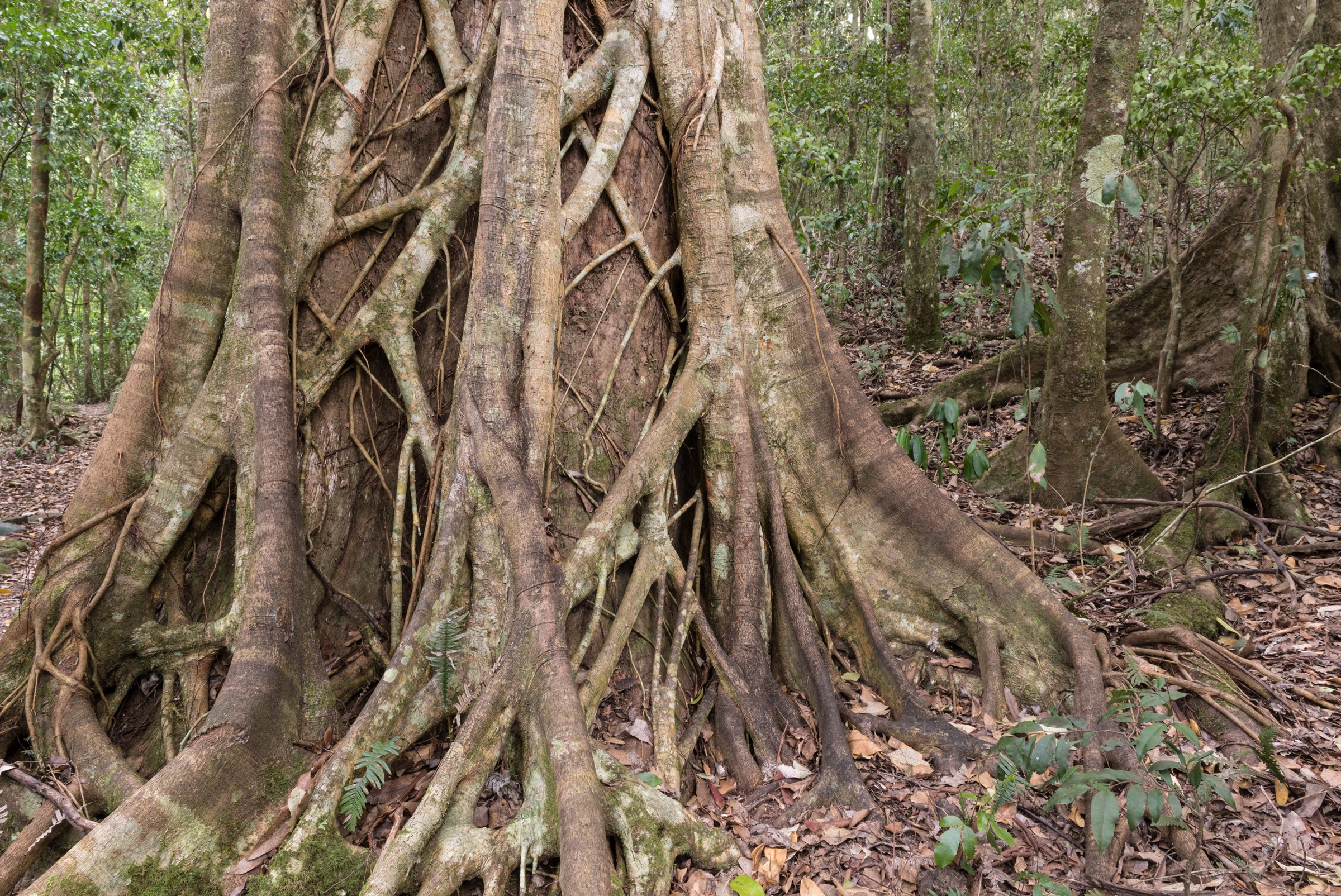
strangler fig

A strangler fig is a family of plants that grow their roots from the top of the trees that host them, eventually enveloping or replacing their host. Author Martin Fowler first coined the term to describe a migration design pattern. The idea is “to gradually create a new system around the edges of the old, letting it grow slowly over several years until the old system is strangled”.

How Can I Apply This Plant Behavior To My Application Migration?
Inspired by this family of plants, I might want to extract capabilities from a monolithic application and rewrite them as microservices. Then, I incrementally route traffic away from the old to the new. Over time, all of the requests are routed to microservices, and the existing application is retired.

While effective, this approach to application transformation creates hurdles. I must create the required infrastructure to separate the existing applications and the microservices. In the AWS cloud, this often involves creating multiple AWS accounts, so teams or services can more easily operate independently. Having multiple accounts is the most efficient way to separate concerns and billing across teams. When dealing with multiple AWS accounts, it is required to maintain networking infrastructure to connect my existing application and new services together. Furthermore, I must create a routing control system to route traffic gradually from the old application to the new services in different accounts. Creating and managing that infrastructure at scale is complex. It introduces additional risks and costs to the refactor project.

How Refactor Spaces Helps
AWS Migration Hub Refactor Spaces takes care of the heavy lifting for me. First, it lays down the networking infrastructure to enable connectivity between multiple AWS accounts. Second, it creates and manages a mechanism to route API calls away from my legacy application.

Let’s imagine I have a monolithic application that I want to refactor. The application is made of a web-based front-end using ReactJS. The front-end application is hosted on Amazon Simple Storage Service (Amazon S3) and distributed through Amazon CloudFront. The front-end makes API calls to a monolithic application developed in NodeJS or Python and deployed on several EC2 instances. The API uses a relational database, because this is how we store data since the company existed.

The architecture of this application is illustrated by the following diagram.

refactor spaces - monolith

Each API has a distinct URI. For example the /cart API handles the shopping basket, the /order API handles the ordering system, etc. I apply the strangler fig pattern and decide to extract the /cart capabilities to a set of new microservices. I create an AWS account for these microservices. I develop and deploy a set of AWS Lambda functions to implement the cart management functionalities. I chose to use Amazon DynamoDB for the shopping basket data storage because of its low latency at scale.

The schema of my new architecture is shown in the following diagram:

Refactor Space - target architectureBut now I have two challenges. First, I have to design, code, and deploy a routing mechanism to route API calls made by the front-end application to the correct back-end: either the monolith, or the new microservices. This service will likely be deployed into a distinct AWS account. Then, I have to configure network connectivity between these multiple AWS accounts.

This is where Refactor Spaces comes into the picture.

Introducing AWS Migration Hub Refactor Spaces
Refactor Spaces makes it easy to manage application refactoring by taking care of the two challenges I just described: the routing of the API calls and the network connectivity between AWS accounts. It is made of Environments, Services, and an Application proxy. Let’s see it in action.

I open the AWS Management Console, navigate to AWS Migration Hub, and select Refactor Spaces.

I first create a Refactor Spaces Environment. An Environment is a multi-account network fabric consisting of peered VPCs. This lets AWS resources in service VPCs added to the environment communicate directly across AWS accounts. It also provides a unified view of networking and services across accounts.

In Create environment, I give my environment a name and a description, and then select Next.

Refactor Spaces - Create environment

Then, I define my application. I give my application a name, and select the VPC where the proxy will be deployed.

An application is a services container. It has a proxy that defines routes. The proxy lets your front-end application use a single endpoint to contact multiple services. All of the traffic hits the single proxy endpoint, and then it’s sent to multiple services based on your rules.

Refactor Space - Create application

You may want to use multiple AWS accounts as explained before. Typically, an application is made of one AWS Account that hosts the Refactor Spaces Application proxy, one or multiple AWS accounts to host the legacy application, and one AWS account for the first microservice. Therefore, I invite the other AWS account owners to join this Refactor Spaces environment. I add one principal per AWS Account. Refactor Spaces doesn’t reinvent the wheel, but it leverages AWS Resource Access Manager (RAM) to do so.

This step is optional. Refactor Spaces may work within one AWS Account. It is possible to share the environments with other AWS accounts at a later stage.

I enter the AWS account IDs as Principals, and then select Next.

Refactor Space - Shared Accounts

Finally, I review my choices and select Create & share environment (not shown here).

Assuming that the microservices are ready to use, the next step is registering them as Refactor Spaces Services. Refactor Spaces Services are entities that provide business capabilities, typically microservices. These services are reachable through unique endpoints, and they can interoperate across accounts in a Refactor Spaces Environment. In this example, there are four services:

  • The monolithic app. This is the default service where Refactor Spaces routes all API calls initiated by the front-end.
  • Three microservices to implement the /cart capability. I decided to refactor this capability with three distinct sevices: AddItem, RemoveItem, and ListItems.

A Refactor Spaces Service may target any compute resource type: EC2, containers deployed on AWS Fargate, an Application Load Balancer, an AWS Lambda function, etc.

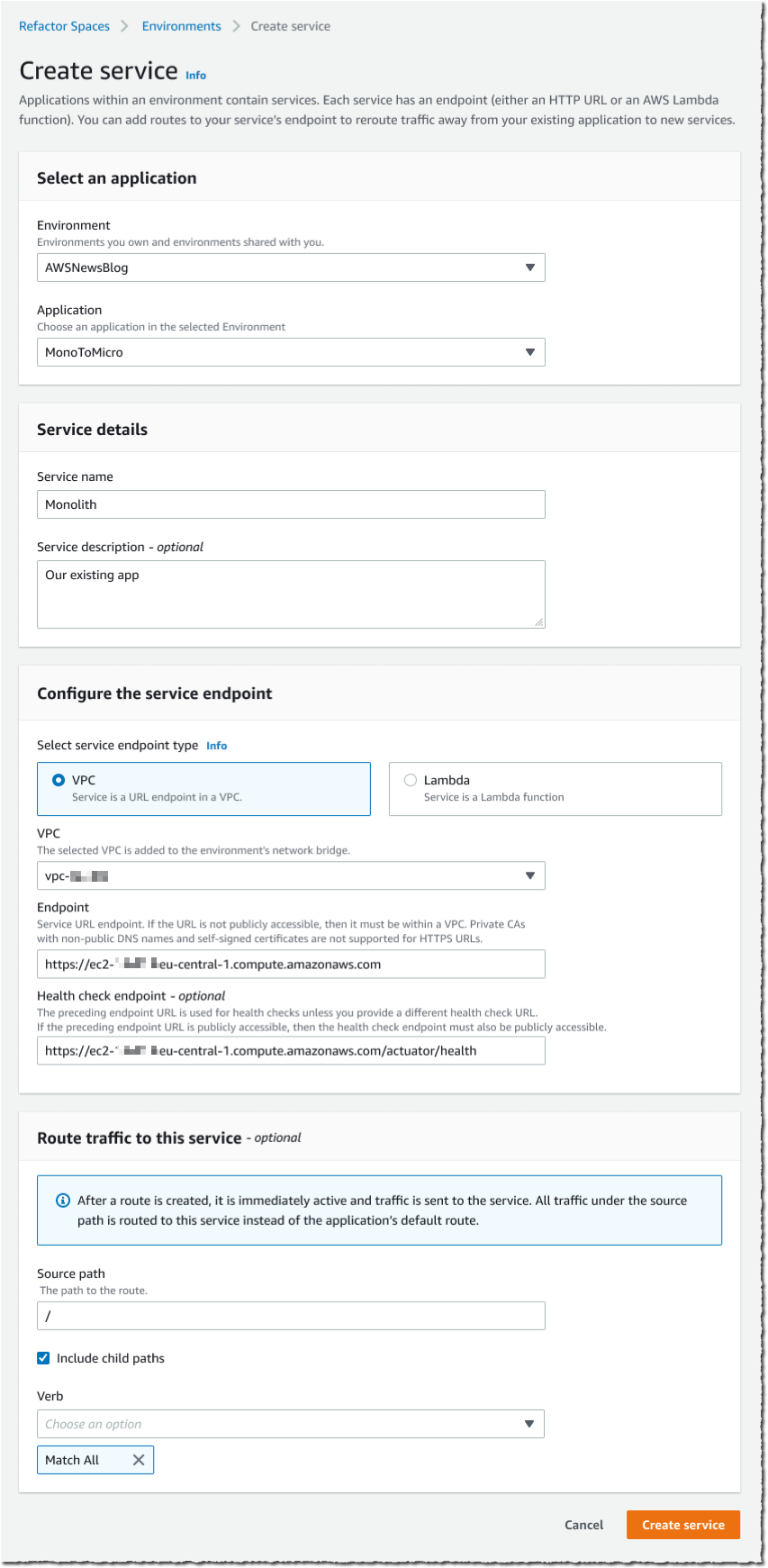
I select Create service from the left menu. The service configuration is in three steps. First, I select the Refactor Spaces Environment and Application where I want to define this service. Second, I give my service a name and a description. And third, I select the service endpoint: either an HTTP/HTTPS URL in a VPC, or a Lambda function.

The monolithic application is the default route where Refactor Spaces Application proxy routes all of the API calls, unless otherwise specified. I enter / as Source path and select Include child paths. Then, I make make sure Match all is selected for HTTP verbs.

When finished, I select Create service. I repeat this process for each of my microservices. For this demo, I create four Refactor Spaces Services in total.

AWS Migration Hub refactor Spaces - create service

The last step defines the routing rules for the Refactor Spaces Application proxy. When configured, the proxy becomes the new API endpoint for my front-end application. The sole change that I have to make in my front-end application is to point it at the Refactor Spaces Application proxy URI. The proxy routes API calls to Services, according to a route definition. An Application proxy supports routing to all compute platforms with public or private visibility. At the moment, private endpoints must be referred through a public DNS name or their private IP address. Each API call is run against the set of routes configured in the proxy. When a path matches a rule, the request is sent to the target service configured for that path. Proxies have a default route that forwards requests to a default service if they don’t match any of the path rules.

I select the service that I just created. Then, I enter the route Source path and the HTTP Verb to support. When my service expects subpaths (such as /cart/123), I make sure to select Include child paths, as well.

Refactor Spaces - Define route

I repeat this process for the GetItem and RemoveItem microservices. They are invoked for different HTTP verbs: GET and DELETE respectively.

Based on this configuration, Refactor Spaces creates and manages the following architecture for me. The Refactor Spaces Application proxy and network fabric are deployed in a separate AWS account. I might further configure the Amazon API Gateway based on the needs of my monolithic application or microservices.

Refactor Spaces - final architecture

The ultimate change is for the application front-end. I modify its configuration to point to the Refactor Spaces Application proxy endpoint, instead of the monolith’s endpoint. From now on, Refactor Spaces routes API calls to the monolith by default. It routes the /cart calls for GET, POST, and DELETE verbs to my new microservices implemented as Lambda functions.

Over time, I will repeat this process to move other capabilities out of the monolithic application, one-by-one, until the old monolith is strangled replaced by the new microservices architecture.

Pricing and Availaibility
AWS Migration Hub Refactor Spaces is available today in the ten following AWS Regions: US East (N. Virginia), US West (Oregon), US East (Ohio), Asia Pacific (Singapore) Asia Pacific (Sydney), Asia Pacific (Tokyo), Europe (Ireland), Europe (Frankfurt), Europe (London), and Europe (Stockholm). As per usual, we’re looking forward to expanding to additional Regions in the future.

This new capability is available today as an open preview, and no registration is necessary. You can start to use it today. There is no charge for using Refactor Space during the preview period. However, you may be charged for the resources that it provisions on your AWS accounts: Amazon API Gateway, AWS Transit Gateway, and Network Load Balancer. The pricing details are available on AWS Migration Hub’s pricing page. Billing will start when Refactor Spaces will be generally available.

Go and start refactoring your applications today!

— seb

re:Invent Session Preview – Under the Hood at Amazon Ads

Post Syndicated from Jeff Barr original https://aws.amazon.com/blogs/aws/reinvent-session-preview-under-the-hood-at-amazon-ads/

My colleagues have spent months creating, reviewing, and improving the content for their upcoming AWS re:Invent sessions. While I do my best not to play favorites, I would like to tell you about one that recently caught my eye!

Session ADM301 (Under the Hood at Amazon Ads) takes place on Tuesday, November 30th at 2 PM. In the session, my colleagues will introduce Amazon Ads, outline the challenges that come with building an advertising system at scale, and then show how they solved those challenges using multiple AWS services. I was able to review a near-final version of their presentation and this post is based on what I learned from that review.

Amazon Ads uses an omnichannel strategy with four elements: building awareness, increasing consideration, engaging shoppers, and driving purchases. Using the well-known “start from the customer and work backwards” model that we use at Amazon, they identified three distinct customer types and worked to design a system that would address their needs. The customer types were:

  • Advertisers running campaigns
  • Third-party partners who use Amazon Ads APIs to build tools & services
  • Shoppers on a purchase journey

Advertisers and third-party developers wanted an experience that spanned both UIs and programmatic interfaces, encompassing campaign management, budgeting, ad serving, a data lake for ad events, and machine learning to improve ad selection & relevance.

Scaling is a really interesting problem, with challenges around performance, storage, availability, cost, and effectiveness. In addition to handling hundreds of millions of ad requests per second (trillions of ads per day) within a latency budget of 120 ms, the ad server must be able to:
  • Track tens of billions of campaign objects, with overall storage measured in hundreds of petabytes
  • Deliver > 99.9999% availability
  • Handle peak events such as Prime Day automatically
  • Run economically and enforce advertiser budgets in near real-time
  • Deliver highly relevant ads using predictions from hundreds of machine learning models

As just one example of what it takes to handle a workload of this magnitude, they needed a caching system capable of handling 500 million requests per second!

As is often the case, the system went through multiple iterations before it reached its current form, and is still under active development. The presentation recaps the journey that the team went through, with architectural snapshots and performance metrics for each iteration.

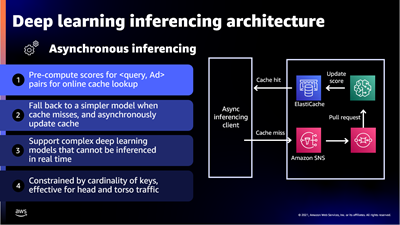
The presentation wraps up by discussing some of the ways that they were able to apply machine learning at scale. For example, to select the right ad for each request, Amazon Ads uses deep learning models to predict relevant ads to show shoppers, predict whether a shopper will click or purchase, and allocate and price an ad. In order to do this, they needed to be able to score thousands of ads per request within a 20 ms window at over 100K transactions per second, all across hundreds of models that each required different hardware and software optimizations.
To handle this workload they built a micro-service inferencing architecture on top of Amazon Elastic Container Service (Amazon ECS) and AWS App Mesh with specific hardware and software optimizations for each type of inference model. For low-latency inferencing the Ads team began with a CPU-based solution and then moved to GPUs to reduce prediction time even as complexity and the number of models grew.

This looks like a very interesting session and I hope that you will be able to attend in person or to watch it online as part of virtual re:Invent.

Jeff;

Amazon CodeGuru Reviewer Introduces Secrets Detector to Identify Hardcoded Secrets and Secure Them with AWS Secrets Manager

Post Syndicated from Alex Casalboni original https://aws.amazon.com/blogs/aws/codeguru-reviewer-secrets-detector-identify-hardcoded-secrets/

Amazon CodeGuru helps you improve code quality and automate code reviews by scanning and profiling your Java and Python applications. CodeGuru Reviewer can detect potential defects and bugs in your code. For example, it suggests improvements regarding security vulnerabilities, resource leaks, concurrency issues, incorrect input validation, and deviation from AWS best practices.

One of the most well-known security practices is the centralization and governance of secrets, such as passwords, API keys, and credentials in general. As many other developers facing a strict deadline, I’ve often taken shortcuts when managing and consuming secrets in my code, using plaintext environment variables or hard-coding static secrets during local development, and then inadvertently commit them. Of course, I’ve always regretted it and wished there was an automated way to detect and secure these secrets across all my repositories.

Today, I’m happy to announce the new Amazon CodeGuru Reviewer Secrets Detector, an automated tool that helps developers detect secrets in source code or configuration files, such as passwords, API keys, SSH keys, and access tokens.

These new detectors use machine learning (ML) to identify hardcoded secrets as part of your code review process, ultimately helping you to ensure that all new code doesn’t contain hardcoded secrets before being merged and deployed. In addition to Java and Python code, secrets detectors also scan configuration and documentation files. CodeGuru Reviewer suggests remediation steps to secure your secrets with AWS Secrets Manager, a managed service that lets you securely and automatically store, rotate, manage, and retrieve credentials, API keys, and all sorts of secrets.

This new functionality is included as part of the CodeGuru Reviewer service at no additional cost and supports the most common API providers, such as AWS, Atlassian, Datadog, Databricks, GitHub, Hubspot, Mailchimp, Salesforce, SendGrid, Shopify, Slack, Stripe, Tableau, Telegram, and Twilio. Check out the full list here.

Secrets Detectors in Action
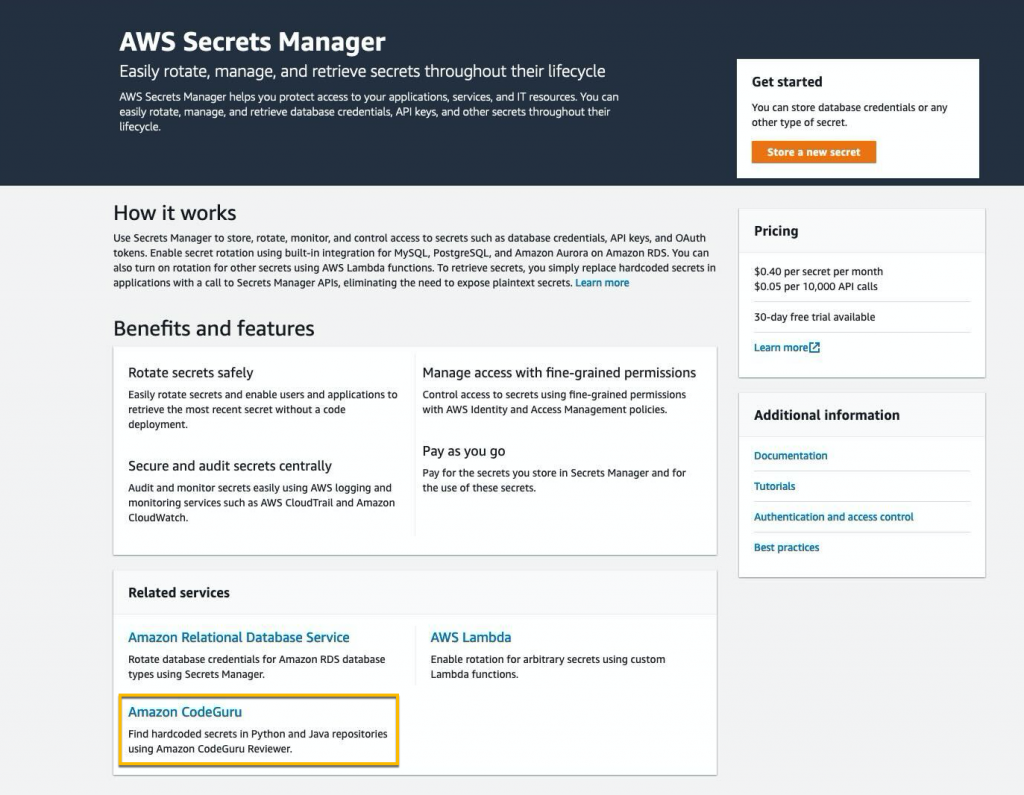
First, I select CodeGuru from the AWS Secrets Manager console. This new flow lets me associate a new repository and run a full repository analysis with the goal of identifying hardcoded secrets.

Associating a new repository only takes a few seconds. I connect my GitHub account, and then select a repository named hawkcd, which contains a few Java, C#, JavaScript, and configuration files.

A few minutes later, my full repository is successfully associated and the full scan is completed. I could also have a look at a demo repository analysis called DemoFullRepositoryAnalysisSecrets. You’ll find this demo in the CodeGuru console, under Full repository analysis, in your AWS Account.

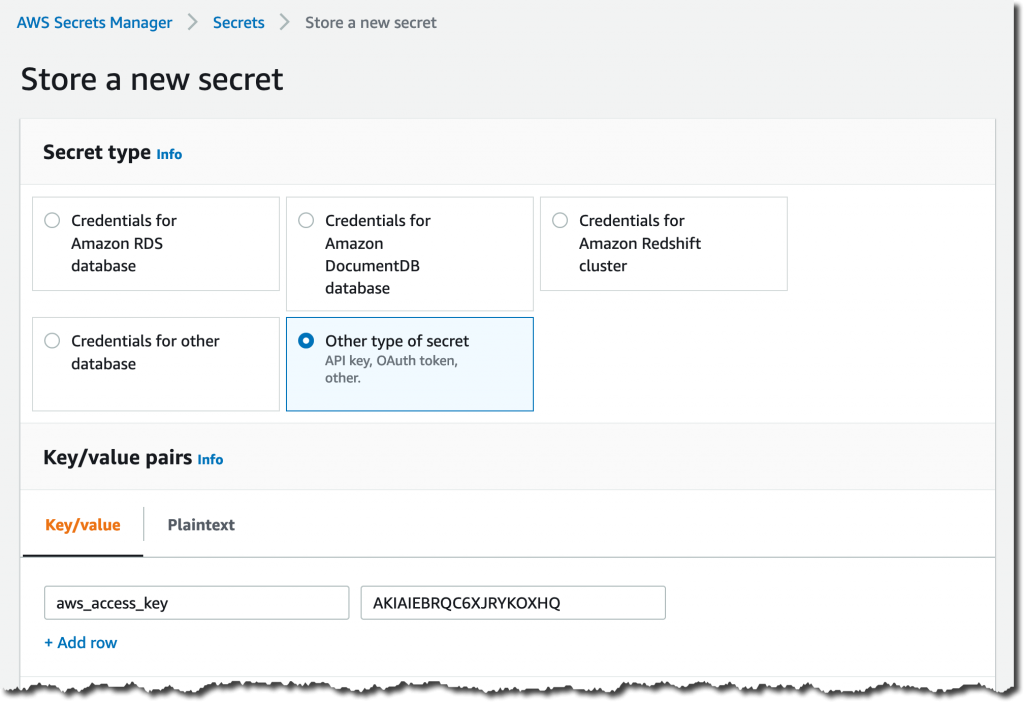
I select the repository analysis and find 42 recommendations, including one recommendation for a hardcoded secret (you can filter recommendations by Type=Secrets). CodeGuru Reviewer identified a hardcoded AWS Access Key ID in a .travis.yml file.

The recommendation highlights the importance of storing these secrets securely, provides a link to learn more about the issue, and suggests rotating the identified secret to make sure that it can’t be reused by malicious actors in the future.

CodeGuru Reviewer lets me jump to the exact file and line of code where the secret appears, so that I can dive deeper, understand the context, verify the file history, and take action quickly.

Last but not least, the recommendation includes a Protect your credential button that lets me jump quickly to the AWS Secrets Manager console and create a new secret with the proper name and value.

I’m going to remove the plaintext secret from my source code and update my application to fetch the secret value from AWS Secrets Manager. In many cases, you can keep the current configuration structure and use existing parameters to store the secret’s name instead of the secret’s value.

Once the secret is securely stored, AWS Secrets Manager also provides me with code snippets that fetch my new secret in many programming languages using the AWS SDKs. These snippets let me save time and include the necessary SDK call, as well as the error handling, decryption, and decoding logic.

I’ve showed you how to run a full repository analysis, and of course the same analysis can be performed continuously on every new pull request to help you prevent hardcoded secrets and other issues from being introduced in the future.

Available Today with CodeGuru Reviewer
CodeGuru Reviewer Secrets Detector is available in all regions where CodeGuru Reviewer is available, at no additional cost.

If you’re new to CodeGuru Reviewer, you can try it for free for 90 days with repositories up to 100,000 lines of code. Connecting your repositories and starting a full scan takes only a couple of minutes, whether your code is hosted on AWS CodeCommit, BitBucket, or GitHub. If you’re using GitHub, check out the GitHub Actions integration as well.

You can learn more about Secrets Detector in the technical documentation.

Alex

Preview – AWS IoT RoboRunner for Building Robot Fleet Management Applications

Post Syndicated from Channy Yun original https://aws.amazon.com/blogs/aws/preview-aws-iot-roborunner-for-building-robot-fleet-management-applications/

In 2018, we launched AWS RoboMaker, a cloud-based simulation service that enables robotics developers to run, scale, and automate simulation without managing any infrastructure. As we worked with robot developers and operators, we have repeatedly heard that they face challenges in operating different robot types in their automation efforts, including autonomous guided vehicles (AGV), autonomous mobile vehicles (AMR), and robotic manipulators.

Many customers choose different types of robots – often from different vendors in a single facility. Robot operator want to access the unified data required to build applications that work across a fleet of robots. However, when a new robot is added to an autonomous operation, complex and time-consuming software integration work is required to connect the robot control software to work management systems.

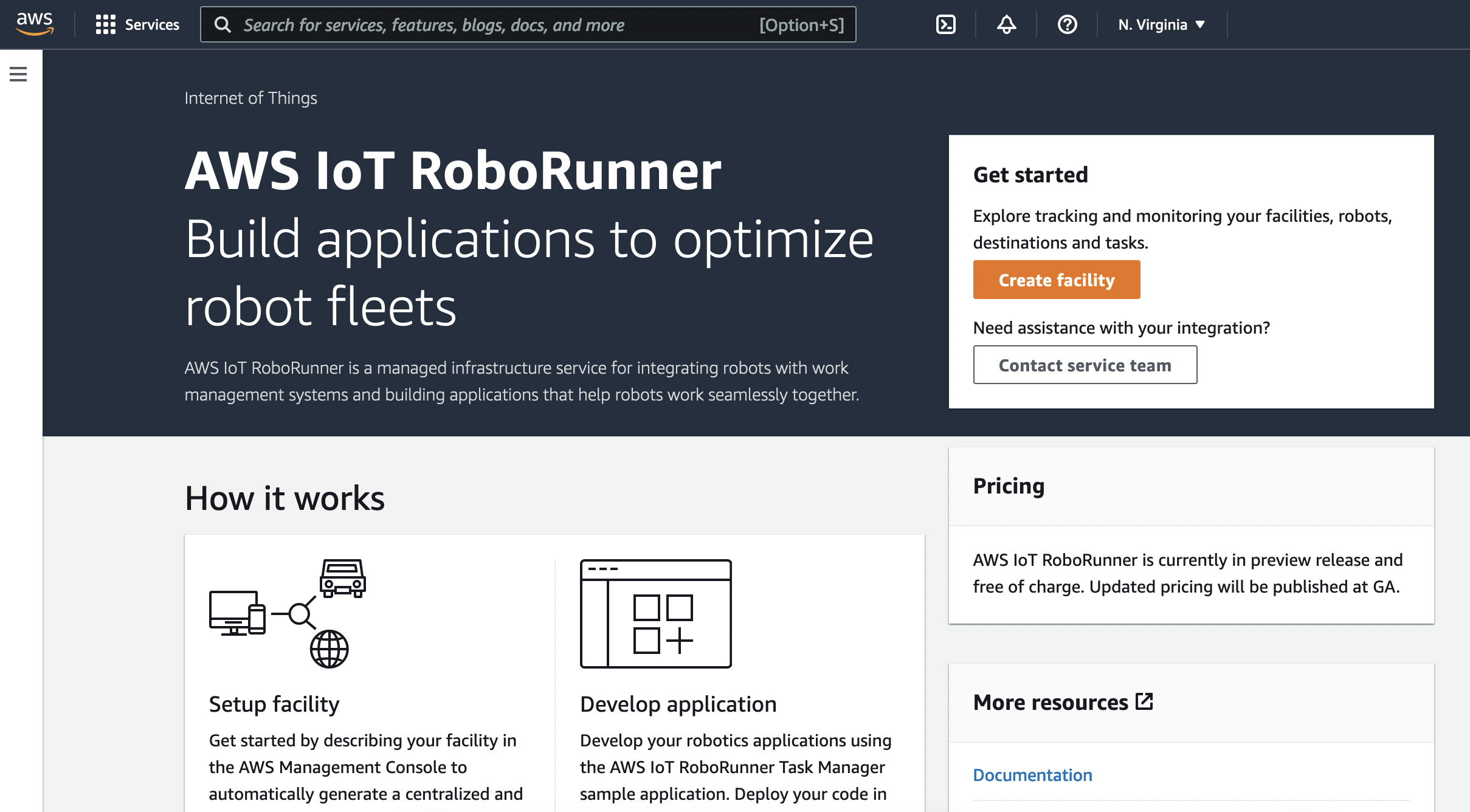
Today, we are launching a public preview of AWS IoT RoboRunner, a new robotics service that makes it easier for enterprises to build and deploy applications that help fleets of robots work seamlessly together. AWS IoT RoboRunner lets you connect your robots and work management systems, thereby enabling you to orchestrate work across your operation through a single system view.

This new service builds on the same technology used in Amazon fulfillment centers, and now we are excited to make it available to all developers to build advanced robotics applications for their businesses.

AWS IoT RoboRunner in Action
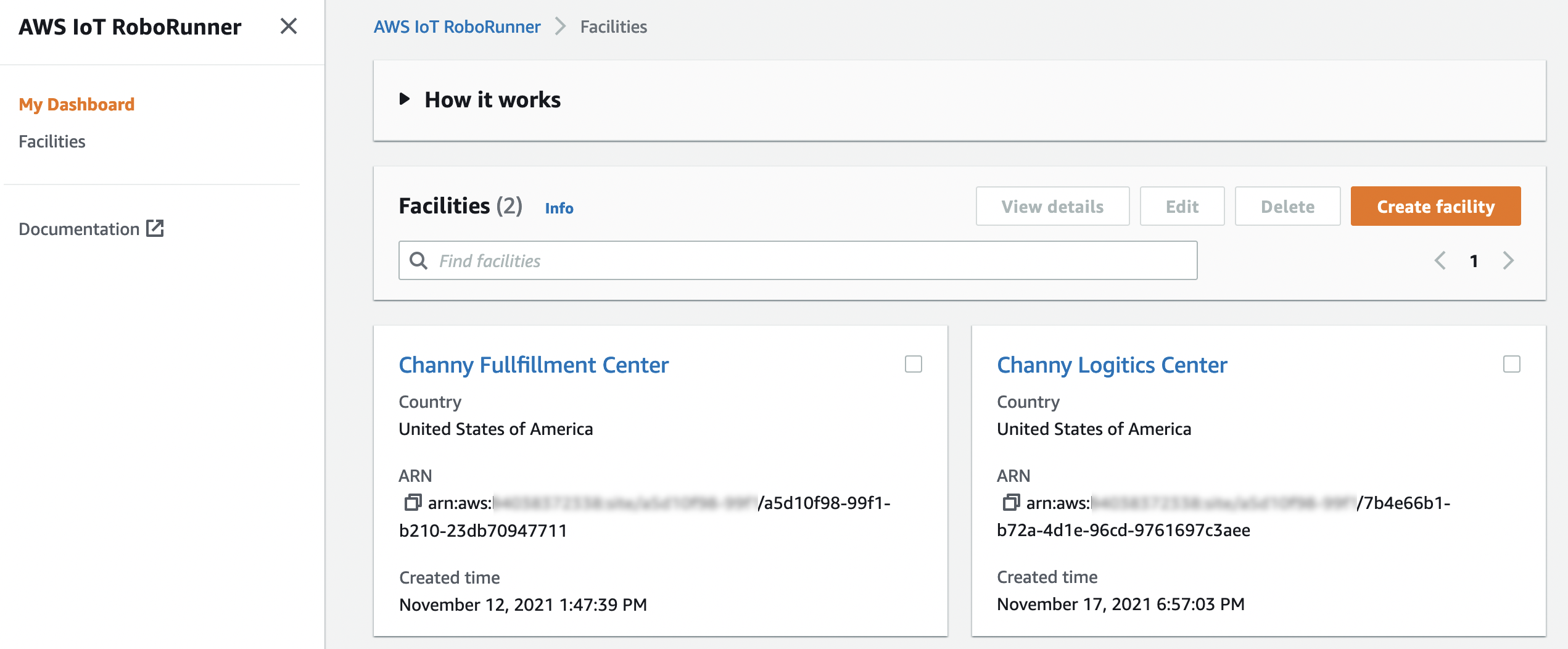
You can create a single facility (e.g., site name and location) in the AWS Management Console to get started with AWS IoT RoboRunner. Behind the scenes, AWS IoT RoboRunner automatically creates centralized repositories for storing facility, robot, destination, and task data. Then, the robots working on this site are setup as a “Fleet”, and each individual robot is setup in AWS IoT RoboRunner as a “Robot” within a fleet.

You can download the Fleet Gateway Library to develop integration codes for connecting your robots and WMS systems with AWS IoT RoboRunner to send and receive data from individual robot fleets. You can also develop the first robotics management application using the Task Manager Library and deploy Task Manager codes as an AWS Lambda function and Fleet Gateway codes on-premises as an AWS IoT Greengrass component.

To enable a single-system view of the robots, status of the systems, and progress of tasks on the same interface, AWS IoT RoboRunner provides APIs that let you build a user application. AWS IoT RoboRunner provides sample applications for allocating tasks to robot fleets so that you can get started quickly. You can customize the task allocation code with business requirements that align to your use case.

Learn more by reading Getting started with AWS IoT RoboRunner in the AWS IoT RoboRunner Developer Guide. Watch a quick introductory video about AWS IoT RoboRunner for more information.

Try Public Preview Now
AWS IoT RoboRunner is now available in public preview, and you can start using them today in the US East (N. Virginia) and Europe (Frankfrut) Regions. There will be no additional cost to use this feature during the preview period.

You can send feedback to [email protected], the AWS forum for AWS IoT, or through your usual AWS Support contacts.

Channy

AWS Security Profiles: Megan O’Neil, Sr. Security Solutions Architect

Post Syndicated from Maddie Bacon original https://aws.amazon.com/blogs/security/aws-security-profiles-megan-oneil-sr-security-solutions-architect/

AWS Security Profiles: Megan O’Neil, Sr. Security Solutions Architect
In the week leading up to AWS re:Invent 2021, we’ll share conversations we’ve had with people at AWS who will be presenting, and get a sneak peek at their work.


How long have you been at Amazon Web Services (AWS), and what do you do in your current role?

I’ve been at AWS nearly 4 years, and in IT security over 15 years. I’m a solutions architect with a specialty in security. I work with commercial customers in North America, helping them solve security problems and build out secure foundations for their AWS workloads.

How did you get started in security?

I took part in a Boeing internship for three summers starting my junior year of high school. This internship gave me the opportunity to work with mechanical engineers at Boeing. The specific team I worked with were engineers responsible for building digital tools and robots for the 767-400 line at the Everett plant in Washington state. The purpose of these custom tools and robots was to help build the planes more efficiently and accurately. I had a lot of fun and learned a lot from my time working with them. I asked the group for career advice during lunch one day, and they all pointed me towards computer science (CS) instead of mechanical engineering. Because of their strong support for CS, I took the first course, Intro to Computer Science, and was excited that something that I previously thought was intimidating was actually approachable and a subject I really enjoyed.

During my sophomore year there was a new elective class offered called Digital Security, which piqued my interest and influenced my senior project. I built (coded) an intrusion detection program that identified nefarious network traffic. I also worked on campus during college in the sound services department and participated in the Dance Ensemble Program, where I met the IT manager for a local hospital in Washington state, Good Samaritan Hospital in Puyallup. He was helping mix music at the studio I worked in. After showing him my senior project, he told me about a job opening for a network security specialist at the hospital. No one else had applied for the role. I then interviewed with the team, which was made up of only three engineers including the manager. They were responsible for the all-backend systems including the hospital information system, patient telemetry and clinic systems, the hospital network, etc. The group of people I worked with at the hospital is still very special to me, we are all still friends.

How do you explain your job to non-tech friends?

I’m in tech, and I help companies protect their websites and their customers’ data.

What are you currently working on that you’re excited about?

I’m very excited about re:Invent. It’s the 10th anniversary, we’re back in person, and I’ve got quite a few sessions I’m delivering.

Speaking of AWS re:Invent 2021 – can you give readers a sneak peek at what you’re covering?

The first is a session I’m delivering is called Use AWS to improve your security posture against ransomware (SEC308) with Merritt Baer, Principal in the Office of the CISO. We’re discussing what AWS services and features you can use to help you protect your systems from ransomware.

The second is a chalk talk, Automating and evidencing key compliance security controls (STP211-R1 and STP211-R2), I’m delivering with Kristin Haught, Principal Security TPM, and we’re discussing strategies for automating, monitoring, and evidencing common controls required for multiple compliance standards.

The third session is a builder session called Grant least privilege temporary access securely at scale (WPS304). We’ll use AWS Secrets Manager, AWS Identity and Access Management (IAM), and the isolated compute functionality provided by AWS Nitro Enclaves to allow system administrators to request and retrieve narrowly scoped and limited-time access.

The fourth session is another builder session called Detecting security threats with Amazon GuardDuty (SEC213-R1 and SEC213-R2). It includes several simulated scenarios, representing just a small sample of the threats that GuardDuty can detect. We will review how to view and analyze GuardDuty findings, how to send alerts based on the findings, and, finally, how to remediate findings.

From your perspective, what’s the most important thing to know about ransomware?

Whenever we see a security event continue to make news, it’s a call to action and an opportunity for customers to analyze their security programs including operations and controls. There’s no silver bullet when it comes to protection from ransomware, but it’s time to level up your security operations and controls. This means minimize human access, translate security policies into code, build mechanism and measure them, streamline the use of environment and infrastructure, and use advanced data/database service features.

For example, we still see customers with large amounts of long-lived credentials; it’s time to take inventory and minimize or eliminate them. While there is a small subset of use cases where they may be required, such as on-premises to AWS access, I recommend the following:

  1. Inventory your long-lived credentials.
  2. Ensure the access is least privilege, absolutely no wildcard actions and/or resources.
  3. If the access is interactive, apply multi-factor authentication (MFA).
  4. Ask if you can architect a better option that doesn’t rely on static access keys.
  5. Rotate access keys on a regular, frequent basis.
  6. Enable alerts on login events.

For more information, check out Ransomware mitigation: Top 5 protections and recovery preparation actions and Ransomware Risk Management on AWS Using the NIST Cyber Security Framework (CSF).

What’s your favorite Leadership Principle at Amazon and why?

Learn and Be Curious! I am the most happy in my job and personal life when I’m learning new things. I also believe that this principle is a way of life for us technology folks. Learning new technology and finding better ways of implementing technology is our job. My favorite quote/laptop sticker is:

“I hate programming”

“I hate programming”

“I hate programming”

“IT WORKS! ”

“I love programming.”

It just makes me laugh because it’s so true. Of course we are only that frustrated when something is very new. It’s like solving a puzzle. When a project comes together, it’s absolutely worth it – the puzzle pieces now fit.

What’s the best career advice you’ve ever gotten?

Work with a mentor. This can be casual by finding projects where you can collaborate with folks who have more experience than you. Or it can be more formal by asking someone to be your mentor and setting up a regular cadence of meetings with them. I’ve done both, a simple example is by collaborating with Merritt and Kristen on upcoming re:Invent presentations, I’ve already learned a lot from both of them just through the preparation process and developing the content. Having a mentor by your side can be especially helpful when setting new goals. Sometimes we need someone to push us out of our comfort zone and believe that we can achieve bigger things than we would have thought and then can help devise a plan to help you achieve those goals. All it takes is someone else believing in us.

If you had to pick any other job, what would you want to do?

I’ve always been interested in naturopathic medicine and getting to the root cause of an issue. It’s somewhat similar to my job in that I’m solving puzzles and complex problems, but in technology, instead of the body.
 

If you have feedback about this post, submit comments in the Comments section below.

Want more AWS Security news? Follow us on Twitter.

Author

Megan O’Neil

Megan is a Senior Specialist Solutions Architect focused on threat detection and incident response. Megan and her team enable AWS customers to implement sophisticated, scalable, and secure solutions that solve their business challenges.

Author

Maddie Bacon

Maddie (she/her) is a technical writer for AWS Security with a passion for creating meaningful content. She previously worked as a security reporter and editor at TechTarget and has a BA in Mathematics. In her spare time, she enjoys reading, traveling, and all things Harry Potter.

AWS Security Profiles: Merritt Baer, Principal in OCISO

Post Syndicated from Maddie Bacon original https://aws.amazon.com/blogs/security/aws-security-profiles-merritt-baer-principal-in-ociso/

AWS Security Profiles: Merritt Baer, Principal in OCISO
In the week leading up AWS re:Invent 2021, we’ll share conversations we’ve had with people at AWS who will be presenting, and get a sneak peek at their work.


How long have you been at Amazon Web Services (AWS), and what do you do in your current role?

I’m a Principal in the Office of the Chief Information Security Officer (OCISO), and I’ve been at AWS about four years. In the past, I’ve worked in all three branches of the U.S. Government, doing security on behalf of the American people.

My current role involves both internal- and external- facing security.

I love having C-level conversations around hard but simple questions about how to prioritize the team’s resources and attention. A lot of my conversations revolve around organizational change, and how to motivate the move to the cloud from a security perspective. Within that, there’s a technical “how”—we might talk about the move to an intelligent multi-account governance structure using AWS Organizations, or the use of appropriate security controls, including remediations like AWS Config Rules and Amazon EventBridge. We might also talk about the ability to do forensics, which in the cloud looks like logging and monitoring with AWS CloudTrail, Amazon CloudWatch, Amazon GuardDuty, and others aggregated in AWS Security Hub.

I also handle strategic initiatives for our security shop, from operational considerations like how we share threat intelligence internally, to the ways we can better streamline our policy and contract vehicles, to the ways that we can incorporate customer feedback into our products and services. The work I do for AWS’ security gives me the empathy and credibility to talk with our customers—after all, we’re a security organization, running on AWS.

What drew you to security?

(Sidebar: it’s a little bit of who I am— I mean, doesn’t everyone rely on polaroid photos? just kidding— kind of :))
 
Merritt Baer polaroid photo

I always wanted to matter.

I was in school post-9/11, and security was an imperative. Meanwhile, I was in Mark Zuckerberg’s undergrad class at Harvard. A lot of the technologies that feel so intimate and foundational—cloud, AI/ML, IoT, and the use of mobile apps, for example—were just gaining traction back then. I loved both emerging tech and security, and I was convinced that they needed to speak to and with one another. I wanted our approach to include considerations around how our systems impact vulnerable people and communities. I became an expert in child pornography law, which continues to be an important area of security definition.

I am someone who wonders what we’re all doing here, and I got into security because I wanted to help change the world. In the words of Poet Laureate Joy Harjo, “There is no world like the one surfacing.”

How do you explain your job to non-tech friends?

I often frame my work relative to what they do, or where we are when we’re chatting. Today, nearly everyone interacts with cloud infrastructure in our everyday lives. If I’m talking to a person who works in finance, I might point to AWS’ role providing IT infrastructure to the global financial system; if we’re walking through a pharmacy I might describe how research and development cycles have accelerated because of high-performance computing (HPC) on AWS.

What are you currently working on that you’re excited about?

Right now, I’m helping customer executives who’ve had a tumultuous (different, not necessarily all bad) couple of years. I help them adjust to a new reality in their employee behavior and access needs, like the move to fully remote work. I listen to their challenges in the ability to democratize security knowledge through their organizations, including embedding security in dev teams. And I help them restructure their consumption of AWS, which has been changing in light of the events of the last two years.

On a strategic level, I have a lot going on … here’s a good sampling: I’ve been championing new work based on customers asking our experts to be more proactive by “snapshotting” metadata about their resources and evaluating that metadata against our well-architected security framework. I work closely with our Trust and Safety team on new projects that both increase automation for high volume issues but also provide more “high touch” and prioritized responses to trusted reporters. I’m also building the business case for security service teams to make their capabilities even more broadly available by extended free tiers and timelines. I’m providing expertise to our private equity folks on a framework for evaluating the maturity of security capabilities of target acquisitions. Finally, I’ve helped lead our efforts to add tighter security controls when AWS teams provide prototyping and co-development work. I live in Miami, Florida, USA, and I also work on building out the local tech ecosystem here!

I’m also working on some of the ways we can address ransomware. During our interview process, Amazon requests that folks do an hour-long presentation on a topic of your choice. I did mine on ransomware in the cloud, and when I came on board I pointed to that area of need for security solutions. Now we have a ransomware working group I help lead, with efforts underway to help out customers doing both education and architectural guidance, as well as curated solutions with industries and partners, including healthcare.

You’re presenting at AWS re:Invent this year—can you give readers a sneak peek at what you’re covering?

One talk is on cloud-native approaches to ransomware defense, encouraging folks to think innovatively as they mature their IT infrastructure. And a second talk highlights partner solutions that can help meet customers where they are, and improve their anti-ransomware posture using vendors—from MSSPs and systems integrators, to endpoint security, DNS filtering, and custom backup solutions.

What are you hoping the audience will take away from the sessions?

These days, security doesn’t just take the form of security services (like GuardDuty and AWS WAF), but will also manifest in the ways you design a cloud-aware architecture. For example, our managed database service Aurora can be cloned; that clone might act as a canary when you see data drift (a canary is security concept for testing your expectations). You can use this to get back to a known good state.

Security is a bottom line proposition. What I mean by that is:

  1. It’s a business criticality to avoid a bad day
  2. Embracing mature security will enable your entity’s development innovation
  3. The security of your products is a meaningful part of what you deliver on to your customers.

From your perspective, what’s the most important thing to know about ransomware?

Ransomware is a big headline-maker right now, but it’s not new. Most ransomware attacks are not based on zero days; they’re knowable but opportunistic. So, without victim-blaming, I mean to equip us with the confidence to confront the security issue. There’s no need to be ransomed.

I try not to get wrapped around particular issues, and instead emphasize building the foundation right. So sure, we can call it ransomware defense, but we can also point to these security maturity measures as best practices in general.

I think it’s fair to say that you’re passionate about women in tech and in security specifically. You recently presented at the Day of Shecurity conference and the Women in Business Summit, and did an Instagram takeover for Women in CyberSecurity (WiCyS). Why do you feel passionately about this?

I see security as an inherently creative field. As security professionals, we’re capable of freeing the business to get stuff done, and to get it done securely. That sounds simple, and it’s hard!

Any time you’re working in a creative field, you rely on human ingenuity and pragmatism to ensure you’re doing it imaginatively instead of simply accepting old realities. When we want to be creative, we need more of the stuff life is made of: human experience. We know that people who move through the world with different identities and experiences think differently. They approach problems differently. They code differently.

So, I think having women in security is important, both for the women who choose to work in security, and for the security field as a whole.

What advice would you give a woman just starting out in the security industry?

No one is born with a brain full of security knowledge. Technology is human-made and imperfect, and we all had to learn it at some point. Start somewhere. No one is going to tap you on the shoulder and invite you to your life 🙂

Operationally, I recommend:

  • Curate your “elevator pitch” about who you are and what you’re looking for, and be explicit when asking for folks for a career conversation or a referral (you can find me on Twitter @MerrittBaer, feel free to send a note).
  • Don’t accept a first job offer—ask for more.
  • Beware of false choices. For example, sometimes there’s a job that’s not in the description—consider writing your own value proposition and pitching it to the organization. This is a field that’s developing all the time, and you may be seeing a need they hadn’t yet solidified.

What’s your favorite Leadership Principle at Amazon and why?

I think Bias for Action takes precedence for me— there’s a business decision here to move fast. We know that comes with some costs and risks, but we’ve made that calculated decision to pursue high velocity.

I have a law degree, and I see the Leadership Principles sort of like the Bill of Rights: they are frequently in tension and sometimes even at odds with one another (for example, Bias for Action and Are Right, A Lot might demand different modes). That is what makes them timeless—yet even more contingent on our interpretation—as we derive value from them. As a security person, I want us to pursue the good, and also to transcend the particular fears of the day.

If you had to pick any other industry, what would you want to do?

Probably public health. I think if I wasn’t doing security, I would want to do something else landscape-level.

Even before I had a daughter, but certainly now that I have a one-year-old, I would calculate the ROI of my life’s existence and my investment in my working life.

That being said, there are days I just need to come home to some unconditional love from my rescue pug, Peanut Butter.
 
Peanut Butter the dog


If you have feedback about this post, submit comments in the Comments section below.

Want more AWS Security news? Follow us on Twitter.

 Merritt Baer

Merritt Baer

Merritt is a Principal in the Office of the CISO. She can be found on Twitter at @merrittbaer and looks forward to meeting you at re:Invent, or in your next executive conversation.

Author

Maddie Bacon

Maddie (she/her) is a technical writer for AWS Security with a passion for creating meaningful content. She previously worked as a security reporter and editor at TechTarget and has a BA in Mathematics. In her spare time, she enjoys reading, traveling, and all things Harry Potter.

AWS attendee guide for DevOps and Developer Productivity track at re:Invent2021

Post Syndicated from Harshitha Putta original https://aws.amazon.com/blogs/devops/aws-attendee-guide-for-devops-and-developer-productivity-track-at-reinvent-2021/

AWS re:Invent is a learning conference hosted by Amazon Web Services for the global cloud computing community. We are super excited to join you at the 10th annual re:Invent to share the latest from AWS leaders and discover more ways to learn and build. Let’s celebrate this milestone, which will be offered in person in Las Vegas (November 29-December 3) and in virtual (November 29–December 10) formats. The health and safety of our customers, and partners remains our top priority and you can learn more about it in health measures page. For details about the virtual format, check out the virtual section. If you haven’t already registered, don’t forget to register and save your spot at your favorite sessions.

The AWS DevOps and Developer Productivity track at re:Invent offers you with sessions that are combination of cultural philosophies, practices, and tools that increase an organization’s ability to deliver applications and services at high velocity. The sessions vary from intermediate (200) through expert (400) levels, and help you accelerate the pace of innovation in your business. This blog post highlights the sessions from the Cloud Operations track that you shouldn’t miss.

Breakout Sessions

 AWS re:Invent breakout sessions are lecture-style and one hour long. These sessions are delivered by AWS experts, customers, and partners, and they typically include 10–15 minutes of Q&A at the end. For our virtual attendees, breakout sessions will be made available on demand in the week after re:Invent. 

Level 200 – Intermediate

  • DOP208-R1 and DOP208-R2 DevOps revolution

While DevOps has not changed much, the industry has fundamentally transformed over the last decade. Monolithic architectures have evolved into microservices. Containers and serverless have become the default. Applications are distributed on cloud infrastructure across the globe. The technical environment and tooling ecosystem has changed radically from the original conditions in which DevOps was created. So, what’s next? In this session, learn about the next phase of DevOps: a distributed model that emphasizes swift development, observable systems, accountable engineers, and resilient applications.

Level 300 – Advanced

  • DOP301 How to reuse patterns when developing infrastructure as code

This session explores the AWS Cloud Development Kit (AWS CDK) constructs and AWS CloudFormation modules and how they can be used to make building applications easier on AWS. Learn how you can extend CloudFormation to include support for third-party resources and how those resource types can be used by AWS Config.

  • DOP309 Amazon builders’ library: Operational excellence at Amazon

Operational excellence at Amazon is achieved through a DevOps model, where software development teams operate the systems they build. In this session, Senior Principal Engineer David Yanacek describes Amazon’s operational practices that he has observed during his 15 years of building and operating services at Amazon. Hear David describe the habits that teams have adopted, such as how teams handle retrospectives, share knowledge, and regularly review operational metrics as a team. David discusses how these behaviors have led teams to innovate to build better tools and make architectural shifts.

  • DOP310 Enabling decentralized development teams with a shared services platform

Speed in software development requires being able to equip development teams with tools and guardrails for DevOps, security, and infrastructure configuration. Too often, central teams find they need to piece together their own custom solutions or compromise the speed of their development organization in order to maintain standards. In this session, dive deep into the crawl, walk, and run options and best practices for building a shared services platform on AWS using tools and services such as AWS Copilot, AWS Proton, and pre-built solutions using AWS CloudFormation.

  • DOP311 Incorporating continuous resilience in your development ecosystem

Today, resilience encompasses a broad range of considerations from infrastructure, application patterns, and data management to application building and monitoring. Additionally, after incorporating resilience, it is essential to maintain it in a continuous manner. In this session, explore various considerations for implementing processes designed to provide continuous improvement through a DevOps methodology. Review various services that can incorporate resilience in the development process in a nearly continuous manner.

  • DOP312 Observing your applications from development through production

Implementing observability differs at various stages of the software development lifecycle. In development, detailed logging and tracing are necessary to understand application behavior. In testing, logging and tracing are needed but in varying levels of detail and must be augmented by new metrics. In integration and production, it’s necessary to correlate and contextualize large volumes of data with dashboards that encompass metrics, alarms, and notifications connected to internal and external events. In this session, explore the mechanisms, mental models, and tools (including Amazon CloudWatch, AWS CloudTrail, AWS X-Ray and Amazon DevOps Guru) that top-performing teams use to observe applications throughout various stages of the software development lifecycle.

  • DOP313 Best practices for securing your software delivery lifecycle

In this session, learn about ways you can secure your AWS CI/CD pipeline. Review topics like security of the pipeline versus security in the pipeline, and learn about practices to incorporate security checkpoints across various pipeline stages, security event management, and aggregation of vulnerability findings into a unified display. This session also introduces foundational methodologies that combine best practices, processes, and tools to increase an organization’s ability to deliver applications and services securely.

  • DOP314 Write, deploy, and provision cloud resources with AWS Developer Tools

In this session, learn how you can use various AWS Developer Tools to improve your ergonomics across the entire development lifecycle. This session dives deep into IDE extensions, SDKs, and toolkits that provide first-class integrations with AWS services. It also explores how to manage and fine-tune your resources with the AWS Command Line Interface (AWS CLI); how to define your infrastructure in common programming languages with AWS CDK; and how to automate testing, building, debugging, and deployment.

  • DOP315 What’s new with AWS CloudFormation and AWS CDK

Join this session to learn about new features to up-level your infrastructure as code (IaC) experiences on AWS. It covers working with AWS CloudFormation modules and AWS CDK constructs to make working with AWS easier; CloudFormation registry to streamline creating, publishing, discovering, and using AWS and third-party plugins; CloudFormation StackSets and CDK Pipelines to automate the deployment of resources and applications across multiple AWS Regions and accounts; CloudFormation Guard 2.0 to attain security and best practice compliance before deployments reach production; and more. Explore how AWS is improving our IaC coverage of AWS services and features in a scalable, decentralized way and how you can contribute.

  • DOP325 Building with the new AWS SDKs for Rust, Kotlin, and Swift

Writing code in the AWS SDKs for Rust, Kotlin, and Swift has never been as easy as it is now. This session explores how AWS built these SDKs in parallel, the commonalities they share, and how to build an application with each one. Then, it details best practices for using the SDKs and how to use the features to test your code efficiently. Lastly, this session takes a close look at how the SDKs work and reviews the road map for the future.

  • DOP328-S Slack is the digital HQ for AWS developers and DevOps teams (sponsored by Slack)

With increased pressure on software teams to release high-quality products faster, it’s more important than ever to work effectively in an interdependent and cross-functional manner. Yet, communication and collaboration have not changed to reflect the way Agile and DevOps teams actually get work done. Join this session to find out why Slack is the digital HQ for engineering and operations teams. This presentation is brought to you by Slack, an AWS Partner. Speakers: Logan Franey (Slack) and Clint Burns (Slack).

Level 400 – Expert

  • DOP402-R1 and DOP402-R2 Automating cross-account CI/CD pipelines

When building a deployment strategy for your applications, using a multi-account approach is a recommended best practice. This limits the area of impact for changes made and results in better modularity, security, and governance. In this session, dive deep into an example multi-account deployment using infrastructure as code (IaC) services such as the AWS CDK, AWS CodePipeline, and AWS CloudFormation. Also explore a real-world customer use case that is deploying at scale across hundreds of AWS accounts.

Builders’ Sessions

Builders Sessions are small-group sessions led by an AWS expert who guides you as you build the service or product. Each builders’ session begins with a short explanation or demonstration of what you are going to build. Once the demonstration is complete, use your laptop to experiment and build with the AWS expert.

Level 300 – Advanced

  • DOP303 Assessing your application resiliency using chaos engineering

This builders’ session guides you through the principles of chaos engineering and building observability to assess the resiliency of your application and infrastructure. Walk through a hands-on exercise using AWS Fault Injection Simulator to inject faults and observe the impacts using various managed services such as an Amazon CloudWatch dashboard. Learn to use Amazon DevOps Guru, which uses machine learning for observability, to improve the minimum time to recovery (MTTR) by decreasing downtime.

  • DOP304 Creating and publishing AWS CloudFormation public resources

This builders’ session guides you through the process for creating AWS CloudFormation extensions for a CloudFormation public or private registry. Also, learn how to consume resource types from the registries created by other teams or organizations.

  • DOP305-R1 and DOP305-R2 Continuous deployment with AWS CDK Pipelines

CDK Pipelines is a new AWS CDK construct that simplifies defining and building CI/CD pipelines for safely deploying software changes. This builders’ session shows you how to effectively use CDK Pipelines to manage software releases.

Chalk Talks

Chalk Talks are highly interactive sessions with a small audience. Experts lead you through problems and solutions on a digital whiteboard as the discussion unfolds. Each begins with a short lecture (10–15 minutes) delivered by an AWS expert, followed by a 45- or 50-minute Q&A session with the audience.

Level 200 – Intermediate

  • DOP201 Provisioning, automating, and orchestrating IaC on AWS

This chalk talk answers your questions about infrastructure as code (IaC), including relevant AWS services and partner products. It covers topics like IaC patterns, the AWS Cloud Development Kit (AWS CDK) and AWS CloudFormation, augmentation of your CI/CD workflows with services like AWS Systems Manager, and how to select the right tools for the job. Join this talk and bring your questions.

  • DOP202 Increasing availability with AWS observability solutions

In this chalk talk, learn how you can use Amazon CloudWatch to gain insights about the trends and patterns of your infrastructure performance in real time. Learn how to slice and dice your CloudWatch Container Insights metrics to help you gain actionable insights. Also, learn how to monitor blue/green deployments to stay away from downtimes. Lastly, discuss how to use metric querying to analyze and compare how your business is doing across different areas.

  • DOP203-R1 and DOP203-R2 Getting started developing backend applications in the cloud

This chalk talk dives deep into the most common strategies for organizing the development of complex cloud applications using various AWS services and solutions. Learn about how to get started with your local development environment, about how to select the right infrastructure, and about achieving the fastest time to market. Join this talk and bring your questions.

  • DOP204 Testing on AWS

Testing software is a crucial part of the software delivery lifecycle, with testing methodologies prescribed for every stage of the process from local unit testing on a developer laptop to load testing production environments. This chalk talk briefly covers several test methodologies, then transitions to a Q&A session where you can ask AWS experts your testing-related questions.

  • DOP209-R1 and DOP209-R2 Amazon’s DevOps culture

In this chalk talk, learn about how Amazon enables its developers to rapidly release and iterate software while maintaining industry-leading standards on security, reliability, and performance. Consider the tradition of two-pizza teams and how to maintain a culture of DevOps in a large enterprise. Also, hear how you can help AWS customers build such a culture for themselves.

  • DOP210 Using on-premises Git with AWS Developer Tools for security and compliance

In this chalk talk, learn about using AWS Development Tools in conjunction with third-party Git solutions, such as GitHub Enterprise, Bitbucket Server, and more.

  • DOP211-R1 and DOP211-R2 Building scalable machine-learning pipelines

In this chalk talk, explore how to build, automate, manage, and scale machine learning (ML) workflows using the AWS-native DevOps tools and services. Learn how to provision the underlying resources needed to enable CI/CD capabilities for your ML development lifecycle. Also, learn how to use the built-in templates or create your own custom templates using AWS CloudFormation.

Level 300 – Advanced

  • DOP302 Continuous compliance for your development workflow

This chalk talk dives deep into the importance of and mechanisms for meeting security and compliance requirements for your organization. Learn ways that you can enforce pre- and post-deployment standards, shift-left testing, and use of services like Amazon CodeGuru Reviewer, AWS CloudFormation Guard, and AWS Config for security static analysis and runtime compliance checks. Join this talk and bring your questions.

  • DOP316-R1 and DOP316-R2 continuous integration strategies and best practices

In this chalk talk, learn about using continuous integration across your branches and pull-request workflows. Explore various considerations for monolith versus containerized applications, incorporating best practices like security checkpoints, generating test reports, integrating open-source packages, and more. Learn some build-optimization techniques with available tools and services. Lastly, evaluate integration into the GitOps model.

  • DOP317 Application deployment strategies for AWS applications

This chalk talk covers deployment strategies, including blue/green, in-place, feature-flag, and canary deployments. It also explores strategies for working with data structure changes.

  • DOP318 Deploying AWS Config conformance packs with RDK using AWS CodePipeline

In this chalk talk, learn how to use a simple pipeline to create custom AWS Config rules and deploy them across an AWS Organizations organization-using AWS Config, the AWS Developer Tools, the AWS Config Rule Development Kit (RDK), and RDKLib. During the talk, explore how to build, test, and deploy these rules at scale across multiple AWS accounts in a repeatable, secure, and automated way.

  • DOP319-R1 and DOP319-R2 Choose your own adventure: AWS Java developer tooling

Are you a Java developer deploying applications to AWS? Do you wonder how you can improve your development cycle, be more productive, and deliver better-performing applications? During this highly interactive chalk talk, AWS experts adapt topics in real time to cover those that interest you the most. Choose from a range of options, from Java-specific integrations with popular services like Amazon S3, AWS Lambda, and Amazon DynamoDB, to Java-focused IDE tooling to help you be more productive when you’re authoring code that runs on AWS. Also, review Amazon Corretto (open JDK) and Amazon CodeGuru as part of Java application development.

Level 400 – Expert

  • DOP403-R1 and DOP403-R2 Maximize value with AWS CloudFormation advanced features

In this chalk talk, gain insights into AWS CloudFormation advanced features to transform the way you provision and manage your AWS and third-party resources. Discover how to use best practice plugins from the CloudFormation registry to create a CloudFormation template, use CloudFormation Guard to check the template for security and compliance errors, disable the rollback to accelerate provisioning, and use CloudFormation StackSets to provision resources in multiple AWS accounts and Regions.

Workshops

Workshops are two-hour interactive learning sessions where you work in small group teams to solve problems using AWS services. Each workshop starts with a short lecture (10–15 minutes) by the main speaker, and the rest of the time is spent working as a group. Come prepared with your laptop and a willingness to learn!

Level 200 – Intermediate

  • DOP205-R1 and DOP205-R2 Build your infrastructure with AWS CloudFormation and the AWS CDK

In this workshop, learn how to build using infrastructure as code with AWS CloudFormation and the AWS CDK. Create resources using CloudFormation and learn about maintenance and operations tips. Also delve into using the AWS CDK to enable developers to utilize their choice of programming language to create infrastructure. The workshop walks you through the steps of coding and building your own constructs (or integrating solution constructs) and publishing them as shared libraries. Let’s build!

  • DOP206 Improve availability and resilience with fault injection experiments

This workshop introduces you to chaos engineering. Learn how to improve the resiliency of applications and infrastructure using hypothesis-based experiments, disruption, and observation, including recurrent scenarios and CI/CD. Get hands-on with AWS Fault Injection Simulator and AWS Systems Manager to simulate outage scenarios, and learn how to combine this with observability tools like Amazon CloudWatch and Amazon DevOps Guru to uncover hidden issues, expose unseen areas, and validate remediation steps.

  • DOP207 Improving development ergonomics for developers

In this workshop, get hands-on with developer tools on AWS including AWS IDE toolkits, SDKs, and CLIs to build a modern application. Learn how to easily and efficiently build, test, and debug a serverless application and explore modern tooling, including Amazon CodeGuru, AWS Serverless Application Model (AWS SAM) tooling, and managed environments, to rapidly prototype and debug secure applications in the cloud.

Level 300 – Advanced

  • DOP306 Implementing release management strategies for CI/CD

This workshop guides you through building CI/CD pipelines with release-management best practices, including artifact management as well as zero-downtime release promotion and rollback mechanisms. Evaluate various rollback/roll forward strategies across compute types and assess the need for manual processes.

  • DOP307-R1 and DOP307-R2 AWS CLI tips and tricks

In this workshop, learn AWS Command Line Interface (AWS CLI) tips and tricks. Discover how to efficiently interact with your AWS services, manage your AWS resources, automate your regular repetitive operations, and utilize various use cases presented in this workshop. Join this workshop to hear about new feature functionalities integrated for developer operations.

  • DOP320 Observability: Best practices for improving developer productivity

In this hands-on workshop, dive deep into how you can improve developer productivity by correlating metrics and traces to identify user impact from any source and to find broken or expensive code paths as quickly as possible. Learn how to do this with AWS services, without having to re-instrument code, when adding new observability tools to development workflows.

Level 400 – Expert

  • DOP401-R1 and DOP401R2 Continuous security and compliance for your CI/CD pipeline

This workshop dives deep into the importance of and mechanisms for meeting security and compliance requirements for your organization. Learn ways that you can enforce pre- and post-deployment standards, shift-left testing, and use of services like Amazon CodeGuru Reviewer, AWS CloudFormation Guard, and AWS Config for security static analysis and runtime compliance checks. Join this talk and bring your questions.

In addition to these sessions, we offer leadership sessions through which you can hear directly from AWS leaders as they share the latest advances in AWS technologies, set the future product direction, and motivate you through compelling success stories. Also, expect to hear about the launch of new and exciting AWS services and features throughout the event.

Still looking for more?

We have an extensive list of curated content on DevOps on AWS, including case studies, white papers, previous re:Invent presentations, reference architectures, and how-to instructional videos. Subscribe to our AWS Developer Tools and Services channel to get updates when new videos are added.

About the author

Harshitha Putta

Harshitha Putta is a Senior Cloud Infrastructure Architect with AWS Professional Services in Seattle, WA. She is passionate about building innovative solutions using AWS services to help customers achieve their business objectives. She enjoys spending time with family and friends, playing board games and hiking.

Attendee guide for the AWS Analytics track at AWS re:Invent 2021

Post Syndicated from Imtiaz Sayed original https://aws.amazon.com/blogs/big-data/attendee-guide-for-the-aws-analytics-track-at-aws-reinvent-2021/

AWS re:Invent is a learning conference hosted by Amazon Web Services (AWS) for the global cloud computing community. We’re super excited to join you at the 10th annual re:Invent to share the latest from AWS leaders and discover more ways to learn and build. Let’s celebrate this milestone, which will be offered in person in Las Vegas (November 29–December 3) and virtually (November 29–December 10). The health and safety of our customers and partners remains our top priority. You can find additional information on the health measures page. For details about the virtual format, check out the virtual section.

The AWS Analytics track at re:Invent offers sessions in various analytics disciplines delivered by AWS Analytics experts and AWS customers. The sessions vary from intermediate (200) through expert (400) levels, share new AWS innovations, discuss exciting customer experiences, and provide you opportunities to learn how to easily extract more out of your data in the most cost-effective and performant manner.

Keynotes

Adam Selipsky – CEO, Amazon Web Services – Keynote
Adam Selipsky, AWS CEO, takes the stage to share his insights and the latest news about AWS customers, products, and services including Analytics services announcements

Swami Sivasubramanian – Vice President, Amazon Machine Learning – Keynote
Join Swami Sivasubramanian, Vice President, Amazon Machine Learning, on an exploration of what it takes to put data in action with an end to end data strategy including the latest news on databases, analytics, and machine learning.

Leadership session

ANT214-L – Reinvent your business for the future with AWS Analytics
The next wave of digital transformation will be data-driven, and organizations will have to reinvent themselves using data to make decisions quickly and gain faster and deeper insights to serve their customers. In this session, Rahul Pathak, VP of AWS Analytics, addresses the current state of analytics on AWS, focusing on the latest service innovations. Learn how you can put your data to work with the best of both data lakes and purpose-built data stores. Also, discover how AWS can help you build new experiences and reimagine old processes with a modern data architecture on AWS.

Breakout sessions

re:Invent breakout sessions are lecture-style and 1 hour long. These sessions are delivered by AWS experts, customers, and partners, and typically include 10–15 minutes of Q&A at the end. For our virtual attendees, breakout sessions will be made available on-demand in the week after re:Invent.

ANT215 – Introduction to AWS Data Exchange for Amazon Redshift
AWS Data Exchange for Amazon Redshift allows you to combine third-party data found on AWS Data Exchange with your own data from your Amazon Redshift cloud data warehouse, requiring no ETL and accelerating time to value. AWS Data Exchange allows an organization’s line of business to immediately access and analyze a provider’s data once access has been granted, eliminating the need to depend on IT teams to provision the necessary data. Data providers can license access to their Amazon Redshift cloud data warehouses or allow subscribers to download files from Amazon S3 with no heavy lifting.

ANT203 – What’s new in Amazon OpenSearch Service
Amazon OpenSearch Service (successor to Amazon Elasticsearch Service), is a fully managed service that makes it easy for you to deploy, secure, and run OpenSearch and Apache 2.0-licensed Elasticsearch clusters cost-effectively at scale. The OpenSearch project is a community-driven, open-source fork of Elasticsearch and Kibana. This session discusses customer use cases, best practices, and newly launched features. In addition, it discusses how AWS has made the move to OpenSearch seamless and what to expect going forward.

ANT201 – What’s new with Amazon Redshift
Join this session to hear about important new features of Amazon Redshift. Learn about the architectural evolution of Amazon Redshift and how it uses machine learning to create a self-optimizing data warehouse. Additionally, explore how Amazon Redshift integrates with other popular AWS services.

ANT202 – What’s new with Amazon EMR
Amazon EMR simplifies running open-source data processing applications such as Apache Spark, Apache Hive, and Presto on AWS, enabling users to run ETL, ML, real-time processing, data science, and low-latency SQL at petabyte scale. This session covers the latest on Amazon EMR and how Amazon EMR runtimes provide excellent performance to open-source versions of such engines without breaking API compatibility. Discover how Amazon EMR Studio and Amazon SageMaker Studio simplify building applications and pipelines for data scientists and engineers. Learn how to add support for transactions and real-time streams in data lakes with Apache Hudi and Apache Iceberg. See how to enforce fine-grained access control over data in Amazon S3.

ANT318 – Data lakes: Easily build, secure, and share data with AWS Lake Formation
Organizations are breaking down data silos and building petabyte-scale data lakes on AWS to democratize access to thousands of end-users. In this session, learn about recent innovations in AWS Lake Formation that make it easy to build, secure, and manage your data lakes. Hear how an AWS customer built their data mesh architecture using Lake Formation to share data across their lines of business and inform data-driven decisions.

ANT303 – Democratizing data for self-service analytics and ML
Access to all your data for fast analytics at scale is foundational for 360-degree projects involving data engineers, database developers, data analysts, data scientists, BI professionals, and the line of business. In this session, learn how easy-to-use ML can help your organization imagine new products or services, transform your customer experiences, streamline your business operations, and improve your decision-making. A secure, integrated platform that’s easy to use and supports nonproprietary data formats can improve collaboration through data sharing and can also improve customer responsiveness. Learn how AWS developer tools, including the Data API, and native support for semi-structured data using standard SQL commands can improve software time to market.

ANT316 – How Coinbase uses Amazon MSK as an event store for applications
In this session, learn how focusing on security, availability, and customer obsession has translated into operational excellence and product innovations with Amazon MSK, a managed service for Apache Kafka. This session features cryptocurrency exchange company Coinbase’s experience managing streaming events and analyzing billions of daily cryptocurrency transactions with Amazon MSK. Dive into Coinbase’s event streaming architecture to learn how it leverages Amazon MSK as an enterprise event bus to ingest and analyze a huge scale of events from users, applications, databases, and cryptocurrency sources across products.

ANT310 – How VMware uses Amazon Kinesis to keep customers safe from cyberattacks
Streaming data with Amazon Kinesis Data Streams is an easy and cost-effective way to capture data from hundreds of thousands of sources and make it available for analysis in milliseconds. VMware Carbon Black’s cloud-native intelligent threat detection system uses Kinesis Data Streams and other AWS services. Join this session to dive deep into how VMware Carbon Black, a leader in cybersecurity, processes trillions of events per day to uncover concerning behavioral patterns and detect and prevent cybersecurity risks. VMware Carbon Black shares lessons learned while scaling its multi-tenant streaming data infrastructure and best practices for cost-effective data processing in real time.

ANT317 – Serverless data integration with AWS Glue
The first step in an analytics or machine learning project is to prepare your data to obtain quality results. AWS Glue is a serverless data integration service that makes data preparation simpler, faster, and cheaper. In this session, learn about the latest innovations in AWS Glue and hear how an AWS customer uses AWS Glue to enable self-service data preparation across their organization.

ANT307 – What’s new with Amazon Athena
Amazon Athena is a highly scalable analytics service that makes it easy to analyze data in Amazon S3 and other data stores. Athena is serverless, so there is no infrastructure to manage, and you pay only for the queries that you run. This session offers a deep dive into the service, customer use cases, best practices, newly launched features, and what is next for Athena.

ANT401 – Deep dive: Accelerating Apache Spark with Amazon EMR
Running Apache Spark workloads on Amazon EMR is becoming faster and more cost-effective. In this session, explore the features that Amazon EMR offers to improve performance and reduce the cost of operating big data analytics workloads. In this session, dive deep into the architectures and design patterns that organizations have employed when migrating their open-source analytics applications to Amazon EMR, and explore features such as the performance-optimized Amazon EMR runtime for Apache Spark, Graviton2 instance support, and more.

Chalk talks

Chalk talks are highly interactive sessions with a small audience. Experts lead you through problems and solutions on a digital whiteboard as the discussion unfolds. Each begins with a short lecture (10–15 minutes) delivered by an AWS expert, followed by a Q&A session of 45–50 minutes with the audience.

ANT322 – Amazon EMR on EKS
Is your organization considering a move to Kubernetes and Amazon EKS and wondering how to run Apache Spark applications on Amazon EKS? In this chalk talk, learn how Amazon EMR on EKS simplifies running Spark applications on Amazon EKS. Learn about the benefits of moving to containerization and moving to Amazon EKS. Also, dive into architectures and best practices and learn from customers who are using Spark on Amazon EKS at 3,000 or more nodes.

ANT308 – Building analytics at scale with Amazon Athena
Organizations want analytics solutions that are easy to set up and maintain while delivering the powerful analytics required to succeed with a modern data strategy. This chalk talk covers how you can use Amazon Athena to build powerful capabilities, like real-time fraud detection, and enable data scientists to build and train ML models across all of your data. Learn how Athena offers this capability with no infrastructure for you to manage and offers simple centralized governance and security.

ANT320 – Building data lakes and sharing data with AWS Lake Formation
Building data lakes and sharing data across your organization can be challenging. In this chalk talk, learn how to use AWS Lake Formation to simplify building, securing, and managing your data lakes. Discover best practices for reliably building your data lakes and sharing this data across your lines of business and thousands of users.

ANT301 – Concurrency and scalability strategies with Amazon Redshift
Amazon Redshift provides multiple features to help you deliver consistent performance, even as workloads grow and vary. Learn how to use concurrency scaling, data sharing, and more on their own and together to manage your workloads. In this chalk talk, you have the opportunity to ask Amazon Redshift service team experts about your unique situation.

ANT319 – Data preparation: Building scalable ETL pipelines with AWS Glue
Do you have questions about how AWS Glue works? Join this chalk talk to learn more about the best practices for building data integration pipelines at scale. Learn how to use the different components of AWS Glue to discover, catalog, and prepare your data for machine learning and analytics. Also learn best practices for optimizing your Apache Spark scripts.

ANT306 – Modernize your log analytics solution with Amazon OpenSearch Service
Amazon OpenSearch Service (successor to Amazon Elasticsearch Service) is a fully managed service that makes it easy for you to deploy, secure, and run OpenSearch and Apache 2.0-licensed Elasticsearch clusters cost-effectively at scale. In this chalk talk, learn how to ingest data into Amazon OpenSearch Service from Amazon ECS using FireLens for logging and AWS Distro for OpenTelemetry for distributed tracing. Discover how to leverage OpenSearch Dashboards to analyze your application health and performance.

ANT302 – New use cases for Amazon Redshift
Amazon Redshift continuous innovations provide cloud data warehousing capabilities that deliver price performance leadership and ease of use with scale. Learn how Amazon Redshift features, built on the reliability and performance this service is known for today, can help you empower developers with automated capabilities, reduce time to business insights, or integrate across data types, AWS, and third-party services. Join this chalk talk to explore new features and learn from the experts about ways that you can use them.

ANT314 – Process streaming data using Amazon MSK & Amazon Kinesis Data Analytics
As data streaming architectures evolve, it’s vital to continuously improve your streaming data pipelines and take advantage of new features and updates to streaming services. With fully managed Apache Kafka and Apache Flink services, AWS makes it easy for developers to run streaming applications without managing infrastructure. In this chalk talk, learn how to use Amazon MSK, Amazon Kinesis Data Analytics for Apache Flink, and AWS Lambda to build serverless streaming data pipelines. Discover best practices for application operations and reliability, and see how AWS managed services can help you avoid potential challenges.

ANT321 – Set up capital markets analytics, integrated with your data, using FinSpace
Are you a financial services firm such as a hedge fund, sell side bank, or asset manager with quantitative financial analysts using Jupyter notebooks to perform financial analysis such as time series, portfolio, or risk analytics? Do your analysts require secure access to data across your enterprise? Do your analysts need scalable Apache Spark to process petabytes of data such as trade and quote data? In this chalk talk, learn how Amazon FinSpace provides a managed research notebook environment with the security controls you need and the ability to integrate with data from internal systems and third-party data feeds.

ANT309 – Simplifying Amazon S3 analytics with Amazon Kinesis Data Firehose
Join this chalk talk to learn how Amazon Kinesis Data Firehose enables you to reliably load your streaming data into data lakes, data warehouses, and analytics services built on AWS, with AWS Partners, and using open-source tools. This talk includes a demonstration showcasing how Kinesis Data Firehose easily captures, transforms, and delivers streaming data to a data lake built on Amazon S3. Dive deep into reducing the cost of Amazon S3 analytics queries and simplifying Amazon S3 analytics workflows using Kinesis Data Firehose, Apache Parquet, and dynamic partitioning.

ANT315 – Using Amazon Redshift to directly query third-party data on AWS
In this chalk talk, learn how companies spanning multiple industries are using AWS Data Exchange and Amazon Redshift to find, subscribe to, and immediately access and analyze third-party datasets without having to set up data ingestion pipelines.

ANT405 – Enforcing data access control on Amazon EMR
Organizations often want to enforce fine-grained data access controls across data lakes throughout a company. In this chalk talk, learn about what these controls are and how you can you enforce them when using Apache Spark, Presto, and Hive on Amazon EMR. Discover various ways of authenticating users and how each of these authentication mechanisms impact authorization policies. Lastly, review the use of IAM roles, AWS Lake Formation, and Apache Ranger as tools to enforce fine-grained data access controls, and learn when you should use which. This chalk talk covers the basic tools required to enforce fine-grained authorization and how to use them.

ANT402 – Sizing Amazon OpenSearch Service domains
Whether you’re searching your product catalog or storing your logs for infrastructure monitoring, application performance monitoring, or observability, Amazon OpenSearch Service is the ideal tool. Its distributed search engine scales to support high-volume ingest and query rates. How you scale affects the performance of your workload and your cost running that workload, so it’s important to get it right. How do you find your way through all of the configuration options to create an optimal cluster? Come to this chalk talk with your workload description—source data, velocity, query types, and quantity—and we’ll help you get sized right.

Builders’ sessions

Builders’ sessions are small group sessions led by an AWS expert who demonstrates and builds a solution on AWS. Each builders’ session is an interactive, hour-long engagement. It begins with a short explanation followed by a practical walkthrough of the demonstration. When the demonstration is complete, feel free to use the shared artifacts to build on your own.

ANT311 – Build a data mesh with AWS Lake Formation and AWS Glue
In this builders’ session, learn how to build a data mesh design pattern using AWS Glue and AWS Lake Formation that supports a proliferation of data producers and data consumers with consistent, centralized governance. The design approach facilitates best practices for building scalable data platforms, ubiquitous data sharing, and centralized governance, and enables self-service analytics on AWS.

ANT312 – Building a secure, modern data architecture with AWS analytics
In this builders’ session, learn how to build a secure modern data architecture to combine various disparate data sources using AWS Lake Formation, Amazon AppFlow, AWS Database Migration Service (AWS DMS), and AWS Glue. Gain an understanding of key architecture tenets for ingestion patterns, design factors for securely storing data, how to apply granular security policies, data cataloging, and transformation for consumption.

ANT313 – Security essentials with Amazon MSK
Organizations have unique security and compliance mandates. A well-informed understanding of authentication features is critical to making the right choice for an organization’s security posture. Amazon MSK provides several authentication options to control access to Apache Kafka clusters. In this builders’ session, explore the available Amazon MSK authentication mechanisms, industry best practices, and recommendations for running secure Amazon MSK clusters.

Workshops

Workshops are 2-hour interactive learning sessions where you work in small group teams to solve problems using AWS services. Each workshop starts with a short lecture (10–15 minutes) by the main speaker, and the rest of the time is spent working as a group. Come prepared with your laptop and a willingness to learn!

ANT205- Create and train ML models with ease using Amazon Redshift ML
Amazon Redshift is the most widely deployed data warehouse and is the cornerstone of AWS data lake strategy. Experience how quickly you can build your data warehouse with Amazon Redshift and gain insights using the integrated SQL query editor. In this workshop, data analysts and data scientists can easily train machine learning (ML) models using SQL with Amazon Redshift ML, with zero data movement required. Data engineers can learn how the data API simplifies access and allows you to easily integrate applications with Amazon Redshift and build event-driven applications systems.

ANT204 – Dive into Amazon OpenSearch Service
OpenSearch is an Apache 2.0-licensed tool that provides you with rich, relevant search results for your data. Paired with OpenSearch Dashboards, you can analyze and visualize your log data. In this workshop, discover how Amazon OpenSearch Service enables you to focus on your search or monitoring problem and not worry about managing your infrastructure. Explore the console and deploy an OpenSearch Service domain in Amazon VPC, use OpenSearch search APIs, and work with OpenSearch Dashboards to build out visualizations. Come see how Amazon OpenSearch Service can help you solve your search and analytics needs.

ANT305 – Data science and DataOps workflows with Amazon EMR Studio
Have you ever felt that building data science applications, data engineering pipelines, or machine learning models was hard with Apache Spark on Amazon EMR? Join this workshop to learn how Amazon EMR Studio makes it simple to do these things. The workshop includes a walkthrough of a couple of examples with sample data so you can see how collaboration works with Amazon EMR Studio.

 ANT404 – Event detection using Amazon MSK and Amazon Kinesis Data Analytics
In this workshop, you take on the role of an acting technology manager for a Las Vegas casino. Your assignment is to create a stream processing application that identifies customers entering your casino who have gambled heavily in the past and then sends you a text message when big spenders sit down at a gambling table. To do this, use Amazon MSK to capture events, Amazon Kinesis Data Analytics Studio to detect events of interest, and AWS Lambda with Amazon SNS to send you an email for any events.

ANT403 – Powering observability with Amazon OpenSearch Service
Amazon OpenSearch Service’s Trace Analytics functionality allows you to go beyond simple monitoring to understand not just what events are happening, but why they are happening. In this workshop, learn how to instrument, collect, and analyze metrics, traces, and log data all the way from user front ends to service backends and everything in between. Put this together with Amazon OpenSearch Service, AWS Distro for OpenTelemetry, and Data Prepper.

AWS Analytics Kiosk

Join us at the AWS Analytics Kiosk in the AWS Village at the Expo. Dive deep into AWS Analytics with AWS subject matter experts, see the latest demos, ask questions, or just drop by to chat with your peers.

AWS Analytics Meet-and-Greet Cocktail Hour

Date: Tuesday, November 30, 8:00 PM – 9:00 PM PST

Location: Canaletto Ristorante Veneto (The Venetian), Las Vegas, NV

Socialize with the AWS Analytics technical community. Join us and network over hors d’oeuvres and drinks with AWS leaders and specialists.

Looking forward to seeing you there!


About the Authors

Taz Sayed is the world-wide Analytics Tech Leader at AWS. He enjoys engaging with the wider data analytics community, and designing well-architected solutions for AWS customers.

Navnit Shukla is an Analytics Specialist Solution Architect with AWS. He is passionate about helping customers uncover insights from their data. He has been building solutions to help organizations make data-driven decisions.
Deepen Your Knowledge of Architecting for Sustainability at re:Invent

Post Syndicated from Margaret O'Toole original https://aws.amazon.com/blogs/architecture/deepen-your-knowledge-of-architecting-for-sustainability-at-reinvent/

This year, AWS customers took on sustainability challenges, including energy efficient building management, environmental and social governance reporting, and near-real-time renewable energy plant monitoring. Underscoring these unique and compelling projects is a need to understand, at the developer level, how to architect sustainably. So, this year, we’re excited to share sustainability content at re:Invent to inspire teams, to learn from each other, to get hands on, and to see what‘s possible when we combine technology with sustainability.

I recommend that all architects, developers, and anyone involved with AWS workloads tune in to ARC325, Architecting for sustainability. In this session, we’ll explore why teams would want to architect sustainably, and then dive into practical actions teams can apply to their own workloads. (You’ll also learn a bit about what AWS does to optimize for sustainability). ARC325 will feature an AWS enterprise customer and their engineering teams’ sustainability journey. Sustainability is an important non-functional requirement for their engineering teams, so they created a process to factor sustainability into their workload planning and execution. This will be an engaging session for engineering teams seeking to include sustainability into their workflows.

I’m personally very excited about STG209, Building a sustainable infrastructure with AWS Cloud storage. It will cover different storage options at AWS and how using efficient storage options strategically can help teams lower their storage carbon footprint.

I also recommend reserving a spot in Nat Sahlstrom’s session, ARC206, Sustainability in AWS global infrastructure. Nat is a Director, AWS energy strategy, and will share updates on AWS sustainability efforts, including updates on Amazon’s path to reach 100% renewable energy by 2025. Nat will also cover some key topics, such as water stewardship and how we work with communities in which our data centers are built.

Software developers and teams will definitely want to tune in for OPN301, Using Rust to minimize environmental impact. Studies have shown that Rust consumes less energy than other programming languages such as Python (98% less), Java (50% less), and C++ (23% less). In OPN301, Chairwoman of the Rust Foundation, Shane Miller, and AWS teammate, Carl Lerche, will explain how the efficiency gains of Rust can enable more workloads per watt and how to start using Rust in your own projects.

Explore hands-on sustainability activities

Check out our AWS GameDay – Reuse, Recycle, Reduce, Rearchitect. GameDays are collaborative learning exercises that test your skills as you implement AWS solutions (or fix broken ones) to solve real-world challenges in a gamified, risk-free environment. In Reuse, Recycle, Reduce, Rearchitect, teams play the role of new hires in a fictitious company (Unicorn.Rentals). Unicorn.Rentals rents unicorns to travelers around the world and has just made a holistic commitment to transform its business for sustainability. Teams will help Unicorn.Rentals find and reduce hotspots in their AWS usage and help optimize architectures for sustainability by better matching resource consumption to need, selecting the right instance to get the job done, and improving the efficiency of their software. Then, teams will help Unicorn.Rentals predict (and avoid) wildfires and understand and rank their suppliers based on sustainability commitments. After the GameDay, teams will understand practically how to architect sustainably and see some ways IT can support the sustainability goals of the broader organization.

For those looking for a creative build outlet, we will have the Code Green! Hackathon, where entrants can build sustainability solutions using data from the Amazon Sustainability Data Initiative (ASDI) or the AWS Data Exchange. All code resulting from the hackathon will be open sourced. You can see previous hack results from 2019 here.

Celebrate AWS customers innovating for sustainability

Don’t miss our special premiere video screening of AWS customers addressing climate change and driving sustainability! Climate Next is an original documentary series about AWS customers using AWS technologies to fight climate change. The short-form documentaries feature inspiring stories and engaging cinematography. We will host a Q&A reception with featured customers and the creative producer immediately following the screening. Join us for this special premiere screening at re:Invent Tuesday, November 30 at 6:30-8:00 pm PDT.

There’s even more going on, so we’ve put together a re:Invent sustainability attendee guide to make it easy to find all sessions related to sustainability. We hope you can join us – either in person or virtually!

We look forward to seeing you there!

Help Make BugBusting History at AWS re:Invent 2021

Post Syndicated from Sean M. Tracey original https://aws.amazon.com/blogs/aws/help-make-bugbusting-history-at-aws-reinvent-2021/

Earlier this year, we launched the AWS BugBust Challenge, the world’s first global competition to fix one million code bugs and reduce technical debt by over $100 million. As part of this endeavor, we are launching the first AWS BugBust re:Invent Challenge at this year’s AWS re:Invent conference, from 10 a.m. (PST) November 29 to 2 p.m (PST) December 2, and in doing so, hope to create a new World Record for “Largest Bug Fixing Competition” as recognized by Guinness World Records.

To date, AWS BugBust events have been run internally by organizations that want to reduce the number of code bugs and the impact they have on their external customers. At these events, an event administrator from within the organization invites internal developers to collaborate in a shared AWS account via a unique link allowing them to participate in the challenge. While this benefits the organizations, it limits the reach of the event, as it focuses only on their internal bugs. To increase the impact that the AWS BugBust events have, at this year’s re:Invent we will open up the challenge to anybody with Java or Python knowledge to help fix open-source code bases.

Historically, finding bugs has been a labor-intensive challenge. 620 million developer hours are wasted each year searching for potential bugs in a code base and patching them before they can cause any trouble in production – or worse yet, fix them on-the-fly when they’re already causing issues. The AWS BugBust re:Invent Challenge uses Amazon CodeGuru, an ML-powered developer tool that provides intelligent recommendations to improve code quality and identify an application’s most expensive lines of code. Rather than reacting to security and operational events caused by bugs, Amazon CodeGuru proactively highlights any potential issues in defined code bases as they’re being written and before they can make it into production. Using CodeGuru, developers can immediately begin picking off bugs and earning points for the challenge.

As part of this challenge, AWS will be including a myriad of open source projects that developers will be able to patch and contribute to throughout the event. Bugs can range from security issues, to duplicate code, to resource leaks and more. Once each bug has been submitted and CodeGuru determines that the issue is resolved, all of the patched software will be released back to the open source projects so that everyone can benefit from the combined efforts to squash software bugs.

The AWS BugBust re:Invent Challenge is open to all developers who have Python or Java knowledge regardless of whether or not they’re attending re:Invent. There will be an array of prizes, from hoodies and fly swatters to Amazon Echo Dots, available to all who participate and meet certain milestones in the challenge. There’s also the coveted title of “Ultimate AWS BugBuster” accompanied by a cash prize of $1500 for whomever earns the most points by squashing bugs during the event.

A screenshot of the AWS BugBust re:Invent challenge registration page

For those attending in-person, we have created the AWS BugBust Hub, a 500 square-foot space in the main exhibition hall. This space will give developers a place to join in with the challenge and track their progress on the AWS BugBust leadership board while maintaining appropriate social-distancing. In addition to the AWS BugBust Hub, there will be an AWS BugBust kiosk located within the event space where developers will be able to sign up to contribute toward the Largest Bug Fixing Challenge World Record attempt. Attendees will also be able to speak with Amazonians from the AWS BugBust SWAT team who will be able to answer questions about the event and provide product demos.

To take part in the AWS BugBust re:Invent Challenge, developers must have an AWS BugBust player account and a GitHub account. Pre-registration for the competition can be done online, or if you’re at re:Invent 2021 in-person you can register to participate at our AWS BugBust Hub or kiosk. If you’re not planning on joining us in person at re:Invent, you can still join us online, fix bugs and earn points to win prizes.

New for AWS Distro for OpenTelemetry – Tracing Support is Now Generally Available

Post Syndicated from Danilo Poccia original https://aws.amazon.com/blogs/aws/new-for-aws-distro-for-opentelemetry-tracing-support-is-now-generally-available/

Last year before re:Invent, we introduced the public preview of AWS Distro for OpenTelemetry, a secure distribution of the OpenTelemetry project supported by AWS. OpenTelemetry provides tools, APIs, and SDKs to instrument, generate, collect, and export telemetry data to better understand the behavior and the performance of your applications. Yesterday, upstream OpenTelemetry announced tracing stability milestone for its components. Today, I am happy to share that support for traces is now generally available in AWS Distro for OpenTelemetry.

Using OpenTelemetry, you can instrument your applications just once and then send traces to multiple monitoring solutions.

You can use AWS Distro for OpenTelemetry to instrument your applications running on Amazon Elastic Compute Cloud (Amazon EC2), Amazon Elastic Container Service (Amazon ECS), Amazon Elastic Kubernetes Service (EKS), and AWS Lambda, as well as on premises. Containers running on AWS Fargate and orchestrated via either ECS or EKS are also supported.

You can send tracing data collected by AWS Distro for OpenTelemetry to AWS X-Ray, as well as partner destinations such as:

You can use auto-instrumentation agents to collect traces without changing your code. Auto-instrumentation is available today for Java and Python applications. Auto-instrumentation support for Python currently only covers the AWS SDK. You can instrument your applications using other programming languages (such as Go, Node.js, and .NET) with the OpenTelemetry SDKs.

Let’s see how this works in practice for a Java application.

Visualizing Traces for a Java Application Using Auto-Instrumentation
I create a simple Java application that shows the list of my Amazon Simple Storage Service (Amazon S3) buckets and my Amazon DynamoDB tables:

package com.example.myapp;

import software.amazon.awssdk.regions.Region;
import software.amazon.awssdk.services.s3.S3Client;
import software.amazon.awssdk.services.s3.model.*;
import software.amazon.awssdk.services.dynamodb.model.DynamoDbException;
import software.amazon.awssdk.services.dynamodb.model.ListTablesResponse;
import software.amazon.awssdk.services.dynamodb.model.ListTablesRequest;
import software.amazon.awssdk.services.dynamodb.DynamoDbClient;

import java.util.List;

/**
 * Hello world!
 *
 */
public class App {

    public static void listAllTables(DynamoDbClient ddb) {

        System.out.println("DynamoDB Tables:");

        boolean moreTables = true;
        String lastName = null;

        while (moreTables) {
            try {
                ListTablesResponse response = null;
                if (lastName == null) {
                    ListTablesRequest request = ListTablesRequest.builder().build();
                    response = ddb.listTables(request);
                } else {
                    ListTablesRequest request = ListTablesRequest.builder().exclusiveStartTableName(lastName).build();
                    response = ddb.listTables(request);
                }

                List<String> tableNames = response.tableNames();

                if (tableNames.size() > 0) {
                    for (String curName : tableNames) {
                        System.out.format("* %s\n", curName);
                    }
                } else {
                    System.out.println("No tables found!");
                    System.exit(0);
                }

                lastName = response.lastEvaluatedTableName();
                if (lastName == null) {
                    moreTables = false;
                }
            } catch (DynamoDbException e) {
                System.err.println(e.getMessage());
                System.exit(1);
            }
        }

        System.out.println("Done!\n");
    }

    public static void listAllBuckets(S3Client s3) {

        System.out.println("S3 Buckets:");

        ListBucketsRequest listBucketsRequest = ListBucketsRequest.builder().build();
        ListBucketsResponse listBucketsResponse = s3.listBuckets(listBucketsRequest);
        listBucketsResponse.buckets().stream().forEach(x -> System.out.format("* %s\n", x.name()));

        System.out.println("Done!\n");
    }

    public static void listAllBucketsAndTables(S3Client s3, DynamoDbClient ddb) {
        listAllBuckets(s3);
        listAllTables(ddb);
    }

    public static void main(String[] args) {

        Region region = Region.EU_WEST_1;

        S3Client s3 = S3Client.builder().region(region).build();
        DynamoDbClient ddb = DynamoDbClient.builder().region(region).build();

        listAllBucketsAndTables(s3, ddb);

        s3.close();
        ddb.close();
    }
}

I package the application using Apache Maven. Here’s the Project Object Model (POM) file managing dependencies such as the AWS SDK for Java 2.x that I use to interact with S3 and DynamoDB:

<project xmlns="http://maven.apache.org/POM/4.0.0" xmlns:xsi="http://www.w3.org/2001/XMLSchema-instance" xsi:schemaLocation="http://maven.apache.org/POM/4.0.0 http://maven.apache.org/maven-v4_0_0.xsd">
  <modelVersion>4.0.0</modelVersion>
  <properties>
    <project.build.sourceEncoding>UTF-8</project.build.sourceEncoding>
  </properties>
  <groupId>com.example.myapp</groupId>
  <artifactId>myapp</artifactId>
  <packaging>jar</packaging>
  <version>1.0-SNAPSHOT</version>
  <name>myapp</name>
  <dependencyManagement>
    <dependencies>
      <dependency>
        <groupId>software.amazon.awssdk</groupId>
        <artifactId>bom</artifactId>
        <version>2.17.38</version>
        <type>pom</type>
        <scope>import</scope>
      </dependency>
    </dependencies>
  </dependencyManagement>
  <dependencies>
    <dependency>
      <groupId>junit</groupId>
      <artifactId>junit</artifactId>
      <version>3.8.1</version>
      <scope>test</scope>
    </dependency>
    <dependency>
      <groupId>software.amazon.awssdk</groupId>
      <artifactId>s3</artifactId>
    </dependency>
    <dependency>
      <groupId>software.amazon.awssdk</groupId>
      <artifactId>dynamodb</artifactId>
    </dependency>
  </dependencies>
  <build>
    <plugins>
      <plugin>
        <groupId>org.apache.maven.plugins</groupId>
        <artifactId>maven-compiler-plugin</artifactId>
        <version>3.8.1</version>
        <configuration>
          <source>8</source>
          <target>8</target>
        </configuration>
      </plugin>
      <plugin>
        <artifactId>maven-assembly-plugin</artifactId>
        <configuration>
          <archive>
            <manifest>
              <mainClass>com.example.myapp.App</mainClass>
            </manifest>
          </archive>
          <descriptorRefs>
            <descriptorRef>jar-with-dependencies</descriptorRef>
          </descriptorRefs>
        </configuration>
      </plugin>
    </plugins>
  </build>
</project>

I use Maven to create an executable Java Archive (JAR) file that includes all dependencies:

$ mvn clean compile assembly:single

To run the application and get tracing data, I need two components:

In one terminal, I run the AWS Distro for OpenTelemetry Collector using Docker:

$ docker run --rm -p 4317:4317 -p 55680:55680 -p 8889:8888 \
         -e AWS_REGION=eu-west-1 \
         -e AWS_PROFILE=default \
         -v ~/.aws:/root/.aws \
         --name awscollector public.ecr.aws/aws-observability/aws-otel-collector:latest

The collector is now ready to receive traces and forward them to a monitoring platform. By default, the AWS Distro for OpenTelemetry Collector sends traces to AWS X-Ray. I can change the exporter or add more exporters by editing the collector configuration. For example, I can follow the documentation to configure OLTP exporters to send telemetry data using the OLTP protocol. In the documentation, I also find how to configure other partner destinations. [[ It would be great it we had a link for the partner section, I can find only links to a specific partner ]]

I download the latest version of the AWS Distro for OpenTelemetry Auto-Instrumentation Java Agent. Now, I run my application and use the agent to capture telemetry data without having to add any specific instrumentation the code. In the OTEL_RESOURCE_ATTRIBUTES environment variable I set a name and a namespace for the service: [[ Are service.name and service.namespace being used by X-Ray? I couldn’t find them in the service map ]]

$ OTEL_RESOURCE_ATTRIBUTES=service.name=MyApp,service.namespace=MyTeam \
  java -javaagent:otel/aws-opentelemetry-agent.jar \
       -jar myapp/target/myapp-1.0-SNAPSHOT-jar-with-dependencies.jar

As expected, I get the list of my S3 buckets globally and of the DynamoDB tables in the Region.

To generate more tracing data, I run the previous command a few times. Each time I run the application, telemetry data is collected by the agent and sent to the collector. The collector buffers the data and then sends it to the configured exporters. By default, it is sending traces to X-Ray.

Now, I look at the service map in the AWS X-Ray console to see my application’s interactions with other services:

Console screenshot.

And there they are! Without any change in the code, I see my application’s calls to the S3 and DynamoDB APIs. There were no errors, and all the circles are green. Inside the circles, I find the average latency of the invocations and the number of transactions per minute.

Adding Spans to a Java Application
The information automatically collected can be improved by providing more information with the traces. For example, I might have interactions with the same service in different parts of my application, and it would be useful to separate those interactions in the service map. In this way, if there is an error or high latency, I would know which part of my application is affected.

One way to do so is to use spans or segments. A span represents a group of logically related activities. For example, the listAllBucketsAndTables method is performing two operations, one with S3 and one with DynamoDB. I’d like to group them together in a span. The quickest way with OpenTelemetry is to add the @WithSpan annotation to the method. Because the result of a method usually depends on its arguments, I also use the @SpanAttribute annotation to describe which arguments in the method invocation should be automatically added as attributes to the span.

@WithSpan
    public static void listAllBucketsAndTables(@SpanAttribute("title") String title, S3Client s3, DynamoDbClient ddb) {

        System.out.println(title);

        listAllBuckets(s3);
        listAllTables(ddb);
    }

To be able to use the @WithSpan and @SpanAttribute annotations, I need to import them into the code and add the necessary OpenTelemetry dependencies to the POM. All these changes are based on the OpenTelemetry specifications and don’t depend on the actual implementation that I am using, or on the tool that I will use to visualize or analyze the telemetry data. I have only to make these changes once to instrument my application. Isn’t that great?

To better see how spans work, I create another method that is running the same operations in reverse order, first listing the DynamoDB tables, then the S3 buckets:

    @WithSpan
    public static void listTablesFirstAndThenBuckets(@SpanAttribute("title") String title, S3Client s3, DynamoDbClient ddb) {

        System.out.println(title);

        listAllTables(ddb);
        listAllBuckets(s3);
    }

The application is now running the two methods (listAllBucketsAndTables and listTablesFirstAndThenBuckets) one after the other. For simplicity, here’s the full code of the instrumented application:

package com.example.myapp;

import software.amazon.awssdk.regions.Region;
import software.amazon.awssdk.services.s3.S3Client;
import software.amazon.awssdk.services.s3.model.*;
import software.amazon.awssdk.services.dynamodb.model.DynamoDbException;
import software.amazon.awssdk.services.dynamodb.model.ListTablesResponse;
import software.amazon.awssdk.services.dynamodb.model.ListTablesRequest;
import software.amazon.awssdk.services.dynamodb.DynamoDbClient;

import java.util.List;

import io.opentelemetry.extension.annotations.SpanAttribute;
import io.opentelemetry.extension.annotations.WithSpan;

/**
 * Hello world!
 *
 */
public class App {

    public static void listAllTables(DynamoDbClient ddb) {

        System.out.println("DynamoDB Tables:");

        boolean moreTables = true;
        String lastName = null;

        while (moreTables) {
            try {
                ListTablesResponse response = null;
                if (lastName == null) {
                    ListTablesRequest request = ListTablesRequest.builder().build();
                    response = ddb.listTables(request);
                } else {
                    ListTablesRequest request = ListTablesRequest.builder().exclusiveStartTableName(lastName).build();
                    response = ddb.listTables(request);
                }

                List<String> tableNames = response.tableNames();

                if (tableNames.size() > 0) {
                    for (String curName : tableNames) {
                        System.out.format("* %s\n", curName);
                    }
                } else {
                    System.out.println("No tables found!");
                    System.exit(0);
                }

                lastName = response.lastEvaluatedTableName();
                if (lastName == null) {
                    moreTables = false;
                }
            } catch (DynamoDbException e) {
                System.err.println(e.getMessage());
                System.exit(1);
            }
        }

        System.out.println("Done!\n");
    }

    public static void listAllBuckets(S3Client s3) {

        System.out.println("S3 Buckets:");

        ListBucketsRequest listBucketsRequest = ListBucketsRequest.builder().build();
        ListBucketsResponse listBucketsResponse = s3.listBuckets(listBucketsRequest);
        listBucketsResponse.buckets().stream().forEach(x -> System.out.format("* %s\n", x.name()));

        System.out.println("Done!\n");
    }

    @WithSpan
    public static void listAllBucketsAndTables(@SpanAttribute("title") String title, S3Client s3, DynamoDbClient ddb) {

        System.out.println(title);

        listAllBuckets(s3);
        listAllTables(ddb);

    }

    @WithSpan
    public static void listTablesFirstAndThenBuckets(@SpanAttribute("title") String title, S3Client s3, DynamoDbClient ddb) {

        System.out.println(title);

        listAllTables(ddb);
        listAllBuckets(s3);

    }

    public static void main(String[] args) {

        Region region = Region.EU_WEST_1;

        S3Client s3 = S3Client.builder().region(region).build();
        DynamoDbClient ddb = DynamoDbClient.builder().region(region).build();

        listAllBucketsAndTables("My S3 buckets and DynamoDB tables", s3, ddb);
        listTablesFirstAndThenBuckets("My DynamoDB tables first and then S3 bucket", s3, ddb);

        s3.close();
        ddb.close();
    }
}

And here’s the updated POM that includes the additional OpenTelemetry dependencies:

<project xmlns="http://maven.apache.org/POM/4.0.0" xmlns:xsi="http://www.w3.org/2001/XMLSchema-instance" xsi:schemaLocation="http://maven.apache.org/POM/4.0.0 http://maven.apache.org/maven-v4_0_0.xsd">
  <modelVersion>4.0.0</modelVersion>
  <properties>
    <project.build.sourceEncoding>UTF-8</project.build.sourceEncoding>
  </properties>
  <groupId>com.example.myapp</groupId>
  <artifactId>myapp</artifactId>
  <packaging>jar</packaging>
  <version>1.0-SNAPSHOT</version>
  <name>myapp</name>
  <dependencyManagement>
    <dependencies>
      <dependency>
        <groupId>software.amazon.awssdk</groupId>
        <artifactId>bom</artifactId>
        <version>2.16.60</version>
        <type>pom</type>
        <scope>import</scope>
      </dependency>
    </dependencies>
  </dependencyManagement>
  <dependencies>
    <dependency>
      <groupId>junit</groupId>
      <artifactId>junit</artifactId>
      <version>3.8.1</version>
      <scope>test</scope>
    </dependency>
    <dependency>
      <groupId>software.amazon.awssdk</groupId>
      <artifactId>s3</artifactId>
    </dependency>
    <dependency>
      <groupId>software.amazon.awssdk</groupId>
      <artifactId>dynamodb</artifactId>
    </dependency>
    <dependency>
      <groupId>io.opentelemetry</groupId>
      <artifactId>opentelemetry-extension-annotations</artifactId>
      <version>1.5.0</version>
    </dependency>
    <dependency>
      <groupId>io.opentelemetry</groupId>
      <artifactId>opentelemetry-api</artifactId>
      <version>1.5.0</version>
    </dependency>
  </dependencies>
  <build>
    <plugins>
      <plugin>
        <groupId>org.apache.maven.plugins</groupId>
        <artifactId>maven-compiler-plugin</artifactId>
        <version>3.8.1</version>
        <configuration>
          <source>8</source>
          <target>8</target>
        </configuration>
      </plugin>
      <plugin>
        <artifactId>maven-assembly-plugin</artifactId>
        <configuration>
          <archive>
            <manifest>
              <mainClass>com.example.myapp.App</mainClass>
            </manifest>
          </archive>
          <descriptorRefs>
            <descriptorRef>jar-with-dependencies</descriptorRef>
          </descriptorRefs>
        </configuration>
      </plugin>
    </plugins>
  </build>
</project>

I compile my application with these changes and run it again a few times:

$ mvn clean compile assembly:single

$ OTEL_RESOURCE_ATTRIBUTES=service.name=MyApp,service.namespace=MyTeam \
  java -javaagent:otel/aws-opentelemetry-agent.jar \
       -jar myapp/target/myapp-1.0-SNAPSHOT-jar-with-dependencies.jar

Now, let’s look at the X-Ray service map, computed using the additional information provided by those annotations.

Console screenshot.

Now I see the two methods and the other services they invoke. If there are errors or high latency, I can easily understand how the two methods are affected.

In the Traces section of the X-Ray console, I look at the Raw data for some of the traces. Because the title argument was annotated with @SpanAttribute, each trace has the value of that argument in the metadata section.

Console screenshot.

Collecting Traces from Lambda Functions
The previous steps work on premises, on EC2, and with applications running in containers. To collect traces and use auto-instrumentation with Lambda functions, you can use the AWS managed OpenTelemetry Lambda Layers (a few examples are included in the repository).

After you add the Lambda layer to your function, you can use the environment variable OPENTELEMETRY_COLLECTOR_CONFIG_FILE to pass your own configuration to the collector. More information on using AWS Distro for OpenTelemetry with AWS Lambda is available in the documentation.

Availability and Pricing
You can use AWS Distro for OpenTelemetry to get telemetry data from your application running on premises and on AWS. There are no additional costs for using AWS Distro for OpenTelemetry. Depending on your configuration, you might pay for the AWS services that are destinations for OpenTelemetry data, such as AWS X-Ray, Amazon CloudWatch, and Amazon Managed Service for Prometheus (AMP).

To learn more, you are invited to this webinar on Thursday, October 7 at 10:00 am PT / 1:00 pm EDT / 7:00 pm CEST.

Simplify the instrumentation of your applications and improve their observability using AWS Distro for OpenTelemetry today.

Danilo

Understanding memory usage in your Java application with Amazon CodeGuru Profiler

Post Syndicated from Fernando Ciciliati original https://aws.amazon.com/blogs/devops/understanding-memory-usage-in-your-java-application-with-amazon-codeguru-profiler/

“Where has all that free memory gone?” This is the question we ask ourselves every time our application emits that dreaded OutOfMemoyError just before it crashes. Amazon CodeGuru Profiler can help you find the answer.

Thanks to its brand-new memory profiling capabilities, troubleshooting and resolving memory issues in Java applications (or almost anything that runs on the JVM) is much easier. AWS launched the CodeGuru Profiler Heap Summary feature at re:Invent 2020. This is the first step in helping us, developers, understand what our software is doing with all that memory it uses.

The Heap Summary view shows a list of Java classes and data types present in the Java Virtual Machine heap, alongside the amount of memory they’re retaining and the number of instances they represent. The following screenshot shows an example of this view.

Amazon CodeGuru Profiler heap summary view example

Figure: Amazon CodeGuru Profiler Heap Summary feature

Because CodeGuru Profiler is a low-overhead, production profiling service designed to be always on, it can capture and represent how memory utilization varies over time, providing helpful visual hints about the object types and the data types that exhibit a growing trend in memory consumption.

In the preceding screenshot, we can see that several lines on the graph are trending upwards:

  • The red top line, horizontal and flat, shows how much memory has been reserved as heap space in the JVM. In this case, we see a heap size of 512 MB, which can usually be configured in the JVM with command line parameters like -Xmx.
  • The second line from the top, blue, represents the total memory in use in the heap, independent of their type.
  • The third, fourth, and fifth lines show how much memory space each specific type has been using historically in the heap. We can easily spot that java.util.LinkedHashMap$Entry and java.lang.UUID display growing trends, whereas byte[] has a flat line and seems stable in memory usage.

Types that exhibit constantly growing trend of memory utilization with time deserve a closer look. Profiler helps you focus your attention on these cases. Associating the information presented by the Profiler with your own knowledge of your application and code base, you can evaluate whether the amount of memory being used for a specific data type can be considered normal, or if it might be a memory leak – the unintentional holding of memory by an application due to the failure in freeing-up unused objects. In our example above, java.util.LinkedHashMap$Entry and java.lang.UUIDare good candidates for investigation.

To make this functionality available to customers, CodeGuru Profiler uses the power of Java Flight Recorder (JFR), which is now openly available with Java 8 (since OpenJDK release 262) and above. The Amazon CodeGuru Profiler agent for Java, which already does an awesome job capturing data about CPU utilization, has been extended to periodically collect memory retention metrics from JFR and submit them for processing and visualization via Amazon CodeGuru Profiler. Thanks to its high stability and low overhead, the Profiler agent can be safely deployed to services in production, because it is exactly there, under real workloads, that really interesting memory issues are most likely to show up.

Summary

For more information about CodeGuru Profiler and other AI-powered services in the Amazon CodeGuru family, see Amazon CodeGuru. If you haven’t tried the CodeGuru Profiler yet, start your 90-day free trial right now and understand why continuous profiling is becoming a must-have in every production environment. For Amazon CodeGuru customers who are already enjoying the benefits of always-on profiling, this new feature is available at no extra cost. Just update your Profiler agent to version 1.1.0 or newer, and enable Heap Summary in your agent configuration.


Happy profiling!

ICYMI: Serverless Q4 2020

Post Syndicated from James Beswick original https://aws.amazon.com/blogs/compute/icymi-serverless-q4-2020/

Welcome to the 12th edition of the AWS Serverless ICYMI (in case you missed it) quarterly recap. Every quarter, we share all of the most recent product launches, feature enhancements, blog posts, webinars, Twitch live streams, and other interesting things that you might have missed!

ICYMI Q4 calendar

In case you missed our last ICYMI, check out what happened last quarter here.

AWS re:Invent

re:Invent 2020 banner

re:Invent was entirely virtual in 2020 and free to all attendees. The conference had a record number of registrants and featured over 700 sessions. The serverless developer advocacy team presented a number of talks to help developers build their skills. These are now available on-demand:

AWS Lambda

There were three major Lambda announcements at re:Invent. Lambda duration billing changed granularity from 100 ms to 1 ms, which is shown in the December billing statement. All functions benefit from this change automatically, and it’s especially beneficial for sub-100ms Lambda functions.

Lambda has also increased the maximum memory available to 10 GB. Since memory also controls CPU allocation in Lambda, this means that functions now have up to 6 vCPU cores available for processing. Finally, Lambda now supports container images as a packaging format, enabling teams to use familiar container tooling, such as Docker CLI. Container images are stored in Amazon ECR.

There were three feature releases that make it easier for developers working on data processing workloads. Lambda now supports self-hosted Kafka as an event source, allowing you to source events from on-premises or instance-based Kafka clusters. You can also process streaming analytics with tumbling windows and use custom checkpoints for processing batches with failed messages.

We launched Lambda Extensions in preview, enabling you to more easily integrate monitoring, security, and governance tools into Lambda functions. You can also build your own extensions that run code during Lambda lifecycle events. See this example extensions repo for starting development.

You can now send logs from Lambda functions to custom destinations by using Lambda Extensions and the new Lambda Logs API. Previously, you could only forward logs after they were written to Amazon CloudWatch Logs. Now, logging tools can receive log streams directly from the Lambda execution environment. This makes it easier to use your preferred tools for log management and analysis, including Datadog, Lumigo, New Relic, Coralogix, Honeycomb, or Sumo Logic.

Lambda Logs API architecture

Lambda launched support for Amazon MQ as an event source. Amazon MQ is a managed broker service for Apache ActiveMQ that simplifies deploying and scaling queues. The event source operates in a similar way to using Amazon SQS or Amazon Kinesis. In all cases, the Lambda service manages an internal poller to invoke the target Lambda function.

Lambda announced support for AWS PrivateLink. This allows you to invoke Lambda functions from a VPC without traversing the public internet. It provides private connectivity between your VPCs and AWS services. By using VPC endpoints to access the Lambda API from your VPC, this can replace the need for an Internet Gateway or NAT Gateway.

For developers building machine learning inferencing, media processing, high performance computing (HPC), scientific simulations, and financial modeling in Lambda, you can now use AVX2 support to help reduce duration and lower cost. In this blog post’s example, enabling AVX2 for an image-processing function increased performance by 32-43%.

Lambda now supports batch windows of up to 5 minutes when using SQS as an event source. This is useful for workloads that are not time-sensitive, allowing developers to reduce the number of Lambda invocations from queues. Additionally, the batch size has been increased from 10 to 10,000. This is now the same batch size as Kinesis as an event source, helping Lambda-based applications process more data per invocation.

Code signing is now available for Lambda, using AWS Signer. This allows account administrators to ensure that Lambda functions only accept signed code for deployment. You can learn more about using this new feature in the developer documentation.

AWS Step Functions

Synchronous Express Workflows have been launched for AWS Step Functions, providing a new way to run high-throughput Express Workflows. This feature allows developers to receive workflow responses without needing to poll services or build custom solutions. This is useful for high-volume microservice orchestration and fast compute tasks communicating via HTTPS.

The Step Functions service recently added support for other AWS services in workflows. You can now integrate API Gateway REST and HTTP APIs. This enables you to call API Gateway directly from a state machine as an asynchronous service integration.

Step Functions now also supports Amazon EKS service integration. This allows you to build workflows with steps that synchronously launch tasks in EKS and wait for a response. The service also announced support for Amazon Athena, so workflows can now query data in your S3 data lakes.

Amazon API Gateway

API Gateway now supports mutual TLS authentication, which is commonly used for business-to-business applications and standards such as Open Banking. This is provided at no additional cost. You can now also disable the default REST API endpoint when deploying APIs using custom domain names.

HTTP APIs now supports service integrations with Step Functions Synchronous Express Workflows. This is a result of the service team’s work to add the most popular features of REST APIs to HTTP APIs.

AWS X-Ray

X-Ray now integrates with Amazon S3 to trace upstream requests. If a Lambda function uses the X-Ray SDK, S3 sends tracing headers to downstream event subscribers. This allows you to use the X-Ray service map to view connections between S3 and other services used to process an application request.

X-Ray announced support for end-to-end tracing in Step Functions to make it easier to trace requests across multiple AWS services. It also launched X-Ray Insights in preview, which generates actionable insights based on anomalies detected in an application. For Java developers, the services released an auto-instrumentation agent, for collecting instrumentation without modifying existing code.

Additionally, the AWS Distro for Open Telemetry is now in preview. OpenTelemetry is a collaborative effort by tracing solution providers to create common approaches to instrumentation.

Amazon EventBridge

You can now use event replay to archive and replay events with Amazon EventBridge. After configuring an archive, EventBridge automatically stores all events or filtered events, based upon event pattern matching logic. Event replay can help with testing new features or changes in your code, or hydrating development or test environments.

EventBridge archive and replay

EventBridge also launched resource policies that simplify managing access to events across multiple AWS accounts. Resource policies provide a powerful mechanism for modeling event buses across multiple account and providing fine-grained access control to EventBridge API actions.

EventBridge resource policies

EventBridge announced support for Server-Side Encryption (SSE). Events are encrypted using AES-256 at no additional cost for customers. EventBridge also increased PutEvent quotas to 10,000 transactions per second in US East (N. Virginia), US West (Oregon), and Europe (Ireland). This helps support workloads with high throughput.

Developer tools

The AWS SDK for JavaScript v3 was launched and includes first-class TypeScript support and a modular architecture. This makes it easier to import only the services needed to minimize deployment package sizes.

The AWS Serverless Application Model (AWS SAM) is an AWS CloudFormation extension that makes it easier to build, manage, and maintain serverless applications. The latest versions include support for cached and parallel builds, together with container image support for Lambda functions.

You can use AWS SAM in the new AWS CloudShell, which provides a browser-based shell in the AWS Management Console. This can help run a subset of AWS SAM CLI commands as an alternative to using a dedicated instance or AWS Cloud9 terminal.

AWS CloudShell

Amazon SNS

Amazon SNS announced support for First-In-First-Out (FIFO) topics. These are used with SQS FIFO queues for applications that require strict message ordering with exactly once processing and message deduplication.

Amazon DynamoDB

Developers can now use PartiQL, an SQL-compatible query language, with DynamoDB tables, bringing familiar SQL syntax to NoSQL data. You can also choose to use Kinesis Data Streams to capture changes to tables.

For customers using DynamoDB global tables, you can now use your own encryption keys. While all data in DynamoDB is encrypted by default, this feature enables you to use customer managed keys (CMKs). DynamoDB also announced the ability to export table data to data lakes in Amazon S3. This enables you to use services like Amazon Athena and AWS Lake Formation to analyze DynamoDB data with no custom code required.

AWS Amplify and AWS AppSync

You can now use existing Amazon Cognito user pools and identity pools for Amplify projects, making it easier to build new applications for an existing user base. With the new AWS Amplify Admin UI, you can configure application backends without using the AWS Management Console.

AWS AppSync enabled AWS WAF integration, making it easier to protect GraphQL APIs against common web exploits. You can also implement rate-based rules to help slow down brute force attacks. Using AWS Managed Rules for AWS WAF provides a faster way to configure application protection without creating the rules directly.

Serverless Posts

October

November

December

Tech Talks & Events

We hold AWS Online Tech Talks covering serverless topics throughout the year. These are listed in the Serverless section of the AWS Online Tech Talks page. We also regularly deliver talks at conferences and events around the world, speak on podcasts, and record videos you can find to learn in bite-sized chunks.

Here are some from Q4:

Videos

October:

November:

December:

There are also other helpful videos covering Serverless available on the Serverless Land YouTube channel.

The Serverless Land website

Serverless Land website

To help developers find serverless learning resources, we have curated a list of serverless blogs, videos, events, and training programs at a new site, Serverless Land. This is regularly updated with new information – you can subscribe to the RSS feed for automatic updates or follow the LinkedIn page.

Still looking for more?

The Serverless landing page has lots of information. The Lambda resources page contains case studies, webinars, whitepapers, customer stories, reference architectures, and even more Getting Started tutorials.

You can also follow all of us on Twitter to see latest news, follow conversations, and interact with the team.

Amazon Location – Add Maps and Location Awareness to Your Applications

Post Syndicated from Jeff Barr original https://aws.amazon.com/blogs/aws/amazon-location-add-maps-and-location-awareness-to-your-applications/

We want to make it easier and more cost-effective for you to add maps, location awareness, and other location-based features to your web and mobile applications. Until now, doing this has been somewhat complex and expensive, and also tied you to the business and programming models of a single provider.
Introducing Amazon Location Service
Today we are making Amazon Location available in preview form and you can start using it today. Priced at a fraction of common alternatives, Amazon Location Service gives you access to maps and location-based services from multiple providers on an economical, pay-as-you-go basis.

You can use Amazon Location Service to build applications that know where they are and respond accordingly. You can display maps, validate addresses, perform geocoding (turn an address into a location), track the movement of packages and devices, and much more. You can easily set up geofences and receive notifications when tracked items enter or leave a geofenced area. You can even overlay your own data on the map while retaining full control.

You can access Amazon Location Service from the AWS Management Console, AWS Command Line Interface (CLI), or via a set of APIs. You can also use existing map libraries such as Mapbox GL and Tangram.

All About Amazon Location
Let’s take a look at the types of resources that Amazon Location Service makes available to you, and then talk about how you can use them in your applications.

MapsAmazon Location Service lets you create maps that make use of data from our partners. You can choose between maps and map styles provided by Esri and by HERE Technologies, with the potential for more maps & more styles from these and other partners in the future. After you create a map, you can retrieve a tile (at one of up to 16 zoom levels) using the GetMapTile function. You won’t do this directly, but will use Mapbox GL, Tangram, or another library instead.

Place Indexes – You can choose between indexes provided by Esri and HERE. The indexes support the SearchPlaceIndexForPosition function which returns places, such as residential addresses or points of interest (often known as POI) that are closest to the position that you supply, while also performing reverse geocoding to turn the position (a pair of coordinates) into a legible address. Indexes also support the SearchPlaceIndexForText function, which searches for addresses, businesses, and points of interest using free-form text such as an address, a name, a city, or a region.

Trackers –Trackers receive location updates from one or more devices via the BatchUpdateDevicePosition function, and can be queried for the current position (GetDevicePosition) or location history (GetDevicePositionHistory) of a device. Trackers can also be linked to Geofence Collections to implement monitoring of devices as they move in and out of geofences.

Geofence Collections – Each collection contains a list of geofences that define geographic boundaries. Here’s a geofence (created with geojson.io) that outlines a park near me:

Amazon Location in Action
I can use the AWS Management Console to get started with Amazon Location and then move on to the AWS Command Line Interface (CLI) or the APIs if necessary. I open the Amazon Location Service Console, and I can either click Try it! to create a set of starter resources, or I can open up the navigation on the left and create them one-by-one. I’ll go for one-by-one, and click Maps:

Then I click Create map to proceed:

I enter a Name and a Description:

Then I choose the desired map and click Create map:

The map is created and ready to be added to my application right away:

Now I am ready to embed the map in my application, and I have several options including the Amplify JavaScript SDK, the Amplify Android SDK, the Amplify iOS SDK, Tangram, and Mapbox GL (read the Developer Guide to learn more about each option).

Next, I want to track the position of devices so that I can be notified when they enter or exit a given region. I use a GeoJSON editing tool such as geojson.io to create a geofence that is built from polygons, and save (download) the resulting file:

I click Create geofence collection in the left-side navigation, and in Step 1, I add my GeoJSON file, enter a Name and Description, and click Next:

Now I enter a Name and a Description for my tracker, and click Next. It will be linked to the geofence collection that I just created:

The next step is to arrange for the tracker to send events to Amazon EventBridge so that I can monitor them in CloudWatch Logs. I leave the settings as-is, and click Next to proceed:

I review all of my choices, and click Finalize to move ahead:

The resources are created, set up, and ready to go:

I can then write code or use the CLI to update the positions of my devices:

$ aws location batch-update-device-position \
   --tracker-name MyTracker1 \
   --updates "DeviceId=Jeff1,Position=-122.33805,47.62748,SampleTime=2020-11-05T02:59:07+0000"

After I do this a time or two, I can retrieve the position history for the device:

$ aws location get-device-position-history \
  -tracker-name MyTracker1 --device-id Jeff1
------------------------------------------------
|           GetDevicePositionHistory           |
+----------------------------------------------+
||               DevicePositions              ||
|+---------------+----------------------------+|
||  DeviceId     |  Jeff1                     ||
||  ReceivedTime |  2020-11-05T02:59:17.246Z  ||
||  SampleTime   |  2020-11-05T02:59:07Z      ||
|+---------------+----------------------------+|
|||                 Position                 |||
||+------------------------------------------+||
|||  -122.33805                              |||
|||  47.62748                                |||
||+------------------------------------------+||
||               DevicePositions              ||
|+---------------+----------------------------+|
||  DeviceId     |  Jeff1                     ||
||  ReceivedTime |  2020-11-05T03:02:08.002Z  ||
||  SampleTime   |  2020-11-05T03:01:29Z      ||
|+---------------+----------------------------+|
|||                 Position                 |||
||+------------------------------------------+||
|||  -122.43805                              |||
|||  47.52748                                |||
||+------------------------------------------+||

I can write Amazon EventBridge rules that watch for the events, and use them to perform any desired processing. Events are published when a device enters or leaves a geofenced area, and look like this:

{
  "version": "0",
  "id": "7cb6afa8-cbf0-e1d9-e585-fd5169025ee0",
  "detail-type": "Location Geofence Event",
  "source": "aws.geo",
  "account": "123456789012",
  "time": "2020-11-05T02:59:17.246Z",
  "region": "us-east-1",
  "resources": [
    "arn:aws:geo:us-east-1:123456789012:geofence-collection/MyGeoFences1",
    "arn:aws:geo:us-east-1:123456789012:tracker/MyTracker1"
  ],
  "detail": {
        "EventType": "ENTER",
        "GeofenceId": "LakeUnionPark",
        "DeviceId": "Jeff1",
        "SampleTime": "2020-11-05T02:59:07Z",
        "Position": [-122.33805, 47.52748]
  }
}

Finally, I can create and use place indexes so that I can work with geographical objects. I’ll use the CLI for a change of pace. I create the index:

$ aws location create-place-index \
  --index-name MyIndex1 --data-source Here

Then I query it to find the addresses and points of interest near the location:

$ aws location search-place-index-for-position --index-name MyIndex1 \
  --position "[-122.33805,47.62748]" --output json \
  |  jq .Results[].Place.Label
"Terry Ave N, Seattle, WA 98109, United States"
"900 Westlake Ave N, Seattle, WA 98109-3523, United States"
"851 Terry Ave N, Seattle, WA 98109-4348, United States"
"860 Terry Ave N, Seattle, WA 98109-4330, United States"
"Seattle Fireboat Duwamish, 860 Terry Ave N, Seattle, WA 98109-4330, United States"
"824 Terry Ave N, Seattle, WA 98109-4330, United States"
"9th Ave N, Seattle, WA 98109, United States"
...

I can also do a text-based search:

$ aws location search-place-index-for-text --index-name MyIndex1 \
  --text Coffee --bias-position "[-122.33805,47.62748]" \
  --output json | jq .Results[].Place.Label
"Mohai Cafe, 860 Terry Ave N, Seattle, WA 98109, United States"
"Starbucks, 1200 Westlake Ave N, Seattle, WA 98109, United States"
"Metropolitan Deli and Cafe, 903 Dexter Ave N, Seattle, WA 98109, United States"
"Top Pot Doughnuts, 590 Terry Ave N, Seattle, WA 98109, United States"
"Caffe Umbria, 1201 Westlake Ave N, Seattle, WA 98109, United States"
"Starbucks, 515 Westlake Ave N, Seattle, WA 98109, United States"
"Cafe 815 Mercer, 815 9th Ave N, Seattle, WA 98109, United States"
"Victrola Coffee Roasters, 500 Boren Ave N, Seattle, WA 98109, United States"
"Specialty's, 520 Terry Ave N, Seattle, WA 98109, United States"
...

Both of the searches have other options; read the Geocoding, Reverse Geocoding, and Search to learn more.

Things to Know
Amazon Location is launching today as a preview, and you can get started with it right away. During the preview we plan to add an API for routing, and will also do our best to respond to customer feedback and feature requests as they arrive.

Pricing is based on usage, with an initial evaluation period that lasts for three months and lets you make numerous calls to the Amazon Location APIs at no charge. After the evaluation period you pay the prices listed on the Amazon Location Pricing page.

Amazon Location is available in the US East (N. Virginia), US East (Ohio), US West (Oregon), Europe (Ireland), and Asia Pacific (Tokyo) Regions.

Jeff;


New –  FreeRTOS Long Term Support to Provide Years of Feature Stability

Post Syndicated from Channy Yun original https://aws.amazon.com/blogs/aws/new-freertos-long-term-support-to-provide-years-of-feature-stability/

Today, I’m particularly happy to announce FreeRTOS Long Term Support (LTS). FreeRTOS is an open source, real-time operating system for microcontrollers that makes small, low-power edge devices easy to program, deploy, secure, connect, and manage. LTS releases offer a more stable foundation than standard releases as manufacturers deploy and later update devices in the field. As we have planned, LTS is now included in the FreeRTOS kernel and a set of FreeRTOS libraries needed for embedded and IoT applications, and for securely connecting microcontroller-based (MCU) devices to the cloud.

Embedded developers at original equipment manufacturers (OEMs) and MCU vendors using FreeRTOS to build long-lived applications on IoT devices now get the predictability and feature stability of an LTS release without compromising access to critical security updates. The FreeRTOS 202012.00 LTS release applies to the FreeRTOS kernel, connectivity libraries (FreeRTOS+TCP, coreMQTT, coreHTTP), security library (PKCS #11 implementation), and AWS library (AWS IoT Device Shadow).
We will provide security updates and critical bug fixes for all these libraries until December 31, 2022.

Benefits of FreeRTOS LTS
Embedded developers at OEMs who want to use FreeRTOS libraries for their long-lived applications want to benefit from security updates and bug fixes in the latest FreeRTOS mainline releases. Mainline releases can introduce both new features and critical fixes, which may increase time and effort for users to include only fixes.

An LTS release provides years of feature stability of included libraries. With an LTS release, any update will not change public APIs, file structure, or build processes that could require changes to your application. Security updates and critical bug fixes will be backported at least until Dec 31, 2022. LTS releases contain updates that only address critical issues including security vulnerabilities. Therefore, the integration of LTS releases is less disruptive to customers’ development and integration efforts as they approach and move into production. For MCU vendors, this means reduced effort in integrating a stable code base and faster time to market with vendors’ latest libraries.

Available Now
The FreeRTOS 202012.00 LTS release is available now to download. To learn more, visit FreeRTOS LTS and the documentation. Please send us feedback on the Github repository and the forum of FreeRTOS.

Channy

Announcing AWS IoT Greengrass 2.0 – With an Open Source Edge Runtime and New Developer Capabilities

Post Syndicated from Channy Yun original https://aws.amazon.com/blogs/aws/announcing-aws-iot-greengrass-2-0-with-an-open-source-edge-runtime-and-new-developer-capabilities/

I am happy to announce AWS IoT Greengrass 2.0, a new version of AWS IoT Greengrass that makes it easy for device builders to build, deploy, and manage intelligent device software. AWS IoT Greengrass 2.0 provides an open source edge runtime, a rich set of pre-built software components, tools for local software development, and new features for managing software on large fleets of devices.


AWS IoT Greengrass 2.0 edge runtime is now open source under an Apache 2.0 license, and available on Github. Access to the source code allows you to more easily integrate your applications, troubleshoot problems, and build more reliable and performant applications that use AWS IoT Greengrass.

You can add or remove pre-built software components based on your IoT use case and your device’s CPU and memory resources. For example, you can choose to include pre-built AWS IoT Greengrass components such as stream manager only when you need to process data streams with your application, or machine learning components only when you want to perform machine learning inference locally on your devices.

The AWS IoT Greengrass IoT Greengrass 2.0 includes a new command-line interface (CLI) that allows you to locally develop and debug applications on your device. In addition, there is a new local debug console that helps you visually debug applications on your device. With these new capabilities, you can rapidly develop and debug code on a test device before using the cloud to deploy to your production devices.

AWS IoT Greengrass 2.0 is also integrated with AWS IoT thing groups, enabling you to easily organize your devices in groups and manage application deployments across your devices with features to control rollout rates, timeouts, and rollbacks.

AWS IoT Greengrass 2.0 – Getting Started
Device builders can use AWS IoT Greengrass 2.0 by going to the AWS IoT Greengrass console where you can find a download and install command that you run on your device. Once the installer is downloaded to the device, you can use it to install Greengrass software with all essential features, register the device as an AWS IoT Thing, and create a simple “hello world” software component in less than 10 minutes.

To get started in the AWS IoT Greengrass console, you first register a test device by clicking Set up core device. You assign the name and group of your core device. To deploy to only the core device, select No group. In the next step, install the AWS IoT Greengrass Core software in your device.

When the installer completes, you can find your device in the list of AWS IoT Greengrass Core devices on the Core devices page.

AWS IoT Greengrass components enable you to develop and deploy software to your AWS IoT Greengrass Core devices. You can write your application functionality and bundle it as a private component for deployment. AWS IoT Greengrass also provides public components, which provide pre-built software for common use cases that you can deploy to your devices as you develop your device software. When you finish developing the software for your component, you can register it with AWS IoT Greengrass. Then, you can deploy and run the component on your AWS IoT Greengrass Core devices.


To create a component, click the Create component button on the Components page. You can use a recipe or import an AWS Lambda function. The component recipe is a YAML or JSON file that defines the component’s details, dependencies, compatibility, and lifecycle. To learn about the specifications, visit the recipe reference guide.

Here is an example of a YAML recipe.

When you finish developing your component, you can add it to a deployment configuration to deploy to one or more core devices. To create a new deployment or configure the components to deploy to core devices, click the Create button on the Deployments page. You can deploy to a core device or a thing group as a target, and select the components to deploy. The deployment includes the dependencies for each component that you select.


You can edit the version and parameters of selected components and advanced settings such as the rollout configuration, which defines the rate at which the configuration deploys to the target devices; timeout configuration, which defines the duration that each device has to apply the deployment; or cancel configuration, which defines when to automatically stop the deployment.

Moving to AWS IoT Greengrass 2.0
Existing devices running AWS IoT Greengrass 1.x will continue to run without any changes. If you want to take advantage of new AWS IoT Greengrass 2.0 features, you will need to move your existing AWS IoT Greengrass 1.x devices and workloads to AWS IoT Greengrass 2.0. To learn how to do this, visit the migration guide.

After you move your 1.x applications over, you can start adding components to your applications using new version 2 features, while leaving your version 1 code as-is until you decide to update them.

AWS IoT Greengrass 2.0 Partners
At launch, industry-leading partners NVIDIA and NXP have qualified a number of their devices for AWS IoT Greengrass 2.0:

See all partner device listings in the AWS Partner Device Catalog. To learn about getting your device qualified, visit the AWS Device Qualification Program.

Available Now
AWS IoT Greengrass 2.0 is available today. Please see the AWS Region table for all the regions where AWS IoT Greengrass is available. For more information, see the developer guide.

Starting today, to help you evaluate, test, and develop with this new release of AWS IoT Greengrass, the first 1,000 devices in your account will not incur any AWS IoT Greengrass charges until December 31, 2021. For pricing information, check out the AWS IoT Greengrass pricing page.

Give it a try, and please send us feedback through your usual AWS Support contacts or the AWS forum for AWS IoT Greengrass.

Learn all the details about AWS IoT Greengrass 2.0 and get started with the new version today.

Channy

New – AWS IoT Core for LoRaWAN to Connect, Manage, and Secure LoRaWAN Devices at Scale

Post Syndicated from Channy Yun original https://aws.amazon.com/blogs/aws/new-aws-iot-core-for-lorawan-to-connect-manage-and-secure-lorawan-devices-at-scale/

Today, I am happy to announce AWS IoT Core for LoRaWAN, a new fully-managed feature that allows AWS IoT Core customers to connect and manage wireless devices that use low-power long-range wide area network (LoRaWAN) connectivity with the AWS Cloud.

Using AWS IoT Core for LoRaWAN, customers can now set up a private LoRaWAN network by connecting their own LoRaWAN devices and gateways to the AWS Cloud – without developing or operating a LoRaWAN Network Server (LNS) by themselves. The LNS is required to manage LoRaWAN devices and gateways’ connection to the cloud; gateways serve as a bridge and carry device data to and from the LNS, usually over Wi-Fi or Ethernet.

This allows customers to eliminate the undifferentiated work and operational burden of managing an LNS, and enables them to easily and quickly connect and secure LoRaWAN device fleets at scale.

Combined with the long range and deep in-building coverage provided by LoRa technology, AWS IoT Core now enables customers to accelerate IoT application development using AWS services and acting on the data generated easily from connected LoRaWAN devices.

Customers – mostly enterprises – need to develop IoT applications using devices that transmit data over long range (1-3 miles of urban coverage or up to 10 miles for line-of-sight) or through the walls and floors of buildings, for example for real-time asset tracking at airports, remote temperature monitoring in buildings, or predictive maintenance of industrial equipment. Such applications also require devices to be optimized for low-power consumption, so that batteries can last several years without replacement, thus making the implementation cost-effective. Given the extended coverage of LoRaWAN connectivity, it is attractive to enterprises for these use cases, but setting up LoRaWAN connectivity in a privately managed site requires customers to operate an LNS.

With AWS IoT Core for LoRaWAN, you can connect LoRaWAN devices and gateways to the cloud with a few simple steps in the AWS IoT Management Console, thus speeding up the network setup time, and connect off-the-shelf LoRaWAN devices, without any requirement to modify embedded software, for a plug and play experience.

AWS IoT Core for LoRaWAN – Getting Started
Getting started with a LoRaWAN network setup is easy. You can find AWS IoT Core for LoRaWAN qualified gateways and developer kits from the AWS Partner Device Catalog. AWS qualified gateways and developer kits are pre-tested and come with a step by step guide from the manufacturer on how to connect it with AWS IoT Core for LoRaWAN.

With AWS IoT Core console, you can register the gateways by providing a gateway’s unique identifier (provided by the gateway vendor) and selecting LoRa frequency band. For registering devices, you can input device credentials (identifiers and security keys provided by the device vendor) on the console.

Each device has a Device Profile that specifies the device capabilities and boot parameters the LNS requires to set up LoRaWAN radio access service. Using the console, you can select a pre-populated Device Profile or create a new one.

A destination automatically routes messages from LoRaWAN devices to AWS IoT Rules Engine. Once a destination is created, you can use it to map multiple LoRaWAN devices to the same IoT rule. You can write rules using simple SQL queries, to transform and act on the device data, like converting data from proprietary binary to JSON format, raising alerts, or routing it to other AWS services like Amazon Simple Storage Service (S3). From the console, you can also query metrics for connected devices and gateways to troubleshoot connectivity issues.

Available Now
AWS IoT Core for LoRaWAN is available today in US East (N. Virginia) and Europe (Ireland) Regions. With pay-as-you-go pricing and no monthly commitments, you can connect and scale LoRaWAN device fleets reliably, and build applications with AWS services quickly and efficiently. For more information, see the pricing page.

To get started, buy an AWS qualified LoRaWAN developer kit and and launch Getting Started experience in the AWS Management Console. To learn more, visit the developer guide. Give this a try, and please send us feedback either through your usual AWS Support contacts or the AWS forum for AWS IoT.

Learn all the details about AWS IoT Core for LoRaWAN and get started with the new feature today.

Channy

Announcing Amazon Managed Service for Grafana (in Preview)

Post Syndicated from Marcia Villalba original https://aws.amazon.com/blogs/aws/announcing-amazon-managed-grafana-service-in-preview/

Today, in partnership with Grafana Labs, we are excited to announce in preview, Amazon Managed Service for Grafana (AMG), a fully managed service that makes it easy to create on-demand, scalable, and secure Grafana workspaces to visualize and analyze your data from multiple sources.

Grafana is one of the most popular open source technologies used to create observability dashboards for your applications. It has a pluggable data source model and support for different kinds of time series databases and cloud monitoring vendors. Grafana centralizes your application data from multiple open-source, cloud, and third-party data sources.

Many of our customers love Grafana, but don’t want the burden of self-hosting and managing it. AMG manages the provisioning, setup, scaling, version upgrades and security patching of Grafana, eliminating the need for customers to do it themselves. AMG automatically scales to support thousands of users with high availability.

With AMG, you will get a fully managed and secure data visualization service where you can query, correlate, and visualize operational metrics, logs and traces across multiple data sources including cloud services such as AWS, Google, and Microsoft. AMG is integrated with AWS data sources, such as Amazon CloudWatch, Amazon Elasticsearch Service, AWS X-Ray, AWS IoT SiteWise, Amazon Timestream, and others to collect operational data in a simple way. Additionally, AMG also provides plug-ins to connect to popular third-party data sources, such as Datadog, Splunk, ServiceNow, and New Relic by upgrading to Grafana Enterprise directly from the AWS Console.

Screenshot for creating and configuring a managed Grafana workspace

AMG integrates directly into your AWS Organizations. You can define a AMG workspace in one AWS account that allows you to discover and access datasources in all your accounts and regions across your AWS organization. Creating dashboards in Grafana is easy as all these different datasources are discoverable in one place.

Customers really like Grafana for the ease of creating dashboards, it comes with many built-in dashboards to use when you add a new data source, or you can take advantage of its broad community of pre-built dashboards. For example, you can see in the following image a really nice dashboard that AMG created for me from one of my AWS Lambda function.

Screenshot of an automatic dashboard for Lambda function

One of my favorite things from AMG is the built-in security features. You can easily enable single sign-on using AWS Single Sign-On, restrict access to data sources and dashboards to the right users, and access audit logs via AWS CloudTrail for your hosted Grafana workspace. With AWS Single Sign-On you can leverage your existing corporate directories to enforce authentication and authorization permissions.

Another powerful feature that AMG has is support for Alerts. AMG integrates with Amazon Simple Notification Service (SNS) so customers can send Grafana alerts to SNS as a notification destination. It also has support for four other alert destinations including PagerDuty, Slack, VictorOps and OpsGenie.

There are no up-front investments required to use AMG, and you only pay a monthly active user license fee. This means that you can provision many users to access to your Grafana workspace, but will only be billed for active users that log in and use the workspace that month. Users granted access but that do not log in, will not be billed that month. You can also upgrade to Grafana Enterprise using AWS Marketplace, to get access to enterprise plugins, support, and training content directly from Grafana Labs.

Availability

This service is available in US East (N. Virginia) and Europe (Ireland) regions. To learn more visit the AMG service page, and be sure to join our re:Invent session tomorrow 12/16 from 8:00am – 8:30am PST for a demo!

AMG is now available in preview; to get access to this service fill out the registration form here.

Marcia

Join the Preview – Amazon Managed Service for Prometheus (AMP)

Post Syndicated from Jeff Barr original https://aws.amazon.com/blogs/aws/join-the-preview-amazon-managed-service-for-prometheus-amp/

Observability is an essential aspect of running cloud infrastructure at scale. You need to know that your resources are healthy and performing as expected, and that your system is delivering the desired level of performance to your customers.

A lot of challenges arise when monitoring container-based applications. First, because container resources are transient and there are lots of metrics to watch, the monitoring data has strikingly high cardinality. In plain language this means that there are lots of unique values, which can make it harder to define a space-efficient storage model and to create queries that return meaningful results. Second, because a well-architected container-based system is composed using a large number of moving parts, ingesting, processing, and storing the monitoring data can become an infrastructure challenge of its own.

Prometheus is a leading open-source monitoring solution with an active developer and user community. It has a multi-dimensional data model that is a great fit for time series data collected from containers.

Introducing Amazon Managed Service for Prometheus (AMP)
Today we are launching a preview of Amazon Managed Service for Prometheus (AMP). This fully-managed service is 100% compatible with Prometheus. It supports the same metrics, the same PromQL queries, and can also make use of the 150+ Prometheus exporters. AMP runs across multiple Availability Zones for high availability, and is powered by CNCF Cortex for horizontal scalability. AMP will easily scale to ingest, store, and query millions of time series metrics.

The preview includes support for Amazon Elastic Kubernetes Service (EKS) and Amazon Elastic Container Service (ECS). It can also be used to monitor your self-managed Kubernetes clusters that are running in the cloud or on-premises.

Getting Started with Amazon Managed Service for Prometheus (AMP)
After joining the preview, I open the AMP Console, enter a name for my AMP workspace, and click Create to get started (API and CLI support is also available):

My workspace is active within a minute or so. The console provides me with the endpoints that I can use to write data to my workspace, and to issue queries:

It also provides guidance on how to configure an existing Prometheus server to send metrics to the AMP workspace:

I can also use AWS Distro for OpenTelemetry to scrape Prometheus metrics and send them to my AMP workspace.

Once I have stored some metrics in my workspace, I can run PromQL queries and I can use Grafana to create dashboards and other visualizations. Here’s a sample Grafana dashboard:

Join the Preview
As noted earlier, we’re launching Amazon Managed Service for Prometheus (AMP) in preview form and you are welcome to try it out today.

We’ll have more info (and a more detailed blog post) at launch time.

Jeff;

New – AWS Systems Manager Consolidates Application Management

Post Syndicated from Steve Roberts original https://aws.amazon.com/blogs/aws/new-aws-systems-manager-consolidates-application-management/

A desire for consolidated, and simplified operational oversight isn’t limited to just cloud infrastructure. Increasingly, customers ask us for a “single pane of glass” approach for also monitoring and managing their application portfolios.

These customers tell us that detection and investigation of application issues takes additional time and effort, due to the typical use of multiple consoles, tools, and sources of information such as resource usage metrics, logs, and more, to enable their DevOps engineers to obtain context about the application issue under investigation. Here, an “application” means not just the application code but also the logical group of resources that act as a unit to host the application, along with ownership boundaries for operators, and environments such as development, staging, and production.

Today, I’m pleased to announce a new feature of AWS Systems Manager, called Application Manager. Application Manager aggregates operational information from multiple AWS services and Systems Manager capabilities into a single console, making it easier to view operational data for your applications.

To make it even more convenient, the service can automatically discover your applications. Today, auto-discovery is available for applications running in AWS CloudFormation stacks and Amazon Elastic Kubernetes Service (EKS) clusters, or launched using AWS Launch Wizard. Applications can also be discovered from Resource Groups.

A particular benefit of automated discovery is that application components and resources are automatically kept up-to-date on an ongoing basis, but you can also always revise applications as needed by adding or deleting components manually.

With applications discovered and consolidated into a single console, you can more easily diagnose operational issues and resolve them with minimal time and effort. Automated runbooks targeting an application component or resource can be run to help remediate operational issues. For any given application, you can select a resource and explore relevant details without needing to leave the console.

For example, the application can surface Amazon CloudWatch logs, operational metrics, AWS CloudTrail logs, and configuration changes, removing the need to engage with multiple tools or consoles. This means your on-call engineers can understand issues more quickly and reduce the time needed to resolve them.

Exploring an Application with Application Manager
I can access Application Manager from the Systems Manager home page. Once open, I get an overview of my discovered applications and can see immediately that there are some alarms, without needing to switch context to the Amazon CloudWatch console, and some operations items (“OpsItems”) that I might need to pay attention to. I can also switch to the Applications tab to view the collections of applications, or I can click the buttons in the Applications panel for the collection I’m interested in.

Screenshot of the <span title="">Application Manager</span> overview page

In the screenshot below, I’ve navigated to a sample application and again, have indicators showing that alarms have raised. The various tabs enable me to drill into more detail to view resources used by the application, config resource and rules compliance, monitoring alarms, logs, and automation runbooks associated with the application.

Screenshot of application components and overview

Clicking on the Alarm indicator takes me into the Monitoring tab, and it shows that the ConsumedWriteCapacityUnits alarm has been raised. I can change the timescale to zero in on when the event occurred, or I can use the View recent alarms dashboard link to jump into the Amazon CloudWatch Alarms console to view more detail.

Screenshot of alarms on the <span title="">Application Manager</span> Monitoring tab

The Logs tab shows me a consolidated list of log groups for the application, and clicking a log group name takes me directly to the CloudWatch Logs where I can inspect the log streams, and take advantage of Log Insights to dive deeper by querying the log data.

OpsItems shows me operational issues associated with the resources of my application, and enables me to indicate the current status of the issue (open, in progress, resolved). Below, I am marking investigation of a stopped EC2 instance as in progress.

Screenshot of <span title="">Application Manager</span> OpsItems tab

Finally, Runbooks shows me automation documents associated with the application and their execution status. Below, it’s showing that I ran the AWS-RestartEC2Instance automation document to restart the EC2 instance that was stopped, and I would now resolve the issue logged in the OpsItems tab.

Screenshot of <span title="">Application Manager</span>'s Runbooks tab

Consolidating this information into a single console gives engineers a single starting location to monitor and investigate issues arising with their applications, and automatic discovery of applications and resources makes getting started simple. AWS Systems Manager Application Manager is available today, at no extra charge, in all public AWS Regions where Systems Manager is available.

Learn more about Application Manager and get started at AWS Systems Manager.

— Steve