Selecting cost effective capacity reservations for your business-critical workloads on Amazon EC2

Post Syndicated from Sheila Busser original https://aws.amazon.com/blogs/compute/selecting-cost-effective-capacity-reservations-for-your-business-critical-workloads-on-amazon-ec2/

This blog post is written by Sarath Krishnan, Senior Solutions Architect and Navdeep Singh, Senior Customer Solutions Manager.

Amazon CTO Werner Vogels famously said, “everything fails all the time.” Designing your systems for failure is important for ensuring availability, scalability, fault tolerance and business continuity. Resilient systems scale with your business demand changes, prevent data loss, and allow for seamless recovery from failures. There are many strategies and architectural patterns to build resilient systems on AWS. Building resiliency often involves running duplicate workloads and maintaining backups and failover mechanisms. However, these additional resources may translate into higher costs. It is important to balance the cost of implementing resiliency measures against the potential cost of downtime and the associated risks to the organization.

In addition to the resilient architectural patterns, if your business-critical workloads are running on Amazon Elastic Compute Cloud (Amazon EC2) instances, it is imperative to understand different EC2 capacity reservation options available in AWS. Capacity reservations ensure that you always have access to Amazon EC2 capacity when you need it. For instance, Multi-AZ deployment is one of the architectural patterns to build highly resilient systems on AWS. In a Multi-AZ deployment, you spread your workload across multiple Availability Zones (AZs) with an Auto Scaling group. In an unlikely event of an AZ failure, the Auto Scaling group will try to bring up your instance in another AZ. In a rare scenario, the other AZ may not have the capacity at that time for your specific instance type, hence capacity reservations are important for your crucial workloads.

While implementing capacity reservations, it is important to understand how to control costs for your capacity reservations. In this post, we describe different EC2 capacity reservation and cost savings options available at AWS.

Amazon EC2 Purchase Options

Before we dive into the capacity reservation options, it is important to understand different EC2 instance purchase options available on AWS. EC2 On-Demand purchase option enables you to pay by the second for the instance you launch. Spot Instances purchase option allows you to request unused EC2 capacity for a steep discount. Savings Plans enable you to reduce cost through one- or three-year usage commitments.

Dedicated Hosts and Dedicated Instances allow you to run EC2 instances on single-tenant hardware. But only the On-Demand Capacity Reservations and zonal reservations can reserve capacity for your EC2 instances..

On-Demand Capacity Reservations Deep Dive

On-Demand Capacity Reservations enable you to reserve compute capacity for your Amazon EC2 instances in a specific AZ for any duration. On-Demand Capacity Reservations ensure On-Demand capacity allocation during capacity constraints without entering into a long-term commitment. With On-Demand Capacity Reservations, you pay on-demand price irrespective of your instance running or not. If your business needs capacity reservations only for a shorter duration, like a holiday season, or for a critical business event, such as large streaming event held once a quarter, On-Demand Capacity Reservations is the right fit for your needs. However, if you need capacity reservations for your business-critical workloads for a longer period consistently, we recommend combining On-Demand Capacity Reservations with Savings Plans to achieve capacity reservations and cost savings.

Savings Plans

Savings Plans is a flexible pricing model that can help you reduce your bill by up to 72% compared to On-Demand prices, in exchange for a one – or three-year hourly spend commitment. AWS offers three types of Savings Plans: Compute Savings Plans, EC2 Instance Savings Plans, and Amazon SageMaker Savings Plans.

With EC2 Instance Savings Plans, you can make an hourly spend commitment for instance family and region (e.g. M5 usage in N. Virginia) for one- or three-year terms. Savings are automatically applied to the instances launched in the selected instance family and region irrespective of size, tenancy and operating system. EC2 Instance Savings Plans also give you the flexibility to change your usage between instances within a family in that region. For example, you can move from c5.xlarge running Windows to c5.2xlarge running Linux and automatically benefit from the Savings Plans prices. EC2 Instance Savings Plans gets you the maximum discount of up to 72%.

Compute Savings Plans offer great flexibility as you can change the instance types, migrate workloads between regions, or move workloads to AWS Fargate or AWS Lambda and automatically continue to pay the discounted Savings Plans price. If you are an EC2 customer today, and planning to modernize your applications by leveraging AWS Fargate or AWS Lambda, evaluating Compute Savings Plans is recommended. This plan offers great flexibility so that your commercial agreements support your long-term changing architectural needs and offer cost savings of up to 66%. For example, with Compute Savings Plans, you can change from C4 to M5 instances, shift a workload from EU (Ireland) to EU (London), or move a workload from EC2 to Fargate or Lambda at any time and automatically continue to pay the Savings Plans price. Combining On-Demand Capacity Reservations with Compute Savings Plans give the capacity reservations, significant discounts and maximum flexibility.

We recommend utilizing Savings Plans for discounts due to its flexibility. However, some of the AWS customers might still have older Reserved Instances. If you have already purchased Reserved Instances and want to ensure capacity reservations, you can combine On-Demand Capacity Reservations with Reserved Instances to get the capacity reservations and the discounts. As your Reserved Instances expire, we recommend to sign up for Savings Plans as they offer the same savings as Reserved Instances, but with additional flexibility.

You may find Savings Plans pricing discount examples explained in the Savings Plans documentation.

Zonal Reservations

Zonal reservations offer reservation of capacity in a specific AZ. Zonal reservation requires one- or three- years commitment and reservation applies to a pre-defined instance family. Zonal reservation provides less flexibility as compared to Savings Plans. With zonal reservations, you do not have flexibility to change the instance family and its size. Zonal reservation also does not support queuing your purchase for a future date. We recommend to consider Savings Plans and On-Demand Capacity Reservations over zonal Reserved Instances so that you can get similar discounts and you get much better flexibility. If you are already on a zonal reservation, as your plan expires, we recommend you sign up for Savings Plans and On-Demand Capacity Reservations .

Working with Capacity Reservations and Savings Plans

You may provision capacity reservations using AWS console, Command Line Interface(CLI), and Application Programming Interface (API).

Work with capacity reservations documentation explains the steps to provision the On-Demand Capacity Reservations using AWS console and CLI in detail. You may find the steps to purchase the Savings Plans explained in the documentation.

Conclusion

In this post, we discussed different options for capacity reservations and cost control for your mission-critical workloads on EC2. For most flexibility and value, we recommend using On-Demand Capacity Reservations with Savings Plans. If you have a steady EC2 workloads which are not suitable candidates for modernization, EC2 Savings Plans is recommended. If you are looking for more flexibility of changing the instance types, migrate workloads between regions or planning to modernize your workloads leveraging AWS Fargate or AWS Lambda, consider Compute Savings Plans. Zonal reservations are not the preferred capacity reservation approach due to its lack of flexibility. If you need the capacity reservation for a short period of time, you may leverage the flexibility of On-Demand Capacity Reservations to book and cancel the reservations anytime.

You may refer to the blog to implement Reserving EC2 Capacity across Availability Zones by utilizing On Demand Capacity Reservations.
Developer experience: What is it and why should you care?

Post Syndicated from Gwen Davis original https://github.blog/2023-06-08-developer-experience-what-is-it-and-why-should-you-care/


Developer experience examines how people, processes, and tools affect developers’ ability to work efficiently. Learn more about what developers want in our developer experience survey >

What do building software and vacuuming your house have in common?

Jonathan Carter, technical advisor of the CEO at GitHub, used to hate vacuuming. That’s because his vacuum was located on the first floor of his home and bringing it upstairs to the main floor was tedious. But when he realized he could simply keep the vacuum where he needed it, the task wasn’t that hard. Now he vacuums every other day.

“The same is true with building software,” he says. “When we construct the experience to empower the desired behavior naturally and effortlessly, we get a great outcome.”

This is what developer experience (DevEx) is about. DevEx—sometimes called DevX or DX—examines how the juxtaposition of developers, processes, and tools positively or negatively affects software development. In this article, we’ll explore the key components of DevEx and how its optimization is integral for business success.

Let’s jump in.

Are you a visual learner? 😎 We’ve got you covered.
Learn about DevEx in our What is DevEx? video.

What is developer experience?

DevEx refers to the systems, technology, process, and culture that influence the effectiveness of software development. It looks at all components of a developer’s ecosystem—from environment to workflows to tools—and asks how they are contributing to developer productivity, satisfaction, and operational impact.

“Building software is like having a giant house of cards in our brains,” says Idan Gazit, senior director of research at GitHub. “Tiny distractions can knock it over in an instant. DevEx is ultimately about how we contend with that house of cards.”

With DevEx, every aspect of a developer’s journey is questioned.

“Is the tool making my job harder or easier?” Gazit asks. “Is the environment helping me focus? Is the process eliminating ways in which I can make mistakes? Is the system keeping me in my flow—and confidently enabling me to stack my cards ever higher?”

Additionally, how developers subjectively feel makes all the difference—which can be gauged by user testing, surveys, and feedback.

“DevEx puts developers at the center and works to understand how they feel and think about the work that they do,” says Eirini Kalliamvakou, staff researcher at GitHub. Developer sentiment can uncover points of friction and provide the opportunity to find appropriate fixes.

“You can’t improve the developer experience with developers out of the loop,” she says.

Importantly, collaboration is the multiplier across the entire DevEx. Developers need to be able to easily communicate and share with each other to do their best work.

What is the history of developer experience?

While DevEx might seem like a logical strategy to improve software development, the industry has been slow to apply it.

Over the past few decades, developers have witnessed an explosion of technologies, open source libraries, package managers, languages, and services—with more tools, APIs, and integrations arriving by the day. The result is an ecosystem where nearly everything developers could want or need is at their fingertips.

But as the analyst firm RedMonk notes, while developers have access to an exponential amount of technology and DevOps tooling—which has produced a large degree of innovation and competition—they’re on their own figuring out how it all works together. This has led to a fragmented DevEx. It also puts pressure on developers to constantly learn about the latest products (or even just how to connect to the newest API).

“We need a holistic view of what makes up developers’ workflow,” GitHub’s Kalliamvakou says. “And once we have that, we need to make sure that the experience is collaborative and smooth every step of the way.”

Why is developer experience important?

In short, a good DevEx is important because it enables developers to build with more confidence, drive greater impact, and feel satisfied.

Greg Mondello, director of product at GitHub, says it’s no surprise that DevEx has seen a significant increase in investment over the past five years.

“In most contexts, software development capacity is the limiting factor for innovation,” he says. “Therefore, improvements to the effectiveness of software development are inherently valuable.”

Moreover, development is only becoming more complex. Building software today involves many tools, technologies, and services across different providers, which requires developers to manage far more intricate environments.

At its best, a well-conceived DevEx provides greater consistency across environments, processes, and workflows, while automating the more tedious and manual processes.

“This enables companies with better DevEx to outperform their competitors, regardless of vertical,” Mondello says.

The research backs this up.

According to a report from McKinsey, a better DevEx can lead to extensive benefits for organizations, such as improved employee attraction and retention, enhanced security, and increased developer productivity. As such, DevEx is important for all companies—and not just tech.

“It doesn’t matter what industry you’re part of or what geography you’re in,” Mondello says. “With better DevEx, you’ll have better business results.”

And the importance of DevEx will only continue to grow.

According to a Forrester opportunity snapshot, teams can reduce time to market and grow revenue by creating an easier way for developers to write code, build software, and ship updates to customers. As a result of improving DevEx:

  • 74% of survey respondents said they can drive developer productivity
  • 77% can shorten time to market
  • 85% can impact revenue growth
  • 75% can better attract and retain customers
  • 82% can increase customer satisfaction

“I find it fascinating how anxious people get sitting at a stoplight,” GitHub’s Carter says. “They’re not there for very long. Yes, it’s a psychological thing that humans don’t like to wait.”

The same goes for building software.

“Great DevEx shortens the distance between intention and reality,” he says.

What makes a good developer experience?

A good DevEx is where developers “have the info they need and can pivot between focus and collaboration,” Kalliamvakou says. “They can complete tasks with minimal delay.”

Low friction is important.

“Or ideally, no friction at all,” she notes.

Developers experience many types of friction during their end-to-end workflow, especially if they’re using multiple tools. From meetings to requests to many other types of disruptions, developers often have to piece together context from fragmented, out-of-date sources, which hinders their ability to be productive and write high-quality code.

In the end, collaboration is king.

“Without collaboration, a good DevEx isn’t possible,” Kalliamvakou says.

What are key developer experience metrics?

Unfortunately, there are currently no standardized industry metrics to measure DevEx. However, Mondello says the DevOps Research and Assessment (DORA) framework, which measures an organization’s DevOps performance, can be helpful. Key metrics include:

  • Deployment frequency (DF): how frequently an organization releases new software
  • Lead time for changes (LT): the time taken from when a change is requested or initiated to when it is deployed
  • Mean time to recovery (MTTR): the average time it takes to recover from a failure
  • Change failure rate (CFR): the percentage of changes that result in a failure

However, Carter thinks good metrics go beyond DORA. For instance, he believes a great DevEx metric is the time to first contribution for a new hire. A good time signifies that the new developer got all the context they needed plus feels empowered from creating value, which is what DevEx is all about.

“No amount of moral boosting or being friendly makes up for the fact that people want to feel valuable,” Carter says. “Happier developers is the goal. There’s nobody in the world who feels great about opening a pull request that sits in an approval queue for two days.”

Likewise, Carter says customer response time is a good metric. A strong response time indicates that the team has what they need to move quickly, while feeling empowered and helpful.

“The more we can treat developer happiness as a goal, and measure thoughtful signals to make sure we’re doing that, the better,” he says. “This requires addressing culture, tooling, and policies to make sure teams have clarity and autonomy.”

Kalliamvakou notes that measuring DevEx underscores the need to continually check in with developers and see how they’re feeling. While organizations already know how to capture system performance data to gauge how efficient processes are, most don’t collect developers’ opinions on the systems they’re using.

“How can we improve developers’ experiences without checking in with developers about what their experience is?” she asks.

Kalliamvakou says that running periodic surveys is critical. These surveys need to capture developers’ satisfaction—or dissatisfaction—with systems and what it’s like to work with them daily. “Without these surveys, even the most sophisticated telemetry is incomplete and potentially misleading,” she says.

Kalliamvakou also warns that this work is not optional. “Organizations that are not surveying their developers on productivity, ease of work, etc. will fall behind,” she says.

What are ways to improve developer experience?

Companies and development teams should improve their DevEx the same way they improve other product spaces—by using a strategy that includes research, discovery, user testing, and other key design components.

“Here at GitHub, we are constantly striving to reduce the time it takes for our developers to execute their workflows,” Mondello says, mentioning how GitHub’s invention of the pull request was a pivotal moment in DevEx history. “This means finding ways to make the build process more efficient, optimizing deployment, and tuning tests to execute more effectively.”

He also adds that GitHub plays a leading role in the DevEx space: GitHub is a collaboration company, first and foremost, and collaboration is essential to DevEx. Especially in the age of AI. As time goes on, collaboration will become increasingly important, since it’s the only way to ensure that AI-generated code is solid.

“If you improve your collaboration, you’ll inevitably improve your DevEx,” Mondello says.

Kalliamvakou also notes that organizations need to understand their current DevEx and the most critical friction points.

“Is the documentation scattered and do developers have to spend precious energy to understand context?” she asks. “Do the build systems take a long time? Or are they flaky, leaving your developers frustrated by the delays and inconsistent behavior? Worst of all, are your developers unable to focus?”

Once an organization has done the work to identify friction, it needs to simplify, accelerate, or optimize existing systems and processes.

“Careful though!” Kalliamvakou says. “Any change will involve tradeoffs, so companies need to monitor if DevEx is actually improving or if friction is actually introduced by an intervention.”

Cutting down on the number of meetings, for instance, can seem like a great idea for leveling interruptions. But if developers start reporting that their collaboration is poor, you may end up in a worse place than when you started.

“It’s a lot of work to approach DevEx holistically and effectively,” Kalliamvakou says. This is why many organizations create DevEx teams that are dedicated to understanding, improving, and monitoring it.

What role does generative AI play in developer experience?

There is no doubt that generative AI is the future of DevEx, as it enables developers to write high-quality code faster.

“As models get better and more functionality is built around how developers work, we can expect AI to suggest whole workflows,” Kalliamvakou says, in addition to the code and pull request suggestions that they already provide. “AI could remove major disruptions, delays, and cognitive load that developers previously had to endure.”

Mondello agrees.

“Generative AI will unlock the potential for developers to leapfrog large amounts of the software development process,” he says. “Instead of merely focusing on eliminating toil or friction, DevEx will focus on finding ways to enable developers to make large strides in their development workflows.”

However, with the enablement of faster code, companies will also need to determine ways to speed up their build and test processes and improve their overall pipelines to production.

Mondello points to the impact that’s being made by GitHub’s generative AI product, GitHub Copilot.

“We will build upon our success with GitHub Copilot as we shape GitHub Copilot X and bring generative AI to the entire software development lifecycle,” he says.

The bottom line

In today’s engineering environments, DevEx is one of the most important aspects to innovating quickly and achieving business goals. Developer happiness and empowerment are critical for software success, regardless of industry or niche—and will only continue to become more important over time.

Learn more about what developers want in our developer experience survey >

Implement alerts in Amazon OpenSearch Service with PagerDuty

Post Syndicated from Manikanta Gona original https://aws.amazon.com/blogs/big-data/implement-alerts-in-amazon-opensearch-service-with-pagerduty/

In today’s fast-paced digital world, businesses rely heavily on their data to make informed decisions. This data is often stored and analyzed using various tools, such as Amazon OpenSearch Service, a powerful search and analytics service offered by AWS. OpenSearch Service provides real-time insights into your data to support use cases like interactive log analytics, real-time application monitoring, website search, and more. Analyzing logs can help businesses quickly identify and troubleshoot issues.

However, with the increasing amount of data, it can be challenging to monitor everything manually. Manual monitoring consumes a lot of resources and is hard to maintain as the application landscape changes. We need a sustainable and automated approach to monitor critical applications and infrastructure.

With automated alerting with a third-party service like PagerDuty, an incident management platform, combined with the robust and powerful alerting plugin provided by OpenSearch Service, businesses can proactively manage and respond to critical events. You can use this proactive alerting to monitor data patterns for existing data, monitor clusters, detect patterns, and more.

OpenSearch Dashboard provides an alerting plugin that you can use to set up various types of monitors and alerts. You can use the plugin to set up different monitors, including cluster health, an individual document, a custom query, or aggregated data. These monitors can be used to send alerts to users.

In this post, we demonstrate how to implement PagerDuty as the notification mechanism to get notified based on cluster health status. These notifications can be delivered via various channels, including email, SMS, or custom webhooks (like PagerDuty). The OpenSearch Service alerting plugin supports complex alert rules and provides a user interface to manage them.

Solution overview

PagerDuty is a cloud-based incident management platform that helps businesses handle their alerts and incidents in real time. PagerDuty works by consolidating alerts from various monitoring tools and routing them to the right team member, ensuring that issues are addressed promptly. Many businesses are using PagerDuty for real-time incident notifications via multiple channels, ensuring that the right team members are alerted quickly.

In this post, we describe how to set up PagerDuty and integrate it with an OpenSearch Service custom webhook for alert notifications when a threshold is met.

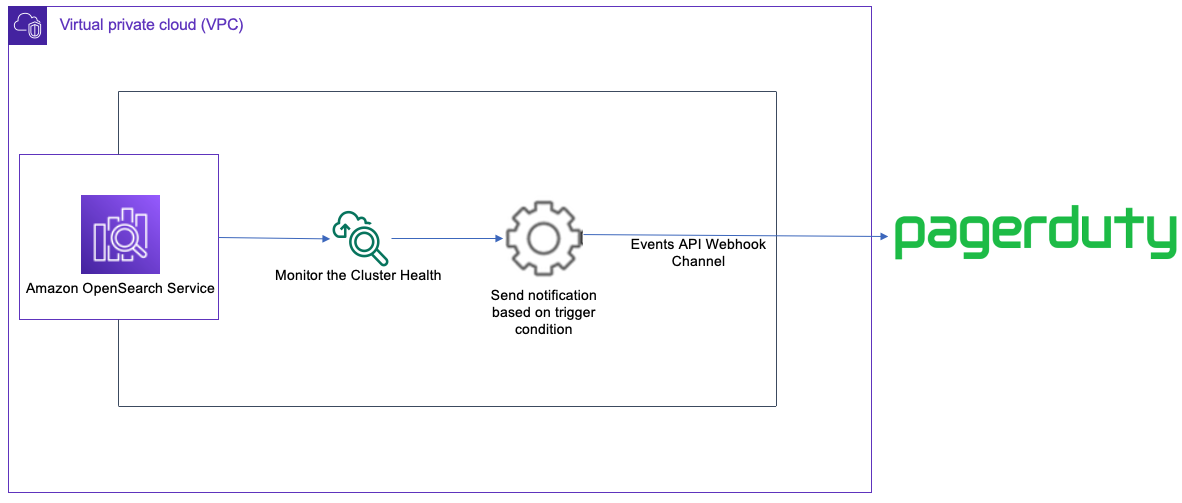
The following diagram illustrate OpenSearch Service running within an Amazon VPC using monitors and triggers to send a notification to the PagerDuty service using an Events API custom webhook

We need to set up a service and integration on PagerDuty to begin receiving incident notifications from OpenSearch Service. A service in PagerDuty represents an application, component, or team that we can trigger the notification against.

Prerequisites

Before you get started, create the following resources, if not already available:

Create a service on PagerDuty

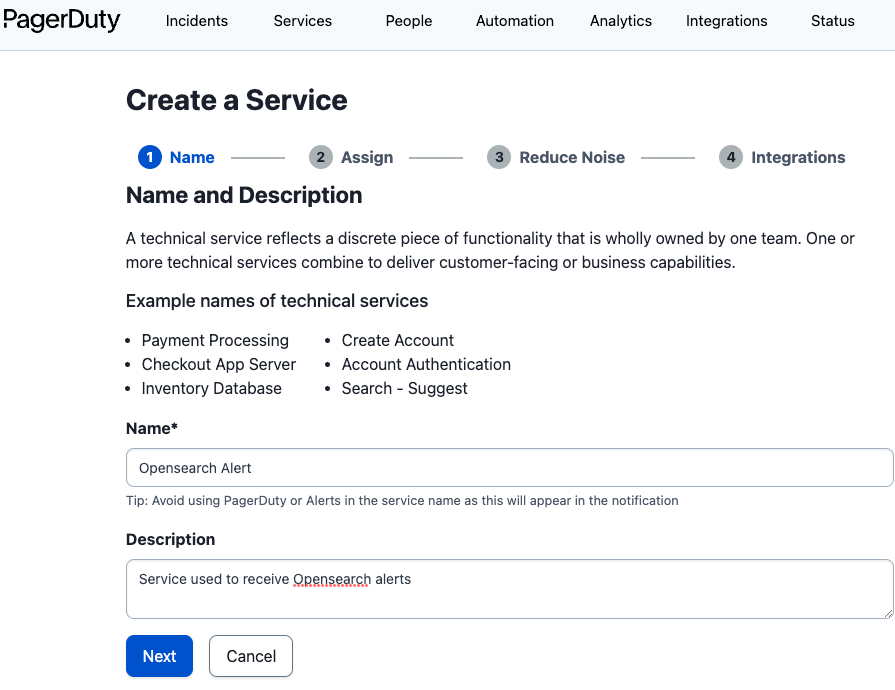
To create a service on PagerDuty, complete the following steps:

  1. Log in to PagerDuty using your personal or enterprise account that is being used to enable the integration with OpenSearch Service.
  2. On the Services tab, choose New Service.
  3. Enter a name and optional description, then choose Next.

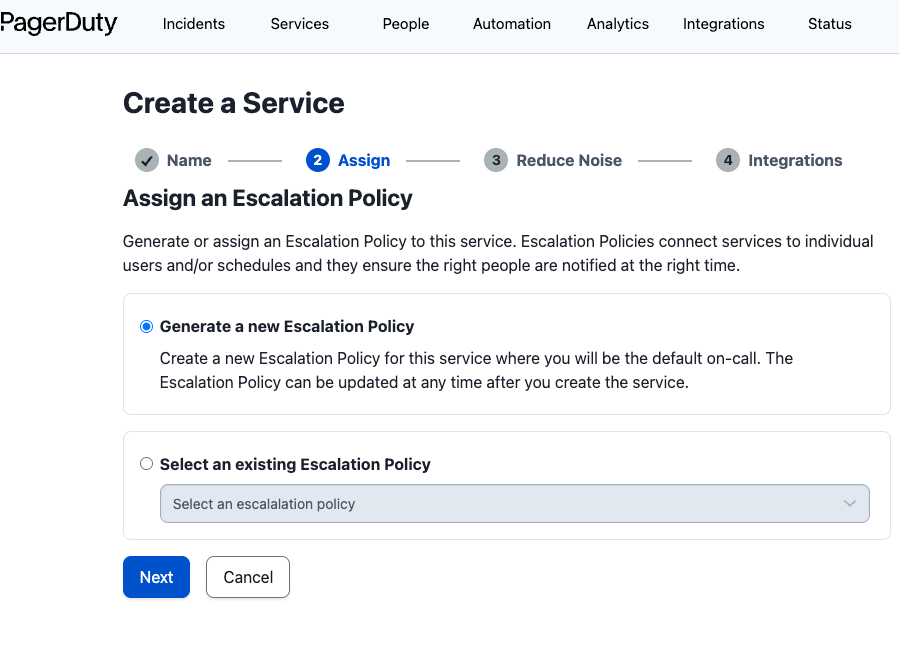
In the next step, we create or assign an escalation policy for the service. An escalation policy represents the order of responsibility for reacting to the issues detected on a service.

  1. If you already have an escalation policy defined within the organization or team, select Select an existing Escalation Policy and specify your policy. Otherwise, select Generate a new Escalation Policy, then choose Next.

In the next step, we can group the alerts based on time or content:

    • To group alerts together based on the alert content, select Content-Based grouping.
    • To group them based on a specific time duration, select Time-Based grouping.
    • Selecting the Intelligent grouping option will group the alerts intelligently based on content or time.
  1. Leave the defaults and choose Next.
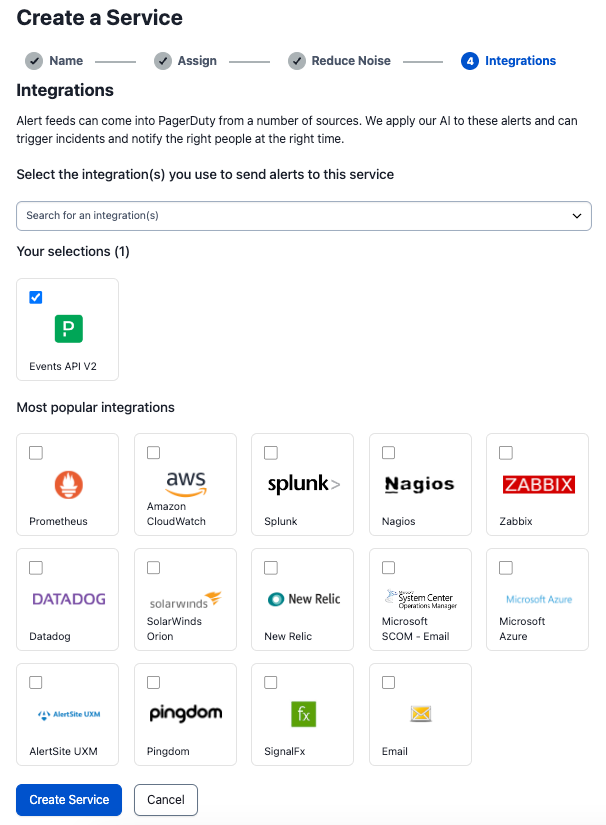
  2. On the Integrations page, select the Events API V2 integration (this will be used for integration with OpenSearch Service) and choose Create Service.

If you don’t select the integration during this step, you can add it later.

  1. Take note of the integration key on the Integrations tab.

Create a notification channel on OpenSearch Service with a custom webhook

Custom webhooks provide the ability to send these notifications to third-party services like PagerDuty using a REST API. After we configure the notification channel, we can use it for other monitors beyond this use case and to detect data patterns that are stored within the cluster.

Complete the following steps to configure the notification channel:

  1. On the OpenSearch Dashboards page, choose Notifications under Amazon OpenSearch Plugins in the navigation pane.
  2. On the Channels tab, choose Create channel.
  3. Enter a name for the channel and an optional description.
  4. For Channel type, choose Custom webhook.
  5. For Method, choose POST.
  6. For Define endpoints by, select Custom attributes URL.
  1. For Host, enter events.PagerDuty.com.
  2. For Path, enter v2/enqueue.
  3. Under Webhook headers, choose Add header.
  4. Enter X-Routing-Key as the key and the integration key you obtained earlier as the value.
  5. Choose Create and ensure the channel is successfully created.

Configure OpenSearch Service alerts to send notifications to PagerDuty

We can monitor OpenSearch cluster health in two different ways:

  • Using the OpenSearch Dashboard alerting plugin by setting up a per cluster metrics monitor. This provides a query to retrieve metrics related to the cluster health.
  • Integrating with Amazon CloudWatch, a monitoring and observability service.

In this use case, we use the alerting plugin. Complete the following steps:

  1. On the OpenSearch Dashboards page, choose Alerting under Amazon OpenSearch Plugins in the navigation pane.
  2. On the Monitors tab, choose Create monitor.
  3. For Monitor name, enter a name (for example, Monitor Cluster Health).
  4. For Monitor type, select Per cluster metrics monitor.
  5. Under Schedule¸ configure the monitor to run every minute.
  6. In the Query section, for Request type, choose Cluster health.
  7. Choose Preview query.
  8. Create a trigger by choosing Add trigger.
  9. For Trigger name, enter a name (for example, Cluster Health Status is Red).
  10. Leave Severity level at 1 (Highest).
  11. Under Trigger condition, delete the default code and enter the following:
ctx.results[0].status == "red"
  1. Choose Preview condition response to confirm that Trigger condition response shows as false, indicating that the cluster is healthy.
  2. Under Actions, choose Add action.
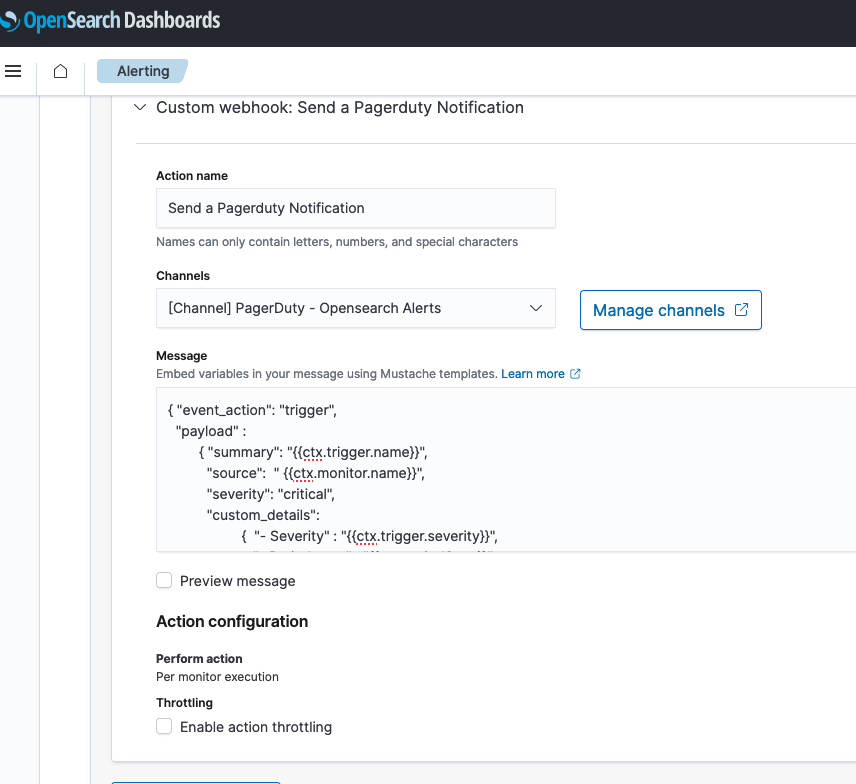
  3. For Action name, enter a name (for example, Send a PagerDuty notification).
  4. For Channels, choose the channel you created earlier.
  5. For Message, enter the following code:
{ "event_action": "trigger",
"payload" :
	{	"summary": "{{ctx.trigger.name}}",
		"source": " {{ctx.monitor.name}}",
		"severity": "critical",
		"custom_details":
			{ 
				"-Severity" : "{{ctx.trigger.severity}}",
				"-Period start" : "{{ctx.periodStart}}",
				"-Period end": "{{ctx.periodEnd}}"
			}
	}
}

Note that apart from the custom_details section in the code, the rest of the fields are mandatory for PagerDuty.

  1. Choose Send test message and test to make sure you receive an alert on the PagerDuty service.
  2. Choose Create and ensure the monitor was created successfully.

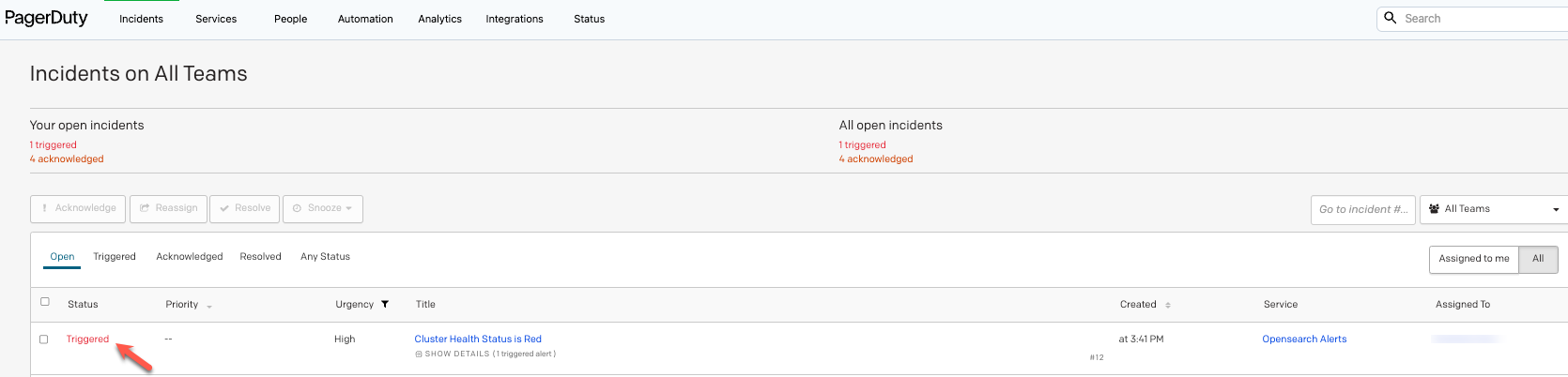
A notification will be sent to the PagerDuty service as part of the test, which will trigger a notification via a phone call or text message for the person who is available based on the escalation policy defined earlier. This notification can be safely acknowledged and resolved from PagerDuty because this is was a test.

Clean up

To clean up the infrastructure and avoid additional charges, complete the following steps:

  1. Delete the PagerDuty service.
  2. Delete the OpenSearch Service domain that was created as part of the prerequisites.

Conclusion

The integration of OpenSearch Service alerts with PagerDuty provides a powerful and efficient solution for managing and responding to critical events in real time. With this integration, you can easily set up alerts and notifications to stay informed about potential issues within your OpenSearch Service clusters or issues related to data and documents stored within the cluster, and proactively take action to resolve any problems that arise. Additionally, the integration allows for seamless collaboration between teams, enabling them to work together to identify and troubleshoot issues as they occur.

For more information about anomaly detection and alerts in OpenSearch Service, refer to Anomaly Detection in Amazon OpenSearch and Configuring Alerts in Amazon OpenSearch.


About the Authors

Manikanta Gona is a Data and ML Engineer at AWS Professional Services. He joined AWS in 2021 with 6+ years of experience in IT. At AWS, he is focused on Data Lake implementations, and Search, Analytical workloads using Amazon OpenSearch Service. In his spare time, he love to garden, and go on hikes and biking with his husband.

Vivek Shrivastava is a Principal Data Architect, Data Lake in AWS Professional Services. He is a Bigdata enthusiast and holds 14 AWS Certifications. He is passionate about helping customers build scalable and high-performance data analytics solutions in the cloud. In his spare time, he loves reading and finds areas for home automation

Ravikiran Rao is a Data Architect at AWS and is passionate about solving complex data challenges for various customers. Outside of work, he is a theatre enthusiast and an amateur tennis player.

Hari Krishna KC is a Data Architect with the AWS Professional Services Team. He specializes in AWS Data Lakes & AWS OpenSearch Service and have helped numerous client migrate their workload to Data Lakes and Search data stores


A Guide to Maintaining a Healthy Email Database

Post Syndicated from nnatri original https://aws.amazon.com/blogs/messaging-and-targeting/guide-to-maintaining-healthy-email-database/

Introduction

In the digital age, email remains a powerful tool for businesses to communicate with their customers. Whether it’s for marketing campaigns, customer service updates, or important announcements, a well-maintained email database is crucial for ensuring that your messages reach their intended recipients. However, managing an email database is not just about storing email addresses. It involves keeping the database healthy, which means it’s up-to-date, accurate, and filled with engaged subscribers.

Amazon Simple Email Service (SES) offers robust features that help businesses manage their email environments effectively. Trusted by customers such as Amazon.com, Netflix, Duolingo and Reddit, SES helps customers deliver high-volume email campaigns of hundreds of billions of emails per year. Introduced in 2020, the list and subscription management feature of Amazon SES has added a new dimension to email database management, thereby reducing effort and time-to-value of managing a subscription list by allowing you to manage your list of contacts via its REST API, SDK or AWS CLI.

In this blog post, we will delve into the world of email database management in Amazon SES. You will explore two ways to manage your email database: building out your own email database functionality and using the built-in list and subscription management service. You will also learn the pros and cons of each approach and provide examples of customer use cases that would benefit from each approach. Regardless of the approach you ultimately decide to take, the blog will also share updated strategies for email database management to help with improving deliverability and customer engagement.

This guide is designed to help you navigate the complexities of email database management and make informed decisions that best suit your business needs. So, whether you’re new to Amazon SES or looking to optimize your existing email database management practices, this guide is for you. Let’s get started!

Email Database Management in Amazon SES

Amazon Simple Email Service (SES) offers two primary ways to manage your email database: building out your own email database functionality and using the built-in list and subscription management service. Each approach has its own set of advantages and potential drawbacks, and the best choice depends on your specific use case and business needs.

Building Out Your Email Database Functionality

When you choose to build out your own email database functionality, you have the flexibility to customize the database to suit your specific needs and leverage SES’ scalability as an email channel to send email at high volumes to your customer. Depending on the business requirement, the customizations could involve creating custom fields for subscriber data, implementing complex logic for categorizing and segmenting users, or integrating with other systems in your tech stack.

Using the Built-in List and Subscription Management Service

Alternatively, you can look at Amazon SES’s built-in list and subscription management service, which offers a ready-made solution for managing your email database. It handles tasks such as managing subscriptions to different topics and maintaining your customer email database through contact lists. Additionally, you can insert up to two links per email to the subscription preference page, which allow users to manage their topic preferences within Amazon SES.

SubscriptionPage

The non-configurable subscription page will automatically populate the customer’s current subscribed topic and allow setting of granular topic’s preferences. More information on how to configure that can be found here.

The following table should serve as a guideline to help you with deciding your approach for Email Database Management.
Building Your Own Email Database Functionality Using Built-in List and Subscription Management Service
Pros

Customization: Full control over the database structure and functionality, allowing for tailoring to specific needs. This includes creating custom fields for subscriber data, implementing own algorithms for handling bounces and complaints, and integrating with other systems in the tech stack.

Integration: Flexible flow of data across the business due to the ability to integrate the email database with other systems in the tech stack. You’ve already built your own email database or have one in mind which supports querying, building that database external to Amazon SES would make for a more customizable implementation.

Data Ownership: When you manage your own database, you have full ownership and control over your data. This can be important for businesses with strict data governance or regulatory requirements.

Ease of Use: The built-in service provides readily-available API to create, update and delete contacts. These operations are also available via REST API, AWS CLI and SDK. Once you’ve set up the subscription topics and contact lists, you can leverage the preference center to allow your customers to easily sub/unsubscribe from different topics.

Cost-Effective: More cost-effective than building own functionality as it requires less time and resources. The built-in service is also available free of charge unlike building out own infrastructure which would require ongoing infrastructure service costs.

Cons

Time and Resources: Building your own email database functionality requires a significant investment of time and resources. This includes the initial setup of the database, designing the schema, setting up the servers, and configuring the database software. Additionally, you’ll need to develop the functionality for managing subscriptions, and database cleanup in upon receiving bounces and complaints. Databases require ongoing maintenance to ensure they remain operational and efficient. This includes tasks like updating the database software, managing backups, optimizing queries, and scaling the database as your subscriber base grows.

Complexity: As your subscriber base grows, managing your own email database can become increasingly complex. You’ll need to handle more data, which can slow down queries and make the database more difficult to manage. You’ll also need to deal with more complex issues like data integrity, redundancy, and normalization. Additionally, as you add more features to your email database functionality, the codebase can become more complex, making it harder to maintain and debug.

Security: When you manage your own email database, you’re responsible for its security. This includes protecting the data from unauthorized access, ensuring the confidentiality of your subscribers’ information, and complying with data protection regulations. You’ll need to implement security measures like encryption, access controls, and regular security audits. If your database is compromised, it could lead to data loss or a breach of your subscribers’ privacy, which could damage your reputation and potentially lead to legal consequences.

Limited Customization: The built-in service may not offer the same level of customization as building own functionality. It may not meet all needs if there are specific requirements. For example, the preference center management page cannot be customized.

Dependence: Using the built-in service means you’re reliant on Amazon SES for your email database management. If the service experiences downtime or issues, it could impact your ability to manage your email database. This could potentially disrupt your email campaigns and affect your relationship with your subscribers. Furthermore, if you decide to switch to a different email service provider in the future, migrating your email database from the built-in service could be a complex and time-consuming process. Additionally, if your email database needs to be accessed or manipulated by other systems in your tech stack, this dependency on Amazon SES could complicate the integration process and limit your flexibility.

Customer Use Cases Best suited for businesses with specific needs that aren’t met by standard list management services, or those who wish to integrate their email database with other systems. For example, a large e-commerce company might choose to build out their own email database functionality to integrate with their customer relationship management (CRM) and inventory systems. Ideal for small to medium-sized businesses that need a straightforward, cost-effective solution for managing their email database. It’s also a good fit for businesses without the resources or technical expertise to build their own email database functionality.

Strategies for Email Database Management with Amazon Simple Email Service

Once you’ve made the decision on whether to manage your email database within Amazon SES or build your own, that’s only half of the equation. It’s important to recognize that your email databases will only work best to serve the business needs when you have processes in place to maintain them. In this section, let’s go through some of the best practices on how to do so.

  • Maintaining email list hygiene:
    • Both Amazon SES and a custom-built email database require maintaining a healthy email list. This involves regularly cleaning your list to remove invalid email addresses, hard bounces, and unengaged subscribers. With Amazon SES, the process to handle hard bounces and complaints is automated.
    • With a custom-built email database, you have more control over how and when this cleaning occurs. Rather than focusing on only email addresses that either hard bounces or complained, you can remove unengaged users. Every business will have their own definition of an un-engaged users based on business needs. Regardless, you will need to store the engagement attribute (e.g. days since last interaction). This will be simpler to architect in an external database which supports querying and bulk modification.
  • Managing Subscriptions:
    • With Amazon SES, you can easily manage subscriptions using the built-in functionality. This includes adding new subscribers, removing unsubscribed users, and updating user topic preferences. However, you will not be able to customize the look-and-feel of your subscription preference pages.
    • If you build your own email database, you’ll need to create your own system for managing subscriptions, which could require significant time and resources. The trade-off is that you can fully customize your subscription management system to showcase your branding on the subscription preference page and also handle custom logic for subscription/unsubscription.
  • Encouraging Engagement: Low engagement rates can indicate that your recipients are not interested in your content. To stimulate action, you can include a survey in the email, ask for feedback, or run a giveaway. You can then filter out inactive subscribers who still aren’t interacting with your emails. For engaged subscribers, you can segment these audiences into sub-groups by preference and send tailored email marketing campaigns. Before removing less active subscribers, consider what other kinds of content you could provide that might be more appealing. Unengaged subscribers can sometimes be re-engaged with the right offer, such as a free gift, a special perk, or exclusive content.
  • Renewing Opt-In: For your disengaged subscribers, send a re-optin campaign and remove them if they don’t re-subscribe. Be transparent! Notify inactive subscribers that you’ve noticed their lack of engagement and let them know that you don’t want to clutter their inbox if they’re not interested. Ask them if they want to continue to receive emails with a clear call-to-action button that will re-sign them up for future emails.
  • Making It Easy to Unsubscribe: Including an easy-to-find unsubscribe button and a one-step opt-out process won’t encourage subscribers to leave if you’re giving them a reason to stay. If recipients feel like they can’t leave, they’ll just mark your emails as spam, which counts as a big strike against your sender reputation.

Remember, effective email database management is a continuous process that requires regular attention and maintenance. By following these best practices, you can maximize the effectiveness of your email marketing efforts and build strong relationships with your subscribers.

Conclusion

In conclusion, maintaining a healthy email database is a critical aspect of successful email marketing. Whether you choose to build out your own email database functionality or use Amazon SES’s built-in list and subscription management service, it’s important to understand the pros and cons of each approach and align your decision with your business needs.

Building your own email database functionality offers the advantage of customization and integration with other systems in your tech stack. However, it requires significant time, resources, and technical expertise. On the other hand, Amazon SES’s built-in service is easy to use, cost-effective, and handles many complexities of email database management, but it may not offer the same level of customization.

Regardless of the approach you choose, following best practices for email database management is essential. This includes handling bounces and complaints, managing subscriptions, encouraging engagement, sending re-engagement email campaigns, renewing opt-ins, and making it easy to unsubscribe.

These practices will help you maintain a healthy email list, improve engagement rates, and ultimately, enhance the effectiveness of your email marketing efforts.It’s important to stay updated with the latest trends and strategies in email database management. So, keep exploring, learning, and implementing the best practices that suit your business needs.

For more information on Amazon SES and its features, visit the Amazon SES Documentation. Here, you’ll find comprehensive guides, tutorials, and API references to help you make the most of Amazon SES.

How to Choose the Right Enterprise NAS for Your Business

Post Syndicated from Vinodh Subramanian original https://www.backblaze.com/blog/how-to-choose-the-right-enterprise-nas-for-your-business/

A decorative image showing a building, a storage cloud, and a NAS device.

When it comes to enterprise storage, we’ve seen a rapid move to cloud-based infrastructure. But, recently, tech leaders have started to question the assumptions behind a cloud-only approach, and there are industries (particularly media and entertainment) where on-premises storage has tangible benefits. With all that in mind, enterprise-level network attached storage (NAS) in hybrid cloud setups presents a strong storage foundation for many companies.

With recent reports showing the global NAS market size is projected to grow from $26 billion to $82.9 billion in 2030, it’s clear that NAS isn’t going anywhere. So, let’s talk about how to choose an enterprise-level NAS solution.

What Is an Enterprise NAS?

Enterprise NAS is a large-scale data storage system that is connected to a local network to provide data storage and access to the organization. It’s designed for large-scale business environments that require high-capacity storage, superior performance, and advanced data management capabilities.

Compared with home-use NAS devices, enterprise NAS devices often come with superior hardware specifications, including powerful processors, large amounts of memory (RAM), and numerous drive bays to accommodate vast amounts of data.

How Do Enterprises Use NAS Devices?

Enterprises use NAS devices for a wide range of use cases and applications:

  • File storage and sharing: NAS devices provide a centralized platform for storing and sharing files across a network. This fosters collaboration, as employees can easily access shared files regardless of their physical location.
  • Data protection: With built-in redundancy features, NAS devices offer robust data protection. This ensures data remains safe and accessible even in the event of a disk failure.
  • Disaster recovery: Snapshot and replication features allow for quick restoration of data minimizing downtime and data loss from hardware failures, cyberattacks, or natural disasters. However, it’s important to note that NAS devices alone don’t provide this protection—they’re subject to the same vulnerabilities as all on-premises devices. Rather, this benefit comes from a NAS setup that tiers to the cloud.
  • Hosting business applications: Businesses can also use NAS devices to host business applications. Much the same as how you would use a server, since these devices can handle high volumes of data traffic and support multiple connections, they are well suited for running enterprise-level applications that require high availability and performance.
  • Running virtual machines (VMs): Virtualization software providers, like VMware, support running their products on NAS. With proper configuration, including potentially adding RAM to your device, you can easily spin up virtual machines using NAS.
  • Using NAS as a file server: NAS devices can function as dedicated file servers, offering high-performance, stable environments, which are useful for businesses with large user bases requiring concurrent access to shared files.
  • Archiving: Long-term storage and archiving is another key application of NAS devices in the enterprise. There are benefits to having archival data on-premises. It can reduce recovery times in case you need to restore from backups.

Enterprise NAS vs. Server Area Networks (SAN)

As you’re choosing how to create an enterprise-level storage system, it’s important to know the differences between NAS and SAN. The short answer: From the perspective of the user, there’s not much difference. From the perspective of the person managing the system, SAN setups are more complex and have more customization options, particularly in your network connections.

However, NAS companies have done an excellent job of adding functionality to NAS devices, making those features easily manageable. Since they’re less complex, they may be easier for your internal IT team to manage—and that can translate to OpEx savings and more time for your IT team to stay on top of challenges in an ever-changing tech landscape.

What Is the Difference Between Entry-Level, Mid-Market, and Enterprise NAS Devices?

NAS devices can be grouped into three major categories based on factors such as storage capacity, performance, and scalability. The following table provides a side-by-side comparison of the key features and differences between entry-level, mid-market, and enterprise NAS devices.

Feature Entry-Level NAS Mid-Market NAS Enterprise NAS
Storage Capacity Up to a few terabytes. Can range from a few terabytes to tens of terabytes. Usually hundreds of terabytes or more, scalable to meet enterprise needs.
Performance Adequate for home use and basic file sharing. Enhanced performance for small to medium businesses with higher data traffic. High-performance systems designed to handle heavy workloads and concurrent access.
Reliability & Redundancy Basic redundancy usually with RAID 1 or RAID 5 options. More advanced redundancy options, including multiple RAID configurations. Highly reliable with advanced redundancy features (RAID, replication, etc.).
Scalability Limited scalability. Moderate scalability, depending on model. Highly scalable with clustering options.
Advanced Features Basic features like media streaming, remote access, and basic data redundancy. More advanced features like virtualization, data encryption, access control, and snapshot capability. Enterprise-grade features like high-speed data transfers, advanced backup and disaster recovery options, deduplication, encryption, and virtualization support.

How Do I Choose an Enterprise NAS Device?

Now that you understand the difference between the different types of NAS devices and their respective features, it’s crucial to understand your specific business needs before choosing an enterprise NAS device. There are several aspects to consider, so let’s take them one by one.

1. Storage Capacity

One of the first things to consider is the amount of storage your enterprise requires. This isn’t just about your current needs, but also about the projected growth of your data over time. In a NAS system, storage is defined by the number of drives, the total amount of shared volume they create, and their striping scheme. A striping scheme defines where data is stored and what kinds of redundancies it has, and is also known as RAID levels that are usually defined like so: RAID 0, 1 5, 6, etc.

There are a few ways to add storage to a NAS device.

  1. You can add drives to your NAS unit if you originally provisioned one with extra bays. This is most applicable to entry-level units.
  2. You can purchase another NAS device and network it with your first device. On the enterprise level, you’ll likely have a more complex architecture of connected NAS devices acting as clusters or nodes on your network.
  3. Finally, cloud-connected NAS devices mean that you can provision both primary and backup data to the cloud, so your setup is infinitely scalable. This means you can also nimbly add more storage on a short time frame—no need to wait for hardware upgrades (though you may still want to make upgrades in the longer term).

2. Data Access Speeds

The speed at which data can be accessed from your NAS device is another crucial factor. NAS devices are built to be directly connected to your local area network (LAN) and usually require a direct ethernet connection. An entry-level NAS system will have a gigabit ethernet connection (1GigE), and is suitable for entry-level or home NAS users.

But for enterprises that want to provide frequent and intensive data access to a large number of users, NAS vendors offer higher capacity ethernet connections on their systems. Some vendors offer 2.5 Gb/s or 5 Gb/s connections on their systems, but they usually require that you get a compatible network switch, USB adapters, or expansion cards. Still other NAS systems provide the option of Thunderbolt connections in addition to ethernet connections to provide higher bandwidth—up to 40GigE—and are good for systems that need to edit large files directly on the NAS.

3. Scalability

As your business grows, your data needs will likely increase. Therefore, it’s essential that your NAS device has the ability to grow with your business. You may not know exactly how much data you’ll need in a year or five, but you can certainly make an estimate based on your product roadmap, current rate of growth, and so on. And, we put together this handy NAS Buyer’s Guide so you can compare that potential growth to existing NAS features.

4. Data Protection and Backup Features

Effective backups are the cornerstone of any good disaster recovery (DR) plan, which is defined as the (hopefully tested!) step-by-step procedure to get your business back online and your data restored after a disruptive event like accidental deletions, cyberattacks, or natural disasters. We recommend the 3-2-1 backup strategy at minimum, and you’ll want to consider things like what kinds of restore options you prefer, compliance requirements in your industry, and how long you want to keep your backups.

With any good backup strategy, you’ll want to set up recurring and automatic backups of all your systems. Also, in complex environments like a business, backups are just as much about data management—that is, knowing where all your data is stored (the shared file system vs. employee workstations vs. the cloud) and how to back it up effectively.

Enterprise NAS devices provide advanced data protection and backup features to protect NAS data against data loss and enhance accessibility. These include advanced RAID configurations (i.e. on what server and how redundant your data storage is), automated backup features, cloud storage integrations, enterprise grade encryption features, advanced backup and disaster recovery options, data deduplication, encryption, and virtualization support, etc.

Other features to look for can include snapshot technology, which allows capturing the state of the system at different points in time, and replication features which enable copying of data from one NAS device to another for redundancy.

5. Evaluating Total Cost of Ownership

When evaluating an investment in an enterprise NAS device, it’s important to not limit your focus on the initial purchase price of the NAS device itself. Keep in mind that with a NAS device, you’ll need to purchase hard drives (HDDs) or solid-state drives (SSDs) (and possibly other devices) to complete your setup.

Depending on the kind of data durability you want to create, the storage hardware cost can add up if you’re aiming for high capacity storage with advanced RAID configurations. Also, make sure to take into account energy consumption, software licenses, labor and IT costs, and maintenance costs.

6. Vendor Support and Warranty

One of the often ignored and underestimated parts of selecting an enterprise NAS device is the support and warranty provided by the NAS vendors. Enterprise NAS devices are complex pieces of technology. NAS devices, in general, are designed to be user-friendly, but once you’re networking NAS devices on the enterprise level, things get more complex.

When you encounter an issue, addressing the challenges as quickly as possible can mean the difference between prolonged downtime and quick resolution. Of course, this means having in-house IT support, but it’s also absolutely critical to choose an enterprise NAS vendor that provides robust support and a good warranty to ensure the resilience and longevity of your enterprise NAS solution.

Level Up: Connect Your Enterprise NAS to the Cloud

Okay, so you’ve chosen your enterprise NAS and devised your on-site, connected NAS solution. In industry parlance, what you’ve essentially done is to create a private cloud: storage dedicated solely to your organization, but accessible from anywhere. But, if you only have on-site storage, your data is vulnerable to theft, natural disasters, fire, and so on; and, as we mentioned above, you always want to have multiple copies of your data with at least one copy stored off-site.

The easiest way to achieve this is to connect your NAS to a public cloud service provider (CSP) like Backblaze. Make sure that you take into account the location of the CSP’s data centers to ensure that you have adequate geographic separation between your data. And, once connected to a CSP, you can take advantage of services like cloud replication to create yet another redundant copy of your data automatically.

Beyond backups, data storage on your NAS vs. in the cloud can have performance (speed) differences. This has implications on both your internal workflows and your external workflows. Take the use case of a media and entertainment company: when you’re editing files, you’re typically working with large, raw files that take time to transmit. That means that on-site storage can be faster for your team. But, teams have become more remote, and you might be using freelancers.

The great news is that most NAS devices have data management and syncing features, as noted above. A NAS hybrid cloud setup lets your employees or freelancers access remotely. They can access data via cloud storage, and your NAS client takes care of making sure all versions are up-to-date.

Once you have your business’ hybrid cloud setup, then you’ve opened up several opportunities to enhance how you store, manage, and use your data.

  1. Store your data closer to delivery endpoints for faster speeds. If you’re creating, editing, or delivering large files like you would in the media and entertainment industry, the physical location of your data makes a difference to how fast you can deliver it to the end user. Depending on where your endpoints are located and what region you choose, using cloud storage as an active archive allows you to store data closer to delivery endpoints for fast access.
  2. Integrate your NAS device with software as a service (SaaS) tools. In our SaaS landscape, all of our programs are internet-connected, and all of them need to be connected to storage. Many of these tools have their own clouds (like Google Drive or Adobe Creative Cloud) that you can bypass by connecting your own cloud storage account. Your NAS client then has excellent sync tools to keep your files updated as necessary, and, since that file is on your network instead of the tool’s cloud, it will be protected by your backup rules.
  3. Actively strengthen your backups. We’ve talked about the need for geographic separation, and storing in the cloud is the easiest way to do this. (People used to ship tape backups back in the distant past of the 1990s and early 2000s.) You can also set up different rules for your different files. Your primary storage obviously needs to be modifiable, but you can use tools like Object Lock to set immutable rules on your backups as well.
  4. Scale your storage flexibly. One of the biggest challenges of on-site storage is that adding more storage means buying more drives—it’s not an instant solution—and you’re more vulnerable to fluctuations in the supply chain. (Remember the Thailand Drive Crisis?) While you want to plan for future storage needs, cloud storage lets you add more storage immediately should you have unexpected needs.

Sum Up and Get Started

As you can see, having a clear understanding of your business needs is crucial before you build your storage strategy. Choosing an enterprise NAS is not only about getting a device that works now, but one that will continue to serve your business efficiently as your organization grows and evolves. A well thought-out enterprise NAS selection can boost your data management, provide robust data protection, and support your business’s growth goals.

If you have any questions or thoughts, please feel free to share them in the comments.

The post How to Choose the Right Enterprise NAS for Your Business appeared first on Backblaze Blog | Cloud Storage & Cloud Backup.

CVE-2023-2868: Total Compromise of Physical Barracuda ESG Appliances

Post Syndicated from Caitlin Condon original https://blog.rapid7.com/2023/06/08/etr-cve-2023-2868-total-compromise-of-physical-barracuda-esg-appliances/

CVE-2023-2868: Total Compromise of Physical Barracuda ESG Appliances

Rapid7 incident response teams are investigating exploitation of physical Barracuda Networks Email Security Gateway (ESG) appliances dating back to at least November 2022. As of June 6, 2023, as part of an ongoing product incident response, Barracuda is urging ESG customers to immediately decommission and replace ALL ESG physical appliances irrespective of patch level.

Background

On May 18 and 19, 2023, Barracuda discovered anomalous traffic originating from their Email Security Gateway (ESG) appliances. Barracuda ESG is a solution for filtering inbound and outbound email and protecting customer data. ESG can be deployed as a physical or virtual appliance, or in a public cloud environment on AWS or Microsoft Azure.

On May 30, Barracuda disclosed CVE-2023-2868, a remote command injection vulnerability that the firm said had been exploited in the wild by threat actors since at least October 2022 across a subset of devices running versions 5.1.3.001-9.2.0.006. According to the security bulletin, the vulnerability exists in a module that performs initial screens on attachments of incoming emails. Barracuda has indicated that, as of June 6, no other products, including SaaS email security services, are known to be affected.

The company indicated they had pushed patches to their global ESG customer base on May 20, 2023. On May 21, Barracuda deployed an additional script to “contain the incident and counter unauthorized access methods.” However, on June 6, the company updated their advisory to warn customers that physical devices should be completely replaced, irrespective of firmware version or patch level.

The pivot from patch to total replacement of affected devices is fairly stunning and implies the malware the threat actors deployed somehow achieves persistence at a low enough level that even wiping the device wouldn’t eradicate attacker access.

Barracuda has a full description of the incident so far in their advisory, including extensive indicators of compromise, additional vulnerability details, and information on the backdoored module for Barracuda’s SMTP daemon (the trojanized module has been dubbed SALTWATER).

Baselining on a known ESG appliance, which runs the "Barracuda Networks Spam Firewall" SMTP daemon, there appear to be roughly 11,000 appliances on the internet (Barracuda Networks Spam Firewall smtpd). Notably, if other Barracuda appliances also run this service, that number may be inflated.

Observed attacker behavior

Rapid7 services teams have so far identified malicious activity that took place as far back as November 2022, with the most recent communication with threat actor infrastructure observed in May 2023. In at least one case, outbound network traffic indicated potential data exfiltration. We have not yet observed any lateral movement from a compromised appliance.

Note: Although sharing malware indicators like hashes and YARA hunting rules can be very useful, in this case they may not be as relevant unless teams have direct access to the operating system of the appliance or VMDK image. Network indicators like the IP addresses shared by Barracuda and also observed by Rapid services teams are a good start for reviewing network logs (e.g., firewall or IPS logs).

Mitigation guidance

Customers who use the physical Barracuda ESG appliance should take the device offline immediately and replace it. Barracuda’s advisory has instructions for contacting support. Users are also being advised to rotate any credentials connected to the ESG appliance, including:

  • Any connected LDAP/AD
  • Barracuda Cloud Control
  • FTP Server
  • SMB
  • Any private TLS certificates

ESG appliance users should check for signs of compromise dating back to at least October 2022 using the network and endpoint indicators Barracuda has released publicly (where possible): https://www.barracuda.com/company/legal/esg-vulnerability

AWS Security Profile: Matthew Campagna, Senior Principal, Security Engineering, AWS Cryptography

Post Syndicated from Roger Park original https://aws.amazon.com/blogs/security/security-profile-matthew-campagna-aws-cryptography/

In the AWS Security Profile series, we interview Amazon Web Services (AWS) thought leaders who help keep our customers safe and secure. This interview features Matt Campagna, Senior Principal, Security Engineering, AWS Cryptography, and re:Inforce 2023 session speaker, who shares thoughts on data protection, cloud security, post-quantum cryptography, and more. Matthew was first profiled on the AWS Security Blog in 2019. This is part 1 of 3 in a series of interviews with our AWS Cryptography team.


What do you do in your current role and how long have you been at AWS?

I started at Amazon in 2013 as the first cryptographer at AWS. Today, my focus is on the cryptographic security of our customers’ data. I work across AWS to make sure that our cryptographic engineering meets our most sensitive customer needs. I lead our migration to quantum-resistant cryptography, and help make privacy-preserving cryptography techniques part of our security model.

How did you get started in the data protection and cryptography space? What about it piqued your interest?

I first learned about public-key cryptography (for example, RSA) during a math lesson about group theory. I found the mathematics intriguing and the idea of sending secret messages using only a public value astounding. My undergraduate and graduate education focused on group theory, and I started my career at the National Security Agency (NSA) designing and analyzing cryptologics. But what interests me most about cryptography is its ability to enable business by reducing risks. I look at cryptography as a financial instrument that affords new business cases, like e-commerce, digital currency, and secure collaboration. What enables Amazon to deliver for our customers is rooted in cryptography; our business exists because cryptography enables trust and confidentiality across the internet. I find this the most intriguing aspect of cryptography.

AWS has invested in the migration to post-quantum cryptography by contributing to post-quantum key agreement and post-quantum signature schemes to protect the confidentiality, integrity, and authenticity of customer data. What should customers do to prepare for post-quantum cryptography?

Our focus at AWS is to help ensure that customers can migrate to post-quantum cryptography as fast as prudently possible. This work started with inventorying our dependencies on algorithms that aren’t known to be quantum-resistant, like integer-factorization-based cryptography, and discrete-log-based cryptography, like ECC. Customers can rely on AWS to assist with transitioning to post-quantum cryptography for their cloud computing needs.

We recommend customers begin inventorying their dependencies on algorithms that aren’t quantum-resistant, and consider developing a migration plan, to understand if they can migrate directly to new post-quantum algorithms or if they should re-architect them. For the systems that are provided by a technology provider, customers should ask what their strategy is for post-quantum cryptography migration.

AWS offers post-quantum TLS endpoints in some security services. Can you tell us about these endpoints and how customers can use them?

Our open source TLS implementation, s2n-TLS, includes post-quantum hybrid key exchange (PQHKEX) in its mainline. It’s deployed everywhere that s2n is deployed. AWS Key Management Service, AWS Secrets Manager, and AWS Certificate Manager have enabled PQHKEX cipher suites in our commercial AWS Regions. Today customers can use the AWS SDK for Java 2.0 to enable PQHKEX on their connection to AWS, and on the services that also have it enabled, they will negotiate a post-quantum key exchange method. As we enable these cipher suites on additional services, customers will also be able to connect to these services using PQHKEX.

You are a frequent contributor to the Amazon Science Blog. What were some of your recent posts about?

In 2022, we published a post on preparing for post-quantum cryptography, which provides general information on the broader industry development and deployment of post-quantum cryptography. The post links to a number of additional resources to help customers understand post-quantum cryptography. The AWS Post-Quantum Cryptography page and the Science Blog are great places to start learning about post-quantum cryptography.

We also published a post highlighting the security of post-quantum hybrid key exchange. Amazon believes in evidencing the cryptographic security of the solutions that we vend. We are actively participating in cryptographic research to validate the security that we provide in our services and tools.

What’s been the most dramatic change you’ve seen in the data protection and post-quantum cryptography landscape since we talked to you in 2019?

Since 2019, there have been two significant advances in the development of post-quantum cryptography.

First, the National Institute of Standards and Technology (NIST) announced their selection of PQC algorithms for standardization. NIST expects to finish the standardization of a post-quantum key encapsulation mechanism (Kyber) and digital signature scheme (Dilithium) by 2024 as part of the Federal Information Processing Standard (FIPS). NIST will also work on standardization of two additional signature standards (FALCON and SPHINCS+), and continue to consider future standardization of the key encapsulation mechanisms BIKE, HQC, and Classical McEliece.

Second, the NSA announced their Commercial National Security Algorithm (CNSA) Suite 2.0, which includes their timelines for National Security Systems (NSS) to migrate to post-quantum algorithms. The NSA will begin preferring post-quantum solutions in 2025 and expect that systems will have completed migration by 2033. Although this timeline might seem far away, it’s an aggressive strategy. Experience shows that it can take 20 years to develop and deploy new high-assurance cryptographic algorithms. If technology providers are not already planning to migrate their systems and services, they will be challenged to meet this timeline.

What makes cryptography exciting to you?

Cryptography is a dynamic area of research. In addition to the business applications, I enjoy the mathematics of cryptography. The state-of-the-art is constantly progressing in terms of new capabilities that cryptography can enable, and the potential risks to existing cryptographic primitives. This plays out in the public sphere of cryptographic research across the globe. These advancements are made public and are accessible for companies like AWS to innovate on behalf of our customers, and protect our systems in advance of the development of new challenges to our existing crypto algorithms. This is happening now as we monitor the advancements of quantum computing against our ability to define and deploy new high-assurance quantum-resistant algorithms. For me, it doesn’t get more exciting than this.

Where do you see the cryptography and post-quantum cryptography space heading to in the future?

While NIST transitions from their selection process to standardization, the broader cryptographic community will be more focused on validating the cryptographic assurances of these proposed schemes for standardization. This is a critical part of the process. I’m optimistic that we will enter 2025 with new cryptographic standards to deploy.

There is a lot of additional cryptographic research and engineering ahead of us. Applying these new primitives to the cryptographic applications that use classical asymmetric schemes still needs to be done. Some of this work is happening in parallel, like in the IETF TLS working group, and in the ETSI Quantum-Safe Cryptography Technical Committee. The next five years should see the adoption of PQHKEX in protocols like TLS, SSH, and IKEv2 and certification of new FIPS hardware security modules (HSMs) for establishing new post-quantum, long-lived roots of trust for code-signing and entity authentication.

I expect that the selected primitives for standardization will also be used to develop novel uses in fields like secure multi-party communication, privacy preserving machine learning, and cryptographic computing.

With AWS re:Inforce 2023 around the corner, what will your session focus on? What do you hope attendees will take away from your session?

Session DAP302 – “Post-quantum cryptography migration strategy for cloud services” is about the challenge quantum computers pose to currently used public-key cryptographic algorithms and how the industry is responding. Post-quantum cryptography (PQC) offers a solution to this challenge, providing security to help protect against quantum computer cybersecurity events. We outline current efforts in PQC standardization and migration strategies. We want our customers to leave with a better understanding of the importance of PQC and the steps required to migrate to it in a cloud environment.

Is there something you wish customers would ask you about more often?

The question I am most interested in hearing from our customers is, “when will you have a solution to my problem?” If customers have a need for a novel cryptographic solution, I’m eager to try to solve that with them.

How about outside of work, any hobbies?

My main hobbies outside of work are biking and running. I wish I was as consistent attending to my hobbies as I am to my work desk. I am happier being able to run every day for a constant speed and distance as opposed to running faster or further tomorrow or next week. Last year I was fortunate enough to do the Cycle Oregon ride. I had registered for it twice before without being able to find the time to do it.

If you have feedback about this post, submit comments in the Comments section below. If you have questions about this post, contact AWS Support.

Want more AWS Security news? Follow us on Twitter.

Roger Park

Roger Park

Roger is a Senior Security Content Specialist at AWS Security focusing on data protection. He has worked in cybersecurity for almost ten years as a writer and content producer. In his spare time, he enjoys trying new cuisines, gardening, and collecting records.

Campagna bio photo

Matthew Campagna

Matthew is a Sr. Principal Engineer for Amazon Web Services’s Cryptography Group. He manages the design and review of cryptographic solutions across AWS. He is an affiliate of Institute for Quantum Computing at the University of Waterloo, a member of the ETSI Security Algorithms Group Experts (SAGE), and ETSI TC CYBER’s Quantum Safe Cryptography group. Previously, Matthew led the Certicom Research group at BlackBerry managing cryptographic research, standards, and IP, and participated in various standards organizations, including ANSI, ZigBee, SECG, ETSI’s SAGE, and the 3GPP-SA3 working group. He holds a Ph.D. in mathematics from Wesleyan University in group theory, and a bachelor’s degree in mathematics from Fordham University.

A New Set of APIs for Amazon SQS Dead-Letter Queue Redrive

Post Syndicated from Sébastien Stormacq original https://aws.amazon.com/blogs/aws/a-new-set-of-apis-for-amazon-sqs-dead-letter-queue-redrive/

Today, we launch a new set of APIs for Amazon Simple Queue Service (Amazon SQS). These new APIs allow you to manage dead-letter queue (DLQ) redrive programmatically. You can now use the AWS SDKs or the AWS Command Line Interface (AWS CLI) to programmatically move messages from the DLQ to their original queue, or to a custom queue destination, to attempt to process them again. A DLQ is a queue where Amazon SQS automatically moves messages that are not correctly processed by your consumer application.

To fully appreciate how this new API might help you, let’s have a quick look back at history.

Message queues are an integral part of modern application architectures. They allow developers to decouple services by allowing asynchronous and message-based communications between message producers and consumers. In most systems, messages are persisted in shared storage (the queue) until the consumer processes them. Message queues allow developers to build applications that are resilient to temporary service failure. They help prioritize message processing and scale their fleet of worker nodes that process the messages. Message queues are also popular in event-driven architectures.

Asynchronous message exchange is not new in application architectures. The concept of exchanging messages asynchronously between applications appeared in the 1960s and was first made popular when IBM launched TCAM for OS/360 in 1972. The general adoption came 20 years later with IBM MQ Series in 1993 (now IBM MQ) and when Sun Microsystems released Java Messaging Service (JMS) in 1998, a standard API for Java applications to interact with message queues.

AWS launched Amazon SQS on July 12, 2006. Amazon SQS is a highly scalable, reliable, and elastic queuing service that “just works.” As Werner wrote at the time: “We have chosen a concurrency model where the process working on a message automatically acquires a leased lock on that message; if the message is not deleted before the lease expires, it becomes available for processing again. Makes failure handling very simple.”

On January 29, 2014, we introduced dead-letter queues (DLQ). DLQs help you avoid a message that failed to be processed from staying forever on top of the queue, possibly preventing other messages in the queue from processing. With DLQs, each queue has an associated property telling Amazon SQS how many times a message may be presented for processing (maxReceiveCount). Each message also has an associated receive counter (ReceiveCount). Each time a consumer application picks up a message for processing, the message receive count is incremented by 1. When ReceiveCount > maxReceiveCount, Amazon SQS moves the message to your designated DLQ for human analysis and debugging. You generally associate alarms with the DLQ to send notifications when such events happen. Typical reasons to move a message to the DLQ are because they are incorrectly formatted, there are bugs in the consumer application, or it takes too long to process the message.

At AWS re:Invent 2021, AWS announced dead-letter queue redrive on the Amazon SQS console. The redrive addresses the second part of the failed message lifecycle. It allows you to reinject the message in its original queue to attempt processing it again. After the consumer application is fixed and ready to consume the failed messages, you can redrive the messages from the DLQ back in the source queue or a customized queue destination. It just requires a couple of clicks on the console.

Today, we are adding APIs allowing you to write applications and scripts that handle the redrive programmatically. There is no longer a need to have a human clicking on the console. Using the API increases the scalability of your processes and reduces the risk of human error.

Let’s See It in Action
To try out this new API, I open a terminal for a command-line only demo. Before I get started, I make sure I have the latest version of the AWS CLI. On macOS I enter brew upgrade awscli.

I first create two queues. One is the dead-letter queue, and the other is my application queue:

# First, I create the dead-letter queue (notice the -dlq I choose to add at the end of the queue name)
➜ ~ aws sqs create-queue \
            --queue-name awsnewsblog-dlq                                            
{
    "QueueUrl": "https://sqs.us-east-2.amazonaws.com/012345678900/awsnewsblog-dlq"
}

# second, I retrieve the Arn of the queue I just created
➜  ~ aws sqs get-queue-attributes \
             --queue-url https://sqs.us-east-2.amazonaws.com/012345678900/awsnewsblog-dlq \
             --attribute-names QueueArn
{
    "Attributes": {
        "QueueArn": "arn:aws:sqs:us-east-2:012345678900:awsnewsblog-dlq"
    }
}

# Third, I create the application queue. I enter a redrive policy: post messages in the DLQ after three delivery attempts
➜  ~ aws sqs create-queue \
             --queue-name awsnewsblog \
             --attributes '{"RedrivePolicy": "{\"deadLetterTargetArn\":\"arn:aws:sqs:us-east-2:012345678900:awsnewsblog-dlq\",\"maxReceiveCount\":\"3\"}"}' 
{
    "QueueUrl": "https://sqs.us-east-2.amazonaws.com/012345678900/awsnewsblog"
}

Now that the two queues are ready, I post a message to the application queue:

➜ ~ aws sqs send-message \
            --queue-url https://sqs.us-east-2.amazonaws.com/012345678900/awsnewsblog \
            --message-body "Hello World"
{
"MD5OfMessageBody": "b10a8db164e0754105b7a99be72e3fe5",
"MessageId": "fdc26778-ce9a-4782-9e33-ae73877cfcb2"
}

Next, I consume the message, but I don’t delete it from the queue. This simulates a crash in the message consumer application. Message consumers are supposed to delete the message after successful processing. I set the maxReceivedCount property to 3 when I entered the redrivePolicy. I therefore repeat this operation three times to force Amazon SQS to move the message to the dead-letter queue after three delivery attempts. The default visibility timeout is 30 seconds, so I have to wait 30 seconds or more between the retries.

➜ ~ aws sqs receive-message \
            --queue-url https://sqs.us-east-2.amazonaws.com/012345678900/awsnewsblog
{
"Messages": [
{
"MessageId": "fdc26778-ce9a-4782-9e33-ae73877cfcb2",
"ReceiptHandle": "AQEBP8yOfgBlnjlkGXjyeLROiY7xg7cZ6Znq8Aoa0d3Ar4uvTLPrHZptNotNfKRK25xm+IU8ebD3kDwZ9lja6JYs/t1kBlwiNO6TBACN5srAb/WggQiAAkYl045Tx3CvsOypbJA3y8U+MyEOQRwIz6G85i7MnR8RgKTlhOzOZOVACXC4W8J9GADaQquFaS1wVeM9VDsOxds1hDZLL0j33PIAkIrG016LOQ4sAntH0DOlEKIWZjvZIQGdlRJS65PJu+I/Ka1UPHGiFt9f8m3SR+Y34/ttRWpQANlXQi5ByA47N8UfcpFXXB5L30cUmoDtKucPewsJNG2zRCteR0bQczMMAmOPujsKq70UGOT8X2gEv2LfhlY7+5n8z3yew8sdBjWhVSegrgj6Yzwoc4kXiMddMg==",
"MD5OfBody": "b10a8db164e0754105b7a99be72e3fe5",
"Body": "Hello World"
}
]
}

# wait 30 seconds,
# then repeat two times (for a total of three receive-message API calls)

After three processing attempts, the message is not in the queue anymore:

➜  ~ aws sqs receive-message \
             --queue-url  https://sqs.us-east-2.amazonaws.com/012345678900/awsnewsblog
{
    "Messages": []
}

The message has been moved to the dead-letter queue. I check the DLQ to confirm (notice the queue URL ending with -dlq):

➜  ~ aws sqs receive-message \
             --queue-url  https://sqs.us-east-2.amazonaws.com/012345678900/awsnewsblog-dlq
{
    "Messages": [
        {
            "MessageId": "fdc26778-ce9a-4782-9e33-ae73877cfcb2",
            "ReceiptHandle": "AQEBCLtBMoZYVMMq7fUGNHeCliqE3mFXnkuJ+nOXLK1++uoXWBG31nDejCpxElmiBZWfbcfGJrEdKj4P9HJdrQMYDbeSqB+u1ZlB7CYzQBiQps4SEG0biEoubwqjQbmDZlPrmkFsnYgLD98D1XYWk/Ik6Z2n/wxDo9ko9rbZ15izK5RFnbwveNy8dfc6ireqVB1EGbeGkHcweHGuoeKWXEab1ynZWhNqZsQgCR6pWRkgtn59lJcLv4cJ4UMewNzvt7tMHH69GvVjXdYDYvJJI2vj+6RHvcvSHWWhTNT+CuPEXguVNuNrSya8gho1fCnKpVwQre6HhMlLPjY4wvn/tXY7+5rmte9eXagCqLQXaENB2R7qWNVPiWRIJy8/cTf37NLYVzBom030DNJlH9EeceRhCQ==",
            "MD5OfBody": "b10a8db164e0754105b7a99be72e3fe5",
            "Body": "Hello World"
        }
    ]
}

Now that the setup is ready, let’s programmatically redrive the message to its original queue. Let’s assume I understand why the consumer didn’t correctly process the message and that I fixed the consumer application code. I use start-message-move-task on the DLQ to start the asynchronous redrive. There is an optional attribute (MaxNumberOfMessagesPerSecond) to control the velocity of the redrive:

➜ ~ aws sqs start-message-move-task \
            --source-arn arn:aws:sqs:us-east-2:012345678900:awsnewsblog-dlq
{
    "TaskHandle": "eyJ0YXNrSWQiOiI4ZGJmNjBiMy00MmUwLTQzYTYtYjg4Zi1iMTZjYWRjY2FkNmEiLCJzb3VyY2VBcm4iOiJhcm46YXdzOnNxczp1cy1lYXN0LTI6NDg2NjUyMDY2NjkzOmF3c25ld3NibG9nLWRscSJ9"
}

I can list and check status the of the move tasks I initiated with list-message-move-tasks or cancel a running task by calling the cancel-message-move-task API:

➜ ~ aws sqs list-message-move-tasks \
            --source-arn arn:aws:sqs:us-east-2:012345678900:awsnewsblog-dlq
{
    "Results": [
        {
            "Status": "COMPLETED",
            "SourceArn": "arn:aws:sqs:us-east-2:012345678900:awsnewsblog-dlq",
            "ApproximateNumberOfMessagesMoved": 1,
            "ApproximateNumberOfMessagesToMove": 1,
            "StartedTimestamp": 1684135792239
        }
    ]
}

Now my application can consume the message again from the application queue:

➜  ~ aws sqs receive-message \
             --queue-url  https://sqs.us-east-2.amazonaws.com/012345678900/awsnewsblog                                   
{
    "Messages": [
        {
            "MessageId": "a7ae83ca-cde4-48bf-b822-3d4bc1f4dcae",
            "ReceiptHandle": "AQEB9a+Dm2nvb3VUn9+46j9UsDidU/W6qFwJtXtNWTyfoSDOKT7h73e6ctT9RVZysEw3qqzJOx1cxblTTOSrYwwwoBA2qoJMGsqsrsRGGYojBvf9X8hqi8B8MHn9rTm8diJ2wT2b7WC+TDrx3zIvUeiSEkP+EhqyYOvOs7Q9aETR+Uz02kQxZ/cUJWsN4MMSXBejwW+c5ivv5uQtpfUrfZuCWa9B9O67Kj/q52clriPHpcqCCfJwFBSZkGTXYwTpnjxD4QM7DPS+xVeVfTyM7DsKCAOtpvFBmX5m4UNKT6TROgCnGxTRglUSMWQp8ufVxXiaUyM1dwqxYekM9uX/RCb01gEyCZHas4jeNRV5nUJlhBkkqPlw3i6w9Uuc2y9nH0Df8nH3g7KTXo4lv5Bl3ayh9w==",
            "MD5OfBody": "b10a8db164e0754105b7a99be72e3fe5",
            "Body": "Hello World"
        }
    ]
}

Availability
DLQ redrive APIs are available today in all commercial Regions where Amazon SQS is available.

Redriving the messages from the dead-letter queue to the source queue or a custom destination queue generates additional API calls billed based on existing pricing (starting at $0.40 per million API calls, after the first million, which is free every month). Amazon SQS batches the messages while redriving them from one queue to another. This makes moving messages from one queue to another a simple and low-cost option.

To learn more about DLQ and DLQ redrive, check our documentation.

Remember that we live in an asynchronous world—so should your applications. Get started today and write your first redrive application.

— seb

[$] Yet another memory allocator for executable code

Post Syndicated from original https://lwn.net/Articles/933867/

The kernel is an increasingly dynamic body of code, where new executable
text can show up at any time. Currently, the task of allocating memory for
new kernel code falls on the subsystem that first brought the ability to
load code into a running kernel: the module loader. This patch
set
from Mike Rapoport looks to move the responsibility for these
allocations to a new “JIT allocator”, addressing a number of rough edges in
the process.

Fanless Intel N100 Firewall and Virtualization Appliance Review

Post Syndicated from Patrick Kennedy original https://www.servethehome.com/fanless-intel-n100-firewall-and-virtualization-appliance-review/

We test the new Intel N100 Alder Lake-N 4x 2.5GbE fanless firewall and virtualization appliance with a massive generational performance jump

The post Fanless Intel N100 Firewall and Virtualization Appliance Review appeared first on ServeTheHome.

Протестът като любов към демокрацията

Post Syndicated from Александър Нуцов original https://www.toest.bg/protestut-kato-lyubov-kum-demokratsiyata/

Протестът като любов към демокрацията

Българската демокрация ще продължи да съществува, докато в България има демократи. Насред скандалните събития в политиката и съдебната система от последните седмици гражданите отново показаха, че са силно чувствителни към всеки опит за изземане на власт от парламента в полза на друга държавна институция. Хиляди българи излязоха пред Президентството в защита на парламентарната република и европейското бъдеще на страната и срещу съсредоточаването на прекомерна власт в ръцете на президента Румен Радев. Това е добър микропример за ролята на гражданската съпротива в развитието на обществото и предпазването му от зловредни влияния.

Човешката история е низ от сблъсъци между управляваните и управляващите, между овластяващите и овластените, между репресираните и репресиращите. Те видоизменят стария ред в нова обществено-политическа тъкан, която дава шанс за по-добър живот. А може би не. Как обществата реагират на несправедливостта, породена от собствените им управници? Учените съпоставят два основни подхода – на ненасилствените граждански движения и на въоръжената съпротива. Тук ще се съсредоточим върху първия подход и технологията на мирното противопоставяне, политическите му цели и условията за успех.

Когато говорим за големи протестни движения, първите личности, които изникват в ума ни, вероятно са Махатма Ганди и Мартин Лутър Кинг. Също толкова забележителни обаче са и действията на недотам познати активисти със значим исторически принос за мира в своите държави.

Маха Госананда например е най-видният будистки лидер в Камбоджа. Той става свидетел на геноцида на червените кхмери в края на 70-те години, отнел живота на милиони души, сред които семейството му и хиляди будистки монаси. Въпреки личните загуби Госананда се посвещава на това да лекува осакатеното общество, стъпвайки върху идеите на будистката вяра, мира, прошката и методите на гандиански активизъм. В условията на гражданска война, бежанска криза и политическо безредие той провежда множество хуманитарни кампании, участва като посредник в инициираните от ООН преговори и вдъхновява маршовете на мира, които се провеждат ежегодно от 1992 г. насам.

В символи на активизма без насилие са се превърнали и много други личности. Такива са Дезмънд Туту – борецът срещу апартейда в ЮАР, Ригоберта Менчу, посветила се на човешките права, правата на жените и коренното местно население в Гватемала, и Лейма Гбоуи, която отстоява правата на жените и активното им участие в изграждането на мира в Либерия. И тримата получават Нобелова награда за мир благодарение на осезаемото си въздействие върху вътрешнополитическите процеси в страните си чрез мирни средства.

Какво всъщност е протестът и кога смятаме, че е успял?

Джийн Шарп – един от бащите на концепцията за мирна съпротива, я определя като „техника на социално-политическо действие за прилагане на сила в конфликт без употреба на насилие“. В този ред на мисли тя цели да принуди властимащите да се съобразят с исканията на протестиращите маси, като подкопае самите устои на властта. Преди идеята за обществения договор властта на монарха се е смятала за дадена му от Бога, тоест е протичала отгоре надолу. С установяването на модерната правова държава обаче овластяването върви отдолу нагоре, от народа към неговите избраници, което прави управляващите отговорни именно пред обществото. Оттук и схващането, че щом населението, институциите и обществените структури, които легитимират властта, я отхвърлят, то тя няма почва, на която да продължи да съществува.

Какво е необходимо за успеха на мирната съпротива? Първото условие е минималното наличие на морал у властимащите. По този повод в своя лекция Дезмънд Туту казва следното:

Ненасилието като средство за прекратяване на една несправедлива система предполага, че потисниците показват минимални равнища на морал. […] Съмнявам се обаче, че подобна гандианска кампания щеше да спаси евреите в Германия.

Следователно доколко успешна може да бъде една кампания, зависи и от същността на управляващия режим. Ако все пак изключим най-крайните примери, учени като Шарп твърдят, че съпротивата ще постигне успех, ако устои на репресиите, независимо от нагласата и относителната сила на режима. Бушуващите протести в Иран са най-интересният случай в това отношение. Докато държавници и анализатори следят изкъсо положението там, иранската власт продължава да налага репресивни мерки срещу населението, а изходът от протестите остава твърде неясен.

Най-важният фактор, от който зависи ефикасността на ненасилствените движения, е масовата мобилизация. Вероятността протестът да постигне целите си е правопропорционална на степента на участие на населението в него. По-масово и разнородно по състав присъствие означава по-малко легитимност за режима и пространство за политическа реакция от негова страна и гарантира по-слаба хватка върху властовите ресурси и лостовете за упражняване на влияние и сила от управляващите.

Второто ключово условие се корени в добрата организация. В своите трудове Джийн Шарп идентифицира 198 метода за упражняване на натиск, разделени в три основни направления:

  • делегитимиране на режима – демонстрации, протести, публични речи, декларации и др.;
  • нанасяне на щети – стачки, бойкоти, социално неподчинение и др.;
  • ограничаване – блокади, претоварване на административните структури, разкриване идентичността на агенти, разкрития за корупция и т.н.

Подходящи тук са думите на светлия доц. Кристиан Таков:

Убеден съм, че формата на протест трябва да се сменя, за да държи безобразните в изморително напрегнато положение. Безобразните стават нагли, защото са безнаказани. Когато ги притесняваме, наказваме, гоним, поругаваме, посочваме поименно, тогава те се усмиряват, влизат обратно, откъдето са изпълзели, и се държат по-възпитано или ако не могат – поне по-страхливо.

Необходимостта от промяна на протестните техники е пряко свързана с друго важно условие – дисциплината. Протестът е война с мирни средства. Участниците в него, освен да са добре организирани, трябва да разбират добре заложените цели и механизмите, по които да бъдат постигнати. Протестиращите трябва да са готови да отстояват справедливите си искания колкото е необходимо, тоест да са готови на саможертви.

Къде е България?

Гражданската съпротива дава началото на модерната българска демокрация. От демонстрациите през 1989 г. и свалянето на Живковия режим, през протестите от 1997 г., до масовите шествия през 2013 г. и 2020 г. поколения граждани се борят за голямата, все още неосъществена българска мечта – за просперираща и демократична България, в която законът се прилага и всички са равни пред него. Въпреки своите различия големите протестни движения в страната отразяват обществената воля за повече справедливост.

Как изглежда гражданската активност днес и какво е състоянието на гражданското общество в тесния политически смисъл на понятието? И защо протестните действия преди три години не изпълниха крайните си цели – сваляне на кабинета „Борисов“, оставка на главния прокурор Иван Гешев и осъществяване на дълбока съдебна реформа? Основните причини са три: недостатъчна мобилизация, лоша организация и липса на ефективност.

Макар и продължителни като времетраене, протестите генерираха масово участие от порядъка на няколко десетки хиляди души само в определени пикови моменти. Много граждани мълчаливо подкрепиха каузите на протеста, други излязоха на площадите само няколко пъти, но масовото присъствие беше по-скоро откъслечно. София отново се превърна в авангард на общественото недоволство, докато активността в другите големи градове остана вяла, а в по-малките населени места напълно липсваше. Отсъствието на повсеместна реакция срещу статуквото му даде нужната легитимност да продължи да съществува.

Протестите страдаха и от липсата на добра организация. Това се дължеше на отсъствието на единен организационен център, който да координира тактическите дейности. Получи се разнобой между водещите граждански движения. Така нареченото „Отровно трио“ пое юздите, но не съумя да съгласува действията си с останалите сдружения. Някои от тях (например Инициатива „Правосъдие за всеки“) организираха отделни шествия срещу главния прокурор, докато основното ядро на протеста се трупаше пред сградите на Министерския съвет и Народното събрание. Други пък (например БОЕЦ) организираха блокади на кръстовища и административни сгради, но не получиха достатъчна подкрепа, за да оптимизират влиянието си. Отделни групи протестиращи временно блокираха ключови кръстовища в столицата, но поради своята малочисленост не привлякоха допълнителна обществена подкрепа, а акциите им се използваха от свързаните с властта медии за изместване на фокуса и компрометиране на протеста.

Слабата активност и лошата координация в останалите населени места подкопаха опитите за блокади и други инициативи на национално ниво. А цялата съвкупност от хаотични действия доведе до разпръскване на гражданската енергия вместо до нейното целенасочено канализиране. Това до голяма степен притъпи елемента на изненада и понижи шансовете за цялостен успех.

„Доброто е дезорганизирано, а злото – в стройни редици“, казваше Кристиан Таков. Три години след протестите гражданското общество изглежда така, сякаш отделните му части съществуват сами за себе си. Гражданските организации, сдружения и свободни медии като архипелаг от малки островчета на морал и отговорност работят самостоятелно и несъгласувано за собствените си каузи. Отделните им удари не нараняват достатъчно статуквото и не успяват да произведат достатъчно силна гражданска енергия за постигане на коренна промяна.

Място за отчаяние обаче няма. Красивата страна на тези протести беше масовото участие на млади и необременени от миналото хора, които образуваха съпротивителното ядро. Тези хора ще изградят гръбнака на гражданското общество в бъдеще. И макар протестите да не постигнаха крайните си цели, те радикално разместиха политическите пластове, отвориха пространства за нови, прогресивни политически сили и косвено доведоха до осветяването на тежките политико-олигархични зависимости в прокуратурата, Висшия съдебен съвет и следствието, на които всички станахме свидетели през последните седмици.

Естествен процес

Автентичният протест се състои от хора с дълбоко чувство за справедливост, чиито подбуди почиват на личната гражданска отговорност и стремеж към по-добро бъдеще за всички. Тези хора участват доброволно и по собствени убеждения. Естественият протест често е подложен на атака – участниците в него са обявявани за „платени“, наричани са с всевъзможни обидни или иронични имена и биват популистки заклеймявани от политици в преследване на електорат и тяснопартийни цели. Естественият протест е опасен за тези, срещу които е насочен – оттам и опитите да бъде компрометиран чрез „окървавяване“, инфилтриране на провокатори, които търсят сблъсъци с органите на реда и мародерстват, или чрез манипулативното му отразяване в медиите и социалните мрежи.

Срещу него се създават отровни двойници – контролирани протести, които се представят за автентични, за „другата гледна точка“, за другата страна на везната. Те обаче са коренна противоположност – хора, организирани от партия (често извозвани с автобуси от всевъзможни краища, както става в България), с партийни средства и под командата на партийния лидер. Актуалните събития дават повод за разсъждения в тази посока. Защо ли „Възраждане“ предпочете да организира „националния“ си протест в почивния съботен ден? И още по-важно: щеше ли въобще да има протест без призивите на Костадинов?

Протестът в демократичните държави е любов към демокрацията. Мирната гражданска съпротива има двояко значение. Като наше право тя ни позволява сами да се погрижим за държавата, в която живеем. А в мирния ѝ характер се крие стремежът ни към еволюция и усъвършенстване на демократичния управленски модел. Нека не се отказваме от привилегията да бдим над демокрацията.

Security updates for Thursday

Post Syndicated from original https://lwn.net/Articles/934245/

Security updates have been issued by Debian (chromium, firefox-esr, and ruby2.5), Fedora (curl, dbus, pypy, pypy3.8, pypy3.9, python3.10, and python3.8), Red Hat (python and python-flask), Scientific Linux (emacs), SUSE (firefox, google-cloud-sap-agent, libwebp, opensc, openssl, openssl-3, openssl1, python-sqlparse, python310, and supportutils), and Ubuntu (libxml2, netatalk, and sysstat).

Cloudflare Area 1 earns SOC 2 report

Post Syndicated from Samuel Vieira original http://blog.cloudflare.com/area-1-earns-soc-2-report/

Cloudflare Area 1 earns SOC 2 report

Cloudflare Area 1 earns SOC 2 report

Cloudflare Area 1 is a cloud-native email security service that identifies and blocks attacks before they hit user inboxes, enabling more effective protection against spear phishing, Business Email Compromise (BEC), and other advanced threats. Cloudflare Area 1 is part of the Cloudflare Zero Trust platform and an essential component of a modern security and compliance strategy, helping organizations to reduce their attackers surface, detect and respond to threats faster, and improve compliance with industry regulations and security standards.

This announcement is another step in our commitment to remaining strong in our security posture.

Our SOC 2 Journey

Many customers want assurance that the sensitive information they send to us can be kept safe. One of the best ways to provide this assurance is a SOC 2 Type II report. We decided to obtain the report as it is the best way for us to demonstrate the controls we have in place to keep Cloudflare Area 1 and its infrastructure secure and available.  

Cloudflare Area 1’s SOC 2 Type II report covers a 3 month period from 1 January 2023 to 31 March 2023. Our auditors assessed the operating effectiveness of the 70 controls we’ve implemented to meet the Trust Services Criteria for Security, Confidentiality, and Availability.

We anticipate that the next ask from our customers will be for a SOC 2 Type II report that covers a longer reporting period, so we’ve decided to expand our scope for the Cloudflare Global Cloud Platform SOC 2 Type II report to be inclusive of Cloudflare Area 1 later on this year.

We are thrilled to reach this milestone and will continue to stay committed to be one of the most trusted platforms.

For a copy of Cloudflare Area 1’s SOC 2 Type II report, existing customers can obtain one through the Cloudflare Dashboard; new customers may also request a copy from your sales representative. For the latest information about our certifications and reports, please visit our Trust Hub.

2023 ISO and CSA STAR certificates now available with 8 new services and 1 new Region

Post Syndicated from Atul Patil original https://aws.amazon.com/blogs/security/2023-iso-and-csa-star-certificates-now-available-with-8-new-services-and-1-new-region/

Amazon Web Services (AWS) successfully completed a special onboarding audit with no findings for ISO 9001, 27001, 27017, 27018, 27701, and 22301, and Cloud Security Alliance (CSA) STAR CCM v4.0. Ernst and Young Certify Point auditors conducted the audit and reissued the certificates on May 23, 2023. The objective of the audit was to assess the level of compliance with the requirements of the applicable international standards.

We added eight additional AWS services and one additional AWS Region to the scope of this special onboarding audit. The following are the eight additional services:

The additional Region is Asia Pacific (Melbourne).

For a full list of AWS services that are certified under ISO and CSA Star, see the AWS ISO and CSA STAR Certified page. Customers can also access the certifications in the console through AWS Artifact.

If you have feedback about this post, submit comments in the Comments section below.

Want more AWS Security how-to content, news, and feature announcements? Follow us on Twitter.

Atul Patil

Atul Patil

Atul is a Compliance Program Manager at AWS. He has 27 years of consulting experience in information technology and information security management. Atul holds a Master’s degree in electronics, and professional certifications such as CCSP, CISSP, CISM, ISO 27001 Lead Auditor, HITRUST CSF, Archer Certified Consultant, and AWS CCP certifications.

Mary Roberts

Mary Roberts

Mary is a Compliance Program Manager at AWS. She is a cybersecurity leader, and an adjunct professor with several years of experience leading and teaching cybersecurity, security governance, risk management, and compliance. Mary holds a Master’s degree in cybersecurity and information assurance, and industry certifications such as CISSP, CHFI, CEH, ISO 27001 Lead Auditor, and AWS Solutions Architect.

Nimesh Ravas

Nimesh Ravasa

Nimesh is a Compliance Program Manager at AWS. He leads multiple security and privacy initiatives within AWS. Nimesh has 15 years of experience in information security and holds CISSP, CISA, PMP, CSX, AWS Solutions Architect – Associate, and AWS Security Specialty certifications.

How to deploy workloads in a multicloud environment with AWS developer tools

Post Syndicated from Brent Van Wynsberge original https://aws.amazon.com/blogs/devops/how-to-deploy-workloads-in-a-multicloud-environment-with-aws-developer-tools/

As organizations embrace cloud computing as part of “cloud first” strategy, and migrate to the cloud, some of the enterprises end up in a multicloud environment.  We see that enterprise customers get the best experience, performance and cost structure when they choose a primary cloud provider. However, for a variety of reasons, some organizations end up operating in a multicloud environment. For example, in case of mergers & acquisitions, an organization may acquire an entity which runs on a different cloud platform, resulting in the organization operating in a multicloud environment. Another example is in the case where an ISV (Independent Software Vendor) provides services to customers operating on different cloud providers. One more example is the scenario where an organization needs to adhere to data residency and data sovereignty requirements, and ends up with workloads deployed to multiple cloud platforms across locations. Thus, the organization ends up running in a multicloud environment.

In the scenarios described above, one of the challenges organizations face operating such a complex environment is managing release process (building, testing, and deploying applications at scale) across multiple cloud platforms. If an organization’s primary cloud provider is AWS, they may want to continue using AWS developer tools to deploy workloads in other cloud platforms. Organizations facing such scenarios can leverage AWS services to develop their end-to-end CI/CD and release process instead of developing a release pipeline for each platform, which is complex, and not sustainable in the long run.

In this post we show how organizations can continue using AWS developer tools in a hybrid and multicloud environment. We walk the audience through a scenario where we deploy an application to VMs running on-premises and Azure, showcasing AWS’ hybrid and multicloud DevOps capabilities.

Solution and scenario overview

In this post we’re demonstrating the following steps:

  • Setup a CI/CD pipeline using AWS CodePipeline, and show how it’s run when application code is updated, and checked into the code repository (GitHub).
  • Check out application code from the code repository, and use an IDE (Visual Studio Code) to make changes, and check-in the code to the code repository.
  • Check in the modified application code to automatically run the release process built using AWS CodePipeline. It makes use of AWS CodeBuild to retrieve the latest version of code from code repository, compile it, build the deployment package, and test the application.
  • Deploy the updated application to VMs across on-premises, and Azure using AWS CodeDeploy.

The high-level solution is shown below. This post does not show all of the possible combinations and integrations available to build the CI/CD pipeline. As an example, you can integrate the pipeline with your existing tools for test and build such as Selenium, Jenkins, SonarQube etc.

This post focuses on deploying application in a multicloud environment, and how AWS Developer Tools can support virtually any scenario or use case specific to your organization. We will be deploying a sample application from this AWS tutorial to an on-premises server, and an Azure Virtual Machine (VM) running Red Hat Enterprise Linux (RHEL). In future posts in this series, we will cover how you can deploy any type of workload using AWS tools, including containers, and serverless applications.

Architecture Diagram

CI/CD pipeline setup

This section describes instructions for setting up a multicloud CI/CD pipeline.

Note: A key point to note is that the CI/CD pipeline setup, and related sub-sections in this post, are a one-time activity, and you’ll not need to perform these steps every time an application is deployed or modified.

Install CodeDeploy agent

The AWS CodeDeploy agent is a software package that is used to execute deployments on an instance. You can install the CodeDeploy agent on an on-premises server and Azure VM by either using the command line, or AWS Systems Manager.

Setup GitHub code repository

Setup GitHub code repository using the following steps:

  1. Create a new GitHub code repository or use a repository that already exists.
  2. Copy the Sample_App_Linux app (zip) from Amazon S3 as described in Step 3 of Upload a sample application to your GitHub repository tutorial.
  3. Commit the files to code repository
    git add .
    git commit -m 'Initial Commit'
    git push

You will use this repository to deploy your code across environments.

Configure AWS CodePipeline

Follow the steps outlined below to setup and configure CodePipeline to orchestrate the CI/CD pipeline of our application.

  1. Navigate to CodePipeline in the AWS console and click on ‘Create pipeline’
  2. Give your pipeline a name (eg: MyWebApp-CICD) and allow CodePipeline to create a service role on your behalf.
  3. For the source stage, select GitHub (v2) as your source provide and click on the Connect to GitHub button to give CodePipeline access to your git repository.
  4. Create a new GitHub connection and click on the Install a new App button to install the AWS Connector in your GitHub account.
  5. Back in the CodePipeline console select the repository and branch you would like to build and deploy.

Image showing the configured source stage

  1. Now we create the build stage; Select AWS CodeBuild as the build provider.
  2. Click on the ‘Create project’ button to create the project for your build stage, and give your project a name.
  3. Select Ubuntu as the operating system for your managed image, chose the standard runtime and select the ‘aws/codebuild/standard’ image with the latest version.

Image showing the configured environment

  1. In the Buildspec section select “Insert build commands” and click on switch to editor. Enter the following yaml code as your build commands:
version: 0.2
phases:
    build:
        commands:
            - echo "This is a dummy build command"
artifacts:
    files:
        - "*/*"

Note: you can also integrate build commands to your git repository by using a buildspec yaml file. More information can be found at Build specification reference for CodeBuild.

  1. Leave all other options as default and click on ‘Continue to CodePipeline’

Image showing the configured buildspec

  1. Back in the CodePipeline console your Project name will automatically be filled in. You can now continue to the next step.
  2. Click the “Skip deploy stage” button; We will create this in the next section.
  3. Review your changes and click “Create pipeline”. Your newly created pipeline will now build for the first time!

Image showing the first execution of the CI/CD pipeline

Configure AWS CodeDeploy on Azure and on-premises VMs

Now that we have built our application, we want to deploy it to both the environments – Azure, and on-premises. In the “Install CodeDeploy agent” section we’ve already installed the CodeDeploy agent. As a one-time step we now have to give the CodeDeploy agents access to the AWS environment.  You can leverage AWS Identity and Access Management (IAM) Roles Anywhere in combination with the code-deploy-session-helper to give access to the AWS resources needed.
The IAM Role should at least have the AWSCodeDeployFullAccess AWS managed policy and Read only access to the CodePipeline S3 bucket in your account (called codepipeline-<region>-<account-id>) .

For more information on how to setup IAM Roles Anywhere please refer how to extend AWS IAM roles to workloads outside of AWS with IAM Roles Anywhere. Alternative ways to configure access can be found in the AWS CodeDeploy user guide. Follow the steps below for instances you want to configure.

  1. Configure your CodeDeploy agent as described in the user guide. Ensure the AWS Command Line Interface (CLI) is installed on your VM and execute the following command to register the instance with CodeDeploy.
    aws deploy register-on-premises-instance --instance-name <name_for_your_instance> --iam-role-arn <arn_of_your_iam_role>
  1. Tag the instance as follows
    aws deploy add-tags-to-on-premises-instances --instance-names <name_for_your_instance> --tags Key=Application,Value=MyWebApp
  2. You should now see both instances registered in the “CodeDeploy > On-premises instances” panel. You can now deploy application to your Azure VM and on premises VMs!

Image showing the registered instances

Configure AWS CodeDeploy to deploy WebApp

Follow the steps mentioned below to modify the CI/CD pipeline to deploy the application to Azure, and on-premises environments.

  1. Create an IAM role named CodeDeployServiceRole and select CodeDeploy > CodeDeploy as your use case. IAM will automatically select the right policy for you. CodeDeploy will use this role to manage the deployments of your application.
  2. In the AWS console navigate to CodeDeploy > Applications. Click on “Create application”.
  3. Give your application a name and choose “EC2/On-premises” as the compute platform.
  4. Configure the instances we want to deploy to. In the detail view of your application click on “Create deployment group”.
  5. Give your deployment group a name and select the CodeDeployServiceRole.
  6. In the environment configuration section choose On-premises Instances.
  7. Configure the Application, MyWebApp key value pair.
  8. Disable load balancing and leave all other options default.
  9. Click on create deployment group. You should now see your newly created deployment group.

Image showing the created CodeDeploy Application and Deployment group

  1. We can now edit our pipeline to deploy to the newly created deployment group.
  2. Navigate to your previously created Pipeline in the CodePipeline section and click edit. Add the deploy stage by clicking on Add stage and name it Deploy. Aftewards click Add action.
  3. Name your action and choose CodeDeploy as your action provider.
  4. Select “BuildArtifact” as your input artifact and select your newly created application and deployment group.
  5. Click on Done and on Save in your pipeline to confirm the changes. You have now added the deploy step to your pipeline!

Image showing the updated pipeline

This completes the on-time devops pipeline setup, and you will not need to repeat the process.

Automated DevOps pipeline in action

This section demonstrates how the devops pipeline operates end-to-end, and automatically deploys application to Azure VM, and on-premises server when the application code changes.

  1. Click on Release Change to deploy your application for the first time. The release change button manually triggers CodePipeline to update your code. In the next section we will make changes to the repository which triggers the pipeline automatically.
  2. During the “Source” stage your pipeline fetches the latest version from github.
  3. During the “Build” stage your pipeline uses CodeBuild to build your application and generate the deployment artifacts for your pipeline. It uses the buildspec.yml file to determine the build steps.
  4. During the “Deploy” stage your pipeline uses CodeDeploy to deploy the build artifacts to the configured Deployment group – Azure VM and on-premises VM. Navigate to the url of your application to see the results of the deployment process.

Image showing the deployed sample application


Update application code in IDE

You can modify the application code using your favorite IDE. In this example we will change the background color and a paragraph of the sample application.

Image showing modifications being made to the file

Once you’ve modified the code, save the updated file followed by pushing the code to the code repository.

git add .
git commit -m "I made changes to the index.html file "
git push

DevOps pipeline (CodePipeline) – compile, build, and test

Once the code is updated, and pushed to GitHub, the DevOps pipeline (CodePipeline) automatically compiles, builds and tests the modified application. You can navigate to your pipeline (CodePipeline) in the AWS Console, and should see the pipeline running (or has recently completed). CodePipeline automatically executes the Build and Deploy steps. In this case we’re not adding any complex logic, but based on your organization’s requirements you can add any build step, or integrate with other tools.

Image showing CodePipeline in action

Deployment process using CodeDeploy

In this section, we describe how the modified application is deployed to the Azure, and on-premises VMs.

  1. Open your pipeline in the CodePipeline console, and click on the “AWS CodeDeploy” link in the Deploy step to navigate to your deployment group. Open the “Deployments” tab.

Image showing application deployment history

  1. Click on the first deployment in the Application deployment history section. This will show the details of your latest deployment.

Image showing deployment lifecycle events for the deployment

  1. In the “Deployment lifecycle events” section click on one of the “View events” links. This shows you the lifecycle steps executed by CodeDeploy and will display the error log output if any of the steps have failed.

Image showing deployment events on instance

  1. Navigate back to your application. You should now see your changes in the application. You’ve successfully set up a multicloud DevOps pipeline!

Image showing a new version of the deployed application

Conclusion

In summary, the post demonstrated how AWS DevOps tools and services can help organizations build a single release pipeline to deploy applications and workloads in a hybrid and multicloud environment. The post also showed how to set up CI/CD pipeline to deploy applications to AWS, on-premises, and Azure VMs.

If you have any questions or feedback, leave them in the comments section.

About the Authors

Picture of Amandeep

Amandeep Bajwa

Amandeep Bajwa is a Senior Solutions Architect at AWS supporting Financial Services enterprises. He helps organizations achieve their business outcomes by identifying the appropriate cloud transformation strategy based on industry trends, and organizational priorities. Some of the areas Amandeep consults on are cloud migration, cloud strategy (including hybrid & multicloud), digital transformation, data & analytics, and technology in general.

Picture of Pawan

Pawan Shrivastava

Pawan Shrivastava is a Partner Solution Architect at AWS in the WWPS team. He focusses on working with partners to provide technical guidance on AWS, collaborate with them to understand their technical requirements, and designing solutions to meet their specific needs. Pawan is passionate about DevOps, automation and CI CD pipelines. He enjoys watching mma, playing cricket and working out in the gym.

Picture of Brent

Brent Van Wynsberge

Brent Van Wynsberge is a Solutions Architect at AWS supporting enterprise customers. He guides organizations in their digital transformation and innovation journey and accelerates cloud adoption. Brent is an IoT enthusiast, specifically in the application of IoT in manufacturing, he is also interested in DevOps, data analytics, containers, and innovative technologies in general.

Picture of Mike

Mike Strubbe

Mike is a Cloud Solutions Architect Manager at AWS with a strong focus on cloud strategy, digital transformation, business value, leadership, and governance. He helps Enterprise customers achieve their business goals through cloud expertise, coupled with strong business acumen skills. Mike is passionate about implementing cloud strategies that enable cloud transformations, increase operational efficiency and drive business value.

Paragon Solutions Spyware: Graphite

Post Syndicated from Bruce Schneier original https://www.schneier.com/blog/archives/2023/06/paragon-solutions-spyware-graphite.html

Paragon Solutions is yet another Israeli spyware company. Their product is called “Graphite,” and is a lot like NSO Group’s Pegasus. And Paragon is working with what seems to be US approval:

American approval, even if indirect, has been at the heart of Paragon’s strategy. The company sought a list of allied nations that the US wouldn’t object to seeing deploy Graphite. People with knowledge of the matter suggested 35 countries are on that list, though the exact nations involved could not be determined. Most were in the EU and some in Asia, the people said.

Remember when NSO Group was banned in the US a year and a half ago? The Drug Enforcement Agency uses Graphite.

We’re never going to reduce the power of these cyberweapons arms merchants by going after them one by one. We need to deal with the whole industry. And we’re not going to do it as long as the democracies of the world use their products as well.

Celebrating 5801 young people’s digital creations at Coolest Projects 2023

Post Syndicated from Helen Gardner original https://www.raspberrypi.org/blog/celebrating-coolest-projects-2023/

An absolutely huge congratulations to each and every single young creator who participated in Coolest Projects 2023, our digital technology showcase for young people! 5801 young people from 37 countries took part. This year’s participants made projects that entertained, inspired, and wowed us — creators showcased everything from robotic arms to platformer games.

We celebrated every project and maker in a special livestream event this Tuesday:

Each year, we invite VIP judges to pick their favourite projects. This year they had the difficult job of choosing between 4111 incredible projects young people showcased. Meet the judges and find out which projects were their favourites.

Yewande Akinola’s favourite projects

Yewande is a chartered engineer, innovator, and speaker. She has worked on projects in the UK, Africa, the Middle East, and East Asia, and has been named the UK Young Woman Engineer of the Year by the Institution of Engineering & Technology.

Yewande Akinola gives a speech.

See Yewande’s favourites:

Coolest Projects 2023 Scratch favourites.

Vaishali Sharma’s favourite projects

Vaishali is an Indian engineer, innovator, and revolutionary educationist. She is the co-founder of Young Tinker Academy and Young Tinker Foundation, started in 2015 to educate the less-privileged students of rural India. Her team at Young Tinker Foundation has impacted the lives of 150,000+ students.

Vaishali Sharma gives a speech.

Vaishali’s favourites are:

Coolest Projects 2023 web favourites.

Lella Halloum’s favourite projects

Lella is an award-winning 18-year-old Digital Changemaker and Power of Youth Champion. Since she taught herself to code at age 8, Lella fosters purpose-driven innovation to create global industry opportunities that ensure young people are at the forefront of the ongoing digital transformation.

Lella Halloum.

Lella’s favourite projects are:

Coolest Projects 2023 games favourites.

Aoife Flynn’s favourite projects

Aoife is the Head of Community Development for Meta Data Centres in Europe and Asia. She and her team deliver on Meta’s commitment to playing a positive role and investing in the long-term vitality of Meta Data Centre communities in Ireland, Denmark, Sweden, and Singapore.

Aoife Flynn.

See Aoife’s favourite projects:

Coolest Projects 2023 mobile apps favourites.

Broadcom Coding with Commitment™ award

Broadcom Foundation has partnered with us for Coolest Projects to encourage young people who are solving problems that impact their communities. Broadcom Coding with Commitment™ is a special recognition for a Coolest Projects creator aged 11–14 who has learned basic coding as an essential problem-solving tool in STEM and is “thinking globally while acting locally.”

Coolest Projects 2023 entry that received the Broadcom Coding with Commitment award.

The Broadcom Coding with Commitment™ recognition goes to Smart Farm, a project by Dang, Chi, and An from Vietnam. They designed Smart Farm to help farmers in their community regulate the temperature of animals, feed them on time, and check them for diseases. The team also built a fish pond model that tests the pH of the water and a vegetable garden model that detects when vegetables are wilting, all with the aim of helping local farmers to care for their livestock and protect their livelihoods. Huge congratulations to the team!

There’s so much more to celebrate

Our judges have chosen their favourite projects — but what about yours? You can explore thousands of incredible projects for 2023 young creators in the Coolest Projects showcase gallery and discover your favourites today.

Coolest Projects 2023 hardware favourites.

All young creators who took part will shortly receive their own unique certificate to recognise their amazing achievements. They’ll also be able to log into their Coolest Projects account to find personalised feedback on their projects from our judging team.

Coolest Projects 2023 advanced programming favourites.

Support from our Coolest Projects sponsors means we can make the online showcase and celebration livestream an inspiring experience for the young people taking part. We want to say a big thank you to all of them: Allianz Technologies, Broadcom Foundation, EPAM Systems, Liberty Global, Meta, and Qube Research and Technologies.

The post Celebrating 5801 young people’s digital creations at Coolest Projects 2023 appeared first on Raspberry Pi Foundation.

The collective thoughts of the interwebz