Tag Archives: launch

New – HTTP/3 Support for Amazon CloudFront

Post Syndicated from Channy Yun original https://aws.amazon.com/blogs/aws/new-http-3-support-for-amazon-cloudfront/

Amazon CloudFront is a content delivery network (CDN) service, a network of interconnected servers that is geographically closer to the users and reaches their computers much faster. Amazon CloudFront reduces latency by delivering data through 410+ globally dispersed Points of Presence (PoPs) with automated network mapping and intelligent routing.

With Amazon CloudFront, content, API requests and responses or applications can be delivered over Hypertext Transfer Protocol (HTTP) version 1.1, and 2.0 over the latest version of Transport Layer Security (TLS) to encrypt and secure communication between the user client and CloudFront.

Today we are adding HTTP version 3.0 (HTTP/3) support for Amazon CloudFront. HTTP/3 uses QUIC, a user datagram protocol-based, stream-multiplexed, and secure transport protocol that combines and improves upon the capabilities of existing transmission control protocol (TCP), TLS, and HTTP/2. Now, you can enable HTTP/3 for end user connections in all new and existing CloudFront distributions on all edge locations worldwide, and there is no additional charge for using this feature.
What is HTTP/3?
HTTP/3 uses QUIC and overcomes many of TCP’s limitations and bring those benefits to HTTP. When using existing HTTP/2 over TCP and TLS, TCP needs a handshake to establish a session between a client and server, and TLS also needs its own handshake to ensure that the session is secured. Each handshake has to make the full round trip between client and server, which can take a long time when client and server and far apart, network-wise. But, QUIC only needs a single handshake to establish a secure session.

Also, TCP is understood and manipulated by a myriad of different middleboxes, such as firewalls and network address translation (NAT) devices. QUIC uses UDP as its basis to allow packet flows in an enterprise or public network and is fully encrypted, including the metadata, which makes middleboxes unable to inspect or manipulate its details.

HTTP/3 streams are multiplexed independently to eliminate head-of-line blocking between requests and responses. This is possible because stream multiplexing occurs in the transport layer as opposed to the application layer like HTTP/2 over TCP. This enables web applications to perform faster, especially over slow networks and latency-sensitive connections.

Benefits of HTTP/3 on CloudFront
Our customers always want to provide faster, more responsive and secure experience on the web for end users. HTTP/3 provides benefits to all CloudFront customers in the form of faster connection times, stream multiplexing, client-side connection migration, and fewer round trips in the handshake process to reduce error rates.

QUIC connections over UDP support connection reuse with a connection ID independent from IP address/port tuples so users have no interruption or impact. Customers operating in countries with low network connectivity will see improved performance from their applications.

CloudFront’s HTTP/3 support provides enhanced security built on top of s2n-quic, an open-source Rust implementation of the QUIC protocol added to our set of AWS encryption open-source libraries, both with a strong emphasis on efficiency and performance.

If you enable HTTP/3 in CloudFront distributions, the users can make HTTP/3 viewer request to CloudFront edge locations. Past the edge location, we have highly reliable networks within AWS Cloud and CloudFront will continue to use HTTP/1.1 for origin fetches. So, you don’t need to make any server-side changes in order to make your content accessible via HTTP/3.
For some types of applications, like those requiring an HTTP client library to make HTTP requests, customers may need to update their HTTP client library to a version that supports HTTP/3. But if for some operational reason clients cannot establish a QUIC connection, they can fall back to another supported protocol such as HTTP/1.1 or HTTP/2.

How to Enable HTTP/3
To enable HTTP/3 connection, you can edit the distribution configuration through the CloudFront console. You can select HTTP/3 in Supported HTTP versions on an existing distribution or create a new distribution without any changes to origin. You can use the UpdateDistribution API or use the CloudFormation template.

After deploying your distribution, you can connect with a browser that supports HTTP/3, such as the latest version of Google Chrome, Mozilla Firefox, and Microsoft Edge, and Apple Safari after turning it on manually. To learn more about web browser support, see the Can I Use – HTTP/3 Support page.

From web developer tools in your browser, you can see the HTTP/3 requests made when a page is loaded from the CloudFront. The image below is an example of Mozilla Firefox.

You can also add HTTP/3 support to Curl and test from the command line:

$ curl --http3 -i https://d1e0fmnut9xxxxx.cloudfront.net/speed.html
HTTP/3 200
content-type: text/html
content-length: 9286
date: Fri, 05 Aug 2022 15:49:52 GMT
last-modified: Thu, 28 Jul 2022 00:50:38 GMT
etag: "d928997023f6479537940324aeddabb3"
x-amz-version-id: mdUmFuUfVaSHPseoVPRoOKGuUkzWeUhK
accept-ranges: bytes
server: AmazonS3
vary: Origin
x-cache: Miss from cloudfront
via: 1.1 6e4f43c5af08f740d02d21f990dfbe80.cloudfront.net (CloudFront)
x-amz-cf-pop: ICN54-C2
alt-svc: h3=":443"; ma=86400
x-amz-cf-id: 6fy8rrUrtqDMrgoc7iJ73kzzXzHz7LQDg73R0lez7_nEXa3h9uAlCQ==

Customer Stories
Several AWS customers including Snap, Zillow, AC3/Movember, Audible, Skyscanner have already enabled HTTP/3 on their CloudFront distributions. Here are some of their voices:

Snap Inc is a social media company that offers Snapchat, an app that offers a fast and fun way to connect with close friends to its community around the world. On AWS, Snap now supports more than 306 million Snapchat users sending over 5.4 billion Snaps daily with 20 percent less latency than its prior architecture.

Mahmoud Ragab, Software Engineering Manager at Snapchat said:

“Snapchat helps millions of people around the world to share moments with friends. At Snapchat, we strive to be the fastest way to communicate. This is why we have been partnering with Amazon Cloudfront for fast, high-performance, low latency content delivery, leveraging QUIC on Cloudfront.

It offers significant advantages while sending and receiving content, especially in networks with lossy signals and intermittent connectivity. Improvements offered by QUIC, like zero round-trip time (0-RTT) connection setup and improved congestion control enables an average of 10% reduction in time to first byte (TTFB) while lowering overall error rates. Lower network latencies and errors make Snapchat better for people all over the world.

With early access to QUIC, we’ve been able to experiment and quickly iterate and improve server-side implementation and optimize integration between the client and the server. Both companies will continue to collaborate together as QUIC is made more widely available.”

Zillow is a real estate tech company that offer its customers an on-demand experience for selling, buying, renting and financing with transparency and nearly seamless end-to-end service. Since 2015, Zillow has increased the availability of its imaging system by using Amazon S3 and Amazon CloudFront.

Craig Link, Chief Cloud Architect at Zillow said:

“We are excited about the launch of HTTP/3 support for Amazon CloudFront. Enabling HTTP/3 on CloudFront was a seamless transition and our synthetic test and ad-hoc usage continued working without issue.”

AC3 is an Australia-based AWS Managed Services partner and has supported our customer, Movember Foundation, one of the leading charities for men’s health. Running an international charity that handles donations, data, events, and localized websites in 21 countries can pose some technical challenges. Born in the cloud, Movember has leveraged AWS technology in adopting new working models, ensuring a flexible IT platform, and innovating faster.

Greg Cockburn, Head of Hyperscale Cloud at AC3 said:

“AC3 is excited to work with their longtime partner Movember enabling HTTP3 on their CloudFront distributions serving web and API frontends and is encouraged by the performance improvements seen in the initial results.”

Now Available
The HTTP/3 support for Amazon CloudFront is now available in all 410+ CloudFront edge locations worldwide with no additional charge for using this feature. To learn more, see the FAQ and Developer Guide of Amazon CloudFront. Please send feedback to AWS re:Post for Amazon CloudFront or through your usual AWS support contacts.

Channy

New – AWS Private 5G – Build Your Own Private Mobile Network

Post Syndicated from Jeff Barr original https://aws.amazon.com/blogs/aws/new-aws-private-5g-build-your-own-private-mobile-network/

Back in the mid-1990’s, I had a young family and 5 or 6 PCs in the basement. One day my son Stephen and I bought a single box that contained a bunch of 3COM network cards, a hub, some drivers, and some cables, and spent a pleasant weekend setting up our first home LAN.

Introducing AWS Private 5G
Today I would like to introduce you to AWS Private 5G, the modern, corporate version of that very powerful box of hardware and software. This cool new service lets you design and deploy your own private mobile network in a matter of days. It is easy to install, operate, and scale, and does not require any specialized expertise. You can use the network to communicate with the sensors & actuators in your smart factory, or to provide better connectivity for handheld devices, scanners, and tablets for process automation.

The private mobile network makes use of CBRS spectrum. It supports 4G LTE (Long Term Evolution) today, and will support 5G in the future, both of which give you a consistent, predictable level of throughput with ultra low latency. You get long range coverage, indoors and out, and fine-grained access control.

AWS Private 5G runs on AWS-managed infrastructure. It is self-service and API-driven, and can scale with respect to geographic coverage, device count, and overall throughput. It also works nicely with other parts of AWS, and lets you use AWS Identity and Access Management (IAM) to control access to both devices and applications.

Getting Started with AWS Private 5G
To get started, I visit the AWS Private 5G Console and click Create network:

I assign a name to my network (JeffCell) and to my site (JeffSite) and click Create network:

The network and the site are created right away. Now I click Create order:

I fill in the shipping address, agree to the pricing (more on that later), and click Create order:

Then I await delivery, and click Acknowledge order to proceed:

The package includes a radio unit and ten SIM cards. The radio unit requires AC power and wired access to the public Internet, along with basic networking (IPv4 and DHCP).

When the order arrives, I click Acknowledge order and confirm that I have received the desired radio unit and SIMs. Then I engage a Certified Professional Installer (CPI) to set it up. As part of the installation process, the installer will enter the latitude, longitude, and elevation of my site.

Things to Know
Here are a couple of important things to know about AWS Private 5G:

Partners – Planning and deploying a private wireless network can be complex and not every enterprise will have the tools to do this work on their own. In addition, CBRS spectrum in the United States requires Certified Professional Installation (CPI) of radios. To address these needs, we are building an ecosystem of partners that can provide customers with radio planning, installation, CPI certification, and implementation of customer use cases. You can access these partners from the AWS Private 5G Console and work with them through the AWS Marketplace.

Deployment Options – In the demo above, I showed you the cloud–based deployment option, which is designed for testing and evaluation purposes, for time-limited deployments, and for deployments that do not use the network in latency-sensitive ways. With this option, the AWS Private 5G Mobile Core runs within a specific AWS Region. We are also working to enable on-premises hosting of the Mobile Core on a Private 5G compute appliance.

CLI and API Access – I can also use the create-network, create-network-site, and acknowledge-order-receipt commands to set up my AWS Private 5G network from the command line. I still need to use the console to place my equipment order.

Scaling and Expansion – Each network supports one radio unit that can provide up to 150 Mbps of throughput spread across up to 100 SIMs. We are working to add support for multiple radio units and greater number of SIM cards per network.

Regions and Locations – We are launching AWS Private 5G in the US East (Ohio), US East (N. Virginia), and US West (Oregon) Regions, and are working to make the service available outside of the United States in the near future.

Pricing – Each radio unit is billed at $10 per hour, with a 60 day minimum.

To learn more, read about AWS Private 5G.

Jeff;

AWS Week in Review – August 8, 2022

Post Syndicated from Steve Roberts original https://aws.amazon.com/blogs/aws/aws-week-in-review-august-8-2022/

As an ex-.NET developer, and now Developer Advocate for .NET at AWS, I’m excited to bring you this week’s Week in Review post, for reasons that will quickly become apparent! There are several updates, customer stories, and events I want to bring to your attention, so let’s dive straight in!

Last Week’s launches
.NET developers, here are two new updates to be aware of—and be sure to check out the events section below for another big announcement:

Tiered pricing for AWS Lambda will interest customers running large workloads on Lambda. The tiers, based on compute duration (measured in GB-seconds), help you save on monthly costs—automatically. Find out more about the new tiers, and see some worked examples showing just how they can help reduce costs, in this AWS Compute Blog post by Heeki Park, a Principal Solutions Architect for Serverless.

Amazon Relational Database Service (RDS) released updates for several popular database engines:

  • RDS for Oracle now supports the April 2022 patch.
  • RDS for PostgreSQL now supports new minor versions. Besides the version upgrades, there are also updates for the PostgreSQL extensions pglogical, pg_hint_plan, and hll.
  • RDS for MySQL can now enforce SSL/TLS for client connections to your databases to help enhance transport layer security. You can enforce SSL/TLS by simply enabling the require_secure_transport parameter (disabled by default) via the Amazon RDS Management console, the AWS Command Line Interface (AWS CLI), AWS Tools for PowerShell, or using the API. When you enable this parameter, clients will only be able to connect if an encrypted connection can be established.

Amazon Elastic Compute Cloud (Amazon EC2) expanded availability of the latest generation storage-optimized Is4gen and Im4gn instances to the Asia Pacific (Sydney), Canada (Central), Europe (Frankfurt), and Europe (London) Regions. Built on the AWS Nitro System and powered by AWS Graviton2 processors, these instance types feature up to 30 TB of storage using the new custom-designed AWS Nitro System SSDs. They’re ideal for maximizing the storage performance of I/O intensive workloads that continuously read and write from the SSDs in a sustained manner, for example SQL/NoSQL databases, search engines, distributed file systems, and data analytics.

Lastly, there’s a new URL from AWS Support API to use when you need to access the AWS Support Center console. I recommend bookmarking the new URL, https://support.console.aws.amazon.com/, which the team built using the latest architectural standards for high availability and Region redundancy to ensure you’re always able to contact AWS Support via the console.

For a full list of AWS announcements, be sure to keep an eye on the What’s New at AWS page.

Other AWS News
Here’s some other news items and customer stories that you may find interesting:

AWS Open Source News and Updates – Catch up on all the latest open-source projects, tools, and demos from the AWS community in installment #123 of the weekly open source newsletter.

In one recent AWS on Air livestream segment from AWS re:MARS, discussing the increasing scale of machine learning (ML) models, our guests mentioned billion-parameter ML models which quite intrigued me. As an ex-developer, my mental model of parameters is a handful of values, if that, supplied to methods or functions—not billions. Of course, I’ve since learned they’re not the same thing! As I continue my own ML learning journey I was particularly interested in reading this Amazon Science blog on 20B-parameter Alexa Teacher Models (AlexaTM). These large-scale multilingual language models can learn new concepts and transfer knowledge from one language or task to another with minimal human input, given only a few examples of a task in a new language.

When developing games intended to run fully in the cloud, what benefits might there be in going fully cloud-native and moving the entire process into the cloud? Find out in this customer story from Return Entertainment, who did just that to build a cloud-native gaming infrastructure in a few months, reducing time and cost with AWS services.

Upcoming events
Check your calendar and sign up for these online and in-person AWS events:

AWS Storage Day: On August 10, tune into this virtual event on twitch.tv/aws, 9:00 AM–4.30 PM PT, where we’ll be diving into building data resiliency into your organization, and how to put data to work to gain insights and realize its potential, while also optimizing your storage costs. Register for the event here.

AWS SummitAWS Global Summits: These free events bring the cloud computing community together to connect, collaborate, and learn about AWS. Registration is open for the following AWS Summits in August:

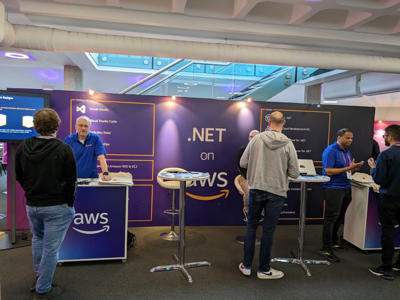
AWS .NET Enterprise Developer Days 2022 – North America: Registration for this free, 2-day, in-person event and follow-up 2-day virtual event opened this past week. The in-person event runs September 7–8, at the Palmer Events Center in Austin, Texas. The virtual event runs September 13–14. AWS .NET Enterprise Developer Days (.NET EDD) runs as a mini-conference within the DeveloperWeek Cloud conference (also in-person and virtual). Anyone registering for .NET EDD is eligible for a free pass to DeveloperWeek Cloud, and vice versa! I’m super excited to be helping organize this third .NET event from AWS, our first that has an in-person version. If you’re a .NET developer working with AWS, I encourage you to check it out!

That’s all for this week. Be sure to check back next Monday for another Week in Review roundup!

— Steve
This post is part of our Week in Review series. Check back each week for a quick roundup of interesting news and announcements from AWS!

Graviton Fast Start – A New Program to Help Move Your Workloads to AWS Graviton

Post Syndicated from Danilo Poccia original https://aws.amazon.com/blogs/aws/graviton-fast-start-a-new-program-to-help-move-your-workloads-to-aws-graviton/

With the Graviton Challenge last year, we helped customers migrate to Graviton-based EC2 instances and get up to 40 percent price performance benefit in as little as 4 days. Tens of thousands of customers, including 48 of the top 50 Amazon Elastic Compute Cloud (Amazon EC2) customers, use AWS Graviton processors for their workloads. In addition to EC2, many AWS managed services can run their workloads on Graviton. For most customers, adoption is easy, requiring minimal code changes. However, the effort and time required to move workloads to Graviton depends on a few factors including your software development environment and the technology stack on which your application is built.

This year, we want to take it a step further and make it even easier for customers to adopt Graviton not only through EC2, but also through managed services. Today, we are launching AWS Graviton Fast Start, a new program that makes it even easier to move your workloads to AWS Graviton by providing step-by-step directions for EC2 and other managed services that support the Graviton platform:

  • Amazon Elastic Compute Cloud (Amazon EC2) – EC2 provides the most flexible environment for a migration and can support many kinds of workloads, such as web apps, custom databases, or analytics. You have full control over the interpreted or compiled code running in the EC2 instance. You can also use many open-source and commercial software products that support the Arm64 architecture.
  • AWS Lambda – Migrating your serverless functions can be really easy, especially if you use an interpreted runtime such as Node.js or Python. Most of the time, you only have to check the compatibility of your software dependencies. I have shown a few examples in this blog post.
  • AWS Fargate – Fargate works best if your applications are already running in containers or if you are planning to containerize them. By using multi-architecture container images or images that have Arm64 in their image manifest, you get the serverless benefits of Fargate and the price-performance advantages of Graviton.
  • Amazon Aurora – Relational databases are at the core of many applications. If you need a database compatible with PostgreSQL or MySQL, you can use Amazon Aurora to have a highly performant and globally available database powered by Graviton.
  • Amazon Relational Database Service (RDS) – Similarly to Aurora, Amazon RDS engines such as PostgreSQL, MySQL, and MariaDB can provide a fully managed relational database service using Graviton-based instances.
  • Amazon ElastiCache – When your workload requires ultra-low latency and high throughput, you can speed up your applications with ElastiCache and have a fully managed in-memory cache running on Graviton and compatible with Redis or Memcached.
  • Amazon EMR – With Amazon EMR, you can run large-scale distributed data processing jobs, interactive SQL queries, and machine learning applications on Graviton using open-source analytics frameworks such as Apache SparkApache Hive, and Presto.

Here’s some feedback we got from customers running their workloads on Graviton:

  • Formula 1 racing told us that Graviton2-based C6gn instances provided the best price performance benefits for some of their computational fluid dynamics (CFD) workloads. More recently, they found that Graviton3 C7g instances are 40 percent faster for the same simulations and expect Graviton3-based instances to become the optimal choice to run all of their CFD workloads.
  • Honeycomb has 100 percent of their production workloads running on Graviton using EC2 and Lambda. They have tested the high-throughput telemetry ingestion workload they use for their observability platform against early preview instances of Graviton3 and have seen a 35 percent performance increase for their workload over Graviton2. They were able to run 30 percent fewer instances of C7g than C6g serving the same workload and with 30 percent reduced latency. With these instances in production, they expect over 50 percent price performance improvement over x86 instances.
  • Twitter is working on a multi-year project to leverage Graviton-based EC2 instances to deliver Twitter timelines. As part of their ongoing effort to drive further efficiencies, they tested the new Graviton3-based C7g instances. Across a number of benchmarks representative of their workloads, they found Graviton3-based C7g instances deliver 20-80 percent higher performance compared to Graviton2-based C6g instances, while also reducing tail latencies by as much as 35 percent. They are excited to utilize Graviton3-based instances in the future to realize significant price performance benefits.

With all these options, getting the benefits of running all or part of your workload on AWS Graviton can be easier than you expect. To help you get started, there’s also a free trial on the Graviton-based T4g instances for up to 750 hours per month through December 31st, 2022.

Visit AWS Graviton Fast Start to get step-by-step directions on how to move your workloads to AWS Graviton.

Danilo

New – Run Visual Studio Software on Amazon EC2 with User-Based License Model

Post Syndicated from Channy Yun original https://aws.amazon.com/blogs/aws/new-run-visual-studio-software-on-amazon-ec2-with-user-based-license-model/

We announce the general availability of license-included Visual Studio software on Amazon Elastic Cloud Compute (Amazon EC2) instances. You can now purchase fully compliant AWS-provided licenses of Visual Studio with a per-user subscription fee. Amazon EC2 provides preconfigured Amazon Machine Images (AMIs) of Visual Studio Enterprise 2022 and Visual Studio Professional 2022. You can launch on-demand Windows instances including Visual Studio and Windows Server licenses without long-term licensing commitments.

Amazon EC2 provides a broad choice of instances, and customers not only have the flexibility of paying for what their end users use but can also provide the capacity and right hardware to their end users. You can simply launch EC2 instances using license-included AMIs, and multiple authorized users can connect to these EC2 instances by using Remote Desktop software. Your administrator can authorize users centrally using AWS License Manager and AWS Managed Microsoft Active Directory (AD).

Configure Visual Studio License with AWS License Manager
As a prerequisite, your administrator needs to create an instance of AWS Managed Microsoft AD and allow AWS License Manager to onboard to it by accepting permission. To set up authorized users, see AWS Managed Microsoft AD documentation.

AWS License Manager makes it easier to manage your software licenses from vendors such as Microsoft, SAP, Oracle, and IBM across AWS and on-premises environments. To display a list of available Visual Studio software licenses, select User-based subscriptions in the AWS Licence Manager console.

You can see listed products to support user-based subscriptions. Each product has a descriptive name, a count of the subscribed users to utilize the product, and whether the subscription has been activated for use with a directory. Also, you are required to purchase Remote Desktop Services SAL licenses in the same way as Visual Studio by authorizing users for those licenses.

When you select Visual Studio Professional, you can see product details and subscribed users. By selecting Subscribe users, you can add authorized users to the license of Visual Studio Professional software.

You can perform the administrative tasks using the AWS Command Line Interface (CLI) tools via AWS License Manager APIs. For example, you can subscribe a user to the product in your Active Directory.

$ aws license-manager-user-subscriptions start-product-subscription \
         --username vscode2 \
         --product VISUAL_STUDIO_PROFESSIONAL \
         --identity-provider " \
                "ActiveDirectoryIdentityProvider" = \
                {"DirectoryId" = "d-9067b110b5"}" 
         --endpoint-url https://license-manager-user-subscriptions.us-east-1.amazonaws.com

To launch a Windows instance with preconfigured Visual Studio software, go to the EC2 console and select Launch instances. In the Application and OS Images (Amazon Machine Image), search for “Visual Studio on EC2,” and you can find AMIs under the Quickstart AMIs and AWS Marketplace AMIs tabs.

After launching your Windows instance, your administrator associates a user to the product in the Instances screen of the License Manager console. You can see the listed instances were launched using an AMI to provide the specified product to users who can then be associated.

These steps will be performed by the administrators who are responsible for managing users, instances, and costs across the organization. To learn more about administrative tasks, see User-based subscriptions in AWS License Manager.

Run Visual Studio Software on EC2 Instances
Once administrators authorize end users and launch the instances, you can remotely connect to Visual Studio instances using your AD account information shared by your administrator via Remote Desktop software. That’s all!

The instances deployed for user-based subscriptions must remain as managed nodes with AWS Systems Manager. For more information, see Troubleshooting managed node availability and Troubleshooting SSM Agent in the AWS Systems Manager User Guide.

Now Available
License-included Visual Studio on Amazon EC2 is now available in all AWS commercial and public Regions. You are billed per user for licenses of Visual Studio through a monthly subscription and per vCPU for license-included Windows Server instances on EC2.  You can use On-Demand InstancesReserved Instances, and Savings Plan pricing models like you do today for EC2 instances.

To learn more, visit our License Manager User Based Subscriptions documentation, and please send any feedback to AWS re:Post for EC2 or through your usual AWS Support contacts.

Channy

New – AWS Skill Builder Subscriptions

Post Syndicated from Sébastien Stormacq original https://aws.amazon.com/blogs/aws/new-aws-skill-builder-subscriptions/

Today, I am excited to announce AWS Skill Builder Individual and Team subscriptions. This is a new way for you to learn about cloud technologies and get practical experience with hands-on training.

Between 2013 and 2016, I spent three years delivering AWS Training classes to customers in Europe, North America, and Asia. At the time, the only classes we offered were in-person, instructor-led classes. Now, you have the choice between a variety of digital courses or in-person classes, lecture-style or hands-on. The foundations are available online for free, and the new subscriptions we are announcing today give you access to a range of exclusive content to advance your cloud skills and prepare for AWS Certification exams with self-paced, digital training. The subscriptions allow you to learn AWS services with hands-on activities.

At Amazon, we often say that it is still Day 1. The cloud market is still nascent. Gartner predicts global public cloud spending will grow from $396 billion to $482 billion this year, a rate of 22 percent this year alone. But this is just 10 percent of total global IT spending in 2022. I talk with customers every day. When I ask them the main obstacles to adopting the cloud, they all mention the lack of trained IT professionals. In fact, 76 percent of IT decision-makers report an IT skills gap, which is up from 31 percent in 2016, according to the Global Knowledge IT Skills and Salary Report, one of the largest studies of industry salaries, certifications, skills, and more.

To close the skills gap, we want to give learners hands-on experience with cloud technologies.

What Content Is Available When I Subscribe?
Starting today, AWS Skill Builder subscriptions give registered individuals and organizations access to exclusive learning materials built by builders for builders. In addition to our 500+ free courses, there are four new learning experiences available.

AWS Builder Labs are hands-on guided exercises to develop practical skills for common cloud scenarios. You receive a sandbox AWS account for the duration of the lab. There is no need for you to use your own AWS account and risk accruing unwanted charges. Next, we provide you with step-by-step instructions to go through a typical cloud scenario. It goes from simple tasks, such as configuring Amazon Simple Storage Service (Amazon S3) to host a static website, to more advanced scenarios, such as developing a serverless web application using Amazon DynamoDB. These are just two examples, and we have 100+ labs available for you to learn by doing it yourself.

AWS Jam gives you clues to guide you in solving real-world, open-ended problems. There are no step-by-step instructions, just hints. There are two types of AWS Jam: AWS Jam Journey and AWS Jam events. Jam events are exclusive to Team subscription. Once started, the Jam Journey is available for several months to give you time to complete all the challenges at your own pace and schedule. With Jam events, team administrators can create events where teams can come together at a certain date and time to solve challenges and compete with each other. AWS Jam events provide 140+ challenges across different domains.

Let’s take a practical example. When you select the security Jam, you are tasked with resolving a series of security-related challenges curated by AWS experts. Tasks might be to perform a security posture evaluation, restore a previous version of a static website, or encrypt an existing Amazon Relational Database Service (Amazon RDS) database with a customer-managed AWS Key Management Service (AWS KMS) key.

Here is the dashboard for the security AWS Jam Journey.

AWS Jam - Security

AWS Cloud Quest is a role-based game where your mission is to help citizens of a virtual city by learning and building cloud solutions for their challenges. You move around in the city, and you’re assigned tasks to complete. Each time you complete a task, you get rewards, which you can use to transform the city. For each task, the Solution Center guides you through four steps: learn the cloud concept to complete the task, practice the execution of the task with instructions, practice by yourself, and evaluate the result. Once again, the practice is done inside an AWS sandbox environment where you can safely test your new skill. To evaluate the result, the Solution Center asks you to enter validation data, such as the name of an S3 bucket or a URL. The system automatically verifies your setup and grants you points when the test succeeds. As of today, there are four roles available: Cloud Practitioner, Solutions Architect, Serverless Developer, and Machine Learning Specialist. We have plans to add more roles to this list over time. AWS Cloud Quest is a fun way to learn cloud skills!

We’ll see Cloud Quest in action in a minute.

AWS Certification Official Practice Exams are, as the name implies, full-length practice exams to help you to evaluate your exam readiness. But wait! Aren’t there free Official Practice Question Sets already? Yes! But in addition to those free 20-question practice question sets, subscribed individuals or teams can now prepare for AWS Certification with new exam preparation courses that include practice materials and the full-length AWS Certification Official Practice Exams. We have designed the exam preparation courses to help you assess your exam preparedness. Each exam preparation course includes a review of technical content, practice questions, lab exercises, and access to the AWS Certification Official Practice Exams. And this is not just a pass/fail exercise. Official practice exams come with thorough feedback for each question and scaled scores simulating actual exam scores. The questions presented have the same style, depth, rigor, and scoring as our AWS Certification exams. Full-length practice exams and exam preparation courses are currently available for the AWS Certified Cloud Practitioner, AWS Certified Solutions Architect – Associate, and AWS Certified SysOps Administrator – Associate certifications, with more to come. Much of the other content available through the subscription, such as AWS Builder Labs and AWS Cloud Quest, can complement your exam preparation.

Here is a typical screen for an Official Practice Exam. I blurred the answers obviously.

SkilBuilder Practice Exam

Type of Subscriptions
Both Individual and Team subscriptions include these four new learning experiences. Team subscriptions are available to organizations that want to purchase seats for 50 or more people. Besides a tiered pricing model, depending on the number of seats, a Team subscription gives you administrator functionality and a single sign-on experience for employees. Team administrators may assign training to individuals to drive targeted skills in their team and track progress. Built-in reports show course enrollment, course progress, completion rates, and more.

This table compares the free digital training, the Individual subscription, and the Team subscription.

SkillBuilder Subscription Comparison

Let’s See It in Action
Regular readers of this blog know we like to show you what we are talking about. Let’s see what AWS Cloud Quest looks like. First, I open AWS Skill Builder and subscribe as an individual.

AWS Skil Builder Subscription Plans

Then, I search for Cloud Quest and launch the experience.

AWS Cloud Quest

I select the role playing game I want to start. I have the choice between Cloud Practitioner, Solutions Architect, Serverless Developer, and Machine Learning Specialist.

Select a quest

Just like in every role game, I may personalize my avatar before starting the game. Any resemblance with the actual me is pure coincidence 🤔.

Quest : personalize my avatar

And finally, I am ready to walk the city, help citizens, and complete my challenges.

quest : start my mission

How Much Does It Cost?
Inclusion is a core value at Amazon. We believe everybody must have a chance to learn and grow their professional career. We made the Individual subscription available in over 200 countries and territories and up to 12 languages: Chinese (Simplified), Chinese (Traditional), English, French (France), German, Indonesian, Italian, Japanese, Korean, Portuguese (Brazil), Spanish (Latin America), and Spanish (Spain). AWS Cloud Quest is in English.

The Individual subscription is offered monthly at the price of $29 per month or annually at the price of $299 per year (this is a 14 percent discount compared to the monthly price). The subscription fee is added to your monthly AWS bill, and there is no need to have a separate credit card or billing agreement. As usual with AWS, you can stop the subscription at any time.

The Team subscription is available for purchase in 17 countries (Australia, Brazil, Canada, Colombia, France, Germany, Ireland, India, Israel, Japan, Netherlands, New Zealand, Singapore, South Korea, Spain, United Kingdom, and the United States) and the same languages as the Individual subscription. These are available for teams over 50 persons. We offer an annual plan for $449 per year and per seat, with tiered pricing based on volume. Our pricing page has all the details.

I am excited to see a new generation of IT professionals acquiring AWS Cloud skills. I can’t wait to discover the new use cases, applications, or innovations you will bring to the world when armed with these new skills.

And now, get your AWS Skill Builder subscription and go learn.

— seb

AWS Week in Review – August 1, 2022

Post Syndicated from Jeff Barr original https://aws.amazon.com/blogs/aws/aws-week-in-review-august-1-2022/

AWS re:Inforce returned to Boston last week, kicking off with a keynote from Amazon Chief Security Officer Steve Schmidt and AWS Chief Information Security officer C.J. Moses:

Be sure to take some time to watch this video and the other leadership sessions, and to use what you learn to take some proactive steps to improve your security posture.

Last Week’s Launches
Here are some launches that caught my eye last week:

AWS Wickr uses 256-bit end-to-end encryption to deliver secure messaging, voice, and video calling, including file sharing and screen sharing, across desktop and mobile devices. Each call, message, and file is encrypted with a new random key and can be decrypted only by the intended recipient. AWS Wickr supports logging to a secure, customer-controlled data store for compliance and auditing, and offers full administrative control over data: permissions, ephemeral messaging options, and security groups. You can now sign up for the preview.

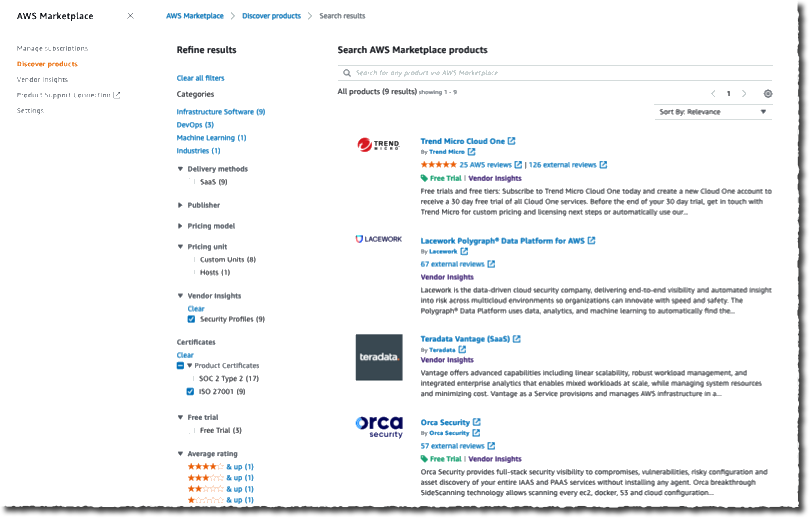
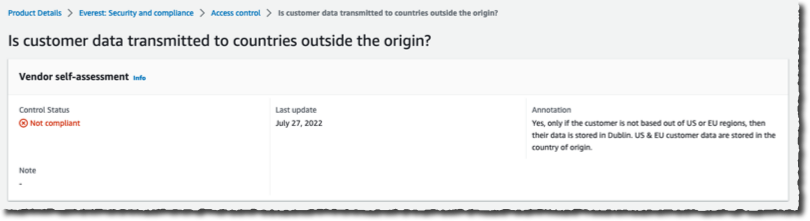
AWS Marketplace Vendor Insights helps AWS Marketplace sellers to make security and compliance data available through AWS Marketplace in the form of a unified, web-based dashboard. Designed to support governance, risk, and compliance teams, the dashboard also provides evidence that is backed by AWS Config and AWS Audit Manager assessments, external audit reports, and self-assessments from software vendors. To learn more, read the What’s New post.

GuardDuty Malware Protection protects Amazon Elastic Block Store (EBS) volumes from malware. As Danilo describes in his blog post, a malware scan is initiated when Amazon GuardDuty detects that a workload running on an EC2 instance or in a container appears to be doing something suspicious. The new malware protection feature creates snapshots of the attached EBS volumes, restores them within a service account, and performs an in-depth scan for malware. The scanner supports many types of file systems and file formats and generates actionable security findings when malware is detected.

Amazon Neptune Global Database lets you build graph applications that run across multiple AWS Regions using a single graph database. You can deploy a primary Neptune cluster in one region and replicate its data to up to five secondary read-only database clusters, with up to 16 read replicas each. Clusters can recover in minutes in the result of an (unlikely) regional outage, with a Recovery Point Objective (RPO) of 1 second and a Recovery Time Objective (RTO) of 1 minute. To learn a lot more and see this new feature in action, read Introducing Amazon Neptune Global Database.

Amazon Detective now Supports Kubernetes Workloads, with the ability to scale to thousands of container deployments and millions of configuration changes per second. It ingests EKS audit logs to capture API activity from users, applications, and the EKS control plane, and correlates user activity with information gleaned from Amazon VPC flow logs. As Channy notes in his blog post, you can enable Amazon Detective and take advantage of a free 30 day trial of the EKS capabilities.

AWS SSO is Now AWS IAM Identity Center in order to better represent the full set of workforce and account management capabilities that are part of IAM. You can create user identities directly in IAM Identity Center, or you can connect your existing Active Directory or standards-based identify provider. To learn more, read this post from the AWS Security Blog.

AWS Config Conformance Packs now provide you with percentage-based scores that will help you track resource compliance within the scope of the resources addressed by the pack. Scores are computed based on the product of the number of resources and the number of rules, and are reported to Amazon CloudWatch so that you can track compliance trends over time. To learn more about how scores are computed, read the What’s New post.

Amazon Macie now lets you perform one-click temporary retrieval of sensitive data that Macie has discovered in an S3 bucket. You can retrieve up to ten examples at a time, and use these findings to accelerate your security investigations. All of the data that is retrieved and displayed in the Macie console is encrypted using customer-managed AWS Key Management Service (AWS KMS) keys. To learn more, read the What’s New post.

AWS Control Tower was updated multiple times last week. CloudTrail Organization Logging creates an org-wide trail in your management account to automatically log the actions of all member accounts in your organization. Control Tower now reduces redundant AWS Config items by limiting recording of global resources to home regions. To take advantage of this change you need to update to the latest landing zone version and then re-register each Organizational Unit, as detailed in the What’s New post. Lastly, Control Tower’s region deny guardrail now includes AWS API endpoints for AWS Chatbot, Amazon S3 Storage Lens, and Amazon S3 Multi Region Access Points. This allows you to limit access to AWS services and operations for accounts enrolled in your AWS Control Tower environment.

For a full list of AWS announcements, be sure to keep an eye on the What’s New at AWS page.

Other AWS News
Here are some other news items and customer stories that you may find interesting:

AWS Open Source News and Updates – My colleague Ricardo Sueiras writes a weekly open source newsletter and highlights new open source projects, tools, and demos from the AWS community. Read installment #122 here.

Growy Case Study – This Netherlands-based company is building fully-automated robot-based vertical farms that grow plants to order. Read the case study to learn how they use AWS IoT and other services to monitor and control light, temperature, CO2, and humidity to maximize yield and quality.

Journey of a Snap on Snapchat – This video shows you how a snapshot flows end-to-end from your camera to AWS, to your friends. With over 300 million daily active users, Snap takes advantage of Amazon Elastic Kubernetes Service (EKS), Amazon DynamoDB, Amazon Simple Storage Service (Amazon S3), Amazon CloudFront, and many other AWS services, storing over 400 terabytes of data in DynamoDB and managing over 900 EKS clusters.

Cutting Cardboard Waste – Bin packing is almost certainly a part of every computer science curriculum! In the linked article from the Amazon Science site, you can learn how an Amazon Principal Research Scientist developed PackOpt to figure out the optimal set of boxes to use for shipments from Amazon’s global network of fulfillment centers. This is an NP-hard problem and the article describes how they build a parallelized solution that explores a multitude of alternative solutions, all running on AWS.

Upcoming Events
Check your calendar and sign up for these online and in-person AWS events:

AWS SummitAWS Global Summits – AWS Global Summits are free events that bring the cloud computing community together to connect, collaborate, and learn about AWS. Registrations are open for the following AWS Summits in August:

Imagine Conference 2022IMAGINE 2022 – The IMAGINE 2022 conference will take place on August 3 at the Seattle Convention Center, Washington, USA. It’s a no-cost event that brings together education, state, and local leaders to learn about the latest innovations and best practices in the cloud. You can register here.

That’s all for this week. Check back next Monday for another Week in Review!

Jeff;

This post is part of our Week in Review series. Check back each week for a quick roundup of interesting news and announcements from AWS!

New for AWS Global Accelerator – Internet Protocol Version 6 (IPv6) Support

Post Syndicated from Danilo Poccia original https://aws.amazon.com/blogs/aws/new-for-aws-global-accelerator-internet-protocol-version-6-ipv6-support/

IPv6 adoption has consistently increased over the last few years, especially among mobile networks. The main reasons to move to IPv6 are:

  • The limited availability of IPv4 addresses can limit the ability to scale up public-facing web and applications servers.
  • IPv6 users from mobile networks experience better performance when their network traffic doesn’t need to manage IPv6 to IPv4 translation.
  • You might need to comply with regulatory rules (such as the Federal Acquisition Regulation in US) to run specific internet traffic over IPv6.

Based on this, we found that we could help improve the network path that your customers use to reach your applications by adding IPv6 support to AWS Global Accelerator. Global Accelerator uses the AWS global network to route network traffic and keep packet loss, jitter, and latency consistently low. Customers like Atlassian, New Relic, and SkyScanner already use Global Accelerator to improve the global availability and performance of their applications.

Global Accelerator provides two global static public IPs that act as a fixed entry point to your application. You can update your application endpoints without making user-facing changes to the IP address. If you configure more than one application endpoint, Global Accelerator automatically reroutes your traffic to your nearest healthy available endpoint to mitigate endpoint failure.

Starting today, you can provide better network performance by routing IPv6 traffic through Global Accelerator to your application endpoints running in AWS Regions. Global Accelerator now supports two types of accelerators: dual-stack and IPv4-only. With a dual-stack accelerator, you are provided with a pair of IPv4 and IPv6 global static IP addresses that can serve both IPv4 and IPv6 traffic.

For existing IPv4-only accelerators, you can update your accelerators to dual-stack to serve both IPv4 and IPv6 traffic. This update enables your accelerator to serve IPv6 traffic and doesn’t impact existing IPv4 traffic served by the accelerator.

Dual-stack accelerators supporting both IPv6 and IPv4 traffic require dual-stack endpoints in the back end. For example, Application Load Balancers (ALBs) can have their IP address type configured as either IPv4-only or dual stack, allowing them to accept both IPv4 or IPv6 client connections. Today, dual-stack ALBs are supported as endpoints for dual-stack accelerators.

Deploying a Dual-Stack Application
To test this new feature, I need a dual-stack application with an ALB entry point. The application must be deployed in Amazon Virtual Private Cloud (Amazon VPC) and support IPv6 traffic. I don’t happen to have IPv6-ready VPCs in my account. I can follow these instructions to migrate an existing VPC that supports IPv4 only to IPv6, or I can create a VPC that supports IPv6 addressing. For this post, I choose to create a VPC.

In the AWS Management Console, I navigate to the Amazon VPC Dashboard. I choose Launch VPC Wizard. In the wizard, I enter a value for the Name tag. This value will be used to auto-generate Name tags for all resources in the VPC. Then, I select the option to associate an Amazon-provided IPv6 CIDR block. I leave all other options to their default values and choose Create VPC.

Console screenshot.

After less than a minute, the VPC is ready. I edit the settings of both public subnets to enable the Auto-assign IP settings to automatically request both a public IPv4 address and an IPv6 address for new network interfaces in this subnet.

Console screenshot.

Now, I want to deploy an application in this VPC. The application will be the endpoint for my accelerator. I view and download the WordPress scalable and durable AWS CloudFormation template from the Sample solutions section of the CloudFormation documentation. This template deploys a full WordPress website behind an ALB. The web tier is scalable and implemented as an EC2 Auto Scaling group. The MySQL database is managed by Amazon Relational Database Service (RDS).

Before deploying the stack, I edit the template to make a few changes. First, I add a DBSubnetGroup resource:

"DBSubnetGroup" : {
  "Type": "AWS::RDS::DBSubnetGroup",
  "Properties": {
    "DBSubnetGroupDescription" : "DB subnet group",
    "SubnetIds" : { "Ref" : "Subnets"}
  }
},

Then, I add the DBSubnetGroupName property to the DBInstance resource. In this way, the database created by the template will be deployed in the same subnets (and VPC) as the web servers.

"DBSubnetGroupName" : { "Ref" : "DBSubnetGroup" },

The last change adds the IpAddressType property to the ApplicationLoadBalancer resource to create a dual-stack load balancer that has IPv6 addresses and will be ready to be used with the new dual-stack option of Global Accelerator.

"IpAddressType": "dualstack",

Because IpAddressType is set to dualstack, the ALB created by the stack will also have IPv6 addresses and will be ready to be used with the new dual-stack option of Global Accelerator.

In the CloudFormation console, I create a stack and upload the template I just edited. In the template parameters, I enter a database user and password to use. For the VpcId parameter, I select the IPv6-ready VPC I just created. For the Subnets parameter, I select the two public subnets of the same VPC. After that, I go to the next steps and create the stack.

After a few minutes, the stack creation is complete. To access the website, I need to open network access to the load balancer. In the EC2 console, I create a security group that allows public access using the HTTP and HTTPS protocols (ports 80 and 443).

Console screenshot.

I choose Load balancers from the navigation pane and select the ALB used by my application. In the Security section, I choose Edit security groups and add the security group I just created to allow web access.

Console screenshot.

Now, I look for the dual-stack (A or AAAA Record) DNS name of the load balancer. I open a browser and connect using the DNS name to complete the configuration of WordPress.

Website.

When connecting again to the endpoint, I see my new (and empty) WordPress website.

Website.

Using Dual-Stack Accelerators with Support for Both IPv6 and IPv4 traffic
Now that my application is ready, I add a dual-stack accelerator in front of the dual-stack ALB. In the Global Accelerator console, I choose Create accelerator. I enter a name for the accelerator and choose the Standard accelerator type.

Console screenshot.

To route both IPv4 and IPv6 through this accelerator, I select the Dual-stack option for the IP address type.

Console screenshot.

Then I add a listener for port 80 using the TCP protocol.

Console screenshot.

For that listener, I configure an endpoint group in the AWS Region where I have my application deployed.

Console screenshot.

I choose Application Load Balancer for the Endpoint type and select the ALB in the CloudFormation stack.

Console screenshot.

Then, I choose Create accelerator. After a few minutes, the accelerator is deployed, and I have a dual-stack DNS name to reach the ALB using IPv4 or IPv6 depending on the network used by the client.

Console screenshot.

Now, my customers can use the IPv4 and IPv6 addresses or, even better, the dual-stack DNS name of the accelerator to connect to the WordPress website. If there is a front-end or mobile application my customers use to connect to the WordPress REST APIs, I can use the dual-stack DNS name so that clients will connect using their preferred IPv4 or IPv6 route.

To understand if the communication between Global Accelerator and the ALB is working, I can monitor the new FlowsDrop Amazon CloudWatch metric. This metric tells me if Global Accelerator is unable to route IPv6 traffic through the endpoint. For example, that can happen if, after the creation of the accelerator, the configuration of the ALB is updated to use IPv4 only.

Availability and Pricing
You can configure dual-stack accelerators using the AWS Management Console, the AWS Command Line Interface (CLI), and AWS SDKs. You can use dual-stack accelerators to optimize access to your applications deployed in any commercial AWS Region.

Protocol translation is not supported, neither IPv4 to IPv6 nor IPv6 to IPv4. For example, Global Accelerator will not allow me to configure a dual-stack accelerator with an IPv4-only ALB endpoint. Also, for IPv6 ALB endpoints, client IP preservation must be enabled.

There are no additional costs for using dual-stack accelerators. You pay for the hours and the amount of data transfer in the dominant direction used by traffic to or from the accelerator. Data transfer costs depend on the location of your clients and the AWS Regions where you are running your applications. For more information, see the Global Accelerator pricing page.

Optimize the IPv6 and IPv4 network paths used by your customers to reach your applications with AWS Global Accelerator.

Danilo

Fortinet FortiCNP – Now Available in AWS Marketplace

Post Syndicated from Jeff Barr original https://aws.amazon.com/blogs/aws/fortinet-forticnp-now-available-in-aws-marketplace/

When I first started to talk about AWS in front of IT professionals, they would always listen intently and ask great questions. Invariably, a seasoned pro would raise there hand and ask “This all sounds great, but have you thought about security?” Of course we had, and for a while I would describe our principal security features ahead of time instead of waiting for the question.

Today, the field of cloud security is well-developed, as is the practice of SecOps (Security Operations). There are plenty of tools, plenty of best practices, and a heightened level of awareness regarding the important of both. However, as on-premises workloads continue to migrate to the cloud, SecOps practitioners report that they are concerned about alert fatigue, while having to choose tools that ensure the desired level of workload coverage. According to a recent survey conducted by Fortinet, 78% of the respondents were looking for a single cloud security platform that offers sufficient workload coverage to address all of their needs.

Fortinet FortiCNP
In response to this clear need for a single tool that addresses cloud workloads and cloud storage, Fortinet has launched FortiCNP (Cloud Native Protection). As the name implies, this security product is designed to offer simple & effective protection of cloud resources. It monitors and tracks multiple sources of security issues including configurations, user activity, and VPC Flow Logs. FortiCNP scans cloud storage for content that is sensitive or malicious, and also inspects containers for vulnerabilities and misconfigurations. The findings and alerts generated by all of this monitoring, tracking, and scanning is mapped into actionable insights and compliance reports, all available through a single dashboard.

Now in AWS Marketplace
I am happy to report that FortiCNP is now available in AWS Marketplace and that you can start your subscription today! It connects to multiple AWS security tools including Amazon Inspector, AWS Security Hub, and Amazon GuardDuty, with plans to add support for Amazon Macie, and other Fortinet products such as FortiEDR (Endpoint Detection and Response) and FortiGate-VM (next-generation firewall) later this year.

FortinCNP provides you with features that are designed to address your top risk management, threat management, compliance, and SecOps challenges. Drawing on all of the data sources and tools that I mentioned earlier, it runs hundreds of configuration assessments to identify risks, and then presents the findings in a scored, prioritized fashion.

Getting Started with FortiCNP
After subscribing to FortiCNP in AWS Marketplace, I set up my accounts and enable some services. In the screenshots that follow I will show you the highlights of each step, and link you to the docs for more information:

Enable Security Hub and EventBridge – Following the instructions in AWS Security Hub and EventBridge Configuration, I choose an AWS region to hold my aggregated findings, enable Amazon GuardDuty and Amazon Inspector, and route the findings to AWS Security Hub.

Add VPC Flow Logs – Again following the instructions (AWS Traffic Configuration), I enable VPC Flow Logs. This allows FortiCNP to access cloud traffic data and present it in the Traffic view.

Add AWS Accounts – FortiCNP can protect a single AWS account or all of the accounts in an entire Organization, or anywhere in-between. Accounts and Organizations can be added manually, or by using a CloudFormation template that sets up an IAM Role, enables CloudTrail, and takes care of other housekeeping. To learn more, read Amazon Web Services Account OnBoarding. Using the ADMIN page of FortiCNP, I choose to add a single account using a template:

Following the prompts, I run a CloudFormation template and review the resources that it creates:

After a few more clicks, FortiCNP verifies my license and then I am ready to go.

Enable Storage Guardian – I can enable data protection for individual S3 buckets, and initiate a scan (more info at Activate Data Protection on Bucket / Container).

With all of the setup steps complete, I can review and act on the findings. I start by reviewing the dashboard:

Because I just started using the product, the overall risk trend section at the top has just a few days worth of history. The Resource Overview shows that my resources are at low risk, with only informational messages. I have no exposed storage with sensitive data, and none with malware (always good to know).

I can click on a resource type to learn more the findings. Each resource has an associated risk score:

From here I can click on a resource to see which of the findings contribute to the risk score:

I can switch to the Changes tab to see all relevant configuration changes for the resource:

I can also add notes to the resource, and I can send notifications to several messaging and ticketing systems:

Compliance reports are generated automatically on a monthly, quarterly, and yearly basis. I can also generate a one-time compliance report to cover any desired time frame:

Reports are available immediately, and can be downloaded for review:

The policies that are used to generate findings are open and accessible,and can be enabled, disabled, and fine-tuned. For example, the Alert on activity from suspicious locations (sorry, all of you who are connecting from Antarctica):

There’s a lot more but I am just about out of space. Check out the online documentation to learn a lot more.

Available Today
You can subscribe to FortiCNP now and start enjoying the benefits today!

Jeff;

New for Amazon GuardDuty – Malware Detection for Amazon EBS Volumes

Post Syndicated from Danilo Poccia original https://aws.amazon.com/blogs/aws/new-for-amazon-guardduty-malware-detection-for-amazon-ebs-volumes/

With Amazon GuardDuty, you can monitor your AWS accounts and workloads to detect malicious activity. Today, we are adding to GuardDuty the capability to detect malware. Malware is malicious software that is used to compromise workloads, repurpose resources, or gain unauthorized access to data. When you have GuardDuty Malware Protection enabled, a malware scan is initiated when GuardDuty detects that one of your EC2 instances or container workloads running on EC2 is doing something suspicious. For example, a malware scan is triggered when an EC2 instance is communicating with a command-and-control server that is known to be malicious or is performing denial of service (DoS) or brute-force attacks against other EC2 instances.

GuardDuty supports many file system types and scans file formats known to be used to spread or contain malware, including Windows and Linux executables, PDF files, archives, binaries, scripts, installers, email databases, and plain emails.

When potential malware is identified, actionable security findings are generated with information such as the threat and file name, the file path, the EC2 instance ID, resource tags and, in the case of containers, the container ID and the container image used. GuardDuty supports container workloads running on EC2, including customer-managed Kubernetes clusters or individual Docker containers. If the container is managed by Amazon Elastic Kubernetes Service (EKS) or Amazon Elastic Container Service (Amazon ECS), the findings also include the cluster name and the task or pod ID so application and security teams can quickly find the affected container resources.

As with all other GuardDuty findings, malware detections are sent to the GuardDuty console, pushed through Amazon EventBridge, routed to AWS Security Hub, and made available in Amazon Detective for incident investigation.

How GuardDuty Malware Protection Works
When you enable malware protection, you set up an AWS Identity and Access Management (IAM) service-linked role that grants GuardDuty permissions to perform malware scans. When a malware scan is initiated for an EC2 instance, GuardDuty Malware Protection uses those permissions to take a snapshot of the attached Amazon Elastic Block Store (EBS) volumes that are less than 1 TB in size and then restore the EBS volumes in an AWS service account in the same AWS Region to scan them for malware. You can use tagging to include or exclude EC2 instances from those permissions and from scanning. In this way, you don’t need to deploy security software or agents to monitor for malware, and scanning the volumes doesn’t impact running workloads. The EBS volumes in the service account and the snapshots in your account are deleted after the scan. Optionally, you can preserve the snapshots when malware is detected.

The service-linked role grants GuardDuty access to AWS Key Management Service (AWS KMS) keys used to encrypt EBS volumes. If the EBS volumes attached to a potentially compromised EC2 instance are encrypted with a customer-managed key, GuardDuty Malware Protection uses the same key to encrypt the replica EBS volumes as well. If the volumes are not encrypted, GuardDuty uses its own key to encrypt the replica EBS volumes and ensure privacy. Volumes encrypted with EBS-managed keys are not supported.

Security in cloud is a shared responsibility between you and AWS. As a guardrail, the service-linked role used by GuardDuty Malware Protection cannot perform any operation on your resources (such as EBS snapshots and volumes, EC2 instances, and KMS keys) if it has the GuardDutyExcluded tag. Once you mark your snapshots with GuardDutyExcluded set to true, the GuardDuty service won’t be able to access these snapshots. The GuardDutyExcluded tag supersedes any inclusion tag. Permissions also restrict how GuardDuty can modify your snapshot so that they cannot be made public while shared with the GuardDuty service account.

The EBS volumes created by GuardDuty are always encrypted. GuardDuty can use KMS keys only on EBS snapshots that have a GuardDuty scan ID tag. The scan ID tag is added by GuardDuty when snapshots are created after an EC2 finding. The KMS keys that are shared with GuardDuty service account cannot be invoked from any other context except the Amazon EBS service. Once the scan completes successfully, the KMS key grant is revoked and the volume replica in GuardDuty service account is deleted, making sure GuardDuty service cannot access your data after completing the scan operation.

Enabling Malware Protection for an AWS Account
If you’re not using GuardDuty yet, Malware Protection is enabled by default when you activate GuardDuty for your account. Because I am already using GuardDuty, I need to enable Malware Protection from the console. If you’re using AWS Organizations, your delegated administrator accounts can enable this for existing member accounts and configure if new AWS accounts in the organization should be automatically enrolled.

In the GuardDuty console, I choose Malware Protection under Settings in the navigation pane. There, I choose Enable and then Enable Malware Protection.

Console screenshot.

Snapshots are automatically deleted after they are scanned. In General settings, I have the option to retain in my AWS account the snapshots where malware is detected and have them available for further analysis.

Console screenshot.

In Scan options, I can configure a list of inclusion tags, so that only EC2 instances with those tags are scanned, or exclusion tags, so that EC2 instances with tags in the list are skipped.

Console screenshot.

Testing Malware Protection GuardDuty Findings
To generate several Amazon GuardDuty findings, including the new Malware Protection findings, I clone the Amazon GuardDuty Tester repo:

$ git clone https://github.com/awslabs/amazon-guardduty-tester

First, I create an AWS CloudFormation stack using the guardduty-tester.template file. When the stack is ready, I follow the instructions to configure my SSH client to log in to the tester instance through the bastion host. Then, I connect to the tester instance:

$ ssh tester

From the tester instance, I start the guardduty_tester.sh script to generate the findings:

$ ./guardduty_tester.sh 

***********************************************************************
* Test #1 - Internal port scanning                                    *
* This simulates internal reconaissance by an internal actor or an   *
* external actor after an initial compromise. This is considered a    *
* low priority finding for GuardDuty because its not a clear indicator*
* of malicious intent on its own.                                     *
***********************************************************************


Starting Nmap 6.40 ( http://nmap.org ) at 2022-05-19 09:36 UTC
Nmap scan report for ip-172-16-0-20.us-west-2.compute.internal (172.16.0.20)
Host is up (0.00032s latency).
Not shown: 997 filtered ports
PORT     STATE  SERVICE
22/tcp   open   ssh
80/tcp   closed http
5050/tcp closed mmcc
MAC Address: 06:25:CB:F4:E0:51 (Unknown)

Nmap done: 1 IP address (1 host up) scanned in 4.96 seconds

-----------------------------------------------------------------------

***********************************************************************
* Test #2 - SSH Brute Force with Compromised Keys                     *
* This simulates an SSH brute force attack on an SSH port that we    *
* can access from this instance. It uses (phony) compromised keys in  *
* many subsequent attempts to see if one works. This is a common      *
* techique where the bad actors will harvest keys from the web in     *
* places like source code repositories where people accidentally leave*
* keys and credentials (This attempt will not actually succeed in     *
* obtaining access to the target linux instance in this subnet)       *
***********************************************************************

2022-05-19 09:36:29 START
2022-05-19 09:36:29 Crowbar v0.4.3-dev
2022-05-19 09:36:29 Trying 172.16.0.20:22
2022-05-19 09:36:33 STOP
2022-05-19 09:36:33 No results found...
2022-05-19 09:36:33 START
2022-05-19 09:36:33 Crowbar v0.4.3-dev
2022-05-19 09:36:33 Trying 172.16.0.20:22
2022-05-19 09:36:37 STOP
2022-05-19 09:36:37 No results found...
2022-05-19 09:36:37 START
2022-05-19 09:36:37 Crowbar v0.4.3-dev
2022-05-19 09:36:37 Trying 172.16.0.20:22
2022-05-19 09:36:41 STOP
2022-05-19 09:36:41 No results found...
2022-05-19 09:36:41 START
2022-05-19 09:36:41 Crowbar v0.4.3-dev
2022-05-19 09:36:41 Trying 172.16.0.20:22
2022-05-19 09:36:45 STOP
2022-05-19 09:36:45 No results found...
2022-05-19 09:36:45 START
2022-05-19 09:36:45 Crowbar v0.4.3-dev
2022-05-19 09:36:45 Trying 172.16.0.20:22
2022-05-19 09:36:48 STOP
2022-05-19 09:36:48 No results found...
2022-05-19 09:36:49 START
2022-05-19 09:36:49 Crowbar v0.4.3-dev
2022-05-19 09:36:49 Trying 172.16.0.20:22
2022-05-19 09:36:52 STOP
2022-05-19 09:36:52 No results found...
2022-05-19 09:36:52 START
2022-05-19 09:36:52 Crowbar v0.4.3-dev
2022-05-19 09:36:52 Trying 172.16.0.20:22
2022-05-19 09:36:56 STOP
2022-05-19 09:36:56 No results found...
2022-05-19 09:36:56 START
2022-05-19 09:36:56 Crowbar v0.4.3-dev
2022-05-19 09:36:56 Trying 172.16.0.20:22
2022-05-19 09:37:00 STOP
2022-05-19 09:37:00 No results found...
2022-05-19 09:37:00 START
2022-05-19 09:37:00 Crowbar v0.4.3-dev
2022-05-19 09:37:00 Trying 172.16.0.20:22
2022-05-19 09:37:04 STOP
2022-05-19 09:37:04 No results found...
2022-05-19 09:37:04 START
2022-05-19 09:37:04 Crowbar v0.4.3-dev
2022-05-19 09:37:04 Trying 172.16.0.20:22
2022-05-19 09:37:08 STOP
2022-05-19 09:37:08 No results found...
2022-05-19 09:37:08 START
2022-05-19 09:37:08 Crowbar v0.4.3-dev
2022-05-19 09:37:08 Trying 172.16.0.20:22
2022-05-19 09:37:12 STOP
2022-05-19 09:37:12 No results found...
2022-05-19 09:37:12 START
2022-05-19 09:37:12 Crowbar v0.4.3-dev
2022-05-19 09:37:12 Trying 172.16.0.20:22
2022-05-19 09:37:16 STOP
2022-05-19 09:37:16 No results found...
2022-05-19 09:37:16 START
2022-05-19 09:37:16 Crowbar v0.4.3-dev
2022-05-19 09:37:16 Trying 172.16.0.20:22
2022-05-19 09:37:20 STOP
2022-05-19 09:37:20 No results found...
2022-05-19 09:37:20 START
2022-05-19 09:37:20 Crowbar v0.4.3-dev
2022-05-19 09:37:20 Trying 172.16.0.20:22
2022-05-19 09:37:23 STOP
2022-05-19 09:37:23 No results found...
2022-05-19 09:37:23 START
2022-05-19 09:37:23 Crowbar v0.4.3-dev
2022-05-19 09:37:23 Trying 172.16.0.20:22
2022-05-19 09:37:27 STOP
2022-05-19 09:37:27 No results found...
2022-05-19 09:37:27 START
2022-05-19 09:37:27 Crowbar v0.4.3-dev
2022-05-19 09:37:27 Trying 172.16.0.20:22
2022-05-19 09:37:31 STOP
2022-05-19 09:37:31 No results found...
2022-05-19 09:37:31 START
2022-05-19 09:37:31 Crowbar v0.4.3-dev
2022-05-19 09:37:31 Trying 172.16.0.20:22
2022-05-19 09:37:34 STOP
2022-05-19 09:37:34 No results found...
2022-05-19 09:37:35 START
2022-05-19 09:37:35 Crowbar v0.4.3-dev
2022-05-19 09:37:35 Trying 172.16.0.20:22
2022-05-19 09:37:38 STOP
2022-05-19 09:37:38 No results found...
2022-05-19 09:37:38 START
2022-05-19 09:37:38 Crowbar v0.4.3-dev
2022-05-19 09:37:38 Trying 172.16.0.20:22
2022-05-19 09:37:42 STOP
2022-05-19 09:37:42 No results found...
2022-05-19 09:37:42 START
2022-05-19 09:37:42 Crowbar v0.4.3-dev
2022-05-19 09:37:42 Trying 172.16.0.20:22
2022-05-19 09:37:46 STOP
2022-05-19 09:37:46 No results found...

-----------------------------------------------------------------------

***********************************************************************
* Test #3 - RDP Brute Force with Password List                        *
* This simulates an RDP brute force attack on the internal RDP port  *
* of the windows server that we installed in the environment.  It uses*
* a list of common passwords that can be found on the web. This test  *
* will trigger a detection, but will fail to get into the target      *
* windows instance.                                                   *
***********************************************************************

Sending 250 password attempts at the windows server...
Hydra v9.4-dev (c) 2022 by van Hauser/THC & David Maciejak - Please do not use in military or secret service organizations, or for illegal purposes (this is non-binding, these *** ignore laws and ethics anyway).

Hydra (https://github.com/vanhauser-thc/thc-hydra) starting at 2022-05-19 09:37:46
[WARNING] rdp servers often don't like many connections, use -t 1 or -t 4 to reduce the number of parallel connections and -W 1 or -W 3 to wait between connection to allow the server to recover
[INFO] Reduced number of tasks to 4 (rdp does not like many parallel connections)
[WARNING] the rdp module is experimental. Please test, report - and if possible, fix.
[DATA] max 4 tasks per 1 server, overall 4 tasks, 1792 login tries (l:7/p:256), ~448 tries per task
[DATA] attacking rdp://172.16.0.24:3389/
[STATUS] 1099.00 tries/min, 1099 tries in 00:01h, 693 to do in 00:01h, 4 active
1 of 1 target completed, 0 valid password found
Hydra (https://github.com/vanhauser-thc/thc-hydra) finished at 2022-05-19 09:39:23

-----------------------------------------------------------------------

***********************************************************************
* Test #4 - CryptoCurrency Mining Activity                            *
* This simulates interaction with a cryptocurrency mining pool which *
* can be an indication of an instance compromise. In this case, we are*
* only interacting with the URL of the pool, but not downloading      *
* any files. This will trigger a threat intel based detection.        *
***********************************************************************

Calling bitcoin wallets to download mining toolkits

-----------------------------------------------------------------------

***********************************************************************
* Test #5 - DNS Exfiltration                                          *
* A common exfiltration technique is to tunnel data out over DNS      *
* to a fake domain.  Its an effective technique because most hosts    *
* have outbound DNS ports open.  This test wont exfiltrate any data,  *
* but it will generate enough unusual DNS activity to trigger the     *
* detection.                                                          *
***********************************************************************

Calling large numbers of large domains to simulate tunneling via DNS

***********************************************************************
* Test #6 - Fake domain to prove that GuardDuty is working            *
* This is a permanent fake domain that customers can use to prove that*
* GuardDuty is working.  Calling this domain will always generate the *
* Backdoor:EC2/C&CActivity.B!DNS finding type                         *
***********************************************************************

Calling a well known fake domain that is used to generate a known finding

; <<>> DiG 9.11.4-P2-RedHat-9.11.4-26.P2.amzn2.5.2 <<>> GuardDutyC2ActivityB.com any
;; global options: +cmd
;; Got answer:
;; ->>HEADER<<- opcode: QUERY, status: NOERROR, id: 11495
;; flags: qr rd ra; QUERY: 1, ANSWER: 8, AUTHORITY: 0, ADDITIONAL: 1

;; OPT PSEUDOSECTION:
; EDNS: version: 0, flags:; udp: 4096
;; QUESTION SECTION:
;GuardDutyC2ActivityB.com.	IN	ANY

;; ANSWER SECTION:
GuardDutyC2ActivityB.com. 6943	IN	SOA	ns1.markmonitor.com. hostmaster.markmonitor.com. 2018091906 86400 3600 2592000 172800
GuardDutyC2ActivityB.com. 6943	IN	NS	ns3.markmonitor.com.
GuardDutyC2ActivityB.com. 6943	IN	NS	ns5.markmonitor.com.
GuardDutyC2ActivityB.com. 6943	IN	NS	ns7.markmonitor.com.
GuardDutyC2ActivityB.com. 6943	IN	NS	ns2.markmonitor.com.
GuardDutyC2ActivityB.com. 6943	IN	NS	ns4.markmonitor.com.
GuardDutyC2ActivityB.com. 6943	IN	NS	ns6.markmonitor.com.
GuardDutyC2ActivityB.com. 6943	IN	NS	ns1.markmonitor.com.

;; Query time: 27 msec
;; SERVER: 172.16.0.2#53(172.16.0.2)
;; WHEN: Thu May 19 09:39:23 UTC 2022
;; MSG SIZE  rcvd: 238


*****************************************************************************************************
Expected GuardDuty Findings

Test 1: Internal Port Scanning
Expected Finding: EC2 Instance  i-011e73af27562827b  is performing outbound port scans against remote host. 172.16.0.20
Finding Type: Recon:EC2/Portscan

Test 2: SSH Brute Force with Compromised Keys
Expecting two findings - one for the outbound and one for the inbound detection
Outbound:  i-011e73af27562827b  is performing SSH brute force attacks against  172.16.0.20
Inbound:  172.16.0.25  is performing SSH brute force attacks against  i-0bada13e0aa12d383
Finding Type: UnauthorizedAccess:EC2/SSHBruteForce

Test 3: RDP Brute Force with Password List
Expecting two findings - one for the outbound and one for the inbound detection
Outbound:  i-011e73af27562827b  is performing RDP brute force attacks against  172.16.0.24
Inbound:  172.16.0.25  is performing RDP brute force attacks against  i-0191573dec3b66924
Finding Type : UnauthorizedAccess:EC2/RDPBruteForce

Test 4: Cryptocurrency Activity
Expected Finding: EC2 Instance  i-011e73af27562827b  is querying a domain name that is associated with bitcoin activity
Finding Type : CryptoCurrency:EC2/BitcoinTool.B!DNS

Test 5: DNS Exfiltration
Expected Finding: EC2 instance  i-011e73af27562827b  is attempting to query domain names that resemble exfiltrated data
Finding Type : Trojan:EC2/DNSDataExfiltration

Test 6: C&C Activity
Expected Finding: EC2 instance  i-011e73af27562827b  is querying a domain name associated with a known Command & Control server. 
Finding Type : Backdoor:EC2/C&CActivity.B!DNS

After a few minutes, the findings appear in the GuardDuty console. At the top, I see the malicious files found by the new Malware Protection capability. One of the findings is related to an EC2 instance, the other to an ECS cluster.

Console screenshot.

First, I select the finding related to the EC2 instance. In the panel, I see the information on the instance and the malicious file, such as the file name and path. In the Malware scan details section, the Trigger finding ID points to the original GuardDuty finding that triggered the malware scan. In my case, the original finding was that this EC2 instance was performing RDP brute force attacks against another EC2 instance.

Console screenshot.

Here, I choose Investigate with Detective and, directly from the GuardDuty console, I go to the Detective console to visualize AWS CloudTrail and Amazon Virtual Private Cloud (Amazon VPC) flow data for the EC2 instance, the AWS account, and the IP address affected by the finding. Using Detective, I can analyze, investigate, and identify the root cause of suspicious activities found by GuardDuty.

Console screenshot.

When I select the finding related to the ECS cluster, I have more information on the resource affected, such as the details of the ECS cluster, the task, the containers, and the container images.

Console screenshot.

Using the GuardDuty tester scripts makes it easier to test the overall integration of GuardDuty with other security frameworks you use so that you can be ready when a real threat is detected.

Comparing GuardDuty Malware Protection with Amazon Inspector
At this point, you might ask yourself how GuardDuty Malware Protection relates to Amazon Inspector, a service that scans AWS workloads for software vulnerabilities and unintended network exposure. The two services complement each other and offer different layers of protection:

  • Amazon Inspector offers proactive protection by identifying and remediating known software and application vulnerabilities that serve as an entry point for attackers to compromise resources and install malware.
  • GuardDuty Malware Protection detects malware that is found to be present on actively running workloads. At that point, the system has already been compromised, but GuardDuty can limit the time of an infection and take action before a system compromise results in a business-impacting event.

Availability and Pricing
Amazon GuardDuty Malware Protection is available today in all AWS Regions where GuardDuty is available, excluding the AWS China (Beijing), AWS China (Ningxia), AWS GovCloud (US-East), and AWS GovCloud (US-West) Regions.

At launch, GuardDuty Malware Protection is integrated with these partner offerings:

With GuardDuty, you don’t need to deploy security software or agents to monitor for malware. You only pay for the amount of GB scanned in the file systems (not for the size of the EBS volumes) and for the EBS snapshots during the time they are kept in your account. All EBS snapshots created by GuardDuty are automatically deleted after they are scanned unless you enable snapshot retention when malware is found. For more information, see GuardDuty pricing and EBS pricing. Note that GuardDuty only scans EBS volumes less than 1 TB in size. To help you control costs and avoid repeating alarms, the same volume is not scanned more often than once every 24 hours.

Detect malicious activity and protect your applications from malware with Amazon GuardDuty.

Danilo

Amazon Detective Supports Kubernetes Workloads on Amazon EKS for Security Investigations

Post Syndicated from Channy Yun original https://aws.amazon.com/blogs/aws/amazon-detective-supports-kubernetes-workloads-on-amazon-eks-for-security-investigations/

In March 2020, we introduced Amazon Detective, a fully managed service that makes it easy to analyze, investigate, and quickly identify the root cause of potential security issues or suspicious activities.

Amazon Detective continuously extracts temporal events such as login attempts, API calls, and network traffic from Amazon GuardDutyAWS CloudTrail, and Amazon Virtual Private Cloud (Amazon VPC) Flow Logs into a graph model that summarizes the resource behaviors and interactions observed across your entire AWS environment. We have added new features such as AWS IAM Role session analysis, enhanced IP address analytics, Splunk integration, Amazon S3 and DNS finding types, and the support of AWS Organizations.

Customers are rapidly moving to containers to deploy Kubernetes workloads with Amazon Elastic Kubernetes Service (Amazon EKS). Its highly programmatic nature allows thousands of individual container deployments and millions of configuration changes to occur in seconds. To effectively secure EKS workloads, it is important to monitor container deployments and configurations that are captured in the form of EKS audit logs and to correlate activities to user activity and network traffic happening across AWS accounts.

Today we announce new capabilities in Amazon Detective to expand security investigation coverage for Kubernetes workloads running on Amazon EKS. When you enable this new feature, Amazon Detective automatically starts ingesting EKS audit logs to capture chronological API activity from users, applications, and the control plane in Amazon EKS for clusters, pods, container images, and Kubernetes subjects (Kubernetes users and service accounts).

Detective automatically correlates user activity using CloudTrail, and network activity using Amazon VPC Flow logs, without the need for you to enable, store, or retain logs manually. The service gleans key security information from these logs and retains them in a security behavioral graph database that enables fast cross-referenced access to twelve months of activity. Detective provides a data analysis and visualization layer purpose-built to answer common security questions backed by a behavioral graph database that allows you to quickly investigate potential malicious behavior associated with your EKS workloads.

You can rapidly respond to security issues rather than focusing on log management, operational systems, or ongoing security tooling maintenance. Detective’s EKS capabilities come with a free 30-day trial for all customers that allows you to ensure that the capabilities meet your needs and to fully understand the cost for the service on an ongoing basis.

Getting Started with Security Investigations for EKS Audit Logs
To get started, enable Amazon Detective with just a few clicks in the AWS Management Console. GuardDuty is a prerequisite of Amazon Detective. When you try to enable Detective, Detective checks whether GuardDuty has been enabled for your account. You must either enable GuardDuty or wait for 48 hours. This allows GuardDuty to assess the data volume that your account produces.

You can enable your account by attaching the AWS IAM policy or delegate it to an administrator of your organization. To learn more, refer to Setting up Detective in the AWS documentation.

To enable EKS support in Detective as an existing customer, navigate to the Settings menu in the left panel and select General. Under Optional source packages, enable EKS audit logs.

If you are a new customer of Detective, the EKS protection feature will be enabled by default. If you do not want to trial EKS audit logs right away, you can disable this feature within the first week of enabling Detective and preserve the full 30-day free trial period to use in the future.

Once enabled, Detective will begin monitoring the Kubernetes audit logs that are generated by Amazon EKS, extracting and correlating information for security usage. You do not need to enable any log sources or make any configuration changes to your existing EKS clusters or future deployments.

You can see recent monitoring results of your EKS clusters on the Summary page.

When you choose one of the EKS clusters, you will see the details of containers running in the cluster, Kubernetes API activities, and network activities that occurred on this resource around the scope time.

In the Overview tab, you also see details about all containers running in the cluster, including their pod, image and security context.

In the Kubernetes API activity tab, you can get an overview of the full API activities involving the EKS cluster. You can choose a time range to drill down based on specific API methods within the EKS cluster. When you select a specific time, you can see API subjects, IP addresses, and the number of API calls by the success, failure, unauthorized, or forbidden state.

You can also see details of newly observed Kubernetes API calls  inside this cluster for the first time and subjects with increased volume that happened inside the cluster.

Enabling GuardDuty EKS Protection
In January 2022, Amazon GuardDuty expanded coverage to EKS cluster activity to identify malicious or suspicious behavior that represents potential threats to container workloads.

When the optional GuardDuty EKS Protection is enabled, GuardDuty will continuously monitor your EKS deployments and alert you to threats detected in your workloads. You can view and investigate these security findings in Detective.

With Detective for EKS enabled, you can quickly access information about the resources involved in the finding, such as their CloudTrail and Kubernetes API activity, and netflow information. This can aid in investigation and help you determine root cause, impact, and other related resources that may also be compromised.

To learn more, see How to use new Amazon GuardDuty EKS Protection findings in the AWS Security Blog.

Now Available
You can now use Amazon Detective for EKS protection in all Regions where Amazon Detective is available. This feature is priced based on the volume of audit logs processed and analyzed by Detective.

Detective provides a free 30-day trial to all customers that enable EKS coverage, allowing customers to ensure that Detective’s capabilities meet security needs and to get an estimate of the service’s monthly cost before committing to paid usage. To learn more, see the Detective pricing page.

For technical documentation, visit the Amazon Detective User Guide. Please send feedback to AWS re:Post for Amazon Detective or through your usual AWS support contacts.

Learn all the details about Amazon Detective for EKS protection and get started today.

Channy

Amazon Prime Day 2022 – AWS for the Win!

Post Syndicated from Jeff Barr original https://aws.amazon.com/blogs/aws/amazon-prime-day-2022-aws-for-the-win/

As part of my annual tradition to tell you about how AWS makes Prime Day possible, I am happy to be able to share some chart-topping metrics (check out my 2016, 2017, 2019, 2020, and 2021 posts for a look back).

My purchases this year included a first aid kit, some wood brown filament for my 3D printer, and a non-stick frying pan! According to our official news release, Prime members worldwide purchased more than 100,000 items per minute during Prime Day, with best-selling categories including Amazon Devices, Consumer Electronics, and Home.

Powered by AWS
As always, AWS played a critical role in making Prime Day a success. A multitude of two-pizza teams worked together to make sure that every part of our infrastructure was scaled, tested, and ready to serve our customers. Here are a few examples:

Amazon Aurora – On Prime Day, 5,326 database instances running the PostgreSQL-compatible and MySQL-compatible editions of Amazon Aurora processed 288 billion transactions, stored 1,849 terabytes of data, and transferred 749 terabytes of data.

Amazon EC2 – For Prime Day 2022, Amazon increased the total number of normalized instances (an internal measure of compute power) on Amazon Elastic Compute Cloud (Amazon EC2) by 12%. This resulted in an overall server equivalent footprint that was only 7% larger than that of Cyber Monday 2021 due to the increased adoption of AWS Graviton2 processors.

Amazon EBS – For Prime Day, the Amazon team added 152 petabytes of EBS storage. The resulting fleet handled 11.4 trillion requests per day and transferred 532 petabytes of data per day. Interestingly enough, due to increased efficiency of some of the internal Amazon services used to run Prime Day, Amazon actually used about 4% less EBS storage and transferred 13% less data than it did during Prime Day last year. Here’s a graph that shows the increase in data transfer during Prime Day:

Amazon SES – In order to keep Prime Day shoppers aware of the deals and to deliver order confirmations, Amazon Simple Email Service (SES) peaked at 33,000 Prime Day email messages per second.

Amazon SQS – During Prime Day, Amazon Simple Queue Service (SQS) set a new traffic record by processing 70.5 million messages per second at peak:

Amazon DynamoDB – DynamoDB powers multiple high-traffic Amazon properties and systems including Alexa, the Amazon.com sites, and all Amazon fulfillment centers. Over the course of Prime Day, these sources made trillions of calls to the DynamoDB API. DynamoDB maintained high availability while delivering single-digit millisecond responses and peaking at 105.2 million requests per second.

Amazon SageMaker – The Amazon Robotics Pick Time Estimator, which uses Amazon SageMaker to train a machine learning model to predict the amount of time future pick operations will take, processed more than 100 million transactions during Prime Day 2022.

Package Planning – In North America, and on the highest traffic Prime 2022 day, package-planning systems performed 60 million AWS Lambda invocations, processed 17 terabytes of compressed data in Amazon Simple Storage Service (Amazon S3), stored 64 million items across Amazon DynamoDB and Amazon ElastiCache, served 200 million events over Amazon Kinesis, and handled 50 million Amazon Simple Queue Service events.

Prepare to Scale
Every year I reiterate the same message: rigorous preparation is key to the success of Prime Day and our other large-scale events. If you are preparing for a similar chart-topping event of your own, I strongly recommend that you take advantage of AWS Infrastructure Event Management (IEM). As part of an IEM engagement, my colleagues will provide you with architectural and operational guidance that will help you to execute your event with confidence!

Jeff;

How We Sent an AWS Snowcone into Orbit

Post Syndicated from Jeff Barr original https://aws.amazon.com/blogs/aws/how-we-sent-an-aws-snowcone-into-orbit/

I have been a fan of space travel and the US space program since I was 4 or 5 years old. I remember reading about the Mercury and Gemini programs, and watched with excitement as Lunar Module Eagle landed on the Moon.

Today, with the cost to reach Low Earth Orbit (LEO) seemingly declining with each launch, there are more opportunities than ever before to push the boundaries of what we know, conducting ever-more bold experiments and producing vast amounts of raw data. Making the situation even more interesting, today’s experiments can use more types of sensors, each collecting data with higher resolution and at a greater sampling frequency. Dealing with this vast amount of data is a huge challenge. Bandwidth on NASA’s constellation of Tracking and Data Relay Satellites (TDRS) is limited, and must be shared equitably across a growing number of missions. Latency, while almost negligible from LEO, becomes a consideration when sending data from the Moon, Mars, or from beyond the bounds of the Solar System.

When we start to think about sending hardware into space, another set of challenges come about. The hardware must be as light as possible in order to minimize the cost to launch it. It must, however, be durable enough to withstand extreme vibration and G-forces during launch, and able to function in a microgravity environment once in orbit. Once in orbit, the hardware must be able to safely connect to the host spacecraft’s power, cooling, and network systems.

AWS Snowcone on the International Space Station
As you may have already read, we recently sent an AWS Snowcone SSD to the International Space Station. Since Amazon Prime does not currently make deliveries to the ISS, the Snowcone traveled aboard a Falcon 9 rocket as part of the first Axiom Space Mission (Ax-1). As part of this mission, four private astronauts ran experiments and conducted technology demos that spanned 17 days and 240 trips around Earth.

The Snowcone is designed to run edge computing workloads, all protected by multiple layers of encryption. After data has been collected and processed locally, the device is typically shipped back to AWS so that the processed data can be stored in the cloud and processed further. Alternatively, AWS DataSync can be used to copy data from a Snowcone device back to AWS.

On the hardware side, the Snowcone is small, exceptionally rugged, and lightweight. With 2 CPUs, 4 GB of memory, and 14 TB of SSD storage, it can do a lot of local processing and storage, making it ideal for the Ax-1 mission.

Preparing for the Journey
In preparation for the trip to space, teams from AWS, NASA, and Axiom Space worked together for seven months to test and validate the Snowcone. The validation process included a rigorous safety review, a detailed thermal analysis, and testing to help ensure that the device would survive vibration at launch and in flight to the ISS. The Snowcone was not modified, but it did end up wrapped in Kapton tape for additional electrical and thermal protection.

On the software side, the AWS Machine Learning Solutions Lab worked closely with Axiom to develop a sophisticated machine learning model that would examine photos taken aboard the ISS to help improve the crew experience in future Axiom missions. The photos were taken by on-board Nikon cameras, stored in Network Attached Storage (NAS) on the ISS, and then transferred from the NAS to the Snowcone over the Joint Station LAN. Once the photos are on the Snowcone, the model was was able to return results within three seconds.

On Board the ISS
After the Snowcone was up and running, the collective team did some initial testing and encountered a few issues. For example, the photos were stored on the NAS with upper-case extensions but the code on the Snowcone was looking for lower-case. Fortunately, the Earth-based team was able to connect to the device via SSH in order to do some remote diagnosis and reconfiguration.

An updated ML model became available during the mission. The team was able to upload a largish (30 GB) AMI to the Snowcone and put the model into production with ease.

The Snowcone remains aboard the ISS, and is available for other experiments through the end of 2022. If you are a researcher, student, or part of an organization that is interested in performing experiments that involve processing data remotely on the ISS, you can express your interest at [email protected]. One interesting use case should be of interest to medical researchers. Many of the medical measurements and experiments conducted on the ISS generate data that must currently be downloaded to Earth for processing and analysis. Taking care of these steps while in orbit could reduce the end-to-end time for downloading and analysis from 20 hours to just 20 minutes, creating the potential for a 60-fold increase in the number of possible experiments.

Success
Net-net, the experiment showed that it is possible to extend cloud computing to the final frontier.

The Earth-based team was able to communicate remotely with the orbiting Snowcone in order to launch, test, and update the model. They then demonstrated that they were able to repeat this process as needed, processing photos from onboard research experiments and making optimal use of the limited bandwidth that is available between space stations and Earth.

All-in-all, this experiment was deemed a success, and we learned a lot as we identified and addressed the challenges that arise when sending AWS hardware into space to serve the needs of our customers.

Check out AWS for Aerospace and Satellite to learn more about how we support our customers and our partners as they explore the final frontier. If you are ready to deploy a Snowcone on a space or an Earth-bound mission of your own, we are ready, willing, and able to work with you!

Jeff;

New – Amazon EC2 R6a Instances Powered by 3rd Gen AMD EPYC Processors for Memory-Intensive Workloads

Post Syndicated from Channy Yun original https://aws.amazon.com/blogs/aws/new-amazon-ec2-r6a-instances-powered-by-3rd-gen-amd-epyc-processors-for-memory-intensive-workloads/

We launched the general-purpose Amazon EC2 M6a instances at AWS re:Invent 2021 and compute-intensive C6a instances in February of this year. These instances are powered by the 3rd Gen AMD EPYC processors running at frequencies up to 3.6 GHz to offer up to 35 percent better price performance versus the previous generation instances.

Today, we are expanding our portfolio to include memory-optimized Amazon EC2 R6a instances featuring AMD EPYC (Milan) processors 10 percent less expensive than comparable x86 instances.

R6a instances, powered by 3rd Gen AMD EPYC processors are well suited for memory-intensive applications such as high-performance databases (relational databases, noSQL databases), distributed web scale in-memory caches (such as memcached, Redis), in-memory databases such as real-time big data analytics (such as Hadoop, Spark clusters), and other enterprise applications.

R6a instances are built on the AWS Nitro System and support Elastic Fabric Adapter (EFA) for workloads that benefit from lower network latency and highly scalable inter-node communication, such as high-performance computing and video processing.

Here’s a quick recap of the advantages of the new R6a instances compared to R5a instances:

  • Up to 35 percent higher price performance per vCPU versus comparable R5a instances
  • Up to 10 percent less expensive than comparable x86 instances
  • Up to 1536 GiB of memory, 2 times more than the previous generation, giving you the benefit of scaling up databases and running larger in-memory workloads.
  • Up to 192 vCPUs, 50 Gbps enhanced networking, and 40 Gbps EBS bandwidth, enabling you to process data faster, consolidate workloads, and lower the cost of ownership.
  • SAP-certified instances require memory-intensive applications such as high-performance enterprise databases like SAP Business Suite.
  • Support always-on memory encryption with AMD transparent sngle key memory encryption (TSME), and support new AVX2 instructions for accelerating encryption and decryption algorithms.

Here are the specs of R6a instances in detail:

Name vCPUs Memory (GiB) Network Bandwidth (Gbps) EBS Throughput (Gbps)
r6a.large 2 16 Up to 12.5 Up to 6.6
r6a.xlarge 4 32 Up to 12.5 Up to 6.6
r6a.2xlarge 8 64 Up to 12.5 Up to 6.6
r6a.4xlarge 16 128 Up to 12.5 Up to 6.6
r6a.8xlarge 32 256 12.5 6.6
r6a.12xlarge 48 384 18.75 10
r6a.16xlarge 64 512 25 13.3
r6a.24xlarge 96 768 37.5 20
r6a.32xlarge 128 1024 50 26.6
r6a.48xlarge 192 1536 50 40
r6a.metal 192 1536 50 40

Now Available
You can launch R6a instances today in the AWS US East (N. Virginia, Ohio), US West (Oregon), Asia Pacific (Mumbai) and Europe (Frankfurt, Ireland) as On-DemandSpot, and Reserved Instances or as part of a Savings Plan.

To learn more, visit the R6a instances page. Please send feedback to [email protected]AWS re:Post for EC2, or through your usual AWS Support contacts.

— Channy

Amazon Redshift Serverless – Now Generally Available with New Capabilities

Post Syndicated from Danilo Poccia original https://aws.amazon.com/blogs/aws/amazon-redshift-serverless-now-generally-available-with-new-capabilities/

Last year at re:Invent, we introduced the preview of Amazon Redshift Serverless, a serverless option of Amazon Redshift that lets you analyze data at any scale without having to manage data warehouse infrastructure. You just need to load and query your data, and you pay only for what you use. This allows more companies to build a modern data strategy, especially for use cases where analytics workloads are not running 24-7 and the data warehouse is not active all the time. It is also applicable to companies where the use of data expands within the organization and users in new departments want to run analytics without having to take ownership of data warehouse infrastructure.

Today, I am happy to share that Amazon Redshift Serverless is generally available and that we added many new capabilities. We are also reducing Amazon Redshift Serverless compute costs compared to the preview.

You can now create multiple serverless endpoints per AWS account and Region using namespaces and workgroups:

  • A namespace is a collection of database objects and users, such as database name and password, permissions, and encryption configuration. This is where your data is managed and where you can see how much storage is used.
  • A workgroup is a collection of compute resources, including network and security settings. Each workgroup has a serverless endpoint to which you can connect your applications. When configuring a workgroup, you can set up private or publicly accessible endpoints.

Each namespace can have only one workgroup associated with it. Conversely, each workgroup can be associated with only one namespace. You can have a namespace without any workgroup associated with it, for example, to use it only for sharing data with other namespaces in the same or another AWS account or Region.

In your workgroup configuration, you can now use query monitoring rules to help keep your costs under control. Also, the way Amazon Redshift Serverless automatically scales data warehouse capacity is more intelligent to deliver fast performance for demanding and unpredictable workloads.

Let’s see how this works with a quick demo. Then, I’ll show you what you can do with namespaces and workgroups.

Using Amazon Redshift Serverless
In the Amazon Redshift console, I select Redshift serverless in the navigation pane. To get started, I choose Use default settings to configure a namespace and a workgroup with the most common options. For example, I’ll be able to connect using my default VPC and default security group.

Console screenshot.

With the default settings, the only option left to configure is Permissions. Here, I can specify how Amazon Redshift can interact with other services such as S3, Amazon CloudWatch Logs, Amazon SageMaker, and AWS Glue. To load data later, I give Amazon Redshift access to an S3 bucket. I choose Manage IAM roles and then Create IAM role.

Console screenshot.

When creating the IAM role, I select the option to give access to specific S3 buckets and pick an S3 bucket in the same AWS Region. Then, I choose Create IAM role as default to complete the creation of the role and to automatically use it as the default role for the namespace.

Console screenshot.

I choose Save configuration and after a few minutes the database is ready for use. In the Serverless dashboard, I choose Query data to open the Redshift query editor v2. There, I follow the instructions in the Amazon Redshift Database Developer guide to load a sample database. If you want to do a quick test, a few sample databases (including the one I am using here) are already available in the sample_data_dev database. Note also that loading data into Amazon Redshift is not required for running queries. I can use data from an S3 data lake in my queries by creating an external schema and an external table.

The sample database consists of seven tables and tracks sales activity for a fictional “TICKIT” website, where users buy and sell tickets for sporting events, shows, and concerts.

Sample database tables relations

To configure the database schema, I run a few SQL commands to create the users, venue, category, date, event, listing, and sales tables.

Console screenshot.

Then, I download the tickitdb.zip file that contains the sample data for the database tables. I unzip and load the files to a tickit folder in the same S3 bucket I used when configuring the IAM role.

Now, I can use the COPY command to load the data from the S3 bucket into my database. For example, to load data into the users table:

copy users from 's3://MYBUCKET/tickit/allusers_pipe.txt' iam_role default;

The file containing the data for the sales table uses tab-separated values:

copy sales from 's3://MYBUCKET/tickit/sales_tab.txt' iam_role default delimiter '\t' timeformat 'MM/DD/YYYY HH:MI:SS';

After I load data in all tables, I start running some queries. For example, the following query joins five tables to find the top five sellers for events based in California (note that the sample data is for the year 2008):

select sellerid, username, (firstname ||' '|| lastname) as sellername, venuestate, sum(qtysold)
from sales, date, users, event, venue
where sales.sellerid = users.userid
and sales.dateid = date.dateid
and sales.eventid = event.eventid
and event.venueid = venue.venueid
and year = 2008
and venuestate = 'CA'
group by sellerid, username, sellername, venuestate
order by 5 desc
limit 5;

Console screenshot.

Now that my database is ready, let’s see what I can do by configuring Amazon Redshift Serverless namespaces and workgroups.

Using and Configuring Namespaces
Namespaces are collections of database data and their security configurations. In the navigation pane of the Amazon Redshift console, I choose Namespace configuration. In the list, I choose the default namespace that I just created.

In the Data backup tab, I can create or restore a snapshot or restore data from one of the recovery points that are automatically created every 30 minutes and kept for 24 hours. That can be useful to recover data in case of accidental writes or deletes.

Console screenshot.

In the Security and encryption tab, I can update permissions and encryption settings, including the AWS Key Management Service (AWS KMS) key used to encrypt and decrypt my resources. In this tab, I can also enable audit logging and export the user, connection, and user activity logs.

Console screenshot.

In the Datashares tab, I can create a datashare to share data with other namespaces and AWS accounts in the same or different Regions. In this tab, I can also create a database from a share I receive from other namespaces or AWS accounts, and I can see the subscriptions for datashares managed by AWS Data Exchange.

Console screenshot.

When I create a datashare, I can select which objects to include. For example, here I want to share only the date and event tables because they don’t contain sensitive data.

Console screenshot.

Using and Configuring Workgroups
Workgroups are collections of compute resources and their network and security settings. They provide the serverless endpoint for the namespace they are configured for. In the navigation pane of the Amazon Redshift console, I choose Workgroup configuration. In the list, I choose the default namespace that I just created.

In the Data access tab, I can update the network and security settings (for example, change the VPC, the subnets, or the security group) or make the endpoint publicly accessible. In this tab, I can also enable Enhanced VPC routing to route network traffic between my serverless database and the data repositories I use (for example, the S3 buckets used to load or unload data) through a VPC instead of the internet. To access serverless endpoints that are in another VPC or subnet, I can create a VPC endpoint managed by Amazon Redshift.

Console screenshot.

In the Limits tab, I can configure the base capacity (expressed in Redshift processing units, or RPUs) used to process my queries. Amazon Redshift Serverless scales the capacity to deal with a higher number of users. Here I also have the option to increase the base capacity to speed up my queries or decrease it to reduce costs.

In this tab, I can also set Usage limits to configure daily, weekly, and monthly thresholds to keep my costs predictable. For example, I configured a daily limit of 200 RPU-hours, and a monthly limit of 2,000 RPU-hours for my compute resources. To control the data-transfer costs for cross-Region datashares, I configured a daily limit of 3 TB and a weekly limit of 10 TB. Finally, to limit the resources used by each query, I use Query limits to time out queries running for more than 60 seconds.

Console screenshot.

Availability and Pricing
Amazon Redshift Serverless is generally available today in the US East (Ohio), US East (N. Virginia), US East (Oregon), Europe (Frankfurt), Europe (Ireland), Europe (London), Europe (Stockholm), and Asia Pacific (Seoul), Asia Pacific (Singapore), Asia Pacific (Sydney), and Asia Pacific (Tokyo) AWS Regions.

You can connect to a workgroup endpoint using your favorite client tools via JDBC/ODBC or with the Amazon Redshift query editor v2, a web-based SQL client application available on the Amazon Redshift console. When using web services-based applications (such as AWS Lambda functions or Amazon SageMaker notebooks), you can access your database and perform queries using the built-in Amazon Redshift Data API.

With Amazon Redshift Serverless, you pay only for the compute capacity your database consumes when active. The compute capacity scales up or down automatically based on your workload and shuts down during periods of inactivity to save time and costs. Your data is stored in managed storage, and you pay a GB-month rate.

To give you improved price performance and the flexibility to use Amazon Redshift Serverless for an even broader set of use cases, we are lowering the price from $0.5 to $0.375 per RPU-hour for the US East (N. Virginia) Region. Similarly, we are lowering the price in other Regions by an average of 25 percent from the preview price. For more information, see the Amazon Redshift pricing page.

To help you get practice with your own use cases, we are also providing $300 in AWS credits for 90 days to try Amazon Redshift Serverless. These credits are used to cover your costs for compute, storage, and snapshot usage of Amazon Redshift Serverless only.

Get insights from your data in seconds with Amazon Redshift Serverless.

Danilo

Now in Preview – Amazon CodeWhisperer- ML-Powered Coding Companion

Post Syndicated from Jeff Barr original https://aws.amazon.com/blogs/aws/now-in-preview-amazon-codewhisperer-ml-powered-coding-companion/

As I was getting ready to write this post I spent some time thinking about some of the coding tools that I have used over the course of my career. This includes the line-oriented editor that was an intrinsic part of the BASIC interpreter that I used in junior high school, the IBM keypunch that I used when I started college, various flavors of Emacs, and Visual Studio. The earliest editors were quite utilitarian, and grew in sophistication as CPU power become more plentiful. At first this increasing sophistication took the form of lexical assistance, such as dynamic completion of partially-entered variable and function names. Later editors were able to parse source code, and to offer assistance based on syntax and data types — Visual Studio‘s IntelliSense, for example. Each of these features broke new ground at the time, and each one had the same basic goal: to help developers to write better code while reducing routine and repetitive work.

Announcing CodeWhisperer
Today I would like to tell you about Amazon CodeWhisperer. Trained on billions of lines of code and powered by machine learning, CodeWhisperer has the same goal. Whether you are a student, a new developer, or an experienced professional, CodeWhisperer will help you to be more productive.

We are launching in preview form with support for multiple IDEs and languages. To get started, you simply install the proper AWS IDE Toolkit, enable the CodeWhisperer feature, enter your preview access code, and start typing:

CodeWhisperer will continually examine your code and your comments, and present you with syntactically correct recommendations. The recommendations are synthesized based on your coding style and variable names, and are not simply snippets.

CodeWhisperer uses multiple contextual clues to drive recommendations including the cursor location in the source code, code that precedes the cursor, comments, and code in other files in the same projects. You can use the recommendations as-is, or you can enhance and customize them as needed. As I mentioned earlier, we trained (and continue to train) CodeWhisperer on billions of lines of code drawn from open source repositories, internal Amazon repositories, API documentation, and forums.

CodeWhisperer in Action
I installed the CodeWhisperer preview in PyCharm and put it through its paces. Here are a few examples to show you what it can do. I want to build a list of prime numbers. I type # See if a number is pr. CodeWhisperer offers to complete this, and I press TAB (the actual key is specific to each IDE) to accept the recommendation:

On the next line, I press Alt-C (again, IDE-specific), and I can choose between a pair of function definitions. I accept the first one, and CodeWhisperer recommends the function body, and here’s what I have:

I write a for statement, and CodeWhisperer recommends the entire body of the loop:

CodeWhisperer can also help me to write code that accesses various AWS services. I start with # create S3 bucket and TAB-complete the rest:

I could show you many more cool examples, but you will learn more by simply joining the preview and taking CodeWhisperer for a spin.

Join the Preview
The preview supports code written in Python, Java, and JavaScript, using VS Code, IntelliJ IDEA, PyCharm, WebStorm, and AWS Cloud9. Support for the AWS Lambda Console is in the works and should be ready very soon.

Join the CodeWhisperer preview and let me know what you think!

Jeff;

AWS IoT ExpressLink Now Generally Available – Quickly Develop Devices That Connect Securely to AWS Cloud

Post Syndicated from Channy Yun original https://aws.amazon.com/blogs/aws/aws-iot-expresslink-now-generally-available-quickly-develop-devices-that-connect-securely-to-aws-cloud/

At AWS re:Invent 2021, we introduced AWS IoT ExpressLink, software for partner-manufactured connectivity modules that makes it easier and faster for original equipment manufacturers to connect any type of product to the cloud, such as industrial sensors, small and large home appliances, irrigation systems, and medical devices.

Today we announce the general availability of AWS IoT ExpressLink and the related connectivity modules offered by AWS Partners, such as EspressifInfineon, and u-blox. The modules contain built-in cloud-connectivity software implementing AWS-mandated security requirements. Integrating these wireless modules into the hardware design of your device makes it faster and easier to securely connect Internet of Things (IoT) devices to the AWS Cloud and integrate with a range of AWS services.

Connecting devices to the AWS cloud requires developers to add tens of thousands of lines of new code to their processor of devices, which demands specialized skills. Merging this new code with their application code also requires a deep understanding of networking and cryptography to ensure the device is both functional and implementing AWS managed security requirements.

Some devices are too resource-constrained to support cloud connectivity, meaning their processors are too small or slow to handle the additional code. For example, a small piece of equipment, like a pool pump, may contain a tiny processor that is optimized to drive a particular type of motor but does not have the memory space or the performance necessary to handle both the motor and a cloud connection.

Modules with AWS IoT ExpressLink include simple codes required to connect the device to the cloud, thereby reducing the development cycle and accelerating time to market. To take the pool pump from the previous example, you can keep the tiny processor in the equipment, and delegate the heavy lifting of connecting to the cloud to AWS IoT ExpressLink, allowing the manufacturer to make the simple application software, and avoid costly redesign.

Modules with AWS IoT ExpressLink feature best practices for device-to-cloud connectivity and security as manufacturing partners incorporate AWS-mandated security requirements designed to help protect devices from remote attacks and to help achieve a secure connection to the AWS Cloud. These include the following provisioning and security procedures:

  • Cryptographically signed certificate with unique device ID.
  • Cryptographically secured boot based in a hardware root of trust.
  • Transport Layer Security (TLS v1.2 or higher) encryption of wireless network connections.
  • Encryption of all sensitive data stored on the module, both in transit and at rest.
  • Hardware root of trust for secrets storage and application code segregation.
  • Compliance with security regression test suite.
  • Verification of communication interfaces (Command Line Interface, Wi-Fi, BLE, or Cellular) against memory corruption attacks.
  • Support for cryptographically secured AWS IoT over-the-air (OTA) firmware updates to keep the devices up to date with new features and security patches.

AWS IoT ExpressLink natively integrates with AWS IoT services, such as AWS IoT Device Management, to help customers easily monitor and update their device fleets at scale.

How AWS IoT ExpressLink Works
I’ll explain how AWS IoT ExpressLink communicates with AWS partner modules and allows you to simply connect to the cloud.

For example, Infineon’s IFW56810 is a single-band Wi-Fi 4 connectivity module that provides a simple, secure solution for connecting products to AWS IoT cloud services. The IFW56810 module is preprogrammed with a tested secured firmware of AWS IoT ExpressLink implementation and supports an easy-to-use AWS IoT ExpressLink AT command interface for configuration.

To get started, connect the IFW956810 evaluation kit to the PC using either the Type-C connector or Type-A male to Type-C female cable. Run a serial terminal to communicate with the kit over USB by choosing the higher of the two enumerated COM ports on Windows with the following configuration. Once you open the serial terminal after configuring your setting, such as baudrate, type AT in the serial terminal. You should see a response OK.

You can also send AWS IoT ExpressLink commands as simple as CONNECT, SEND, and SUBSCRIBE to start communicating with the cloud. The device will translate these commands, make an MQTT connection, and send messages to AWS IoT Core.

Whether you are using a Wi-Fi or a cellular LTE-M module, you can make the most basic telemetry application that can be expressed in 10 lines of pseudo-code as follows.

int main()
{
    print("AT+CONNECT\n");
    while(1){
        print("AT+SEND data {\"A\"=%d}", getSensorA());
        delays(1);
    }
}

To learn more, visit the AWS IoT ExpressLink programmer’s guide.

Customer Stories
Many of our customers use AWS IoT ExpressLink to offload the complex but undifferentiated work required to securely connect devices to the AWS Cloud, which improves the developer experience by reducing the design effort, and helping them deliver product faster.

Cardinal Peak is a Colorado-based product engineering services company that reduces the risk of outsourcing an engineering project. Cardinal Peak specializes in developing connected products in multiple markets, including audio, video, security, health care and others. With design skills in hardware, electronics, embedded, cloud and end-user software, Cardinal Peak provides end-to-end design services for its clients.

Keegan Landreth, Embedded Software Engineer at Cardinal Peak said:

“AWS IoT ExpressLink allowed me to put together a WiFi-connected product demo sending sensor data to the cloud in a single afternoon! Secure networking for embedded systems has never been this easy. It’s an almost completely transparent interface between my application and AWS, as simple as printing data to a serial port. Being able to do OTA firmware updates through it is a huge value add-on. The best part is that I can reuse the same code to make a cellular version, which is unheard of!”

ēdn makes SmallGarden, cloud-powered indoor smart gardening products to let you easily grow plants providing light, water, nutrients, and heat as necessary at home.

Ryan Woltz, CEO of ēdn, said:

“We were looking for a quick and easy way to enable robust cloud capabilities for our indoor gardening product lines. However, from past experience, we knew that doing so adds significant risk in terms of time, money, and overall go-to-market execution. IoT device connectivity is complex, forcing our team to either outsource the development to a costly third party or allocate internal engineering resources, significantly delaying innovative features that differentiate our offerings in the market. Even a small misstep in the implementation of provisioning, security, or over-the-air functionality can set a product back months.

Now, thanks to u-blox’s hardware module with AWS IoT ExpressLink, we can enable secure and reliable cloud connectivity for our devices within days. This not only allows us to accelerate product development, but it ensures our engineering team remains focused on shipping leading-edge technologies that make nature accessible indoors.”

u-blox is an AWS Partner with a broad portfolio of chips, modules, and services. Harald Kroell, Product Manager at u-blox, said:

“At u-blox, with AWS IoT ExpressLink, we strengthen our Wi-Fi and LTE-M portfolio and bring silicon-to-cloud connectivity to the next level. By bridging our hardware and services with the AWS cloud, we progress on our mission to make businesses wirelessly connected and build solutions to last an IoT lifetime.

With the SARA-R5 and NORA-W2 modules with AWS IoT ExpressLink, customers can connect products with two different wireless technologies to AWS with a single homogeneous interface, which significantly reduces development effort. It also enables new business opportunities by lowering the barrier of connecting devices, which previously would have been too expensive to connect.”

To get started, order SARA-R5 Starter Kit and USB-NORA-W256AWS with its development kit user guide, including modules powered by AWS IoT ExpressLink.

AWS IoT ExpressLink Partners
As in the case of u-blox, two other AWS Partners, Infineon Technologies AG and Espressif Systems, have developed wireless modules that support a range of connectivity options, including Wi-Fi and cellular, and are powered by AWS IoT ExpressLink. All qualified devices in the AWS Partner Device Catalog are available for purchase from AWS Partners.

Infineon Technologies AG specializes in semiconductor solutions the goal of which is to make life easier, safer, and greener. Sivaram Trikutam, Vice President, Wi-Fi Product Line at Infineon Technologies, said:

“We’re excited to be working with AWS on the AIROC™ IFW56810 Cloud Connectivity Manager (CCM) solution supporting AWS IoT ExpressLink. With this plug-and-play solution, developers and engineers no longer need to create complex code or possess a wide range of technical competencies in Wi-Fi, embedded systems, antenna design, and cloud configuration.

Now, they can easily, quickly, and securely connect devices at scale to AWS, so they can focus on creating new revenue streams and getting to market faster. We are excited to work with our partner AWS on new business opportunities that help our customers meet their needs.”

Espressif Systems is a multinational, fabless semiconductor company with a strong focus on providing connectivity solutions to internet-connected devices. Amey Inamdar, Director of Technical Marketing, Espressif Systems, said:

“At Espressif, we continuously strive to provide secure, green, versatile, and cost-effective AIoT solutions with a focus on ease of use for our customers. The AWS IoT ExpressLink program fits well into that philosophy, providing a convenient AWS IoT connectivity.

It enables customers to seamlessly transform their offline product into a cloud-connected product by offloading the complexity to the module with AWS IoT ExpressLink, with reduced development costs and a faster time to market and hence lowering the barrier to entry to build secure connected devices. Espressif is proud to participate in this program with Espressif’s module with AWS IoT ExpressLink to provide secure and affordable AWS IoT connectivity.”

Order and Get Started Now
You can discover a range of Partner-provided modules with AWS IoT ExpressLink in the AWS Partner Device Catalog. Order your evaluation kits with AWS IoT ExpressLink today. The kit will include an application processor or will connect to compatible development platforms such as Arduino.

You can then immediately start sending telemetry data to the cloud through the simple AWS IoT ExpressLink serial interface. You can use sample codes for integrating an AWS IoT ExpressLink module into an application. These examples are intended to demonstrate how to perform the common operations for an IoT device.

To learn more, visit the product page. Please send feedback to AWS re:Post for AWS IoT ExpressLink or through your usual AWS support contacts.

Channy

AWS Week in Review – June 20, 2022

Post Syndicated from Steve Roberts original https://aws.amazon.com/blogs/aws/aws-week-in-review-june-20-2022/

This post is part of our Week in Review series. Check back each week for a quick roundup of interesting news and announcements from AWS!

Last Week’s Launches
It’s been a quiet week on the AWS News Blog, however a glance at What’s New page shows the various service teams have been busy as usual. Here’s a round-up of announcements that caught my attention this past week.

Support for 15 new resource types in AWS Config – AWS Config is a service for assessment, audit, and evaluation of the configuration of resources in your account. You can monitor and review changes in resource configuration using automation against a desired configuration. The newly expanded set of types includes resources from Amazon SageMaker, Elastic Load Balancing, AWS Batch, AWS Step Functions, AWS Identity and Access Management (IAM), and more.

New console experience for AWS Budgets – A new split-view panel allows for viewing details of a budget without needing to leave the overview page. The new panel will save you time (and clicks!) when you’re analyzing performance across a set of budgets. By the way, you can also now select multiple budgets at the same time.

VPC endpoint support is now available in Amazon SageMaker Canvas SageMaker Canvas is a visual point-and-click service enabling business analysts to generate accurate machine-learning (ML) models without requiring ML experience or needing to write code. The new VPC endpoint support, available in all Regions where SageMaker Canvas is suppported, eliminates the need for an internet gateway, NAT instance, or a VPN connection when connecting from your SageMaker Canvas environment to services such as Amazon Simple Storage Service (Amazon S3), Amazon Redshift, and more.

Additional data sources for Amazon AppFlow – Facebook Ads, Google Ads, and Mixpanel are now supported as data sources, providing the ability to ingest marketing and product analytics for downstream analysis in AppFlow-connected software-as-a-service (SaaS) applications such as Marketo and Salesforce Marketing Cloud.

For a full list of AWS announcements, be sure to keep an eye on the What’s New at AWS page.

Other AWS News
Some other updates you may have missed from the past week:

Amazon Elastic Compute Cloud (Amazon EC2) expanded the Regional availability of AWS Nitro System-based C6 instance types. C6gn instance types, powered by Arm-based AWS Graviton2 processors, are now available in the Asia Pacific (Seoul), Europe (Milan), Europe (Paris), and Middle East (Bahrain) Regions, while C6i instance types, powered by 3rd generation Intel Xeon Scalable processors, are now available in the Europe (Frankfurt) Region.

As a .NET and PowerShell Developer Advocate here at AWS, there are some news and updates related to .NET I want to highlight:

Upcoming AWS Events
The AWS New York Summit is approaching quickly, on July 12. Registration is also now open for the AWS Summit Canberra, an in-person event scheduled for August 31.

Microsoft SQL Server users may be interested in registering for the SQL Server Database Modernization webinar on June 21. The webinar will show you how to go about modernizing and how to cost-optimize SQL Server on AWS.

Amazon re:MARS is taking place this week in Las Vegas. I’ll be there as a host of the AWS on Air show, along with special guests highlighting their latest news from the conference. I also have some On Air sessions on using our AI services from .NET lined up! As usual, we’ll be streaming live from the expo hall, so if you’re at the conference, give us a wave. You can watch the show live on Twitch.tv/aws, Twitter.com/AWSOnAir, and LinkedIn Live.

A reminder that if you’re a podcast listener, check out the official AWS Podcast Update Show. There is also the latest installment of the AWS Open Source News and Updates newsletter to help keep you up to date.

No doubt there’ll be a whole new batch of releases and announcements from re:MARS, so be sure to check back next Monday for a summary of the announcements that caught our attention!

— Steve

AWS Week in Review – June 13, 2022

Post Syndicated from Jeff Barr original https://aws.amazon.com/blogs/aws/aws-week-in-review-june-13-2022/

This post is part of our Week in Review series. Check back each week for a quick roundup of interesting news and announcements from AWS!

Last Week’s Launches
I made a short trip to Austin, Texas last week in order to visit and learn from some customers. As is always the case, the days when I was traveling were filled with AWS launches; here’s my recap of a few that caught my eye:

R6id Instances – In her first post for the AWS News Blog, Senior Developer Advocate Veliswa Boya wrote about the new R6id instances. These are a variant of our sixth generation of x86-based R6i instances, and feature up to 7.6 TB of NVMe Local Instance Storage. Powered by 3rd Generation Intel Xeon Scalable (Ice Lake) processors, the instances offer higher compute performance, a new larger size (.32xlarge), always-on memory encryption, and double the EBS and network performance as the previous generation. The instances are available now in four AWS Regions.

AWS MGN Post-Launch Actions AWS Application Migration Service (AWS MGN) helps you to migrate your existing servers to AWS, with automation that can handle a wide variety of applications. We launched a set of optional post-migration actions to provide additional support for your migration and modernization efforts. The initial set of actions install the AWS Systems Manager agent, install the AWS Elastic Disaster Recovery Service Agent, migrate from CentOS to Rocky Linux, and convert SUSE Linux subscriptions to AWS-provided subscriptions. You can read my blog post to learn more.

Mainframe Modernization Service – This new service helps you to modernize your mainframe applications and to deploy them to AWS fully-managed runtime environments. As Seb notes in his post, Modernize Your Mainframe Applications & Deploy Them In The Cloud, the application modernization journey is composed of four phases: assessing the situation, mobilizing the project, migrating & modernizing, and operating & optimizing. The Mainframe Modernization Service provides assistance during each phase, and you can review each one in the blog post.

Amazon Aurora – We made multiple Amazon Aurora announcements (all for the PostgreSQL-compatible edition) including support for the Large Objects (LO) module, zero-downtime patching (ZDP), support for bug-fix versions 13.7, 12.11, 11.16, and 10.21, and updates to the pglogical and wal2json extensions.

Amazon SageMaker – There were also multiple announcements related to Amazon SageMaker and Amazon SageMaker Data Wrangler including the ability to split data into train and test sets with a few clicks, Data Wrangler support for model training with Amazon SageMaker Autopilot & the power to export features to Amazon SageMaker Feature Store, new interactive product tours & sample data sets for Amazon SageMaker Canvas, provisioning and management of ML models with CloudFormation templates, and Amazon SageMaker Experiments support for common chart types.

For a full list of AWS announcements, be sure to keep an eye on the What’s New at AWS page.

Other AWS News
Here are some other updates that caught my eye last week:

Open Source News – My colleague Ricardo Sueiras published installment #116 of his AWS Open Source News and Updates. He’s got the latest and greatest on tools for Lambda, Lambda@Edge, CDK, schema management, EMR, and a whole lot more!

aws-prod-infrastructure is an open source tool that generates Terraform code from an AWS production account. Terragen does the same thing, with pricing plans for hobbyists (free), professionals, and enterprises.

resoto creates an inventory of your cloud, provides deep visibility, and reacts to changes in your infrastructure.

green-boost from AWS Labs helps you to quickly build full stack serverless web apps on AWS.

Upcoming AWS Events
Here are some events that may be of interest to you:

re:Mars (June 21-24) – I’ll be heading to Las Vegas next week to attend re:Mars; there’s still some time to register and attend!

AWS Summits (June & July)AWS Summits will take place in-person in June (Toronto and Milan) and July (New York), with more cities on the list for later in the year.

And that’s all for this week!

Jeff;

New – Amazon EC2 R6id Instances with NVMe Local Instance Storage of up to 7.6 TB

Post Syndicated from Veliswa Boya original https://aws.amazon.com/blogs/aws/new-amazon-ec2-r6id-instances/

In November 2021, we launched the memory-optimized Amazon EC2 R6i instances, our sixth-generation x86-based offering powered by 3rd Generation Intel Xeon Scalable processors (code named Ice Lake).

Today I am excited to announce a disk variant of the R6i instance: the Amazon EC2 R6id instances with non-volatile memory express (NVMe) SSD local instance storage. The R6id instances are designed to power applications that require low storage latency or require temporary swap space.

Customers with workloads that require access to high-speed, low-latency storage, including those that need temporary storage for scratch space, temporary files, and caches, have the option to choose the R6id instances with NVMe local instance storage of up to 7.6 TB. The new instances are also available as bare-metal instances to support workloads that benefit from direct access to physical resources.

Here’s some background on what led to the development of the sixth-generation instances. Our customers who are currently using fifth-generation instances are looking for the following:

  • Higher Compute Performance – Higher CPU performance to improve latency and processing time for their workloads
  • Improved Price Performance – Customers are very sensitive to price performance to optimize costs
  • Larger Sizes – Customers require larger sizes to scale their enterprise databases
  • Higher Amazon EBS Performance – Customers have requested higher Amazon EBS throughput (“at least double”) to improve response times for their analytics applications
  • Local Storage – Large customers have expressed a need for more local storage per vCPU

Sixth-generation instances address these requirements by offering generational improvement across the board, including 15 percent increase in price performance, 33 percent more vCPUs, up to 1 TB memory, 2x networking performance, 2x EBS performance, and global availability.

Compared to R5d instances, the R6id instances offer:

  • Larger instance size (.32xlarge) with 128 vCPUs and 1024 GiB of memory, enabling customers to consolidate their workloads and scale up applications.
  • Up to 15 percent improvement in compute price performance and 20 percent higher memory bandwidth.
  • Up to 58 percent higher storage per vCPU and 34 percent lower cost per TB.
  • Up to 50 Gbps network bandwidth and up to 40 Gbps EBS bandwidth; EBS burst bandwidth support for sizes up to .4xlarge.
  • Always-on memory encryption.
  • Support for new Intel Advanced Vector Extensions (AVX 512) instructions such as VAES, VCLMUL, VPCLMULQDQ, and GFNI for faster execution of cryptographic algorithms such as those used in IPSec and TLS implementations.

The detailed specifications of the R6id instances are as follows:

Instance Name

vCPUs RAM (GiB)

Local NVMe SSD Storage (GB)

EBS Throughput (Gbps)

Network Bandwidth (Gbps)

r6id.large 2 16 1 x 118 Up to 10 Up to 12.5
r6id.xlarge 4 32 1 x 237 Up to 10 Up to 12.5
r6id.2xlarge 8 64 1 x 474 Up to 10 Up to 12.5
r6id.4xlarge 16 128 1 x 950 Up to 10 Up to 12.5
r6id.8xlarge 32 256 1 x 1900 10 12.5
r6id.12xlarge 48 384 2 x 1425 15 18.75
r6id.16xlarge 64 512 2 x 1900 20 25
r6id.24xlarge 96 768 4 x 1425 30 37.5
r6id.32xlarge 128 1024 4 x 1900 40 50
r6id.metal 128 1024 4 x 1900 40 50

Now available

The R6id instances are available today in the AWS US East (Ohio), US East (N.Virginia), US West (Oregon), and Europe (Ireland) Regions as On-Demand, Spot, and Reserved Instances or as part of a Savings Plan. As usual, with EC2, you pay for what you use. For more information, see the Amazon EC2 pricing page.

To learn more, visit our Amazon EC2 R6i instances page, and please send feedback to AWS re:Post for EC2 or through your usual AWS Support contacts.

Veliswa x