Tag Archives: news

New – Storage-Optimized Amazon EC2 Instances (I4i) Powered by Intel Xeon Scalable (Ice Lake) Processors

Post Syndicated from Jeff Barr original https://aws.amazon.com/blogs/aws/new-storage-optimized-amazon-ec2-instances-i4i-powered-by-intel-xeon-scalable-ice-lake-processors/

Over the years we have released multiple generations of storage-optimized Amazon Elastic Compute Cloud (Amazon EC2) instances including the HS1 (2012) , D2 (2015), I2 (2013) , I3 (2017), I3en (2019), D3/D3en (2020), and Im4gn/Is4gen (2021). These instances are used to host high-performance real-time relational databases, distributed file systems, data warehouses, key-value stores, and more.

New I4i Instances
Today I am happy to introduce the new I4i instances, powered by the latest generation Intel Xeon Scalable (Ice Lake) Processors with an all-core turbo frequency of 3.5 GHz.

The instances offer up to 30 TB of NVMe storage using AWS Nitro SSD devices that are custom-built by AWS, and are designed to minimize latency and maximize transactions per second (TPS) on workloads that need very fast access to medium-sized datasets on local storage. This includes transactional databases such as MySQL, Oracle DB, and Microsoft SQL Server, as well as NoSQL databases: MongoDB, Couchbase, Aerospike, Redis, and the like. They are also an ideal fit for workloads that can benefit from very high compute performance per TB of storage such as data analytics and search engines.

Here are the specs:

Instance Name vCPUs
Memory (DDR4) Local NVMe Storage
(AWS Nitro SSD)
Sequential Read Throughput
(128 KB Blocks)
Bandwidth
EBS-Optimized
Network
i4i.large 2 16 GiB 468 GB 350 MB/s Up to 10 Gbps Up to 10 Gbps
i4i.xlarge 4 32 GiB 937 GB 700 MB/s Up to 10 Gbps Up to 10 Gbps
i4i.2xlarge 8 64 GiB 1,875 GB 1,400 MB/s Up to 10 Gbps Up to 12 Gbps
i4i.4xlarge 16 128 GiB 3,750 GB 2,800 MB/s Up to 10 Gbps Up to 25 Gbps
i4i.8xlarge 32 256 GiB 7,500 GB
(2 x 3,750 GB)
5,600 MB/s 10 Gbps 18.75 Gbps
i4i.16xlarge 64 512 GiB 15,000 GB
(4 x 3,750 GB)
11,200 MB/s 20 Gbps 37.5 Gbps
i4i.32xlarge 128 1024 GiB 30,000 GB
(8 x 3,750 GB)
22,400 MB/s 40 Gbps 75 Gbps

In comparison to the Xen-based I3 instances, the Nitro-powered I4i instances give you:

  • Up to 60% lower storage I/O latency, along with up to 75% lower storage I/O latency variability.
  • A new, larger instance size (i4i.32xlarge).
  • Up to 30% better compute price/performance.

The i4i.16xlarge and i4.32xlarge instances give you control over C-states, and the i4i.32xlarge instances support non-uniform memory access (NUMA). All of the instances support AVX-512, and use Intel Total Memory Encryption (TME) to deliver always-on memory encryption.

From Our Customers
AWS customers and AWS service teams have been putting these new instances to the test ahead of today’s launch. Here’s what they had to say:

Redis Enterprises powers mission-critical applications for over 8,000 organizations. According to Yiftach Shoolman (Co-Founder and CTO of Redis):

We are thrilled with the performance we are seeing from the Amazon EC2 I4i instances which use the new low latency AWS Nitro SSDs. Our testing shows I4i instances delivering an astonishing 2.9x higher query throughput than the previous generation I3 instances. We have also tested with various read and write mixes, and observed consistent and linearly scaling performance.

ScyllaDB is a high performance NoSQL database that can take advantage of high performance cloud computing instances.
Avi Kivity (Co-Founder and CTO of ScyllaDB) told us:


When we tested I4i instances, we observed up to 2.7x increase in throughput per vCPU compared to I3 instances for reads. With an even mix of reads and writes, we observed 2.2x higher throughput per vCPU, with a 40% reduction in average latency than I3 instances. We are excited for the incredible performance and value these new instances will enable for our customers going forward.

Amazon QuickSight is a business intelligence service. After testing,
Tracy Daugherty (General Manager, Amazon Quicksight) reported that:

I4i instances have demonstrated superior performance over previous generation I instances, with a 30% improvement across operations. We look forward to using I4i to further elevate performance for our customers.

Available Now

You can launch I4i instances today in the AWS US East (N. Virginia), US East (Ohio), US West (Oregon), and Europe (Ireland) Regions (with more to come) in On-Demand and Spot form. Savings Plans and Reserved Instances are available, as are Dedicated Instances and Dedicated Hosts.

In order to take advantage of the performance benefits of these new instances, be sure to use recent AMIs that include current ENA drivers and support for NVMe 1.4.

To learn more, visit the I4i instance home page.

— Jeff;

New AWS Wavelength Zone in Toronto – The First in Canada

Post Syndicated from Danilo Poccia original https://aws.amazon.com/blogs/aws/new-aws-wavelength-zone-in-toronto-the-first-in-canada/

Wireless communication has put us closer to each other. 5G networks increase the reach of what we can achieve to new use cases that need end-to-end low latency. With AWS Wavelength, you can deploy AWS compute and storage services within telecommunications providers’ data centers at the edge of the 5G networks. Your applications can then deliver single-digit millisecond latencies to mobile devices and end users and, at the same time, seamlessly access AWS services in the closest AWS Region.

For example, low latency enables new use cases such as:

  • Delivery of high-resolution and high-fidelity live video streaming.
  • Improved experience for augmented/virtual reality (AR/VR) applications.
  • Running machine learning (ML) inference at the edge for applications in medical diagnostics, retail, and factories.
  • Connected vehicle applications with near real-time connectivity with the cloud to improve driver assistance, autonomous driving, and in-vehicle entertainment experiences.

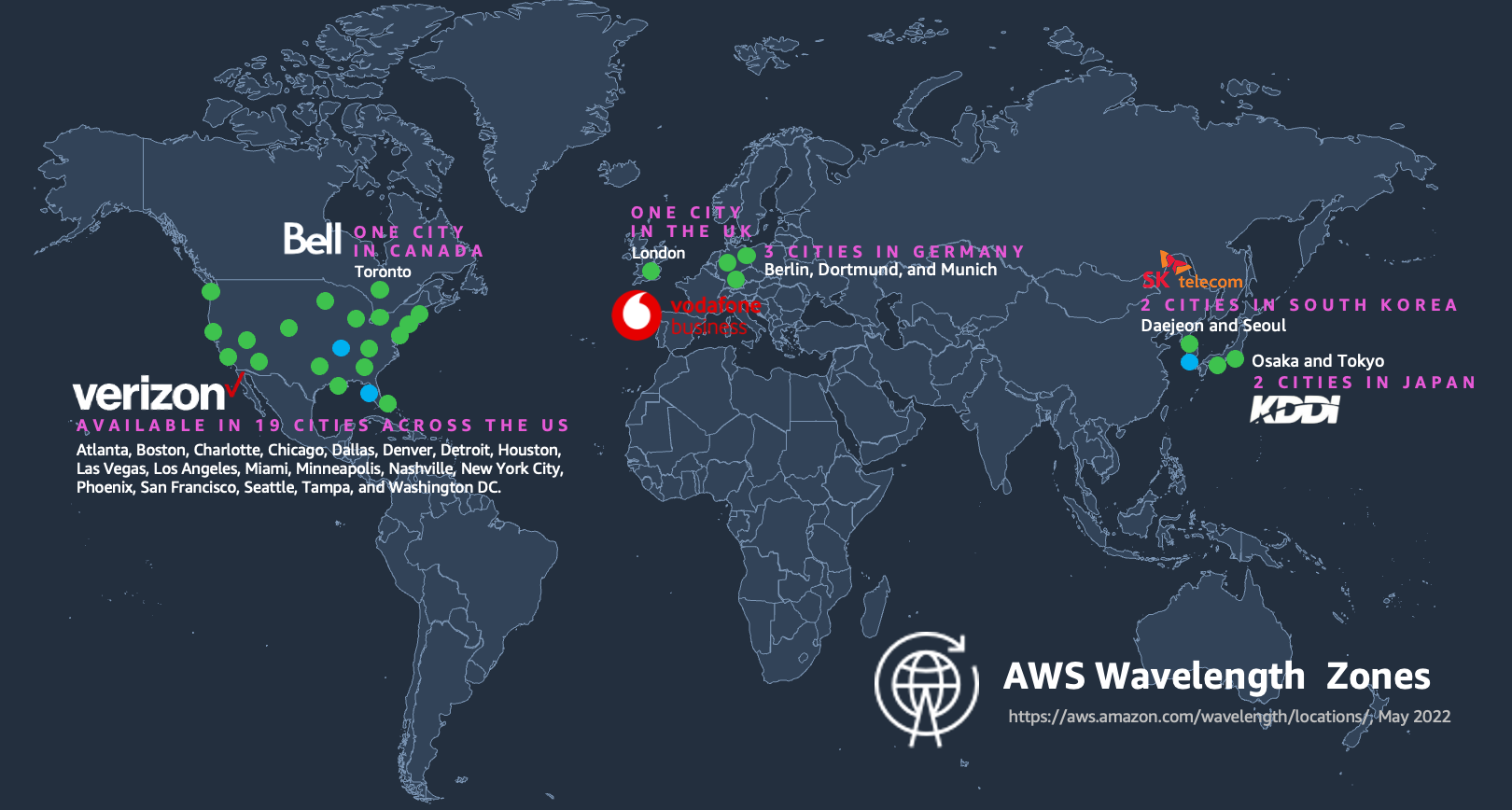
We opened the first AWS Wavelength Zones in 2020 in the US, and then we expanded to new countries, such as Japan, South Korea, the United Kingdom, and Germany. Today, I am happy to share that, in partnership with Bell Canada, we are expanding in a new country with a Wavelength Zone in Toronto.

What You Can Do with AWS Wavelength
As an example of what is possible with Wavelength, let’s look at food deliveries in Toronto. Most deliveries are made within 2 km, and a significant number are for just one item, such as a cup of coffee. Using a car for these deliveries is slow, expensive, and has a large carbon footprint. A better solution is provided by Tiny Mile: they use small remote-controlled robots to deliver small food orders such as coffees and sandwiches at one-tenth the cost of conventional delivery services.

Tiny Mile robot image.

Their remote staff uses the camera feed from the robots to understand the environment, read signage, and drive the robots. To scale up more efficiently, Tiny Mile can now use Bell’s public Multi-access Edge Computing (MEC) solution, delivered through AWS Wavelength, to process data and analyze the video feed in almost real time to detect obstacles and avoid collisions without manual intervention. Having computation at the edge also reduces the weight and the costs of the robots (they don’t need expensive computers onboard) and increases the amount of cargo they can carry.

Using a Wavelength Zone
I follow the instructions in Get started with AWS Wavelength in the documentation. First, I opt in to use the new Wavelength Zone. In the EC2 console for the Canada (Central) Region, I enable New EC2 Experience in the upper-left corner. In the navigation pane, I choose EC2 Dashboard. In the Account attributes section, I choose Zones. There, I enable the Canada (BELL) Wavelength Zone.

Console screenshot.

Now, I can configure networking to use the Wavelength Zone. I can either create an Amazon Virtual Private Cloud (VPC) or extend an existing VPC to include a subnet in a Wavelength Zone. In this case, I want to use a new VPC. In the VPC console, I choose Your VPCs and then Create VPC. I select the VPC only option to create subnets later. I write a name for the VPC and choose the IPv4 CIDR block that will be used for the private addresses of the resources in this VPC. Then, I complete the creation of the VPC.

Console screenshot.

In the navigation pane, I choose Carrier Gateways and then Create carrier gateway. I write a name and select the VPC I just created. I enable Route subnet traffic to the carrier gateway to automatically route traffic from subnets to the carrier gateway.

Console screenshot.

In the Subnets to route section, I configure a subnet residing in the Canada (BELL) – Toronto Wavelength Zone. For the subnet IPv4 CIDR Block, I use a block within the VPC range. Then, I complete the creation of the carrier gateway.

Console screenshot.

Now that networking is configured, I can deploy the portions of my application that require ultra-low latency in the Wavelength Zone and then connect that back to the rest of the application and the cloud services running in the Canada (Central) Region.

To run an EC2 instance in the Wavelength Zone, I use the AWS Command Line Interface (CLI) run-instances command. In this way, I can pass an option to automatically allocate and associate the Carrier IP address with the network interface of the EC2 instance. Another option is to allocate the carrier address and associate it with the network interface after I create the instance. The Carrier IP address is only valid within the telecommunications provider’s network. The carrier gateway uses NAT to translate the Carrier IP address and send traffic to the internet or to mobile devices.

aws ec2 --region ca-central-1 run-instances
--network-interfaces '[{"DeviceIndex":0, "AssociateCarrierIpAddress": true, "SubnetId": "subnet-0d753f7203c2cfd42"}]'
--image-id ami-01d29fca5bdf8f4b4 --instance-type t3.medium

To discover the IP associated with the EC2 instance in the carrier network, I use the describe-instances command:

aws ec2 --region ca-central-1 describe-instances

In the NetworkInterfaces section of the output, I find the Association and the CarrierIP:

"Association": {
  "CarrierIp": "207.61.170.56",
  "IpOwnerId": "amazon",
  "PublicDnsName": ""
}

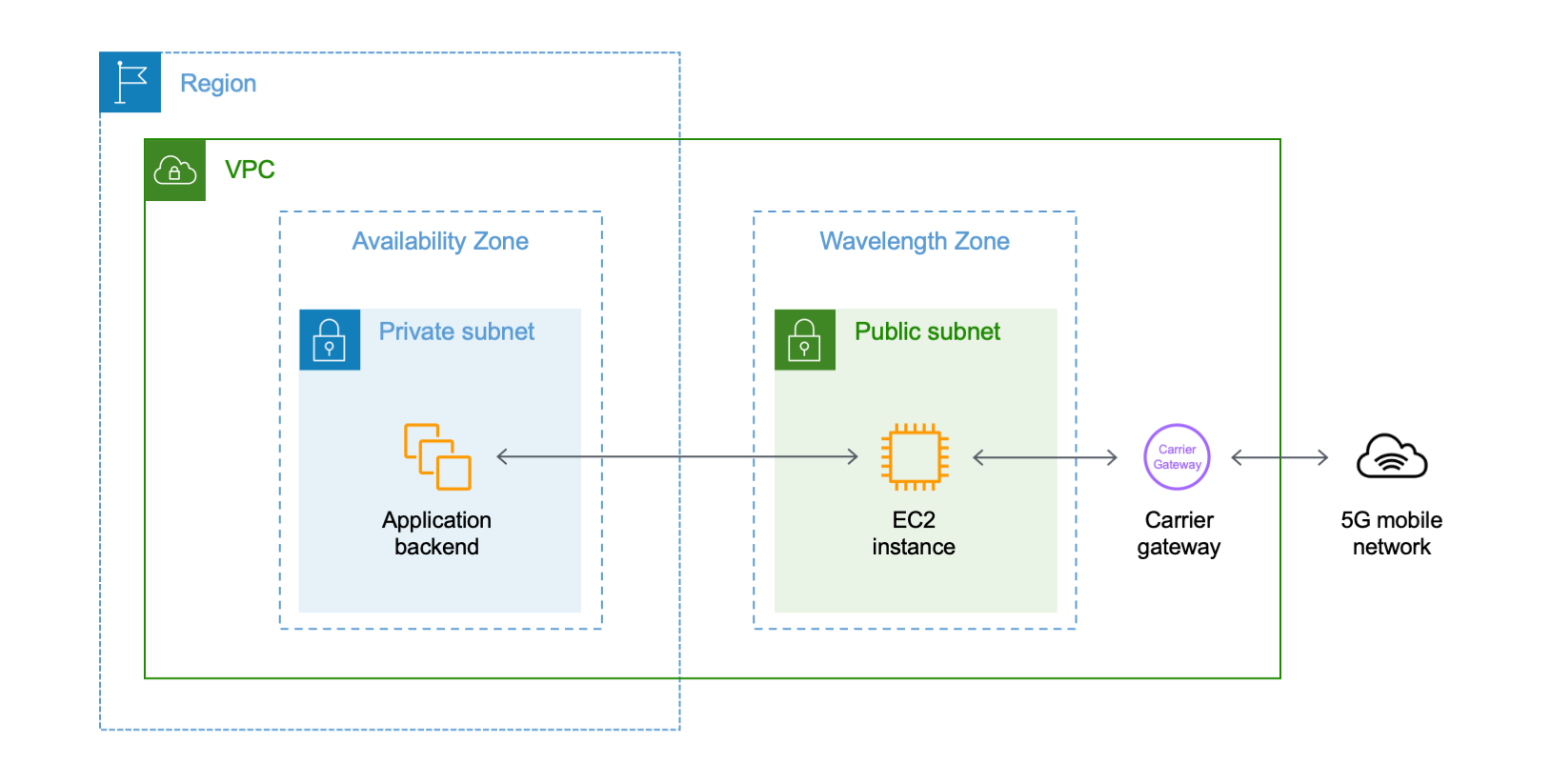
Now that the EC2 instance is running in the Wavelength Zone, I can deploy a portion of my application in the EC2 instance so that application traffic can be processed at very low latency without leaving the mobile network.

Architectural diagram.

For my next steps, I look at Deploying your first 5G enabled application with AWS Wavelength and follow the walkthrough for a common Wavelength use case: implementing machine learning inference at the edge.

Availability and Pricing
The new Wavelength Zone in Toronto, Canada, is embedded in Bell Canada’s 5G network and is available today. EC2 instances and other AWS resources in Wavelength Zones have different prices than in the parent Region. See the Wavelength pricing page for more information.

AWS Wavelength is part of AWS for the Edge services that help you deliver data processing, analysis, and storage outside AWS data centers and closer to your endpoints. These capabilities allow you to process and store data close to where it’s generated, enabling low-latency, intelligent, and real-time responsiveness.

Start using AWS Wavelength to deliver ultra-low-latency applications for 5G devices.

— Danilo

AWS Week in Review – April 25, 2022

Post Syndicated from Jeff Barr original https://aws.amazon.com/blogs/aws/aws-week-in-review-april-25-2022/

This post is part of our Week in Review series. Check back each week for a quick roundup of interesting news and announcements from AWS!

The first in this year’s series of AWS Summits took place in San Francisco this past week and we had a bunch of great announcements. Let’s take a closer look…

Last Week’s Launches
Here are some launches that caught my eye this week:

AWS Migration Hub Orchestrator – Building on AWS Migration Hub (launched in 2017), this service helps you to reduce migration costs by automating manual tasks, managing dependencies between tools, and providing better visibility into the migration progress. It makes use of workflow templates that you can modify and extend, and includes a set of predefined templates to get you started. We are launching with support for applications based on SAP NetWeaver with HANA databases, along with support for rehosting of applications using AWS Application Migration Service (AWS MGN). To learn more, read Channy’s launch post: AWS Migration Hub Orchestrator – New Migration Orchestration Capability with Customizable Workflow Templates.

Amazon DevOps Guru for Serverless – This is a new capability for Amazon DevOps Guru, our ML-powered cloud operations service which helps you to improve the availability of your application using models informed by years of Amazon.com and AWS operational excellence. This launch helps you to automatically detect operational issues in your Lambda functions and DynamoDB tables, giving you actionable recommendations that help you to identify root causes and fix issues as quickly as possible, often before they affect the performance of your serverless application. Among other insights you will be notified of concurrent executions that reach the account limit, lower than expected use of provisioned concurrency, and reads or writes to DynamoDB tables that approach provisioned limits. To learn more and to see the full list of insights, read Marcia’s launch post: Automatically Detect Operational Issues in Lambda Functions with Amazon DevOps Guru for Serverless.

AWS IoT TwinMaker – Launched in preview at re:Invent 2021 (Introducing AWS IoT TwinMaker), this service helps you to create digital twins of real-world systems and to use them in applications. There’s a flexible model builder that allows you to create workspaces that contain entity models and visual assets, connectors to bring in data from data stores to add context, a console-based 3D scene composition tool, and plugins to help you create Grafana and Amazon Managed Grafana dashboards. To learn more and to see AWS IoT TwinMaker in action, read Channy’s post, AWS IoT TwinMaker is now Generally Available.

AWS Amplify Studio – Also launched in preview at re:Invent 2021 (AWS Amplify Studio: Visually build full-stack web apps fast on AWS), this is a point-and-click visual interface that simplifies the development of frontend and backends for web and mobile applications. During the preview we added integration with Figma so that to make it easier for designers and front-end developers to collaborate on design and development tasks. As Steve described in his post (Announcing the General Availability of AWS Amplify Studio), you can easily pull component designs from Figma, attach event handlers, and extend the components with your own code. You can modify default properties, override child UI elements, extend collection items with additional data, and create custom business logic for events. On the visual side, you can use Figma’s Theme Editor plugin to make UI components to your organization’s brand and style.

Amazon Aurora Serverless v2 – Amazon Aurora separates compute and storage, and allows them to scale independently. The first version of Amazon Aurora Serverless was launched in 2018 as a cost-effective way to support workloads that are infrequent, intermittent, or unpredictable. As Marcia shared in her post (Amazon Aurora Serverless v2 is Generally Available: Instant Scaling for Demanding Workloads), the new version is ready to run your most demanding workloads, with instant, non-disruptive scaling, fine-grained capacity adjustments, read replicas, Multi-AZ deployments, and Amazon Aurora Global Database. You pay only for the capacity that you consume, and can save up to 90% compared to provisioning for peak load.

Amazon SageMaker Serverless Inference – Amazon SageMaker already makes it easy for you to build, train, test, and deploy your machine learning models. As Antje descibed in her post (Amazon SageMaker Serverless Inference – Machine Learning Inference without Worrying about Servers), different ML inference use cases pose varied requirements on the infrastructure that is used to host the models. For example, applications that have intermittent traffic patterns can benefit from the ability to automatically provision and scale compute capacity based on the volume of requests. The new serverless inferencing option that Antje wrote about provides this much-desired automatic provisioning and scaling, allowing you to focus on developing your model and your inferencing code without having to manage or worry about infrastructure.

Other AWS News
Here are a few other launches and news items that caught my eye:

AWS Open Source News and Updates – My colleague Ricardo Sueiras writes this weekly open-source newsletter where he highlights new open source projects, tools, and demos from the AWS community. Read edition #109 here.

Amazon Linux AMI – An Amazon Linux 2022 AMI that is optimized for Amazon ECS is now available. Read the What’s New to learn more.

AWS Step Functions – AWS Step Functions now supports over 20 new AWS SDK integrations and over 1000 new AWS API actions. Read the What’s New to learn more.

AWS CloudFormation Registry – There are 35 new resource types in the AWS CloudFormation Registry, including AppRunner, AppStream, Billing Conductor, ECR, EKS, Forecast, Lightsail, MSK, and Personalize. Check out the full list in the What’s New.

Upcoming AWS Events
AWS SummitThe AWS Summit season is in full swing – The next AWS Summits are taking place in London (on April 27), Madrid (on May 4-5), Korea (online, on May 10-11), and Stockholm (on May 11). AWS Global Summits are free events that bring the cloud computing community together to connect, collaborate, and learn about AWS. Summits are held in major cities around the world. Besides in-person summits, we also offer a series of online summits across the regions. Find an AWS Summit near you, and get notified when registration opens in your area.

.NET Enterprise Developer Day EMEA – .NET Enterprise Developer Day EMEA 2022 is a free, one-day virtual conference providing enterprise developers with the most relevant information to swiftly and efficiently migrate and modernize their .NET applications and workloads on AWS. It takes place online on April 26. Attendees can also opt-in to attend the free, virtual DeveloperWeek Europe event, taking place April 27-28.

AWS Innovate - Data EditionAWS Innovate – Data Edition Americas – AWS Innovate Online Conference – Data Edition is a free virtual event designed to inspire and empower you to make better decisions and innovate faster with your data. You learn about key concepts, business use cases, and best practices from AWS experts in over 30 technical and business sessions. This event takes place on May 11.

That’s all for this week. Check back again next week for the another AWS Week in Review!

— Jeff;

Announcing the General Availability of AWS Amplify Studio

Post Syndicated from Steve Roberts original https://aws.amazon.com/blogs/aws/announcing-the-general-availability-of-aws-amplify-studio/

Amplify Studio is a visual interface that simplifies front- and backend development for web and mobile applications. We released it as a preview during AWS re:Invent 2021, and today, I’m happy to announce that it is now generally available (GA). A key feature of Amplify Studio is integration with Figma, helping designers and front-end developers to work collaboratively on design and development tasks. To stay in sync as designs change, developers simply pull the new component designs from Figma into their application in Amplify Studio. The GA version of Amplify Studio also includes some new features such as support for UI event handlers, component theming, and improvements in how you can extend and customize generated components from code.

You may be familiar with AWS Amplify, a set of tools and features to help developers get started faster with configuring various AWS services to support their backend use cases such as user authentication, real-time data, AI/ML, and file storage. Amplify Studio extends this ease of configuration to front-end developers, who can use it to work with prebuilt and custom rich user interface (UI) components for those applications. Backend developers can also make use of Amplify Studio to continue development and configuration of the application’s backend services.

Amplify Studio’s point-and-click visual environment enables front-end developers to quickly and easily compose user interfaces from a library of prebuilt and custom UI components. Components are themeable, enabling you to override Amplify Studio‘s default themes to customize components according to your own or your company’s style guides. Components can also be bound to backend services with no cloud or AWS expertise.

Support for developing the front- and backend tiers of an application isn’t all that’s available. From within Amplify Studio, developers can also take advantage of AWS Amplify Hosting services, Amplify‘s fully managed CI/CD and hosting service for scalable web apps. This service offers a zero-configuration way to deploy the application by simply connecting a Git repository with a built-in continuous integration and deployment workflow. Deployment artifacts can be exported to tools such as the AWS Cloud Development Kit (AWS CDK), making it easy to add support for other AWS services unavailable directly within Amplify Studio. In fact, all of the artifacts that are created in Amplify Studio can be exported as code for you to edit in the IDE of your choice.

You can read all about the original preview, and walk through an example of using Amplify Studio and Figma together, in this blog post published during re:Invent.

UI Event Handlers
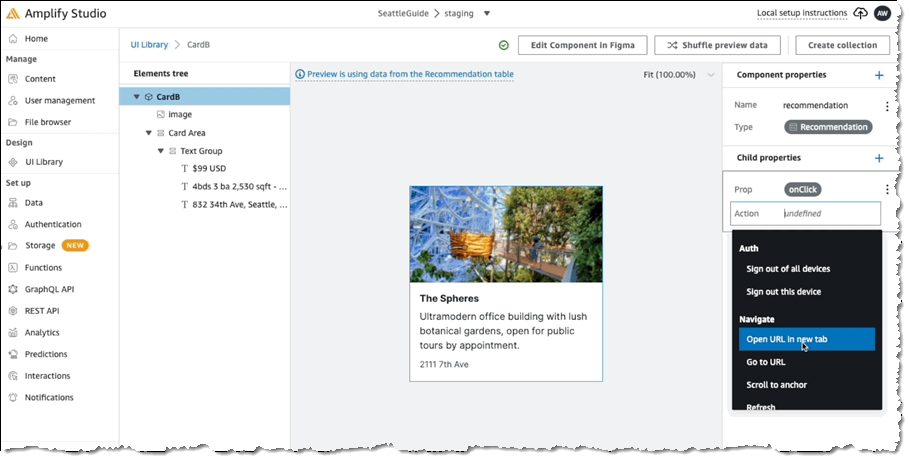
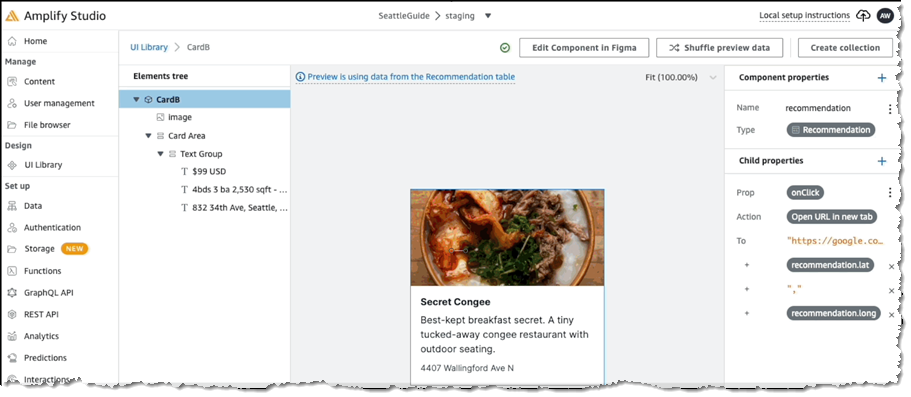
Front-end developers are likely familiar with the concepts behind binding events on UI components to invoke some action. For example, selecting a button might cause a transition to another screen or populate some other field with data, potentially supplied from a backend service. In the following screenshot, we’re configuring an event handler for the onClick event on a Card component to open a new browser tab:

Setting a UI event binding

For the selected action we then define the settings, in this case to open a map view onto the location using the latitude and longitude in the card object’s model:

Setting the properties for the action

Extending Components with Code
When you pull your component designs from Figma into your project in Amplify Studio using the amplify pull command, generated JSX code and TypeScript definition files that map to the Figma designs are added to your project. While you could then edit the generated code, the next time you run the pull command, your changes would be overwritten.

Instead of requiring you to edit the generated code, Amplify Studio exposes mechanisms that enable you to extend the generated code to achieve the changes you need without risking losing those changes if the component code files get regenerated. While this was possible in the original preview, the GA version of Amplify Studio makes this process much simpler and more convenient. There are four ways to change generated components within Amplify Studio:

  • Modifying default properties
    Modifying the default properties of components is simple and an approach that’s probably familiar to most developers. These default properties stem from the Amplify UI Library. For example, let’s say we have a custom collection component that derives from the base Collection type, and we want to control how (or even if) the items in the collection wrap when rendered. The Collection type exposes a wrap property which we can make use of:

    <MyCustomCollection wrap={"nowrap"} />
  • Override child UI elements
    Going beyond individual exposed properties, the code that’s generated for components (and all child components) exposes an overrides prop. This prop enables you to supply an object containing multiple prop overrides, giving you full control over extending that generated code. In the following example, I’m changing the color prop belonging to the Title prop of my collection’s items to orange. As I mentioned, the settings object I’m using could contain other properties I want to override too:

    <MyCustomCollectionItem overrides={{"Title": { color: "orange" } }} />
  • Extending collection items with data
    A useful feature when working with items in a collection is to augment items with additional data, and you can do this with the overrideItems prop. You supply a function to this property, accepting parameters for the item and the item’s index in the collection. The output from the function is a set of override props to apply to that item. In the following example, I’m toggling the background color for a collection item depending on whether the item’s index is odd or even. Note that I’m also able to attach code to the item, in this case, an onClick handler that reports the ID of the item that was clicked:

    <MyCustomCollection overrideItems={({ item, index })=>({
      backgroundColor: index % 2 === 0 ? 'white' : 'lightgray',
      onClick: () = alert(`You clicked item with id: ${item.id}`)
    })} />
  • Custom business logic for events
    Sometimes you want to run custom business logic in response to higher-level, logical events. An example would be code to run when an object is created, updated, or deleted in a datastore. This extensibility option provides that ability. In your code, you attach a listener to Amplify Hub’s ui channel. In your listener, you inspect the received events and take action on those of interest. You identify the events using names, which have a specific format, actions:[category]:[action_name]:[status]. You can find a list of all action event names in the documentation. In the following example, I’m attaching a listener in which I want to run some custom code when a new item in a DataStore has completed creation. In my code I need to inspect, in my listener, for an event with the name actions:datastore:create:finished:

    import { Hub } from 'aws-amplify'
    …
    Hub.listen("ui", (capsule) => {
      if (capsule.payload.event === "actions:datastore:create:finished"){
          // An object has been created, do something in response
      }
    });

Component Theming
To accompany the GA release of Amplify Studio, we’ve also released a Figma plugin that allows you to match UI components to your company’s brand and style. To enable it, simply install the Theme Editor plugin from the Figma community link. For example, let’s say I wanted to match Amazon’s brand colors. All I’d have to do is configure the primary color to the Amazon orange (#ff9900) color, and then all components will automatically reflect that primary color.

Get Started with AWS Amplify Studio Today
Visit the AWS Amplify Studio homepage to discover more features, whether you’re a backend or front-end developer, or both! It’s free to get started and designed to help simplify not only the configuration of backend services supporting your application but also the development of your application’s front end and the connections to those backend services. If you’re new to Amplify Studio, you’ll find a tutorial on developing a React-based UI and information on connecting your application to designs in Figma in the documentation.

— Steve

AWS IoT TwinMaker Is Now Generally Available

Post Syndicated from Channy Yun original https://aws.amazon.com/blogs/aws/aws-iot-twinmaker-is-now-generally-available/

Last year at AWS re:Invent 2021, we introduced the preview of AWS IoT TwinMaker, a new AWS IoT service that makes it faster and easier to create digital twins of real-world systems and use them to monitor and optimize industrial operations.

A digital twin is a living digital representation of an individual physical system that is dynamically updated with data to mimic the true structure, state, and behavior of the physical system in order to drive business outcomes. Digital twins can be applied to a wide variety of use cases spanning the entire lifecycle of a system or asset, such as buildings, factories, industrial equipment, and production lines.

Many of our customers are still early in their digital twins journey. They are working hard to connect their data across disparate sources and be able to contextually visualize that data in a dashboard or an immersive environment in order to unlock their business value and outcomes.

Today at AWS Summit San Francisco, we announce the general availability of AWS IoT TwinMaker with new features, improvements, and the availability in additional AWS Regions. AWS IoT TwinMaker provides the tools to build digital twins using existing data from multiple sources, create virtual representations of any physical environment, and combine existing 3D models with real-world data. With AWS IoT TwinMaker, you can now harness digital twins to create a holistic view of your operations faster and with less effort.

AWS IoT TwinMaker has capabilities for each stage of the digital twin building process: collecting data from diverse data sources using connectors (components), connecting to data where it lives to represent your digital twins, and combining existing 3D visual models with real-world data using a scene composition tool, and building web-based applications using a plug-in for Grafana and Amazon Managed Grafana that you can use to create dashboards.

For example, Cognizant’s 1Facility solution uses AWS IoT TwinMaker to help improve the building monitoring experience by reducing the time to troubleshoot a building issue via 3D visualization and aggregating data from multiple sources in a connected building. To learn about more use cases, visit AWS IoT TwinMaker Customers.

To get started with AWS IoT TwinMaker, refer to the step-by-step process for building your digital twin in Introducing AWS IoT TwinMaker. Also, you can test a fully built-out sample digital twin of a cookie factory complete with simulated data connectors from the GitHub repository. This sample code will guide you through the process of building a digital twin application and let you explore many of the features of AWS IoT TwinMaker.

New Features at the General Availability Launch
At this launch, we added some new features in AWS IoT TwinMaker:

Motion indicator – In preview, developers choose from two ways to represent data in a 3D scene: 1) tag, which can be used to bind an entity with a property and use simple rules to drive behavior like changing colors in near real time when certain conditions are met, and 2) model shader, used to change the color of the entire entity based on simple rules. Now there is a third option, motion indicator, to depict speed of motion in addition to tags (alerts) and color overlay (changing a model’s color).

There are three kinds of motion indicators for different use cases with different visuals, for example, LinearPlane (for conveyor belt), LinearCylinder (for tube), and CircularCylinder (for mixer). You can configure the motion speed and the background or foreground color of the indicator widget with either static values or with rules that will change according to different data input.

Scene templatization – With this new feature, all the data bindings such as for tags and model shaders are templatized. You can choose a template for the data binding in the console. For example, a tag can bind to each ${entityId}/${componentName}/AlarmStatus. When the operator selects the alarm for Mixer 1, the Mixer 3D Scene shows the information for Mixer 1; if the operator chooses Mixer 2, then the Mixer 3D Scene will show the information for Mixer 2.

More API improvements – We are making continuous improvements to user experience across the service based on usability feedback, including in AWS IoT TwinMaker APIs. Here are some API changes:

  • ExternalId filter – Added a new filter to ListEntities API to allow filtering by a property that is marked as isExternalId.
  • Timestamp precision – Added a new type to capture time in ISO 8601 format to support arbitrary timestamp precision like nanoseconds in data plane APIs.
  • New CREATE update type – Added new property update type CREATE to let users explicitly state the intent of the update in an entity. Previously, there were only UPDATE and DELETE.

More code samples – You can refer to more developer samples to get started with AWS IoT TwinMaker. These code packages, including new data connectors such as Snowflake, are distributed through our GitHub repository for the most common scenarios, with a goal to support and build a community of developers building digital twins with AWS IoT TwinMaker.

Now Available
AWS IoT TwinMaker is available in US East (N. Virginia), US West (Oregon), Europe (Ireland), and Asia Pacific (Singapore) Regions. Now, it is also available in Europe (Frankfurt) and Asia Pacific (Sydney) Regions.

As part of the AWS Free Tier, you can use up to 50 million data access API calls for free each month for your first 12 months using AWS. When your free usage expires, or if your application use exceeds the free tier, you simply pay the rates listed on the pricing page. To learn more about AWS IoT TwinMaker, refer to the product page and the documentation.

If you are looking for an AWS IoT TwinMaker partner to support your digital twin journey, visit the AWS IoT TwinMaker Partners page. Please send feedback to AWS re:Post for AWS IoT TwinMaker or through your usual AWS support contacts.

– Channy

AWS Migration Hub Orchestrator – New Migration Orchestration Capability with Customizable Workflow Templates

Post Syndicated from Channy Yun original https://aws.amazon.com/blogs/aws/aws-migration-hub-orchestrator-new-migration-orchestration-capability-with-customizable-workflow-templates/

You can migrate any workload from an on-premises environment to AWS. The key to a successful migration to AWS is a well-thought-out plan, informative tools, prior migration experience, and a quality implementation. Every step along the way, you can use AWS’s years of experience to build your organizational, operational, and technical capabilities so that you can gain business benefits faster.

In 2017, we introduced AWS Migration Hub, a single location for cloud migration and modernization, giving you the tools you need to accelerate and simplify your journey with AWS. With Migration Hub, you can discover or import your on-premises server details, build a migration strategy with right-sizing recommendations, track migrations across multiple tools in a simple dashboard, and refactor your applications incrementally in any AWS Region.

Today we announce the general availability of AWS Migration Hub Orchestrator, providing predefined and customizable workflow templates that offer a prescribed set of migration tasks, migration tools, automation opportunities, and tracking your progress in one place.

With Migration Hub Orchestrator, you can reduce the migration costs and time by removing many of the manual tasks involved in migrating large-scale enterprise applications, managing dependencies between different tools, and providing visibility into the migration progress. Also, Migration Hub Orchestrator enables customers to customize the templates and add additional steps to suit their workflow needs. At this launch, Migration Hub Orchestrator supports the migrations of SAP NetWeaver-based applications with HANA databases and the rehosting of any applications using AWS Application Migration Service (AWS MGN).

AWS Migration Hub Orchestrator – Getting Started
To get started with AWS Migration Hub Orchestrator, choose Get started to create a new migration workflow in the Migration Hub console.

To create a new workflow, you need to add data sources from your on-premises servers and applications using the AWS discovery tools, group your servers as applications, and download and configure the plugin in your environment. This plugin requires a one-time agentless setup in your source environment.

You can install this plugin as a virtual machine in your VMware vCenter Server environment using the AWS-provided Open Virtualization Archive (OVA) file. Migration Hub Orchestrator uses the plug-in to automatically run migration tasks on the source systems while executing the workflow, such as installing AWS MGN agents on source systems. You can see registered plugins in the Plugins menu.

After completing the prerequisites for Migration Hub Orchestrator setup, you can begin configuring a workflow with your chosen template by clicking the Create workflow button in the Workflows menu.

Choose a workflow template, either Rehost applications on Amazon EC2 or Migrate SAP NetWeaver applications to AWS. This workflow template is a playbook of migration workflow specifications: 1) the step-by-step migration workflow and dependencies, 2) migration services, solutions, or scripts required to automate the migration step, and 3) the required input parameters, such as source virtual machine and application settings, target system settings, replication settings, and cutover requirements for the migration.

To configure your workflow to rehost applications on Amazon EC2 in the next step, enter a name for your workflow, select your application to migrate, configure the source environment, and, optionally, add a description and tags.

When you choose a workflow template for migrating an SAP application, provide source SAP application information. As part of the workflow execution, the service will guide you to deploy the target SAP environment using AWS Launch Wizard, extract application info from the newly deployed stack and migrates the application using an SAP and HANA database-specific replication mechanism like HANA System Replication (HSR).

Select  Review and submit in the Step 3 Configure your workflow, it takes several minutes to create your workflow. You can confirm the list of migration workflows.

Choose one of the migration workflows not started yet and select the Run button to migrate your application with each step in the general rehosting process. It takes several minutes to finish the migration. AWS Migration Hub Orchestrator also allows you to pause, resume, or delete your workflows.

After the completion of migration, you can verify the status of each migration step, from validating the source environment to completing the cutover to AWS.

When you select one of the steps, you can check the details of each step transparently.

Also, you can customize your workflow by adding your own steps, dependencies, and automations to address the needs of your specific use cases. Use the Add option to add steps and specify the custom script that you want to run on the source or destination server as part of that step.

For example, you can perform additional migration readiness checks, change configurations of the target environment, and perform post-migration tests using your own automation scripts. You can also add manual steps as part of the workflow as required.

In the case of the SAP application migration, it includes each migration step in several categories, from validating connectivity to the source server to the cutover to AWS.

As you now know, AWS Migration Orchestrator simplifies the complex migration process that often involves multiple teams and tools by automating the manual tasks involved in migrating large-scale enterprise applications managing dependencies between different tools and providing visibility of migration progress in one place.

We plan to add support for more migration and modernization workflows to reduce the migration costs and time to complete the migration.

Troubleshooting Migration Orchestration
AWS Migration Hub Orchestrator stores the output and logs of steps in S3 bucket under your account. These logs can be used to troubleshoot issues or examine the output of a step. For the tasks that are blocked in the dependent migration service, you can also access the consoles of those services for additional troubleshooting.

Migration Hub Orchestrator is integrated with AWS CloudTrail, a service that provides a record of actions taken by a user, role, or an AWS service to capture all API calls for Migration Hub Orchestrator as events.

If you have more than one AWS account, you can use AWS Organizations in Migration Hub Orchestrator from any member account or organizational unit in your company.

Now Available
AWS Migration Hub Orchestrator is now generally available, and you can use it in all AWS Regions where AWS Migration Hub is available. There is no additional cost for using Migration Hub Orchestrator, and you only pay for the AWS resources that you provision for the migration. To learn more, see the product page.

If you are looking for a Migration Partner to support your cloud adoption, visit the AWS Migration Hub Partners page. Please send feedback to AWS re:Post for Migration Hub or through your usual AWS support contacts.

– Channy

AWS Week in Review – April 18, 2022

Post Syndicated from Antje Barth original https://aws.amazon.com/blogs/aws/aws-week-in-review-april-18-2022/

This post is part of our Week in Review series. Check back each week for a quick roundup of interesting news and announcements from AWS!

Here we are with another roundup of the most significant AWS launches from the previous week. Among the news, we have a new deployment option for Amazon FSx for NetApp ONTAP, performance and scaling improvements done in AWS Fargate, and an update on the AWS AI & ML Scholarship program.

Last Week’s Launches
Here are some launches that caught my attention last week:

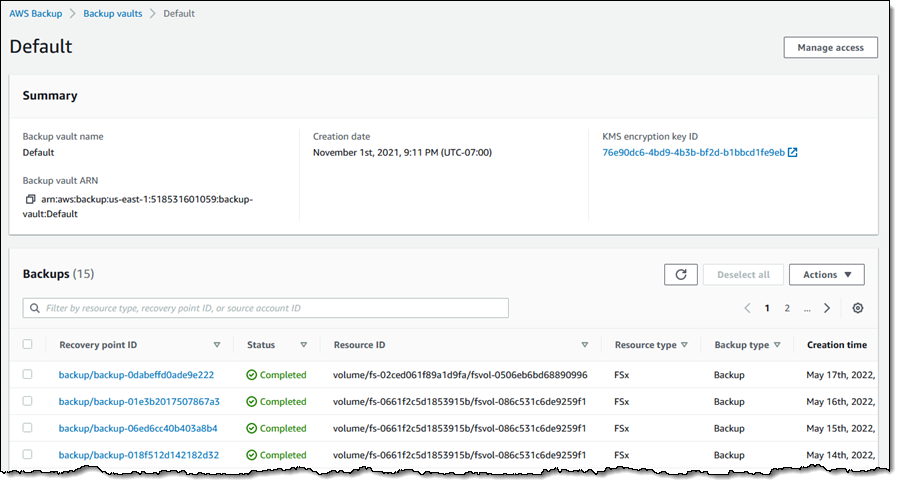
Amazon FSx for NetApp ONTAP introduces a single Availability Zone (AZ) deployment option – Amazon FSx for NetApp ONTAP allows you to launch and run fully managed ONTAP file systems in the cloud. With the new single-AZ deployment option, you can now implement use cases that need storage replicated within an Availability Zone but do not require resiliency across AZs. This could be use cases such as development and test workloads or storing secondary copies of data already stored on-premises or in other AWS Regions. Check out Jeff’s launch blog post to learn more.

Amazon FSx for NetApp ONTAP - Single AZ Deployment

AWS Fargate now delivers faster scaling of applications – AWS Fargate is a serverless compute engine for containers that works with both Amazon Elastic Container Service (Amazon ECS) and Amazon Elastic Kubernetes Service (Amazon EKS). The team has made several improvements over the last year that enable you to scale applications up to 16X faster, making it easier to build and run applications at a larger scale on Fargate. Check out Nathan’s blog post to learn more.

AWS Fargate now delivers faster scaling of applications

AWS AI & ML Scholarship Program opens applications for underrepresented and underserved students – You can now apply for the AWS AI & ML Scholarship Program that will launch this summer. The scholarship program aims to help underserved and underrepresented high school and college students learn foundational ML concepts to prepare them for careers in AI and ML. The program uses AWS DeepRacer Student to teach foundational ML concepts, offer hands-on learning, and track scholarship prerequisites. Check out Anastacia’s blog post for more information and how to apply.

Apply for the AWS AI & ML Scholarship Program through AWS DeepRacer Student

AWS App Runner launches AWS X-Ray support – AWS App Runner is a fully managed service that developers can use to quickly deploy containerized web applications and APIs at scale with little to no infrastructure experience. App Runner now supports tracing as part of its observability suite. You can trace your containerized applications in AWS X-Ray by instrumenting applications with the AWS Distro for OpenTelemetry (ADOT). Check out Yiming’s blog post for more information.

For a full list of AWS announcements, be sure to keep an eye on the What’s New at AWS page.

Other AWS News
Here are additional news and a blog post that caught my attention:

AWS Open-Source News and Updates – My colleague Ricardo Sueiras writes this weekly open-source newsletter in which he highlights new open-source projects, tools, and demos from the AWS Community. Read edition #108 here.

Scheduling Jupyter Notebooks with AWS Orbit Workbench – In this blog post, Olalekan Elesin, Head of Data Platform & Data Architect at HRS Group and AWS Machine Learning Hero, describes how the HRS Group is scheduling Jupyter Notebooks with AWS Orbit Workbench. AWS Orbit Workbench is an open-source framework that provides a single, unified experience for your data, analytics and machine learning projects. Check out Olalekan’s blog post to learn more.

Upcoming AWS Events
Check your calendars and sign up for these AWS events:

AWS SummitThe AWS Summit season is in full swing – The next AWS Summits are taking place in San Francisco (on April 20-21), London (on April 27), Madrid (on May 4-5) and Korea (online, on May 10-11). AWS Global Summits are free events that bring the cloud computing community together to connect, collaborate, and learn about AWS. Summits are held in major cities around the world. Besides in-person summits, we also offer a series of online summits across the regions. Find an AWS Summit near you, and get notified when registration opens in your area.

.NET Enterprise Developer Day EMEA – .NET Enterprise Developer Day EMEA 2022 is a free, one-day virtual conference providing enterprise developers with the most relevant information to swiftly and efficiently migrate and modernize their .NET applications and workloads on AWS. It takes place online on April 26. Attendees can also opt-in to attend the free, virtual DeveloperWeek Europe event, taking place April 27-28.

AWS Innovate - Data EditionAWS Innovate – Data Edition Americas – AWS Innovate Online Conference – Data Edition is a free virtual event designed to inspire and empower you to make better decisions and innovate faster with your data. You learn about key concepts, business use cases, and best practices from AWS experts in over 30 technical and business sessions. This event takes place on May 11.

That’s all for this week. Check back next Monday for another Week in Review!

– Antje

AWS Partner Network (APN) – 10 Years and Going Strong

Post Syndicated from Jeff Barr original https://aws.amazon.com/blogs/aws/aws-partner-network-apn-10-years-and-going-strong/

AWS 10 Years with animated flamesTen years ago we launched AWS Partner Network (APN) in beta form for our partners and our customers. In his post for the beta launch, my then-colleague Jinesh Varia noted that:

Partners are an integral part of the AWS ecosystem as they enable customers and help them scale their business globally. Some of our greatest wins, particularly with enterprises, have been influenced by our Partners.

A decade later, as our customers work toward digital transformation, their needs are becoming more complex. As part of their transformation they are looking for innovation, differentiating solutions, and routinely ask us to refer them to partners with the right skills and the specialized capabilities that will help them to make the best of use AWS services.

The partners, in turn, are stepping up to the challenge and driving innovation on behalf of their customers in ways that transform multiple industries. This includes migration of workloads, modernization of existing code & architectures, and the development of cloud-native applications.

Thank You, Partners
AWS Partners all around the world are doing amazing work! Integrators like Presidio in the US, NEC in Japan, Versent in Australia, T-Systems International in Germany, and Compasso UOL in Latin America are delivering some exemplary transformations on AWS. On the product side, companies like Megazone Cloud (Asia/Pacific) are partnering with global ISVs such as Databricks, Datadog, and New Relic to help them go to market. Many other ISV Partners are working to reinvent their offerings in order to take advantage of specific AWS services and features. The list of such partners is long, and includes Infor, VTEX, and Iron Mountain, to name a few.

In 2021, AWS and our partners worked together to address hundreds of thousands of customer opportunities. Partners like Snowflake, logz.io, and Confluent have told us that AWS Partner program such as ISV Accelerate and AWS Global Startup Program are having a measurable impact on their businesses.

These are just a few examples (we have many more success stories), but the overall trend should be pretty clear — transformation is essential, and AWS Partners are ready, willing, and able to make it happen.

As part of our celebration of this important anniversary, the APN Blog will be sharing a series of success stories that focus on partner-driven customer transformation!

A Decade of Partner-Driven Innovation and Evolution
We launched APN in 2012 with a few hundred partners. Today, AWS customers can choose offerings from more than 100,000 partners in more than 150 countries.

A lot of this growth can be traced back to our first Leadership Principle, Customer Obsession. Most of our services and major features have their origins in customer requests and APN is no different: we build programs that are designed to meet specific, expressed needs of our customers. Today, we continue to seek and listen to partner feedback, use that feedback to innovate and to experiment, and to get it to market as quickly as possible.

Let’s take a quick trip through history and review some of the most interesting APN milestones of the last decade:

In 2012, we first announced the partner type (Consulting and Technology) model when APN came to life. With each partner type, partners could qualify for one of the three tiers (Select, Advanced, and Premier) and achieve benefits based on their tier.

In 2013, AWS Partners told us they wanted to stand out in the industry. To allow partners to differentiate their offerings to customers and show expertise in building solutions, we introduced the first two of what is now a very long list of competencies.

In 2014, we launched the AWS Managed Service Provider Program to help customers find partners who can help with migration to the AWS cloud, along with the AWS SaaS Factory program to support partners looking to build and accelerate delivery of SaaS (Software as a Service) solutions on behalf of their customers. We also launched the APN Blog channel to bring partner success stories with AWS and customers to life. Today, the APN Blog is one of the most popular blogs at AWS.

Next in 2016, customers started to ask us where to go when looking for a partner that can help design, migrate, manage, and optimize their workloads on AWS, or for partner-built tools that can help them achieve their goals. To help them more easily find the right partner and solution for their specific business needs, we launched the AWS Partner Solutions Finder, a new website where customers could search for, discover, and connect with AWS Partners.

In 2017, to allow partners to showcase their earned AWS designations to customers, we introduced the Badge Manager. The dynamic tool allows partners to build customized AWS Partner branded badges to highlight their success with AWS to customers.

In 2018, we launched several new programs and features to better support our partners gain AWS expertise and promote their offerings to customers including AWS Device Qualification program, AWS Well-Architected Partner Program, and several competencies.

In 2019, for mid-to-late stage startups seeking support with product development, go-to-market and co-sell, we launched the AWS Global Startup program. We also launched the AWS Service Ready Program to help customers find validated partner products that work with AWS services.

Next, in 2020 to help organizations co-sell, drive new business and accelerate sales cycles we launched the AWS ISV Accelerate program.

In 2021 our partners told us that they needed more (and faster) ways to work with AWS so that they could meet the ever-growing needs of their customers. We launched AWS Partner Paths in order to accelerate partner engagement with AWS.

Partner Paths replace technology and consulting partner type models—evolving to an offering type model. We now offer five Partner Paths—Software Path, Hardware Path, Training Path, Distribution Path, and Services Path—which represents consulting, professional, managed, or value-add resale services. This new framework provides a curated journey through partner resources, benefits, and programs.

Looking Ahead
As I mentioned earlier, Customer Obsession is central to everything that we do at AWS. We see partners as our customers, and we continue to obsess over ways to make it easier and more efficient for them to work with us. For example, we continue to focus on partner specialization and have developed a deep understanding of the ways that our customers find it to be of value.

Our goal is to empower partners with tools that make it easy for them to navigate through our selection of enablement resources, benefits, and programs and find those that help them to showcase their customer expertise and to get-to-market with AWS faster than ever. The new AWS Partner Central (login required) and AWS Partner Marketing Central experiences that we launched earlier this year are part of this focus.

To wrap up, I would like to once again thank our partner community for all of their support and feedback. We will continue to listen, learn, innovate, and work together with you to invent the future!

— Jeff;

Amazon FSx for NetApp ONTAP Update – New Single-AZ Deployment Type

Post Syndicated from Jeff Barr original https://aws.amazon.com/blogs/aws/amazon-fsx-for-netapp-ontap-update-new-single-az-deployment-type/

Last year I told you about Amazon FSx for NetApp ONTAP and showed you how you can create a file system in minutes with just a couple of clicks. You can use these high-performance, scalable (up to 176 PiB) file systems to migrate your on-premises applications to the cloud and to build new, cloud-native applications. As I noted in my original post, your file systems can have up to 192 TiB of fast, SSD-based primary storage, and many pebibytes of cost-optimized capacity pool storage. Your file systems also support many of ONTAP’s unique features including multi-protocol (NFS, SMB, and iSCSI) access, built-in deduplication & compression, cloning, and replication.

We launched Amazon FSx for NetApp ONTAP with a Multi-AZ deployment type that has AWS infrastructure in a pair of Availability Zones in the same AWS region, data replication between them, and automated failover/failback that is typically complete within seconds. This option has a 99.99% SLA (Service Level Agreement) for availability, and is suitable for hosting the most demanding storage workloads.

New Deployment Type
Today we are launching a new single-AZ deployment type that is designed to provide high availability and durability within an AZ, at a level similar to an on-premises file system. It is a great fit for many use cases including dev & test workloads, disaster recovery, and applications that manage their own replication. It is also a great for storing secondary copies of data that is stored elsewhere (either on-premises or AWS), or for data that can be recomputed if necessary.

The AWS infrastructure powering each single-AZ file system resides in separate fault domains within a single Availability Zone. As is the case with the multi-AZ option, the infrastructure is monitored and replaced automatically, and failover typically completes within seconds.

This new deployment type offers the same ease of use and data management capabilities as the multi-AZ option, with 50% lower storage costs and 40% lower throughput costs. File operations deliver sub-millisecond latency for SSD storage and tens of milliseconds for capacity pool storage, at up to hundreds of thousands of IOPS.

Creating a Single-AZ File System
I can create a single-AZ NetApp ONTAP file system using the Amazon FSx Console, the CLI (aws fsx create-file-system), or the Amazon FSx CreateFileSystem API function. From the console I click Create file system, select Amazon FSx for NetApp ONTAP, and enter a name. Then I select the Single-AZ deployment type, indicate the desired amount of storage, and click Next:

On the next page I review and confirm my choices, and then click Create file system. The file system Status starts out as Creating, then transitions to Available within 20 minutes or so, as detailed in my original post.

Depending on my architecture and use case, I can access my new file system in several different ways. I can simply mount it to an EC2 instance running in the same VPC. I can also access it from another VPC in the same region or in a different region across a peered (VPC or Transit Gateway) connection, and from my on-premises clients using AWS Direct Connect or AWS VPN.

Things to Know
Here are a couple of things to know:

Regions – The new deployment type is available in all regions where FSx for ONTAP is already available.

Pricing – Pricing is based on the same billing dimensions as the multi-AZ deployment type; see the Amazon FSx for NetApp Pricing page for more information.

Available Now
The new deployment type is available now and you can start using it today!

— Jeff;

AWS Week in Review – April 11, 2022

Post Syndicated from Channy Yun original https://aws.amazon.com/blogs/aws/aws-week-in-review-april-11-2022/

This post is part of our Week in Review series. Check back each week for a quick round up of interesting news and announcements from AWS!

As spring arrives in the Northern Hemisphere, tulips, sunshine, and cherry blossoms finally appear to be in bloom—surely signs of warmer days to come in North America, Asia, and Europe. I hope you enjoy the spring and, in the Southern Hemisphere, fall season with your family.

Let’s look the second edition of the AWS Week in Review for the month of April!

Last Week’s Launches
Here are some launches that caught my attention last week:

New Amazon EC2 Single Page Instance Launching Console – As Jeff introduced, the Amazon EC2 console introduces the new and improved launch experience—a quicker and easier way to launch an instance. The new design provides a single page layout, allowing you to view all your settings in one location. You no longer need to navigate back and forth between steps to ensure your configuration is correct. The new design also introduces a summary panel that provides an overview and helps navigate the page. Quickly get started by following the simple steps and see the EC2 documentation to learn more.

Unified Settings in the AWS Management Console – New Unified Settings will persist across devices, browsers, and services. It supports settings called default language, Region, visual theme such as either light or dark mode, and favorites bar with either the service icon and full name or only the service icon. You can access Unified Settings by signing in to the AWS Management Console, navigating to the account menu, and selecting Settings in all AWS Regions.

AWS Lambda Function URLs – This is really big news! AWS Lambda Function URLs is a new feature that makes it easier to invoke functions through an HTTPS endpoint as a built-in capability of the AWS Lambda service. You can add Function URLs to new and existing functions easily from the Lambda console. Function URLs are ideal for getting started with building web services on Lambda or for common tasks like building webhooks. To get started quickly and learn more, see Alex’s blog post.

Amazon CloudWatch Metrics Insights is Now Generally Available – As a fast, flexible, SQL-based query engine, Amazon CloudWatch Metrics Insights enables you to identify trends and patterns across millions of operational metrics in real time and helps you use these insights to reduce time to resolution. With Metrics Insights, you can gain better visibility on your infrastructure and large-scale application performance with flexible querying and on-the-fly metric aggregations. To get started, select the All metrics link under Metrics on the left navigation panel of the CloudWatch console and browse to the Query tab. To learn more, see the Metrics Insights documentation.

AWS Amplify Studio’s New File Storage and File Management – This new feature makes it easy to store and serve user-generated content (such as photos and videos) from web or mobile apps. With Amplify Studio, you can easily create an Amazon Simple Storage Service (Amazon S3) bucket, configure file access levels, integrate storage client libraries into your web or mobile app, and manage files in Studio’s drag-and-drop file explorer. Get started by reading Nikhil’s blog post on how to provision Storage directly from your Amplify Studio.

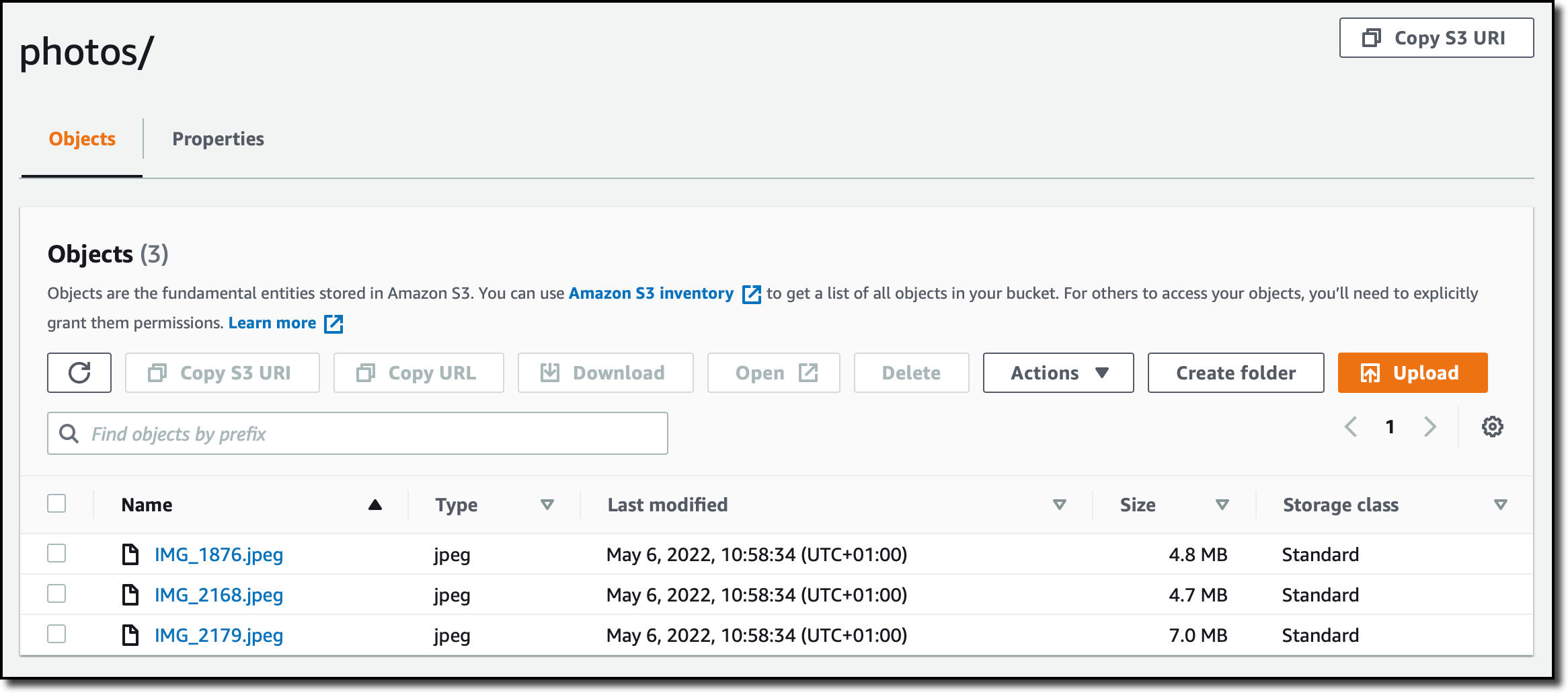
You can either select Upload files or drag and drop files onto your browser

For a full list of AWS announcements, be sure to keep an eye on the What’s New at AWS page.

Other AWS News
Here are some featured news items about open-source and community support at AWS in the last week:

Amazon Athena ACID Transactions Powered by Apache Iceberg – We announced the general availability of Amazon Athena ACID transactions, a new capability that adds insert, update, delete, and time travel operations to Athena’s SQL data manipulation language (DML). Built on the Apache Iceberg table format, Athena ACID transactions are optimized for Amazon S3 storage, support seamless schema evolution, and ensure atomic operations across other services and engines that support the Iceberg table format. To learn more, see Using Amazon Athena Transactions and Using Iceberg Tables in the Athena User Guide.

Amazon OpenSearch Service Now Supports OpenSearch 1.2 – We launched support for OpenSearch 1.0 on Amazon OpenSearch Service in September 2021 and for OpenSearch 1.1 in January 2022. The support included features of OpenSearch 1.2 such as transforms, data streams, notebooks, cross-cluster replication, and improvements to anomaly detection and alerting.

Amazon EKS Now Supports Kubernetes 1.22 – Customers can start taking advantage of the numerous enhancements and new generally available APIs in Kubernetes 1.22. In line with the Kubernetes community support for Kubernetes versions, Amazon EKS is committed to supporting at least four production-ready versions of Kubernetes at any given time. You can learn about how to upgrade your EKS version in our blog posts Amazon EKS now supports Kubernetes 1.22 and Planning Kubernetes Upgrades with Amazon EKS.

The New AWS Community Builders Directory – You can find over 800 AWS Community Builders in the global directory. Community Builders are technical enthusiasts and emerging thought leaders who are passionate about sharing knowledge and connecting with the technical community. You can contact all Community Builders in the directory to engage the AWS Community in your Region. To see created and shared content by them, check them out on dev.to.

Upcoming AWS Events
Check your calendars and sign up for these AWS events:

AWS Summits in the Asia-Pacific Are Back – I am happy to announce newly scheduled AWS Summits Online in the Asia-Pacific Regions such as Korea (on May 10–11), ASEAN (on May 18), and Australia & New Zealand (on May 18–19). More in-person summits in May are coming in Madrid (on May 4), Stockholm (on May 11), Berlin (on May 11–12), Tel Aviv (on May 18), and Atlanta (on May 18–19). Find an AWS Summit near you!

AWS Online Tech Talks for April – These talks cover a range of topics and expertise levels and features technical deep dives, demonstrations, customer examples, and live Q&A with AWS experts. Over 20 virtual or on-demand seminars have been scheduled from April 18–29. You can also find archived on-demand videos from previous AWS Online Tech Talks.

AWS Solutions-Focused Immersion Days – This is a series of events that are designed to educate you about AWS products and services and help you develop the skills needed to build, deploy, and operate your infrastructure and applications in the cloud. Hands on labs provide you with an immersive experience in the AWS console. Join us to learn how to build on AWS.

To find more about AWS events and webinars, explore the all AWS Events page.

That’s all for this week. Check back next Monday for another Week in Review!

— Channy

AWS Week in Review – April 4, 2022

Post Syndicated from Sébastien Stormacq original https://aws.amazon.com/blogs/aws/aws-week-in-review-april-4-2022/

This post is part of our Week in Review series. Check back each week for a quick round up of interesting news and announcements from AWS!

Welcome to the April 4 edition of the AWS Week in Review. This week, alongside the main launches, I also captured a couple of new capabilities, such as a new API to manage your AWS accounts within AWS Organizations, an easier process to update your AWS Lambda layers, and a new behavior of Amazon Elastic Compute Cloud (Amazon EC2).

Last Week’s Launches
Here are some launches that caught my attention last week:

Sustainability Pillar is now available in the Well Architect Tool – The Well Architected Tool is a central place for cloud architecture best practices and guidance. The Sustainability Pillar was announced at the re:Invent 2021 conference. It helps you to learn, measure, and improve your workloads using environmental best practices for cloud computing.

Close an AWS Member Account with an API Call – This feature was launched with little fanfare, but it is a big deal for those of you managing large numbers of AWS accounts through Organizations.  The Twitter community first spotted the change, noticing a commit in the AWS SDK for Go. See the official blog post announcement for more information!

The Lambda Console Now Allows Updates a Lambda Layer in All or a Subset of Functions – Lambda layers provide a convenient way to package libraries and other dependencies that you can use with your Lambda functions. Using layers reduces the size of uploaded deployment archives and makes it faster to deploy your code. Previously, it was challenging to identify and update all the functions that used a specific layer version. With this release, the Lambda console displays a list of all the functions using a given layer and allows you to select multiple functions to be updated with a newer layer version. It eliminates the need to update one function at a time or utilize an external script to perform the update on multiple functions.

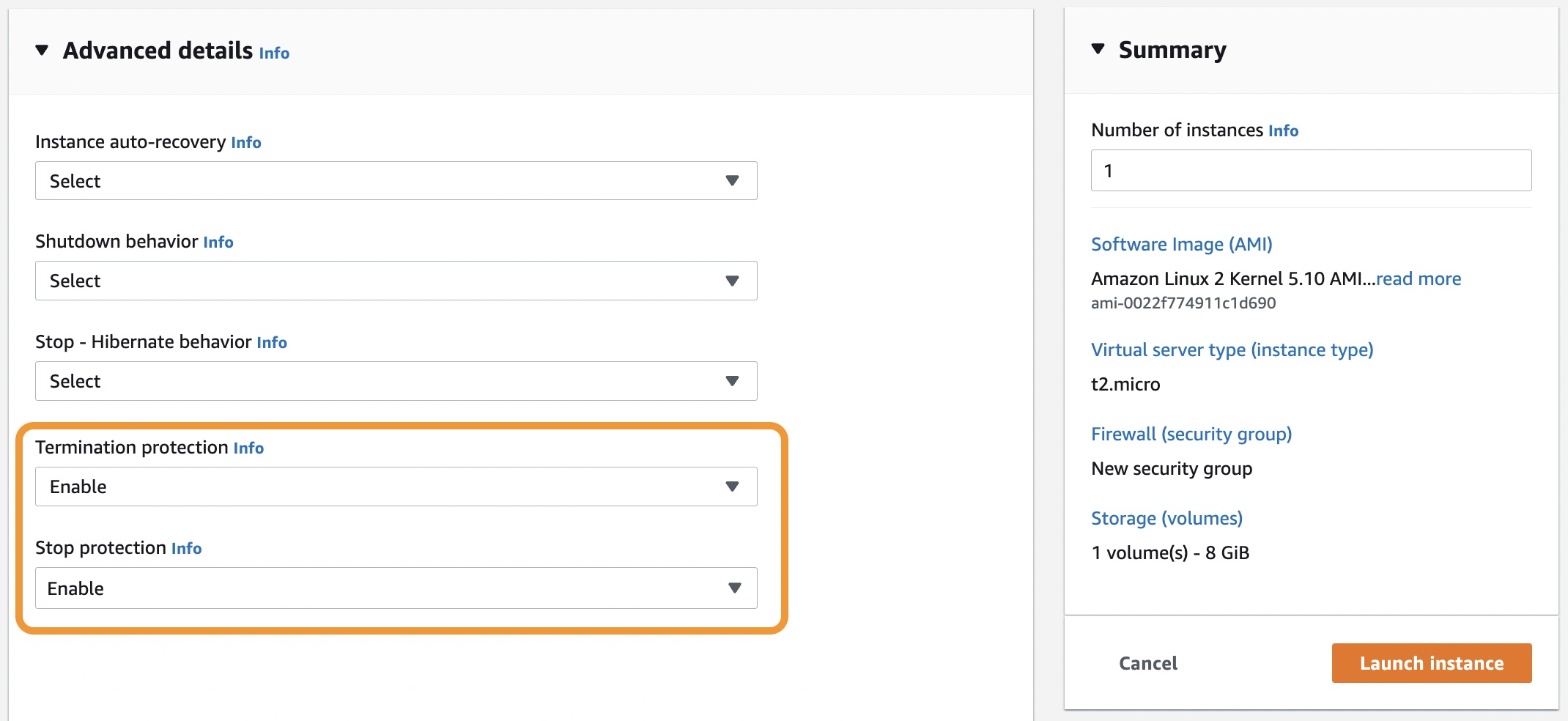
Amazon EC2 Launched Automatic Recovery on Hardware Failure by Default – This new feature makes it easier to recover your instance when it becomes unreachable. Automatic recovery improves instance availability by recovering the instance if it becomes impaired due to an underlying hardware issue. Automatic recovery migrates the instance to another hardware during an instance reboot while retaining its instance ID, private IP addresses, Elastic IP addresses, and all instance metadata. You can choose to disable automatic recovery for your instance if you wish.

For a full list of AWS announcements, be sure to keep an eye on the What’s New at AWS page.

Other AWS News
Beside launches, here are other news worthy items and a blog that caught my attention:

New AWS podcast for Sub-Saharan AWS communities – There are AWS podcasts in many different languages: English, French, Italian, German, three in Spanish, and Russian just to name a few. This week, my colleague Veliswa launched an English podcast aimed at highlighting the Sub-Saharian AWS communities and customers. You can listen to it using any good podcast application (including but not only Spotify and Apple).

100th episode of Le Podcast AWS en Français – This week also marked the publication of the 100th episode of the AWS French Podcast. Since its start in 2019, the podcast has seen 250k downloads. Thank you for listening.

AWS Open Source News and Updates – My colleague Ricardo writes this weekly open-source newsletter. In the 106th edition, I noticed two pieces of information important for the Java community:

First, we released Amazon Corretto 18. This version supports the latest Java feature release OpenJDK 18, and is available on Linux, Windows, and macOS. OpenJDK 18 offers a new internet-address resolution capability, a Simple Web Server, an updated Vector API, a new @snippet Tag for JavaDoc, a new implementation of Core Reflection, a change to UTF-8 as the default character set (charset) of the standard Java APIs, a second iteration of the foreign memory API, advancements in pattern matching for switch statements, and the deprecation of finalization.

Second, we published a blog post showing how to reduce Lambda cold start time by deploying your Java-based Lambda function on Quarkus. Quarkus was created by Java Champion Emmanuel Bernard. It is an open-source native Java stack tailored for GraalVM and OpenJDK HotSpot, crafted from the best of breed Java libraries and standards. It is designed to have an extremely low memory footprint and fast startup time. And yes, Quarkus runs on Corretto too.

A Cloud Guru Answers a Common Question – Nearly every week, people ask me what AWS certification they should take. A Cloud Guru walks through the decision in Which AWS certification is right for me?

Upcoming AWS Events
Check your calendars and sign up for these AWS events:

The AWS Summit season has started – The Brussels Summit was last week, and the next ones are Paris, San Francisco, and London, in that order. I will be delivering the closing keynote at the Paris Summit and will be around the Formula1 GameDay area in London. Be sure to stop by and say “Hi!” if you’re around. You can sign up to receive a notification when registration opens for a Summit in your area. If you can’t attend a Summit in person this year, we will have an online Summit for EMEA in June (at European time, but all sessions will stay available on-demand until September).

.NET Enterprise Developer Day EMEA registrations are open – .NET Enterprise Developer Day EMEA 2022 is a free, one-day virtual conference providing enterprise developers with the most relevant information to swiftly and efficiently migrate and modernize their .NET applications and workloads on AWS. It will happen online on April 26, 2022.

re:Mars conference registrations are open – Mars stands for Machine learning, Automation, Robotics, and Space. You will learn from recognized thought leaders and technical experts who are building the future of AI/ML. It will happen in Las Vegas, Nevada, between June 21 and 24, 2022.

re:Inforce conference registrations are open – Security is our first priority at AWS, and it deserves its own two-day conference to reinforce your AWS security posture. You’ll hear the latest from industry-leading speakers in security, compliance, identity, and privacy. It will happen in Boston, Massachusetts, on July 26 and 27, 2022.

That’s all for this week. Come back next Monday for another Week in Review!

— seb

New – Cloud NGFW for AWS

Post Syndicated from Jeff Barr original https://aws.amazon.com/blogs/aws/new-cloud-ngfw-for-aws/

In 2018 I wrote about AWS Firewall Manager (Central Management for Your Web Application Portfolio) and showed you how you could host multiple applications, perhaps spanning multiple AWS accounts and regions, while maintaining centralized control over your organization’s security settings and profile. In the same way that Amazon Relational Database Service (RDS) supports multiple database engines, Firewall Manager supports multiple types of firewalls: AWS Web Application Firewall, AWS Shield Advanced, VPC security groups, AWS Network Firewall, and Amazon Route 53 DNS Resolver DNS Firewall.

Cloud NGFW for AWS
Today we are introducing support for Palo Alto Networks Cloud NGFW in Firewall Manager. You can now use Firewall Manager to centrally provision & manage your Cloud next-generation firewall resources (also called NGFWs) and monitor for non-compliant configurations, all across multiple accounts and Virtual Private Clouds (VPCs). You get the best-in-class security features offered by Cloud NGFW as a managed service wrapped inside a native AWS experience, with no hardware hassles, no software upgrades, and pay-as-you-go pricing. You can focus on keeping your organization safe and secure, even as you add, change, and remove AWS resources.

Palo Alto Networks pioneered the concept of deep packet inspection in their NGFWs. Cloud NGFW for AWS can decrypt network packets, look inside, and then identify applications using signatures, protocol decoding, behavioral analysis, and heuristics. This gives you the ability to implement fine-grained, application-centric security management that is more effective than simpler models that are based solely on ports, protocols, and IP addresses. Using Advanced URL Filtering, you can create rules that take advantage of curated lists of sites (known as feeds) that distribute viruses, spyware, and other types of malware, and you have many other options for identifying and handling desirable and undesirable network traffic. Finally, Threat Prevention stops known vulnerability exploits, malware, and command-and-control communication.

The integration lets you choose the deployment model that works best with your network architecture:

Centralized – One firewall running in a centralized “inspection” VPC.

Distributed – Multiple firewalls, generally one for each VPC within the scope managed by Cloud NGFW for AWS.

Cloud NGFW protects outbound, inbound, and VPC-to-VPC traffic. We are launching with support for all traffic directions.

AWS Inside
In addition to centralized provisioning and management via Firewall Manager, Cloud NGFW for AWS makes use of many other parts of AWS. For example:

AWS Marketplace – The product is available in SaaS form on AWS Marketplace with pricing based on hours of firewall usage, traffic processed, and security features used. Cloud NGFW for AWS is deployed on a highly available compute cluster that scales up and down with traffic.

AWS Organizations – To list and identify new and existing AWS accounts and to drive consistent, automated cross-account deployment.

AWS Identity and Access Management (IAM) – To create cross-account roles for Cloud NGFW to access log destinations and certificates in AWS Secrets Manager.

AWS Config – To capture changes to AWS resources such as VPCs, VPC route configurations, and firewalls.

AWS CloudFormation – To run a StackSet that onboards each new AWS account by creating the IAM roles.

Amazon S3, Amazon CloudWatch, Amazon Kinesis – Destinations for log files and records.

Gateway Load Balancer – To provide resiliency, scale, and availability for the NGFWs.

AWS Secrets Manager – To store SSL certificates in support of deep packet inspection.

Cloud NGFW for AWS Concepts
Before we dive in and set up a firewall, let’s review a few important concepts:

Tenant – An installation of Cloud NGFW for AWS associated with an AWS customer account. Each purchase from AWS Marketplace creates a new tenant.

NGFW – A firewall resource that spans multiple AWS Availability Zones and is dedicated to a single VPC.

Rulestack – A set of rules that defines the access controls and threat protections for one or more NGFWs.

Global Rulestack – Represented by an FMS policy, contains rules that apply to all of the NGFWs in an AWS Organization.

Getting Started with Cloud NGFW for AWS
Instead of my usual step-by-step walk-through, I am going to show you the highlights of the purchasing and setup process. For a complete guide, read Getting Started with Cloud NGFW for AWS.

I start by visiting the Cloud NGFW Pay-As-You-Go listing in AWS Marketplace. I review the pricing and terms, click Continue to Subscribe, and proceed through the subscription process.

After I subscribe, Cloud NGFW for AWS will send me an email with temporary credentials for the Cloud NGFW console. I use the credential to log in, and then I replace the temporary password with a long-term one:

I click Add AWS Account and enter my AWS account Id. The console will show my account and any others that I subsequently add:

The NGFW console redirects me to the AWS CloudFormation console and prompts me to create a stack. This stack sets up cross-account IAM roles, designates (but does not create) logging destinations, and lets Cloud NGFW access certificates in Secrets Manager for packet decryption.

From here, I proceed to the AWS Firewall Manager console and click Settings. I can see that my cloud NGFW tenant is ready to be associated with my account. I select the radio button next to the name of the firewall, in this case “Palo Alto Networks Cloud NGFW” and then click the Associate button. Note that the subscription status will change to Active in a few minutes.

Screenshot showing the account association process

Once the NGFW tenant is associated with my account I return to the AWS Firewall Manager console and click Security policies to proceed. There are no policies yet, and I click Create policy to make one:

I select Palo Alto Networks Cloud NGFW, choose the Distributed model, pick an AWS region, and click Next to proceed (this model will create a Cloud NGFW endpoint in each in-scope VPC):

I enter a name for my policy (Distributed-1), and select one of the Cloud NGFW firewall policies that are available to my account. I can also click Create firewall policy to navigate to the Palo Alto Networks console and step through the process of creating a new policy. Today I select grs-1:

I have many choices and options when it comes to logging. Each of the three types of logs (Traffic, Decryption, and Threat) can be routed to an S3 bucket, a CloudWatch log group, or a Kinesis Firehose delivery stream. I choose an S3 bucket and click Next to proceed:

A screenshot showing the choices for logging.

Now I choose the Availability Zones where I need endpoints. I have the option to select by name or by ID, and I can optionally designate a CIDR block within each AZ that will be used for the subnets:

The next step is to choose the scope: the set of accounts and resources that are covered by this policy. As I noted earlier, this feature works hand-in-hand with AWS Organizations and gives me multiple options to choose from:

The CloudFormation template linked above is used to create an essential IAM role in each member account. When I run it, I will need to supply values for the CloudNGFW Account ID and ExternalId parameters, both of which are available from within the Palo Alto Networks console. On the next page I can tag my newly created policy:

On the final page I review and confirm all of my choices, and click Create policy to do just that:

My policy is created right away, and it will start to list the in-scope accounts within minutes. Under the hood, AWS Firewall Manager calls Cloud NGFW APIs to create NGFWs for the VPCs in my in-scope accounts, and the global rules are automatically associated with the created NGFWs. When the NGFWs are ready to process traffic, AWS Firewall Manager creates the NGFW endpoints in the subnets.

As new AWS accounts join my organization, AWS Firewall Manager automatically ensures they are compliant by creating new NGFWs as needed.

Next I review the Cloud NGFW threat logs to see what threats are being blocked by Cloud NGFW. In this example Cloud NGFW protected my VPC against SIPVicious scanning activity:

Screenshot showing the threat log detecting SIPVicious activity

And in this example, Cloud NGFW protected my VPC against a malware download:

a screenshot showing the threat log of malware detection

Things to Know
Both AWS Firewall Manager and Cloud NGFW are regional services and my AWS Firewall Manager policy is therefore regional. Cloud NGFW is currently available in the US East (N. Virginia) and US West (N. Califormia) Regions, with plans to expand in the near future.

— Jeff;

AWS Week in Review – March 28, 2022

Post Syndicated from Marcia Villalba original https://aws.amazon.com/blogs/aws/aws-week-in-review-march-28-2022/

This post is part of our Week in Review series. Check back each week for a quick round up of interesting news and announcements from AWS!

Welcome to another round up of the most significant AWS launches from the previous week. Among the most relevant news, we have improvements done in AWS Lambda, a new service for game developers, and we are back with the AWS Summits all around the world.

Last Week’s Launches
Here are some launches that got my attention during the previous week.

AWS Lambda Now Supports Up to 10 GB Ephemeral Storage – This new launch allows you to configure the temporary file system capacity (/tmp) of Lambda up to 10 GB! This is very useful for customers that are trying to use Lambda for ETL jobs, ML inference or other data-intensive workloads. Check Channy’s launch blog post to learn more about how to get started.

Amazon GameSparks – Last week we announced the launch of Amazon GameSparks in preview. Amazon GameSparks is a new serverless service that makes it easy for developers to create, test, and tune custom game features without thinking about the underlying servers or infrastructure. It comes with out-of-the-box features ideal for game backends and it is pre-integrated with the Unity game engine. Learn more in Tabitha’s blog post.

Amazon Connect Forecasting, Capacity Planning, and Scheduling – This set of ML-powered capabilities makes it easier for contact center managers to predict customer service workloads, determine ideal staffing levels, and schedule agents accordingly. These features are available in preview and you can learn more in Sajith’s blog post.

AWS Proton Support for Terraform Open Source – Last November we announced the preview for this feature, and now it is generally available in all the AWS Regions where Proton is available. Platform teams can now define Proton templates using Terraform modules. Read the What’s New post for more information.

Amazon Polly Now Offers Neural TTS Voices in Catalan and Mexican Spanish – Polly is a service that turns your text into lifelike speech. It has support for Neural TTS voices in many languages, and last week they added two more, in Mexican Spanish and in Catalan. You can read more in the What’s New post and listen to the Mexican voice in this audio.


For a full list of AWS announcements, be sure to keep an eye on the What’s New at AWS page.

Other AWS News

Podcast Charlas Técnicas de AWS – If you understand Spanish, this podcast is for you. Podcast Charlas Técnicas is one of the official AWS podcasts in Spanish. It has episodes every other week. The podcast is meant for builders, and it shares stories on how customers implemented and learned AWS and how to architect applications using AWS services. You can listen to all the episodes directly from your favorite podcast app or the podcast web page.

AWS Open Source News and Updates – Ricardo Sueiras, my colleague from the AWS Developer Relation team, runs this newsletter. It brings you all the latest open-source projects, posts and more. This week he shares the latest open source project, tools and also AWS and community blog posts related to open-source. Read edition #106 here.

Upcoming AWS Events
Check your calendars and sign up for these AWS events:

Building a Tech-Enabled Biotech with Celsius Therapeutics on Tuesday March 29 at 10 PM UTC – My colleague Mark Birch hosts regular Clubhouse events, in which he talks with different startups. These companies share their journey and experience using AWS. Join the live event here.

The AWS Summits Are Back – Don’t forget to register for the AWS Summits in Brussels (on March 31), Paris (on April 12), San Francisco (on April 20-21), and London (on April 27). More summits are coming in the next weeks, and we’ll let you know in these weekly posts.
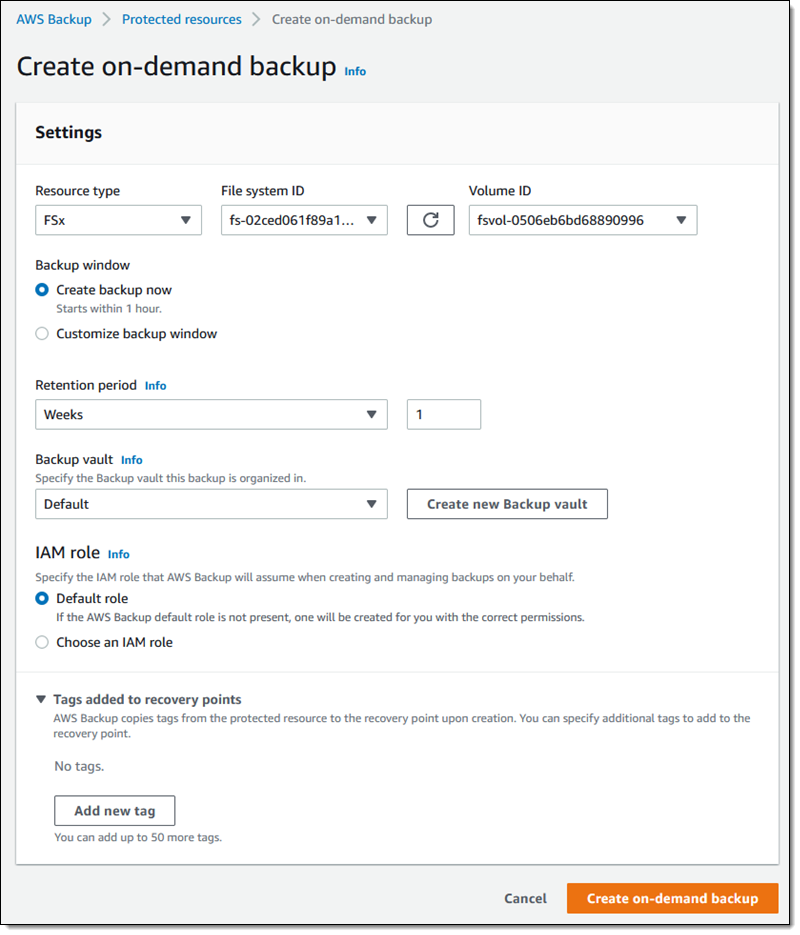
That’s all for this week. Check back next Monday for another Week in Review!

— Marcia

AWS Lambda Now Supports Up to 10 GB Ephemeral Storage

Post Syndicated from Channy Yun original https://aws.amazon.com/blogs/aws/aws-lambda-now-supports-up-to-10-gb-ephemeral-storage/

Serverless applications are event-driven, using ephemeral compute functions ranging from web APIs, mobile backends, and streaming analytics to data processing stages in machine learning (ML) and high-performance applications. While AWS Lambda includes a 512 MB temporary file system (/tmp) for your code, this is an ephemeral scratch resource not intended for durable storage such as Amazon Elastic File System (Amazon EFS).

However, extract, transform, and load (ETL) jobs and content generation workflows such as creating PDF files or media transcoding require fast, scalable local storage to process large amounts of data quickly. Data-intensive applications require large amounts of temporary data specific to the invocation or cached data that can be reused for all invocation in the same execution environment in a highly performant manner. With the previous limit of 512 MB, customers had to selectively load data from Amazon Simple Storage Service (Amazon S3) and Amazon EFS, or increase the allocated function memory and thus increase their cost, just to handle large objects downloaded from Amazon S3. Since customers could not cache larger data locally in the Lambda execution environment, every function invoke had to read data in parallel, which made scaling out harder for customers.

Today, we are announcing that AWS Lambda now allows you to configure ephemeral storage (/tmp) between 512 MB and 10,240 MB. You can now control the amount of ephemeral storage a function gets for reading or writing data, allowing you to use AWS Lambda for ETL jobs, ML inference, or other data-intensive workloads.

With increased AWS Lambda ephemeral storage, you get access to a secure, low-latency ephemeral file system up to 10 GB. You can continue to use up to 512 MB for free and are charged for the amount of storage you configure over the free limit for the duration of invokes.

Setting Larger Ephemeral Storage for Your Lambda Function
To configure your Lambda function with larger ephemeral storage, choose the Configuration tab under the General Configuration section in the AWS Lambda Console. You will see a new configuration for Ephemeral storage setting at 512MB by default.

When you click the Edit button, you can configure the ephemeral storage from 512 MB to 10,240 MB in 1 MB increments for your Lambda functions.

With AWS Command Line Interface (AWS CLI), you can update your desired size of ephemeral storage using theupdate-function-configuration command.

$ aws lambda update-function-configuration --function-name PDFGenerator \
              --ephemeral-storage '{"Size": 10240}'

You can configure ephemeral storage using Lambda API via AWS SDK and AWS CloudFormation. To learn more, see Configuring function options in the AWS Documentation.

As a review, AWS Lambda provides a comprehensive range of storage options. To learn more, see a great blog post, Choosing between AWS Lambda data storage options in web apps, written by my colleague James Beswick. I want to quote the table to show the differences between these options and common use-cases to help you choose the right one for your own applications.

Features Ephemeral Storage (/tmp) Lambda Layers Amazon EFS Amazon S3
Maximum size 10,240 MB 50 MB (direct upload) Elastic Elastic
Persistence Ephemeral Durable Durable Durable
Content Dynamic Static Dynamic Dynamic
Storage type File system Archive File system Object
Lambda event source integration N/A N/A N/A Native
Operations supported Any file system operation Immutable Any file system operation Atomic with versioning
Object tagging and metadata
N N N Y
Pricing model Included in Lambda
(Charged over 512MB)
Included in Lambda Storage + data transfer + throughput Storage + requests + data transfer
Shared across all invocations N Y Y Y
Sharing/permissions model Function-only IAM IAM + NFS IAM
Source for AWS Glue and Amazon Quicksight
N N N Y
Relative data access speed from Lambda Fastest Fastest Very fast Fast

Available Now
You can now configure up to 10 GB of ephemeral storage per Lambda function instance in all Regions where AWS Lambda is available. With 10 GB container image support, 10 GB function memory, and now 10 GB of ephemeral function storage, you can support workloads such as using large temporal files, data and media processing, machine learning inference, and financial analysis.

Support is also available through many AWS Lambda Partners such as HashiCorp (Terraform), Pulumi, Datadog, Splunk (SignalFx), Lumigo, Thundra, Dynatrace, Slalom, Cloudwiry, and Contino.

For this feature, you are charged for the storage you configure over the 512 MB free limit for the duration of your function invokes. To learn more, visit AWS Lambda product and pricing page and send feedback through the AWS re:Post for AWS Lambda or your usual AWS Support contacts.

– Channy

AWS Week in Review – March 21, 2022

Post Syndicated from Danilo Poccia original https://aws.amazon.com/blogs/aws/aws-week-in-review-march-21-2022/

This post is part of our Week in Review series. Check back each week for a quick round up of interesting news and announcements from AWS!

Another week, another round up of the most significant AWS launches from the previous seven days! Among the news, we have new AWS Heroes and a cost reduction. Also, improvements for customers using AWS Lambda and Amazon Elastic Kubernetes Service (EKS), and a new database-to-database connectivity option for Amazon Relational Database Service (RDS).

Last Week’s Launches
Here are some launches that caught my attention last week:

AWS Billing Conductor – This new tool provides customizable pricing and cost visibility for your end customers or business units and helps when you have specific showback and chargeback needs. To get started, see Getting Started with AWS Billing Conductor. And yes, you can call it “ABC.”

Cost Reduction for Amazon Route 53 Resolver DNS Firewall – Starting from the beginning of March, we are introducing a new tiered pricing structure that reduces query processing fees as your query volume increases. We are also implementing internal optimizations to reduce the number of DNS queries for which you are charged without affecting the number of DNS queries that are inspected or introducing any other changes to your security posture. For more info, see the What’s New.

Share Test Events in the Lambda Console With Other Developers – You can now share the test events you create in the Lambda console with other team members and have a consistent set of test events across your team. This new capability is based on Amazon EventBridge schemas and is available in the AWS Regions where both Lambda and EventBridge are available. Have a look at the What’s New for more details.

Use containerd with Windows Worker Nodes Managed by Amazon EKS – containerd is a container runtime that manages the complete container lifecycle on its host system with an emphasis on simplicity, robustness, and portability. In this way, you can get on Windows similar performance, security, and stability benefits to those available for Linux worker nodes. Here’s the What’s New with more info.

Amazon RDS for PostgreSQL databases can now connect and retrieve data from MySQL databases – You can connect your RDS PostgreSQL databases to Amazon Aurora MySQL-compatible, MySQL, and MariaDB databases. This capability works by adding support to mysql_fdw, an extension that implements a Foreign Data Wrapper (FDW) for MySQL. Foreign Data Wrappers are libraries that PostgreSQL databases can use to communicate with an external data source. Find more info in the What’s New.

For a full list of AWS announcements, be sure to keep an eye on the What’s New at AWS page.

Other AWS News
New AWS Heroes – It’s great to see both new and familiar faces joining the AWS Heroes program, a worldwide initiative that acknowledges individuals who have truly gone above and beyond to share knowledge in technical communities. Get to know them in the blog post!

More Than 400 Points of Presence for Amazon CloudFront – Impressive growth here, doubling the Points of Presence we had in October 2019. This number includes edge locations and mid-tier caches in AWS Regions. Do you know that edge locations are connected to the AWS Regions through the AWS network backbone? It’s a fully redundant, multiple 100GbE parallel fiber that circles the globe and links with tens of thousands of networks for improved origin fetches and dynamic content acceleration.

AWS Open Source News and Updates – A newsletter curated by my colleague Ricardo where he brings you the latest open-source projects, posts, events, and much more. This week he is also sharing a short list of some of the open-source roles currently open across Amazon and AWS, covering a broad range of open-source technologies. Read edition #105 here.

Upcoming AWS Events
Check your calendars and sign up for these AWS events:

The AWS Summits Are Back – Don’t forget to register to the AWS Summits in Brussels (on March 31) and Paris (on April 12). More summits are coming in the next weeks, and we’ll let you know in this weekly posts.

That’s all from me for this week. Come back next Monday for another Week in Review!

— Danilo

New and Updated AWS Well-Architected Lenses

Post Syndicated from Channy Yun original https://aws.amazon.com/blogs/aws/new-and-updated-aws-well-architected-lenses/

Since 2015, the AWS Well-Architected Framework has been helping AWS customers and partners improve their cloud architectures. The framework consists of design principles, questions, and best practices across multiple pillars: Operational Excellence, Security, Reliability, Performance Efficiency, and Cost Optimization. At AWS re:Invent 2021, we introduced a new Sustainability Pillar to help organizations learn, measure, and improve their workloads using environmental best practices for cloud computing.

In 2017, we introduced AWS Well-Architected Lenses and extended the best practice guidance to specific industry and technology domains, such as serverless, high performance computing (HPC), internet of things (IoT), software as a service (SaaS), foundational technical review (FTR), and financial services. Use the applicable Lenses together with the pillars of the AWS Well-Architected Framework to fully evaluate your workloads.

In 2021, we added four new lenses for various technologies and industries at the request of our customers. If you are planning a new workload for the new year, check out the new and updated Lenses to help guide you through the implementation of AWS best practices.

New AWS Well-Architected Lenses

Streaming Media Lens (September 29, 2021)
The Streaming Media Lens helps customers apply best practices in the design, delivery, and maintenance of their cloud-based streaming media workloads. Whether you’ve just started designing a greenfield video application on AWS or are looking to migrate an existing workload, this Lens provides perspective on best practices and can spark new ideas. To learn more about best practices for architecting and improving your streaming media workloads on AWS, see the Streaming Media Lens documentation.

SAP Lens (October 29, 2021)
The SAP Lens is a collection of customer-proven design principles and best practices for ensuring SAP workloads on AWS are well-architected. The SAP Lens is based on insights that AWS has gathered from customers, AWS Partners, and the SAP Specialist Architect community. The Lens is designed to help you adopt a cloud-native approach to running SAP. To learn more, see the SAP Lens documentation.

Games Industry Lens (November 19, 2021)
The Games Industry Lens helps customers review and improve cloud-based architecture for game development, deployment, operations of gaming platforms, and to support massive player scale. The Lens presents common games deployment scenarios and identifies key elements to ensure your platforms are in accordance with the best practices of AWS Well-Architected Framework. Learn the best practices for designing, architecting, and deploying your games workloads on AWS in the Games Industry Lens documentation.

Hybrid Networking Lens (November 22, 2021)
The Hybrid Networking Lens provides best practices and strategies to use when designing hybrid networking architectures. This Lens supports a broad spectrum of use cases and helps set you up for success in building hybrid networking architectures and integrating your on-premises data center with AWS operations. It outlines three areas to consider when designing hybrid network connectivity for your workload: data layer, monitoring and configuration management, and security. To learn more, see the Hybrid Networking Lens documentation.

Updated AWS Well-Architected Lens

Machine Learning Lens (October 13, 2021)
The Machine Learning (ML) Lens introduces a set of established and repeatable best practices across the ML lifecycle phases. You can apply this guidance and architectural principles when designing your ML workloads or after your workloads have entered production as part of continuous improvement. The Lens includes guidance and resources on implementing the best practices on AWS. To learn more, see the ML Lens documentation.

Data Analytics Lens (October 29, 2021)
The Data Analytics Lens is a collection of customer-proven best practices for designing well-architected analytics workloads. It contains insights that AWS has gathered from real-world case studies and helps you learn the key design elements of well-architected analytics workloads, along with recommendations for improvement. For more information about building your own data analytics workload, see the Data Analytics Lens whitepaper.

Management and Governance Lens (December 17, 2021)
The Management and Governance Lens (M&G Lens) provides clear guidance to help you prepare your environment, regardless of your stage of cloud adoption, with a focus on eight different functions. Those functions are controls and guardrails, network connectivity, identity management, security management, monitoring and observability, cloud financial management, service management, and sourcing and distribution. To learn more, see the M&G Lens documentation.

To get started with your favorite lenses, visit the AWS Well-Architected page. You can learn, measure, and build using architectural best practices and tools.

To review your workloads using the AWS Well-Architected Framework, we recommend using the AWS Well-Architected Tool, a self-service tool designed to help you review AWS workloads at any time, without the need for an AWS Solutions Architect.

It provides a mechanism for regularly evaluating your workloads, identifying high-risk issues, and recording your improvements applying your favorite Lenses. You can also leverage Custom Lenses to record and track progress towards your organization’s internal best practices.

If you want to train these best practices, AWS Well-Architected Labs provides codes and documentation in the format of hands-on labs to help you learn, measure, and build using architectural best practices categorized into levels. Also, you can access an ecosystem of hundreds of members in the AWS Well-Architected Partner Program in your area to help analyze and review your applications.

You can refer to the AWS Architecture Center, a collection of reference architecture patterns, vetted architecture solutions, and best practices. If you’re new to AWS, use the Architect Learning Plan to learn how to design applications and systems on AWS. Build technical skills as you progress along the path toward AWS Certification.

This is My Architecture is a video series that showcases innovative architectural solutions on AWS by customers and partners. We would love to hear more from you, especially about your success stories in building your applications on AWS Well-Architected Framework. Please share with your account team to introduce your stories.

– Channy

Get to know the first AWS Heroes of 2022!

Post Syndicated from Ross Barich original https://aws.amazon.com/blogs/aws/get-to-know-the-first-aws-heroes-of-2022/

The AWS Heroes program is a worldwide initiative which acknowledges individuals who have truly gone above and beyond to share knowledge in technical communities. AWS Heroes share knowledge by hosting events, Meetups, workshops, and study groups, or by authoring blogs, creating videos, speaking at conferences, or contributing to open source projects. You can see some of the Heroes’ work in the AWS Heroes Content Library.

Today we are excited to introduce the first new Heroes of 2022, including the first Hero based in the Czech Republic:

Albert Suwandhi – Medan, Indonesia

Community Hero Albert Suwandhi is an academic and IT Professional, and an AWS Champion Authorized Instructor who delivers AWS classroom training courses to AWS users and customers. He strongly believes in the power of community: he joined AWS User Group Indonesia, Medan chapter in 2019 and has since organized and delivered several sharing sessions. He has also been featured in number of tech talks, and his areas of cloud computing interest are cloud architecture and security. He enjoys helping people to realize the true potential of cloud computing and he runs a YouTube channel, which provides tutorials and tips & tricks related to AWS.

Dipali Kulshrestha – Delhi, India

Community Hero Dipali Kulshrestha is Vice President of Data Engineering at Natwest Group where she is an AWS trainer & mentor, conducting Cloud Practitioner and Solution Architect workshops every quarter. She is also an AWS Delhi User Group leader, hosts monthly immersive learning sessions on different AWS concepts, and is an active speaker at AWS community events. Dipali released a DevOps with AWS course on LinkedIn Learning, attended by 12000+ learners. She also created an AWS re:Skill series for containers on AWS. Dipali is huge advocate of diversity & inclusion of women in tech, and was recently featured in AWS India’s campaign called Developers of AWS and in a Tech Gig interview about cloud upskilling.

Faizal Khan – Hyderabad, India

Community Hero Faizal Khan is a tech entrepreneur, currently Founder & CEO at Ecomm.in and Xite Logic. He is an ardent contributor to the AWS community. As organizer of the AWS Hyderabad User Group, he helps organize AWS hackathons, AWS Meetups, re:Invent recaps, webinars, and AWS certification bootcamps. He is also a speaker at many events covering Networking, IoT, Storage, and Compute. His VPC masterclass on YouTube has garnered about half a million views. He was a core organizing member and host for the AWS Community Day South Asia 2021 Online, which attracted over 24K viewers. In addition, he built an AWS Q&A discussion forum for the community.

Filip Pyrek – Brno, Czech Republic

Serverless Hero Filip Pyrek is Serverless Architect at Purple Technology. At the age of 23 Filip is one of the youngest AWS Heroes. He started his serverless journey back in 2016 when he was 17 years old. He is helping grow the serverless community in Czech Republic and Slovakia by organizing Serverless Brno meetups, contributing to local podcasts, writing serverless blog posts in Czech language, and doing other evangelization activities. He is in touch with a community of maintainers and developers of serverless tooling projects and provides them with feedback, feature requests, and open-source contributions in order to continuously improve the serverless ecosystem.

Karolina Boboli – Warsaw, Poland

Community Hero Karolina Boboli works as an AWS Cloud Architect and Consultant. She has experience in cloud security, cloud governance, cost management, landing zones, serverless, and IoT. She created an online course “AWS in practice – your first project” about infrastructure as code. In 2019 she founded a vibrant cloud community – swiatchmury.pl – a Slack for cloud professionals focused on AWS – which she runs on a daily basis. The goal of the community is to have a friendly place to ask questions, inspire each other, and simply be together. From time to time she gives talks in AWS UG Poland and organizes her own webinars.

Masaya Arai – Kanagawa, Japan

Container Hero Masaya Arai is an 11x certified Tech Lead working for Nomura Research Institute (NRI). He is the central organizer of the JAWS-UG Container chapter (about 3000 registered members), an AWS user group in Japan, and he regularly contributes to activities in the AWS user community. Masaya wrote a commercial magazine called “AWS Container Guide + Hands-on”, which became a best-selling cloud-related book on amazon.co.jp, and published more than 10,000 copies. He focuses on promoting development of AWS container technologies through a wide variety of activities such as blogs, public presentations, contributing to magazines, and writing books. He truly enjoys sharing his knowledge and experience with others.

Mayank Pandey – Bengaluru, India

Community Hero Mayank Pandey is a cloud architect & teacher, helping both small and large organizations in their cloud adoption journey. He holds Professional & Specialty AWS Certifications and handles assignments including security & cost optimization on AWS, and cloud-native applications. Mayank is passionate about teaching and has done several classroom and online trainings. He is an active member of AWS community and contributes with hands-on demos and video tutorials to the YouTube channel – KnowledgeIndia. The YouTube channel has 65,000 subscribers and 150+ videos on various AWS topics.

Niv Yungelson – Tel Aviv, Israel

Community Hero Niv Yungelson works at Melio as the DevOps Team Lead. She is co-leader of the AWS Israel User Group, one of the biggest AWS User Groups in the world. As a community leader, she organizes Meetups and ensures they include underrepresented groups in the technology industry. She achieves this by both collaborating with other User Groups and experimenting with new initiatives. Niv also volunteers as an instructor in OpsSchool, which is a non-profit program meant to gather industry leaders to contribute together, train new DevOps engineers, and help the community continue the cycle of good deeds. She is active in tech user groups, forums, and Meetups, and is committed to sharing her knowledge and experience at any given opportunity.


If you’d like to learn more about the new Heroes, or connect with a Hero near you, please visit the AWS Heroes website or browse the AWS Heroes Content Library.

— Ross;

AWS Week in Review – March 14, 2022

Post Syndicated from Steve Roberts original https://aws.amazon.com/blogs/aws/aws-week-in-review-march-14-2022/

This post is part of our Week in Review series. Check back each week for a quick round up of interesting news and announcements from AWS!

Welcome to the March 14 AWS Week in Review post, and Happy Pi Day! I hope you managed to catch some of our livestreamed Pi day celebration of the 16th birthday of Amazon Simple Storage Service (Amazon S3). I certainly had a lot of fun in the event, along with my co-hosts – check out the end of this post for some interesting facts and fun from the day.

First, let’s dive right into the news items and launches from the last week that caught my attention.

Last Week’s Launches
New X2idn and X2iedn EC2 Instance Types – Customers with memory-intensive workloads and a requirement for high networking bandwidth may be interested in the newly announced X2idn and X2iedn instance types, which are built on the AWS Nitro system. Featuring third-generation Intel Xeon Scalable (Ice Lake) processors, these instance types can yield up to 50 percent higher compute price performance and up to 45 percent higher SAP Application Performance Standard (SAPS) performance than comparable X1 instances. If you’re curious about the suffixes on those instance type names, they specify processor and other information. In this case, the i suffix indicates that the instances are using an Intel processor, e means it’s a memory-optimized instance family, d indicates local NVMe-based SSDs physically connected to the host server, and n means the instance types support higher network bandwidth up to 100 Gbps. You can find out more about the new instance types in this news blog post.

Amazon DynamoDB released two updates – First, an increase in the default service quotas raises the number of tables allowed by default from 256 to 2500 tables. This will help customers working with large numbers of tables. At the same time the service also increased the allowed number of concurrent table management operations, from 50 to 500. Table management operations are those that create, update, or delete tables. The second update relates to PartiQL a SQL-compatible query language you can use to query, insert, update, or delete DynamoDB table data. You can now specify a limit on the number of items processed. You’ll find this useful when you know you only need to process a certain number of items, helping reduce the cost and duration of requests.

If you’re coding against Amazon ECS‘s API, you may want to take a look at the change to UpdateService that now enables you to update load balancers, service registries, tag propagation, and ECS managed tags for a service. Previously, you would have had to delete and recreate the service to make changes to these resources for a service. Now you can do it all with one call, making it a hassle-free and less disruptive, more efficient experience. Take a look at the What’s New post for more details.

For a full list of AWS announcements, be sure to keep an eye on the What’s New at AWS page.

Other AWS News
If you’re analyzing time series data, take a look at this new book on building forecasting models and detecting anomalies in your data. It’s authored by Michael Hoarau, an AI/ML Specialist Solutions Architect at AWS.

March 8 was International Women’s Day and we published a post featuring several women, including fellow news blogger and published author Antje Barth, chatting about their experiences working in Developer Relations at AWS.

Upcoming AWS Events
Check your calendars and sign up for these AWS events:

.NET Application Modernization Webinar (March 23) – Sign up today to learn about .NET modernization, what it is, and why you might want to modernize. The webinar will include a deep dive focusing on the AWS Microservice Extractor for .NET.

AWS Summit Brussels is fast approaching on March 31st. Register here.

Pi Day Fun & Facts
As this post is published, we’re coming to the end of our livestreamed Pi Day event celebrating the 16th birthday of S3 – how time flies! Here are some interesting facts & fun snippets from the event:

  • In the keynote, we learned S3 currently stores over 200 trillion objects, and serves over 100 million requests per second!
  • S3‘s Intelligent Tiering has saved customers over $250 million to date.
  • Did you know that S3, having reached 16 years of age, is now eligible for a Washington State drivers license? Or that it can now buy a lottery ticket, get a passport, or – check this – it can pilot a hang glider!
  • We asked each of our guests on the livestream, and the team of AWS news bloggers, to nominate their favorite pie. The winner? It’s a tie between apple and pecan pie!

That’s all for this week. Check back next Monday for another Week in Review!

— Steve

Welcome to AWS Pi Day 2022

Post Syndicated from Jeff Barr original https://aws.amazon.com/blogs/aws/welcome-to-aws-pi-day-2022/

We launched Amazon Simple Storage Service (Amazon S3) sixteen years ago today!

As I often told my audiences in the early days, I wanted them to think big thoughts and dream big dreams! Looking back, I think it is safe to say that the launch of S3 empowered them to do just that, and initiated a wave of innovation that continues to this day.

Bigger, Busier, and more Cost-Effective
Our customers count on Amazon S3 to provide them with reliable and highly durable object storage that scales to meet their needs, while growing more and more cost-effective over time. We’ve met those needs and many others; here are some new metrics that prove my point:

Object Storage – Amazon S3 now holds more than 200 trillion (2 x 10¹⁴) objects. That’s almost 29,000 objects for each resident of planet Earth. Counting at one object per second, it would take 6.342 million years to reach this number! According to Ethan Siegel, there are about 2 trillion galaxies in the visible Universe, so that’s 100 objects per galaxy! Shortly after the 2006 launch of S3, I was happy to announce the then-impressive metric of 800 million stored objects, so the object count has grown by a factor of 250,000 in less than 16 years.

Request Rate – Amazon S3 now averages over 100 million requests per second.

Cost Effective – Over time we have added multiple storage classes to S3 in order to optimize cost and performance for many different workloads. For example, AWS customers are making great use of Amazon S3 Intelligent Tiering (the only cloud storage class that delivers automatic storage cost savings when data access patterns change), and have saved more than $250 million in storage costs as compared to Amazon S3 Standard. When I first wrote about this storage class in 2018, I said:

In order to make it easier for you to take advantage of S3 without having to develop a deep understanding of your access patterns, we are launching a new storage class, S3 Intelligent-Tiering.

With the improved cost optimizations for small and short-lived objects and the archiving capabilities that we launched late last year, you can now use S3 Intelligent-Tiering as the default storage class for just about every workload, especially data lakes, analytics use cases, and new applications.

Customer Innovation
As you can see from the metrics above, our customers use S3 to store and protect vast amounts of data in support of an equally vast number of use cases and applications. Here are just a few of the ways that our customers are innovating:

NASCAR – After spending 15 years collecting video, image, and audio assets representing over 70 years of motor sports history, NASCAR built a media library that encompassed over 8,600 LTO 6 tapes and a few thousand LTO 4 tapes, with a growth rate of between 1.5 PB and 2 PB per year. Over the course of 18 months they migrated all of this content (a total of 15 PB) to AWS, making use of the Amazon S3 Standard, Amazon S3 Glacier Flexible Retrieval, and Amazon S3 Glacier Deep Archive storage classes. To learn more about how they migrated this massive and invaluable archive, read Modernizing NASCAR’s multi-PB media archive at speed with AWS Storage.

Electronic Arts –
This game maker’s core telemetry systems handle tens of petabytes of data, tens of thousands of tables, and over 2 billion objects. As their games became more popular and the volume of data grew, they were facing challenges around data growth, cost management, retention, and data usage. In a series of updates, they moved archival data to Amazon S3 Glacier Deep Archive, implemented tag-driven retention management, and implemented Amazon S3 Intelligent-Tiering. They have reduced their costs and made their data assets more accessible; read
Electronic Arts optimizes storage costs and operations using Amazon S3 Intelligent-Tiering and S3 Glacier to learn more.

NRGene / CRISPR-IL –
This team came together to build a best-in-class gene-editing prediction platform. CRISPR (
A Crack In Creation is a great introduction) is a very new and very precise way to edit genes and effect changes to an organism’s genetic makeup. The CRISPR-IL consortium is built around an iterative learning process that allows researchers to send results to a predictive engine that helps to shape the next round of experiments. As described in
A gene-editing prediction engine with iterative learning cycles built on AWS, the team identified five key challenges and then used AWS to build GoGenome, a web service that performs predictions and delivers the results to users. GoGenome stores over 20 terabytes of raw sequencing data, and hundreds of millions of feature vectors, making use of Amazon S3 and other
AWS storage services as the foundation of their data lake.

Some other cool recent S3 success stories include Liberty Mutual (How Liberty Mutual built a highly scalable and cost-effective document management solution), Discovery (Discovery Accelerates Innovation, Cuts Linear Playout Infrastructure Costs by 61% on AWS), and Pinterest (How Pinterest worked with AWS to create a new way to manage data access).

Join Us Online Today
In celebration of AWS Pi Day 2022 we have put together an entire day of educational sessions, live demos, and even a launch or two. We will also take a look at some of the newest S3 launches including Amazon S3 Glacier Instant Retrieval, Amazon S3 Batch Replication and AWS Backup Support for Amazon S3.

Designed for system administrators, engineers, developers, and architects, our sessions will bring you the latest and greatest information on security, backup, archiving, certification, and more. Join us at 9:30 AM PT on Twitch for Kevin Miller’s kickoff keynote, and stick around for the entire day to learn a lot more about how you can put Amazon S3 to use in your applications. See you there!

— Jeff;

New – Amazon EC2 X2idn and X2iedn Instances for Memory-Intensive Workloads with Higher Network Bandwidth

Post Syndicated from Channy Yun original https://aws.amazon.com/blogs/aws/new-amazon-ec2-x2idn-and-x2iedn-instances-for-memory-intensive-workloads-with-higher-network-bandwidth/

In 2016, we launched Amazon EC2 X1 instances designed for large-scale and in-memory applications in the cloud. The price per GiB of RAM for X1 instances is among the lowest. X1 instances are ideal for high performance computing (HPC) applications and running in-memory databases like SAP HANA and big data processing engines such as Apache Spark or Presto.

The following year, we launched X1e instances with up to 4 TiB of memory designed to run SAP HANA and other memory-intensive, in-memory applications. These instances are certified by SAP to run production environments of the next-generation Business Suite S/4HANA, Business Suite on HANA (SoH), Business Warehouse on HANA (BW), and Data Mart Solutions on HANA on the AWS Cloud.

Today, I am happy to announce the general availability of Amazon EC2 X2idn/X2iedn instances, built on the AWS Nitro system and featuring the third-generation Intel Xeon Scalable (Ice Lake) processors with up to 50 percent higher compute price performance than comparable X1 instances. These improvements result in up to 45 percent higher SAP Application Performance Standard (SAPS) performance than comparable X1 instances.

You might have noticed that we’re now using the “i” suffix in the instance type to specify that the instances are using an Intel processor, “e” in the memory-optimized instance family to indicate extended memory, “d” with local NVMe-based SSDs that are physically connected to the host server, and “n” to support higher network bandwidth up to 100 Gbps.

X2idn instances enable up to 2 TiB of memory, while X2iedn instances enable up to 4 TiB of memory. X2idn and X2iedn instances also support 100 Gbps of network performance with hardware-enabled VPC encryption and support 80 Gbps of Amazon EBS bandwidth and 260k IOPs with EBS-encrypted volumes.

Instance Name vCPUs RAM (GiB) Local NVMe SSD Storage (GB) Network Bandwidth (Gbps) EBS-Optimized Bandwidth (Gbps)
x2idn.16xlarge 64 1024 1 x 1900 Up to 50 Up to 40
x2idn.24xlarge 96 1536 1 x 1425 75 60
x2idn.32xlarge 128 2048 2 x 1900 100 80
x2iedn.xlarge 4 128 1 x 118 Up to 25 Up to 20
x2iedn.2xlarge 8 256 1 x 237 Up to 25 Up to 20
x2iedn.4xlarge 16 512 1 x 475 Up to 25 Up to 20
x2iedn.8xlarge 32 1024 1 x 950 25 20
x2iedn.16xlarge 64 2048 1 x 1900 50 40
x2iedn.24xlarge 96 3072 2 x 1425 75 60
x2iedn.32xlarge 128 4096 2 x 1900 100 80

X2idn instances are ideal for running large in-memory databases such as SAP HANA. All of the X2idn instance sizes are certified by SAP for production HANA and S/4HANA workloads. In addition, X2idn instances are ideal for memory-intensive and latency-sensitive workloads such as Apache Spark and Presto, and for generating real-time analytics, processing giant graphs using Neo4j or Titan, or creating enormous caches.

X2iedn instances are optimized for applications that seek high memory to vCPU ratio and deliver the highest memory capacity per vCPU among all virtualized EC2 instance types. X2iedn is suited to run high-performance databases (such as Oracle DB, SQL server) and in-memory workloads (such as SAP HANA, Redis). Workloads that are sensitized to per-core licensing, such as Oracle DB, greatly benefit from the higher memory per vCPU (32GB:1vCPU) offered by X2iedn. X2iedn allows you to optimize licensing costs because it provides customers the same memory at half the number of vCPU compared to X2idn.

These instances offer the same amount of local storage as in X1/X1e, up to 3.8 TB, but the local storage in X2idn/X2iedn is NVMe-based, which will offer an order of magnitude lower latency compared to SATA SSDs in X1/X1e.

Things to Know
Here are some fun facts about the X2idn and X2iedn instances:

Optimizing CPU—You can disable Intel Hyper-Threading Technology for workloads that perform well with single-threaded CPUs, like some HPC applications.

NUMA—You can make use of non-uniform memory access (NUMA) on X2idn and X2iedn instances. This advanced feature is worth exploring if you have a deep understanding of your application’s memory access patterns.

Available Now
X2idn instances are now available in the US East (N. Virginia), Asia Pacific (Mumbai, Singapore, Tokyo), Europe (Frankfurt, Ireland) Regions.

X2iedn instances are now available in the US East (Ohio, N. Virginia), US West (Oregon), Asia Pacific (Singapore, Tokyo), Europe (Frankfurt, Ireland) Regions.

You can use On-Demand Instances, Reserved Instances, Savings Plan, and Spot Instances. Dedicated Instances and Dedicated Hosts are also available.

To learn more, visit our EC2 X2i Instances page, and please send feedback to AWS re:Post for EC2 or through your usual AWS Support contacts.

– Channy